



Abstract
The fight against unwanted sea migration in Southern Europe has triggered the territorial redefinition of European Union (EU) borders and transformed the relationship between sending and receiving countries in the region. This paper focuses on the strategies that the EU and Spain adopted to seal the maritime border around the Canary Islands between 2005 and 2010. According to the primary and secondary data used here, the closure of the Atlantic route that happened in this period was the result of the combination of defensive and preventative measures along and beyond this section of the EU border. Initiatives aimed at promoting economic development, creating jobs at origin, and temporary migration programs paved the way for cooperation among governments, thus making possible the deployment of military resources along the border, the return/deportation of unwanted EU-bound migrants, and the externalization of migration control responsibilities. Cooperation and the mixture of proactive and reactive initiatives seen in this case study are likely to become the hallmark of a new kind of global anti-immigration border that extends beyond the territory of the state.
Introduction
Anti-immigration efforts along the Southern border of the European Union (EU) have evolved greatly in the last three decades. Bilateral efforts such as the agreements between Spain and Morocco in the 1990s are increasingly operating in parallel to EU-coordinated operations. In 2005 the European Agency for the Management of Operational Cooperation at the External Borders of the EU, known as Frontex, became operational. Since then, the control of unwanted migration has moved from the border itself towards countries, regions, and communities of origin of migrants. The EU’s Global Approach to Migration and Mobility (GAMM) articulates this shift. The GAMM originated in 2005, in the context of unwanted land migration of Sub-Saharan migrants (mostly Senegalese) into the Spanish territories of Ceuta and Melilla in Northern Africa (Collyer et al., 2010). It links migration management, development policy, and international relations, and zeroes in on routes rather than on national boundaries.
To analyze critically this shift, this paper focuses on management of the ‘migration crisis’ along the border between West Africa and the EU beginning in 2005 (see Figure 1). Following the unprecedented arrival of West African migrants to the Canary Islands, the Spanish government and the EU adopted a multi-faceted anti-immigration strategy to deter, detect, intercept, and expel what Andreas (2003) has termed CTAs (clandestine transnational actors): ‘nonstate actors who operate across national borders in violation of state laws and who attempt to evade law enforcement efforts’ (Andreas, 2003: 78). Although CTAs may be illicit goods (e.g., drugs), the Southern EU border was designed primarily to keep unwanted migrants out (Carrera, 2007; Carter and Merrill, 2007; Mountz, 2010, 2011; Van Houtum, 2010). Today, policy-makers and journalists declare the Spanish experience a model to emulate, and the Atlantic migratory route ‘closed’ (Casas-Cortes et al., 2014: 11; see also Abellán, 2015; Peregil, 2015). But how exactly did this happen, and what are the implications for territoriality and migration control efforts along and beyond the borders of the EU?
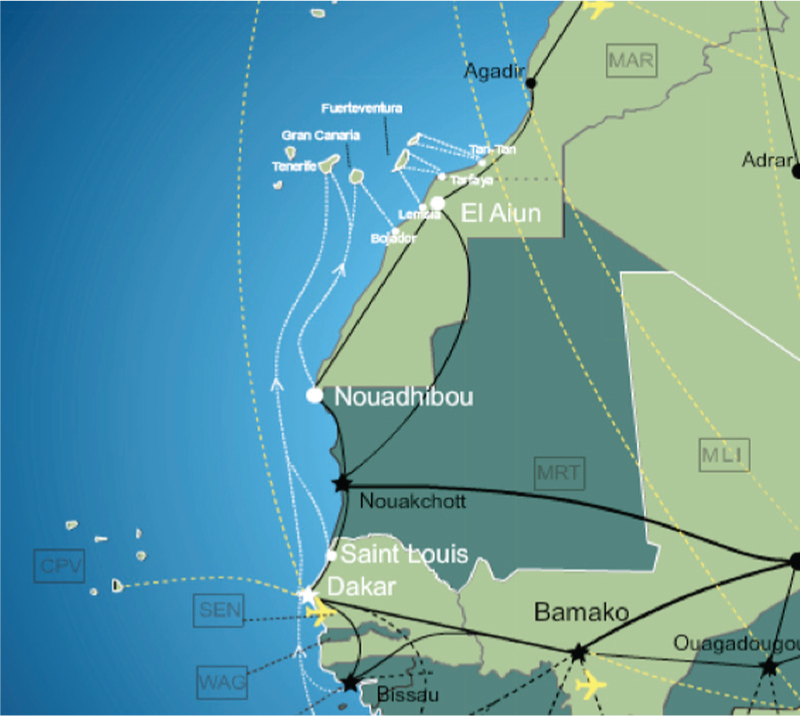
Section of the border discussed in this paper. Source: Mediterranean Transit Migration i-Map, 2010 map on mixed migration routes (ICMPD, 2010).
The discussion begins with a brief overview of some relevant work on EU border territoriality and migration management. I then turn to evidence gathered during one year of multi-sited ethnography and official data from the Spanish ministries of Labor and Social Security (MTAS), the now defunct Ministry of Labor and Immigration (MTIN, 2008–2011), and Frontex. The article focuses on six elements key to the institutional architecture put in place to end unwanted sea migration into the region. Militarization, return and removal of undocumented migrants, and externalization of migration control responsibilities ‘hardened’ the territorial border of the EU, and acted as defensive measures. Cooperation for development, job creation in communities of origin, and temporary migration programs were explicitly designed to prevent migrants from leaving. Initiatives in all these areas are inextricably linked to the EU’s GAMM and three of its four priority themes: the promotion of legal migration, the fight against ‘illegal’ migration and human trafficking, and the promotion of development through migration and mobility (EC, 2011).
In practice, preventative measures were used to buy the cooperation of governments in West Africa to implement more stringent migration and border controls outside the EU’s territory. In other words, defensive and preventative strategies are not separate, but two sides of the same anti-immigration coin. The interplay between both sets of measures is crucial to our understanding of new forms of border territoriality in the context of continued migratory pressure on the maritime borders of Southern Europe.
The European Union border in West Africa
Borders are social constructs that serve as assemblages and walls between territorial and sovereign states; as institutions with varied functions; as sites of struggle, encounter, and permanent negotiation; and as processes through which inside and outside, self and other, are defined (Johnson et al., 2011; Novak, 2011). Paradoxical and always contested, borders exist in the tension between the ideal (disembodied, achieved, and static: a border perfectly sealed against unwanted migrants) and the actual (tangible, in-process, and ever-changing: the porous border where state security forces and undocumented migrants play a never-ending game of a cat-and-mouse).
The border – understood as an instrument for the control of human mobility – has been a defining element of the EU since its creation. Countries along the Union’s external borders have been asked to implement a functioning immigration regime and an adequate border control apparatus prior to joining the EU (Agrela Romero and Gil Araújo, 2005; Casas-Cortes et al., 2013). The strengthening of the external border has in turn allowed for the ‘softening’ of internal ones, and for free mobility. Since the creation of the Schengen Area in 1995, the EU border has gradually become ‘a territorially extended, increasingly informal and itinerant bordering assemblage of institutions, state authorities, and policies that react to dynamic and turbulent migratory movements’ (Casas-Cortes et al., 2014: 2).
Spaces participating in this assemblage are located both inside and outside of EU territory. Such spaces are differentially integrated (Mezzadra, 2014) into the anti-immigration border complex. This extension of migration responsibilities to territories beyond the EU (and even the larger EU neighborhood) has led Casas-Cortes et al. to talk about the ‘spatial and institutional stretching of the domains of migration control beyond sovereign territories,’ and also about a new kind of frontier where ‘a traveling reticular system is established with the aim of identifying and classifying mobilities’ (2015a: 49). Here, I argue that the two factors determining a site’s level of integration are location, which defines the capacity to impose the categories created by the new border regime (undocumented, documented, temporary migrant, forcibly returned migrant, and so on); and connectedness or relevance within a network of decision-making centers (Madrid, Brussels). In this landscape, places like Dakar (see Figure 2) are central, due to their importance as origin of much sea migration and as centers of political power; Saint Louis is key to the functioning of the border, but holds little leverage in the decision-making process; and places like Mbour are peripheral both geographically and in policy-making.
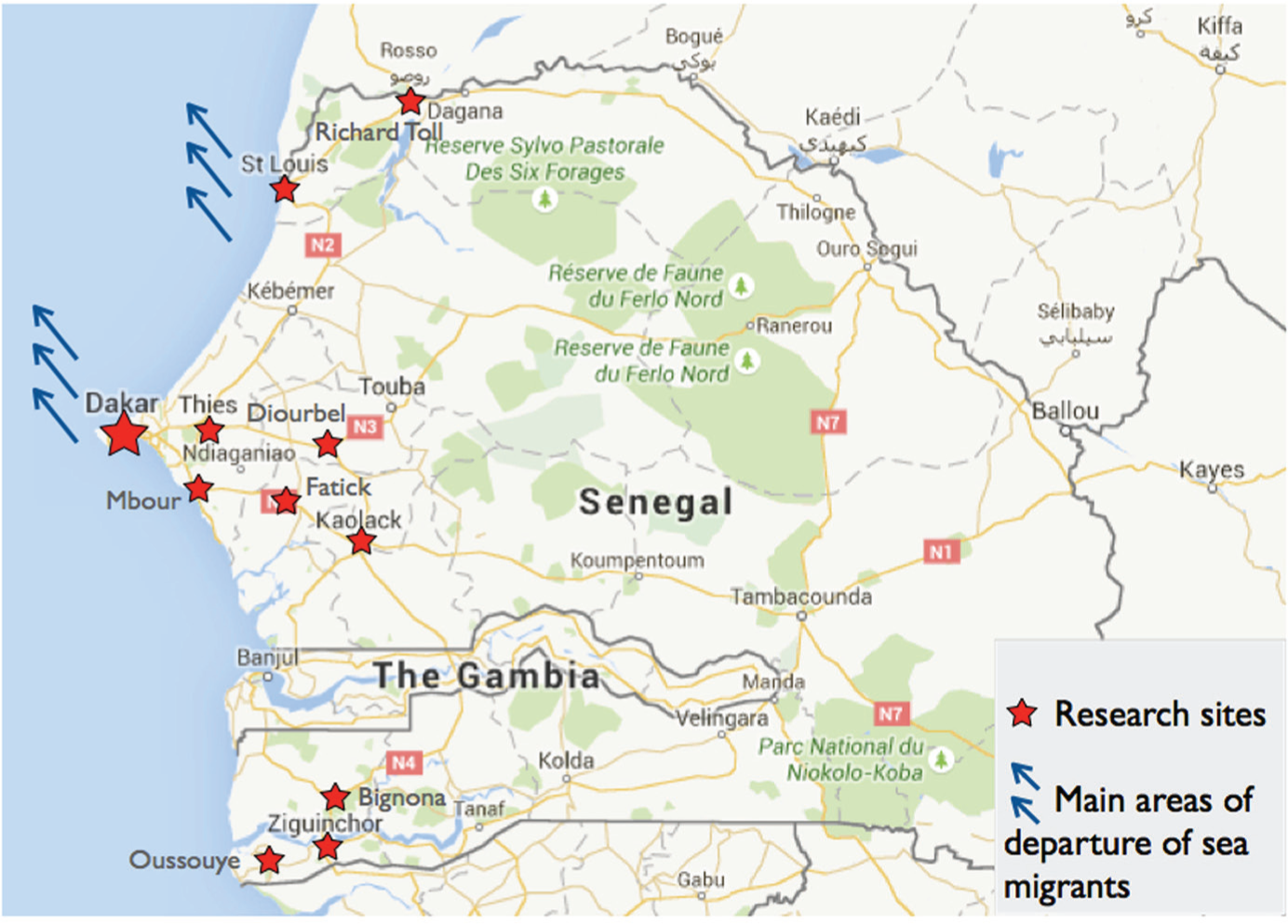
Map Data ©2015 Google.
Three developments were of particular relevance for the emergence of this assemblage along the sea border between West Africa and Southern Europe, and to the new anti-immigration border architecture that supported it. Firstly, the introduction of the supra-national scale into the area of border control policy – long the exclusive realm of nation-states. This evolution towards supra-nationalization has immense implications for the way we conceptualize sovereignty, border territoriality, and migration management. In West Africa, as Casas-Cortes et al. (2014) have detailed, supra-nationalization meant the overlapping of bilateral agreements between Spain and regional governments (notably Senegal and Mauritania) and multi-lateral agreements between the EU, Spain, and African governments. Bilateral and multi-lateral agreements ran in parallel and tended to build on each other. For example, multi-lateral cooperation in the region allowed the (Spanish) Guardia Civil to regularly patrol Senegalese territorial waters in search of migrant boats. Further into the Atlantic, migrants were intercepted and returned to the coast in the context of Frontex’s HERA operation, thanks to existing agreements between Spain/the EU and West African governments. In addition, at a larger scale, in recent years the Seahorse and West Sahel Operations have made West Africa increasingly monitored via satellite, allowing Spain and the EU to have a de facto permanent (virtual) presence in territories under another states’ sovereign power (see, for example, the discussion in Casas-Cortes et al., 2014).
Secondly, the operationalization of the border as an extended territory regulated through a series of interconnected agreements – an ‘assemblage’ of spaces differentially integrated for the purposes of migration control – has triggered the second development: the emergence of the border as a new area of expertise with a growing number of key stakeholders. Andrijasevic and Walters have argued that ‘an entire specialist domain wherein the design, policy, administration, and legal and technical operation of borders has become a field of knowledge in its own right, coupled with a set of administrative measures aimed at reshaping the control of borders’ (2010: 978).
In the context of the West Africa–EU border, this development is particularly poignant. Along with the rapidly increasing presence of Spanish and EU state security forces and development agencies in African territory, there is growing involvement of private Spanish security companies (such as Proytecsa, hired to secure the perimeters of Ceuta and Melilla) and national humanitarian organizations (such as the Red Cross or Amnesty International) – not to mention inter-governmental organizations that assist governments in the negotiations, such as the International Labour Organization (ILO) and the International Organization for Migration (IOM). To justify their involvement, stakeholders have embarked on a ‘war on numbers’: migration is quantified, estimated, categorized, and mapped. A primary example is the International Centre for Migration Policy Development’s i-Map project – a tool used to document the dynamism of migrant routes, share this information, and develop risk assessment tools (Casas-Cortes et al., 2013, 2015b; ICMPD, 2010). Despite common tools such as the International Centre for Migration Policy Development’s i-Map, stakeholders come to the table with diverging and at times competing interests, contributing to the complexity and ambiguity of the emerging institutional architecture of the anti-immigration border. This is never as obvious as in the context of a crisis, when the border becomes a spectacle (Cuttitta, 2014; Kasparek et al., 2014) and anti-immigration agreements are rolled out in a hurry, often informally and beyond regular accountability channels (Casas-Cortes et al., 2014; Mountz, 2010, 2011; Mountz and Loyd, 2013).
Thirdly, the struggle to seal the border against unwanted migration has brought to light that the relationship between the border and the migrant is one of creative interdependence. The reactive nature of the border is well documented (Casas-Cortes et al., 2014; Collyer, 2012; Mountz, 2010). To address this, in the period between 2000 and 2015 Spain and the EU radically redefined their approach to migration control, moving from a focus on the border (e.g., the Spanish SIVE or the Integrated System of External Vigilance) to a focus on migration routes as articulated in the GAMM. This is to respond to the great dynamism of irregular migration, which reacts quickly to policies that take a long time to modify (Mountz, 2010; Vives González, 2012). The creative relationship between the migrant and the state’s efforts to control the border in this regime also points to an idea we will return to later: the role of the unwanted migrant as something more than a victim or a criminal (Agustin, 2003; Collyer, 2012; Vives González, 2012) and migration as ‘a set of mobile and creative forces that constantly push institutional arrangements to shift their strategies and build new architectures’ (Casas-Cortes et al., 2015b: 898).
These three developments (the supra-nationalization of border control, the involvement of a growing number of institutional stakeholders, and the switch from a focus on the border to a focus on the route) took place during the EU’s attempt to control unwanted sea migration to the Canary Islands between 2005 and 2010.
Defensive responses to the ‘migration crisis’ in the Canary Islands
Spain’s quick transition from source to destination of international migration in the 1990s and the sudden popularity of the Atlantic route after 2005 became major forces in the country’s politics – both because of their relevance in national electoral processes and their impact on national institutions. In 2001, 20% (3500) of the unwanted sea migrants intercepted while trying to enter Spanish territory by boat arrived in the Canary Islands; by 2006 the figure had risen to over 85% (32,500) (Asociación Pro-Derechos Humanos de Andalucía (APDHA), 2009; Ministerio del Interior (MIR), 2007, 2008, 2009, 2010) (see Figure 3). Nonetheless, the influx of a large number of undocumented West African sea migrants to the archipelago in 2005 was exaggerated, both in the media and in policy reports (see IOM and ICMPD, 2010). By 2007, two-thirds of Spaniards believed immigration was one of the three main problems the country faced (CIS, 2007). The arrivals were interpreted as a threat to the territorial integrity of both Spain and the EU.
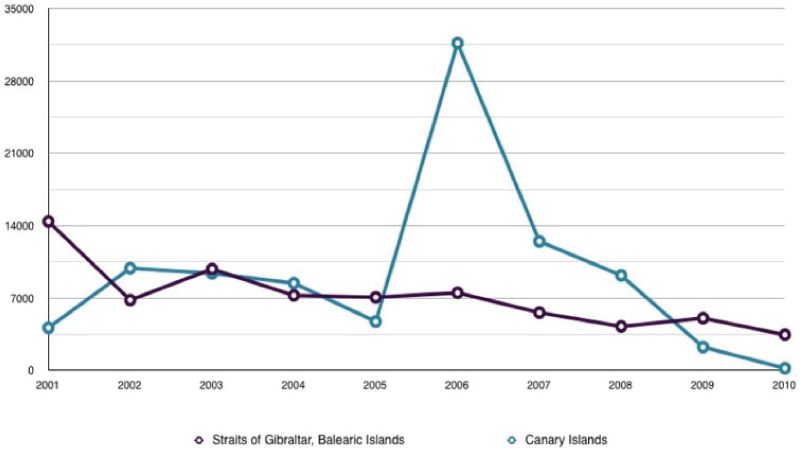
Undocumented sea migrants detained in Spain by place of detention between 2001 and 2010. Sources: MIR (2007, 2008, 2009, 2010) and APDHA (2009).
The situation triggered sweeping changes in key Spanish institutions. The reach and internal structure of the Guardia Civil (the force in charge of sea border surveillance and coordination with countries of origin and transit) were modified to coordinate Spain’s response to the ‘crisis’: a new unit was created (the Coastal Border Unit) and another one vastly expanded (the Maritime Unit) (Gabella Maroto, 2004; Olea, 2009). In 2008, the government created the MTIN to centralize the management of legal migration.
At the supra-national level, the drastic increase of unwanted migration deepened collaboration between Spain and the EU. This collaboration began after the 1995 Barcelona Summit, but it was not until the arrival of large numbers of undocumented sub-Saharan migrants to Spain’s land and sea borders in 2005 that highly positioned policy-makers began to frame the situation as a state of emergency not only for Spain, but also for the entire EU (Carrera, 2007). The result was the embrace of a radically new approach to migration control (articulated in the GAMM) and the creation of Frontex, both in 2005. The first Frontex-led operation was HERA in the Canary Islands (Carrera, 2007; FRONTEX, 2010), which is still in existence. From then on, the EU provided both political legitimacy and logistic and financial support to governments to implement stringent border and migration policies. Three defensive anti-immigration mechanisms were of particular relevance: militarization, return and removal of undocumented migrants, and externalization of control responsibilities.
Militarization
The expansion of SIVE (which connects early detection technology with operational centers to respond to unwanted sea migration in real time) along much of the perimeter of the Canary Islands in 2008 was key to the militarization of West African borders. Two other instruments enabled this process. Firstly, joint operation HERA, the first and, to date, longest-standing sea operation coordinated by Frontex, and secondly, the Seahorse and West Sahel Projects (2006–2015), a related set of initiatives funded by the EU to control the external borders of the Union through the sharing of information among partners using satellite technology (see Casas-Cortes et al., 2014; Ferrer-Gallardo and Van Houtum, 2014).
Official accounts give the impression that this has been a linear and smooth process. However, on the ground, since SIVE was first implemented along some sections of the Spanish coast in 2002, militarization along and beyond the EU’s border has moved forward in a series of fits and starts. The ‘extraterritorialization’ of migration control (Ryan, 2010) has relied on a patchwork of ‘ad hoc arrangements’ (Casas-Cortes et al., 2014). Moreover, glossy accounts of the resulting institutional architecture of EU migration control beyond the border ignores both conflicts (‘bickering’) among the involved EU member states (Mountz and Loyd, 2013) and the violence that these decisions have forced on migrants (Collyer, 2012; Ferrer-Gallardo and Van Houtum, 2014; Mountz and Loyd, 2013).
Other problems are hidden from view. Despite Senegal being ‘an ideal partner’ in the ‘fight’ against unwanted migration (interview with senior officer, Spanish Ministry of Interior, Madrid, 2007), Spanish government officials described cumbersome inter-governmental negotiations, slowed down by the different institutional cultures in Spain and Senegal, the absence of human capital, the vastly different understanding of reasonable time frames, and endemic corruption (communications with Guardia Civil agents, Granada, 2008; Ceuta 2009). Non-governmental stakeholders involved in the negotiations also stressed Spanish delegations’ lack of local knowledge and their willingness to bend the rules in order to achieve the cooperation of the Senegalese government (interview, IOM, Dakar, 2009; ILO, Dakar, 2010).
Outside the official negotiations, there were other problems associated with militarization of the border. Human rights organizations saw militarization as the front of a larger operation – one that also included return and deportation, and relied on the externalization of migration control responsibilities to countries of origin as well as transit that could not be held accountable for violating migrants’ human rights. For the director of Amnesty International in West Africa: The fact that the boats are there to impede people from reaching Europe is totally legal. We believe that Spain has the right to defend its borders (…). It’s the way they’re doing it that we have an issue with. Because once intercepted, [Spanish and European military forces deployed along the sea border] bring migrants to Mauritania, sometimes even without identifying them. And the problem for us is the way they are returned without due process and the conditions of their detention in Mauritania. (Interview, Amnesty International, Dakar, 2009)
Return and deportation to West Africa
Since 2005, EU-bound migrants leaving the coasts of Senegal and Mauritania have been ‘returned’ when intercepted at sea, and ‘deported’ if found to be in Spanish territory without proper travel or residence documents (Spanish legislation uses the terms devolución and expulsión to refer to these situations; Jefatura del Estado, 2000). The rolling out of more geographically comprehensive and longer-lasting agreements between Spain/the EU and West African countries points to an understanding of return and repatriation as pivotal for the success of the anti-immigration border, despite the fact that these are logistically complex, expensive, and controversial instruments of migration control (Gibney, 2008). Available data reflects this shift: in 2006, Spain returned 44% of Senegalese sea migrants intercepted by Frontex to West Africa (6000 out of 13,569; Migreurop, 2010). After signing agreements with both Senegal and Mauritania in 2007 and 2008 that allowed Spanish and Frontex agents to divert EU-bound boats back to their point of departure, 92.3% of undocumented migrants caught en route were returned and deported (MIR, 2010).
Spain’s immigration law allows for the automatic return of an undocumented foreigner caught trying to cross the border illegally, in all but two cases: minors and asylum seekers. Nonetheless, return agreements with Senegal and Mauritania have translated into a routine infringement of this general rule. The principle of non-refoulement (the return of refugees and asylum seekers to countries where their lives or freedom may be at risk) is not often respected (Adepoju et al., 2010; Mountz and Loyd, 2013).
Government officials and representatives of the state’s security forces declined to comment on collective returns at the border (devoluciones en caliente). Migrants in Senegal and Morocco, however, were more than willing to talk about the topic. In Tangiers I encountered Senegalese minors who had traveled to the Canary Islands by boat and had been intercepted by Spanish authorities. They had been returned to Mauritania after a short stint at a CIE (Centro de Internamiento de Extranjeros or Detention Center for Foreigners); the Spanish government argued that the results of an x-ray proved they were, in fact, adults. However, as the Spanish Ombudsman warned in 2011, bone maturity and dental mineralization are techniques with potentially large margins of error, particularly when used with Sub-Saharan black men and women (Defensor del Pueblo de España, 2011: 3). There is also evidence that even minors identified as such are, in practice, deported in a move that is at once illegal, punitive, and ineffective (Martínez Escamilla et al., 2014; Suárez-Navaz and Jiménez Álvarez, 2011).
In West Africa, irregularities during return and deportation were also observed at the processing camp of Richard Toll (near the border between Mauritania and Senegal, see Figure 2). The processing camp of Richard Toll was funded with Spanish development funds and run by the Red Cross/Red Crescent with limited police presence. Migrants arrived there after spending an indefinite amount time in detention in Mauritania, often in grievous conditions (interview, Amnesty International, Dakar, 2009; interview, CIMADE, Dakar, 2010; see also, Amnesty International, 2008). During their deportation, the Mauritanian police took these migrants to the northern shore of the Senegal River and loaded them into a ferry. On the other side, migrants were received by the Senegalese police and the Red Cross/Red Crescent members. In the camp (little more than a walled lot with showers and a small office) migrants received pocket money, food, and clean clothes, and were given access to basic medical services and a phone. When I asked if this border crossing was done following legal procedures, the person in charge of the Richard Toll camp answered with a chuckle: That I can’t say, but often the ferry [with the migrants] crosses the river in the middle of the night. I’ve seen police guards on both sides pretending they’ve seen nothing, and there’s never a member of either police force in the ferry when we get the migrants. (Interview, Red Cross, Richard Toll, 2010)
This quote unveils the border-as-practice as an uneven landscape of policy decisions and enforcement actions. While these migrants were crossing the border/river in the middle of the night, their fate was being sealed by Spanish, the EU, Mauritanian, and Senegalese government decisions that were being carried out by West African state security forces and a Spanish-funded humanitarian organization. The migrants’ role as a currency to be exchanged among the different government actors (some of whom wanted the migrants out, and some of whom wanted something in return to take them back) emerges in full force during this crossing. At the same time, however, the complicated management of these unwanted travelers’ mobility – prior to migration and then as they are detained and moved around on the way back to a country with a readmission agreement – highlights the crucial role of migration as a ‘collective force re-making space’ (Casas-Cortes et al., 2015b: 900). Migrants’ ‘tactics’ are a subversion of, and a revulsive for, an ever-moving state anti-immigration ‘strategy’ (Collyer, 2012).
Externalization
Both militarization and the increasing reliance on return and deportation agreements required the externalization of certain migration-related responsibilities to countries of origin and the transit of unwanted sea migrants. Externalization had two aspects. The first was Europeanization, or the adaptation of West African partners’ institutional frameworks to bring them up to speed with the EU standards. Featherstone and Radaelli have defined Europeanization as the …construction, diffusion and institutionalization of formal and informal rules, procedures, policy paradigms, styles, ‘ways of doing things,’ and shared beliefs and norms which are first defined and consolidated in the EU policy process and then incorporated in the logic of domestic discourse, political structures and public policies. (Featherstone and Radaelli, 2003, quoted in Jones, 2006: 417)
In Senegal, the main forces behind the Europeani-zation of national institutions in the area of migration have been the GAMM and Frontex. More subtle but equally effective in this regard have been the ongoing bilateral negotiations between the Spanish and Senegalese state since 2005, which have consolidated Spain’s ‘seminal role’ in the externalization of the Southern EU border in the region (Casas-Cortes et al., 2015a). An example of Europeanization was the passing, in 2005, of an anti-smuggling and trafficking law, which imposed fines and prison sentences of up to 10 years on human traffickers, smugglers, and document forgers (the Loi No. 2005-06 du 10 mai 2005 relative à la lutte contre la traite des personnes et pratiques assimilées et à la protection des victimes). This law was a stepping stone for conversations between Spain and Senegal, as it was interpreted as an act of good faith and political will to cooperate early in the ‘migration crisis’ (interview, Ministry of Interior, Madrid, 2007).
At times, difficulties in Europeanizing West African institutions threw a wrench in the ongoing negotiations. This happened, for example, during the rolling out of the temporary worker program (2006–2008). After signing the initial agreement for the program, Spanish bureaucrats were dismayed to find out that the Senegalese government did not have clearly defined responsibilities around labor market management, or a database of unemployed people looking for a job (interview, OIT, Dakar, 2009; interview, Ministry of Labour, Dakar, 2009). Instead, Spanish officials found a shifting institutional landscape: the ministry in charge of the folder changed names and structures three times in the course of two years, with the Ministry of Youth, Leisure and Sports being eventually responsible for managing it (interview, OIT, Dakar, 2009). Local youth centers were responsible for the first round of selection of candidates in a process rife with corruption and with little state control (interview, CEDEP, Saint Louis, 2009; CEDEP, Bignona, 2009). Potential migrants and recruiters found creative ways to benefit from the lack of coordination, eventually forcing the Spanish government to redefine the program.
A second aspect of externalization was the delegation of actual migration control responsibilities to non-EU countries. In 2007, a senior official of the Spanish Ministry of Interior described the Senegalese national and local governments as ‘very accommodating of our demands to have them assist with border control and also very open to having us there’ (interview, Ministry of Interior, 2007). By that, he meant that both governments had cooperated in several initiatives involving the donation of military equipment to patrol Senegalese coasts; training programs whereby the Guardia Civil instructed the Senegalese Gendarmerie and police on how to detect and manage unwanted migration by sea; and the constant presence of Spanish military equipment and personnel in Senegalese sovereign territory. Cooperation between state security forces was so regular that in 2009 I interviewed a Senegalese police chief mostly in Spanish – he had picked up the language while socializing with the Guardia Civil during many training sessions.
Cooperation towards the sealing of the EU border advanced rapidly between 2005 and 2010 despite many challenges, such as lack of funds, lack of capacity, lack of trust between government partners, lack of a stable institutional landscape, and lack of local knowledge. Combined, the Europeanization of institutional frameworks and the delegation of migration control responsibilities resulted in the emergence of a buffer zone or cordon sanitaire in West Africa that included both land and territorial waters (Casas-Cortes et al., 2014; Ferrer-Gallardo and Van Houtum, 2014; Mountz, 2011; Mountz and Loyd, 2013; Van Houtum, 2010; Vives González, 2012). On the ground, this meant that Senegalese migrants found an elongated border zone of migration control that extended from their doorstep, through Mauritania and Morocco, and into Spanish territory. However, what made defensive responses (militarization, return/deportation, and externalization) possible was the concurrent implementation of a preventative strategy – one aimed at deterring migrants from leaving in the first place.
Preventative responses to the ‘migration crisis’
Spain prioritized three interrelated areas of intervention between 2005 and 2010: cooperation for development, job creation in fishing communities, and temporary migration. These interventions were not designed in isolation, but negotiated as part of a larger multi-faceted strategy: development money and temporary migration programs were traded for support in the return of unwanted migrants as well as for cooperation in the anti-immigration efforts; training programs paved the way for preferential agreements with Spanish fishing companies.
Cooperation for development and the anti-immigration effort
The connection between development aid and the control of Europe-bound migration is well established in government documents. As mentioned earlier, the EU’s GAMM explicitly links international migration, development policy, and external relations. The treaty of the European Development Fund (EDF) – also known as the Cotonou Agreement – requires that recipients of development aid ‘shall accept the return of and readmission of any of its nationals who are illegally present on the territory of a Member State of the European Union, at that Member State’s request and without further formalities’ (EC, 2000: Article 13.5.c.i). Furthermore, EDF money has been used to encourage the passing of legislation restricting human mobility, and to build and staff detention and processing centers for EU-bound migrants in Mauritania and Senegal (interviews, Amnesty International, 2009; Red Cross, 2009; CIMADE, 2010).
The same can be said for the Spanish Agency for International Cooperation and Development (AECID). The Agency’s first integrated development plan for Africa (the Plan África 2006–2008) defined Senegal as a ‘country of primary interest’ because of its role as a source of unwanted sea migration (Ministerio de Asuntos Exteriores y Cooperación (MAEC), 2006: 118). The stated goals of Spain’s cooperation for development in Senegal were the regulation of migratory flows and the ‘Europeanization of migration policies’ in West Africa (MAEC, 2006: 44). A second development plan (the Plan África 2009–2012) insisted on the role of development aid for migration control, stating that: Spain and Senegal’s intense cooperation in the area of migration will continue through (…) the fight against illegal immigration, in particular through the Frontex system and the SEAHORSE network; the promotion of legal migration through the establishment of procedures for the hiring of workers at origin, specifically in the sectors of agriculture and fishing; and the creation of new initiatives in the area of migration and development. (MAEC, 2009: 96)
In other words, the true target of Spain’s development plan was not the reduction of poverty or Senegal’s Millennium Goals, but the coordination of a multi-scalar strategy for the control of unwanted sea migration.
Development funds were dedicated to finance summits and workshops on anti-immigration cooperation in the region. The first África Plan (MAEC, 2006) specifically earmarked funds within the framework of the 2006 Ministerial Euro-African Conference on Migration and Development to promote the ‘Europeanization of migration policies’ in Africa (MAEC, 2006: 75). This money was used to advance Spain’s diplomatic and political presence in countries of origin and transit; increase the resources available for border control, return, and integration of migrants; facilitate the readmission of undocumented African citizens to their countries of origin; and allow for the opening of a Bureau of Defense in Dakar. The second Plan África (2009–2012; MAEC, 2009) further advanced these goals, and included the cancellation of Senegal’s external debt with Spain (worth 66.5 million Euros).
In other words, cooperation money advanced the militarization of the EU border in West Africa, facilitated the presence of Spanish state security forces in Senegalese and Mauritanian territories, served to compensate countries of origin for accepting forcibly returned migrants, and made the transfer of control responsibilities possible. In addition, while cooperation between Spain and Senegal involved deep inequalities, it moved forward because the Senegalese government perceived the agreements to be beneficial. Former President Abdoulaye Wade traded returnees for 10 million Euros of development aid after his reelection in 2007 (Migreurop, 2010).
Job creation
The AECID had other programs that were more in line with the Agency’s mandate. There were initiatives to encourage co-development, micro-financing, and business investment in Senegal. Migrants already in Spain were given support to ‘come up with a feasible business plan [in Senegal]’ (interview, AECID 1, 2010). The ultimate goal was to assist these migrants in their return to their country of origin. This is in line with the GAMM’s fourth ‘thematic priority’: the harnessing of migration’s potential to promote economic development in countries of origin (EC, 2011).
Part of the Agency’s work focused on creating job opportunities in rural areas and fishing communities, the source of the vast majority of sea migration. A key focus of this work was the REVA program (Retour vers l’agriculture or back to agriculture), which aimed to modernize the agricultural sector in Senegal and attract young unemployed workers who would otherwise migrate towards urban areas – and then to Europe. Spain contributed about 1 million Euros in financial and technical support to the program between 2006 and 2009 (interview, AECID 1, Dakar, 2010; Open Aid Data, n.d.-a). In exchange, the Senegalese government signed an agreement to accept sea migrants intercepted while on their way to the Canary Islands. Senegal’s former President was criticized for taking these migrants in, to which he responded: ‘[the EU] may send me returned migrants, but they will also give me irrigation facilities’ (quoted in Migreurop, 2010: 88). The program has not been implemented yet.
Fishing communities were even more central to Spain’s effort to stop unwanted sea migration. The fishing industry is fundamental for the Senegalese economy: 15% of national workers depend on the sector, either directly or indirectly (UNEP, 2002). It is also important for Spanish interests, since Spanish companies have operated in Senegalese waters for a number of years. In an attempt to both support Spain’s economic interests in West Africa and encourage Senegal to take back unwanted sea migrants, former Minister of Immigration Jesús Caldera created incentives for Spanish-owned fishing companies to hire Senegalese fishermen (respondents from the Ministries of Immigration and Labor and Social Affairs interviewed declined to define the exact nature of these incentives). The contracts were then used to enlist the support of the Senegalese government in the EU’s anti-immigration strategy (interviews, IOM 2009; ILO 2009; MTIN 2, 2010). As a result of these efforts, 700 Senegalese fishermen found employment in their country of origin with Spanish-owned companies in 2009 (MTIN, 2010; MTIN 1 and 2, interviews, 2010).
The Spanish government also funded training programs for Senegalese youth in fishing areas, prime candidates for sea migration (see Sarr et al., 2009). Spain transferred almost 6.5 million US dollars to Senegal between 2007 and 2010 to help the country modernize its antiquated fishing sector (Open Aid Data, n.d.-b). Most of this money funded the FORPEX program, designed for the professional training of local fishermen in modern fishing techniques. However, Spain also invested money to train young fishermen in other professions. Young men from Guet Ndar (a poor fishing community of Saint Louis with one of the highest rates of population density in the world, and a hot spot for departures towards the Canary Islands) were targeted in a pilot program in 2007 and 2008 and trained as masons, electricians, plumbers, painters, and plasterers with Spanish development funds. The director of the AECID in Dakar saw this program as a short-term way to give these youth employment away from the coast, in the rehabilitation of the city’s historical buildings (interview, AECID 2, Dakar, 2010).
REVA, FORPEX, and the trade school in Saint Louis targeted the main areas of departure of sea migrants. In theory, youth participating in these programs committed to ‘returning to their communities of origin and act as leaders, as liaisons with the local population’ (interview, AECID 2, Dakar, 2010). However, young trainees in the Saint Louis trade school had a very different understanding of the situation: they believed they were being trained to migrate to Spain (interviews 1, 2, 3, Saint Louis trade school, 2010).
Temporary migration
A final element in Spain’s preventative strategy followed through with the GAMM’s first ‘thematic priority’: the creation of permanent and temporary migration programs. As of 2006, family reunification was the only government-sanctioned way to migrate to Spain legally. Temporary migration programs had two main advantages. Firstly, they diverted potential migrants’ attention from illegal land and sea routes, while responding to the demands of the agricultural sector for cheap seasonal labor. Secondly, temporary migration programs were ‘a direct reaction to the problem of undocumented sea migration from Senegal’ (interview, MTIN 1, Madrid, 2010) – a key negotiating point to entice Senegal to take back West African migrants who were in Spain. Once again, temporary migration programs were designed to facilitate cooperation in the defense of Spain and the EU’s external border.
Despite their importance, the number of migrants recruited through this channel was small: 1500 Senegalese citizens were selected to migrate to Spain as workers between 2006 and 2008; 68% of these were temporary workers. The first such migrants arrived in late 2006. A civil servant involved in the negotiations described an intense sense of urgency during the launching of the first program in late 2006: The first group to arrive from Senegal was a particular offer that [the MTIN] managed in 2006, just before the end of the year. They were not many, maybe 50 or 60, they were the first ones ever to come from Senegal. At that time, [the government] tried really hard to speed up the visa procedure, because among other things they were negotiating the deportation of some Sub-Saharan migrants who were in the Canary Islands. The collective hiring was part of the negotiations. (…) Right before the Christmas break we suddenly received a phone call saying it had to happen that day. (…) We hired a private courier just to [take the applications to the police for processing] because they had to be hired before the end of the year and we were going on holidays that afternoon! (MTIN 2, interview, February 2010).
This quote shows how labeling a social phenomenon as a ‘crisis’ (in this case, the unprecedented arrival of West Africans to the Canary Islands) allows policy-makers to use exceptional measures (Mountz, 2010). Routine bureaucratic procedure was altered: what usually would have taken many months took just a few hours. According to the former director of the IOM for West and Central Africa, the sense of urgency stemmed from the fact that in the midst of the crisis, ‘the Spanish government believed that managed migration would be the answer to sea migration’ (IOM, interview, April 2009). Perhaps as a result of the urgency and rush to have Senegal accept its nationals, the program ran into a number of difficulties.
Firstly, the Spanish government designed and launched the program without taking into account the lack of capacity of the Senegalese institutions they were making responsible for the recruitment and processing of applicants. Temporary workers were selected not because of their experience in agriculture (as was intended), but because they successfully navigated a system plagued by corruption. Temporary migrants interviewed for this study had either paid up to 2000 Euros to be selected or had relatives or friends in recruiting agencies, or both. In some cases, women were asked to have sex with recruiters in exchange for a selection certificate (Vives González, 2012). According to the director of a labor union that oversaw the process, …people used these contracts not to go to Spain to work, but to enter Europe. We found that there were relatives waiting for the women [selected to work in agriculture] at the Barajas airport: they never even met their employer; they went elsewhere as soon as they landed in Spain! (…) Once a woman went into labor in the plane to Madrid. Which tells you how many of the medical certificates that said that these workers were healthy and not pregnant were simply fake. (Interview, Labor Union, Dakar, 2010)
This interviewee’s statement is further supported by the extremely low rates of return (5–10%) (interview, MTIN 1, Madrid, 2010; MTIN 2, Madrid, 2010; IOM, Dakar, 2009; ILO, Dakar, 2009, MTAS, Dakar, 2010). Furthermore, it shows the existence of an in-between space for agency where the unwanted migrant is neither a victim nor a full agent, but someone who works through the cracks of an imperfect anti-immigration architecture (see also Agustin, 2003; Collyer, 2012).
Secondly, Spain made the crucial mistake of entering the negotiations without a good understanding of the political landscape at the time. Mainly, Spanish policy-makers neglected the influence of the lobby of forcibly returned migrants (interview, IOM, Dakar, 2009; ILO, Dakar, 2010). This loosely organized group made up of 13,000 members enjoyed great sympathy from the larger population, who did not perceive migration as a crime but as a duty in times of duress. Former President Abdoulaye Wade attempted to respond to both the demands of the lobby of returnees (that they would be allowed back in Spain) and of the Spanish government (that Wade’s government would collaborate in the control of the border). Eventually, he negotiated an agreement whereby two-thirds of the temporary workers would be recruited among forcibly returned migrants (interview, ILO, Dakar, 2010). However, this arrangement was contrary to the Schengen Agreement, which forbade any such migrant from entering the common area for 5 years following their expulsion. To fix this, the Spanish government authorized returnees to nominate a family member in their stead, something that led to all kinds of irregularities. This ‘nonsense’ (interview, IOM, Dakar, 2009; ILO, Dakar, 2009) precipitated a new iteration of the temporary migration program.
In the second phase, Spanish policy-makers adapted an existing circular migration program already in place in Eastern Europe and Morocco to the Senegalese context. In this program, workers would travel to Spain for 2–8 months to work in agriculture. This was seen as a win–win–win situation: Spain attracted much-needed temporary workers, unemployment in countries of origin decreased, and workers’ families benefitted from the remittances (Moreno Nieto, 2009; interview, MTAS, Dakar, 2009).
To adapt the program to the Senegalese context, an office of the Spanish Labour Bureau opened in Dakar in 2006, and a senior government official who had spent years fine-tuning the program in Morocco was put in charge. Candidates should be healthy women between the ages of 18 and 40; reside in rural areas; have experience working in agriculture; be married, separated, divorced, or widowed; and have dependent children under the age of 14 (Moreno Nieto, 2009). Women with family responsibilities were seen as dependable, docile, more likely to return than men, and with better social skills (Gualda, 2012; Moreno Nieto, 2009; interviews, MTIN 1 and 2, 2010; MTAS, Dakar, 2009). In the end, 94% of workers recruited to work in agriculture were women and less than half (44.35%) had dependent children (Díaz-Diego and Márquez-Domínguez, 2012).
Problems emerged as the program was being implemented. Many migrants did not have access to a written contract in a language they could understand, and had no access to translators to communicate with their employers and union representatives. Most did not receive information and training sessions to learn about their rights, duties, and responsibilities in the workplace. Upon arrival, some women suffered psychological, physical, and sexual abuse – but had no one to turn to for help (interviews CEDEP, Saint Louis, 2009; CEDEP, Bignona, 2009; former temporary worker 1, 2, 3, 4, 5, Senegal and Spain, 2009 and 2010; Senegalese Labor Union, 2009). In addition, as mentioned earlier, the vast majority stayed in Europe as undocumented migrants.
In short, the program never attained its stated goals. However, it was a huge success in getting the Senegalese government to take back the unwanted and undocumented migrants that the Spanish government wished to get rid of. The program also furthered the integration of Senegal into the EU’s area of economic influence, and was a key mechanism to roll out border externalization beyond the Union’s territory.
Discussion
In this paper I have analyzed Spain and the EU’s response to ‘spontaneous’ (Mountz, 2011) and unwanted migration from West Africa to the Canary Islands between 2005 and 2010. I have argued that the labeling of this phenomenon as a ‘crisis’ turned the border into a spectacle (Cuttitta, 2014; Kasparek et al., 2014), providing an excuse for the rolling out of specific political agendas. In this case, the arrival of a small number of sea migrants triggered a whole range of initiatives (from militarization to temporary migration programs) that fully integrated the section of the EU’s border surrounding the Canary Islands into the Union’s broader anti-immigration border regime. The paper described the emergence of a new kind of institutional architecture at the border that has successfully closed migratory routes into the EU (Abellán, 2015; Peregil, 2015), and is therefore likely to be duplicated elsewhere. I have focused on two aspects of this new border: the new forms of spatiality it requires, and the new management practices it imposes on policy-making.
Spatially, the new anti-immigration border is gradually leaving behind the operationalization of the border as a line, or even as a contiguous territory. It dismantles the argument of a Europe that is akin to a Fortress Europe (Geddes, 2000) or a gated community (Van Houtum and Pijpers, 2007). Instead, what we see is the differential integration (Mezzadra, 2014) of spaces along and beyond the border (paths and nodes along migratory routes) into the anti-immigration border regime. This integration is achieved at many levels, but it increasingly relies on the incorporation of spaces outside the EU into the Union’s geo-economic area of influence and the externalization of migration-related responsibilities (Casas-Cortes et al., 2013). This orientation is consistent with the EU’s GAMM. It shows a radically different understanding of unwanted migration and a new way to operationalize the relationship between migrants and the state, or migration and policy-making. The differential inclusion of spaces outside of the EU – through ad hoc and largely informal arrangements (Casas-Cortes et al., 2014) – into the conceptual space of the border, allows the state to respond quickly to phenomena that are too fluid and dynamic for traditional policy-making practice (Mountz, 2011). The space of the border has also become reflexive, fluid, and dynamic through this praxis, as sites and routes can be quickly integrated or excluded as migrants reacted to the states’ response to their actions.
In practice, the geographical diffusion of the border and the regionalization of the EU’s policy-making have brought onboard a growing number of institutional stakeholders. This is also a radical departure from pre-1990 border control practice in the region. Perhaps more importantly, the new anti-immigration border has a decidedly holistic approach. Defensive measures, such as militarization, externalization, or the increasing reliance on return and deportation, are not seen in isolation. Instead, they depend, in a fundamental way, on less publicized forms of collaboration – namely the exchange of development funds, the creation of jobs at origin, and the signing of preferential trade and migration agreements. This is the greatest contribution of this paper: to show that preventative measures are crucial enablers of collaboration with countries of origin and transit towards the militarization of the border region, the externalization of migration control, and the return and deportation of migrants.
Novel forms of border spatiality and the emerging official architectures that they require remain incomplete, fragmented, and ambiguous. They are built upon an assemblage of relations between states, institutions, and areas of public policy that is forged behind closed doors (Casas-Cortes et al., 2014). Other less official sets of relationships emerge as a response: for example, when forcibly returned migrants become part of the negotiations through their lobbying efforts; or when sea migrants become increasingly dependent on international criminal networks to circumvent an increasingly secured border (UNODC, 2011). As the lessons learned in the Canary Islands are put into practice in other islands and spaces that are today the destination of unwanted migrants, the ambiguities inherent to these relations and the unexpected consequences of the new global border must continue to be critically assessed.
Footnotes
Acknowledgements
Thanks to Professors Dan Hiebert and David Ley from the Department of Geography at the University of British Columbia, Professor María Lois from the Universidad Complutense de Madrid, and Professor Alexander Aylett from the INRS in Montreal for their feedback on earlier versions of this manuscript. I would also like to thank the anonymous referees for their thoughtful comments and suggestions on earlier drafts of this paper.
Declaration of Conflicting Interests
The author(s) declared no potential conflicts of interest with respect to the research, authorship, and/or publication of this article.
Funding
The author(s) disclosed receipt of the following financial support for the research, authorship, and/or publication of this article: This work was supported by the ‘Settling Into Motion’ Bucerius PhD Scholarship in Migration Studies, ZEIT Stiftung, Germany; the Vanier Canada Graduate Scholarship, Social Sciences and Humanities Research Council of Canada (award no. 770-2009-0082); and an I+D research grant from the Ministry of Education, Spain (reference number CSO2008-04838).