




Abstract
Many urban development projects (UDPs) in Europe take place on lands belonging to public bodies and administrations, and publicly owned firms. Yet, the literature has failed to explain why a substantial proportion of the remaking of European cities is shaped on public properties, and with what outcomes. My underlying hypothesis is that the redevelopment of such properties depends primarily on the restructuring of the state. Firstly, this paper provides evidence of the relationships between three dynamics of state restructuring and the disposal of public land and real estate properties owned by one sector of the French state, that is, the railways. Secondly, the paper focuses on two UDPs of railway sites, respectively located in Paris and Nantes, in order to disclose the specificity of the redevelopment process associated with public railway properties, due to the socio-legal infrastructure of railway land disposal stemming from these dynamics. The paper demonstrates that (i) state restructuring impels various levels and organisations of the state to redevelop public land and real estate properties; and (ii) the effects of state restructuring can be explained only by analysing the mediating role of the socio-legal infrastructure of these properties, which frames the processes and outcomes of the redevelopment projects. In so doing, the paper offers a specific account of the explanatory factors, processes and outcomes of the relationship between state restructuring and a significant proportion of the restructuring of urban areas in Europe.
Introduction
Many urban development projects (UDPs) in Europe take place on land belonging to public bodies and administrations, and to publicly owned firms. Numerous flagship UDPs in the past decades have been built less on private industrial properties than on sites that are host to state activities within cities. The gigantic Ørestad project in Denmark (Salet and Gualini, 2007: 172–198) and the Adlershof conversion in the outskirts of Berlin took place on public military sites (Moulaert et al., 2003: 107–124). The same applies to port infrastructures, for example in flagship projects like Bilbao where ‘most of the land (almost 95 percent) belonged to public companies and bodies’ (Moulaert et al., 2003: 192) or the redevelopment of the Port of Marseille (Bertoncello and Dubois, 2010). To cite the operator that will be the focus of this paper, the Paris Rive Gauche redevelopment project (Newman and Thornley, 1996), the multi-site negotiation of the Milan rail yards and the linear ‘La Sagrera’ redevelopment in Barcelona (Buhigas, 2011) are all happening on large-scale publicly owned railway sites located in central urban areas. This list could be extended to other public operators, and to projects of lesser importance, as well as to smaller cities. Hospitals, gasometers, prisons and courthouses – the sites from and upon which European states deploy their activities on the territory under their control – have all been targets of conversion in the last three decades.
A substantial proportion of the remaking of cities is thus shaped on land and buildings owned, managed and used by various organisations of the state apparatus. In this paper, land and real estate properties – referred to as properties from thereon – are defined as physical assets that entail a set of rules, policies, values and socio-legal and socio-technical arrangements (Li, 2014; Mitchell, 2002). I call these different features the structure of property (or ownership structure) and I argue that they are key in understanding UDPs. The paper explores how public properties embody a specific process of urban restructuring in cities, which deserves to be analytically distinguished from other structures of properties on which UDPs also occur, such as privately owned former industrial sites. The underlying hypothesis is that the redevelopment of such properties depends primarily on the restructuring of the state. To test this hypothesis, the paper focuses on the land belonging to one sector of the state in France, namely the railways. It scrutinises the distinct features of the redevelopment process that are associated with the public structure of railway properties. It demonstrates that state restructuring is the driving force of the disposal of public properties, and that the actual disposal of these properties depends on their nationally (re)defined ownership structure, whose mediation produces specific processes and outcomes. By foregrounding the key importance of ownership structures, the paper thus offers a specific account of the explanatory factors, processes and outcomes involved in the remaking of a significant proportion of UDPs.
The next section discusses how the dominant urban political economy accounts relate the recourse to UDPs as a policy instrument for the wider issue of state restructuring. However, it argues that, up to now, state restructuring has been understood more as one of a series of macro-political-economic processes that gives a context to UDPs regardless of the structures of property, than as a process that specifically transforms public properties themselves. The third section describes the case study methodology. Then, the demonstration proceeds in two steps. The fourth section demonstrates that the changes in the ownership structure fuelling the redevelopment of railway land are directly related to three processes that make up contemporary state restructuring. The fifth section shows how the public ownership structure frames the negotiations and the outcomes of urban redevelopment projects of railway sites in both Paris and Nantes. The conclusion draws on these empirical findings to discuss the avenues for research opened by this reconsideration of ownership structure and state restructuring in the analysis of UDPs and more widely of urban restructuring.
The structure of property: A Cinderella issue in the study of urban redevelopment projects
While UDPs are not confined to publicly owned land and buildings, these policy instruments also, and often predominantly, enrol properties belonging to state organisations. In most Western countries, UDPs are the dominant form of the remaking of the urban fabric in central and pericentral areas, at least symbolically (Orueta and Fainstein, 2008). In spite of their theoretical divergences, urban scholars studying UDPs agree that these instruments are related to two structural processes, namely economic restructuring and state restructuring. As stated by Pinson (2009: 61, my translation): ‘city and urban development projects are a way for cities to respond to a new structure of opportunity’ opened up by two main factors: ‘globalisation and changes in the systems of production’, and ‘the restructuring of the state, European integration and the ascendancy of the local and regional political scales’. The idea is that the shift from the national Keynesian regime of capital accumulation to flexible and international regimes has material consequences for the urban fabric. Consequently, UDPs ‘tend to be in locations which, as a consequence of urban restructuring, have lost their previous uses but have potential to be once again profitable within the post-Fordist urban economy’ (Orueta and Fainstein, 2008: 760). Quite often this economic restructuring is further supported by the strategic reorganisation of the state itself, from the Keynesian welfare state to the Schumpeterian workfare state (Jessop, 1993). According to Brenner (2004), the underlying process of state rescaling thus supports the adoption of UDPs for the redevelopment of European cities.
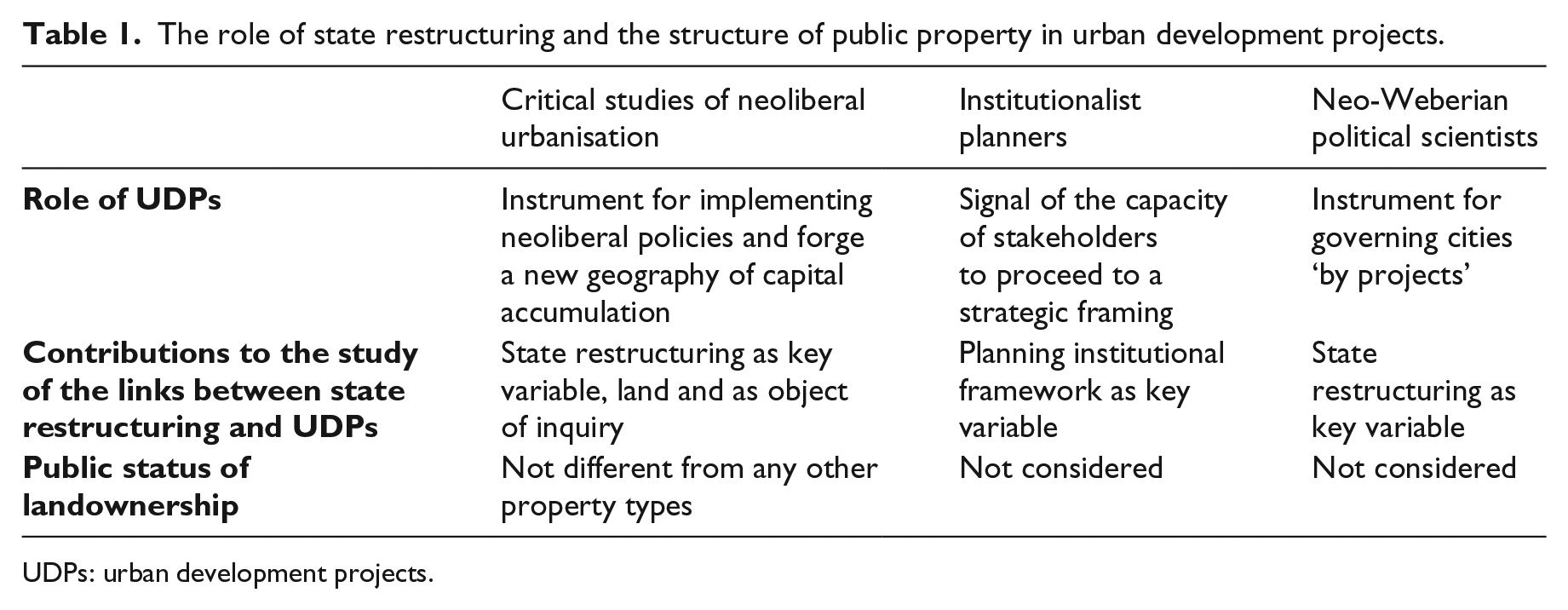
Yet, in spite of their interest for state restructuring, the three dominant urban political economy accounts on UDPs fail to grasp its differentiated effects in urban restructuring, according to ownership structures (see also Table 1). Critical studies of neoliberal urbanisation locate political factors, such as state restructuring, in-between the transformations in capitalism and urban restructuring. Neoliberal policies and practices are positioned as a mediating stage between the two (Brenner and Theodore, 2002). For Moulaert et al. (2003), UDPs are a means for bringing together political and economic actors in order to ensure ‘the reconversion of derelict sites left behind by industrial closures or rationalization of obsolete infrastructure as an opportunity to create the physical conditions necessary to launch a new phase of development’ (p. 35). UDPs pave the way for neoliberal policies, including rent gaps, the gentrification of working-class areas (Smith, 2002), the creation of ‘premium network spaces’ (Graham, 2000) and state spatial strategies that reshape cities in order to compete in the new global geography of accumulation (Brenner, 2004). Although the state is central to this explanation and many UDPs studied in the prominent work by Moulaert et al. are located on land belonging to state organisations, the authors make no analytical distinction between state-owned land and other properties. In other words, the structures of ownership are not considered to be a relevant explanatory variable of urban restructuring.
The role of state restructuring and the structure of public property in urban development projects.
UDPs: urban development projects.
Shifting away from the predominance of capitalistic restructuring and neoliberal policies, a second body of works emphasises the prevalence of institutional frameworks in understanding the rise of UDPs. If planning studies usually centre their accounts on changing urban doctrines, models and practices (but see Mangin and Panerai, 1999), global, national and local institutional frameworks and their evolution are also posited as a key factor in the differences and convergences between European planning systems and their shift from comprehensive planning to strategic planning and UDPs (Newman and Thornley, 1996). Linking these institutional frameworks, the post-Fordist transition and the practices of redevelopment projects, Salet and Gualini (2007) conceive UDPs as the capacity of stakeholders to proceed to a strategic framing specific to each project (see also Savini, 2012). This capacity depends mainly on the urban and national planning institutions and the way UDP actors handle them. While land and buildings are saturated with planning institutions (think, for instance, of land use rules or building rights), and although most of the projects studied in Salet and Gualini are once again located on public property, the ownership structures are surprisingly neglected in their analytical framework.
Neo-Weberian political scientists put forward a third explanation for the rise and spread of UDPs. Epitomising a new way of governing cities ‘by projects’ (Dente et al., 1990; Pinson, 2009), UDPs reflect the ‘return of European cities’ as a key scale of social regulation (Le Galès, 2002). UDPs would thus reflect the diminishing role of the central state in urban affairs and the shift from city government to urban governance. According to Pinson, this policy tool is not so much the outcome of structural changes affecting capitalism as the response of urban societies to the structure of opportunity that arises from such changes. Here again though, in spite of a strong emphasis on state restructuring, its relationship with the public structure of property is never taken into account in the analysis.
All in all, if these three streams of literature factor the restructuring of the state in the rise of UDPs, they share the view that state restructuring remains a contextual element that will affect all sites equally. The redevelopment of public properties is implicitly thought of within larger and perhaps fuzzy categories that accommodate all types of sites considered to be ‘obsolete’ (Weber, 2002), ‘derelict’ (Moulaert et al., 2003) or ‘brownfield’ (Bourdin, 2001: my translation). Anne Haila (2008) and Francesca Artioli (2016a, 2016b) are notable exceptions in this respect. They explicitly relate the disposal and redevelopment of public property to reforms of the Finnish, French and Italian states and changing conceptions of such property in the 1990s and 2000s. Managed by public administrations or publicly owned enterprises, the disposal and conversion of public properties follow specific rules and are subject to dedicated state policies, strategies and projects. This paves the way for analyses cognisant of the structure of properties. Railway sites constitute a good testing ground to explore the relationship between state and urban restructuring processes, as they are enacted through the redevelopment of public properties in UDPs and mediated by the structure of property. They support a lengthy and functionally unified transport network, whose development has contributed to modern state building. This is particularly true in France, because the state has historically played a central role in rail transport planning and development (Dobbin, 1994). Moreover, railway sites have a significant footprint in urban areas (e.g. 4.7% of Paris land was dedicated to railway activities in the 1970s, APUR, 1980). They are part of the public domain, that is, areas that fall within a specific set of institutions extraneous to private land and real estate markets. Finally, the railway sector has undergone a restructuring process led by both the European Commission and national states in the last 25 years (Holvad, 2009) that has affected the status, ownership and management of railway property.
Scholars who have studied UDPs targeting railway land have related the rent-maximising strategies pursued by railway companies – and the consequent intensification of land uses of their sites – to the reform of their regulation. However, they ignore the effects of these reforms on the ownership structure. Bertolini and Spit highlighted early on that ‘land and buildings next to stations that were seen only as instrumental to transport operations are now regarded as potential sources of profit’, and that this shift is due to the privatisation of the railways (1998: 39). Linking this conduct to Thatcherite reforms, Fainstein regrets that ‘although BR [British Rail] had the capacity to act as a strategic planning body for London through its control of so much centrally located land, its public ownership did not inhibit it from behaving exactly like a speculative private landowner’ (2001: 120). On the basis of the case study of Stuttgart 21, Novy and Peters (2012: 131) show that, in Germany, Deutsche Bahn ‘considered the upgrading [through large-scale redevelopment project] of its larger, centrally located railway stations and their environs as a key activity in generating revenue and profit’ (see Savino, 2003: 112, for a similar conclusion on the Italian national railway firm). The insufficiency of such analyses is that they tend to treat railway companies as single, consistent actors focused solely on the maximisation of profit. Gerber (2008) offers a more nuanced account of the landownership strategies of Swiss Railways. On the one hand, he establishes a link between the shift from a cumulative tendency (‘patrimonial system’) to ‘capitalist management’, based on the profitability of transactions and the transfer of real estate stock from the state to the (partially) privatised firm. On the other hand, he distinguishes between the interests of the real estate and infrastructure branches within the companies, and concludes that even the real estate branch incorporates a long-term and social sustainability-inspired perspective into its management. More needs to be done to understand the interplay between these multiple strategies and those of the other organisations involved in the redevelopment of railway property, and how this interplay is framed by the ownership structure of railway property.
Case study selection and methodology
The enquiry is based on the study of two UDPs developed on railway sites located in Paris and Nantes. The French context defines the specific structure of public properties and power relationships that shape UDPs, as the paper will reveal. This does not make this context a deviant or extreme case, since all European countries are characterised by their own trajectories of public land reforms leading to distinct socio-legal arrangements regarding the disposal and redevelopment of these properties (e.g. Christophers, 2017, for the case of the UK). In other words, the French context is typical of the trajectories experienced by these countries. The in-depth analysis of its features provided by this paper makes it possible to decipher the causal mechanisms linking the dynamics of state restructuring and the transformation of the ownership structure of public properties, and the role of this structure in framing the processes and outcomes of the UDPs unfolding on public land.
The case studies were chosen as part of an ‘information-oriented’ research strategy that seeks to ‘maximise the utility of information from small samples’ and where ‘cases are selected on the basis of expectations about their information content’ (Flyvbjerg, 2006: 230–240). Without overstating the differences between Paris and Nantes, the selection of the two cities aimed at contrasting elements regarding their position in the European urban hierarchy (dominant global city-region versus middle-rank urban area, see Halbert et al., 2012) and their bargaining context (dirigist versus negotiated). Kantor et al. (1997: 354–355) considers Paris to be ‘the classic planner regime’, ‘able to optimize democratic impulses and use the public sector to pursue aggressive social policies’. This regime has fundamentally persisted during the 2000s (Adisson, 2015). In contrast, ‘in the city of Nantes, the urban planning system which has existed since the late 1970s can be characterised as negotiated’ (Dormois, 2006: 844, my translation). This ‘paired comparison’ is consistent with the research strategy: it offers a way to implement the ‘dual process tracing’ (Tarrow, 2010: 244) of two cases that differ in their contexts, here in terms of urban hierarchy and regimes, in order to highlight the role of their similar structure of ownership.
The findings emerge from a qualitative approach. Firstly, 31 semi-structured interviews were conducted with key UDP actors: French railway company employees, land, planning and transport experts and elected representatives and chief administrative officers in the municipal, regional and national tiers of government. The objective was to understand their role, their representations of railway property and its redevelopment, the interests pursued by their organisation in the process and the relationships between the different stakeholders. Secondly, the investigation included an extensive analysis of published and unpublished documents about the two UDPs, notably planning documents, trade publications and local editions of national newspapers. The enquiry was rounded off with 10 interviews with key players in the management and disposal of railway property (managers of railway company real estate departments and officers of central government departments responsible for overseeing the alienation of the public railway domain), together with the analysis of documentation on rail sector reform. This allowed me to understand the changing status, ownership and management of railway property in France.
Relating the disposal of public properties to state restructuring
This section argues that the disposal of state properties is directly related to the three archetypical types of restructuring that affect Western European states (Wright and Cassese, 1996). As summarised in Table 2, I explore how the policies, strategies and projects targeting railway land redeveloped by the three main sets of organisations involved in the two studied UDPs (French central administrations, railway companies and local governments) are linked to these three processes of state restructuring. It appears that these policies, strategies and projects converge in fuelling the disposal and redevelopment of rail yards 1 by modifying their ownership structure.
Three dynamics of state restructuring and the implications on the disposal of public properties.
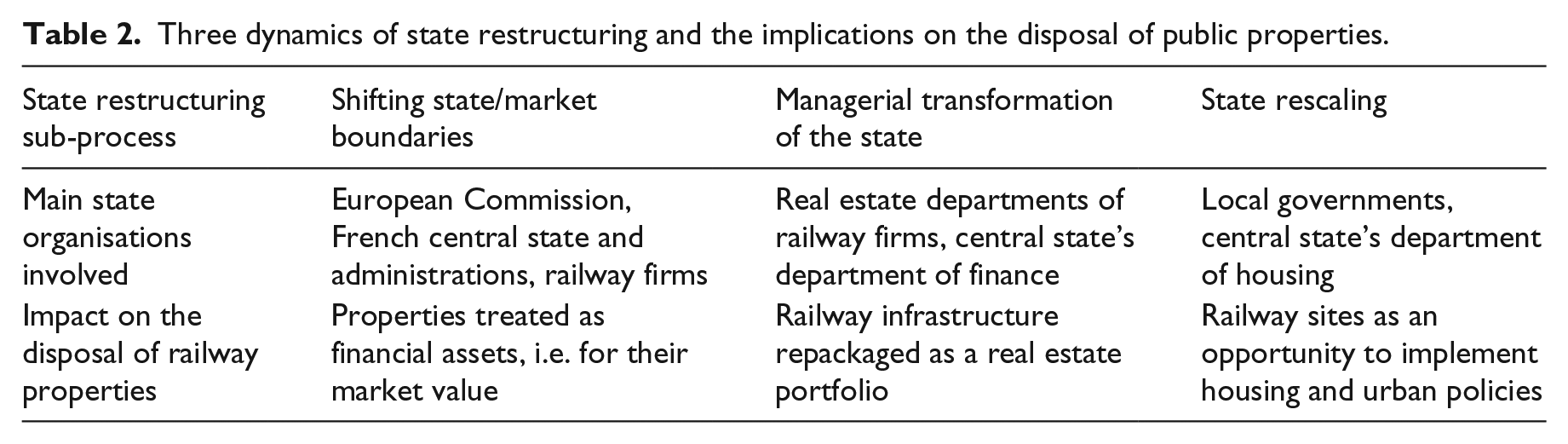
This section goes over the three main forms of state restructuring, that is: (i) the shifting and blurring of the boundaries and the division of roles between the state, market and civil society spheres; (ii) the adoption of new, usually market-inspired, principles that lead to the internal transformations of state organisations and policy reformulation; (iii) the rescaling and redefinition of power relations between the central state and the lower and upper tiers of government. All European countries are experiencing these dynamics of state restructuring fostering the disposal of public land properties. However, their actual implementation determines national trajectories and, consequently, specific transformations of the socio-legal arrangements underpinning the structure of these properties.
The shifting state/market boundary
Firstly, changes are taking place in the boundaries between state and market with regard to public property. Once firmly demarcated from the market sphere by their socio-legal recognition as pertaining to the public domain and, thus, abiding to specific rules and administrative management practices, public properties are directly affected by the reforms of the sectors within which they are embedded. Consequently, their status and ownership change, with the consequence of public properties increasingly adopting the rationalities, rules and practices observed in real estate markets. The sectorial reforms thus contribute to public properties being transferred from the public domain to intermediate, transitional and hazy positions between state and market, which, as epitomised by the French railway sector, facilitate their disposal.
Historically characterised by a national and ‘integrated’ ideal, the railway in France has undergone both a vertical division process (notably between infrastructure and operations management) and a regulatory rescaling (Europeanisation and regionalisation). Infrastructure management and train operations were separated into two publicly owned companies in 1997 2 – respectively Réseau ferré de France (RFF) and Société nationale des chemins de fer (SNCF). This separation was a response by the central state to the 1991 European Commission Directive 440, 3 an integral part of its larger neoliberal agenda for the creation of a European transport market. However, anticipating the forthcoming European rail transport competition, the government’s primary aim was to transfer the accumulated railway debt to RFF in order to clean up SNCF’s balance sheets (Cour des comptes, 2003), the former taking up no less than two-thirds of the total railway debt (€20.5 billion). To offset this, RFF became the sole owner of the railway infrastructure, making it France’s second largest landowner after the Army (108,000 hectares, estimated €22.4 billion) (Cour des comptes, 2008). 4 The 1997 reform had thus major repercussions for railway land and buildings. The new relation established between railway properties and debt prompted the railway firms to reconsider their properties: no longer just a means of production, land and real estate became financial assets whose capitalisation and sale could improve their balance sheet. In short, the implementation of the European Union reform on rail transport has resulted in a nationally specific organisation for the management and ownership of railway lands and buildings.
New public management doctrines
The second point that relates the disposal of public land and real estate properties to the dynamics of state restructuring is associated with the emergence of new public management doctrines. According to these doctrines, properties – like the state in general – are perceived as much too large, and therefore constitute both a policy problem and a potential financial resource (Artioli, 2012). 5 This reflects how new public management reforms support state policies that are ‘self-concerned’ in as far as their object is less the society than the state itself (Bezès, 2009). Public properties are indeed perfect candidates to apply the three recurrent new public management arguments identified by Hood (1998): (i) they may be the target of radically new management, replacing the previous ‘archaic’ forms of administration; (ii) management can be uniform for all these properties; and (iii) it may be economically ‘rational’ and driven by market rules and private business practices. As a consequence of these new rationales, the material infrastructure of the state is increasingly treated as a real estate concern governed by objectives of financial performance.
The French railway firms and central government departments adopted this approach to landholdings, albeit in contradictory ways. In parallel with the transfers of ownership, SNCF and RFF have structured, separated and professionalised their real estate activities since the 1990s. They created real estate departments and subsidiaries. They recruited urban planners, real estate agents, asset managers and developers. They imported and adapted real estate software in order to manage their inventories and value their properties at market prices. Following a corporate approach that is widespread in large firms (Halbert, 2013; Kaika and Ruggiero, 2016), they pursued a twin strategy of ‘right sizing’, reducing their costs by downsizing their property portfolio while making sizable capital gains by selling redundant assets. I showed that the literature studying railway firms in UDPs targeting their land properties draws attention to their rent maximising strategies, but these strategies are not merely the result of a behavioural change. They have, in fact, implied an accumulation of organisational, professional and informational resources in order to develop property and real estate activities during the 1990s and 2000s.
This was partly supported by the central state itself through its ‘financial’ departments (the Budget, Economy and Finance ministries). However, ‘planning’ departments (the ministries responsible for Town and Country Planning, Sustainable Development, Infrastructure and Housing) backed opposing policies on railway property disposal. As explained by a senior civil servant who was involved in the recognition of public real estate as a government issue in the 2000s:
Regarding state landholdings, you have at the same time […] part of the state that considers that [it] has every reason to get the best price. Other people in the state apparatus consider that this land should produce housing. […] This contradiction is present within the state. […] State-owned land as a means to enhance urban or environmental values, or as source of financial value. (Interview, April 2012)
On the one hand, therefore, railway assets have been incorporated into the state’s new public management-inspired real estate policy (see, for example, public reports by Debains, 2003; Tron, 2005). As with any public land and real estate, business-like management and arbitrage of land are encouraged in order to finance the railway sector debt and/or infrastructure investment, to the extent that financial targets regarding the assets owned by RFF and SNCF are set in ‘performance contracts’ signed between these organisations and the state (e.g. Ministère de l’Économie de l’Industrie et de l’Emploi et al., 2008). More coercively, the Budget Ministry set up a real estate company in 2006 (SOVAFIM) to which RFF was forced to transfer assets at their book value. The aim of this short-term policy (one-year duration) was to in-source the capital gain from the sales to reduce the national budget deficit. 6
On the other hand, other state departments require that rail companies contribute to the objective set for the national housing policy, as suggested during the last decade by different public reports (but see Braye and Repentin, 2005; Pommellet, 2003). This led to the ‘Programme of public land mobilisation for housing’ (Programme de mobilisation du foncier public en faveur du logement), which was initiated in 2008 and is managed by the Ministry of Sustainable Development’s real estate department (Délégation de l’action foncière et immobilière). This programme, to which the publicly owned rail companies are the lead contributors (but including other large public landowners, such as the Army and the Ministry of Higher Education and Scientific Research), was further reinforced by the left-wing government elected in 2012, which increased the price discount over public land redeveloped for social housing. 7 The ubiquitous new public management doctrines have provided a rationale for public policies aiming at redeveloping railway land. Here again, though, this leads to counter policies and peculiar arrangements between RFF and SNCF and the line ministries.
State rescaling
The rescaling of the state is the third dynamic driving the disposal of public properties. Since the 1980s, devolution has been gradually transferring legal and organisational resources related to urban planning and land use policies from the central administration to local governments (Pinson and Le Galès, 2005). The latter have embraced UDPs as a favoured policy instrument for implementing their urban policies (Pinson, 2009) and competing with other cities (Brenner, 2004). However, in comparison with private properties, it quickly appeared that local authorities could hope to exert a greater bargaining power on public properties due to their proximity to other involved public actors and that railway sites above all are particularly well-suited for redevelopment projects due to their large-scale, often central locations in city-regions. As a result, according to one RFF real estate project manager, ‘most often, local governments are the driving force, […] they call us saying: “We want to transform our territory, we are thinking about our urban plan, is your land available?”’ (interview, April 2012). This reflects a twofold redevelopment agenda. On the one hand, local governments perceive these sites as underused spaces that splinter the urban fabric and need to be ‘regenerated’ and connected to their urban environment. On the other hand, such properties are seen as land resources that can contribute to multifarious policy objectives, from economic development to local welfare, social diversity, sustainable development and mobility, etc.
The institutional setting associated with the public structure of ownership matters all the more, given that French local government approvals and actions are needed to redevelop rail yards, for three main reasons. Firstly, because land use is regulated through local zoning plans and building rights permits and the rise in value is dependent on local government willingness to see the railway areas redeveloped. Secondly, by law, local governments can exercise a pre-emptive right for the two months following the declaration of intent to sell railway property. Thirdly, French local governments often redevelop the areas themselves through publicly owned developers that they tightly control. These redevelopments are thus highly dependent on local public investment. Although none of these resources is specific to the French context, their combination makes the local governments of this country structurally powerful in their relationships with the other stakeholders of the UDPs.
To sum up, the dynamics of state restructuring push state organisations to the redevelopment of railway land properties. Usually inspired by market and neoliberal rationales (privatisation of the railways, new public management doctrines, inter-urban competition), new rules, policies and strategies fuel the disposal of railway land property by changing their ownership structure. If these dynamics pave the way for the redevelopment of public railway property, it is necessary to analyse how this structure actually frames the processes and outcomes of the UDPs that target railway land and buildings.
How the public ownership structure frames the redevelopment of railway sites
After having introduced the two case studies and their main actors, this section shows how the negotiations around the UDPs are strongly dependent on the public structure of railway properties. Given the changing institutional context portrayed above, I will show how the negotiations over redevelopment and UDPs outcomes are constrained by the rules, procedures and policies governing the disposal of the railway domain and their strategic use by the actors involved in the negotiations.
In Paris, three among the four largest UDPs of the 2000s – the decade when the left-wing mayor Delanoë led the city – were on former railway sites. The project considered in this paper, Clichy Batignolles, reshapes the Saint-Lazare station maintenance and freight site, which was one of the city’s largest rail yards. The situation in Nantes shows similar features, since the two largest UDPs in the metropolitan area also involve former rail yards. The ‘Nantes État’ site – named after the public ‘Administration des chemins de fer de l’État’ that owned the yard from 1878 to 1938 – is located in the centre of the ‘Île de Nantes’ (Nantes Island) industrial port complex. Its redevelopment is part of a larger project for the whole island (460 hectares) that has been underway for the last 20 years. The plan is to move the remaining rail functions to another rail site located in a peripheral area (Grand Blottereau, see Figure 1).
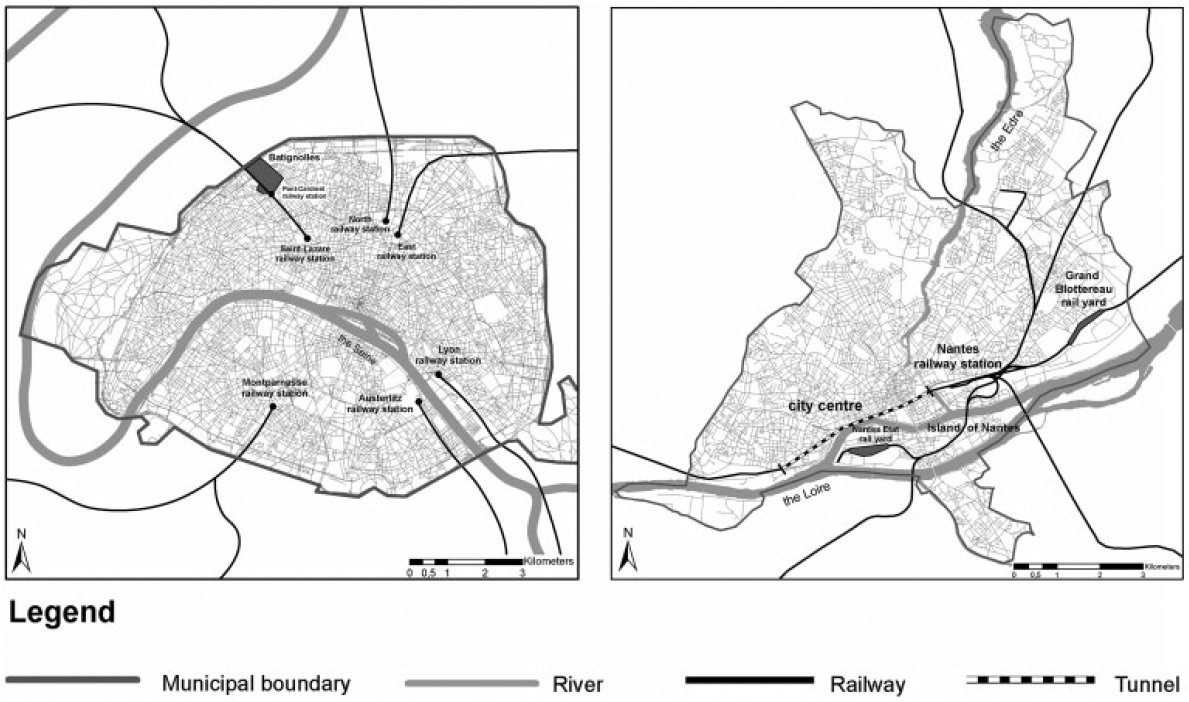
Location maps of Paris Batignolles and Nantes État.
Both Clichy Batignolles and Nantes État (54 and 22 hectares) are UDPs. The redevelopment initiatives came from local governments, which questioned the need for those railway functions in those particular locations, as illustrated by the preliminary studies they mandated in the late 1990s (APUR, 2000; Chemetoff, 1999). They later steered the redevelopment through arm’s length planning agencies under their direct control, as frequently observed in France. 8 In Paris, the city’s bid to host the 30th Olympic Games rapidly provided a clear discussion framework for the future of Clichy Batignolles. Between September 2004 and July 2005, intense negotiations occurred between several state organisations. The representatives of the central state in the Region (called the ‘Prefect’), the Ministry of Sport, the national Olympic Committee, the Region (which in France has a limited role in spatial planning but received regulatory powers over rail transport in the late 1990s), the municipality of Paris and the railway firms discussed the conditions for the remodelling of the railway activities and for the Olympic Village programme that was due to be located on the railway site (Groupement d’intérêt public Paris – Ile-de–France, 2012, 2005). Although the city of London eventually won the bid for the Olympic Games, the negotiation continued, but between fewer stakeholders, including the Prefect (i.e. the central state), the municipality and the railway operators (Préfecture de Paris et al., 2006).
Likewise, Nantes État’s future was debated in multilevel bargaining that included the metropolitan government (Nantes Métropole), the Region, the central state through the Prefect and the rail companies. Yet, unlike in Paris where land and urban planning issues were predominant, this bargaining was structured around issues related to the railway network. Land transfers are the object of direct deals between the railway firms and the metropolitan government’s development agencies. These deals are based on an agreement approved by the Prefect (Nantes Métropole et al., 2005).
As summarised in Table 3, this section now turns to analyse how the redevelopment is framed by the public ownership structure, through an analysis of the three main purposes followed by the involved actors. These purposes respectively consist of (i) capturing the urban land rent; (ii) pursuing urban policies aiming at providing affordable housing, public parks and facilities; and (iii) modernising the railway network.
The structure of ownership and the negotiations of railway site urban redevelopment.

Regulating the capture of urban land rent from public properties
The fourth section has shown that the conception of railway sites as financial assets whose value should be maximised has become pervasive over the last two decades in both the rail companies and parts of the central state administration. It is therefore not surprising that a major purpose of the redevelopment of railway sites lies in obtaining capital gains. On the one hand, the raison d’être of the fast-growing real estate departments within rail companies is a secret to no one: they strive to bring revenues to their parent firms. On the other hand, a similar objective is pursued by the central state via France Domaine, the administration in the national Budget Department responsible for the implementation of the state’s real estate policy (renamed Direction de l’immobilier de l’État in September 2016). Embodying the state as a landowner, France Domaine is openly ‘seeking to increase the value of public land and real estate properties to defend its [the state’s] interests’, as explained by one of its senior official (interview, April 2012). To do this, and following existing law over public properties that requires the approval of France Domaine over all transactions pertaining to public properties, this central state administration ensures that the agreed price reflects current market values. As France Domaine’s approval comes only at the end of the bargaining process, it constrains railway companies as well as local governments and their arm’s length planning agencies to anticipate a price reflecting market values in the surrounding area on similar plots of land.
Still, not all state actors involved in the bargaining over the redevelopment of public properties consider it as a way to maximise urban land rent. Local governments would rather wish to buy land at the lowest price to bring down redevelopment costs and support urban and housing policies of their own. Here again, though, the negotiation of this purpose is framed by the very structure of public property, as evidenced in the pricing of the sites. On the one hand, the law stipulates that the negotiating baseline is the ‘market value’ established by comparison to other transactions and/or through a cost–benefit analysis of the development scheme. On the other hand, the pre-emptive right granted to local government when it comes to land transactions (be they public or private) implies that railway companies are legally forced to sell their land through discrete negotiations with the local government (‘gré à gré’) rather than at the end of a process of public auctioning. In spite of France Domaine’s role in ensuring market price and the willingness of the railway firms’ real estate departments to sell at a high price, the railway companies finally accepted substantial discounts invoking the public status of railway properties. In Clichy Batignolles, a 60% reduction (€3320 per m2) was obtained where the municipality was planning a park (around a third of the property acquired by the local government). 9 In Nantes État, the controversial dimension of land valuation and appropriation is even clearer. On the one hand, some landholdings of RFF were part of the transfer to the state-owned enterprise directed at in-sourcing the capital gain into the Government budget (SOVAFIM). They were, therefore, the objects of a short-term strategy of rent maximisation related to new public management reforms at the central level. On the other hand, discounts were granted for the land dedicated to social housing and to the green park, which will occupy the majority of the rail yard. The local government representatives argued that this was in line with the central government’s ‘Programme of public land mobilization for housing’, since railway holdings were eventually incorporated into this programme by the Department of Housing (Léchenet, 2012). The process is even more contradictory, since some plots of land were included both in this programme and in the transfer to SOVAFIM. In short, capital gain is embedded in the somewhat discrepant policies and procedures specific to the rules that apply to public property ownership resulting from state restructuring, as identified in the previous section. These specificities have substantial impacts on the selling price and the appropriation and distribution of the urban land rent.
Providing social housing and public facilities through public land redevelopment
State organisations struggle over rent because some of them intend to implement urban and housing policies that are all the more efficient as the costs of land acquisition are low. When asked why Clichy Batignolles had been chosen as one of the largest urban developments in Paris, the Deputy Mayor responsible for urban planning during Delanoë’s first term explained that it ‘is Paris’s largest remaining brownfield site’ and ‘there was political will to develop these fifty hectares’ (interview, April 2012). Urban intensification, transit-oriented development, brownfield regeneration, connecting divided neighbourhoods, increased attractiveness of (parts of) the city – these are among the features of the urban planning framework within which local officials ground and justify their claims for redeveloping public rail yards. This explains why a Nantes municipal official could declare that ‘there are some spaces on which we have, for some time now, considered that maintaining a railway activity was no longer compatible with the [city’s] urban plan’ (interview, September 2012). To demonstrate how such claims and the negotiations prompted by these claims are framed by the ownership structure, and what are the actual consequences on the redevelopments, I will focus here on two main outcomes: social infrastructure and housing.
In the case of Paris, the central government’s Department for Sustainable Development required housing to be built in Clichy Batignolles right from the start (around 3000 units as proposed in the Pommellet report of 2003). The 2006 agreement signed between the state, the municipality and the railway firms insisted on ‘the common goal of the state and the city of Paris to build as much housing as possible’ (Préfecture de Paris et al., 2006). The convergence between the municipality and the state housing Department ensured that 50% of the new dwellings would consist of social housing and a further 20% of mid-range, rent-controlled accommodation, leaving only 30% of the newly built housing stock to be sold at ‘free market’ rates (Adisson, 2013). Local governments can also strategically call on formal rules set in the national regulation to pursue the provision of public facilities. This is illustrated by the agent who led the negotiations against the rail companies on behalf of the local authority in the case of the 10-hectare green park of Clichy Batignolles:
We said to the owners [RFF and SNCF]: ‘We will try to find an agreement on a building land price to be approved by France Domaine […]. We must get approval, but we advise you that we will apply a […] national circular about the value of railway land, which provides that when railway properties are intended for a park, there will be a reduction of 60-65% on the price.’ (Interview, April 2012)
In the case of Nantes, here again various actors have supported social housing and infrastructure provision in the name of the public quality of the railway sites. The share of social housing is 25%, thereby complying with national regulations. The Prefect and the decentralised state planning administration were keen on supporting this production of social housing. They included the railway site in the national ‘Programme of public land mobilisation for housing’, and thus allowed a reduction in the price of the land hosting these housing programmes. In a similar manner, most of the present rail yard will be converted for other low-profit public facilities: the old station has already been symbolically transformed into the city’s Trade Union Centre, while the new park (14 hectares) will cover more than half of the site (Samoa and Nantes Métropole, 2012).
Local governments intervene as planners, negotiators and developers in the railway site redevelopment. As anticipated in the previous section, this is possible thanks to the power they received with the rescaling of the French state. However, the idea that railway sites are instruments for the implementation of housing and wider urban policies is not restricted to local governments but cuts across central state representatives. This is also observed in the real estate departments of the rail companies. A project manager of the real estate department of RFF considered that its land must participate in the housing construction effort:
Maybe we are interventionist, but I think that today we have so many problems of land availability, especially in the Ile-de-France region, so the land we make available […] should be used to achieve urban density, to resolve the housing question. (Interview, RFF, April 2012)
This is explained by the fact that the land under consideration (a railway site in central Paris) and its owner (RFF) are public and thus should contribute to ‘public interest’ (embodied here in the ‘housing question’):
Value creation is not only financial value. The state also asks us to upgrade our land in order to build housing, social housing too. I have never entered an organisation – and I think that it is not the spirit of the people who work for RFF – where we seek excessive rises in value, and we relinquish our goods in order to make money […]. If we sold our land without concern for what becomes of it, first it would mean that, quote unquote, we have no sense of right and wrong, that we do not have a concept of public interest. (Interview, RFF, April 2012)
In other words, if formal rules and policies related to railway properties may be called in to negotiate the features of the development, the ownership structure also embodies moral values associated with the public quality of the land.
It thus appears that the ways railway sites have been redeveloped to implement public facilities and social housing are strongly related to their public ownership structure. It is because state actors activated the specific rules, norms, resources and policies contained in the institutional framework for public properties that such UDPs took their present forms.
Modernising the rail network
The conversion of rail yards for urban use often conflicts with the operation and evolution of the rail network. The redevelopment of Clichy Batignolles and Nantes État are thus confronted with the need for continued operation of the railway service during and after redevelopment works. Moreover, because they alienate important plots of land within already dense and centrally located areas, these large-scale urban conversions may conflict with the further development of the rail network. In Clichy Batignolles, for instance, one area had long been set aside by SNCF and RFF for an extension project on the regional express rail network (RER E), while in Nantes a 30-metre wide zone within the Nantes État perimeter is still earmarked for a bypass planned by the railway companies to resolve the long-standing risks posed by the railway tunnel running through the city centre. As explained by an RFF project manager:
These railway projects, which have not yet been financed by RFF, which are in the mind of three people – well – they are more important driving forces than the land disposal question and the implementation of urban development. (Interview, Paris, April 2012)
The operational issue is not solely a constraining factor: the negotiation of the redevelopment may also become an opportunity to modernise the extant infrastructure. In the Clichy Batignolles redevelopment, for instance, the relocation of the maintenance plant is conceived as a means of improving both network performances and working conditions, notably through the creation of a dual access to the area and the addition of a travelling crane. For railway firms and other state organisations interested in supporting public transport, UDPs on railway sites thus became an opportunity to reorganise the state’s railway networks.
Once again this is made possible by legislation, in this case specific to railway properties, and which provides that when a railway activity that is still useful to the public rail service is affected by a redevelopment project, it must be restored without damage to rail operations. The costs of the transfers must be covered not by railway firms but by the developer, that is, due to their implications in land development, the local authorities in France. 10 Such a rule has substantial effects on the outcomes of the redevelopment of railway public properties. In Paris, the capital gain the railway firms extracted from the sale of the land (€318.5 million) was roughly comparable with the local government’s further investment in the infrastructure itself (€263.5 million). 11 In Nantes, although the negotiations had not ended at the time of writing, the figures are even clearer. The engineering studies estimated the transfer at €88 million (Préfet de la Région Pays de la Loire and Région Pays de la Loire, 2013: 112) and returns from the land deals (already sold or still in negotiation) should total between €20 and €25 million (interview, project manager for the planning agency, July 2012).
The companies’ infrastructure departments are not the only actors interested in improving the rail service. In Paris and Nantes, several elected representatives and chief administrative and railway officers saw these transfers as an opportunity to revitalise rail freight in their cities thanks to the improvement of the network. Green party councillors in the first Delanoë mayoral term lobbied for the creation of a new and expanded freight platform at Clichy Batignolles. Likewise, the Pays de la Loire Region, of which Nantes is the administrative capital, called for a new rail freight platform to be built with the marshalling yard. This interest does not reflect only the institutional role of the regional level of government in issues pertaining to public rail transport. It also echoes the politicisation of the rail issue by the President of the Pays de la Loire Region, who also happened to be a member of the RFF board and the President of the Transport and Infrastructures Committee of the Association of French Regions, where he actively promoted the regional public rail service. In addition, the National Transport Users’ Federation (FNAUT), as well as Green party councillors, supported the preservation of railway activity and the development of a new regional rail station in Nantes État (Norrito, 2007). This demonstrates how concern for the performance of the network runs in parallel with the other purposes at work in the disposal of railway land in both Clichy Batignolles and Nantes État. As observed with the housing and public amenities above, the actors can rely on specific public institutions associated with the rail network (such as the law providing for the restoration without damage of rail operations) to promote their objective of network modernisation.
Again, the treatment of this issue is directly related to the institutional framework for public properties and, regarding technical improvement, more specifically to that of the railway domain. Likewise, the railway firms, the Region and the green party, as well as the representative of the users, can tap into these institutional resources to legitimise their own objectives. Along with the valuation of the sites and the related programmes planned, these institutional resources contribute to making the restructuring of public properties a specific process with distinct outcomes.
Conclusion
This paper explored the reasons why public properties on which state functions are located are increasingly the target of urban redevelopment projects in European cities, and with what outcomes. The UDPs targeting these properties have risen in parallel with the gradual exhaustion of the private industrial areas in pericentral areas of these cities, but explanations in terms of post-Fordist transition or neoliberal urbanisation do not make it possible analytically distinguish these two processes. In order to understand how the redevelopment of public land properties has become a central urban issue on a European scale, the paper addressed the relation between state restructuring and urban restructuring. The central contention of the paper is that the dynamics of state restructuring transform the ownership structure of public properties, which in turn frames the procedures at national level, in addition to the negotiations and outcomes of the redevelopment of such properties. By focusing on the landownership structure within which UDPs unfold, the paper has shown how the current redevelopments of sites belonging to state administrations and enterprises are mainly driven by institutional changes internal to the state.
The demonstration was based on railway land properties in France considered as a typical case of the changes affecting the structure of public properties due to state restructuring. Indeed, its first step consisted of explaining that these properties are targeted by urban redevelopment projects because of at least three dynamics linked to state restructuring: (i) the reforms of the railway sector pushing for disposal of the land and real estate properties by linking these assets to the debt of the sector; (ii) new public management doctrines spreading market-inspired policies and practices in the administration of public properties; and (iii) the rescaling of the state, resulting in increased power and pressures on local governments in urban affairs, which consequently reclaim the redevelopment of these land properties. The second step of the demonstration shed light on the specificities not only of the causes of the redevelopment projects on railway properties, but also of the processes and their outcomes. At this point, the structure of property has the key role in the explanation. It frames the formulations and arrangements that combine coexisting main purposes: rent maximisation, urban policy objectives and improvements in rail operations. The construction of the value of the land, the programmes planned and the reorganisation of railway functions are all moulded by the strategic uses of the rules, norms, procedures and policies surrounding the disposal of this domain. Between macro-political-economic changes and urban restructuring stands the intermediation of the ownership structure.
Taking ownership structures seriously means that two conclusions can be reached in the field of urban political economy. Firstly, the research protocol leads us to reconsider the connection between state and urban restructuring. State restructuring dynamics appear not only as contextual factors that contribute to the rise and spread of UDPs in general, as is the case for the standard narratives of urban political economy. Rather, shifting boundaries between state and market, new public management rationales and the rescaling of the state are transforming the institutional framework of public properties in particular, and consequently give rise to a specific process in the remaking of publicly owned sites. By doing so, the paper not only contributes to refine the main, and at times one-size-fits-all, explanations given by the literature on UDPs, in which the effects of the restructuring of both the state and the Fordist economy are usually not disaggregated. Rather, it also underlines the need for scholars in the field of urban studies to factor in the specific national institutional framework associated with the ownership structure. Otherwise, one fails to distinguish the multifaceted and partially autonomous logics and changes prompting the redevelopment of public properties associated with state restructuring, and thus to explain a substantial part of urban restructuring in European cities. Secondly, now extending the conclusion to a more global scale, by heeding not only macro-contextual changes such as state restructuring or financialisation, but also middle-range and context-related institutions, policies, socio-legal infrastructure, actors and scales related to the ownership structure, it is possible to offer fine-grained understandings of the causes, paths and outcomes of urban restructuring. Following this approach, urban scholars, like Anne Haila (2016) in the case of the ‘property state’ of Singapore, can explain how these changes are actually materialised in urban development and vary from one place to another. These conclusions pave the way for comparisons of the role played by the modifications of ownership structures, at European and global scales, in urban studies. These comparisons would allow an explanation of the commonalities and specificities of the processes and outcomes of urban redevelopment based on public and privates properties, as well as between different public or private structures.
Footnotes
Acknowledgements
I presented a first version of this paper at the seminar ‘Analysing State Restructuring and Urban Policies’, Politecnico di Milano, on 22 November 2012. I am very grateful to Anne Haila, Gabriele Pasqui and Serena Vicari for their helpful comments at that session. I would also like to thank Olivier Coutard, Antoine Guironnet, Maria Kaika and especially Ludovic Halbert for helping me to improve the article. I wish to extend thanks to the two anonymous referees for their insightful remarks. The usual disclaimers apply.
Declaration of conflicting interests
The author(s) declared no potential conflicts of interest with respect to the research, authorship and/or publication of this article.
Funding
The author(s) disclosed receipt of the following financial support for the research, authorship, and/or publication of this article: The article is part of the author’s PhD research. The latter received both material and financial support by Politecnico di Milano and Université Paris-Est.