




Abstract
Traditional theories of migration frequently fail to fully explain the real-world patterns of interregional mobility. Empirical studies indicate that individuals may not always migrate for economic reasons such as poor employment and income prospects. Which characteristics drive people to stay or move after job displacement? Using information on establishment closures, we analyse the economic and social determinants of interregional mobility following job loss. We base our empirical analysis on nationwide individual-level register data from Finland for 1997–2015. We find that receiving earnings-based unemployment benefits substantially weakens the economic incentives for interregional mobility. This negative association is particularly strong for the lower educated and those living in more rural areas. Moreover, our results show that the migration decisions of displaced workers are strongly affected by homeownership, differences in regional housing prices, and social connections, as measured by childhood family relations.
Keywords
Introduction
Persistent unemployment highlights the spatial mismatch problem in Europe. Spatial mismatch has become a central policy concern because it hampers the efficient allocation of labour resources in the Fourth Industrial Revolution, characterised by occupational restructuring, accelerating technological transformation, globalisation, an ageing population and stagnant economic growth. Economic migration theory emphasises that individuals respond to regional differences in job prospects by migrating to areas with better opportunities (Mueller, 1982; Pissarides and McMaster, 1990). Consequently, regional mobility meaningfully improves the functioning of labour markets because job losses lead to internal migration to low-unemployment regions, alleviating the spatial mismatch problem in the labour market.
Evidence of the effects of exogenous employment shocks on migration decisions in Europe is inconclusive (Andersson et al., 2020; Fackler and Rippe, 2016; Huttunen et al., 2018; Meekes and Hassink, 2019) and implies that people may not always migrate for economic reasons and move to better-opportunity regions. Therefore, to improve the functioning of labour markets in Europe, it is essential to examine why substantial numbers of displaced workers decide to stay in their home regions. Analysing patterns of interregional mobility, we focus on previously employed workers who experience exogenous job loss due to establishment closures because these workers represent the segment of the labour force that arguably responds most strongly to the determinants of interregional migration. They also face an elevated risk of long-term unemployment.
Earlier studies by Dahl and Sorenson (2010) and Hansen et al. (2021) used Danish data for their research. Dahl and Sorenson (2010) specifically investigate how expected income and social factors influence the likelihood of technically skilled workers relocating after losing their jobs. They find that these workers respond to differences in wages but greatly prefer living close to family members. Hansen et al. (2021) focus on the migration dynamics of a representative sample of laid-off workers and examine whether the migration patterns differ between regions with different characteristics. Their results show that displaced workers in non-urban regions are less likely to move than those in urban regions. Moreover, Neffke et al. (2018) show that a higher local concentration of workers’ in industries increases the likelihood of finding a new job and thus decreases displaced workers’ likelihood of migrating.
We utilise rich nationwide employer–employee panel data for 1997–2015 to analyse the determinants of interregional migration following job displacement in Finland. Our study contributes to the earlier empirical literature in three ways. First, we analyse the relationship between receiving earnings-related unemployment benefits and migration decisions in the context of a Nordic welfare state, where income transfers for the unemployed can significantly weaken economic incentives for migration and the efficient allocation of labour resources across regions. Importantly, regional growth hubs have the potential to mitigate the challenges created by the ageing population in Europe, and the role of highly educated workers is particularly important in this process (Eliasson et al., 2020).
Second, we examine the other key determinants of interregional mobility, focusing on housing market conditions, including local housing liquidity (how fast people can sell their existing houses), regional differences in housing prices, and the type of housing. Notably, the roles of housing liquidity and whether people have their own detached houses versus owner-occupied flats have rarely been studied in the European context. Our research setting is useful for this purpose because a large proportion of housing in Finland is owner-occupied, and people (particularly blue-collar and service sector workers) may have to live relatively close to their workplaces because their jobs are tied to a specific geographical location. Housing costs also create regional differences in the cost of living. Moreover, from a policy perspective, housing market conditions are closely related to regulations, such as zoning policies (Rodríguez-Pose and Storper, 2020). The fact that zoning in Finland is based on municipal policies that lack national coordination further heightens the role of local housing market conditions in migration patterns in our research setting.
Third, we highlight the heterogeneous effects of the determinants of migration by skill level and region. The results shed additional light on policy-relevant population groups that have been inadequately covered in the literature and may help to target policy interventions for groups that fail to respond to economic incentives to migrate to regions with better employment opportunities. The Finnish economy provides a useful research setting for studying interregional mobility because, while being representative of advanced European countries in many ways, it also has persistently high unemployment in some regions and one of the highest employment mismatch rates in Europe, as measured by the relationship between unemployment and job vacancy rates (Eurostat). 1 In this article, we provide policy-relevant findings and show that there are substantial labour-market impediments preventing efficient matching between displaced workers and potential jobs across regions.
Literature
Migration theory highlights several factors that affect migration decisions. Herein, we briefly describe the key characteristics that may encourage or discourage internal migration following job loss. Thereafter, we emphasise the importance of the earnings-based unemployment benefit system, housing market conditions and social connections.
Conceptual framework
According to neoclassical migration theory, people base their migration decisions on economic rationality and move from low-wage regions to high-wage regions to maximise their lifetime incomes and/or utility (Harris and Todaro, 1970; Todaro, 1969). Consequently, the theory predicts that migration propensity should be higher for the unemployed and that the magnitude of migration flows should depend on regional differences in expected income and unemployment (Pissarides and McMaster, 1990).
Empirical studies have used establishment closures and mass layoffs to measure involuntary job loss. Dahl and Sorenson (2010) find that income differences across Danish regions affect the migration decisions of technical workers after job displacement. 2 Some studies support traditional migration theories by showing that job displacement substantially increases the propensity to move in Norway (Huttunen et al., 2018) and Germany (Fackler and Rippe, 2016). However, in the Netherlands – a country with high population density – Meekes and Hassink (2019) demonstrate that job displacement decreases migration but increases the tendency to commute. Using Swedish data, Andersson et al. (2020) find that displaced workers are less likely to migrate than their matched counterparts. Their results also highlight the potential role of a person’s education in migration decisions. Notably, Andersson et al. (2020) show that highly educated workers not directly affected by plant closures are likely to move when their regions are hit by economic shocks, probably because they have sufficient resources to adjust to increasing turbulence in the labour market. Regional characteristics may also be important. A recent study in Denmark shows that displaced workers in non-urban regions are less likely to move than displaced workers in urban regions (Hansen et al., 2021). Monras (2018) also demonstrates that internal migration responses to local unemployment shocks occur mainly through changes in the in-migration rate rather than the out-migration rate. This empirical observation raises the question of why people do not migrate despite large income and opportunity gaps within a country.
It has long been recognised that the traditional neoclassical migration theory fails to explain real-world migration patterns and processes (De Haas, 2021). For example, the new economics of labour migration (NELM) holds that migration decisions are not made by individuals but by families or households. The NELM extends the traditional neoclassical theory by arguing that people make decisions collectively to maximise expected income and minimise the risks associated with market failures (Stark, 1978, 1991). In developed countries, income risks are generally mitigated by government programmes and unemployment insurance schemes. Moreover, De Haas (2021) states that traditional migration theories still omit many important aspects of migration, including people’s subjective life aspirations and capabilities to stay or migrate, which include, for example, a sedentary lifestyle (having a place ‘to live’), the pressure of constraints on voluntary migration (such as housing or economic constraints), the innate desire or socio-psychological need to leave home, people’s own perceptions of the ‘good life’, or their access to different material, human, health, and education resources that affect their ability and desire to move (De Haas, 2021).
In this article, we examine the determinants of migration following job loss. Along the lines of NELM theory, we consider how earnings-based unemployment benefits are related to migration decisions. Moreover, we focus on two vital determinants that significantly affect an individual’s aspirations and capabilities for (or constraints on) migration: housing markets (Dietz and Haurin, 2003; Oswald, 2019; Zabel, 2012) and social connections (Lundholm et al., 2004; Niedomysl, 2011; Sandow and Lundholm, 2020).
Earnings-related unemployment benefits and interregional mobility
Unemployment benefits provide substantial income support for recently displaced workers and compensate for a large fraction of lost earnings due to unemployment. Non-wage income may affect interregional mobility because, according to job search theory, the crucial parameter affecting migration decisions is reservation wages (Abraham et al., 2013). Unemployment benefits increase workers’ reservation wages and may thus reduce economic incentives for interregional mobility. The theoretical and empirical literature pays only limited attention to this important issue. For example, Eggert et al. (2010) highlight the role of unemployment benefits in discouraging interregional mobility from a theoretical perspective. However, micro-level evidence based on nationwide data on this issue is sparse and does not consider the effects of earnings-related unemployment benefits (as opposed to basic unemployment benefits) on migration (Arntz et al., 2014; Goss and Paul, 1990).
Unemployment benefits in Finland include an earnings-related unemployment allowance, a basic unemployment allowance and a labour market subsidy. Entitlement to the earnings-related unemployment allowance, basic unemployment allowance or labour market subsidy depends on whether a claimant meets the work requirement. 3 Payment of the earnings-related unemployment allowance requires membership in a government-subsidised unemployment insurance fund, and most of the funds are administered by unions. Not all employees in Finland choose to become members of voluntary unemployment insurance funds. Evidence shows that highly educated, older workers, women, and workers in the public sector are most likely to be members of unemployment insurance funds (Böckerman and Uusitalo, 2006). Hence, caution should be used when interpreting results regarding migration as causal effects due to the benefits scheme. It is generally possible to receive an earnings-related allowance for 400 days. Those who are not eligible for the earnings-related unemployment allowance are entitled to a basic unemployment allowance and a labour market subsidy, which provide much lower levels of compensation. For example, the basic unemployment allowance for a single individual without dependents was approximately 742 euros per month in 2022. The earnings-related unemployment allowance for an otherwise similar individual with (previous) average monthly earnings of 3,500 euros was approximately 1,900 euros per month. According to the Organisation for Economic Co-operation and Development (OECD), 4 the average replacement rate of unemployment benefits in Finland is approximately 65 per cent. There is no regional variation in unemployment benefits, and their level does not account for differences in the cost of living in urban versus rural regions.
Housing market conditions and interregional mobility
Housing markets potentially constitute a significant impediment to migration (Dietz and Haurin, 2003; Oswald, 2019; Zabel, 2012). Empirical studies in Europe have shown that homeowners are less likely to move than renters (Böheim and Taylor, 2002; Munch et al., 2008) and that the relationship is stronger in more depressed regions (Palomares-Linares and Van Ham, 2020). Moreover, an increase in regional housing prices is a factor that reduces interregional migration (Cannari et al., 2000; Hämäläinen and Böckerman, 2004). We contribute to the literature by using comprehensive administrative information on specific types of homeownership to examine the different influences of owning detached houses versus owner-occupied flats, together with housing prices. Findings from the United States show that moving decisions also depend on housing liquidity (i.e. how quickly homeowners can sell their houses; Head and Lloyd-Ellis, 2012). Whether moving decisions also depend on housing liquidity in the European context has only rarely been studied. Hence, we also use regional-level data on houses sold per housing stock to examine the effect of turnover rate on moving decisions following job displacement.
Social connections and interregional mobility
Lundholm et al. (2004) consider five Nordic countries and show that the main motives for long-distance migration go beyond narrowly defined economic incentives (Niedomysl, 2011). Notably, the literature on the European context argues that the presence of relatives or friends in a place of residence is negatively related to migration decisions and that the propensity to migrate increases when relatives or friends are already living in the destination location, highlighting the role of social connections in migration decisions (Dahl and Sorenson, 2010; Haug, 2008; Huttunen et al., 2018; Ilyés et al., 2023; Mulder and Malmberg, 2014). 5 Usually, a family member (such as a partner) also has local social connections that could affect an individual’s migration decision (Ilyés et al., 2023; Reichelt and Abrahan, 2017) and, potentially, family migration. For example, a recent study in Sweden shows that the family ties of women, more than those of men, affect the destination choices of migrant couples (Ilyés et al., 2023). Earlier studies in Finland reveal that dual-income families have a lower likelihood of migrating, but that potential migration is often based on the career concerns of husbands (Nivalainen, 2004, 2005). Although the evidence regarding social connections is extensive in the European context, little is known about the effects of such social connections on migration decisions in Finland.
Data
Registers
Our analysis is based on data from the Finnish Longitudinal Employer–Employee Data (FLEED) provided by Statistics Finland for 1997–2015. The data are created by combining nationwide registers linked together by unique identification codes for individuals, firms and establishments. The data include statistics for wages and employment, education and socioeconomic status, region of residence and demographic characteristics. Moreover, the Business Register contains comprehensive information on firms and their establishments. We identify each worker’s employer in the private sector by using establishment code and examine whether establishments closed their entire operations. The FLEED covers the Finnish labour force (under the age of 70). We use the identification codes of family members (mother, father, and/or siblings) to determine their locations and take regional data on housing prices and sold houses from Statistics Finland.
Sample construction
Given that the determinants of migration among students and early retirees may differ substantially and confound our empirical findings, we restrict the sample to working-age individuals between 25 and 55 years of age. People defined as retirees or in receipt of disability pensions are excluded from the analysis.
Our identification strategy is based on job displacement information. Both treatment and control groups are usually used to identify the causal effects of displacement on interregional mobility (Fackler and Rippe, 2016; Huttunen et al., 2018; Meekes and Hassink, 2019). In this study, we do not examine the effect of job loss on migration decisions per se; instead, we consider the determinants of migration following job loss. We follow previous studies, such as those of Dahl and Sorenson (2010), Neffke et al. (2018) and Hansen et al. (2021), and define displaced workers as those who are separated from their private-sector jobs after experiencing establishment closures. We do not consider an establishment closure to be a genuine closure if workers obtain jobs in the same firm thereafter or if a considerable percentage (75%) of displaced workers from a specific establishment transition to other establishments in the same region within a year of job loss (Eriksson et al., 2018). This enables us to distinguish genuine establishment closures from potential firm mergers, outsourcing and other related organisational changes. We keep job-to-job transitions in the sample to include displaced workers who do not necessarily become unemployed. This is an important issue because some individuals may find new jobs immediately after displacement due to regional migration.
We denote the year of displacement as b (the base year) and restrict the pre-displacement sample to a full year (12 months of employment) of non-student wage earners. This means that we focus on those with stable employment prior to job displacement. The identification strategy relies on the assumption that labour market shocks should be independent of workers’ own behaviour. However, in very small establishments, we cannot rule out the possibility that workers themselves may affect the likelihood of displacement; therefore, we restrict the pre-displacement sample to individuals who have worked in establishments with at least 10 employees (Bratsberg et al., 2018; Huttunen et al., 2018; Neffke et al., 2018). 6 Socioeconomic status in the FLEED is measured during the last week of each year. We exclude those who were students during the last week of the year and those who received a student allowance during year b − 1. Accordingly, workers must have worked at the same establishment for two years before the base year, so we exclude workers who were displaced from their jobs during the previous two years. In the estimations, we follow displaced workers until b + 2. Given that the data covers 1997–2015, we include only displaced workers who experienced job loss during 1999–2013 in the sample. The FLEED does not contain information on part-time work or hours of work; therefore, we use thresholds for annual wages above which individuals are expected to be full-time workers based on official estimates from the Income Distribution Statistics.
Over 96 per cent of all displaced workers in the sample experienced involuntary job loss once, and approximately 3.7 per cent experienced involuntary job loss twice. Although involuntary unemployment shocks do not tend to accumulate for the same persons, we only include the first displacement event in the sample and subsequent annual observations until the next displacement.
Interregional migration
The measure of interregional migration is an indicator variable describing whether an individual moved to a new region 2 years after displacement (b + 2) (Fackler and Rippe, 2016; Huttunen et al., 2018). We choose a 2-year interval after displacement because the earnings-related daily allowance for unemployed individuals usually lasts 14 or 18 months, depending on the work history. We base regional information on 41 travel-to-work areas (or labour market regions) as officially defined by Statistics Finland. A travel-to-work area consists of a central municipality and surrounding municipalities, from which at least 10 per cent of the labour force commutes to the central municipality. Travel-to-work areas are particularly well suited for studying interregional mobility in the Finnish context because commuting between travel-to-work areas is almost non-existent.
Earnings-based unemployment allowance
We analyse the potential role of receiving an earnings-related unemployment allowance in moving decisions after job displacement. It is possible to receive an earnings-related allowance for 400 days, and the compensation it offers is much higher than the basic unemployment subsidy. Our sample of displaced workers all meet the work requirement for the earnings-related unemployment allowance because they had worked for a full year (12 months) and full-time during b − 1. The data also include information on paid annual unemployment benefits. We have gathered the level of the basic unemployment subsidy with child supplements for each year from the yearbooks of the Social Insurance Institution (Kela). The earnings-related allowance includes a basic component and an earnings-related component. The amount of the earnings-related component of the daily allowance is calculated based on the regular salary (e.g. excluding holiday pay) using the rules stipulated by Finnish law. 7 The allowance increases with the number of children under 18 years of age.
Using register-based data on earnings, unemployment months and the number of children under the age of 18 in the FLEED, it is possible to reliably determine who has received the earnings-related unemployment allowance. We thus created a categorical variable to describe the receipt of unemployment benefits (1 = no unemployment benefits, 2 = unemployed and receiving a basic unemployment subsidy, and 3 = unemployed and receiving an earnings-based unemployment allowance).
Housing market characteristics
Housing market characteristics include homeownership, housing liquidity and housing prices. Homeownership includes three categories (1 = rental or other, 2 = own detached house, and 3 = owner-occupied flat). We measure housing liquidity by the turnover rate (sold houses per housing stock) in each travel-to-work area, based on the comprehensive housing statistics of Statistics Finland. Moreover, we add a variable to describe the expected housing price level outside the worker’s original region. The housing price data are drawn from Statistics Finland, and we adjust the variable according to the size of the region.
Social connections
The data include comprehensive information on the region of residence of the father, mother and all siblings. We measure family ties using an indicator variable that takes a value of one if at least one family member lives in the same pre-displacement region. Approximately 18 per cent of the observations have no information on family members, implying that the workers have no siblings and/or that their parents are over 70 years old or deceased. We classify these observations as ‘no family members living in the same region’. 8
Other control variables
We further augment the migration model with regional and individual control variables. The key regional characteristics include expected earnings, industry mix, unemployment rate and a variable describing employment prospects in the surrounding region. To measure expected wages, we calculated the logarithm of average annual wages outside workers’ initial home regions. We adjust the average wages for gender, education, age and the size of the region. According to neoclassical migration theory and related empirical work, regional differences in wages affect migration decisions (Cannari et al., 2000; Dahl and Sorenson, 2010; Kennan and Walker, 2011). We follow Neffke et al. (2018), who examine the importance of Marshallian externalities in job searches after job displacement. Marshallian externalities refer to the advantages that industries gain from geographical concentration. Industrial clustering should help unemployed individuals to find new employment. Neffke et al. (2018) document that a large concentration of a worker’s original industry makes it easier for that individual to find a new job after displacement, thus decreasing the likelihood of migrating. We measure the industry mix variable as the industry’s percentage share of regional employment. 9 We also augment the model with a variable describing employment prospects in surrounding regions, calculated as the average unemployment rate in surrounding travel-to-work areas within a county minus the local unemployment rate.
The individual-level control variables include age (and square of age), gender, education years, marital status, 10 having children under 7 and 18 years of age, Finnish nationality, previous migration pattern and worker’s industry of employment. We base industry information on the Standard Industrial Classification, divided into 14 groups using one-digit classification. We also augment the migration model to include the full set of year fixed effects.
Descriptive evidence
Table 1 reports the means of selected pre-displacement (in b − 1) and post-displacement (in b + 2) characteristics of displaced workers in the sample, broken down by migration status. We deflate earnings, sales and housing prices to 2015 prices using the cost-of-living index of Statistics Finland. The sample comprises 50,583 yearly observations. The share of displaced workers who moved to another region within 2 years is 3.3 per cent, and stayers and movers differ in several key characteristics. For example, movers are younger and more highly educated than stayers. The movers’ pre-displacement wages are lower, they are likelier to be tenants, and a lower percentage of them have family members living in the same home location compared to stayers. Table 1 also reports the means for the regional characteristics according to migration status. We find that workers tend to move from regions with high unemployment rates and low average wage and price levels. However, displaced workers also tend to migrate to high-unemployment regions. At the aggregate level, displaced workers who move have a weaker labour market position at time b + 2 than those who stay. A greater proportion of movers are inactive 2 years after displacement compared to stayers (6% vs 3%).
Sample means of selected pre- and post-displacement characteristics.
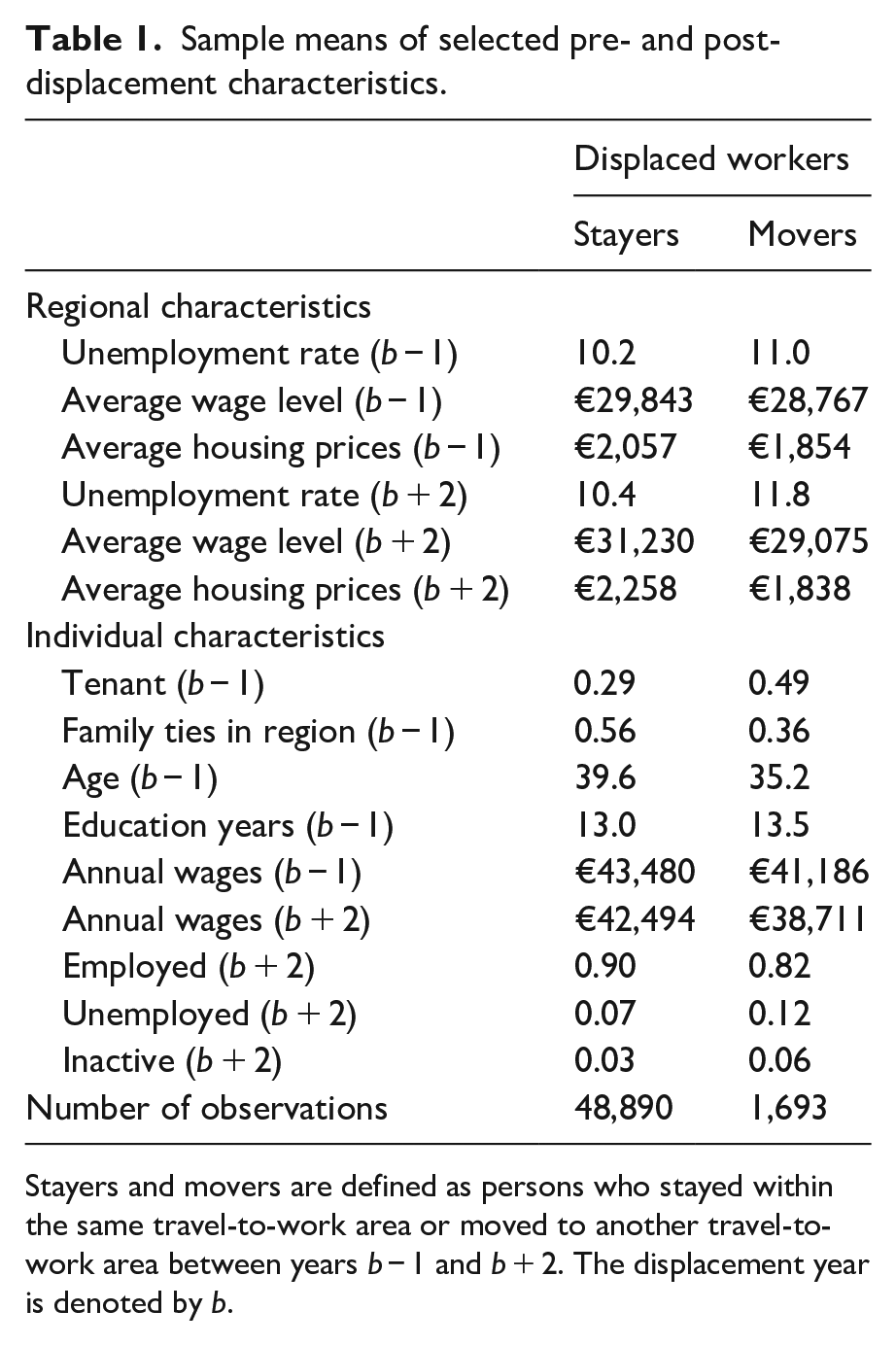
Stayers and movers are defined as persons who stayed within the same travel-to-work area or moved to another travel-to-work area between years b − 1 and b + 2. The displacement year is denoted by b.
Empirical approach
Specifications
To quantify the relationships, we examine the determinants of the interregional mobility of displaced workers based on the following empirical specification, which we estimate using the logit model

Following the literature,
Next, we examine whether migration decisions following job displacement depend on skills and the type of region. Notably, according to the Borjas’ (1992) framework, highly skilled workers tend to move to regions with high average wages and high-wage inequalities. Hence, we estimate Equation 1 for the different skill groups separately. We measure an individual’s skills by education level, which we classify into two groups: low education (primary or secondary education levels) and high education (at least some tertiary education). We also classify the region variable into two groups: the Helsinki travel-to-work area (the capital city region in Finland, which is a relatively small but compact area with a high population density) and the rest of Finland.
Main estimation results
Table 2 (Column 1) reports the marginal effects of the central determinants of interregional mobility for the sample of displaced workers. We find three main results. First, as predicted by job search theory, receiving higher compensation from the unemployment benefit system while being unemployed is negatively related to migration. The quantitative size of the point estimate reveals that the earnings-based unemployment allowance decreases the likelihood of interregional mobility by 1.2 percentage points (approximately 30%).
Regional mobility of displaced workers.
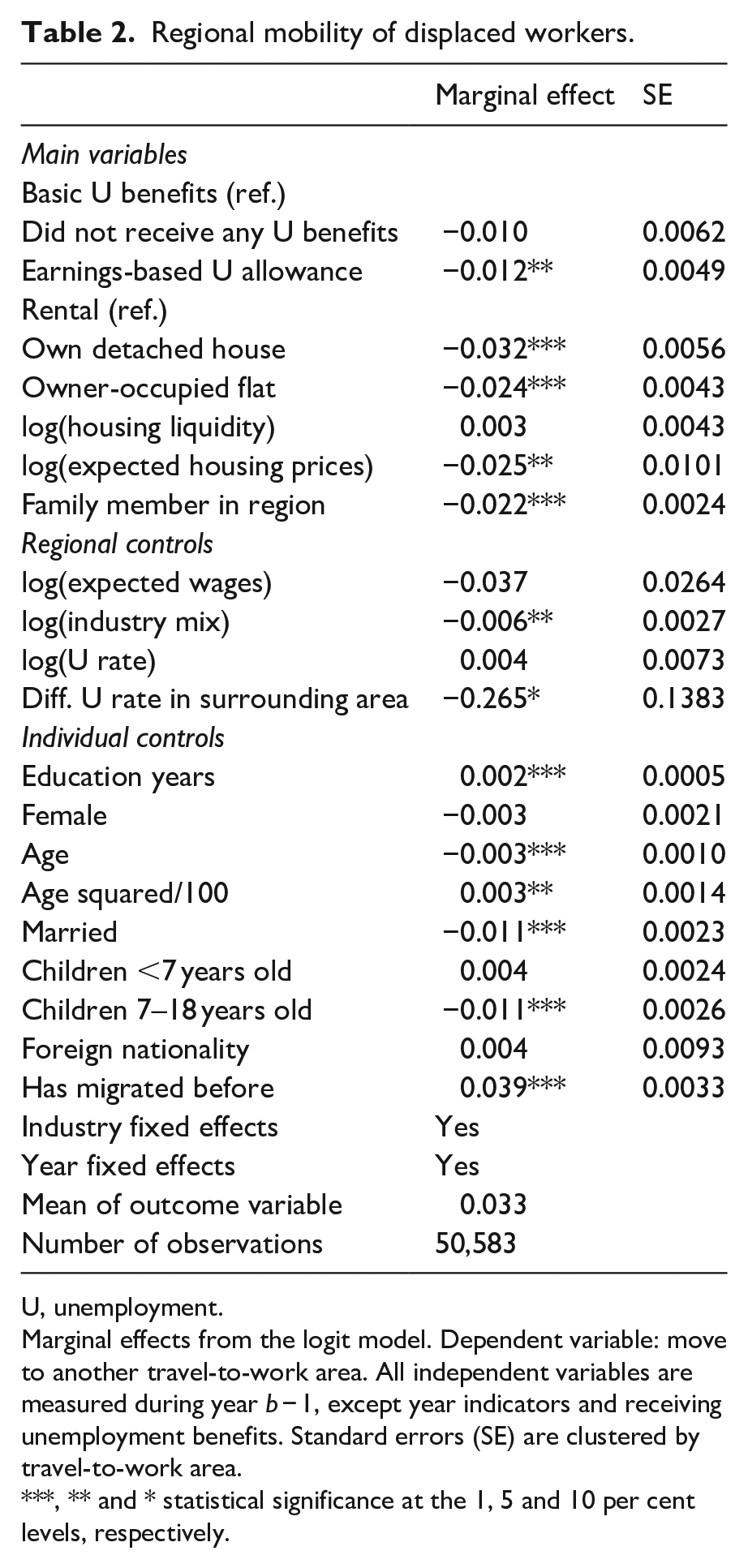
U, unemployment.
Marginal effects from the logit model. Dependent variable: move to another travel-to-work area. All independent variables are measured during year b − 1, except year indicators and receiving unemployment benefits. Standard errors (SE) are clustered by travel-to-work area.
, ** and * statistical significance at the 1, 5 and 10 per cent levels, respectively.
Second, the variables measuring housing market conditions reveal the expected effects, as homeowners are less likely to move than tenants, with the marginal effects corresponding to a decrease in the moving probability of 2.4–3.2 percentage points (approximately 40%–60%). Importantly, our results reveal that the negative association is significantly larger for those who own detached houses than for those who have owner-occupied flats. Moreover, higher housing prices outside the home region decrease the probability of moving, whereas house selling times (i.e. liquidity) are not statistically significantly associated with the propensity to migrate.
Third, the results show that proximity to family members is negatively related to migration. Individuals who live close to family members have a 2.2 percentage points lower probability of moving. As the average worker with no family members in a region has a 4.8 per cent probability of moving (Table 1), this estimate is roughly equivalent to a 46 per cent decrease in migration probability.
Additional individual-level control variables are also significantly linked to an individuals’ migration choices. For example, previous migration experience and education are positively related to moving probability, whereas being married and having school-aged children are negatively related to moving probability. Moreover, the results reveal that a higher concentration of workers’ initial working industry in a region and a higher unemployment rate in the surrounding regions are negatively related to moving decisions. Notably, expected wages do not affect moving decisions following job displacement.
Robustness
As a robustness check, we estimate the migration model using a longer post-displacement period (b + 5). The marginal effects of the determinants of moving are documented in Table A1 of the Supplemental Appendix. The results remain generally unchanged. The only notable exception is that receiving a higher earnings-based unemployment allowance is no longer a statistically significant determinant of long-term interregional mobility decisions. The fact that a generous unemployment allowance seems to affect migration decisions only in the short term is plausible, given that the allowance for unemployed individuals lasts less than 18 months in Finland.
Heterogeneity by education and region
Table 3 reports the marginal effects of the main variables (receiving unemployment benefits, regional characteristics, and social connections) and regional controls for displaced workers disaggregated by education level and the type of region. These results provide additional policy-relevant insights into the determinants of migration. The negative link between receiving earnings-based unemployment allowance and interregional migration is statistically significant for lower educated people but not for highly educated people (columns 1 and 2) and for people who live outside the Helsinki area but not for those who live in the Helsinki area (columns 3 and 4).
Regional mobility of displaced workers by education level and region.
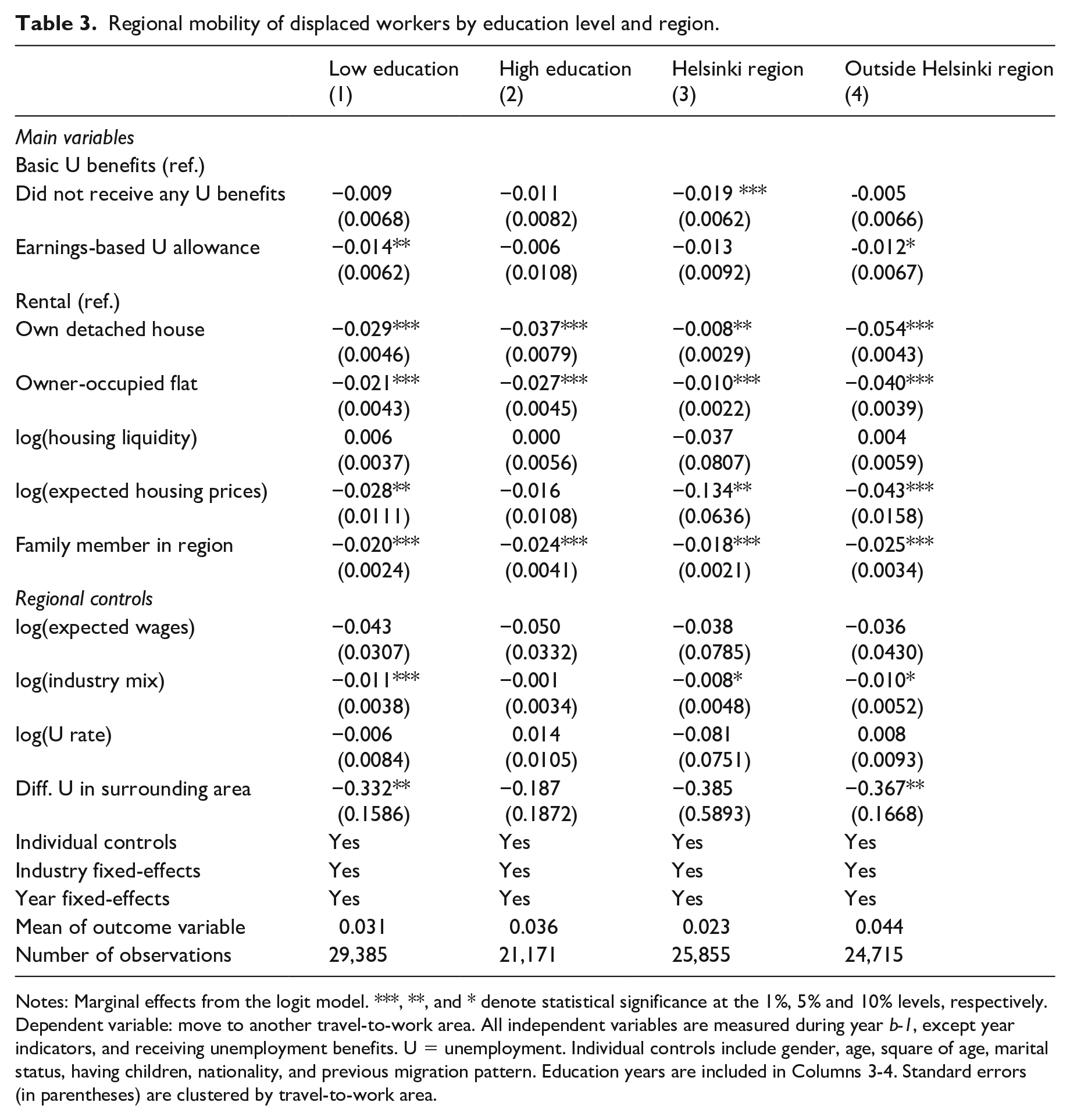
Notes: Marginal effects from the logit model. ***, **, and * denote statistical significance at the 1%, 5% and 10% levels, respectively. Dependent variable: move to another travel-to-work area. All independent variables are measured during year b-1, except year indicators, and receiving unemployment benefits. U = unemployment. Individual controls include gender, age, square of age, marital status, having children, nationality, and previous migration pattern. Education years are included in Columns 3-4. Standard errors (in parentheses) are clustered by travel-to-work area.
The marginal effects of owning a detached house or owner-occupied flat are all negative and statistically significant for each group, showing that owning a home is an important constraint on migration and affects all worker groups similarly. However, when we examine the effect sizes as percentage changes in probabilities, the negative association of owning a detached house on the migration probability is significantly lower (~20%) for people living in the Helsinki area than outside the Helsinki area (~60%). Moreover, we find that higher housing prices outside the home region negatively affect moving decisions, except among the highly educated group.
Our results also reveal that living close to a family member is negatively related to migration following job displacement for each group, and these associations are quite similar in magnitude (in terms of percentage changes in probabilities) for people living in the Helsinki area or outside the Helsinki area (~50%). Moreover, we find that highly educated displaced workers seem to value social connections more in their migration decisions than lower educated displaced workers (~30% vs 50%). The results for other regional control variables suggest that the moving decisions of less-skilled workers are more determined by regional differences in job opportunities than those of high-skilled workers, which accords with Arntz (2010).
Discussion
We investigated the primary determinants of regional labour market dynamics in the European context. Our empirical analysis was based on nationwide employer–employee panel data from Finland that were linked to registers containing comprehensive information on earnings-related unemployment benefits, housing market conditions, regional characteristics and the location of family members. The central question is why so many displaced workers remain in their home regions. Moreover, what motivates individuals to relocate to a country such as Finland, given its extensive Nordic welfare system, low wage inequality and earnings-based unemployment benefits? As De Haas (2021) highlights, individual mobility is as much a social norm as staying in one’s home region.
We find that significant obstacles in the Finnish labour market hinder efficient matching between displaced workers and potential jobs across regions. To date, the empirical literature has paid only a little attention to the role of earnings-based unemployment benefits as determinants of economic incentives to migrate. Notably, the Finnish economy is characterised by generous earnings-related unemployment benefits that compensate for a large proportion of lost earnings during the early phases of unemployment. As a novel contribution to the literature, using nationwide individual-level data, our empirical findings highlight that receiving earnings-based unemployment benefits substantially weakens economic incentives for interregional mobility, further weakening the interregional relocation of labour resources. Importantly, our results also reveal policy-relevant heterogeneity in this relationship. We find that the negative association between receiving earnings-based unemployment benefits and interregional mobility is stronger for lower-educated than for highly educated individuals and for people living outside the Helsinki region than those living in the Helsinki metropolitan region. This finding underscores that opportunities exist to improve the spatial mismatch of the lower-educated workforce (mostly blue-collar workers) living outside the Helsinki metropolitan region.
Although our results regarding housing markets are mostly consistent with earlier evidence on migration in Europe (Böheim and Taylor, 2002; Hämäläinen and Böckerman, 2004; Munch et al., 2008), we broaden the understanding by studying the different roles of living in detached houses versus owner-occupied flats. Notably, we find that those who own detached houses have a much lower probability of migrating than those who have owner-occupied flats. Moreover, the heterogeneity analysis reveals that this negative link is considerably stronger among people who live in more rural areas than among people who live in the Helsinki metropolitan region. A plausible explanation for this observation is that it is particularly difficult to sell an owned detached house in rural regions that suffer from long-term unemployment and persistent outmigration of the working-age population.
Studies from other Nordic countries have shown that people prefer to live close to their family members and friends, and in their childhood regions, thus linking social connections closely to migration decisions (Dahl and Sorenson, 2010; Huttunen et al., 2018; Ilyés et al., 2023; Mulder et al., 2020; Mulder and Malmberg, 2014). We find that broader social determinants of migration are also relevant for interregional mobility in Finland because displaced workers strongly prefer staying in their home regions if childhood family members live there. Moreover, the heterogeneity analysis reveals that highly educated workers seem to value social connections more than lower-educated workers in their migration decisions following job displacement.
A limitation of our study is that it presents descriptive evidence of migration patterns. There is a potential endogeneity concern because (future) displaced workers with different individual characteristics may self-select into firms that have lower or higher firm survival probabilities. In an ideal research setting, workers would be randomly selected into non-displaced and displaced firms. An approach to mitigating these endogeneity concerns would be using the Heckman selection model, which relies on strong exclusion restrictions. Overall, displaced workers may not represent the general population, and the use of information on job displacements implies that the external validity of the results may be limited, at least to some degree. We cannot draw cause-and-effect conclusions from the estimates due to unobserved individual characteristics, which may affect variables such as whether workers join the unemployment insurance fund.
Some knowledge gaps about migration patterns follow from our findings and could prompt further research. These include a more causal evaluation of the effect of the duration or level of the earnings-based unemployment allowance on migration decisions, potentially utilising the methods presented in Kyyrä and Pesola (2020a, 2020b). Considering social ties, the migration choices of dual-income families also present a significant area for future research, given that the evidence on this topic from Finland is nearly 20 years old (Nivalainen, 2004, 2005). For example, researchers could study whether dual-income families are likelier to move if the husband, rather than the wife, lose their job after a plant closure. Moreover, reallocation leads to potential adjustment costs that could be mitigated by policy interventions, such as providing training, skills, or subsidies for individuals who have lost their jobs and who have difficulty finding new jobs in migration destination regions. Notably, Caliendo et al. (2017) studied the impact of a subsidy programme that covered moving costs to encourage the unemployed to search for and accept jobs in distant regions. The results showed that the subsidy increased the probability of moving, and participants also received higher wages and found more stable jobs than non-participants. These positive effects were mainly explained by better job match due to the increased job search radius of the participants. More research is evidently needed to determine whether similar policies would work in other European countries, including Finland.
Our study provides policy-relevant insights into the determinants of migration in Nordic countries, which are sparsely populated nations with similar social welfare policies and labour institutions. The exception is Denmark, which is one of the most densely populated countries in Europe. This implies that the rate of interregional migration is presumably lower in Denmark than in other Nordic countries, and one would expect to see weaker roles of different determinants of migration in Denmark than in other Nordic countries. Earlier studies using Danish data find that technical workers respond to regional differences in wages but greatly prefer living close to family members after job displacement (Dahl and Sorenson, 2010). Hansen et al. (2021) highlight the migration dynamics of a representative sample of displaced workers, finding that workers in non-urban regions are less likely to move than displaced workers in urban regions. A natural extension of our work would be to investigate whether there are similar links regarding, for example, unemployment benefits and housing market conditions in other Nordic countries.
Conclusion
There is an ongoing debate about the duration and level of allowance payments in Finland. Recent surveys indicate that over half of new lawmakers support cuts in earnings-related unemployment benefits. A prominent proposal is to cut the duration of the allowance from 400 to 200 days. Recent studies in Finland show that longer benefit periods, as well as higher unemployment benefit levels, tend to increase unemployment duration (Kyyrä and Pesola, 2020a, 2020b). Our results highlight that the unintended consequences of earnings-based unemployment benefits on interregional mobility should receive more attention. These findings could be used to improve the design of income support systems for the unemployed, which would contribute to better interregional allocation of labour resources, encouraging the unemployed to find work quicker and in other areas. However, cuts in earnings-based unemployment benefits may also decrease expected wages (Kyyrä and Pesola, 2020a), prompting people to accept job offers that do not match their skills.
Finland is also characterised by a generous housing allowance, meeting a maximum of 80 per cent of acceptable housing costs, such as rent and any charges paid separately for water and heating. 12 Although the housing allowance makes it easier to acquire new rental property in another region after job displacement, our results suggest that it is still important to promote more affordable housing options in urban areas with better job opportunities. This would make migration an economically more feasible option for displaced workers because higher housing prices significantly weaken incentives to move. Affordable housing options or direct subsidies should be aimed at those who own detached houses and those who live in rural areas. Urbanisation has led to the polarisation of housing markets, making it more difficult to sell owned detached houses in rural areas, although housing prices have fallen consistently in those regions. Therefore, improving the functioning of housing markets would reduce large, persistent regional disparities in unemployment and, hence, structural unemployment. For example, earlier Finnish evidence indicates that higher real estate transfer taxes reduce migration flows (Eerola et al., 2021). Importantly, real estate transfer taxes in Finland are much higher for those who own detached houses than those with owner-occupied flats. We thus argue that cuts in real estate taxes could enhance interregional migration. There are two potential mechanisms for this. First, home seekers could be encouraged to buy their own houses, potentially in other areas, because real estate taxes would be lower, and second, home sellers could sell their houses more quickly, encouraging them to move to other areas.
Our evidence also highlights that social connections with family members are important predictors of the propensity to move (or not move) to another location. However, it is challenging for public policymakers to influence non-economic incentives to migrate because they would require changes in cultural and societal norms. One may argue whether such changes are desirable. We acknowledge that some people may prefer to stay in regions with high unemployment because they place more value on other amenities, such as nature, and prefer to stay in their birth regions due to family and social connections. This accords with research showing that the main motives for migration are often not related to employment incentives (Lundholm et al., 2004; Niedomysl, 2011). This places even more pressure on policymakers to redesign economic and financial incentives (including the earnings-based unemployment benefit system) to encourage interregional mobility, support labour market dynamics and maintain robust long-term economic growth. Overall, there is very limited evidence of explicit policy designs that could be implemented to enhance internal migration. Clearly, there is a need for further empirical studies to support the design of policy interventions and to identify the most effective policies for diminishing regional inequalities in Europe.
Supplemental Material
sj-docx-1-eur-10.1177_09697764231186746 – Supplemental material for Losing a job and (dis)incentives to move: Interregional migration in Finland
Supplemental material, sj-docx-1-eur-10.1177_09697764231186746 for Losing a job and (dis)incentives to move: Interregional migration in Finland by Terhi Maczulskij and Petri Böckerman in European Urban and Regional Studies
Supplemental Material
sj-docx-2-eur-10.1177_09697764231186746 – Supplemental material for Losing a job and (dis)incentives to move: Interregional migration in Finland
Supplemental material, sj-docx-2-eur-10.1177_09697764231186746 for Losing a job and (dis)incentives to move: Interregional migration in Finland by Terhi Maczulskij and Petri Böckerman in European Urban and Regional Studies
Footnotes
Acknowledgements
The authors wish to thank the following for helpful comments: Three anonymous reviewers, Tuomas Kosonen, Piera Bello, Labour Institute for Economic Research Institute seminar audience, VATT seminar audience and IIPF and EALE conference audiences.
Declaration of conflicting interests
The author(s) declared no potential conflicts of interest with respect to the research, authorship and/or publication of this article.
Funding
The author(s) disclosed receipt of the following financial support for the research, authorship and/or publication of this article: Financial support from the Academy of Finland Strategic Research Council project Work, Inequality and Public Policy (number 293120) and Palkansaajasäätiö are gratefully acknowledged.

Supplemental material
Supplemental material for this article is available online.
Notes
References
Supplementary Material
Please find the following supplemental material available below.
For Open Access articles published under a Creative Commons License, all supplemental material carries the same license as the article it is associated with.
For non-Open Access articles published, all supplemental material carries a non-exclusive license, and permission requests for re-use of supplemental material or any part of supplemental material shall be sent directly to the copyright owner as specified in the copyright notice associated with the article.
