



Abstract
In spite of the recognition that entrepreneurship and innovation are interlinked, very few studies have attempted to articulate this relationship. The aim of this article is to explain the nature of the relationship between entrepreneurship and innovation in large firms, arguing that entrepreneurship is an antecedent to innovation. The study employs a multidimensional entrepreneurial architecture (EA) framework for the first time and tests the effect of a battery of entrepreneurship measures on innovation output, which is reflected as degree and frequency of incremental and radical innovations. Adopting a quantitative approach, data were collected from 400 corporate firms in Oman representing various sectors of the economy. The EA dimensions reflected through entrepreneurial culture, entrepreneurial structure, entrepreneurial strategies and entrepreneurial leadership were tested through measurement and structural modelling. The results confirmed that entrepreneurship is a precursor to innovation. The EA framework, through its four dimensions, creates a collaborative and complimentary intensity that promotes innovation outputs, which may not be possible from the isolated effects of individual factors. The present study extends the extant literature, explaining how these entrepreneurship measures synergistically impact varying levels of innovation output. It has practical implications for managers in large firms involved in promoting innovation. They can transform the existing organisational architecture into an EA, by transplanting these entrepreneurship measures and creating a framework that promotes innovation.
Keywords
The role of entrepreneurship in promoting innovation in large firms has received considerable empirical attention. There is a widely held view in the literature that entrepreneurship and innovation are tightly intertwined (Fagerberg, Fossas, & Sappprasert, 2012). However, the relationship between entrepreneurship and innovation is not well articulated (Landström, Åström, & Harirchi, 2013; Maritz & Donovan, 2013). One view, led by researchers such as Crossan and Apaydin (2010), postulated that entrepreneurship is a tool of innovators, while the other most commonly held view in the literature led by researchers such as Lewrick, Omar, Raeside and Sailer (2010) and Zhaou (2005) posited that innovation is a tool of entrepreneurs, arguing that innovation is a result of entrepreneurship. They observed that there are economic consequences of entrepreneurship, which are mostly manifested as innovation outcomes (Block, Thurik, & Zhou, 2013). Mcfadzean, O’Loughlin and Shaw (2005) acknowledged that without the presence of entrepreneurship within organisations, innovation only remains aspirational, rather than a possibility. Antonic (2006), Ireland, Kuratko and Morris (2006), Robert and Amit (2003) and Yildiz (2014) have all supported the central role of entrepreneurship in promoting innovation. In the context of large firms, entrepreneurship leverages innovation as a tool for strategic renewal and business venturing (Yildiz, 2014).
Taking a distinct view, Mittelstadt and Cerri (2009) stated that the relationship between entrepreneurship and innovation is co-dependent. Supporting them, Kuratko, Morris and Schindehutte (2015) explained the reciprocal nature of this relationship. They argued that by underpinning firm creation and firm expansion, entrepreneurship tends to promote innovation. On other hand, fostering policies for innovation supports entrepreneurship, characterised through spin-offs and strategic renewal. Thus, the debate on the nature of the relationship between entrepreneurship and innovation has driven researchers and scholars to search for empirical evidence, but a universal agreement on the issue has remained somewhat elusive (Shane & Venkataraman, 2000; Wiklund & Shepherd, 2008). Although entrepreneurial orientation studies (Covin & Wales, 2012; Dess, Pinkham, & Yang, 2011) have identified what constitutes entrepreneurship measures, it is still not clear how these can be implemented through an organisational framework in large organisations. Chesbrough (2003), Mcfadzean et al. (2005) and Morris, Kuratko and Covin (2011) have called for better understanding of entrepreneurial measures that influence innovation.
This study aims to fill this research gap by developing and testing a research framework, which clearly articulates that entrepreneurship is essential for innovation. Further, this study emphasises the need for an entrepreneurship framework that is instrumental in the implementation of measures that support innovation. It builds on previous studies affirming that during uncertain times and disruptive competition, innovation is a key tool to achieve competitive strength and strategic renewal (Kuratko et al., 2015). The study for the first time uses a multidimensional entrepreneurial architecture (EA) framework, developed by Burns (2008, 2013), and tests its effect on innovation output, reflected as degree and frequency of innovation (Bessant & Tidd, 2011). Further, this study explains how organisational dimensions, namely, entrepreneurial culture, entrepreneurial structure, entrepreneurial strategies and entrepreneurial leadership (CSSL), the four dimensions of EA, influence varying levels of innovation output in firms. The study argues that the four CSSL dimensions can be designed entrepreneurially by transplanting the EA measures into a large firm. It therefore not only sheds more light on the nature of relationship between entrepreneurship and innovation, but also validates entrepreneurship measures that can be instrumental in promoting innovation in large firms.
The entrepreneurship measures identified and empirically validated in this study are informed by a comprehensive 100-item EA measurement scale, called CEA audit, developed by Burns (2013). Further, the study was informed by an exhaustive literature search on entrepreneurship measures promoting innovation. This study suggests that the aggregated effect of multidimensional EA factors and associated measures creates an orchestrated and collaborative force that enhances innovation in large firms. A combined action of multiple entrepreneurship factors, as compared to isolated efforts, is needed to spur innovation because innovation is a broad, complex and multistage process and needs enabling organisational conditions (Bessant & Tidd, 2011). This is in line with the arguments put forward by Dalohoun, Hall and Van Mele (2009), who stated that the combined effort of multiple entrepreneurship factors not only creates an innovation-enabling environment, but also enhances innovation. Considering the fact that EA is a multidimensional construct, aggregates of heterogeneous measures statistically, can provide a complete understanding of entrepreneurial behaviour in organisations, as compared to only specific dimensions studied in isolation (Edwards, 2001; Frieman, Saucier, & Miller, 2017).
This is especially relevant for large firms, which tend to undervalue entrepreneurship under pressures of growth and efficiency and create bureaucratic obstacles to change and innovation (Badal, 2013). As a result, large firms struggle to find a universal solution for promoting innovation (Hansen & Birkinshaw, 2007). They recommended an end-to-end view of the organisation and proposed an entrepreneurship framework that supports innovation. Hosseini, Hossein and Brege (2012) also called for creating an entrepreneurship framework, where coordinated and collaborative entrepreneurship efforts are undertaken to promote innovation.
Entrepreneurial Architecture Framework
The EA was conceptualised by Burns (2008, 2013), as an entrepreneurship framework for large firms. The EA was largely informed by organisational architecture literature, which has seen more than 50 years of academic development, since it was first proposed by Sayles (1964). It was later developed by Kay (1998), Grant (2010) and Tushman, et al. (2006). Brizek (2014), Nelles and Vorley (2011) and Tahseen Arshi (2012) found EA to be a useful amalgamation of entrepreneurial measures.
Organisational architecture factors usually comprise of organisational culture, structure, strategies and leadership factors (CSSL). The fact that entrepreneurship can be infused into CSSL factors has found support in the literature. A substantial amount of research was found that investigated the effect of individual CSSL factors on innovation. The studies on the effect of organisational culture on innovation gave insight into measures of an entrepreneurial culture that promotes innovation. Büschgens, Bausch and Balkin (2013) included measures related to norms and values focused on valuing people and ideas. Cameron and Quinn (2011), Glisson (2015) and Nham, Pham and Ngyuen (2015) called for embedding effective human resources practice into organisational culture. Primary among them were reward and retention strategies and team development. Hofstede, Hofstede and Minkov (2010) and Yildiz (2014) reported that collectivist culture and low power distance promotes innovation. A number of organisational climate studies, including those by Amabile (1997) and Isaksen and Evkall (2010), used extensive measures related to idea generation, rewards and recognition, resource allocation and organisational support (Balker, 2015). Bastic and Leskovar-Spacapan (2006), Gürkan and Tükeltürk (2017) and Youngblood (2007) opined that a quantum culture, characterised through speed, responsiveness, creativity, tolerance for risk and failure are important measures of an organisational culture that can promote innovation.
The studies on the effect of organisational structure on innovation were mapped with Burn’s (2013) EA measures and were found to be similar. Prominent among them were from Nagji and Tuff (2012) and Dlugoborskyte, Petraite and Buse (2015), who recommended removal of bureaucratic controls, and Ahmed and Shepherd (2010) and Demrici (2013), who called for independence of operating divisions. On similar lines, Gürkan and Tükeltürk (2017) believed that organic structures are better suited for innovation compared to mechanistic structures. These are characterised through flatness, low specialisation and decentralised decision-making. Finally, Allen and Henn (2007) and Knott (2012) called for creation of formal and informal networks to promote innovation.
The studies on the effect of organisational strategies on innovation were useful to analyse the measures of entrepreneurial strategies that promote innovation. Kuratko et al. (2015) and Teece (2012) concurred that strategies to promote innovation involve developing dynamic capabilities and resources. Strategic focus on creating intellectual, social and relational assets was found to be influencing innovation (Bogers, 2011; Dobni, Klassen, & Nelson, 2015; Lavie, 2006; Subramaniam & Youndt, 2005). An open innovation strategy and crowdsourcing were supported by Afuah and Tucci (2013). Finally, market entry strategies were linked to innovation by Ahmed and Shepherd (2010), Lerner (2010) and Kim and Mauborgne (2005).
The studies on the effect of organisational leadership on innovation gave insight into the measures of entrepreneurial leadership that promotes innovation, many of which were part of Burn’s (2013) EA measures. Sarros, Cooper and Santora (2011) found leadership dimension to be positively influencing innovation. Specific leadership style that was linked to innovation was transformation leadership style, which included a vision for innovation, inspirational motivation and team or collective leadership (Denti, 2011; Zacher & Rosing, 2015). Another leadership style that was linked to innovation was self-leadership and distributive leadership characterised through autonomy and trust (Neck & Houghton, 2006; Spillane, 2006). Considering the fact that entrepreneurship can be infused into CSSL factors, the following hypothesis was developed:
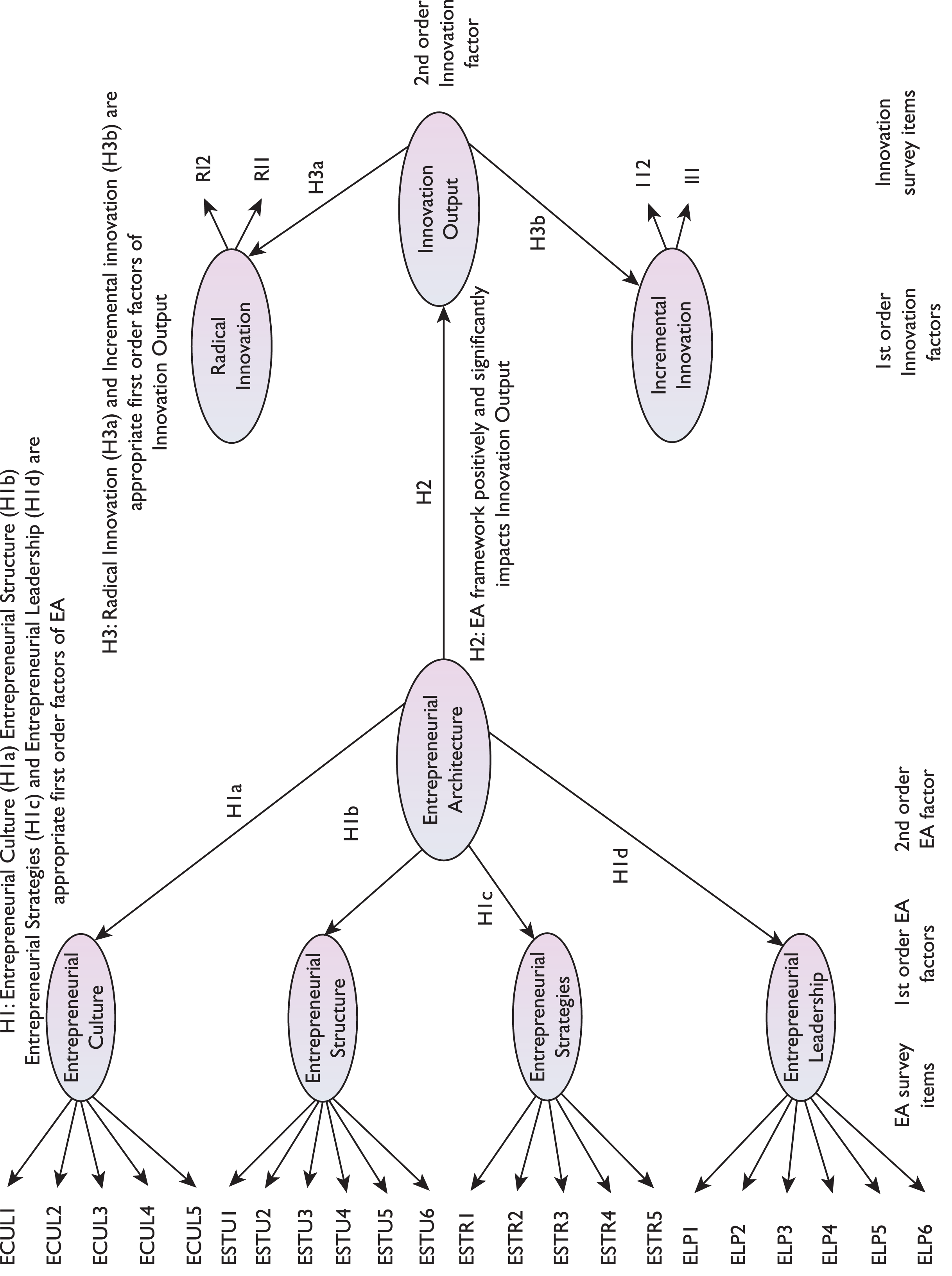
Hypothesis 1: Entrepreneurial culture (H1a), entrepreneurial structure (H1b), entrepreneurial strategies (H1c) and entrepreneurial leadership (H1d) reflect entrepreneurial measures and hence are appropriate first-order factors of EA.
A sizeable amount of literature was found to have investigated the effect of a combination of CSSL factors on innovation in large firms. Primary among them were Beheshtifar and Shariatifar (2013), who studied the relationship between organisational structure and culture on innovation. Similarly, Apekey, Mc Sorley and Tilling (2011) and Melnyk and Davidson (2009) examined the role of organisational culture and leadership in promoting innovation. Further, Muller, Malikangas and Merlyn (2005) and Rainey (2006) studied the effect of organisational strategy and leadership on innovation. Although these studies were useful in providing insights into the effect of individual or a combination of factors on innovation, they were not able to shed much light on the combined effect of all CSSL factors on innovation output (Rutherford & Holt, 2007). It is argued that in quantitative studies like these, where measurement and validity are key goals, the aggregate effect of multidimensional measures has the potential to create valid scales (Edwards, 2001). Individual factors may provide useful insights into measures related to a single dimension, but they can be dependent on other dimensions and their measures. These measures may therefore complement or support each other. An EA, as a result, can be more effective in promoting innovation output. Therefore, the following hypothesis was developed.
Hypothesis 2: EA framework positively and significantly impacts innovation output.
Since this study supported the proposition that innovation is a result of entrepreneurship, only output measures of innovation, as conceptualised by Rosenbusch, Brinckmann and Bausch (2010), were considered in this study. Output measures of innovation usually reflect in markets in the form of products and services. Output factors of innovation are largely represented as degree or scale of innovation, often termed as incremental and radical innovations. Degree of innovation is applicable to most categories of innovation outputs (Bessant & Tidd, 2011; Morris & Kuratko, 2002). The frequency of innovation was also found to be valid measure of innovation output by Tahseen Arshi (2017). He found it to be associated more with incremental innovation, rather than radical innovation. Incremental innovation is explained by Conway and Stewards (2009) as learning by doing and incremental improvements over time with higher frequency, while radical innovation was explained as major advancement in a particular field. Bessant and Tidd (2011) pointed out that radical innovation disrupts the markets and competition, however with lower frequency, compared to incremental innovation. Based on the proposition that innovation output is reflected through innovation degree, the following hypothesis was developed.
Hypothesis 3: Radical innovation degree (H3a) and incremental innovation degree (H3b) are appropriate first-order factors of innovation output.
Research Framework
The research framework in Figure 1 shows that the first-order CSSL factors of the second-order EA construct are reflective of entrepreneurship measures. Similarly, the first-order radical and incremental innovation degree factors of the second-order innovation output construct are reflective of innovation measures. The research framework was developed to test the validity of the reflective measures and the hypothesised relationship between EA and innovation output.
Methodology
Epistemological positioning for this research was an important consideration because it influenced how the research objectives were framed, hypotheses developed and research approaches aligned (Saunders, Lewis, & Thornhill, 2010). This study adopted a positivist and realist approach and followed a deductive approach with most of the variables identified from the theoretical frameworks (Fisher, 2004). Quantitative research strategies were helpful to reduce the data, test relationship between variables, test hypothesis, validate existing scale and arrive at findings. Measurement, causality and validity therefore assumed importance in this research. Qualitative strategy was limited to confirming the results and refining measures. Once the quantitative study was completed, the measures were reconfirmed by corporate managers through qualitative interviews.
Sample
A total of 580 large firms based on Institutional Standards Classification by Oman Chamber of Commerce and Industry were selected for the study. After receiving a prior consent from these firms, a structured questionnaire was sent to the senior managers (one from each firm) representing different sectors of the economy. Out of 405 firms that responded, 400 responses were considered fit for analysis and were found adequate based on Yamane’s formula.
Measures
The items for the EA construct were derived mainly from EA scale developed by Burns (2008, 2013) and mapped against related scales and the literature. The measures for innovation output were derived from the models from Rosenbusch et al. (2010), Morris and Kuratko (2002) and Bessant and Tidd (2011). The initial research instrument was piloted and the items were pretested qualitatively by experts and practitioners. A total of 44 items were refined, psychologically dissociated and selected.
Results
Homogeneity of variances indicted that the sample across different sectors was homogeneous (indicated by Levene’s statistic >0.05 and single column Tukey’s honest significant difference [HSD] test) on all demographic factors such as experience in the company and industry. The results showed a high level of reliability with Cronbach’s alpha score of 0.893. The Kolmogorov–Smirnov and Shapiro–Wilk test values (>0.000) indicated that the data were derived from a normally distributed sample. No presence of multicollinearity was detected as the VIF values were <0.2. Ideally, the presence of multicollinearity is detected when the VIF values are >2 (Tabachnik & Fidell, 2013). All items were subjected to exploratory factor analysis involving principal components analysis with promax rotation and Kaiser normalisation as suggested by Kline (2010). The results of exploratory factor analysis through pattern matrix showed that the measures satisfactorily loaded on to their respective factors (>0.40, p < 0.05). The factor matrix comprising of 44 items identified 10 measures each in four groups for EA and 4 measures in two groups for innovation, which had eigenvalues >1 and keeping a minimum factor loading cut-off value >0.40. The Kaiser–Meyer–Olkin (KMO) test showed a score of 0.882 indicating the usefulness of factor analysis data fit for structural equation modelling (SEM) tests.
Structural Equation Modelling Tests and Hypothesis Testing
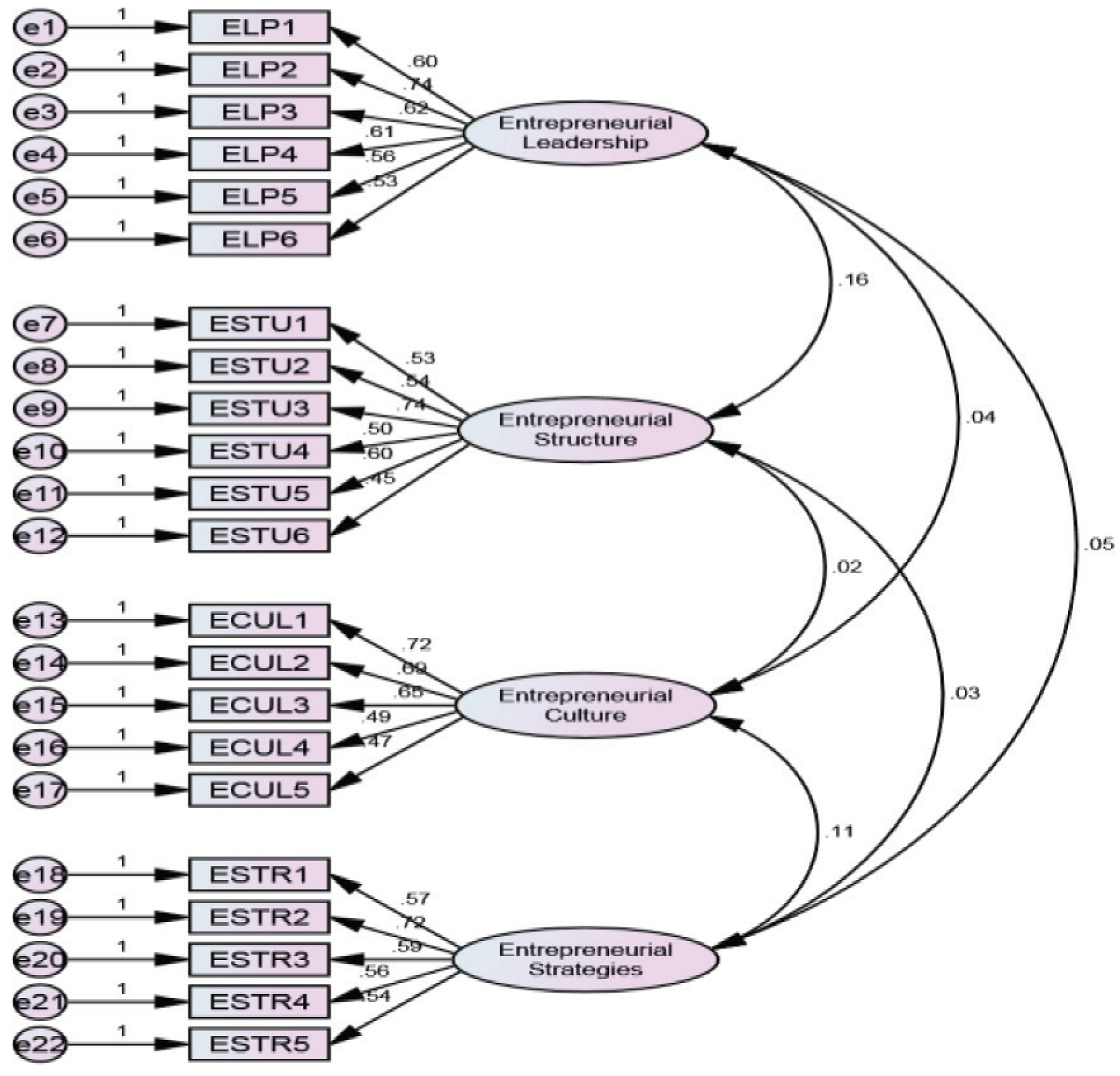
The SEM tests were conducted to test the validity of the EA factors and measures in this study. The SEM allowed testing of a set of relationships between one of more independent variables and one or more dependent variables. Westland (2015) considers SEM to be an appropriate tool as it tests modelling interactions, non-linearity, correlated independents, correlated errors and error terms. This is the reason that SEM is also referred as measurement model and causal model terms which will be used in this study. The measurement model (Figure 2) was estimated based on MLM using AMOS (version 22). The tests confirmed validity of 22 of the 40 measures of the EA scale. All the four measures of innovation were found to be valid in the structural model (Figure 3). Figure 2 shows the measurement model for EA and factor loadings, which were above the recommended range (>0.40, p < 0.001), as suggested by Tabachnik and Fidell (2013). The model fit indices met the required standards recommended by of Tabachnik and Fidell (2013).
Based on the cut-off criteria (>0.40), 18 items were removed from the measurement model leaving 22 valid items. All the measures loaded satisfactorily on to their measure showing convergent validity, while discriminant validity was shown through low covariance scores (Figure 2). Based on the findings, H1(a–d) is well supported positively and significantly (path coefficient values: 0.77; 0.59; 0.61; 0.74, p < 0.001) (Figure 3). Therefore, H1(a–d) is accepted proving that entrepreneurial culture (H1a), entrepreneurial structure (H1b), entrepreneurial strategies (H1c) and entrepreneurial leadership (H1d) reflect entrepreneurial measures and hence are appropriate first-order factors of EA. Further, to analyse the impact of EA on innovation, the causal relationship was tested as the complete SEM model and the results are shown in Figure 3.
Based on the cut-off criteria (>0.40), all items were validated in the measurement model and retained in the SEM model. H2 is also well supported positively and significantly as the complete SEM model showed that EA framework positively and significantly impacts innovation output (path coefficient value: 0.79, p < 0.05). All the fit indices were satisfactory with recommended ranges as suggested by Gaskin (2012). All the paths were significant ( p < 0.001). Based on the findings, H3(a and b) is also supported positively and significantly as radical innovation degree (H3a) (path coefficient value 0.51, p < 0.001) and incremental innovation degree (H3b) (path coefficient value 0.67, p < 0.001) are appropriate first-order factors of innovation output.

Validity
Validity theorists argue that construct validity is a primary concern and is overarching on other types of validity (Hair, Black, Babin, & Anderson, 2010). Construct validity helps to measure a construct, which is operationally difficult to define. In such cases, inferences are made based on the test scores (William & Wragg, 2004). In this study, construct validity was determined primarily to assess whether the measure behaved in accordance with the theory. Jeremy and Park (2009) pointed out that if all observed variables load satisfactorily on each factor (>0.40), then it is an indication of convergent validity. Convergent validity was also established through AVE scores >0.50, which indicated more indicator variance than variance due to error. Since the shared variance between the latent constructs’ indicators was higher than the variance shared with other latent variables, it indicated the presence of discriminant validity (Götz, Krafft, & Liehr-Gobbers, 2010).
Discussion
The results show that 22 measures across CSSL factors are significant measures of EA and are precursor to innovation output. It establishes that entrepreneurship is instrumental in promoting innovation in large firms. The measures are summarised in Table 1.
Validated Measures of Entrepreneurial Architecture

Validated Measures of Innovation

These measures as shown in Table 1 provide an insight into an entrepreneurial organisational design framework. They promote innovation through a coordinated and collaborative effort that can act as enabling and guiding factors for corporate firms. The magic pills of standalone initiatives to create an entrepreneurial organisations are abound, but however well intentioned they may be, can be subject to failure in the absence of a framework as proposed by EA. The entrepreneurship measures within the EA framework act synergistically and create a collaborative force to promote innovation. The discussion below explains how different entrepreneurship measures influence varying levels of innovation output. Table 2 shows the innovation output measures. The detailed measures of entrepreneurial architecture and innovation are shown in Tables 3 and 4.
Detailed Measures of Entrepreneurial Architecture

Detailed Measures of Innovation

Entrepreneurial Culture
Entrepreneurial culture was found to be a valid dimension of EA. The entrepreneurial culture dimension was represented through the five significant culture characteristics: team working [ECLU1], valuing people [ECLU2], time for learning [ECLU3], experimentation [ECLU4] and reward [ECLU5]. Items meaning entrepreneurial culture, structure, strategies, leadership and innovation are provided in Table 3. The findings of this study indicate that the measures of culture were similar to organisational climate measures, suggested by Amabile (1997) and Isaksen and Ekvall (2010). These studies also considered measures such as time for learning, experimentation and reward for ideas and innovation. Hashimoto and Nassif (2014) claimed that entrepreneurial culture characteristics such as valuing employees, reward systems and time for learning induce entrepreneurial behaviour among employees. Ideas and innovation flourish within such an entrepreneurial culture. They recommended that reward systems should be designed for new ideas, as well as for results of implementation of those ideas.
Team work is also seen as valuable measure in an entrepreneurial culture. Innovation is often a result of team work and cross-functional teams; in particular, they are adept to deal with creative tensions associated with innovation (José, Pérez, & Molina, 2017). Brettel, Heinemann, Engelen and Neubauer (2011) also reported a positive relationship between cross-functional teams and innovation. The entrepreneurial leadership measures like leadership trust [ELP3], vision [ELP4] and entrepreneurial structure measure such as delegated decision-making [ESTU6] support and complement these entrepreneurial culture measures. It is difficult to create an entrepreneurial culture in the absence of a clear vision for innovation, a trusting relationship between employees and leaders and delegated decision-making. Youngblood (2007) supported these entrepreneurial culture measures, where employees are treated as equal to or above financial concerns and motivation comes from an inspiring vision and empowerment. Such a culture promotes feelings of belongings, trust and creativity.
Entrepreneurial Structure
Entrepreneurial structure was found to be an appropriate measure of EA with six significant measures. The structure dimension emphasises loose organisational control (e.g., decentralisation, autonomy) and structures that monitor and manage risk and promote innovation (e.g., networking, team working). These characteristics are represented in the six significant structure characteristics: risk management [ESTU1], autonomous [ESTU2], spin-offs [ESTU3], networks [ESTU4], resources for new ventures [ESTU5] and delegated decision-making [ESTU6]. Some of the entrepreneurial strategy measures complement entrepreneurial structure characteristics related to customer feedback [ESTR1] and spotting opportunities [ESTR4], both of which can be helpful in creating spin-offs [ESTU3]. The entrepreneurial leadership measures also support spin-offs, which requires monitoring of market trends [ELP2] and clarifies uncertainties [ELP5]. The balance between risk taking and risk management goes to the heart of entrepreneurship. An entrepreneurial firm must take measured risks if it is to gain competitive advantage in a changing, uncertain environment, but it must also manage those risks if it is to survive. Large firms need to be consistent to value both risk taking [ESTR3] and risk management [ESTU1].
Gürkan and Tükeltürk (2017) and Nagji and Tuff (2012) emphasised that organisations that wish to nurture innovation must have structures that facilitate it. The literature on innovation emphasises the importance of formal and informal networks in providing information on new opportunities (e.g., Allen & Henn, 2007). Marks and Lockyer (2004) and Mulec and Roth (2005) also discussed how networking is crucial in gaining market insights and new commercial opportunities [ESTR4]. Thornhill and Amit (2001) asserted that divisions should enjoy considerable autonomy and lose control, provided that there is a strategic fit within the organisation. Autonomy and independence give the flexibility to respond to changes in the environment and adjust innovation objectives (Tsang, 2016). Firms can easily grow enamoured with the idea of transformational change and innovation, but should be cautioned that the transformation process cannot overcome fundamental structural disadvantages by it. A flawed organisational structure can jeopardise its effort towards change and innovation. An entrepreneurial structure coupled with an entrepreneurial strategy underpins any transformation effort that leads to innovation.
Entrepreneurial Strategies
Entrepreneurial strategy factor was found to be a valid element of EA with five significant measures. The entrepreneurial strategy dimension tends to be broad in scope, focusing on the importance of knowledge, information and learning. These characteristics are represented in the five significant strategy characteristics: customer feedback [ESTR1], crowdsourcing [ESTR2], risk taking [ESTR3], spotting opportunities [ESTR4] and resource sharing [ESTR5]. Crowdsourcing in particular is largely complemented by leaders’ openness to new business models [ELP1], entrepreneurial structure measures such as spin-offs [ESTU3], professional networks [ESTU4] and resource allocation [ESTU5]. For different forms of innovation, crowdsourcing is a relevant strategy for business venturing, whereby resources and technical skills and knowledge can be shared globally through online communities (Penin, 2008). Howe (2008) suggested that these collaborative partnerships can be created with professional forums, venture capitalists, universities, hobbyists and even customer groups. This has brought a paradigm shift in sourcing and manufacturing. Open innovation has made manufacturing just another cloud service. Common design file standards can be sent to web-based on-demand commercial manufacturing services to be produced in any number. Risk taking in this context revolves around chances of losing on patenting and intellectual property.
The results emphasise a strategic focus with an awareness of customer-focused opportunities. Debruyne (2015) and Martin (2011) opined that customers also influence different forms of innovation, particularly incremental innovation. Opportunity seeking, which is termed as proactiveness in entrepreneurial orientation literature (Covin & Lumpkin, 2011), is a key aspect of business venturing, without which innovation cannot be fully exploited. Rhee and Mehra (2013), Tang and Hull (2012) and Wang, Hermens, Huang and Chelliah (2015) suggested first mover strategies for innovation. An interesting aspect of the strategies related to innovation is that it also needs to be internally directed. Teece (2012) suggested the importance of internally directed strategies particularly those associated with resource sharing [ESTU6] and developing capabilities for innovation.
Entrepreneurial Leadership
The entrepreneurial leadership factor was found to be a key element of EA with six significant measures. The findings therefore support entrepreneurial leadership as a significant dimension affecting innovation, which is also supported by Sarros et al. (2011). The leaders’ ability to spark and sustain innovation in their organisations was highly regarded [ELP1], supported by a reward culture [ECUL5]. The leadership dimension reflects all the established characteristics of strategic leaders (strategic thinkers, learners and reflectors) and authentic leaders (emotional intelligence, self-awareness and self-management). While it also reflects elements of a number of leadership paradigms, it draws particularly on the transformational and delegated leadership literatures. These characteristics are therefore well represented in the six significant leadership characteristics: openness [ELP1], environmental monitoring [ELP2], trust [ELP3], vision [ELP4], clarification of uncertainty [ELP5] and influence rather than direction [ELP6]. However, they also need to be complemented by entrepreneurial structure measures such as autonomous structures [ESTU2] and delegated decision-making [ESTU6].
Leader’s vision was found to be a key measure that supports many other entrepreneurial measures across four dimensions. Sarros et al. (2011) highlighted the role of vision that challenges the status quo and promotes change, a characteristic represented in these results [ELP4]. Antonakis, Avolio and Sivasubramaniam (2003) maintained that leader’s ability to communicate the vision and inspire others to commit to their vision is critical. This motivates followers to achieve the vision (Waite, 2014), at the same time reassuring them that it can be achieved despite uncertainties (Ahmed & Shepherd, 2010). Transformational leadership is about vision, interpersonal skills, participation and empowerment [ELP1, 3, 4 and 6]. It inspires and prompts employees to emulate the behaviours of their leaders. Transformational leaders have the capacity to motivate and engage their employees beyond their excepted levels of performance and make them feel rewarded and engaged (Sarros et al., 2011). It is characterised by lower order factors such as idealised influence (related to leaders’ charisma), inspirational motivation and intellectual stimulation. Jung, Chow and Wu (2003) believed that transformational leaders enhance innovation by engaging and trusting employees, empowering them to take on new responsibilities.
Dispersed or distributive leadership is about trust, openness and delegation. It is characterised by influence rather than direction [LP1, 3]. It encourages leadership at all levels in the organisation. Spillane (2006) pointed out that distributive leadership is primarily characterised by strong interactions between leaders and followers. Deschamps (2005) supported the leadership role in bottom-up innovation, where the ideas are employee-driven, in a culture where people are not afraid to learn from their failures, experiment and take risks [ECUL3 and 4]. Similarly, Krause, Gebert and Kearney (2007) reported strong and positive relationship between delegative-participative leadership and process innovation [ESTU6]. Kuratko and Hodgetts (2007) pointed out that entrepreneurial leadership develop self-directing, self-managing and high performing teams that can initiate and handle transformational change.
The study highlighted the leaders’ ability to monitor threats and opportunities [LP2] and act strategically to encourage entrepreneurship. Environmental scanning is a critical characteristic of strategic leadership. Deschamps (2005) argued that leaders focused on innovation, think and act strategically by building teams to spot opportunities [ESTR4]. The literature also discussed strategic focus in the context of innovation and risk management. Borgelt and Falk (2007) pointed out that organisations will not be ready to take up risky projects until the leadership of the organisation supports risk-taking initiatives as part of organisational strategy [ESTR3]. De-Bertani (2001) observed that entrepreneurial leaders manage the resources for risky projects by interacting with multiple stakeholders including those outside the organisation [ESTU4].
Innovation Output
All four measures of innovation output, namely, degree and frequency of radical innovation [RI1 and RI2], and degree and frequency of incremental innovation [II1 and II2], were found to be significant in this study. Incremental innovation is an output measure that relates to improvements and modifications of products and services which have moderate effects on competitors and markets [II1]. The frequency of these incremental changes may vary, although higher levels of frequency may be evident [II2]. Radical innovation is also an output measure and relates to radical changes to products and services that have a significant impact on competitors as well as markets [RI1]. The frequency of these radical changes may vary, usually resulting in lower levels of frequency [RI2]. This is due to greater degree of research and development associated with radical innovation, which has implications on time and cost.
The valid measures of incremental and radical innovations in this study are similar to those identified by Nieto, Santamaria and Fernandez (2013), Tellis, Prabhu and Chandy (2009) and Wong (2014). Both forms of innovation are essential for firms impacting with varying degrees and frequency (Tahseen Arshi, 2017). Frequent radical innovation, although difficult to witness, provides the firm a substantially superior competitive position (Dunlop-Hinkler, Mudambi, & Kotabe, 2010). Avermaete, Viaene, Morgan and Crawford (2003) and Salavou (2002) remarked that frequent incremental innovation is a more commonly witnessed phenomenon, which provides a firm with sustained competitive advantage, an observation supported by Dong (2015) and Norman and Verganti (2014). While radical innovation has substantial impact on competition, customers and markets, incremental innovation involves improvements, searching and adjusting products and services based on multiple feedbacks (Alvarez & Barney, 2007; Bessant & Tidd, 2011). Dunlop-Hinkler et al. (2010) argued that both radical and incremental innovation can be combined at different stages of the business lifecycle to achieve sustained competitive advantage. The nature and outcome of innovation are multiple and complex and it is one of the reasons an appropriate entrepreneurship framework is essential, as it creates an entire framework of entrepreneurship measures that is critical to innovation value chain within and outside the organisations (Hansen & Birkinshaw, 2007).
Limitations
Although there may be other factors that promote innovation in organisations, they were not included considering the scope of this study. The robustness of the 22-item scale is generalisable in the present research setting as the measures were validated through a rigorous data analytic technique and a large sample size. However, the findings should be applied with caution because the research was conducted only within Omani corporate sector and its validity has not been checked in different economic settings. Burns (2013) observed that the exact form of an effective EA depends upon the environment, which can be different from country to country and sector to sector and vary over time with different competitive environments. He also observed that its influence might vary across different degrees of innovative intensity (degree and frequency). It therefore may be appropriate to include other qualitative inputs to provide contextual as well as statistical validity to the measures used.
Implications and Future Research Directions
The findings have important managerial implications. Firms cannot expect to be innovative unless their leadership, culture, structure and strategies are mutually consistent and entrepreneurial. The measures validated in this study are useful for managers to design entrepreneurial organisations. They cover a range of organisational dynamics and hence provide an appropriate framework that can guide managerial decision-making. Further, managers should not give preference to either forms of innovation as both incremental and radical innovations improve firm performance and operate at different levels of degree and frequency, all forms having an impact on customers, markets and competition.
Further research is needed to validate the transferability of these results and establish the EA framework as a more generalisable management tool to measure entrepreneurship within an organisation and its influence on different types of innovation. Further, the moderating and mediating effects of different variables between entrepreneurship and innovation should be analysed in future studies to bring more clarity in understanding such relationships. Finally, other critical dimensions of innovation such as frequency and speed have not been well investigated, which need empirical attention in future studies. It may also be of interest to researchers to investigate specific entrepreneurship measures focused separately for incremental and radical innovations.
Conclusion
This research supports EA measures and also supports the proposition that entrepreneurship precedes innovation. Large firms are susceptible to neglecting entrepreneurship, under pressures of growth and productivity, which can have a detrimental effect on innovation outputs. This study shows that large firms can retain entrepreneurship or in its absence transplant entrepreneurship into its organisational architecture. Therefore, EA measures can be helpful in guiding theoretical development and professional practice. Individually, the CSSL factors can promote innovation but the aggregate measures of an EA can support and promote innovation in large firms through a collaborative and complementary force. The EA measures weave a framework of supporting and collaborating acts of entrepreneurial behaviour resulting in enhanced innovation output. Such an entrepreneurial framework supports the implementation of innovation efforts across the organisations. It can be also concluded that there is a causal link between EA and incremental and radical innovations undertaken on a frequent basis. It supports the proposition that incremental innovation and radical innovation has varying levels of impact on customers, market and competition, since both vary in degree and frequency. The frequency of incremental and radical innovations may vary but both types of innovation provide substantial level of competitive advantage to large firms. Finally, it is concluded that both forms of innovation are independent of each other and therefore mutually exclusive.
Declaration of Conflicting Interests
The authors declared no potential conflicts of interest with respect to the research, authorship and/or publication of this article.
Funding
The authors received no financial support for the research, authorship and/or publication of this article.
Footnotes
Acknowledgements
We would like to thank Oman Chamber of Commerce and Industry for supporting this research. We would also like to extend our gratitude to all corporate firms who participated in this study. Finally, we are indebted to our colleagues at Majan University College and University of Bedfordshire, who provided insight and expertise that greatly assisted this research.