



Abstract
In pursuit of the beneficial outcomes of entrepreneurship, governments and regional development organisations enact policies to stimulate entrepreneurial activity. A growing focus of policymakers in emerging and developed economies is the promotion of entrepreneurial ecosystems: the interconnected system of forces that generate and sustain regional entrepreneurship. Despite intense interest in entrepreneurial ecosystems, the topic is under-theorised. Studies draw attention to the positive effects of entrepreneurial ecosystems on the creation and functioning of early-stage ventures; however, the specific mechanisms through which ecosystems influence entrepreneurs are not clear. To address this issue, we build on dynamic capabilities theory to create a theoretical framework that identifies a set of forces through which ecosystems influence entrepreneurship. We propose that in vibrant entrepreneurial ecosystems entrepreneurs are more able to sense, seize and reconfigure resources and opportunities. Our theory contributes to entrepreneurship research, has implications for policymakers and practitioners, and suggests directions for future studies.
Keywords
Introduction
Entrepreneurship, the creation and pursuit of innovative opportunities to produce value for society, is recognised by scholars and policymakers as a potent mechanism for economic and community development (Acs, 2006; Audretsch, Belitski, & Desai, 2015; Baumol & Strom, 2007; Seelos & Mair, 2005; Shane & Venkataraman, 2000; Valliere, 2016). Entrepreneurs create novel organisations, products and services, which are engines for job creation (Malchow-Møller, Schjerning, & Sørensen, 2011), technological advancement (Acs & Audretsch, 2003) and economic growth (Galindo & Méndez, 2014). Beyond its economic impact, there is also growing evidence of entrepreneurship’s ability to shape culture by influencing institutions and communities (Rindova, Barry, & Ketchen, 2009) and by generating solutions to social problems (Zahra & Wright, 2016). In these functions, entrepreneurship is a source of ‘emancipation’ (Rindova et al., 2009), enabling the pursuit of financial independence, the promotion of creativity and the disruption of the status quo (Stevenson, 1986).
Scholars increasingly acknowledge the social- and cultural-embeddedness of entrepreneurship (e.g., Smith & Stevens, 2010; Urban & Muzamhindo, 2018), which has shifted the focus of research from individual entrepreneurs to entrepreneurial ecosystems (EEs): the interrelated set of actors, organisations, resources and values that generate and support regional entrepreneurial activities (e.g., Acs, Stam, Audretsch, & O’Connor, 2017; Brown & Mason, 2017; Hechavarria & Ingram, 2014; Malecki, 2018; Roundy, Bradshaw, & Brockman, 2018; Spigel, 2017; Stam, 2015). The EE perspective emphasises that entrepreneurship is a social activity (Thornton, 1999). Entrepreneurs do not identify or develop opportunities in isolation; they are dependent on a complex and interconnected community of resource providers, customers, social and cultural forces and infrastructure (Ramachandran & Ray, 2006; Roundy, Brockman, & Bradshaw, 2017).
Research focuses on thriving and high-profile EEs in Silicon Valley (Kenney & Von Burg, 1999), Taiwan (Klingler-Vidra, Kenney, & Breznitz, 2016), Bangalore (Goswami, Mitchell, & Bhagavatula, 2018) and Edinburgh (Spigel, 2016) and, to a lesser degree, on nascent and emerging ecosystems (e.g., Bala Subrahmanya, 2017; Roundy, 2017a). These studies primarily emphasise the identification of successful EEs and their core attributes, such as early-stage investment, support organisations (e.g., incubators and accelerators), entrepreneurial human capital, social networks, stories of successful entrepreneurs and values that promote entrepreneurship (Isenberg, 2010; Neck, Meyer, Cohen, & Corbett, 2004). Recent studies examine how EE components are connected (e.g., Motoyama & Knowlton, 2017), the life cycle of EEs (e.g., Mack & Mayer, 2016) and ecosystem-level performance (e.g., Roundy et al., 2017; Stam, 2018).
Despite the insights produced by EE research, studies have not developed a theory explaining the mechanisms through which vibrant EEs influence entrepreneurial activity. Most studies examining EEs are built on the assumption that well-functioning EEs improve the ease of engaging in entrepreneurial activities; however, ‘how’ EEs and their core attributes influence entrepreneurs and improve the functioning of early-stage ventures is under-theorised. Thus, it is not obvious from prior research how, precisely, the components of vibrant EEs influence the emergence and intra-organisational functioning of new ventures.
To address this gap in EE research, and the general lack of theory in ecosystems research (Spigel, 2017), we extend work on dynamic capabilities to theorise about how vibrant EEs influence the capabilities of early-stage ventures. We propose a theoretical model that explains how the forces of vibrant EEs influence the dynamic capabilities associated with how entrepreneurs sense and seize new opportunities and recon-figure ventures in pursuit of opportunities. The proposed model (see Figure 1) and the theory that motivates it represent contributions to the entrepreneurship literature by integrating dynamic capabilities and EE research and identifying a set of specific mechanisms through which EEs influence entrepreneurs’ behaviours and the functioning of their ventures.
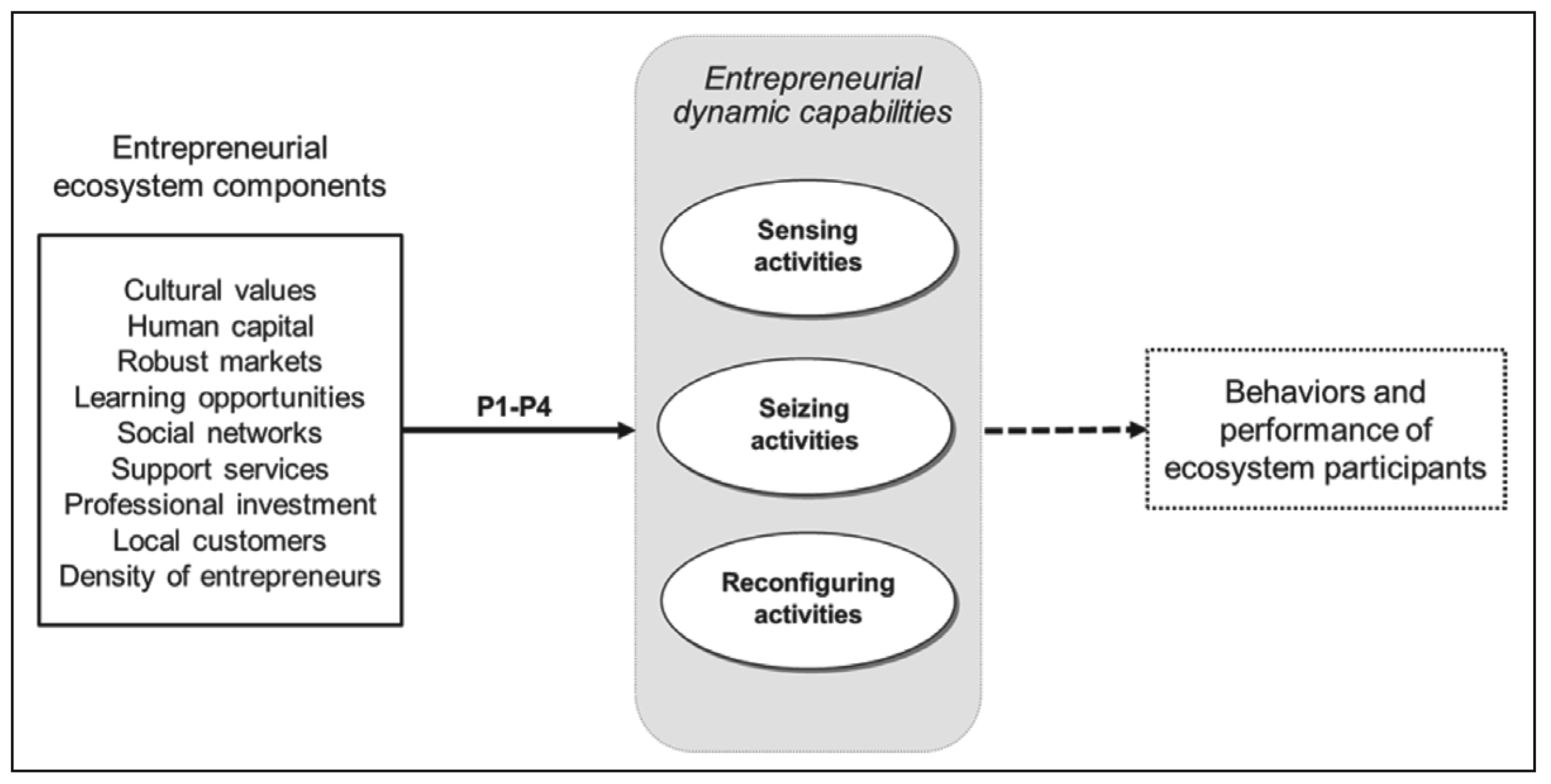
We structure the article as follows. First, research on EEs, dynamic capabilities and the intersection of capabilities and entrepreneurship is reviewed. Extended emphasis is devoted to key omissions and points of connection in these literatures addressed by our proposed model. A theory is then developed about how the micro- and macro-level characteristics of EEs, individually and in tandem, influence the dynamic capabilities associated with entrepreneurial activity. Finally, the implications of our theorising and the directions for future studies are discussed.
Literature Review
Entrepreneurial Ecosystems
The roots of EEs scholarship are in the work of Aldrich (1979) and Hannan and Freeman (1977), which emphasised an ecological perspective on entrepreneurship and organisational analysis. This approach draws attention to the dependence of new ventures on macro-processes in their environments (Aldrich & Martinez, 2001). Dubini (1989) laid further groundwork for the ecosystem concept by creating the distinction between ‘munificent’ and ‘unmunificent’ entrepreneurial environments. Munificent environments have ample role models for entrepreneurship, a diversified economy, rich infrastructure, skilled resources, a thriving financial community, a culture that supports entrepreneurship and government policies that incentivise venture creation. Similarly, Van de Ven (1993) emphasises an ‘infrastructure’ (rather than an ‘environment’) supporting entrepreneurship, positing that entrepreneurial infrastructures are created by multiple resource investments and institutional activities. Bahrami and Evans (1995) use the ‘ecosystem’ concept to describe Silicon Valley’s entrepreneurial community. Spilling (1996) focuses on the ‘entrepreneurial system’, explaining that it is the interacting agents, roles and contextual features that influence a region’s entrepreneurial performance (Roundy et al., 2018).
Beyond identifying the importance of the ecosystem of forces surrounding entrepreneurial activities, scholars are beginning to address issues that commonly surface when establishing a new sub-discipline, such as creating a clear definition of ‘EE’ (e.g., Roundy et al., 2018), identifying the critical components of EEs (Brown & Mason, 2017) and delineating the boundaries of the EE concept and its relation to similar phenomena (e.g., regional systems of innovation, industry clusters, business ecosystems, innovation districts, Acs et al., 2017). Studies find that regions with vibrant EEs have high concentrations of entrepreneurship, which generates novel ventures, products, innovations and initiatives (Carayannis, Provance, & Grigoroudis, 2016; Feld, 2012; Saxenian, 1990; Spigel, 2017).
In sum, studies have generated insights about EEs, including their core attributes and the importance of connections among their actors and organisations (Roundy et al., 2018). Despite the progress made by prior EE scholars, ‘many questions are still unanswered’ (Fisher, Kuratko, Bloodgood, & Hornsby, 2017). For instance, Spigel (2017) identifies critical gaps in the EEs literature, noting that ecosystems theory, to this point, is more of a conceptual umbrella involving the ‘geography of entrepreneurship’ than a comprehensive theory about the functioning of EEs. The lack of theory creates a tendency for researchers to treat the economic, cultural and policy components of vibrant EEs in isolation and as best practices to be imitated without regard for the connections between entrepreneurs and these components (Auerswald, 2015). The importance of analysing the interactions among the components of EEs continues to be recognised, with recent calls for research to evaluate multilevel and multi-organisation interactions (Audretsch & Belitski, 2017; Stam, 2015). To advance the study of EEs, however, a theoretical framework is needed that identifies how the components of EEs directly influence the activities of entrepreneurs. In the next sections, we suggest that dynamic capabilities theory can be integrated with EE research to provide such a framework.
Dynamic Capabilities
Dynamic capabilities represent a firm’s ability to sense, pursue and reconfigure opportunities and resources in response to quickly shifting environmental conditions (Teece, Pisano, & Shuen, 1997). Capabilities are rooted in a venture’s organisational and managerial processes and activities (Kindström, Kowalkowski, & Sandberg, 2013; Teece et al., 1997; Winter, 2003). Not all capabilities are ‘dynamic’. The dynamic capabilities perspective (DCP) focuses on the ‘subset of the competencies/capabilities which allow the firm to create new products and processes and respond to changing market circumstances’ (Teece & Pisano, 1994). The DCP emphasises dynamism by focusing on firms’ capabilities to reconfigure, respond and evolve in response to changing conditions rather than on capabilities that allow for the maintenance of existing resources and competencies (Teece et al., 1997). Even if organisations have resources, competitive advantage will not be sustainable if they do not have the processes necessary to identify, seize and reconfigure resources to pursue new opportunities and adapt to shifting environments (Eisenhardt & Martin, 2000).
The DCP addresses how ‘firms achieve and sustain competitive advantage’ (Teece et al., 1997). In doing so, DCP acknowledges the ‘inside and outside’ influences on competitive advantage (Antonacopoulou, Ferdinand, Graca, & Easterby-Smith, 2005). Other approaches explain heterogeneity in firm performance by focusing on firm-specific attributes, such as resources or skills (e.g., Barney, 1991), or on firms’ positions within an industry (e.g., the structure–conduct–performance paradigm; Porter, 1980). In contrast, the DCP recognises that organisations’ internal competencies and the environment’s external forces are intimately linked (Teece et al., 1997). Integrating work on the resource-based view (e.g., Wernerfelt, 1984), evolutionary economics (Nelson & Winter, 2005) and organisational learning (Argyris & Schon, 1978), the DCP contends that firm success rests on managerial and organisational processes (i.e., dynamic capabilities) that allow firms ‘to achieve new resource configurations as markets emerge, collide, split, evolve, and die’ (Eisenhardt & Martin, 2000). There is some debate about if dynamic capabilities directly influence competitive advantage or if it is how a firm ‘uses’ dynamic capabilities (e.g., ‘sooner, more astutely, or more fortuitously than the competition’ (Eisenhardt & Martin, 2000) that drives competitive advantage; however, there is widespread agreement that improving an organisation’s dynamic capabilities influences firm performance (Drnevich & Kriauciunas, 2011; Zott, 2003).
Dynamic Capabilities and Entrepreneurship
The DCP emphasises the logic of ‘opportunity’, in which firm performance is tied to capabilities to identify and pursue opportunities (Eisenhardt & Martin, 2000). Dynamic capabilities allow firms to sense and seize opportunities by acquiring and rearranging resources, which is accomplished by fine-tuning existing competencies or creating new ones (Harreld, O’Reilly, & Tushman, 2007). Other perspectives seeking to explain competitive advantage and abnormal returns focus on how firms generate Ricardian rents (i.e., rents tied to the factors of production, e.g., resource-based view) or monopoly rents (i.e., rents tied to market power; e.g., industrial organisation economics). The DCP focuses on Schumpeterian (i.e., entrepreneurial) rents, which accrue to firms that create innovations and engage in actions to identify, construct and take advantage of new market opportunities (Lee & Slater, 2007). Schumpeterian rents are derived not only from the firms’ resources but also from their ability to act entrepreneurially and to reconfigure and transform themselves in response to new opportunities that arise from changing environments (Teece et al., 1997).
The claim that heterogeneity in firm performance is tied to heterogeneity in firms’ dynamic capabilities points to the question: what is the source of differences in dynamic capabilities? Teece et al. (1997) contend that an organisation’s distinctive dynamic capabilities are determined by three factors: processes, positions and paths. Processes are a firm’s routines, or patterns of action, which encompass ‘the way things are done’ (Teece et al., 1997). A firm’s capabilities reside in processes involving coordination, integration, learning and reconfiguration (Teece et al., 1997). However, these processes, as well as the firm’s capabilities, are shaped by the position of the firm (i.e., its specific endowment of assets, including technologies and intellectual property) and the path the firm has taken. Firms are endowed with different asset bundles (Dierickx & Cool, 1989; Wernerfelt, 1984) and make different choices (which leads to path-dependence), which cause their processes—and capabilities—to differ. Another key difference among firms is their environmental context. However, research has devoted little attention to examining how external forces related to a firm’s location influence its dynamic capabilities. In the next section, we propose that a venture’s location in an EE shapes its capabilities.
Theory Development
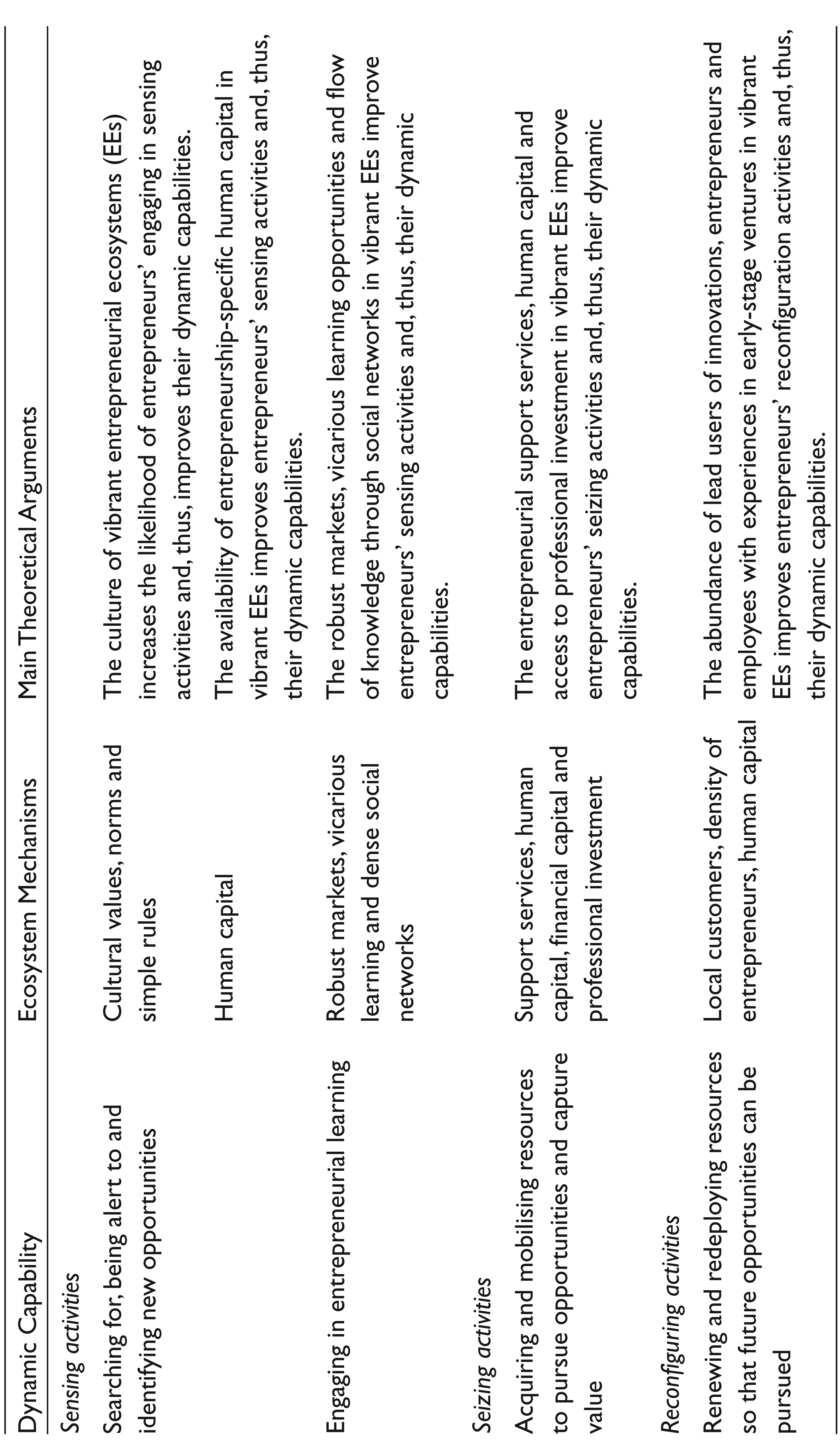
Dynamic capabilities are conceptually disaggregated into three sub-capabilities: (a) identifying and assessing opportunities (i.e., sensing); (b) mobilising resources to pursue opportunities and capture value (i.e., seizing); and (c) continually renewing, reconfiguring and redeploying resources so that future opportunities can be pursued (i.e., ‘transforming’; Teece, 2007, 2012). Sensing, seizing and transforming activities allow an organisation to maintain its competitive advantage as technologies and markets change (Teece, 2007). In the sections that follow, we argue that EEs improve each of these three types of capabilities. Table 1 summarises our main arguments and the mechanisms driving our theory.
The Influence of EEs on Entrepreneurs’ Dynamic Capabilities
The Impact of Entrepreneurial Ecosystems on Sensing Capabilities
A new venture’s sensing capabilities involve the ability to scan local and global markets, search and explore activities across markets, gather information to assess the preferences of customers and capture employees’ ideas (Day, 2004; Kindström et al., 2013). Sensing allows entrepreneurs to notice market opportunities and is tied to their attention and perceptions (Helfat & Peteraf, 2015; Teece, 2007). Sensing encompasses identifying, developing and assessing opportunities associated with customer needs and problems (Teece, 2014) and is performed through activities such as participating in professional associations, seeking information on changing customer demands, observing the best practices of other firms and gathering economic information on operations and environments (Wilden, Gudergan, Nielsen, & Lings, 2013). A firm’s sensing capabilities are influenced by two, general processes: search and learning (Teece et al., 1997; Zott, 2003). We contend that vibrant EEs influence both sensing processes.
Entrepreneurial Ecosystems and Entrepreneurial Search
Ecosystem Culture and the Likelihood of Search
Sensing capabilities are based on searching for and being alert to new opportunities (Kirzner, 1979; Roundy, Harrison, Khavul, Perez-Nordtvedt, & McGee, 2017). There are forces in vibrant EEs that increase the like- lihood of engaging in entrepreneurial search and improve search capabilities.
Vibrant EEs have cultures that encourage entrepreneurship by treating entrepreneurship as legitimate, elevating entrepreneurs’ status and supporting risk-taking, innovation and opportunity-pursuit (Isenberg, 2011; Roundy, 2017a). Beyond supporting entrepreneurship, the cultures of flourishing EE also emphasise values, such as tolerating business failure, embracing experimentation and demonstrating creativity (Isenberg, 2011), and norms, such as ‘give [to the ecosystem] before taking’, ‘favour cooperation [with other ecosystem participants] over competition,’ and ‘be inclusive toward and encouraging of new members of the ecosystem’ (Feld, 2012; Roundy, 2017a). These values act as ‘simple rules’ that influence ecosystem participants in their exchanges (Bingham & Eisenhardt, 2011; Roundy, 2016). These cultural values also increase the perceived acceptability (and viability) of entrepreneurial activities and encourage ecosystem participants to engage in entrepreneurship, which involves the search for new opportunities. The culture of a vibrant EE creates an environment that is ‘ripe’ for entrepreneurial search and that promotes entrepreneurial sensing. The more entrepreneurs engage in sensing, the more the capability is practiced and refined (Baron & Ensley, 2006).
Entrepreneurship-Specific Human Capital and the Capability to Search
The characteristics of vibrant EEs not only increase entrepreneurs’ likelihood of searching for new opportunities but they also improve entrepreneurs’ capabilities to search. Ecosystem participants’ human capital is a critical attribute of a vibrant EE (Isenberg, 2010). Human capital is the knowledge gained from education, training and experience (Coff & Kryscynski, 2011; Roundy, 2017a). Entrepreneurship-specific human capital is knowledge gained from founding businesses, hiring high- performing early-stage employees and developing the organisational routines and activities needed to grow young companies (Roundy, 2017a). Because of the high concentration of entrepreneurs in vibrant ecosystems, this type of human capital is abundant (Isenberg, 2010). Vibrant ecosystems also possess a reservoir of non-entrepreneurs comprised of skilled workers with the experiences and human capital to work for early-stage companies and the knowledge to serve as advisers and board members to start-ups (Bahrami & Evans, 1995; Case & Harris, 2012; Isenberg, 2010; Spigel, 2017). Furthermore, if a vibrant ecosystem does not have access to a particular type of human capital, it can often successfully attract entrepreneurial talent from other locations, which can complement the ecosystem’s existing human capital (Roundy, 2017a).
These arguments suggest that in vibrant EEs, entrepreneurs are more likely to possess or be able to readily acquire entrepreneurship-oriented human capital and more able to attract employees, board members, mentors and other stakeholders with such capital. As entrepreneurs’ experiences and entrepreneurship-specific human capital increase, their capabilities to recognise and search for new opportunities will improve as they develop a more refined schema for identifying opportunities (cf. Fiet, Norton, & Clouse, 2013). Thus, the human capital available to entrepreneurs in vibrant EEs makes entrepreneurs more likely to engage in search and more capable of searching.
Entrepreneurial Ecosystems and Entrepreneurial Learning
In addition to search processes, the dynamic capabilities involved in sensing new business opportunities are influenced by entrepreneurial learning (Teece et al., 1997). Learning is the process through which experimentation and repetition allow tasks to be performed faster and with greater accuracy (Teece et al., 1997; Zott, 2003). Vibrant EEs improve entrepreneurs’ ability to learn through three ecosystem components: robust local markets, ample vicarious learning opportunities and increased knowledge flow.
Robust Local Markets and Entrepreneurial Learning
Vibrant EEs contain robust markets with sufficient customers and users of innovations in the ecosystem (Bahrami & Evans, 1995; Isenberg, 2010, 2011). A benefit of local consumers is that they are available to purchase and provide rapid feedback on the new products and services of early-stage companies. The learning that occurs from customer feedback on new ventures’ product offerings can improve sensing capabilities by helping entrepreneurs notice and identify new customer opportunities and refine the alignment between their venture’s existing business model and current consumer demands (Wilden et al., 2013).
Vicarious Learning Opportunities
Beyond learning from customers, entrepreneurs can also learn from the actions of other entrepreneurs, early-stage ventures and mature organisations in their ecosystem (Rae, 2004). Vicarious learning occurs when an organisation learns by observing the behaviours and outcomes of other organisations’ activities. Vibrant EEs typically have dense networks of firms, which produce scale and agglomeration economies (Dumais, Ellison, & Glaeser, 2002; Panzar & Willig, 1977) and other types of positive externalities (e.g., innovation spillovers) and provides plentiful opportunities for entrepreneurs to learn by observing other entrepreneurs and ventures in their ecosystem.
Vicarious learning occurs through direct observation of other firms’ actions and, indirectly, through the communication of narratives describing the actions of other participants in the ecosystem (Roundy, 2016). Vibrant EEs contain numerous ‘success stories’ (as well as failure narratives; Mantere, Aula, Schildt, & Vaara, 2013) about ventures in the ecosystem, which improve vicarious learning by making it possible for entrepreneurs to indirectly observe the outcomes of the actions of entrepreneurs in the ecosystem (Feld, 2012; Nelles, Bramwell, & Wolfe, 2005; Spigel, 2017). For example, entrepreneurs learn from success stories describing other entrepreneurs in the ecosystem who have created rapidly scaling ventures or who achieved a successful exit (e.g., a high-profile acquisition or initial public offering; Roundy, 2016). The details of such stories are imitated as ‘best practices’ and improve entrepreneurs’ schemas for sensing and identifying viable opportunities. Entrepreneurs can also learn from the smaller (i.e., less high-profile) outcomes of ecosystem participants, such as the results of changes in pricing or marketing strategies. Indeed, learning from ‘small losses’ sometimes results in more effective learning than the observation of major successes or failures (e.g., Eisenhardt & Martin, 2000).
Social Networks and the Flow of Knowledge
Vibrant EEs are comprised of dense social networks of relationships (Isenberg, 2010). The genesis of such networks are informal interactions among ecosystem participants (i.e., ‘collisions’; Katz & Wagner, 2014) and planned events, such as entrepreneurship-oriented meet-ups, pitch competitions and conferences, which provide forums to connect individuals seeking to participate in the ecosystem (Case & Harris, 2012; Roundy, 2017b). Networks are central to EEs; indeed, ecosystems are often conceptualised as a networked constellation of links among individuals (e.g., entrepreneurs, mentors) and organisations (universities, incubators and corporations; Motoyama & Knowlton, 2017; Neck et al., 2004). A key difference between vibrant EEs and non-entrepreneurial business communities is the depth and connectedness of the network of entrepreneurs, investors, advisors and supporters (Case & Harris, 2012; Roundy et al., 2017).
The well-developed social networks of vibrant ecosystems are beneficial to entrepreneurs because they improve the transfer of information between EE participants and from entities external to the system (Roundy, 2017a; Saha & Banerjee, 2015; Spigel, 2017). In such ecosystems, knowledge is transmitted more efficiently through the community, which improves the efficiency of entrepreneurs’ search (Zott, 2003). This information includes knowledge about changes in technologies and customer preferences, which can improve entrepreneurs’ capabilities to sense new opportunities (Singh, 2005).
The Impact of Entrepreneurial Ecosystems on Seizing Activities
It is not sufficient to simply sense or search for opportunities; new ventures must also have the capability to ‘seize’ opportunities once they are identified, that is, to invest in necessary technologies, resources and complementary assets to build sustainable business models around opportunities (Chesbrough, 2010; Kindström et al., 2013; Teece, 2010). Seizing involves mobilising resources to address and develop opportunities and capturing value from these activities (Teece, 2014). In seizing opportunities, entrepreneurs evaluate their emerging and existing capabilities and invest in ‘relevant designs and technologies that are most likely to achieve marketplace acceptance’ (O’Reilly & Tushman, 2008; Teece, 2007; Wilden et al., 2013).
There are three forces in vibrant EEs that will improve entrepreneurs’ seizing capabilities: entrepreneurship support services, the availability of employees with entrepreneurship human capital and early-stage professional investment.
Entrepreneurship Support Services
Vibrant EEs contain a wide range of support services aimed at helping entrepreneurs found and grow their ventures (Goswami et al., 2018). These services include support organisations, such as incubators, accelerators and business development centres (Roundy, 2017b). Support organisations improve entrepreneurs’ ability to build a viable organisation around a sensed opportunity in several ways. Support organisations often provide entrepreneurs with access to necessary professional services, such as legal, insurance, banking, accounting and technology services (Isenberg, 2011; Spigel, 2017) and to professionals who have experience doing business with entrepreneurs and will adapt their services (and compensation) to align with the operations of early-stage ventures (e.g., offering services in exchange for equity; Isenberg, 2010). In addition, support organisations provide key early-stage resources, such as office space and IT services, often at discounted prices (Hackett & Dilts, 2004).
Support organisations also improve entrepreneurs’ capabilities to seize opportunities by connecting entrepreneurs to resource providers, such as professional investors, and to mentors with entrepreneurship human capital. By interacting with support organisation staff, mentors and investors (e.g., in business model development programs), entrepreneurs gain the human capital and knowledge needed to create and scale new ventures. Through these interactions, entrepreneurs are exposed to an EE’s cultural values (e.g., ‘give [to the ecosystem] before taking’ and ‘be altruistic towards other ecosystem participants’ (e.g., Feld, 2012), which allow them to take part in the community of the ecosystem. Finally, support organisations host events that connect EE members, expand entrepreneurs’ social networks and introduce participants to the EE (Roundy, 2017b). By doing so, entrepreneurs are more likely to be able to access the financial and human capital they need to organise new ventures and seize opportunities.
Entrepreneurship Human Capital
As described in the previous section, vibrant EEs typically have a deep reservoir of individuals with entrepreneurship-oriented human capital. Some of these individuals become frustrated with the bureaucracy of large organisations in the ecosystem and leave them to create new ventures based on sensed opportunities (Neck et al., 2004). Other individuals enter the ecosystem as entrepreneurs. In addition to entrepreneurs, in vibrant ecosystems, there is an abundance of individuals with the human capital needed to be employees for start-up ventures (Spigel, 2017) and the knowledge necessary to be advisors for or board members in early-stage ventures (Isenberg, 2010). There is also diversity across sectors in entrepreneurial talent (Bahrami & Evans, 1995; Case & Harris, 2012). Access to these sources of entrepreneurial human capital increases entrepreneurs’ capabilities of founding successful ventures based on the opportunities they sense.
Access to Financial Capital and Professional Investment
When an opportunity is sensed, significant financial capital can be required to build a rapidly scaling, high-growth venture and to test and refine a viable business model associated with the opportunity. The capital entrepreneurs require is often beyond what they personally control, which leads them to seek funding from external resource providers (Stevenson & Gumpert, 1985). Vibrant EEs have a robust investor community offering capital at all stages along the spectrum of venture funding, from angel to mezzanine financing (Case & Harris, 2012; Isenberg, 2011; Roundy, 2017a; Spigel, 2017). Having access to a deep and diverse pool of financial capital improves entrepreneurs’ seizing capabilities in two ways: by increasing the likelihood that entrepreneurs will be able to acquire the financial resources they need to pursue an opportunity and, indirectly, through the knowledge that can be gained during the pursuit of funding and during interactions with professional investors. In sum, the forces present in vibrant EEs suggest:
The Impact of Entrepreneurial Ecosystems on Reconfiguring Activities
After opportunities are sensed and then seized, the dynamic capabilities perspective contends that ventures must continually renew and recon-figure their resources and processes in response to signals from their shifting environment (Teece et al., 1997). Reconfiguration is necessary because existing resources and capabilities become less valuable as competitors replicate them and as markets shift. Thus, to sustain profitability, entrepreneurs must be able to reconfigure their ventures’ assets, competencies and business models to address changing market circumstances (Harreld et al., 2007). Reconfiguring is a challenge because, over time, firms become complacent and rigid in their routines. Slight adjustments to business models are often insufficient to sustain the competitive advantage associated with an opportunity (or set of opportunities). Entrepreneurs sometimes need to make more substantial reconfigurations in response to environmental disruptions (Kindström et al., 2013). During reconfiguration, entrepreneurs engage in activities such as implementing new kinds of management techniques, enacting a new or updated marketing plan, implementing new business processes or engaging in different ways of achieving objectives and targets (Wilden et al., 2013).
EEs contain forces that improve a venture’s capabilities to know that reconfigurations are necessary and to make the necessary changes to its operations (Amit & Schoemaker, 1993; Teece et al., 1997). First, entrepreneurs in vibrant EEs are more likely to found innovative ventures based on ‘leading edge’ technologies because of the abundance of lead users of innovation in the ecosystems. Since entrepreneurs gain feedback from such users, they are more likely to become aware of changes in technologies and in consumers’ demands and preferences. Thus, in vibrant EEs, entrepreneurs’ market information is timelier, which improves their capability to sense the need to reconfigure their business models, products, routines and resources (Teece et al., 1997).
Furthermore, in vibrant EEs, there are typically many entrepreneurs creating early-stage businesses across numerous industry sectors (indeed, this is often the defining characteristic of an EE). As described in the previous section, in such environments, entrepreneurs can observe and learn vicariously from the activities of other entrepreneurs and, particularly, from ventures in the same or closely adjacent industries. Thus, when entrepreneurs face changes in their environment that induce reconfigurations of strategies, product offerings or business processes, they can look to nearby ventures for novel configurations, which improves their capability of finding and combining new components and allows them to pursue new opportunities (Fleming, 2001).
Finally, in the same way that it is not sufficient for entrepreneurs to merely sense new opportunities but they must also be able to seize them, it is also not sufficient for entrepreneurs to simply notice the need for reconfiguring their capabilities—they must also be able to ‘implement’ new configurations (Zott, 2003). In vibrant EEs, ventures are more able to enact reconfigurations—both minor and substantial—because entrepreneurs and other early-stage employees are more likely to have experience working for other entrepreneurial ventures that were also faced with rapidly iterating, updating and reconfiguring their capabilities, that is, ecosystem participants are more likely to have past experiences working for early-stage ventures and, therefore, are more likely to have developed competencies in quickly and efficiently reconfiguring a venture’s operations. In contrast, in non-entrepreneurial business communities, in which most businesses are mature organisations, employees will be less likely to have experiences with rapidly evolving organisations that are hyper-responsive to changes in the marketplace. These arguments suggest:
Discussion
EEs are receiving increasing academic and practitioner attention with most research aimed at identifying the factors that influence EE emergence and functioning. Studies only hint at the mechanisms through which ecosystem-level components directly influence the creation, operation and success of early-stage ventures. Research has not proposed an actionable theoretical framework for explaining the influence of EEs on entrepreneurs and ventures. To address this omission in EE research, we developed a theory to explain how the core attributes of vibrant EEs influence the capabilities associated with entrepreneurial activities. Our theorising has implications for EEs and dynamic capabilities scholars, entrepreneurs and policymakers.
Theoretical Contributions to Entrepreneurship Research
Research on EEs broadly describes the benefits EEs create for regions and entrepreneurs. However, the specific linkages between ecosystem components and entrepreneur- and venture-level effects are under- studied. A related criticism of EE research is that it lacks a coherent theoretical basis (Spigel & Harrison, 2018). We seek to address these limitations of prior research by integrating dynamic capabilities theories from strategic management with work on EEs. We develop a theory that teases apart the specific mechanisms linking the core attributes of ecosystems to entrepreneurs’ abilities. By identifying how EEs improve sensing, seizing and reconfiguring capabilities, our theory represents an organising framework for understanding how EEs influence entrepreneurial activities. Our model suggests that a ‘strategic EEs’ perspective (akin to work on strategic entrepreneurship; Withers, Ireland, Miller, Harrison, & Boss, n.d.) could provide EE scholars with rich theoretical foundations.
Another contribution of our proposed framework is that it addresses open questions about the micro-level (i.e., entrepreneur and venture) functioning of EEs. A criticism of EE research is that, in focusing on ecosystem-level dynamics, it does ‘not address the attribution of outcomes, costs, and benefits’ to ecosystem participants (e.g., Cunningham, Menter, & Wirsching, 2017). Our model clarifies how the components of an EE produce benefits for entrepreneurs and early-stage ventures. By doing so, we respond to claims that the macro-approach to EEs is insufficient and draw attention to the micro-foundations of EEs and their impact on entrepreneurial activities (Cunningham et al., 2017).
Finally, our theory contributes to dynamic capabilities research. Studies of dynamic capabilities tend to focus on the influence of intra-organisational factors (e.g., strategic decision-making, the presence of resources) on firm capabilities (e.g., Helfat & Peteraf, 2015) rather than examining how capabilities within one organisation affect other organisations. Research has also been slow to examine how organisations’ geographic locations and context shape their capabilities. Our theory suggests that the EE in which a venture is located is an important factor influencing heterogeneity in early-stage ventures’ dynamic capabilities. By identifying how benefits are accrued from EEs, we can begin to assess which capability-improving benefits are influenced by a firm’s local context and which benefits are acquired from greater distances.
Implications for Entrepreneurial Ecosystem Stakeholders
The proposed theoretical model linking ecosystem components to entrepreneurial dynamic capabilities can inform the decisions of practitioners. Policymakers seeking to spur entrepreneurial activities in their regions are increasingly encouraging the creation of EEs. However, regional stakeholders often promote EEs without a concrete understanding of how EEs benefit entrepreneurs and stimulate entrepreneurial activity. Instead, many practitioners assert that investing in the creation of thriving EEs is an efficient use of community resources because such ecosystems ‘increase’ entrepreneurial activity and make entrepreneurs more ‘successful.’ However, when pressed, practitioners (and academics) often cannot point to the mechanisms through which EE components produce these beneficial outcomes. Without understanding how EEs operate, EE builders struggle to know how their ecosystems functions and, thus, where gaps exist and strategic investments are needed. The proposed framework can help practitioners avoid making ineffective investments or using resources inefficiently.
Related to this point, our theorising draws attention to the importance of encouraging cohesiveness among EE participants. Academic studies and practitioner research emphasise that cohesion among EE participants, which is produced from the pursuit of common activities (e.g., creating businesses) and by sharing similar experiences, values and goals, is a force that holds an ecosystem together (cf. Roundy et al., 2018). Thus, practitioners seeking the capability-improving benefits of a vibrant EE should acknowledge that these benefits require a connected entrepreneurship community. Fortunately, community building can be a low cost activity (e.g., holding networking events like ‘1 Million Cups’; Konczal, & Motoyama, 2013).
Private foundations, local government agencies and other funding sources, which serve as resource providers to EE builders, often require grant recipients to measure the impact of the funding they receive (Kempner, 2013). However, there is debate among practitioners and academics about what outcomes indicate a vibrant EE and, therefore, should be measured (Stangler & Bell-Masterson, 2015). The proposed framework suggests that EE builders should look to studies of dynamic capabilities to identify specific activities that could be measured and tracked (cf. Macher & Mowery, 2009). If regional leaders want to know if efforts at EE creation are successful, they could assess if entrepreneurs’ capabilities to sense, seize and reconfigure resources and opportunities have improved over time.
Directions for Future Research
Our theory and proposed model explain the influence of EEs on entrepreneurs’ capabilities to create and scale new ventures. However, entrepreneurs represent only one type of ecosystem participant. For instance, vibrant EEs may also improve investors’ search capabilities as information passes more freely among participants than in regions with under-developed EEs. Future research is needed to examine how a thriving EE may influence the capabilities of other types of ecosystem stakeholders, such as investors, suppliers and support organisation managers.
Our theorising focuses on the impact of vibrant, well-functioning EEs on entrepreneurs’ capabilities. Yet, not all ecosystems are fully developed and flourishing. There are regions with EEs that are nascent, stagnant or in decline (Roundy, 2017a). Indeed, thriving EEs like Silicon Valley and Tel Aviv are rare. If scholars examine the implications of entrepreneurs locating in non-thriving ecosystems, it may generate findings that are more generalisable and applicable to more typical regions.
We emphasise the influence of EEs on entrepreneur- and venture-level capabilities. However, differences in the vibrancy of EEs suggest that, in addition to examining the sources of heterogeneity in venture-level performance, it may be fruitful to explore the sources of heterogeneity in ‘ecosystem’ performance. Specifically, in the same way that firms differ in their dynamic capabilities, EEs, as meta-organisations (cf. Ahrne & Brunsson, 2008), may differ in their system-level capabilities. Ecosystem-level research is needed to understand variation among EEs in their capabilities—as systems—to sense, seize and reconfigure their resources and capabilities in pursuing new opportunities.
Finally, the creation and promotion of EEs, across contexts (e.g., Welter, Trettin, & Neumann, 2008), is often driven by the goal of achieving the entrepreneurial intensity of ecosystems like Silicon Valley (Feldman & Francis, 2002). Understanding how to promote and foster EEs has become a ‘holy grail’ for policymakers and practitioners in both developed and emerging economies (Isenberg, 2010). However, for EE research to become a fully developed and consistent paradigm (Kuhn, 1962), scholars should begin to identify and tease apart the concrete mechanisms through which EEs and their components influence the activities of ecosystem participants. Doing so requires isolating the specific connections between ecosystem participants and system-level attributes and tracing how these relationships influence entrepreneurial activities. The theorising in this article represents the first steps towards identifying how inter-organisational and ecosystem-level forces improve entrepreneurs’ capabilities to create and operate new ventures. We hope that the proposed theory stimulates thought, debate and future research that produces a detailed understanding of the functioning of EEs, a phenomenon that is increasingly at the centre of efforts to jumpstart sluggish regional economies and revitalise communities.
Declaration of Conflicting Interests
The authors declared no potential conflicts of interest with respect to the research, authorship and/or publication of this article.
Funding
The authors received no financial support for the research, authorship and/or publication of this article.