




Abstract
The discipline of entrepreneurship has witnessed significant progress over the past 25 years in terms of the introduction of new courses and degree programmes in universities across the globe. At the same time, the question of what should be taught in basic or foundational entrepreneurship courses remains an open issue. As a result, it is unclear how such topics as the entrepreneurial mindset or the development of entrepreneurial competencies should be approached, and whether topics such as the lean start up or the business plan should be included. Without clear direction on what should be taught, pedagogical discussions regarding how these courses are delivered, such as the relative emphasis on experiential learning, are problematic. This article suggests the question of content in foundational courses in entrepreneurship rests upon the question of whether the educator seeks to teach students about entrepreneurship, or rather, how to become an entrepreneur. A framework is introduced for determining priorities when deciding upon course content. Attention is devoted to seven decision variables for use in determining what to include in a foundational course, and guidance is provided for how one might approach each of these variables. Using this framework, educators can address a number of other issues surrounding foundational courses, including treatments of different contexts for entrepreneurship and the employment of different pedagogical approaches to content delivery.
The Question of Content
Despite the significant expansion of entrepreneurship education across the globe over the past 25 years (Kuratko, 2016; Neck & Greene, 2011), there remains considerable debate regarding exactly what should be taught in an entrepreneurship course. At the centre of this debate are (at least) two schools of thought. The first suggests our focus should be on teaching students of all types about entrepreneurship—what it is, why it matters, and what are some of the big questions surrounding entrepreneurship. The second is concerned with teaching students how to become entrepreneurs. The emphasis here becomes more applied and practical, where students are encouraged to start ventures and provided with tools and approaches for doing so.
This distinction is analogous to teaching students about psychology, sociology or biology versus teaching them to be psychologists, sociologists or biologists. The former assumes the subject area has important value for virtually any student, and can contribute to their ability to navigate life’s journey, function successfully in the complex modern world and realise their underlying potential. In the case of entrepreneurship, it assumes students will benefit from knowing what entrepreneurship is, why it matters, and how they and others have innate entrepreneurial potential which can be applied in a variety ways and in many different contexts. The emphasis is on the breadth of understanding. The latter assumes students will benefit if they are prepared for an occupation or career path, and have developed a set of skills and competencies. With entrepreneurship, it means students are encouraged to start businesses, and that these businesses can contribute more to society (e.g., though jobs, inventions, wealth created and taxes paid) if students are exposed to the key building blocks that result in a successful enterprise. The focus here is on depth of understanding of a narrower range of topics.
In a sense, teaching students about entrepreneurship reflects a classic liberal arts perspective, where the university seeks to develop modern-day renaissance men and women. Alternatively, teaching students how to be entrepreneurs is more reflective of the professional school perspective, which is often quite applied and career-focused. For instance, business schools teach undergraduate students how to be accountants, and the health sciences teach students how to be nurses. Professional certifications sometimes follow the pursuit of these kinds of majors. There certainly is a role for more professional-oriented training within universities, even if such training is more often associated with master’s level degrees. However, it limits the appeal of entrepreneurship to those few who may be seriously interested in a career as an entrepreneur.
While the discipline has witnessed rapid growth in numbers of entrepreneurship courses, degree programmes and co-curricular learning initiatives offered by universities, the issue of course content has not received the kind of attention one might expect. Some of this lack of debate may be due to staffing issues, and the need many institutions have to rely upon adjuncts and instructors to teach entrepreneurship, individuals who are often entrepreneurs and/or university alumni. Such individuals bring a more practical perspective and frequently have no previous exposure to entrepreneurship education, and particularly, issues of pedagogy and content. Alternatively, relatively few tenure track faculty members have doctoral degrees in entrepreneurship. Further, absent an academic department of entrepreneurship at most universities, entrepreneurship courses and programmes are offered out of a centre/institute or an academic unit that centres on some other discipline (e.g., management and electrical engineering) (Morris et al., 2013a). Another contributing factor is the significant value of financial donations received by universities from entrepreneurs or to support entrepreneurship education. Such donors often want to see how their money is being translated into new ventures launched by students. Finally, a number of services that rank entrepreneurship programmes (e.g., the Princeton Review) use the number of ventures generated by the programme as a key rating criterion. This combined set of factors may help explain limits to any debates within an institution regarding what should be taught in an entrepreneurship course.
Absent such debate, the content of these courses is likely determined in an idiosyncratic manner. It may be that a syllabus was obtained from an online search, or from a colleague at another institution, and this was used to guide course development. A different scenario may find an instructor asked by a department head to teach an entrepreneurship course, and so he/she selects (or is given) a textbook, and a syllabus is developed based on the structure of the textbook. Yet, another possibility might involve an instructor simply emphasizing content with which he/she is familiar, or that experience tells him/her is important when starting a business. Finally, course content may evolve to reflect concepts that have become widely popularized and publicized, such as the contemporary popularity of the lean start-up methodology, the elevator pitch or the business model canvas.
The current research explores the question of what should be taught in foundational courses in entrepreneurship. Our purpose is not to advocate for particular content coverage. Instead, the range of subject areas that may be included in these courses is examined, and factors are identified that influence which topics are covered, how much time is devoted to a topic, the kind of content introduced around a particular topic, and the teaching approach used to deliver this content. It is argued that, at the heart of these decisions, lies the issue of whether the instructor seeks to teach students about entrepreneurship or strives to teach students how to become entrepreneurs. This is not a simple dichotomy, but a question of relative priorities. The determination of these priorities will drive the establishment of learning objectives, which in turn drives content.
A framework is introduced for determining priorities when deciding upon course content. Specific attention is also devoted to the roles of the entrepreneurial mindset and development of entrepreneurial competencies, two major topics receiving considerable attention in recent discussions of entrepreneurship education (Cui et al., 2021; Morris et al., 2013b; Rodriguez & Lieber, 2020). Finally, attention is devoted to the growing emphasis on experiential learning, and how this pedagogical approach relates to issues of course content, and to the implications for content of the large range of contexts within which entrepreneurial behaviour can occur.
Content Coverage in Basic Entrepreneurship Courses
A key limitation of entrepreneurship as a field of study is that there is no standard structure for a foundational course in entrepreneurship. This is not a problem in well-established disciplines. If we consider a basic course in physics, marketing, or sociology, there is general agreement on the core content, and it reflects a basic knowledge of the essential principles, concepts and building blocks in those disciplines. This core content sets the stage for further study, as it establishes the general domain and the various sub-domains that constitute a given discipline. With entrepreneurship, one or two foundational courses are often taken by large numbers of students, and represent the only exposure they will likely get to the subject area. At some institutions, they are the only courses offered. Yet, students can be exposed to a broad range of differing content based on which university, unit within the university, and instructor is teaching the course.
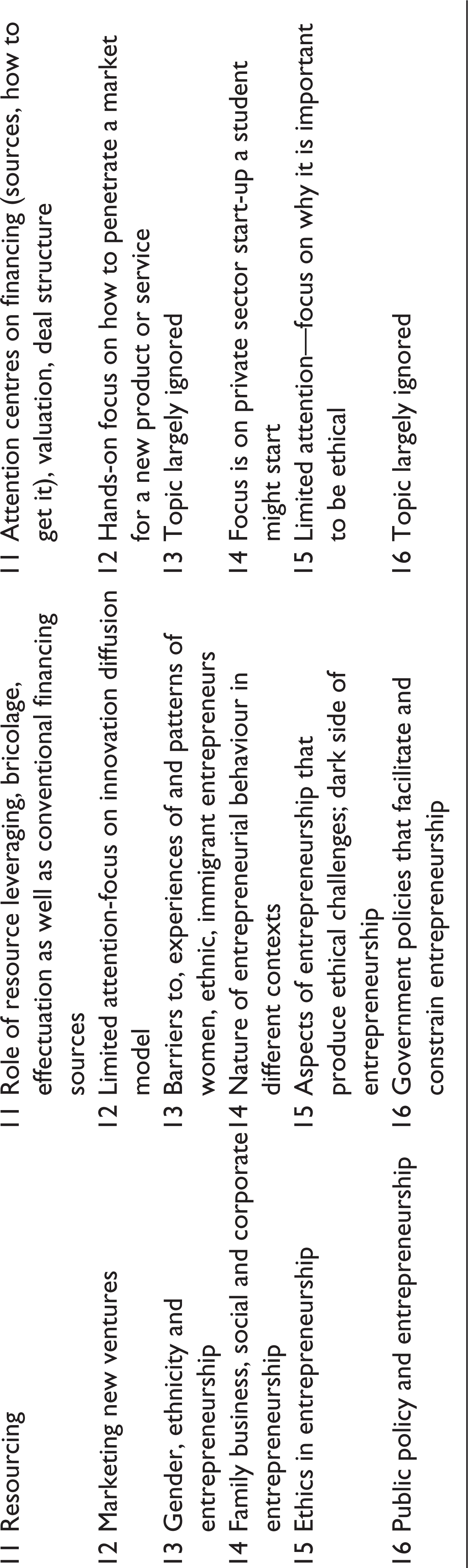
As Table 1 illustrates, a wide array of topics can receive attention within foundational entrepreneurship courses. Here, over forty major topics have been highlighted based on a synthesis of a large sample of course syllabi, yet the list is not comprehensive. These can be characterized as major topics, as each of them involves significant content with varying degrees of complexity—hence each requires meaningful effort to provide even a basic introduction or overview.
The Range of Topics Covered in a Basic Entrepreneurship Course
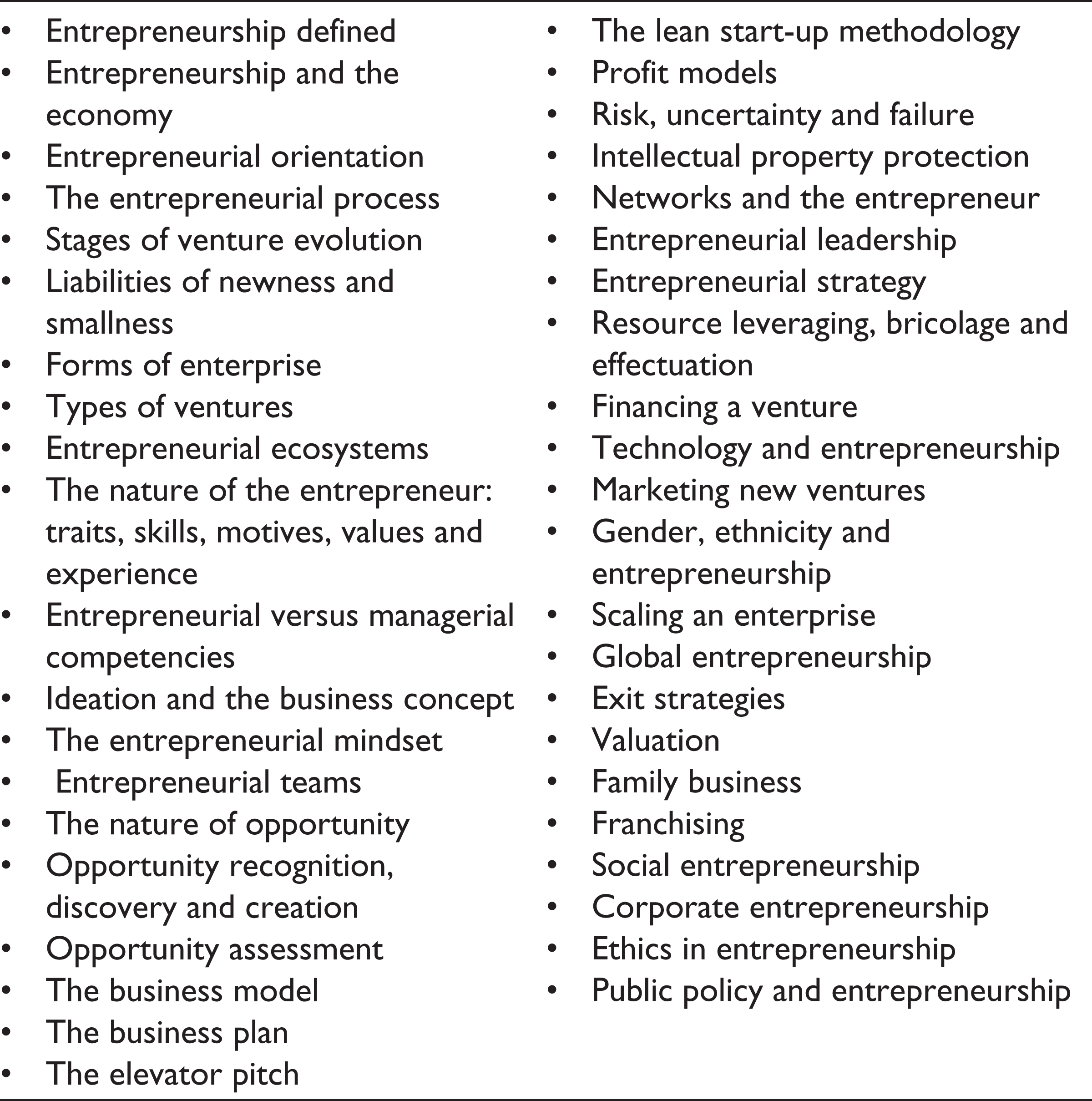
The determination of which topics are actually covered can vary widely depending upon the department in which the course is offered, the disciplinary background of instructors, whether they come from the world of practice or have started a business of their own, the extent to which they are research-active, the textbook they select (and many instructors no longer prescribe a standard textbook), and how long they have been teaching entrepreneurship. And then there are courses that have relatively little content in any of these areas, focusing instead on storytelling about entrepreneurs and their venture journeys, case studies, guest lectures by entrepreneurs, videos and related materials that concern entrepreneurial experiences.
The implication is that a basic course in entrepreneurship can be whatever an instructor wants it to be, and that students (even students at the same institution) need not receive common grounding when exposed to entrepreneurship education. This lack of consensus on what a student should be exposed to in a foundational or introductory course reflects the adolescence of the entrepreneurship discipline. However, it is also an unhealthy set of circumstances, undermining the legitimacy of entrepreneurship as an academic area of study. It raises questions regarding how much these courses reflect the established body of knowledge, schools of thought, basic methodologies and boundaries associated within of an area of study. Further, absent a consensus on the basics of entrepreneurship education, universities have little guidance regarding what sort of assurance of learning standards are being met by an introductory course.
As a caveat, we are not suggesting that everyone must teach the same thing in a basic entrepreneurship course, but instead that these courses should be systematically designed around core content, and this content is dependent on outcome objectives. Further, the foundational course should not be static. The foundation in most disciplines is periodically modified, augmented, or enhanced as a discipline evolves and there are new conceptual, theoretical or empirical advances and discoveries. With entrepreneurship, however, educators must first agree on a foundation.
It All Begins with Learning Objectives
Fundamental to the question of content is the issue of learning objectives, or relatively concise statements that capture the primary knowledge, attitudes and skills students are expected to master or grasp. Such objectives should be explicit, learner-centric and observable or measurable. Below are examples of learning objectives in a foundational entrepreneurship course:
Upon Completion of this Course, Students will be Able to
Recognize their innate entrepreneurial potential and how that potential can be applied in a variety of professional contexts.
Understand the role of entrepreneurship as a dynamic in national and regional economies.
Appreciate the critical role of an entrepreneurial mindset in achieving sustainable competitive advantage in the contemporary business environment.
Understand the nature of the entrepreneurial process and the many contexts in which this process applies.
Grasp the nature of an effective entrepreneurial ecosystem and the critical role played by supportive environments in fostering entrepreneurial activity.
Apply ideas and insights from a variety of disciplines and functional areas to the process involved in creating and critiquing innovative concepts for new ventures.
Appreciate the requirements surrounding the creation of a new venture, the kinds of obstacles encountered and approaches for overcoming those obstacles.
Demonstrate an understanding of key sources of entrepreneurial financing and considerations involved to attracting financing from a given source.
Engage in reflective thinking regarding ethical challenges and how they might be approached by those who launch entrepreneurial ventures.
These (and other) examples make it clear that a wide range of learning objectives is possible. Deciding on particular objectives is critical, in that this determination establishes boundaries regarding the content to be delivered and reinforced through lectures, experiential activities, guest speakers and other learning vehicles.
Given the many things one can accomplish in an entrepreneurship course, the ability to sort through and prioritize learning objectives can be a vexing task. Ultimately, however, there is a more fundamental objective that underlies the reliance on any one of these (or any other) specific content-related objectives. This fundamental objective is tied to the overall purpose of the course. Is the instructor trying to teach students how to become entrepreneurs, or rather, attempting to help them understand the nature of entrepreneurship and its role within society? It is quite difficult to accomplish both of these overall objectives at the same time. Instead of picking one or the other, instructors often attempt to do a bit of both. Yet, each takes students in very different directions when it comes to topical coverage.
Organizing Content into General Categories
To better grasp the wide array of potential topics addressed in foundational entrepreneurship courses, the content can be grouped into three general categories (see Table 2). The first of these can be termed ‘business basics’. Here, the educational focus is on understanding how to establish new ventures. Hence, the student needs to understand rudimentary aspects of finance, accounting, marketing, operations and information management when starting a new business. They are taught how to calculate breakeven, understand customer needs, set prices, penetrate a market for a new product or service, manage cash flows and structure an entity, among other topics. This category of content tends to be highlighted by instructors whose learning objective centres on teaching students how to start ventures.
Three Perspectives on What Universities Teach
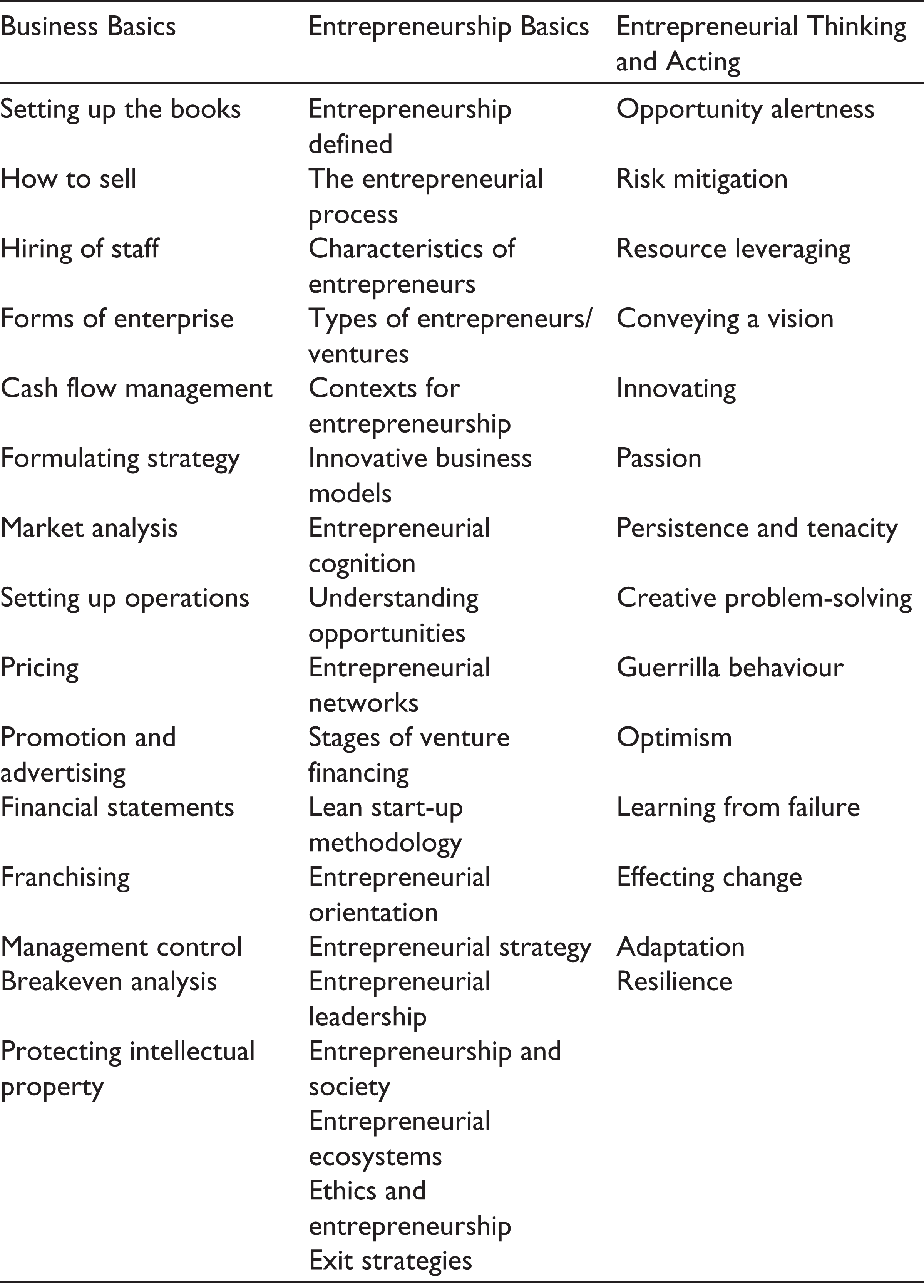
The second general focus is on ‘core entrepreneurship content’. As the field of entrepreneurship has evolved, a number of core concepts and tools have been produced, and new knowledge, insights and perspectives are continually generated. These advances have spawned considerable content for an entrepreneurship course. Examples include the nature of the entrepreneurial process, the idea that businesses can be characterized in terms of their entrepreneurial orientation (EO), the distinction between opportunity discovery and opportunity creation, the nature of entrepreneurial ecosystems, how venture financing evolves through stages and different types of exit strategies. Some of these advances raise questions about established approaches within entrepreneurship education. For instance, in Sarasvathy’s (2001) groundbreaking examination of how entrepreneurs approach decision-making, she distinguishes causal and effectual logics, challenging the conventional wisdom that successful venture creation is tied to proper execution of a well-constructed business plan. As a category of content, the second column in Table 2 is arguably emphasised by instructors attempting to teach students about the nature of entrepreneurship.
A third general orientation to the content of entrepreneurship centres on getting students to ‘think and act in entrepreneurial ways’. The educational content now centres on teaching competencies associated with entrepreneurial success. Students are taught how to ideate, be more alert to emerging opportunities, formulate and convey a compelling vision, overcome limited resources with creative bootstrapping and leveraging approaches, mitigate risks, and adapt key elements of the business based on trial and error. This third category of content could be emphasized by instructors seeking to teach students about the nature of entrepreneurship and those who are trying to get students to start ventures. However, the former will stress what the entrepreneurial mindset is and why it matters, while the latter may go further in attempting to develop or nurture the mindset in students.
Table 2 can be approached as a continuum, where the educational emphasis varies from a strong business-centric focus (i.e., the mechanics of business management in a start-up context) to a general exposure to entrepreneurship (i.e., key concepts and ideas related to understanding the phenomenon of entrepreneurship) to a strong behavioural focus (teaching students to be more entrepreneurial). The challenge for entrepreneurship educators is that they often find themselves attempting to accomplish elements of all three of these. Yet, the relative balance in terms of these three general categories is likely to be a function of the instructor’s background. Of particular importance here are (a) the amount of exposure the individual has had to the academic discipline of entrepreneurship, including the extant research, (b) the amount of experience he/she has with creating entrepreneurial ventures, (c) their general business experience or exposure to business practice and (d) whether their educational background includes business training.
What About the Mindset?
At the heart of entrepreneurship is the entrepreneurial mindset, a concept that has assumed a significant role in our educational efforts (Castaldi et al., 2020; Corbett, 2005; Pittaway & Cope, 2007). The first challenge for educators is to more clearly conceptualise this mindset. This conceptualising must go beyond encouraging students to think and act in entrepreneurial ways. A mindset is a particular orientation to one’s environment that shapes the behaviour of the individual, and is associated with personal characteristics and competencies (Rhinesmith, 1992). With an entrepreneurial mindset, the concern is with an individual’s disposition toward and overall approach to opportunity recognition, problem-solving, resource constraints and the creation of a sustainable enterprise.
Researchers have identified cognitive (e.g., Haynie et al., 2010), affective (e.g., Kuratko et al., 2020) and behavioural (e.g., McMullen & Kier, 2016) dimensions to the mindset. Figure 1 represents an attempt to synthesize the underlying elements that constitute these dimensions. A number of these elements are also reflected in the right-hand side of Table 2. The assumption is that this mindset enables successful navigation of the entrepreneurial process, at least relative to someone without such a mindset. But absent ways to measure the mindset, it is an assumption that has not been empirically validated. However, many of the individual components identified in Figure 1 have been associated with entrepreneurial success.
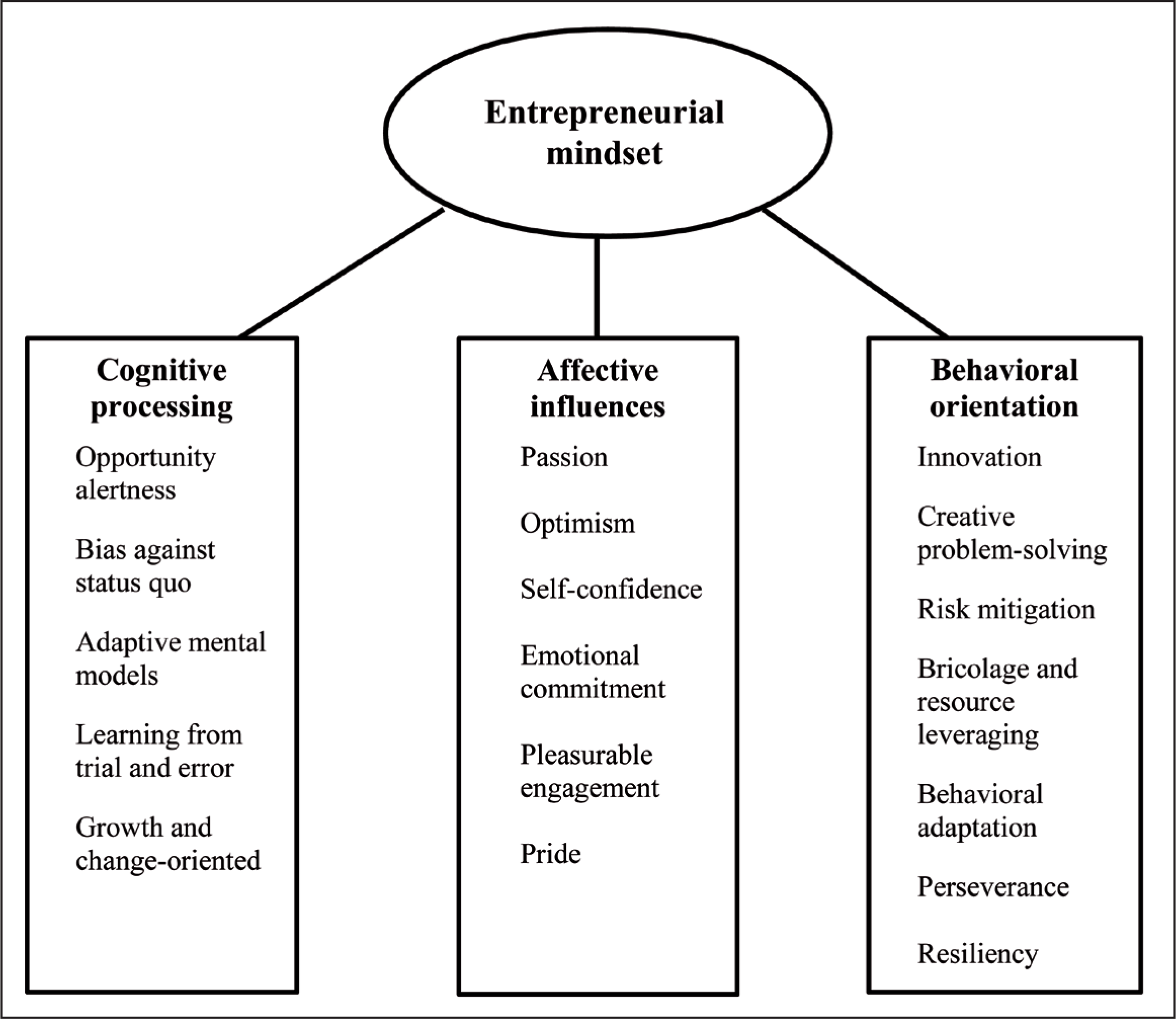
This brings us to the question of what educators should be teaching when it comes to this mindset. The answer depends upon whether one is trying to teach students about entrepreneurship, or teach them how to be entrepreneurs. When attempting to teach them about entrepreneurship, it may be sufficient to introduce a conceptualisation of the mindset, such as in Figure 1, and then explain why the mindset matters, how it affects successful navigation of the entrepreneurial process, and the fact that it can be nurtured and developed (together with any insights on how this is done). Thus, teaching the nature and importance of the mindset is relatively straightforward.
If instead the educator is attempting to teach students to be entrepreneurs, then the task centres not just on introducing the mindset, but on attempting to engender the mindset within students. This represents a much more difficult undertaking. There is evidence that a mindset can be cultivated (Dweck, 2006; Gupta & Govindarajan, 2002), but it can require considerable time, and likely occurs with increased practice or repetition of a task (Stenros, 2015). Hence, as a student is taught ways to mitigate risks or leverage resources, and repeatedly pushed to find ways to apply or adapt these approaches in particular contexts, the entrepreneurial mindset is being cultivated.
The educator will find that students start at different places in terms of how much they have incorporated elements of the mindset into their approach to an entrepreneurial opportunity. Some students will begin from a position of resisting change, not being adaptable, or being quite risk averse. In effect, they may have competing mindsets. Regardless of where they start, certain of these elements are arguably more difficult to inculcate than are others. For instance, a person’s degree of passion or resilience can represent deeply engrained elements of their personality, and be much harder to change, especially when compared to their orientation toward more learnable skills such as leveraging the resources of others, or taking actions to mitigate risks. Alternatively, educators may discover that there are interactive effects among the elements that make up the mindset. Thus, progress in helping a student master certain elements may serve to reinforce their development in terms of other elements. For example, as they become more alert to opportunities, or more adaptable in decision-making, this progress may interact with self-confidence to influence their willingness to take calculated risks.
In the end, if educators have an impact, it will be a matter of degree, such that a student develops a relatively stronger or weaker entrepreneurial mindset. Further, students are likely to be stronger on particular elements in Figure 1, and weaker on others. At the same time, one’s ability to succeed in a given entrepreneurial context may depend on the strength of their mindset. Thus, where uncertainty is greater, resource constraints are more severe, more adversity is encountered, and the entrepreneur confronts more complexity and novelty, success is likely to require a stronger mindset (Morris & Tucker, 2021). Educators may also find that, once developed, the strength of a student’s mindset dissipates with non-use or lack of practice.
The Competency Movement in Entrepreneurship Education
Our conceptualisation of the entrepreneurial mindset indicates it is more than a way of thinking. It is directly tied to behavioural tendencies that require certain capabilities or competencies (Zupan et al., 2018). The link between the entrepreneurial mindset and personal capabilities is reflected in the suggestion by Mathisen and Arnulf (2013) that aspects of the mindset relevant in early stages of the entrepreneurial process may differ from aspects relevant in subsequent stages. Morris et al. (2013) have provided empirical support for a number of entrepreneurial competencies (Bacigalupo et al., 2016; González-López et al., 2020; Oosterbeek et al., 2008). Examples include the abilities to recognize and evaluate opportunity, mitigate risks, and leverage resources.
Building a successful new venture, or implementing something new, requires two kinds of competencies: entrepreneurial and managerial. Table 3 provides examples of each type. Entrepreneurial competencies are instrumental in identifying high potential opportunities. They are necessary when dealing with high levels of novelty, uncertainty and ambiguity. They are critical for overcoming significant obstacles and addressing severe resource constraints.
Distinguishing Two Types of Competencies
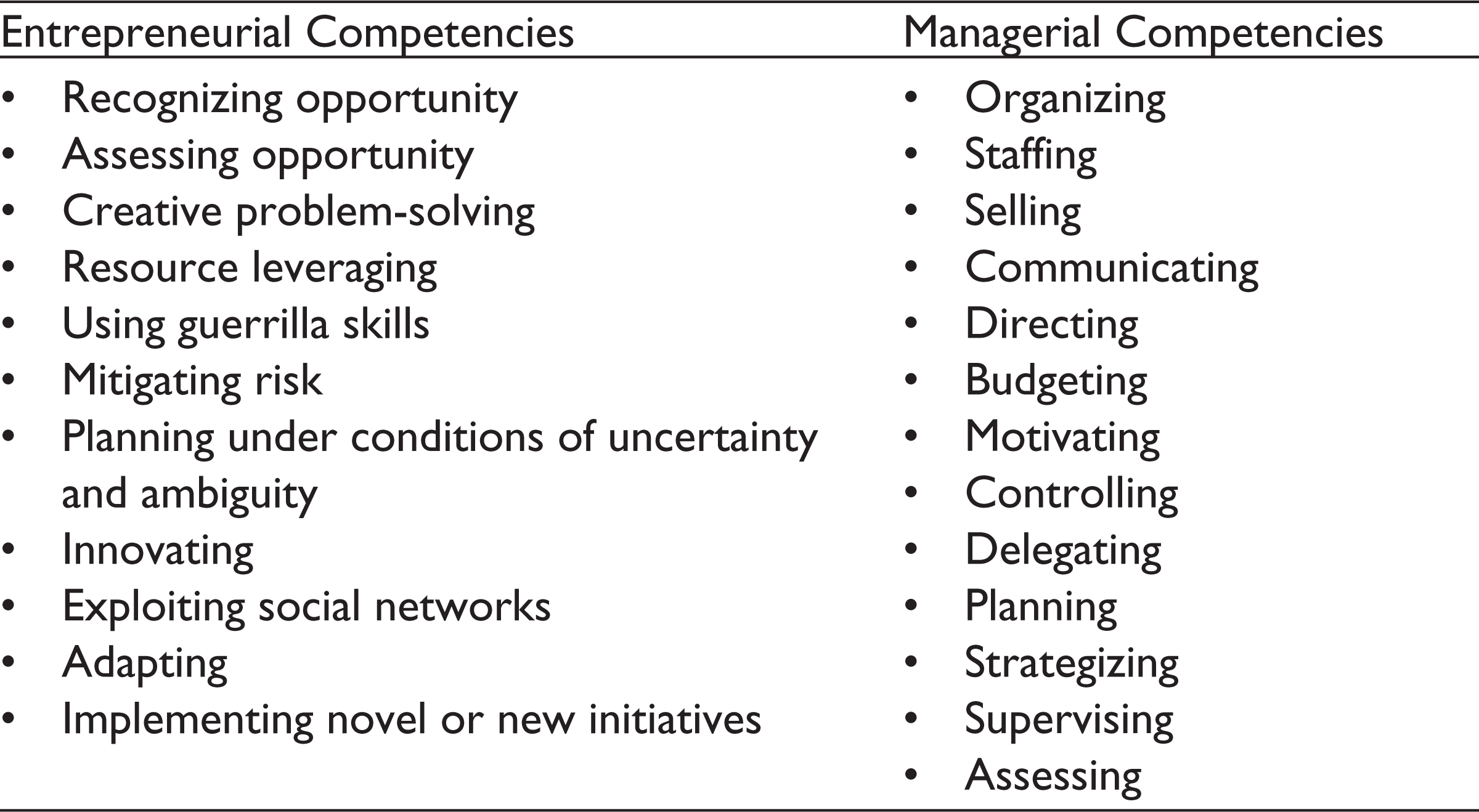
The fact that highly entrepreneurial individuals often prove to be poor managers reinforces the parallel importance of managerial competencies. In any start-up, the founder finds herself wearing all the hats, with a broad range of functional responsibilities. Any sort of growth requires the abilities to delegate to others, to hire the right kind of employee, and to supervise and motivate people. Other managerial competencies are vital for establishing the systems, standards and structures that can allow a venture to operate efficiently, ensure consistency in quality and make timely decisions. They are central to the entrepreneur’s ability to assess the performance of people, equipment, products, market segments and distributors.
There is a growing movement that argues entrepreneurship education should be competency-based (e.g., Morris et al., 2013b), much like medicine. While competencies certainly matter, how they are integrated into content depends upon whether one is teaching students about entrepreneurship, or instead, how to become entrepreneurs. In the former case, it becomes important to identify key competencies, explain them and how they impact the venture creation process, and methods through which they can be mastered. In the latter case, mastering competencies becomes the core focus of entrepreneurship education.
When attempting to teach students to become entrepreneurs, the educator must first determine how much emphasis should be placed on entrepreneurial versus managerial competencies. If the evolution of a venture from pre-start-up to launch to stabilisation to growth is considered, both of these two sets of competencies are important throughout, but the relative importance of managerial competencies is increasing throughout these stages. However, if one is purely focused on translating an idea into an operating business, then perhaps entrepreneurial competencies should receive much more attention. But if the focus is creating a venture that can be sustainable, can grow or can be scalable, then managerial competencies may warrant the greater amount of attention. Related to this determination is the extent to which one expects entrepreneurship educators to teach managerial skills, or instead, rely on other business courses to convey managerial capabilities.
Progress in helping students actually develop competencies requires that educators design measures of competency mastery. From an assurance of learning standpoint, the instructor must be able to determine how well a student can, for example, recognize opportunities or leverage resources of others. Using opportunity recognition as a case in point, the proficiency level might be reflected in the extent to which the student:
understands general sources of opportunity; is capable of scanning the environment to identify emerging patterns and trends, competitor shortcomings, unutilized resources and unmet needs; and can translate such patterns or trends into a definable market opportunity, including a specific target audience with a measurable need.
Within the learning environment, ensuring students can demonstrate such proficiency will require educators to develop three major learning components. These include (a) knowledge and understanding (i.e., what does the student need to know about opportunity recognition?); (b) attitude/affect and self-awareness (i.e., what does the student need to think, believe and feel about the competency?) and (c) skills and behaviours (i.e., what does the student need to be able to do in terms of the competency?). Such measures must be built into the academic environment through some combination of lectures, experiential learning activities or projects within the classroom, and experiential learning opportunities outside the classroom.
Teaching ‘How’ and ‘Who’ vs. ‘What’ and ‘Why’
An emphasis on the entrepreneurial mindset and unique competencies can represent a distinguishing feature of entrepreneurship education, distinguishing it from other forms of business education. Again, the issue is whether instructors should be teaching skills and capabilities, or conveying the nature of entrepreneurship, its role at the individual, organizational, community, societal and global levels, and why it matters.
If the educator is more concerned with students mastering competencies or the mindset, the teaching focus is more on aspects of the ‘how’ of entrepreneurship, including how to generate ideas, get funded, launch a business and become a successful entrepreneur; and the ‘who’ of entrepreneurship in terms of the nature, characteristics, skills and approaches employed by entrepreneurs who succeed, or understanding issues in forming teams and taking on partners.
Alternatively, if the educational priority is to teach a student about entrepreneurship, then the concern becomes aspects of the ‘what’ of entrepreneurship, addressing such issues as general models of the entrepreneurial process, general patterns in entrepreneurial activity, the forms that entrepreneurship takes, types of ventures created, their success and failure rates and associated causes, and the nature of ecosystems and other elements (e.g., public policies) that facilitate entrepreneurship; as well as the ‘why’ of entrepreneurship, including such issues as the different motives that drive entrepreneurial behaviour, as well as the impact of entrepreneurial ventures on individuals, communities and nations.
Table 4 provides an example of how a range of topics from Table 1 (including the mindset and competencies), might receive more or less emphasis depending on whether one is teaching students about entrepreneurship or teaching students to be entrepreneurs. It also suggests how the content covered for a given topic might vary based on these two purposes. While examples provided in the table are only intended for illustrative purposes, fairly fundamental differences are both possible and probable with each topic selected.
Comparing Treatments of 16 Course Topics Based on Teaching Purpose

Teaching individuals to become entrepreneurs finds the educator concentrating more heavily on a micro-level of analysis: the student creating a venture in a given context. Moreover, the approach is quite business-centric. This can allow for a fairly deep dive into the practical issues and critical decisions the student is likely to encounter during his or her entrepreneurial journey. Teaching them about the phenomenon of entrepreneurship requires that one introduce multiple levels of analysis (macro, meso and micro), as the student is exposed to the roles of institutions and a variety of actors at global, national, regional, community, organizational and individual levels. It also requires the educator to more heavily assume a multi-disciplinary perspective, where psychological, economic, sociological, anthropological and political perspectives on the phenomenon of entrepreneurship are explored.
This is not to suggest that these two pathways are mutually exclusive. When teaching a student how to start a venture, he or she is likely to encounter issues that help them understand the roles that institutions can play, or the impact a venture can have on a community. Similarly, when teaching a student about the general phenomenon or nature of entrepreneurship, he or she is apt to develop some insights into how to launch a business of their own (and may become more motivated to do so). However, in either case, the exposure to the other pathway is going to be more cursory. In practice, the likelihood is that educators attempt to address a bit of both pathways. Thus, they may present content on the role of entrepreneurship in society or sociological perspectives on entrepreneurial networks, while also having students write a business plan. The need is to be clearer on how much of each pathway one is pursuing, and how this translates into learning objectives and content coverage.
The Interface Between Entrepreneurship Content and Experiential Learning
As educational efforts have evolved to emphasize nurturing an entrepreneurial mindset in students and helping them master entrepreneurial competencies, there has been a parallel movement toward greater reliance on experiential learning (Cooper et al., 2004; Dhliwayo, 2008; Neck & Corbett, 2018). This sort of learning by doing can include practicing various aspects of entrepreneurship, interacting with others involved in entrepreneurial activities, or observing entrepreneurship in action. Experiential learning activities for students can be directly tied to a course, such as with simulations, case studies, small business consulting projects, business plans or interviews of entrepreneurs. They can also be provided to students as co-curricular offerings unrelated to any particular course, such as with student incubators, pitch competitions and mentorship programmes.
Some have gone so far as to argue that experiential learning opportunities should take precedence over conventional classroom lectures as the dominant component of a student’s entrepreneurship education (Ramsgaard, 2018; Schindehutte & Morris, 2016). To date, some limited evidence has been produced to support the efficacy of experiential approaches in achieving learning outcomes. For instance, Lackeus (2020) has demonstrated the variable effects of different experiential approaches on entrepreneurial competencies, student motivation, and the acquisition of knowledge and skills.
At the same time, a false dichotomy should not be created between exposure to lecture content and experiential techniques. It is a mistake to suggest that lectures are somehow less desirable, and should be replaced with experiential approaches, or vice versa (Gundlach & Zivnuska, 2010). Both approaches can produce substantive learning, depending upon what the instructor is attempting to teach and the dominant learning style of individual students (Kolb, 1984).
Consider the field of medicine. While there is a strong experiential component within medical education, there is an equally strong emphasis on lecture and introduction to substantive content. One does not practice heart surgery without first learning a considerable amount about a range of subjects such as anatomy, pathology, microbiology, biochemistry, anaesthesiology, pharmacology and surgical procedure. This content is not conveyed simply by having students read a book. Even when the educator has prioritised teaching students to become entrepreneurs, there are key concepts, frameworks, models, tools, research findings and identified best practices that should provide the foundation upon which experiential learning is built. As such, educators must be concerned that the pendulum does not swing too far in the direction of experiential approaches in entrepreneurship education to the exception of content.
The complex challenge for educators is not one of deciding between lecture content (which can be delivered in a host of creative ways) and experiential activities, but instead, one of integrating the two. Left to their own devices, experiential exercises can result in fun, interesting or challenging experiences, with very little actual learning. More problematic is when these activities result in learning things that are incorrect or lead to the wrong conclusions. The power of experiential learning can only be truly realized when the educator approaches lecture content and experiential exercises as complementary pedagogical approaches. Elements of core content can guide the design of experiential activities and be used to reinforce that content. They can heighten the ability of the student to successfully engage in or complete the experiential exercise. Beyond this, various observers have stressed the role of reflection in effective experiential learning (Lamm et al., 2011; Le Roux & Steyn, 2007). A vital aspect of this reflection should be a concern for how the experiential exercise provided an illustration of core concepts and principles in practice, and how to successfully apply such content to real world contexts.
There can also be cases where the reliance on experiential tools is due to an instructor not having a grasp on the core content. And this content is a moving target given the rapid expansion of knowledge within the discipline of entrepreneurship. This lack of instructor knowledge plagues entrepreneurship education, first, due to the significant number of faculty members who themselves have never taken an entrepreneurship course or conducted any entrepreneurship research, and second, due to the preponderance of entrepreneurs who are teaching. The latter group tends to know a lot about what it takes to start a particular venture in a particular industry and market context. They know much less about theories, frameworks, tools, concepts and research findings that help explain the motives, values and characteristics of entrepreneurs, the types of ventures created and their respective requirements, the nature of opportunity discovery, innovative business models, and patterns in entrepreneurial activity.
Contexts for Entrepreneurship as an Influence on What Is Taught
As a final consideration, educators must be more cognizant of the contexts for entrepreneurship, and which contexts are most pertinent for the types of students one is teaching. Consider twelve examples of contexts that might be relevant in an entrepreneurship course:
Start-ups in general Lifestyle ventures Family firms High tech and scalable start-ups Women- or minority-owned ventures Ventures started by those experiencing poverty Non-profit ventures Social ventures Global ventures Informal sector ventures Entrepreneurship inside corporations or established organizations Entrepreneurship in the public sector
The nature of entrepreneurship, and hence what is taught, can be fundamentally different if the instructor is addressing lifestyle businesses, scalable enterprises, social entrepreneurship or corporate entrepreneurship. A simple illustration can be found in topics such as marketing or financing a new venture, where the issues vary dramatically in exploring the entrepreneur in poverty circumstances compared to one starting a scalable, aggressive growth firms or one creating a social venture. Other pedagogical tools, such as the lean start-up methodology, may simply lose their relevance depending upon the context. Of course, dedicated courses can be created to explore the nuances of at least some of the relevant contexts for entrepreneurial behaviour. However, even in a foundation course, it is important to be cognizant of context in discussing most of the issues being covered. Morris and Kuratko (2020) demonstrate this point in in their exploration of the profound differences between survival, lifestyle, managed growth and aggressive growth ventures.
Another important contextual variable concerns the extent to which educators are more focused on the conceptualization and launch of a venture versus the development of a sustainable enterprise versus the growth or scaling of a business (or on all three equally). Priority issues to be addressed, obstacles encountered, decision-making considerations, critical stakeholders, institutional influences, and much more are changing. Again, the relevance of different categories of competencies will vary across these three stages. In addition, the content surrounding an array of other topics (and the relevance of a given topical area) and can also vary significantly by stage.
A Pathway Forward
The impressive emergence of entrepreneurship as a scholarly field is reflected in the rigorous standards and high impact factors established by leading journals such as the Journal of Business Venturing, Entrepreneurship Theory and Practice and the Strategic Entrepreneurship Journal. It is also reflected in the kinds of leading edge co-curricular programming found in many university entrepreneurship programmes. While the number of courses taught and degree programmes offered has also rapidly expanded, and there have been highly innovative approaches introduced around experiential learning, it still remains unclear exactly what instructors should be teaching, particularly in terms of the foundational elements of entrepreneurship education.
Academic programmes in entrepreneurship at universities tend to develop in idiosyncratic ways, and often in a piecemeal manner. Historically, educators have not started with a model or framework around which to design the curriculum. Such a curricular model delineates a core knowledge base in entrepreneurship (e.g., theories, definitions, concepts, frameworks, principles and issues), distinguishes common offerings for any student versus disciplinary-distinct courses for major/minors, establishes a coherent mix of contexts for entrepreneurship, and establishes a clear set of desired learning outcomes and assurance of learning approaches. Part of the challenge is the lack of any generally recognised entity that provides oversight or guidance regarding these issues. As exciting, new topics emerge, there is no forum for addressing how they can best be integrated into our teaching approaches.
The framework presented in Figure 2 is proposed as a beginning point for establishing what should be taught as the core or foundation of entrepreneurship. Here, educators are first encouraged to determine whether they are attempting to teach students about entrepreneurship, or prepare students for starting ventures of their own. There is value in either of these two objectives. The impact of entrepreneurship education may prove to be greater if a primacy is placed on teaching students about entrepreneurship. The framework allows for the fact that prioritizing one of these can still influence achievement of the other. Seven decision variables are proposed for use in determining what to include in a foundational course. Based on the general teaching objective, guidance is provided for how one might approach each of these variables. Hence, building mastery of competencies into courses and relying more heavily on experiential learning and a business-centric and micro-level approach become more relevant when teaching students how to start ventures.
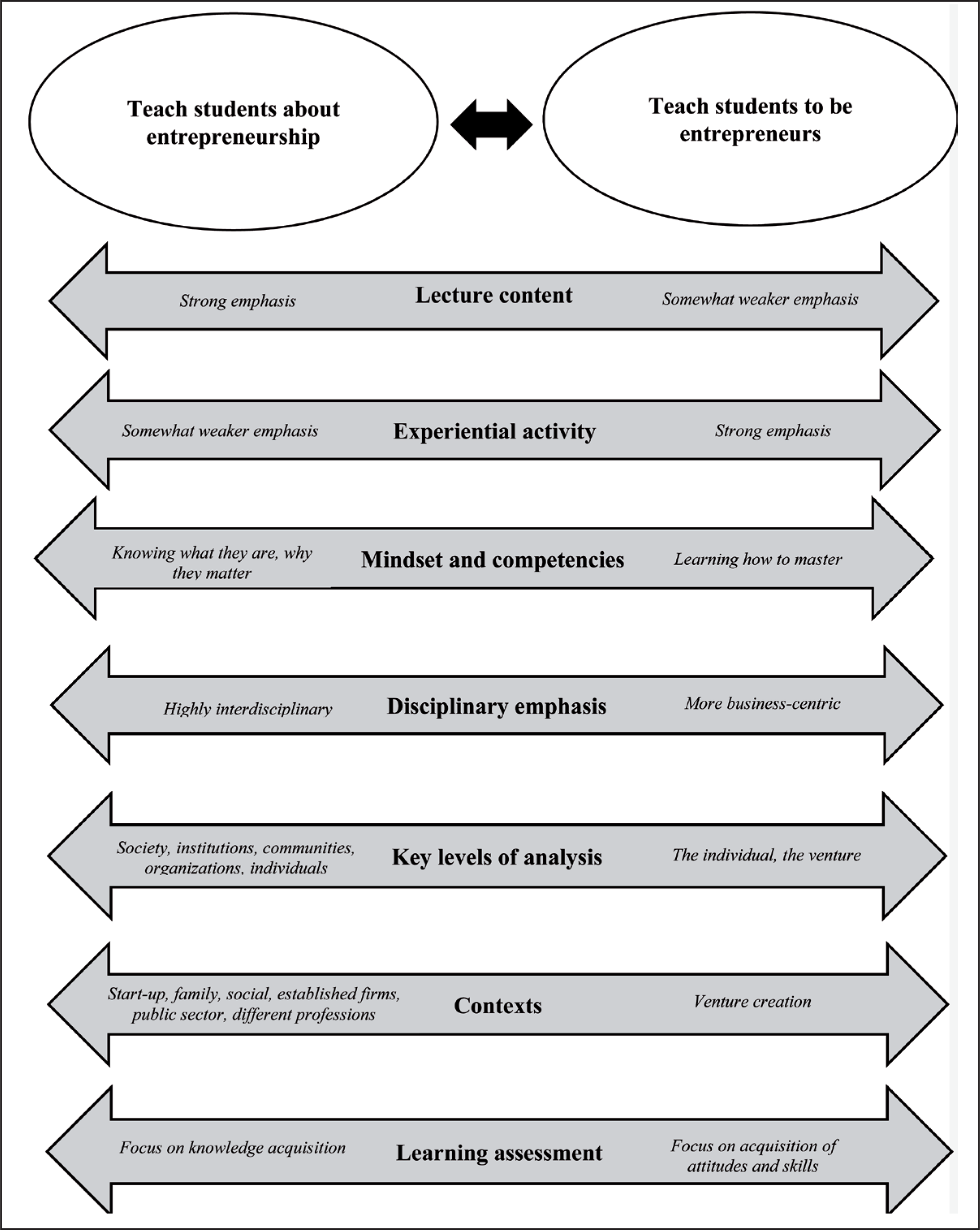
We do not address the question of specific topics, but instead argue that topics will receive different priorities and treatments in terms of content, as demonstrated in Table 4, based on where one falls in terms of the overall objective and the seven decision variables. One would begin by identifying those topics that are clearly common to both objectives, such as the entrepreneurial process or the business model. Then, if the educator were interested for instance in teaching students about entrepreneurship, the multidisciplinary and multi-context approach involving multiple levels of analysis that would apply here might suggest the importance of cognitive perspectives from psychology together with public policy perspectives from political science, as well as a need to address the family firm, the social venture and the scalable, high-tech firm as contexts. Lastly, the framework suggests that the teaching approach in this instance might rely more heavily on lecture content relative to experiential learning.
In conclusion, the field of entrepreneurship would appear to be making rapid advances in terms of scholarly research, the launch of curricular programmes and the introduction of pedagogical innovations, while progress in ensuring the consistency and substance of the content that educators deliver has lagged. Yet, there are exciting developments in terms of the rich content that is available and that is being continually produced. Opportunities for new content are regularly generated from the findings of those who study the phenomenon of entrepreneurship and the experiences of those who work with entrepreneurs. As the discipline matures, educators need to do more to translate these new insights into teachable material that can be integrated into the classroom.
These ongoing developments are a reminder that our approach to content must be dynamic, with continual renewal of topics and the associated concepts, tools, frameworks and insights surrounding each topic. This article has attempted to introduce an overarching question to guide this process, and a framework for addressing content elements (and pedagogical approaches) based on how this question is answered. The extent to which educators want to teach the many about the nature and importance of entrepreneurship, or teach the few about starting their own ventures is a vital determinant of how a university designs its courses. It is not that one objective must be chosen to the exclusion of the other. Rather, educators must set relative priorities and reflect these in foundational courses. It may be that these relative priorities also vary across the larger entrepreneurship curriculum, at least where the university it offering more than just foundational courses. For instance, a university might decide that foundational courses will be focused exclusively on teaching students about entrepreneurship, and particular follow-on courses might concentrate on teaching students to be entrepreneurs.
Being more systematic and intentional in our approach will contribute to the ability of entrepreneurship programmes to set and achieve assurance of learning objectives, enhance the legitimacy of entrepreneurship education across campuses and with accrediting bodies and help us move forward as a discipline.
Footnotes
Declaration of Conflicting Interests
The author declared no potential conflicts of interest with respect to the research, authorship and/or publication of this article.
Funding
The author received no financial support for the research, authorship and/or publication of this article.