




Abstract
Do basic human values facilitate prosocial behaviour on a global scale? This study, for the first time, analyzes the effect of values on prosocial behaviour in the context of public support for foreign development assistance. Support for foreign development assistance is a prosocial act intended to benefit the less fortunate in developing nations. Despite a plethora of evidence showing the effect of personal values on prosocial behaviour, the literature has neglected the value origins of support for development assistance. I argue that personal values play a crucial role in shaping individuals’ support for foreign development assistance. Using data from nationally representative samples covering 11 Organisation for Economic Cooperation and Development (OECD) countries, I show that self-transcendence and openness to change values, as defined by Schwartz’ theory of values, are reliable predictors of support for foreign development assistance. By linking human values to foreign development aid, this study expands the purview of values research to the domain of global governance and opens up new avenues of interdisciplinary inquiry that apply theories of values to different dimensions of world affairs.
Introduction
Do core human values reinforce prosocial behaviour on a global scale? A large body of work in cognitive and organizational psychology, management, sociology and related disciplines has demonstrated that personal values predict various forms of prosocial behaviour (Batson, 1991; Bond & Chi, 1997; Caprara, Alessandri, & Eisenberg, 2012; Caprara & Steca, 2007; Eisenberg & Fabes, 1998; Hitlin, 2007; Oliner & Oliner, 1988; Omoto & Snyder, 1995; Sarangi & Kartha, 2013; Schwartz, 2010; Schwartz & Howard, 1984; Vallabh & Singhal, 2014), defined as actions undertaken to benefit and help others (Batson, 1998; Penner, Dovidio, Piliavin, & Schroeder, 2005). However, there has been no examination of whether values reinforce prosocial behaviour on a global scale. This study, for the first time, analyzes the effect of values on prosocial behaviour in the context of public support for foreign development assistance in developed countries.
Foreign development assistance or aid (FDA) refers to the financial assistance governments of developed countries give to developing countries to aid their economic and social development. FDA is essential to addressing poverty and income disparity in the world (Collier, 2007). It is an indispensable source of income for poor countries. In some cases, FDA amounts to more than 10 per cent of a recipient country’s national income. 1 A sizable body of research has shown that effective development aid helps reduce poverty and boosts economic growth (Burnside & Dollar, 2000; Collier & Dehn, 2001; Dalgaard, Hansen, & Tarp, 2004; Stern, 2002; Stiglitz, 2002).
In democracies, public support for development assistance is critical. While public support increases the amount of aid donor governments are willing to provide, public opposition gives governments an incentive to reduce the percentage of their national budget spent on aid (Collier, 2007; Paxton & Knack, 2012). Support for FDA requires sacrifice by the citizens of donor countries. When citizens in donor nations endorse FDA, they are agreeing to pay higher taxes or cut government spending on domestic policy programmes to help the people in poor countries and address income inequality in the world. Thus, support for FDA is an act of sacrifice intended to benefit the less fortunate in developing nations. It is a prosocial behaviour on a global scale.
Several independently conducted public opinion surveys show that citizens in donor countries vary considerably in their support for FDA. 2 What explains these individual differences? Despite a plethora of evidence showing the effect of personal values on prosocial behaviour, the literature has neglected the value origins of support for development assistance, emphasizing material and ideological factors instead. This neglect is problematic because these factors, by themselves, do not explain what motivates individuals to help the have-nots in the world. I argue that personal values play a crucial role in shaping individuals’ support for FDA. Personal values determine whether individuals are concerned with the income disparity in the world and are motivated to help those in poor countries. Values provide the drive to extend a helping hand to the poor even at the expense of one’s egoistic interests.
To illuminate the value origins of support for FDA, I apply Schwartz’s theory of values. Using data from nationally representative samples covering 11 Organisation for Economic Cooperation and Development (OECD) countries provided by the World Values Survey (WVS), I show that self-transcendence and openness to change values are strong and reliable predictors of support for FDA.
This study makes a vital contribution to a large body of interdisciplinary scholarship that examines the role that human values play in shaping social interactions and behaviour (Baeva, 2014; Bayram, 2015; Bhattacharya, 2013; Bardi & Schwartz, 2003; Feather, 1995; Feldman, 2003; Hitlin & Piliavin, 2004; Hurwitz & Peffley, 1987; Roccas & Brewer, 2002; Schwartz, Caprara, & Vecchione, 2010; Sharma & Sharma, 2015; Verplanken & Holland, 2002). No study to date has systematically investigated how personal values affect prosocial behaviour on a global scale. The application of Schwartz’s theory of values to FDA expands the purview of values research to the domain of global governance and opens up new avenues of inquiry that link human values to different dimensions of world affairs.
In the following sections, I first review the literature on public attitudes towards FDA and explain why values predict individual support for foreign aid as a particular form of prosocial behaviour. I then introduce Schwartz’s theory of values and derive testable hypotheses. In the following sections, I discuss the data and methods, followed by the presentation of results. I conclude by discussing the implications of my findings for research on values and for global governance more generally.
Support for FDA
Poverty bests developing countries. Child deaths, hunger, poor water quality and lack of housing and education are direct results of poverty. Development assistance is an essential source of income for developing countries. Yet, it does impose costs on donor publics. Even though people in donor countries are richer than those in recipient nations in relative terms, they are not immune to poverty and income inequality. Some do live below the median income and rely on social welfare programmes. In the last few decades, income inequality has increased in several donor nations. 3 By endorsing FDA, donor publics are allowing their home governments to spend precious tax money on developing countries. As such, support for development aid is a prosocial act, voluntarily undertaken to benefit others at the expense of one’s own interests.
Citizens in donor countries hold different opinions on FDA (Milner & Tingley, 2013). Some are willing to help developing countries even if that means they pay higher taxes, whereas others are not. To explain this variation, scholars have largely focused on two main factors: material considerations and ideology. Material considerations include income and education. Because they are less likely to depend on government welfare programmes to ensure their own survival, individuals who are financially comfortable and highly educated are thought to approve of helping poor countries. A series of studies have shown that high income–high education individuals are indeed more likely to support FDA than low income–low education people (Chong & Gradstein, 2008; Milner & Tingley, 2010; Paxton & Knack, 2012).
Scholars have also argued that ideology influences individuals’ support for development aid. Because development assistance is a form of redistribution that requires government intervention, liberals and conservatives project their opinions on redistribution in the domestic context onto the international realm. Liberals favour government spending on social welfare programmes and redistribution policies, such as tax breaks for the less fortunate, whereas conservatives are largely against wealth redistribution by the state. When it comes to redistribution on a global scale, liberals and conservatives export these views to the domain of FDA. A number of studies have found support for the ideology argument, demonstrating that liberals are more supportive of foreign aid than conservatives (Breuning, 1995; Fleck & Kilby, 2006; Noel & Therien, 2002; Tingley, 2010; Milner & Tingley, 2013).
Despite their importance, income, education and ideology, by themselves, are not sufficient to explain what motivates citizens to extend a helping hand to the poor in the world. Arguments based on income and education, for example, might account for an individual’s ability to help but do not explain his or her motivation to help. Similarly, a focus on ideology alone fails to capture the moral reasons driving citizens’ support for FDA (Bayram, forthcoming; Lumsdaine, 1993).
I argue that personal values are a crucial source of support for FDA. Values by definition reflect individuals’ beliefs about desirable end-states, or outcomes, and shape their motivations. Therefore, values determine whether an individual is concerned with poverty and income inequality in the world and has the motivation to help address this concern.
Values and Support for FDA
Values are cognitive representations of fundamental motivational goals that transcend specific situations and operate as guiding principles in individuals’ lives. Rokeach (1973, p. 5) defines a value as ‘an enduring belief that a specific mode of conduct or an end-state of existence is personally or socially preferable to an opposite or converse mode of conduct or end-state of existence’. Similarly, Schwartz (1992, p. 4) explains that ‘values are 1) are concepts or beliefs, 2) pertain to desirable end states or behaviours, 3) transcend specific situations, 4) guide selection or evaluation of behaviour and events, and 5) are ordered by their relative importance’.
As guiding principles, values shape individuals’ preferences, motives and behaviour (Bardi & Schwartz, 2003; Feather, 1995; Feldman, 2003; Hitlin & Piliavin, 2004; Rohan, 2000). First, values determine the outcomes individuals find desirable and the personal concerns they adopt. Second, values shape the goals and actions people pursue to achieve the outcomes they desire and to address the issues they care about. Individuals behave in ways that allow them to attain their values and avoid actions that conflict with their values. Third, values operate as evaluative standards by which people assess the actions of themselves and others (Feather, 1995; Hitlin, 2007; Roccas, Schwartz, & Amit, 2010; Schwartz, 1992; Schwartz & Bilsky, 1987).
Given their centrality in individuals’ lives, values are intimately related to prosocial behaviour. Support for FDA is no exception. For an individual to support FDA, he or she needs to believe that income inequality and poverty in the world are undesirable, adopt assisting poor people in under-developed countries as a personal concern and be motivated to help. Because they embody basic motivational goals that shape people’s beliefs about desirable end-states, values determine whether an individual regards inequality and poverty in the world as a critical problem and is motivated to help address this problem.
First, values direct individuals’ attention to the plight of the poor in the world and generate awareness. The growing income disparity between developed and developing countries and the ills caused by poverty in such regions as sub-Saharan Africa, North Africa, South Asia and Latin America are a few of many grave problems in the world. Psychologists have long demonstrated that individuals have selective attention (Driver, 2001; Lavie, 1995; Pashler & Sutherland, 1998). Because of cognitive and resource limitations, people selectively focus their attention on some stimuli and disregard others. Values associate with support for foreign aid because the ideals and goals grounded in values determine the extent to which one pays attention to global poverty.
Second, values provide the motivation to help. Because they reflect fundamental beliefs about desirable end-states, values are by definition goal directed and shape individuals’ understandings of attractive and unattractive ways of behaving (Caprara & Steca, 2007; French & Kahn, 1962; Schwartz, 2010). Values induce valences, namely, cognitive and emotional assessments of different actions (Feather, 1995). Valences move people to undertake behaviour that is perceived positively and avoid actions that are perceived negatively. Values provide the motivation to help the poor in the world because they shape valence of FDA. Individuals will endorse FDA to the extent their values induce positive valence on it, leading them to see it as subjectively attractive (Feather, 1995; Schwartz, 2010).
Application of Schwartz’s Theory of Values and Hypotheses
Building upon Rokeach (1973), Schwartz has identified 10 distinct values, each expressing a specific motivational goal (Schwartz, 1992, 1994, 2012; Schwartz & Bilsky, 1987; Schwartz & Boehnke, 2004). Self-transcendence values of universalism and benevolence reflect concern for others’ well-being. They embody humanistic and sociotropic goals. Composed of power and achievement, self-enhancement values are the antithesis of self-transcendence values. Self-enhancement values emphasize promoting one’s selfish interests, achieving success and power over others. Stimulation and self-direction make up openness to change values. These values prioritize independence of thought and action and include a preference for change. Openness values rival conservation values composed of conformity, tradition and security. Conservation values privilege the status quo, order, obedience and self-restraint.
Together, the 10 values form a circumplex structure. Values adjacent to each other tap parallel motives, and thus are compatible with each other. Values located in opposite domains of the value circle tap divergent motives, and could conflict with one another. For example, universalism values indicating care about the welfare of others are compatible with benevolence values, but clash with hedonism, achievement and power values that reflect egoistic motives.
The structure of values theorized by Schwartz has been supported by a myriad of empirical tests in more than 300 empirical samples over the last few decades. 4 Employing the Schwartz value theory (SVT) allows me to start with a strong theoretical foundation of values and examine the effect of different values within a single analytical framework.
Going beyond one’s selfish interests and caring about others is what defines self-transcendence values of universalism and benevolence. Individuals who place importance on self-transcendence values care about the welfare and prosperity of people and are accepting and understanding of others. As a result, they are committed to fairness, equality, social cooperation, amity, peace as well as protection of the environment. Since self-transcendence values encourage regarding the interests and welfare of others, these values should lead to support for FDA. Therefore, the first hypothesis is:
H1: The stronger the self-transcendence values, the higher the support for FDA.
Openness to change values of self-direction and stimulation privilege the freedom of human agency. Individuals who hold these values in high regard care about independent thought and action, creativity, diversity and discovery. These motivational goals, in turn, generate a commitment to a world in which people act as self-governing agents unencumbered by social, political and economic constraints. It is obvious that poverty undermines an individual’s quality of life and limits his or her agency. Thus, individuals who hold openness values in high regard should have an interest in liberating the less fortunate in the world from the shackles of poverty so that they can live free and fulfilling lives. Thus, the second hypothesis is:
H2: The stronger the openness to change values, the higher the support for FDA.
Self-enhancement values are about one’s selfish interests. Those who place emphasis on these values are driven towards success, wealth, power and prestige, and might not hesitate to dominate others to achieve these objectives. Self-enhancement values stand in opposition to self-enhancement values in the Schwartz value circumplex because the former privileges the interests of the self, at the expense of others if necessary. To the extent FDA requires sacrifice for others, we should expect self-enhancement values to impede support for FDA.
H3: The stronger the self-enhancement values, the lower the support for FDA.
I expect conservation values to be orthogonal to support for development aid, and thus not have much effect. Conservation values specifically regulate an individual’s relationship with others in his or her in-group or community. Individuals who prioritize these values are interested in maintaining the social order and solidarity in their community; upholding communal traditions and customs; and ensuring the safety of group members. They prioritize the status quo over change, defer to social rules and censor their words and actions. FDA, by definition, is about out-groups. Caring about the traditions and unity of one’s in-group should have little bearing about how one feels about helping poor people in the world. Therefore, the fourth hypothesis can be stated as follows:
H4: Conservation values will have no effect on the support for FDA.
Data and Variables
I test my hypotheses cross-nationally, using data from the 2005 wave of the WVS covering OECD countries. 5 The countries included in the sample are Australia, Canada, Finland, Germany, Italy, Japan, Norway, Spain, Sweden, Switzerland and the United States (US). The WVS provides nationally representative samples for each country by employing random and stratified sampling methods. The unit of analysis is the individual survey respondent.
Dependent Variable: Global Prosociality
The dependent variable is support for FDA. It is measured with two questions. First, participants are asked whether they would be willing to pay higher taxes to increase their country’s foreign aid to poor countries. Higher Taxes is a binary variable coded ‘1’ if the respondent is willing to pay higher taxes and ‘0’ if he or she is unwilling. 6 Second, participants are asked whether the leaders of their country should give top priority to reducing poverty in the world or to solving one’s own country’s problems and are requested to indicate their position on a 10-point scale. Response categories for the variable Prioritize Global Poverty are anchored by ‘Top priority to help reducing poverty in the world’ (coded 10) and ‘Top priority to solve my own country’s problems’ (coded 1). These questions effectively capture prosocial behaviour in the global context because they measure participants’ willingness to sacrifice their own welfare to help the poor in the world.
Independent Variables: Schwartz Values
The values hypothesized to promote altruism on a global scale are self-transcendence and openness to change values as identified by Schwartz. The WVS survey includes measures of each of the values identified by the SVT. Respondents are presented with a series of descriptions and asked to indicate whether the individual depicted in a given description resembles them. A five-point scale, ranging from ‘Very much like me (coded 5), Like me, Somewhat like me, Not like me, or Not at all like me (coded 1)’, is used to record responses.
Universalism is gauged by ‘Looking after the environment is important to this person; to care for nature’. Benevolence is measured by ‘It is important to this person to help the people nearby; to care for their well-being’. The self-transcendence value scale reflects the standardized average of universalism and benevolence values (α = 0.56). 7
Openness to change values are made up of self-direction and stimulation. Self-direction is measured by ‘It is important to this person to think up new ideas and be creative; to do things one’s own way’. Stimulation is captured by ‘Adventure and taking risks are important to this person; to have an exciting life’. The openness to change value index is the standardized average of self-direction and stimulation values (α = 0.45).
The conservation value index is the standardized average of conformity, security and tradition values (α = 0.62). Security is measured by ‘Living in secure surroundings is important to this person; to avoid anything that might be dangerous’. Conformity is captured by ‘It is important to this person to always behave properly; to avoid doing anything people would say is wrong’. Finally, ‘Tradition is important to this person; to follow the customs handed down by one’s religion or family’ measures Tradition.
The self-enhancement index consists of the standardized averages of power, achievement and hedonism (α = 0.56). Power is gauged by ‘It is important to this person to be rich; to have a lot of money and expensive things’; Achievement is measured by ‘Being very successful is important to this person; to have people recognize one’s achievements’; and Hedonism is tapped by ‘It is important to this person to have a good time; to spoil oneself’.
Control Variables
To isolate the effect of personal values on support for FDA, I control for a series of factors. As noted previously, explanations based on income, education and ideology dominate the existing literature on public support for FDA. The variable Income measures household income in deciles as reported by participants. It is coded on a 10-point scale, ranging from ‘lowest’ (coded 1) to ‘highest’ (coded 10). The Education variable measures a respondent’s education in years (from 12 or less to 21 or more) based on the highest level of education they have attained. To capture ideology, I use the traditional ideological self-placement measure. Participants are asked to place themselves on a 10-point political spectrum scale anchored by left (coded 10) and right (coded 1). Ideology is a measure of political ideology, with higher values indicating stronger left orientation. Some scholars have argued that religious individuals are more supportive of foreign aid than non-religious people because religiosity inspires them to charitable (Paxton & Knack, 2012). Thus, the variable Religion gauges the importance of religion in a person’s life and ranges from ‘Very important (coded 4)’ to ‘Not at all important (coded 1)’. Finally, I control for demographic factors. The variables Sex (coded 1 for man; 0 for woman) and Age (age in years) measure respondents’ sex and age.
Method
First, I estimate four logistic regression models, using the dependent variable Higher Taxes. Since this variable is a binary one, a logistic regression is the appropriate method of estimate. Next, I estimate four linear regression models, using the dependent variable Prioritize Global Poverty. As this is an interval and normally distributed variable, a least squares regression model is suitable. Following convention, I include dummy variables for countries to capture possible country effects given the cross-national nature of the data. Schwartz (2009) cautions against using all four value indexes in the same estimation because they are highly correlated with each other. Following convention, I first focus on the values on the opposite sides of the value circle, and subsequently examine the effects of the values most pertinent to FDA.
Results and Discussion
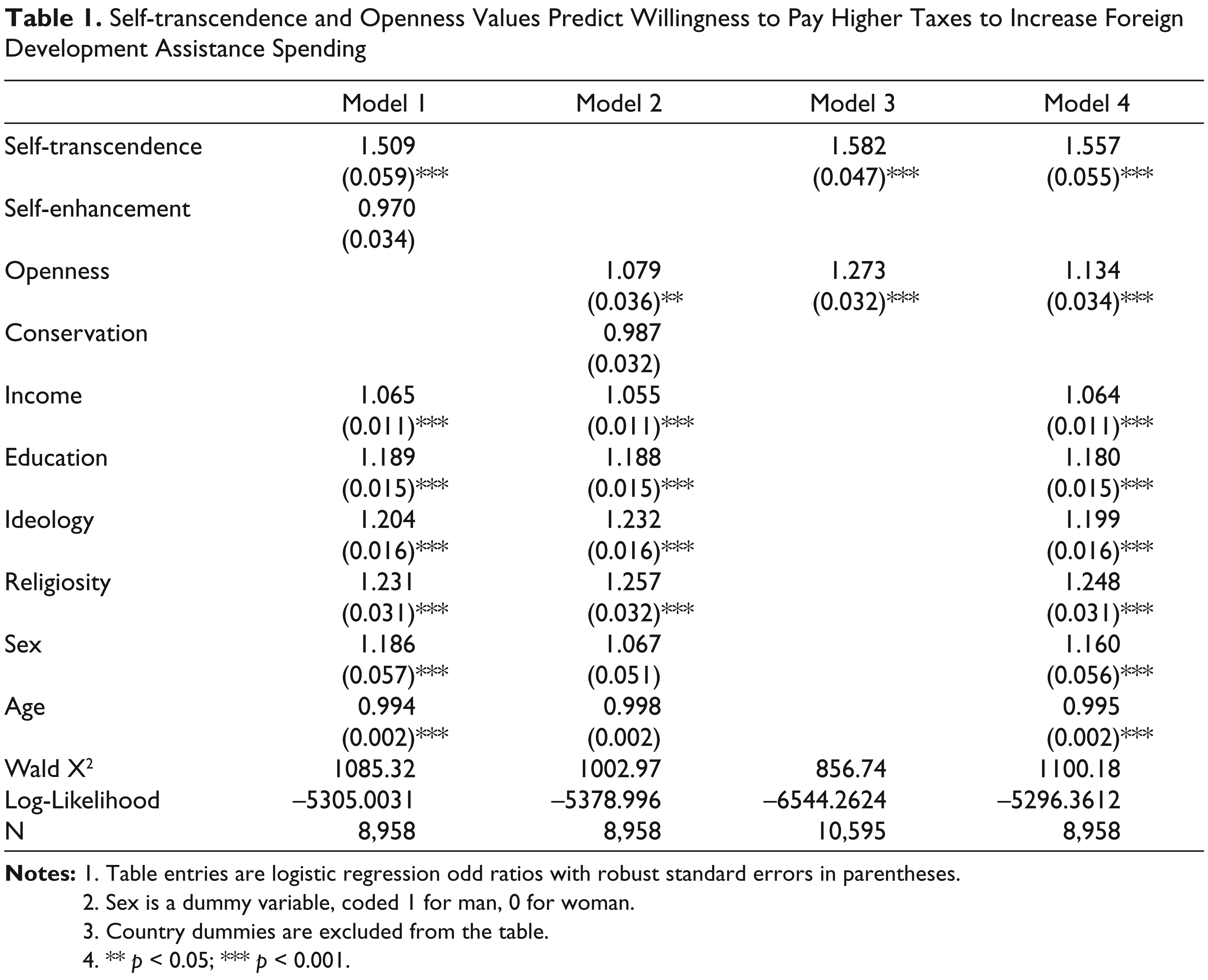
Table 1 presents the results of four logistic regression analyses. Model 1 regresses self-transcendence and self-enhancement values on respondents’ support for FDA measured by their willingness to pay higher taxes to increase development assistance, controlling for income, education and ideology, religiosity and demographic factors. As can be seen in the far left column of Table 1, self-transcendence values have a highly statistically significant and substantively large effect on support for FDA. The predicted probability that a respondent agrees to pay higher taxes increases by 58 per cent moving from the minimum to the maximum of self-transcendence values. 8 This finding shows that the stronger the self-transcendence values, the greater one’s support for FDA, supporting hypothesis one.
Self-transcendence and Openness Values Predict Willingness to Pay Higher Taxes to Increase Foreign Development Assistance Spending
2. Sex is a dummy variable, coded 1 for man, 0 for woman.
3. Country dummies are excluded from the table.
4. ** p < 0.05; *** p < 0.001.
The effect of self-enhancement values fails to reach statistical significance. This result implies that prioritizing achievement, power and success does not necessarily translate into indifference to others’ well-being. Even though self-enhancement values are opposed to self-transcended values in Schwartz value circle, in the context of global prosociality, these values do not seem to be antithetical to each other.
Results of Model 1 also support the arguments on material factors and ideology. Individuals who earn higher incomes, are highly educated and lean left are more likely to support FDA than others. For example, the difference in the predicted probability of supporting foreign aid between lowest and highest income people is 13 per cent and between lowest and highest education levels is 30 per cent. Similarly, moving from the far right to the far left on the political ideology scale, the predicted probability of support for higher taxes rises by 37 per cent. Nonetheless, compared to the importance of self-transcendence values, the substantive effects of income, education and ideology are much smaller. Religious individuals, men and younger people are more likely to favour FDA than others. The difference in the predicted probability of supporting foreign aid is 15 per cent between religious and non-religious people; 4 per cent between men and women; and 7 per cent between 25- and 75-year-olds.
The highly statistically significant and substantively large effect of self-transcendence values on support for FDA is robust to alternative model specifications. It remains unchanged when I estimate a series of simpler models as robustness checks.
Model 2 regresses openness and conservation values on respondents’ support for FDA, again controlling for income, education and ideology, religiosity and demographic factors. Results support hypotheses two and four. As predicted, openness is a significant predictor of support for FDA. The probability of being willing to pay higher taxes to increase foreign aid spending rises by 18 per cent moving from the lowest to the highest value of openness to change values. I also find support for the claim that conservation values are not predictive of support for FDA. The effect of conservation is not statistically significant. This implies that prioritizing in-group solidarity does not affect how one feels about helping the poor in the world. Reinforcing the earlier findings, income, education, left ideology and religiosity associate with greater willingness to aid the have-nots of the world. The substantive effect of openness to change values is smaller than that of ideology; however, it is larger or comparable to the effects of income, education and religiosity. Results do not reveal significant differences between men and women and age groups.
Given the importance of self-transcendence and openness values for support for FDA, Model 3 focuses on only these value orientations. Results replicate earlier findings. Both self-transcendence and openness values positively associate with support for foreign aid, with a higher level of statistical significance. The predicted probability of being willing to pay higher taxes to increase foreign aid is about 10 per cent for respondents who score lowest on self-transcendence values. It jumps to 72 per cent for respondents who score highest on self-transcendence values. This is a tremendous increase. Similarly, the probability of being willing to pay higher taxes to increase foreign aid rises by 31 per cent moving from the lowest to the highest value of openness to change values. These findings strongly support hypotheses one and two. Model 4 adds the control variables into the analysis. Again, the predicted probability of being willing to pay higher taxes to expand foreign aid rises by 60 per cent going from the lowest to the highest score on self-transcendence values. In the same vein, respondents who place the highest importance on openness values are about 20 per cent more likely to support FDA than those who place the least importance on these values. Findings for income, education, ideology, religiosity and demographic factors replicate earlier results. In sum, these findings clearly indicate that selftranscendence and openness values are strong predictors of citizens’ support for FDA.
Table 2 presents the results of four linear regression models, using the dependent variable Prioritize Global Poverty. Following the logic used earlier, I start with regressing self-transcendence and self-enhancement values on the outcome variable, controlling for income, education, ideology, religiosity and demographic factors. As hypothesized, the more an individual values self-transcendence, the more support he or she expresses to helping the poor in the world. According to Model 1’, a unit increase in an individual’s self-transcendence score leads to a 0.30 increase in support for helping the poor. Income, education, left ideology and religiosity positively and significantly associate with support for aiding developing countries. However, compared to self-transcendence values, the substantive effect of these factors on support for foreign aid is notably small. While younger people are slightly more in favour of development assistance, women and men do not differ in their preferences. Reinforcing the earlier results, self-enhancement values do not predict public attitudes towards global poverty reduction. This finding shows that valuing personal success and power do not necessarily come at the expense of others.
Self-transcendence and Openness Values Predict Willingness to Reduce Poverty in the World

2. Sex is a dummy variable, coded 1 for man, 0 for woman.
3. Country dummies are excluded from the table.
4. *** p < 0.05; **** p < 0.001.
Model 2’ estimates the effects of openness and conservation values on support for reducing poverty in the world, taking into account the control variables. As predicted, openness values positively and significantly associate with favourable attitudes towards global poverty reduction, whereas conservation values do not play a role. A unit increase in openness scores results in a 0.10 increase in support for global poverty reduction. The effect of conservation values is negative but does not reach statistical significance.
Since self-transcendence and openness values are the strongest predictors of support for foreign aid, Model 3’ specifically focuses on these value orientations. As can be seen, individuals who place emphasis on self-transcendence and openness values are considerably more likely to favour foreign aid. Model 4’ shows that the importance of self-transcendence and openness values is robust to the addition of the control factors in the analysis. For a unit increase in self-transcendence scores, there is a 0.32 increase in one’s willingness to prioritize reducing poverty in the world. In the same vein, an increase in openness scores leads to a 0.16 points increase in support for global poverty reduction. Even though education, ideology, religiosity, and to a lesser extent income, matter, values reliably predict support for helping the have-nots of the world.
To sum up, results from both of my analyses indicate that personal values drive citizens’ support for FDA. Specifically, individuals who place importance on others’ well-being and prioritize the freedom of human agency are more inclined to help the less fortunate in developing countries.
Conclusion
My findings indicate that values play a crucial role in shaping citizens’ support for FDA as a particular form of prosocial act. Even though scholars have shown the effect of values on prosocial behaviour across a wide range of domains, no study to date has explored whether values influence prosocial behaviour in the international context. This study, for the first time, investigates the relationship between personal values and helping the poor in the world using nationally representative samples of 11 OECD countries. I demonstrate that self-transcendence and openness values reinforce support for FDA. This result shows that support for development assistance is a personal choice to help address income disparity and poverty in the world. It is not necessarily an economic or an ideological decision, but a personal preference anchored in individuals’ values.
As the first application of Schwartz’s theory of values to prosocial behaviour on a global scale, this work broadens the scope of values research and facilitates its further application to the domain of world politics. Also, the results of this work have important political and normative implications. Development assistance provided by donor countries is essential to addressing the income disparity and poverty in the world. Yet, donor governments sometimes claim that their citizens, especially those with lower capital endowment, are unenthusiastic about FDA. This study casts doubt upon the validity of this claim. It shows that citizens’ approval of FDA has a value dimension; it is not merely a function of their financial status.
This study opens up new avenues of research that link human values to the larger study of global governance. Scholars can investigate the influence of values on other types of prosocial behaviour in the international context, such as support for humanitarian assistance, commitment to fairness in international negotiations, participation in international philanthropic organizations and making personal donations to schools and universities across the world. Similarly, future works can examine how values structure individuals’ postures on different foreign policy issues, such as war, trade negotiations and international law.