



Abstract
The main aim of the present research was to study the religiosity and moral identity internalization as effective variables of prosocial behaviour. Sample consisted of 400 emerging adults (females) in the age range of 18–24. All participants completed questionnaire measures, namely religiosity scale (Bhushan, 1970), moral identity inventory (Aquino & Reed, 2002, Journal of Personality and Social Psychology, 83, 1423–1440) and prosocial personality battery (Penner, Fritzsche, Craiger & Friefeld, 1995, Advances in Personality Assessment (vol. 10, pp. 147–184). Hillsdale, NJ: Lea). The data were subjected to 2
Psychology of religion has been explored intensively as it is evident from the existing literature, but there is a lag in the research regarding the possible behavioural outcomes that religiosity may produce during emerging adult years. The previous research has documented that religiosity influences prosocial behaviour, but a very small number of studies in Indian context have explored the role of religiosity and moral identity internalization together and their capacity in fostering positive youth outcomes, mainly prosocial behaviour.
According to Bhushan (1970) ‘Religiosity has three important aspects: theoretical, practical and emotional’. Theoretically, it refers to the individual’s faith in God. The practical aspect of religiosity constitutes of an individual’s faith in observance of ethical and moral duties and rituals as divine commands. As far as emotional aspect is concerned, it is reflected in the feelings of devotion and dedication to the God.
Religiosity influences prosocial behaviour in a number of ways. Prosocial behaviour may be defined analytically as ‘Behavior carried out for the benefit of others’, such as giving donation to charity, helping a stranger by giving directions in town or saving somebody from drowning (Bierhoff, 2002). Prosocial behaviour is a multidimensional construct. Penner, Fritzsche, Craiger, and Freifeld (1995) described factors which are responsible for prosocial behaviour and developed ‘Prosocial Personality Battery’.
The link between religiosity and prosocial behaviour is explained by ‘supernatural punishment hypothesis’ (Bering & Johnson, 2005) and ‘costly signaling theory’ (Sosis & Alcorta, 2003). According to the supernatural punishment hypothesis, cooperation among the members of the large group is maintained by the perceived presence of God (Preston, Salomon & Ritter, 2013). Religious prosocialitity is also explained by ‘costly signaling theory’, which suggests that religious commitments are used as costly signalling device (McAndrew, 2019). Studies have shown that religiosity leads to prosocial behaviour (Anderson, 2009; Van Cappellen, Saroglou, & Toth-Gauthier, 2016).
According to Aquino and Reed (2002), moral identity has been defined as ‘a self-conception organized around a set of moral traits’. Moral identity can be measured explicitly or implicitly. ‘Moral identity inventory’, as given by Aquino and Reed (2002), measures the two dimensions of moral identity, namely moral identity internalization and moral identity symbolization and it is an explicit measure of moral identity. Moral identity internalization ‘reflects the degree to which a set of moral traits is central to the self-concept whereas symbolization reflects the degree to which these traits are expressed publicly through a person’s actions in the world’ (Reynolds & Ceranic, 2007).
Emerging adulthood is a period of development that extends from the late teens through the twenties. It is a period of development that provides a chance for exploration of identity in various life domains (Arnett, 2000). Moreover, during this period, religious development is completely shaped (McNamara Barry, Nelson, Davarya, & Urry, 2010) because of the maturation process that occurs in the brain during the transition from late teens into the early twenties. Much importance has been given to the influence of religiosity on behavioural outcomes among gerontological population. Little focus has been given to explore the role of religiosity in various outcomes during emerging adult years (McNamara et al., 2010). Development of moral identity also occurs during emerging adulthood. Krettenauer and Hertz (2015) described that the ‘goal of moral identity development is in the integration of self and morality, such that self-concerns and moral concerns become unified’. The integration of self and morality takes place usually in emerging adult years.
A large number of predictors of prosocial behaviour have been identified, but a growing body of research is indicating that moral identity may be a crucial predictor of prosocial behaviour (Hardy, Bean, & Olsen, 2015). Further, Hoffman described that individuals having internalized moral principles will act prosocially or morally because of self-affirmation (Gibbs, 2003). Moral identity internalization was associated positively with prosociality (Azimpour, Shehni-Yailagh, Esfandiyari, Abdollahi, & Eslamiyeh, 2017; Yildiz, Senel, & Yildiran, 2018). Sunil and Verma (2018) reported that moral identity internalization was a significant predictor of civic engagement attitude.
Objectives of the Study
The main objectives of the present study were as follows:
To study the main effect of religiosity on various dimensions of prosocial behaviour. To study the main effect of moral identity internalization on various dimensions of prosocial behaviour. To study the interactive effect of religiosity and moral identity internalization on prosocial behaviour.
Hypotheses of the Study
Religiosity may have a significant effect on prosocial behaviour. The highly religious persons may be more prosocial as compared to less religious ones.
Moral identity internalization may produce a significant effect on prosocial behaviour. The persons high on moral identity internalization may be more prosocial.
Regarding the interactive effect of religiosity and moral identity internalization on prosocial behaviour, it is expected that high religious participants having high scores on moral identity internalization may be more prosocial as compared to their lower counterparts
Materials and Methods
Sample
The population of the study was emerging adults doing graduation and postgraduation in various colleges of Amritsar (Punjab) from which the sample was drawn. The sample consisted of 400 participants (females) in the age range of 18–24 (mean = 20.16, SD = 1.92) doing graduation and postgraduation from seven colleges of Amritsar, Punjab (India). A total of 235 (58.75%) participants were doing graduation, and 165 (41.25%) were doing postgraduation. The convenient sampling technique was used to collect the data, and only those participants could be taken who were willing to participate. Out of total sample, 261 (62.25%) were Sikh, 134 (33.5%) were Hindu, 5 (1.25%) were Christian, 332 (83%) were urban participants and 68 (17%) were rural participants.
Procedure
The permission for data collection was taken from concerned authorities. The participants were asked to complete the religiosity scale and moral identity inventory and prosocial personality battery after giving the instructions. On the basis of scores of religiosity scale, subjects were categorized into high and low scorers on the basis of the criterion of mean ± 1.0 S.D. (16% cases in each group). Mean of the religiosity scores of 400 participants was 134.68 and S.D. was 14.33. After applying the criterion, participants having score of 149.01 and above were taken in high group, and participants having score of 120.35 and below were taken in low group. Each group consisted of 52 participants who were further categorized into two groups, that is, ‘high moral identity internalization’ and ‘low moral identity internalization’, using median as a cut-off point. Finally, each group consisted of 26 participants.
Measures
Religiosity Scale
Religiosity scale (Bhushan, 1970), a self-report measure, was used for assessment of religiosity. It is composed of 36 items, of which, 11 items are negative and 25 are positive. The possible maximum score is 180 and the minimum is 36. The reported split half reliability is 0.82, and test retest reliability of the scale is 0.78.
Moral Identity Inventory
The construct of moral identity was assessed by self-report moral identity inventory (Aquino & Reed, 2002). Respondents were given a list of nine moral characters, namely caring, compassionate, fair, friendly, generous, helpful, hard-working, honest and kind and were instructed to portray a person with these characteristics while giving responses to 10 statements on a scale from 1 (completely disagree) to 7 (completely agree). This inventory has two subscales consisting of five items each, namely internalization and symbolization. The coefficient alpha of internalization and symbolization dimension are 0.84 and 0.85, respectively. The only internalization dimension of the moral identity inventory has been used for the present study.
Prosocial Personality Battery
The short version of prosocial personality battery (Penner et al., 1995) was used for measuring prosociality. It consists of 30 items, which measures 7 individual scales, namely social responsibility; empathic concern; perspective taking; personal distress; other oriented moral reasoning; mutual concerns moral reasoning; self-reported altruism; and two factors, that is, other oriented empathy and helpfulness. It is scored on a 5-point Likert scale. Coefficient alpha for social responsibility is 0.65, empathic concern is 0.67, perspective-taking is 0.66, personal distress is 0.77, mutual moral reasoning is 0.64, other oriented reasoning is 0.77 and self-reported altruism is 0.73.
Research Design
The present study involved two independent variables, namely religiosity and moral identity internalization. A 2
Results
The data were analysed using SPSS version 19. The results of the present study are summarized in Table 1, which shows means and standard deviations of various groups in relation to each dimension of prosocial behaviour. The data of the present study were tested for homogeneity of variance. Levene’s test revealed that the assumption was valid.
Mean and SD of Various Dimensions of Prosocial Behaviour
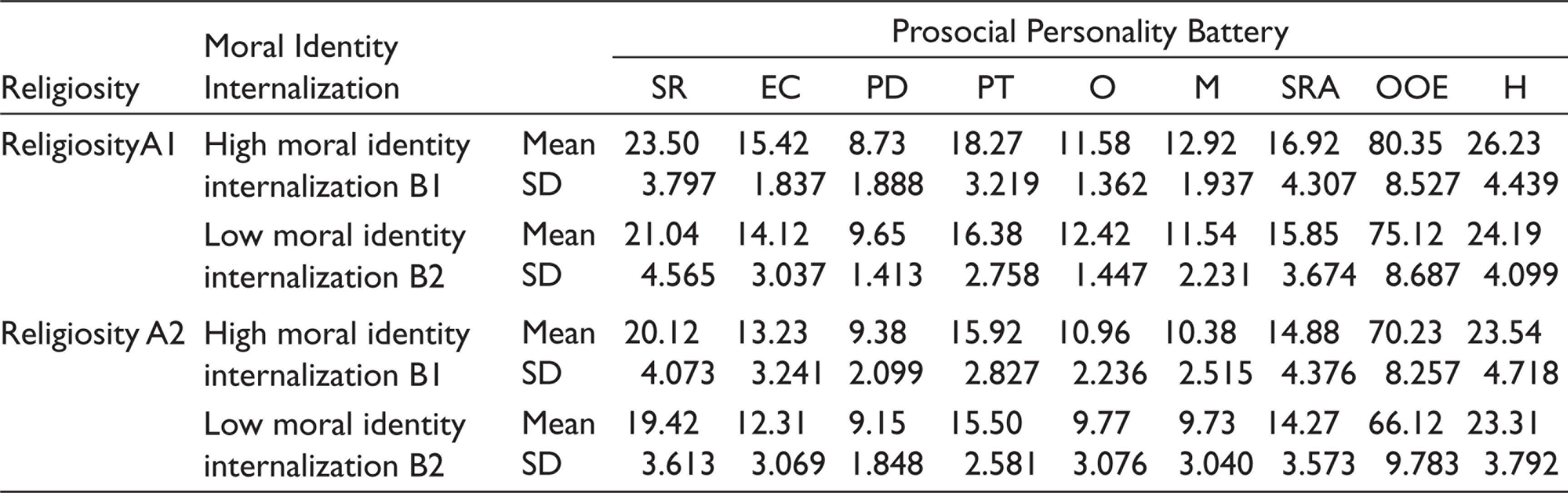
The data were subjected to 2
Social Responsibility
Table 2 clearly revealed that the main effect of religiosity (A) was statistically significant [F(1, 100) = 10.016; p ≤ 0.01]. Therefore, the religiosity had a significant independent effect on social responsibility. Highly religious individuals were found to be more responsible socially as compared to less religious participants. Table 2 also indicated that the main effect of variable moral identity internalization also produced a significant independent effect on social responsibility [F(1, 100) = 3.985; p ≤ 0.05]. Further, the results also reported that the interaction between religiosity and moral identity internalization was statistically non-significant.
Empathic Concern
Table 2 clearly indicated that the main effect of variable religiosity was statistically significant [F(1, 100) = 12.790; p ≤ 0.01]. Thus, results showed that the individuals having high religiosity have high scores on empathic concern as compared to less religious individuals. Table 2 also revealed that the main effect of variable moral identity internalization was statistically significant [F(1, 100) = 3.978; p ≤ 0.05]. Therefore, the results indicated that high scorers on moral identity internalization have high scores on empathic concern as compared to low scorers on moral identity internalization.
Personal Distress
Table 2 revealed that the main effect of variable religiosity was statistically non-significant. Therefore, religiosity did not have any significant independent effect on personal distress. Table 2 also showed that main effect of moral identity internalization was also statistically non-significant. Therefore, moral identity internalization did not produce any significant independent effect on personal distress. The interaction between religiosity and moral identity internalization was statistically non-significant.
Perspective Taking
Table 2 showed that the main effect of variable religiosity was statistically significant [F(1, 100) = 8.318; p ≤ 0.01]. Therefore, the subjects having high scores on religiosity also had higher scores on perspective taking than subjects with low scores on religiosity. Table 2 also indicated that the main effect of variable moral identity internalization was statistically significant [F(1, 100) = 4.244; p ≤ 0.05]. Therefore, the participants having high scores on internalized moral identity also have higher scores on perspective-taking skills as compared to their lower counterparts.
Other Oriented Moral Reasoning
Table 2 revealed that the main effect of variable religiosity was statistically significant [F(1, 100) = 15.094; p ≤ 0.01]. Therefore, religiosity produced a significant independent effect on other oriented moral reasoning. Table 2 also showed that the main effect of variable moral identity internalization was statistically non-significant; therefore, moral identity internalization did not produce any significant independent effect on other oriented moral reasoning. The interaction between religiosity and moral identity internalization was statistically significant [F(1, 100) = 5.868; p ≤ 0.01]. Therefore, highly religious individuals having a high internalized moral identity had higher scores on other oriented moral reasoning as compared to less religious participants along with low moral identity internalization.
F ratios for Each Dimension and Two Factors of Prosocial Behaviour: Religiosity (A) × Moral Identity Internalization (B) (n = 26)

Mutual Concern Moral Reasoning
Table 2 further explained that the main effect of variable religiosity was statistically significant; therefore, religiosity elicited significant [F(1, 100) = 20.208; p ≤ 0.01] independent effect on mutual concern moral reasoning. Therefore, highly religious individuals engage in more prosocial moral reasoning. Results also indicated that the main effect of moral identity internalization was also statistically significant [F(1, 100) = 4.445; p ≤ 0.05]. Therefore, moral identity exhibited significant independent effect on mutual concern moral reasoning. Therefore, the participants having high scores on internalized moral identity also have higher scores on mutual concern moral reasoning as compared to their lower counterparts.
Self-reported Altruisms
Table 2 clearly indicated that the main effect of variable religiosity was statistically significant [F(1, 100) = 5.313; p ≤ 0.05]. Therefore, the subjects scoring higher on religiosity had higher scores on self-reported altruism as compared to less religious individuals. Table 2 also puts light that the main effect of variable moral identity internalization was statistically non-significant. The interaction between religiosity and moral identity internalization was statistically non-significant.
Other Oriented Empathy
Table 2 clearly indicated that the main effect of variable religiosity was statistically significant [F(1, 100) = 30.443; p ≤ 0.01]. Therefore, the subjects scoring higher on religiosity had higher scores on other oriented empathy as compared to less religious individuals. Table 2 also puts light that the main effect of variable moral identity internalization was statistically significant [F(1, 100) = 7.287; p ≤ 0.01]. Therefore, high moral identity internalization results in high levels of other oriented empathy.
Helpfulness
Table 2 clearly indicated that the main effect of variable religiosity was statistically significant [F(1, 100) = 4.548; p ≤ 0.01]. Therefore, the subjects scoring higher on religiosity had higher scores on helpfulness as compared to less religious individuals. Table 2 also puts light that the main effect of variable moral identity internalization was statistically non-significant. The interaction between religiosity and moral identity internalization was statistically non-significant.
Hence, it can be inferred from results that Hypothesis 1 stands accepted on all the dimensions of prosocial behaviour except for personal distress.
Hypothesis 2 stands accepted on dimensions of prosocial behaviour, namely social responsibility, empathic concern, perspective taking, mutual concern moral reasoning, other oriented empathy, and it has not been accepted on personal distress, other oriented moral reasoning, self-reported altruism, and helpfulness.
Hypothesis 3 stands accepted only on other oriented moral reasoning dimension of prosocial behaviour.
Discussion
The present study explored the effect of religiosity and moral identity internalization on prosocial behaviour. The results found that religious individuals were more socially responsible. Highly religious individuals are socially more responsible because they want to create ceaseless reputation that may outstretch above their physical existence. They want to create a long-lasting positive impression on the eternal power that exists beyond their physical existence. This finding is consistent with the results described by Ridenour, Campbell, Bufford, and Gathercoal (2008) and Barron and Chou (2017).
The results also indicated that highly religious individuals possess higher empathic concern as compared to less religious individuals. The possible explanation for the same is that religiosity when promoted among individuals through the development of an intimate relationship with God leads to empathic emotion. The intimacy with God leads to cohesion of religiosity with one’s identity, which further provides meaning in life, then there are chances that there may occur transition of emotional ties with God into other oriented emotional caring (empathic concern) (Henry, Plunkett, Robinson, Huey, & Mcmichael, 2009). This result is consistent with the study conducted by Henry et al. (2009).
The results showed that highly religious individuals had higher perspective-taking abilities. The possible explanation for the same may be that religious individuals celebrate various religious events; there may be moments when people become aware of not only of their own psychological experience but also of others’, because they share same values and beliefs. The result is consistent with findings of Aquino and Reed (2002).
Table 2 illustrated that highly religious individuals had high scores on mutual concern moral reasoning. ‘Divine Command’ theory explains that religion and morality are inseparable, and Divine will is the primary source of morality. This theory states that whatever is ‘morally right’ is commanded by the God and whatever is ‘morally wrong’ means is forbidden by the God (Zagzebski, 2005). Moreover, the individuals high on moral reasoning make judgements about moral and social issues based on shared ideals as compared to individuals low on religiosity. The decision-making process is influenced by religious faith and divine laws of highly religious individuals. Religion also influences the choices chosen in moral dilemma situation (Glover, 1997; Stapleton, 2013). Emerging adulthood is a time when an individual gets more exposure to higher education and to social issues as well. This exposure stimulates moral reasoning among college students because it provides broader societal context to emerging adults who can think of different alternatives when they encounter varied problems (Mayhew, Seifert, & Pascarella, 2010). This finding is consistent with the results found by Stapleton (2013).
Table 2 clearly suggested that highly religious individuals are more altruistic, and this notion is well explained by ‘Natural kin Selection Theory’. Ordinarily biological kinship refers to genetic similarity between two individuals. Individuals who share the common genes exhibit cooperation in egalitarian ways (Richerson & Boyd, 2001), but religiosity proliferates the altruistic tendencies beyond the biological kinship. This goal is achieved by religious teachings that explain to the humanity that ‘we all are children of one God’ (Duriez, 2004). Therefore, altruistic impulses do not remain confined to biologically related individuals but get extended to whole humanity in general (Duriez, 2004). This result is in line with findings of Pessi (2011).
The obtained results clearly indicated that the highly religious individuals had high scores on other oriented empathy. Individuals who scored higher on this factor ‘are likely to be predisposed to experience both affective and cognitive empathy and to feel responsibility for and concern about the welfare of others’ (Penner et al., 1995). The development of empathic understanding is explained by ‘Simulation Theory’ and by the function of ‘Mirroring Neurons’ (Memon & Treur, 2012). Simulation theory explains that empathic understanding is generated in observing agent by activation of mental state similar to the observed agent. Mirroring neurons also get activated when a similar action is performed by an observing agent and an observed agent (Memon & Treur, 2012). According to ‘Temporal Causal Networks Model’, internal simulation and mirroring neuron also effect beliefs of the individuals. Religiosity influences behaviour by forming God’s image, which is referred to as individual’s personal God. God’s image is composed of cognitive component and emotional component. The cognitive component is acquired mainly from religious beliefs and practices performed at religious congregations and also from religious studies imparted to individuals at school or college settings, whereas emotional component develops unconsciously. Due to mirroring neurons, the individual mirrors the emotions, beliefs and actions of their perceived image of God. Highly religious individuals perceive God’s image as empathic, and according to internal simulation theory, the person makes an effort to behave in a manner similar to mind’s state and hence becomes more empathic. This result is consistent with the findings of Francis and Pearson (1987).
The results showed that highly religious individuals were more helpful. Religiosity helps in cultivating the view that helping others will decide their destiny after life. If they help others, it will carve a way to heaven; otherwise, they have to face hell. The religious social settings, also called as religious congregations, help individuals to meet their needs for love and self-worth, which acts as a motivator for helping others (Cnaan, 2002). These findings are in line with studies conducted by (Bennett & Einolf, 2017; Saroglou & Pichon, 2009).
The results mentioned in Table 2 demonstrated that individuals having a high moral identity are more socially responsible. When individuals have morality salient to their identity, then they feel a responsibility to act morally and have a purpose for life. Moral values make these individuals more obligated to have helping attitude towards others, and they want to have a positive impact on society. Therefore, the commitment of these individuals to be moral makes them socially more responsible (Hardy, Walker, Olsen, Woodbury, & Hickman, 2014). This finding is in accordance with Blasi’s notion that the link between moral identity and action is expressed through the concept of responsibility and integrity.
The results depicted that participants having a high moral identity can take the other’s perspective efficiently and hence can engage in more prosocial behaviour. The mechanism underlying this relationship can be explained by moral deliberation, which is supposed to contribute positively towards perspective-taking abilities (cognitive component of empathy). The salience effect of empathy results in empathetic deliberation, and this empathetic deliberation can in turn be changed into moral deliberation. The salience effect of empathy can be explained as an ability to draw conclusions about what others feel in a specific situation and to perceive the concerns, values and reasons that are connected with another person’s feelings. Empathetic deliberation involves ‘feeling another person’s perspective and emotions in a way that is sensitive to his/her situation, so that certain features of his/her perspective becomes salient to the observer and he/she can evaluate it’. Moral deliberation may be explained as, considering the other’s perspective and imagining what they will themselves feel, if they were in a similar situation and individuals high on moral identity use one’s personal moral standards to process other’s information. The conversion of empathetic deliberation to moral deliberation can occur when deliberative process is guided by moral standards. Moral identity guides this moral deliberative process and hence facilitates perspective-taking abilities (Oxley, 2011). This finding is in accordance with view of Sonenshein (2007) who explained that morality leads to higher perspective-taking abilities.
The results also revealed that participants having a high moral identity also scored higher on prosocial moral reasoning, namely mutual concern moral reasoning. Individuals having a high moral identity use more moral reasoning while engaging in prosocial behaviour because they are more prompt to use their cognitive resources when they scrutinize certain ethical dilemma situations (Aquino & Reed, 2002). Individuals having a high moral identity are more involved in using sophisticated moral reasoning while making decision as compared to individuals low on moral identity who prefer to use heuristics while making decisions (Aquino & Reed 2002). Moral identity acts as a guide for moral reasoning (Azimpour et al., 2017). This finding is consistent with the study conducted by Azimpour et al. (2017).
The results also showed that participants having higher levels of religiosity along with more salience of morality to their identity exhibited higher levels of other oriented moral reasoning. Religiosity acts as a motivator for an individual to give priority to moral values above self-interest. These values then help the individual to guide moral judgements. When morality becomes the part of identity through religiosity, it becomes a potential motivator of moral reasoning. These findings are consistent with results obtained by Maclean (2000) who found a strong intercorrelation between religiosity, identity integration and moral reasoning.
Table 2 also indicated that individuals for whom morality is salient to their identity are more empathic than individuals scoring low on moral identity. Moral identity may be considered as a self-image an individual constructs about his or her morality (Reed, Aquino, & Levy, 2007). If an individual portrays the characteristics of moral exemplar as a person who shows empathy and concern for others, then his moral identity, that is, salience of moral characters of moral exemplar to his self-image, can motivate those actions that clearly make him a person more capable of experiencing the needs of others (Reed et al., 2007). Therefore, it can be concluded that empathy becomes consistent with the moral self-image of an individual who has high moral identity (Lee, Winterich, & Ross, 2014).
Footnotes
Declaration of Conflicting Interests
The author declared the following potential conflicts of interest with respect to the research, authorship, and/or publication of this article: There is no potential conflicts of interest.
Funding
The author received no financial support for the research, authorship and/or publication of this article.