



Abstract
How foreign policy embodies human values is an issue worth studying. Such a value not only refers to the interests of social and political elites but to the prevailing welfare of people. In 2016, the Taiwan government launched the New Southbound Policy (NSP), considering it as the flagship foreign policy of President Tsai Ing-wen. It is also Taiwan’s regional strategy for Asia, envisaging a people-centred agenda of Taiwan’s national development and Asia’s regional growth. The NSP demonstrates Taiwan’s concern for national development; in addition, it expresses Taiwan’s emphasis on the human value of Asian development. This article highlights how the NSP responds to prevailing human values by developing social connectivity between Taiwan and its neighbours in Southeast Asia.
Keywords
Introduction
Can foreign policy embody human values? Or does it only reflect the values and interests of political and social elites? These questions are not only the focus of academic debates (Baglione, 2008; Bayram, 2016; Gaskarth, 2013; Pratt, 2001), but public concerns across the world (Schoen, 2007; Souva, 2005). In the past, foreign policy was seen as the exclusive territory of diplomatic elites, designed to uphold state interests and enhance the international influence of a specific country (Headley & Reitzig, 2012; Murray, Cowden, & Russett, 1999; Roberts, 2009). In recent years, however, domestic factors are increasingly being incorporated and highlighted as key elements in foreign policymaking.
In some cases, foreign policymaking seems to fulfil domestic appeals, either from within or from the society of the targeted countries. The major powers, in particular, often claim that their foreign policies are based on prevailing values for the purpose of legitimizing their influence by avoiding accusations of hegemony (Chandler, 2007).
The USA, for example, instils its foreign policy with the specific features of democracy and human rights, thereby strengthening the link between American interests and universal values. As the State Department reiterates its rationale of diplomacy in action, ‘promoting freedom and democracy and protecting human rights around the world are central to U.S. foreign policy’ (U.S. Department of the State, 2019).
Another example is Japan’s ‘heart-to-heart’ diplomacy which developed in the late 1970s. The then Fukuda Doctrine was aimed at reversing Japan’s international image of militarism and reinventing closer ties with Southeast Asian countries by providing development assistance and facilitating regional growth (Lam, 2007).
A recent case is China’s ‘good neighbour’ diplomacy. As China’s economic and political power continues to develop, Beijing has also begun to expand its influence, starting from its immediate neighbouring countries (The State Council, The People’s Republic of China, 2015). It offers abundant economic resources and incentives through the Belt and Road Initiative, highlighting China’s development model and its governance experience and forming another kind of ideological value, that of proactive growth (Swaine, 2015).
Foreign policy centred on human values is not the prerogative of the major powers, nor is it a normative proposition endorsed by the United Nations and other international organizations. This article argues that there are at least two connotations of human values. In terms of normative definitions, human values embody universal values such as equal economic rights, social welfare and political rights that ensure the sustainability of human survival. Each country should be responsible for ensuring equality, openness and freedom for its people. In operational terms, governments of all countries should prioritize policy instruments and arrangements which uphold and practise human values while safeguarding their national interests.
Foreign policy featured with human values plays an even more important role for small countries in terms of protecting their strategic interests and ensuring state survival. For example, global climate change is threatening the very existence of the Pacific island states (Howes, Birchenough, & Lincoln, 2018). By all means, the Pacific island states prioritize the importance of collective action and collaboration in their foreign policies, in tackling climate risks and hazards, to defend sustainable development and environmental security. The purpose of this, of course, is to ensure the state survival and the welfare of the people in the name of safeguarding human values that are threatened by environmental degradation. Similar to its Pacific counterparts, Taiwan is an island country vulnerable to natural disasters and external political inference. It is worthwhile to explore how Taiwan utilizes its new foreign policy undertakings and efforts to secure its survival while contributing to the regional community.
In 2016, Taiwan unfolded the New Southbound Policy (NSP) envisaged by President Ing-wen Tsai as its ‘regional strategy for Asia’ (Office of the President, 2017). The NSP is featured with a people-centred agenda deeply imbued with human values for domestic development and regional growth. This article highlights how the NSP responds to prevailing human values by developing social connectivity between Taiwan and its neighbours in Southeast Asia. It begins with the introduction of the NSP in securing the state survival of Taiwan. Then, it addresses the people-centred agenda of the NSP and highlights its blueprint for transcending the political constraints set on Taiwan and facilitating human values upheld there and throughout the region.
The New Southbound Policy and Taiwan’s State Survival
The strategic rationale underlying the NSP is linking Taiwan with the ASEAN-led regional integration process and a broader context of Indo-Pacific communities (Yang, 2016). The implementation of the NSP highlights Taiwan’s strategic importance and contribution in facilitating development and growth in Asia.
Compared with previous efforts made by the Taiwan government since the 1990s, the NSP’s strategic thrust emphasizes people-to-people exchanges and a people-centred agenda for regional and national development in Southeast Asia, South Asian countries, Australia and New Zealand. It is a geo-strategic move, echoing the regional community-building process initiated by the ASEAN and embraced by its dialogue partners in accordance with the prevailing values of the United Nations (Wu, 2018). Moreover, the NSP is implemented in line with Taiwan’s own national growth and social transformation projects.
There are three reasons to address how the NSP would facilitate Taiwan’s state survival.
First, Taiwan is facing imminent economic and social transformation within the region. In terms of ensuring economic growth, it is imperative that Taiwan’s domestic industries strengthen their ties with regional production networks. The NSP is aimed at securing economic interests and the welfare of Taiwanese people in the region by setting up and upgrading institutional arrangements in trade, investment and related fields. Moreover, institutional connectivity between Taiwan and Southeast Asia needs to move beyond economic issues towards technology, education, public health and agriculture. And in terms of social development, the number of immigrants and foreign workers in Taiwan has been increasing since the 1990s, most of whom come from Southeast Asia (Shaw, 2017). Currently, they account for 3 per cent of Taiwan’s population, with over 600,000 people from Southeast Asia, increasingly transforming how Taiwanese perceive themselves and their relationship with the region (Chiang & Yang, 2018). The need for taking good care of their rights and welfare is in great demand. By safeguarding human rights and labour rights of migrant workers and ensuring fair access to education and social welfare for ‘new immigrants’ living in Taiwan, the government would be demonstrating its determination to address human values in relation to the value of development in Asia.
Second, the NSP can be seen as Taiwan’s concrete initiative to support the ASEAN-led regional community-building masterplan. As ASEAN has been developing a people-centred regional community for more than five decades, its governments and societies are prioritizing human values in regional development upon its three pillars: the ASEAN Political Security Community (APSC) the ASEAN Economic Community (AEC) and the ASEAN Socio-Cultural Community (ASSC) (Mahbubani & Sng, 2017; Natalegawa, 2018). In the past two decades, Taiwan was devoted to promoting political democratization, accelerating economic prosperity and facilitating social stability by highlighting the dignity of its people, improving quality of life and fostering a vibrant civil society. The NSP is a crucial bridge in the development of regional prosperity among Taiwan and like-minded stakeholders.
Finally, Taiwan needs to tackle with the diplomatic constraints imposed by China through new pragmatic partnerships with its Asian neighbours. This challenge will not be easily resolved anytime soon in the near future, as China still firmly maintains its aggressive claims on Taiwan. This antagonism towards Taiwan is also being increasingly enhanced by the upsurge and state support of reckless nationalism among its citizens. For a long time, Beijing has tried to frame the Cross-Strait relations in an arbitrary manner, treating the values of Taiwanese people with disdain and restricting this island country from being normally integrated as a part of the international society. One recent example of this is China’s intervention to exclude Taiwan from the World Health Assembly (WHA), which has deprived Taiwanese people from sharing valuable experience in public health with the world, disrupting the Asian and global epidemic prevention network, for example, the regional fight against the African swine flu since 2018 (Horton, 2017; Kyodo News, 2018; Kyodo News, 2018). China’s opposition to Taiwan’s constructive role in the region is a loss for every stakeholder but itself. If Taiwan is prevented from defending its people’s rights or from participating in international organizations, the human values of its people and those of citizens in other countries will be endangered.
These factors demonstrate how Taiwan needs to prioritize human values in its foreign policy to secure state survival. In this regard, the NSP can develop common interests and values and strive for more regional links and international ties. This also makes the NSP more relevant to the people both in Taiwan and in Asia.
The New Southbound Policy: A People-centred Foreign Policy
The Democratic Progressive Party (DPP) as the ruling party in Taiwan since 2016 prioritized the NSP as its flagship foreign policy stance along with its people-centred agenda. The NSP-related initiatives envisaged an ever-closer relationship between Taiwan and Southeast Asia and South Asia through heightened awareness of regional communities. Its purpose is to reinforce Taiwan’s ‘warm power’, contributing to economic integration and social stability of Asia (Public Television Service Foundation, 2018).
As its diplomatic allies have severed their ties with Taipei under political pressure and economic inducement from China, Taiwan only has 17 diplomatic allies out of more than 200 countries in the world, none of which are in Asia. In addition to defending its relationship with allies, this island country’s foreign policy needs to actively engage in different fronts. The people-centred rationale of the NSP reflects the changing mentality of Taiwan’s foreign policymaking. It is Taiwan’s continuous effort that relocates itself in Asia by upholding human values in regional development agendas.
For Taiwan, emphasizing the people-centred development agenda can highlight its experiences and resources in promoting sustainable development and inclusive growth manifesting as human values shared by Taiwan and its Asian neighbours. Since 2016, Taiwan has been reinvigorating these experiences and resources into substantial content of the NSP from four policy dimensions (economic collaboration, people-to-people exchanges, resource sharing and regional links) to five flagship programmes, that is, industrial innovation and cooperation; industrial talent development; medical and public health cooperation; regional agricultural development; and setting up regional and national platforms and forums, such as the ‘Yushan Forum: Asian Dialogue for Innovation and Progress’.
The flagship programme industrial innovation and cooperation is designed to strengthen regional ties on industrial innovation between Taiwan and its Asian counterparts in the field of green energy and technology, industrial networks and smart machinery. The focus of cooperation is not only on facilitating the commodity trade of technological collaboration but also on consolidating institutional linkages with regional counterparts. For example, as the NSP emphasizes the importance of India and South Asia, the Indian Cabinet approved the signing of a bilateral investment agreement between India and Taiwan in October 2018, which will increase investment flows between both sides and facilitate a better environment for investment in both countries (Press Information Bureau, 2018).
In terms of industrial talent development, Taiwan plans to establish institutional platforms for bi-directional exchanges and then strengthen its multi-faceted engagement in Asia. In addition, the Taiwan government and its civil society are paying extensive attention to Southeast Asian and South Asian residents in localities with its empowerment and capacity-building projects. They can together become important linkages and stakeholders for Taiwan and Asia for progress. Since 2016, increasing numbers of students from Southeast Asia and South Asia have been migrating to Taiwan to study in universities and colleges. In 2019, Taiwan aims to receive and train 58,000 young talents in higher education from the region (Focus Taiwan News Channel, 2018).
With regard to medical and public health cooperation, Taiwan is implementing the ‘One County One Center’ (1C1C) project, linking up the national hubs of hospital collaboration in the Philippines, Vietnam, Thailand, Malaysia, Indonesia and India with Taiwan’s counterpart hospitals for the purpose of upgrading collaboration in public health, medical services and in establishing transnational disease prevention networks. Moreover, facilitated by the Ministry of Health and Welfare, the New Southbound Market Healthcare Union will prioritize its ties with local medical centres and medical service networks in Southeast Asia (Taiwan News, 2018).
In regional agriculture, the NSP focuses on common interests in the agricultural industry, sustainable development and local empowerment in rural areas. One successful example of the ‘Agricultural Demonstration Farm (ADF)’ is set in Karawang in Indonesia with a specific focus on facilitating irrigation, rice cultivation, horticulture, smart agriculture and farmer training, while also procuring food security through bilateral and regional undertakings (Chairunnisa, 2018). Not only in Indonesia, the Philippines is also partnering with Taiwan through joint venture agreement in setting up the ADF at localities to produce high-value crops (Hou & Yeh, 2018).
Finally, Taiwan has pledged to organize new regional dialogues to share ideas and practices of regional development. The Yushan Forum, initiated by Taiwan and held annually, is one of the key mechanisms to promote warm power diplomacy and seek for more participation from regional stakeholders. In 2018, this Taiwan-initiated regional platform hosted by the Taiwan-Asia Exchange Foundation (TAEF) attracted more than 1,000 participants from Taiwan and neighbouring countries. There were 51 representatives from 17 countries, including international leaders such as Nobel Peace Prize laureates Frederik Willem de Klerk and Kailash Satyarthi, to address human values and people-centred development agendas for regional prosperity (Yang & Chiang, 2018).
In Taiwan, the people-centred agenda and practice of the NSP enjoy solid support from within. It is encouraging that, according to public opinion surveys conducted by the Ministry of Foreign Affairs (MOFA) in 2016 and 2017, the NSP enjoyed support from the majority of Taiwanese people. In 2016, 71 per cent of respondents said they were ‘satisfied’ with the policy, while 80 per cent said they were ‘supportive’ of it in 2017 (Taiwan Today Agencies, 2017).
Highlighting People-centred Regional and Global Values
Taiwan’s President Ing-wen Tsai emphasizes strengthening ‘values-based diplomacy’ with ‘like-minded’ international partners as a way to secure its survival niche (Tiezzi, 2018). The NSP is her flagship foreign policy initiative to promote its values-based diplomacy in Asia and with like-minded partners.
The NSP is to promote regional identity and human values shared by the Taiwanese people and the region, rather than merely exporting a so-called ‘Taiwan model’ to neighbouring countries. Its ‘soft branding’ looks at reinforcing solid partnerships between Taiwan and regional stakeholders in tackling with development challenges. In other words, Taiwan is seeking to develop regional recognition that will eventually lead to more regional collaboration. The prevailing regional and global values are also the values that are being promoted by Taiwan. To this end, Taiwan can contribute to the modalities of good governance and share its practice on how these challenges can be addressed and common interests can be shaped. The process of sharing and cultivating partnerships facilitates linkages between human and regional values.
At a regional level, since ASEAN began its community-building process in the late 1990s, it has sought to promote a people-centred agenda by underlining the importance of human values in regional integration (Morada, 2008). For instance, the AEC plans to accelerate regional economic growth by creating a single production base and an integrated market. The economic benefits of this undertaking will be shared with the people of ASEAN. The APSC is aimed at creating a stable environment for political development that will protect the rights and interests of its people. The ASCC is being developed in response to the new transnational challenges, regional connectivity and economic integration. Its purpose is to encourage social transformation and foster multicultural values.
Taiwan is aware of the community-building process in ASEAN for the past two decades. It is therefore keen to utilize the NSP to catch up and be included in the process of ongoing regionalization. Now that ASEAN members are embracing the idea of ASEAN connectivity, with the purpose of establishing transnational connections among institutions, infrastructures and people, Taiwan is eager to share its experience in developing soft infrastructure and good governance as well as participating in physical infrastructure projects.
With regard to the APSC, Taiwan is firmly in favour of securing regional peace and stability and hopes to promote this with values of good governance. Taiwan’s responses to the AEC and the ASCC are embodied in the NSP’s five flagship programmes as well as in potential policy areas such as e-commerce, infrastructure and tourism.
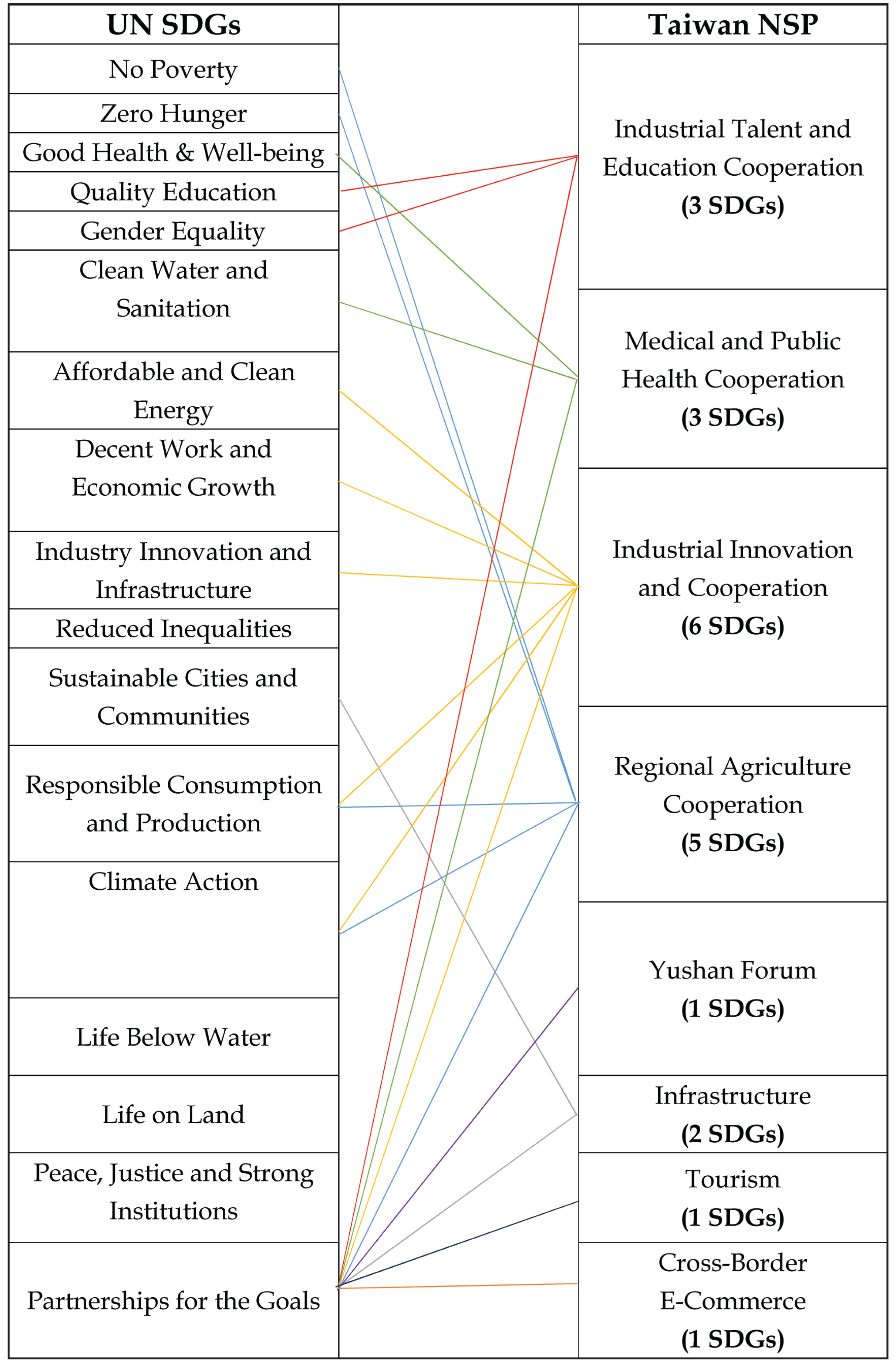
At a global level, these efforts also show that Taiwan’s NSP is moving towards the practice of value diplomacy corresponding to the Sustainable Development Goals (SDGs) upheld by the United Nations (refer to Table 1). The flagship programme industrial innovation and cooperation, for example, addresses six SDGs out of 17 goals, such as ‘affordable and clean energy’, ‘decent work and economic growth’, ‘industry innovation and infrastructure’, ‘reduced inequalities’, ‘responsible consumption and production’, ‘climate action’ and ‘partnership for the goals’. In effect, 13 out of 17 SDGs are addressed by the NSP’s flagship programmes as well as its potential policy engagement areas. In this regard, the NSP not only ensures Taiwan’s national interests but more importantly, implements the vision of regional and global co-prosperity with human values through bilateral and multilateral engagement.
In defence of regional and global human values, Taiwan’s NSP has at least three significant features: material sharing, capacity upgrading and identity making.
First, at the material level, the promotion of the NSP represents Taiwan’s provision of material resources and support towards its neighbours and cooperation with their local communities in building production bases or securing common development needs. Taiwan does not aim to act alone but instead seeks to work in tandem with local efforts. In countries or localities with insufficient development opportunities in Asia, Taiwan’s NGOs, for example, Taiwan Alliance in International Development (Taiwan AID), is working together with local partners to provide equal educational opportunities for people, building facilities such as water-pumping stations and developing specific local assistance programmes. Resources sharing by Taiwan can contribute in freeing people from the threat of hunger and provide them the opportunity to access sufficient food and clothing.
Second, in other Asian countries or societies that have already attained foundations for further development, Taiwan’s NSP focuses more on promoting or enhancing the development capabilities of its partners. This is the idea and practice of social progress. Through the sharing of resources and experiences of development, the NSP would facilitate the government and people of partner countries in adopting a sustainable and balanced inclusive growth model, translating the results of bilateral cooperation into a reference for the government’s and people’s self-improvement.
From the perspective of education and talent cultivation cooperation, this is not just about providing school hardware but introducing the supplementary concepts of education and empowerment, so that more talent may be developed for local needs. A good example is the Taiwan-Indonesia joint project in ADF in Karawang mentioned earlier. This is not a trailblazing mission to open new farmlands but instead aims to upgrade agricultural practices and irrigation systems and promotes the development of ‘Smart Agriculture’. This project is embodied in the spirit that people should not be left in hunger and destitution but should have a better, more sustainable livelihood in which adequate food and clothing should not be a distant dream.
Sustainable Development Goals and Taiwan’s New Southbound Policy
Third, in addition to the advancement of material and capabilities, the NSP strives to enable the establishment of a regional community identity, which will be embedded within and supported through deeper mutual understanding and interaction between people in the region. These people-to-people exchanges are not limited to political and social elites or to only businessmen and young leaders. By intimate interaction and dialogue, and by sharing similar concerns, embracing common interests and executing joint endeavours, social actors from different backgrounds and nationalities in the region become part of other living world experiences. Through intensive cooperation, Taiwan and the people of neighbouring countries can jointly advance the goal of co-prosperity. This is not only a value upheld by Taiwan and neighbouring countries but also is commonly shared by the world.
Linking Societies and People as a Regional Community
The NSP is not a short-term policy initiative; rather, it is a long-term self-reformation policy of Taiwan. It proceeds with a specific blueprint of ‘inward-looking’ regional engagement in promoting human values through public and private partnership. Its sustainability requires the engagement of various stakeholders and partnerships through new synergies. For Taiwan, the particularity of the NSP is related to the nature of Taiwan’s immigrant society. While developing its ‘regional strategy for Asia’, Taiwan needs to prioritize the welfare and rights of Southeast Asian and South Asian communities in Taiwan. It would be an encouraging model of enabling human values in foreign policy for all countries in Asia.
We believe that there are at least two modalities of domestic efforts to localize the people-centred NSP in the Taiwan society: one is the efforts made by Taiwan’s public sector and the other is capacity-building projects and social engagements initiated by civil society. The former has mostly ensured the basic rights of migrant communities of Southeast Asia in Taiwan, while the later focuses on the enhancement of their welfare and consolidates mutual understanding among people in Taiwan and the region.
It is true that public sectors in Taiwan have been devoted to ensuring the basic rights and interests of immigrants in Taiwan. Some further steps are taken by the Taiwan government through the implementation of the NSP. In 2018, there are approximately 696,000 migrant workers in Taiwan, of which 260,000 are from Indonesia, 210,000 from Vietnam and 150,000 from the Philippines. The Taiwan government has been committed to providing basic protections for migrant workers, as well as ensuring labour rights and adopting equal standards of minimum wage for both domestic and migrant workers.
Taiwan’s National Immigration Agency (NIA) has increased its capacity in protecting labour rights and securing the interests of migrant workers from guaranteeing basic minimum wages and promoting the Respite Care Service for special domestic caregivers. For years, there have been a number of migrant workers in Taiwan whom have fled out of factories for different reasons, called by governments in the past as ‘runaway migrant workers’. The NIA has recently changed the term ‘runaway migrant workers’ to ‘foreign workers lost in contact’ in 2018. It not only shows the changing mentality of bureaucrats, but also Taiwan’s respect for basic human rights and human values of its economic partners.
In the seaports of Taiwan, due to the population shift to urban cities and insufficient labour resources, migrant workers are in great demand in the fishing industry. The labour rights of fishermen have not been properly taken care of, especially in cases of overseas employment; this has become a concern for the Taiwan government and civil society. In Yilan, Yilan Migrant Fisherman Union (YMFU) was set up in 2013 with specific focus on protecting and ensuring labour rights and the basic rights of Indonesian and Pilipino migrant fishermen. The YMFU has long been committed to the care of fishermen and provides training courses. Its Secretary-General, Allison Lee, with her contribution, was awarded ‘Hero Acting to End Modern Slavery Award’ from the US State Department in 2017 (Everington, 2017).
For decades, many migrant fishermen from Indonesia have been working for the local village of Donggang Township, a famous port in southern Taiwan. They raised a total of NTD 7 million to set up a Donggang Mosque which is now a religious centre for Indonesian migrant fishermen there, valued and respected by local people. Taiwan’s NIA also assists in recruiting resources for the Mosque to provide facilities or computer classrooms to facilitate capacity-building programmes for migrant workers. (Interview with an Official of National Immigration Agency, 23 October 2018, Taiwan-Asia Exchange Foundation, Taipei).
In addition to upgradation and capacity-building programmes, more efforts are being made by Taiwan’s social enterprises. One-Forty, one of the leading NGOs working on capacity-building programme for migrant workers in Taiwan, has pledged to establish ‘Business School for Migrant Workers’ with free courses, including classes on Chinese, savings, business and photography on the weekend. The trainees during their stay in Taiwan, initially only 10 students, now have increased to 400, and are increasing every year, and they have successfully operated businesses after returning to their home countries.
Moreover, One-Forty offers online courses for more than 22,000 subscribers. Labour workers are helped by newly acquired talents and subsequently become civilian ambassadors of Taiwan when they return to Indonesia, the Philippines and Vietnam.
The exchanges and understanding between Taiwan and Asian neighbours should not be limited to the areas of economic, commerce, investment or migration issues. In particular, bilateral exchanges on cultures and arts would be meaningful in contributing to the deeper social understanding of Taiwan and Asian societies. For example, Vietnam National Institute of Culture and Arts Studies (VICAS) under Vietnam’s Ministry of Culture, Sport, and Tourism worked with TAEF and National Culture and Art Foundation (NCAF) in developing cultural leaders and artists’ exchanges in late 2018. A delegation of contemporary artists, as the first group of VICAS for bilateral exchange, was invited to Taiwan for in-depth visits and dialogues with local counterparts. They not only learnt that the development of contemporary art in Taiwan has been deeply influenced by its historical legacy, political development, economic and social transformation, but also believed that display of arts is the best projection of Taiwan’s civil society and human values. Through the exchange of arts and cultures, it can better overcome the obstacles of languages and foster a genuine community for Taiwan and Vietnam.
Conclusion
Human values are the positive driving forces for the advancement of national and regional development. Taiwan seeks to defend and ensure human values in partnership with regional stakeholders with the same goals that regional governments and civil societies aspire to. Human values should not be represented as negative quantitative indicators or a social credibility waiting to be deducted (Hatton, 2015), nor should they be mere slogans used by the government to sustain the regime. They should be people oriented, not people targeted.
It is not easy for any country to enable human values in its foreign policy. As some major powers utilize ‘sharp power’ (Walker & Ludwig, 2017) to impose their ideology on others, what they are promoting is pursuing hegemony over other countries, rather than promoting human values for all. When it is practised by small states, diplomacy with human values is more likely to be ignored or brought into question because these small powers have insufficient resources or lack commitment. But this is not the case with Taiwan.
Taiwan is a small state that has endured decades of political constraints imposed on it by China. These constraints have limited the island’s ability to contribute to the international community. However, Taiwan has also undergone a long period of economic transition and social transformation. Based on Taiwan’s story of good governance, people-centred political development and foreign policy transformation, the NSP is able to contribute to the promotion of human values and the realization of the regional community in Asia. While President Tsai’s predecessor focused too much on Taiwan’s relations with China, the current administration worked vigorously to relocate Taiwan in the ongoing dynamism in Asia. This new value-based NSP bases itself on humanistic aspirations that are shared by most Taiwanese politicians from both sides of the aisle. While as a democratic country Taiwan inevitably experiences electoral power transitions, its people and leaders should be aware that Taiwan’s human values and progressive achievements, not only its military and economic capacities, are key to its own state survival. It should strive to share its resources and experiences for the betterment of its surrounding neighbours.
Taiwan’s practice of the NSP is not without its own set of challenges. While China’s aggression is a constant background factor, the hesitance of other regional countries to expand relations with Taiwan due to their fear of upsetting China may also limit the success of the NSP. In light of that, Taiwan should not proceed with unilateral actions but instead treat carefully the cautious feelings of its neighbours and strive to carve out innovative collaboration linkages that may contribute to stability and development in the region. Taiwan must always maintain an active role while avoiding being too high profile, so as to avoid causing uneasiness among its partners.
And, on the other hand, the Taiwanese government needs to communicate its policy objectives to its people with more clarity, to inform the public not only the necessity of trade and investment but also the necessity of comprehensive engagement with neighbouring countries. While economic cooperation is important and one of the key concerns of the Taiwanese public, people-to-people relations must also be prioritized so that the NSP may continue to progress organically into the future after the policy’s implementation, not only in the public sector but also among civil societies within the region.
The execution of the NSP may be challenging, but it is the right path to take if one envisions a region embedded in human values, with Taiwan playing an active role in this evolution. Taiwan’s NSP embodies a people-centred and people-oriented agenda for regional development, one which utilizes its economic and social resources to develop new regional economic networks and social partnerships. Only by emphasizing on human values and the prosperity of the entire regional community can Taiwan persuade its international partners to actively support Taiwan’s existence and contribution, thus ensuring Taiwan’s role as a key link in global development.
Footnotes
Declaration of Conflicting Interests
The authors declared no potential conflicts of interest with respect to the research, authorship and/or publication of this article.
Funding
This article is a part of the authors’ research project (MOST 106-2420-H-004-002-MY2) financed by Taiwan’s Ministry of Science and Technology.