



Abstract
Value-based education aims to train students with appropriate attitude and values when they are interacting with their friends, family and outside the school. It helps in developing the child’s Personality, Character, Citizenship, and Spirituality. Stories are an effective tool and an ideal medium through which children can be taught essential life lessons. In ancient India, children were taught values and ethics through the oral story-telling tradition. Stories from Indian Folk tales such as Panchatantra, Hitopodesha, Epics like Ramayana and Bhagavad Gita were told to children during their childhood to teach them Ethics, Values which plays a significant role in their personality development. In this article, we have attempted to bring out the commonality between the values as given in Patanjali Yoga Sutras and HYP as Yamas (Social Discipline) and Niyamas (Personal Discipline) with the characters of Ramayana and the values given in Bhagavad Gita. It is easy to incorporate them in the curriculum with the help of stories class wise.
Introduction
Education is a lifelong process that begins in school and continues into adulthood. It is a school that builds the foundation on a child’s behaviour on how to behave in their life. Primary and Secondary Education must focus on the following six aspects of development (NCERT, 2018)—Moral and religious values, social and emotional development, and independence, language capacity, cognitive ability, physical/motor ability, and artistic aptitude. Hence, schools play an important role in imparting value-based or moral-education (Reddy, 2010). Studies show that students who are offered value-based stories have stronger self-esteem and are more accountable for their own actions and learning. They enable students to determine what type of life is desirable and what type of life they want for themselves (Garg et al., 2017). We believe that moral concepts and behaviour in children emerge at a young age. As a result, it is critical to pay close attention to children’s education, especially moral education, beginning at a young age (Lakshimi, 2009).
Definition of Values
Values are essential beliefs, principles, rules and living standards that serve as a reference for decision making in our life at important times. They are principles about what is good and wrong, or what matters in life (Indrani, 2012). Value literally refers to something that has a cost, is valuable, dear, and for which one is not willing to compromise. Values are guiding concepts that shape our perspective on the world, our attitudes, and our behaviour (Das, 2008). Moral values are a true measure of a society’s or nation’s progress. They show how far a civilization or country has advanced (Alavi, 2007).
Role of Values
Values are the foundations of humanity that contribute to a child’s overall development. They provide meaning to life and hence bring happiness, fulfilment, and calm (CBSE, 2012). Any human activity, thinking or concept, feeling, sentiment, or emotion that promotes an individual’s self- development qualifies as a value (Ravinder, 2005). The other complementary role of a value is that it should contribute to the well-being of the broader social unit in which an individual is a part, such as the family, community, and nation (Bagheeayavalle et al., 1991).
Value Education in Ancient Education System
Gurukuls were known in ancient India as places where students learn various types of knowledge. The primary goal of ancient Indian education was to prepare students to be productive and religious members of society (Ghonge et al., 2020). The ancient Indian educational system also included instilling civic and societal responsibilities in students. The Vedas, Upanishads, Brahmanas, and Puranas are the sources of value education (Srivastava, 2013).
The ancient Indian educational system emphasized the development of a disciplined, values-based civilization (Bhatta, 2009). Trust, respect, honesty, dignity, and courtesy are the foundations of any free and advanced society (Sirswal & Gitanjali, 2011). Teaching education and including values was regarded a societal responsibility by ancient teachers (Guru) (Nigal, 2006). Sravana (hearing), Manana (deliberation), and Nididhyasana (meditation) were the three steps of the education (Forbes, 1996) process.
The Taittiriya Upanishad’s convocation discourse provides insight into the principles that should be instilled in students Taittiriya Upanishad (1987). They are:
Speak the truth. There should be no room for doubt when it comes to truth. Practice righteousness. There should be no detour from the path of righteousness. Do not be careless about learning and teaching. Respect your mother, Father, Teacher, and your guest. Follow the advice of knowledgeable men who are not influenced by others, are not unkind, and seek merit.
Yamas and Niyamas of Yoga Shastra, Buddhism’s eightfold path, Jainism’s philosophy, Krishna’s preaching, and the Upanishads’ description are all sources for building values for life through ethical behaviour (Joshi, 1992). In general, we try to approach value from the perspective of normative ethics, which tells us what is good, what behaviours are right, and vice versa. For example, the famous sloka ‘Satyam Shivam Sundaram’, which means Truth, Goodness, and Beauty, and on the other hand, Kama, Krodha, Mada, and Moha, which refers to unethical behaviour was taught to children (Mookerjee, 1989).
The distinctive aspect of the ancient Indian value system was that a person was allowed the freedom to earn wealth (Artha) and physical well-being (Kama), but only in a righteous manner (Dharma) to achieve the ultimate aim of life (Moksha) (Yardi, 1996). This type of voluntary and spiritual control over the accumulation of wealth and bodily well-being within the context of higher purushartha (Dharma and Moksha) helped to maintain a peaceful and virtuous way of life through the way of stories from Vedas, Upanishads, Nitishastra, Ramayana, Bhagavad Gita, Panchatantra, and Hitopo- desha (Pankajam, 2001).
Value Education in Modern Education System
Perry defined ‘Value means the relation of an object to a valuing subject’ (Perry, 1999). In 1966 Hindzay, proposed that ‘By values we mean a person’s idea of what is desirable, what he actually wants’ (Pandey & Bhat, 2021). ‘Value education means primarily to prize to esteem to appraise, holding it dear and also the act of passing judgement upon the nature and amount of its value as compared with something else’ as per John Dewey (Pandey & Bhat, 2021).
The National Council of Educational Research and Training (NCERT) produced the National Curriculum Framework (NCF) 2005, which emphasizes ethical development through teaching the values, attitudes, and abilities necessary for living in harmony with oneself and others (Rajput, n.d.). The CBSE has provided a ‘Values Education Kit’ that would enable schools to provide values education along prescribed curriculum (Government of India, 2019). It is widely stated that core values at the school level must be rooted in the context of a student’s entire development as a human being and as a responsible member/citizen of society, as well as the circumstances in which the school’s objectives are framed (Ministry of Education, 2020).
Values are a complex combination of knowledge, attitudes, beliefs, behaviours, and abilities. A particular value is related to a group of attitudes and ideas. For example, honesty is part of loyalty, and dedication and justice are intertwined. Furthermore, values overlap and are interrelated. Further, values take on diverse meanings depending on the context. For example, being just in one’s dealings with others is an example of justice as a value. It also entails a general commitment to social fairness (NCERT 2005a).
According to the National Education Policy (NEP) 2020, the curriculum will include Ethical reasoning, Traditional Indian values, and all basic human and constitutional values (such as (service), Ahimsa (Non-violence), Swachatta (Cleanliness), Satya (Truth), Nishkama Karma (Selfless service), Shanti (Patience), Sacrifice, Tolerance, Diversity, Pluralism, Dharma (Righteous conduct), Gender sensitivity, Respect for elders, Respect for all people and their inherent capabilities regardless of background, and so on (Pant & Gulati, 2010). From the foundational stage onwards, all curriculum and pedagogy will be redesigned to be deeply rooted in the Indian and local context and ethos in terms of culture, traditions, heritage, customs, language, philosophy, geography, ancient and contemporary knowledge, societal and scientific needs, indigenous and traditional ways of learning, and so on—to ensure that education is maximally comprehensible, appropriate, interesting, and efficient (Radhakrishnan, 1990).
Positive psychology founded in 1998 by Martin Seligman is a bridge that links ancient virtue theories with our modern understanding of how the human mind works. Seligman’s positive psychology elevates the human experience and cultivates excellence through the world’s great moral tomes, looking for a common set of virtues celebrated in these texts. Given that these works came from all over the world and at different times in history, the virtues identified by Seligman and his companion Peterson were not universal, and some were promoted more in one culture than another. However, there were six universal values that were praised by all civilizations. There are 24-character strengths below the six virtues which were put forward as Values in Action classification of character, strengths, and virtues (Table 1). An individual can work towards the ultimate growth of values by cultivating these character characteristics (Seligman, 2002).
Values in Action Classification of Character, Strengths and Virtues.
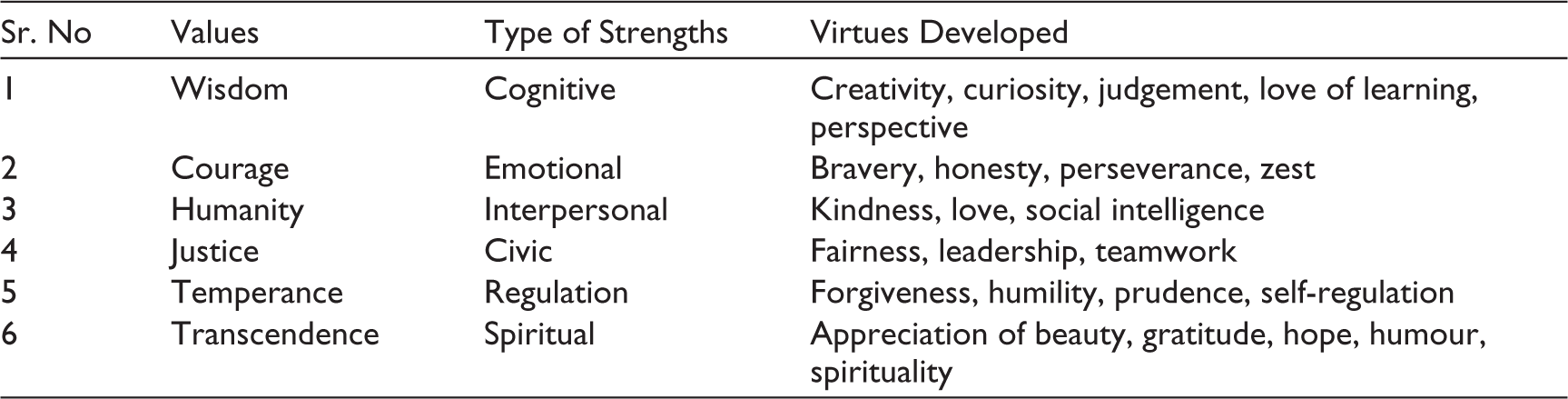
The ultimate and most comprehensive goal of the hierarchy of human ends is Happiness or Human flourishing which is termed as Eudaimonia by Aristotle and other classical thinkers. This is the goal that everyone strives towards, and it is the only goal for which it is worthwhile to expend resources. Eudaimonia is defined by intelligent activity in line with excellence, not by honour, fortune, or power, according to Aristotle (Aristotle, 1925). Character virtues such as courage, honesty, pride, friendliness, and wittiness are manifested in this activity, as are intellectual virtues such as rationality in judgement. It also includes non-sacrificial (i.e., mutually beneficial) friendships and scientific knowledge (knowledge of fundamental and/or unchanging things is the best).
In 1989, Carol Ryff, a psychology professor, was known for his concept termed as “Psychological Well Being”. He looked at many different approaches to happiness from diverse sub-fields of psychology and arrived at the conclusion that happiness is made up of six components. These elements include self-acceptance (a positive assessment of oneself and one’s life), personal growth, life purpose, positive interpersonal relationships, environmental mastery (the ability to properly manage one’s life and the environment), and autonomy (Ryff, 2014, 2016).
Developmental psychology (Kohlberg, 1973) studies how and why specific changes (cognitive, social, intellectual, and personality) occur throughout time in a person’s life. Many thinkers have contributed significantly to this field of psychology (Erik, 2015). Erik Erikson, for example, created an eight-stage model of psychological development. He believed that persons evolved in stages throughout their lives, which influenced their conduct.
Piaget proposed that logic and morality are developed in phases. (Kohlberg, 1973) Lawrence Kohlberg, building on Piaget’s study, discovered that the process of moral development was primarily concerned with fairness and that it persisted throughout one’s lifetime (Kohlberg, 1958). Pre-conventional moral reasoning, conventional moral reasoning, and post-conventional moral reasoning were his three degrees of moral thinking. Children’s pre-conventional moral reasoning is defined by reasoning that is centred on rewards and penalties associated with various courses of conduct. Conventional moral reasoning occurs in late childhood and early adolescence and is defined by reasoning based on societal standards and traditions. Finally, post-conventional moral reasoning refers to a stage in which a person views society’s laws and customs as relative and subjective rather than authoritative (Steinberg, 2008).
Inculcation of Values Through Stories
NEP 2020 has identified Storytelling as one of the effective channels in teaching values to Students in this modern era (NEP 2020). Inculcating desirable values through stories in language books is a powerful medium through which students would be given time to ponder, talk, and make up analogies (Swapna & Karuna, 2021). The Sanskrit language is full of such ideals that can teach a youngster how to live a good life. ‘Vidya Dadati Vinayam’, ‘Paropakaraya Satam Vibhuti Ahh’ and ‘Vasudeva Kutumbakam’ are wonderful epigrams that highlight universal ideals (Goyal, 2018). The epics, Ramayana and the Bhagavad Gita are examples of stories most commonly used to teach the ideals of living to children at a very early age (CPP, n.d.).
Scope of the Study
This article solely focuses on reviewing ancient literature in inculcating values through stories and characters. Indian Epics like Ramayana and Mahabharata revolve around characters which have enumerated values who reveal the ideal personality of a human being. The author Veda Vyas of Ramayana has listed all the values for an ideal person whereas in Bhagavad Gita around twenty-six values have been listed. Hence, we selected these two texts to list out the values described them and used it to map to the Yamas and Niyamas from Yogic Philosophy.
Sixteen Qualities of Lord Rama Described in Ramayana
Lord Rama is known as a perfect person who is ideal for every Indian in every aspect such as values, relationships and character. Sage Valmiki has explained 16 noble qualities that transforms an average human being to a Maryada Puroshottam that have been explained in Bala Kanda 1st Sarga, wherein Sage Valmiki asks Sage Narada to describe about a person, who possess these qualities in 1.1.2–6 (Bala Kanda 1st Sarga 1.1.2–6) (Rao, 1998). Ramayana has explained the sixteen noble qualities (Srinivasan & Prema, 2013) that would transform an average child to a great individual which is listed in Table 2 with the qualities and respective stories from the Ramayana from which these are observed. Storied are listed in Appendix A.
Qualities of Rama and Referred Stories (Bala Kanda 1st Sarga 1.1.2–6).
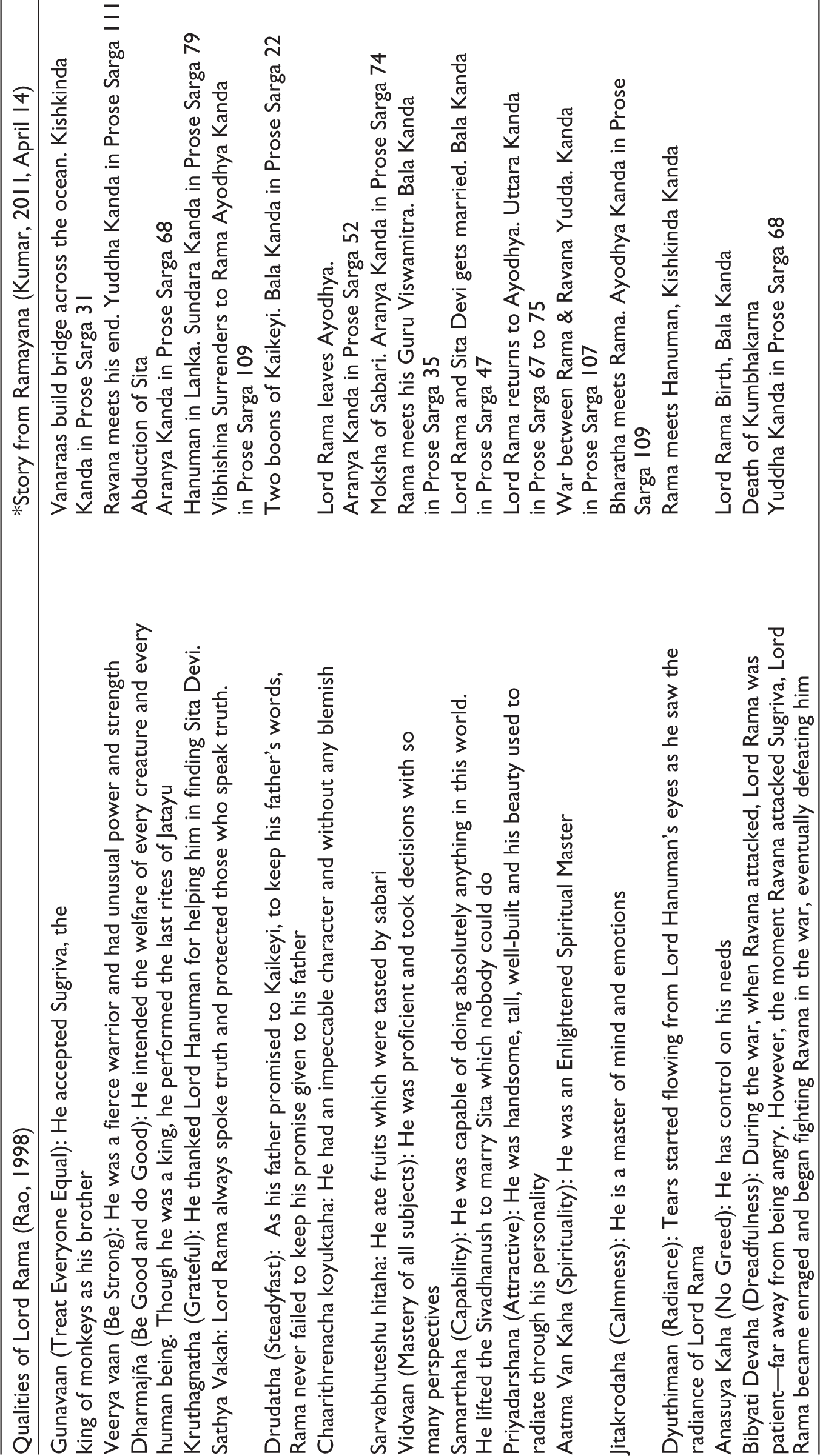
The above sixteen qualities show us the values that should be taught to children to shape their personality for a better world.
Twenty-Six Values Described in Bhagavad Gita
In Chapter 16, Verse 1–3 of Bhagavad Gita (Sastry, 1980), Lord Krishna lists out the qualities/values that should be present in every human being. He lists the following divine qualities which make a person divine:
श्रीभगवानुवाच | अभयं सत्त्वसंशुद्धिर्ज्ञानयोगव्यवस्थिति: | दानं दमश्च यज्ञश्च स्वाध्यायस्तप आर्जवम् || 1|| अहिंसा सत्यमक्रोधस्त्याग: शान्तिरपैशुनम् | दया भूतेष्वलोलुप्त्वं मार्दवं ह्रीरचापलम् || 2|| तेज: क्षमा धृति: शौचमद्रोहोनातिमानिता | भवन्ति सम्पदं दैवीमभिजातस्य भारत || 3||
Chapter 16, Verse 1–3 of Bhagavad Gita (Mukundananda, 2014)
(Mukundananda, 2014) These qualities are described as below:
Thus, we can see that Krishna lists out all the values that should be practised by a person to build a strong personality which enables him to free himself from all major hurdles and achieve a condition of perfect balance, inner stability, and mental tranquilly, free of grief, fear, and anxiety (Sastry, 1980).
Yoga Shastras and Its Relevance to Children’s Growth
Within Yoga philosophy, the Yamas and their complement, the Niyamas, constitute a set of ‘good living’ or ethical guidelines. It implies ‘control’ or ‘reining in’. The Vedas and the Yoga Sutras both provide rules for ethical manners (Iyengar, 2005). Yamas describe attitudes and values that would mould us to become a good human being, a good friend to others, and the world and Niyamas describe how to be a good person. In other words, the Yamas direct us how to treat others, and the Niyamas tell us how to take care of ourselves (Adele, 2009). Through them, we can build character, make them learn mindfulness and self-discipline so that they will be good citizens in the world. These ethical guidelines could be made part of the curriculum to teach values that should be practised and followed in a children’s friendly manner (Vemuri & Kaipa, 2014). Yoga Sutras of Patanjali Maharshi and Hatha Yoga Philosophy have emphasized ethical values and moral principles are the foundations for higher yogic practises.
The eightfold path given by the Sage Patanjali in Ashtanga yoga dedicates the first two steps ‘Yamas’ and ‘Niyamas’ on how to lead our life as an individual as well as with others (Bhavanani & Ramanathan, 2013). Patanjali has described them in second chapter ‘sadhana Pada’ in sutras 2.30 and 2.32. (Ramdev, 2012)
अहिंसासत्यास्तेयब्रह्मचर्यापरिग्रहा यमाः। PYS 2.30 शौचसंतोषतपःस्वाध्यायेश्वरप्रणिधानानि नियमाः। PYS 2.32
It is summarized in Table 3 which could be taught to children in simpler terms.
Yamas and Niyamas of Patanjali Yoga Sutras.
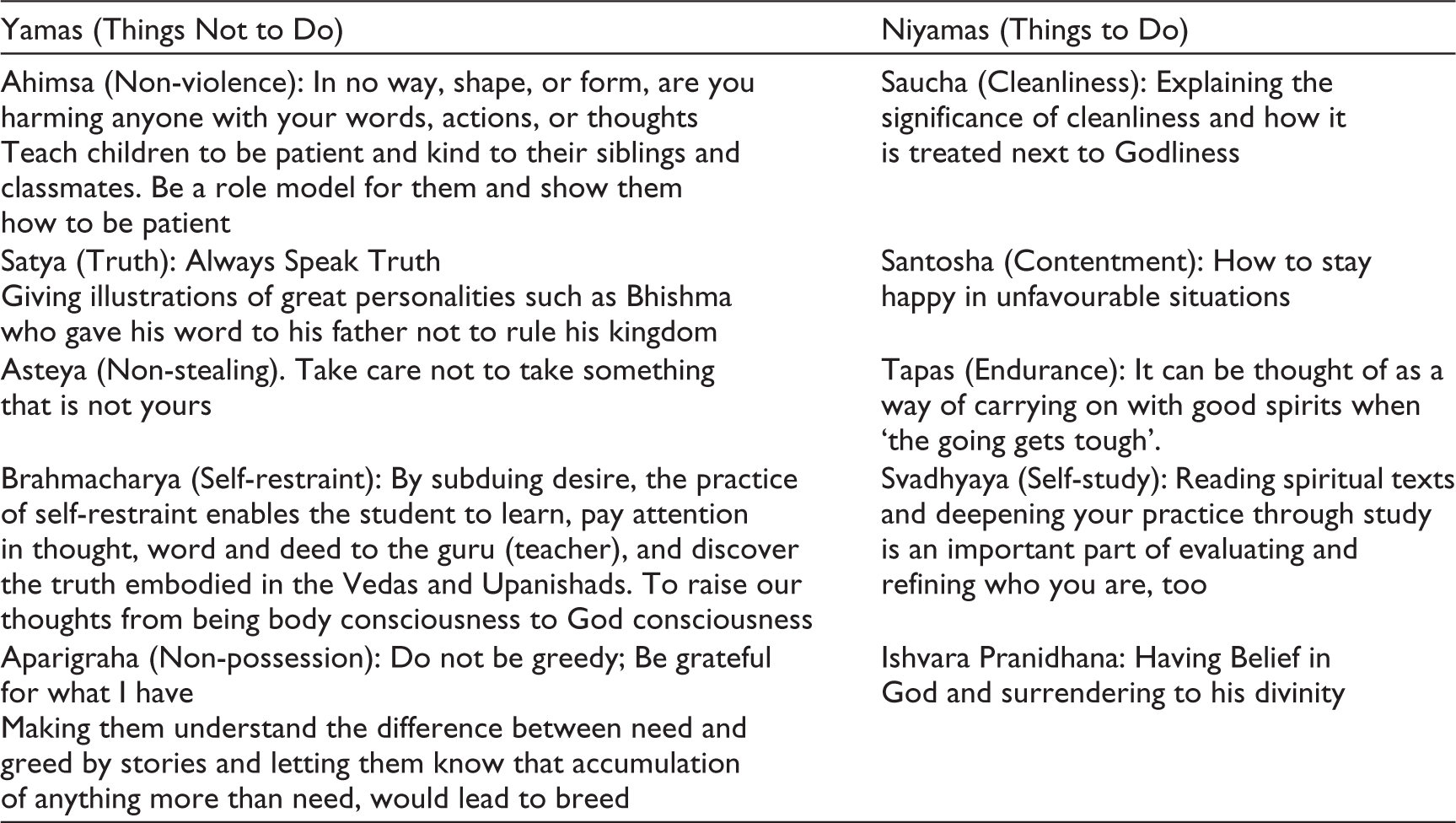
The above Yamas and Niyamas were also explained in Hatha Yoga Pradipika. The Hatha Yoga Pradipika was the first book ever written about yoga around the year 1350 (Swami, 1999). According to Hatha Yoga Pradipika, the rules of moral conduct (Yamas) and the rules of Personal Observances (Niyamas) are 10 (Satyanarayan & Dash, 2018). They are shown in Table 4.
Yamas and Niyamas of Hatha Yoga Pradipika.
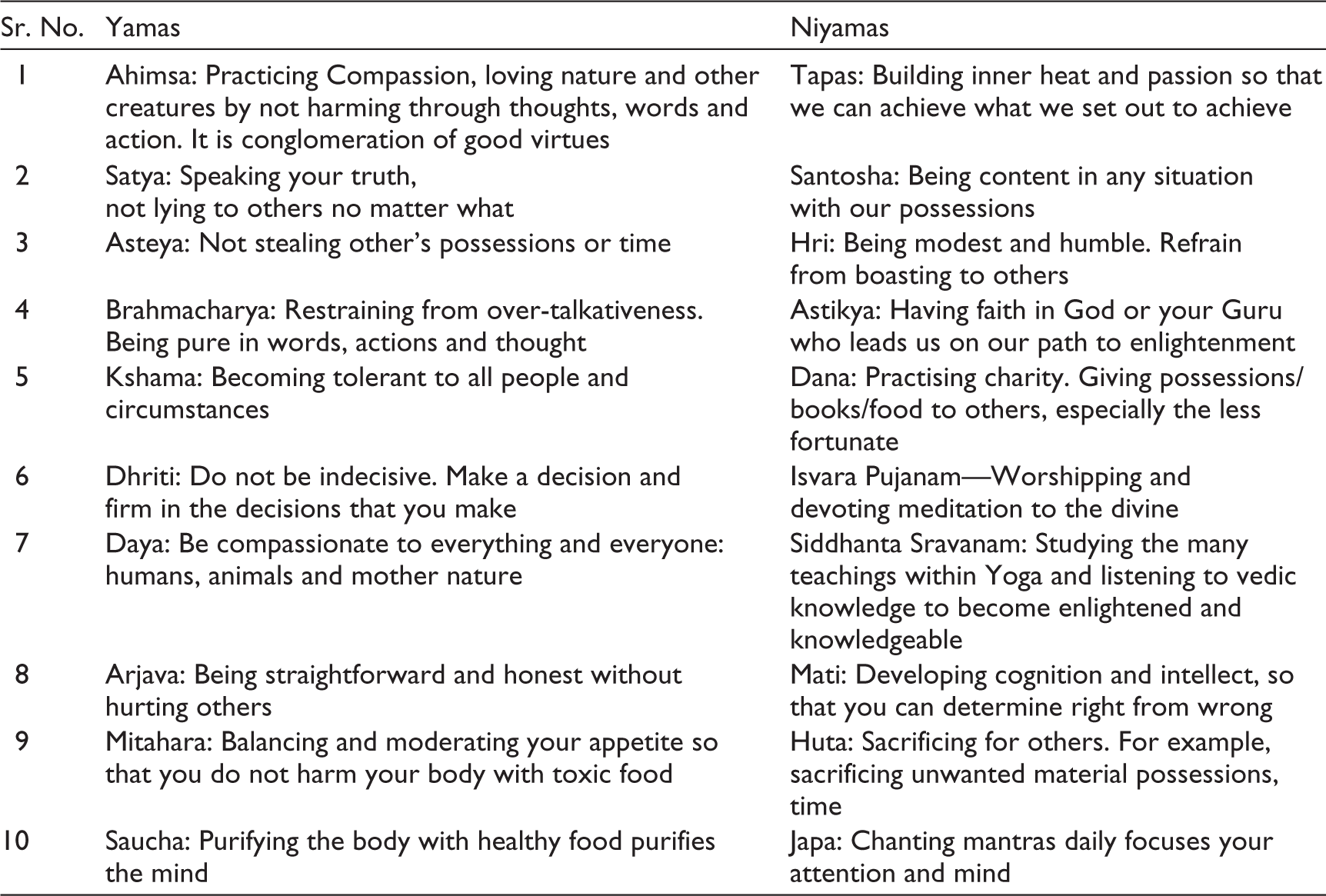
atha yama-niyamāḥ
ahiṃsā satyamasteyaṃ brahmacharyaṃ kṣhamā dhṝtiḥ |
dayārjavaṃ mitāhāraḥ śauchaṃ chaiva yamā daśa || HYP 1.17
tapaḥ santoṣha āstikyaṃ dānamīśvara-pūjanam |
siddhānta-vākya-śravaṇaṃ hrīmatī cha tapo hutam |
niyamā daśa samproktā yogha-śāstra-viśāradaiḥ || HYP 1.18
Contributions
From the ancient Indian literature, it has been found that epics like Ramayana and Bhagavad Gita listed ethics/values to be inculcated from early childhood and the Yoga Philosophy has listed out rules and observances which are the first steps to be practices by a student to reach self-realization.
From the above, it can be inferred that qualities/values/characteristics of a good individual which has been portrayed in Indian Epics has commonality with the Yamas and Niyamas described in Yoga Philosophy.
Empathy, Respect for others, Cleanliness, Courtesy, Democratic spirit, Spirit of Service, Respect for public property, Scientific temper, Liberty, Responsibility, Pluralism, Equality, Justice are the values listed in Page Num 5 in NEP 2020 Framework Guidelines (Nigal, 2006). (NCERT, 2018). Traditional Indian values and all basic human and Constitutional values such as Seva, Ahimsa, Satya, Nishkama karma, Swachata, Shanti, Sacrifice, Tolerance, Diversity, Pluralism, Righteous conduct, gender sensitivity, respect for elders, respect for all people and their inherent capabilities regardless of background, respect for environment, helpfulness, courtesy, patience, forgiveness, empathy, compassion, patriotism, democratic outlook, integrity, responsibility, justice, liberty, equality, and fraternity are listed in Page Number 16 in NEP 2020 Framework Guidelines (NEP 2020).
For example, Satyavakah (Truthfulness) an essential quality as per Ramayana was listed in Bhagavad Gita as a desirable quality and the same was listed as moral principles (Yamas) to be followed by every individual in Yogic Texts. The same moral value ‘Truth’ was also identified in National Curriculum Framework guidelines under NEP 2020. On the same lines, Danam (charity), Tapas (Austerity), Ahimsa (Not to harm anyone) and many more have been identified which has been highlighted in Table 5.
NEP (Ministry of Education, 2020) has identified four levels, namely, Foundation Stage (Stage 1: 3–6 years, Stage 2: 6–8 years), Preparatory Stage (8–11 years), Middle Stage (11–14 years), Secondary (14–18 years). (Ministry of Education, 2020, p. 6). Based on these levels, we tried to map values which could be taught age wise to the child which would help them to build their personality in Table 5.
Table 5 summarizes the values listed in Ramayana, Bhagavad Gita, Yogic Texts, and Values listed in National Educational Policy 2020 (NEP 2020) framed in India. The second row shows all the qualities described in the specific scriptures and the common values are highlighted.
Age Wise Classification of Values.
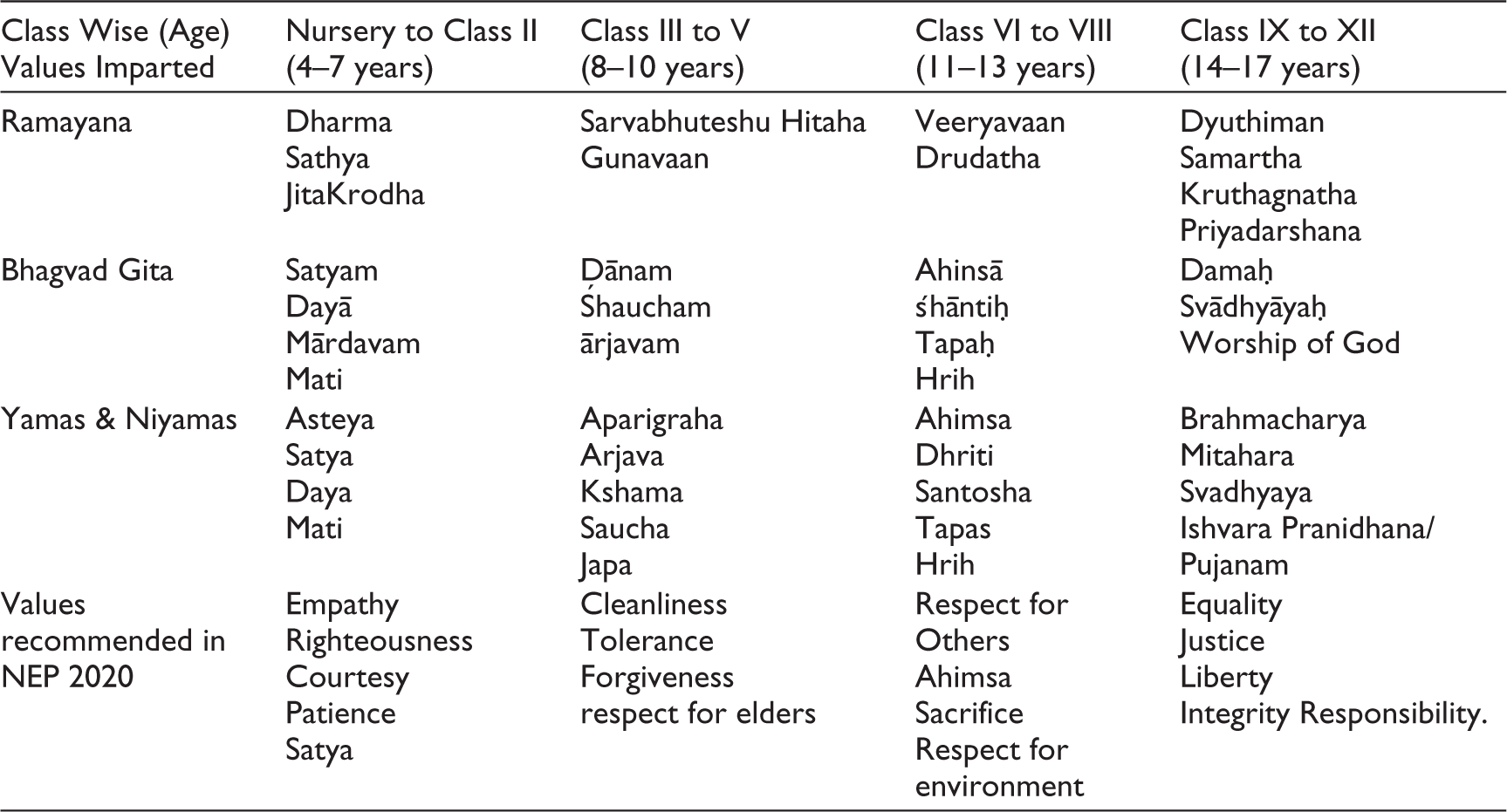
From Table 5, one could see that all the values included in the NEP framework are similar to Yamas and Niyamas identified long back by Patanjali Maharshi in the Yoga Sutras and Hatha Yoga Philosophy. Also, most of the values are in similar lines with the life lessons taught in Ramayana and Bhagavad Gita.
Conclusions
Education should ‘foster universal and eternal values, oriented towards the unity and integration of our people’ (Martha, 2021). Echoing the National Policy on Education (2020), the National Curriculum Framework for School Education (2000) criticized the ‘erosion of important social, moral, and spiritual values, as well as a growth in cynicism at all levels’ (NCERT, 2005b).
Through this article, we tried to identify essential values that could be taught to students with the help of stories/characters which enables the children to be treated with dignity, have the confidence to learn, develop self-esteem and ethics, and be encouraged to be creative while also being environmentally conscious.
Limitations and Implications
The results of this study clearly showed that there needs an extensive study to map all the values described in the ancient Indian literature to present them in a modern way according to the twenty-first century values. Modern Education needs to rephrase these values in a powerful medium which could help the child to grasp the importance of these time immemorial values and follow them. For the sake of time and scope of the study, we considered only Ramayana and Gita from the Indian Epics and classical Yoga Texts ‘Patanjali Yoga Sutras’ and ‘Hatha Yoga Pradipika’ were considered. Sanskrit–English Translation of Values and Qualities are adapted from Amarkosha—
Future Scope
The current study could be elaborated by considering many collections of Stories such as Panchatantra, Niti Chandrika, and so on, and other prominent Yogic Textbooks.
Footnotes
Declaration of Conflicting Interests
The authors declared no potential conflicts of interest with respect to the research, authorship and/or publication of this article.
Funding
The authors received no financial support for the research, authorship and/or publication of this article.