



Abstract
Gunas personality framework is an inclusive and comprehensive personality framework. Every human being is composed of three gunas or fundamental elements—sattva (intelligence-stuff), rajas (energy-stuff), and tamas (mass-stuff). Some of the prior measures of gunas do not fully capture the content of this variable, and some are not suitable for contemporary use. We conceptualize gunas in terms of an individual’s attitude towards social issues and have developed a new measure of gunas. We have demonstrated the concurrent and predictive validity of the measure through a study of two samples of 60 executives and 356 MBA students. We show that sattva predicts performance, rajas predicts effort, and tamas is positively related to dispositional negativity. We show how the new gunas scale is a useful tool in contemporary times.
The study of personality is an important factor in all organizational behaviour and leadership theories. The gunas personality framework is an inclusive and comprehensive framework of human personality, since it is based on both thought and physical body (Dasgupta, 1975). In addition, it includes a developmental and evolutionary trajectory (Niranjananada, 2008). Existing measures of gunas are not suitable for contemporary use due to several reasons. In this study, we develop a new measure of gunas and we demonstrate the validity of the measure by investigating the impact of gunas on important outcomes.
Gunas Personality Framework
The concept of gunas is first described in the Atharva Veda, but it is fully developed in the Samkhya philosophy (Murthy & Kumar, 2007). Samkhya is the most ancient school of Indian philosophy, and it is the foundation on which Vedanta rests (Hiriyanna, 1993; Virupakshananda, 1963). According to Samkhya philosophy, individuals are governed by two principles—Purusha (pure consciousness) and Prakriti (nature consisting of matter). These two principles can also be termed as the subject and the object, respectively, which form the basis of all experiences (Radhakrishnan, 1927). Primal nature in its unmanifest form was transformed into the phenomenal world through an evolutionary process made possible by the three gunas (Rao, 1963). Hence, gunas form the underlying basis of all things physical and psychical and are the causes of our mental states and behaviours (Rao, 2017). For example, our body is supposed to be made up of five elements, which possess three types of energies or gunas (Kapadia & Dagar, 2022; Singh et al., 2016; Venkateswaran & Patel, 2021).
Gunas, though not directly perceived, can be inferred from their effects (Radhakrishnan, 1927). Both thought and gross matter are made up of three elements—intelligence-stuff (sattva), energy-stuff (rajas), and mass-stuff (tamas) collectively known as gunas. While energy and mass stuff are predominant in gross matter, intelligence and energy stuff are predominant in thought (Dasgupta, 1975). In a more general sense, ‘sattva represents everything that is fine or light; tamas, whatever is coarse or heavy; and rajas, whatever is active’ in nature (Hiriyanna, 1993, pp. 271–272).
All individuals possess all the three gunas at all times; however, an individual’s current state of sattva, rajas, or tamas can be explained due to the dominance of one of the three gunas over the other two (Das, 1987). These subtle guna substances are united in different proportions, and because of this, different substances with different qualities come into being. In fact, all actions that are attributed to an individual agency are the work of one’s gunas (Radhakrishnan, 1971), and hence they are similar to one’s personality.
The gunas framework emphasizes the study of the human being as a whole and is similar to humanistic psychology (Mohan & Sandhu, 1986). However, it is also different from other personality theories. First, while the gunas help distinguish between individuals, they are not fixed but fluid and may change with time, context, and life experiences (Sinha, 2014). All three gunas are always present in all individuals; however, the predominance of one over the others may change. Hence, despite stability, there is some flexibility and gunas have characteristics of both ‘trait’ and ‘state’ (Rao & Paranjpe, 2016). Second, there is an implicit hierarchy and a recommended developmental trajectory: individuals evolve by increasing sattva while simultaneously reducing tamas and rajas.
The three gunas have been compared to the three ego states in transactional analysis (Chakraborty, 1988), and the gunas framework has been used to develop a novel approach to motivation based on ‘giving’ (Chakraborty, 1987).
Measurement of Gunas
Many scholars developed measures for the three gunas (Bhal & Debnath, 2006; Das, 1987, 1991; Mohan & Sandhu, 1986, 1988; Pathak et al., 1992; Shilpa & Murthy, 2011; Wolf, 1999). Mohan and Sandhu (1986) developed a 40-item scale containing a mix of life situations and personal habits. For each statement, respondents could choose amongst three alternatives (i.e., one each for each guna), and each choice of a guna was scored as one point. Based on this, individuals were scored on each of the three gunas. Similarly, Das (1987) developed an inventory of 10 triplets with each statement in a triplet indicating the preference for a guna. Like Mohan and Sandhu (1986), in Das’s (1987) scale too, respondents were required to select the most preferred guna within the triplet. A limitation of these scales was that the choice of a guna within each dimension was binary, and the extent to which an individual preferred one choice to the other was not captured. Das (1991) improved on the earlier (Das, 1987) scale to develop an instrument having two parts—the first consisted of 10 triplets and the second consisted of a list of 30 activities from which the respondent had to select 10 most preferred activities. Subsequently, Pathak et al. (1992) developed an inventory with 88 items, and respondents were required to indicate whether each item described them adequately.
The most recently systematically developed instrument to measure gunas was developed by Bhal and Debnath (2006). This was a 15-item Likert scale, which contained three factors called illumination (sattva), passion (rajas), and dullness (tamas).
Need for a Contemporary Measure of Gunas
The measure of Bhal and Debnath (2006), while useful, does not do justice to the conceptualization of gunas in two ways. First, it does not capture each dimension at the cost of the other two dimensions. Since it is a Likert scale, it is possible for an individual to score high on all the three gunas simultaneously. This is contrary to the original conceptualization of gunas in Samkhya philosophy, where each guna manifests by suppressing the other two (Radhakrishnan, 1971, p. 319). Moreover, gunas must be captured on different dimensions separately. It should be possible for someone to have sattva predominating on one dimension (e.g., climate change) and rajas predominating on another (e.g., violence against women). The Bhal and Debnath (2006) scale does not allow for such domain-specific differences in gunas.
Das’s (1987, 1991) scale is true to the initial conceptualization of gunas in both aspects. First, it captures predominance of gunas across different domains, and second, by asking respondents to allocate 10 points across each of the three gunas, it ensures that the predominance of one guna is always at the cost of the other two. Our concern with Das’s (1987, 1991) scale is that some of its items are quite abstract. For example, one of the items requires respondents to complete the sentence—‘I strive for happiness that is…’ by weighing three alternatives—‘based on stupor and sloth’ (tamas); ‘sweet right away, though bitter later’ (rajas); and ‘sweet in the end, though requiring sour toil initially’ (sattva).
To overcome these limitations of the existing scales, we developed a scale that is true to the conceptualization of gunas and yet is contemporary and specific enough to relate to respondents in today’s times. Moreover, we show how the scale is able to differentiate clearly between the distinct effects of the gunas.
Gunas and Attitudes Towards Social Issues
Instead of focusing on abstract opinions or preferences as in Das’s (1981, 1991) scales, we prefer a more contemporary approach to the effects on gunas. We do this by conceptualizing gunas as how an individual responds to issues prevalent in one’s environment. We also avoid the limitations of Bhal and Debnath’s (2006) scale by incorporating the interdependent nature of the three gunas in our scale design and measuring gunas across different domains within social issues.
Individuals have all the three gunas and their manifest state is a function of which of the gunas is dominant (Das, 1987). The dominance of a particular dimension is pervasive and is reflected in diverse aspects of an individual’s life such as the type of food consumed, the type of recreations preferred, the type of companions, conduct, and ways of thinking and behaving (Mohan & Sandhu, 1986). Even in terms of outcomes, the gunas have distinct effects—with sattva leading to knowledge, rajas leading to greed, and tamas leading to negligence, error, and ignorance (Radhakrishnan, 1971; Virupakshananda, 1963). Verse 13 of the Samkhya Karika clearly distinguishes the effects of the three gunas—sattva as illuminating, rajas as promoting desire or stimulating, and tamas as sluggish, ignorant, and indifferent (Niranjananada, 2008). When we apply these attributes to how an individual reacts to issues in his or her immediate environment or society, it is clear that the predominance of sattva, rajas, and tamas in an individual will each create a distinctive attitude towards social issues.
One’s attitude towards social issues is a good measure of an individual’s dominant personality disposition. Sattva provides an illumined or enlightened response to social issues, while rajas is likely to lead to passion, discontentment, and anger, and tamas is likely lead to ignorance or indifference to social issues (Niranjananada, 2008).
Hence, for measuring the three gunas, we developed a scale which measured three diverse orientations towards social issues. We identified several contemporary social issues from the United Nations (United Nations, 2014) and World Bank (World Bank, 2014) websites as well as issues of relevance to India and developed a set of 41 items.
There are three possible ways to respond to challenges in our immediate environment. The first attitude is one of tamas or indifference in which one does not care about the issue and displays an attitude of apathy or heedlessness (Niranjananada, 2008). The second attitude is one of rajas or anger towards others who one believes are responsible for the situation and, hence, represents a state of feverish activity and restlessness (Radhakrishnan, 1927). The third attitude is one of sattva in which one not only recognizes the issue but also acknowledges one’s own role in solving the issue and, hence, one tends to make self-directed efforts to improve society by performing one’s duty with practical wisdom (Radhakrishnan, 1927, 1971).
Scale Development and Item Reduction
Our measure of gunas measures an individual’s attitude towards social issues as one of three possible attitudes—tamas (dullness, apathy, or indifference), rajas (passion, activity, or anger), and sattva (goodness, illumination, or wisdom). Individuals who are high on tamas are indifferent to their surroundings and social issues in general. They do not feel the need to take any action towards reducing the suffering in society. Individuals who are high on rajas are passionate about changing their environment. However, their passion is directed towards others. They see others as the source of all problems and seek to address society’s problems by targeting those individuals whom they consider to be responsible for the problem. Individuals who are high on sattva are wise, and while they recognize social problems, they also realize their own responsibility in dealing with these by changing their own behaviour.
We identified 41 social issues of contemporary relevance such as violence against children and women, environment, discrimination, and education. For each issue, we developed three items representing diverse attitudes with respect to that issue. A sample item is given below:
Violence against women.
It is better not to get oneself involved in such issues which are best resolved within the family (tamas)
Stringent laws and quick justice to offenders is the best way to address this issue (rajas)
Each one of us needs to re-examine our attitudes towards women and strive to change (sattva)
For each of the items, participants were asked to distribute 10 points across each of the three options representing tamas, rajas, and sattva. The scores on sattva on all the relevant items of the scale were averaged to provide the final score on sattva. Similarly, the scores on rajas and tamas on all items of the scale were averaged to provide the final scores on rajas and tamas, respectively.
Several of the issues we cover in this scale are important and critical social issues in which the government has a significant role to play as compared to the efforts of individuals. However, the purpose of our instrument is not to look at the correct or more effective solution but rather to assess the extent to which an individual takes responsibility for individual transformation to achieve the social goal. While seeking to assess the attitude or orientation of the research participants, the sattva items assess whether or not the research participant recognizes his or her own role in addressing the issue or does he or she merely pass on the responsibility to an external source. Individuals who are high on sattva may continue to fight for government intervention or support for such critical macro issues while deeply realizing their own role in addressing the issues at a personal level. A good example of this is Gandhi—on the one hand, he fought for systemic changes in government, while at the same time, tirelessly recognizing and fulfilling his own responsibilities (Guha, 2018).
We collected data from 60 executives while they were volunteering on a two-year national service program coordinated by a public-funded Indian university. These executives were selected by the university from a rigorous selection process out of approximately 9,000 applicants based on their verbal and numerical abilities as well as their awareness and sensitivity to social issues. In the sample of 60 executives, there were four women. The ages of the entire sample of executives ranged from 23 years to 30 years (Median = 25 years). The executives were administered a questionnaire containing the 41 triplets of the new gunas questionnaire.
Item selection. The initial scale developed by us had 41 items. After collecting data from the 60 executives, each of the items in the scale was analyzed. First, the variance within each individual’s responses for each of the questions was calculated and then the average variance across all 60 individuals for each theme was calculated. Next, the correlation between item score and total score on a particular guna for an individual was analyzed. The average correlations were calculated and ranked from highest to lowest. To maximize variance as well as enhance consistency, the top 21 items that satisfied both the above conditions were selected to constitute the final scale and used in all subsequent analysis.
Scale Validation
In order to validate the new gunas scale, we explored the essential nature of the three gunas and developed hypotheses for assessing the predictive validity of each of the three gunas on outcomes of interest. Later, these hypotheses were empirically tested on a sample of students.
Sattva (Intelligence-Stuff)
Sattva represents illumination and a love for knowledge. Moreover, sattva is related to calmness and good judgment, which leads to good outcomes (Radhakrishnan, 1971, 321) like self-compassion (Verma & Tiwari, 2017) and wisdom and psychological well-being (Agrawal, 2021; Sharma et al., 2016). Individuals who have a love for knowledge are calm, possess good judgment, and are likely to be successful in their endeavours. Individuals high on sattva have high moral standards (Bhal & Debnath, 2006) and are selfless towards their work. Their actions are driven by wisdom and not merely by desires (Radhakrishnan, 1971, 359–360). Sattva corresponds to the tendency to perform one’s duty with practical wisdom (Radhakrishnan, 1927). The two most prominent drivers of job performance are intelligence and conscientiousness (Schmidt et al., 2016). As discussed above, individuals high on sattva are likely to be knowledgeable, wise, and selfless workers who are not distracted by desires. Hence, it is likely that they would also have higher performance than others. In a study of Indian banks, Anuradha and Kumar (2015) found that managers who were high on sattva also had higher job performance. Hence, we propose the following hypothesis.
Rajas (Energy-Stuff)
Individuals high on rajas are driven by desires, passion, and ambition. They are generally aggressive by nature, but at the same time, they are generous and large hearted. Since these people are highly driven by desires and ambition (Rao & Paranjpe, 2016), they can compromise their ethical values for the achievement of worldly pleasures (Bhal & Debnath, 2006). For such individuals, all actions are driven by self-interest. For example, even charity is performed for the sake of visibility and enhancement of reputation (Radhakrishnan, 1971, 346–348).
Rajas prompts individuals to take actions that are primarily motivated by a desire to get rewards. In fact, individuals driven by rajas are willing to make great sacrifices to get material gains (Radhakrishnan, 1971). Individuals who are filled with rajas engage in feverish activity and restless efforts (Radhakrishnan, 1927). They are deeply attached to action and are unable to sit quietly even for a moment without any activity (Radhakrishnan, 1971, pp. 318–319). The behaviours of individuals high on rajas are likely to be quite distinct from those high on sattva. While individuals who are high on sattva are wise and silent workers who do their duty irrespective of whether or not they will be rewarded, indivi- duals who are high on rajas are likely to be visibly more active especially when there are material or social rewards to be got from the activity. In some ways, differences between sattva and rajas may be similar to the distinction between the two facets of the personality factor—conscientiousness, that is, dutifulness and achievement striving (Costa & McCrae, 1995). These two facets, while appearing similar, may have drastically different outcomes in specific situations (Moon, 2001). While duty is associated with calm and selfless actions, achievement striving is associated with the visible activity to impress others. Similarly, while sattva drives intelligent and focused actions without getting distracted and leads to higher performance, rajas is likely to lead to visible efforts, which may or may not translate into performance. Hence, we propose the following hypothesis.
Tamas (Mass-Stuff)
Individuals high on tamas display qualities like inertia, heedlessness, laziness and are generally ignorant of the consequences of their actions (Chinmayananda, 1996). Tamas is also represented by the psychological state of delusion or sluggishness (Virupakshananda, 1963). There is immense laziness, and no regard for time or punctuality (Radhakrishnan, 1971, p. 360). Since they live in the state of ignorance and delusion (Rao & Paranjpe, 2016), it is difficult for them to complete their tasks in time or remain grounded. There is no sacrifice of sense gratification or postponement of desires because of the performance of certain duties. Since it represents sluggishness, an individual does not think about performing any other action apart from those linked to sense gratification. In this state, there is absolutely no understanding of ethics or moral behaviour.
Individuals who are high on tamas are described as being lazy and irresponsible, given to procrastination, and not fulfilling their obligations. Moreover, they perform activities in a haphazard manner without any concern for correct procedures or protocols (Radhakrishnan, 1971). These tendencies of an individual high on tamas are exactly opposite to the personality factor, conscientiousness, which is made up of facets such as order, dutifulness, achievement-striving, self-discipline, and deliberation (Costa & McCrae, 1995).
Tamas is indicative of inertia, stupor, indolence, and a general attitude of ignorance and indifference towards the well-being of oneself and that of others (Niranjananada, 2008). Individuals who are dominated by tamas are likely to be inactive and deluded and are likely to be consumed by thoughts and intentions that cause pain to themselves, and to others (Radhakrishnan, 1971). Hence, we hypothesized:
Method
We collected data while one of the authors was teaching a course on group dynamics to 356 MBA students. The sample of 356 MBA students contained 94 females. The ages of the entire sample ranged from 22 years to 29 years (median = 25 years).
The course involved 10 hours of classroom interaction followed by a written examination. During the course, students were required to do pre-reads prior to each session and were required to submit their reflections in the form of a ‘tweet’ consisting of not more than 140 characters. After the classroom inputs, students were required to work in groups to make a difference in the lives of a neighbourhood rural community in which their peers reported on their efforts.
At the start of the course, all the students responded to a questionnaire containing the 21 triplets of the new gunas questionnaire along with the 14 triplets of old gunas questionnaire (developed by Das, 1987, 1991). During the data collection, the students’ responses were mapped to their roll numbers, and they were assured of the complete confidentiality of their responses.
The three dependent variables were each measured after a period of time on different occasions as part of the routine course evaluation. The measures for each of these variables are described in the following sections.
Performance
After about three weeks after the start of the course, students appeared for an examination, which covered all the topics covered in the syllabus. The exam was completely based on multiple-choice questions in which a correct answer earned one mark and for every four wrong answers, one mark was cut. The grade of the students on this examination was used as a measure of their performance.
Efforts
After the classroom inputs were completed, students worked in groups in a rural community and tried to make a positive impact on the community. Each group of about 18 students was allotted one village in which they were to perform community service, and there were 21 such villages. After the completion of the group project, all the members of the group rated each other anonymously on the efforts put in by each of them. Each member of the group rated the others on a scale of 1 to 10 on the extent to which the ratee displayed efforts towards achieving the group’s goal. The average peer ratings on efforts were used as a measure of efforts.
Dispositional Negativity
While classes were on, students submitted their reflections on the pre-reads in the form of a ‘tweet’ consisting of not more than 140 characters. Since there were seven classroom sessions in all, each student submitted seven tweets throughout the course (hence, 980 characters of text were available per student). The words used by an individual constitute their linguistic style which is a good measure of an individual’s personality (Pennebaker & King, 1999), and several studies have validated that the word counts of specific categories of words have psychological meanings and can tell us about the personality of the individual who used them (Tausczik & Pennebaker, 2010). Since we had access to original content from each student, we used this to get an insight into their personality. The tweets sent by each student were coded separately using the Linguistic Analysis and Word Count (LIWC; Pennebaker et al., 2007), a text analysis software which calculates the degree to which people use different categories of words in a given text. The use of negative words in the text is an indicator of depression (Rude et al., 2004), and individuals who are high on extraversion use a smaller number of negative words (Tausczik & Pennebaker, 2010). Hence, the proportion of negative words used by individuals in their ‘tweets’ was used as a measure of dispositional negativity.
Results
Reliability of the Scale
The new scale consisted of 21 triplets with one of the three items in each of the 21 triplets representing tamas, rajas, and sattva, respectively. For each triplet, respondents were required to distribute 10 points amongst each of the three gunas depending on the extent to which a statement best described their own attitudes. Hence, each guna within each of the 21 triplets could receive points between 0 and 10. In this manner, the scale can be considered as three interdependent scales of 21 items woven into one with each item having a Likert scale-type response from 0 to 10. The reliability of the new scale compared favourably with that of the old scale. The reliabilities (Cronbach alphas) of the tamas, rajas, and sattva in the new scale were 0.80, 0.64, and 0.56, respectively. The reliabilities (Cronbach alphas) of the tamas, rajas, and sattva elements in the old scale (Das, 1987, 1991) were 0.62, 0.33, and 0.61, respectively. Hence, the reliabilities of both scales were comparable.
Correlation Amongst Dimensions of the New Scale with the Old Scale
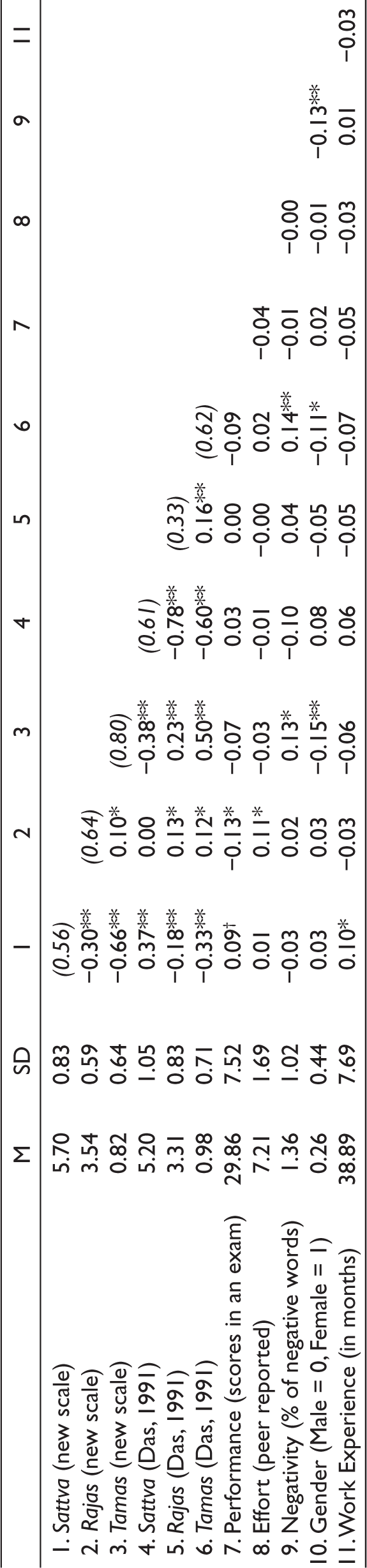
Dimensions of the new scale correlated favourably with dimensions of the old scale—tamas, rajas, and sattva in the new scale were significantly related to tamas, rajas, and sattva, respectively, in the old scale. The correlation amongst the dimensions is shown in Table 1. From the table, it is observed that for each of the three variables, viz. sattva, rajas, and tamas, the highest positive correlation is with the corresponding guna in the old scale. This suggests that the sattva, rajas, and tamas as measured in the new scale are indicators of sattva, rajas, and tamas in the old scale. We also found that sattva was positively related to work experience (r = 0.11, p < .05). This finding is in line with an earlier study (Kaur & Sinha, 1992), which showed that sattva relates positively with work experience.
Means, Standard Deviations, and Zero-Order Intercorrelations.
Comparison Amongst the Two Samples
We also compared the sample of 356 MBA students with 60 executives enrolled in the national service program. Both these samples were comparable because they consisted of individuals from similar populations, that is, working executives who had opted either for MBA or for the national service program. The age profiles of the two groups were also similar (a one-way ANOVA to test differences in ages across the two groups was not significant). However, the gender ratio was not similar; the proportion of women in the MBA program was significantly higher than that in the national service program.
Since 60 executives had been specifically selected for their social sensitivity through an interview, we expected that they would score higher on sattva as well as rajas as compared to the MBA students. We compared the mean values on all three dimensions for both the samples using one-way ANOVA. The results of the ANOVA are reported in Table 2.
One-Way ANOVA to Measure Differences in Means between the Two Groups (MBA Students vs. Executives Enrolled in National Service Programme) on the Three gunas.

As seen in Table 2, the executives enrolled in the national service program scored significantly higher than the MBA students on sattva and rajas, while the MBA students were significantly higher on tamas. Hence, we find that the new test does seem to be able to distinguish between the inherent interests of the two groups of individuals despite demographic similarities.
Sattva and Performance
In the correlation matrix (Table 1), we observed that except for gender being correlated with tamas and negativity, none of the other control variables were correlated with any of the independent or dependent variables in our hypotheses. Hence, we could test the first two hypotheses based on the correlation matrix alone, while for the third hypothesis, we used regression controlling for gender.
From Table 1, we found that individuals who scored higher on sattva also got higher marks in the quiz (r = 0.09, p = .06), which was conducted at the end of the course. Hence, Hypothesis 1 was moderately supported.
Rajas and Effort
The most significant finding in this study was that rajas significantly predicted peer-reported effort of participants measured approximately a month later. Individuals who scored high on rajas were seen by their group members as energetic, enthusiastic, and determined to put in more efforts, and hence, they were rated high on peer-reported effort (r = 0.11, p < .05). The scores on peer-reported effort were used as part of the evaluation towards the course credit. Hence, rajas could clearly predict the extent to which individuals engaged in a reward-induced activity. Hence, Hypothesis 2 was supported.
We also looked at the number of questions attempted by students in which the students got negative marks. A negative mark means that the student evaluated the tradeoff (one mark for the right answer and one-fourth of a negative mark for the wrong answer), and despite not being sure of the answer, attempted the question after being tempted by the reward. Rajas was significantly positively related to the number of attempts of questions despite not being sure of the right answer (r = 0.12, p < .05). Since the quiz was held almost three weeks after the gunas were measured, this is a validation of the ability of the sattva to predict performance and rajas to predict engaging in a reward-induced activity.
Tamas and Dispositional Negativity
Dispositional negativity was measured using the LIWC outputs of students’ statements during the course. Individuals who scored high on tamas used more negative words (r = 0.13, p = .01). To test the hypotheses, we performed regression with negativity as a dependent variable and tamas and gender as the independent variables. The results of the regression are reported in Table 3. We find that tamas strongly predicts dispositional negativity even after controlling for gender. Hence, Hypothesis 3 was supported.
Regression to Measure the Effect of tamas on Dispositional Negativity.

Supplementary Analysis
Some of the LIWC findings, though not hypothesized, showed an interesting insight into the possible outcomes of all three gunas. Hence, these are also reported where relevant.
The LIWC analysis of students’ tweets showed that students who were scored higher on sattva also used the second person pronoun to a lesser extent (r = −0.11, p < .05). Studies have shown that the lesser use of the second person pronoun (e.g., you and your) indicates a higher quality of relationship (Simmons et al., 2008; Slatcher et al., 2008). Hence, it is likely that individuals who score high on sattva may show less anger and be less critical of others (Rankin-Esquer et al., 1997) and hence more likely to enjoy better relationships.
We also found interesting patterns in word usage with respect to rajas. Individuals who scored high on rajas used more verbs (r = 0.10, p = .05), hence showing that they were more action oriented (Tausczik & Pennebaker, 2010).
Discussion
Gunas are the fundamental subtle elements in all beings. There have been several attempts at measuring gunas and relating them to outcomes of interest. We developed a new measure of gunas that is better aligned with the original conceptualization of gunas and is suited for contemporary times. The new measure does not ignore the two core aspects of the gunas framework that one guna predominates at the cost of the other two gunas and that individuals may have different predominant gunas in different aspects of their lives.
While useful, the scale also has some limitations in terms of reliabilities. We call upon scholars to modify and build on our work so that the psychometric properties can be enhanced further. We have explored only three outcomes of gunas in a sample of students. Further studies can explore several other outcomes of gunas with working executives in an organizational context.
There are also some improvements possible to the wording of the scale items to make them more appropriate for measuring gunas. For example, the use of the term ‘we’ in some of the items relating to sattva. Scholars who use this scale in the future may choose to use ‘Each one of us…’ to indicate the emphasis on personal responsibility rather than the ambiguous term ‘we’. Similarly, for some of the rajas items dealing with sustainable development, climate change, and disaster losses, the items may need to be re-written to highlight the action orientation and the externalizing nature of rajas. 1
Implications for Researchers
In this study, we show the versatility of the gunas framework in predicting outcomes of interest. We show how each of the gunas has a distinct outcome. Sattva predicts performance, while rajas predicts reward-induced effort, and tamas predicts negativity. These findings substantiate our argument that gunas indeed constitute a comprehensive and useful framework of an individual’s personality. Each of the variables in our study were collected from distinct sources and at different points in time. Specifically, outcome variables were collected from independent sources long after the gunas were captured. The ability of each of the gunas to predict outcomes for many weeks after they were measured is a significant finding.
This new scale is likely to be useful to scholars for developing more studies to explore the effects of gunas in the organizational context. Conceptualizing and developing new constructs and measures which are rooted in the Indian context is essential for the development of our discipline.
Our definition of personality and its use in management today suffers from implicit biases based on our worldview (Dachler & Enderle, 1989). Indeed, some scholars have deemed this as epistemological violence (Khan & Naguib, 2019). We respond to Greenwood and Freeman’s (2018, p. 4) call for being aware of epistemic biases in existing theories and engaging with diverse theoretical frameworks to analyze ethical issues. We also respond to the call of senior scholars in management and social sciences in India (e.g., Gupta, 2011) to develop novel and useful constructs to explain human behaviour based on ancient Indian philosophy.
Managerial Implications
The guna theory is extremely relevant to management practice (Innes-Brown & Chatterjee, 1999) and several scholars (e.g., Agarwalla et al., 2015; Elankumaran, 2004; and Modh, 2014) have explored the relationship of gunas with outcomes of interest. The new gunas scale operationalizes gunas as attitudes towards social issues. This is a novel and useful way of operationalizing gunas for the current times. As organizations become more conscious of their social responsibilities, an important parameter for senior executives is their attitude towards social issues. This new gunas scale can be used by organizations to measure their executives’ attitudes towards social issues and can provide domain-specific feedback on areas for growth.
The three gunas are inter-connected and one of them can increase only by reducing another. It is evident from our studies that tamas has no useful purpose to serve, and by reducing it, the other two can be increased. Organizations are likely to be better off by taking steps to reduce tamas in their employees.
Conclusion
The new and contemporary measure of gunas that we have developed and validated should be useful in exploring various organizationally significant outcomes. We have demonstrated the versatility of the gunas personality framework by showing the relationships between each of the three gunas and distinct outcomes. As more studies are conducted using the gunas personality framework, we will be able to build ethical organizations that genuinely care for all stakeholders and thereby enhance well-being in society.
Footnotes
Declaration of Conflicting Interests
The authors disclosed receipt of the following financial support for the research, authorship, and/or publication of this article: The authors declared no potential conflicts of interest with respect to the research, authorship and/or publication of this article.
Funding
This research was partially funded by Aon Hewitt Think Tank—a research scholarship instituted by an industry consortium.