



Abstract
The resource areas development is facing increasingly serious challenge in post-crisis era; it is essential to propose a reasonable approach for improving the self-innovation capability of resource area by using technology spillover of foreign direct investment (FDI) and applying absorptive capacity as the conduction medium. Based on the development characteristics of resource areas, the ‘micro-meso-macro’ view three-dimensional conceptual framework of FDI spillover, absorptive capacity and self-innovation capability was constructed. Then, the empirical analysis was conducted in three steps: first, the FDI technology spillover effects between Shanxi and three eastern provinces (Jiangsu, Liaoning and Hebei) were compared; second, the absorptive capacity and the relative factors were compared; third, by taking Shanxi province as an example, the relationship between FDI technology spillover and the self-innovation capacity was verified and the conduction medium role of absorptive capacity was investigated. Finally, by combining the theoretical and empirical analysis, three suggestions were put forward for reference.
Introduction
The concept of innovation capacity is a series of strategy, organisation, technology and market practice which the enterprise searches, identifies, obtains new knowledge or finds out the new combination of knowledge, or discovers new application of knowledge, and thus creates new knowledge which can create market value (Chen Litian et al., 2012). Operating in different background, the definition, utilisation and policy implications of technological capacity are different. The technological capacity of this article focuses mainly on the obtainment of technology, digestion, absorption and secondary innovation (Zhang Gang, 1997). It includes technology using capacity, technology acquisition capacity, technology comprehensive capacity and technology generation capability (TDRI, 1989). Articles focus on FDI spillover effects of the ascension of the innovation capacity, which is so-called ‘secondary innovation’. In this article, the absorptive capacity is a kind of recessive enterprise knowledge, and is effective to introduce, absorb, control and improve the existing technology to create new technical skills and knowledge (Zhu Hua, 2008). It is also a dynamic organisation practice and processe in which the organisation acquires, digests and transforms the use of knowledge. Among them, the acquisition and digestion belong to potential absorptive capacity, and the transformation and utilisation belong to the realisation of absorptive capacity (Cohen & Levinthal, 1990). Only by strengthening the enterprises’ ability to absorb advanced technology, learning and imitation, help foreign spillover effects on the regional innovation ability of diffusion (Yang Xiuwen, 2011), can lead to an improvement in its capacity for innovation. Through enhancing the absorption and learning, imitation makes the enterprise more effective to use of external technology, and indirectly promotes the technological progress.
Shanxi province, as an important energy base and typical resource area in China, takes coal, coking, metallurgy and electric power as its traditional leading industries. However, with the gradual natural resource exhaustion, the area is losing its inherent advantages. Currently, Shanxi is in a crucial period of looking for new economic growth, by breaking through the bottleneck of resource constraints and realising transformation and upgrade. While, self-innovation, as the core engine for maintaining regional competitiveness, becomes the key factor for solving the problem (Ivanovic, Keser & Blazevic, 2011). However, problems such as single industrial structure, unsmooth industry linkage, extensive growth pattern and ecological environment deterioration that are caused by long-term excessive dependence on natural resources have weakened the internal driving force and caused poor innovation environment, including serious backward infrastructure, low education level and R&D ability. Considering the characteristics of FDI technology, such as high starting point, low risk, short income cycle, etc., it is sensible to realise economic restructure and industrial upgrade by promoting the self-innovation capacity using FDI spillover and applying absorptive capability as conduction media.
FDI, as the primary method for introducing external technology, has less investment, more spillover channels and better access to the core technology than trade and licensing. FDI spillovers not only have the effect on the aspects of capital and technology, but also produce unconscious influence of other aspects on the host country’s economic growth and efficiency (Zhao Qiwei, 2009), such as brand effect, power of the demonstration (Li Ping, 2007), management skills and the effect of institutional change (Zhao Qiwei, 2009). As the key to the transformation development of the natural resource rich regions lies in improving the innovation capacity, this article focuses mainly on the technology spillover effect of FDI (Zeng, M. et al., 2007). Moreover, a large number of domestic and foreign research and the practices in Japan, Korea, Taiwan and the eastern coastal areas of China have proved this innovation model of ‘technology introduction—digestion and absorption— secondary innovation’, that is formed by absorbing FDI technology spillover effects (Bitzer & Kerekes, 2008; Wang Hongling et al., 2006). Nevertheless, Shanxi, as a typical inland resource-based area, presents significant difference in ‘hard environment’ (location condition, regional policy, etc.) and ‘soft environment’ (technology ability, education level, etc.) with the eastern coastal areas. Therefore, how to efficiently absorb limited FDI technology spillover effect, promote regional technology level and enhance the self-innovation capacity in Shanxi is still a question.
Research Status and Theoretical Framework
FDI technology spillover effects emerge by numerous channels, such as limitation-demonstration, competition effect, personnel flowing, industry links (Fosfuri, A et al., 2001; Chen Dehu et al., 2013) and industrial agglomeration (Li Ping et al., 2009; Wang Ran et al., 2010), and then play an indirect role in self-innovation via influencing industrial technical efficiency (Peng Feng et al., 2013), innovation input (Zhou Yanmei, 2010) and R&D efficiency (Mendikute-Zulaika & Serrano-Lasa, 2015; Shen Neng, 2013;). However, because of the restriction of ‘threshold’ conditions of absorption capacity (Yang Xiuwen, 2011) and technology gap (Li Yan et al., 2011), FDI technology spillover effects make a positive (Haddad, M., 1993; Bitzer & Kerekes, 2008; Chen Jiyong, Lei Xin & Huang Kaizhuo, 2010; Wang Yu, 2009) or negative (Castillo, Salem & Guasch, 2012; Wang Ran, Yan Bo & Deng Wei-gen, 2010) impact on innovation capacity, with varying effect degrees (Tong Jing et al., 2011; Huang Zhiyong et al., 2013). At the same time, the promotion of the self-innovation capacity influences FDI technology spillover effects as well by improving location condition (Chen Jiyong et al., 2013), attracting more advanced technology, enhancing digestion, absorption and the diffusion of innovation technology (Cheung, K., 2004; Blomström M., 1999; Yao Zuowen et al., 2013), promoting the absorption capacity and then boosting the high-efficient generation of FDI technology spillover effects; promoting industrial agglomeration (Stiebale, J. et al., 2011; Zhang Yu et al., 2008; Sha Wenbing, 2011, 2013), improving production efficiency of domestic enterprises (Liu, X. J. et al., 2000; Lin Jinzhi et al., 2013), enhancing regional competitiveness and optimising FI environment so as to attract higher quality FDI flows and realise higher level technology spillover; competing and squeezing the backward part of foreign enterprises, inhibiting the inflows of outdated foreign technology, purifying the advanced FDI technology, and then ensuring the quality and efficiency of technology spillover. Thus there is not a one-way relationship, but a two-way interaction between FDI technology spillover effects and the self-innovation capacity, which has been confirmed in terms of the theoretical and empirical analysis by lots of scholars, such as Zhu Hua (2008), Chen Jiyong (2008), Li Cheng (2012) and Xing Kaixuan and Deng Guangya (2012).
However, as two important sources of regional technological progress, FDI technology spillover effects and self-innovation capacity are affected by a lot of factors and can realise conduction through multi-path as both ends of technical sources, whose mechanism of action is possibly a multi-subject, multi-stage and complex process (Figure 1). Therefore, this article constructs a comprehensive framework of ‘Micro–Meso-Macro’ to describe the path. The micro-body is the basis of macro-goal, and the macro-body is the comprehensive performance of micro-practice.
At micro-level, FDI external technology and self-innovation based internal technology directly act on the domestic and foreign enterprises with the assistance and support of multi-intermediate actuated subjects. By the technology spillover from foreign companies to local ones, coupled with the government’s policy support, the intermediary service’s support and the educational institutions and scientific research institutes’ support in talent and project, the aggregation of ‘official production and research’ was formed. As the major way of forming local innovation capacity, ‘Government-Industry-University-Research Institutions’ not only can enhance regional overall competitiveness and absorption capacity and achieve high-quality and high-efficiency technology spillover by cooperating, communicating and interaction (Rosenberg, N. et al., 2001), but also can produce synergetic innovation effect combining strategic, organisation, knowledge and competition (He Yubing, 2012) and make a significant promotion effect for regional innovation output (Wang Peng et al., 2013), and guarantee the local enterprises to obtain and absorb advanced technology effectively, thus enhancing the innovation capacity, and realising secondary innovation.
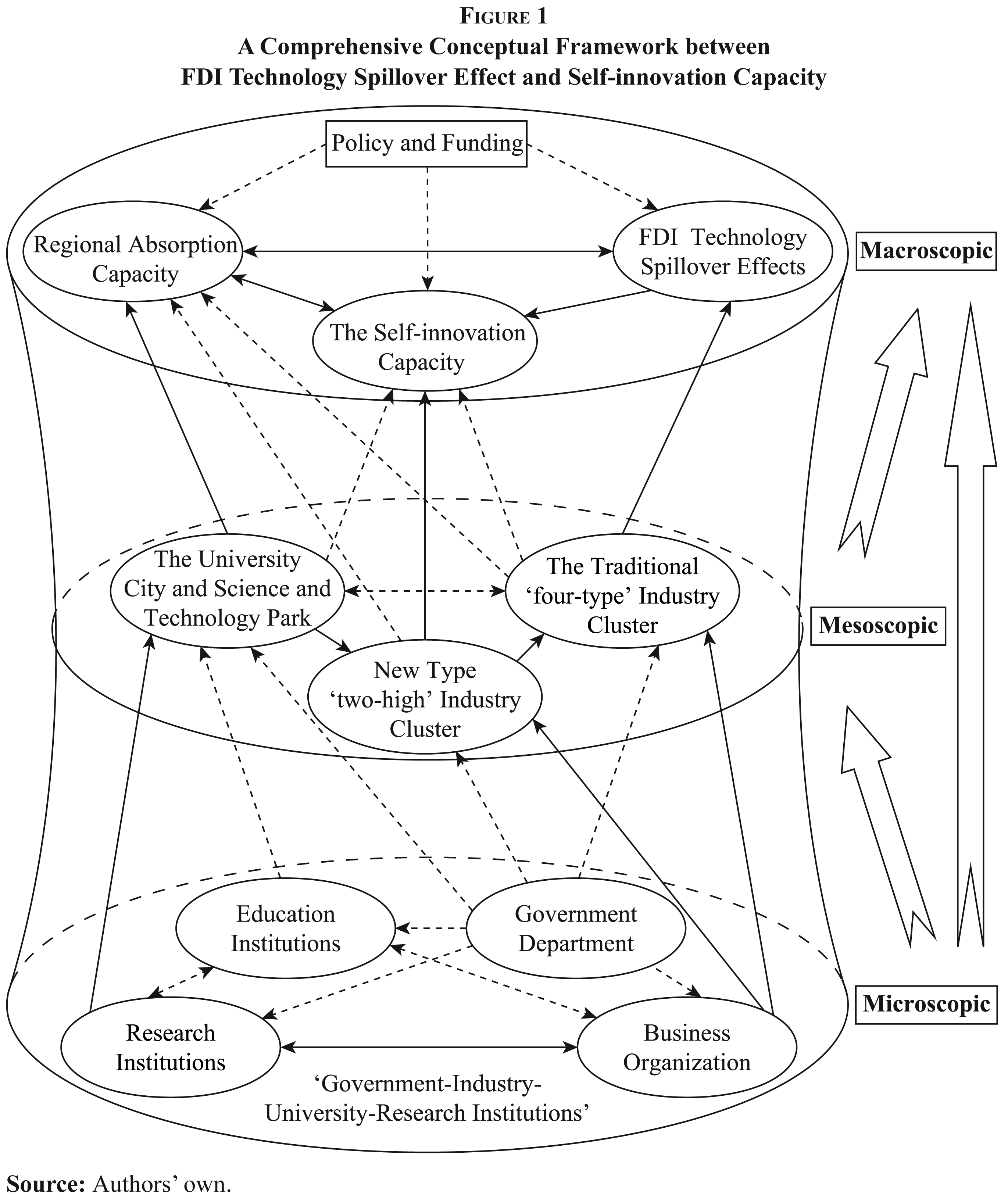
Source: Authors’ own.
At meso-level, owing to the promotion of FDI, industry cluster realises vertical set by directly acting on actuated subjects (enterprises) (Xian Guoming et al., 2006). The formation of industrial clusters is not only conducive to the formation of a favourable innovation atmosphere, but also can improve innovation capacity of the related industry through the competition effect and spillover effect (Humphrey, J et al., 2002). Then, because of cluster leaning, competition and cooperation, diffusion and spillover and organisation mechanism, cluster innovation effects are developed (Brenner, T. et al., 2001; Peng Yuwen, 2012), which play a key intermediary role in the conductive process (Li Ping & Sheng Dan, 2009). Meanwhile, the University City and Science and Technology Park show equally significant effects by vertically assembling intermediate actuated subjects (education institutions and research institutions) and performing interactive exchange and information sharing among them. Enterprises with foreign capital, as one of the members of the cluster, actively participate in the operation of the whole industry chain. They can make the corresponding technical guidance and training on the upstream and downstream enterprises, and produce industrial ripple effect.
For a specific region, it is necessary to have a macro-level analysis since both micro and macro subjects are the main part of topical action of regions. Technology spillover, absorptive capacity and innovation is respectively a kind of integration which interacted by various factors. By the flow of outstanding technical development talents, FDI technology spillover can directly promote the improvement of innovation capacity, and meanwhile, enhance the absorptive capacity of local enterprises, narrow the technology gap and raise the innovation capacity indirectly. At macro-level, the conductive process has to meet the threshold conditions of regional absorption capacity which plays a particularly prominent mediating role. Moreover, Shanxi’s transition path of industrial agglomeration has to be performed step by step (Zhao Hong et al., 2008). Presently, the traditional ‘four-type’ industry cluster (coal, coking, metallurgy and electric power) still plays an obviously fundamental and diffused effect in the new type ‘two-high’ industry cluster (high value-added industry and high-tech industry). So, in this article, the conceptual framework for FDI technology spillover effects and the self-innovation capacity is designed as a hyperboloid cylindrical stereo model which is based on the micro subjects, and applies the meso subjects as axis and the macro subjects as the top. Furthermore, the micro subjects, as the basic behavioural subjects, can directly play solo effect on macro ones or form meso ones according to their organic integration. The meso subjects indirectly act on macro subjects through cluster effect and therefore produce an organic framework of interdependence and interaction in the ‘Micro-Meso-Macro’ view framework (Woo-Cumings, M. et al., 1999).
Based on the above theoretical framework, to make a contrast analysis, Jiangsu, Liaoning and Hebei were selected as the typical representatives of high-level, middle-level and low-level of economic development in eastern coastal area by combining clustering analysis and comprehensive consideration. The empirical analysis was performed in the following three steps: first, comparison of FDI technology spillover effects among the provinces; second, comparison of the absorption capacity and its related factors and finally, verifying the interactive degree between FDI technology spillover effects and the self-innovation capacity of Shanxi.
FDI Technology Spillover Effects: Inter-provincial Comparison
Model Specifications
To measure FDI technology spillover effects, the authors studied plenty of previous research. The total amount of FDI actually utilised was used to measure direct spillover effects, which reflected the direct effect of foreign technology on the technical progress of domestic enterprises; while the share of FDI in total investment in fixed assets was adopted to measure indirect spillover effects, which reflected the indirect effect of foreign technology on other related enterprises by influencing domestic firms. Meanwhile, according to the research ideas of Levin and Raut (1997) and Feder (1982), the basic model is defined as

Based on the principle of Taylor’s formula (ln(1 + x)) . x, by taking logarithms for both sides of equation (1), model (1) is modified as

Furthermore, according to Tian Suhua’s study (2012), the reversed U-type fluctuation trend of the variable SHARE and irregular line chart of Y and SHARE reveal that Y is not simply linearly related to SHARE. The equation (2) is modified as

In Equation (3), the dependent variable (Y) denotes total output; L and K represent the inputs of labour and capital, respectively; RD stands for domestic R&D activities; SHARE denotes the share of FDI in total investment in fixed assets and FDI represents total amount of FDI actually utilised. α1, α2 γ, η δ, and θ are the regression coefficients of each variables, respectively; α0 represents the influence of other factors; and ε is used to measure the effect of random errors.
Variable Substitution and Data Specification
Variable Substitution
The variables used in the model (3) are measured as follow:
Total output (Y): it is calculated using ‘gross industrial output value of industrial enterprises’ minus ‘gross industrial output value of industrial enterprises with Hong Kong, Macao, Taiwan and foreign funds’, and converted to actual value at constant prices in 1992 based on consumer price index (CPI).
Labour input (L): it is computed using ‘number of employed persons of industrial enterprises at the end of the year’ minus ‘number of employed persons of industrial enterprises with Hong Kong, Macao, Taiwan and foreign funds at the end of the year’. In this article, we do not subdivide labour into skilled workers and unskilled workers because the high profits of the resource sector make entrepreneurs give up the R&D department, which are low technology-intensive industries, thus the labour are locked in the department of natural resource which requires only low skills. In the long-term, the industries are in the state of low technology level.
Capital input (K): it is calculated using ‘total assets of industrial enterprises at the end of the year’ minus ‘total assets of industrial enterprises with Hong Kong, Macao, Taiwan and foreign funds at the end of the year’, and converted to actual value at constant prices in 1992 based on CPI.
Domestic R&D (RD): it is the ratio of internal expenditure on R&D to sales revenue of industrial enterprises and represented as RD = R&D/SI.
The share of FDI in total investment in fixed assets (SHARE): it is the ratio of total amount of FDI actually utilised for total investment in fixed assets and represented as SHARE = FDI/FAI.
Foreign direct investment (FDI): it is substituted by the total amount of FDI actually utilised and converted to RMB-denominated value on the basis of the average exchange rate of US dollar against the RMB. Meanwhile, it is discounted to actual value at constant prices in 1992 based on CPI.
Data Specification
The data trend analysis of FDI actually utilised amount in Shanxi demonstrates that the size of FDI is smaller before 1992. As most domestic scholars take 1992 as the dividing line of relevant policy variables and considering the availability of data, twenty-two cycle data from 1992 to 2013 were also used as time series data to perform the empirical analysis. The data for verification were obtained from the original data of Provincial Statistical Yearbook, China Statistical Yearbook, China Statistical Yearbook on Science and Technology and China Compendium of Statistics 1949–2008.
Empirical Results
Regression estimation was carried out for equation (3) using measurement software EViews 6.0. The results are displayed in Table 1. And, we used the White Heteroskedasticity-Consistent standard errors and covariance to modify the heteroscedasticity in the model, such method of estimation is based on the robust standard error.
In Table 1, the modified Adj-R2 of each model is above 0.9 and all F values are highly significant, which indicate a good fitting of the regression model and strong interpretation ability.
Table 1 shows the results of Equation (3). The coefficient for L variable is significantly negative in Hebei, but it is positive in other provinces. Moreover, the coefficient in Shanxi is obviously higher than that in Jiangsu and Liaoning. This is possibly because that L in Hebei is replaced with the total number of employed persons of state-owned and urban industrial enterprises at the end of the year, which is likely to be overestimated. With the progress of technology and the rapid development of service industry, the contribution of labour in industrial enterprises is weakening. However, because Shanxi is an inland province and has been subject to resource-based industry for a long time, its development of service industry lags behind the manufacturing industry, and more behind the eastern coastal provinces.
The Empirical Results of FDI Technology Spillover Effects between Shanxi and Three Eastern Provinces
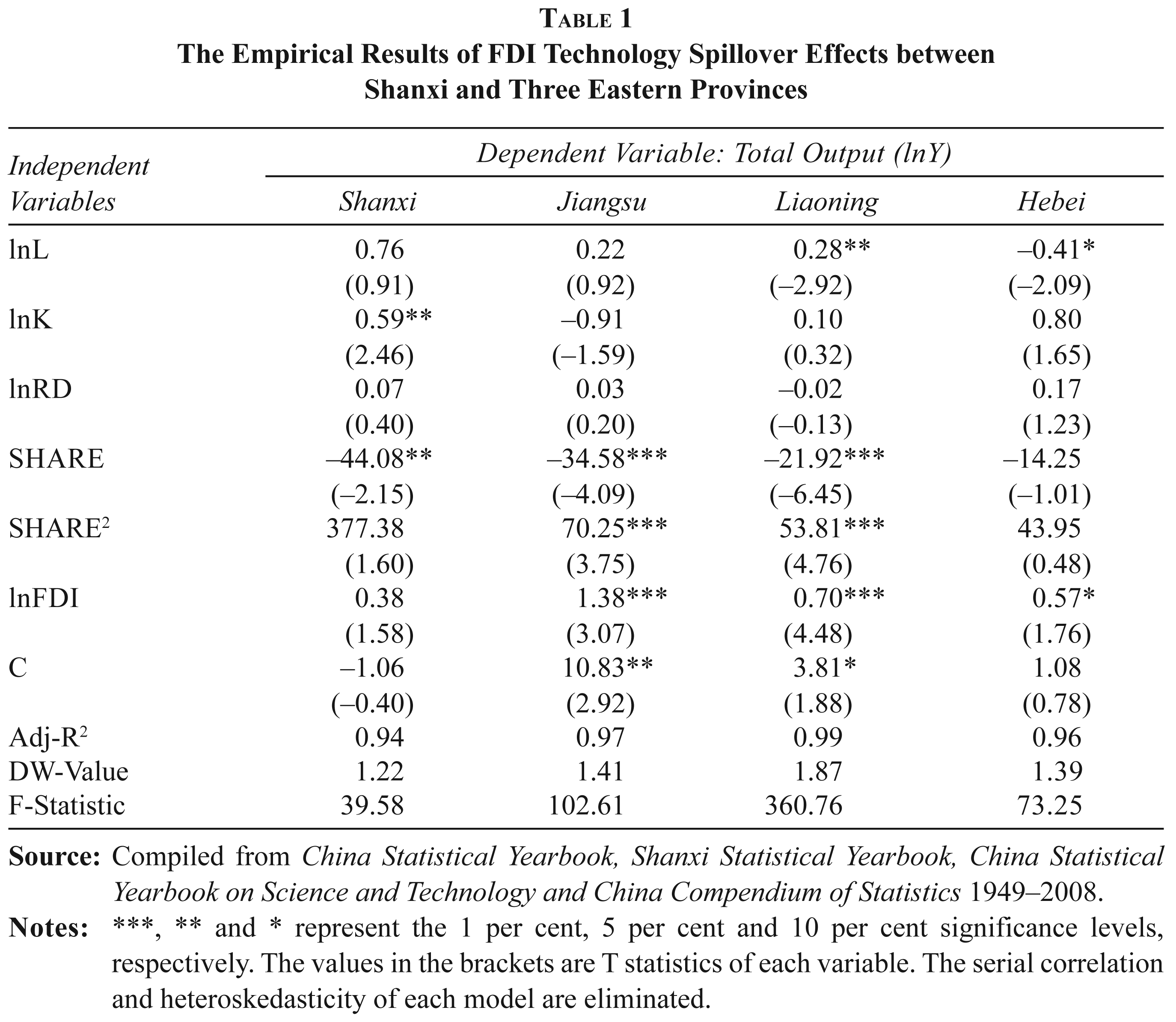
The coefficient for K is negative but not significant in Jiangsu, but it is positive in other provinces. Furthermore, except Hebei, all the coefficients are lower than that of L. In addition, the coefficient in Shanxi is lower than that in Hebei. It shows that the weakening trend of capital contribution is more distinct than that of labour in industrial enterprises and the weakening trend in Jiangsu and Liaoning is more significant than the two inland provinces, Shanxi and Hebei.
Then, the coefficient for RD is negative but smaller and insignificant in Liaoning; it is positive but insignificant in Jiangsu, Hebei and Shanxi, which is lower than the contribution of FDI direct technology spillover. Except Shanxi, the coefficient for FDI is significantly positive in other provinces, in a decreasing order as Jiangsu> Liaoning> Hebei>Shanxi. This indicates that independent R&D is becoming more prominent in industrial enterprises; owing to location advantage, FDI direct technology spillover effects are more obvious and easily applied in Jiangsu and Liaoning, where there is larger opportunity for obtaining advanced technology through FDI, which possibly inhibits the independent R&D effort. For inland provinces Shanxi and Hebei, the poor effect of introducing advanced technology using FDI technology and the low absorption efficiency, as well as the low direct spill-over effects highlight the crucial effect of independent R&D in the development of enterprises.
Except Hebei and Shanxi, the second order item for SHARE are significant in Jiangsu and Liaoning, which indicates that the item is linear for Hebei and Shanxi while non-linear for other provinces with positive coefficient of second order item and negative coefficient of first order item. In addition, it demonstrates that the relationship between Y and SHARE shows non-linear and FDI indirect technology spillover effect is negative and follows the U-type trend. At first, because the initial FDI technologies come from Hong Kong and Macao more than Europe–America–Japan–Korea, the inflows of FDI technology are at a low level and local enterprises are keen on the simple imitation instead of substantive innovation. FDI indirect technology spillover is overstated. With the deepening of globalisation, high-tech swarms into the domestic market and enterprises change their innovation concept rapidly. However, owing to backward technology capacity and the lack of high-tech talents, local enterprises are still difficult to absorb the core technology of FDI, which contributes a poor performance of FDI indirect technology spillover. Afterwards, as the technology capacity upgrades and the technology talents enriches, the level and efficiency using FDI technology gradually improves, which enables FDI indirect technology spillover to show a substantial rise. Moreover, taking into account the competitive and cooperative relationship between foreign enterprises and local enterprises, FDI indirect technology spillover presents fluctuation and convergence tendency generally.
Compared with overall FDI technology spillover effect, the coefficient for FDI is positive, while that for SHARE is negative, and the coefficient in Shanxi is lower than Jiangsu and Liaoning. The result implies that FDI advanced technology shows obvious positive effect on the technology progress of local enterprises, but inhibits the technical innovation activities of other related enterprises. This is because, to maintain the competitive advantages, foreign enterprises block their core technologies and have obvious crowding-out effect for local enterprises. In the condition, local businesses are unable to efficiently absorb and utilise the introduced technology and probably get bogged down in technology dependence. The overall FDI technology spillover is lower than that in Jiangsu and Liaoning. It is possibly because Shanxi has been dominated by resource-based industries for long time and its skill-intensive industries are relatively backward; therefore it is more seriously impacted by foreign high-tech and shows more obvious crowding-out effect.
Regional Absorptive Capacity and Its Influencing Factors: Interprovincial Comparison
Model Specifications
As mentioned above, there was significant FDI technology spillover effect in each province; however, whether local enterprises are able to effectively use these technologies to realise technical progress and self-innovation by mean of foreign force is the internal condition. Based on the integrated conceptual framework and previous research, the influencing factors of absorption capacity can be divided into three layers, including micro, meso and macro.
The macroscopic factors for measuring the regional overall development include economic development level, the opening degree, financial environment and infrastructure conditions.
The mesoscopic factors are represented by industry agglomeration and scientific research agglomeration.
Considering microscopic factors, technology gap, human capital, R&D capacity and government expenditure structure are adopted to represent the influences of micro subjects such as enterprises, education institutions, research institutions and government on regional absorption capacity. As these factors can directly or indirectly affect regional technical progress, the estimating models of different layers are set as:



Where TFP stands for total factor productivity, which reflects regional technology level; RD represents domestic R&D activities and FDI is used to measure FDI technology spillover effect. PGDP, OPEN, FC, BF, IA, SRA, TG, HC, RC and GEC are the corresponding influencing factors, respectively, among which the interactive term is used to measure regional absorptive capacity. β0 is a constant, which reflects the average influence of other factors that are unconsidered. β1" β10 is the regression coefficient of each variable and μ stands for the random error term.
Variable Substitution and Data Specification
Variable Substitution
The detailed measures of each variable are presented below.
The Dependent Variable
Total Factor Productivity (TFP): according to the Cobb-Douglas function, TFP is defined as
The Independent Variable
Foreign Direct Investment (FDI): the ratio of the total amount of FDI actually utilised to the real GDP.
The Macroscopic Factors
Economic Development Level (PGDP): it is represented by the real GDP per capita and converted to actual value at constant prices in 1992 based on CPI.
The Opening Degree (OPEN): it is the ratio of the total amount of import and export to the real GDP.
Financial Environment (FC): by adopting the method proposed by Zhou Yongtao (2010), it is measured by the ratio of loans in non-state sector to GDP, where loans in non-state state sector = total loans × (1-total investment in fixed assets in state-owned economy/total investment in fixed assets in the whole country).
Infrastructure Conditions (BF): this indicator is measured by length of highways in unit area and presented by the average length of highways per hundred square kilometre.
The Mesoscopic Factors
Industry Agglomeration (IA): it is represented by the proportion of the number of employed persons in secondary industry in the total number of employed persons, because employment is the main performance index of industry.
Scientific Research Agglomeration (SRA): it is the ratio of the total expenditures on R&D to regional administrative area, that is, the expenditures on R&D in unit area.
The Microscopic Factors
Technology Gap (TG): considering that the economic development and technology level of Shanghai is in the forefront of the country and basically same with the developed countries, Shanghai is taken as the reference standard to indirectly measure the technology gap between domestic and foreign enterprises. Concretely, this indicator is the ratio of the expenditure for technology development of employed persons in units in each province to that in Shanghai in large and medium-sized industrial enterprises.
Human Capital (HC): the number of college students per 10 thousand populations in each area in each year.
R&D Capacity (RC): the ratio of the total expenditures on scientific and technological activities of R&D institutions to the real GDP.
Government Expenditure Structure (GEC): the proportion of expenditure for education in general budgetary expenditure in each year.
Data Specification
The twenty-two cycle data from 1992 to 2013 were still used for the comparative analysis. The data were obtained from the Provincial Statistical Yearbook, China Statistical Yearbook, China Statistical Yearbook on Science and Technology and China Compendium of Statistics 1949–2008.
Empirical Results
Inter-provincial Macro Comparison
Multiple regression was performed for equation (4) using the measurement software EViews 6.0. The results are demonstrated in Tables 2 and 3.
Table 2 and Table 3 show the results of Equation (4). The coefficient for FDI is positive and significant in Jiangsu and Hebei, insignificant in Liaoning and negative in Shanxi. This result contradicts with the above empirical results, which indicates that FDI advanced technology has spillover effect on local enterprises, but not really promotes regional technical progress. This is caused by two reasons. First, investment motivation of foreign enterprises is not consistent with the original intention of local government, and therefore the technology spillover degree is limited. Second, the internal potential of native human resource is restricted by foreign enterprises, which leads to the crowding-out effect on labour input and capital input for R&D.
The Empirical Results of the Absorptive Capacity and Its Macro Factors in Shanxi and Hebei
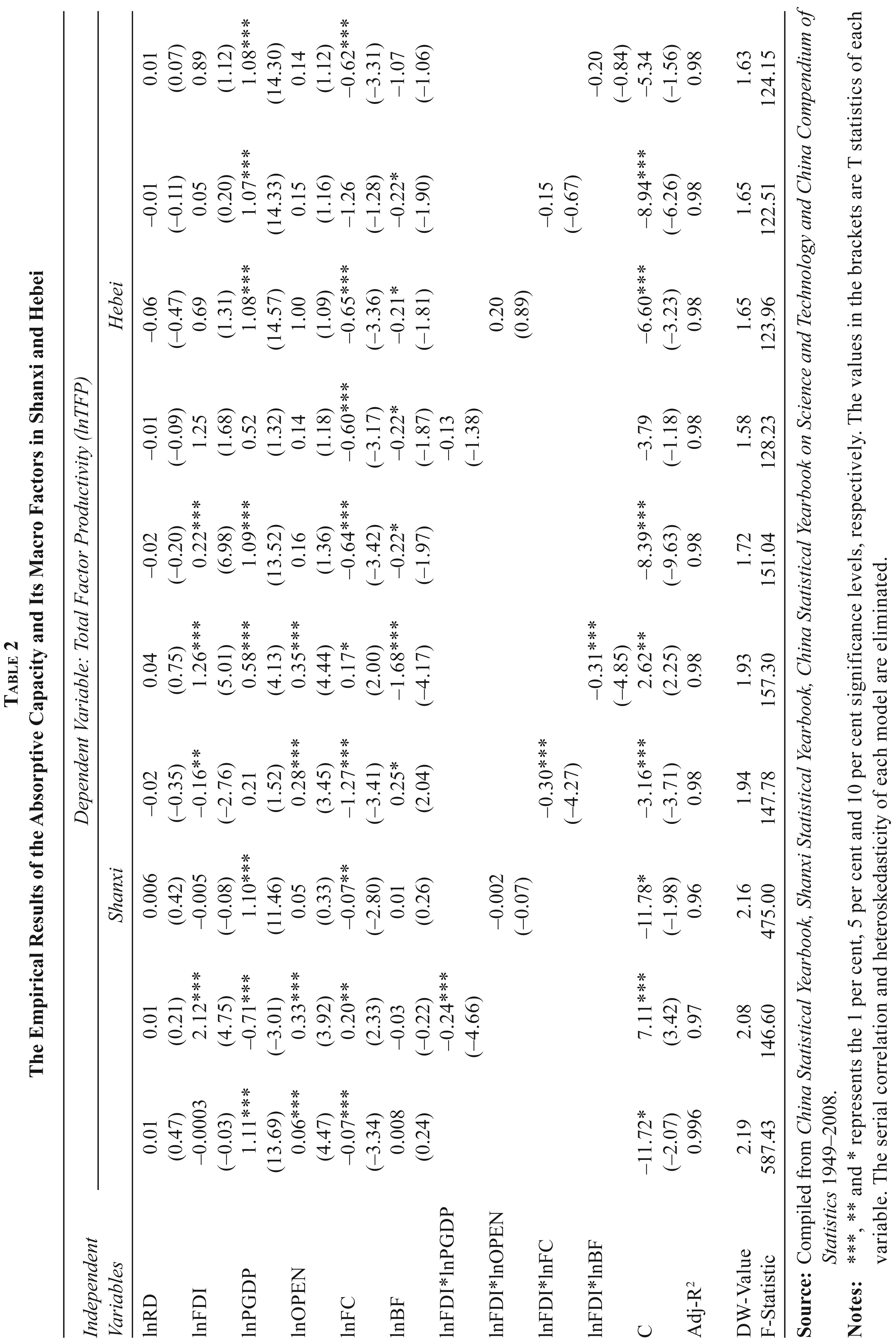
For economic development level, when its interaction with FDI is added to the model, the coefficient for FDI changes from positive to negative for Jiangsu, while increases obviously for the rest three provinces. The PGDP coefficient increases obviously in Jiangsu, but decreases for the other three provinces among which Liaoning shows the biggest degree. The interaction coefficient is significantly negative in Shanxi and Liaoning but not significant in Jiangsu and Hebei. The result shows that PGDP and FDI promote each other mutually, but PGDP has a negative impact on FDI. This is because the introduced FDI technology is different in areas with different development levels. Taking Jiangsu, which presents high economic development level, for an example, it introduced FDI technology level is high; therefore it is difficult to absorb technology spillover.
The Empirical Results of the Absorptive Capacity and Its Macro Factors in Jiangsu and Liaoning
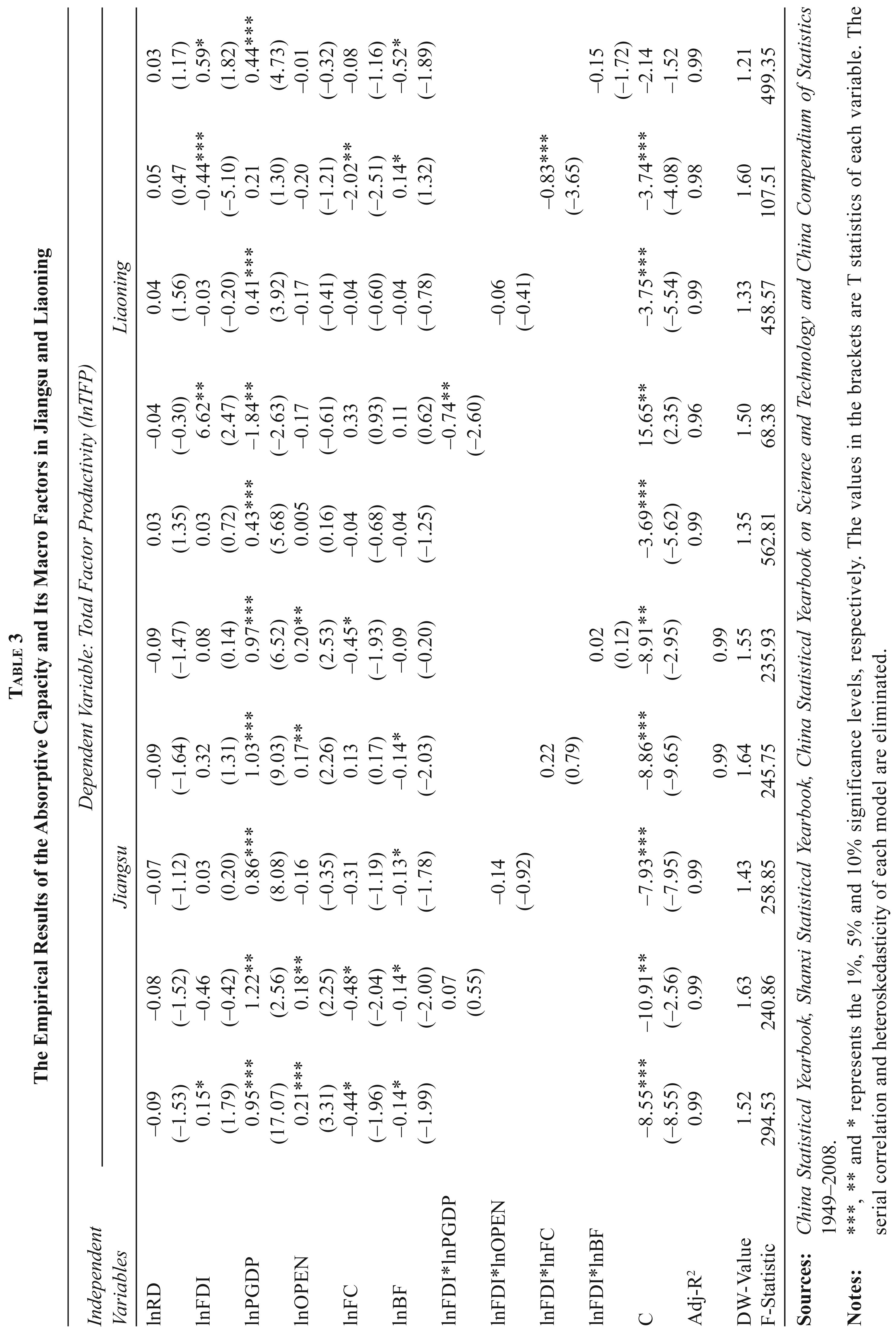
Regarding the opening degree, when its interaction with FDI is added to the model, the coefficient for FDI in Liaoning changes from positive to negative and the interaction are negative except Hebei, but not significant in these provinces. In contrast, the FDI coefficient changes slightly and the coefficient for its interaction is very small in Shanxi and Liaoning. This implies that OPEN restrains the absorption capacity of Shanxi and Liaoning, while the FDI coefficient is negative. This is possibly because Shanxi is located in inland and lacks of location advantage, while the coastal province Liaoning and Jiangsu shows seriously imbalanced internal structure of FDI, with an excessively high proportion of Hong Kong FDI (accounted for 52.3 per cent and 56 per cent of the total investment of Liaoning and Jiangsu in 2013). Therefore, technology spillover of FDI induced by OPEN is over estimated.
Considering financial environment, after adding its interaction with FDI, the coefficient for FDI changes slightly and is still significantly negative in Liaoning and Shanxi, and except Jiangsu the interaction term is negative. But compared with the original model, the coefficient for FC obviously changes, which indicates that the financial development level is still low for each provinces and not conductive for promoting the absorption capacity. But the introduction of FDI requires higher financial level, which can possibly improve the financial conditions of the areas.
Furthermore, by adding the interaction of BF and FDI to the model, the coefficient for FDI is still positive for all the four provinces. Additionally, except a small BF coefficient in Shanxi and Hebei, the BF coefficients are slightly bigger in other provinces. The analysis reveals that the introduction of FDI in the coastal provinces is in favour of the improvement of regional infrastructure condition, which is one of the important factors for attracting FDI in turn. And FDI and BF interact with each other except Shanxi and Hebei. However, the negative interaction coefficient except Jiangsu indicates that the backward infrastructure inhibits the absorptive capacity.
Inter-provincial Meso Comparison
The variable IA and SRA and their interaction with FDI are added to the model (5) using software EViews 6.0, and the empirical results are illustrated in Table 4.
The introduction of industry agglomeration, scientific research agglomeration and the interactions with FDI in the model demonstrates that:
The Empirical Results of the Absorptive Capacity and Its Meso Factors
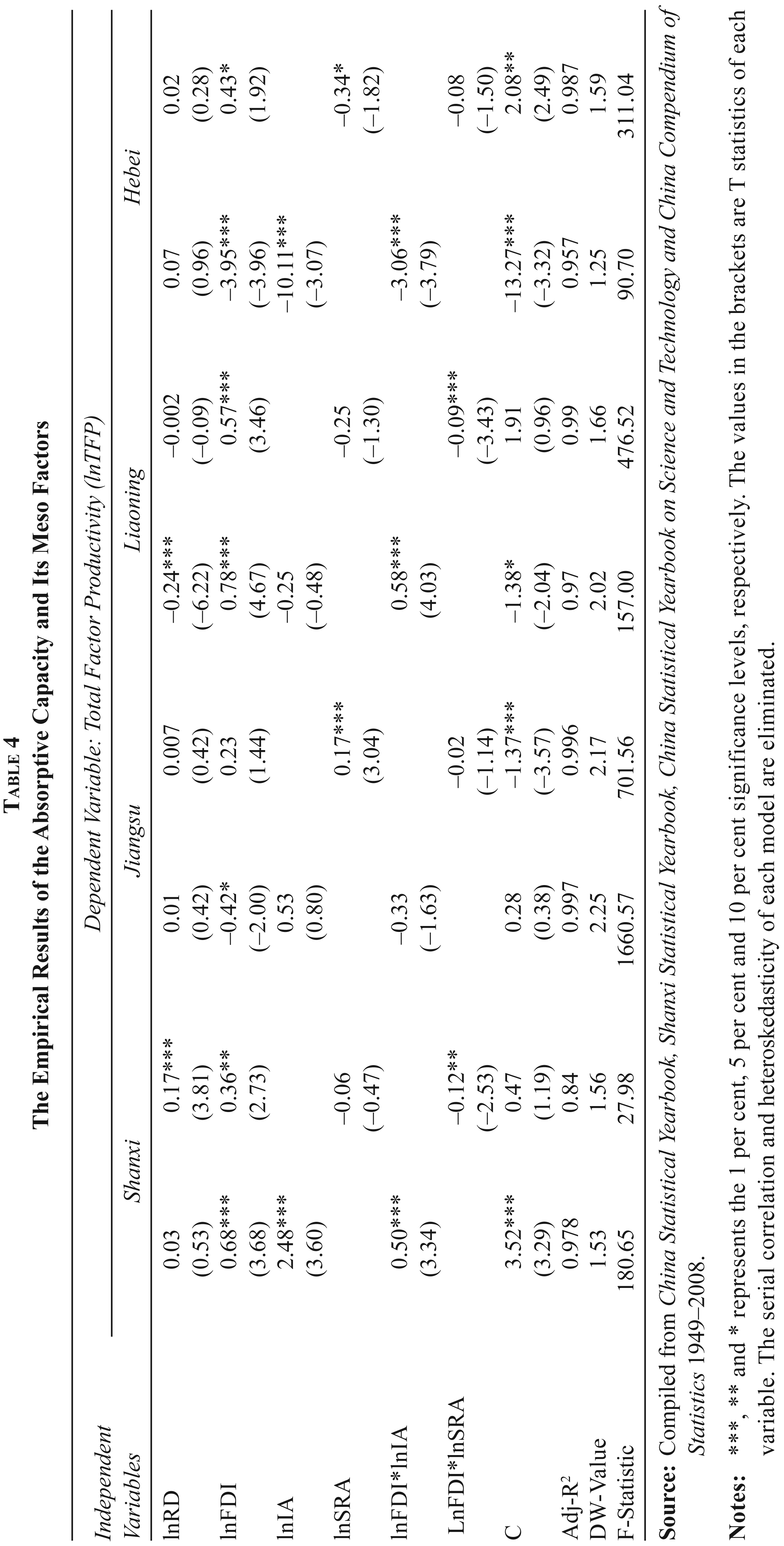
For industry agglomeration, the coefficient for FDI and its interaction with IA are significantly positive in Shanxi and Liaoning. It indicates that industry agglomeration stimulates the regional technical progress, which can be indirectly promoted by boosting the absorptive capacity. To find out the reasons, the overall size of employed persons in secondary industry was taken as substitution variable in Shanxi and Liaoning, which are resource-based provinces with high proportion of secondary industry and low technical level. But industry agglomeration can indirectly produce scale effect for related industries, such as high-tech industries of R&D and design in upper section and service industry including after-sales service. On the contrary, the coefficient for FDI and its interaction with IA is negative in Jiangsu and Hebei, meanwhile that for IA is negative in Liaoning and Hebei, implying that industry cluster hinders the overall technical progress and at the same time inhibits the promotion of absorptive capacity. This conclusion is unreasonable. As shown in Figure 2, the output value proportion in secondary industry declines in Jiangsu, while it remains stable in Hebei and gradually lower than Shanxi and Liaoning. But the employment proportion in secondary industry of the former provinces is increasing and gradually higher than the latter ones. This distinct contrast is possibly because the inter-provincial differences of industrial organisation forms. For example, Jiangsu shows a high proportion of manufacturing industry, which is lower in Shanxi and Liaoning due to the considerable proportion of their mining industry. Besides, manufacturing industry in Shanxi and Liaoning are mainly private and small-medium enterprises with limited scale, weak competition strength and low comprehensive quality of employees. While, mining industry is generally state-owned, with normative regulation, obvious scale and agglomeration effect, sufficient capital and preferential policy tendency. All these advantages benefit for the improvement of the absorptive capacity.

Source: China Statistical Yearbook.
Analysis of scientific research agglomeration shows that the coefficients for FDI are positive in each province, in a decreasing order as Liaoning > Hebei > Shanxi > Jiangsu. Except Jiangsu, all the coefficients for SRA are negative. This may be related to extrusion technology and human capital locking of resources industry. Except Hebei and Jiangsu, the coefficients for interaction FDI and SRA are significantly negative. The results show that the introduction of FDI hightech forces regional R&D activities to agglomerate and compete with, digest and absorb the introduced FDI high-tech. Furthermore, scientific research agglomeration delivers the sign of human resources advantages to foreign enterprises, and therefore attracts FDI technology at higher level. However, the conclusion states that the variable SRA does not promote the absorptive capacity. This is possibly because the industrial agglomeration is more obvious than scientific research agglomeration in China, and the latter is still in the initial stage with merely a form instead of substance. Scientific research agglomeration has not really exhibited its scale and diffusion effect.
Inter-Provincial Micro Comparison
The micro factors (TG, HC, RC and GEC) and their interactions with FDI are added to the model respectively, and the empirical results are demonstrated in Tables 5 and 6.
The technology gap, human capital and R&D capacity and their interactions with FDI were introduced in the model, and it showed that:
For technology gap, the coefficient for FDI is significantly positive in Liaoning, but negative in other provinces; and that for TG is positive in Liaoning and Hebei while negative in other provinces; except Liaoning, the interaction of other provinces is negative. The analysis results of different provinces are not completely conformed, which fails to prove that the technology gap has no effect on the absorptive capacity. This is probably caused by the great differences of FDI technology in different provinces; therefore there is not obvious threshold effect of technology gap.
Considering human capital, the coefficient for FDI is positive in all provinces. Except Jiangsu, the coefficient for HC is negative but insignificant, and all those for its interaction are negative. It indicates that the introduction of FDI technology increases the demand for high-quality talents and the contacting opportunity of high-tech, which helps to cultivate high-tech talents. Equally, the high level of human capital also attracts more advanced FDI technology. But the results show that the human capital inhibits the absorptive capacity in each province, which possibly resulted from the threshold effect of human capital. It is believed that the main reason is the mismatch between the human capital and the introduced technology, while the inconsistency between theoretical research in school and practical application in enterprises is also a key factor.
Regarding R&D capacity, except Shanxi and Hebei, all the coefficients for FDI and those for RC are positive, and the coefficients for its interaction are positive except Hebei, in a decreasing order as Liaoning > Jiangsu > Shanxi > Hebei. This result proves that scientific research institutions in each province contribute to sufficient absorption for advanced FDI technology except Hebei because the R&D institutions are not only close to enterprises and easy to obtain the most advanced technology, but also understand the real demand of enterprises and the market, which benefits for the technical localisation. However, R&D capacity exhibits a low negative effect in Shanxi and Hebei, implying that there is obvious difference in R&D capacity between Shanxi and Hebei and the eastern provinces. Therefore, it is significant for Shanxi and Hebei to introduce and retain talents, and then stimulate the agglomeration effect.
Finally, government expenditure structure is analysed to reveal the support of government for education and scientific research. The results display that all the coefficients for FDI are positive, and those for GEC are positive except Hebei, as well as the coefficients for its interaction, in a decreasing order as Jiangsu > Liaoning > Shanxi > Hebei. It indicates that governmental funding input has an apparently positive effect on regional absorptive capacity and the rise positive effect is found in Shanxi. It shows that the local government in Shanxi puts some education funding, pays more attention to the cultivation of talents in high-tech fields, and in some degree plays the comprehensive effects of ‘Government– Industry–University–Research Institutions’. On the other hand, the minimum positive effect of Hebei maybe caused by the decreased support of government for education and scientific research.
The Empirical Results of the Absorptive Capacity and Its Micro Factors in Shanxi and Hebei
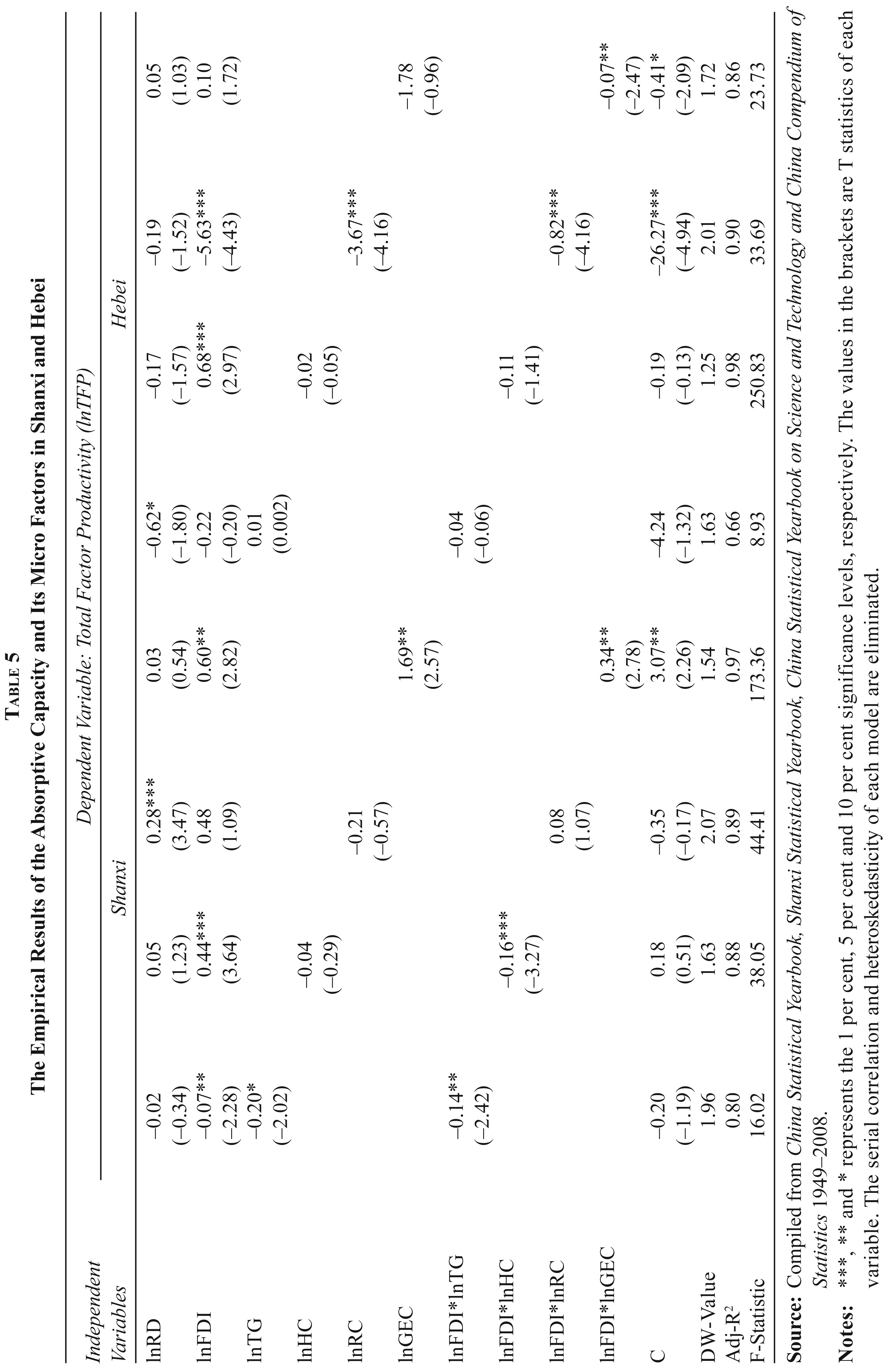
The Empirical Results of the Absorptive Capacity and Its Micro Factors in Jiangsu and Liaoning
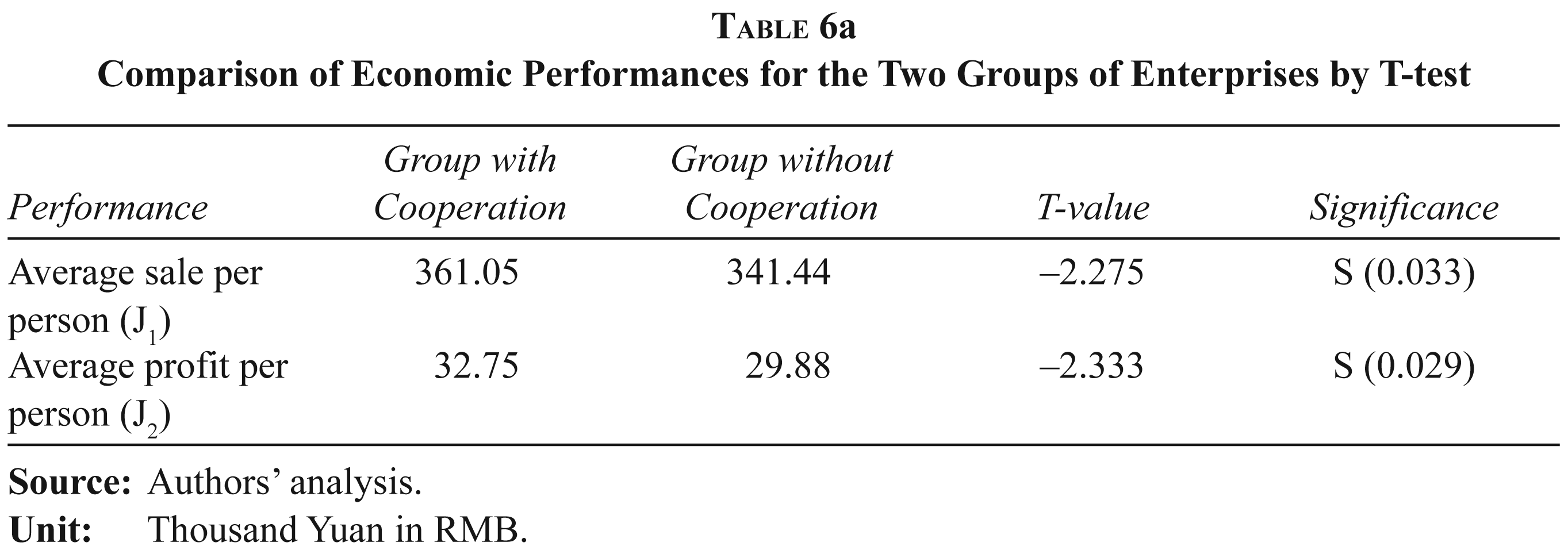
The article focuses on the FI of four provinces of Jiangsu, Hebei, Liaoning and Shanxi. The rapid development of China attracts more and more enterprises which are high technology, new energy, new materials, energy conservation and environmental protection. Jiangsu has a large number of Science and Technology Parks and high technology industrial districts, which attract JTEKT, Caterpillar, Toyota, Samsung, Emerson, Bosch, Ford, Lucent, Panasonic, Novartis and other enterprises to set up R&D centres here. And with the improvement of investment environment, the high-tech companies have moved into Liaoning, such as Agoda, Voith, Kanomax, China Resources, Sanyo and Forbo Siegling. Hebei also increases the intensity of capital to provide preferential policies for Siemens, LG, Marini-Prima AkzoNobei, Stanley, W.E.T, Cincinnati Lamb, Velux, Sandvik and other enterprises. These companies will undoubtedly produce technology spillover effect in China and improve the regional technological capacity.
FDI technology spillover has direct and indirect channels. The former focuses on the introduction of excellent employees, especially outstanding technical development talents, maintenance personnel and senior management personnel, and the latter is progressive. FDI technology spillover can improve the absorptive capacity of enterprise, narrow the technology gap and make the local enterprises efficiently absorb technology spillover, increase investment in scientific research range and realise the promotion of innovation capacity (Zheng Muqiang, 2011). Through four channels of the spillover accumulation (learn to follow, the industrial links, the industrial cluster and the diffusion of R&D) and three channels (personnel sharing, competition in resources and reversed transmission of competition), FDI technology spillover plays a role on the local companies. Among them, learning to follow, industry links and industry cluster can usually come into direct contact with advanced technology of foreign companies, so as to benefit the promotion of local enterprises’ technological capacity. The diffusion of R&D is helpful to promote local enterprises to form their own R&D team, and provide the necessary management experience and appropriate technology selection. While personnel sharing make the talents into local enterprises’ R&D team, and raise their R&D capabilities. In addition, local corporations and foreign enterprises compete for resources and markets, and the external pressure will be reversed transmission ways to improve the market capacity of local corporations. As a result, technological capacity, the R&D capabilities and the market power have effects in absorptive capacity of the local corporations, and indirectly promote the efficient absorption of technology spillover of foreign companies.
For natural resource rich regions as Shanxi, its industrial structure has weak links to each other. Therefore, the key is to increase the degree of competition in the market, which makes relevant enterprises use existing resources and technology, and improve their technological capacity. And the staff turnover will accelerate this process. Once the adjustment of industrial structure happens, it can develop industry association effect, and gradually form industrial cluster. So, FDI will have a greater effect on the new carrier of technology spillover, such as Joy, Caterpillar and DTB companies. They activate the Shanxi coal market, which increase competition within local corporations, and prompt the improvement of technological capacity.
Empirical Analysis on FDI Technology Spillover Effect and Self-innovation Capacity in Shanxi
Model Specifications
As mentioned above, Shanxi shows most obvious FDI technology spillover effect and a certain degree of absorptive capacity. Then the question arises whether or not FDI technology spillover promotes the self-innovation capacity? And whether there is mutual promotion relationship between them? According to the mechanism of above comprehensively conceptual framework, FDI technology spillover can directly or indirectly affect regional self-innovation by using stronger absorptive capacity. As the realisation of innovation is a cumulative process, the integrated effect of multiple factors is required for a long time. Based on the development status of Shanxi and considering the self-innovation can be impacted by policy environment, institutional environment and social environment, they are set as the control variables. Hence, the model of panel data is:

where INNOit is the self-innovation capacity of region i at time t;
FDIit is the FDI technology spillover effect of region i at time t;
ACit is the absorptive capacity of region i at time t;
Cit is control variable, including policy environment, institutional environment and social environment;
β1, . . ., βi are the regression coefficients of each variable. In which, β1 is the critical variable. If β1 > 0, FDI technology spillover promotes the self-innovation capacity in Shanxi. Otherwise, if β1 < 0, FDI technology spillover inhibits the self-innovation capability. β0 is the intercept term;
μ reflects the regional fixed term;
εit is the error term.
Variable Substitution and Data Specification
Variable Substitution
The detailed measures of each variable are presented below.
The Dependent Variable
Self-innovation Capacity (INNO): Because there is no specifically statistical data to reflect the self-innovation capacity, which is affected by multiple factors, to comprehensively measure this indicator, it is divided into three layers. The first is the potential resource index of self-innovation, which is represented by the proportion of domestic-funded enterprises in gross industrial output value. The second is the actual input index of self-innovation and is demonstrated by the ratio of the number of persons engaged in science and technology (S&T) activities in the number of employees in each urban area, considering that S&T activities are mainly performed in cities. The third one is the environment supporting index of innovation and represented by the proportion of education expenses in financial expenditure. Then, the average values of each index are taken as references and equally assigned after standardised processing. Afterwards, comprehensive index method is used to construct innovation capacity index.
The Crucial Variables
FDI Technology Spillover Effect (FDI): two indicators are adopted for the variable. One is the ratio of the amount of utilised FDI to the fixed assets that newly constructed each year, and converted to RMB-denominated value based on the average exchange rate of US dollar against the RMB. Another is the proportion of sales value of foreign-funded enterprises in total industrial sales output value.
The Absorptive Capacity (AC): considering multiple influencing factors of absorptive capability, four indexes including per capita GDP, average length of highways per 10 thousand population, the proportion of the third industry in gross industrial output value and the number of students in higher education institutions are used first. Then in view of the typical resource-based characteristics of Shanxi, energy consumption per unit of GDP is added as a reversed index. Reciprocal processing and equal assignment are conducted, and the data of Shanxi are taken as a reference. After standardised processing, comprehensive index method is applied to construct absorptive capacity index.
The Control Variables
Policy Environment (NE): self-innovation requires market to play a more significant role, while the government acts as a regulatory and instructional role and performs appropriate effect. The improper proportion of government, no matter too large or too small, is not good for achieving self-innovation. Hence, this indictor is measured by the proportion of public finance expenditure in GDP.
Institutional Environment (IE): generally, it is the larger proportion of state-owned enterprises, the more inactive the market, the less competitive intensity, and the less is promotion for self-innovation. Here, this indictor is measured by the proportion of the sales value of state-owned industrial enterprises in gross industrial sales output value.
Social Environment (SE): the overall social development level is affected by many factors, among which the average income level of residents is the most critical one. The higher the per capita income, the better the overall operation of society is and the greater is the support for self-innovation. It is represented by the ratio of per capita disposable income of urban households to that of the whole province.
Data Specification
Eleven cities in Shanxi are taken as the research objects, including Taiyuan, Datong, Yangquan, Changzhi, Jincheng, Shuozhou, Jinzhong, Yuncheng, Xinzhou, Linfen and Lvliang. Considering that Lvliang city was established in 2003 and part of the data is lost, particularly the related innovation index data, ten cycles of data from 2004 to 2013 are used in the empirical analysis to ensure the integrity and continuity of the data. The data are obtained from Shanxi Statistical Yearbook and Rising Abruptly through Reform and Opening: A Retrospection for the 30-year Experience of Reform and Opening in Shanxi.
Empirical Results
Based on the calculated data, unit root test, cointegration test and regression analysis are performed for related variables using software EViews 6.0. The unit root test shows that each variable obeys first-order integration, that is, they have a long-term cointegration relationship. Because the research objects are all prefecture level cities and there is no random choice, the fixed effect model is used. The regression results are shown in Table 7.
The Regression Results of Model (7)
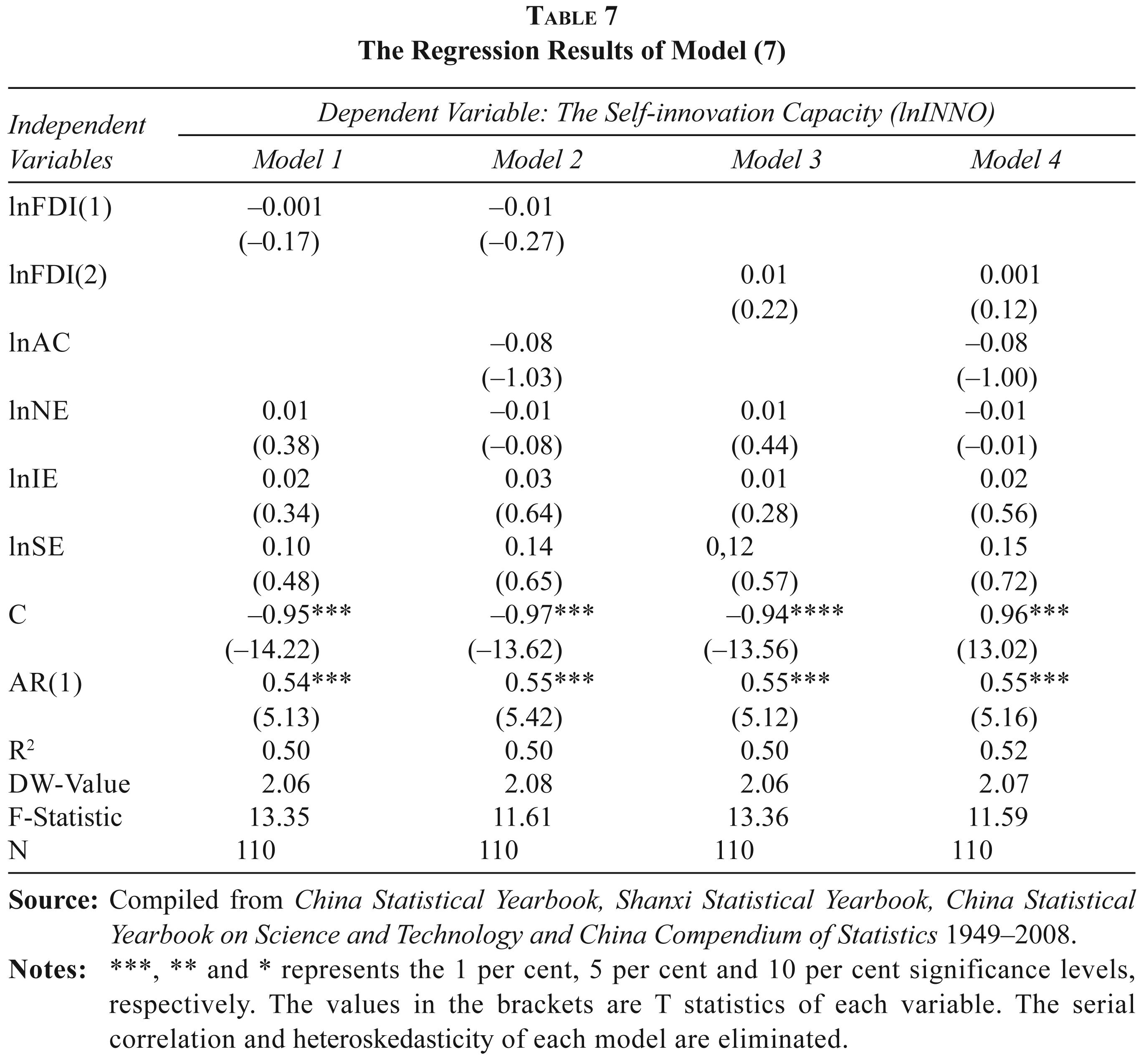
The analysis of FDI technology spillover effect shows that, first, when the share of FDI actually utilised amount in new fixed assets investment is taken as a substitution variable for the model, the variable FDI(1) does not significantly promote or inhibit the dependent variable INNO. And when adding the variable AC to the model, the variable does not have a significant positive effect on the dependent variable, and the coefficient for FDI(1) changes slightly; second, when the proportion of the sales output value of foreign-funded enterprises is regarded as its alternative indicator for the model, the coefficient for FDI(2) is positive but insignificant. After adding the variable AC to the model, FDI(2) still positively influences the dependent variable and decreases slightly. In general, FDI technology spillover effect does not promote the self-innovation capacity, but greatly inhibits it. This is possibly because the inflows of foreign enterprises are mostly based on the resource-related interest and other motivation in Shanxi, with limited substantive core technology. Meanwhile, owing to the low technical level of local enterprises, there is a big gap with foreign enterprises. Therefore, the competition extrusion effect is greater than the absorption effect of technology spillover. In terms of absorptive capacity, the results show that it slightly improves the innovation capacity, and plays a limited but positive role in the conduction between FDI and INNO. The reason is that the gap of technical level between Shanxi and FDI which inflows in Shanxi is large. It indicates that the absorptive capacity of Shanxi is low and the development levels of each factor fail to absorb FDI advanced technology.
Furthermore, the influences of three control variables (NE, IE and SE) on the innovation capacity are analysed. In the four models, the coefficients for NE are small, those for IE and SE are positive. The empirical results suggest that the local government policy is not beneficial for promoting innovation capacity. Though the education expenditure proportion of government fiscal expenditure in GDP is increasing year by year, and it reached the 4 per cent standard which was set in the national financial work conference in 2012, the ratio of it is still small. Additionally, the ratio of S&T expenditure is smaller, as shown in Figure 3. Obviously, the insufficient input in education and S&T is one of the important reasons. And the market system does not have obvious effect on self-innovation, implying that the high proportion of state-owned enterprises (about more than 50 per cent) does not restraint the development of private enterprises, both of which fairly compete in the market to mutually boost their technology and finally promote self-innovation. Moreover, social environment shows certain positive effect in promoting self-innovation but it is not significant. It indicates that there is a certain social condition in Shanxi for self-innovation, which possibly is influenced by bad social phenomena, such as fake and shoddy commodity, speculative behaviour, etc.

Granger Causality Test
To more accurately understand the relationship among FDI technology spillover effect, the absorptive capacity and the self-innovation capacity, Granger Causality Test is performed for them. The test results are displayed in Table 8.
The Results of Bidirectional Granger Causality Test
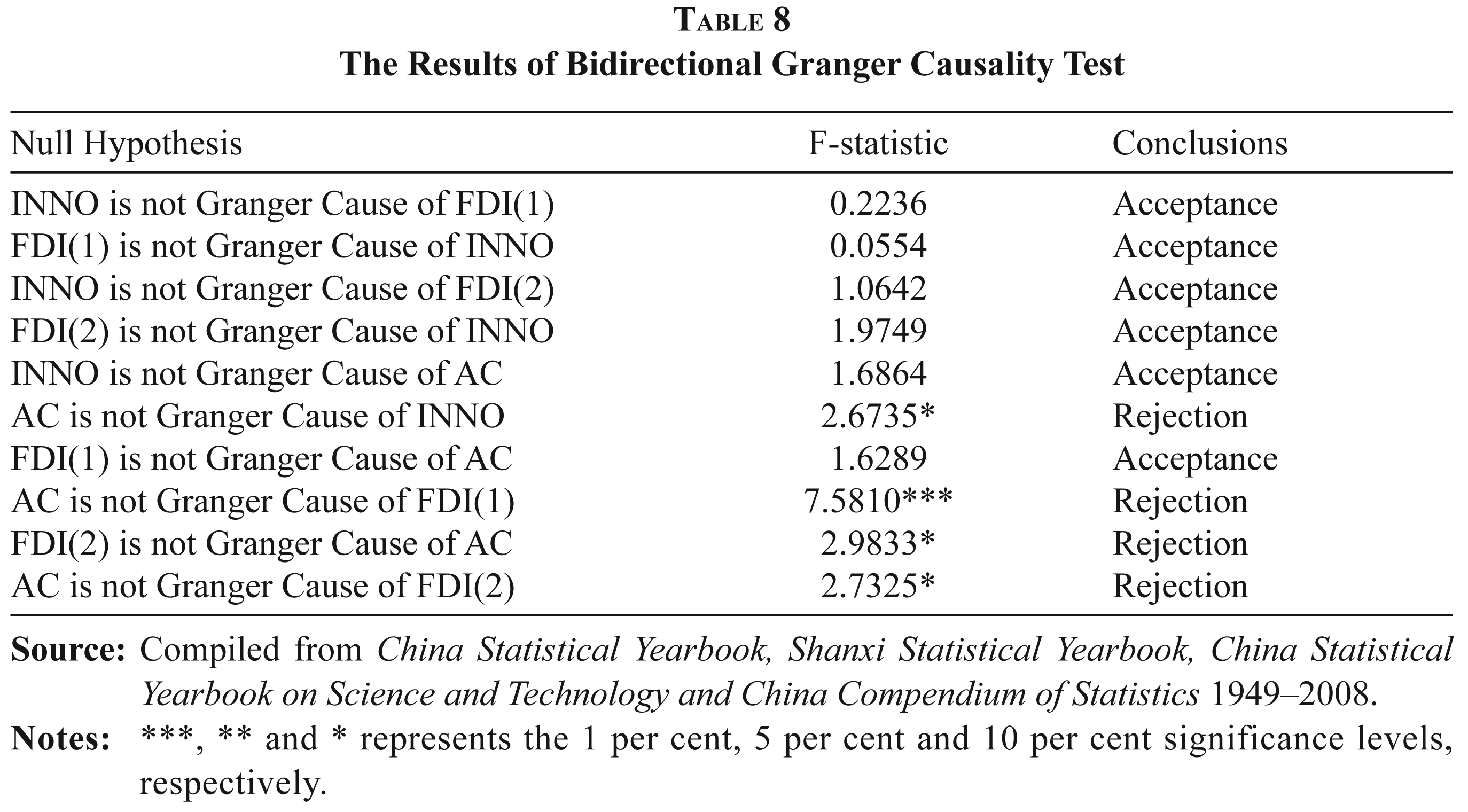
Based on the test results, it is observed that the self-innovation capacity is not Granger cause of FDI technology spillover effect, and the latter is not Granger cause of the former as well. Theoretically, FDI can bring advanced technology and its technology spillover can promote the self-innovation capacity, while the realisation of self-innovation in turn forces foreign enterprises to bring more advanced technology, therefore local enterprises can absorb FDI technology spillover effect more efficiently. However, the results do not show significant positive interaction in Shanxi between the above two subjects. This is probably caused by the limited amount of technology carried and the poor supporting innovation conditions.
In terms of the intermediary role of the absorptive capacity, the results demonstrate that the absorptive capacity is the one-way Granger cause of self-innovation capacity, and that the absorptive capacity is the one-way Granger cause of the FDI technology spillover effect. It implies that, in general, Shanxi has the ability to absorb FDI advanced technology, but due to the large technology gap among enterprises and the low level of related factors, the absorptive capacity is weakened. As a result, absorptive capacity fails to play the mediating role in the conduction between FDI technology spillover effect and the self-innovation capacity.
In summary, the fluctuation of statistics results is very big, which may be related to the recalculation of FDI as well as the lack of data on the years of 2012 and 2013.
Conclusions and Suggestions
Based on the theoretical and empirical analysis, the following conclusions are drawn.
There are positive FDI technology spillover effects in Shanxi and the eastern provinces, and the former is weaker than the latter ones. However, the technology spillover does not really promote regional technology progress and independent R&D is still the dominant force for realising technology progress and self-innovation.
The comparison of absorptive capacities in Shanxi and the eastern provinces indicates that, Shanxi has the advantage of certain degree of absorptive capacity, and education, scientific research and local government play obviously fundamental roles. But it shows the disadvantage as well. The influencing factors of absorptive capacity in Shanxi exhibit great difference with that of the eastern provinces and the absorptive capacity fails to play its mediating role.
FDI technology spillover effect does not show significant positive effect on the self-innovation capacity in Shanxi, but even competes and extrudes the human input and capital input of local enterprises. Therefore, there is no benign interaction between them. To promote the self-innovation capacity, Shanxi has to rely on independent R&D. However, there are insufficient government inputs in education and S&T and inadequate support from policy environment and social environment in Shanxi.
Although Shanxi, as a typical inland resource-based area, has prominent advantages, it shows obvious gaps with other provinces as well. To enhance the self-innovation capacity, three suggestions are put forward by means of efficiently absorbing FDI technology spillover effect.
Based on the threshold characteristics of technology gap and considering technology cost and cultural integration, Shanxi has to consider eastern coastal provinces when introducing external technologies, and then formulate preferential policy to introduce foreign technology after accumulating for a period of time, especially paying attention to expand new channels of technology spillover. For example, foreign enterprises can be invited to play dominator role in industry agglomeration and scientific research cluster.
The introducing structure of FDI has to be arranged and treated differently. Specifically, Shanxi has to focus on introducing FDI that can improve production efficiency and core technology of related derivative industry in resource-based industry. For ‘two-high’ industry, the investment degree has to be increased and matching and fusion of the introduced technology and local technology has to be paid more attention.
Finally, Shanxi needs to distinguish the source and quality of foreign technologies, pays attention to conduction effect of regional absorptive capacity and focus on the construction of cooperation mechanism of ‘Government-Industry-University-Research Institutions’. At the same time, to increase education and scientific research fund inputs, the government has to make policy to guide industry agglomeration and scientific research cluster and create a social atmosphere that encourages innovation. Enterprises have to be active in absorbing FDI technology spillover. Education institutions and scientific research institutions have to actively participate in cooperation with foreign enterprises and their R&D alliance, and intensify theoretical research, to improve the conversion rate of scientific research projects and realise industrialisation of innovation.
Footnotes
Acknowledgements
This work was financially supported by the Humanities and Social Science Project in Colleges and Universities of Shanxi Province (PSSR) (A research on the interaction mechanism of Shanxi’s industrial restructuring and technological innovation, No. 2013322) and the Soft Science Project of Shanxi Province (FDI technology spillover effect and Shanxi’s innovation: A comparative study with the Chinese eastern, No. 2013041037-02).