



Abstract
This study intends to demonstrate whether firms’ cooperative activities, particularly ‘coopetition’, affect business performances. Coopetition, which is cooperation with competitors, is a strategic concept that suggests competition and cooperation between firms can exist simultaneously. More specifically, in order to investigate cooperation as a part of innovation mechanism, this study analysed the mediating effects of product and process innovation performances in between cooperative activities and management performances. For this purpose, we applied a structural equation model (SEM) by integrating a regression model and a logistic regression model. The former analysed the effects of cooperation and innovation on management performances, whereas the latter studied influence of cooperation on innovation performances. For empirical analysis, we utilised data from Korea Innovation Survey (KIS), which incorporates information on Korean firm’s innovation activities and their relevant performances. The results from this study can be applied to addressing and diagnosing issues in Korean industries by analysing relationships among cooperative activities, innovation outcomes and management performances in the structural context.
The analysis showed that coopetition, compared to other types of cooperation, has enhanced the performance of process innovation. Furthermore, the analysis demonstrated that cooperation related positively to management performances. This study, however, also addresses the problem that Korean firms have limitations in linking these innovation performances to actual management performances of financial growth. The results highlight the significance of strategic openness and flexibility, even to competitors, as the business environment and technology market may change drastically. Coopetition strategy can work as a facilitator in providing windows of opportunity for sustainable growth through field-based innovation.
Keywords
Introduction
A
According to the transaction cost theory, vertically integrated firms appear as a result of internalising transactions in order to reduce the cost of transactions. However, increased complexities of technology and markets lead to an environment of high uncertainty. A vertical structure may be insufficient for properly responding to such market changes, and therefore, firms will need to cooperate to survive and prosper. To overcome this limitation, firms may seek new opportunities for knowledge creation and innovation through cooperative activities. Organic cooperative activities promote competitive advantages such as reducing transaction costs, improving flexibility and can eventually affecting management performances.
However, not all cooperative activities affect management performances in a positive fashion. The outcomes can vary significantly depending on many factors, including the size of the firm, organisational capabilities, types of partners, and so on (Belderbos, Carree, & Lokshin, 2004). This study focuses on external factors affecting firms, rather than on internal corporate capacity. By analysing the characteristics in selection of cooperative partners by various firms, we aim to understand their impacts on business performances represented by innovation performances and management performances. Especially, as the environment surrounding business and technology undergoes drastic changes, the scope of cooperative activities has broadened to encompass various types of firms that may have been previously considered to be competitors. In this sense, this study aims to address the following question:
Do cooperative activities, especially with competitors, enhance corporate business performances such as innovation and management performances?
In order to answer this question, this study attempts to show empirically how cooperative activities affect business performances. More specifically, we examine the relationship between cooperative activities, especially by competing firms, and their related business performances. This study divides the business performances into two categories: innovation performances and management performances. The former refers to product and process innovation, whereas the latter refers to corporate financial output, like total revenue. This research also analyses the mediating effects of innovation performances in between cooperative activities and management performances, in the context of a structural equation model (SEM). By doing so, we can analyse cooperation as part of an innovation mechanism, which affects management performances.
Related Works on Cooperation
Purpose of Firm’s Cooperation
Firms can achieve economies of scope as well as economies of scale through cooperation. The purpose of cooperation between firms includes increased profitability, higher market share and knowledge by sharing mutually complementary resources and core competencies (Hagedoorn, 1993). Particularly, start-ups pursue establishing various forms of business networks or cooperative relationships, in order to address difficulties faced by new entrants in the market (Baum, Calabrese, & Silverman, 2000). The purpose of cooperation is divided into four categories.
First, motivation for cooperation is to secure the necessary resources and achieve cost savings. It is difficult to secure all necessary information, capital and human resources to cope with changes in the market environment. In general, small and medium-sized enterprises (SMEs) have difficulties in procuring operating funds for product manufacturing. At the same time, large companies have limits in securing large amounts of capital to fulfil their own R&D activities in order to develop new products to take the initiative in the market. Second, firms cooperate with others to check their opponents, like rival firms. As the global economy has developed, competition between individual companies has shifted to competition between groups of businesses with ties to firms producing end products (Iansiti & Levien, 2004). Therefore, close cooperation between firms within a vertical structure is important to checking their competing business group. Third, firms cooperate for the purposes of risk management in order to alleviate uncertainty caused by the volatile market environment. The emergence of new technologies and convergence between existing technologies shorten product life cycle, which in turn increases market volatility and complexity. Therefore, in order to predict and handle changes in the market environment, firms should preemptively respond to R&D investments and market competition simultaneously. In this type of business environment, firms can utilise cooperation as to prepare for technological and capital risks (Silipo & Weiss, 2005). Finally, firms utilise cooperation in order to intensify technological innovation and absorptive capability. Through cooperation with other firms, a firm can acquire external knowledge and build up absorptive capacity for innovation to expect long-term effects (Chen, Lin, & Chang, 2009; Cohen & Levinthal, 1990).
Cooperation Types and Effects on Innovation
In order to secure a competitive advantage, firms should efficiently acquire and utilise technological knowledge. There are three sources for gaining such technological knowledge (Cohen & Levinthal, 1990). Other than internally generated knowledge, firms have to acquire such knowledge from competing firms or other research institutions. From the traditional viewpoint, the relationship between firms mainly refers to competition and cooperation through vertical integration (Ilinitch, D’Aveni, & Lewin, 1996). For example, strategic alliance and joint R&D are typical types of relationships between firms. In the past, the more cooperative firms are, the more vertical relationships are formed. The more competitive firms are, the more horizontal relationships are formed. Furthermore, firms seek inter-industrial alliances, when they emphasise cooperation, whereas they seek internal alliances when they regard competition is important (Yoshino & Rangan, 1995). As the necessity of R&D has become more significant, firms tend to be more active in building alliances. As firms spend higher costs on R&D, they capitalise more on technological resources for innovation and stronger absorptive capacity (Miotti & Sachwald, 2003). Firms focusing on process innovation in low technology and service sector tend to conduct innovation independently. New-to-market firms in high technology and service sector, however, tend to be more cooperative in R&D with external partners. This enables them to accomplish better outcomes. In other words, the focus and motivations of a firm determine the degree of cooperation for innovation (Tether, 2002). The level of cooperation in critical corporate activities, like marketing, is a significant factor for improving innovation performance other than acquiring technological knowledge directly (Lu & Yang, 2004). These types of cooperation tend to be formed within the same industrial sectors or between vertically integrated firms.
‘Coopetition’ is a business concept that arises from further advancement of cooperation and refers to a state where competition and cooperation between firms simultaneously exist in balance (Nalebuff & Brandenburger, 1997). The concept of coopetition that is especially meaningful in the relationship between competing firms within identical or similar technology/industry fields can evolve to cooperation towards achieving a common goal. This concept presents ways to mutually complement limited resources or capacities that the focal firm lacks, providing opportunities for them to gain competitive advantages (Ritala, Golnam, & Wegmann, 2014).
Regarding the relationship between cooperation and innovation, cooperation among firms is known to affect innovation performances, which can be categorised into product innovation and process innovation. Product innovation refers to the production of a new product, which did not exist before, through technological innovation or improving performance of the existing products. Process innovation refers to improving efficiency by applying innovative techniques and methods to manufacturing processes (Chen et al., 2009). As mentioned earlier, we establish Hypothesis 1 (
Cooperation and Mediating Role of Innovation
Firms actively engage in technological cooperation with external entities due to limitations in internal resources as well as potential improvements in efficiency. Cooperative partnership between firms can result in successful innovation performances. Furthermore, cooperation strengthens the absorptive capacity to acquire external knowledge, which can eventually improve business performances (Cohen & Levinthal, 1990). In general, the more innovative the firm and the larger the firm size, the greater the number of cooperative partnerships that is accomplished. In other words, there is a positive correlation between R&D cooperation and profitability (Belderbos et al., 2004; Hagedoorn & Schakenraad, 1994; Mitchell & Singh, 1996). Belderbos et al. (2004) divided R&D partners into competitors, suppliers, customers, universities and research institutions, in order to analyse impacts on innovation and management performances in community innovation survey (CIS) data. The study showed that cooperation with competitors and suppliers affected increase in innovative activities and improvement of productivity, while cooperation with universities and competitors affected revenue increases. This study applied growth value added, which utilises labour productivity growth and innovative sales productivity growth, in order to examine management performances (Belderbos et al., 2004). Additionally, profitability rates, like return on investment (ROI), are used to assess firms’ growth patterns (Calatone & Zhao, 2000). In the case of venture firms, corporate survival rate is used as the ultimate indicator of performance (Mitchell & Singh, 1996).
However, it cannot be assumed that cooperative activities of firms directly affect the improvement of management performances. Rather, various studies point towards firms achieving innovation (product innovation, process innovation, etc.) through cooperation, thereby affecting management performances (financial performances). As innovative products are more appealing to customers, they help secure competitive advantage (Oke, Burke, & Myers, 2007), leading to innovative outcomes and ultimately higher profits (Camisón & López, 2010). Inauen and Schenker-Wicki (2011) utilised product innovation, process innovation and revenue of new products, as innovation-related performances that stem from external innovation. External cooperative parties, which can influence innovation performances, were divided into consumer suppliers, competitors, firms in other industries, consulting firms and academia. This research studied the effect of innovation in-flowing from each agent on innovation outcomes. Ikeuchi and Okamuro (2013) defined innovation outcome as the output from a start-up company through innovation and incorporated the notion of developing new products and introducing new processes. Particularly, they defined innovation performance as a mediator for firms to accomplish business performance. The empirical study utilised productivity and profitability as indicators for the corporate final business performances.
We pay attention to these previous works showing that firms achieve innovation performances through cooperation with various partners, including competitors, and such innovation eventually affects management performances. More specifically, this study presumes that innovation should be understood as a mediating factor between cooperative activities and management performances. Based on earlier considerations, this study establishes Hypotheses 2 (
Methodology
Research Design
This study mainly focuses on the cooperation among various factors that affect business performances. To this end, we reviewed existing studies on characteristics and motivations that affect cooperation. This study also considered related works on the issues by cooperation types and relevant partners. Considering these previous works, it was determined that this study includes an analytical framework that would be vital for research with systemic and logical flows to incorporate factors regarding the notions of cooperation and performances. Furthermore, based on the existing research, we constructed an overall structure between the factors focused on cooperative activities as follows: ‘corporate organisational characteristics’ → ‘motivation of cooperative activities’ → ‘cooperative activities’ → ‘innovation and management performances’.
In particular, when we pay attention to the effects of cooperation, it is possible to set an analytical framework to study the effects of cooperative activities on innovation and management performances. We intend to analyse dynamics of cooperation scientifically and to investigate their characteristics. Furthermore, this empirical research reflects the concept of coopetition that scholars in business and administration fields have recently focused on. This type of cooperative activity is also related to the issue of partner selection. In this sense, this article diagnoses the extent to which cooperation partners, including competitors, affect business performances. Through this diagnosis, we can suggest strategic directions for business practitioners as well as governmental directions for policymakers. To this end, first, this study analyses the effects of firms’ cooperative activities, particularly with competitors, on innovation performances (
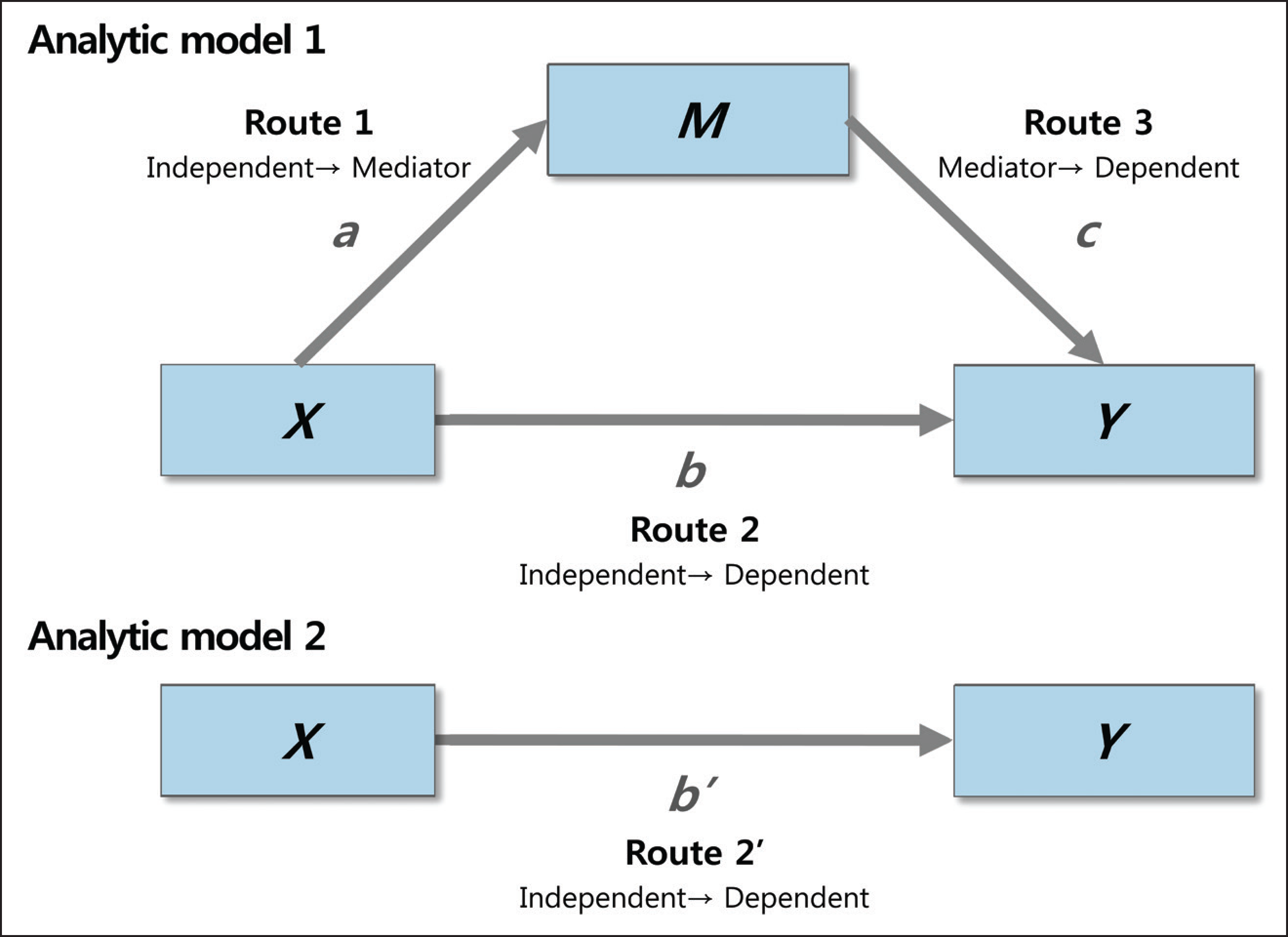
When following the BK approach, we intend to examine a partial mediating effect of innovation factors. This effect should satisfy the following conditions:



The standardised beta, b, in Step 3, should be smaller than b’ in Step 2.
When we apply SEM to this study, Figure 2 describes the overall empirical research structure reflecting the partial mediating effect in SEM. In this model, total effect is decomposed into direct and indirect effects. The former is associated with the concept that a part of the exposure effect is not mediated by a given set of potential mediators. In the case of our research model, this corresponds to cooperation’s effects on management performances. The latter, meanwhile, relates to the concept that a part of the exposure effect is mediated by a given set of potential mediators. In our model, this corresponds to the cooperation’s effect on management performance mediated by innovation performances. In this sense, we can demonstrate that there is an indirect or mediating effect when two conditional relationships, such as the effect of cooperation on management performances and the effect of innovations on management performances, occur simultaneously.
Regarding the analytical structure, first, this study sets the factor of cooperation partners as the cooperative activities among motivations of cooperation and ways of decision-making, which is defined as one of the representative motivations and characteristics of cooperation. Second, this article conducts an empirical analysis on how cooperation affects management performances, the ultimate goal of business management. This study sets total revenue, represented by financial growth, as the management performance. Third, cooperation among firms makes primary changes in innovation performances by inevitably diverting the strategic behaviour. We then assume that innovation performances eventually affect management performances. This is based on the proposition that innovation performances act as a factor affecting management performances. Accordingly, innovation and management performances have a causal relationship, unlike popular perception of the two concepts being on equal terms. In this context, this study develops a sequential linkage structure as follows: ‘Cooperative activities’ → ‘Innovation performances’ → ‘Management performances’. In summary, the analytical structure used in this study is that cooperative activities affect innovation performances, which subsequently leads innovation to affect management performances, as shown in Figure 2. Additionally, this article operationally defines ‘business performances’, the effects caused by cooperative activities, encompassing ‘management performances’ and ‘innovation performances’. These two concepts are highlighted in Figure 2.

Regarding the methodology, this study uses regression analysis because it is a basic research structure for analysis of causal effect. Especially, it is crucial to identify whether innovation performances act as a mediator between cooperative activities and management performances. When applying the regression model, the following two methodological issues are raised. First, to test
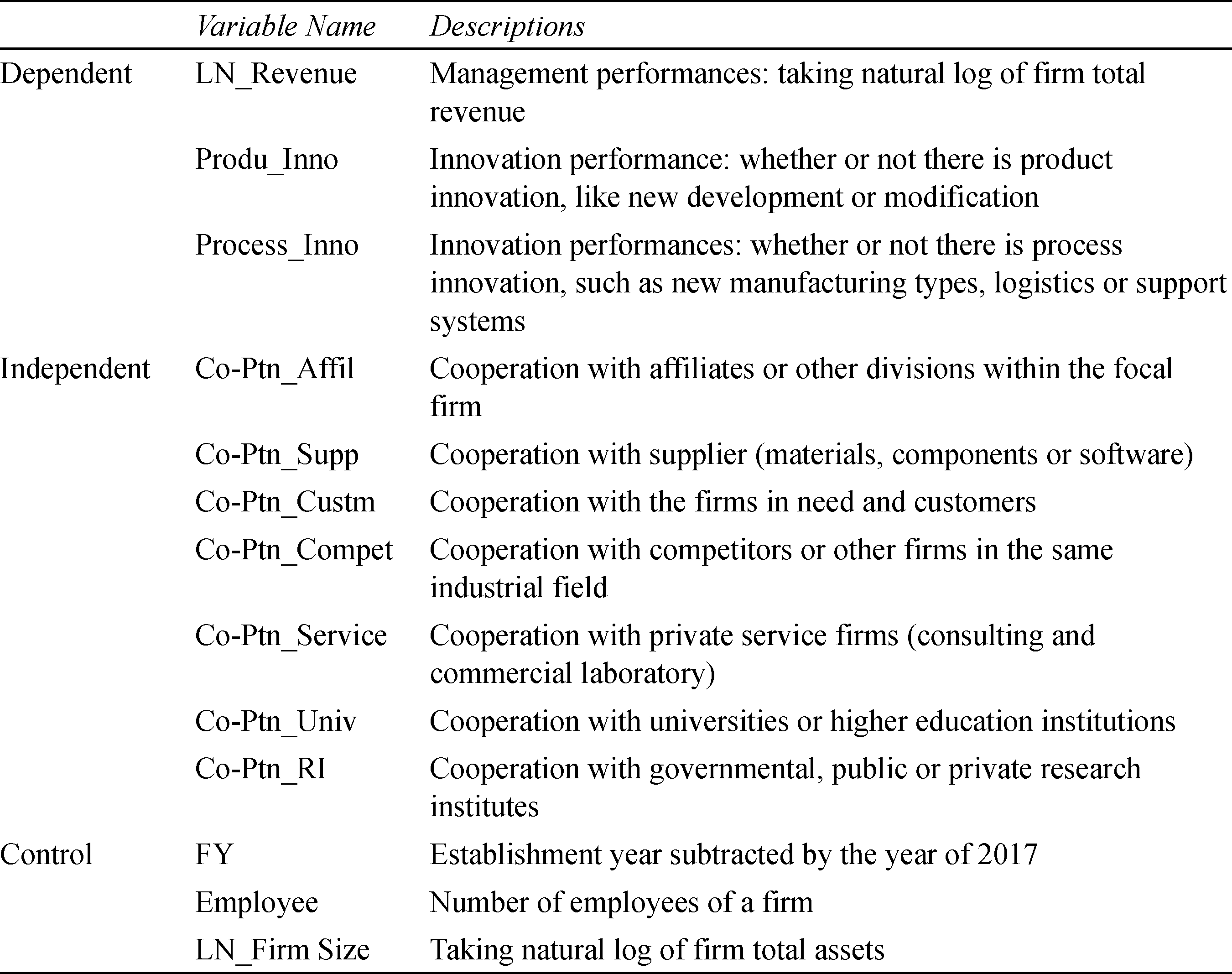
In summary, this study adopts a SEM of regression-oriented BK approach in order to examine cooperation’s direct effect on management performances and innovation’s mediating effects on management performances. With regard to the detailed regression model, this study applies the structural equation analysis that integrates multiple regression models and logistic regression models. Two models commonly utilise the pooled regression datasets that incorporate information on cooperation partners, innovation performances and management performances. This structural equation enables us to understand to what extent innovation performances play a mediating role in identifying the effects of the type of cooperation partner firms on management performances. With regard to the operational definition of each variable used in our analysis, Table 1 provides a summarised description of each variable. Particularly, the independent variable of ‘Co-Ptn_Compet’ is used in this study as the factor of ‘coopetition’.
Explanations on the Variables for the Analysis
Data Collection
The Science and Technology Policy Institute (STEPI), a policy research institute under the Prime Minister’s office, engages in Korea Innovation Survey (KIS) for manufacturing and service industries, based on OECD’s Oslo Manual. Like the KIS, community innovation survey (CIS) of the European Union (EU) is also a large-scale innovation survey based on the Oslo Manual. CIS consists of three dimensions: innovation enablers, innovation activities and innovation performances. Facilitating the condition of innovation includes human resources, capital and government aid. Innovation activities consist of enterprise activities, such as business investment, open innovation and entrepreneurship. Lastly, CIS conducts investigations on economic effects such as the number of firms, employment, trade and sales to measure innovation performances. The subjects of studies that utilise CIS data are diverse, including research on the relationship between cooperation with external partners and innovation performance, by extension, with business performances. Other studies focus on decision factors of R&D cooperation (Bayona, Garcia-Marco, & Huerta, 2001; Cassiman & Veugelers, 2002; Lopez, 2008). In the same context, KIS has similar surveys and data structure, and thus, it can be considered an appropriate analogue data for empirical analysis incorporating cooperative ties.
STEPI conducts KIS targeting manufacturing and service sectors separately every other year. Out of these surveys, this study collected and utilised data in manufacturing industry because this sector shows more typical industrial characteristics than the service sector. By doing so, we expect to investigate more general patterns of relations among cooperative activity types and business performances. As the unique statistical indicator related to corporate innovation in Korea, KIS has strengths in that input elements and performance elements of innovation activities are linked. For this study, we utilised the following three KIS datasets in the manufacturing sector: (a) KIS from 2012 (innovation activities between 2009 and 2011); (b) KIS from 2014 (innovation activities between 2011 and 2013 and (c) KIS from 2016 (innovation activities between 2013 and 2015). In aggregate, these datasets contain data from 12,161 firms.
Additionally, we integrated these datasets with financial database for corresponding firms and periods incorporated in the KIS datasets. Financial data is one of the most representative indicators of management performances, which is available from Korean financial supervisory services. Through this process of data integration, we crosschecked the datasets between KIS and financial information. After data processing, we eventually used data from 1,679 firms for empirical analysis.
Results
Descriptive Statistics
The descriptive statistics of variables used in this analysis can be summarised as shown in Table 2. Data from 1,679 firms were used in this analysis. Financial performance variables of total revenue or firm size variables of total assets have been normalised by taking their natural logs (see Table 2).
Descriptive Statistics of the Variables for the Analyses

Out of all data, 544 firms that experienced cooperation were subject to this analysis, and these firms are mainly in the manufacturing sector. In addition, 279 firms answered that they have experienced cooperative activities with rival firms, and 96 per cent of these firms are concentrated in the manufacturing sector. In terms of overall manufacturing sector firms in this analysis, 265 firms (16.28%) have experienced cooperation with competitors (see Figure 3).

Structural Equation Analysis
In this section, we test the hypotheses by utilising the regression-based BK approach, which examines the mediating role of innovation performances. To this end, SEM analysis is carried out in the following three steps: (a)
1. Hypothesis 1: the effect of cooperative activity on innovation performances
We analysed the causal effect between cooperative activities and innovation performances. We tested
Test of Hypothesis 1–1: Effect of Cooperative Activity on Product Innovation
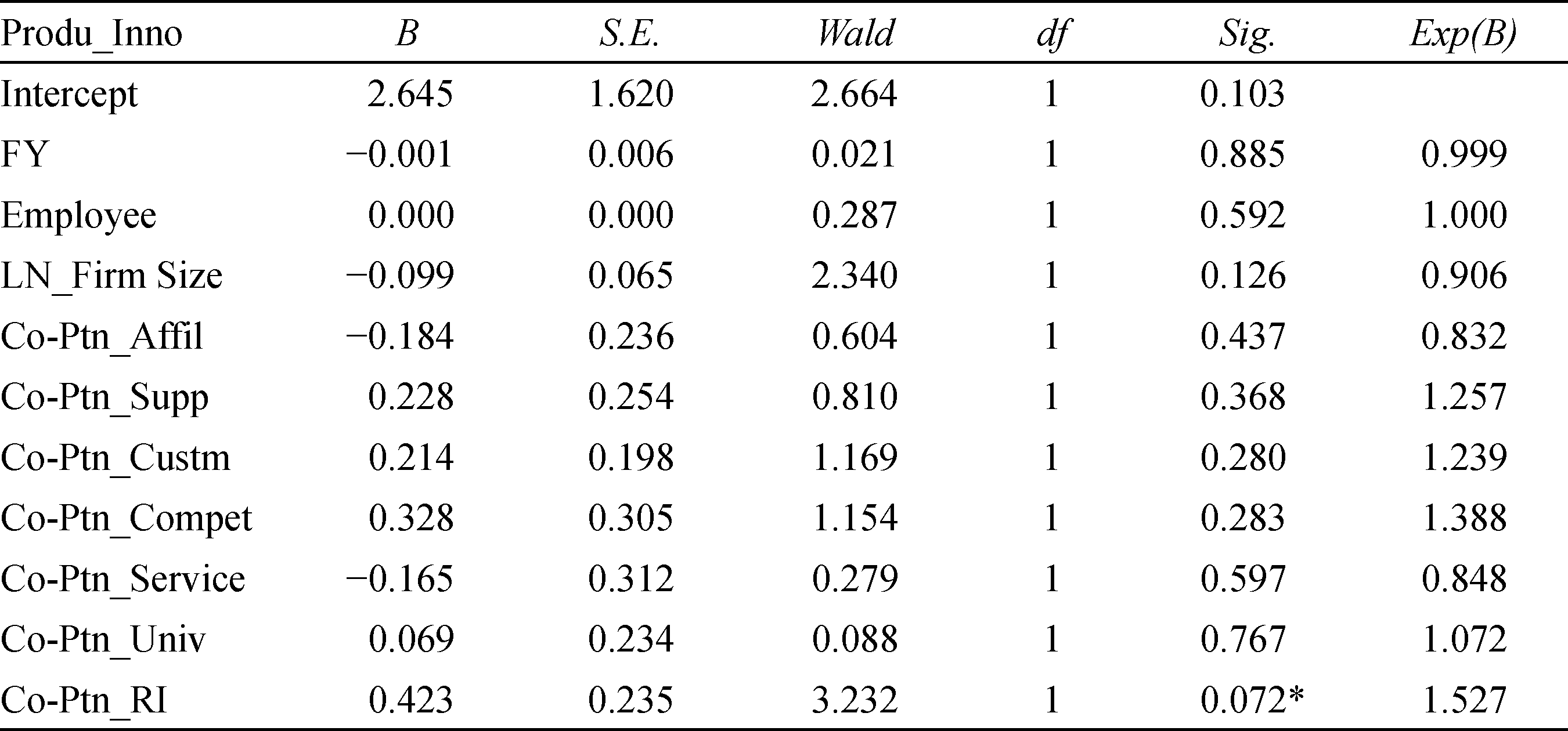
Second, with regard to
Test of Hypothesis 1–2: Effect of Cooperative Activity on Process Innovation
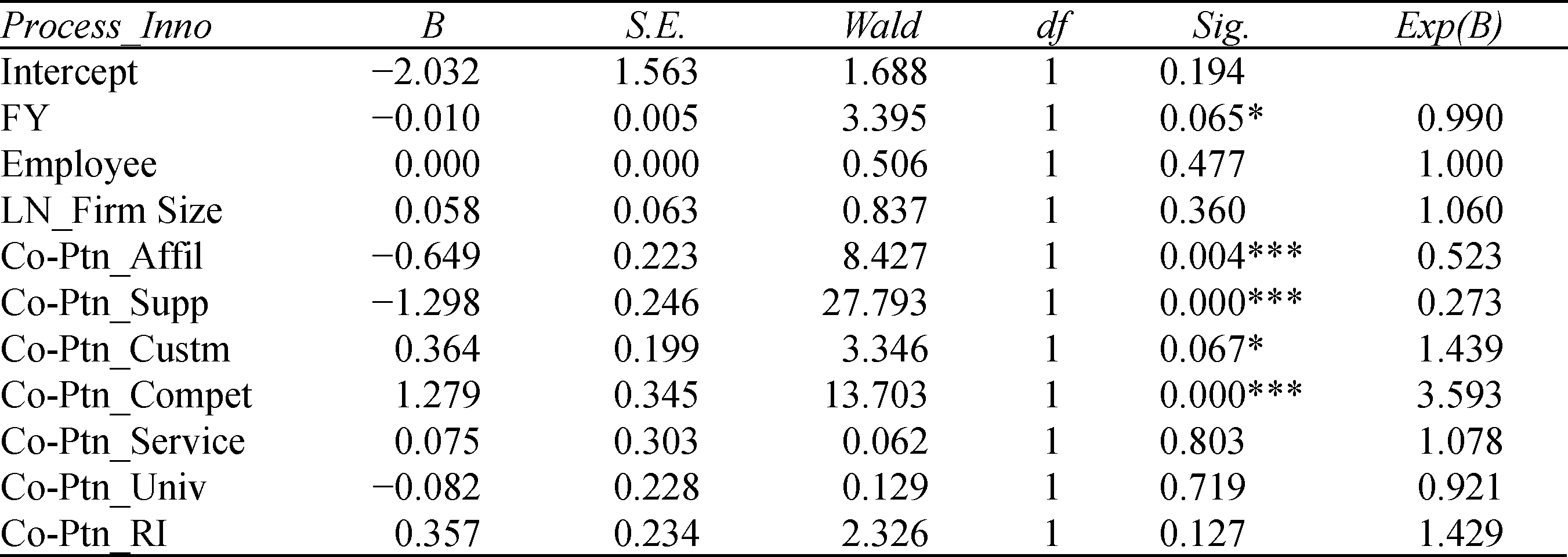
When summarising the results of the hypothesis tests,
2. Hypothesis 2: the effect of cooperative activity on management performances
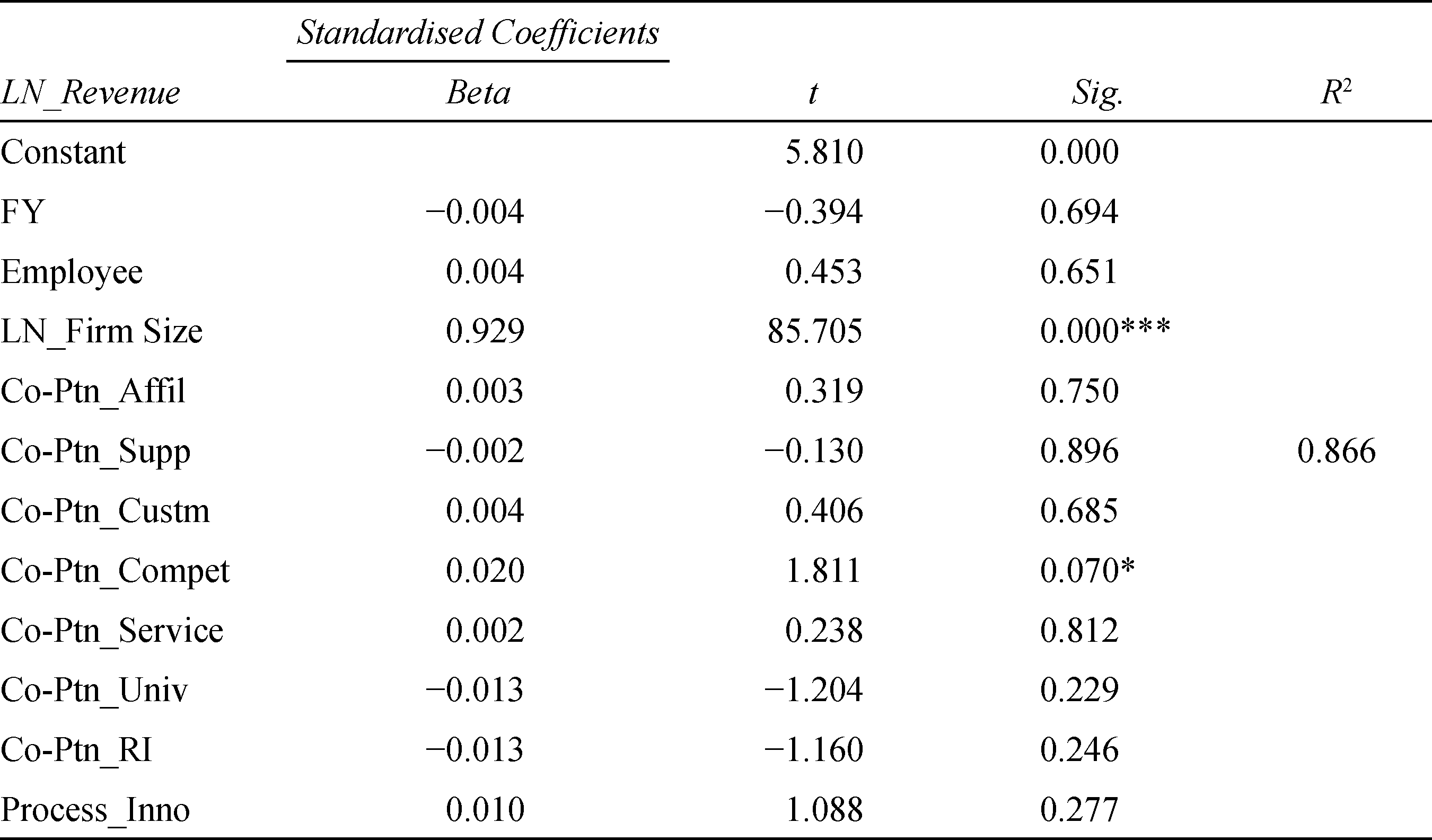
We analysed the direct effect between the independent variables of cooperative activities and the dependent variable of management performances. Cooperation with rival firms has positive effects on management performances (B = 0.020, Significance = 0.070). However, other cooperation-related variables showed no statistically significant relationships with dependent variables (see Table 5). Therefore, these results indicate that
Test of Hypothesis 2–1: Effect of Cooperative Activity on Total Revenue

From the hypothesis test,
3. Hypothesis 3: the effect of cooperative activity and innovation performances on management performances
In this step, we analysed the direct effect of coopetitive activities on management performances and indirect effect of innovation on management performances, simultaneously. As mentioned earlier, innovation performances in this study are divided into two: product innovation and process innovation. Thus, we set Hypothesis 3–1 and Hypothesis 3–2, according to the innovation performance variables. First,
Test of Hypothesis 3-1: Effect of Cooperative Activity and Product Innovation on Total Revenue

Second,
Summarising the results from the hypothesis tests,
Test of Hypothesis 3-2: Effect of Cooperative Activity and Process Innovation on Total Revenue
Discussion and Conclusion
This study aimed to reveal whether coopetition, which means cooperation with competitors, affects business performances, like innovation and management performances. More specifically, in order to scrutinise cooperation in relationship with innovation, this study attempted to verify empirically a mediating role of product and process innovations between coopetitive activities and management performances, as measured by total revenue. To this end, we applied and utilised the SEM by integrating logistic regression and multiple regression models. The former analysed the effect of cooperation on innovation performances, while the latter analysed the effect of cooperation and innovation on management performances. Summarising the analytical results, cooperative activities, especially coopetition, certainly had a directly positive impact on management performances. Furthermore, we showed that a strong relationship exists with innovation performances, specifically process innovation. However, we could not find indirect effects exist in the structural model, suggesting that innovation performances did not link to management performances. Therefore, this study empirically demonstrated that management performances of Korean firms are determined by direct factors, like cooperation, rather than mediating factors, like innovation performances. Through empirical analyses, this study leads to several implications for corporate strategy in technology management by diagnosing the characteristics of Korean firms’ cooperative activities.
First, the analysis showed that Korean firms’ cooperative activities with competitors affected business performances. More specifically, some cooperative activities positively affected not only innovation performances but also management performances. In particular, the cooperation with rivals led to positive impacts on innovation performances involved with firms in production operation, as well as logistics and supplier network, as represented by process innovation. In the same context, a previous study showed that cooperation with competitors affects incremental innovation and productivity improvement. In addition, cooperation with universities and competitors influenced revenue increase (Belderbos et al., 2004). Our findings are consistent with the results of the existing research. Our empirical study showed that the coopetitive activities of Korean firms have a significant effect on process innovation and total revenue increase. In other words, coopetition contributes to the focal firm’s incremental innovation performance, which then associates with new manufacturing types and a relevant support system. Process innovation strongly tends to be formed through accumulation of implicit or tacit knowledge, like the know-how and field experiences (Foray & Lundvall, 1998; Nonaka & Takeuchi, 1995). Thus, we conclude that Korean firms’ coopetitive activities have enhanced field-based innovation that demands manufacturing skills and relevant technological capabilities.
Second, contrary to common expectations, cooperative activities with affiliates and suppliers had a negative effect on process innovation performances in the empirical analysis. The results of our study, in some way, may not be consistent with the existing research on this topic. A previous study exhibited that cooperation with suppliers focused on incremental innovation leads to improvement of productivity (Belderbos et al., 2004). However, empirical results in our study suggest that in-house or vertical cooperation negatively affected innovation performances. Furthermore, these factors had no meaningful relationships to revenue increase. Business organisations inherently have a propensity of path dependency. In this sense, there is no doubt that firms are usually familiar in cooperating with accustomed and controllable business partners or a closed type of cooperation, like the vertical integration. Nevertheless, our analysis suggests that changes in existing cooperative strategy of organisational inertia may be required (Amburgey, Kelly, & Barnett, 1993). Korean firms, similar to the firms in other countries, prefer cooperation as a form of vertical integration structure. The focus of partner selection, mainly with existing suppliers and internal affiliates, needs to be transformed to more external, loosely coupled links. Through this open innovation strategy, firms can take opportunities to expand beyond their immediate current business areas and research subjects, generating unexpected innovations that could lead to financial growth. Additionally, while it may seem counterintuitive and paradoxical, firms need to be open-minded about cooperating with external partners, like new suppliers or buyers, and sometimes even with competitors, as the business environment changes drastically. To achieve this state, firms need to seek partners to complement technological resources and capabilities insufficient on their own. Furthermore, continuous efforts are necessary to grasp trends in the industrial and technological markets, along with collection of relevant information for decision-making. Our study contributes to further developing previous research, as it provides windows of opportunity for strategic technology management decisions regarding the issue of open innovation.
Third, this study attempted to discover mediating effects of innovation performances between cooperative activities and management performances. Certainly, there was a positive relationship between coopetition and management performances as the independent variable had a direct effect on the dependent variable. However, this study had its limitations in identifying whether innovation performances have taken mediator’s or linker’s role in the SEM. Reversely, this result is meaningful; in that, it addresses and points out the problem of Korean industrial structure from a diagnostic viewpoint. Based on analytical results, this study can diagnose that inter-firm cooperation in the case of Korean firms may enhance innovation outputs; however, there was a limit in innovation outputs leading to business performances. We can conclude that cooperative activities with rivals by Korean firms mainly affect financial performances, but innovation performances resulting from cooperative activities do not relate to management performances as characterised by financial outcomes. These results address the managerial side of the issue that even though Korean firms’ cooperative activities may strengthen internal competencies (process innovation), they still have limitations in converting these improved capabilities into substantial profits. This may be due to the general structural problems of Korean industries, which are dependent on in-house or closed innovation strategies. Therefore, managerial board members and staffs should establish a technology management strategy focusing on how to capitalise innovation outputs to actual profits. From the results of this analysis, we suggest companies to pursue a more productive managerial pathway, linking innovation performances to financial growths. Diversification of external partnership strengthening cooperation with various parties such as universities, consumers and even with competitors can be a possible solution to this problem.
This study suggests a more constructive attitude towards the cooperative activities with rivals towards the goal of establishing production and logistics system to generate better business performances. By providing an impetus for field-based innovation, the coopetition strategy can be a catalyst for sustainable improvement in future business performances.
Footnotes
Declaration of conflicting interests
The authors declared no potential conflicts of interest with respect to the research, authorship and/or publication of this article.
Funding
The authors received no financial support for the research, authorship and/or publication of this article.
Acknowledgements
The main idea of this study is based on the national project of ‘Year 2017 Korea Innovation Survey: Manufacturing and Service Industry’. We send thanks to Heejong Kang at STEPI, who is in charge of KIS data processing and analysis for his help with the data used in this study. We also send thanks to the project team leader, Kawon Cho at STEPI, who supported the funding for this research. The analysis using a structural equation model was verified by quantitative expert Seungbeom Suh at Korea Advanced Institute of Science and Technology (KAIST), and we deeply appreciate his efforts.