




Abstract
The present study investigated the effects of communication styles, source expertise, and audiences’ preexisting attitudes in the contexts of the debate regarding genetically modified organisms. A between-subject experiment (N = 416) was conducted manipulating communication styles (aggressive vs. polite) and the expertise of the communicator (scientist vs. nonscientist) in blog articles. The results showed significant effects of communicator expertise and individuals’ preexisting attitudes on writer likability and message quality, depending on the communication style used. Expectancy violation was found as a significant mediator that explains the differences. These findings provided a plausible explanation for the way in which communication styles work in science communication contexts and offered practical implications for science communicators to communicate more strategically.
Keywords
The use of genetically modified organisms (GMOs) is a controversial topic in the United States. A recent survey from the Pew Research Center shows that only 37% of U.S. adults think that food made from GMOs is safe to consume. Moreover, more than half (67%) of adults believe that scientists do not fully understand the health consequences of GMO products (Funk & Rainie, 2015). In contrast, 88% of the members of the American Association for the Advancement of Science—a leading scientific society and publisher of the journal Science—believe that GMO foods are safe for consumption. A range of genetically modified crops is grown in the United States, with regulatory approval based on a range of health and environmental safety assessments (Fernandez-Cornejo, Wechsler, Livingston, & Mitchell, 2014; National Research Council, 2010). The misalignment between public opinion and mainstream scientific opinion (e.g., etc Group, 2016; Greenpeace, 2016) provided a test ground for our research interest in exploring what kind of roles communication styles play in the debate on controversial topics such as GMOs.
One commonly used communication style by science communicators is to denounce those who refuse to accept the scientific facts on issues such as GMO product use, climate change, and vaccinations (Hiltzik, 2015; Romm, 2012). Although there are no statistics showing how often different communication styles are used when people talk about GMOs, a quick browse of Internet content on the issue exposes one to a large number of aggressive arguments (e.g., Sarich, 2015; Schewitz, 2014). Another example would be environmental activist organizations such as Greenpeace (Derville, 2005). Although researchers have examined communication styles in other contexts such as political communication or classroom communication, the objectives of communication are very different, and therefore, the effects may be different as well. It is worth knowing whether and what kind of role communication style plays in science communication with consideration of other communication factors. Moreover, the research sees the choice to focus on delivering persuasive scientific message as strategic communication behavior. Previous behavioral research such as theory of planned behavior (TPB; Ajzen, 1991) or integrative model for behavioral prediction (Fishbein, 2009; Fishbein & Ajzen, 2011) illustrated the factors that drive planned behaviors, which provided theoretical support for the rationale of investigating factors in the current study and helped improve the predictive power of expectancy violation theory (EVT; Burgoon & Hale, 1988).
All told, the present research focuses on assessing the potential effects of an aggressive communication style, as well as the opposite—of a polite communication style on recipients’ attitudes toward GMOs. The findings of this study contribute to the theoretical and empirical conceptualization of communication styles in strategic science communication. We aim to boost the theoretical integration of literatures on communication styles and other communication perspectives, such as those of source and receiver (McGuire, Rick, & Atkin, 2001), which will contribute to a better understanding of individuals’ expectations in the decision-making process.
Literature Review
Several researchers have investigated the effects of communication styles in the context of science communication. We provide a brief review of the literature on communication styles, specifically on aggressive and polite communication styles, and summarize the literature on the key concepts that underpin the present study. We organize the literature section by introducing all the concepts and factors first and then propose the hypotheses and research questions that explain the paths of the conceptual model.
Communication Styles
A communication style is defined as “the characteristic way a person sends verbal, paraverbal, and nonverbal signals in social interactions” (de Vries, Bakker-Pieper, Siberg, van Gameren, & Vlug, 2009). Although communication style is often discussed in interpersonal communication settings, these studies have shown that a communicator’s style would influence the effects of the communication messages (Arnold & Boggs, 1989; Southwell, 2013). Based on the effects found previously, we argue that communication styles can be applied in strategic science communication in order to enhance the positive effects or diminish the negative effects of communication messages, particularly with aggressive and polite styles. Here, we provide a summary of the description and major findings on both aggressive and polite communication styles (see a review of Yuan, Besley, & Ma, 2018).
Aggressive communication can be understood as one specific communication style among a range of potential styles. Previous research has explored this concept along with several similar concepts of aggressive communication, including verbal aggression, incivility, language intensity, and forceful language (Yuan & Besley, 2017). Based on the similar concepts reviewed previously, aggressive communication can be described as a style of language that combines intense language with attacks on a person or persons (Yuan et al., 2018).
In the current study, we argue that communication styles are important tools in science campaign or messages. Conversations generated by these messages, such as in health contexts, are influencing individuals’ attitudes and behaviors (Robbins & Niederdeppe, 2017; Southwell & Yzer, 2007). Several studies have investigated the effects of what we consider aggressive communication on science communication. For example, research on incivility found that using uncivil language in an article about climate change jeopardized the communicator’s credibility (Thorson, Vraga, & Ekdale, 2010). Researchers also examined aggressive communication in political campaign messages, where it is a commonly used strategy to defame the competitors or highlight their weaknesses (Lau, Sigelman, & Rovner, 2007; McNair, 2011). These studies found that aggressive communication could be a double-edged sword in political campaigns. That is, the aggressive communication can damage the trustworthiness of the attacker and not just the trustworthiness of those being attacked (Lau et al., 2007).
Some positive effects of aggressive communication have also been observed, such as an entertaining effect (Mutz & Reeves, 2005), or increasing audience engagement (Brooks & Geer, 2007). Previous research that investigated aggressive communication style in the GMO debate has shown negative effects of aggressive communication style on perceived message quality and writer likability in general (Yuan & Besley, 2017).
The literature on the opposite communication style, polite communication, likewise presents both negative and positive effects. Literature on politeness theory (Brown & Levinson, 1987) illustrates four levels of politeness by reducing face threats from low to high with redress strategies, which generally include two types of tactics: One uses peaceful utterance rather than the intense emotion of aggressive communication, and the other uses closeness rather than an attack on persons. More specifically, in politeness theory, positive face redress refers to using in-group or informal language to present a group-accepted identity, negative face redress refers to attempting to minimize the imposition of an individual’s autonomy, off-record tries to address the issue indirectly, and bold on-record does nothing to reduce the threat (Brown & Levinson, 1987). Therefore, we describe polite communication as a style that uses peaceful language in the attempt to reinforce recipients’ autonomy or build closeness with them. Researchers suggest that using an appropriate level of politeness allows a communicator to be more persuasive and at the same time to build a stronger relationship with an audience (Goldsmith & MacGeorge, 2000). The literature on warm communication, a concept closely related to polite communication, also covers the warm verbal communication tactics used by health care providers. For example, the use of friendly language, such as expressing concern, friendliness, empathy, or compassion, results in the health care providers being perceived as more caring by patients (Arnold & Boggs, 1989); similar positive results have been found with customer service providers as well (Webster & Sundaram, 2009).
Previous research has shown that approaches similar to negative and positive face redress can achieve positive communication effects in different contexts. For example, one advertising message study found that an off-record approach, which means not confronting directly, was perceived more favorably (Pishghadam & Navari, 2012). Similar to negative face redress, collaborative language (e.g., the act of asking permission) was found to be able to enhance patients’ perceptions of personal control and receptivity to the doctor’s message, in contrast to the effect of restrictive language (e.g., the act of demanding; Gerbert et al., 2003). Moreover, similar to positive face redress, verbal behavior such as humor or providing feedback can also enhance immediacy between a teacher and students (Allen, Witt, & Wheeless, 2006). Yet not all studies found positive effects for polite communication; polite messages are often perceived as vague and indirect (Miller, Lane, Deatrick, Young, & Potts, 2007) and jeopardize the power of a speech (Blankenship & Holtgraves, 2005; Erickson, Lind, Johnson, & O’Barr, 1978; Jenkins & Dragojevic, 2011).
The literature on both aggressive and polite communication indicates that exposing audiences to different styles of discourse can have different effects. Previous researchers (Yuan & Besley, 2017; Yuan et al., 2018) have attempted to explain the differences by using EVT. They found expectancy violation to be a significant mediator in the relationship of communication style to both perceived writer likeability and message quality. In the present study, we also consider expectancy violation as a potential mediator. We provide a brief introduction to the theory below.
Expectancy Violation Theory
Expectancy violation theory (Burgoon & Hale, 1988) states that people have expectations of communication behavior and that violation of these expectations lead to changes in attitude and behavioral intention. Specifically, when the expectations of a message recipient are violated, corresponding shifts in the attitude and behavior intention of the recipient occur (Burgoon & Hale, 1988). Expectation is measured as the extent to which the described behavior is appropriate, and expectancy violation is reflected by the deviant that is viewed as unexpected (Burgoon & Walther, 1990). Therefore, violation is measured by the opposite of the perceived expectation toward described behavior. Burgoon and Hale (1988) further explained that audience’s expectancies for a communicator are formed by considering factors such as “communicator characteristics” (e.g., gender, age), “relationship characteristics” (status inequality, degree of acquaintance, etc.), and “context” (situational definition, formality, etc.) (p. 64). Communication styles fall under the factors that affect expectancy formation.
Several studies on styles of science communication have shown that when communication styles violate a receiver’s expectation of the communicator’s style, the receiver perceives the message with lower quality and finds the communicator less likable (Yuan & Besley, 2017; Yuan et al., 2018). These studies employed a mediation model to explain the mechanism of communication style. Starting from the previously examined mediation model outlined above, we attempt to expand our conceptual understanding of this mediation model by adding two important factors to the mediation model: source expertise and preexisting attitude. The conceptual model is presented below (Figure 1). In the following section, we introduce each new factor and propose a series of hypotheses and research questions in detail.
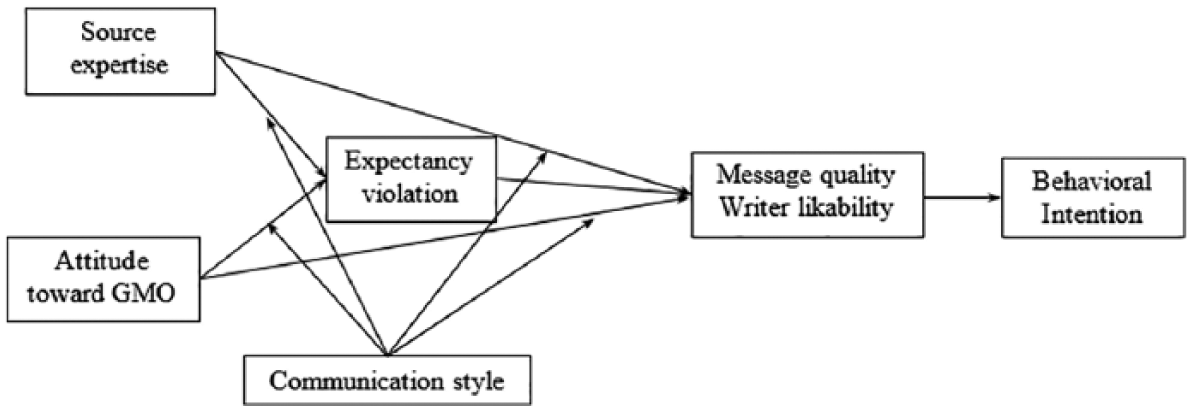
Theoretical model.
Source Expertise
The first factor in our research is source expertise. Source expertise is discussed in both source credibility literature and trustworthiness literature. Based on the definition of expertise from source credibility and the definition of ability from trustworthiness, we define “source expertise” in the present study as the level of skill or knowledge of the communicator individuals perceive. Source expertise is not only theoretically important but also relevant to the context of the present research. First, source expertise is an important component in both EVT and politeness theory. Burgoon and Hale (1988) pointed out that the causes of expectancy violation include status inequality and degree of acquaintance between the communicator and the recipient and context, such as situational definition and formality. EVT provides the theoretical support for how source expertise might influence the relationship between communication style and expectancy violation, but this relationship has not yet been tested in experiments by researchers.
Additionally, politeness theory (Brown & Levinson, 1987) suggests that people may perceive advice differently, depending on their relationship with the communicator. A less powerful speaker who does not have a close relationship with the audience would need to use higher levels of politeness strategy to reduce the level of perceived threat when he or she performs face-threatening acts (Goldsmith & MacGeorge, 2000). In the context of debate on GMOs, status inequality between the communicator and the message recipient is typical. A typical communicator on GMOs is often a scientist who has knowledge related to the discipline. In other words, the communicator often has more knowledge and power than the typical recipient of the message does. Discussions on source expertise are often derived from the classic communication variable source credibility, which still contributes meaningfully to current communication research (for a review, see Pornpitakpan, 2004).
The previous literature has provided consistent evidence that source expertise positively influences persuasion outcomes. A meta-analysis of the effects of source expertise in communication and persuasion research showed that expertise appears to have a stronger effect on persuasion than other source characteristics such as attractiveness (Wilson & Sherrell, 1993). Wilson and Sherrell (1993) explained that expertise is a more straightforward factor for individuals to assess and thus is more often employed in decision making by message recipients. Moreover, researchers in psychology (e.g., Maddux & Rogers, 1980; Wood & Kallgren, 1988) and in advertising (e.g., Braunsberger & Munch, 1998) found that message recipients tend to have more positive attitudes toward sources that have a higher level of expertise.
Attitudes Toward GMOs
In the present study, we argue that individuals’ attitudes toward GMOs would affect their attitudes and behavior intentions after exposure to a persuasive message. Thus, the second factor in the present study is preexisting attitude. In recent years, risk communication scholars have studied the phenomenon called motivated reasoning. Motivated reasoning is described as the tendency of people to make information they encounter to conform their desired conclusions (Kahan, 2015; Kunda, 1990). People who are motivated to be accurate in their beliefs are likely to devote more cognitive effort to defending those beliefs (Kunda, 1990). One study that drew on motivated reasoning also found that an individual’s attitude to politics or partisanship affected his or her support for climate mitigation policies (Hart, & Nisbet, 2011). Therefore, people who strongly agree with a certain political view may be more likely to have stronger reactions to the message being communicated than someone who disagrees. In the context of this study, we argue that individuals who agree with the use of GMOs may have different responses to a message.
Hypotheses and Research Questions
Regarding the persuasion outcomes, we are interested in message quality, writer likability, and behavioral intention. Perceived message quality is the extent to which readers find an argument compelling, believable, and/or convincing. The second outcome of persuasion is the perceived communicator’s likability, which is described as the degree of favorable attitude an audience has toward the communicator (Chaiken, 1980).
The first set of hypotheses tests the interaction effects of source and communication styles, as well as preexisting attitude and communication styles, on two persuasion outcomes. The exploration of the interaction between source expertise and communication style is still limited in this line of research. However, some related discussions provide some guidance for our research question and hypotheses development. For example, Czapiński and Lewicka (1979) found that messages that focus on a negative aspect are more likely to be rejected than are messages that focus on a positive aspect in conditions of low source credibility, while negative messages have higher impacts than positive messages in conditions of high source credibility. Another study on communication style showed that source credibility plays an important role in assertive language—sources with high credibility appear to be more influential than sources with low credibility (Wegner, Wenzlaff, Kerker, & Beattie, 1981). Moreover, Hamilton, Hunter, and Burgoon (1990) stated that language intensity and source credibility interact in producing attitude change when the intensity of language may enhance the effect of high credibility but inhibit the effect of low credibility. High source credibility may contribute more positively to the effect of intense language than low source credibility. Thus, we believe that source expertise may also interact with communication style in the production of attitudes. Therefore, we developed the following research question:
We expect that the effects of preexisting attitude on the persuasive outcomes toward GMOs will be moderated by the communication style in use. Based on previous studies, we predict that, when a person has a negative preexisting attitude toward an issue, he or she may have different expectations for communication styles and have different responses to the perceived message quality and writer likability. Similarly, we have a second research question regarding preexisting attitude:
Another set of research questions we propose is on the interaction effects between communication styles and these two factors, respectively. We have discussed how aggressive or polite message style may violate an individual’s expectations; therefore, we developed the following research questions:
In the next section, we test the mediating effects of expectancy violation on the relationships we proposed previously. EVT not only helps answer the question of how different communicators strategically utilize communication styles when facing different audiences but also why.
Although previous literature has suggested positive effects for both source expertise and attitude on persuasion, these studies have not been examined in conjunction with communication styles. For the purposes of effective communication, we argue that the level of perceived expectancy violation would further shift message receivers’ responses to message quality and writer likability. Based on the aforementioned literature on aggressive and polite communication styles, we predict the following:
Moreover, in the context of the GMO debate, it is important to see to what extent attitudinal outcomes would affect an individual’s intention to purchase genetically modified products. Many previous studies and theories, including TPB (Ajzen, 1991), have demonstrated a positive relationship between an attitude and an individual’s intention to purchase. Thus, in the current study, we also predict that positive attitude toward the message quality and writer likability may lead to a stronger intention to purchase.
Although not specified, a neutral communication style is included in the current study as a control condition that is neither aggressive nor polite. The rationale for having a neutral communication style is to better manipulate communication style so that the aggressive condition would not be mistaken as the impolite or neutral condition, or vice versa.
Method
The present study employed a 3 (aggressive vs. neutral vs. polite) × 2 (expert vs. nonexpert) between-subject factorial design. This experiment was conducted online through Qualtrics with participants from Amazon’s Mechanical Turk (mTurk). A total of 415 participants finished the survey. They ranged in age from 19 to 83 years with an average age of 48 years. Sixty-four percent of the participants were female. The majority of the participants were White (79%), followed by African American (9%), Asian (6%), Hispanic or Latino (4%), and others (2%). More than half of the respondents had received some college education (38%) or a bachelor’s degree (36%). Some had received a master’s degree (11%), and some had received a high school or GED degree (10%). The majority of participants shopped for groceries once to several times per week (82%), and more than half of the respondents sometimes read news about GMOs (63%).
Stimuli
A part of a blog article (Cadaver, 2015) from the Internet (about 480 words) targeted at people who do not believe in GMO products was used as one of the stimuli in the study. The original article (with limited editing) was treated as the aggressive condition. This article was then modified to serve as the neutral condition by removing aggressive elements, such as attacks on specific targets (Infante, 1987). It was further modified into a polite version using approaches from politeness theory focused on respecting the opponent’s autonomy and working toward sharing the same group identity. For example, the title of the original article (aggressive condition) was “Anti-GMO Alarmists Are Misinformed Idiots.” The modified nonaggressive title was “Anti-GMO Skeptics Are Misinformed,” whereas the polite version was “GMO Worriers Have Been Misled.” The profile photo was displayed on the left side of the article along with author information. The same profile photo was used for both expert and nonexpert conditions. The expert was described as “Dr. Alex Johnson, food scientist at a world-renowned university, studying GMOs for over 10 years, father of three,” and the nonexpert was described as “Mr. Alex Johnson, father of three.” Messages were pretested with a text analysis software LIWC. Differences on several LIWC dimensions such as swear words, anger, power, certainty, and positive emotion were observed from the three style conditions. In the aggressive condition, more swear words, anger, power, and other aggressive elements were observed than in the other two conditions. More positive emotion was observed in the polite condition than in the other two conditions.
Procedure
To make sure that the participants were potential audiences of messages on the topic of GMOs, the participants were restricted to individuals who are both readers of science or health news and grocery shoppers. The data were cleaned and filtered before the data analysis. Answers from respondents who failed to recall the author’s occupation or attitude toward the issue were removed from the data set. Participants younger than 18 years who did not select science and health as the types of news that they followed or who were not one of the major household grocery shoppers were screened out and compensated with $0.05. Participants who passed the prescreening questions were asked to read an informed consent form and were then directed to a page informing them that they were being asked to help assess a scientist’s or a grocery shopper’s writing by evaluating an article related to GMO issues.
Participants were first introduced to the definition of GMOs and were then asked about their attitudes toward GMOs. They were informed that they were to read a blog article; the author of the article was introduced, and participants were asked to rate the level of expertise and trustworthiness that they perceived this author to possess. Next, participants were randomly assigned to one of the six article conditions. After reading, they were asked a series of questions that included assessments of perceived aggressiveness, perceived politeness, writer likability, expectancy violation, perceived quality of the message, and perceived writer likability. Participants were debriefed at the end of the survey and compensated with an extra $0.70 as an incentive. On average, participants took 13 minutes (SD = 9.33) to finish the survey.
Missing Values Treatment
The online questionnaire did not compel the participants to fill in every question. In addition, the participants could choose to drop out. Therefore, there are some missing values in the data set. We carried out a missing pattern analysis. There were 408 participants who finished the questionnaire. Seven participants had missing values in their questionnaires. Each of the seven participants had a different pattern of missing data, meaning that they had missing values on different variables. Thus, we decided to use the default of Mplus, pairwise deletion, to handle the missing values. Pairwise deletion uses the available information of the participants rather than deleting their records entirely if there is any single missing value. Given the small number of missing values and the property of pairwise deletion, we believe that the missing values caused only negligible bias and reduction of the statistical power of the parameter estimation.
Data Analysis
The proposed model contains moderation effects, mediation effects, and moderated mediation effects. To handle the complexity of the model, we used group structural equation modeling (SEM) to build a model containing the mediation process, with communication style as the grouping variable (aggressive, neutral, polite).
The indicators of the latent variables were ordinal variables and had skewed distributions. Therefore, we used weighted least squares adjusted for the sample means and variance (WLSMV) as the estimation method, and we used the difftest procedure embedded in Mplus to test the moderation effects.
Results
Manipulation Check
Two manipulation check tests were conducted to ensure that respondents perceived the message styles differently and that in each condition they perceived the expertise of the source differently. An ANOVA (analysis of variance) test showed that respondents perceived the aggressive message as most aggressive (M = 5.95, SD = 1.28), followed by the neutral message (M = 4.33, SD = 1.50) and the polite message (M = 3.38, SD = 1.43), F(2, 413) = 119.19, p < .01, η2 = .37. Also, the polite message was perceived as most polite (M = 5.34, SD = 1.21), followed by the neutral message (M = 4.23, SD = 1.47) and the aggressive message (M = 2.07, SD = 1.37), F(2, 413) = 213.64, p < .01, η2 = .51. Post hoc analyses showed that the difference between each condition was significant as well. Moreover, the results showed that respondents perceived the scientist writer to have greater expertise (M = 5.93, SD = 0.99) than the nonscientist writer (M = 3.72, SD = 1.24), F(1, 413) = 404.13, p < .01, η2 = .50. This confirmed the success of the manipulation. An additional finding from the pretest was that the level of perceived trustworthiness differed between the scientist and the nonscientist conditions, F(1, 413) = 21.89, p < .01, η2 = .05. The scientist writer was perceived to be slightly more trustworthy (M = 5.19, SD = 1.22) than the nonscientist writer (M = 4.65, SD = 1.12).
Measurement Model
Several variables in our model were latent variables. Therefore, our model included the measurement component (see Table 1). We also reported convergent and divergent validity (see Table 2). The results indicated that the measurements are reliable and valid.
Estimates of Measurement Model.

Note. GMO = genetically modified organism.
Convergent and Divergent Validity of the Constructs.
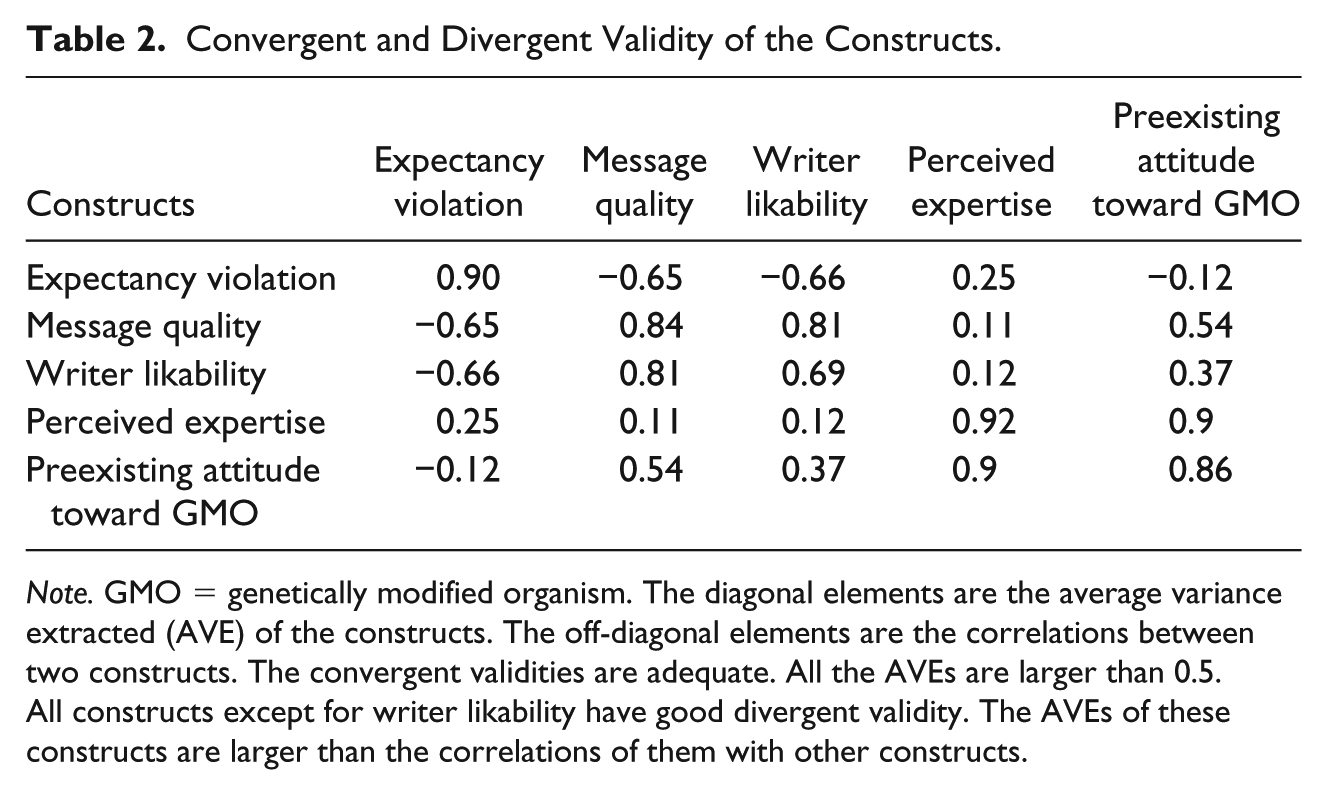
Note. GMO = genetically modified organism. The diagonal elements are the average variance extracted (AVE) of the constructs. The off-diagonal elements are the correlations between two constructs. The convergent validities are adequate. All the AVEs are larger than 0.5. All constructs except for writer likability have good divergent validity. The AVEs of these constructs are larger than the correlations of them with other constructs.
Hypotheses Testing
We used group SEM to answer the research questions and to test the hypotheses. That is, we compare the chi-square values of the two nested group SEMs. All the parameters in the full model were fixed to be equal across groups. The corresponding parameters were free in order to estimate across groups in the comparison model. If there is a significant difference between these two models, then we can conclude that the moderation effect of communication style on a path we hypothesized is significant. First, the fit indexes of the full model showed that the model fitted the data adequately, χ2(1,415) = 2547.05, p < .01, comparative fit index = .98, Tucker-Lewis Index = .99, root mean square error of approximation = .08. Furthermore, we refer to the specific parameter estimates in the text when we describe and discuss them (Table 3).
Estimates of Constructed Model.
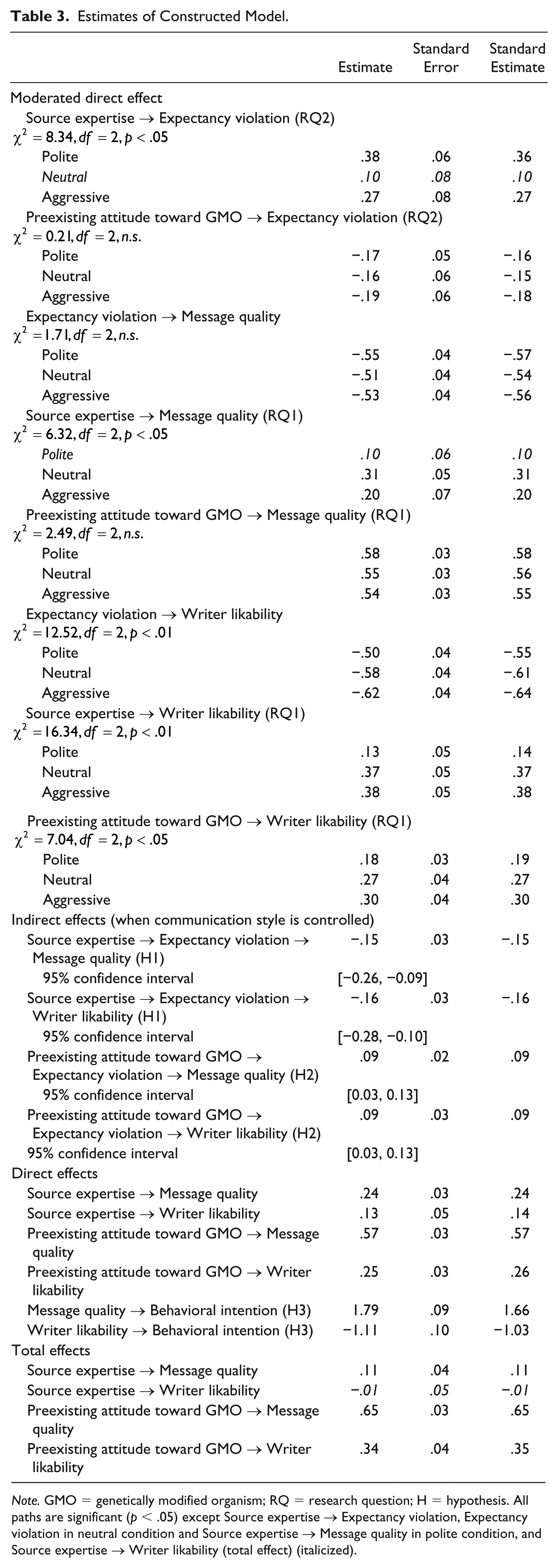
Note. GMO = genetically modified organism; RQ = research question; H = hypothesis. All paths are significant (p < .05) except Source expertise → Expectancy violation, Expectancy violation in neutral condition and Source expertise → Message quality in polite condition, and Source expertise → Writer likability (total effect) (italicized).
In the present study, the first set of research questions asked the moderation effects of communication styles on the relationships between source expertise (Research Question 1a-b) and preexisting attitude (Research Question 2a-b) toward GMOs on (a) message quality and (b) writer likeability. The results (see Table 3) showed that communication style significantly moderated the relationship paths from source expertise to message quality,
To answer Hypotheses 1 and 2 on the mediation effect of expectancy violation, we first looked into the moderating effect of communication style on source expertise and preexisting attitude toward GMO on expectancy violation. The results showed that communication style significantly moderated the relationship between source expertise and expectancy violation (
We had predicted that the effects of source expertise (Hypothesis 1a-b) and preexisting attitude (Hypothesis 2a-b) toward GMOs on (a) message quality and (b) writer likeability would be mediated by expectancy violation. The results showed that all the indirect effects are statistically significant (see Table 3). Specifically, source expertise has significant negative indirect effects on perceived message quality (
To better understand the mediation effect, we looked into the direct, indirect, and total effects of the antecedents. The direct and the indirect effects of source expertise took different directions. Thus, the effects cancelled each other out. In the case of the effect of source expertise on message quality, the total effect (
Last, we found that both message quality and writer likability had a significant effect on behavioral intention (Hypothesis 3a-b). More specifically, message quality positively affected purchase intention (
Discussion
The purpose of this study was to further understand the effects of communication styles, as one aspect of strategic communication, on an individual’s perception of a persuasive message about GMOs. Importantly, the current study attempted to draw a more comprehensive picture of the effects of communication styles, source expertise, and preexisting attitude toward GMOs. The findings point to an important role for expectancy violation in how individuals process the different communication styles of different types of communicators.
First, source expertise was found to be an important factor influencing the outcome of a strategic risk communication. A message from an expert appears to be more effective than a message from a nonexpert. However, expectancy violation diminishes the positive effects of both message quality and writer likability. The total effect of source expertise on writer likability was not significant because the direct effects and indirect effects of expectancy violation canceled each other out. What is surprising is that the scientist violated individuals’ expectations more when he wrote politely than when he wrote aggressively. Source expertise contributed to message quality and writer likability most when using the neutral style and more when using the aggressive style than when using the polite style. These results on source expertise suggest that polite style is not necessarily the best strategy for scientists. While it remains important for communicators to understand the expectations of audiences and to try not to violate those expectations, these findings suggest that more intensive and assertive message styles persuade better than does polite style. One explanation for this finding is that scientists need to be affirmative when communicating about scientific issues; polite and vague message styles may make scientists look weak and vacillating.
Additionally, the results of the effects of the attitude toward GMOs showed the importance of preexisting attitude. Consistently with previous studies, individuals are more likely to give a positive response to ideas they agree with. No interaction effects were observed between communication styles and preexisting attitude on expectancy violation and message quality, except on writer likability, which suggest that audiences who hold positive attitude toward GMOs find the writer more likable if he uses an aggressive style rather than a polite style. This finding may be explained by the fact that pro-GMO audiences may sympathize with an aggressive communicator and find the author more likeable. It is also interesting to note that, in keeping with the results from the national survey (Funk & Kennedy, 2016), individuals’ attitudes toward GMOs did not favor either pro- or anti-GMO positions, as the average score was around the midpoint of the scale.
Overall, the findings showed that the difference in how individuals react to aggressive and polite communication styles is determined by the level of violation individuals perceived during the interaction. More specifically, for risk communication contexts such as the GMO debate, in contrast to the findings of many previous studies and in contrast to our norm that politeness is always better than aggressiveness, scientists are not advised to use polite or not-affirmative language. Nevertheless, the primary takeaway for a science communicator is to understand the audiences well and to attempt to make sure that the message is within audiences’ range of expectation.
We asked one behavioral intention question about the participants’ intention to purchase genetically modified products. The results suggested that individuals were more likely to purchase genetically modified products when they perceived the message to be of higher quality, which is consistent with findings from numerous prior studies and theories, including TPB (Ajzen, 1991). However, different from what we expected, individuals who found the writer more likeable were less likely to purchase genetically modified products. This surprising finding requires more tests to yield a reasonable explanation.
Limitations and Future Study
There are several limitations to the current study. First, the current study controlled for participants’ suitability by asking the prescreen questions on the participant’s previous behaviors. According to the elaboration likelihood model (Cacioppo, Petty & Morris, 1983), an individual’s involvement may affect whether they would use a peripheral or a central route to process information. Future study can include involvement in the model so that we may better understand the role of communication styles. Second, the data were collected from U.S. users of mTurk. mTurk participants may not adequately represent the whole U.S. population. Future study should consider culture as a factor in audiences’ information processing while using different communication styles. Third, the current study examined this conceptual model in only one risk communication context: the GMO debate. Future research can examine the conceptual model in other contexts beyond science and risk communication. Moreover, in addition to online-written blog articles, future studies might also examine communication style in other formats, such as video or audio. Fourth, the current study examined only one type of behavioral intention: purchasing behavior. We recognize that there are other important behaviors or behavioral intentions that are relevant for the issue of GMOs, including voting and volunteering behaviors. Future research could also consider measuring audiences’ other behavioral intentions, emotions, and behaviors when testing this model. Moreover, the standardized loadings of some measurement items are higher than .9. In the future studies, we will explore broader conceptualization and measurement methods of the constructs.
Footnotes
Declaration of Conflicting Interests
The author(s) declared no potential conflicts of interest with respect to the research, authorship, and/or publication of this article.
Funding
The author(s) received no financial support for the research, authorship, and/or publication of this article.
