



Abstract
Knowledge innovation is the driving force and guarantee of regional development. Inspired by population ecology, this article uses symbiosis theory to explore the symbiotic relationship of subjects in the regional knowledge innovation ecosystem. The nonlinear Lotka–Volterra model is constructed with the main subjects to measure the knowledge innovation ability of knowledge innovation subjects. The symbiotic relationships among the knowledge innovation subjects in each region are identified. Taking Beijing, Shanghai, and Guangzhou as examples, a sensitivity analysis of the initial value and coopetition relationship is conducted. The results show that the initial value change has no significant effect on the development of knowledge innovation subjects. The interaction relationships among subjects directly affect the symbiotic evolution trend. The study extends the application scope of the symbiosis theory and develops a theoretical framework for the development of subjects in regional knowledge innovation ecosystem. It offers regions a reference to use Lotka–Volterra model adjusting the knowledge innovation structure in various regions.
Keywords
Introduction
Regional innovation is the support of a country’s economic development and upgrading of national competitiveness. In China’s government work report released on 5 March 2023, it was pointed out that it is necessary to improve national and local innovation systems and enhance the leading role of innovation. Science and technology have always been in an important strategic position in China, and are strong support for economic development. In the new round of technological revolution, China’s technological innovation has expanded in breadth and depth. However, there are still some challenges, and the country needs to improve the overall effectiveness of the national system. The report clarifies the important role of universities and research institutes, the main position of enterprises, and the organisational role of the government. With the increasing demand for knowledge in emerging industries such as artificial intelligence, biomedicine, and new materials, knowledge breakthroughs require the complementation and collaboration of multiple subjects (Radziwon & Bogers, 2019). At present, the development level of knowledge innovation main body in each region of China is unbalanced. As the characteristics of different regions are different, taking the region as the research object has more practical significance for enhancing the competitiveness of the national knowledge innovation system. How to promote the symbiotic development of knowledge innovation ecosystems in different regions through effective means needs to be studied urgently.
This article considers that the regional knowledge innovation ecosystem consists of the geographically adjacent government, enterprises, universities, scientific research institutions and other subjects. The inseparable relationships among knowledge innovation subjects promote the development of regional knowledge innovation ecosystems. The competitiveness and superiority of the system depend to a large extent on the coevolution and cocompetition of knowledge stock (Carayannis & Campbell, 2009). In the regional innovation system, the government, universities and enterprises as the innovation triple helix subject, scholars analysed the tightness of subjects (Kang et al., 2019). The symbiotic relationship is included in the innovation ecosystem evaluation system (Chen et al., 2022). Current research focuses on the static perspective to analyse the importance of inter-subjective relationships. For the dynamic research of symbiotic relationships, scholars analysed the knowledge innovation process and the way to optimise the innovation efficiency of multi-intelligentsia in the knowledge innovation network from the micro perspective (Bao & Wang, 2022). Some scholars have studied the important members of knowledge diffusion (Su et al., 2018). Prior research has provided an important foundation for exploring the relationship between the subjects of regional knowledge innovation ecosystems. There is insufficient research on the symbiotic evolution of the three subjects of government, universities, and firms at the regional level. Based on this, this article uses metaphor theory 1 to metaphorise the regional knowledge innovation system into a regional knowledge innovation ecosystem. Applying symbiosis theory to explore the symbiotic relationship between symbiotic subjects from an ecosystem perspective (Chen et al., 2022). The initial states and subjective abilities of different provinces in China are different, leading to different symbiotic relationships among the subjects of knowledge innovation ecosystems, which may include competition relationships, predation relationships (acquisition) and cooperation relationships. It is necessary to use the Lotka–Volterra model to explore the characteristics and trends of knowledge innovation subject relationships in different provinces. In the past, scholars often set their own parameters for simulation analysis. The simulation in this article is based on standardised real data, which is more scientific than setting one’s own parameters.
The potential contributions of this article are as follows: First, it clearly describes the subject symbiosis relationship from the ecological perspective, which is conducive to grasping the situation of knowledge subject symbiosis mode. Second, with the help of the Lotka–Volterra model, a theoretical framework for the development of subjects in the regional knowledge innovation ecosystem is developed. Third, the simulation analysis based on actual data explores how the three knowledge innovation subjects develop, and sets different parameters for simulation analysis, which provides an effective reference for optimising the development path of regional knowledge innovation ecosystems with different characteristics. It is of great practical significance for improving the development of knowledge subjects.
Literature Review
Innovation system theory suggests that the system consists of innovative subjects and is capable of realising the functions of knowledge creation and providing new products. The regional innovation system is influenced by university and enterprise R&D cooperation (Petruzzelli & Murgia, 2021). Both internal and external cooperation networks have an impact on knowledge emergence (Su & Yan, 2023). Technological innovation in a broad sense is knowledge innovation, and knowledge innovation is the basis for the subject to carry out all innovation activities (Su et al., 2021). Scholars have explored the drivers of regional knowledge creation (Neulandtner, 2020). University, industry, and government cooperation and collaboration within the region stimulate knowledge production and innovation (Peixoto et al., 2021). Knowledge innovation systems emerge.
In the regional knowledge innovation system, universities and research institutions have rich knowledge reserves in interdisciplinary fields, participate in major knowledge exchanges (Kauffeld-Monz & Fritsch, 2013). The ability of them to contact the market is weak, and it is difficult to obtain feedback. Although enterprises have good market insights and can add value to knowledge, the market alone cannot provide them with sufficient incentives for knowledge production (Wang, 2018). Enterprises need knowledge sources brought by universities (Pinto et al., 2015). The process of knowledge innovation is actually a process of the input-output cycle. The government acts as both the source and feedback of knowledge creation. Although the government itself does not engage in knowledge research, it can provide guidance and material basis for the knowledge innovation system through various methods such as government subsidies and institutional conditions (Moodysson & Zukauskaite, 2014; Su & Li, 2023), as the motivation and goal of knowledge innovation. The government promotes cooperation between universities and enterprises (Park et al., 2015), promotes knowledge exchange and innovation (Alexander & Childe, 2013; Su et al., 2016). Then, the government reflects the results of innovation and becomes the basis for the next round of knowledge innovation. This article explores the symbiotic evolution of the three subjects, which is conducive to the generation of knowledge innovation and promotes the evolution and development of the regional knowledge innovation ecosystem.
Metaphor Theory and Symbiosis Theory
Metaphor is a concrete expression of a way of thinking about abstract concepts (Lakoff & Johnson, 1980). Metaphor-based scientific modelling is the analogy between the model and the target object. Metaphor theory is widely used in the social sciences, where scholars often use networks as a metaphor for complex structures (Börzel, 2011), use the evolutionary theory of biology as a metaphor for the innovation process (Businaro, 1983). By seeking the commonality, a real physical model is applied to understand another real system. Metaphors can solve cross-domain abstraction problems. The regional knowledge innovation system has great similarity with the regional knowledge innovation ecosystem: the hierarchical and functional characteristics of regional knowledge innovation subjects are similar to the ecological characteristics of individuals and the population, and the interaction relationship is consistent with the interaction characteristics of individuals, populations and the environment in ecology. The generation and diffusion of knowledge are similar to the flow of matter and energy in ecosystems. We metaphorise the regional innovation system as an ecosystem and apply the symbiosis theory in ecology to solve the problem of subject relationships in the regional innovation ecosystem.
Symbiosis theory is one of the core theories for studying interspecies relations in ecosystems. ‘Symbiosis’ was first proposed by the biologist De Bary (1879), who defined the concept of symbiosis as the living together of different species in beneficial relationships. The symbiosis of living organisms and new communities is the most important source of innovation in the evolutionary process that takes place on Earth (Margulis & Fester, 1991). In the regional knowledge innovation ecosystem, the government, enterprises, universities and research institutions are the basic unit of knowledge evolution. They cannot be self-sufficient, inevitably depend on other resources in the environment. The survival of any one subject is inseparable from the resource dependence of other subjects. The subjects of knowledge innovation systems are voluntarily united, and the close interspecies relationships and effective interactions are the resources of enterprises, universities and research institutions (Miller et al., 2016). The process approach is also the source of the provincial government’s competitive advantage. The population dynamically evolves in the interaction between symbiosis and competition, which promotes advantages for the whole system. Existing studies applying symbiosis theory and the Lotka–Volterra model have studied the interaction between two groups of maritime sectors marine sector, between enterprises, and the trend of the development of the subjects (Wei et al., 2018; Zhang & Lam, 2013). For the knowledge innovation ecosystem in the government, enterprises, and universities three subjects of symbiosis relationship is not clear. This article applies the symbiosis theory to the regional knowledge innovation ecosystem. This article refers to the government, enterprises, universities and research institutions as the population in the knowledge innovation ecosystem and measures the development level of knowledge innovation subjects with their input and output factors, representing the growth of the population in the ecosystem. The Lotka–Volterra model is used to explore the symbiotic relationship and evolution rule of three subjects in different regions and the influencing factors of coexistence and coevolution among knowledge innovation subjects.
Symbiotic Model Construction of Regional Knowledge Innovation Ecosystem
The Lotka–Volterra model considers nonlinear relationships among populations described by differential equations under symbiotic theory, and it is a model of the quantitative change in biological populations based on a logistic model. Such quantitative models describing the relationships among species were first developed by Lotka (Alfred J. Lotka) and Volterra (Vito Volterra) and were established in 1925 and 1926, respectively.
In the knowledge innovation ecosystem, the population does not exist on its own (Hu & Mathews, 2008). Due to the differences in knowledge stocks and knowledge attributes among enterprises and universities, knowledge can flow in both entities (Wu et al., 2022). Enterprises can not only acquire the knowledge of universities and research institutions but also play an important role in the knowledge processing and new knowledge output stages downstream of the knowledge chain to meet the needs of knowledge appreciation. At the same time, enterprises and universities have differences in the ‘understanding’ and ‘absorption’ of knowledge. Enterprises can acquire, absorb and utilise external knowledge while providing funds to and thus cooperating with universities and research institutions to complete the knowledge innovation process in two ways (De Wit-De Vries et al., 2018). The differences in knowledge among enterprises and universities are not sufficient to promote knowledge innovation. Therefore, the government acts as the facilitator of knowledge flow between them. The relationships among the government, universities, research institutions and enterprises are complicated, and their development must not only be based on their own growth rate but also be affected by other populations. It is necessary to construct three knowledge innovation subject relationship models by using the nonlinear multigroup mixed-relation Lotka–Volterra model to explore the competition, cooperation and predation relationships among three knowledge subjects in different regions.
Based on the ecological background of knowledge innovation, the level of knowledge innovation of governments, universities and research institutions, and enterprises at time t is x1(t), x2(t), and x3(t), respectively; the natural growth rates of the three populations are r1, r2 and r3, respectively. The innovative subjects realise the development of knowledge through self-regulation in dynamic change. Enterprises, universities and research institutions are limited by their infrastructure, market environment and limited resources, and thus, they cannot achieve unlimited development. They are constrained by the limited growth of scale K1 and K2, and the development of knowledge innovation follows the rules of the logistic model:
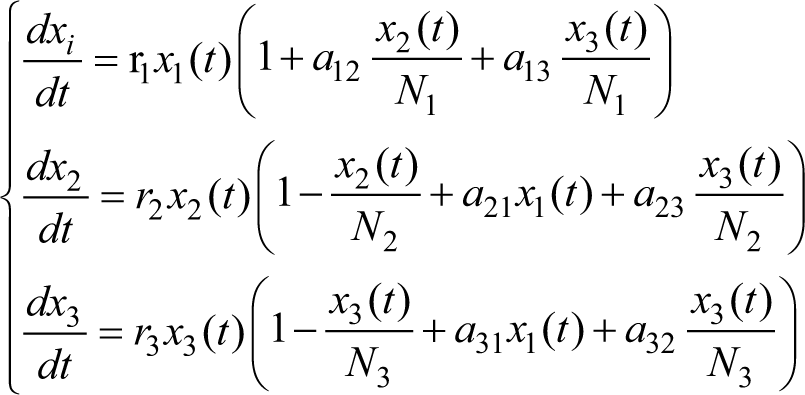
Equation (1) can be rewritten as follows:
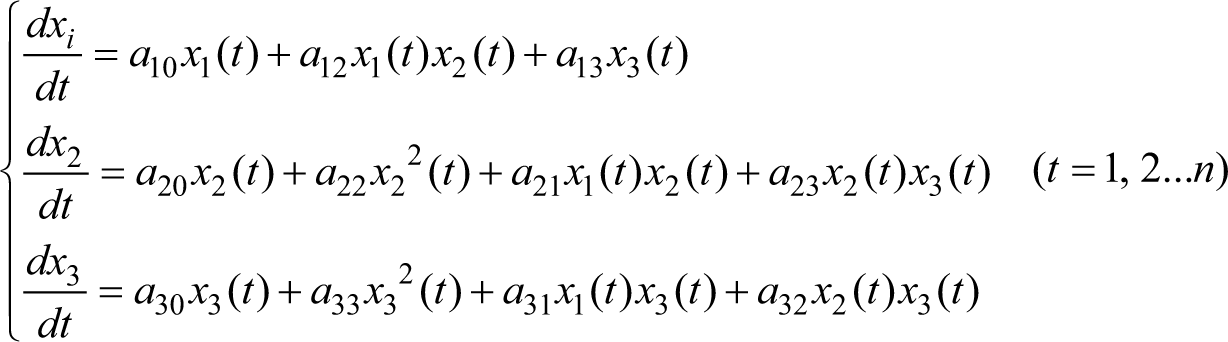
The relationship coefficient between the two populations is aij (i, j = 1, 2, 3, i ≠ j), which indicates the effect of population j on population i. The numerical value of aij reflects the relationship between the two, aij > 0 is a promoting effect, and aij < 0 is an inhibitory effect. aij > 0 and aji < 0 indicate that population j has a promoting effect on population i, while when population i has an inhibitory effect on population j, they are said to have a predator relationship. aij > 0 and aji > 0 indicate that both sides of the population promote each other’s growth, and the two are in a mutually beneficial symbiotic relationship. aji < 0 且 aji < 0 indicates that the two sides of the population suppress each other and exhibit a competitive relationship.
To solve the nonlinear relation model of time-series sample data, the grey estimation method (Wu & Wang, 2011) is used to calculate the interaction coefficient.
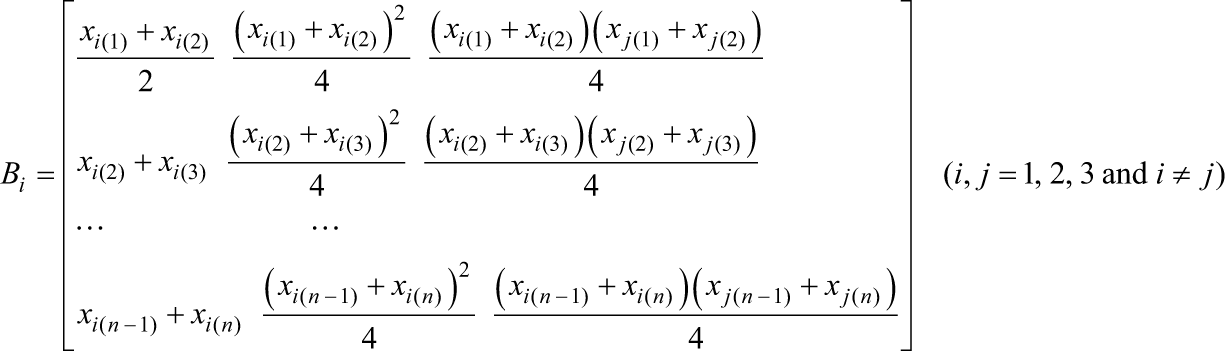
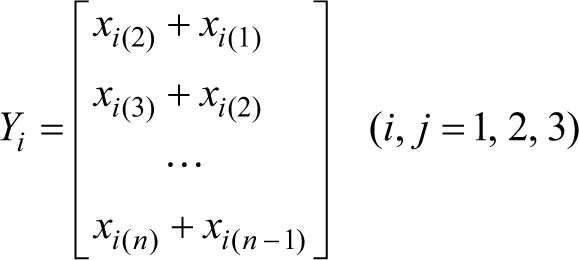
Taking xi (t + 1) –xi as an approximation of

The least squares method is used to estimate the parameter column: [a1, b1, c1]T = (BTB)–1BTY, a1 = [a10, a12, a13]T, b1 = [a20, a22, a21, a23]T, and c1 = [a30, a33, a31, a32]T.
Variable Selection and Data Processing
Variable Selection
Since the inputs and outputs of the symbiotic units circulate in the knowledge innovation ecosystem, the input-output index of the population is usually used to represent the quality parameters reflecting the internal nature of the population. The following indicators are selected as the basis for describing the input-output factors of the population’s knowledge innovation activities and the relationships among species. The indicators of the regional knowledge innovation ecosystem are shown in Table 1.
Quality Parameter Indicators of Subjects in the Regional Knowledge Innovation Ecosystem.

Universities and research institutions. Higher education institutions and research institutions have knowledge in many fields. Their total amount of knowledge accumulation is large, their degree of knowledge diversification is high, they are the main subject of knowledge creation; their investment is measured by the full-time equivalent of their R&D personnel and their R&D funds (Jiao et al., 2016), as well as their knowledge creation capabilities in scientific article publication, patent applications, and revenue from transferring and licensing patent ownership (Agrawal, 2001; Johnston et al., 2023). This article selects the number of patent applications rather than the amount of patent grants as an indicator (Saragossi & van Pottelsberghe De La Potterie, 2003), for measuring the output of knowledge innovation because it can measure the ability and scale of knowledge innovation, avoiding the influence of the innovation environment on the number of patents granted.
Enterprise. The quality parameters of enterprises include not only input-output indicators but also knowledge acquisition and absorption capacity indicators (Fores & Camison, 2016). Enterprises can not only acquire the knowledge of universities and research institutions (Bellucci & Pennacchio, 2016), transform this knowledge through knowledge processing downstream of the knowledge chain, increasing the value of products or services, but also exchange and reorganisation of explicit knowledge and tacit knowledge and cooperation and participation in the creation of such knowledge due to the differences in the knowledge stocks of enterprises and universities (Giannopoulou et al., 2019). The input indicators of enterprises are measured by the full-time equivalent of their R&D personnel in industrial enterprises divided by the internal expenditure of their R&D funds, and the output of enterprise knowledge conversion and knowledge application is measured by the number of patent applications and sales revenue from new products. The purchase of domestic technology and technical renovation are taken as a measure of the ability of enterprises to acquire and integrate knowledge.
Government. Effective knowledge dissemination plays a vital role in the success of knowledge-based organisations (Su et al., 2018), The important role of the government in the regional knowledge innovation ecosystem is reflected in the fact that there is no motivation for knowledge innovation when there is only a knowledge gap between universities and research institutions and enterprises, which is not enough to promote the dissemination of knowledge, as the government is the thrust and pull of knowledge flow. The government’s input is measured by the funds of its departments and those of all levels of fixed asset investment and R&D expenditures, and the disposable income of urban residents is used as the government’s output for the knowledge innovation ecosystem.
Data Collection and Processing
This article selects the knowledge innovation ecosystem of thirty provinces and cities in Mainland Chinese as the research object (Tibet is excluded due to a lack of data) and explores the coopetition relationships among knowledge innovation subjects in different regions according to the development level of knowledge innovation subjects. Since some indicators have been used since 2009, the 2009–2017 data are selected as the basis for analysis. The data come from the China Statistical Yearbook and the China Science and Technology Statistical Yearbook. On the basis of eliminating the standardised data of dimension, the entropy weight method is used to weight the quality parameters and the level of knowledge innovation of the three populations in the regional knowledge innovation ecosystem is calculated, which can be used as the basis for exploring the competition, cooperation and predation among the three populations.
Empirical Study on the Regional Knowledge Innovation Ecosystem
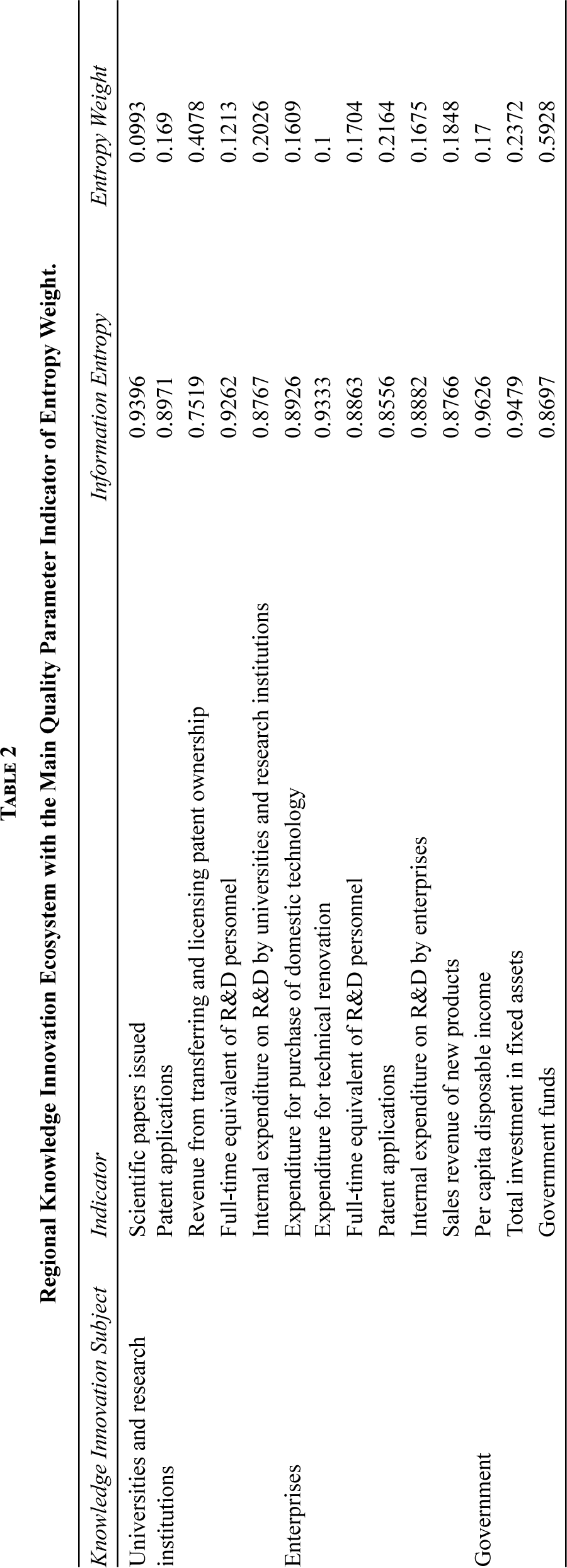
To further determine the development of each subject, the weight of the indicators is determined according to the amount of effective information they provide. The entropy weights of the indicators are shown in Table 2.
Regional Knowledge Innovation Ecosystem with the Main Quality Parameter Indicator of Entropy Weight.
The relationship coefficients of the Lotka–Volterra model among universities and research institutions, enterprises and governments in thirty provinces and cities in China can be calculated with the grey relational method. Specifically, the actual data of the subject in each knowledge innovation ecosystem are integrated, and then, the integrated values are substituted into Equations (4) and (5); the interspecies relationship coefficients are calculated, and the symbiotic relationship types of each province are determined to compare the differences among the thirty provinces. The relationships are shown in Table 3.
Relationships Among Universities and Research Institutions, Enterprises, and the Government in 30 Provinces in China.

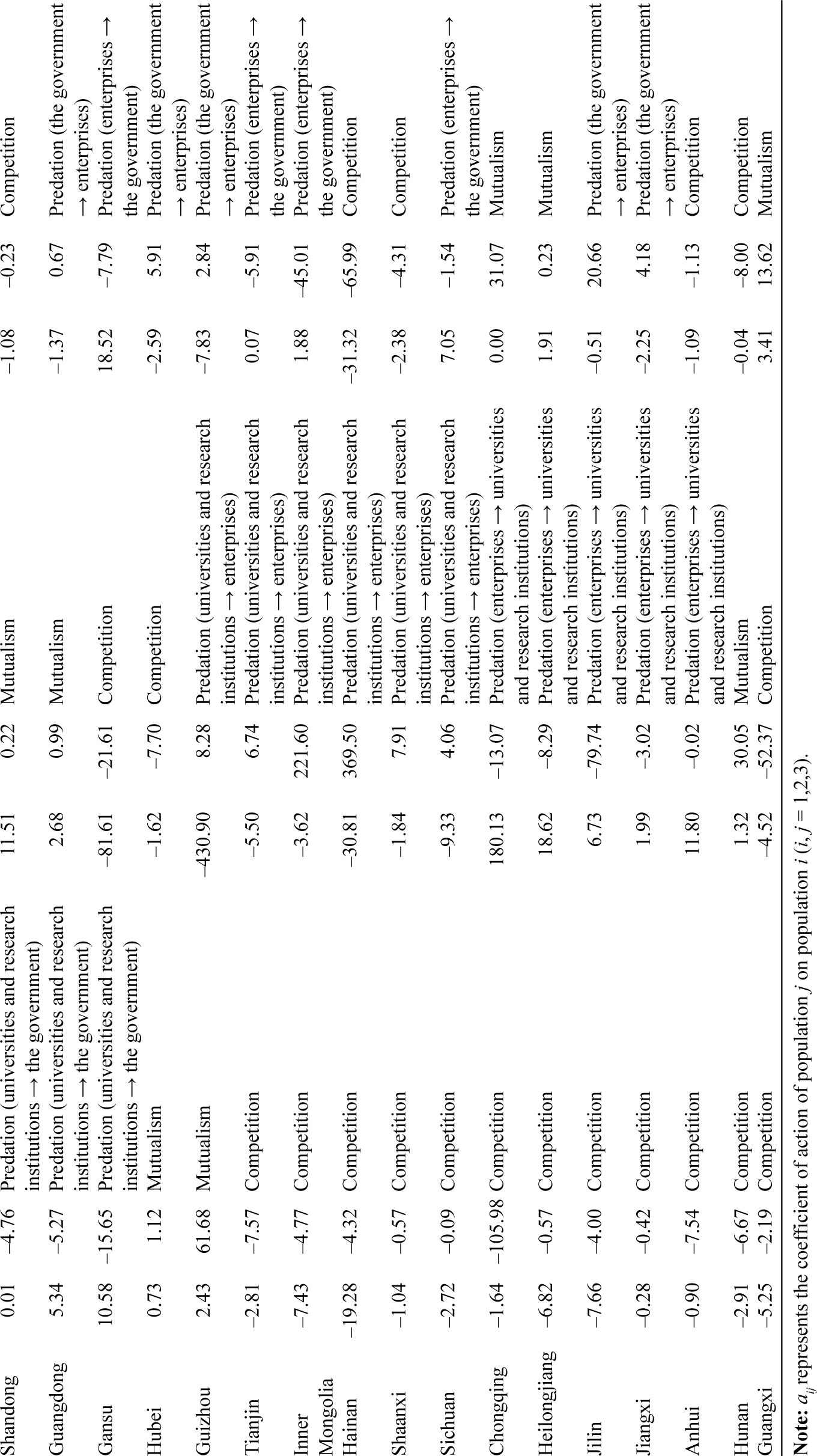
Generally, in the regional knowledge innovation ecosystem, the relationships among the government, universities and research institutions, and enterprises are mostly based on the predator relationship of government resources and the mutually restrained competitive relationship. Universities and research institutions and enterprises have failed to effectively use the knowledge innovation resources from the government in many provinces, but they have not yet reached the level that can bring about good economic advantages for the government. The relationship between universities and research institutions and enterprises is mostly a predation relationship. Enterprises usually acquire the knowledge of and rely on the knowledge innovation ability of universities and research institutions. At the same time, universities and research institutions also prey on the resources of enterprises. Regardless of which entity is the predator, this predation relationship is only beneficial to the development of one party and inhibits the development of the other. The mutually beneficial symbiosis between enterprises and universities and research institutions exists in four provinces and cities. These four provinces and cities are located in the more developed eastern and central regions of China. Overall, Beijing, Shanxi, Henan, and Ningxia have the same characteristics: universities and research institutions prey on government resources, government and enterprises suppress each other, and enterprises prey on the resources of universities and research institutions. Fujian and Qinghai, Jiangsu and Zhejiang, Tianjin and Inner Mongolia, Hainan and Shaanxi, Chongqing and Heilongjiang, and Jilin and Jiangxi Provinces have the same population relationship.
Simulation Analysis
This article simulated the coopetition relationships among knowledge innovation subjects in various provinces in China, simulated the symbiotic evolution trend of knowledge innovation subjects in thirty provinces and cities in China, drew the trend graph of the population symbiosis model for each province and city, and observed different symbiotic directions of each knowledge innovation subject. Due to space limitations, this article lists only the simulation graphs of the Lotka–Volterra model of China’s most economically and politically developed provinces—Beijing, Shanghai, and Guangdong—which directly reflects the population competition relationship in the knowledge innovation ecosystem. The simulation results are shown in Figure 1.
The Symbiotic Evolution Trends of Knowledge Innovation Subjects in Beijing, Shanghai and Guangdong.
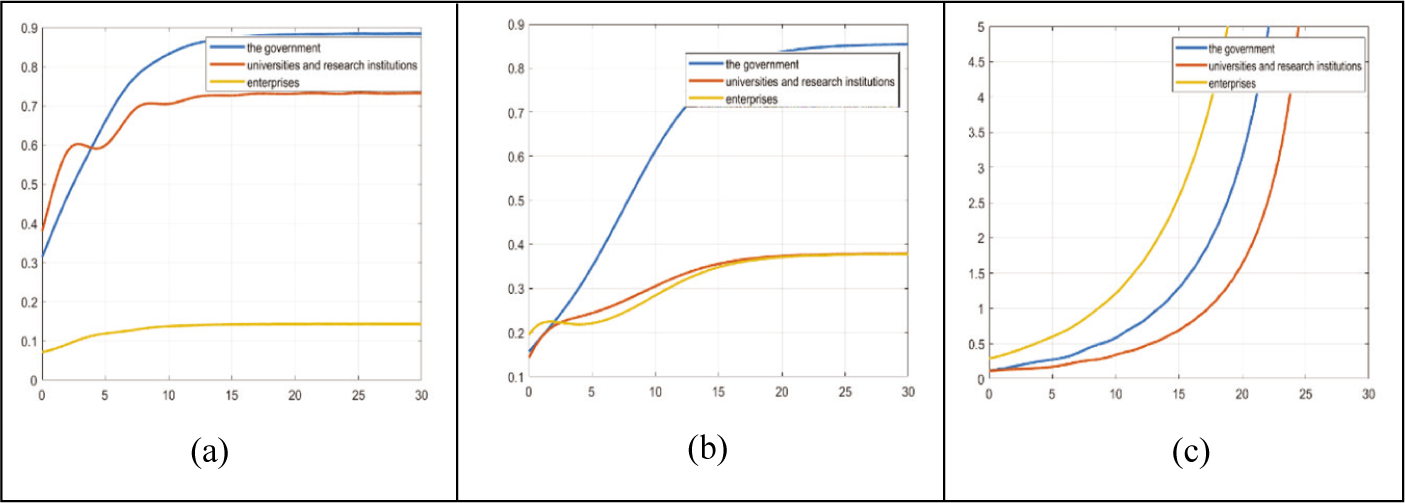
Figure 1(a), (b), and (c) shows the development trend curves of Beijing, Shanghai, and Guangdong Provinces, respectively, with the actual data of 2009 as the initial value and the interaction coefficient among knowledge innovation subjects. In Beijing, the government plays an important role in guiding and promoting the knowledge innovation ecosystem. Due to the mutual restraint between the government and enterprises, their roles are often confused, and enterprises can complete the government’s production plan but cannot obtain the maximum profit. This phenomenon hinders the development of productivity, enterprises can present only a low level of development. In Shanghai, the level of government development is higher than that of the other two knowledge innovation subjects. Although universities and research institutions and enterprises are acquiring government resources, they have less of an inhibitory effect on the government. The three subjects can achieve steady-state development at a slower pace. In Guangdong, due to the mutual symbiosis between universities and research institutions and enterprises and to the food chains by which enterprises prey on the government and the government preys on universities and research institutions, the development speed of enterprises is ahead of that of the other subjects, and there is an overall trend of common development.
The influence of initial value changes on the development trend of knowledge innovation subjects
The influence of the government’s initial level of knowledge innovation on the development trend Changing only the initial development level of the government, the situation is as shown in Figure 2. According to the trend chart of symbiotic evolution in Beijing, the improvement of the government initial level brought about only a temporary sudden increase in the development level of universities and research institutions, and then, the development level of all three subjects returned to the same state as the unchanging government value. The improvement of the government’s development level in Shanghai also brought about a slight improvement in the development level of enterprises and universities and research institutions, which was stable in the same state, without changing the initial development level of the government. With the increase in the role of the government in Guangdong, there was an obvious one-way promotion effect between the government and enterprises in the early stage. Under the restraining effect of enterprise development, the government developed slowly for a short period of time. The overall development of the three main subjects was in a state of fluctuation, slightly slower than the original state. The improvement of the government’s development level has only a temporary effect on the development levels of the other knowledge innovation subjects, the development trend is similar to the original one.
The influence of the initial level of knowledge innovation of universities and research institutions on the development trend Changing only the initial development level of universities and research institutions and keeping all other indicators unchanged, the situation is shown in Figure 3. Under the influence of changes in universities and research institutions, in Beijing, the development trend of other knowledge innovation subjects is almost unchanged, except for that of universities and research institutions themselves fluctuating in the early stage. Due to the suppression of government development by universities and research institutions in Shanghai, the level of government development is significantly lower than in the original state. In Guangdong Province, universities and research institutions promote enterprises and the government in three groups of symbiotic relationships. Improvements in the initial development level of universities and research institutions accelerate the development of the three subjects.
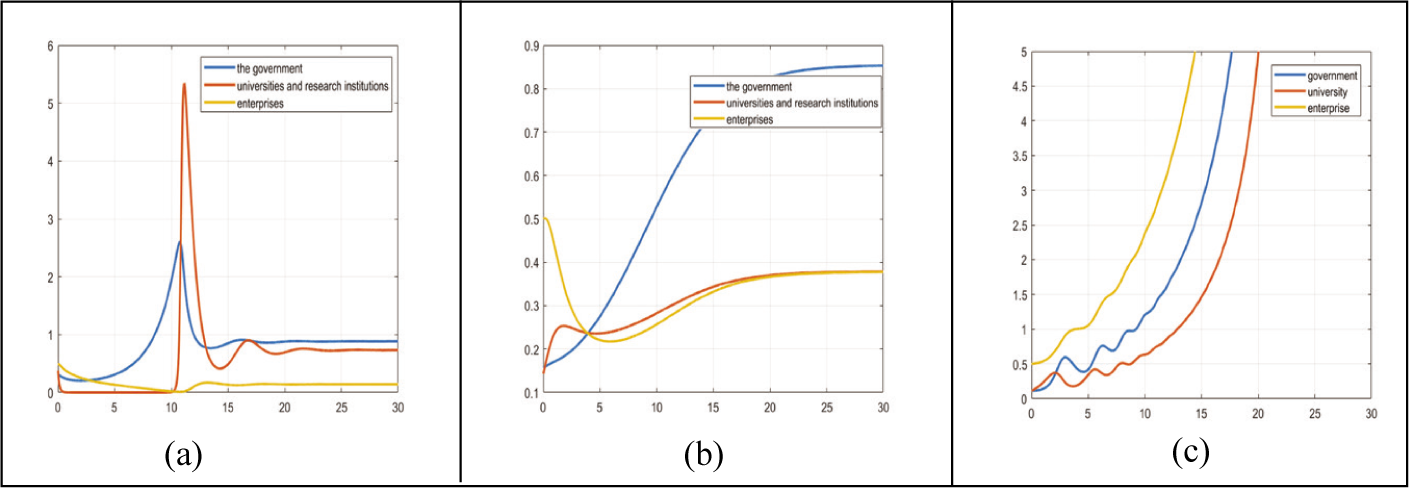
The influence of the initial level of knowledge innovation of enterprises on the development trend The situation in which only the initial development level of enterprises is changed and all other indicators remain unchanged is shown in Figure 4. Figure 4(a) shows the obvious competition relationship between the government and enterprises from Beijing’s knowledge innovation development trend. The improvement of the enterprise’s development level has a greater impact on the development of the subjects in the knowledge innovation ecosystem in the first fifteen years, which can bring about an increase in the development level of the government and enterprises, but after many years, the development falls back to its original state. The steady-state development level of Shanghai has not changed due to the increase in the initial value of enterprises. Guangdong Province can accelerate its development due to the initial development level change of enterprises.
The Symbiotic Evolutionary Trend of Improving the Government’s Initial Development Level.

The Symbiotic Evolutionary Trend of Improving the Initial Development Level of Universities and Research Institutions.

The Symbiotic Evolutionary Trend of Improving the Initial Development Level of Enterprises.
The impact of the change in the coopetition relationship on the development trend of knowledge innovation subjects
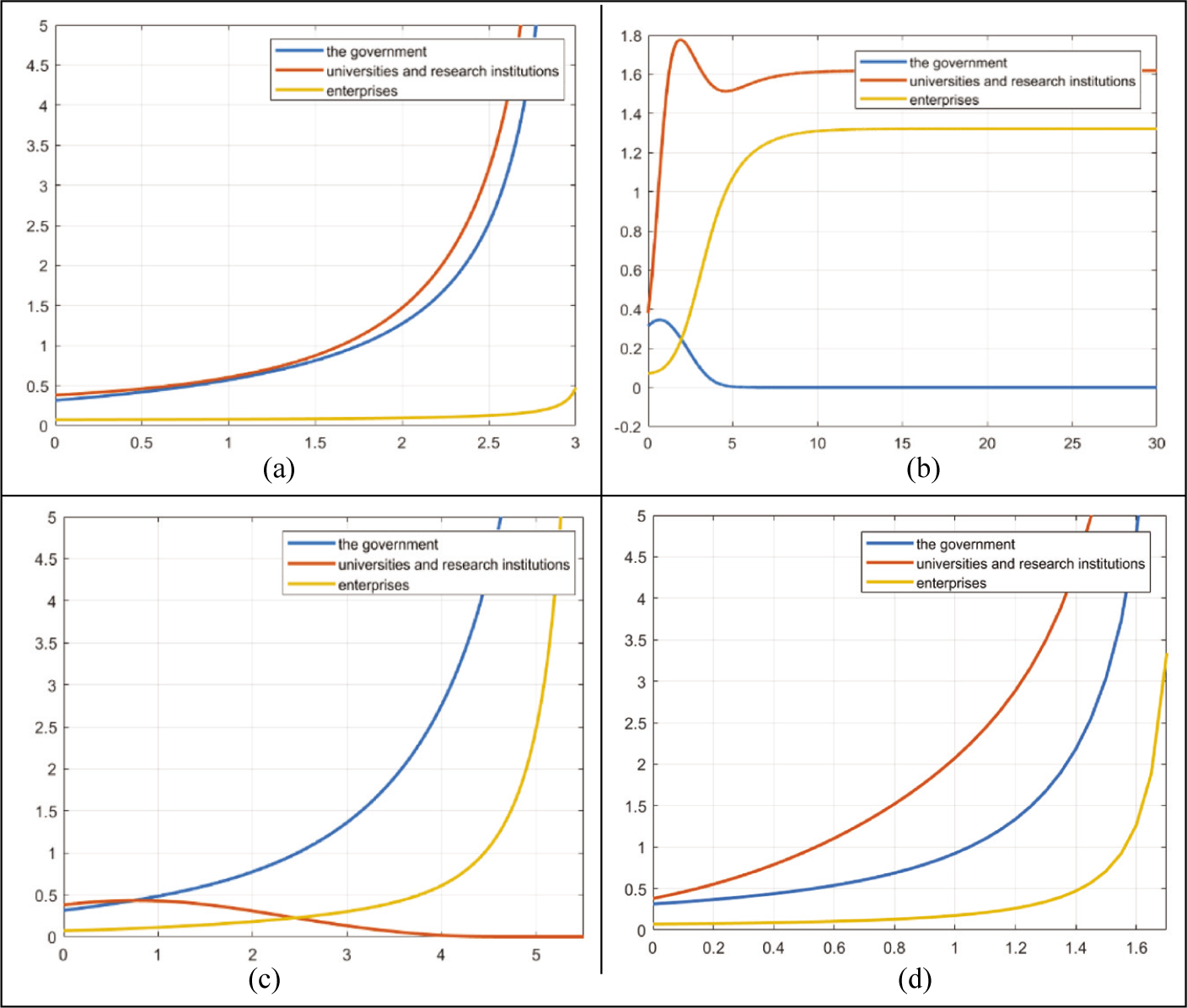
Coopetition relationship changes in Beijing A single relationship change is made while ensuring that other competing relationships are unchanged. Let a12 = 0.5; the government and universities and research institutions are in mutually beneficial symbiotic relationships. As shown in Figure 5(a), the mutual benefit and symbiosis effect are obvious, showing a synchronous upward trend in a short period of time. Let a23 = 0.5; at this time, enterprises and universities and research institutions are in mutually beneficial symbiotic relationships. As shown in Figure 5(b), the mutual benefit of enterprises and universities and research institutions enhances the development level of both subjects, and the development level of enterprises obviously grows in a short time. However, the development level of the government is restrained at this time, and thus, the government does not play a role as the driving force behind the new round of knowledge innovation. Let a13 = a31 = 0.5; the mutual inhibition relationship between the government and enterprises is changed to a mutually beneficial symbiotic relationship. As shown in Figure 5(c), both the government and enterprises show an upward trend, but because enterprises too strongly inhibit universities and research institutions, with the passage of time, the development trend of universities and research institutions in the knowledge innovation ecosystem gradually declines, which cannot provide strong support for the knowledge innovation ecosystem. Finally, the coefficients in the coopetition relationship are all set to 0.5, and the development of the three subjects shows a significant upward trend.
Coopetition relationship changes in Shanghai Let a12 = 0.5; the relationship between the government and universities and research institutions is mutually beneficial and symbiotic. As shown in Figure 6(a), due to this mutually beneficial symbiotic relationship, the level of knowledge development in the region exceeds the resource limit. The cooperative relationship can bring about many results in expanding system resources. Let a32 = 0.5; at this time, enterprises and universities and research institutions are in a mutually beneficial symbiotic relationship, as shown in Figure 6(b), and this relationship promotes the development level of both subjects. Let a13 = 0.5; in Figure 6(c), the symbiotic relationship between the government and enterprises promotes the development of the knowledge innovation system in Shanghai, and enterprises occupy a greater niche than do universities and research institutions. All the coefficients in the competition and cooperation relationship are set to 0.5, as shown in Figure 6(d); the development of the three entities shows a significant upward trend in a short time, demonstrating the leading role of the priority development of enterprises, and the rapid growth of the three subjects can even occur within three years.
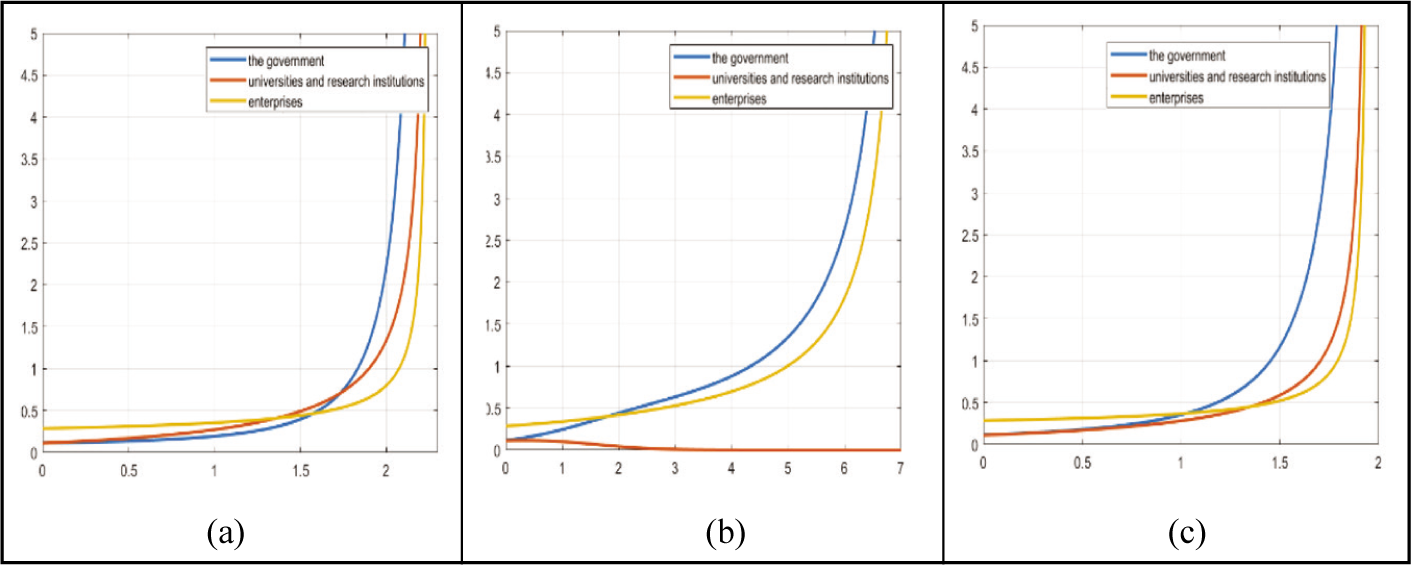
Coopetition relationship changes in Guangdong Province Let a21 = 0.5; at this time, the government and universities and research institutions are in a mutually beneficial symbiotic relationship, as shown in Figure 7(a). Because of this relationship, the two subjects drive the development of enterprises, and at the same time, the state of symbiotic development that could be shown only for fifteen years was advanced to two years. Let a13 = 0.5; enterprises and the government are in a mutually beneficial symbiotic relationship. Figure 7(b) shows the mutual promotion of the government and enterprises, but these two subjects fail to drive the development of universities and research institutions. The mutual promotion of the three subjects is shown in Figure 7(c). At this time, the government gives priority to development and promotes knowledge innovation in the region, and the simultaneous acceleration of the development of the three subjects occurs earlier than the mutual promotion of only two subjects.
Beijing.
Shanghai.

Guangdong Province.
Theoretical Contributions
The theoretical contributions of this article are as follows: first, this article analyses the ecological characteristics of knowledge innovation system. Applying the metaphor theory to metaphorise the knowledge innovation system as a knowledge innovation ecosystem, through the metaphor, the relationship between the subjects of the regional knowledge innovation system can be clearly described with the help of the symbiosis theory, which extends the application scope of the symbiosis theory.
Second, this study develops a theoretical framework for the development of subjects in the regional knowledge innovation ecosystem. The Lotka–Volterra model is used to construct a nonlinear symbiotic relationship model between species of knowledge innovation ecosystems. Existing studies have noticed the influence of the initial state of subjects and symbiotic relationship on the development of populations (Xue et al., 2022), but there is a lack of exploration of the functions of the initial state of subjects and symbiotic relationship in the development process of the government, enterprises, and universities in the context of regional knowledge innovation ecosystems. This article finds that the improvement of different initial states and symbiotic relationships has different effects on Beijing, Shanghai, and Guangzhou.
Management Insights
The research in this article can guide the development of the subjects of regional knowledge innovation systems in practice. The simulation results show that the effect of the initial value change on the development of the regional knowledge innovation subjects is relatively short-lived, and in the long run, the three subjects maintain almost the same development trend as the initial value. After adjusting the interspecies relationship between government, enterprises, universities and research institutions, we find that the mutually beneficial symbiotic relationship has a significant promotion effect on the development of the three subjects. This is consistent with previous studies (Liu et al., 2022). Mutually beneficial symbiosis is the best direction for the evolution of regional knowledge innovation ecosystem subjects, and efforts should be made to transform the competition and predation model into a mutually beneficial symbiosis model. Based on encouraging knowledge innovation, actively building knowledge innovation platforms and promoting knowledge collaboration of the regional knowledge innovation ecosystem in a better direction.
Distinguishing from the holistic insights of innovation capacity enhancement in previous studies (Schiuma & Carlucci, 2018). When the state controls the development trend of various knowledge innovation ecosystems, each region should identify the implementation steps needed to transform the relationships among species according to its own characteristics. If Beijing wants to let the government and enterprises develop beyond the resource constraints in a short period of time, it can give priority to the development of enterprises, create a good infrastructure and market environment, and appropriately stimulate consumption and cut taxes or exemptions, promoting the knowledge innovation of enterprises. The stronger the enterprises are, the more capable they are in transforming the government’s input and improving the utilisation efficiency of government resources. Then, the intersection of the respective goals, equality, and mutual benefit of the government and enterprises is identified, and the accelerated development of universities and research institutions is promoted. In Guangdong Province, due to the promotion of enterprises and the government by universities and research institutions, we should pay attention to the main creators of knowledge and promote the development of other subjects. Guangdong Province cannot blindly increase the government input, or otherwise, enterprises will focus on getting subsidies to meet government needs, ignoring the knowledge innovation of enterprises themselves (Yi et al., 2021). This would result in a resource that depends on the government and cannot create productivity. The improvement of the relationship between the government and universities and research institutions is crucial to the knowledge innovation ecosystem of Guangdong Province. Establishing innovation consciousness and cultivating competitive advantages of enterprises can help avoid vicious competition among enterprises when facing innovation opportunities. In Shanghai, it is necessary to influence the trend of symbiotic evolution of the population by changing the relationships among species. We can attempt to change the relationship between the government and universities and research institutions. At this time, the government will take action, and then, the relationship between the government and enterprises will be improved. The ultimate goal is to achieve mutual benefit among the three groups.
Footnotes
Declaration of Conflicting Interests
The authors declared no potential conflicts of interest with respect to the research, authorship and/or publication of this article.
Funding
This work was supported by the National Natural Science Foundation of China (72074059, 72004085).