



Abstract
In this study, we surveyed customers’ behaviour and influence of individual characteristics (tendency to uniqueness and orientation towards foreign brands) and characteristics of brands (perceived quality and emotional value) on intention to buy foreign brands in comparison to local brands. In this research, questionnaire is used to gather data and the Kokran formula is employed to determine the volume of sample of survey. Indeed, this research surveys the relationship between different variables using structural equation model. About 850 customers of Iranian shops are surveyed. The results reflect that the need to be unique, within customers, influences tendency to buy foreign products or services. What is more, increasing the tendency to purchase foreign brands causes customers to recognize quality and the emotional value of foreign brands in a better way. Hence, by increasing acceptance of perceived quality and emotional value of foreign brands, consumers are more motivated to buy foreign brands. Finally, in consumers’ point of view, variable ATFP to PQ is more important. because attitudes toward foren products that causes customer recognizing them of higher quality.
Introduction
With revolutionary changes happening in products across various categories and lifestyle trends demonstrating a complete failure of stereotypes, the consumer can no longer be slotted in heterogeneous compartments. Today’s consumers defy classification, but universally demonstrate a significant increase in their spending pattern) Sondhi and Singhvi, 2006, p. 57). Nowadays, the customer’s ability to select local and foreign brands has been increased in developing countries. In a competitive environment, sellers of both local and foreign brands gain profit through exploring the reason of the customer’s behaviour in selecting the products they intend to buy. In Iran, different levels of income have caused to emerge a broad range of local and foreign products to sell. Despite the fact that there are people noticeable who are living a low quality of life and their income is below the minimum amount of a normal life, most in the upper brackets are interested in buying foreign brands so as to gain high levels of visibility and also differentiate their style of life from that of others. Maybe, that occurs due to their tendency to live in the style of modern countries such as the US. This kind of behaviour is more usual with the young and teenagers (Kumar and Kim, 2009, p. 512).
In this vein, the main question is why do people choose local or foreign brands? In this paper, we aim to survey the reasons for preferring one brand over another. We explore the consumer₹s behaviour and effects of personal characteristics (tendency to differentiation and buy foreign brands) and the characteristics of brands (perceived quality and emotional value) in buying foreign brand in comparison to local brands.
Literature Review
Researchers have concluded that consumers with a high need for uniqueness tended to adopt new products or brands more quickly than those with a low need for uniqueness (Amaldoss and Jain, 2005; Zimmer et al., 1999). The theory of consumers’ need for uniqueness explains how an individual’s need for uniqueness can influence brand responses and the need to be different from others (Tian and Hunter, 2001) through the pursuit of material goods (Deek and Kim, 2007). Snyder and Fromkin (1977) found it is logical to speculate that different people exhibit varying degrees of need for uniqueness in similar circumstances and this can have a significant impact on their purchase decisions. This need for uniqueness can be demonstrated in three types of consumer behaviour:
Creative choice counter-conformity Unpopular choice counter-conformity and Avoidance of similarity (Deek and Kim, 2006)
According to this theoretical perspective, an individual, despite the influence of normative pressure, seeks differentiation and intentionally disregards prescribed social norms in order to distinguish himself or herself from the group (Snyder and Fromkin, 1977).
Unlike an individual driven by an independence motivation, the individual is exposed to a set of social norms and actively seeks differentiation through non-congruence (Tian and Hunter, 2001). The effect on the individual is ultimately dependent on the good becoming a publicly recognized symbol. Due to its recognized meaning, these expressions of uniqueness are sought in different forms and through multiple outlets, where the social penalties for being different are not severe. This makes the acquisition of material goods particularly valued (Tian and Hunter, 2001).
Consumers’ emotions is an interesting field of research. Organizations can deliver services to customers in new ways and levels through recognizing the significant role of emotions and gain competitive advantage over competitors and also increase profitability. Consumers may intend to purchase a particular brand because they perceive the brand offers the right features, quality, or emotional benefits (Kumar and Kim, 2008). ‘Perceived quality’ is defined as the consumer’s subjective judgment about a brand’s overall excellence or superiority (Yoo et al., 2000). It is a competitive necessity and many companies today have turned customer-driven quality into a potent strategic weapon. The origin of the consumer perception of quality mainly lies in the perception of quality-related intrinsic and extrinsic attributes (Gil, 2007). In fact, the perceived quality is different from actual or objective quality, product-based quality, and manufacturing quality (Aaker, 1991). Furthermore, perceived quality may lead to consumer satisfaction, which is determined by perceived performance and expectation (Chaudhuri, 2002). Deek and Kim (2006) found that the perceived quality decreased purchase intention, while the emotional value increased purchase intention. Kumar and Kim (2008) found that emotional value was found to be an important factor influencing purchase intention towards US brands and the local brand as well. In the past few years, in Iran, there has been an increase in the import of foreign goods from Western countries (for example, Korea, China and Japan). As a result, Western products and brands are becoming increasingly popular in Iran, creating intense competitions between local products and foreign products (Field, 2005). Foreign products, particularly home appliances, were accepted first by Iranian women. In spite of the popularity of foreign home appliances among Iranians, there is no empirical research on understanding consumer perceptions towards foreign home appliance brands and, more specifically, Korean home appliance brands. Many Korean retail companies and brands, are expanding their businesses into Iran, making their products and brands easily available to the typical Iranian consumer. Some of the Korean home appliance brands available in Iran are LG, Samsung and Daewoo. Iranian consumers are purchasing these brands in modern shopping formats, such as malls and department stores. Although retailing in Iran seems to provide countless opportunities to both foreign and local retailers, it has been the subject of relatively little research. More empirical research should be conducted to determine factors that explain Iranian consumers’ brand choice between local brands and Korean brands sold in Iran. Based on the results of this study, implications will be drawn for both Korean and Iranian retailers.
Theoretical Framework
In Iran, where higher-income disparities and status mobility exist, consumers seek to emulate Western practices by purchasing foreign brands. They may use US home appliance brands to enhance their self-concept, to project a unique identity, or to exhibit their social standing. Thus, Iranian consumers’ perception and purchase of specific home appliance brands may reflect congruence between their self-concept and consumption behaviour such as need for uniqueness (NFU) and attitudes towards foreign products.
In this paper, Iranian consumers’ needs for uniqueness and consumption behaviour are postulated to be linked to brand perceptions, which are postulated to influence purchase intention. Brand perceptions can be viewed as utilitarian (for example, quality and price) as well as non-utilitarian (for example, display of status, wealth and prestige) (Batra et al., 2000, p. 5). Iranian consumers’ brand perception may be influenced by their NFU, and by the level of attitudes towards foreign products. This study is designed to determine the factors influencing Iranian consumers’ purchase intention towards a US versus local home appliances brand. Purchase intention is explained with several variables—consumer’s NFU, attitudes towards foreign products, perceived quality and emotional value.
Need for Uniqueness: Attitudes towards Foreign Products
Consumers’ need for uniqueness is grounded in Snyder and Fromkin’s (1980) uniqueness theory, which manifests itself in the individual’s pursuit of material goods to differentiate themselves from others (Deek and Kim, 2006, p. 271). The need for uniqueness is the need of an individual to express his/her uniqueness from other individuals—to be ‘different’ and not ‘just another face in the crowd’ (Snyder and Fromkin, 1980). Individuals who have a strong desire to be unique often express their individuality through personalized products such as clothing and accessories (Solomon, 2003).
Workman and Kidd (2000) discuss that when individuals feel too similar to others, they will take actions to regain their individuality and uniqueness. Some people need to have separated identity and uniqueness. These kinds of consumers gain a need for uniqueness through belonging to original and special brands so as to show themselves in a well-established social-imagination way (Tian et al., 2001). Consumers purchase goods that express their uniqueness and also are acceptable to others (Solomon and Rabolt 2004). Researchers have concluded that consumers with a high need for uniqueness tended to adopt new products or brands more quickly than those with a low need for uniqueness (Amaldoss and Jain, 2005; Zimmer et al., 1999). Tepper observed that individuals with stronger needs for uniqueness are more likely to desire consumer choices that may be viewed as ‘nontraditional’ (Tepper 1994; Burns and Warren, 1995, p. 6). In fact, home appliances’ selection has been considered as a uniqueness-seeking behaviour where clothing serves as a tool to extend or reflect one’s unique self. Therefore, Iranian people (and also developing and undeveloped countries) have noticeable orientations towards foreign brands, because they recognize using foreign brands in higher levels of life and look at them as a symbol of modern life. This fact is severely accepted by people who have more tendencies to be unique in comparison to other people. In fact, it seems that when Iranian consumers’ NFU increases, their attitudestowardhome appliances increases well.
Attitudes towards Foreign Products: Perceived Quality
One of the ways consumers form perceptions about a brand is based upon quality (Doyle, 2001). Individuals interested in accessories (for example, home appliances) tend to pay more attention to physical properties and features it that are in higher levels of quality (Kaiser, 1998). Perceived quality is not the real quality of a product. Actually, it₹s considered as mental assessment of customer about a product (Zeithaml, 1988, p. 5).
Also, quality has been associated with brand names (Batra et al., 2000); this association is greater to Iranian consumers. The quality of products that are not famous brands have had many changes in Iran and that₹s why Iranian manufacturers and retailers are not harmonized with each other and their activities encompass many different aspects and considerations. This leads Iranian consumers to perceive branded goods to be of a superior quality, especially if Iranian consumers perceive the country of origin of the product to be the West. Therefore, it can be posited that Iranian consumers with attitudes towards foreign products will have a positive perception of the quality of branded goods, whether it is a US brand or a local brand. Consequently, it seems that Iranian consumers who have higher levels of attitude towards foreign products will perceive US home appliance brands as having higher quality in comparison to those who have a lower level of attitude towards foreign products.
Attitudes towards Foreign Products: Emotional Value
Certain products and brands provide non-profitable experiences that generate distinct emotional value for consumers (Holbrook, 1986). Emotional value is defined as the benefit derived from the feeling or affective states (that is, enjoyment or pleasure) that a product generates (Sweeney and Soutar, 2001). Johansson has been reported that brand names generally have a higher symbolic and emotional meaning in developing countries (for example, Iran and India). Furthermore, consumers in developing countries see the country-of-origin as a cue to determine a brand’s desirability for symbolic, status-enhancing reasons (Batra et al., 2000). Batra et al. (2000) found that in India, a product originating from the West has significant positive effect on brand attitudes, even after controlling for perceived quality, and that this effect was most powerful for consumers with a high admiration for Western lifestyles. As a product category that induces high involvement and interest due to its symbolic and hedonic nature, foreign goods tend to evoke emotion as consumers go through the stages of selection and use (Kim et al., 2002).
It is anticipated that Iranian consumers who have greater interest in home appliances will perceive greater emotional value towards the US home appliance brands they purchase. To the contrary, Iranian consumers do not seem to perceive local brands as providing a positive brand image. It follows that Iranian consumers who have attitudes towards foreign products do not perceive local brands as possessing emotional value. As a result, it would be probable that Iranian consumers who have higher levels of attitude towards foreign products will perceive US home appliance brand to gain higher emotional value in comparison to those who have lower levels of attitude towards foreign products.
Perceived Quality: Purchase Intention
Brands strive to elicit strong, positive relationships with their target consumers. Previous studies found that consumers respond to brands during the decision-making process in two ways—cognitive and emotional (Morris et al., 2002) that have been referred to as the ‘thinking and feeling’ aspects (Sweeney and Soutar, 2001). Consumers use numerous cues to determine brand quality, including price, country-of-origin, performance, and image (Andaleeb, 1995; Dodds et al., 1991; Yoo et al., 2000). Similarly, Keller (2001) defined brand judgment as consumers’ personal opinions about brands, based on how they combined performance and image associations, including perceived quality, credibility, consideration, and superiority. Although consumers may have a variety of attitudes towards brands, the most important in terms of purchase intention relates to perceived quality, particularly for unfamiliar brands (Hoyer and Brown, 1990). Yoo et al. (2000) also found that the perceived quality of a brand positively related to the level of brand equity, supporting Zeithaml’s (1988) contention that perceived high quality drives consumers to choose a particular brand over competing brands.
Consumers may intend to purchase a particular brand because they perceive the brand offers the right features, quality, or emotional benefits. The perception of high quality may lead consumers to recognize the differentiation and superiority of a particular brand and thus encourage them to choose that brand over competing brands (Yoo et al., 2000). Simply put, other aspects of any two brands being equal, consumers may purchase the brand with higher quality. This positive relationship between quality and tendency to buy is applicable for Iranian consumers that recognizing if they buy a local brand product or the foreign one. In fact, it would be assumed that Iranian consumers who perceive US home appliance brands to gain higher levels of quality will have higher purchase intention towards the US home appliances brand in comparison to those who perceive US home appliance brands as being of lower levels of quality.
Emotional Value: Purchase Intention
Consumers’ perceived ‘emotional value’ refers to their affective reactions to a brand (Supphellen, 2000). General feelings for brands are often reported in elicitation sessions (for example, ‘this brand makes me feel good’). The feelings about brands can be mild, intense and negative or positive in nature (Keller, 2001). Importantly, emotional response to a brand is a strong predictor of purchase intention and accounts for more than twice the variance of cognition. Consumers are inundated with commercial messages relative to brands, and advertisements that evoke emotional responses can significantly affect purchase intention (Deek and Kim, 2007, p. 273). Emotional value towards a brand is associated with positive feelings (for example, a sense of happiness and pleasure) from using the brand, which increases consumer intention to repurchase the brand (Stauss and Neuhaus, 1997). In other words, consumers who feel good are pleased with the purchase of a brand may re-purchase the brand even when provided with other options (Gobe, 2001).
Hence, it can be posited that Iranian consumers’ purchase intention towards a brand will increase as their emotional value increases towards the brand. This positive relationship between emotional value and purchase intention should be considered whether a US or local home appliances brand is chosen. Thus, according to facts mentioned, it would be declared that Iranian consumers who perceive US home appliance brands for gaining higher emotional value will have higher purchase intentions towards US home appliances brand in comparison to those who perceive US home appliance brands in lower emotional value.
Exploring the Process of Evaluation and Selection of a Brand in Purchasing ‘Home Appliance’ Products
The objective of this work is to describe the process of selecting a special home appliance brand by a consumer among different brands. In reality, we attempt to clarify the characteristic of customer behaviour in evaluation and selection of a brand as a border process of purchase decision making. Covering the aim of this research, the main questions of the research are mentioned bellow:
How demographical factors of customers affect the process of selecting home appliances products? Which factors influence evaluation and selection of home appliance products? In which priority can each factor influencing evaluation and selection of home appliances products be described?
In accordance with the above notion, consumer and consumer behaviour are critical and influential parts of all commercial activities that in this paper we aim to explore and elaborate on.
Research Methodology
This study attempts at identifying factors that are significant in determining the purchase intention of US home appliance brands versus a local home appliance brand in Iran. In this research, structural equation modelling with LISREL 8.5 was used to analyze the data and parameters were estimated using the maximum likelihood method. Overall fit of the model was assessed by statistic indexes: Chi-square (χ2), comparative fit index (CFI), and root mean square estimated approximation (RMSEA). In order to gather data, a questionnaire was utilized. Chronbach’s α was conducted to test the reliability of gathered data with the questionnaire. In this research, customers of the most popular shopping centres in four cities of Iran (Tehran, Isfahan, Shiraz and Mashhad) are surveyed and the volume of sample is 850 using simple random sampling.
Research Model
The research model consisted of five latent variables with 14 observed variables as is shown in Figure 1. In other words, the proposed model consisted of one exogenous variable (NFU) and four endogenous variables (attitudes towards foreign products, perceived quality, emotional value and purchase intention). The scale items for NFU were adapted from Tian et al. (2001) and the scale items for attitudes towards foreign products were developed by the researcher. What is more, perceived quality is extracted from Dee and Kim (2007), emotional value from Sweeney and Soutar (2001) and also the purchase intention is extracted from Kumar et al. (2008).
Research Model

Measures and Variables
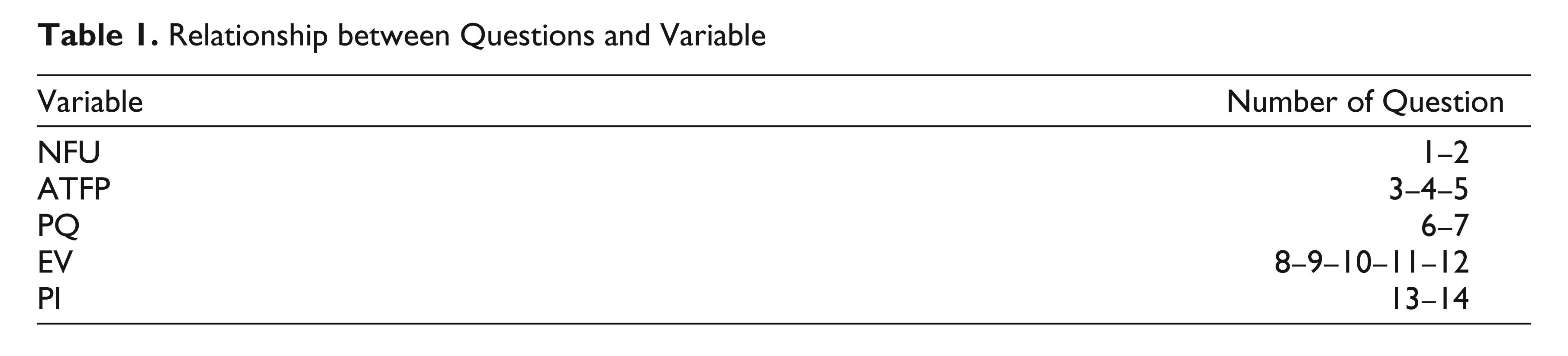
The measures used in this research consisted of self-oriented variable (that is, NFU), product-oriented variable (that is, attitudes towards foreign products), and brand-specific variables (that is, perceived quality, emotional value and purchase intention). Each item was rated on a five-point Likert scale anchored by ‘completely disagree’ to ‘completely agree’ for each of 14 questions. Chronbach’s Alpha was conducted to test the reliability of gathered data with the questionnaire. The results illustrated that the Alpha coefficient equals 0.917, which is considered acceptable as an indication of good reliability for this research. Table 1 illustrates the relationship between research variables and number of each question in questionnaire.
Relationship between Questions and Variable
Sampling
Customers of the most popular shopping centres in four cities of Iran (Tehran, Isfahan, Shiraz, Mashhad) are surveyed. As collected data demonstrated, all of the consumers surveyed, used both local and foreign brands. In this research, brands of refrigerator and vacuum cleaner were selected for surveying. For local brands of refrigerator, the brands chosen were ‘Emersan’ and ‘Golsan’, and for foreign brands, the selected names were ‘LG’ and ‘Samsung’. Furthermore, local brands of vacuum cleaner chosen were ‘Parskhazar’ and ‘Sanam’ and for foreign brands, ‘LG’ and ‘Samsung’ were selected. Since it’s not possible to ask all members of Statistical Society to fill the questionnaire, simple random sampling was used. The reason behind using this method is that we assumed that there is no difference between customers of any shop in all cities of province. What is more, customers usually visit many shops and gather sufficient information before buying anything. As a result, Statistical Society is assumed harmonized and homogeneous using the Kokran formula (for unlimited societies) so as to estimate the volume of sample. Considering value 0.05 and d = 0.0333, volume of sample is 850. In order to gather data, 478 questionnaires in Tehran, 163 questionnaires in Mashhad, 113 questionnaires in Isfahan and 96 questionnaires in Shiraz were distributed. Since the refrigerator was recognized of high importance, about 75 per cent (637) of questionnaires were devoted to customers of refrigerator and about 25 per cent (213) of questionnaires to vacuum cleaner customers.
Data Analysis and Results
Measurement Model
The research model consisted of five latent variables with 14 observed variables, which is shown in Table 2. The measurement models showed acceptable model-data fit: χ2 = 422.8, (df = 66, p < 0.001), χ2/df ratio = 6.4, comparative fit index (CFI) = .93, and root mean square errors of approximation (RMSEA) = .08. The construct validities of the latent constructs were evaluated by both convergent and discriminated validity. For home appliance brands, all path weights were significant (p < 0.001). Considering the significance of 0.05, the research model is accepted. The composite reliabilities of all constructs were greater than the minimum criteria of 0.70 (Nunnally and Bernstein, 1994), indicating adequate convergent validity (Table 2).
Measurement Items and Reliabilities for Brands

Research model is analyzed based on structural equation. Since factors employed in the model are independent in an equation, they are dependent on each other in other equations. This fact causes all equations to be interdependent and all of them should be considered simultaneously. According to the research model, the following structural models are driven:
As seen, in order to create a factor, there are some measurement factors that conform equations encompassing factors. Regarding each factor, the following equations can be defined:
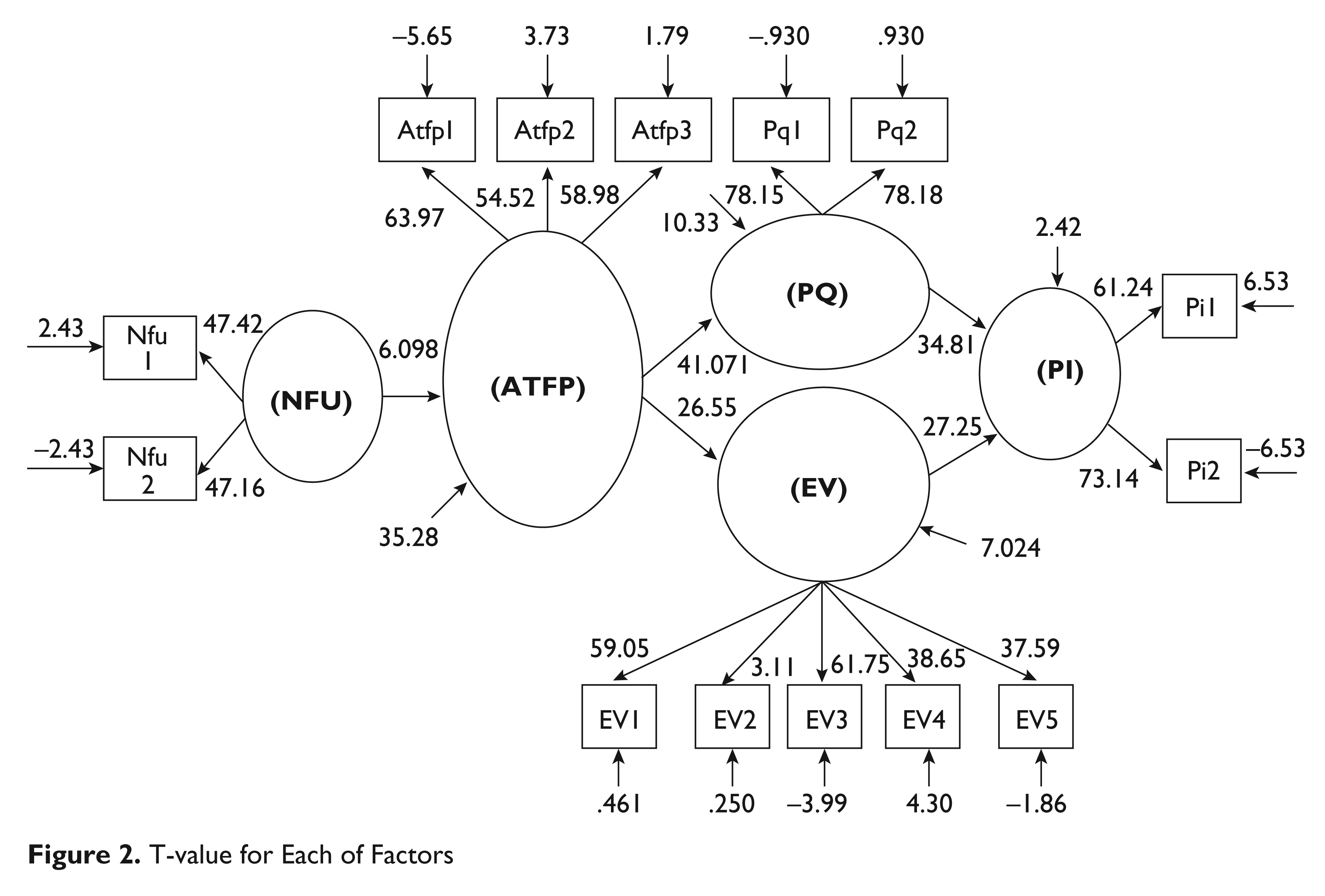
As is mentioned in Table 3 and Figure 2, the value of influence of (NFU) over (ATFP) equals to 0.176 and the value of influence of (ATFP) over (PQ) equals to 0.799.
Also, the value of influence of (ATFP) over (EV) equals to 0.688, the value of influence of (PQ) over (PI) equals to 0.794, and also the value of influence of (EV) over (PI) equals to 0.678.
Prioritizing Factors in Consumer’s Point of View
As shown in Table 4, factor (ATFP) affects factor (PQ) more than other factors due to attraction of foreign brands that causes customer recognizing them of higher quality and attract customers to buy them.
Relationship of Factors on Each Other

T-value for Each of Factors
Important Factors in Consumers’ Point of View

Conclusions and Implications
This study identified factors influencing of purchase intention towards a US versus local brand based on NFU, attitudes towards foreign products, brand perception, and purchase intention. In research model, NFU directly influenced attitudes towards foreign products. Perceived quality and emotional value were other important variables that directly influenced purchase intention. This study provides valuable implications for both existing Iranian home appliances retailers or manufacturers and US home appliance retailers or manufacturers who plan to enter the Iranian market. Regarding results attained from analyzing data according to theoretical model of research, need to be uniqueness increases orientations to foreign products and this orientation actually has a direct and meaningful relationship with perceived quality and emotional value of foreign brands. US retailers entering Iran could focus on uniqueness and perceived quality and emotional aspects of US home appliance brands in order to appeal to Iranian consumers, especially those who exhibit higher interest in home appliances. The positive relationship between attitudes towards foreign products, perceived quality and emotional value for foreign brands supports previous findings that products from developed countries are positively evaluated in terms of product quality and emotional benefits (Han and Terpstra ,1988). However, this positive relationship did not exist for a local brand but maybe it would be explained by the fact that consumers from developing countries prefer foreign brands over brands from their own country because foreign brands are associated with status symbols and quality while local brands are not (Kinra, 2006). Positive perceptions of quality and emotional value are important for the long-term success of a brand (Yoo and Lee, 2000). Therefore, it is recommended that Iranian manufacturers and retailers employ aggressive strategies to improve consumer perception of their brands in terms of quality and emotional appeal among those who have higher interest in home appliances. One strategy is to hire Iranian celebrities to endorse their brands in advertisements in order to form positive consumer attitudes towards the brand (Bhushan, 2004). Other possible strategies to improve Iranian consumers’ perception towards local brands include strategic alliances, licensing agreements, or joint ventures in order to sell under US brand names associated with higher status and quality. Such partnerships may enable local brands’ weaknesses to be balanced by US brands’ strengths. This study used two home appliance brands that are usually associated with symbolic and hedonic attributes, which may have resulted in a greater influence of emotional value on purchase intention. It is recommended for future researchers to explore other factors that probably influence the research model so as to change it in a way that leads to a more comprehensive casual model. What is more, personal preferences and the style of selecting brands differ from one country to another. So, these patterns should be localized and specialized for each society, based on their cultures and style of life.