



Abstract
Given the special characteristics of the Malaysian market, the current study aims to investigate the impact of variables from different levels (firm, industry and country) on the firms’ debt policies. Considering the dynamic nature of capital structure, the study takes the novel approach of examining three levels of determinants simultaneously with respect to time effect. To achieve this, the dataset is constructed from 171 firms listed on the Main Market of the Bursa Malaysia resulting in a total of 1026 firm-year observations within 2005–2010. The firms are from seven different sectors and 63 industries. Based on the ordinary least squares (OLS) results, growth opportunities, profitability, size, ownership, dividend, industry leverage and inflation rate have highly significant relationships with leverage. Board size and firm’s asset liquidity show 5 per cent predictive power while industry liquidity, lending rate and gross domestic products (GDP) demonstrate weakly significant influences on debt levels. Meanwhile, risk, tangibility, age, tax, industry concentration and non-debt tax shields (NDTS) represent insignificant values. Generalized method of moments (GMM) results are similar except for those of dividend and tax, which have opposite signs to the results in OLS, and profitability, firm liquidity and GDP, which lose significance compared to the OLS model. There is also evidence of firms adjusting to a target level of leverage.
Introduction
Firm’s financial structure has remained as one of the most important debates of corporate finance since its introduction by Modigliani and Miller in the 1950s. Over time, several theories have been formed and become the focus of extensive empirical studies on capital structure worldwide. Agency Cost Theory (Free Cash Flow Theory) by Jensen and Meckling (1976), Static Trade-off Theory (Tax Based Theory) by Myers (1984) and Pecking Order Theory (Information Asymmetry Theory) by Myers (1984) and Myers and Majluf (1984) are well known theories in this domain though Signalling Theory by Ross (1977) and Market Timing Theory by Baker and Wurgler (2002) can also be considered as alternative theories.
The manner in which firms balance their financial policy or fail to rebalance it over time is highly related to the firm’s capability of responding to the desires of its different stakeholders. Hence, it is necessary to understand the logic behind the formulation of the firm’s capital structure which is influenced directly and indirectly by different attributes inside and outside the company (Antoniou et al., 2002; Deesomsak et al., 2004). Although various studies have been conducted to understand the impact of different factors on financial mix of companies, only a few have been studied all levels (i.e., firm, industry and country) simultaneously with respect to time effects. While most ignored the role of the industry in their study, there were others which neglected the role of time by limiting their study to cross-sectional analysis of variables. Even among those which realized the inevitable impact of industry, the efforts were mostly limited to using dummy variables in categorizing different industries rather than considering well-characterized industry-specific factors (i.e., the only exceptions are studies by Kayo and Kimura, 2011; and MacKay and Phillips, 2005). Additionally, majority of these studies have been done in developed economies while hardly any comprehensive attention has been focused on the developing countries with the exception of the work by Kayo and Kimura (2011).
Malaysia is of interest in present study because the structure of firms in this market is different from those of most developed countries due to the strong political supports (Johnson and Mitton, 2003), significant family controls (Wiwattanakantang, 1999) and close relationships with banking institutions (Suto, 2003). Besides, although prior studies pointed to the dynamic and not static nature of capital structure decisions, majority of these studies have not been carried out in emerging markets. To our knowledge, the specification of capital structure dynamism is limited to the studies by Abdeljawad et al. (2013) and Haron et al. (2013) in Malaysia. In line with their efforts, the motivation of the current study is to analyze the influence of various factors, at different levels, on the financing structure of publicly traded firms in Malaysia while considering both the static and dynamic nature of capital structure in analyzing its determinants.
The results point to the highest predictability power of firm attributes amongst the three levels followed by industry and country characteristics, respectively. Mostly, the OLS results are confirmed by GMM model except for the divided and tax which show opposite signs and profitability, firm liquidity and GDP which lose their significance of impact. The GMM results also support the existence of a target level of leverage among Malaysian companies.
The remainder of the current article is organized as follows. The section ‘Capital Structure and its Determinants’ covers a review of relevant literature on capital structure and its determinants in three levels: firm, industry and country. Data collection, sampling and the empirical model will be described in the section ‘Research Methodology’. The section ‘Analysis and Discussion of Results’ covers the variables’ measurements and analysis results. And the section ‘Summary and Conclusion’ concludes the findings and offers recommendations for future studies.
Capital Structure and its Determinants
Since Modigliani and Miller (1958, 1963), developed theories pointed to the imperfections in the markets and the emergence of different factors’ impact in determining firm’s leverage. However, these theories (i.e., Agency Cost Theory, Static Trade-off Theory, Pecking Order Theory, Market Timing Theory and Signalling Theory) show contradicting point of view in describing the impact of particular factor on capital structure. As a matter of fact, based on the theoretical mould, each predictor can have either positive or negative impact on debt issuance.
Among pioneer works on firm level determinants, Rajan and Zingales (1995) studied the impact of growth opportunities, profitability, size and tangibility on leverage. Since then, some studies had inspected these factors in other regions (e.g., Bevan and Danbolt, 2002; Hijazi and Tariq, 2006) while others considered additional attributes as well (e.g., Huang and Song, 2006; Mahajan and Tartaroglu, 2008; Sibilvok, 2009). Along with firm-level characteristics, some studies examined industry-level determinants (e.g., Lööf, 2004; Titman and Wessels, 1988; Wiwattanakantang, 1999) though mostly failed to meet this aim thoroughly as their investigations were limited to categorizing industries based on dummy variables rather than characterizing them properly (Kayo and Kimura, 2011). Yet others worked on the influence of both firm and country level factors (e.g., Deesomsak et al., 2004; Miguel and Pindado, 2001; Pandey, 2004).
Aside from the earlier studies considering two dimensions, there were other efforts which looked at all three levels simultaneously (e.g., Frank and Goyal, 2007; Kayo and Kimura, 2011; Nivorozhkin, 2005).
Among the influential factors identified by the literature, in present study, growth opportunities, profitability, risk, size, tangibility, ownership, size of board of directors, NDTS, age, liquidity, dividend and tax appear at the firm level; industry leverage, industry liquidity and industry concentration at the industry level; and GDP, inflation rate and lending rate at the country level. Table 1 presents summarized findings of literature as well as theoretical implications in describing the relationship between each aforementioned factor and capital structure.
Capital Structure’s Theoretical Implications and Literature Findings
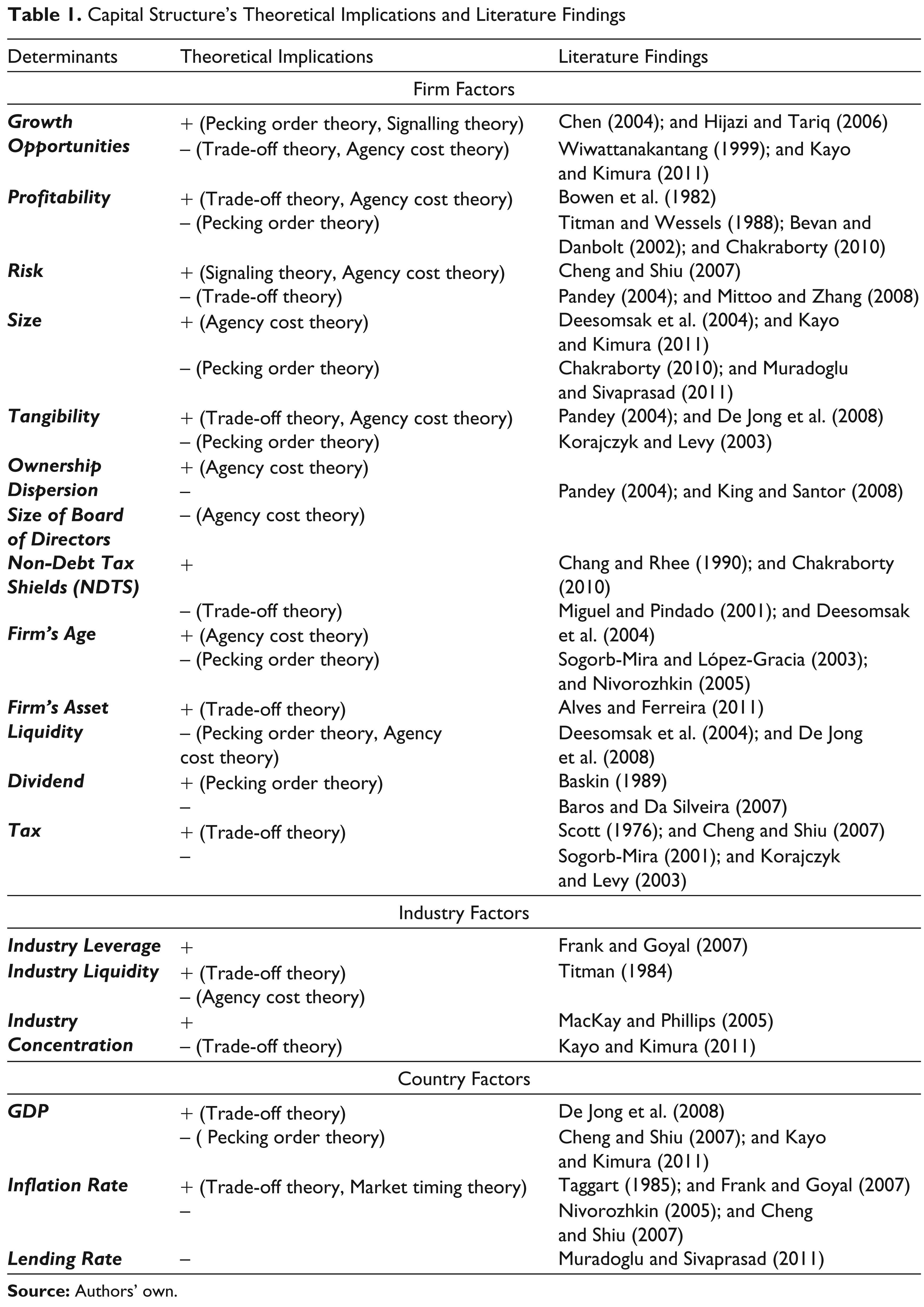
According to what was discussed earlier, lack of comprehensive study on three level determinants of leverage in developing market of Malaysia makes the specific objective of this study to assess the impact of each attribute on the capital structure of Malaysian firms, and to identify the dominant level of determinants with the strongest explanatory power in this market.
Although Myers (2003, pp. 216–217) declared that ‘each factor could be dominant for some firms or in some circumstances, yet unimportant elsewhere’, finding the similarities and differences concerning comparative efforts around the world can improve literature in studying such conditional behaviours.
Research Methodology
Data and Sampling
In current study, all listed companies in Bursa Malaysia are targeted as the main population for the construction of a panel data within 2005–2010. After dropping highly regulated sectors, that is, finance and real estate investment trust (REITS) and sectors with less than 20 companies, the sample is limited to the Construction, Consumer Products, Industrial Products, Plantation, Properties, Technology and Trade and Services sectors. Further, firms with financial year end changes, missing information and those belonging to the real estate and rental and leasing services industries are also eliminated from the sample. As a consequence, the final sample is composed of 171 companies from seven sectors and 63 industries on the Main Market of Malaysia Stock Exchange over six years, resulting in a total of 1026 firm-year observations. Using ISI Emerging Markets database and companies’ annual reports from the Bursa Malaysia website, secondary data at firm and industry levels are collected for the period of 2005–2010. 1 Country information is extracted from the Datastream database. The data are Winsorized at the 1 and 99 per cent level.
Empirical Model
It is assumed that in the absence of market frictions, firms would maintain a target level of debt when making their capital structure decisions (Flannery and Rangan, 2006). The target level should then be linearly related to the factors described in literature review and is estimated as:
where LEV*it represents firm i’s target leverage at time t, GO: growth opportunities, PROF: profitability, RISK: business risk, SIZE: firm’s size, TANG: tangibility, OWN: ownership structure, BOSI: board size, NDTS: non-debt tax shields, AGE: firm’s age, LIQ: firm’s asset liquidity, DIV: dividend, TAX: effective tax rates (ETR), INLEV: industry leverage, INLIQ: industry liquidity, INCON: industry concentration, GDP: country’s gross domestic products, INF: inflation rates, LEN: lending rates and ε: the error term.
However, in the presence of market frictions, the existence of adjustment costs may not enable a firm to adjust immediately to the target level of leverage so the adjustment is done according to the standard partial adjustment model next:
where LEVit represents firm’s leverage at time t and δit is the error term. Substituting equation (1) in (2) results in:
where αk = γβk, ρ = (1–γ), υit = γεit; ηi represents the unobservable firm effects and ηt the time-specific effects.
Equation (1) can be evaluated using OLS estimation technique with standard errors adjusted for clustering at the firm level using Rogers’ (1993) standard errors. However, to estimate equation (3) which is a dynamic panel data model, the OLS technique will create bias in the estimation. Also, profitability (PROF) and dividend (DIV) are found to be endogenous and this is dealt with using the Arellano and Bond’s (1991) GMM technique, specifically the two-step System GMM estimator.
Analysis and Discussion of Results
Measurement and Description of Variables
Table 2 represents the measurements of dependent variable as well as predictors in each level of firm, industry and country which are analyzed by OLS and GMM methods in this study.
Measurement of Variables
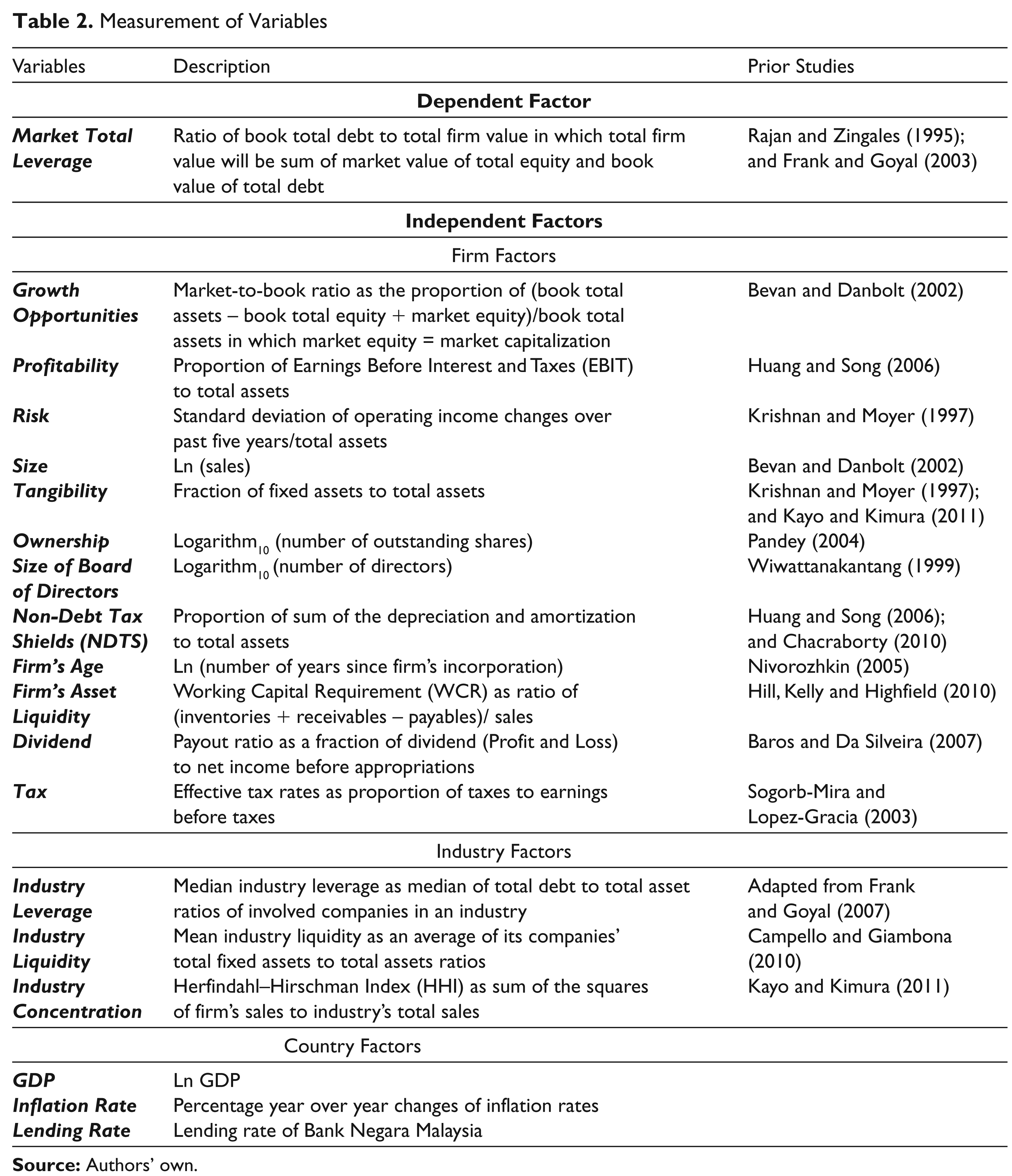
Table 3 demonstrates the descriptive analysis of the data for each variable. Panel A indicates the descriptive statistics of both the dependent and independent variables while Panel B exhibits the descriptive trends of market leverage over the study period.
Results of Panel A in Table 3 reveal that firms in the sample are ‘giants’ in the market (mean size = RM197,890,000) which are entered to their maturity phase (mean growth = 0.9546 2 ) and are paying out high dividends (mean payout ratio = 30 per cent) in low profitability levels (5 per cent mean value). The age of the companies under study averages to 21 years with minimum 6 and maximum 97 years of activity. Firms’ asset liquidity shows mean value around 42 per cent below the average industry liquidity (i.e., 21.82 versus 51.69 per cent).
The average market leverage within the whole study period amounts to 47.23 per cent which is higher than findings of similar studies in Malaysia: 11.8 per cent reported by Pandey (2001) within 1988–1999 and 26.97 per cent found by Deesomsak et al. (2004) during 1993–2001. This may indicate changes in financial strategies and appreciation of target leverages in Malaysia over time as a result of higher economic developments and more competition in the Malaysian capital markets (Suto, 2003) or the entrance of most sample companies into their maturity phase all of which encourage companies to raise their debt levels across the time. However, looking at industry leverage which indicates mean value 26 per cent below firm capital structure (i.e., 21.06 versus 47.23 per cent), it can be concluded that within each industry, excluded firms from the sample may have lower leverage ratios.
Panel B in Table 3 represents statistical trends of market leverage during the study period. While mean values show similarity in 2005–2006, along with the world economic recession, they reduce in 2007 and reach to their highest level by the end of 2008. This trend is consistent with the findings of Pandey (2001) for Malaysian companies’ debt levels after the Asian financial crisis of 1997. In years 2009–2010, these values diminish again and reach the levels even below those during the pre-recession period. By considering the two indicators of economic development, GDP and inflation rate, it is perceived that while the former results in lower debt levels (Korajczyk and Levy, 2003), the latter supports positive changes in capital structure (i.e., consistent with the findings of Frank and Goyal, 2007). The accuracy of this conjecture is confirmed by the findings reported in the results section.
Results
The regression results of leverage against the predictors are reported in Table 4. Using ordinary least squares (OLS) technique with Rogers’ (1993) standard errors’ adjustments for firm level clustering, Columns (I) through (III) indicate the relationships and significance of impact for the predictors obtained by regressing leverage against the firm, industry and country level determinants, respectively. Tests of the endogeneity of the variables show that profitability and dividend are endogenous to market leverage hence Column (IV) contains the results of GMM technique which takes into consideration these endogenous relationships.
The Table 4 indicates the dominance of firm level factors’ predictability power followed by industry and country level attributes which contribute to 40.22, 3.62 and 0.23 per cent of the overall variations in market leverage, respectively. Variations in the predictability of the different levels (i.e., firm, industry, country and time) and dominant explanatory power of firm characteristics could refer to the dynamic nature of firm attributes that show changes even in small portions of time compared to the steadier scenery of industry and country factors that require longer time periods to change (Kayo and Kimura, 2011).
Descriptive Analysis

Determinants of Capital Structure

Referring to the OLS results, growth opportunities, profitability, ownership, board size, firm’s asset liquidity, dividend, industry liquidity, lending rate and GDP have significant negative impacts on leverage (at least at the 10 per cent level). Size, industry leverage and inflation rate show significant positive influences. Age and industry concentration with insignificant negative and risk, tangibility and tax with insignificant direct relations impress upon debt levels. NDTS is found to be significant only at the 10 per cent level in presence of firm variables (Column I) but is insignificant when both industry and country factors are included. The GMM results are similar to those of OLS findings except for profitability, firm’s asset liquidity and GDP which become insignificant and tax and dividend which indicate opposite signs while dividend becoming less significant.
The lagged dependent variable is found to be highly significant in the GMM results, indicating that the firms have a target leverage which pursue with an adjustment coefficient speed of 0.40. This refers to approximately 2.5 years of adjustment to the target leverage. Study by Abdeljawad and Mat Nor (2011) documents the adjustment speed of 43.3 per cent for Malaysian firms while Haron et al. (2013) find adjustment coefficients between the range of 0.43 and 0.65 for different measurements of leverage.
Discussion of Results
Among the predictors, growth opportunities, size and dividend imply the need to use leverage as a disciplinary mechanism to control managers. Size and dividend can be seen as firm’s financial constraint measurements, too (Faulkender and Wang, 2006). A large firm with high dividend payouts and low growth opportunities ahead would have easy access to both internal and external funding. To avoid the misuse of funds by managers, debt takes on a disciplinary role in such company. Besides, costs of equity in companies with high ownership dispersion and large board sizes reduce which fade the disciplinary role of debt (Berger et al., 1997; Deesomsak et al., 2004).
The insignificant effects of age, risk and tangibility on leverage may be due to the special features of the Malaysian market. The absence of a feasible bond market and bank-based debt financing of majority firms in Malaysia reduces information asymmetry and significance of the impact of reputation—and age—on leverage. In addition, strong family controls of firms and close relationships between companies and their creditors (usually banks) decrease business risk and tangibility’s significance (Deesomsak et al., 2004). In countries like Thailand and Malaysia, banks also actively invest in firms’ shares which make it easier for them to access to external debt regardless of their tangibility and risk level. This is more pronounced in Malaysia with well-supported banks and more regulated stock markets.
Profitability shows highly significant values in OLS results which correspond to the findings by Bevan and Danbolt (2002) and Chakraborty (2010). However, it loses its significance in GMM findings which may point to the endogenous nature of this variable. Besides, alleviation of information asymmetry in Malaysian market with well-supported banking sector that sometimes plays the role of major investor mitigates firms’ reliance on internal funds and results in insignificant relationship between profitability and leverage (Antoniou et al., 2002).
Correspondingly, NDTS and tax variables show insignificant values, too. In the OLS findings, NDTS present significant impact only when firm variables are considered while turn to be insignificant when both industry and country factors are included. In the absence of industry variables in OLS and GMM models, NDTS indicate significant (10 per cent level) and insignificant values (but with p-value lower than when industry factors are considered), respectively. Dissimilarity of NDTS in different industries and higher predictability power of industry liquidity may overshadow NDTS’s explanatory impact in models including industry attributes.
The insignificant impact of tax could point to the changes in the tax system and reduction in the tax rates over the years. Prior to 2008, the ‘Imputation’ tax system was implemented in Malaysia that was changed to the ‘Single tier’ tax system in 2008. Thus, the sample firms in this study were under two tax regimes within the study period, where only the latter supports the tax advantages of debt. The reduction of tax rates from 27 per cent in 2007 to 25 per cent in 2009 reduces tax advantage of debt which may fade its significance. Besides, MacKie-Mason (1990) believed that the insignificant impact of tax on leverage may relate to the broad scope of capital structure that forms based on several years’ financial decisions in which marginal tax rates show insignificant changes in companies.
Among the industry variables, strong positive relations between industry leverage and firm’s capital structure follows the findings of MacKay and Phillips (2005) which report dissimilarities across and within industries’ leverage, supporting the notion that some industries carry higher levels of debts. With respect to industry liquidity, it can be claimed that the high probability of asset substitution in industries with higher liquidity ratios (i.e., where finding customers is not expensive) increases the cost of debt and results in companies’ lower debt issuance. In contrast to the findings by MacKay and Phillips (2005), industry concentration is found to insignificantly influence capital structure and this could be due to the monopolistic nature of most industries in Malaysia (i.e., mean HHI value of 0.2451 shown in Table 3). The negative relationship is, however, consistent with the findings of Sivaprasad and Muradoglu (2012).
Among the country variables, inflation rate and lending rate are found to have significant influences on leverage. It can be argued that when bankruptcy risk and tax costs exist, lower lending rates encourage companies to issue more debt (Deesomsak et al., 2004). With higher inflation rates, the tax advantages of debt increase and hence debt levels appreciate (Taggart, 1985). GDP is found to be significant in the OLS model but not in the GMM results. The negative relationship between GDP and leverage is in line with the Pecking Order Theory where higher generated internal funds in boom periods make debt less attractive source of funds.
Summary and Conclusion
The current study attempts to investigate the impact of firm, industry and country level attributes on leverage in Malaysia over the period of 2005 to 2010. The findings reveal that a large portion of capital structure changes is related to firm’s intrinsic characteristics while industry and country features are responsible for only 3.62 and 0.23 per cent of changes in capital structure. The study also finds the existence of a target towards which firms adjust their capital structure. In the study, GMM results are similar to OLS findings except for those of dividend and tax, which have opposite signs to the results in OLS, and profitability, firm liquidity and GDP, which lose their significance. The significance of the lagged leverage also points to the existence of target leverage.
This article has various limitations that can provide the base for future efforts. Titman and Wessels (1988) believed that finding the best measurement for unperceivable attributes can carry different errors in each research study. In the present article, the selection of variables was based on the results from former studies, which may carry some levels of such errors in analysis. The majority of industries in Malaysia contain less than 10 companies. In such industries, industrial indexes may be highly influenced by those companies which leave or join the industry over time (Sibilvok, 2009). Obviously the probability of these biases was not considered within the study. Investigation on interaction impact of the variables on leverage and different functional structures and non-linearity of factors were also not considered.
Footnotes
Acknowledgements
The authors are grateful to the anonymous referees of the journal for their helpful comments and suggestions in improving the article.