



Abstract
This research article identifies certain factors that strongly impact the work–life balance (WLB) of women employees in information technology (IT) companies in India. These factors are related to the challenges and enhancers to the professional and personal lives of 186 women working in various IT companies in India. The study also identifies the impact of social media (SM) in their work lives. Based on an extensive review of the literature, a set of 42 factors relating to WLB is grouped into five constructs, namely, professional challenges, personal challenges, SM involvement, professional enhancers and personal enhancers. Exploratory factor analysis is used to extract the highly impacting factors. The results show that the personal enhancers of WLB, such as regular exercises and fitness schedule, yoga and meditation, balanced diet as well as good sleep and involvement in the hobbies, loaded the heaviest as the most impacting factors; working from home heavily impacts as a professional enhancer in the WLB of women. The second heavily loaded component is comprised of personal challenges, such as inadequate self-attention, insufficient time spent on elders and children, feeling depressed or suffering with hypertension along with a professional challenge of extended or odd working time. We find that irrespective of challenges or enhancers, personal factors are perceived to be more impacting than the professional ones. Interestingly, the study shows that SM involvement has no significant impact. It is neither considered as a challenge nor an enhancer to the WLB.
Keywords
Introduction
Work–life balance (WLB) is the ability to experience a sense of control and to stay productive and competitive at work while maintaining a happy, healthy home life with sufficient leisure. It is attaining focus and awareness, despite seemingly endless tasks and activities competing for the time and attention of the employees. Employers, employees and governments want to maximize participation in the workforce. However, in our demanding lives, many people struggle to balance work and the responsibilities of caring for children, family members with a disability or elderly parents. Indian families are undergoing rapid changes due to the increased pace of urbanization and modernization. Indian women belonging to all classes have entered into paying occupations. WLB of women employees has become an important subject in today’s world, where both men and women equally share the responsibility of earning for the betterment of their family life (Doble & Supriya, 2010). Hence, it is really necessary to recognize how the women balance their professional and domestic life. Employers need to work out the schemes that would not only attract and retain the employees for a longer period but also make them highly productive. Organizations have many such facilities like transport, canteen, day care centres, postal/saving schemes, flexible working hours, part-time working, and special leave arrangement, such as annual leave and public holiday leave, career break leave for elective representative, leave to attend as witness at court in your organization, health care centres, rewards and recognition, career growth, insurance plans, job rotation, incentives, performance-related pays, rest rooms and other government schemes, such as maternity, marriage, sick leave benefit and medical benefits (Shuklaa & Bhandari, 2014). Chugh and Sahgal (2007), in their study on the leadership prospects for women managers, state that one of the challenges is about striking a balance in their professional and personal lives. Moreover, organizations have women empowerment schemes, such as forums, committees, grievance redressal system and suggestion schemes, where a woman is empowered to share her views, complaints and suggestions to the top management and derive solutions for the same. Such schemes serve the women employees to work peacefully without any kin, child’s tension so that they are able to give their best at work.
But many organizations in India need to implement these schemes which enhance the WLB of employees. As the organizations are basically the profit-driven entities, they are rarely bothered about the personal life and work satisfaction issues of the employees. Thus, they are least concerned at their level with work–life satisfaction. Organizations have the workforce in abundance and as long as an employee is ready to do three people’s work, they do not bother about the consequences the employees may face with this stressful work atmosphere. Though women workforce is found in all fields, their participation in the information technology (IT) industry is quite high (Narayanan & Narayanan, 2012). Unlike other sectors, this fast growing business sector is purely knowledge-driven. Hence, they do not discriminate on the basis of gender. As a result, there are a significant number of women employees in this sector. The National Association of Software and Services Companies (NASSCOM) survey reveals that 38 per cent of the employees are women (Santhi & Sundar, 2012). When compared to the manufacturing sector, IT industry includes all knowledge-based activities. Both men and women are attracted by this rising sector for the lucrative pay. Only this job requires profound contribution at job environment, psychological attachment of mind and good physical fitness. In that respect, it is also a pressure to dispatch the project on time due to cut-throat competitors. Besides this, they accept to solve for both Indian and foreign companies/clients/projects which require different work climate, timings, etc., that leads to work–life imbalance in this sector. Mishra, Bhaskar and Khurana (2007), in their study on developing a scale for measuring the employees’ perception, conceptualized change as a response by an organization to internal and external happenings. These changes impact the WLB of employees.
This article comprises of seven distinct and sequential sections. The introductory section presents the complete background of the study, the next section reviews the existing literature about the work carried out on WLB of women working employees. After reviewing the literature, it is found that though considerable research knowledge is present in WLB, relatively less content is found in the application of WLB studies to women employees in the IT companies operating in India. The third, fourth and fifth sections, respectively, give the objectives, rationale and methodology, including the theoretical framework and the assumptions of the study. The sixth section presents the analysis, which includes the descriptive analysis, reliability test and the results of the exploratory factor analysis (EFA). The seventh section is the conclusion, and it consists of the recommendations, limitations and future directions of the study.
Review of Literature
In this section, we understand in detail how WLB of women employees can be impacted by a wide range of personal and professional factors based upon review of past articles published in reputed journals and magazines. The following paragraphs bring out an extensive review of the related work. Based on the literature review, certain critical directions for research are drawn which are listed below.
WLB and its impact on women employees.
Determinants of WLB from a personal and professional perspective.
Family life is becoming more complex. The concept of extended family is slowly disappearing even in India (Patel, 2005). Small nuclear families have come to stay, where both the spouses go to work. In addition, there is an increasing number of single parent households due to increase in divorces (Amato, 2003). Although this problem is not as serious in India as in the West, yet it could become a serious issue sometime in the future. Women continue to shoulder the bulk of the domestic chores and responsibility pertaining to raising children (Mitnick, 2006). These synchronous changes in work and family life result in a need for employees to continuously attempt a balancing act. Quite often, the work intrudes on the family and social life, while at other times family pressures affect the work performance (Fu & Shaffer, 2001; Nabong, 2012; Reddy, Vranda, Ahmed, Nirmala & Siddaramu, 2010). The literature of WLB is replete with discussions on the lack of effective policies, underutilization of WLB programmes, job satisfaction, performance management, organizational commitment, productivity and other related concepts. Indian organizations have to do a lot to treat WLB practices as strategic aspects of organizational performance and effectively communicate about the availability of different WLB practices; further, family contributes extensively to work in terms of enhancing the performance and positive emotions at workplace (Bhargava & Baral, 2009). Firms that adopt better WLB policies can improve the level of job satisfaction and increase the organizational commitment among their employees (Bloom & Van Reenen, 2006). Professionals view flexible workplace schedules as a key to employee retention and place this working condition at the top in order to control employee attrition (Jain, 2009). Selvarajan, Cloninger and Singh (2013) have studied the cross-domain indirect relationship between social support in the work domain and family interference with work conflict and between social support in the family domain and work interfering with family conflict. The study found that the social support systems in the work domain, such as family friendly organizational policies, family supportive organizational climate and perceived organizational support were significant. A case analysis on labour–management partnership brought out certain profound recommendations; among others are WLB employee involvement in welfare administration and certain socialization initiatives, such as family get-togethers, organizing picnics, festival celebrations and sports events (Ramaswamy, 2009). Wu, Rusyidi, Claiborne and McCarthy (2013) have examined the relationships between WLB and several job-related factors among 573 public child welfare workers. The findings demonstrate that the job-related factors, organizational support, job value, work time and income are significantly associated with WLB among child welfare workers. WLB is partially mediated. Süß and Sayah’s (2013) findings show how to reduce the existing research gap by presenting findings of an exploratory study of contract workers. These findings show that on the one hand contract working is challenging the individual WLB when it comes to long working hours, absences from home due to travel and flexibility requirements regarding time and place of work. On the other hand, for some, individual contract working offers the possibility to work flexibly with regard to time and place and, therefore, enables a better reconciliation of work and private life. Jin, Sha, Shen and Jiang’s (2013) findings show how public relations practitioners cope with work–life conflict. Findings report strong preferences in using more proactive conflict, coping strategies, such as rational action and positive thinking. Women and those with a graduate degree tend to report more coping behaviours than others. Three types of stresses are identified as sources of work–life conflict: behaviour-driven, work-driven and life-driven. Laharnar, Glass, Perrin, Hanson and Anger (2013) have studied about workplace intervention on a national employee benefits, Family and Medical Leave Act (FMLA), and evaluated the effectiveness of the intervention on supervisor knowledge, awareness and experience with the FMLA. The study reveals that the lack of supervised training and knowledge of an important but complex employee benefit exposes a serious impediment to effective policy implementation and may lead to negative outcomes for the organization and the employee. Keeney, Boyd, Sinha, Westring and Ryan (2013) have shown that the purpose of the research is to move beyond work–family conflict (WFC) to a broader conceptualization and measurement of work interferes with life. The findings show that work interference with life demonstrated incremental validity above and beyond work interference with family with respect to job satisfaction, turnover intentions, life satisfaction and mental health. The results of relative importance analyses are presented for the same outcomes. Adkins and Premeaux (2012) have studied the linear and quadratic effects of work–family and family–work conflicts. The findings indicate that working hours are linearly related to WFC and with family–work conflict (FWC) it was curvilinear. Work hours and a dimension of the FW care moderated by managerial support. Number of children moderates the relationship between work hours and WFC. Ma and Yin (2012) have examined the relation between work and life orientation. Four profiles or orientation are identified, namely, work, life, integration and disengagement. It is interesting to note that WLB ranked low as a factor for employee engagement in public sector undertakings while pay, job content and objectivity were strong predictors (Mohapatra & Sharma, 2010).
Work interference in personal life and vice versa has found significant differences. Valk and Srinivasan (2011) and Messersmith (2007) have studied on how work- and family-related factors influence the work–family balance of Indian women IT professionals based on an exploratory qualitative study on 13 women IT professional. They identified six major themes, namely, familial influences on life choices; multi-role responsibilities and attempts to negotiate them; self and professional identity; work–life challenges and coping strategies; organizational policies and practices; and social. Minnotte, Gravelle and Minnotte’s (2013) study addresses whether work-to-life conflict mediates the relationships between workplace characteristics and psychological distress for workers who experience heightened stress in the workplace. The findings indicate that work-to-life conflict mediates the relationship between job pressure and supervisor support and psychological distress. Griggs, Casper and Eby’s (2013) study examines the relationships between support from work, family and community domains with time- and strain-based WFC. Results reveal significant within-domain and cross-domain relationships among supports from all three life domains with WFC. With respect to family support, support for children was associated with lower time- and strain-based family interfering with work and extended family support was associated with lower strain-based work interfering with family (Lakshmi & Gopinath, 2013). Panisoara and Serban (2013) have examined the impact of marital status on WLB. The study found that unmarried, married without children, married with children under 18, married with children over 18 years, did not have a significant level of WLB. Baral and Bhargava (2010) have studied to find the experiences of working men and women in various organizations of India. In a study of 485 employees working in varied organizations in India, it is found that working men and women in India experience more work family enrichment than the WFC. It has also been found that there are no gender differences in the employee perception of work family enrichment. Braunstein-Bercovitz, Frish-Burstein and Benjamin (2013) have studied to examine the personality types associated with resilience and WFC of the mothers of young children. The findings have shown that personality type is related to burnout and life satisfaction, a relationship which is only partially mediated by work interference in family conflict and family interference in work conflict. Kong’s (2013) study aims to explore the relationships among work–family supportive supervisors, career competencies, job involvement and job satisfaction. The findings indicate a positive relationship between work–family supportive supervisors and career competencies. Career competencies contribute positively to job involvement and job satisfaction (Rani, Kamalanabhan & Selvarani, 2011; Rehman & Roomi, 2012). This study provides insights into how managers of human resources can retain qualified staff and increase the job satisfaction of employees. Hochschild (2003) studied the preferences of working men and women and found that there is an inevitable temptation to use the promotion of WLB policies to enhance commitment to the organization.
Research Objectives
The nature and professional routine of the IT organization has become a global concern with regard to the WLB for its employees. Coping up with different time zones, 24/7/365 nature of fast-paced digital operations contributed to this concern. Ironically, technology has added to the speed of operation, rather than easing the work practice. Employees in this knowledge industry are expected to work long hours and cope with deadlines. The study on the workaholic tendency of employees identified certain characteristics of the job profile like daily routine challenges and extended office hours. These are closely associated with the IT industry because of its international service scope which majorly is aligned to the international working hours (Sharma & Sharma, 2013).
The main aim and objective of this study is to find out how women employees, especially those belonging to the IT sector, balance their professional and personal aspect. The objective is studied considering their demographic aspects in relation to a set of factors considered to be challenging and enhancing the WLB in professional and personal aspect. The objectives can be enlisted as follows:
To identify and analyze the professional and personal-related factors challenging the WLB among working women in the IT companies. To identify and analyze the professional and personal enhancers relating to WLB among working women in the IT companies.
Today’s world literally does not go to sleep. With all the above-mentioned concerns regarding WLB, this study focuses on researching on certain key professional and personal challenges and enhancers to WLB for women employees in the IT industry. The following are the research questions under consideration.
How does the profession or work-related factors influence the WLB of women employees in the IT companies?
How do personal/home-related factors influence the WLB of women employees in the IT companies?
What are the different initiatives to ensure WLB from both professional and personal perspectives of working women in the IT companies?
Rationale of the Study
Work–life balance is an issue of strategic importance to organizations and of significance to employees especially for women employees (Fleetwood, 2007; Varatharaj & Vasantha, 2012). We believe that an individual’s life can be considered unbalanced when the amount of time one works causes some sort of conflict or stress in other areas of life. The choices people make about their priorities can cause conflict with bosses, co-workers and/or family members (Dubey, Saxena & Bajpai, 2010). Awareness and action of an organization with respect to implementing WLB strategy hinges around the need to attract and retain valued employees in a highly competitive labour market. A good WLB is a key to employee effectiveness and satisfaction.
The purpose of this research is to study the WLB of women working in the IT sector operating in the city of Pune. The study has been done to find out the impactful factor, affecting the WLB of women employees. Forty-two factors have been identified which have been distributed under five constructs of professional challenges and enhancers, personal challenges and enhancers and social media (SM), respectively. The study is conducted with a perspective, where the personal and professional challenges and enhancers for the WLB are compared and analyzed through the experiential platform of the sample group of the women employees working in various IT companies. Though the study has revealed that the personal and professional enhancers are the impactful factors influencing WLB, the challenges are also equally significant while the SM has the least impact on WLB. The proposed study has been presented with a wide array of factors affecting WLB that can help the individual employee to explore her values, aspirations and goals to understand what she expects from work and life and then develop the suitable ways of balancing work and life. It would help her to negotiate her roles within the organization and family. It would enable her to introspect on her job, ways of coping and relationship management.
Methodology
For the purposes of research, convenience sampling is used. Convenience sampling is used in exploratory research where the researcher is interested in getting an inexpensive approximation of the truth regarding the WLB of women employees with reference to the IT companies at Hinjewadi, in Pune city. As the name implies, the sample is selected because they are convenient. This non-probability method used for this research is only a preliminary effort to get a gross estimate of the results, without incurring the cost or time required to select a random sample. A total of 186 women working in IT companies constitute the sample size. The responses are collected by means of structured questionnaires. The collected samples are tabulated and graphically represented for further analysis.
Proposed Theoretical Model
The theoretical model presented in this study is drawn from the works of Fisher-McAuley, Stanton, Jolton and Gavin (2003). From their work, we understood that WLB is impacted by the roles an individual plays. We broadly define these roles in professional and personal facets. These facets are filled with challenges as well as enhancement avenues to which individuals attempt to devote their time and energy during their pursuit to balance work and life. Over the last decade, there is immense research interest visible in the impact of web 2.0 and SM in the work life and job satisfaction. We are motivated to add this dimension also to our theoretical model based on the work of Haeger and Lingham (2014). The resultant theoretical model is given in Figure 1.
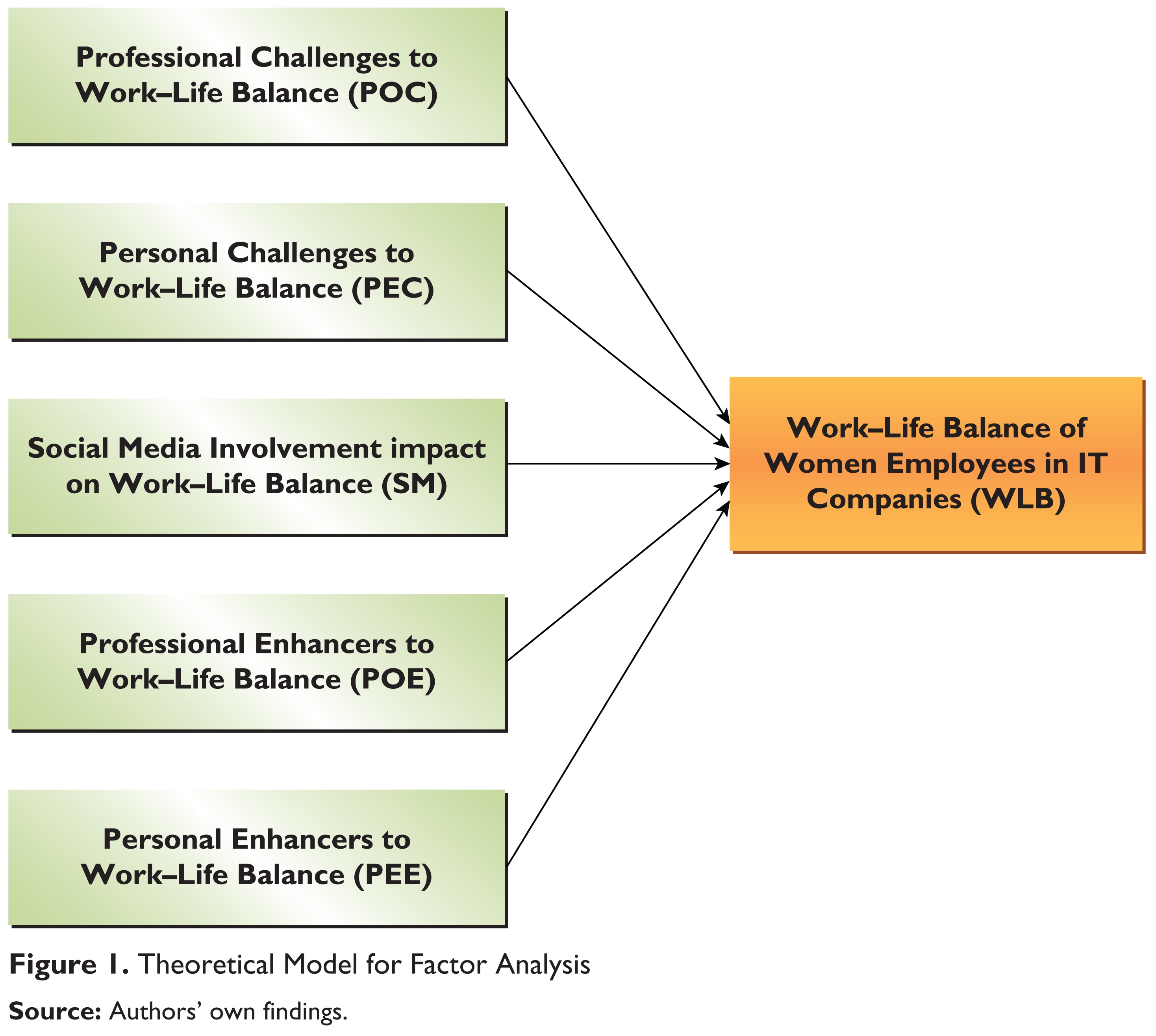
The WLB constructs presented in the theoretical model are explained in the subsequent paragraphs.
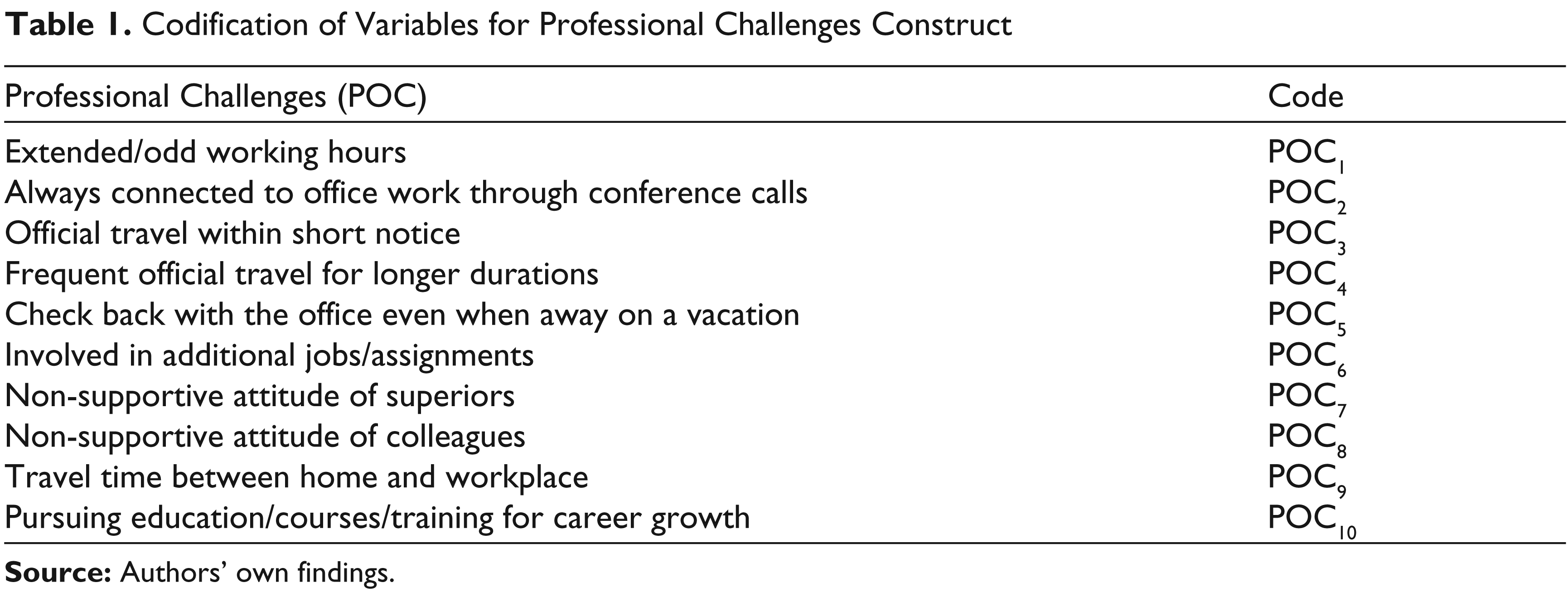
Professional challenges to WLB (POC) can be defined as the different aspects of work interfering with personal life. The challenges mean that personal life is suffering because of organizational and job-related factors resulting in the individual’s neglect of personal life. Employees find it difficult to work, experience both work and non-work activities, finding sufficient time for non-work activities and missing on personal activities. Some of the variables included in the professional challenges construct are codified as given in Table 1.
Codification of Variables for Professional Challenges Construct
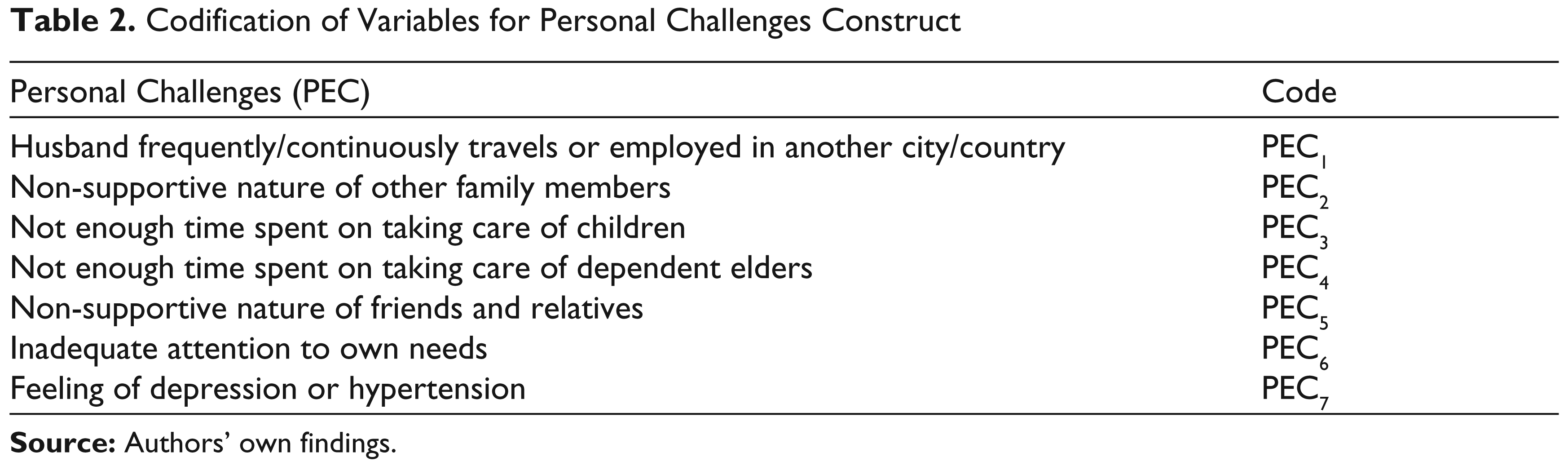
Personal challenges to WLB (PEC) focus on factors that are defined as those set of factors that impact the WLB from a personal perspective. They may be triggered from family, home and self-resulting in less or inadequate support from family to professional life. These factors can also impact an individual’s productivity in the workplace and professional career. The variables forming part of personal challenges construct considered in this study are tabulated in Table 2.
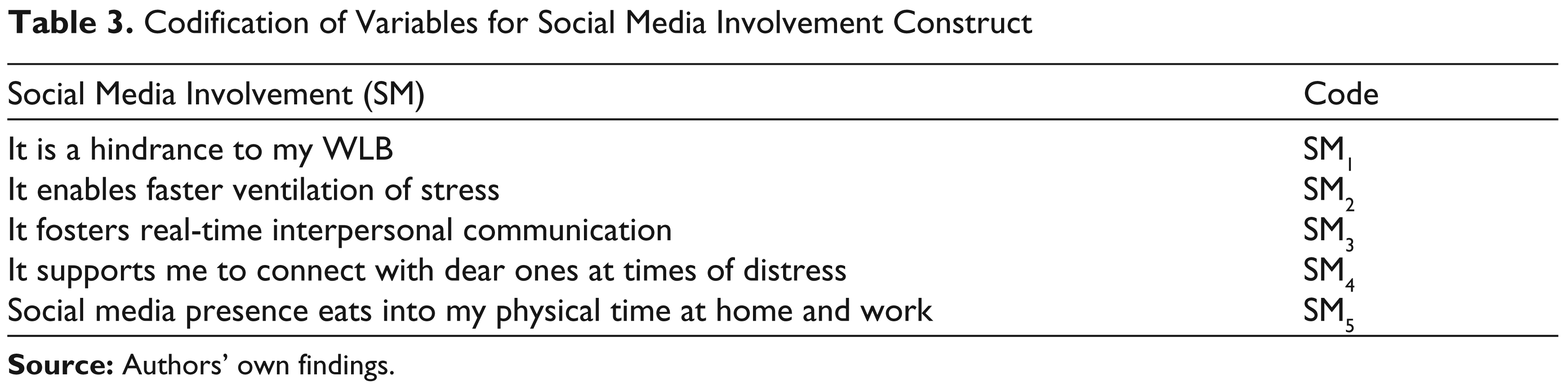
Social media (SM) are a group Internet-based application that builds on the ideological and technological foundations of web 2.0 and that allow the creation and exchange of user-generated content. The article on the challenges and opportunities of SM defined what is and what is not SM, and brought out certain key opportunities and challenges of SM, namely collaborative projects, blogs, content communities, social networking sites, virtual game worlds and virtual social worlds (Kaplan & Haenlein, 2010). The involvement of individuals in SM in terms of time spent, content sharing and seeking, networking can influence the WLB. Social media tools, such as Facebook, Twitter, LinkedIn and YouTube can come a long way in impacting the WLB of individuals. In this study, Table 3 presents the factors considered to analyze the impact of SM construct on WLB.
Codification of Variables for Personal Challenges Construct
Codification of Variables for Social Media Involvement Construct
Codification of Variables for Professional Enhancement Factors Construct
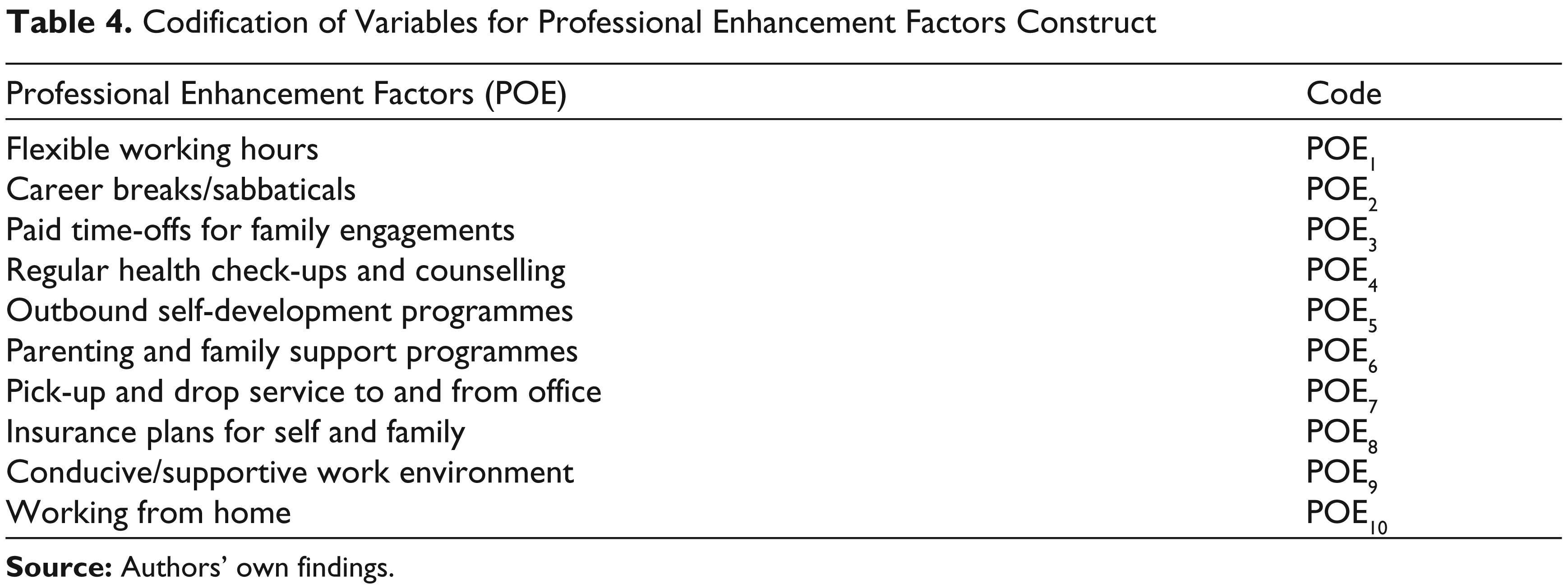
Professional enhancers to the WLB (POE) are defined as those organizationally driven factors that can facilitate and support employees to experience a favourable environment to balance their work and personal life. These factors mainly focus upon certain best practices that the organization imparts to enhance the quality of work life. Improving the quality of work life can enhance employee productivity (Bhal, 2002). Some of the factors considered in analyzing the professional enhancers are given in the Table 4.
Personal enhancers to WLB (PEE) can be defined as those factors which emerge of the individuals’ personal relationship/involvement, including his family, friends, society, personal routine, etc. Some of the relevant factors considered in this study for validating the construct of PEE are presented in Table 5.
Codification of Variables for Personal Enhancement Factors Construct

Assumptions of Study
Based on the survey conducted, the following assumptions can be drawn in the study.
The various personal and the professional enhancers as well as the challenges are assumed to influence the WLB of the women employees in the IT companies.
Social media are also assumed to have a deep impact on the aspect of WLB.
To maintain a healthy WLB there may be several other challenges and enhancers but the most essential ones are considered for the study, which impacts the performance of the women employees at work and home fronts.
Most of the respondents are assumed to be ‘married women’.
Analysis
Descriptive Analysis
Out of the 186 women employees who have taken part in the survey, a majority of 96 per cent is constituted by women who are less than 40 years of age with less than 10 years of work experience. Sixty-nine per cent of the sample is doing technical jobs in IT companies and only 13 per cent of the sample engages in managerial jobs. Interestingly, about 18 per cent of the employees are doing jobs which are techno-managerial in nature. The proportion of top management employees of the sample is only 1 per cent, while a majority of the employees belongs to the operational level profiles (66 per cent) and middle management profiles (33 per cent). In the sample, 79 per cent of the employees work for 40–50 hour per week and only 21 per cent work for 50–60 hours per week. Married women employees constitute 73 per cent of the sample and unmarried employees constitute 24 per cent. There are three each of divorcees and widows in the total sample of 186 women employees. It is found that 63 per cent of the sample’s husbands are also employed in IT organizations which reinforce the relevance of WLB study for women employees in this industry sector. A majority of the family composition of the samples is found to be nuclear comprising of self, husband and children (62 per cent of the sample). Forty-nine per cent of the samples have only one child and 38 per cent of the samples have no children in this study.
Now, with respect to the constructs of the study in the professional challenges to WLB, the top three agreeable factors (score >3.75 out of 5) are found to be factors such as extended/odd working hours, travel time between home and workplace and involvement in additional jobs and assignments. In the personal challenges to WLB, the top three agreeable factors (score >3.50 out of 5) are found to be inadequate attention to own needs, not enough time spent on taking care of dependent elders, and feeling of depression and hypertension. In the SM involvement of employees and WLB, the top three agreeable factors (score >3.5 out 5) are that the SM involvement enables to connect with dear ones at times of distress; it enables faster ventilation of stress; and it fosters real-time interpersonal communication. All the professional enhancement factors to WLB have a highly agreeable score from the respondents (>4 out of 5). The top three factors among them are conducive and supportive work environment, flexible working hours and working from home. In the personal enhancement factors to WLB, out of 10 factors chosen for the study, eight factors have a highly agreeable score of more than 4 out of 5. The top three agreeable factors are understanding and supportive family and friends, balanced diet and sufficient sleep and supportive and caring husband.
Reliability and Validity Statistics

Data Reliability and Validity Test
The reliability test is conducted to find the extent to which a variable or a set of variables is consistent in what it is intended to measure (Hair, Anderson, Tatham & Black, 1998). For the measurement of both stability and consistency, test of the reliability of a measure is critical (Wiklund, 1999). Chronbach’s alpha is calculated from the average intercorrelations among the items measuring the concept. The closer Chronbach’s alpha is to 1, the higher the internal consistency or reliability (Downing, 2004; Green, Lissitz & Mulaik, 1977; Hair et al., 1998). The validity of the variable reflects the extent by which the differences in scores among objectives reflect the objects’ true differences related to the construct that is sought to be measured (Hair et al., 1999). The reliability of a variable is a necessary, but not a sufficient condition for its validity. Validity can never be established unequivocally, but can only be inferred either by direct assessment or indirectly by assessing the reliability (Dubey, Bag, Ali & Venkatesh, 2013).
The reliability score of the data collected to analyze for the purpose of this project is 0.90 as given in Table 6 confirming that the data collected is highly reliable. As the questions are very relevant, the respondents could very well understand the questions. The responses are formatted in Likert’s scale so that the questionnaires are not time consuming.
The selection of appropriate tools and collection of data have been given careful consideration. The tools to collect data, description of the variables investigated and scoring procedures have been explained. The sampling technique used for this research and the sample size for data collection and analysis are also presented. The tools and the statistical techniques employed for data analysis have also been explained.
Factor Analysis
The collected data are subjected to exploratory factor analysis (EFA) after entering through Statistical Package for the Social Sciences (SPSS). The EFA is conducted to know which challenge or enhancer has the most and least impact on the women employee of the IT companies personally and professionally. For extraction of the factors, we use the combination of principal component analysis (PCA) with varimax rotation (orthogonal type). This combination is useful because it considers both the unique and common variances (values of 1s in the correlation matrix diagonal, supports the extraction of maximum variance, number of extremely loaded variables are minimized and makes it possible to identify a variable with a factor (Exploratory Factor Analysis [EFA], 2014; Rao, 1964; Shlens, 2014). In the following paragraphs, we present the analysis in two phases, that is, preliminary and final.
The first step in EFA is the preliminary analysis which includes the test of sample adequacy test and the correlation matrix. The sample adequacy test which is known as the Kaiser–Meyer–Olkin measure of sampling adequacy (KMO-test) is a convenient option in SPSS, which enables the researcher to check whether the sample is big enough for conducting a factor analysis. In most of the researches, it has been seen that it is acceptable if the KMO value is greater than 0.5. The anti-image matrix of correlations and covariance of all the elements on the diagonal of this matrix are greater than 0.5 which justifies the sample adequacy (Field 2000, 2009). The Bartlett’s test of sphericity is used to determine whether the correlation matrix in the factor analysis is an identity matrix. In other words, Bartlett’s test of sphericity is performed to check the intercorrelation which ‘tests the null hypothesis that the original correlation matrix is an identity matrix’ (Field, 2000). It should be noted that there will no correlations between the variables if the correlation matrix is an identity matrix. The determinant value is greater than 0.00001, which is arrived through the determinant of the correlation matrix, and then multicollinearity does not exist (Field, 2000). Bartlett’s test of sphericity, which is usually done before factor analysis identifies if the data comes from a multivariate normal distribution with zero covariances. The null hypothesis is that the population correlation matrix is and identity matrix or the covariance matrix is diagonal in nature. If the Bartlett’s chi-square value is not significant and positive, it is advised not to use factor analysis because the variables will not be loaded together properly (Pett, Lackey & Sullivan, 2003; Rummel, 1967). The KMO value of 0.702 is comfortably adequate and the chi-square value out of the Bartlett’s test is found to be significantly positive for the data contained in all the 42 variables comprised in the five constructs of the WLB study, namely POC (10 variables), PEC (seven variables), SM involvement (five variables), POE (10 variables) and PEE (10 variables). The values of KMO and Bartlett’s test are presented in Table 7.
The correlation matrix is used to track if there are any pairs of variables with high intercorrelation. If so, it can be inferred that such a pair represent the same underlying variable (Rietveld & Van Hout, 1993). The correlation matrix has two important implications during factor analysis. They are intercorrelation between the variables and also that the degree of such relatedness is not too high (leading to multicollinearity or singularity). Such extreme cases will dilute or nullify the unique contribution of each variable to the factor. The extent to which a variable correlates with the other variable is found through communalities. The communalities (refer Appendix, Table A1) show high values of extraction (>0.500), which means that all the 42 variables are eligible for factor rotation and they will be comfortably loaded on any factor (Anastasiadou, 2011; Field, 2000). Moreover, the communalities also indicate the internal consistency which also relates to construct validity (Jakobsson, 2011).
Finally, we present the interpretation of the output from the PCA based on the values derived from ‘Total Variance Explained’ and the ‘Rotated Component Matrix Value’ for all the variables to be explained in WLB. Based on the component grouping of the factors, their relevance and impact to WLB has been explained (Tables 8 and 9).
KMO and Bartlett’s Test

Components Extracted with Eigenvalues and Total Variance
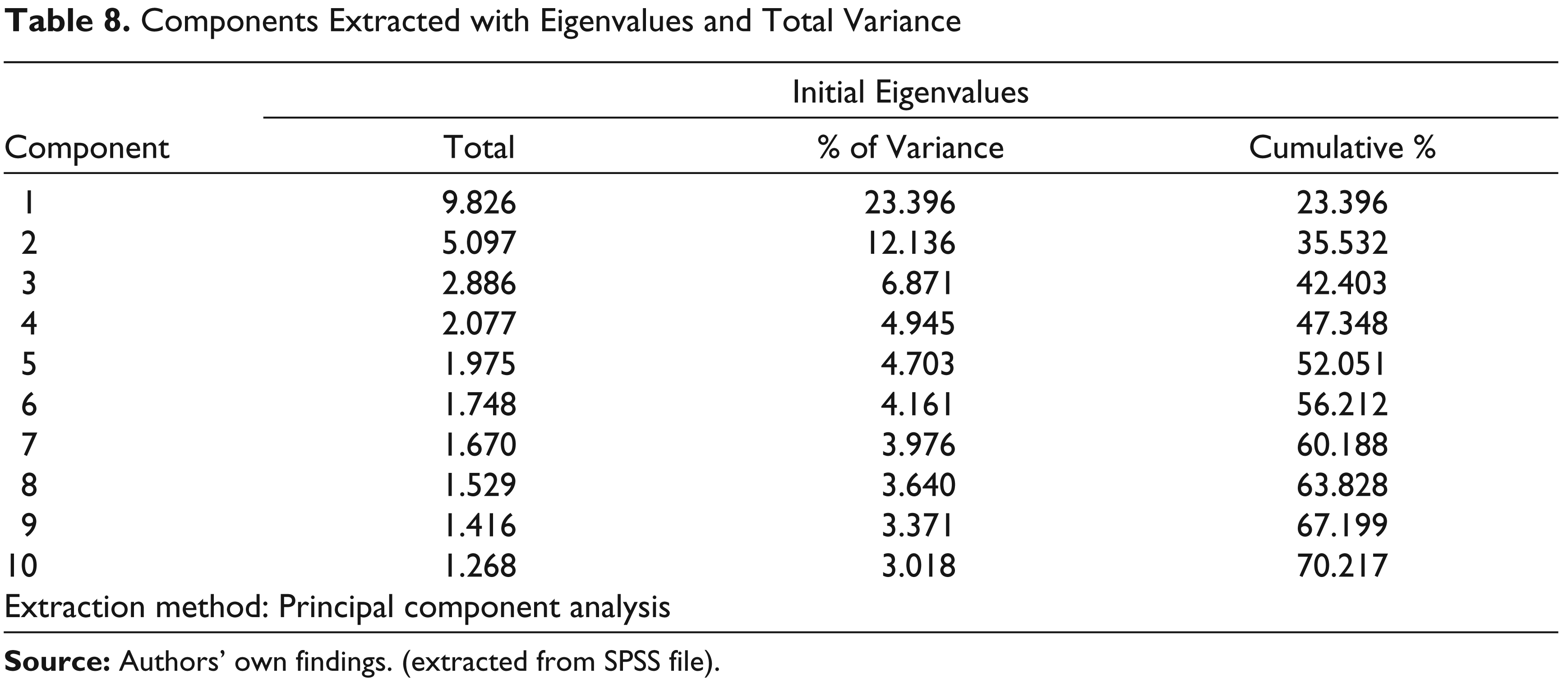
Table Showing Total Variance Explanation (Rotated Component Matrixa)

Extraction method: Principal component analysis; Rotation method: Varimax with Kaiser Normalization.
aRotation converged in 10 iterations.
The graphical representation of the components extracted with their eigenvalues is presented in Figure 2.

The factor loading columns in Table 9 show that the variables within each factor are highly correlated. Irrespective of the sample size, it is very desirable to have loading values of 0.500 and above to ensure convergent validity (Jakobsson, 2011).
The 10 extracted components with the variables in the combination of professional and personal challenges and enhancement, SM involvement together constitute 70.217 per cent of the total variance which indicates the strong impact of these components of the WLB of women employees in the IT companies. Component 1 accounts for 23.396 per cent of the variance and it is comprised of five variables all of which are enhancement factors for WLB which create the strongest impact. These factors are critical for understanding WLB and it can be inferred that the respondents’ level of awareness about these factors is the highest. The component 2 comprises of five factors, all of which are challenging to WLB and account for 12.136 per cent of the total variance. We infer that the respondents strongly agree to the fact that these challenges can impact their WLB to a high extent. Component accounts for 6.871 per cent of the total variance and it comprises of six enhancement factors. The respondents are quite aware that these enhancement factors can keep them balanced with the personal life and professional work. Component 4 constitutes 4.945 per cent of the variance and comprises of two challenge variables. Component 5 constitutes 4.703 per cent of the total variance and comprises of three variables of which two are enhancement variables. Component 6 constitutes 4.161 per cent of the variance and comprises of three variables of which two are enhancement variables. Component 7 constitutes about 3.976 per cent of the total variance and comprises of four variables all of which relate to the awareness of SM involvement in WLB. Component 8 constitutes about 3.640 per cent of the total variance and comprises of three variables all of which are personal challenges to WLB. Component 9 constitutes about 3.371 per cent of the total variance and comprises three factors, all of which are challenging to WLB. Lastly, component 10 constitutes 3.018 per cent of the total variance and comprises of two factors which are professional challenges.
Conclusion
Thus balancing the work life of a woman employee in an IT company is a challenge for IT leaders, managers and attracts the attention of researchers. As IT profession is a knowledge-based profession, it needs abundant application of knowledge which has to be updated in accordance with the recent developments to keep the company ahead in the competition. Due to this, irrespective of the gender, the employees work for long hours without sufficient breaks, making it very difficult for the women employees from an Indian context to balance their personal and professional lives life.
Though the study has been confined to only one section of the total population, that is, women employees of IT industry, the results of the study have, in fact, opened up several avenues for further research in the aspect of WLB. There is immense scope for research on this topic in India. In India, consequent to exploding human population, the quality of the work environment has been deteriorating, despite many focused efforts. The root cause for such a distressing situation can be traced to the inclusion of only limited concepts of WLB in the company agenda, and ineffective operational process by the managers, due to lack of adequate knowledge and training of the same.
The sample comprises female respondents only, which means that the study does not hold the perspective of WLB from a male’s point of view. As the data is collected only from the female employees of IT companies in Pune city, this study is limited only to the IT organizations. It may not hold good for other types of organizations. The study is conducted under the assumption that the information given by the respondents is authentic and there is a minimum bias in responding to the questionnaire.
This study reveals that from among the constructs, namely, personal and professional enhancers and challengers and SM involvement, the most impactful components influencing the WLB are the personal enhancers, such as regular exercises, yoga and meditation, proper sleep and diet and pursuing of hobbies, while the professional enhancer of work from home and flexible timings hold the topmost position as the strategies to maintain a healthy WLB. Following this, personal challenges, such as insufficient time for self, inadequate care for the elders and the children at home and feeling of depression or hypertension, constitute the components that heavily impact WLB. The professional challenge of extended or odd working hours also adds to the weightage of the impacting components. Interestingly, SM does not impact the WLB. Some more options, such as short travel time, supportive environment—both at home and work place—job rotation and working in the designated hours have been recommended by the respondents for a healthy WLB. The authors strongly believe that the challenge of effecting a change rests with the attitude of the employers and the employees towards each other, who will be responsible for improving the WLB of future employees and ensure a safe and happy workplace.
Footnotes
Appendix
Communalities

| Initial | Extraction | ||
| POC1 | Extended/odd working hours | 1.000 | 0.682 |
| POC2 | Always connected to office work through conference calls | 1.000 | 0.744 |
| POC3 | Official travel within short notice | 1.000 | 0.764 |
| POC4 | Frequent official travel for longer durations | 1.000 | 0.786 |
| POC5 | Check back with office even when away on a vacation | 1.000 | 0.726 |
| POC6 | Involved in additional jobs/assignments | 1.000 | 0.699 |
| POC7 | Non-supportive attitude of superiors | 1.000 | 0.749 |
| POC8 | Non-supportive attitude of colleagues | 1.000 | 0.760 |
| POC9 | Travel time between home and workplace | 1.000 | 0.629 |
| POC10 | Pursuing education/courses/training for career growth | 1.000 | 0.528 |
| PEC1 | Husband frequently/continuously travels or employed in another city/country | 1.000 | 0.619 |
| PEC2 | Non-supportive nature of other family members | 1.000 | 0.776 |
| PEC3 | Not enough time spent on taking care of children | 1.000 | 0.731 |
| PEC4 | Not enough time spent on taking care of dependant elders | 1.000 | 0.709 |
| PEC5 | Non-supportive nature of friends and relatives | 1.000 | 0.773 |
| PEC6 | Inadequate attention to own needs | 1.000 | 0.759 |
| PEC7 | Feeling of depression or hypertension | 1.000 | 0.707 |
| SM1 | It is hindrance to my WLB | 1.000 | 0.656 |
| SM2 | It enables faster ventilation of stress | 1.000 | 0.687 |
| SM3 | It fosters real-time interpersonal communication | 1.000 | 0.667 |
| SM4 | It supports me to connect with dear ones at times of distress | 1.000 | 0.642 |
| SM5 | SM presence eats into my physical time at home and work | 1.000 | 0.659 |
| POE1 | Flexible working hours | 1.000 | 0.641 |
| POE2 | Career breaks/sabbaticals | 1.000 | 0.619 |
| POE3 | Paid time-offs for family engagements | 1.000 | 0.628 |
| POE4 | Regular health check-ups and counselling | 1.000 | 0.708 |
| POE5 | Outbound self-development programmes | 1.000 | 0.731 |
| POE6 | Parenting and family support programmes | 1.000 | 0.732 |
| POE7 | Pick-up and drop service to and from office | 1.000 | 0.729 |
| POE8 | Insurance plans for self and family | 1.000 | 0.756 |
| POE9 | Conducive/supportive work environment | 1.000 | 0.533 |
| POE10 | Working from home | 1.000 | 0.688 |
| PEE1 | Regular exercises and fitness schedule | 1.000 | 0.842 |
| PEE2 | Yoga and meditation | 1.000 | 0.839 |
| PEE3 | Balanced diet and sufficient sleep | 1.000 | 0.887 |
| PEE4 | Involvement in hobbies | 1.000 | 0.673 |
| PEE5 | Supportive and caring husband | 1.000 | 0.677 |
| PEE6 | Understanding and supportive family members and friends | 1.000 | 0.645 |
| PEE7 | Availability of reliable and consistent servant maid (outsourced domestic help) | 1.000 | 0.619 |
| PEE8 | Proximity and availability of reliable crèche facility for children | 1.000 | 0.720 |
| PEE9 | Participation in spiritual and cultural activities | 1.000 | 0.696 |
| PEE10 | Participation in social work | 1.000 | 0.675 |
Extraction Method: Principal Component Analysis.
Acknowledgements
The authors are grateful to the anonymous referees of the journal for their extremely useful suggestions to improve the quality of the article.