



Abstract
Transformational leaders inspire their followers to exert more than their normal share of efforts and demonstrate unflinching loyalty towards the organizational goals. Although previous studies have reported positive influence of transformational leadership on employee’s affective organizational commitment and their contextual performance, the process by which transformational leadership influences the affective commitment and contextual performance has not yet been adequately studied. Hence, the present study will empirically investigate one such mediator’s (meaningful work) role in explaining the relationship between transformational leadership and the two job outcomes. This study includes a sample of 480 IT professionals working in several IT firms across India. SPSS 18 was used for data analysis and interpretation. Results of the present study reported a significant positive effect of transformational leadership on follower’s affective organizational commitment and contextual performance. The findings of this study also reported meaningful work partially mediating the relationship between transformational leadership and affective organizational commitment and contextual performance. The implications of the findings, limitations of the study and its scope for future research are also discussed.
Keywords
Introduction
Transformational leadership has received a great deal of attention from both researchers and management practitioners in past few decades. The popularity of this form of leadership can be judged from the fact that more than half of the leadership studies in past two decades include neo-charismatic school of leadership (Bryman, 1992). Transformational leadership is radically different in its approach from all the previous leadership theories as it engages followers in a meaningful manner which ensures both the achievement of organizational goals and the personal growth of the follower. In this relationship, both the leader and the follower transcend to a higher level of motivation and morality (Bass, 1985). Burns (1978) in his book Leadership has also reiterated that the singular feature that separates transformational leadership from all other forms of leadership is its ability to motivate followers to pursue goals beyond their self-interests.
Transformational leadership has been found to be positively linked with outcomes both at individual level and at organizational level (Kirkpatrick & Locke, 1996). In past 30 years, a number of studies have shown significant positive relationship between transformational leadership and desirable organizational outcomes like job satisfaction of subordinates (Hater & Bass, 1988; Ross & Offermann, 1997), job commitment (Ekeland, 2005), perceived justice (Pillai, Schriesheim & Williams, 1999), organizational citizenship behaviour (Podsakoff, MacKenzie, Moorman & Fetter, 1990), individual performance (Waldman, Bass & Einstein, 1987), collective performance (Hoffman & Jones, 2005), quality and quantity of performance (Kirkpatrick & Locke, 1996) and work unit effectiveness (Lowe, Kroeck & Sivasubramaniam, 1996) etc.
Transformational leadership arrests the commitment of their followers towards the organizational goals by linking the self-identity of their followers with the organizational identity. This newly found identity inspires the individual follower to stay loyal towards the leader as well as the organization. In other words, a deep and profound connection emerges among the follower, the leader and the organization (Bass & Riggio, 2006). This connection instils a sense of emotional commitment in the employee towards both the leader and the firm. Previous studies have also reported significant relationship between transformational leadership and affective organizational commitment (Chandna & Krishnan, 2009; Ramachandran & Krishnan, 2009).
Bass (1985) in his book Leadership and Performance beyond Expectations has mentioned how transformational leaders inspire followers to achieve more than ordinary by making them realize their true potential. Transformational leadership emphasizes on a relationship-based performance which includes ethical practices, cooperation, healthy competition and unselfish approach towards goal attainment (Bass & Riggio, 2006). Previous studies have explored the association between transformational leadership and their employee’s extra role behaviours which although officially not demanded yet is very much desirable (Podsakoff, MacKenzie & Bommer, 1996).
Several studies have reported of transformational leadership’s positive influence on follower’s job outcomes like job-related attitudes, job behaviours and performance, yet quite less is known about the process through which transformational leadership exerts its effects (Conger, 1999; Sivanathan, Arnold, Turner & Barling, 2004). Similar demand for future investigation of the underlying processes through which transformational leaders influence their followers’ job outcomes has been made by many researchers (such as Shamir, House & Arthur, 1993; Yukl, 1999). In his study, Yukl (1999, p. 287) has explicitly mentioned about the ambiguity related to the mediating processes through which transformational leaders’ influence their followers and urged for future empirical studies to shed more light on the intervening process. One such process by which transformational leaders positively influence followers’ job outcomes is by helping them attach meaning to their work. Transformational leaders motivate their followers to relook at their job by elevating the status of the job from being boring, repetitive and menial into something more meaningful and significant. This ascendance of their job as something important and its contribution to overall organizational vision is what arrests their commitment and inspire them to exert more extra role efforts.
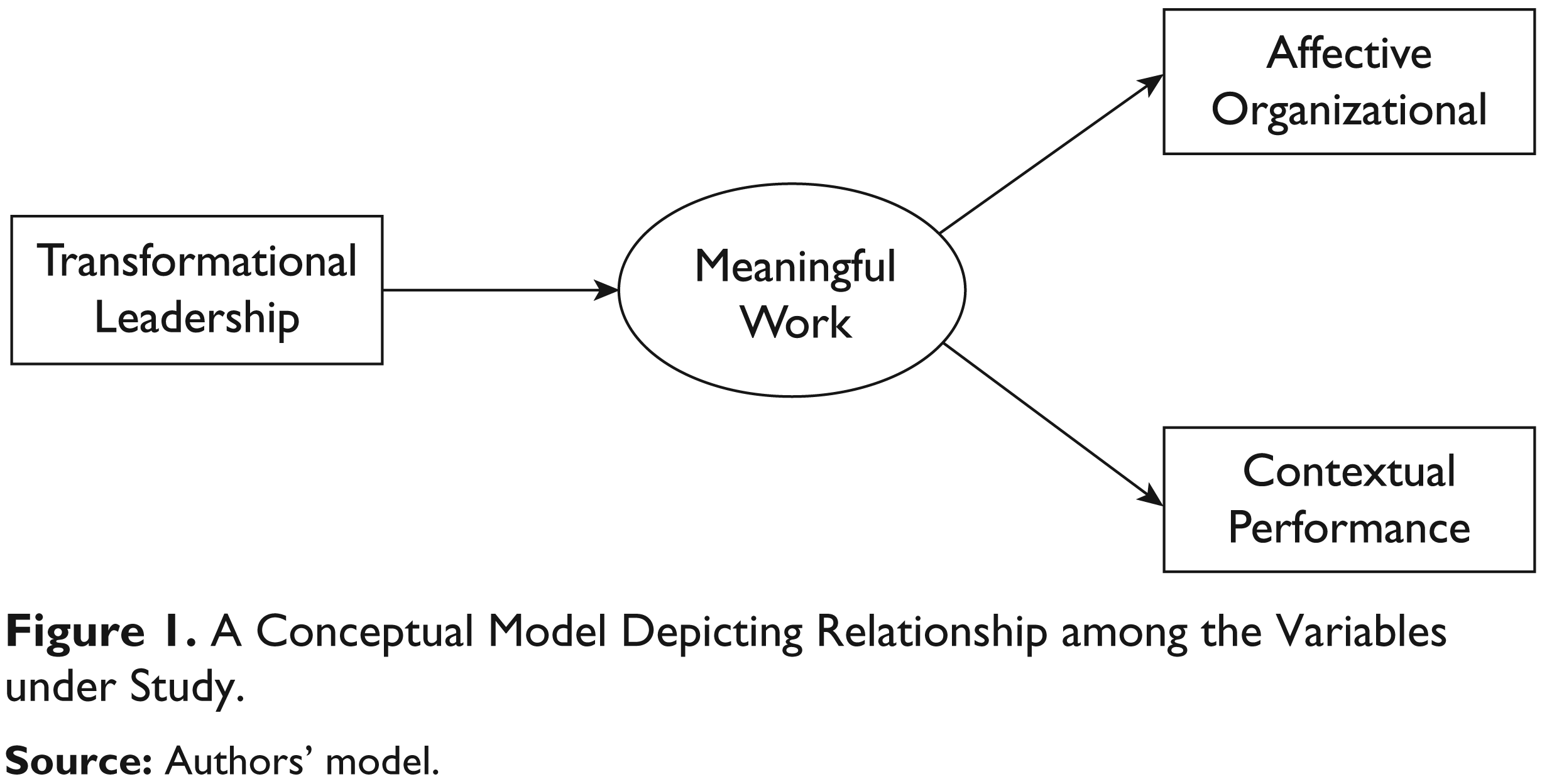
Hence, this study will test the indirect effect of transformational leadership on followers’ affective organizational commitment and contextual performance as mediated through followers’ perception of meaningful work (refer to Figure 1).
Review of Literature
Transformational Leadership and Job Outcomes
Previous empirical studies and meta-analyses indicate positive relationship between transformational leadership and followers’ performance at all the three levels, that is, at individual, group and organizational level (Howell & Hall-Merenda, 1999). Some meta-analytic reviews (e.g., Dumdum, Lowe & Avolio, 2002; Fuller, Patterson, Hester & Stringer, 1996; Lowe, Kroeck & Sivasubramaniam, 1996) have also reported positive relationship between transformational leadership and various job outcomes such as job satisfaction, job commitment and employee performance. In the following section, we discuss the effect of transformational leadership on job outcomes like affective organizational commitment and contextual performance.
Transformational Leadership and Affective Organizational Commitment
According to Popper, Ori and Ury (1992) the defining characteristic of transformational leaders is their ability to secure subordinate’s commitment towards the organizational goal. A transformational leader creates meaning in otherwise mundane activities, a meaning that arrest subordinates’ commitment towards the organization’s goals. Transformational leaders act as a catalyst which translates subordinates’ motivation to commitment and their commitment into extraordinary performance.
In a recent study, Mert, Keskin and Bas (2010) found transformational leadership to positively affect organizational commitment of the followers. Tseng and Kang (2008) also found a significant positive relationship between transformational leadership and organizational commitment. Rai and Sinha (2000) have found similar linkage between supervisor’s transformational leadership style and subordinate’s organizational commitment in Indian non-banking sectors.
Meyer and Allen (1997) defined affective commitment as the emotional attachment of an employee to an organization; such an attachment leads the employee to identify with the vision and mission of the organization. Several empirical studies have reported positive association between transformational leadership and employee’s affective commitment (Bycio, Hackett & Allen, 1995; Rhoades, Eisenberger & Armeli, 2001). Few of the studies in Indian context have also recorded significant relationship between transformational leadership and affective commitment (Chandna & Krishnan, 2009; Ekeland, 2005).
In their cross-cultural study, Ramachandran and Krishnan (2009) found that transformational leadership is positively related to normative commitment in both India and China but such a linkage is not present in case of US, while transformational leadership was found positively related to affective commitment in the US and India but not in case of China. The present study will supplement the findings of previous studies that have reported positive linkage between transformational leader and employee’s affective commitment.
Transformational Leadership and Contextual Performance
In today’s competitive business world an employee is expected to do more than his/her share of work, by engaging in positive activities which are not explicitly mentioned in one’s job description (Borman & Motowidlo, 1993; Motowidlo & Van Scotter, 1994; Van Scotter & Motowidlo, 1996). These extra role behaviours, also called contextual behaviours, include voluntarily helping peers who are lagging behind, acting amiably so as to maintain good working relationships, exerting extra effort for the timely completion of a task, introducing a new employee to his/her work and work culture etc.
Burns (1978) defined transformational leadership as the process of pursuing collective goals by linking the motives of all the concerned parties. Transformational leaders exhort their followers to exert more effort, and to look beyond their own vested interests so as to take the collective performance beyond expectation (Grant, 2012). Several research findings in the area of transformational leadership have shown that leaders who articulate a powerful vision have positive effect on the employee attitude, providing them role clarity, and facilitate extra-role behaviour in their employees (Bass, 1985; Burns, 1978; Conger & Kanungo, 1987; House, 1977; Podsakoff et al., 1996). One key attribute of a transformational leader is the ability to display self-sacrificial behaviours for the organization (Choi & Mai-Dalton, 1999; De Cremer & Van Knippenberg, 2002). Studies suggest that transformational leaders’ self-sacrificial behaviours influence followers so much that they imbibe and demonstrate similar self-sacrificial behaviours (Choi & Mai-Dalton, 1999).
Transformational leaders exhort their followers to focus on collective goals rather than individual goals, which results in higher degree of collaboration and cooperation among the members (Cavazotte, Moreno & Bernardo, 2013).
Transformational Leadership, Meaningful Work and Job Outcomes
Transformational leadership has been associated with followers’ attitudes, behaviours and performance at both individual and collective level (Avolio, 1999; Kirkpatrick & Locke, 1996). Yet, there are certain doubts about the intervening process by which transformational leader influence their followers (Conger, 1999; Yukl, 1999). In their study, Shamir et al. (1993) has postulated about the series of mediating mechanisms that explain transformational leaders’ effect on follower’s job outcomes. These mediating mechanisms include follower’s self-concept which is intertwined with their collective identity and thus motivate them to achieve more for their group or organization. Most of the transformational leadership literature is unequivocal about the leader’s role in raising followers to ‘higher levels of morality’ (Burns, 1978), activating followers’ ‘higher order needs’ (Bass, 1985; Yukl, 1999) and altering their ‘needs, values, preferences, and aspirations by appealing to ideological values’ (Shamir et al., 1993). This conceptualization of transformational leader’s effect, in other words, is mediated by the followers’ perception of meaningful work. Followers’ transformation occur when they link their work with ‘higher purposes’ that goes beyond mere financial gain (Bass, 1985; Podsakoff et al., 1996; Yukl, 1999). In their empirical study of multi-level marketing organizations, Sparks and Schenk (2001) have demanded further investigation of other higher order needs like meaningful work as a mediator affecting the relationship between transformational leadership and job-related outcomes. Similar demand has been forwarded by Tummers and Knies (2013), who, in their study of public sector employees, have explored the mediating role of meaningful work on the relationship between LMX and various job outcomes. The theoretical assumptions and previous empirical investigations urge further testing of the meditational role of meaningful work on the relationship between transformational leadership, affective organizational commitment and contextual performance.
Research Objectives
The study will serve two purposes: First, to investigate the direct influence of transformational leadership on the followers’ affective organizational commitment and their contextual performance. Second, the study will also attempt to explain the indirect influence of transformational leadership on the two job outcomes through followers’ perception of meaningfulness of work.
The three objectives formulated based on the gap areas identified from the literature review are
To assess the influence of transformational leadership on followers’ affective organizational commitment. To test the impact of transformational leadership on followers’ contextual performance. To explore the mediating role of meaningful work on the relationship between transformational leadership and the two job outcomes, that is, affective organizational commitment and contextual performance.
Rationale of the Study
Previous studies have also supported our assertion that transformational leadership positively affects the followers’ emotional commitment (affective organizational commitment) towards the organization by linking their self-identity with the organizational identity. This linkage of one’s core self-concept and self-identity with a larger cause or purpose arrest their commitment towards both the leader as well as the organization (Ramachandran & Krishnan, 2009). Similarly, transformational leadership encourages their followers to engage in pro-social behaviours which go beyond the normal call of duty. This demonstration of pro-social or extra role behaviours leads to performance beyond expectation (Bass, 1985; Podsakoff et al., 1996). But, the intervening mechanism by which the transformational leaders achieve such a feat is quite unclear and unexplored (Conger, 1999; Yukl, 1999). The rationale of this study is to investigate whether an employee’s meaningful work perception can explain the influence of transformational leadership on job outcomes like affective organizational commitment and contextual performance.
Method
Research Design
This study was conducted to investigate the predictive relationship between transformational leadership and job outcomes like affective organizational commitment and contextual performance and the extent to which their relationship is mediated by an employee’s perception of meaningful work. This study is quantitative, as reliable questionnaires were used to collect data from the participants (i.e., IT professionals). The data was collected only once from the respondents and was analyzed with the help of SPSS 18.0. The unit of analysis for this study was at individual level.
Sample
The subjects of this study were IT professionals working in private information technology (IT) companies located in several Indian cities like, Bhubaneswar, Kolkata, Hyderabad, Chennai and Bangalore. Out of 900 survey questionnaires sent to the HR managers of the respective companies to distribute and collect the filled up questionnaires from their software professionals, only 564 (i.e., 62.67 per cent) were returned. After rejecting the incomplete questionnaires, 480 (i.e., 53.33 per cent) subjects were retained for the purpose of study.
Out of the 480 subjects, 345 subjects (i.e., 71.9 per cent) were males, while 135 (28.1 per cent) were females. The average age of the respondents was 26.82 years. Of the total of 480 respondents, 371 subjects (i.e., 77.3 per cent) were single, while 109 subjects (22.7 per cent) were married. 254 respondents, that is, 52.9 per cent of respondents, were graduates who had completed their BE/B Tech/BSc, whereas 226 respondents were postgraduates having completed MSc/MTech/PhD etc. The number of respondents who had less than 2 years of experience was 141 (i.e., 29.4 per cent), while the number of respondents who have more than 2 years of experience were 339 (70.6 per cent). The largest sample was collected from Hyderabad which had 152 subjects (31.6 per cent), followed by 108 (22.5 per cent) from Bhubaneswar, 82 (17.0 per cent) from Kolkata, 78 (16.2 per cent) from Chennai and 60 (12.5 per cent) from Bangalore.
Measures
Multifactor Leadership Questionnaire by Bass and Avolio (1990) was used to assess the extent to which employees attribute transformational leadership to their superior. The scale has four dimensions: (i) idealized influence (attitude and behaviour), (ii) inspirational motivation, (iii) intellectual stimulation and (iv) individualized consideration. This questionnaire has 20 items capturing the four dimensions of transformational leadership. The Cronbach’s alpha of this scale was 0.95. A questionnaire developed by Arnold, Turner, Barling, Kelloway and McKee (2007) based on the original Workplace Spirituality Scale (WSS) by Ashmos and Duchon (2000) was used to measure the extent by which an employee experiences meaningful work at office. The scale has six items and has Cronbach’s alpha value of 0.76. To measure the affective organizational commitment, Meyer and Allen’s (1991) Affective Organizational Commitment Scale was used. The scale has eight items. The Cronbach’s alpha of this scale was 0.85. The Motowidlo and Van Scotter (1994) CP scale was used. The scale has 15 items. The Cronbach’s alpha of this scale was 0.90. Hence, all the scales fulfil the reliability criteria of alpha coefficient more than 0.70 (Garson, 2010; Nunnally, 1967).
Conceptual Model
Results
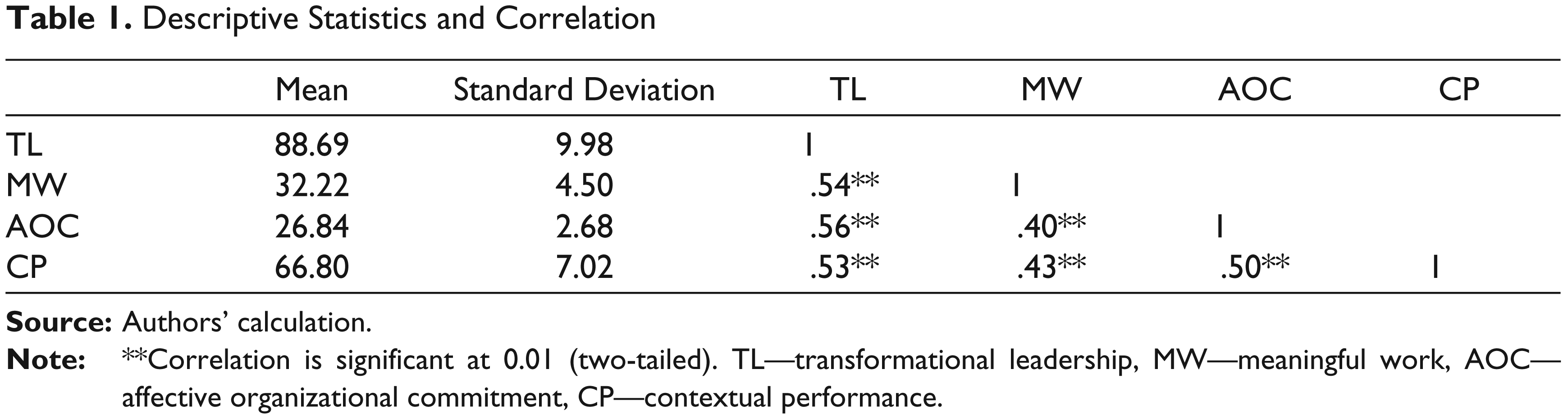
Several statistical analyses were performed to satisfy some critical assumptions underlying regression analysis. Data cleaning and screening were conducted to check for normality, linearity, homoscedasticity and multicollinearity and to ensure that the standards of these assumptions were satisfied. According to Tabachnick and Fidell (2007), if the percentage of missing data is above 5 per cent of the total collected data, it may pose problems later. In order to find the missing data, descriptive statistics were used. Less than 5 per cent of data were found to be missing and the missing values were replaced with suitable modal numbers. The data were then checked for outliers (both univariate and multivariate). Hair, Black, Babin and Anderson (2010) argue that outliers, in general, influence the mean and inflate the standard deviations and cannot be considered problematic. By exploring the Mahalanobis distance for the dataset, four cases of multivariate outliers were determined and addressed. In this study, Pearson correlation was analyzed in order to determine linearity between all of the measures. All the independent variables are significantly correlated to the dependent variables. The normality of the data is tested with the help of the values of kurtosis, skewness, and the Kolmogorov–Smirnov and Shapiro–Wilk tests. The data showed that some of the variables are moderately skewed; however, this was not found to be a problem for the regression analysis given the large sample size (n = 480) in the study (Hair et al., 2010; Pallant, 2007). Table 1 shows the correlation among transformational leadership, affective organizational commitment, contextual performance and meaningful work.
Table 1 presents the inter-correlation among the four variables used in this study. The table shows that transformational leadership is positively correlated with affective organizational commitment (r = 0.56, p < 0.01), and contextual performance (r = 0.53, p < 0.01). The correlation value of transformational leadership and meaningful work is r = 0.54, p < 0.01.
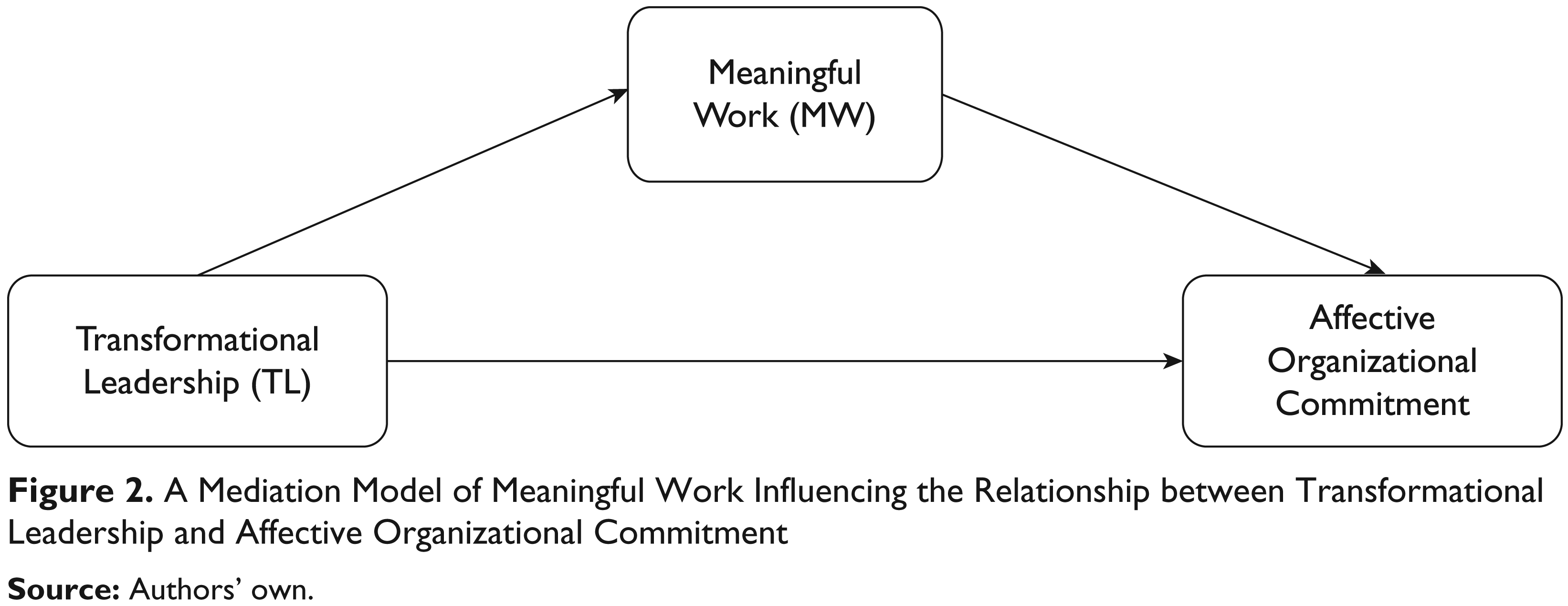
To test the meditational effect of meaningful work on the relationship between transformational leadership and affective organizational commitment (refer to Figure 2), Baron and Kenny’s (1986) ‘causal four step approach’ was adopted.
Descriptive Statistics and Correlation
Regression Analysis for the Mediated Effects of Meaningful Work
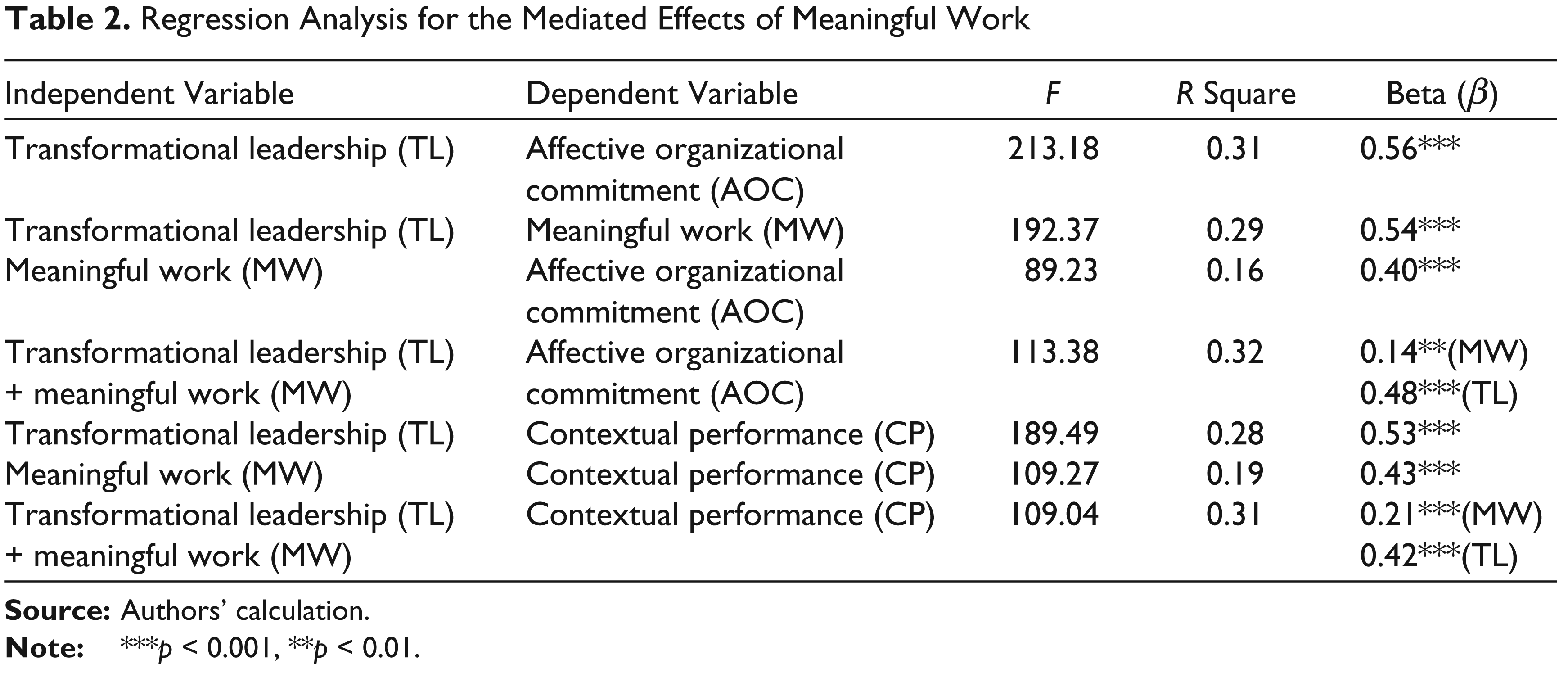
The first step involves verifying the presence of direct effect between the independent variable (transformational leadership) and the dependent variable (affective organizational commitment). The results of affective organizational commitment when regressed on transformational leadership, is presented in the Table 2, which shows transformational leadership was significantly and positively related to affective organizational commitment (β = 0.56, p < 0.001). In the second step, meaningful work was regressed on transformational leadership and the results shows a significant and positive relationship between the two variables (β = 0.54, p < 0.001). Hence, the results support main effects of transformational leadership on meaningful work. The third step involves regressing of affective organizational commitment on meaningful work. The result is presented in Table 2, which confirms the postulated relationship. The result indicates that meaningful work has a significant and positive relationship with affective organizational commitment (β = 0.40, p < 0.001).
In the final step, affective organizational commitment was regressed on transformational leadership and meaningful work. When mediation variable, in this case meaningful work is introduced into the equation, the β coefficient of the relationship between transformational leadership and affective organizational commitment remains significant but reduces (β = 0.48, p < 0.001) and the β coefficient of the meaningful work remained significant (β = 0. 14, p < 0.01). This confirms the partial mediation effect of meaningful work on the relationship between transformational leadership and affective organizational commitment.
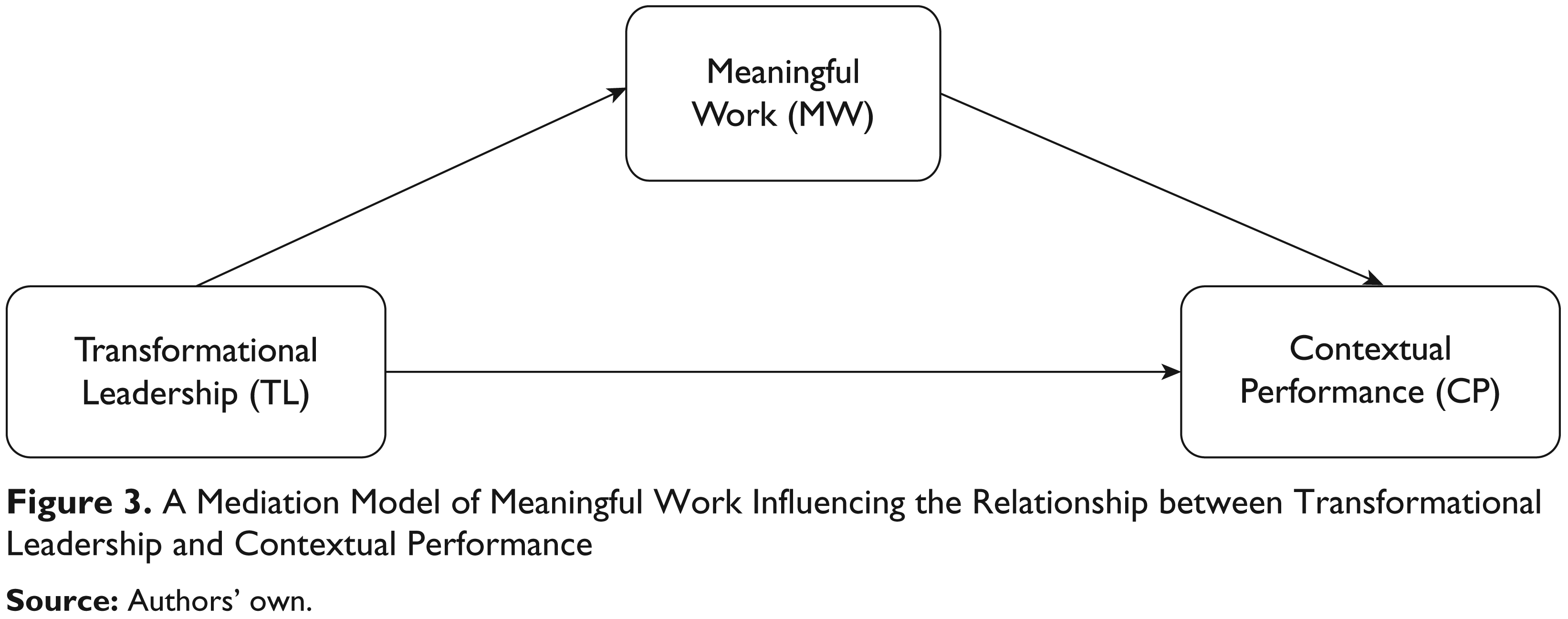
A similar four-step mediation analysis as proposed by Baron and Kenny (1986) was used to test the meditational role of meaningful work on the relationship between transformational leadership and contextual performance (refer to Figure 3). The first step is regressing contextual performance on transformational leadership. The results presented in Table 2 show that transformational leadership significantly and positively affect contextual performance (β = 0.53, p < 0.001). The second step involves regressing meaningful work on transformational leadership. The result shows a significant and positive relationship between transformational leadership and meaningful work (β = 0.54, p < 0.001). The third step of the mediation analysis involved the regressing of contextual performance on meaningful work. The finding verifies a significant and positive relationship between the two variables (β = 0.43, p < 0.001). In the final step, contextual performance was regressed on transformational leadership and meaningful work. When mediation variable, in this case meaningful work, is introduced in the equation the β coefficient of the relationship between transformational leadership and contextual performance remains significant but reduces (β = 0.42, p < 0.001) and the β coefficient of the meaningful work remained significant (β = 0.21, p < 0.001). This confirms the partial mediation effect of meaningful work on the relationship between transformational leadership and contextual performance.
Discussion
The positive effect of transformational leadership on employee’s affective organizational commitment (Chandna & Krishnan, 2009; Ekeland, 2005; Ramachandran & Krishnan, 2009) and employee’s contextual performance (Judge & Piccolo, 2004; Podsakoff et al., 1996) are well documented, but the intervening mechanism or the meditational path is less explored (Shamir et al., 1993; Yukl, 1999). Consistent with previous empirical studies, the finding of the present study reports transformational leadership to positively influence the affective organizational commitment of an employee. Transformational leaders through their inspirational motivation create an appealing vision (Bass, 1985) which attracts the commitment of their followers who demonstrate unflinching loyalty towards that vision. This emotional attachment towards the leader and the organization is unconditional and absolute and remains intact till the leader displays transformational behaviours. The finding of the present study also reports of positive effect of transformational leadership on employee’s contextual performance. Previous studies have also endorsed the fact that supervisors demonstrating transformational style persuade their subordinates to engage in pro-social behaviours (Podsakoff et al., 1990). Transformational leaders inspire their followers to think above their self-centred goals and to prioritize organizational goals over individual gains by engaging in activities which although are not part of their formal job roles but are very much desirable. Such demonstration of extra role behaviours by the followers of transformational leaders enhances the sense of self-worth or self-concept.
The study also reports of partial mediation of meaningful work in affecting the relationship between transformational leadership and job outcomes like affective organizational commitment and contextual performance. Transformational leader increases their followers’ emotional attachment and their extra role behaviours by attaching a deeper and profound meaning to their work (Judge & Piccolo, 2004). This elevation of job as a means to achieve higher order needs is what inspires the followers’ to exert more efforts and to demonstrate emotional loyalty towards both the leader as well as the organization. The present study offers one of the plausible explanations as how transformational leadership influences the affective organizational commitment and contextual performance of their follower by ascribing meaningfulness to their work.
Implication
The present study has theoretically contributed two important insights, one is the conceptualization of meaningful work as previous studies have emphasized mostly on the objective job characteristics (Hackman & Oldham, 1980) to define meaningful work but in this study we have conceptualized meaningful work as one’s perception of how his/her job contributes towards higher purposes of life. Second, the knowledge we gained about the mediating role of meaningful work on the relationship between transformational leadership and job outcomes. A central feature of transformational leadership is to display inspirational behaviours and to articulate an appealing vision to the followers’ who will find meaning in their work (Piccolo & Colquitt, 2006) and relate their individual contribution towards something more significant and purposeful (Shamir et al., 1993). This study also offers practical implications for the managers and the organizational leaders as they should facilitate employees in their search for meaning in work by counselling and guiding them. Another suggestion for the HR manager is to design job in a way that will satisfy both the extrinsic needs (e.g., pay hike, promotion, incentives etc) as well as the intrinsic needs (finding meaning in work and deriving deeper job satisfaction) of the employee. Although the extrinsic outcomes are important (Morse & Weiss, 1955), research findings have indicated that most individuals’ perception of job is not limited to the objective characteristics of the job (Piccolo & Colquitt, 2006) but also involves intrinsic outcomes.
Limitation and Recommendations
A major limitation of the present study is that of single-method bias or common-method variance. Hence, any relationship that is derived may be attributed to the response bias on the part of the respondent. However, in this study we have used one of the procedural methods suggested by Podsakoff and Organ (1986). The respondents were given the predictor scales and the criterion scales after a gap of 7–10 days. Another plausible limitation of this study is that causality cannot be extended to the hypothesized relationships until further investigation in future bolsters these causal linkages. In future, other possible explanations to the hypothesized relationships should also be explored. For example, if the respondent has high positive affect, the individual will attach positive meaning to the work even if the work is not meaningful and will demonstrate higher affective commitment as well as increased contextual performance. Another aspect that may be investigated in future is the possible interactional (moderational) effect of meaningful work on the relationship between transformational leadership and the two job outcomes.
Conclusion
The results of the current study support previous studies which reported positive effect of transformational leadership on employees’ job outcomes like, affective organizational commitment and contextual performance. Therefore, it can be safely concluded that an employee who perceives his/her immediate supervisor as transformational will tend to be more committed towards the organization and will also display extra role behaviours which are not explicitly part of their job roles. In addition, the finding of the study also reported meaningful work to mediate the relationship between transformational leadership and job outcomes. Transformational leaders convert their followers through specific behaviours that motivate them to transcend their own vested interests for the larger interest of the group or organization by making them attach meaningfulness to their work.
Footnotes
Acknowledgements
The authors are grateful to the anonymous referees of the journal for their extremely useful suggestions to improve the quality of the paper. Usual disclaimers apply.