



Abstract
The present study empirically investigates the long-run causal relationship between foreign capital and economic development in India by using the annual time-series data from 1990–1991 to 2013–2014. The study uses some selected macroeconomic variables such as per capita government expenditure on education (PcGEE, as an indicator of economic development), gross domestic product (GDP, as an indicator of economic growth), gross capital formation (GCF, as an indicator of domestic investment), official development assistance (ODA, as an indicator of foreign official inflows) and foreign direct investment (FDI, as an indicator of foreign private investment) for its empirical analysis. By using the cointegration test and the vector vector-error correction model (VECM) technique, this study finds that in the long run, domestic investment has shown a significant and positive impact on economic development, whereas, ODA, FDI and GDP have shown a significant negative impact on it. It concludes that domestic investment, foreign capital along with economic growth have a significant impact on economic development in India in long run. It suggests that the national developmental policy of India should focus on the productive utilization of both domestic and foreign capital along with it should give emphasis on effective transformation of growth benefits towards development process.
Introduction
Economic development is a multidimensional process which is necessary for the survival of an economy. It is a continuous long-run process whereby the real national income of an economy increases over a longer period of time (Lekhi & Aggarwal, 1999). In the twenty-first century, survival and sustainability of higher economic development are the primary objectives of the developing economies. This fact is rooted in the advent of Millennium Development Goals (MDGs) based on the recommendations of the Millennium Summit report in United States in 2000. Economists rightly said that capital is considered as the lifeblood of all the economic activities. Total stock of capital and the rate of capital formation of an economy determine its financial strength to achieve the developmental goals. The strategic role of capital in accelerating the development process has traditionally been acknowledged in economics. The growth model propounded by Harrod–Domar model 1 has treated capital as the crucial factor in economic growth which further leads to higher economic development.
Before the Second World War, foreign capital was used as a profitable mode of investment and an important instrument of the foreign policy of the states. However, it was only in the post-war period that the flow of foreign capital began in a planned way, when western countries started contributing mostly for the development of infrastructure, alleviation of poverty, emergency relief and socio-economic reconstruction programs of their war allies (Fraser, 1998). The importance of foreign aid has increased dramatically since after the success of Marshall Plan 2 in 1950s. The successful implementation of the Marshall Plan in Europe created a great deal of optimism that the provision of foreign aid inflows acts as a catalyst to stimulate the development process in recipient countries (Cairncross, 1964, p. 49). The origin of the foreign aid inflows was based on the modernization theory 3 which believes that it is the moral obligation on the part of the rich countries to support the development process of the poor countries. It explains economic development as a linear process, in which the backward traditional economy renovates to a modern and technologically developed economy (Collodel, 2011).
In the era of globalization and economic integration, the importance of foreign capital in accelerating the development process of a developing country like India is essential and unique. The current wave of financial globalization and its aftermath has been marked by the huge transfer in international capital flows to the developing economies which is based on the assumption that huge amount of foreign capital inflows leads to high economic growth in the developing countries (Edwin, 1950). It is observed that economic liberalization process of China acts as a catalyst to earn huge foreign exchange reserves via foreign direct investment (FDI; Yilmaz, Cooke & Dellios, 2008). Shortage of adequate amount of domestic capital is the major obstacle in the path of development of many developing economies including India. The solution is to have more and more capital. There are two ways to generate capital, that is, domestic capital and foreign capital. Developing countries are characterized as capital poor, low saving, low investing economies, shortage of foreign exchange and low per capita income along with technological backwardness. Foreign capital helps in overcoming these drawbacks as it brings sufficient physical and financial capital, investment funds for technical know-how, skilled personnel, organizational experience, market information, advanced production techniques, innovations in products and foreign exchange resources (Morrissey, 2001).
Foreign capital inflows are considered as one of the major determinants of the movement towards globalization and higher economic development. It can be classified into two forms, that is, official flows (aid, grants, technical assistance) and private flows (FDI, foreign portfolio investment [FPI]). Official capital flows refer to the transfer of resources at a concessional rate from a developed country or an international financial institution to developing or underdeveloped countries. Private capital flows include all the investments made by foreign companies, firms, individuals in various sectors of the economy. The major difference between these two types of flows is that the former is guided by the welfare motive, whereas the latter is guided by the profit motive (Sahoo & Sethi, 2013).
Currently, India is considered as the economic powerhouse in South Asia. As the third largest economy in the world, India is the preferred destination of foreign investors. The real gross domestic product (GDP) of India is US $1012.00 billion in 2013 and the average GDP growth rate is 7.2 per cent in between 2008 and 2013 (Ministry of External Affairs Report, 2014). Since 1960s, a huge amount of foreign aid has been coming to India for developmental purposes. After 1990s, a huge amount of foreign private capital has been coming to India due to the adoption of new economic reforms. The question arises, whether foreign capital is necessary for economic development of India or not? If India needs foreign capital, then up to what extent it should be allowed. If we consider the positive side of foreign capital, then it is required as it supplements the scare domestic capital in India. The total domestic capital of India is not sufficient to meet all its developmental objectives so it has to depend upon foreign capital to meet its financial needs. There is no single country which is self-sufficient that is why to fulfil their domestic demands they participate in international trade which positively contributes to their growth process (Harris & Kulkarni, 2004; Kulkarni & Sun, 2004).
On the other hand, even after getting hundred billions of dollars, most of the developmental goals are partially fulfilled and in certain cases its remains stagnant. To attain the new development paradigm, it is essential that the government should focus on self-sustaining acceleration of the employment opportunity and income growth (Virmani, 2002). In the above context, this study attempts to empirically investigate the impact of foreign capital on economic development of India from 1990–1991 to 2013–2014. The remaining part of this article is organized into five sections including introduction. The second section presents the review of literature. The third section deals with the nature, sources and methodology of the study. The fourth section presents the analysis of the empirical results and its discussion. The fifth section presents the summary, conclusion and policy implication of the study.
Review of Literature
The role of foreign capital in the development process has been a burning topic of debate in several developing countries including India. Both theoretical and empirical research on the role of foreign capital in the development process has generally produced contradictory results (Waheed, 2004). It is also true that foreign capital is necessary to accelerate the development process of Indian economy as it helps in filling the two major gaps, that is, saving–investment gap and export–import gap (Chenery & Burno, 1962). Some of the earlier studies have tried to investigate the individual impact of foreign private capital, that is, FDI, FPI and foreign official flows, that is, foreign aid on economic development separately. Studies carried out by Rostow (1960), Papanek (1972), Dowling and Hiemenz (1982), Gupta and Islam (1983), Burnside and Dollar (1997), Hansen and Tarp (2000), Dalgaard, Hansen and Tarp (2004), Gomanee, Girma and Morrisey (2005), Karras (2006) and Minoiu and Reddy (2009) found evidence that foreign aid has a significant positive impact on economic growth.
Foreign capital helps in increasing the economic growth through structural transformation of the economy via strengthening the growth of industrial and agricultural sectors by providing technical assistance (Mohey-ud-din, 2007). Hong (1997) conducted a study on Korean economy in which he stated that foreign capital has a significant positive impact on the productivity of Korea and FDI alone contributed to 20 per cent growth in its manufacturing sector. It is observed that FDI inflows to Bulgaria and Romania help in the restructuring process of their economy (Lammarino & Pitelis, 2000). Foreign direct investment has played a significant role in the transformation of the Chinese economy by linking with its large domestic market, openness, quality of infrastructure and lower wage rates (Jiang, Liping & Sharma, 2013). In some cases, FDI becomes attracted by specific sectors, that is, natural resources industries, tourism, service and manufacturing sectors in foreign countries (Howard & Banik, 2001).
Development of the financial sector is considered as an important determinant of FDI inflows to Brazil, Russia, India and China (BRIC) nations (Kaur, Yadav & Gautam, 2013). Karras (2006) found that the effect of foreign aid on economic growth is positive, permanent and statistically significant. Kamath (2008) argued that FDI has a significant positive impact on both export and economic growth in India. The development of educational institution, development of knowledge-intensive industries and proper use of information technology are essential factors contributing towards the development of the Caribbean economies (Bhaumik & Banik, 2006). Bhandari, Dhakal, Pradhan and Upadhyaya (2007) examined the impact of foreign aid and FDI on various East European Countries and found that an increase in the stock of domestic capital and inflow of FDI has shown a significant positive impact on economic growth whereas foreign aid has shown an insignificant impact. Sakyi (2011) found that the impact of both trade openness and aid inflows on economic growth is positive and statistically significant in both short run and long run. Market size, infrastructure and business ethics are some of the factors that attract the FDI inflows to China (Liu & Pearson, 2011). Financial development, imports and FDI have shown a significant positive long-run impact on economic growth of Pakistan (Shahbaz & Rahman, 2012). Adding to this, foreign aid contributes to faster economic development, increased employment, income and ultimately it will help to reduce the poverty level in the recipient countries (Ali & Ahmad, 2013).
In the last 10 years, two major economic issues, that is, sudden fall in growth rate due to global financial turmoil of mid-2007 and the ongoing depreciation of Indian currency catch the attention of many researchers. It puts a question mark on the effectiveness of foreign capital inflows to India. Some researchers argue that free inflows of foreign capital are one of the major causes of currency depreciation. So it is better for Indian economy to generate more amount of domestic capital rather than depending upon foreign capital to finance its development process. Since the last 60 years, huge amount of foreign aid has been coming to India for developmental purposes. Still India ranks 135th in Human Development Index (HDI) and one-third of world’s poor are living in India. It clearly shows that foreign aid program is not able to fulfil its developmental goals in India. The opponents of the foreign aid program such as Pedersen (1996), Svensson (1998), Knack (2000), Easterly, Levine and Roodman (2003), Mallick and Moore (2006), Mallik (2008) and Ekanayake and Chatrna (2010) have found that the impact of foreign aid on economic development is negative. They believed that unproductive utilization of the foreign aid is the cause of its failure or its partial success. Knack (2000) has explained that the higher aid inflows hinder the development process of the economy. Katerina, John and Vamvakidis (2004) examined the relationship of FDI and economic growth and failed to find strong evidence of positive correlation between FDI inflows and economic growth. Mallick and Moore (2006) have investigated the impact of external financial capital (both official and private capital flows) on economic growth for 60 developing countries from 1970 to 2003. They found that private capital flows have more favourable effects on the domestic capital formation than on official financial flows. The opponents of foreign capital inflows believed that unproductive utilization of the foreign capital is the cause of its failure or its partial success. Some other factors, that is, fungibility of foreign aid, volatility of aid inflows, bad economic management, corruption, underutilization of aid, poor economic policies, aid dependency, lack of coordination and cooperation among aid agencies are also responsible for the ineffectiveness of the foreign capital inflows.
Objective of the Study
By considering both success and failure of foreign capital inflows, it is important to examine whether foreign capital has any significant impact on economic development of India or not. The study aims to empirically examine the long-run impact of foreign capital on economic development of India. It also aims to examine the impact of domestic capital on economic growth and economic development of India.
Rationale of the Study
The present study test the long-run association between foreign capital and economic development along with the presence of domestic capital and economic growth. Most of the earlier studies have taken more than 30 countries at a time where they considered time zone, economic conditions and types of foreign capital to be homogeneous. However, in reality, all the factors differ from country to country. In this regard, the individual country study will give more appropriate results than cross-country analysis. Adding to this, foreign aid or FDI is not the only determinant of economic development. This study is an improvement over earlier studies as it considers all the financial determinants of economic development. Most of the past studies have made a mistake regarding the selection of the variables. They have considered GDP as the indicator of economic development but in reality GDP indicates growth rate which differs from economic development. According to Amartya Sen’s view ‘Economic Growth is one aspect of the process of Economic Development’. There are very few studies that empirically tested the impact of foreign capital on economic development in India. Most of the earlier studies measure the impact of foreign capital on economic growth. This study considers public expenditure on education as the indicator of economic development as education is a more appropriate indicator of development than GDP or gross national income (GNI). This study has used appropriate econometric tools, that is, cointegration and vector vector-error correction model (VECM) which helps to measure the long-run impact of independent variables on dependent variables. After that, this study employs different diagnostic criteria to test the reliability of the empirical results.
Methodology: Data Sources, Econometric Tools and Empirical Model
To examine the long-run impact of foreign capital on economic development of India, this study uses annual time-series data covering the time period from 1990–1991 to 2013–2014. All the variables are expressed in terms of US$ (real value). Due to high variation in the original values of the variables, all the variables are converted into their natural log values. We have considered both types of foreign capital, that is, official flows in terms of foreign aid and private foreign capital in terms of FDI. This study uses some selected macroeconomic variables such as per capita government expenditure on education (PcGEE, as an indicator of economic development), official development assistance (ODA, as an indicator of foreign aid), FDI as an indicator of private foreign capital, gross capital formation (GCF, as an indicator of domestic investment) and GDP (as an indicator of economic growth) for its empirical analysis. All the data for this study have been collected from World Development Indicators (WDI) published by the World Bank (2015). The data have been collected from a single source, that is, WDI in order to maintain the uniformity among the variables and to reduce the errors of sampling occurred n part of different organizations at the time of defining the variables and collecting secondary data set.
We have used annual time-series data of 24 years which contains some trend. When working with the time-series data, the first step is to identify whether the series is stationary or not. If the variables of a time-series data do not satisfy the unit root test or non-stationary random processes, then the modelling of the dependent and explanatory variables will generate spurious regression result due to the effect of the common trend. For example, if X and Y series are non-stationary, then their simple regression relationship will generate spurious regression results which have no practical use (see equation (1).

Time-series stationarity is the statistical characteristics of a series where mean, variance and autocorrelation are time variant. Before applying any econometric tool, first it is essential to convert the non-stationary time series into stationary form by using the differencing methods. Differencing of a time series produces new data set called first-differenced values, second- differenced values and so on (Asari et al., 2011).
Unit root test is used to test the stationary property of the variables. If a time-series data set becomes stationary at its level (raw data), it is integrated of order 0 and it is denoted by I(0). If the series is non-stationary in its level but becomes stationary at its first difference, then the series is integrated of order 1 and it is denoted by I(1). This study has used augmented Dicky–Fuller (ADF) test (Dicky & Fuller, 1979) which is based on the following regression equation:

Here, ∆Yt = Yt – Yt-1, Yt is the variable under consideration, m is the number of lags in the dependent variable and µt is the error term.
If the null hypothesis is rejected, then it implies that time series is non-stationary at a given significance level. It is necessary to take higher differentiation of the data to make it stationary (Banik & Khatun, 2012). Augmented Dicky–Fuller test is more preferable due to its stable critical values and its power to different sampling experiments (Granger, 1969).
Before the cointegration test and VECM test, it is essential to select the appropriate lag length of the time-series data. The study uses five lag-order selection criteria such as likelihood ratio (LR), final prediction error (FPE), Akaike information criterion (AIC), Schwarz information criterion (SC) and Hannan–Quinn (HQ) information criterion to select the optimum lag. The lowest value of each criterion is used to select the optimum lag.
Johansen and Juselius Cointegration Test
Cointegration test is used in non-stationary data set where all the variables are endogenous. This study employs Johansen and Juselius (1990) cointegration technique for testing the long-run relationship among the variables. It is a well-established model to trace out long-run relationship among the time-series variables. It also helps to find out the presence of multiple cointegrating vectors in that series. It uses two tests to determine the existing number of cointegrating vectors: trace test and maximum eigenvalue test. Trace statistics investigate the null hypothesis of r cointegrating relations against the alternative of n cointegrating relations, where n represents the total number of variables in the system where r = 0, 1, 2, 3, …, n - 1. Its test statistics is calculated by applying the following formula:

The maximum eigenvalue statistics test the null hypothesis of r cointegrating relations against the alternative of r + 1 cointegrating relations, where r = 0, 1, 2, 3 …, n - 1. Its test statistics is calculated by applying the following formula:

In certain cases, both the trace test and the maximum eigenvalue test show the same number of cointegrating vectors. If there is one or more than one cointegrated vector (error terms) existing in the model, then it shows that there exists a long-run relationship among the variables.
Vector Vector-error Correction Model
If all the variables are cointegrated in the same order, then we go for the VECM

In the VECM, the cointegration rank shows the number of cointegrating vectors. A significant and negative coefficient of the error correction term (ECM) indicates that any short run fluctuations between the dependent variables and explanatory variables will give rise to a stable long-run relationship among the variables.
Pair-wise Granger Causality Test
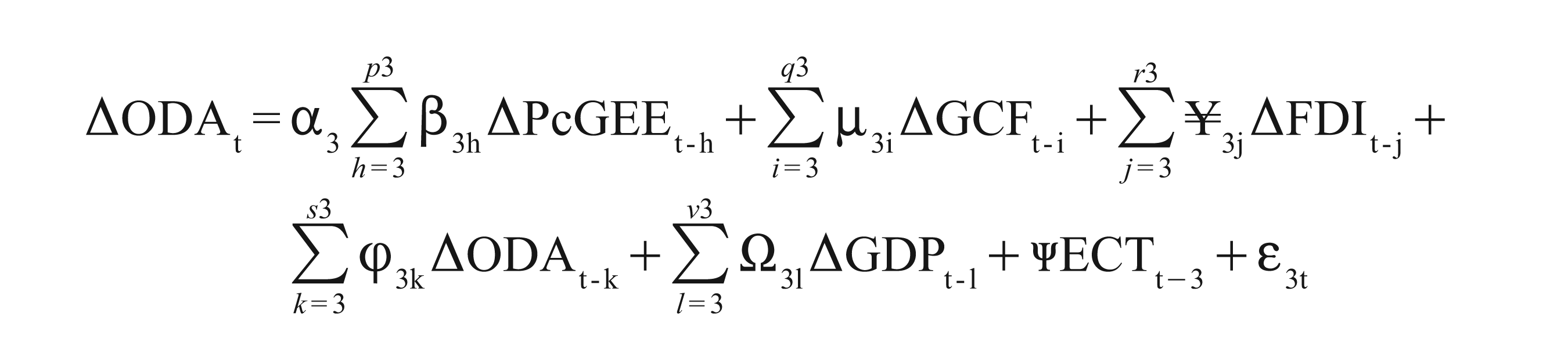
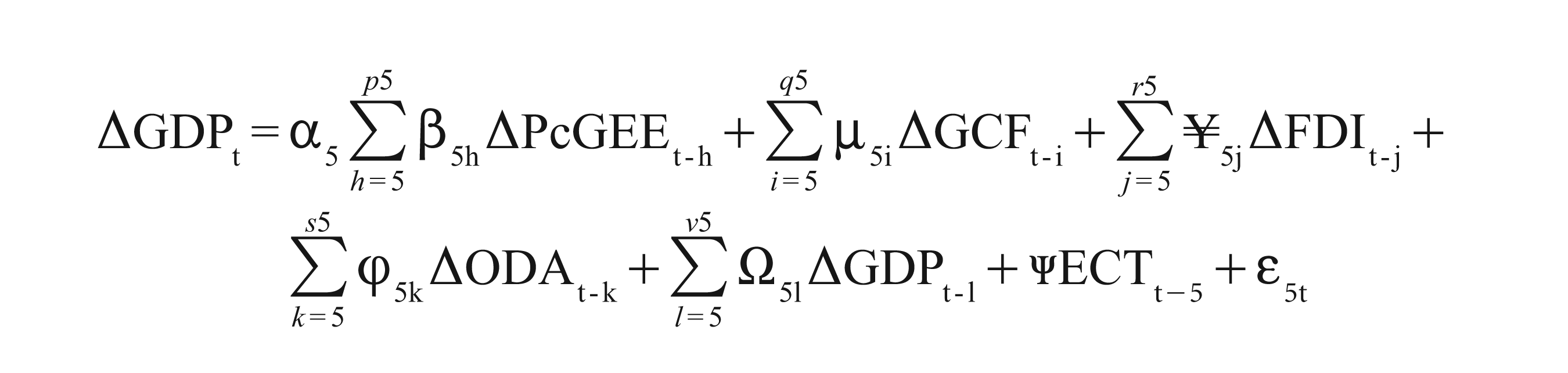
Cointegration and VECM techniques help to identify the existence or absence of long-run relationships among the dependent and explanatory variables in the model. It does not indicate the direction of causality. If the variables are cointegrated in a model, then one can employ pair-wise Granger causality models to know the direction of relationship among the variables. The study has employed five variables, that is, PcGEE, GCF, ODA, FDI and GDP. Thus, the following models employed to explore the causal relationships among the four variables:



Empirical Results and Discussion
This study uses the ADF test to check the stationary properties of the time-series variables. The result of the unit root test (using ADF test) is presented in Table 1.
ADF Unit Root Test
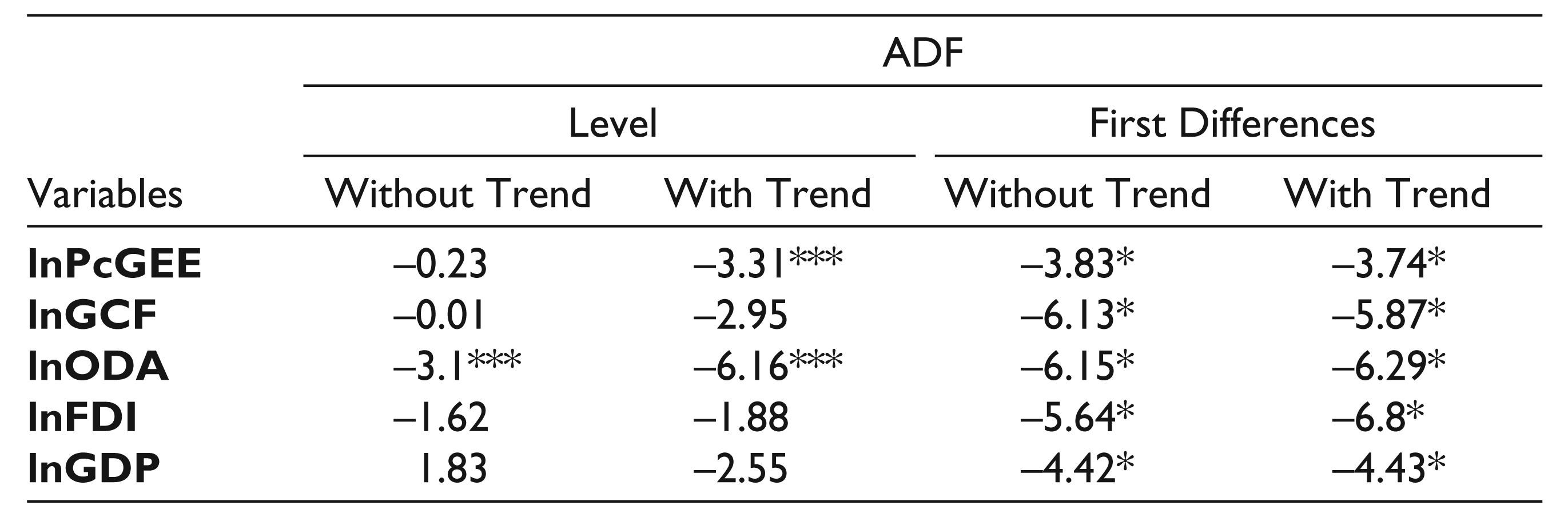
Table 1 shows that the null hypothesis for all the variables is rejected in their first differences at ADF test. Thus, all the time-series variables are stationary and integrated of the same order, that is, I(1). In short, all the variables have unit root in their level but became stationary in first differences. Before the cointegration test, one must have to select the appropriate lag length of the time-series data. Table 2 shows the selection procedure of the optimum lags by using the six criteria, that is, LogL, LR, FPE, AIC, SC and HQ.
It is clear from Table 2 that all the five criteria unanimously select lag order 1 and thus we hypothesize one as the optimum lag length. A lag of 1 year seems appropriate to analyze the relationship between foreign capital inflows and economic development in India.
ince all the variables are cointegrated in their first order, that is, I(1), we can go for the Johansen multivariate cointegration test. This study is applied in the cointegration test for finding the cointegration vector (denoted by r) among the time-series variables in the case of India. It uses two likelihood estimators, that is, trace test and maximum eigenvalue test. Both the tests either reject the null hypothesis (H0 ≠ 0) which shows no cointegration among the variables or accept the null hypothesis (H0 = 0) which shows the presence of cointegration vector. First, we will start the testing by considering H0: r = 0. If it rejects, then we will go for the testing of H0: r = 1. This process will continue till the null hypothesis becomes accepted. It will stop when a test statistics is not rejected. The result of cointegration test of India is reported in Table 3.
Optimum Lag Order Selection Criterion

Johansen and Juselius Co-integration Test

Table 3 states that both the trace test and maximum eigenvalue test accept the presence of cointegrating vector among the variables. In both the tests, H0: r = 0 and H0: r = 1 are accepted at 5 per cent level of significance. Both the tests do not reject the null hypothesis that these variables are not cointegrated. The test result of both tests shows that the final number of cointegrating vectors with one lags is equal to 1 which is more than zero and less than the number of variables. It indicates the presence of a long-run relationship among the time-series variables, that is, PcGEE, ODA, GCF, GDP and FDI. In other words, all the variables move together in the long run.
Vector Vector-error Correction Model
The presence of cointegration vector in the model suggests a long-run relationship among the variables under consideration. The cointegration vector represents the dynamic and adjustment of the variables in the long-run equilibrium. The long-run relationship between economic development and four other development determinants for one cointegrating vector of India over the period from 1990–1991 to 2013–2014 is presented as follows (t-statistics values are given in parenthesis):
Long-run cointegrating equation:

From equation (11), the long-term cointegration vector suggests that ln(ODA), ln(GDP) and ln(FDI) have a significant positive impact on the dependent variable, that is, public expenditure on the education sector of India in the long run. Among all the four explanatory variables, domestic investment is the only variable which shows a significant positive long-run impact on economic development in India during this study period. The result shows that in the long run, an increase of 1 per cent of GCF leads to an increase in the public expenditure on the education sector by 0.8 per cent in India. The result also reveals that in the long run an increase of 1 per cent of ODA leads to a fall in the public expenditure on the education sector of India by 0.24 per cent. It means foreign aid has a significant negative impact on the development of the education sector of India during this study period. The growth in FDI with 1 per cent indicates the fall in public expenditure on the education sector by 0.18 per cent in the long run in turn specifying that FDI inflows have a significant negative impact on the development of the education sector in India. The growth in GDP with 1 per cent indicates the fall in public expenditure on the education sector by 0.17 per cent in the long run in turn specifying that GDP growth in India has shown a significant negative impact on the development of the education sector. In India, domestic capital only shows a significant positive impact on development, which may be due to its productive utilization where as other three variables, that is, FDI, ODA and GDP show a significant negative impact on it. The unproductive utilization of both types of foreign capital and unequal distribution of growth benefits may be the cause of the negative impact on development in India.
Diagnostic Checking Criteria

Though this study is based on the time-series data, it is essential to conduct the diagnostic check to know the goodness of the fitted model. We have conducted four diagnostic checks to know about the existing problems in the model. The result of the diagnostic checking criteria is presented in Table 4. It shows that the fitted model suffers from the serial correlation which is mostly found in the case of time-series data. Other than this, the model is free from ARCH effect, heteroscedasticity problems and residuals are normally distributed.
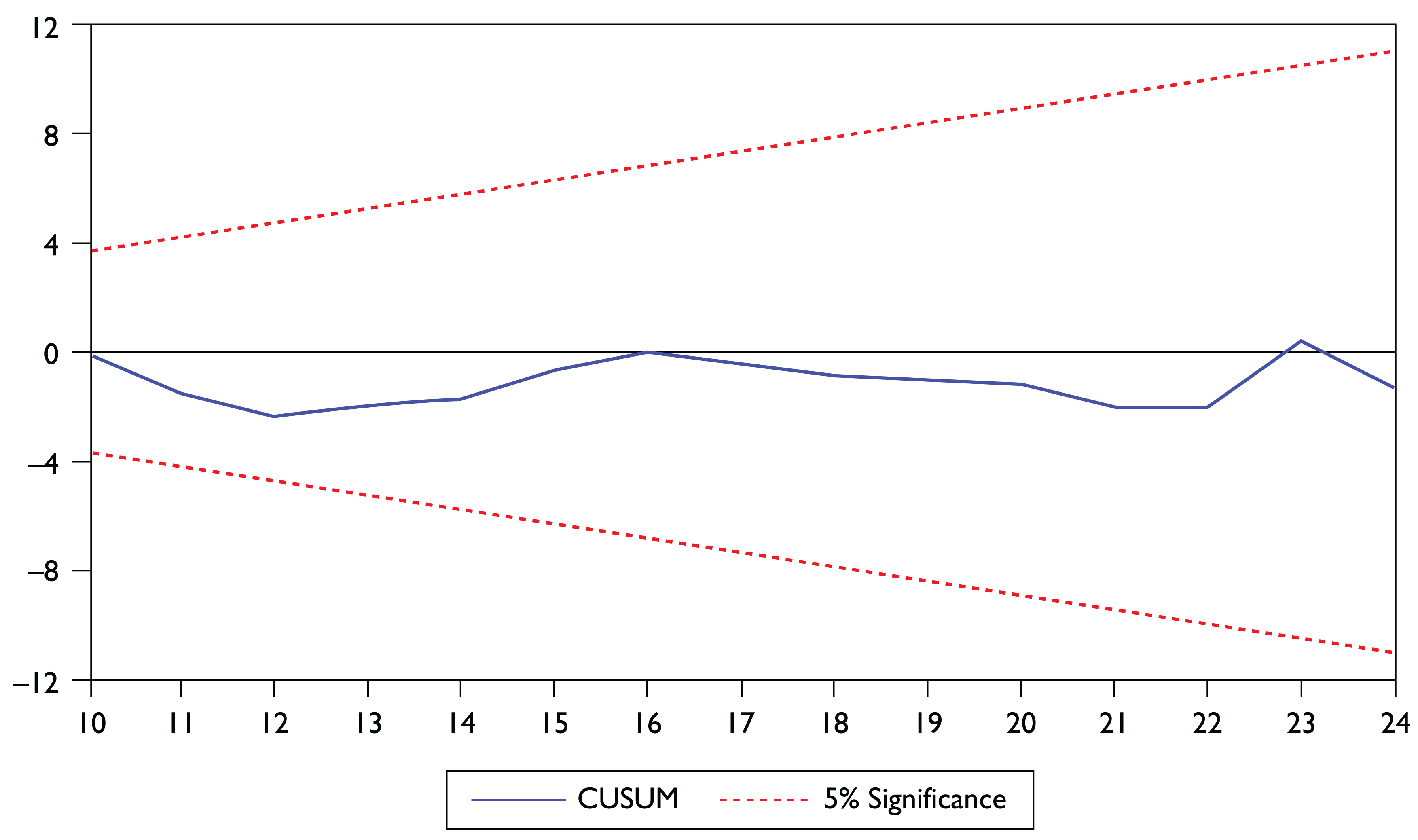
The question arises about the stability of the dependent variable, that is, PcGEE. To test the stability of the dependent variable, we have used the CUSUM test at 5 per cent level of significance. It is clear from Figure 1 that the dependent variable lies within the two boundary lines during the study period.
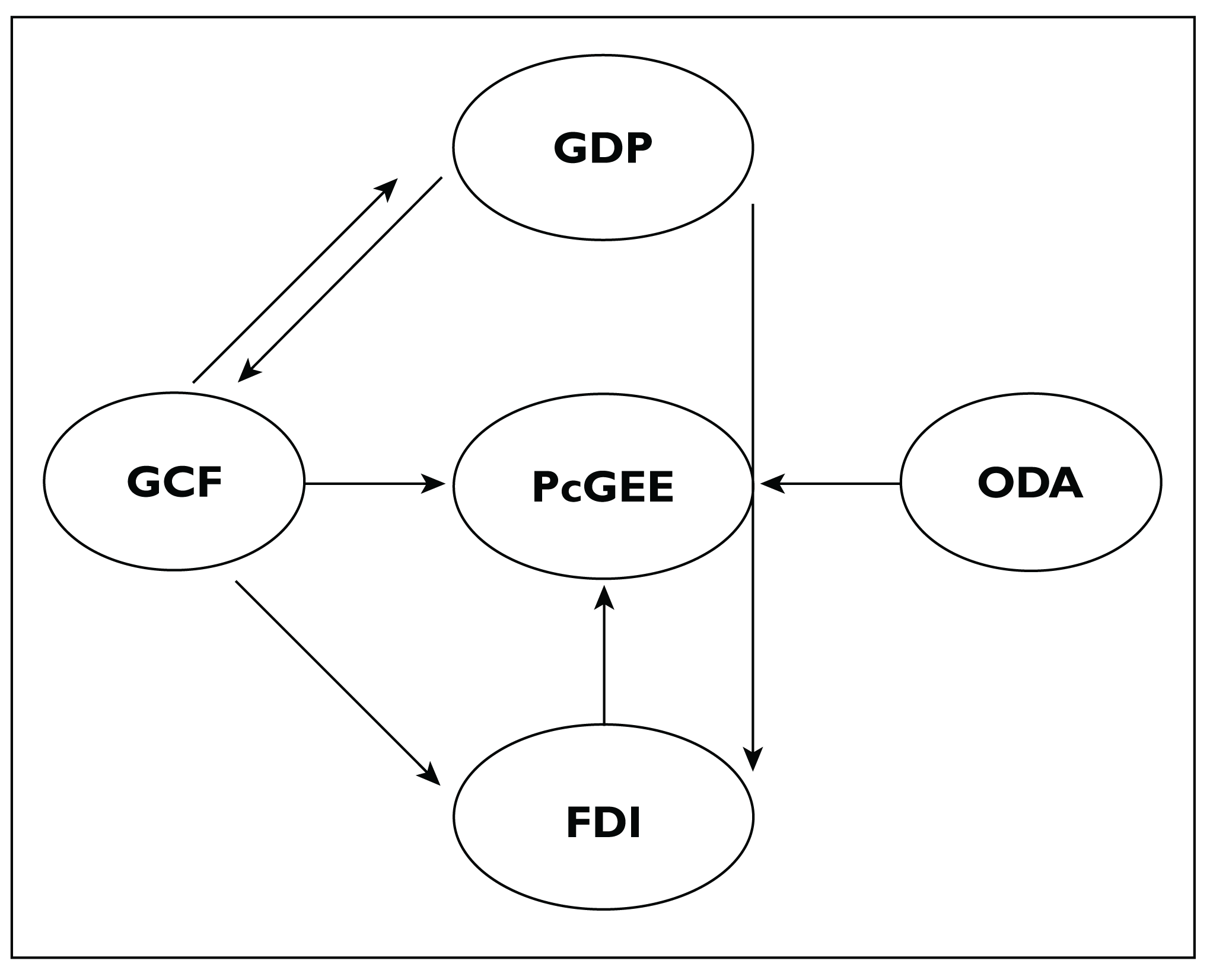
The pair-wise Granger causality test shows the direction of causality among the variables included in the model. The pair-wise Granger casualty test result is presented in Figure 2. The result depicts that there is a bidirectional causality existing between economic growth, that is, GDP and domestic investment, that is, GCF, which means both economic growth and domestic investment positively influence each other. It also shows that there is a unidirectional causality flow from GCF to PcGEE, ODA to PcGEE, FDI to PcGEE and GDP to FDI. The results show that higher economic growth attracts more FDI inflows, whereas higher FDI inflows attract PcGEE. The results also indicate that there are unidirectional causality flows from ODA and GDP to economic development. Higher domestic investment causes FDI inflows to India. There is no causal relationship found between ODA and GCF in India.
Conclusion and Policy Implications
This study contributes to the recent empirical literature of investment–development nexus. The study finds that domestic investment has a positive and significant impact on economic development, that is, public expenditure on education of India in the long run. It finds the productive utilization of the domestic investment. On the other hand, both types of foreign capital, that is, foreign aid and FDI along with economic growth have a significant but negative impact on economic development of India which may be the cause for their unproductive utilization. Adding to this, the persistence of mass poverty, unequal distributions of growth benefits, corruption and institutional failure are some of the other factors which may be responsible for the adverse long-run impact of foreign capital on economic growth in India. Finally, this study concludes that domestic investment is one of the major determinants towards the development process in India in comparison to foreign capital and economic growth. It is also true that both domestic capital and foreign capital are essential for higher economic development in India. Both types of capital have their own contribution towards Indian economy which cannot be ignored or substituted by each other.
This study suggests that the national developmental policy of India should focus on the productive utilization of both domestic and foreign capital along with it should give emphasis on effective transformation of growth benefits towards development process. However, this study is not without its limitations. The study is constrained due to the unavailability of time-series data of certain variables such as HDI value, foreign capital meant only for developmental programs, sector-wise public investment, etc. The present study hopefully provokes further empirical research to find out the appropriate and advance method by which the growth benefits can be utilized for the development of the economy and individuals.
Footnotes
Acknowledgements
We are grateful to the anonymous referees and editor of the journal for their valuable comments and suggestions for the improvement of this article. Usual disclaimers apply. The first author of the article is thankful to University Grant Commission (UGC), New Delhi, Government of India, for giving financial assistance (SRF) during her research work.