



Abstract
Interest in spirituality as a scholarly topic has grown in recent years. The present research aspires to investigate the relationship between workplace spirituality and organizational performance. First, necessity of workplace spirituality for organizational performance is investigated with the help of necessary condition analysis (NCA). Second, mediation effect of organizational citizenship behaviour (OCB) in relationship between workplace spirituality and organizational performance is explored with the help of technique propagated by Baron and Kenny (1986). Hierarchal regression is used to test Baron and Kenny’s (1986) conditions of mediation. Results of NCA establish workplace spirituality as a necessary condition for occurrence of organizational performance. The OCB is also reported to partially mediate the relationship between workplace spirituality and organizational performance. Practical implications, limitations of the study and suggestions for future researchers have been discussed in the last part of the article.
Introduction
There is an emergent attention on workplace spirituality (Giacalone & Jurkiewicz, 2003). Interest in spirituality as a scholarly topic has grown in recent years (Petchsawanga & Duchon, 2012). Wagner-Marsh and Conley (1999) stated that there is ‘an organizational fourth wave’ called as ‘the spiritually based firm’ (p. 292), after Toffler’s (1980) technological third wave. Theoretical and empirical research studies on the concept and utility of spirituality at workplace have increased significantly in the last two decades (Houghton, Neck, & Krishnakumar, 2016). Spirituality at workplace is increasingly being lauded as a credible solution to many HR challenges. Addressing spiritual aspect of workplace experience, organization achieves reduced stress, enhanced creativity and improved problem-solving (Tischler, Biberman, & McKeage, 2002). Workplace spirituality leads to greater job satisfaction, enhanced job involvement, greater honesty, trust and commitment (Krishnakumar & Neck, 2002), greater levels of organizational identification and rewards satisfaction (Kolodinsky, Giacalone, & Jurkiewicz, 2008) and improved work performance (Duchon & Plowman, 2005).
Utilities and benefits associated with workplace spirituality are categorized into three levels—societal, organizational and individual (Moore & Casper, 2006). At societal level, spirituality at workplace consolidates one’s trust and faith in power of goodness (Miller, 2001). Social services, philanthropic activities and corporate social responsibility have been included as major objectives of the firm along with organizational goal of profit maximization (Garg, 2017a). At the level of individual employee, spirituality at workplace leads to better physical, psychological, mental and spiritual health of the employees (Krahnke, Giacalone, & Jurkiewicz, 2003). Workplace spirituality helps an employee in realizing full potential and complete self at work place. Higher levels of personal growth, self-confidence and self-worth awareness are natural resultants of workplace spirituality (Krahnke et al., 2003). Other individual-based work parameters are also reported to have positive relationship with workplace spirituality. These relationships include the relationship between workplace spirituality and organizational commitment (Garg, 2017a; Rego & Cunha, 2008), job involvement, rational decision-making (Sisk, 2008), work rewards satisfaction (Kolodinsky et al., 2008; Milliman, Czaplewski, & Ferguson, 2003), career commitment (De Klerk et al., 2006), employee engagement (Garg, 2017b), motivation (Bhunia & Das, 2012), emotional intelligence (Hartsfield, 2003), self-efficacy (Sharma & Garg, 2015), ethics (Giacalone & Jurkiewicz, 2003) and work values (Issa & Pick, 2011).
At organizational level, workplace spirituality results into greater profitability and productivity in long run. Spiritual organizations achieved greater efficiencies and rate of return than organizations where spirituality is absent (Jurkiewicz & Giacalone, 2004). Lloyd (1990) concluded that the organization practicing shows 86 per cent higher than firms with little or no workplace spirituality. Researchers who advocated greater organizational performance with workplace spirituality include Neck and Milliman (1994), Thompson (2000), Pandey, Gupta and Arora (2009), Malik and Naeem (2011) and Maleki, Jafari, Safari and KhodayariZarnaq (2012).
Although workplace spirituality affects organizations’ performance at various levels (Moore & Casper, 2006), exact mechanism through which workplace spirituality impacts workplace spirituality is little explored. In the opinion of Giacalone and Jurkiewicz (2003), the systematic study of workplace spirituality focuses on a fundamental question: ‘Is spirituality significantly related to various aspects of organizational behavior and performance, and if so, how?’ The present study is an endeavour to answer the ‘how’ part of the question raised. Specifically, the present article looks at the mediating effect of organization citizenship behaviour (OCB) in relationship between workplace spirituality and organizational performance.
The article is broadly divided into four parts. In the first part of the article, various definitions of workplace spirituality along with divergent views of researchers are discussed. In the second part, six constructs of Indian spiritualism, already delineated in the literature, are described. Third, necessity of workplace spirituality for organizational performance has been studied with the help of necessary condition analysis (NCA). The mediating effect of intervening variables is investigated with the help of Baron and Kenny’s (1986) method. And finally, practical implications, limitation and propositions for further research are discussed.
Literature Review
Defining Workplace Spirituality
There are more than 70 definitions of workplace spirituality, but still there is no widely accepted definition of workplace spirituality (Kinjerski & Skrypnek, 2004; Markow & Klenke, 2005). ‘Defining spirituality in the workplace is like capturing an angel—it’s ethereal and beautiful, but perplexing’ (Laabs, 1995, p. 63). According to Giacalone and Jurkiewics (2010), spirituality may be defined as:
Aspects of the workplace, either in the individual, the group, or the organization, that promotes individual feelings of satisfaction through transcendence. To elaborate, that the process of work facilitates employees sense of being connected to a non-physical force beyond them that provide feelings of completeness and joy.
Covey (2009) elaborated spirituality as:
The word spiritual has its roots in spirit, for which dictionaries provide many definitions, most of which are nonreligious in nature, such as ‘disposition of mind or outlook’ or ‘a mental disposition characterized by firmness or assertiveness. Thesauruses likewise put forward many synonyms for spirit including disposition, courage, determination, vigor, will, moral fiber, heart, enthusiasm, inner self, fortitude, and strength. Combine the dictionary definitions with these synonyms, and that is what I am referring to here when speaking of young people’s spirits, or spiritual needs’.
Workplace spirituality has been approached with the help of different concepts such as value and belief system, as a developmental line, as a way to get in touch with inner self, as a means of self-realization and as inner experience (Garg, 2017b). It is a multifaceted construct that aspire to find a connection with something meaningful that transcends one’s ordinary lives (Dehler & Welsh, 2003; George, Sorenson & Bums, 2004; Mitroff & Denton 1999b; Tepper, 2003).Workplace spirituality is characterized by super-intelligence which is evaluated by effective and prompt understanding, judgement and response of incoming stimuli (Zohar & Marshall, 2000). India’s most revered epic, Shrimad Bhagwad Gita, also opines the same. The epic says Yogah Karmasu Kaushalam which means excellence in action is Yoga (2.50). Spirituality has also been explained as inner experiences (Dillard, 1982) and an attitude of openness, care or loving which can be practiced and developed (Miller, 2001; Wilber, 2004). According to Emmons (2000), spirituality leads to experience of higher state of self-realization. Krishnakumar and Neck (2002) defined spirituality as perennial search for the purpose and meaning of the life. Other authors provide different connotation to workplace spirituality: inner experiences (Dillard, 1982); attitude of openness and care (Milliman et al., 2003); morality (Kohlberg & Ryncarz, 1990); workplace integration and connectedness (Ingersoll, 2003); respect, humility and courage (Heaton, Schmidt- Wilk, & Travis, 2004); common purpose (Kinjerski & Skrypnek, 2004); inclusiveness and inter- connectedness; inner consciousness (Guillory, 2000); feelings that energize action (Dehler & Welsh, 1994); faith (Fowler, 1981); sacred force that implies life (Nash & Mclennan, 2001); compassion (McCormick, 1994) and so on.
Although researchers are not unanimous for definition of workplace spirituality, there is growing consensus on constructs of spirituality. While Western scholars focused on inner life, transcendence, sense of community, alignment of organizational and individual values, sense of enjoyment, mindfulness, meaningfulness and so on, Indian scholars have explored Indian spiritual values and ethos for Indian set of spiritual constructs. Present work is based on six core components of Indian workplace spirituality: swadharma, lokasamgraha, authenticity, sense of community, karma capital and kritagyata. These six constructs are selected after the synthesis of modern empirical researches and ancient Indian epics such as Ramayana, Shrimad Bhagwad Gita and Upanishads. Based on these Indian constructs, a working definition of workplace has been developed. Workplace spirituality may be defined as an experience of meaningful work (swadharma), done with honesty and truth (authenticity) and without fear of result (karma capital), in a trust worthy and mutually beneficial group (sense of community) done for welfare of the society (lokasamgraha) with feeling of gratefulness (kritagyata).
Constructs of Indian Spiritualism
Indian experience with workplace spirituality is quite old. Even Indian kings of ancient age used to have a spiritual teacher (Rajpurohit ) in their courts for practicing morality and spirituality with work. In Indian tradition, spiritual teacher (Guru ) has been assigned rank even higher than God. Among modern-day researchers, Pandey, Gupta and Kumar (2016) explored Indian spiritual climate using four constructs: swadharma, lokasamgraha, authenticity and sense of community. Two other constructs of workplace spirituality, karma capital and kritagyata, were introduced by Garg (2017a).
Workplace Spirituality and Organizational Performance
Fry (2005) concluded that workplace spirituality benefits individuals and organizations both. Spiritually based organizations are more productive than organizations with no spiritual orientation (Giacalone & Jurkiewicz, 2003). An employee, who considers their organizations as spiritual, also believes their organizations as more profitable and more productive (Mitroff & Denton, 1999b). Workplace spirituality has positive effects on job performance (Milliman, 1994). Workplace spirituality improves organizational performance (Ashmos & Duchon, 2000; Fry, 2005; Garcia-Zamor, 2003; Giacalone & Jurkiewicz, 2010). Several other empirical research projects also reported positive association between workplace spirituality and organizational performance (Ashmos & Duchon, 2000; Biberman & Whitty, 1997; Bierly, Kessler & Christensen, 2000; Burack, 1999; Dehler & Welsh, 1994; Delbecq, 1999; Fry, 2005; Garcia-Zamor, 2003; Giacalone & Jurkiewicz, 2003; Giacalone, Jurkiewicz & Fry, 2005; Korac-Kakabadse, Kouzmin, & Kakabadse, 2002; Kriger & Hanson, 1999; Konz & Ryan, 1999; Mitroff & Denton, 1999a; Neck & Milliman, 1994; Pandey & Gupta, 2008; Thompson, 2000; Turner, 1999). Although workplace spirituality is increasingly lauded as a significant area of investigation, studies exploring intersection of workplace spirituality and organizational performance have not been systematically consolidated (Karakas, 2010). Researchers (Giacalone et al., 2005) encouraged scholars to pursue theoretical and empirical studied to highlight positive effects of workplace spirituality on organizational performance to prevent the marginalization of spirituality at work research. Fundamental objective of such unusual call was to make the domain of workplace spirituality research more legitimate and mainstream to organizational studies.
Workplace Spirituality, Organizational Citizenship Behaviour and Organizational Performance
Bateman and Organ (1983) defined OCB as: ‘individual behavior that is discretionary, not directly or explicitly recognized by the formal reward system, and in the aggregate promotes the effective functioning of the organization’. The OCB is a multidimensional concept and is comprised of five constructs.
Altruism: Discretionary behaviour of the employees that intend to help others in an organization with a relevant task or problem.
Courtesy: Proactive gestures that consider consulting with other workers in the organization before acting, giving advance notice and passing along information.
Conscientiousness: Employee performance his or her assigned tasks according to their role expectations.
Civic virtue: Engrossment which the employee illustrates in the political life of the organization.
Sportsmanship: Abstaining from complaining about trivial matters.
Workplace spirituality was reported to be a strong predictor of OCB (Fatahi, 2007). Farhangi et al. (2006) indicated a significant association between workplace spirituality and OCB. Geh (2010) used a hypothetical model, in an experimental study, on the relationship between work spirituality and OCB. The author concluded a positive relationship between OCB and spirituality at work with organization. Other researchers (Harmer, 2008; Kutcher et al., 2010; Liu, 2008; Setiyawati & Abdul Rahman, 2007) also confirmed significant relationship between the OCBs with spirituality at work (refer to Figure 1(a) for direct relation between OCB and workplace spirituality).
Various other researchers explored and concluded significant relationship between OCB and organizational performance (Bambale, 2011). Similarly, Tai, Chang, Che-Ming and Yu Hong (2012) also argued significant and positive association between organizational performance and OCB. One of the mechanisms of action of OCB in increasing organizational performance is the reduction in employee turnover rate (Kark, 2004). Another important mechanism concluded by other researchers is ability of OCB to attract and retain qualified and efficient forces (Winer, 2001). Highly efficient, competent and qualified workforce ensures higher organizational performance. Other researchers have also concluded that the citizenship behaviours are associated with high performance (George & Brief, 1992; Magliocca & Christakis, 2001; Schappe, 1998).
In sum, the above-referred studies clearly highlight the potential importance of workplace spirituality for modern-day organizations. But empirical studies on the exact mechanism through which spirituality impacts organizational performance have received limited attention (Giacalone & Jurkiewicz, 2010). This study is an attempt to fill this research gap by exploring OCB as probable mediator in the relationship between workplace spirituality and organizational performance. The above-mentioned previous empirical and theoretical studies reported positive relationship between workplace spirituality and organizational performance and between workplace spirituality and OCB. In this light, it would be interesting to investigate mediating effect of OCB. The specific research proposition is as follows: OCB mediates the relationship between workplace spirituality and organizational performance (refer to Figure 1(b) for proposed model). Previous studies have concluded positive association between workplace spirituality and organizational performance, and the present study investigates necessity of spirituality at workplace for organizational performance with the help of NCA. Another proposition of study is as follows: workplace spirituality is a necessary condition for organizational performance.
Workplace Spirituality
Direct Path

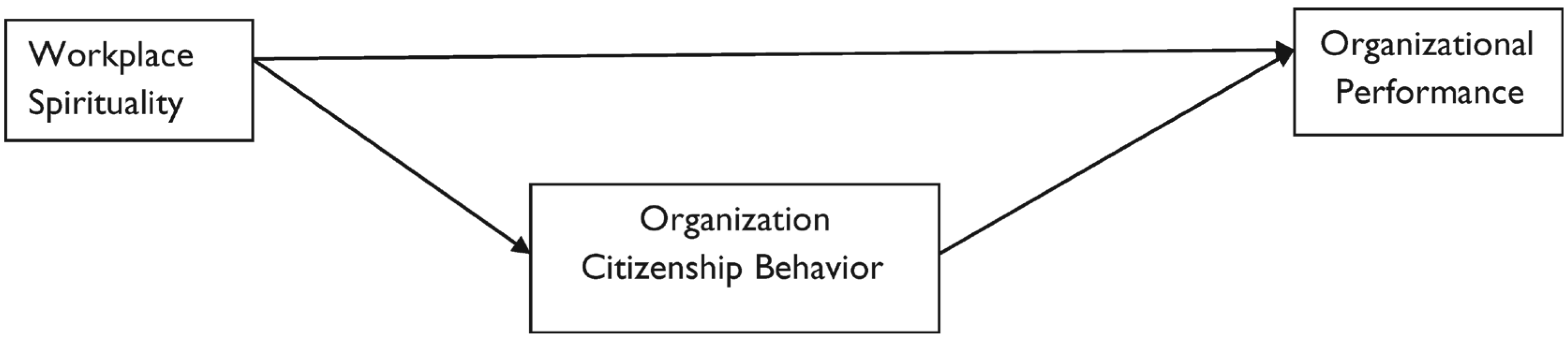
Research Framework
Data Collection and Sample
The research setting for present study is insurance companies located in India. The study is based upon descriptive research design. The company surveyed included Life Insurance Corporation, The Oriental Insurance Company Limited, United India Insurance Company Limited, New India Assurance Company Limited, National Insurance Company Limited, General Insurance Company, HDFC Ergo, ICICI Lombard, Star Health, Bajaj Alliance and Shriram General Insurance. A sample of 194 managers was selected with the help of convenience sampling. Probable respondents were surveyed with the help of online survey. The participants were apprised with the purpose of the study and were also assured of confidentiality of their responses. Out of 194 respondents, 119 (61 per cent) were from public sector insurance companies and 75 (39 per cent) were from private insurance companies. Further, 100 (51 per cent) respondents were male managers and 94 (49 per cent) respondents were female employees. Mean age of the respondents was 38.6 years. Majority of participants 71 per cent were graduates and rest were either diploma holder (19 per cent) or postgraduate (10 per cent).
Measures
Workplace spirituality: The variable was accessed using scale developed by Pandey et al. (2009). This scale is based on four constructs of spirituality: swadharma (e.g., ‘My job helps me to understand my life’s purpose, Working here makes my life meaningful’), authenticity (e.g., ‘Peoples’ actions here are aligned with their words and People here own up to mistakes with others in the group’), lokasamgraha (e.g., ‘People here perform their duties as if they contribute to the (community/society at large/humankind in general’), sense of community (e.g., ‘When stuck with a problem, people here feel free to ask for advice from colleagues/advice from a superior/help from their colleagues/help from a superior’), karma capital (e.g., ‘I put my hundred percent at my work, Working itself provides me work satisfaction’) and kritagyata (e.g., ‘my job makes me understand that I have numerous things to cherish in my life’) were added based on work of Garg (2017b). All questions were answered on five-point Likert scale ranging from 1 (strongly disagree) to 5 (strongly agree). Mean value of workplace spirituality was 3.76 and reliability (Cronbach’s alpha) is good (overall = 0.91, swadharma = 0.81, authenticity = 0.89, lokasamgraha = 0.85, sense of community = 0.93, karma capital= 0.83 and kritagyata = 0.78).
OCB: The variable was measured with the help of 15-item questionnaire used by Podsakoff and MacKenzie (1997). The scale measured five dimensions of OCB as altruism (e.g., ‘I have others who have heavy workloads’), courtesy (‘Take steps to prevent problems with other workers’), sportsmanship (‘Consume a lot of time complaining about trivial matters’), civic virtue (‘Reads and keeps up with industry change and new products introduced by the organization’) and conscientiousness (‘I am mindful of how my behaviour affect other people’s job’). All items rated on seven-point scale, mean value of the variable was 4.37 and reliability (Cronbach’s alpha) is good (overall = 0.77, altruism = 0.83, courtesy = 0.90, sportsmanship = 0.87, civic virtue = 0.78, conscientiousness = 0.74).
Perceived organizational performance: Perceived organizational performance was accessed with the help of scale developed by Singh (2004). Items included ‘quality of products or services’ and ‘development of new products or services’. Perceived organizational performance was accessed on 5-point Likert scale ranging from 1 (strongly disagree) to 5 (strongly agree). Mean value of dependent variable is 3.25 and reliability coefficient is 0.86.
Method
The present article used NCA to identify necessary conditions in the data sets. The NCA is used to explore whether workplace spirituality is necessary condition for organizational performance. The NCA is applied along with correlation and regression analysis. Necessary cause is a constraint, a barrier, an obstacle, a bottleneck that should be present to allow a preferred result to exist. The presence of necessary condition does not ensure outcome, but without necessary condition, outcome does not exist (Dul, 2016). Every necessary condition is essential, as there is no additive causality that can compensate for the absence of the necessary condition (Dul, 2016; Shadish et al., 2002). Without the necessary condition, there is definite failure, which cannot be compensated by other determinants of the outcome (Dul, 2016). In case of NCA, the absence of the necessary cause straightaway results in outcome failure.
Further, mediation effect of OCB in relationship between workplace spirituality and organizational performance has been accessed with the help of Baron and Kenny (1986). According to technique developed by Baron and Kenny (1986), mediation exists if below-mentioned four conditions are satisfied.
Independent variable (workplace spirituality) relates to dependent variable (performance).
Mediating variable (OCB) relates to the dependent variable.
Independent variable relates to the mediator.
The relationship of independent variable with dependent variable is reduced significantly (partial mediation) or remains no longer significant (full mediation) when controlled for mediating variable.
Results
Table 1 represents the mean, standard deviation and correlations for the study variables. All dimensions of workplace spirituality (swadharma, lokasamgraha, authenticity, sense of community, karma capital and kritagyata) were reported to have significant positive correlation with all dimensions of OCB (altruism, civic virtue, conscientiousness, courtesy and sportsmanship). Overall workplace spirituality showed significant positive correlation with overall OCB (r = 0.84). Workplace spirituality was also positively correlated with organizational performance (r = 0.78). Further, OCB also reported positive correlation with organizational performance (r = 0.87). Positive association between workplace spirituality and organizational performance has been concluded in numerous previous studies; however, the present article takes domain of workplace studied to next level by exploring the association with the help of NCA.
Mean, Standard Deviation and Correlation among Variables
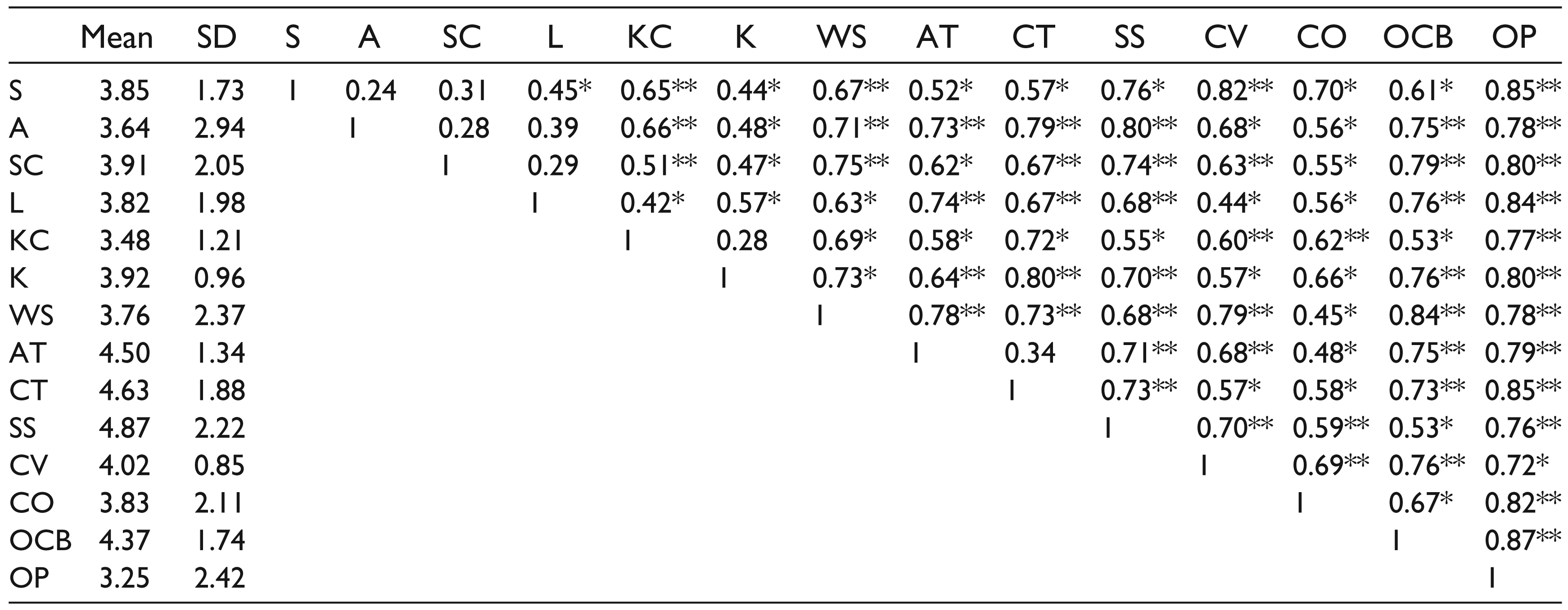
2. *p < 0.05, **p < 0.01.
The NCA is applied in two steps: (a) drawing ceiling lines and the corresponding bottleneck tables; (b) determining other parameters of NCA—accuracy of the ceiling line, effect size of the necessary condition and necessity inefficiency. Scatter diagram using Cartesian coordinate system is plotted taking workplace spirituality on x -axis and organizational performance on y -axis. If upper left corner of the graph is empty, then necessary condition may be concluded to exist. To check this condition, a ceiling line between the empty zone (zone without observations) and the full zone with observations is drawn. Author relied on ceiling envelopment with free disposal hull (CE-FDH) method for ceiling zone determination, as CE-FDH is better method (Dul, 2016). The next step is to observe the effect size (d ) whose value lies from 0 to 1. Dul (2016) proposed segregation of the effect size as follows:
0 < d < 0.1—Small effect 0.1≤ d < 0.3—Medium effect 0.3 ≤ d < 0.5—Large effect 0.5 ≤ d < 1.0—Very large effect
Dul (2016) suggested threshold limit of 0.1 for the necessary condition such that the effect size greater than 0.1 indicates the necessary variable. Accuracy represents the number of observations that does not lay in the empty space divided by the total number of observations, multiplied by 100 per cent. If accuracy ≥ 95 per cent and size effect is large enough, then the necessary condition is confirmed (Dul, 2016).
Figure 2 demonstrates NCA plot and NCA statistics of workplace spirituality and organizational performance. The presence of empty zone in upper left portion of NCA plot confirms the fact that workplace spirituality is necessary condition of organizational performance. The effect size is 0.71 for CR-FDH, which means the effect size is ‘very large’ and accuracy is 99.7 per cent. Both NCA plot and NCA statistics conclude the presence of very large necessary condition. Finding is an important extension to the domain of workplace spirituality studies. Now proposed hypothesis of probable mediation effect of OCB is explored with the help of Baron and Kenny’s (1986) technique.
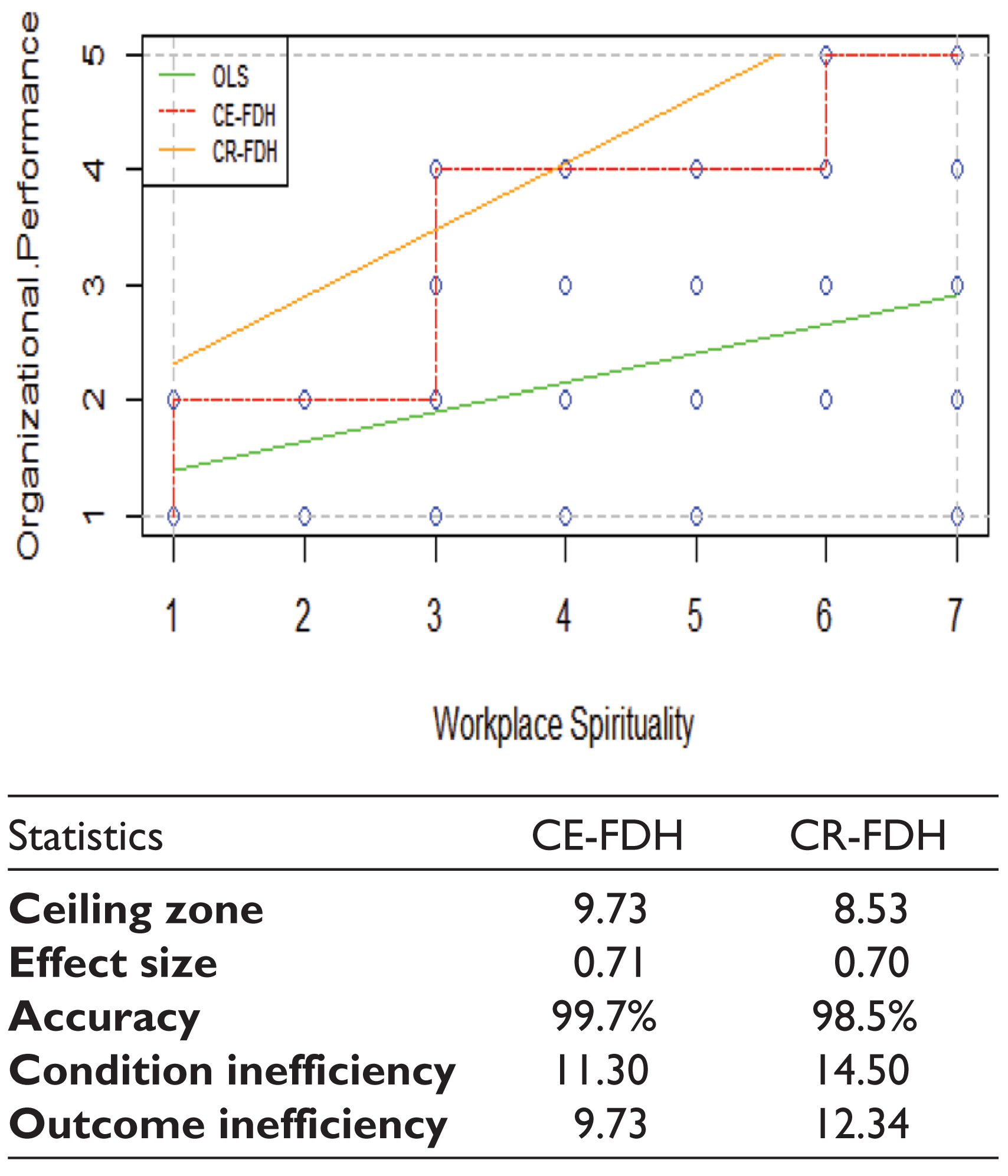
Table 2 attempts to investigate probable mediation effect of OCB in relationship between workplace spirituality and organizational performance using Baron and Kenny’s (1986) four-step technique. In Model 1, workplace spirituality was regressed on organizational performance and it was realized that the relationship is significant and positive ( β = 0.80, p < 0.05). Here, first condition of mediation is fulfilled. In Model 2, workplace spirituality was regressed on OCB and it was again realized that the relationship is positive and significant ( β = 0.84, p < 0.05). Here, second condition of mediation is satisfied. In Model 3, OCB was regressed on organizational performance and relationship is found to be significant and positive ( β = 0.87, p < 0.01). Here, third condition of mediation is fulfilled. Now, with the help of hierarchical regression, OCB was controlled and relationship between workplace spirituality and organizational performance was analysed. It was realized that the relationship between workplace spirituality and organizational performance is reduced ( β value reduced from 0.80 to 0.70) and association was also reported significant. Hence, partial mediation is confirmed. In summation, it could be concluded that OCB partially mediates the relationship between workplace spirituality and organizational performance.
Mediation Effect of OCB in Relationship between Workplace Spirituality and Organizational Performance

Discussion
A number of large organizations have institutionalized workplace spirituality for performance excellence. World’s renowned firms such as World Bank, AT&T, Hewlett-Packard, DuPont, Ford Motor Company and Apple computers internalized special programmes to practice spirituality at workplace. Microsoft enriched life of its employees with the help of online prayer system. World’s largest search engine Google started Google’s school of personal growth. The school aspired to bring spiritual flavour in the work life of its employees. Mediation classes are permanent attribute of various organizations’ work routine, namely, Apple, Google, Yahoo, IBM and so on. Hewlett-Packard introduced workplace spirituality with the help of renewed vision. New company vision emphasized the values of trust and mutual respect. Such humanly vision helped firm to develop an organizational culture of mutual cooperation and sense of purpose (Burack, 1999). AT&T sends its middle managers to three-day spiritual cum self-development programmes. Trainee reported better self-understanding and renewed positive relationship with colleagues (Cavanagh, 1999).
Although previous studies reported strong influence of spirituality at workplace over organizational performance, mediation studies are scare. The present study makes an effort in the field by exploring role of OCB for probable mediating effect. Mediator (OCB) defines the path through which independent variable (workplace spirituality) makes an impact on dependent variable (organizational performance). It is noteworthy fact that the present study is based on Indian conceptualization of workplace spirituality as all six variables of spirituality are imported from great Indian epics and also from previous researches conducted in Indian settings. Another notable contribution of the present article is NCA of workplace spirituality. Results were consistent with initial proposition of the study. The article concludes that workplace spirituality is a necessary condition for existence of organizational performance. Also, OCB is reported to partially mediate the relationship between workplace spirituality and organizational performance. In nutshell, the results suggest that employees show higher level of OCB when their spiritual needs are satisfied at workplace and this helping behaviour leads to higher level of organizational performance. The article has successfully established OCB as an important intervening variable through which workplace spirituality leads to higher organizational performance. And thereby theoretical gap illustrated by Giacalone and Jurkiewicz (2010) has been answered herewith. The HR managers need to ensure smooth transition of workplace spirituality into higher level of OCB. The OCB leads to an organizational climate based on trust, faith, mutual support and cooperation. Such enriching organizational climate translates into higher organizational performance. Thus, in this blind obsession of performance maximization, organizations around the globe are required to incorporate a set of humanistic and spiritual values into workplaces to enable human hearts, spirits and souls to grow and flourish. Employees and managers are increasingly resorting on various ways for incorporating spirituality, wisdom, reflection, inspiration, creativity and compassion into work. As spirituality is reported as necessary condition, thus it is suggested that the employers should institutionalize spiritual values and techniques in organizational vision, mission and policies and practice for better workforce performance. Firms should develop an organizational climate, which values and rewards workplace spirituality, to channelize true potential of workplace spirituality (Garg, 2017b). However, workplace spirituality should not be manipulated only to achieve organizational performance. It should be implemented for betterment of all stakeholders of the organizations. A culture organizational citizenship should be cultivated in the workplace by enforcing codes of conduct as well as instilling values of tolerance and compassion.
Conclusion
Although this research provides certain invaluable inputs in Indian context, the article is marred with certain limitations too. First, data were collected from the same source and at the same time, which may lead to risk of common method error. It is suggested that the future researchers may use double source method or longitudinal approach to deal with the problem of common method error. However, author has tried to minimize the common method error through both design control and statistical methods as suggested by Podsakoff et al. (2003). Respondents were assured of anonymity and secrecy of data and raters were also told that there is no wrong and right response to questions. Further, different scale formats (five-point scale for measuring workplace spirituality and seven-point scale to measure OCB) were used to minimize common method bias. Harman’s single-factor method was also applied to minimize the method variance. If common method error is substantial, the only single factor will emerge from exploratory factor analysis (Podsakoff et al., 2003). However, no single factor was found in the present case.
Second, sample is selected only from Indian insurance companies and thus generalization of results is a bit risky affair. Future researchers are suggested to collect data from a range of representative companies. Most importantly, variables of the study are highly correlated. This was expected given the nature of variables, but such high correlation presents challenges for disentangling the unique contributions of the present study. Future researchers are suggested to use both qualitative and quantitative research approaches to investigate the interesting domain of workplace spirituality. Researchers could explore integration of apparently different topics like spirituality and employee-level outcomes (attitude, organizational commitment, engagement and so on) which has the potential to enrich our knowledge and understanding of both. Other variables such as trust, positive emotions, organizational role stress and perceived organizational support can be investigated for probable mediating effect. Further, other variables such as individual characteristics, gender, experience and leader behaviours could also be explored for possible moderating effect. This re-synthesis could lead to new and exciting researches for the benefit individuals and organizations. Further, the methodology adapted in the study could be replicated in other cultures but with different dimensions of spirituality.
Footnotes
Acknowledgement
The author is grateful to the anonymous referees of the journal for their extremely useful suggestions to improve the quality of the article. Usual disclaimers apply.
Declaration of Conflicting Interests
The author declared no potential conflicts of interest with respect to the research, authorship and/or publication of this article.
Funding
The author received no financial support for the research, authorship and/or publication of this article.