




Abstract
The purpose of this research article is to examine the relationship between human resource (HR) practices and organizational performance. Though this research theme has been extensively researched in Western countries, very limited research has been done in the prevailing HRM scenario obtained in developing economies, especially in India. Hence, this article attempts to study the relationship and fill this research gap. A two-stage structural equation modeling (SEM) has been used to study this relationship. In the first stage, the proposed measurement model is validated through confirmatory factor analysis (CFA) and, in the second, the structural model examines the hypothesized relationship between the HR practices and organizational performance. It is found that the two are positively related. The findings of this study strengthen existing literature in the area and have important implications for managers engaged in HR functions.
Introduction
Business organizations nowadays are operating in a highly competitive environment. Organizations must, therefore, possess competitive advantage to score over their competitors. They should continuously strive for developing competitive strengths to develop long-term strategies (Khatri, 2000). This demands the best use of the resources at their disposal.
Management of scarce and valuable resources results in development of sustained competitive advantage (Barney, 1991). Human resource (HR) systems could be a good source of core competencies, which may ensure sustainable competitive advantage (Pfeffer, 1994; Snell, Mark, & Wright, 1996). Though technology, natural resources and economies of scale could act as drivers of competitive advantage, the resource-based theory advocates that these are increasingly available to almost all organizations. Moreover, they can be easily duplicated vis-à-vis HR systems (Ulrich & Lake, 1990). Human capital has a longer gestation period compared to other organizational resources, which makes it difficult for competitors to imitate easily in the short run (Becker & Gerhart, 1996). Hence, human resources are considered to be more important and powerful resources for sustained competitive advantage than other forms of resources. Human resources are now the last frontiers of sustainable competitive advantage for an organization. These findings are also supported by Hamel and Prahalad (1994), who suggest that core competencies are generally people-embodied skills. Bohlander, Snell and Sherman (2001) also advocated that HR is central to organizations for creating competitive advantage. Similarly, Rubel, Rimi and Walters (2017) advocated that it is critical to create highly committed human resources for an organization that can help create strategies and practices leading to organizational capability to survive in a competitive environment.
Good HR practices help create a source of competitive advantage for organizations (Huselid, 1995). Huselid, Jackson and Schuler (1997) have also explored the link between strategic HR practices and organizational objectives. According to Wernerfelt (1984), HR enables organizations to put resources to the best use and continuously improve effectiveness. Hence, HR is crucial to an organization’s sustained performance (Pfeffer, 1994). Organizations should, therefore, possess very high quality of HR competencies (Khandekar & Sharma, 2005) to fare well in a competitive world. In this knowledge-driven economy, human resources—which are rare, inimitable and flexible—play a primary and central role for organizations to acquire competitive advantage as opposed to the secondary and supportive role that human resources have traditionally been assigned to (Lengnick-Hall & Lengnick-Hall, 2002). With more and more organizations increasingly recognizing the importance of human capital and knowledge management with respect to competitive success, it is inevitable to expect that management of HR will be the lead driver for organizational success in future. Sustained competitiveness of an organization is contingent upon managing the human resources of an organization through the use of HR practices (Singh & Rao, 2017)
This research article is organized as follows: Review of relevant literature is presented in the next section. It dwells extensively on HR practices, organizational performance and the link between the two. This section ends with limitations in the existing literature. The next section outlines the objectives of the study and puts forth the rationale for the study. Thereafter, the article discusses the theoretical framework, which sets the basis for testing the model. Then, it presents the research method followed by an analysis of results using exploratory factor analysis (EFA), confirmatory factor analysis (CFA) and structural equation modeling (SEM). Finally, it discusses the results in detail and concludes the article with limitations and implications for practicing managers.
Review of Literature
Human resources have been accepted as a strategic tool in the present day knowledge economy. The HR managers play a strategically important role in formulation and implementation of organizational strategies (Myloni, Harzing, & Mirza, 2004). The HR practices are being proactively followed in organizations to garner competitive advantage (Jackson & Schuler, 2000; MacDuffie, 1995).
Investigating the relationship between HR practices and organizational performance has long been a leading theme of research (Qureshi, Tahir, Syed, & Mohammad, 2007) and past studies have examined the relationship to increase organizational performance (Neal, West, & Patterson, 2005; Richard & Johnson, 2001; Stroh & Caligiuri, 1998; Tzafrir, 2005). The results of such studies are encouraging and indicate a positive association between the two (Appelbaum, Bailey, Berg, & Kalleberg, 2000; Becker & Gerhart, 1996; Becker & Huselid, 1998; Cully, Woodland, O’Reilly, & Dix, 1999; Dyer & Reeves, 1995; Guest, 1997; Guest, Michie, Sheehan, & Conway, 2000; Harel & Tzafrir, 1999; Huselid, 1995). There are numerous instances wherein it has been established that effective HR practices augment organizational performance (Deepak, James, & Patrick, 2003; Singh, 2004). Investments in HR practices result in considerable financial profit (Cascio, 1991; Flamholtz, 1985). Katou and Budhwar (2007) also got evidence for the best HR practices and advocated for focusing on HR for creating competitive advantage. Literature review indicates important HR practices to be workforce planning (Mathis & Jackson, 2004); job analysis (Cascio, 2006; Dessler, 2003); training and development (Kundu, 2003); recruitment and selection (Kulik, 2004); compensation and reward (Milkovich & Newmen, 1999); performance appraisal (Bernardin & Russel, 1993); career management (Schein, 1996); HR information system (Wolfe, 1998); quality of work life, personnel diversity and employees’ attitude surveys (Bracken, 2000; Hayes, 1999). Tessema and Soeters (2006) have taken eight HR practices in their study relating to performance. The practices include compensation practices, training practices, recruitment and selection practices, promotion practices, placement practices, grievance procedures, employee performance evaluation practices and pension or social security. Similarly, Huselid (1995) took 11 HR practices in his study; they were employee selection, incentive compensation, performance appraisal, job design, information sharing, grievance procedures, labour management participation, attitude assessment, recruitment efforts, promotion criteria and employee training. Huselid (1995) studied 968 American organizations and found a positive impact of HR practices on performance and inferred that one standard deviation improvement in HR practices leads to organizational performance to an extent of 25 per cent. This led Armstrong (2006) to opine that people are critical to an organization’s performance.
Organizational performance analyses the output of an organization vis-à-vis its goals and objectives. Financial performance, product market performance and shareholder return are the three organizational outcomes that together explain the concept of organizational performance (Richards, Devinney, Yip, & Johnson, 2009). Organizational performance measures include both financial and non-financial aspects. However, Hoskisson, Eden, Lau and Wright (2000) reported that there are shortcomings in financial measures in the developing economies because of the need of market-based financial reporting, regulatory mechanisms and enforcement of financial reporting, precision in financial reporting and provision of fictitious financial information (Bae & Lawer, 2000; Hoskisson, Eden, Lau, & Wright, 2000). A host of researchers have advocated that measures over which employees exert influence are theoretically more reasonable and methodically easier to link. These include productivity (Huselid, 1995; Kato & Morishima, 2002), quality of products and services (Jayaram, Droge, & Vickery, 1999; MacDuffie, 1995), job satisfaction (Hoque, 1999), employees’ turnover intentions (Batt, 2002; Shaw, Delery, Jenkins, & Gupta, 1998), absenteeism (Lowe & Oliver, 1997), trust in management (Whitener, 2001) and commitment (Tsui, Pearce, Porter, & Tripoli, 1997).
Despite the existence of a large body of literature on contribution of HR practices towards organizational performance in general, there is scarce literature on Indian HRM scenario (Stump, Doh, & Tymon, 2010). Research in this area has so far been focused on organizations in developed countries, and only limited research has been carried out in developing countries (Singh, 2004; Yeganeh & Su, 2008). Pareek (1979) also notes that Western countries, especially the USA, have carried out a lot of empirical studies. Past studies have established the link between HR practices and organizational performance in the USA and European countries (Boselie, Paauwe, & Jansen, 2001; Hoque, 1999) and Africa (Ghebregiorgis & Karsten, 2007).
Budhwar (2009) has found from his studies that traditional Indian employment practices are undergoing changes in the prevailing economic conditions adopting those from developed countries in the West. This is a departure from traditional Indian work systems. The traditional systems are giving way to those based on formalization, professionalism and a systematic approach (Budhwar, Varma, Singh, & Dhar, 2006). Adopting HR practices in different contexts is fraught with challenges (Budhwar, 2009). In future, HR practices common in the USA and Europe will continue to be adopted in the Indian context. The degree to which their introduction and implementation generates the desired results needs to be the subject of the ongoing study, and more academic research on usefulness of HR practices in India, in general, and in different organization types and sectors, in particular, is needed (Stump et al., 2010). This study is an attempt to fill this research gap.
Objectives
A survey of the existing literature has indicated that most of the studies on impact of HR practices on organizational performance have been conducted outside India (Singh, 2004, Yeganeh & Su, 2008), especially in the USA and Europe. Very limited research has been done in India. There is scarce literature on this relationship in the Indian context and more research needs to be conducted to strengthen the literature (Stump et al., 2010). Moreover, the best HR practices of the Western countries are increasingly being transplanted in Indian organizations and they are expected to continue in future, too. Hence, the HRM scenario in India is dynamically evolving and hence needs to be studied on a continual basis (Stump et al., 2010). Moreover, there is a need to study whether the HR practices borrowed from the developed countries produce similar organizational results in the developing countries such as India (Parker et al., 2003). This study will, therefore, be an attempt to fill this research gap.
The present study sets out with two objectives in mind: First, it examines the relationship between HR practices and organizational performance to see whether there exists any causal link and, second, whether HR practices have any synergistic effect on performance of the organization.
Theoretical Framework
Resource-based view of the organization theorizes that possession of valuable resources (e.g., human resources), which are rare and non-substitutable, results in competitive advantage and hence good performance. The HR practices attract, motivate and retain employees of an organization for its survival (Schuler & Jackson, 1987). When designed and implemented properly, they help attain organizational goals (Delery & Doty, 1996) by influencing employee commitment level (Boxall & Purcell, 2003), thereby contributing to organizational effectiveness positively by increasing job satisfaction and motivation, resulting in improvements in quantity and quality of products and services and financial and market performance such as return on assets, revenue and market share (Paauwe & Richardson, 1997).
The HR practices–organizational performance linkage could be explained by three perspectives, namely, universalistic, contingency and configuration. According to universalistic perspective, a set of best HR practices could be identified and adopted for improving organizational performance irrespective of the organizational context (M. L. Lengnick-Hall, C. A. Lengnick-Hall, Andrade, & Drake, 2009). In the contingency perspective, it is held that HR activities should be aligned with the business strategy of the organization to have an effect on organizational performance (Delery & Doty, 1996). That is, the HR practices–performance link is contingent upon the organizational context. On the other hand, according to configuration perspective, synergistic effects of HR practices can be created only when they are grouped together in a coherent manner. The following sections underpin the theoretical basis of the research proposition in relation to effect of the three HR practices on organizational performance.
Training Practices and Organizational Performance
Employees need relevant knowledge and skills for performing their jobs and making meaningful contribution to organizational goals (Ospina & Watad, 1999). Training is a systematic acquisition and development of knowledge, skills and attitudes that are necessary to perform or improve performance of a job (Tharenou, Saks, & Moore, 2007). Training teaches employees to perform their jobs by helping them acquire knowledge and skills needed for the purpose (Jones, George, & Hill, 2000). Dessler (2003) opines that training provides employees with required knowledge and skills to perform their current and future jobs effectively. Human capital approach regards training as an investment in human capital (Luo, 2000). According to this approach, training enhances an individual’s skills, thereby contributing to output and productivity of the organization (Jones et al., 2000). Smith (2010) opines that training makes employees more motivated, productive and innovative. It also makes them capable and willing to assume more control over their jobs, less supervisor-dependent and better capable to provide customer satisfaction. That is, training helps an organization perform better (Alliger, Tannenbaum, Bennett, Traver, & Shortland, 1997; Kozlowski, Brown, Weissbein, Cannon-Bowers, & Salas, 2000). In an age of rapidly changing business scenario, training equips employees with knowledge to cope with changing technology, products and systems (Bartel & Lichtenberg, 1987). Training and developing existing employees result in decreased cost and risk involved in selecting, hiring and internalizing employees from external labour markets and promote employee productivity and reduce turnover, contributing to organizational performance. Thus, good training practices increase organizational performance.
Performance Appraisal Practices and Organizational Performance
Performance appraisal is a continuous process of assessing and measuring contribution of employees (Caruth & Humphreys, 2008; Moorhead & Griffin, 1992) and communicating the assessment (feedback) back to them (Cook & Crossman, 2004; Sole, 2009) to know their strengths and weaknesses (Brown & Benson, 2003). It contributes to effective management of individuals (Caruth & Humphreys, 2008) and teams to achieve higher levels of organizational performance (Armstrong & Baron, 2005). Through a good feedback mechanism, performance appraisal helps employees to know how they are progressing within the organization in carrying out their duties, tasks and responsibilities (Lee, 2005). Performance appraisal is really a broad concept that evaluates employees thereby providing the basis for improving their capabilities, skills and abilities through training and compensation practices. Performance appraisal allows employees to know what is expected of them (Caruth & Humphreys, 2008) and what the performance parameters are (Chiang & Birtch, 2010) through the feedback mechanism. Feedbacks leave room for improved competitive positioning (Roberson & Stewart, 2006). If it is done, there is the high possibility of this feedback raising an inner drive within employees and motivating them to do more or increase their level of commitment to the organization, which in turn will lead to an improved and better competitive positioning for an organization. High levels of labour productivity will be achieved if an employee feels satisfied with his/her job and does not feel being exploited at the workplace (Den Hartog, Boselie, & Paaiwe, 2004; Keeping & Levy, 2000; Lawler, 2003; Mone & London, 2010; Roberson & Stewart, 2006; Schraeder, Becton, & Portis, 2007). And performance appraisal determines what employees deserve for their performance. Performance appraisal also forms the basis of reward systems that channelize the effort of the organization to common goals (Cleveland & Murphy, 1992; Williams, 2002). Performance appraisal practices, as part of performance management systems, manage and align all organizational resources towards better performance. Performance appraisal dictates an important term on success and competitive positioning of an organization (Macey, Schneider, Barbera, & Young, 2009; Mone & London, 2010; Schraeder, Becton, & Portis, 2007). Performance appraisal ensures that goals of the organization are attained effectively and efficiently (Tyson & York, 2002) and organizational performance is improved. That is, performance appraisal practices positively impact organizational performance.
Compensation Practices and Organizational Performance
Compensation includes payments made to employees in return for their services to the organization as a result of their employment relationships (Dessler, 2003). Compensation practices produce better competitive advantage by creating more productive and skilled workforce (Pfeffer, 1995). According to Huselid (1995), the compensation system is largely outcome-based. In the management of human behaviour, money can exert influence through instrumental or symbolic motivational properties (Stajovic & Luthans, 2001). The expectancy theory (Vroom, 1964) proposes that direct and indirect rewards can potentially influence employee work motivation. That is, compensation practices could channelize employee efforts in the direction of organizational goals. Leonard (1990) has clearly suggested that long-term incentive plans are instrumental to increased return on equity. Incentive pay systems significantly increase performance of workers and the organization when associated with innovative work practices such as employee participation in problem-solving teams, flexible job design, training to provide workers with multiple skills, employment security and extensive screening and communication (Ichniowski, Shaw, & Prenunshi, 1997). Ferguson and Parsons (1992) argued that compensation practices form an important part of the organizational strategy helping it to gain competitive advantage. Mcnally (1992) stressed that compensation does not only attract and retain talented employees but also motivate them to achieve organizational goals. Thus, there is a positive association between properly designed compensation practices and organizational performance.
Individual or System View of HR Practices
Universalistic theories, developed by Huselid (1995), Osterman (1994) and Pfeffer (1994), which, in general, employ individual HR practices, suggest that there is a linear relationship between HRM practices and organizational performance. However, universalistic approaches also use more than one HR practice in combination (Alcázar, Fernández, & Gardey, 2005) termed as ‘high performance work systems’, which explains the HR practices–organizational performance link more coherently. On the other hand, the configurational perspective advocates that an effective combination of HR practices, called ‘HR bundles’ (MacDuffie, 1995), leads to better organizational performance. That is, organizational performance is contingent on bundling together of related HR practices having a better internal fit. The association between HR practices and organizational performance is dependent upon complex interactions between bundles of HR practices and outcomes (Arthur, 1994; MacDuffie, 1995). In fact, interaction effects among HR practices explain organizational productivity (Ichniowski et al., 1997) and, hence, performance. Only bundles or clusters of complementary practices rather than individual HR practices determine organizational effectiveness. Though HR bundles have organization-specific configurations, the configurational approach assumes that HR bundles are equally effective under all conditions (Delery & Doty, 1996). Whereas configurational HR practices bundles consist of synergistic practices, universalistic bundles, on the other hand, are individual HR practices combined in an additive manner. Opinions swing between two poles: while the universalistic approach assumes that HR practices are additive in nature (Guest, Michie, Conway, & Sheehan, 2003), the configurational approach advocates that HR practices cannot be additive. Synergies/complementarities among HR practices (configurational) are theoretically more plausible than individual HR practices (universal) in explaining organizational performance.
On the basis of the above theoretical discussion, the proposed research framework for the study has been presented in Figure 1.
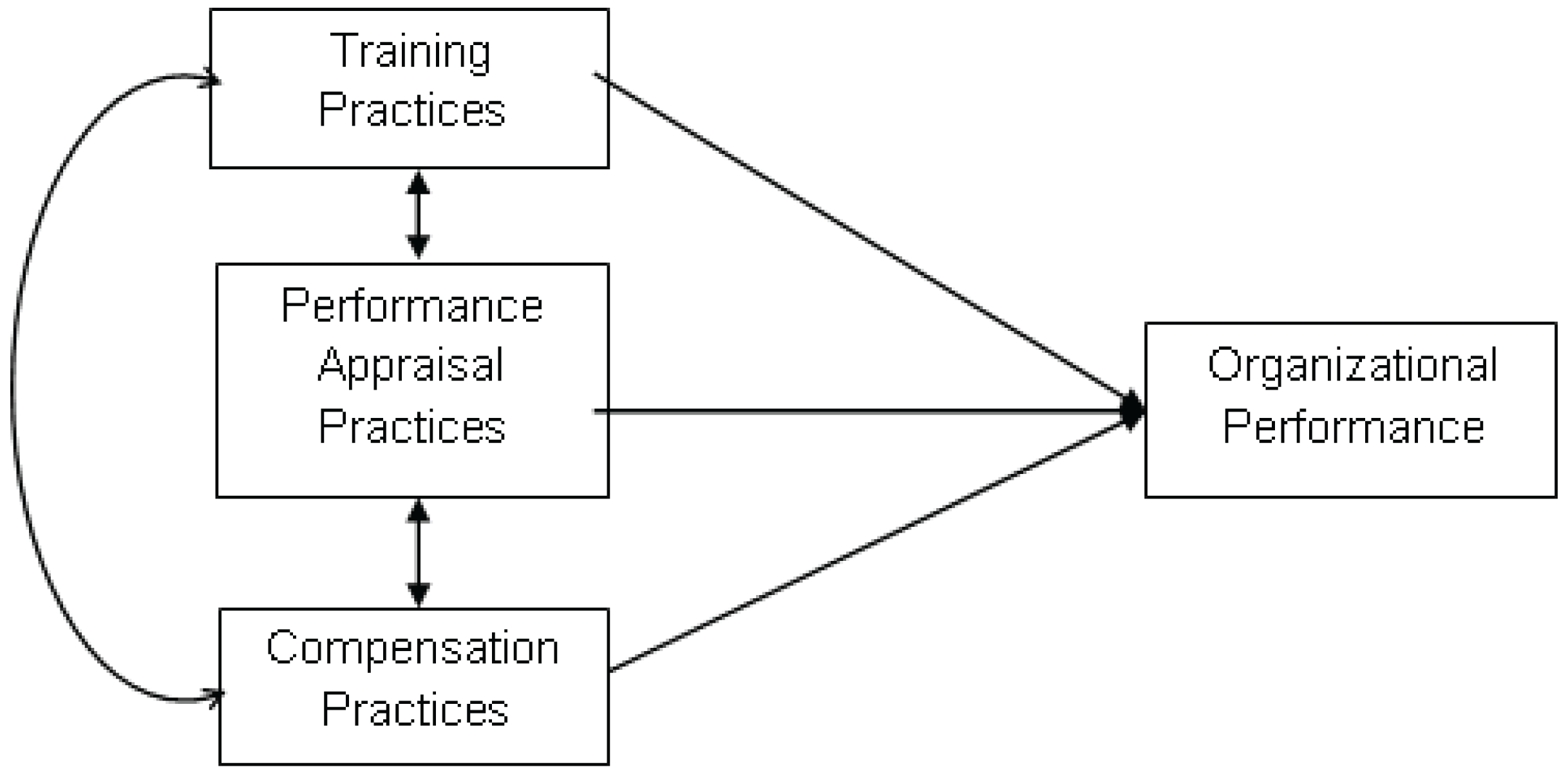
There are a large number of HR practices that influence organizational performance. But Boselie, Dietz and Boon (2005) did a comprehensive meta-analysis of 104 empirical research studies on linkages between HR practices and organizational performance, which have been published in pre-eminent referred journals between 1994 and 2003. From the meta-analysis, it has been concluded that the top three HR practices studied widely in the context of the linkages between HR practices and organizational performance, in order, were compensation, training and performance appraisal practices. This meta-analysis has provided motivation to the authors of the present study to choose the above three HR practices.
Relevant literature also reveals that earlier studies have frequently used perceptual measures in such research studies (Delaney & Huselid, 1996; Youndt, Snell, Dean & Lepak, 1996). There is also good evidence that perceived measures compare well with actual ones (Geringer & Hebert, 1991; Powell, 1992). Though subjective measures are fraught with shortcomings, Wall et al. (2004) found that self-reported data minimizes biases. Hence, whether actual or perceived measures are taken, the conclusion of the research does not change. Hence, perceptual measures have been taken here.
Research Methodology
Research Design
To find out the relationship between HR practices and organizational performance empirically, a survey study using the descriptive research design was conducted at the Mineral & Refinery (M&R) Complex of National Aluminium Company Ltd located at Damanjodi in the district of Koraput, Odisha, India. Data from primary sources were collected to investigate the relationship.
Sampling Frame and Data
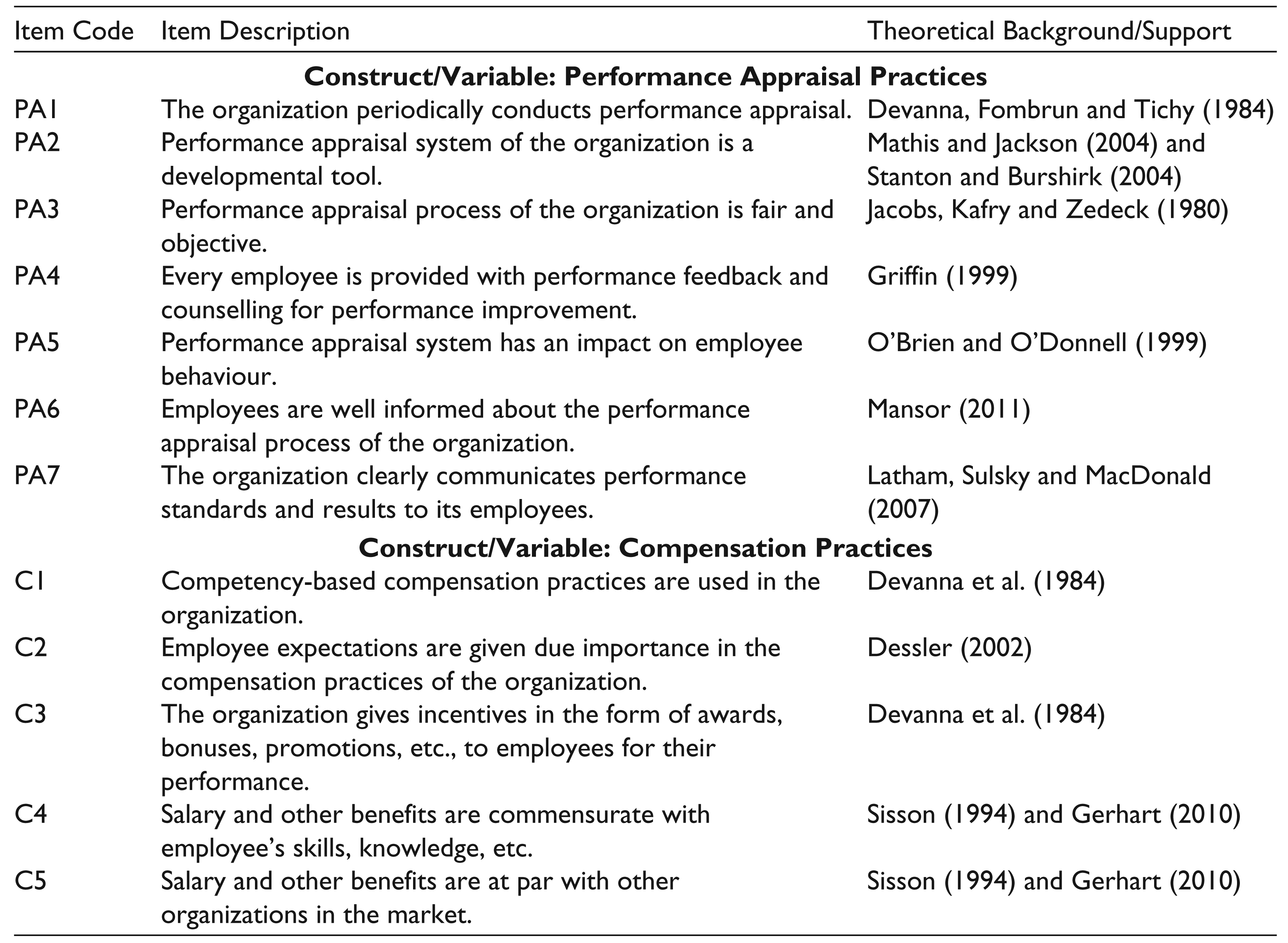
The population for the study was the employees of the M&R Complex of NALCO at Damanjodi. Random sampling technique was used for collection of primary data. A 24-item five-point Likert scale questionnaire was developed for the study taking inputs from past research studies and academic and industrial experts. For development of the scale, the items under each of the constructs/variables were identified from the existing empirical studies. For this, an extensive literature review in the area was undertaken and 24 items were identified. The items under each of the constructs were shared with academic and industrial experts for their opinion for finalization of the scale. The theoretical background for choosing the items has been detailed in Table 1. In all, 600 questionnaires were randomly administered to collect primary data on employee perception about HR practices and organizational performance and 438 were returned. Out of which, 424 were found valid for final analysis. The sample size and response rate were found to be acceptable (Cochran, 1977; Reilly & Wrensen, 2007). The survey instrument was pilot-tested taking 50 respondents and, with minor changes in wording, the instrument was finalized for the actual survey.
Theoretical Background/Support for Scale Items

Analysis and Results
The self-reported data collected using questionnaires were analysed using SPSS 24.0 and AMOS 24.0.
Scale Reliability Analysis
Responses of pilot-testing were analysed for reliability using Cronbach’s alpha (Churchill Jr., 1979). Values for all the constructs were found to be satisfying the cut-off value of 0.7 (Nunnally, 1978). The Cronbach’s alpha values for six-item organizational performance (ORGP), six-item training practices (TRNP), seven-item performance appraisal practices (PFAP) and five-item compensation practices (COMP) were 0.935, 0.729, 0.776 and 0.771, respectively. Now the scale was ready for collecting actual/full data for the study.
A two-stage SEM was carried out to validate the hypothesized model (Hair, Ringle, & Sarstedt, 2013). First, CFA was carried out to validate the proposed measurement model (MM) and hence the developed scale and, in the second stage, the structural model (SM) was developed to test the relationship among the variables based on the research/theoretical model. Prior to validating the measurement model, a preliminary check was made using exploratory factor analysis (EFA) to see whether all the proposed items (measured variables) load significantly on their respective factor and, therefore, to identify the underlying relationship between measured variables and their respective factor/construct.
Exploratory Factor Analysis
Kaiser–Meyer–Oklin (KMO) and Bartlett’s Sphericity tests were carried out to measure sample adequacy for factor analysis and values were found to be satisfactory. The approximate of chi-square was found to be 5,529.324 with a degree of freedom of 253, which is significant at 5 per cent level of significance. The KMO statistic was found to be 0.918, greater than 0.50 (Hair et al., 2013). Factor analysis was performed using SPSS 24.0. Principal component extraction with Varimax rotation was selected for the purpose (Costello & Osborne, 2011). Cut-off values of factor lodgings (>0.5) (Karatepe, Yavas, & Babakus, 2005), cross-lodgings (<0.40) or communalities (<0.30) (Hair, Black, Babin, & Anderson, 2010) and eigenvalues more than 1 were taken as references. Four factors have been extracted explaining a total variance of 66.21 per cent. All the items except ‘Pb’ in the construct/variable ‘organizational performance’ have been retained after the EFA. After deletion of the item, the scale was used for CFA. The factor matrix for factor loadings has been present in Table 2.
Factor Matrix for Factor Loadings

Measurement Model (CFA)
In CFA, goodness-of-fit indices are estimated for each latent construct as a distinct model (Schreiber, Stage, King, Nora, & Barlow, 2006) and then for all the latent constructs together as one model (pooled measurement model). First of all, multivariate normality was tested, which is one of the important assumptions of SEM, and it was found that the data departed from normal distribution. Hence, value of the maximum likelihood (ML)-based chi-square was likely to be exaggerated (Curran, West, & Finch, 1996) and, therefore, was not used to evaluate the overall model fit. Bootstrapping procedure was used to correct for the non-normality. Bollen–Stine p-value (Bollen & Stine, 1993) was used in place of the ML p-value to evaluate overall model fit as it can provide the corrected p-value for chi-square statistic. The fit of the developed models was also assessed on the basis of the values of fit indices. The factor loadings of the items in the confirmatory validation ranged between 0.70 and 0.92, showing good quality items, according to Comrey and Lee (1992). In order to lend support to our proposed four-factor measurement model (pooled measurement model), a one-factor model taking all the measured variables was developed and assessed for its goodness-of-fit. As the model was a poor fit (in terms of factor loadings and fit indices), it was discarded to lend support in favour of the four-factor/pooled measurement model. The results are presented in Table 3.
Measurement Models Fit Indices
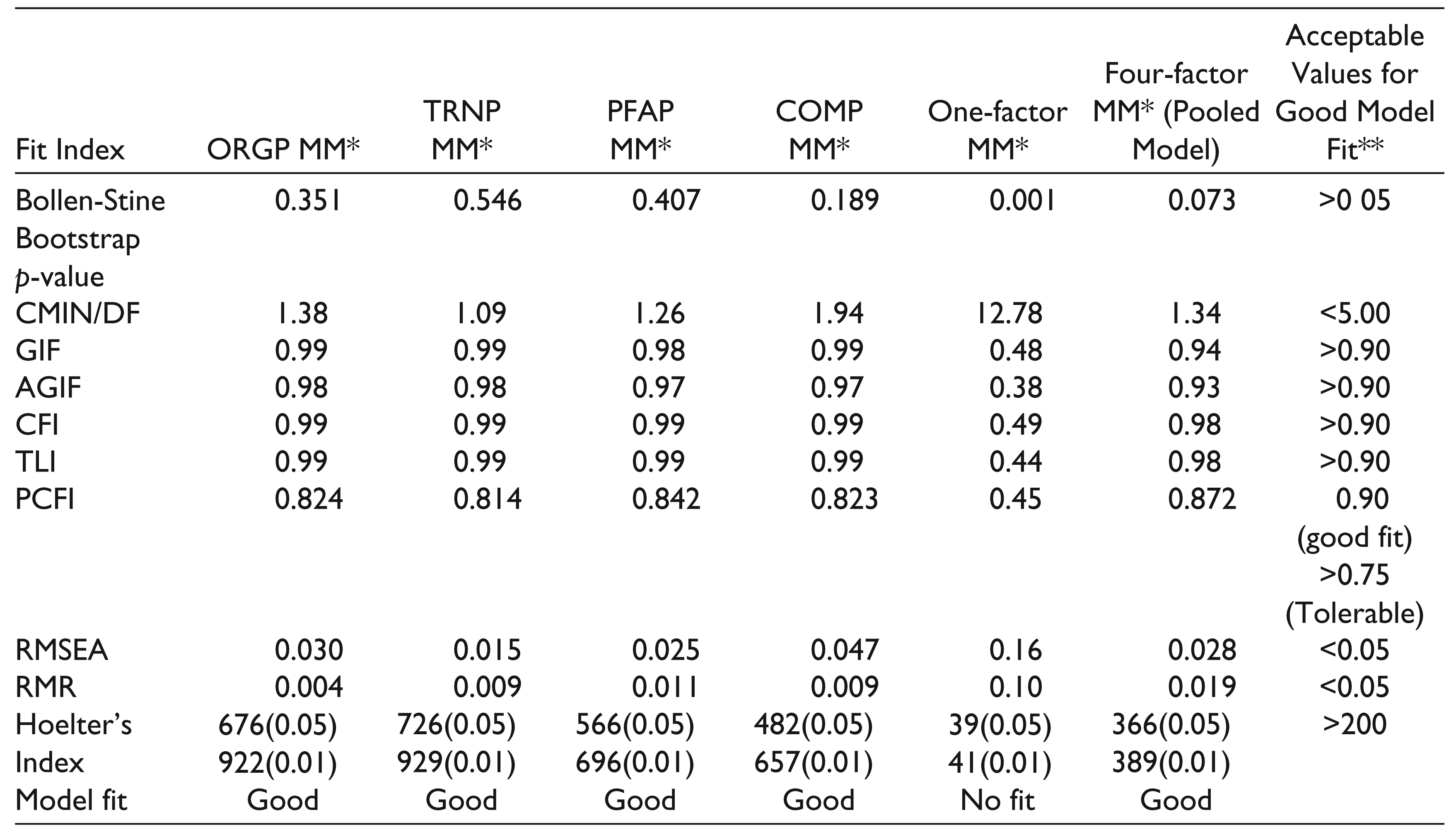
(b) **Hair, Black, Babin and Anderson (2010).
The one-factor measurement model and four-factor pooled measurement model have been presented in Figures 2 and 3, respectively.


Podsakoff, MacKenzie, Lee and Podsakoff (2003) have presented a number of potential sources of common method bias (CMB), which is the spurious variance that is attributable to the measurement method rather than to the constructs the measures are assumed to represent. The CMB has potentially serious effect on research findings. To exclude the bias, we have used Harmon’s single factor method and common latent factor (CLF)-CFA based tests. In Harmon’s single factor method, factor analysis using principal component method, without using any rotation, extracting only one factor was done. The percentage of total variance explained is 32.59, which is less than 50 per cent and hence CBM was ruled out. In CLF-CFA-based test, the difference between standardized regression weights from CLF-based model and that of a model without the CLF were calculated, which are small (less than 0.20), indicating that CBM is not suspected. As the model was evaluated using bootstrapping with 500 bootstrap replicates, Bollen–Stine p was taken into consideration. Values of model fit indices are as follows: Bollen–Stine p = 0.058; CMIN/DF = 1.34; GFI = 0.94; AGFI = 0.93; CFI = 0.98; TLI = 0.98; RMSEA = 0.028; RMR = 0.019; Hoelter’s Index: 366 (0.5), 388 (0.1), which are within the acceptable ranges. The CLF-based measurement model diagram is given in Figure 4.

The convergent validity of the four-factor (pooled) model was assessed by finding out the values of average variance extracted (AVE) and composite reliability (CR) from the results of CFA. The measurement model (four-factor pooled model) was found to be convergent-validated as AVE > 0.5 and CR > 0.7 (Fornell & Larcker, 1981). The results are presented in Table 4. Similarly, Table 5 presents the discriminant validity analysis. As the diagonal values are greater than the correlation values along respective row and column values, the constructs are discriminant-validated as suggested by Fornell and Larcker (1981).
Test of Convergent Validity of Measurement Model (Four-factor Pooled Model)


Test of Discriminant Validity of Measurement Model (Four-factor Pooled Model)

Structural Model
The scale was explored and confirmed through EFA and CFA, respectively. Now in the structural model, testing and validation of the proposed model formulated through theoretical framework was done. The model has been evaluated using maximum likelihood estimation method along with bootstrapping procedure with 500 bootstrap replicates to deal with non-normality of the data. From analysis of the fit indices and other parameters, the hypothesized model has been validated. Although Hair, Black, Babin and Anderson (2010) proposed that values of model fit indices between 0.5 and 0.8 are considered good for social science studies, we have obtained far better values in our model. All the values are hovering around 0.9 indicating that the proposed model fits well with the data excepting for PCFI (0.87), which is close to 0.90. The RMSEA is 0.028 (<0.05) and RMA is 0.019, which are acceptable for a good model fit. The Bollen–Stine p is 0.073 (>0.05), indicating that the data fit the model well. The fit indices are presented in Table 6. The loading estimates did not change from the measurement model indicating stability in parameters among measured items, which further supports our measurement model validity (Hair et al., 2010). Therefore, organizational performance is predicted by the HR practices as hypothesized in the model. The validated model explains 44 per cent of the variance as the value of R2 = 0.44. Figure 5 depicts the structural model path diagram.
Structural Model Fit Indices


Table 7 summarizes the path details obtained after testing the relationship between the latent constructs. From Table 7, it is clear that all the path coefficients, including the co-variance paths, are positive and significant in the proposed overall model. Therefore, our proposed model cannot be rejected and, hence, supported. That is, there is a positive association between training, performance appraisal and compensation practices and organizational performance.
Path Details of Structural Model

Test for Reverse Causality
The hypothesized model validated above has been drawn from the theoretical frameworks in extant literature. However, in order to lend more support to the hypothesized model, the feasibility of reverse causality should be explored. For this, we have envisaged an alternate model wherein the directional causal relationships between the latent constructs have been reversed. The goodness-of-fit was assessed and the alternate model was ruled out as the Bollen–Stine p-value for the model was 0.032 (<0.05), indicating the data do not fit the hypothesized model and the goodness-of-fit indices are also poor. Hence, reverse causality is not empirically supported and our model stands the scrutiny.
Discussion
The theoretical model/framework hypothesized has been validated by the findings of the study. The model has statistically demonstrated that all the three HR practices have a significantly positive impact on organizational performance. That is, HR practices are predictors of organizational performance. The R2 for the model is 0.44, indicating that 44 per cent of the variance in the endogenous variable (organizational performance) is explained by the exogenous variables (HR practices) together. The overall prediction of the model is quite acceptable (Cohen, 1988; Falk & Miller, 1992). The results account for a good amount of the variance in organizational performance. The rest of the variance in the response variable is explained by other HR practices not included in the present study. The results show that compensation practices are the strongest predictor of organizational performance with a factor loading of 0.40, which means that one unit of change in compensation practices will lead to 0.40 unit of change in organizational performance. Similarly, training practices come next to have an effect on organizational performance with a factor loading of 0.29 and performance appraisal practices come third in terms of influence with a 0.22 factor loading. Further, the three HR practices considered in the study have a good deal of synergy among each other thereby supporting the integrated/system view of HR practices.
The results are in line with the findings of earlier studies conducted elsewhere. Compensation, training and performance appraisal practices do have a positive impact on organizational performance. Compensation practices have got the highest contributing effect on organizational performance in our study, which indicates that properly designed compensation practices are always in the best interest of the organization. It should be viewed as an investment rather than a cost. Similarly, training and performance appraisal practices should also be considered among the best performance practices of an organization along with compensation practices. These findings are in consonance with the universalistic perspective that better organizational performance is contingent upon greater use of HR practices (Delery & Doty, 1996). Moreover, the system view of HR practices is also attested to in this research. The HR practices, which complement each other, contribute to organizational performance in a better way than individual HR practices. Indian organizations, which are mostly run on a traditional line rather than on professional lines, have important implications from such findings.
Conclusion
A review of the relevant literature has formed the basis of the objectives of the present empirical study. Most of the studies have indicated that HR practices do influence organizational performance positively. But only very little research has been done in the Indian setting and scant literature exists on the theme. Therefore, there exists a research gap, which makes a strong case for more studies in varied settings including India. What makes the study more relevant is the fact that Indian HRM scenario has been undergoing rapid changes owing to dynamically evolving HRM practices imported from developed countries and implanted in developing countries like India. Therefore, the present study tries to fill this research gap.
Primary data on perceptions of employees regarding organizational performance and the HR practices has been collected using a structured questionnaire from a valid sample of 424 employees making use of probabilistic sampling procedure. The data has been subjected to analysis using SEM to empirically examine the relationship between organizational performance and HR practices. A two-stage SEM has been adopted and goodness-of-fit of the measurement model and structural model with the data have been assessed using different fit indices. Both measurement and structural models have been found to have a good fit with the data thereby supporting the measurement theory (developed scale) and the relationship between proposed exogenous and endogenous variables.
It has been empirically established that HR practices are predictors of performance of an organization. All the path coefficients between individual HR practices and organizational performance are positive and significant (p-value < 0.05). Therefore, perceptually, HR practices followed in the organization individually influence organizational performance positively. Among the three HR practices considered for the present study, compensation practices influence to the greatest extent with a factor loading of 0.40. Next in influence comes training practices with a factor loading of 0.29, followed by performance appraisal practices with 0.22. Hence, good HR practices are always in the long term and larger interest of an organization and, for that matter, its employees. The co-variance path coefficients are also positive and significant pointing to the fact that there exists a good internal fit between the HR practices and they have a synergistic effect on organizational performance. The three HR practices together explain more than 44 per cent of variance in the organizational performance, which is a good percentage. Hence, the HR practices considered for the present study are among the high performing HR practices and have a significantly high contribution towards organizational performance. The rest of the variance is accounted for by the other HR practices, which have not been considered in the present study. From the study, it has been found that when ‘HR practices basket’ is so chosen as to have complementarities among themselves, there will be a synergistic effect on organizational performance. An arbitrarily chosen bundle of HR practices may nullify the benefits brought out by each other. Hence, properly designed and aligned HR practices are keys to superior organizational performance.
Managerial Implications
The managers taking care of the HR functions of organizations should realize that for enhancing performance of the organizations they should not hesitate to invest in HR functions. Human resources should never be construed as a cost, rather as an investment with a high rate of return. While designing the HR system, they should see that the HR practices should have a good fit to have a synergistic effect. The sectors in which there is no semblance of HR practices, should implement HR practices, if not to merely comply with legal provisions, but at least to reap the benefits of increased performance.
Since Independence, the country has given a lot of importance to public sector undertakings (PSUs) for its economic growth. For about four decades until 1991, PSUs almost monopolized production of goods and services in the Indian economic scenario. With the introduction of LPG era since 1991, private players have come in a big way and posed a very serious challenge to PSUs. The working of the PSUs, particularly the HR function, was plagued with traditional and inefficient way of functioning. But PSUs can no longer afford to ignore introduction of progressive and innovate HR practices to keep pace with and face the challenges posed by the private sector organizations, which are run most professionally as profit-making is the sole motive of such organizations. Among the major maladies plaguing the public sector, neglect of required talent is a failure of HR-related issues by the organizations. There is a wide gap between the two sectors as far as quality training, realistic performance assessment and wide disparities in the pay and perks are concerned. The IT revolution in India is mostly attributed to the spectacular initiatives by the private sector and the public sector has no matching HRM-related competitive advantage.
The present study, undertaken in a profit-making and successful PSU, should be a pointer to the top-level managers of the PSUs for revamping their HR practices for improving their performance on similar lines. Therefore, this article enriches the literature on the relationship between HR practices and organizational performance for any organization, in general, and Indian PSUs, in particular, in the dynamically changing HRM scenario.
Limitations
No research is without limitations. More HR practices could have been included in the study. A five-point Likert scale has been used for the present study but a seven-point Likert scale could have given the data more of a continuous nature. A survey study with perceptual/subjective measurement of the constructs has its own limitations as far as generalizability is concerned. Future researchers could do well to pay heed to these limitations while designing their research.
Declaration of Conflicting Interests
The authors declared no potential conflicts of interest with respect to the research, authorship and/or publication of this article.
Funding
The authors received no financial support for the research, authorship and/or publication of this article.
Footnotes
Acknowledgements
The authors are grateful to the anonymous referees of the journal for their extremely useful suggestions to improve the quality of the article. Usual disclaimers apply.