



Abstract
The hotel industry is growing rapidly in developing countries due to an increase in the tourism industry; however, on the other hand, the hotel industry is one of the sectors largely increasing the burden on the environment. Therefore, due to the massive number of environmental issues that hotel industry has encountered, there is an increasing force to pay a correct reaction to environmental issues and executing sustainable business practices such as the adoption of green human resource management (HRM) practices provide a win–win situation for the organization and its stakeholders. It, therefore, signals the need to examine how green HRM practices will enhance the environmental performance in the hotel industry. Grounded by resource-based view theory, this study utilized a research model examining the relationship between green HRM practices (green recruitment and selection, green training and development, green performance appraisal, and green compensation) and environmental performance in Malaysia’s hotel industry. Questionnaires were distributed to human resource (HR) managers/ executives in 3-, 4- and 5-star hotels in Malaysia. A total of 206 hotels participated in the study. The data collected were analysed using partial least squares structural equation modelling. Based on the analysis, the study revealed that green recruitment and selection, green training and development, and green compensation have a meaningful relationship with environmental performance, while green performance appraisal did not have a significant relationship with environmental performance. Our results extend previous research by not only highlighting the importance of green HRM practices in driving environmental performance but also indicating how each dimension of green HRM practices either enhances or inhibits environmental performance. This is the first empirical research that investigates the relationship between green HRM and environmental performance in the hotel industry literature.
Keywords
Introduction
Global tourism industry keeps increasing yearly since 1950 with the global tourist arrivals to the foreign countries growing to between 3 per cent and 4 per cent in 2015 and in Asia Pacific by 4 per cent to 5 per cent (UNTWO, 2015). This movement of foreign tourists is predicted to rise 4 per cent annually over the next 10 years, resulting in a lot of rooms demand (Hotel Investment Outlook, 2017). As tourism industry keeps increasing, hotel industry also facing the same phenomena as in global hotel industry has over 300,000 facilities and lodging to partially of international and national tourists, and in Europe alone, 160 to 200 million international tourists per year (Bohdanowicz, Simanic, & Martinac, 2005). In 2016, income generated from hotel industry in the Asia Pacific was US$ 8.5 billion and in first quarter 2017, in Asia Pacific, the volumes were maintained at US$ 8.5 billion (Hotel Investment Outlook, 2017).
Most hotels face internal and external pressures are forcing them to pay attention towards the preservation of the environment through eco-friendly hotel services that do not harm the environment and are safer for customers. These pressures are stronger against the hotel industry that contribute directly to the environmental issues such as water, energy and waste (Graci & Kuehnel, 2011). As mentioned by Gössling et al. (2005), the hotel industry releases an average 20.6 kg of carbon dioxide per hotel per night and uses 130 Megajoules energy per bed per night in a hotel. As a result, the hotel industry has caused energy consumption annually to rise to US$ 3.7 billion (Bruns-smith, Choy, Chong, & Verma, 2015). In addition, the hotel industry also produced waste at least one kilogram per day per customer (Bohdanowicz, 2005) and used 218 gallons of water per room per day in a typical hotel (Bruns-smith et al., 2015). Therefore, due to the massive number of environmental issues as discussed earlier that hotel industry has encountered, there is increasing force to pay a correct reaction to environmental issues (Erdogan & Baris, 2007).
With increasingly intense competition and ever-changing environmental conditions, a hotel’s ability to change direction and to reconfigure strategically is critical to its success in achieving environmental performance. In other words, we propose that hotels need to embrace green human resource management practices (green HRM). Recent empirical evidence supports the contention that green HRM practices drives firm performance (e.g., Daily, Bishop, & Massoud, 2012; Guerci, Longoni, & Luzzini, 2016; Jabbar & Abid, 2014). It is therefore not surprising that green HRM practices are gaining increasing importance in the academic and practitioner literature of management.
The human resource (HR) function plays a very important role in deciding which conservation practices should be applied in every aspect of business and implemented in all stages of an organization which is a continuous process (Cohen, Taylor & Muller-Camen, 2012). It is believed that green HRM practices are the best strategy of environmental performance programmes and green HRM practices provide a fundamental structure that allows organizations to better govern the organization’s environmental impacts (Sudin, 2011). A. Sheopuri and A. Sheopuri (2015) highlight that green HRM practices comprise the activities of environment-friendly HR, resulting in lower costs, greater efficiencies, and better employee retention and engagement which in turn help organizations to decrease employee carbon footprints.
Therefore, it is important to identify the green HRM practices that accelerate the contribution to the environmental performance in the hotel industry. The purpose of this article is to provide empirical evidence of the green HRM practices as a main contributor to the environmental performance in the hotel industry. Hence, next sections discussed the literature review on green HRM practices, environmental performance, underlying theory and present our hypotheses. In the following section, we present our methodology. Our results are next, and we conclude with a discussion of our findings and their implication.
Review of Literature
Green Human Resource Management Practices
Green HRM practices specify as a resolution of the organization using every employee’s crossing point to inspire environmental performance activities, increase the employee awareness and sustainable activities, therefore, increase the employee awareness towards environmental issues (Fayyazi, Shahbazmoradi, Afshar, & Shahbazmoradi, 2015). In general, this requires talent, skill and employees’ motivation for sustaining the organization’s environmental performance programmes (Brammer, Millington, & Rayton, 2007). With regard to green HRM practices as a best strategy to achieve organization’s environmental performance, Dutta (2012) demonstrated that green HRM practices is the best strategy that helps the organization by creating a ‘green employee’ who appreciates and recognizes the environmental performance in an organization by focusing on green recruiting and hiring; green training and development, green compensation and improving the organization’s human capital. Furthermore, through the green HRM practices, an organization can encourage the sustainable business practices in an organization and also promote the source of environmental issues by using every employee crossing point (Mathapati, 2013).
As discussed by Arulrajah, Opatha and Nawaratne (2016), green HRM practices are the programmes, techniques and processes that get completed in the organization to lessen negative environmental effects or increase positive environmental effects. Green HRM practices have the same practices as traditional HRM practices such as recruitment and selection, training and development, performance appraisal and compensation. However, green HRM practices have to bring the capabilities required for the continuous improvement of the organization’s environmental performance (Jabbour & Santos, 2008). Investment of people who are concerned in environmental problems is the main strategy in green HRM practices (Renwick, Redman, & Maguire, 2013) while traditional HRM practices stress on talent management, great performance workplaces and knowledge management and for the organization’s success (Davidson, Mcphail, & Barry, 2011). As a result, green HRM can be defined as the portion of the sustainable HRM that engages with the requirements associated with environmental sustainability. Green HRM practices constitutes the best approach which helps organizations to implement the environmental performance programmes by forming green employees who can appreciate and identify the environmental issues in business activities by concentrating on green recruitment and selection; green training and development; green performance management and appraisal; and green pay and reward system and improving the organization’s human capital (Dutta, 2012).
The existing literature shows that there has been increasing attention on green marketing, green accounting and green management. Nevertheless, a study on green HRM practices is relatively diverse and fractional (Renwick et al., 2013). In addition, an analytical focus on the relationship between the green HRM practices and environmental performance in Malaysia’s hotel industry is still lacking as green HRM practices are still at an emerging stage in Malaysia and gain minor attention (Aragón-Correa, Martin-Tapia, & de la Torre-Ruiz, 2015).
Based on some evidence, green HRM practices increase employees’ engagement, reduce costs and enhance efficiency. Furthermore, green HRM practices help organizations to lessen the carbon footprint of employees by carpooling, virtual training, job sharing, teleconferencing and online interviews and recycling (Mandip, 2012). Therefore, recruitment and selection, training and development, performance management and appraisal, pay and reward system, employee involvement and others are the practices that should be carried out by an organization to form green HRM through HR processes (Mandip, 2012). Therefore, this study defines green HR as the use of policies, philosophies and practices of HR (recruitment and selection, training and development, performance management and appraisal and compensation) that promote the use of sustainable business.
Environmental Performance
At present, various organizations in most of the industries are implementing strategic environmental performance programmes to gain a competitive advantage (Rodríguez-Antón, del Mar Alonso-Almeida, Celemín, & Rubio, 2012). Some of the stakeholders believe that environmentally concerned organizations are pricey. However, some of the stakeholders believe that consumers and capital market appreciate green organizations and hence, environmental performance should increase business performance (Chaklader & Gulati, 2015). Besides that, an increasing number of environmental laws and pressures from the market has raised organizations’ and managers’ awareness of environmental performance (DiPietro, Cao, & Partlow, 2013). Based on the aforementioned discussion, it is thought that the importance of environmental performance is a good opportunity to enhance the competitiveness of organizations in a win–win situation because incorporating environmental performance issues through to business strategy and innovating the process by a green concept are becoming a strategic prospect for organizations (Dangelico & Pujari, 2010). Therefore, along with increased social demand for environmental performance, the organizations applying strategic environmental management practices to be more competitive (Yang, Hong, & Modi, 2011) and the number of organizations applying and developing the concept of environmental performance into their business strategies are growing (Aragón-Correa & Sharma, 2003).
Alternatively, the execution of environmental performance programmes helped many industries to reduce their emissions, reduce their greenhouse gasses, reduce their hazardous waste and decreases their solid waste (Daily et al., 2012). Consequently, several organizations in the hotel industry executed the environmental performance programmes to reach environmental performance due to the awareness of the environmental issues (Mensah, 2006). End to end with this trend of environmental concerns, the hotel industry has focused increasing interest in environmental performance programmes (Kang, Lee, & Huh, 2010) as environmental performance programmes lead to quite a lot of benefits, for instance, more well-organized business practices, operational cost savings, increasing image, compliance with the regulations and improved competitiveness (Quazi, 1999).
Moreover, environmental performance has progressively become more important to practice and business research over the past decade as per reaction to a rapid reduction of natural resources by developed countries and the importance of corporate social responsibility in organizations to achieve competitive advantage (Dao, Langella, & Carbo, 2011). It is likely that most of the practitioners and researchers ought to examine why organizations react to environmental issues; it seems possible that integrating environmental performance programmes into their business strategies can lead to improved organization’s performance (Melville, 2010). Therefore, organizations themselves have developed a variety of measures that consist of the several basics of environmental performance (Ilinitch, Soderstrom, & Thomas, 1998). Furthermore, various measurement systems were introduced such as the corporate environmental scorecard, corporate environmental reports by the organizations and environmental rating matrices (Ilinitch et al., 1998).
A study by Milliman and Clair (1996) discoursed that there are abundant methods that can be used to measure environmental performance such as adopting corporate-wide metrics for measuring resource usage, acquisition and waste; performing information systems in order to track resource movements; and conducting field audits as a mechanism for employees to identify problems while gaining information and feedback about the environmental performance of the organization. In addition, a set of indicators such as low environmental emissions, pollution prevention, waste minimization and recycling activities can be used as an environmental performance indicator (Lober, 1996). On the other hand, according to del Brío, Fernandez and Junquera (2007) environmental performance can be improved by the execution of EMS such as ISO 14001 certification, a tool that requires high interaction between HRM and environmental management.
The effective implementation of environmental performance can only be achieved when the organization has the right people with the right skills and capabilities (Daily & Huang, 2001). Therefore, HR practices must be aligned with the business strategic goals. Hence, organizations are able to shape the skills, behaviour and attitudes of the individual as well as influence them to execute their work and accomplish the organization’s goals (Collins & Clark, 2003). In addition, employees’ involvement in the environmental performance programmes is of great importance, and as mentioned by Harvey, Bosco and Emanuele (2010), employees are more attracted to working with the organization that has concern towards environmental issues and find greater job satisfaction (Chan & Hawkins, 2010).
Green Human Resource Management Practices and Environmental Performance
Prior empirical research studies have examined various indicators that may contribute to environmental performance, such as economic performance and environmental performance. For instance, researchers have focused on the adequacy of environmental disclosure in financial reporting, and these data provide information about the organization’s exposure to green regulation and activities on environmental performance (Al-Tuwaijri, Christensen, & Hughes, 2004). Another research by Spicer (1978) used profitability, total risk, systematic risk, size and the price–earnings ratio to study environmental performance in the paper industry. The findings indicated that systematic risk, price–earnings ratio and size were significant with environmental performance. Additionally, in 1980, Ingram and Frazier studied environmental performance using corporate annual report by looking at the environmental disclosures, and the result indicated no significant relationship between environmental disclosure and environmental performance.
The present study examines the management strategy of using green HRM practices as a strategic tool to enhance environmental performance because according to Al-Tuwaijri et al. (2004), management strategy is very important to investigate the interrelations between environmental performance and economic performance. In addition, system changes towards the environmental performance programmes and infrastructure to reduce the organization’s environmental impacts and employee responses to those changes are a critical boundary condition (Young et al., 2015). Furthermore, organizations are gradually using employee behaviour change involvement to solve environmental issues such as reducing energy and water use, reducing greenhouse gas emissions, increasing recycling activities, and increasing the use of public transport (Young et al., 2015).
The findings from the study by Salehudin, Prasad and Osmond (2013) concluded that encouraging environmental performance programmes in the hotel industry in Malaysia might be a challenging and tough practice. In the hotel industry, in promoting environmental performance programmes, the biggest challenge is getting employees to change their behaviour and invest their ideas to help implement the environmental performance programmes (Chan & Hawkins, 2010). A study on how the attitudes and behaviour of employees in achieving effective environmental performance is an important aspect of the hotel industry (Chan, Hon, Chan, & Okumus, 2014). Employees’ involvement in the environmental performance programmes is very important, and as mentioned by Harvey et al. (2010), employees are more attracted to working with the organization that has concern towards environmental issues. This also enhances their job satisfaction (Chan & Hawkins, 2010). However, Chan et al. (2014) stated, there is a lack of research carried out to determine the relationship between employee readiness to implement green policies and environmental programmes, although there are studies claiming environmental management system will improve employees’ satisfaction and morale (Chan & Hawkins, 2010; Chan & Li, 2001).
As discussed earlier, the environmental performance may be enhanced with high interactions of HRM practices (del Brío et al., 2007). Thus far, several studies have indicated that appropriate HRM practices lead to better environmental performance of the organization such as the study by Jabbour, Santos and Nagano (2008) examined the organizations holding the ISO 14001 certification, and the result showed that better environmental performance was observed in the organization where the employees were the highly motivated by the use of appropriate HRM practices at all stages of the operating processes. Another study by Paillé, Chen, Boiral and Jin (2014) reported that implementing HRM practices at the strategic level is essential to the success of the environmental performance with the condition that all the employees (from top management to frontline employees) are involved in environmental performance programmes. Moreover, the study by Chan et al. (2014) indicates that environmental performance programmes by employees in the hotel is narrowly associated with green HRM factors, which are infrequently discussed in the literature. These factors involve selecting candidates with good environmental awareness, knowledge and behaviour and also providing constant environmental training to hotel employees as potential keys to improving a hotel’s environmental performance. Conversely, limited studies focused on the organization’s perspective in the implementation of green practices such as green HRM in the hotel industry, particularly within the Malaysia context (Aragón-Correa et al., 2015). Therefore, this study will verify whether green HRM practices will improve the environmental performance of Malaysia’s hotel industry.
Framework
An important role of HRM in the implementation of an organization’s environmental programmes has found united agreement (e.g., Jabbour & Santos, 2008; José, Jabbour, Beatriz, & Sousa, 2015; Teixeira, Jabbour, & de Sousa Jabbour, 2012); however, the developments are still disintegrated (Aragón-Correa et al., 2015) as there are some studies that have studied the consequence of environmental strategy, in particular, HRM practices, such as, training, performance appraisal, learning and development and the strategies to increase the employee’s motivation (Aragón-Correa et al., 2015). At present, no study has been carried out to examine these practices as a whole concept of green HRM and environmental performance programmes as green HRM practices has had little attention from the organizations as environmental concerns were not a significant cost factor consistent with the weak regulations or non-existing regulations. However, with increase in strict regulations, lots of organizations started to implement the environmental performance programmes (Wagner, 2014). Consequently, green HRM practices became more common as soon as the organizations started to grow and execute their environmental performance programmes (Christmann, 2000). There are numerous studies which have established that HRM practices play important roles in accomplishing the environmental performance programmes (Jabbour & Santos, 2008; Jose et al., 2015; Teixeira et al., 2012). Given that, green HRM practices (recruitment and selection, training and development, performance appraisal and compensation) developed as an important strategy to increase the organization’s environmental performance.
According to Jabbour (2011), the selection and recruitment processes have an impact on the environmental performance. Hence, Jabbour (2011, p. 99) defined recruitment as the ‘organization activity aimed at locating and motivating potential candidates for available and predicted job openings’. Furthermore, the recruitment activity aims to encourage the number and variety of applicants for a particular position including internal and external recruitment (Ivancevich, 1995). The selection activity for future employees must stress on the overlap between applicants’ values on the environment and those of the organizations (Paillé, Boiral, & Chen, 2013) and should make sure that environmentally dedicated applicants have higher probabilities of being selected (Jabbour, 2011). Current literature scarcely reviews the selection of environmentally committed employees in general, especially, in terms of selecting employees with technical familiarity and knowledge about environmental performance programmes (Jabbour, 2011). In addition, organizations that are looking for candidates with environmental attitudes will pose environmentally linked questions to the candidates during the interview session (Mandip, 2012) and select candidates with significant environmental values as part of their daily practices (Opatha & Arulrajah, 2014). With this type of a candidate, organizations will benefit the environmental performance and enhance its business performance in the future. Therefore, this study hypothesizes that green recruitment and selection practices positively influence the environmental performance.
Many organizations take efforts to manage the environmental issues by using training and education programmes to distribute the environmental performance culture in an organization and make known the organization values to notify employees about the importance to change during the early stage of environmental performance programmes, for instance, improve employee competencies in tune with the criteria of performance evaluation (Renwick, Jabbour, Muller-Camen, Redman, & Wilkinson, 2015). With regards to green training, the organization should update the employees about the green policies and procedures, the advantage of the environmental performance and the organization’s initiatives to improve its environmental performance (A. Sheopuri & A. Sheopuri, 2015). As employees have ample knowledge and information about the environmental issues and the organization direction towards these issues, in the long run, the organization will benefit from the environmental performance as organization performance increases (Renwick et al., 2015). Therefore, environmental training for all levels of the organization is vital for environmental performance programmes (Perron, Côté, & Duffy, 2006). In addition, the common benefits gained by the organizations and employees from green training are competitive advantages and helps sustaining high standards of organization’s services (Murthy, 2008). This study hypothesizes that green training and development practices positively influence the environmental performance.
Green performance appraisal plays an important role in achieving environmental performance because this practice provides the strategy that assesses employee’s job performance based on green-related standards and consists of an unconnected element for progress on greening in the performance feedback talk (Jabbour, Santos, & Nagano, 2010). As mentioned by A. Sheopuri and A. Sheopuri (2015) the environmental criteria are included in the performance appraisal of the employees, so that a culture of environmental performance might be encouraged in the organization. Therefore, the performance of the individual employee will be taken together with the environmental performance that affects the total amount of encouragement awards and flexible compensation that can be permitted to employees (Jabbour, 2011). In addition, green performance appraisal includes topics such as the use of environmental responsibilities, environmental incidents and the knowledge about the environmental policy and issues, as these issues that are involved in environmental performance appraisal concern the requirement for managers to be responsible for environmental performance (Renwick et al., 2013). Hence, this study hypothesizes that green performance appraisal practices positively influence the environmental performance.
According to Daily and Huang (2001), to motivate and enhance the commitment from employees to be responsible for the environment, compensation plays a significant role. As compensation briefs employees to environmental awareness, it rejects undesired behaviours and strengthens preferred ones (Jackson, Renwick, Jabbour, & Muller-Camen, 2011). With regard to compensation, there was a situation when managers used compensation systems holistically to control employees towards escaping negative environmental behaviours. Therefore, they can preclude damage to the organization and themselves (Jackson et al., 2011). Hence, to increase the environmental performance of the organizations, it is necessary to implement a compensation system that includes the financial and non-financial rewards for employees with a specific potential to commit to environmental performance (Jabbour et al., 2010). Therefore, with a proper compensation system, the organization will benefit from the environmental performance. Thus, this study hypothesizes that green compensation practices positively influence the environmental performance.
Objectives
This study attempts to examine the relationship between green HRM practices (recruitment and selection, training and development, performance appraisal and compensation) and the environmental performance in Malaysia’s hotel industry.
Rationale of the Study
This study seeks to provide a better understanding of the relationship between the green HRM practices and environmental performance in Malaysia’s hotel industry. This study also provides better insight on how green HRM can enhance the hotel industry’s environmental performance in Malaysia, as environmental issues are becoming more significant and well-known due to the enhancement of human and business activities. Therefore, the environmental issues in the hotel industry also need further consideration. Thus, numerous multidisciplinary literature is focused on the relationship between organization’s environmental performance programmes and natural environmental protection (Shwom, 2009). The establishment of the environmental performance programmes in the hotel industry is a strong platform supported by the HRM practices and generate common consensus (Jabbour et al., 2008; Teixeira et al., 2012). However, there are still existing fragmented developments (Kramar, 2014).
Methodology
Sample and Data Collection
To test our hypotheses, we collected data from 206 hotels in Malaysia. The total number of hotel registered in Malaysia is 2,091 hotels (Ministry of Tourism and Culture Malaysia, n.d.). The target population of this study comprises 3-, 4- and 5-star hotels and respondents were the HR managers in these registered hotels as stated in the Ministry of Tourism and Culture Malaysia. The study focused on hotels that are 3-, 4- and 5-star, eliminating 1- and 2-star hotels because of their lack of demonstration in adopting environmental performance programmes (Rodríguez-Antón et al., 2012). The total number of 3-, 4- and 5-star hotels registered in Malaysia is 721 hotels (April 2016) based on the statistics provided by Ministry of Tourism and Culture Malaysia as stated in Table 1. A total of 250 questionnaires were distributed to target respondents. Of these 250 questionnaires distributed, a total of 225 questionnaires were returned. Among these, only 19 returned questionnaires were unusable due to incomplete information. The final usable questionnaires were 206 which accounted for 82 per cent response rate.
Measurement
A combination of existing validated measurements, extensive literature review (items as conceptualized by the authors) and with the help of academic and industry experts were utilized to develop an instrument for this research. At the initial stage, this research used an existing validated measurement to measure all variables in this study. This research conducted an in-depth pilot interview with three HR managers of the hotel in Malaysia and asked two academic HR management experts to review the questionnaires. The researchers asked them to specify any ambiguity about the phrasing of the items. Based on the feedback, the HR Managers provided suggestions to add more items to measure independent variables, green HRM practices as the initial items adapted from Jabbour et al. (2010) are difficult for them to understand further. Therefore, this study added items as conceptualized by Arulrajah et al. (2016) to make the questions more clear and understandable.
Total Number of Hotel in Malaysia Based on Star

Furthermore, this research was designed for items designated as independent variables with environmental performance based on the actual practices in Malaysia’s hotel industry. The actual practices of environmental performance in Malaysia’s hotel industry were adapted from a qualitative study by Yusof and Jamaludin (2013). As these items are conceptualized items and are not statistically tested, to ensure content validity, therefore, the reliability of the items was measured using Cronbach alpha.
Green Human Resource Practices
In this study, green HRM comprises six components which are; green recruitment and selection, green training and development, green performance appraisal and green compensation. This study adapted the questions from Jabbour et al. (2010) and Arulrajah et al. (2016). Furthermore, this study used the 5-point Likert Scale (1 = strongly disagree, 5 = strongly agree).
Environmental Performance
To measure environmental performance, Yusof and Jamaludin’s scale (2013) was employed. These items were tested as a qualitative measurement. The Cronbach’s alpha reported for the overall items from this study is 0.817. Each dimension of environmental performance was measured on a 5-point Likert scale, ranging from one (strongly disagree) to five (strongly agree).
Analysis
Measurement Model
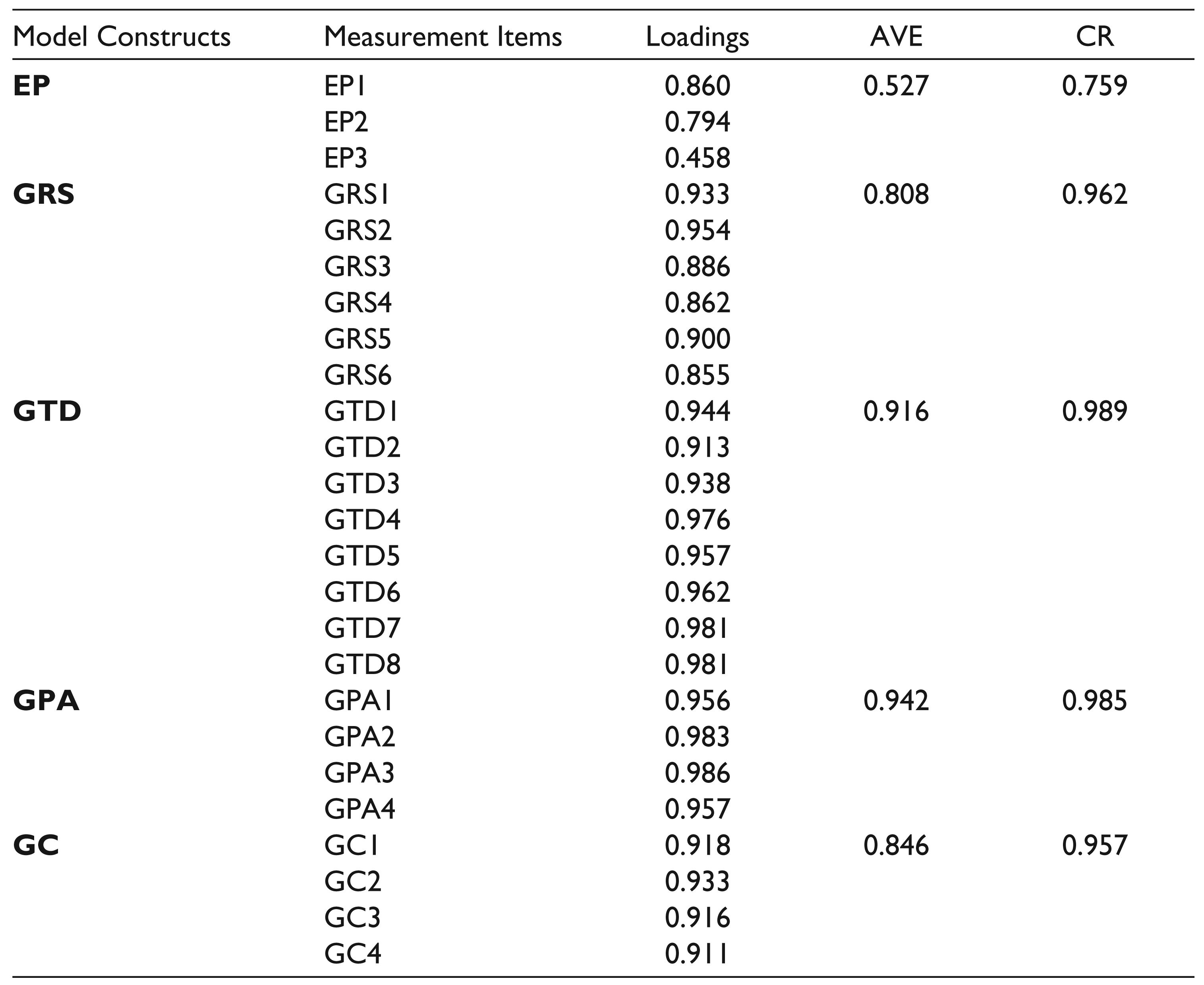
This study used the two-step approach as suggested by Anderson and Gerbing (1988). Firstly, the study assessed convergent validity and reliability and the discriminant validity. Convergent validity can be ascertained if the loadings are greater than 0.5 (Hair, Black, Babin, & Anderson, 2010), composite reliability greater than 0.7 (Gefen, Straub, & Boudreau, 2000) and the average variance extracted is greater than 0.5 (Fornell & Larcker, 1981) as stated in Table 2.
Results of Measurement Model
This study also tested for the discriminant validity using the evaluation of the heterotrait-monotrait ratio of correlations (HTMT) (Henseler, Ringle, & Sarstedt, 2015). Using HTMT as a criterion to access discriminant validity, the researcher needs to compare it to a predefined threshold. Hence, if the value of the HTMT is greater than its predefined threshold, the researcher can conclude that there is a non-existence of discriminant validity. This study used a conservative threshold of 0.85 as suggested by Clark and Watson (1995) and Kline (2015) as stated in Table 3.
Discriminant Validity of Constructs

Structural Model
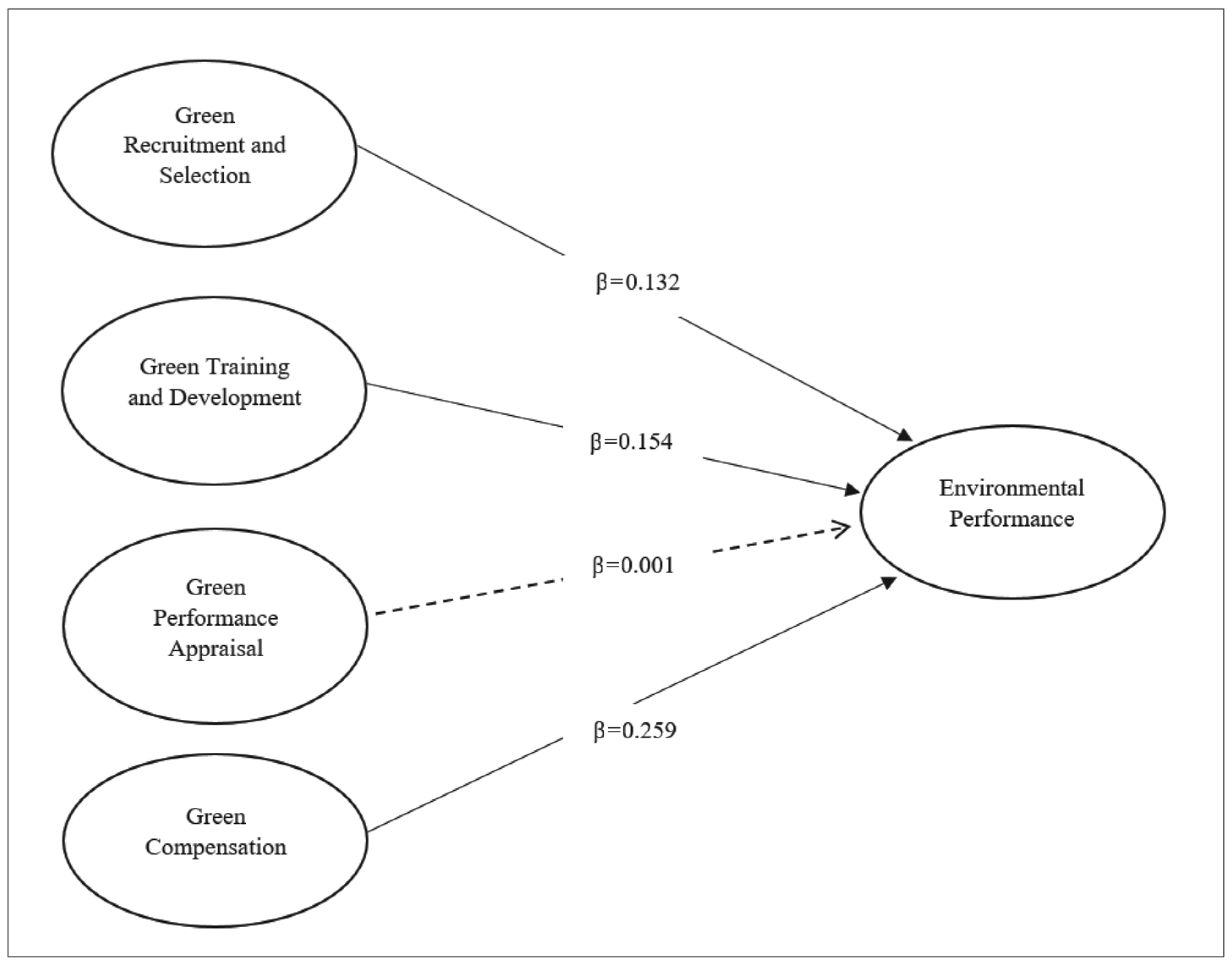
The structural model was tested next. The results are presented in Table 4 and Figure 1. The R2 is 0.260 meaning that 26 per cent of the variance in environmental performance was explained by the green recruitment and selection; green training and development; green performance appraisal and green compensation. Furthermore, bootstrapping of 5,000 resamples was conducted to determine the path coefficient values and the t values for each path. Therefore, looking at each structural path, green recruitment and selection (β = 0.132, p < 0.10), green training and development (β = 0.154, p < 0.05) and green recruitment (β = 0.259, p < 0.05) were found to have a significant relationship with environmental performance. Meanwhile, green performance appraisal (β = 0.001, p > 0.10) was not found to be significantly related to environmental performance.
Summary of Path Coefficient

Discussion
The major finding from this study is that 75 per cent of the hypotheses are supported; green recruitment and selection, green training and development and green compensation have a positive relationship with environmental performance. This result indicates that to reach environmental performance, the organization in the hotel industry can use green HRM practices to stimulate their employees (Paillé et al., 2013). In addition, the greater outcome of environmental performance involves HRM practices that support the entire execution and management of environmental programmes and activities in the organizations (Jabbour & Santos, 2008).
Malaysia’s hotel industry is facing a lack of information about the level of environmental knowledge and interest of hotel managers and about how the daily hotel practices relate to environmental outcomes (Erdogan & Baris, 2007). Hence, this result. Green recruitment and selection positively influence the environmental performance and contribute to the important strategy for hotel industry to be embedded in the green recruitment because it provides employer with an opportunity to position ahead of the competitors, and there are chances of attracting the applicants and retaining them after orientation and training (Ahmad & Nisar, 2015). Besides, in order to improve the environmental performance, hotel industry needs to recruit the candidates with green attitude. Thus, hotel industry can invest in people, who already are environmentally alert and used to environmental management such as waste management, recycling and ISO 14001 certification. As a result, these people will help hotel industry achieve their environmental performance (Ahmad & Nisar, 2015).
It has been suggested that when organizations act in environmentally responsible approaches (green HRM), organizations will benefit from competitiveness such as environmental performance, social well-being and financial success (Bansal & Roth, 2000). Hence, this study found that green training relates positively with the environmental performance. This result was confirmed by Jabbour (2013) as environmental or green training was establish as an essential condition for every effective activity of environmental performance. In addition, Aragón-Correa et al. (2015) conclude that green training is a significant practice in the development of environmental performance, for enhancing environmental skills and knowledge and helping in improving environmental performance (Wagner, 2013). Additionally, to make the environmental performance part of the organization’s culture, hotel industry needs to provide employees with environmental training to enhance their environmental knowledge and environmental awareness (Bansal & Roth, 2000).
This study also found that green compensation has a positive impact on environmental performance. According to Ahmad and Nisar (2015), compensation can stimulate employees’ awareness to the maximum at the place of work and encourage them to put an all-out effort to achieve the organization’s goals. Furthermore, with a good type of compensation system, organizations will encourage the environmentally friendly practices and the improvements of services and processes and hence will increase customer satisfaction in the hotel industry (Govindarajulu & Daily, 2004).
Conclusion
From the aforementioned discussion, it can be concluded that green HRM practices (green recruitment and selection; green training and development and green compensation) will lead to environmental performance in the hotel industry. However, there is one hypothesis, green performance appraisal does not positively influence the environmental performance in the hotel industry. According to Ahmad and Nisar (2015), green performance appraisal is a process in which employees are stimulated to improve their professional skills in terms of environmental issues helping to attain the goals and objectives of the environmental performance in a better way (Ahmad & Nisar, 2015). Thus, hotel industry owners must integrate the environmental performance into performance appraisal (Epstein & Roy, 1997). However, the result shows that green performance appraisal did not have a significant relationship with environmental performance. The reason for this situation happened possibly due environmental issues in the Malaysia's hotel industry are still new, and an insignificant number of hoteliers differentiate they are a green hotel (Yusof & Jamaludin, 2013). Also, the study was conducted in the early stage of the awareness about the green HRM in Malaysia. Therefore, a future study will be encouraged to study different industries when the green HRM practices are more mature in the context of Malaysia.
Managerial Implications
This study provides valuable suggestions to practitioners in Malaysia’s hotel industry. Specifically, those policy makers in charge of HRM in hotel industry could make full use of the results from this study to manage the HR by providing strategy recommendations with regards to sustainability, green practices and processes towards HR management in Malaysia as general, and more specifically, in the hotel industry. In addition, the study has provided suggestions that could help maximize the environmental performance in hotel industry through the implementation of green HRM practices such as green recruitment and selection, green training and development and green compensation.
Limitations
Although this study provides practical contributions to practitioners, there are still some limitations to this study. First, the sample of this study was solely collected from HR manager and HR executive working in hotels in Malaysia. Hence, the level of knowledge in term of environmental performance may not up to the actual practices that they practiced and solely depends on their knowledge as HR manager/executive and not the person in charge of the environmental performance programmes in the hotels. Secondly, this study is a cross-sectional study and therefore, causality between the variables could not be strongly demonstrated when data are collected at the same point of time (Sekaran & Bougie, 2013). Regardless of the limitation of a cross-sectional study to establish the direction of causality, this limitation can be partly mitigated by relying on a theory to establish and to explain the causal relationships between the variables in a cross-sectional study (Hair et al., 2010). The supported hypotheses in this study, which is consistent with the theoretical foundations of the RBV Theory, helps to conjecture the causal relationships involved.
Declaration of Conflicting Interests
The authors declared no potential conflicts of interest with respect to the research, authorship and/or publication of this article.
Funding
The authors received no financial support for the research, authorship and/or publication of this article.
Footnotes
Acknowledgements
The authors are grateful to the anonymous referees of the journal for their extremely useful suggestions to improve the quality of the article. Usual disclaimers apply.