



Abstract
Frequent turnover of employees began from the last century, increased further with the inception of turnover-prone millennial employees and is likely to continue in the future. This study used expectation–confirmation theory and Herzberg’s two-factor theory as the underpinning theory. Its calibrated factors such as transformational leadership, stress reduction, and compensation and rewards that affect employee retention mediating through job embeddedness. A simple random sampling technique was utilized while selecting the respondents from millennial employees in private sectors. For developing the model, Smart Partial Least Square (PLS) was applied for path modelling, measurement models as well as for bootstrapping while testing the hypotheses. The study found that all these factors have got a significant positive relationship as predicted. This study has got numerous contributions, which are beneficial for all stakeholders of private industries. Although the enormous studies have been carried out in the Western context, the problem of frequent millennial turnover remains unresolved both in the West and in non-Western context. Practically, the study will be helpful for all against the frequent turnover and its losses. The paucity of studies on transformational leadership, stress reduction, compensation and rewards, and the retention of millennial employees in a developing country’s context made this research more significant and relevant. The mediating role of job embeddedness was also found to be significant in this relationship. Finally, the study was found to have implications for all stakeholders and future researchers.
Introduction
The concept of job embeddedness was rarely studied since the beginning of the twentieth century, whereas there was a move towards considering the psychological conditions of the employee associated with post-war industrial revaluation to increase the productivity of workers (Gupta & Sharma, 2019; Mullins, 2004). At present, employees’ embeddedness and retention have become a subject of growing interest in organizational management (Aboobaker & Edward, 2019; Worthington & Britton, 2006). Supervisor behaviour, compensation and benefits have significant positive effects on job embeddedness, where compensation and benefits have the highest impact. On the contrary, job character is found to have an insignificant impact on job embeddedness. Moreover, job embeddedness was found positively and significantly related to employee in-role performance (Rubel & Kee, 2014). Supervisor behaviour, compensation and benefits have a substantial positive influence on job embeddedness where compensation and benefits have the highest impact. Employee retention was found positively and meaningfully to be related to employee retention and embeddedness (Noor et al., 2020; Rubel & Kee, 2014).
Wiggins (2016) predicted that within 1 year, if a choice is given, one in four millennial employees or millennials will quit their work to join a new organization or to do something different than their present job. The survey found that at the end of 2020, two of every three employees hope to have moved on, whereas only 16 percent of millennials like to see themselves with their present employers a decade afterwards as well (Wiggins, 2016). This significant moral degradation and absence of loyalty represent some serious hurdles to any business organization. At the same time, employees from the millennial group are going to represent the largest segment of the workforce in the world. As per Deloitte (2016), two in three millennials expect to leave by 2020. Gen Y or the millennials were born between 1980 and 2000. It is found that members of M = millennial employees are smarter, better behaved and more civic minded compared to previous generations. It is also found that employees always seek better job opportunities if their existing leaders or managers do not fulfil their demands (Ahmed et al., 2020; Bhat & Rainayee, 2019). However, transformational leadership, stress-free workplace, and compensation and benefits can retain them in the workplace (Chawla et al., 2017; Urban & Verachia, 2019).
However, the current section discusses the research background, evidence or issues related to global and specific contexts related to the employee turnover of millennials in the workplace. Further insights are revealed in following sections. After the preamble, the first section of the article deals with the literature review where extensive reviews were carried out to pinpoint the gaps in the literature, find out the problems, which are subsequently used for formulating the theoretical framework. The documentation of different variables incorporated in this research was also discussed in this section. The second section discusses objectives and describes the relevance of the study. The third section elaborates on the research methodology and how the research was conducted. This section also includes methods for quantitative data presentation, analysis, structural equation modelling (SEM) and ethical considerations. It also elaborates on data collection and analysis based on the actual study. Finally, the last section includes comprehensive discussions, conclusions, managerial implications and the limitations of the study.
Review of Literature
Background
Maximum employee retention–related researches were carried out from a Western cultural perspective, while developing countries were left out. Researchers of developing countries did not focus much on human resource management (HRM) strategies related to the retention of young employees (Kour & Sudan, 2018; Urban & Verachia, 2019). There are scarcity of indexed literature on the current state of employee turnover and retention in the private sector. Using the technology world has turned in to a single global village. By keeping pace with technology, the new generation advanced quickly, but HRM could not keep pace with this technological transformation. In the global context, turnover of employees from the new generation became a burning issue for the human resource manager from the perspective of an employee (D'Amato & Macchi, 2019; Rubel et al., 2017). The use of modern technology turned into a basic necessity for the millennial generation. The demands of the millennial generation are a little more in addition to traditional motivational factors in comparison to baby boomers and Generation X.
Previous studies have found that salary is correlated to job embeddedness, whereas new generation employees appreciate the fairness, which ultimately retains them (Chhabra, 2020; Herzberg et al., 1959; Sharma & Bajpai, 2014). It is reported that justice and equity are more critical determinants of embeddedness than the actual level of pay. Job embeddedness is a crucial factor in employee retention and can be achieved through transformational leadership, compensation, rewards, stress reduction and job embeddedness (Cohen-Charash & Spector, 2001).
Millennials’ wants are considerably higher than other generations. These youngsters are scholastic but impatient. They want to wear flip-flops to the office or listen to music from their iPods at their desk. Millennial employees may not be taken enough initiative, same time, they are never hesitated to raise the voices considering their requirements. They have high expectations of self, and aspire to work faster and more significantly than their peers. They have high expectations from employers and are interested in transformational leadership, compensation and rewards, and stress reduction (Hassan et al., 2019). They appreciate creative challenges and view colleagues as significant resources from whom they can draw substantial knowledge. They are goal-oriented from the first day and highly ambitious. They do not like to stay in an organization for long. Millennials are skilled to undertake multitasks, and very much expert of juggle e-mail on their Samsung side by side talking on mobile while trolling online. There are plenty of differences between employee and employers’ views regarding the millennials. According to a survey conducted, individuals belonging to the Gen Y think they are extremely hardworking (86%), whereas HR managers feel they are not (11% only) hardworking (As per
The concept of job embeddedness has been widely researched since the beginning of the twentieth century when there was a move towards considering the psychological conditions of the employee associated with post-war industrial revaluation for increasing the productivity of workers (Mullins, 2004; Pradhan et al., 2019; Singh & Bhattacharjee, 2020). In recent years, measuring employees’ embeddedness has become a subject of growing interest among organizational management. This corporate interest in measuring job embeddedness has been influenced by workplace aggression. To increase productivity, organizational commitment, organizational citizenship and job embeddedness are required (Sharma & Bajpai, 2014; Spector, 1997, 2008).
Wiggins (2016) stated that, if a choice is given, one in four millennial employees or Gen Y would quit their present employment and look for newer opportunities. Through a survey, it is found that at the end of 2020, two of every three employees hope to have moved on, whereas only 16 per cent of the millennials like to see themselves with their present employers a decade later as well. This significant moral degradation and absence of loyalty represent some severe hurdles to any business organization while employing a large number of millennials (Bagheri & Akbari, 2019). Whereas millennials are going to represent the largest segment of the workforce of the world very soon. Deloitte’s Millennial Survey (2016) found that two in three millennials expect to leave by 2020. Gen Y or the millennials were born between 1980 and 2000. The millennial employees are smarter, better behaved and more civic minded compared to previous generations. The millennials are found to be always seeking better job opportunities if the existing leaders or managers do not fulfil their demands.
Emerging Problem
The most significant problem is faced by present private organizations regarding millennials who did not have the desire to work for prolonged periods. Motivational factors are required to meet the needs of individuals for psychological growth, achievement, recognition, career advancement and the opportunity of employment for the organization (Tanwar & Prasad, 2016; Wiggins, 2016). The majority of studies in this area discussed the challenges associated with talent flow, which refers to the migration of talented individuals to different countries for a variety of reasons (Carra et al., 2005). It includes undertaking advanced studies abroad or to acquire different work experiences, and then subsequently return to their country of origin to take advantage of economic opportunities and so on. Few studies had compared talent flow to the notion of ‘brain drain’ and suggested that as days go by, it is becoming a burning question that needs to be firmly dealt with (Carra et al., 2005). If the millennials are satisfied with their employment, only then retention can be achieved. Indeed, transformational leadership, compensation and rewards, and stress reduction can retain these valuable employees (Isfahani et al., 2019).
Turn over creates significant financial loss for any Organization irrespective of country. An organization deals with both visible and hidden costs like loss of productivity and motivation in terms of individuals and organization. All organizations must spend a handsome amount of time educating new recruits and filling up the gaps. It has become essential for organization to ensure constant productivity and output through retention. In contrast, it is a general tendency for individuals belonging to Gen Y to look for newer opportunities if their requirements are not met. Employees who are happy and content at work are gratified with their job. These days, employers have also realized and place greater emphasis on employee job embeddedness (Shropshire & Kadlec, 2012).
Only 30 per cent of Americans like their job. Unhappy employees were depressed and found means to avoid working in US companies, which count the loss at US$450–550 billion every year (Notte, 2013). Millennials likely to leave their organization within the next 3 years are relatively more compared to other generational employees (Schawbel, 2016). Excessive turnover spoils the organizational images and break the customer flows. By 2025, 75% of the millennials are going to lead the world business (Wiggins, 2016).
Human resource executives all over the world understand that motivational factors influence employee engagement and retention. Only respondents based in the Netherlands, Switzerland, Spain and Belgium found that their organizations are ready to address turnover issues by redefining and redesigning their engagement in line with the requirement of time, but such strategic thinking is not found in developing countries. Individuals belonging to Gen Y have some unique attributes that can be very beneficial and at the same time unfavourable, depending on the organizational settings (Wiggins, 2016). In 2025, the number of millennials will be the highest in the workplace. Despite a lot of scholarly studies and surveys, global statistics and literature show that job embeddedness and retention issues have not been solved yet and are, instead, increasing (Anjum, 2016; Schawbel, 2016; Srouji et al., 2019).
However, the percentage quitting government jobs stands at 3.57 per cent and private jobs at 96.43 per cent. So, the private sector needs to enhance its efforts to retain its employees of the organization for the fulfilment of a long-standing dream of Bangladesh to switch over to middle-income countries from low income country. The findings by Hassan et al. (2019) were also supported by the results of Hassan and Jambulingam (2018) that showed higher rates (96.43%) in terms of employee turnover in the private sector in comparison to the public sector (3.57%). Alam et al. (2019) states that the absence of continuous professional development and regular feedback hinder job retention and the enthusiasm to engage effectively at the workplace. These burning problems of turnover require to be addressed through comprehensive studies where global strategies are needed to re-evaluate the data gathered to combat the current turnover phenomenon (Srouji et al., 2019).
In the twenty-first century Generation Y employee demands a new type of requirements from all over the world. By 2025, 75% of millennials going to lead the world business. Like many other developed and developing countries, turnover issues are not yet considered, neither did they inculcate retention strategies to retain valuable employees. Primarily due to this employee turnover, entrepreneurs, employers, Organization, and its employees are suffering very severely (D'Amato & Macchi, 2019). Deficiencies in literature in the context of developing countries and problems of turnover necessitate further studies on job retention in the context of developing countries. Due to excessive voluntary turnover of millennial employee, the organization faces both overt, and covert losses .
Maximum studies on job embeddedness and retention were carried out from a Western cultural perspective, whereas similar studies on developing countries have been scarce as there is no literature available in terms of Gen Y employee turnover and its causes. Moreover, most of the research in the context of developing countries did not cater for underlying theories; if this could be addressed, the outcome could be much accurate and usable (Hassan et al., 2019). The analyses of literature also reveal that in the context of developing countries, in most cases, data were collected from a single industry, whereas a unique picture could be portrayed pertaining to employee retention if data could be collected from diverse industries. But there is no empirical study that has yet attempted to study the mediating role of job embeddedness in the relationship between proposed retention factors and employee retention (Rubel et al., 2017; Sivapragasam & Raya, 2018). Whereas other relevant millennials preferred viable factors like meaningful job, training, development, growth opportunities, work–life balance, etc. Substantial amount of studies were carried out in this context. As such, considering the emerging gaps and paucity of studies on transformational leadership, stress reduction, compensation, rewards and the retention of millennial employees in the context of developing countries made this research more significant.
There are a substantial number of gaps perceived related to the research on millennial employee retention. It is found that the Asia Pacific region is lagging in terms of motivating their employees in the field of management because it fails to set transparent performances prerequisites, objectives, goal-oriented missions and visions due to the scarcity of viable information (Ashton, 2018). Many studies have been performed in this regard; nevertheless, appropriate methodological tools were not used like SEM. Some studies found significant relationships between job embeddedness and employee retention, and some studies found no significant relationship; for this reason, there was a need for further study. Most of the non-Western research was carried out in a single company if multiple companies could be surveyed then result could be more generalized.
There was no integrated model that was proposed by any researcher that used these gaps and viable factors on retention. Past literature and gaps reveal that no author has performed a study on viable factors to retain the Gen Y population such as transformational leadership, stress reduction, compensation, rewards and the retention of millennial employees in the context of a developing country, whereas Gen Y got more than two times of turnover than Gen X, and 4.5 times than baby boomers and other predecessors (Hassan et al., 2019). These massive turnover tendencies of Gen Y employee likely to be continued in the future also. During the period from 2020 to 2025, the Gen Y population is expected to be the highest employed among others in the workplace. During this time, this problem is likely to increase further. Currently, the problem is the Gen Y turnover. More specifically, business leaders and managers lack Gen Y-centric strategies to combat the Gen Y turnover–related losses and job embeddedness in the emerging private sectors (Hassan et al, 2019).
Job Embeddedness and Turnover Intentions of Millennial Employees
There are some studies investigating job embeddedness and job retention; still, the remedies are not working effectively, or existing measures are not competent as such the researcher intended to address these emerging gaps of literature and going to contribute new lessons and directives to the body of knowledge. The private sector has got enormous contributions to the overall development of any country. If job embeddedness is addressed, it will promote job retention for the new generation of employees. It will also help HRM to form future strategies and policies for any company, and that is how this research work will facilitate in broader aspects to fulfil the objectives (Alamayreh et al., 2019).
In a seminar on structural and policy gaps for the private sector in Bangladesh, in 2018, the United Nations International Children’s Emergency Fund (UNICEF) conversation emphasized the necessity for the involvement of the private sector in applying UNICEF’s Sustainable Development Goals (SDG) as approved by the United Nations (UN). Hassan et al. (2020), project advisor and SDG lead, United Nations Development Programme (UNDP), Bangladesh, stated that the private sector is undertaking 78 per cent of the development work in Bangladesh, so the Government of Bangladesh should give due importance to the private sector of Bangladesh. In this discussion, others, including advisers to the prime minister, International Affairs and other leading private investors, suggested that the private sector needs to be prioritized to uplift Bangladesh from lower-income countries to high middle-income countries by 2030. Hassan et al. (2019) said that, by 2020, Bangladesh is going to generate 2.5 million jobs where public and private investment will be 7.8 per cent and 26.6 per cent, respectively.
Indeed, employees are the key drivers for the success of any organization in the world. Soon employee from Generation Y will retire from their position due to age, as such new energetic employee from Millennial going to take over these positions. Millennials have got the general tendency to contribute positively towards world’s progress. Millennial employees are loyal to team works, they grown up with openness, and having aptitudes for sharing their knowledge. From resourcing and talent planning (2017), it is observed that the private sector is going to develop more talented employees internally and will emphasize more on retention. In the era of globalization, all the personnel from the top management and entrepreneurs should understand the importance of retaining the millennials.
However, considering the loss to a company, like knowledge, cost of turnover, recurrence of turnover, regaining efficiency levels and goodwill of the company, it is very much essential to take necessary steps to retain talented employees. Almost every aspects, employees from millennial are lagging behind. Millennial employees are not appreciating cost-effectiveness, hardworking, team cohesiveness, problem-solving initiatives of the organisations. On the contrary, at present, they lead in terms of entrepreneurship. Most of the cases to retain turnover prone employees HR managers increase the salary or provide other fringe benefits but these solutions are temporary in nature (Srouji et al., 2019). Moreover, top management and proprietors are not also much concerned about these turnovers of employees and losses. Hence, it has become very much essential to highlight and examine the general factors affecting the turnover of a company through the employment of millennials to upgrade the desired productivity of any organization.
To keep pace with this transforming world, a comprehensive guideline is required, which will include how employees are to be appointed, how responsibilities are delegated and how to make adequate resources available to succeed (Martínez et al., 2019). Organizations need to look towards promoting and developing transformational leaders. Leadership needs to be uniquely suited to meet the demands of the millennial generation because it is primarily focused on the needs and development of the generations that will follow them. There are five specific dimensions of desired leadership—altruistic calling, emotional healing, wisdom, persuasive mapping and organizational stewardship—all of which cater to specific desires or needs of millennials. These dimensions are necessary if the organization wants to attract and retain top talent among the millennial population (Carvalho et al., 2019).
Today, most organizations have some form of assigning groups of people to work together towards common goals. Unfortunately, most teams fail to achieve their full potential due to issues in sharing leadership (Graen & Grace, 2015). Alam et al. (2020) affirmed that human resource executives all over the world understand that motivational factors influence employee engagement and retention. Only respondents based in the Netherlands, Switzerland, Spain and Belgium found that their organizations are ready to address retention by redefining and redesigning the engagement in line with personal, corporate and social purposes, which is close to matching their sense of urgency in this area. Finally, it found that millennial job embeddedness and retention is decreasing in private sectors as such different retention strategies are required, which may include transformational leadership, compensation, rewards, stress-reduction, etc.
Losses of Employee Turnover
According to the exit voice employees’ leave, the job due to dis-embeddedness in a job can take four forms, each is unique and got two dimensions: active versus passive and constructive versus destructive (Farrell, 1983). Loyalty or neglect of an employee’s attitude of faith towards the association occurs when a staff demonstrates absenteeism, presents late for work and exerts less at work (Carvalho et al., 2019). So far, the researchers only focused on job satisfaction, but not on embeddedness of employees. As per Notte (2013), only 30 per cent of Americans like their job; it means 70 per cent of employees in the USA do not like their jobs. Unhappy employees that sound in sick and find means to avoid working for cost US companies US$450 billion to US$550 billion every year. Job retention involves offering windows of growth opportunity, valuable retention awareness, awareness management, side effects, formulation of work and environment-friendly policies; otherwise, there likely to be a significant loss in any company. Experienced employees will be replaced with amateurs. A long time will be required to get output from these new employees (to oriented & train). All concerns to give extra efforts to bring new employees in current footings of day to day affairs. It will also include recruitment costs, other visible and hidden costs to count as a burden.
Turnover Issues are not yet considered in most of the developing countries also, neither to teach soft HRM strategies to retain valuable employees. Primarily through this turnover, entrepreneurs, employers, Organization, and its employees are suffering very badly. Deficiencies of literature and aroused problems of turnover demand study on job retention beyond the western context. Moreover, due to excessive voluntary turnover, organization count high hidden costs like loss of productivity in terms of individual, Organizational overt, and covert losses (Sohel, 2015).
Relationship of Transformational Leadership, Stress, Compensation and Rewards, Retention and Job Embeddedness
In transformational leadership, a leader becomes a good listener and should not only listen but also intend to recognize. Listening to others does not only assist in resolving the issues effectively but also helps to reinforce the effectiveness through communication. All leaders should have the attitude of serving first. This individual should make a workable choice to lead (Hassan et al., 2019). There is a strong correlation to job embeddedness and retention of the employee (Liden et al., 2014). Previous studies reveal that transformational leadership, compensation and rewards, and stress reduction have a positive effect on discharging stress. It also diminishes turnover and employee turnover intentions (Gotsis & Grimani, 2016). It is found that all styles of leadership have a positive effect in motivating millennial employees (Liden et al., 2015). It is assumed that transformational leadership, compensation and rewards, and stress reduction are important factors affecting millennial employee retention (Hassan et al., 2019).
It is of prime importance to develop leadership skills and organizational values and ethics, which are very much crucial for millennials (Ruys, 2013). It has been found that almost all styles of leadership possess a positive relationship in motivating millennial employees to give their best. However, literature reviews indicated that there are gaps in past studies. Hauw and Vos (2010) stated that a difference remains in profiling millennials in non-Western countries. Conversely, the literature review shows that little effort has gone into generational aspects in non-Western developing countries, and very less focus has gone into millennial retention.
Today, most organizations have some form of assigning groups of people to work together towards common goals (Lawler & Porter, 1967). Unfortunately, most teams fail to achieve their full potential due to improper leadership (Graen & Grace, 2015). By using transformational leadership approach it is possible to take necessary measures to fulfil the viable requirements of Millennial employees, However, in these cases temporary expenditures likely to be increased. Yet, in most of the cases, total expenses remain lower than the turnover cost (Druker et al., 1996). Few elements help to achieve job embeddedness and retention—compensation, rewards, management style and stress reduction (Cuddy-Casey, 2010). To uphold the efficiency and productivity of Millennial employees’ necessary care should be taken by leadership and management of the organisations to indorse employees' state of Job embeddedness (Ahmed & Uddin, 2012).
Strategic transformational leadership trends are positively correlated with change in competency. Judicious commitment arbitrated the relationship between competency development and intention to stay with the organization (Naim & Lenka, 2018). Furthermore, management practices, leadership features and organizational culture also influence a manager’s ability to become successful in a multigenerational environment. (Iden, 2016). There is a positive and significant link between job satisfaction and human resource management policies such as teamwork, environment, job autonomy and leadership behaviour (Sohel, 2015).
Herzberg et al. (1959) classified the recognition factor as one of the satisfier factors. Employees have a positive psychological effect when recognized for good work and are happy within the organization; these feelings then have a positive impact on their job embeddedness. Spector (1997) states that if an employee is recognized for good work, job embeddedness automatically increases. Spector (1997) defines recognition as contingent rewards that are not necessarily monetary. Contingent rewards are commonly offered for good performance. It is found that employees feel greater embeddedness if organizations reward job performances that are above average. Mitchell et al. (2001) maintain that the lack of proper reward by appropriate leadership seems to be a significant problem for many organizations. For example, employees who experience little recognition are more likely to experience ‘dis-embeddedness’ and frustration. Moreover, as per different theories, it is predicted that appropriate leadership, compensation and rewards, and stress reduction positively impact employee retention, mediated through job embeddedness.
Underlying Theories
The expectancy-confirmation theory (ECT) was initially proposed by Vroom (1964). The underlying concept of ECT is to find the embeddedness with day-to-day affairs (Vroom, 1964). The expectancy theory states that an employee joins an organization with inner values and hopes and if these requirements and are fulfiled, they are likely to remain in the organization (Vroom, 1964). Likewise, lecturers in private universities in Malaysia on turnover intentions mentioned that employees enrol in an organization with a couple of hopes; negative attitudes like absenteeism and turnover tendencies will ensue if these necessities are not fulfilled. To give the foundation of the study the researcher identifies the expectancy theory as one of our fundamental theories for retention & turnover research. If those expectations are met via viable strategies, then one is satisfied. If those expectations are not met through proper ways, then one is not happy. The Expectancy Theory states that the Expectancy Theory–related frameworks guided the research on turnover intention (Mobley, 1977) successfully. Turnover intention is related to the hope of employees. As per the expectancy-confirmation theory (ECT), leaders and managers need to assess and satisfy the desires of their employees which can be term as retention strategies.
Transformational leadership, compensation and rewards, and stress reduction are most effective in retaining and satisfying millennial employees. It influences subordinates with the highest priorities and allows employees to perform ethically (Liden et al., 2014, 2015). The relationship between job satisfaction, motivation and retention of Gen Y leaders within the research framework has been mentioned in Maslow’s hierarchy of needs, Adams’s equity theory, Vroom’s expectancy theory and Herzberg’s two-factor theories. Leaders from different sectors have experienced enormous problems due to turnover issues, but compared to its gravity, not many concentrations were given against turnover (Wiggins, 2016). To address these gaps, it is necessary to recruit new employees and to provide the necessary environment to stay through leadership, rewards and stress-free environment. It is also essential to adhere to the best practices through qualitative efforts to retain the experiences and to ascertain the motivational factors of the Gen Y population. Certainly, it will help them to attracts and retain. Two-factor theory, Vroom’s expectancy theory, Adams’s equity theory, and Maslow’s hierarchy of needs. Maslow’s hierarchy of needs concerns motivation and employee job satisfaction. Adams’s equity theory involves determining the balance between employee input and output. Vroom’s expectancy theory pertains to why individuals choose one behaviour over another. Herzberg’s two-factor theory relates to motivation and job satisfaction. Herzberg’s academic concepts helped determine what factors are present in studies that are either embeddedness or hygiene factors. This theory is considered one of the best-known content theories in this regard.
This article compares and evaluates the ECT, Servant Leadership theory and Herzberg two-factor theory, where expectation-confirmation approach and Herzberg two-factor theory found more suitable applicability against the Gen Y population’s retention. This theory was extensively compared against other content and process theories in terms of employees’ motivational aspects. These theories were applied to enhance the understanding of the effects of the Gen Y population’s viable requirements against their job satisfaction and turnover. There substantial logic and rationale for the Selection of Mixed Theories. This study is based on a combination of Hertzberg’s two-factor theory and ECT, as the crucial motive of the study is to investigate the specific factors that have a positive impact on the employee job embeddedness and retention of millennial employees.
The theory has the likenesses, acceptance and variances over other leadership theories. This is because none of the theories described earlier integrates all characteristics, which put transformational leadership, compensation and rewards, and stress reduction in a unique position (Liden et al., 2015; Tanwar & Prasad, 2016; Von Fischer & De Jong, 2017). Additionally, it typically specifies combined embeddedness to become a leader with a necessity to serve, and it is the most explicit in emphasizing the reputation of follower outcomes in terms of personal growth (Liden et al., 2014). Furthermore, it has been found that transformational leadership, compensation and rewards, and stress reduction are positively and significantly related to organizational citizenship behaviour, job embeddedness and employee retention (Ozyilmaz & Cicek, 2015). By placing the functional attributes of transformational leadership, compensation and rewards, and stress reduction in the centre of a model, job embeddedness, and intention to stay observed in the organization would possess a consequence. In other words, it proposed an upward spiral whereby transformational leadership, compensation and rewards, and stress reduction would influence the organizational climate, which, in turn, would affect the employee attitudes, performance, job embeddedness, attitude to retain and vice versa (Van Dierendonck, 2011).
Objectives
Considering the emerging problems of frequent turnover by millennial employees, this research is going to identify the effects of transformational leadership, compensation and rewards, and stress reduction in the retention of the millennial employee in the private sector. It will reveal the impact of transformational leadership, compensation and rewards, and stress reduction on millennial employees’ job embeddedness in the private sector. The study will identify the mediating role of job embeddedness between transformational leadership, compensation and rewards, and stress reduction, and millennial retention in the private sector. Finally, the study will also determine the effect of job embeddedness on the retention of the millennial employee in the private sector.
Theoretical Framework
Organizations are run with a shortage of efficient leadership at various stages. Communication gap prevails between leaders and subordinates. The future generation demands for a devoted leadership, which is flexible, creative, friendly, adaptive and serves the millennial employees positively (Balda & Mora, 2011). Millennials, unlike the other generations, do not respect values and are short of understanding. They do not hesitate to voice out their opinion if their requirements are not met (Lu & Gursoy, 2013). Approximately 65 per cent of baby boomer workers plan to work until they are 65 years of age or more, and do not intend to retire earlier. The other generational employees (54%), except the millennials, also plan to do so. However, most of the millennial employees (60%) plan to retire by 65 years of age or sooner. Almost 55% of the millennial population believe that leadership opportunity is one of the most important factors for serving in an organization (Collinson, 2014). Effective HRM can only be ensured by leadership as well as management and same time effective HR practice numerous ways for performance improvements, including improved productivity, lower employee turnover and may ensure higher profits (Teimouri et al., 2018). Transformational leaders can minimize turnover costs, while building a committed and loyal workforce by embedding in the job. The review suggested that leaders need to supplement their engagement strategy with targeted retention efforts for their youngest and newest staff members.
The development of an innovation team approach requires developing a collaborative design that focuses on creating a friendly innovative workplace culture that deeply engages employees in the most challenging turnover problems faced by business today (Grace & Graen, 2015). The design of the new team-based organizations must begin with primary intention to build a flexible organization that can adapt and innovate more quickly in the rapidly changing business environment. Tailoring compensation and rewards and transformational leadership for the new generation of employees is required. Executives too often cannot foresee what is over the horizon, and they stay the course until it is too late to change (Grace & Graen, 2015). This may be fatal for their organization. But a human resource–inspired organizational culture of collaborative designing and workforce planning can shift the strategy from quickly patching up the old design to building a new one for the future. A collaborative design focus can create an innovative and flexible leadership system that can then be transformed into balancing innovation and operational excellence. The whole system is thus continuously seeded through a commitment to searching for opportunities everywhere, while leveraging alliances with innovative leadership and management, compensation and rewards, and through stress reduction (Liden et al., 2015).
Millennials think that relationship building is the essential quality, which is closely associated with relational transparency (Bennigson, 2015). The new generation of employees place a high value on themselves (Twenge & Campbell, 2012); they do not intend to confirm the costs of others, even if it does not relieve their stress. As such, transformational leadership is likely to experience discontinuation of the millennial who desire to have a comfortable workplace, a reduction in stress, flexible work schedule and job embeddedness (Twenge & Kasser, 2013).
Nevertheless, numerous factors influence employee retention, this includes different HRM factors, transformational leadership, job embeddedness, rewards and stress reduction, etc. Schawbel (2016), in his study, revealed that 87 per cent of employers said improving employee retention is one of the main concerns for any organization. Bahar et al. (2020) stated that there are a lot of discrepancies in different private industries, as most of the staff are not satisfied with the leadership in addition to a lack of motivation and rewards. Therefore, it is always better to fight against negative phenomenon well in time through appropriate leadership, such as transformational leadership, compensation and rewards, and stress reduction proposed in the present study.
In the context of the ECT, specifically, transformational leadership, compensation and rewards, and stress reduction, etc. efforts to assess and satisfy the hopes of our valuable employees which can be term as retention strategies, and which can be combat turnover intentions. Social learning theory explains the precursors and outcomes of ethical leadership. It sheds light on an individual’s characteristics in terms of leadership traits and situational impacts with respect to followers’ insights of a leader as creative management. As per social learning theory, leaders are desired to be flexible leaders by their followers; leaders should be attractive and trustworthy role models. In our review of the ethics and leadership, we found some influences and individual characteristics, which amplify a role model who can allure and also be reliable. Alam et al. (2020) stated that if leaders do not follow what they preach, why should others follow that. Transformational leadership and management are dependable for their trustworthiness and exercising what they preach.
Hassan et al. (2019) stated that transformational conflicts and they also trust that ferocity is not the answer, rather a harmonious solution is always expected. Hence, it is necessary to set up a dedicated HRM department in every organization, which not only modernizes the managerial concepts but also stabilizes the unrest situations.
It can be mentioned that the Gen-Y employees are strongly attracted towards extrinsic rewards. There is a positive and significant link between job embeddedness and HRM policies such as teamwork, environment, stress, compensation and behaviour of leadership (Sohel, 2015). From numerous previous studies it is assumed that job satisfaction likely to be mediator between the integrated HRM approach and retention of millennial employees. Likewise, Baron and Kenny (1986) rightly said that a variable might be considered as either a moderator or a mediator, depending on the adopted theoretical framework. It is found that the transformational leadership, compensation and rewards, and stress reduction style impact the level of job embeddedness, and this, in turn, influences employee retention. Servant leaders interact with the followers to support in creating clear goals, augmenting job embeddedness and helping to retain the valuable employees. Numerous attempts in the past were made to reveal employees’ job embeddedness in the organizations (Hassan et al., 2019). Therefore, it is perceived to have a relationship between job embeddedness and millennial employee turnover intentions. Transformational leadership, compensation and rewards, and stress reduction tend to have an impact both on job embeddedness and retention of millennial employees.
The transformational leadership is founded on replacing ideas that are pertinent and innovative for leaders and subordinates. The leaders help the subordinate to connect themselves with the organization’s vision, guide them to realize their powers and flaws and then assign tasks, therefore, to motivate them into taking larger challenges and duties, embedding them with the organization and becoming their character model. This type of leadership settled by Bass (1985), which entails idealized influence, inspirational motivation, intellectual stimulation and individualized consideration. Transformational leadership is very useful to ensure employee job embeddedness and to retain them in promising organizations (Block, 2003; Bass & Avolio, 1993; McColl-Kennedy & Anderson, 2002)
It is very much important to ensure the interpersonal relationship between leaders and employees (De-Spiegelaere et al., 2018; Gerhart et al., 1995). When an organization provides compensation and ensures the well-being of employees, it leads to a sound relationship between the organization and employees. Leaders and managers afford compensation for their employees to get the best out of them (Banjoko, 1996). Compensation and rewards are the best-known policies to fascinate the workers to get them involved within an organization so that employees remain in the job over a prolonged period (Porter et al., 2003). Recognition and rewards motivate the employees to embed with the organization as well as help them to remain with the organization.
Stresses are part of our bodies and minds, which involve regulating ourselves with the frequently changing situation; it has got both physical and emotional impacts to create optimistic and undesirable manners. Stress arises in diverse situations. Apprehensions regarding effective activities and anxiety of adverse outcomes result from target failure and conjure powerful undesirable emotions of nervousness, frustration and anger. The involvement of stress is strengthened if no backing or assistance is offered by supervisors or colleagues. As such, lack of cooperation and social isolation increase the problems of lengthy stress at the job, and the associated undesirable health consequences and amplified coincidental jeopardy. Stress reductions are very important for job embeddedness and to retain valuable young employees. Stress reduction or stress management is a very important pre-requisite for employee job satisfaction. Stresses are frequently used to demonstrate and interconnect the measure and degree of the problem that exists in the organization for the long run, which claims the business cases for pre-emptive measures (Koopmanschap, 1998; Larg & Moss, 2011).
Turnover intentions are related to the work environment, job satisfaction and job embeddedness (Humphrey et al., 2007). In particular, higher-level variables like organizational commitment and turnover intentions are very important for any organization. The emergent concept of job embeddedness describes the concept of keeping employees in the organizations, thus preventing employees from frequent turnover from the job (Lee & Kozak, 2012). Job embeddedness may be considered as the predictor of retention and turnover intentions (Harris, 2012). The prior study stated that employees got high job embeddedness, while having a lesser chance of leaving the job (Karatepe & Shahriari, 2014; Wheeler, 2010). Retention is a continuous and planned effort of taking all actions by the organization to retain knowledgeable, skilled and competent employees. It involves taking actions that motivate and tempt employees to stay with the organization for the maximum period. Turnover is defined as a process whereby employees leave or transfer within an organization or any job move, either leaving the organization or leaving the profession (Koketso & Rust, 2012).
The literature review, gaps and necessities also guided strongly to formulate the retention policy for millennial employees who have the general tendencies of job hopping all over the world. Different past literature found the effect of key retention factors which included transformational leadership, compensation, rewards and stress reduction for ensuring the millennial employees retention. Therefore, focusing on the viable requirements, underlying theories and significances, a retention policy–related framework was developed (Figure 1):

Research Methodology and Analyses
The present study represents managerial-level employees working in the largest groups of private companies in Bangladesh. Under one group, several companies with separate businesses are listed. A questionnaire-based survey was conducted among the professionals within IT, textiles, banks, foods, pharmaceuticals, energy sectors, and the participation in the study was voluntary. A systematic random sampling technique was used to select the participants for the study. In total, 570 responses were collected from entry-, middle- and top-level professionals. After removing the extreme values and missing cases, 500 valid responses were used for further statistical analysis. The items of the questionnaire were adapted from existing literature with a 5-point Likert scale. The quantitative research approach was used to examine the relationship between transformational leadership, compensation and rewards, stress reduction, job embeddedness and employee retention. The partial least square structural equation modelling (PLS-SEM) was administered to analyse the data. Barroso et al. (2010) recommended that PLS data must be analysed in two stages, which are the measurement model and the structural model. This is intended to explain the interconnection of all variables tested by producing the standardized regression coefficients for the model (Gotz et al., 2010). Before employing SEM, preliminary tests and descriptive statistics via the use of SPSS were also employed in the present study.
Demographic Profile
A total of 500 responses were taken from the private industries of Bangladesh by simple random sampling. Mostly similar distribution was found with 58.20 per cent male and 41.80 per cent female. All of them were from the millennial group aged between 30 and 39 (32.2%), followed by 20–29 years (29.8%). The survey was dominated by males (58.20%) and the married (65.60%). For the length of experience, most of them have worked with the organization for 3–15 years (42.4), and the majority earned a take-home salary of BDT 25,000–40,000 per month.
Measurement Model Assessment
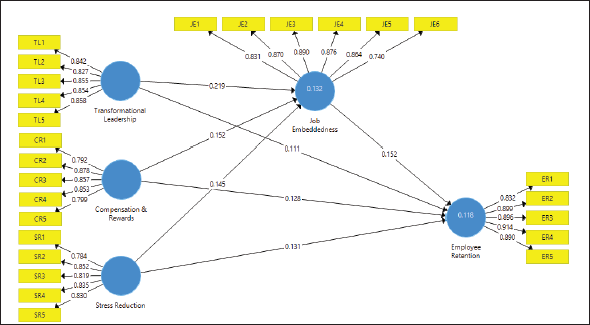
Five items each pertaining to transformational leadership (Bass, 1985), stress reduction (Brantley & Jones, 1989), compensation and rewards (Gibbs et al., 2004, 2009; Jansen et al., 2009), job embeddedness (Cunningham et al., 2005; Mitchell et al., 2001) and five items on employee retention were taken from Markowitz (2012) .These items were chosen based on high factor loadings and appropriateness in private sector employee retention context. The evaluation of construct validity was measured by using (1) convergent and (2) discriminant validity. The first is measured by evaluating the standardized loadings for each of the constructs, where loadings bigger than 0.6 were retained (Birkinshaw et al., 1995; Johansson & Yip, 1994). In reaching sufficient convergent validity, as in Table 1, the factor loading of remaining items was within the range from 0.740 to 0.914 as recommended (Chiang et al., 2012). All the composite reliability (CR) exceeded 0.70, and convergent validity (AVE) was more than 0.50.
Construct Validity and Reliability
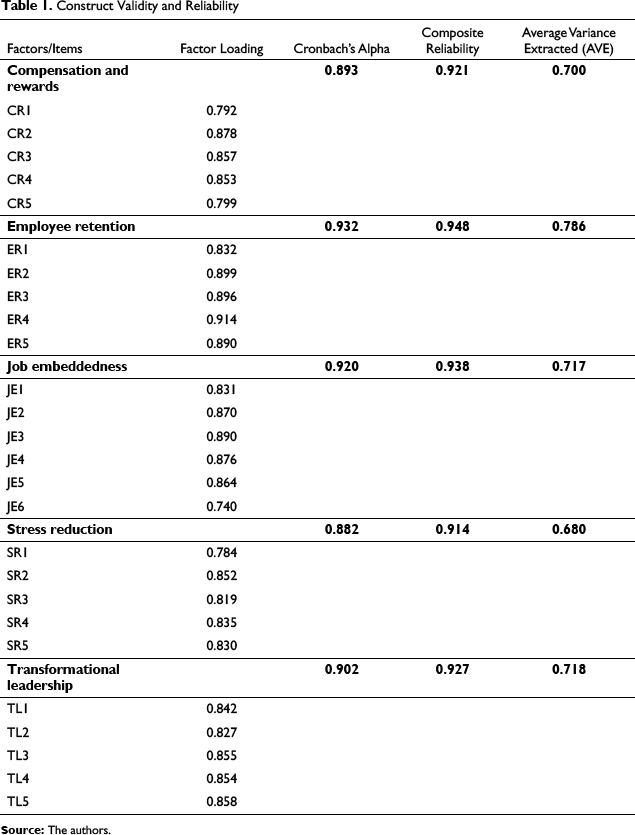
Discriminant validity measures the extent of the construct difference between one another. Discriminant validity is measured by several approaches, including Fornell Lacker and HTMT (the heterotrait-monotrait ratio of correlations) approaches. The first criterion is to determine the discriminant validity, using the Fornell Lacker approach. The value of square root AVE should be more significant than the inter-correlations with any other constructs in the model. As depicted in Table 2, all of the square roots of the AVE are greater than their corresponding inter-correlations. Thus, the assessment of reliability and validity suggests that the measurement model is satisfactory.
Discriminant Validity: Fornell Larcker

The HTMT values must be lower than 0.90 to show that discriminant validity is valid (Henseler et al., 2015). Table 3 shows that the highest HTMT value was 0.313, which is lower than the cut-off value of 0.90. Therefore, it has confirmed that the constructs have adequate discriminant validity.
Discriminant Validity: HTMT

Structural Model Assessment
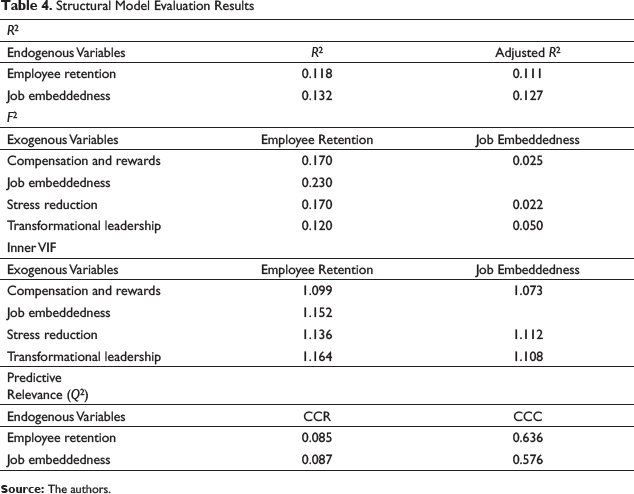
According to Hair et al. (2013), the structural model assessment includes the coefficient of determination (R2), effect size (f2) multicollinearity (Inner VIF) and predictive relevance (Q2). The general prediction strength of the model is measured through R2, as the good fitness is verified by a higher value of R2. Table 4 presents the R2 value of endogenous variables at 0.118 and 0.132. Table 4 also shows that all the VIF values for the variable are below 5, which indicates that there is no multicollinearity problem among the variables. F2 was used to measure the effect size. The value from 0.00 to 0.15 indicates a small effect size, while the value between more than 0.15 and 0.35 shows the medium effect, and values above 0.35 indicate large effects (Hair et al., 2016). The outcomes demonstrate that the impact of job embeddedness on employee retention has a medium impact because f2 is 0.170, 0.230, 0.170 and 0.120, respectively. The effect of transformational leadership, compensation and rewards, and stress reduction on job embeddedness were 0.025, 0.022 and 0.050, respectively, which indicates the small effect size, as the value is lower than 0.15, as presented in Table 4. Also, a blindfolding test (Q2 statistic) is performed as an extra evaluation of model fit in PLS analysis as the test of predictive relevance. As recommended by Geisser (1975) model, Q2 higher than zero is regarded to have predictive relevance. The value of Q2 was higher than zero as per the result depicted in Table 4. This supported the assertion that the model has an adequate prediction quality.
Structural Model Evaluation Results
Path Coefficient (Direct Effect) Results
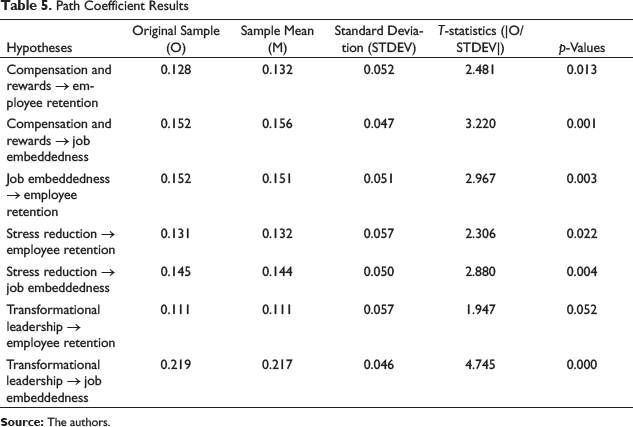
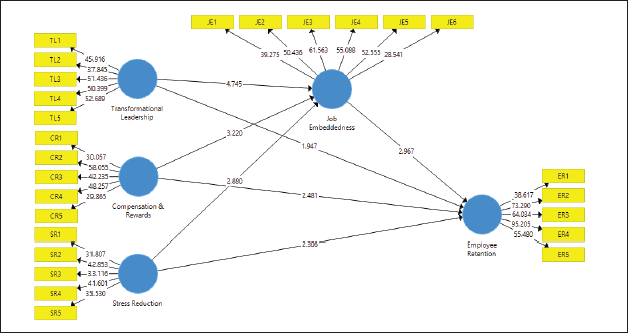
The bootstrapping procedure was used to test the hypotheses results, and the results indicate that all hypotheses were statistically significant. As noted in Table 4, job embeddedness had a substantial effect on millennial employee retention (Beta = 0.132, t = 2.481, p = 0.013) and transformational leadership, compensation and rewards, and stress reduction significantly effect on millennial employee retention as shown in Table 5. Furthermore, there was a significant association between transformational leadership, compensation and rewards, stress reduction, and job embeddedness, which has presented in Table 5 and depicted in Figure 2.
Path Coefficient Results
Mediating Results
The mediating role of job embeddedness in the relationship between transformational leadership, compensation and rewards and stress reduction, and millennial employee retention was also statistically significant, which has been presented in Table 6. The results showed that transformational leadership, compensation and rewards, and stress reduction have a significant and indirect positive effect on millennial employee retention that is mediated by job temperateness with the desired standardized indirect effect, t-value and p-value as presented in Table 6.
Mediation Results

Discussions
Subordinates from all generations want innovative leadership like transformational leadership to raise their motivation level. It is the responsibility of leadership. The leader must concentrate on the needs of the subordinates. Leaders should share their innovative ideas in the office, which will have a positive impact on the motivation of the subordinate. The leaders are required to establish a balance between the perceptions of the leader and the led. Confidence among subordinates that leaders can do for them what they cannot do reduces job dis-embeddedness. All leaders in an organization cannot increase the pay of the personnel, whereas the supervisor can inculcate the transformational leadership, compensation and rewards, and stress reduction of the subordinates. The leader should positively take care of the issues, which he can influence and ensure justice with respect to these viable requirements. It will be a significant motivating factor for the subordinates. Lead by example should be the ultimate dictum for the leaders. It will increase the interaction and participation of leaders with their subordinates. It might be the most effective way of reducing the gap between leaders and subordinates. If the leaders of an organization can establish and maintain a healthy working environment in the Organization, then subordinates will be able to carry out their responsibilities freely and effectively. It will significantly enhance the job embeddedness among all personnel.
Leaders also need motivation for job embeddedness. Once lower-level subordinates have the trust that the Organization will take care of their materialistic needs, they will be able to dedicate themselves to performing their responsibilities. This, in turn, will allow more interaction between leaders and subordinates. It will enhance the credibility of the leadership before their subordinates, and the subordinates will trust their leaders more. Delegation of authority to lower-level employees will increase job embeddedness. A transparent compensation and rewards policy will reduce the disparity among employees. Induction of enough talented candidates will ease up the excessive workload of the employees, which will help establish a healthy working environment.
Transformational leadership, by creating an ethical environment, may motivate employees and bring back job embeddedness among subordinates, and its ultimate result is employee retention. While leaders are willing to delegate authority to the subordinates, the subordinates enjoy the flexibility which offers freedom of work to them. Through practical and transformational leadership, it would be possible to train the subordinate and to guide them in the right path through compensation and rewards, and stress reduction, which will increase job embeddedness. Through proper leadership, subordinates will grow as confident workers. Only then can the leadership vacuum prevailing in various stages in the Organization be minimized.
Based on the results of the present study, it may be deduced that extant of studies exhibit transformational leadership, compensation and rewards, and stress reduction behaviours that can inspire the retention of employees and also theses of transformational leadership, compensation and rewards, and stress reduction behaviours can inspire retention, mediating through job embeddedness. Efforts to implement transformational leadership changes focused more on the extrinsic factors, such as handling co-workers, making competent decisions, effectively implementing policies and strategies, subordinate advancement, improving working conditions and praising subordinates for doing a good job, which ultimately ensure job embeddedness and retention of millennial employees (Hassan et al., 2019).
Conclusions
The purpose of retention strategy is not only to focus on the organization’s economic indicators but also to care about employee feelings, embeddedness, etc. Understanding millennial employee retention within the organization is essential, as millennials will soon be the highest in the workplace. However, limited studies have explored the issue of the private job turnover and proposed a model with the view of the private sector exclusively in the context of the least developing countries. As such, the present study has promoted the lack of management literature in a non-Western context against the losses of frequent turnover challenges of the millennial population.
In some cases, subordinates from the new generation think that leaders do not provide enough compensation and rewards to them, and thereby they do not enjoy their job. So, providing compensation and rewards to subordinates properly will influence and improve job embeddedness and retention. Some believe that the reduction of stress and more involvement of the management at all levels in administration and welfare activities will retain viable employees. Transformational leadership is one of the real attractions of the millennial employee. As such, providing methods to rule out this disparity will settle the issue and increase embeddedness among all. Whatever may be the case, addressing the needs of subordinates will raise their embeddedness, which ultimately retains their valuable employees.
The previous researchers, like Hassan and Jambulingam (2018) also confirm that employees who have a high level of job stress usually are unhealthy, less productive, poorly motivated and least safe at work. Job stress may be created through different sources and influences people in various ways. A negative relationship was found between work stress and retention. Some researcher found that excessive stress increases the employee turnover and few researchers found inversely proportional relationship. Therefore, it was very much feasible to test or find out the relationship in this study context.
In sum, from the analysis of the results of this study, it may be stated that transformational leadership, compensation and rewards, and stress reduction are required for ensuring millennial employee job embeddedness and retention. Also, it is observed that job embeddedness can perform a mediating starring role among transformational leadership, compensation and rewards, stress reduction, and millennial employee retention. On the contrary, the current study was not without constraints. Focus on these limitations will offer directions for future studies.
Implications
Usually, most of the studies are beneficial for a specific group of people. Still, the output of this study is helpful for all stakeholders, as it reduces expenditures caused by the embeddedness of employees. It will also guarantee the organizational productivity and success of the business organizations. If the Gen Y workforce is embedded, it will also be retained in the private sector. Through this study, leadership and management are likely to understand the necessities of their participation, while inaugurating Gen Y-preferred viable retention policies such as transformational leadership, compensation and rewards, stress reduction, and job embeddedness. The study also reveals the valuable grids between transformational leadership, compensation and rewards, stress reduction as well as job embeddedness, which were not established so far. Combinedly, if job embeddedness, transformational leadership, compensation and rewards, and stress reduction can be used as management practices, then it will reflect the mission, aims, and visions of the company. Indeed, through this initiative, overall retention practices will be noticeable. Finally, as an output of the study, transformational leadership, compensation and rewards, stress reduction as well as job embeddedness will inspire the retention of employees mediating through organizational job embeddedness. In sum, the present study theoretically contributed to the body of knowledge by uncovering the relationship between transformational leadership, compensation and rewards, and stress reduction as a predictor for millennial employees’ retention. Also, this study highlighted the necessities of millennial employees’ job embeddedness as a mediator between transformational leadership, compensation and rewards, and stress reduction and millennial employee’s retention.
Limitations and Future Research Directives
Almost all studies have got some limitations, and this study has also got numerous flaws, which offer opportunities for future researchers. The cross-sectional data were used, whereas future studies may be carried out using longitudinal analysis with experimental or longitudinal designs for a better outcome. Limitations of this study also lie in the source of the data. Future studies may collect data from multiple sources, and more objectively, it may reduce the possibility of social desirability bias. The survey of the research was limited to entry- and mid-level employees. As such, a similar type of study might be carried out considering employees from various levels relating to more industries. The causal relationship of the model may fluctuate at multinational and cross-national perspectives. As such, it is recommended for future researchers to design a longitudinal study, which may offer more comprehensive and sustainable results in the private sector. Finally, it can be stated that turnover causes substantial overt and covert losses; so, job embeddedness requires to ensure the transformational leadership, compensation and rewards, and stress reduction for the retention of valuable millennial employees. Ultimately, it will decrease both overt and covert losses for all stakeholders.
There is limitation pertaining to overlooking external factors, which may affect the findings at the individual or at the organizational environment levels, where cultural factors are far distinct to those that apply in the Bangladesh context. The job retention level among males and females may be different, which is not discussed in this study. Thus, future researchers may address this gap and make the comparison between male and female employees, considering these factors. Nevertheless, future studies may be conducted to evaluate further predictions and frameworks, focusing on the other generations. Future cross-national and multinational research may be carried out in a non-Western perspective for ensuring the job satisfaction of valuable millennial employees.
Footnotes
Acknowledgement
The authors are grateful to the anonymous referees of the journal for their extremely useful suggestions to improve the quality of this article. Usual disclaimers apply.
Declaration of Conflicting Interests
The authors declared no potential conflicts of interest with respect to the research, authorship and/or publication of this article.
Funding
The authors received no financial support for the research, authorship and/or publication of this article.
