




Abstract
This article aims to empirically examine the mediating impact of consumer’s parasocial interaction on the relationship between celebrity images on the consumer’s purchase intentions. It aims to empirically investigate the moderating role of celebrity liking in the formation of consumer’s parasocial interaction. Four different versions of self-administered questionnaire using different celebrities as a stimulus were developed. Data were collected from 484 respondents. Quota cum judgemental sampling method was used for the study. The findings show that parasocial interaction mediates the relationship between celebrity images and purchase intentions. It also reveals positive moderating effect of celebrity liking. It has significant implications for marketers and academicians.
Introduction
Seno and Lukas (2007) define celebrity image as the perception about an individual who enjoys public recognition as reflected by the celebrity associations held in consumer memory. Celebrities develop their own unique image in the mind of the consumer. These images are a result of the assumption consumers make based on the knowledge they have acquired about a celebrity over a period of time. McCracken (1989) confers that the success of celebrity endorsements depends upon the public perception of their distinctive images. Business practices have shown that as celebrity images develop favourably, the celebrities get an opportunity to augment their endorsement fees, highlighting the significance of celebrity images in the endorsement process.
Consumers form imaginary relationships with celebrities due to their recurring appearances on mass media platforms (Alperstein, 1991; Basil, 1996). Levy (1979) reports that such interpersonal interaction can be established by the reaction of the audience to meanings ascribed to a media persona. Horton and Wohl (1956) defined it as ‘intimacy at a distance’ as individuals tend to form an illusion of an interpersonal relationship with popular media figures like celebrities and TV news broadcasters. The main reason for forming such relationships is that TV gives an illusion that media figures are talking to them even though there is no direct contact between the two parties. As celebrities are popular media figures, consumers have pre-established knowledge structures regarding different aspects of celebrity’s lives, which influence their relationship with celebrity endorsers, and their attitude towards endorsement and product and services being endorsed (Alperstein, 1991).
Consumer–celebrity parasocial relationships are essential for understanding consumption behaviour. Earlier, these relationships were formed based on their appearances on TV, newspapers, magazines, radio, etc., and were limited only for their publicity and promotional works. But, with the growth of social media platforms such as Facebook, Twitter, Instagram, etc., the chances of consumers interacting with celebrities have increased as the relationship has become more mutual (Chung and Cho, 2017). The depiction of celebrity images in various media platforms attracts consumers to form empathic connections with celebrities (Ohanian, 1990).
Schudson (1984) reports that celebrity advertisements are successful because the consumers who are in front of a television screen are relatively unwary and form pseudo-social interactions with celebrities, which help to make up even if the advertisement is flat. As a celebrity makes repeated appearances across programming, it develops an intertextual web, which could be associated with actual social relationships. The viewers use advertisements as a means for creating, altering and even ending relationships (Alperstein, 1991). The knowledge about various facets of media figures’ (celebrities’) lives is a significant element of consumer’s daily social interactions. Consumers not only know about celebrities, but they also strongly feel for them.
Celebrities are admired and well-liked individuals. Consumers’ liking for the celebrity is associated to their influence as an endorser. The literature related to interpersonal communication signifies that persuasion from a liked individual is more effective than from a disliked individual (Eagly & Chaiken,1993; Wright, 1966). Scott and Craig-Lees (2010) report that celebrity liking leads to the strength of associations consumers develop with celebrities, that impacts their memory of placements. Celebrity liking transmits to considering them as role models in such a way that consumers process information to connect themselves with attractive individual associations. Consumers can employ consumer goods to associate with celebrity associations. They can validate their understanding of the celebrity, their buying behaviour and their self-identity, and they can associate the world of entertainment with their social life and consumption patterns. Therefore, consumers liking of celebrity should impact their parasocial relationship with celebrities.
Despite the evidence of literature on exploring relationship between celebrities and consumers, the focus of those studies have been on celebrities’ content on social media (Frederick et al., 2012; Kassing & Sanderson, 2010; Stever & Lawson, 2013); motives for following celebrities (Hargittai & Litt, 2011; Kim et al., 2015; Sanderson, 2011); celebrities’ self-disclosure on social media (Chung and Cho, 2017); and celebrity reputation (Kim et al., 2015). There is a need for developing an understanding of the factors and processes that impact how consumers foster parasocial interactions with celebrities. As also suggested by Chung and Cho (2017), there is lack of understanding regarding the ways in which consumers’ parasocial interaction with the celebrities impacts the effectiveness of celebrity endorsements.
Previous studies have established that the match of a product with a trustworthy and attractive celebrity increases consumer’s attitudes and behavioural intentions (Erdogan, 1999; Miller & Allen, 2012). It is also revealed that impact on celebrity endorsement and attitude change enhances with increase in celebrity likeability (Erdogan, 1999). However, there are no studies that have investigated the moderating effect of celebrity liking on the relationship between celebrity images and consumers’ parasocial interaction with the celebrities.
The current research is conducted to achieve three objectives. First, it aims to empirically examine the impact of celebrity images on the consumer’s purchase intentions towards products endorsed by celebrities. Second, it aims to empirically investigate the impact of celebrity images on consumer’s parasocial interaction with the celebrities. Third, it aims to assess the moderating role of celebrity liking in the formation of consumer’s parasocial interaction on the basis of the celebrity images.
Conceptual Foundations
Horton and Wohl (1956) described parasocial interaction as a one-sided relationship between audience and media personality. It occurs when audiences are repeatedly exposed to the media personality and the audiences develop a sense of understanding, friendship and identification with them. Previous studies have shown that there has been limited research relating to parasocial interactions with celebrities. Kim et al. (2015) found that celebrity reputation consisting of three dimensions, namely reliability, social contribution and risk management, plays a key role in the formation of parasocial interactions and developing strong purchase intentions towards the products endorsed by them. Knoll et al. (2015) found that parasocial interactions with the celebrity endorsers resulted in positive attitude towards the products. The associations studied comprised attractiveness and character representation (good vs. bad). Chung and Cho (2017) found that consumer–celebrity parasocial interactions had a positive impact on the brand credibility and purchase intentions towards products endorsed by the celebrities. They used only one dimension of source credibility, namely source trustworthiness in studying the relationship model. Existing literature has shown that celebrity images comprises other dimensions of celebrity images residing in the minds of the consumers, which influence a consumer’s parasocial interaction with the celebrities. Therefore, there is a need to measure the impact of celebrity images using a multidimensional scale for determining parasocial interaction with celebrities.
A plethora of literature relating to parasocial interactions shows that it has been studied by using different media personalities, such as soap opera characters (Rubin & Perse, 1987); TV shopping hosts (Grant et al., 1991; Gudelunas, 2006; Lim & Kim, 2011); comedians (Auter, 1992); talk and radio show hosts (Rubin & Step, 2000); sports celebrities (Brown et al., 2003; Sun & Wu, 2012); and movie stars and pop stars (Kim et al., 2015); movie star (Knoll et al., 2015). However, none of the studies have incorporated both male and female celebrities from different professions to study the impact of consumer parasocial interactions with celebrities on celebrity endorsement process.
Celebrity Images and Purchase Intentions
The role of celebrities in today’s world can be defined as that of referents. They have been elevated to this status, owing to their professional performances and lifestyles (Choi & Rifon, 2007). Celebrities use their status for inducing feelings towards the product by getting attention and providing social value to the products endorsed by them, thus resulting in positive impact on purchase intentions (Park & Yang, 2010). Choi and Rifon (2007) state that celebrities symbolize unique images, and they transfer these images to the products through the process of endorsement. Consumers imitate the behaviour of the celebrity by following their style and behaviours. Consumers may find some of the celebrity images to be personally relevant to their self-image, and they may purchase the product endorsed by the celebrity in expectation that they may become just like the celebrity by consuming the endorsed products. Kim et al. (2015) state that celebrities are often used for endorsement of products and services because the celebrity images have a positive impact on purchase intentions. Hence, we suggest that celebrity image has a direct positive impact on purchase intentions.
Celebrity Images and Parasocial Interactions
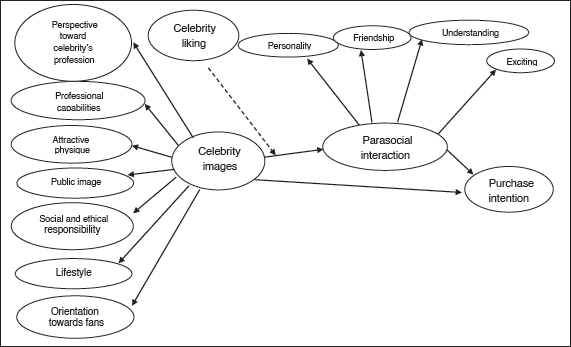
This study uses seven celebrity image dimensions, namely lifestyle, professional capabilities, perspective towards celebrity’s profession, orientation towards fans, attractive physique and public Image, which are identified as key variables in determining the consumer–celebrity interaction.
Social Responsibility and Ethics
Previous research has shown that consumers are more likely to interact with celebrities who have been socially responsible and ethical in their behaviour. They have discussed the role of consumer–celebrity relationship in the formation of health beliefs and activities. Brown and de Matviuk (2010) cite the example of Diego Maradona’s impact on spreading awareness about the drug prevention campaign. Celebrities use social media platforms to tweet about raising funds as could be seen in the case of Ellen DeGeneres and other celebrity messages about raising funds for victims of automobile accidents (Daily Mail Reporter, 2011). Chung and Cho (2017) report the example of Messi’s involvement in tax evasion scandal, suggesting that consumers may view him as someone who is socially irresponsible and unethical. This may lead to decrease in his perceived trustworthiness. However, consumers may evaluate another individual’s trustworthiness on the basis of interpersonal interaction with the celebrity by having detailed understanding of their character, goals, motivations, etc. (Altman & Taylor, 1973). Therefore, celebrity social responsibility and ethical behaviour are key dimensions for building parasocial interaction.
Lifestyle
Chung and Cho (2014) assert that consumers’ knowledge about celebrities comprising of their style, personality, preferences and personal life is amassed, and interpretation of the behaviour of media personality becomes more precise. Lueck (2015) states that celebrity lifestyles depicted through reality television and social media are well liked and socially acknowledged. Consumers begin to develop parasocial interaction by wanting to emulate their role models and to develop a sense of closeness through communication. Thus, the consumers are driven by celebrities’ glamorous lifestyle and tries to emulate them by constructing a parasocial interaction with them.
Professional Capabilities
Consumers follow a celebrity who is an excellent performer in their field. As celebrities portray consumers’ aspiration through their successful careers and lives, consumers desire to be like them encourage them to foster a relationship with the celebrity (Hung, 2014). Clavio and Kian (2010) applied uses and gratification to investigate followers’ motivation and found that their perception of the athlete as an expert in her sport was a key factor for following a female athlete. It has been widely recognized that celebrities who are professionally performing well are followed more by fans as compared to celebrities who have retired or have not been doing well in their careers. Kassing and Sanderson (2009) cited the example of Floyd Landis whose excellent performance at Tour de France, 2006, led his fans to display parasocial interaction by expressing joy over his win. Thus, the celebrity professional performance influences their parasocial interaction with consumers.
Perspective Towards Celebrity’s Profession
Celebrity profession is one of the criteria from practitioner’s perspective for selecting celebrity for the endorsement process (Erdogan et al., 2001). Erdogan (1999) cites that celebrities derive their association from their profession in television, film, military or others. They have these associations because the celebrity has formed them by powerful and recurring performances in their profession. Thus, a consumer’s attitude towards celebrity profession becomes a key factor for influencing consumers’ parasocial interactions with them.
Orientation Towards Fans
Before the emergence of social media, the prospects of interactions with celebrities were relatively less and controlled by celebrity for promotion purposes. However, with the emergence of social media, the interaction with celebrities has increased, and celebrities are also more willing to share their personal information. Different media platforms provide an opportunity to consumers to interact and follow the celebrities. These platforms have reduced the distance between the fans and the celebrities by changing their role from that of an admirer to a ‘friend’ (Chung & Cho, 2017). Marwick and Boyd (2011) cited the examples of popular singers, like Snoop Dogg and Mariah Carey, who tweet direct messages to their fans on social media platforms like Twitter. Rubin et al. (1985) also reports that parasocial interaction with media figures is likely to occur when they use a conversational style of communication and try to invite responses from their fans, thereby stating the significance of interaction with fans in developing parasocial interactions. Labrecque (2014) found that if a brand is interactive on social media, then the strength of parasocial interaction with them will also increase. Since celebrities are also human brands (Thomson, 2006), their interaction with fans could also lead to increased parasocial interactions.
Attractive Physique
Following Hoffner and Cantor (1991), consumer’s parasocial interaction may be impacted by a celebrity’s physical attractiveness. Hogg and Hardie (1992) state that physical attractiveness suggests lure towards appearance and physique. Hartmann and Goldhoorn (2011) suggest that when a consumer considers a celebrity to be attractive, they may be further stimulated to treasure the delusion of a social encounter. They also found that the more the consumers perceive a celebrity to be attractive, the more their parasocial experience.
Public Image
Hoffner and Cantor (1991) state that there might be several public image factors, which might influence attractiveness of a media character. Individuals with positive features (good manners), positive non-verbal behaviour (helping others) and who possess desired characteristics (intelligence) may influence attractiveness that further influences parasocial interaction with these characters. Consumers illustrate superior parasocial interactions with a positively represented media character as compared to a negative character (Knoll et al., 2015).
On the basis of the aforementioned discussion, we can posit that the celebrity image has a direct positive impact on parasocial interactions.
Parasocial Interactions and Purchase Intentions
Advertising has a significant role in arousing consumers’ purchase intentions by forming belief regarding product features and in persuading them to uphold positive belief about products (Kim et al., 2012a; Ko et al., 2011). Consumer’s parasocial interactions with celebrities through social networking sites produce improved consumer experiences and have an effect on purchase intentions through product features (Fiore et al., 2005) and directly impact purchase intentions (Song et al., 2007). Previous studies have found that the parasocial interactions between TV audience and shopping TV hosts are identified to strongly influence consumers’ exposure to TV shopping programmes, to increase their purchase intentions (Grant et al., 1991; Kim et al., 2012a), to enhance positive attitudes towards product advertising (Choi & Park, 2011) and to positively impact the frequency of purchase (Park & Lennon, 2004). Kim et al. (2015) also found the relationship between parasocial interaction with celebrities and consumers’ purchase intentions in the context of social networking sites. Therefore, we suggest that parasocial interactions have a direct positive impact on purchase intentions.
Mediating Impact of Parasocial Interactions
Celebrity image provides an overview of the celebrity associations residing in the minds of the consumers and its strong impact on the consumption activities. Previous research states that parasocial interaction increases consumer engagement (Grant et al., 1991; Rubin et al., 1985), and those engaged in parasocial interaction aim to establish their relationship with media personalities by increased levels of viewing and purchasing from the TV series to which they are strongly connected (Hofstetter & Gianos, 1997; Rubin & Step, 2000). Evaluation of celebrity endorser images requires detailed understanding and knowledge of different aspects of celebrity lives. This knowledge results in building a parasocial relationship between the consumer and the celebrity.
The parasocial interaction between the consumer and the celebrity is stored, memorized and accumulated within the relationship schema. Schemas are interrelated and organized knowledge structures (Taylor & Crocker, 1981). Parasocial interaction information is linked with the celebrity as they appear in an advertisement with the endorsed product. The parasocial interaction information gets incorporated in the schemas of the endorsed product (Keller 2012). It may further impact the image of the endorsed product when the respective schemas are processed or retrieved (Knoll et al., 2015). Hence, we can posit that the parasocial interactions mediate the impact of celebrity image on purchase intentions.
Moderating Impact of Celebrity Liking
Existing research revealed that consumers pay more attention to information when it is communicated by likable or attractive source (Joseph 1982; Puckett et al., 1983). McGuire (1985) described it as the closer scrutiny effect of likeable and attractive sources. It is explained by processes relating to initial impression formation that classifies individuals as either attractive or unattractive, which further leads to enhanced motivation in dealing and communication with the individual (Fiske et al., 1999; Shimojo et al., 2003). Stiff and Mongeau (2003) report that celebrity liking enhances celebrity meaning transfer effects since likable celebrities are more persuasive. Consumers are more likely to assign positive qualities like sincerity or social and academic capabilities to attractive and likable celebrities. Tian and Hoffner (2010) suggest that consumers identify more with liked celebrities, which further enhances their parasocial interactions as compared to disliked celebrities. We, therefore, suggest that celebrity liking positively moderates the impact of celebrity image on parasocial interactions as given in Figure 1.
Methodology
Selection of the Celebrities
A survey was conducted to determine the celebrities for the study. As a majority of celebrity endorsements in India is carried out by movie stars and sport stars. So, we conducted a survey using a pool of 30 postgraduate students to identify 5 Indian male movie stars, 5 Indian female movie stars, 5 Indian male sport stars and 5 Indian female sport stars that they identify commonly with endorsements. The most frequently mentioned male movie star was Shahrukh Khan (25 times) and female movie star was Deepika Padukone (22 times), while, for the male sport star, it was Virat Kohli (27 times), and female sport star was Saina Nehwal (19 times).
Selection of the Products and Brand Name
A focus group discussion was carried out to determine the list of products that are congruent with the selected celebrities. The results of focus group discussion led to the selection of four different products for each of the celebrities. Further, a survey was conducted using a pool of 60 postgraduate students to identify the products that are most congruent with the selected celebrities. The respondents were asked to rank the products in terms of congruency between the product and the celebrity. This led to the selection of soft drinks for Shahrukh Khan, bathing soap for Deepika Padukone, milk powdered nutrition drink for Virat Kohli and pain relief balm for Saina Nehwal.
Following Swaminathan et al. (2008) and Till and Busler’s (2000) methodology, a fictitious brand name for the products was selected for the study. The brand name ‘Epitome’ for all the products was selected for the study. A pretest was conducted on a sample of 30 postgraduate students to determine the degree of likability of the name on a 5-point Likert scale. It resulted in moderate likeability (M = 3.43) of the brand name.
Sample
The initial sample of the study consisted of 531 respondents. Four different versions of self-administered questionnaire, using each celebrity as a stimulus, were developed. Data were collected for each of the four celebrities. The questionnaires with more than 30% missing answers (Mattila & Wirtz, 2001) or inconsistent answers (Bidmon, 2017) were discarded, resulting in the use of 484 questionnaires for the study. Approximately 120 respondents were examined for each celebrity. Quota cum judgemental sampling method was used to ensure that the sample was representative of population census data. The sample consisted of 256 (52.9%) males and 228 (47.1%) females, which are in accordance with population data. The age profile of the respondents ranged from 21 years to 45 years and approximately an equal number of respondents (120) were selected from each of the five selected cities (Amritsar, Jallandhar, Ludhiana, Mohali and Patiala) of a northern province of Punjab in India.
Measurements
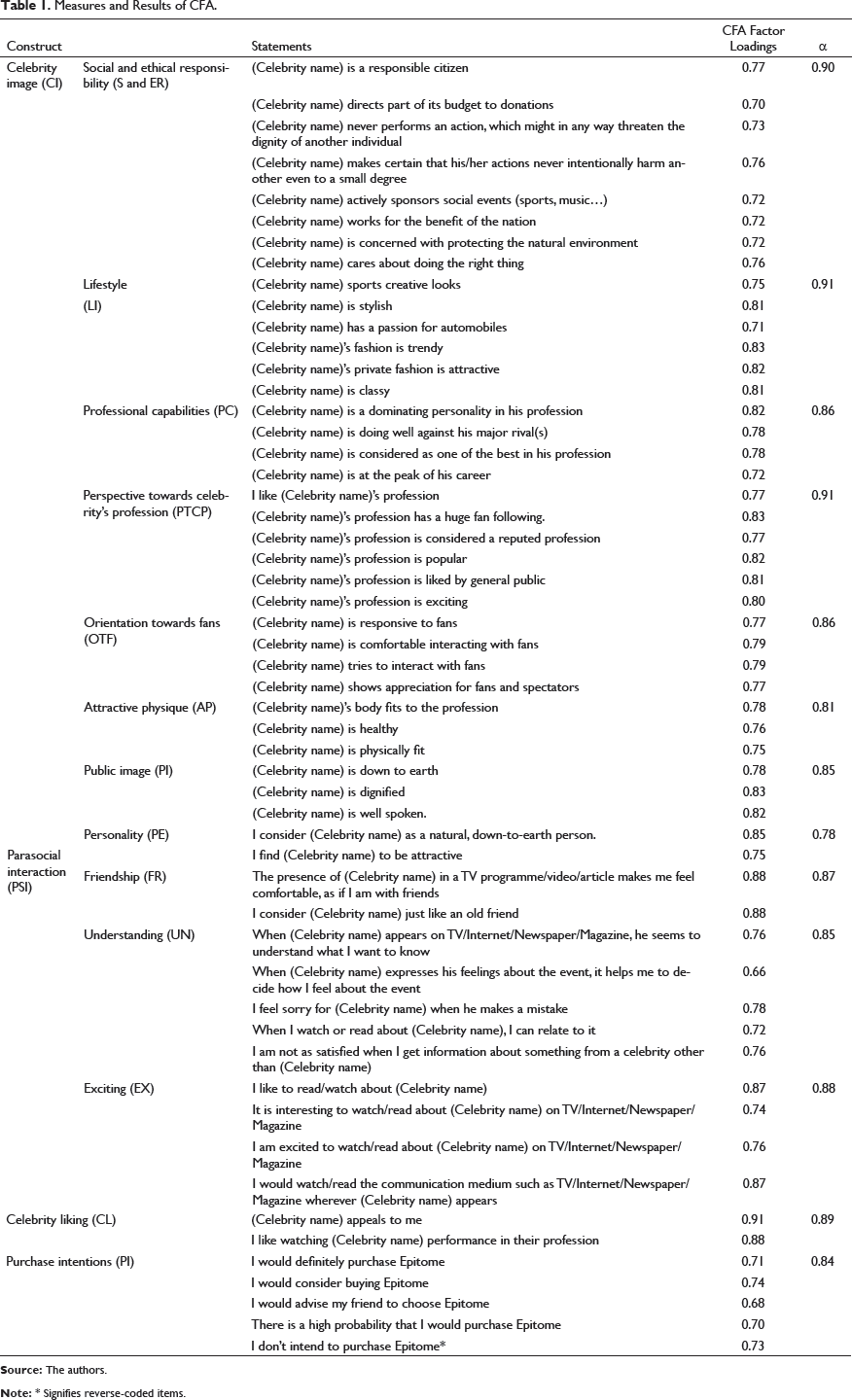
The survey items were adapted from various studies and measured on a 5-point Likert scale. The dimensions of celebrity images were identified and created for the study. The seven dimensions of celebrity image (Mann et al., 2020), comprising social and ethical responsibility, professional capabilities, orientation towards fans, perspective towards celebrity profession, lifestyle, attractive physique and public image, were used for the study. The respondents were asked about their parasocial interactions with celebrities, celebrity liking and their purchase intentions towards the product endorsed by the celebrity.
Measures and Results of CFA.
Data Analysis
AMOS version 25 software was used for the development of the measurement model. The relationships were analysed using PROCESS analysis for SPSS (v2.16.3). As the conventional approaches have numerous theoretical and statistical restrictions, this study uses SPSS macro syntax PROCESS accessible in Hayes (2013) for investigating mediation and moderated mediation effects. PROCESS allows evaluation of indirect as well as interaction effects by means of a bootstrapping procedure, based on producing multiple random samples. The bootstrapping procedure has been used as it helps in investigating a model’s predictive validity, does not compose of any normality assumption and offers stronger precision in confidence intervals (Hayes, 2009). Following Palmer et al. (2016), this study uses conditional process analysis to examine the impact of predictor variable on other variables. Conditional process modelling assesses conditional indirect effects and produces bias-corrected 95% confidence intervals for the indirect effect at different values of the moderator variable.
Results
Scale Evaluations
We examined common method bias using Harman’s single-factor test. The results of the EFA reveal that the total factors of the study accounted for 67.67% of the total variance, and the first factor accounted for 31.15% of the variance, which is less than the majority of the variance. Hence, there is no issue of common method biasness. Further, following the methodology suggested by Anderson and Gerbing (1988), the measurement model was estimated before testing the relationships using the research model. The measurement model consisted of 52 items representing 13 first-order factors. The modification fit indices revealed acceptable fit for our model: CMIN/df = 2253.42/1299 (1.74), NFI = 0.87, IFI = 0.94, TLI = 0.93, CFI = 0.94, RMSEA = 0.04. The CFA factor loadings of all the items were equal to or greater than 0.60. We assessed the validity of the constructs by applying CFA as presented in Table 2.
Psychometric Properties of the Constructs of the Study.

Table 2 presents the psychometric properties of the constructs used in the study. It reveals that composite reliability coefficients exceeded standard threshold of 0.60. It also shows that all the latent variables had a good convergent validity as the Cronbach α exceeded 0.70, and the average variance extracted (AVE) exceeded 0.50. The constructs had good discriminant validity as the square roots of AVE values were larger than the factor correlation coefficients.
Means, Standard Deviations and Correlations.
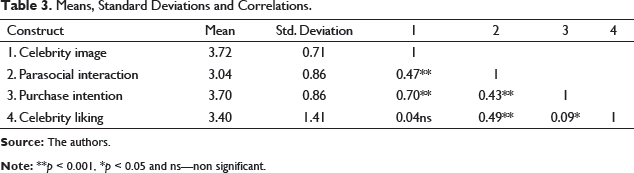
Table 3 depicts the correlations and the descriptive statistics for the four major constructs (two high-order constructs and two first-order constructs). It reveals that all the correlations are significant at the 0.05 level, except for the correlation between celebrity liking and celebrity image.
Testing of Direct and Indirect Effects
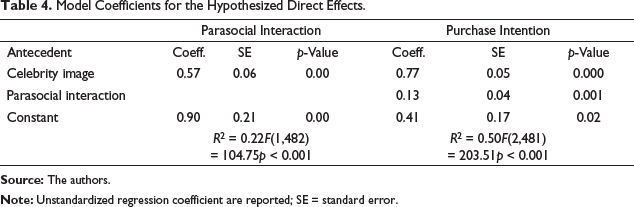
The relationships were tested using a simple mediation model (Model 4). The results show that celebrity image (B = 0.77, SE = 0.05, p < 0.001) had a positive direct association with purchase intentions. Celebrity image (B = 0.57, SE = 0.06, p < 0.001) had a positive direct association with parasocial interactions. Parasocial interaction (B = 0.13, SE = 0.04, p < 0.01) had a positive direct association with purchase intentions as given in Table 4.
Model Coefficients for the Hypothesized Direct Effects.
The indirect effect of celebrity image on purchase intention via parasocial interaction (0.075) based on 5,000 bootstrap samples is estimated to lie between 0.031 and 0.1226 with 95% confidence level. The indirect effect of celebrity image on purchase intention is significant at p < 0.05 as no 0 is included in the 95% CI.
Assessment of the Moderated Mediation Effects
The assumption of the presence of a moderator variable on the paths of mediated relationships calls for examining moderated mediating effects. Celebrity liking was included as a continuous moderator variable in the study. It was tested with a conditional process analysis (Model 7) as per the PROCESS syntax (Hayes, 2013), where the potency of the relationship between the celebrity image and purchase intention directly and indirectly through parasocial interaction is conditional on the value of the moderator, that is, celebrity liking. The model permits all likely direct and indirect effects between antecedent (celebrity image) and outcome variable (parasocial interaction) to be moderated by celebrity liking. This study uses 5,000 bootstrap samples to attain estimates for the conditional relationships. Table 5 presents the results for the moderated mediation analyses.
Model Coefficients for the Moderated Mediation Effects of Celebrity Liking.
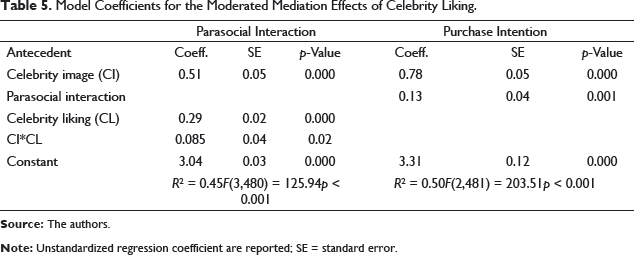
The results presented in Table 5 show that the interaction effect of celebrity image and celebrity liking on parasocial interactions is significant (B = 0.085, SE = 0.04, p < 0.05). It reveals that celebrity liking strengthens the positive relationship between celebrity image and parasocial interaction (Figure 2).

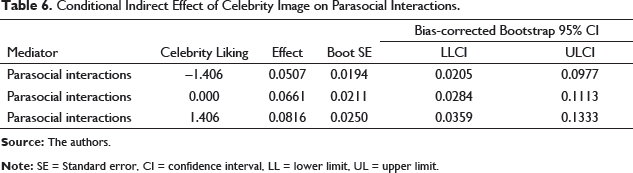
After the confirmation of indirect effect of celebrity image on parasocial interaction is moderated by celebrity liking, the next step is to assess the conditional indirect effects for different values (mean and plus/minus one SD from mean) of celebrity liking, along with inferential tests at those values of a moderator (Hayes, 2013). PROCESS analysis presents bias-corrected 95% bootstrap confidence intervals for the indirect effects at different values of celebrity liking. Table 6 illustrates that the indirect effects of celebrity image on parasocial interaction are positive and increase with celebrity liking. The bias-corrected 95% confidence interval for the conditional indirect effect is more than 0 for the three different levels of the celebrity liking and, thus, significant.
Conditional Indirect Effect of Celebrity Image on Parasocial Interactions.
Discussion
This study applies PROCESS analysis to understand the mediating role that parasocial interaction plays in the relationships among celebrity image, celebrity liking as a moderator and outcome variable and purchase intention. Consumers develop a sense of parasocial interaction with a celebrity through their social and ethical responsibility, lifestyle, professional capabilities, perspective towards celebrity’s profession, orientation towards fans, attractive physique and public image. The feeling of being associated with the celebrity through parasocial interaction goes beyond the relationship between celebrity and consumer and impacts consumer’s intentions to purchase the products endorsed by the celebrity. The results of the study help to explain the role of parasocial interaction in developing consumer–brand relationships and also provide verification of mediation. The moderating effect of celebrity liking highlights the positive impact of celebrity liking on the relationship between celebrity images and consumers parasocial interaction with celebrities.
The main objective of the study was to provide a framework for explaining why and how consumer’s parasocial relationship with the celebrity has impact on the celebrity endorsement. The results reveal that celebrity images enhance consumers’ intentions to purchase the endorsed products. It is supported by the work of Diamantopoulos et al. (2011) who found that brand images are a driver of purchase intention. Since celebrities are also known as human brands, the celebrity images can also increase consumers’ purchase intention. It also reveals that celebrity images have a direct positive impact on developing parasocial relationships with celebrities. We found support in the work of Alperstein (1991) who reported that celebrity images residing in the minds of the consumers can influence their parasocial relationship with the celebrity endorsers. Further, consistent with the work of Choi and Park (2011), Park and Lennon (2004) and Kim et al. (2015), the results also show that parasocial relationships with a celebrity increases consumer purchase intentions.
The findings show that parasocial interaction mediates the relationship between celebrity images and purchase intentions. It reveals that when consumers evaluate their intention to purchase a product endorsed by a celebrity, they are more likely to be influenced by the kind of the relationship they share with the celebrity. Parasocial interactions with celebrities help to augment the consumers’ purchase intentions as consumers seek assistance and understand the endorsement process. The results also suggest that consumers form parasocial interaction with celebrities who have performs social responsibility and is ethical in behaviour; glamorous lifestyle who interacts with their fans; who has a reputed profession; who is performing exceptionally well in their career; who has attractive appearance; and who has good public image. The positive results of moderating effect of celebrity liking on the celebrity-consumer relationship are consistent with the work of Knoll et al. (2017), who also found that celebrity meaning transfer increases with enhancement in celebrity liking. Consumers anticipate sincere, private and authentic information from celebrities that enhances their likability towards the celebrity and helps them in fostering parasocial interaction with celebrities.
Academic and Managerial Implications
However, little academic research is available to marketers to understand the practices for fostering relationships between the celebrity and the consumer through these channels of communication. Thus, this study offers significant implications for academicians as well as marketing practitioners.
The findings provide a framework for building relationship between the celebrity and the consumer. This study extends support to celebrity endorsement literature by establishing that consumers form parasocial interactions with celebrities and enhance their purchase intentions towards a brand endorsed by the celebrity. The academicians may use the findings to understand the underlying dimensions of the celebrity–consumer relationship and how the brands can utilize these dimensions to their own advantage. This study also adds to the parasocial interaction by uncovering the four dimensions, namely image, friendship, understanding and exciting. The study also adds to the celebrity endorsement literature by applying celebrity likability as a moderator variable in the current research model. Thus, the current study offers a detailed account for how celebrity–consumer relationship develops in different media platforms.
The marketers may create a sense of parasocial interaction with consumers, through the use of message content and cues, highlighting the celebrity images. It would also help brand managers in identifying the celebrity images, which are essential for developing consumer–celebrity relationship so that they can use these dimensions for evaluating the celebrity’s effectiveness. Based on the findings of the study, a celebrity endorser should not only be evaluated in terms of their celebrity images, but brand managers should also evaluate the quality of parasocial interactions between the celebrity and the consumers in order to select the appropriate celebrity endorser. It also provides strong implications for brand managers that a close friendship like relations built on the deeper understanding of celebrity images will have a positive impact on consumers’ evaluation of the brand endorsed by a celebrity. Brand managers are also recommended to investigate the celebrity likability before selecting a celebrity for endorsement process as likability ensures transfer effects and helps in developing parasocial interaction with consumers. It would help them as they will not have to repeatedly advertise celebrity endorsements once the celebrity meaning is transferred.
Limitations and Scope for Future Research
This study suffers from a few shortcomings. First, this study has cross-sectional nature of the research design. Future researches could conduct longitudinal research using a series of experiments, which could reveal whether the association among celebrity images, parasocial interaction and purchase intentions strengthen over a period of time and also the impact on these relationship in case of a negative information about a celebrity. Second, this study is conducted in India and the results represent views of the people of a collectivistic society. Future studies must be conducted in individualistic societies to examine the cultural difference. Third, this study makes use of only fast moving consumer goods (FMCG) products, so future research must be conducted on products from other categories in order to examine the generalizability of the results. Fourth, this study uses fictitious brands to determine celebrity endorsement effectiveness. Future research may use real brands to examine the comparative impact on the advertising effectiveness. Fifth, this study does not take into account various demographic variables like age and gender. Future research can make use of these variables to have better and generalizable results.
Footnotes
Declaration of Conflicting Interest
The authors declared no potential conflicts of interest with respect to the research, authorship and/or publication of this article.
Funding
The authors received no financial support for the research, authorship and/or publication of this article.
