




Abstract
This study explores the relationship between job crafting on task performance and job satisfaction among faculty members in higher educational institutions. A conceptual model was developed wherein the moderating role of cognitive and emotional engagement and the mediating role of physical engagement in influencing the task performance. Data was collected from 592 faculty members from higher educational institutions in southern India. First, the instrument’s psychometric properties were checked by performing structural equation modelling using the LISREL package. The hypothesized relationships were tested using Hayes’ PROCESS macros. The findings indicate that (a) job crafting and physical engagement are positively related to task performance, (b) job crafting is positively related to physical engagement, (c) physical engagement mediates the relationship between job crafting and task performance and (d) task performance mediates between job crafting and job satisfaction. The results also suggest that cognitive engagement moderates between job crafting and physical engagement.
Furthermore, emotional engagement (second moderator) moderates the relationship between job crafting and cognitive engagement (first moderator) in influencing task performance mediated through physical engagement. The three-way interaction between task crafting, emotional engagement and cognitive engagement in influencing physical engagement is a novel contribution of this study. The implications for theory and practice in human resource management and personnel psychology are discussed.
Introduction
The initiation of ‘job crafting’ by Wrzesniewski and Dutton (2001) has received increased attention from researchers in human resource management (HRM) and personnel psychology. Consequently, extant research on job crafting dwells on both individual and organizational outcomes (Bakker et al., 2020; Boehnlein & Baum, 2020; Nagarajan et al., 2022; Petrou et al., 2015; Svicher & De Fabio, 2021), the wellbeing of employees (Wang et al., 2020), self-efficacy (Miraglia et al., 2017), and employee engagement (Bruning & Campion, 2018; Oprea et al., 2019), psychological capital (Kerksieck et al., 2019). In addition, some recent studies reported that, in educational institutions, job crafting by faculty members had been used as one of the strategies to meet the challenges imposed by the global pandemic (Nagarajan et al., 2022).
As things stand now, after nearly 2.5 years, the invisible coronavirus (COVID-19) has gripped the world and adversely affected almost all sectors, including higher-educational institutions (Lonska et al., 2021; Sivagnanam et al., 2022; Sohrabi et al., 2020). One significant aftermath of the pandemic is that academic institutions worldwide shifted teaching from in-class to web-based instructions, and India is not an exception (D’Souza et al., 2022; Usman et al., 2021). As developed nations spontaneously adjusted to the change, the shift was not easy for the educational institutions in developing countries like India. The faculty, students and administrators were unprepared for an immediate transition from in-class to web-based instructions because of the lack of adequate infrastructure, training, support staff and experience with the online mode of instruction (Almaiah et al., 2020; D’Souza et al., 2022; Irshad et al., 2021). Though some studies conducted during COVID-19 included e-learning of students in educational institutions (Choudhury, 2022), voluntary development of employees (Deosthali & Johnson, 2021), women empowerment during the pandemic (Kumari & Eguruze, 2022), studies focusing on resilient strategies employed in educational institutions are very sparse. Rana et al. (2020) reported that business schools in India had to change their approach to cope with the logistical challenges imposed by the global pandemic.
Drawing from HRM literature, the present study aims to unravel the role of job crafting and employee engagement as reactive strategies employed by higher educational institution (HEI) in the new normal environment. Extant research reported that job crafting and employee engagement are precursors to performance and satisfaction (Bakker & Demerouti, 2014; Boehnlein & Baum, 2020; Nagarajan et al., 2022).
Job crafting is an employee-initiated alteration or change to make the job more convenient to perform (Wrzesniewski & Dutton, 2001). According to (Wrzesniewski & Dutton 2001), job crafting is defined as ‘physical and cognitive changes the individuals make in the task or relational boundaries’ (p. 179). Employees alter their jobs to suit their skills, capabilities and strengths, and by so doing, they find the jobs meaningful and satisfying (Demerouti, 2014). Job crafting has three components: task crafting (altering the scope, type, sequence and the number of tasks), cognitive crafting (how the employee perceives the work) and relational crafting (how the employees view their co-workers) (Wrzesniewski & Dutton, 2001). In addition, several researchers reported that job crafting helps employees cope with crises (Demerouti, 2014; Slemp & Vella-Brodrick, 2013).
Early scholars on personnel psychology found that engaged employees are more effectively connected to their tasks and contribute effectively than disengaged employees who are emotionally detached from their jobs (Bakker & Demerouti, 2014). Furthermore, scholars from social science advocated that during crises, employee engagement plays a vital role in coping with challenges (Crawford et al., 2010). According to Kahn (1990), employee engagement is the ‘simultaneous employment and expression of a person’s preferred self in task behaviors that promote connections to work and to others, personal presence, and active full role performance’ (p. 700). Therefore, the three-dimensional model of employee commitment consisting of cognitive, emotional and physical engagement is essential to effective performance (De Vreede et al., 2019).
Though extant research on job crafting and employee engagement were conducted during the pre-pandemic period, it is imperative to investigate how job crafting (task, relational and cognitive) and three dimensions of employee engagement (emotional, cognitive and physical) influence task performance and job satisfaction. Some recent studies reported that job crafting and employee engagement helped organizations to cope with difficult situations and contribute to superior performance (Buonocore et al., 2020; Chanana & Sangeeta, 2020; Chidambaram et al., 2022). However, to the best of our knowledge, the inter-relationship between the three dimensions of employee engagement and job crafting in influencing performance and satisfaction has not been explored.
To fill this gap, the present study aims at answering the following research questions (RQs):
RQ1: How does job crafting influence task performance and physical engagement? RQ2: How do cognitive and emotional engagement interact with job crafting to influence physical engagement? RQ3: How is task performance related to job satisfaction? RQ4: How does job crafting indirectly influence task performance through physical engagement? RQ5: How does job crafting indirectly influence job satisfaction through task performance?
This study makes five significant contributions to HRM and personnel psychology literature. First, this research underscores the importance of job crafting in improving task performance, especially during post-crisis situations such as the global pandemic. Especially in developing countries such as India, job crafting enables the faculty members to tailor the tasks to suit their skills and capabilities and perform to the best of their abilities. Second, this study offers insights into how different dimensions of employee engagement play a vital role in enhancing task performance. Most importantly, the study explained how cognitive engagement increases the strength of the positive relationship between job crafting and the physical arrangement of employees at work. Third, the role of emotional engagement in further increasing the strength of job crafting on physical engagement moderated by cognitive engagement. Fourth, the positive association between task performance and job satisfaction was fortified, thus adding to the plethora of previous studies on the performance-satisfaction relationship. Understandably, task performance precedes job satisfaction; hence, we included it in this study to vouch for the long-cherished and established association. Fifth, the conceptual model—moderated moderated-mediated model—investigating the relationship between job crafting and cognitive engagement (first moderator) and emotional engagement (second moderator) in influencing task performance, mediated through physical engagement is a novel contribution to the research. To the best of our knowledge, dismantling the three components of employee engagement and studying the inter-relationships in job crafting, task performance and job satisfaction relationship has not been investigated previously, thus making a unique contribution to the literature: HRM and personnel psychology.
Study Variables and Literature Review
This study is based on six variables: job crafting, cognitive engagement, emotional engagement, physical engagement, task performance and job satisfaction.
Job crafting: Job crafting has three components: task crafting, cognitive crafting and relational crafting. Task crafting includes altering the scope, type, sequence and the number of tasks that make up the job (Slemp & Vella-Brodrick, 2013; Wrzesniewski & Dutton, 2001). In educational institutions, faculty members may engage in task crafting by dividing the job into three tasks—teaching, research and service—and perform these in a way convenient to them. They also may alter the scope and number of tasks to be completed. Cognitive crafting is a psychological dimension of an employee concerned with how the work is perceived as an aggregate, that is, how the work is related to their personal goals. Cognitive crafting does not change the job itself, but it changes the perception of the job. When employees positively perceive the job and view it as supportive of their personal goal achievement, they are said to be cognitively crafting the jobs. The relational component of job crafting concerns how employees view their co-workers on the job. It is more likely that the employees prefer to work with some co-workers and shy away from other workers they may not like, with or without any reason. Relational crafting largely depends on the social relationships employees maintain in organizations. For example, in educational institutions, faculty members tend to work with some faculty in writing research papers and shy away from others whose wavelength of thinking does not match.
Employee engagement: The literature reveals three types of ‘engagement’—employee engagement (Kahn, 1990), work engagement (Schaufeli et al., 2002), and organizational engagement (Saks, 2006). Employee engagement is ‘the simultaneous employment and expression of a person’s “preferred self” in task behaviors that promote connections to work and to others, personal presence, and active full role performances’ (Kahn, 1990, p. 700). Engaged employees get involved into the work wholeheartedly and ‘show enthusiasm at work’ (Harter et al., 2002, p. 269). While Kahn (1990) used the term ‘employee engagement, Schaufeli et al. (2002) preferred to coin work engagement which is defined as a “positive, fulfilling, work-related state of mind that is characterized by vigor, dedication, and absorption”’ (Schaufeli et al., 2002, p. 74). Organizational engagement is ‘a quality that reflects the extent to which an individual is psychologically present in a particular organizational role’ (Saks, 2006, p. 604). A slight variation of Kahn’s (1990) version was given by Shuck and Wollard (2010), who contends that employee engagement represents ‘simultaneous investment of cognitive, affective, and physical energies into role performance’ (Shuck & Wollard, 2010, p. 617).
This study uses the three component-model of employee engagement: cognitive, emotional and physical (May et al., 2004). Cognitive engagement is the extent to which employees are cognitively absorbed in the task without distraction from their surroundings. Employees who are high on cognitive engagement entirely focus on the work and do not notice any disturbances stemming from the environment. Emotional engagement concerns an employee’s psychological reaction and attachment to the task or activity. The own feelings of employees affect their performance and how enthusiastic employees feel at the job determines their emotional engagement. Finally, physical engagement is related to how employees physically stay with the job till it is done. For example, faculty members have a high level of physical engagement when they are continuously involved in teaching a chapter until it is complete.
Task performance is concerned with how employees perform their tasks. This includes whether the faculty fulfils all their departmental duties and whether they are satisfied with the clarity of concepts being taught. Job satisfaction, another dependent variable in this study, refers to the extent to which employees are satisfied with their jobs. This includes whether the faculty are happy with the performance evaluation system and whether the suggestions given by the faculty are encouraged by the institution. Further, job satisfaction is also related to how classroom performance yields satisfaction.
A brief literature review reveals that studies conducted before the global pandemic revealed that job crafting has positive outcomes: Enhanced job satisfaction decreased stress and turnover intentions, and increased employee engagement (Bell & Njoli, 2016; Grant & Ashford, 2008; Rudolph et al., 2017). In one of the recent studies conducted on 285 employees in the information technology (IT) sector in India, the researchers found that work orientation and telecommuting were positively related to work engagement, and telecommuting has been an effective strategy to reduce the stress induced by global pandemic (Chidambaram et al., 2022). In the Indian context, a study on 640 faculty members from HEIs indicated that job crafting and employee commitment had reduced the negative effect of the global pandemic on academic performance (Nagarajan et al., 2022). Further, the positive impact of job crafting on employee engagement was evidenced by Garg et al. (2021) when they analysed 369 respondents in software development companies in India. Some studies also reported that performance feedback on turnover intention was mediated by employee engagement (Lee et al., 2019). The early scholars also found that job crafting results in person-job fit and contributes to superior performance (Tims et al., 2015). Thus, the benefits of both job crafting and employee engagement in increasing commitment, job satisfaction and person-job fit have been documented in the literature (Leana et al., 2009; Lu et al., 2014; Petrou et al., 2012). However, the effect of each dimension of employee engagement—cognitive, emotional and physical—on performance have not been studied by earlier researchers and has been the primary intent of this study.
Theoretical Background and Hypotheses Development
The Job Crafting Theory (JCT; Wrzesniewski & Dutton, 2001) and Job Demands–Resources (JD-R; Bakker & Demerouti, 2007) provide the theoretical underpinning for this study. The underlying theme of JCT is that through job crafting, employees tailor their jobs by altering the work on their own to match their interests and abilities (Tims et al., 2013). Employees use their knowledge about their jobs and make changes in the tasks to make their jobs more meaningful (Berg et al., 2013). In this study, we incorporated three components of job crafting: task crafting, relational crafting and cognitive crafting (Slemp & Vella-Brodrick, 2013; Wrzesniewski & Dutton, 2001). Task crafting involves making structural changes in the task to see how they complete the job. Relational crafting consists in deciding with whom to interact while performing the job. Finally, cognitive crafting refers to how the employees view their jobs and make alterations to find meaning in their jobs. During the post-pandemic phase, faculty members in higher education institutions find it convenient to craft their jobs to suit the changing work climate and perform them effectively (Nagarajan et al., 2022). JCT helps understand how and why faculty members craft their tasks by dissecting the triple-role of teaching, research, and service.
Since job crafting is an employee-initiated process that entails altering the jobs and shaping their work environment to fit their needs by properly balancing job demands and resources, JD-R is another theoretical platform on which this study is based.
In organizations, job demands include the energy and effort required from employees. In contrast, in addition to the physical resources to complete tasks, job resources have the necessary feedback and co-worker and supervisor support provided by organizations (Bakker & Demerouti, 2007). Maintaining a proper balance between the demands and resources is critical for promoting a friendly work environment to motivate employees to perform effectively. Job crafting may also result in increasing structural job resources (seen in finding new learning opportunities) and social job resources (in the form of co-worker support and additional coaching). At the same time, job crafting may also result in meeting increased job demands (in terms of meeting logistical challenges and participating in new projects (Tims et al., 2012). Earlier researchers provided empirical evidence that increased structural and social resources, increased employee engagement and decreased psychological stress of employees (Crawford et al., 2010). Several researchers contend that JD-R helps explain the relationship between job crafting, employee engagement, performance and satisfaction (Letona-Ibañez et al., 2021, Ogbuanya & Chukwuedo, 2017). With support from other studies, we incorporated JCT and JD-R theories as background in this research.
Hypotheses Development
Job Crafting is a Precursor to Task Performance
Job crafting involves altering employees’ jobs to align with their personal interests and abilities (Tims et al., 2013), and such redesigning would place the employees in the ‘drivers’ seat (Berg et al., 2013), increasing significance of their work. Wrzesniewski and Dutton (2001), who introduced the term ‘job crafting’ sometime in 2001, contend that employees re-energize and re-imagine work life by redefining or crafting the job to reflect their strengths, passions and interests. Because employees take control of the work and find meaning in it, it is more likely that job crafting will have positive outcomes. Extant research reported that job crafting results in person-job fit which eventually results in increased performance (Geldenhuys et al., 2021; Parker et al., 2010; Tims & Bakker, 2010). Thus, based on available empirical evidence and logos, we offer the following hypothesis:
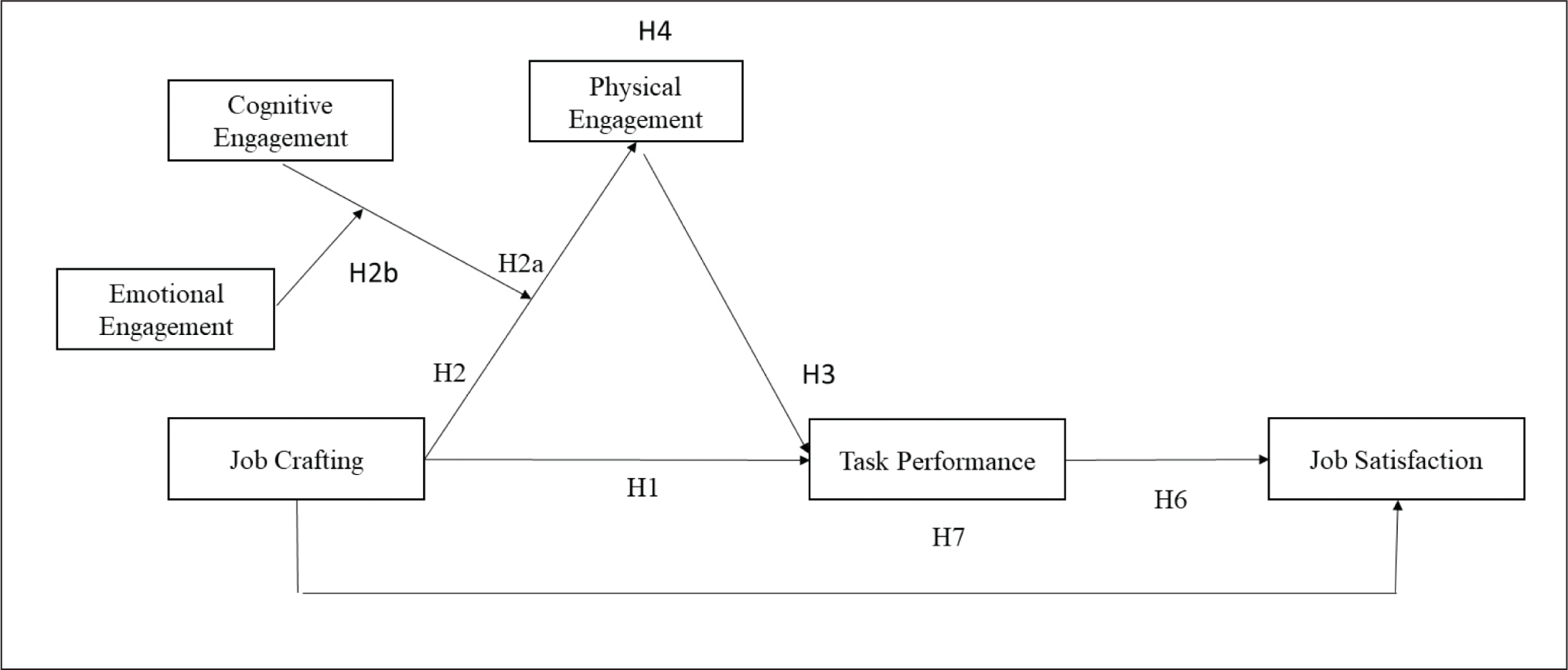
H1: Job crafting positively predicts task performance.
Job Crafting and Physical Engagement
When employees craft their jobs to suit their abilities and characteristics, it is more likely that it results in self-motivation to engage in the jobs physically by being very active and resilient. Physical engagement entails devoting a lot of energy to performing work, and employees do not feel tired while performing. The physical facet of engagement concerns the physical force needed to perform and complete a job. Job crafting helps employees to make changes in tasks to find meaning in their work and motivate them to perform even complex tasks (Oldham & Hackman, 2010). Sometimes, supervisors train them in crafting their jobs to perform better (DuPlessis et al., 2021) and help in their psychological empowerment (Matsuo, 2019). Earlier, some researchers found that positive outcomes of job crafting include work engagement, motivation and superior performance (Demerouti, 2014; Dubbelt et al., 2019; Petrou et al., 2017). Thus, based on available empirical evidence of the positive effect of job crafting on physical engagement, we offer the following hypothesis:
H2: Job crafting positively predicts physical engagement.
Physical Engagement and Task Performance
Employees must be required to devote adequate physical energies to accomplishing any given task. When ‘engaged employees express their authentic selves through physical involvement’ (Truss et al., 2013, p. 2659), it is more likely that the task performance would be higher. On the contrary, disengaged employees do not physically exert their energies and do not perform well in their jobs. In one of the recent studies conducted during the global pandemic, the researchers found that employee engagement interacted with job crafting to reduce the negative impact of the pandemic on performance (Nagarajan et al., 2022). As physical engagement has a significant role in enhancing task performance, organizations require employees to connect to the work physically, emotionally and cognitively (Kahn, 1990). Although the impact of individual effects of physical engagement is separated from emotional and cognitive engagements, earlier researchers reported positive outcomes of employee engagement (Bakker & Demerouti, 2014; Dubbelt et al., 2019; Nguyen et al., 2019). Thus, based on the available empirical evidence, we offer the following hypothesis:
H3: Physical engagement is positively related to task performance.
Physical Engagement as a Mediator
While job crafting has a direct positive impact on task performance, we argue that job crafting also has an indirect effect on task performance through physical engagement. In one of the studies conducted among 247 electrical and electronic educational faculty from Nigerian universities, the researchers found work engagement to be a positive mediator between job crafting, job commitment and job satisfaction (Ogbuanya & Chukwuedo, 2017). When employees alter the physical boundaries of a job, that is, how the job is divided into several activities and performing the task at their convenience, it is more likely that the employees get engaged wholeheartedly (Berg et al., 2010; Wrzesniewski & Dutton, 2001). Job crafting also involves viewing the job cognitively and identifying the rational boundaries to decide with whom to interact for completing given tasks (Demerouti & Bakker, 2014). In addition, a series of studies reported that job crafting indirectly influences performance by accelerating the engagement achieved through the alignment of work demands and resources (Tims & Bakker, 2010; Tims et al., 2012; Nguyen et al., 2019; Van Wingerden et al., 2016). Based on positive outcomes of job crafting and physical engagement, we offer the following exploratory mediation hypothesis:
H4: Physical engagement mediates between job crafting and task performance.
Job Crafting and Job Satisfaction
According to Wrzesniewski and Dutton (2001), job crafting is employee-driven changes in tasks. The three-dimensional model of job crafting (cognitive, relational and task) results in how the employees perceive their jobs and perform the functions by dividing these into convenient parts. When employees tailor their jobs to match their preferences, abilities and needs, they find meaningfulness in work, resulting in job satisfaction (Berg et al., 2013). Further, by following the JD-R model, when employees engage in job crafting, they may get additional resources to perform tasks (Lu et al., 2014). Balancing the job demands and resources results in superior performance and job satisfaction (Tims & Bakker, 2010). Recent researchers have empirically demonstrated that job crafting results in employee well-being (Wang et al., 2020), and self-efficacy (Miraglia et al., 2017), thus resulting in job satisfaction. Based on available empirical evidence and logos, we offer the following hypothesis:
H5: Job crafting positively predicts job satisfaction.
Task Performance and Job Satisfaction
The relationship between performance and job satisfaction has been a widely researched area in organizational behaviour and personnel psychology. Despite volumes of research, the cause-and-effect relationship between performance and satisfaction is not firmly proved, as evidenced in a meta-analysis conducted by Judge et al. (2001). Job satisfaction is an attitude whereby an employee makes a positive or negative judgement about the job and working conditions (Vasiliki & Efthymos, 2013; Weiss, 2002). These judgements depend on how employees feel about jobs, different components of jobs and the working environment (Astrauskaite et al., 2010). Task performance is related to the proficiency of employees in performing a given task (Campbell, 1990), which is a part of work performance. Task performance is reflected in how employees plan their work, keeping the expected results and performing the task within the given time. Employees who perform well are more likely to get job satisfaction than those who do not perform well (Nagarajan et al., 2022). The positive effect of task performance on job satisfaction stems from the expectancy theory of motivation (Vroom, 1964) that performance leads to rewards, resulting in job satisfaction. Similarly, goal-setting theory (Locke, 1970) asserts that when employees reach their goals of superior performance, they derive job satisfaction. Some scholars contend that job satisfaction is an antecedent to performance, but some argue the reverse causality (Judge et al., 2001). Based on extant research, we offer the following straightforward hypothesis:
H6: Task performance positively predicts job satisfaction.
Task Performance as a Mediator
The relationship between job crafting and job satisfaction may not be direct because by crafting the jobs, employees would be able to perform better, leading to job satisfaction. Past researchers have provided empirical evidence that performance was a mediator between stress and satisfaction (Gopal et al., 2021; McVicar, 2016; Tims et al., 2013). Through job crafting, employees alter their work to fit their individual needs and work environment so that the job demands and resources align, resulting in superior performance. Therefore, job crafting per se may not result in job satisfaction, albeit through performance. Following the JD-R theory, when employees match the energy and effort required to perform jobs, it is more likely that the work environment becomes beneficial to them to reach superior performance, leading to job satisfaction (Bakker et al., 2010). In a recent study conducted on 640 faculty members from HEIs in India, the researchers reported that performance was a mediator between the global pandemic effect and job satisfaction (Nagarajan et al., 2022). Based on available empirical support for the positive relationship between job crafting and performance, and performance and job satisfaction, we offer the following exploratory mediation hypothesis:
H7: Task performance mediates between job crafting and job satisfaction.
Cognitive Engagement as a First-Level Moderator
Employee engagement is a three-dimensional construct consisting of cognitive, emotional and physical engagement (May et al., 2004, p. 211). As Shuck and Wollard (2010) aptly mentioned, ‘employee engagement represents the simultaneous investment of cognitive, affective, and physical energies into role performance’ (p. 617). Cognitive engagement is a complete focus on work without distraction from other things while performing work. Emotional engagement is related to the employee’s emotional connection to the job. Finally, physical engagement is concerned with being physically involved in work and, if necessary, going the extra mile in performing work.
As these three components represent different facets of an individual, they are more likely to be interdependent and interacting. First, we argue that when employees concentrate on the work without any diversion from other activities, referring to cognitive engagement, it is more likely that the relationship between job crafting and physical engagement will be strengthened. The employees who show higher levels of cognitive engagement would see the benefits of job crafting, resulting in a higher level of physical engagement. Conversely, when individuals are low on cognitive engagement, even though they put considerable effort into job crafting, it is unlikely that it would make a substantial difference in physical engagement. Though, to the best of our knowledge, none of the previous researchers examine the influence of interaction between task crafting and cognitive engagement on physical engagement. Anecdotal evidence reveals that, for example, during the global pandemic, the faculty members used job crafting as a mantra to perform, given that universities have moved from in-class to web-based instruction. Job crafting resulted in the increased physical engagement of cognitively engaged faculty completing the course work on scheduled time (Nagarajan et al., 2022). Since the cognitive (thinking) facet is associated with employees’ beliefs about the work environment, the higher the cognition, the more significant the impact of job crafting on physical engagement.
In this study, we argue that while employees engage in task crafting, relational crafting, and cognitive crafting, engaging on the task cognitively would enhance the physical engagement of employees, leading to achieving individual and organizational goals. As pointed out by Saks (2006), engagement is ‘a quality that reflects the extent to which an individual is psychologically present in a particular organizational role’ (p. 604); it would be interesting to investigate the moderating effect of cognitive engagement in the relationship between job crafting and physical engagement. Thus, based on the positive impact of job crafting and cognitive engagement, we offer the following exploratory moderation hypothesis:
H2a: Cognitive engagement moderates the relationship between job crafting and physical engagement such that at higher (lower) levels of cognitive engagement, job crafting is associated with higher (lower) levels of physical engagement.
Emotional Engagement as a Second-Level Moderator
The emotional facet of engagement means employees’ positive or negative attitudes toward the organization and the leaders (Saks, 2006). Simply stated, emotional engagement is related to the emotional attachment by employees to workplace experience. Emotional engagement ‘revolved around the emotional bond one feels towards his or her place of work’ (Shuck & Reio, 2011, p. 423). This study argues that this emotional bond would strengthen how an employee is connected to the job by increasing physical engagement. The early scholars have empirically demonstrated the positive effect of emotional engagement on individual outcomes, such as the increase in productivity and satisfaction. Still, none of the studies investigated the interaction effect of emotional engagement with job crafting.
As we attempted to dismantle the three dimensions and investigate their individual effects, one plausible way is to examine the moderating role of emotional engagement. At the same time, employees craft their jobs to match the job demands and resources. While job crafting enables the employees to alter their jobs to suit their abilities and characteristics and redefine the meanings in their jobs, when they simultaneously display a ‘sense of belonging to the workplace’ (Rhoades et al., 2001, p. 825), reflected in emotional engagement, results in more involvement in organizational activities. Some scholars have examined the moderating role of employee engagement, as an aggregated variable, in the relationship between stress and performance (Nguyen et al., 2019). Still, the individual effect of emotional engagement has not been examined. Therefore, exploring the impact of emotional engagement (second moderator) on job crafting and cognitive engagement (first moderator) influencing physical engagement would be interesting. To move in that direction, and with limited empirical evidence, yet based on logos, we offer the following moderated moderated-mediation hypothesis:
H2b: Emotional engagement moderates the moderated relationship between job crafting and cognitive engagement on task performance mediated through physical engagement.
The conceptual model is presented in Figure 1.
Method
Sample
To test hypothesized relationships, we focused on faculty members in HEIs in the southern part of India. The data was collected during the endemic phase of COVID-19, and still, precautions for health and safety were advised. However, social distancing has been rarely followed; we contacted the faculty when the universities re-opened and started normal functioning. We administered surveys by contacting the faculty members. Finally, we assigned the data collection task to the graduate students.
In the first step, we contacted the heads of the HEIs and secured permission to conduct a study on job crafting and employee engagement. In the second step, we reached the faculty, sent the survey link through google forms and requested them to complete the surveys. Several researchers have followed a similar approach of collecting data using online surveys because of social distancing during the global pandemic (Madhu et al., 2022; Singh et al., 2022, Xu et al., 2022). The data collection started in September and was completed by December 2021. Following the minimum sample size requirement of 384 (Krejcie & Morgan, 1970), we stopped collecting data when we received 592 surveys. According to Comrey and Lee (1992), a survey of over 500 are considered ‘good’. We performed a statistical check of non-response bias by comparing the first 150 respondents with the last 150 respondents and found no statistical differences between these two samples.
Demographics
The demographics of the respondents were mentioned in Table 1.
Demographics of the Respondents.

Measures
We prepared a self-administered survey consisting of the constructs measured with established scales in the literature. All the indicators for the constructs were measured using Likert’s 5-point scale (1 representing ‘strongly disagree’, and 5 representing ‘strongly agree’).
Job crafting was measured with items from Job Crafting Questionnaire developed by Slemp and Vella-Brodick (2013). Job crafting consists of three subscales: task crafting (four items), relational crafting (four items) and cognitive crafting (five items). The reliability coefficient Cronbach’s alpha of job crafting was 0.89. Employee engagement was measured using the three-dimensional scale of May et al. (2004, p. 211), consisting of a physical component, an emotional component and a cognitive component. The emotional engagement was measured with five items (Cronbach’s alpha = 0.87), physical engagement was measured with five items (Cronbach’s alpha = 0.88) and cognitive engagement was measured with five items (Cronbach’s alpha = 0.87). Task performance was measured with five items adapted from Nguyen et al. (2019), and Cronbach’s alpha was 0.87. Finally, job satisfaction was measured with five items adapted from Smith et al. (1969), and the reliability coefficient Cronbach’s alpha was 0.91.
Results
Descriptive Statistics
The descriptive statistics: means, standard deviations, and zero-order correlations, composite reliability (CR), Cronbach’s alphas, and average variance extracted estimates (AVE) are presented in Table 2.
Descriptive Statistics: Means, Standard Deviations, Zero-Order Correlations, Reliability and Validity.

This study vouched for construct reliability as the Cronbach’s alphas for all the six variables were over 0.70 (ranged between 0.87 and 0.91), CR values ranged between 0.89 and 0.93 and AVE values ranged between 0.55 and 0.83, and all these were over the acceptable levels of 0.70 (Fornell & Larcker, 1981; Hair et al., 2019). Further, preliminary analysis of correlation matrix reveals that the highest correlation was 0.73 (between cognitive engagement and physical engagement). Since the correlations between all the variables were less than 0.75, multicollinearity was not a problem with the data (Tsui et al., 1995). We also checked the variance inflation factor (VIF) values and found that these are less than 5, thus providing evidence of lack of multicollinearity.
We performed check for discriminant validity in two ways. First, we compared the correlations between the variables with the square root of AVE and found that the correlations were less than AVEs of the variables. Second check is checking through Heterotrait-Monotrait (HTMT) method and presented the results in Table 3. All these values were less than the threshold levels of 0.90, and these statistics provide adequate evidence for discriminant validity of the constructs in this research.
Discriminant Validity Using HTMT.

Common Method Bias
Following the recommendations of Podsakoff et al. (2012), we performed Harman’s single-factor analysis and found that single accounted for less than 30% variance, suggesting common method bias is not a problem with the data. We also did perform latent factor loading technique by loading all the constructs into a single factor at a time and found that the inner VIF values were less than 3.3 as suggested by Kock (2015), suggesting that the data was not infected by common method bias.
Measurement Model
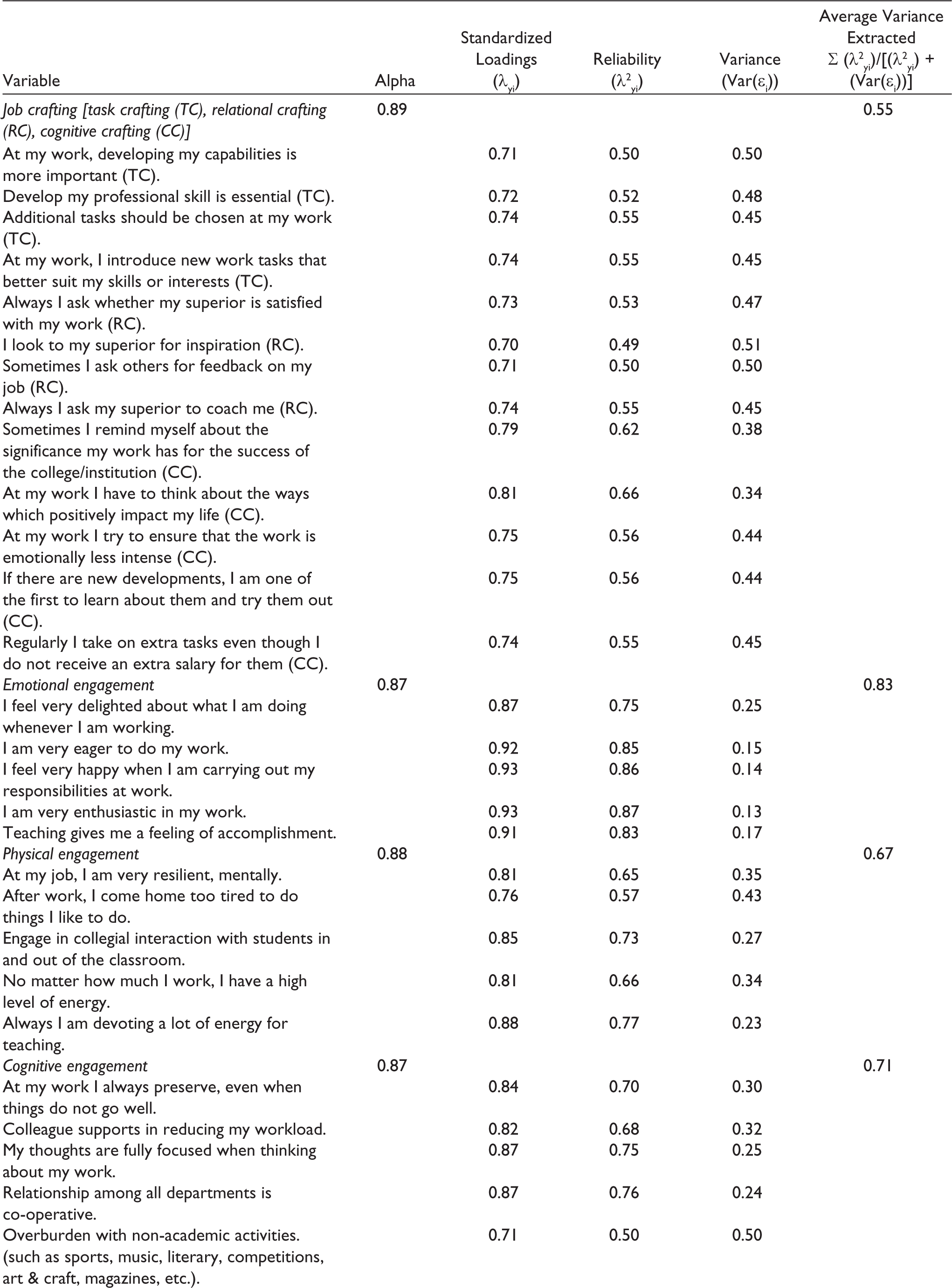
Before testing hypotheses, we tested the measurement model by structural equation modelling (SEM) using the LISREL package and presented the results in Table 4.
As shown in Table 4, the factor loadings of all the indicators were over 0.70 (ranged between 0.70 and 0.90), and the reliability coefficients were well over 0.70. The goodness-of-fit statistics reveal that six-factor model provided a good fit (χ2 = 1102.18; df = 276; χ2/df = 3.99; RMSEA = 0.063; CFI = 0.92; RMR = 0.051; standardized RMR = 0.048; GFI = 0.89; NNFI (TLI) = 0.90). To sum, these statistics provide evidence of distinctiveness of all six constructs in the model.
Results of Confirmatory Factor Analysis and Measurement Properties.

Hypotheses Testing
We used Hayes (2018) PROCESS macros (model number 4) to check H1–H4 presented the results in Table 5.
As shown in Step 1 of Table 5, the regression coefficient of job crafting on task performance was positive and significant (β = 0.734; t = 24.58, p < .001), thus supporting H1. The regression coefficient of job crafting on physical engagement, shown in Step 2 (Table 5), was positive and significant (β = 0.668; t =20.30; p < .001), thus supporting H2. The regression coefficient of the physical engagement on task performance was (shown in Step 3 of Table 5) was positive and significant (β = 0.470; t = 14.73; p < .001), thus supporting H3. Checking mediation hypothesis requires verification of indirect effect of job crafting on task performance through physical engagement as a mediator. The indirect effect of job crafting on task performance through job crafting was significant (β = 0.314; 95% bias-corrected confidence interval (BCCI) [LLCI = 0.2504: ULCI = 0.3780]). Since ‘zero’ was not contained in the BCCI intervals, the mediation hypothesis is supported. The indirect effect was 0.3146 (0.6682 × 0.4708 = 0.3146) and the total effect was direct effect (0.4190) plus indirect effect (0.3146), that is, 0.734. The bootstrapping samples of 20,000 thus support the hypothesis (H4) that physical engagement mediates the relationship between job crafting and task performance.
Testing H1, H2, H3 and the Mediation Hypothesis (H4).

Cognitive Engagement as a First Moderator (H2a) and Emotional Engagement as a Second Moderator (H2b)
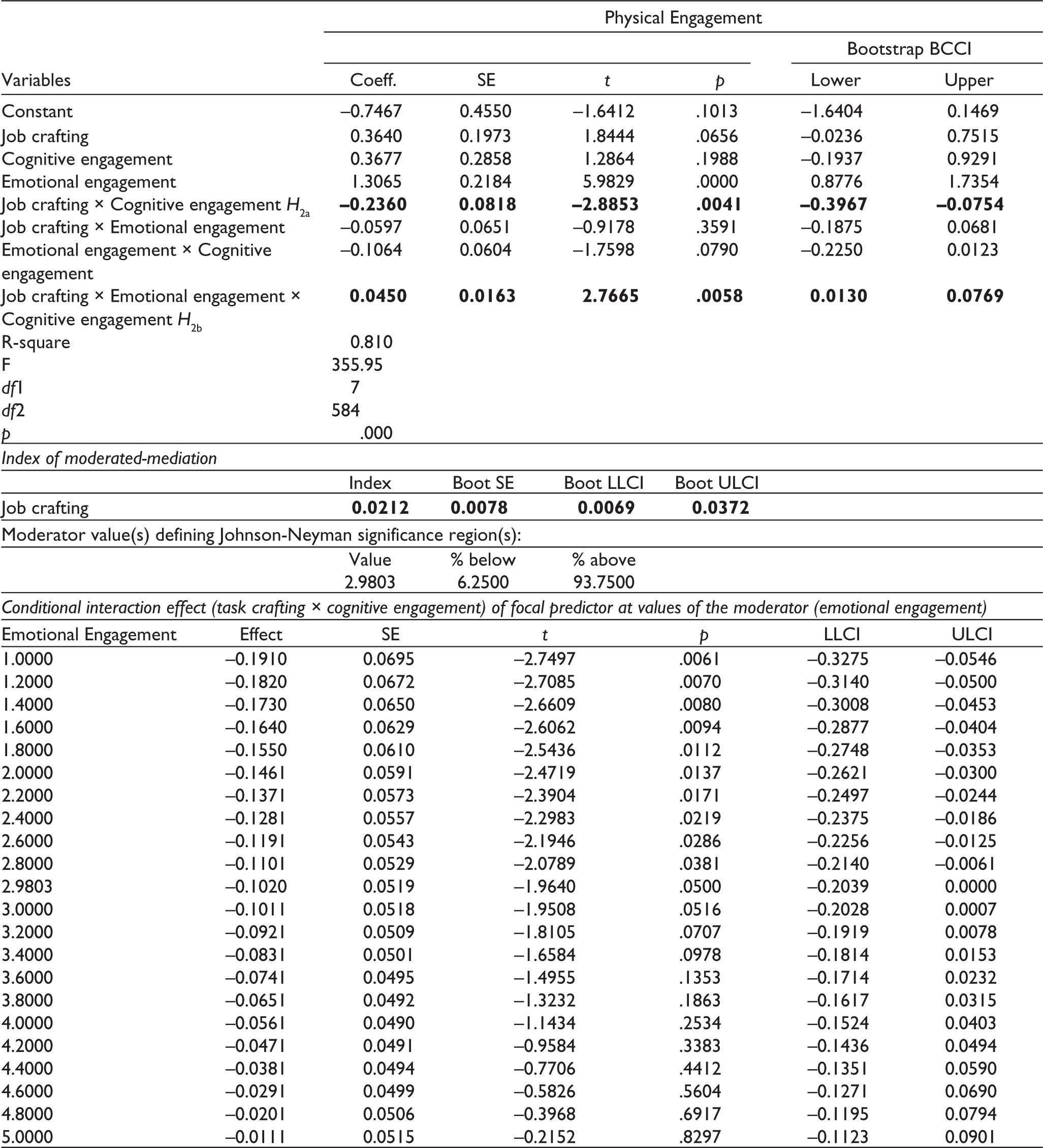
To test moderated-mediation hypotheses (H2a and H2b), we used model number 11 of Hayes (2018) PROCESS macros, and the results are presented in Table 6.
Since the model is having two moderators and one mediator, to check the moderated moderated-mediation, it is essential to plug job crafting as an independent variable, physical engagement as a mediator, cognitive engagement as a first moderator, and emotional engagement as a second moderator. The regression results reveal that the regression coefficient of the interaction term (job crafting and cognitive engagement) was significant (β job crafting × cognitive engagement = –0.236; t = –2.88; p < .01). The bootstrapping samples of 20,000 yielded the BCCI (LLCI = –0.3967; ULCI = –0.0754), and zero was not contained in the confidence intervals, thus supporting the hypothesis (H2a) that cognitive engagement moderates the relationship between job crafting and physical engagement.
H2b posit that emotional engagement moderates the moderated relationship between the job crafting and cognitive engagement to influence physical engagement. The regression coefficient of three-way interaction term was significant (β job crafting × cognitive engagement × emotional engagement = 0.045; t = 2.76; p < .01). The bootstrapping samples of 20,000 yielded the BCCI (LLCI = 0.0130; ULCI = 0.0769), and zero was not contained in the confidence intervals, thus supporting the hypothesis (H2b). The index of moderated-mediation (0.0212) (Boot SE = 0.0078; Boot LLCI = 0.0069; Boot ULCI = 0.0372) reveal that the physical engagement acted as a mediator in the moderated moderated-mediation model, thus rendering support to H2b. The conditional interaction effect (job crafting × cognitive engagement) of focal predictor at values of the moderator (emotional engagement) were shown in the bottom of Table 6. Table 7 shows the conditional indirect effects [job crafting→physical engagement→task performance].
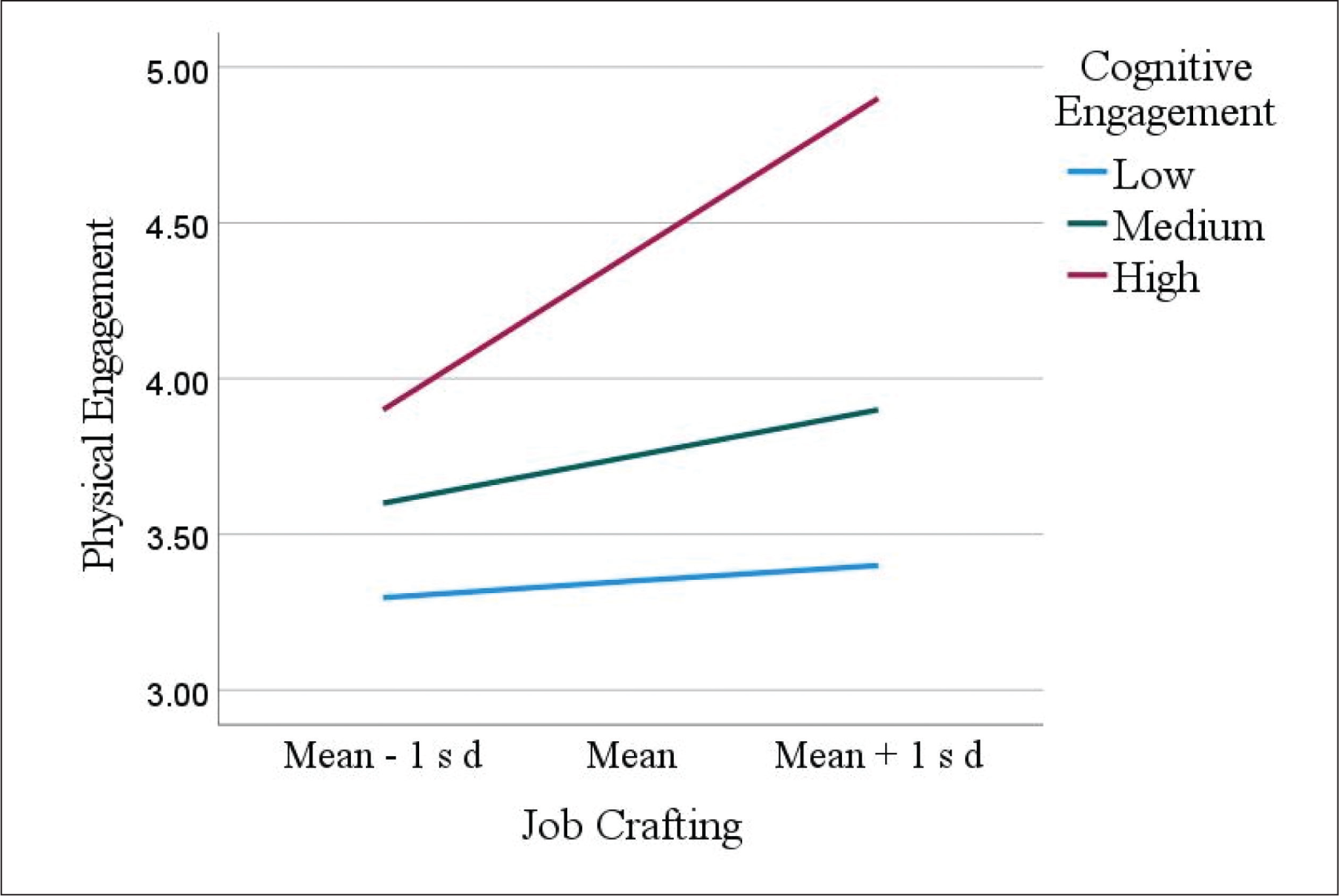
The visual inspection of the interaction effects are presented in Figures 2 and 3.
Results of Moderated-Mediation Model (H2a; H2b) [Model Number 11 in Hayes (2018) PROCESS Macros].
Conditional Indirect Effects of Job Crafting on Task Performance. [Job crafting → Physical Engagement → Task Performance]

As shown in Figure 2, higher levels of cognitive engagement, job crafting results in higher levels of physical engagement than at lower levels of cognitive engagement. Further, when job crafting increases from ‘low’ to ‘high’, the relationship between task crafting and physical engagement becomes stronger when cognitive engagement is high than when it is low (as the slope of the curve representing the higher level of cognitive engagement is greater than the slope of the curve representing low cognitive engagement). These results render support to H2a.
Figure 3 shows the three-way interaction between job crafting, cognitive engagement and emotional engagement influencing physical engagement in two panels. Panel A shows the moderation effect of task crafting and cognitive engagement on physical engagement at lower levels of emotional engagement. The effect is stronger when cognitive engagement is high when compared to low level of cognitive engagement. However, when we move to panel B, which shows the interaction effect at higher levels of emotional engagement, the steep rise in the curve representing the higher levels of cognitive engagement with increase in job crafting resulting in higher levels of physical engagement vouch for the three-way interaction effect. These figures render support to H2b.

Testing H5, H6 and H7
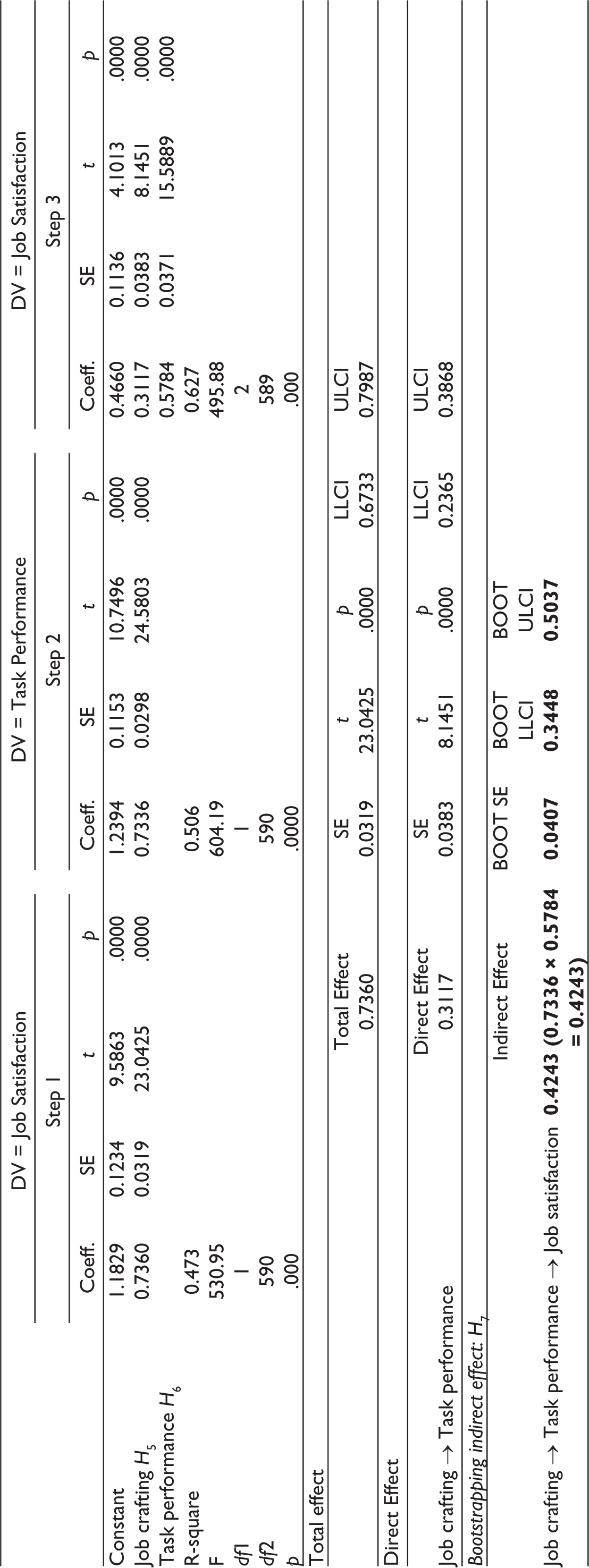
We used Hayes (2018) PROCESS macros model number 4 to test the effect of job crafting on job satisfaction (H5), task performance on job satisfaction (H6) and to test task performance as a mediator the relationship between job crafting and job satisfaction (H7). The results of regression are presented in Table 8.
The regression coefficient (Step 1, Table 8) shows that the effect of job crafting on job satisfaction is positive and significant (β = 0.736; t = 23.04; p < .001), thus supporting H5. The regression coefficient (Step 3, Table 8) shows that the effect of task performance on job satisfaction is positive and significant (β = 0.578; t = 15.59, p < .001), thus supporting H6.
Checking mediation hypothesis requires verification of indirect effect of job crafting on job satisfaction mediated through task performance. The indirect effect of job crafting on job satisfaction through task performance was significant (β = 0.4243; 95% BCCI [LLCI = 0.3448: ULCI = 0.5037]). Since ‘zero’ was not contained in the BCCI intervals, the mediation hypothesis is supported. The indirect effect was 0.4243 (0.7336 × 0.5784 = 0.4243) and the total effect was direct effect (0.3117) plus indirect effect (0.4243), that is, 0.7360. The bootstrapping samples of 20,000 thus support the hypothesis (H7) that task performance mediates the relationship between job crafting and job satisfaction.
Testing H5, H6 and H7.
Post-Hoc Analysis
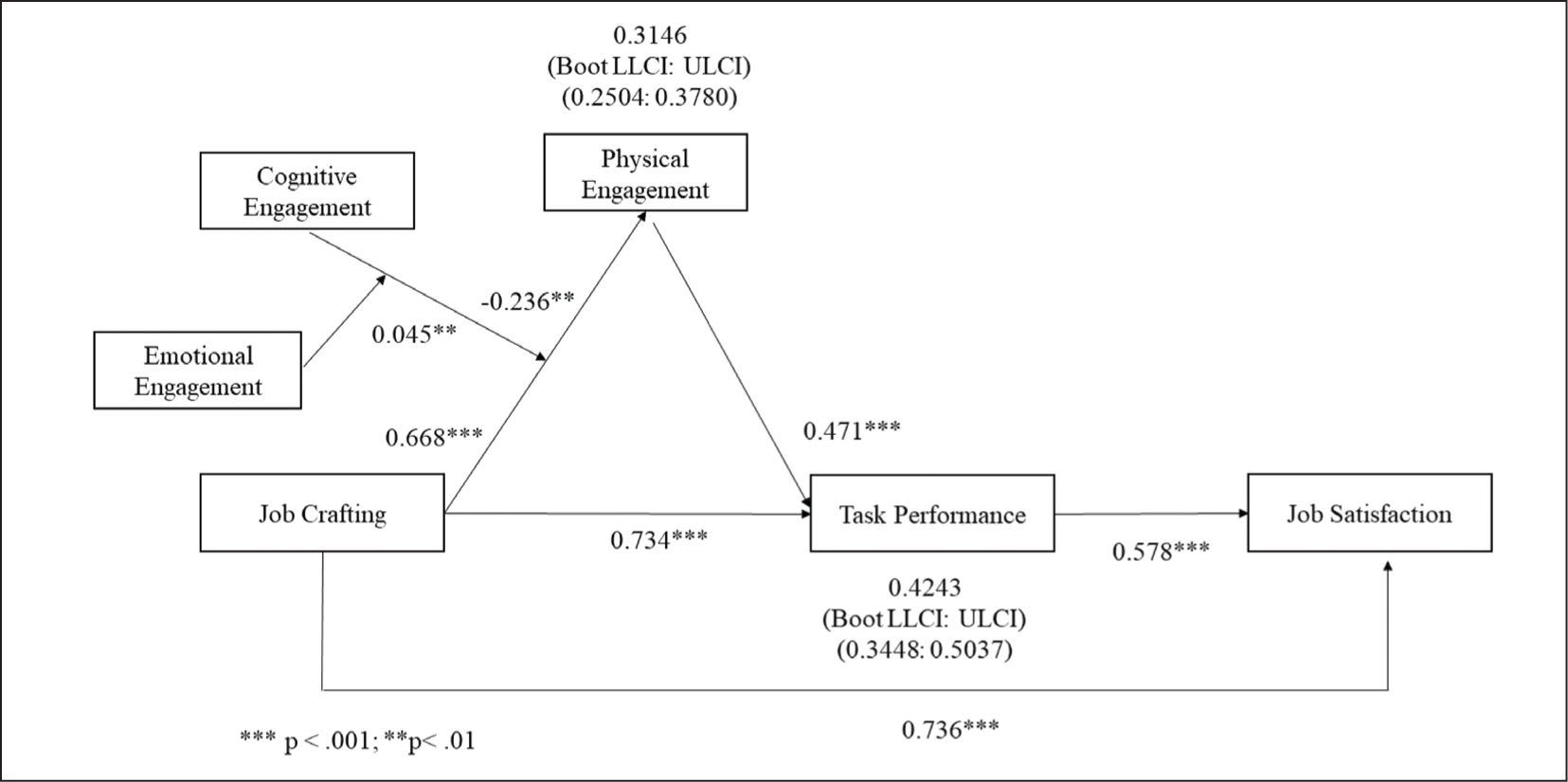
We also checked the mediation of task performance between physical engagement and job satisfaction. The indirect effect of physical engagement on job satisfaction through task performance was significant (β = 0.3152; Boot SE = 0.0390; Boot LLCI = 0.2403; Boot ULCI = 0.3938). The total effect of physical engagement on job satisfaction was 0.6727 (Boot LLCI = 0.6100; Boot ULCI = 0.7354), which consists of direct effect (0.3575: Boot LLCI = 0.2790; ULCI = 0.4360) and indirect effect (0.3152). Since ‘zero’ was not contained in the CIs, the mediation of task performance between physical engagement and job satisfaction is supported.
The empirical model was presented in Figure 4.
Discussion
Organizations, during the post-pandemic period, expect increased performance from employees. As the pandemic has disrupted the normal functioning of HEIs and adversely affected teaching–learning, resilient strategies are called to bring normalcy. The present study is conducted in this direction using two most important variables: job crafting and employee engagement in increasing performance and satisfaction. A conceptual model is developed and tested using Hayes (2018) PROCESS macros and found support for the hypothesized relationships.
First, the results indicate that job crafting positively predicts task performance (H1), the finding consistent with other studies in the literature (Geldenhuys et al., 2021; Letona-Ibañez et al., 2021; Parker et al., 2010). Faculty members crafted their jobs by altering the sequence of steps of performing (task crafting), identifying the co-faculty members with whom to work and take feedback (relational crafting) and perceiving the job as essential to fulfil their personal goals (cognitive crafting). Second, the findings support the positive effect of job crafting on physical engagement (H2); the result is in line with previous studies that focused on employee engagement (Dubbelt et al., 2019; DuPlessis et al., 2021; Petrou et al., 2017). While previous studies focused on global construct ‘employee engagement’, the effect of job crafting on any individual dimension has not been studied. Third, our study found a positive relationship between physical engagement and task performance (H3); the result aligns with past studies (Dubbelt et al., 2019; Nguyen et al., 2019). An increase in task performance is expected when faculty members fully get involved in performing their assigned duties; hence, the result is not surprising. These are aligned with the JCT which emphasized that employees craft the tasks to improve the performance.
Fourth, this study reported the indirect effect of job crafting on task performance through physical engagement (H4); the finding is expected as evidenced by previous studies (Nguyen et al., 2019; Tims et al., 2012; Van Wingerden et al., 2016). As the work climate has undergone unprecedented change due to the global pandemic, faculty members found it convenient to craft their jobs and engage physically till the jobs are completed. Fifth, job crafting as a significant predictor of job satisfaction (H5) has found support in this study, which is in congruence with extant research that documented positive outcomes of job crafting (Bakker et al., 2020; Boehnlein & Baum, 2020). Sixth, the positive association between task performance and job satisfaction (H6) has been supported in this research. This is, instead, a straightforward finding and is in line with extant research (Astrauskaite et al., 2010; Nagarajan et al., 2022). Seventh, the indirect effect of job crafting on job satisfaction mediated through task performance has been supported in this study (H7). Again, the outcome is consistent with the previous studies (Gopal et al., 2021; McVicar, 2016) and aligns with the JD-R theory.
Eighth, the role of cognitive engagement in increasing the positive association between job crafting and physical engagement (H2a) found support in this study. Since not many previous studies were available to vouch for this moderation, we rely on anecdotal evidence, logos and scant empirical evidence from one of the recent studies (Nagarajan et al., 2022). Ninth, this study incorporated emotional engagement as a second moderator that increased the strength of the moderated relationship between job crafting, cognitive engagement and physical engagement (H2b). The three-way interaction has not been investigated before and, therefore, cannot vouch for this from the literature. However, considering the positive effect of both cognitive and emotional engagement on individual outcomes (Nguyen et al., 2019), we hope this hypothesis was in the correct direction. Overall, the direct and moderation effects were supported in this research. To sum up, the results from this study contributes to the advancement of both JCT and JD-R theories.
Theoretical Implications
The findings from this research have several implications for research on job crafting and employee engagement. First, the conceptual model based on JCT and JD-R theories highlights the importance of job crafting and employee engagement in fostering performance and satisfaction. This study found that two overarching variables—job crafting and employee engagement—play a significant role in enhancing performance and satisfaction. Second, the three dimensions of job crafting as an aggregated variable are a precursor to physical engagement, task performance and job satisfaction. According to Tims et al. (2012), job crafting may take any of the four forms: (a) altering the jobs to enhance autonomy and provide new learning opportunities, thereby increasing the demand for structural resources, (b) seeking social support and feedback, thus increase the demand for social job resources, (c) accept the challenging jobs by contributing to new projects and (d) decrease in interactions with other members of the organization. The results from this study vouch for faculty engaging in task crafting by altering the sequence of jobs—teaching, research and service—and seeking additional resources for learning online education, especially in the context of HEIs in India, where the faculty lack adequate training to conduct web-based teaching. Third, this study dismantled the three dimensions of employee engagement and investigated the influence of each of the dimensions. While one dimension, that is, physical engagement, acted as a mediator in the relationship between job crafting and task performance, the other two dimensions, cognitive and emotional, served as moderators. Cognitive engagement (when employees perceived the jobs to be useful for their career and make meaning for their life) was found to significantly influence physical engagement (to make the employees fully engage in completing jobs) by interacting with job crafting.
Fourth, a significant contribution of this study stems from moderated moderated-mediation model whereby emotional engagement (first moderator) moderates the relationship between job crafting and cognitive engagement (first moderator) in influencing task performance mediated through physical engagement. The effect of the three-way interaction between job crafting, emotional engagement and cognitive engagement on physical engagement, which previous researchers have not studied, is a novel contribution to this research. Fifth, the direct effect of job crafting on task performance and job satisfaction adds to the growing body of literature by substantiating the previous studies. Although the positive side of job crafting (task crafting, relational crafting and cognitive crafting) on individual and organizational outcomes have been documented by earlier scholars, studies considering employee engagement dimension as moderators in the relationships are sparse, except for some studies (Nagarajan et al., 2022). Overall, to our knowledge, the multi-layered conceptual model is the first to disaggregate employee engagement and divert one dimension as a mediator, albeit with support from JD-R and JCT, a unique contribution to the literature on HRM and personnel psychology.
Practical Implications
The present study has several implications for educational institutions’ leaders interested in enhancing performance effectiveness. The unprecedented global pandemic has brought phenomenal metamorphosis in how educational institutions disseminate knowledge. Especially in developing countries such as India, frequent mandatory lockdowns and social distancing rules resulted in unprecedented changes in methods of instruction: change from in-class to web-based teaching, virtual meetings and restricted in-class assignments. Consequently, the faculty and administrators faced the challenge of managing the crisis. First, the present study suggests that job crafting and employee engagement can be considered resilient strategies to manage crises and enhance performance and job satisfaction. Second, the extent to which employees engage in job crafting depends on the availability of existing resources to meet the challenging demands; the heads of the institutions must provide adequate infrastructure so that faculty can craft their jobs effectively. Often, while crafting the jobs, faculty may need extra resources to support (for example, support from IT to help faculty in conducting the web-based teaching), and the leaders of the institutions need to devote substantial monetary, technical and physical resources required. Third, managers of the HEIs should offer incentives for the extra mile faculty go to reach the institutions’ goals of imparting successful education. Fourth, it is essential to maintain a healthy work climate to motivate the employees to engage cognitively, physically and emotionally with the organization. Finally, the present study underscores the importance of giving autonomy to the faculty that enables them to craft the jobs to match their skills and abilities to complete assigned tasks. Furthermore, in the present-day digital world, most students are habituated to mobile devices and can attend online classes; more important is to see the compatibility of operating systems that are user-friendly (Farhat et al., 2022). The leaders of higher education institutions need to understand that it is important to provide adequate technological infrastructure for successful functioning.
Limitations and Future Research
We acknowledge some limitations of this research. First, our focus is on HEIs in the southern part of India. Though all the universities are governed by the University Grants Commission (UGC) in India and conditions of almost similar across different states, the inclusion of samples from only one part of the country may have a probability of sampling bias. However, we have taken adequate care in selecting the representative sample so that the results would be free from sampling bias. Second, the social desirability bias inherent in social science research must be acknowledged. However, we have ensured anonymity to the respondents about the survey results, which may minimize the social desirability bias (Holden & Passey, 2009). Third, though the sample size is large enough, it would be interesting to have much bigger samples from the different states of India to see if there are any differences in how job crafting, and employee engagement strategies used by faculty differ across other States.
Though the present research focused on faculty from HEIs to the extent the employees engage in job crafting in manufacturing and services industries, the results could be generalizable. Therefore, the generalizability of this model is not a significant limitation of this study.
This study offers several avenues for future research. First, this study focused only on HEIs in India. Second, future researchers can study how employees used these study variables in different industries: IT, pharmaceutical industry, manufacturing sector, services sector, communications and so on. It would outline the differences across these industries about the employees’ resilient strategies in the new normal that foster performance and satisfaction. Third, cross-country studies, primarily involving comparable developing nations, can be included to verify the conceptual model and test the hypothesized relationships. Furthermore, some additional variables—trust, social support and personality factors—can be included as independent variables. Finally, it would also be interesting to study the effect of job crafting on organizational citizenship behaviour, psychological capital and knowledge transfer and conversion, which may have profound individual and administrative consequences.
Conclusion
Riding on the JCT and JD-R theories, this research demonstrated that organizations could bounce back from adverse work environments created by crises (such as global pandemics) by employing resilient strategies. This study focused on the HEIs in India and highlighted the importance of job crafting and employee engagement as crucial variables, and the results could be generalizable across other sectors. In the multi-layered complex model developed and tested in light of the post-pandemic era, we have specified boundary conditions where job crafting and cognitive and emotional engagement have a significant multiplicative effect on task performance. In addition to contributing to the literature on HRM and personnel psychology, we suggest that the research can move forward by identifying additional variables: trust, organizational citizenship behaviours, psychological capital, enhancing performance and job satisfaction. Through this research, we recommend job crafting interventions in organizations and reward engaged employees for reaping the benefits, and we hope that the research on job crafting continues to be on the agenda of future researchers.
Footnotes
Acknowledgements
We thank Professor Sathish Krishnan, Editor, and the anonymous reviewers for giving us constructive suggestions in the earlier draft.
Declaration of Conflicting Interests
The authors declared no potential conflicts of interest with respect to the research, authorship and/or publication of this article.
Funding
The authors received no financial support for the research, authorship, and/or publication of this article.