



Abstract
This study examines the impact of environmental factors, values and the moderating roles of gender and age on guests’ preferences for green hotels. Drawing Schwartz’s theory, the research adopted a sequential mixed-method approach to identify the key factors influencing sustainable consumption behaviours. The first phase involved a focus group discussion of 23 respondents with green preferences, providing insights into their attitudes, perceptions and motivations towards sustainable hospitality practices. The data collection phase, conducted between August and December 2024, gathered responses from 280 individuals on their preferences for eco-friendly hotels and the influence of personal values, environmental attitudes and demographics on their travel decisions. The results indicated that personal environmental attitudes significantly impacted the intention to visit green hotels (IVGH) (value = 0.353, t = 2.815, p = .005). Further analysis revealed that gender and individual values also positively influenced the IVGH (value = −0.391, t = 2.181, p = .029). These findings highlight the importance of personal values in shaping consumer choices and emphasize the growing role of sustainability in the hospitality industry. This research aligns with the United Nations Sustainable Development Goal 12, promoting responsible consumption and production in the hospitality sector.
Keywords
Introduction
Tourism in the modern era represents a major industry in the developing world, contributing to the economy by generating revenue, offering employment and promoting cultural exchange and localized investments in infrastructure (Mansoor et al., 2025). The tourism sector primarily relies on hospitality services, which are considered the core of the tourist experience and a key factor in achieving high satisfaction (Laksmawati et al., 2024). This is essentially how a tourist can experience a new destination. The hospitality industry is a major contributor to energy consumption and greenhouse gas emissions, which have significant adverse impacts on the environment, leading to an urgent need for sustainable practices (Prakash et al., 2022). In response, green hotels have emerged as an important alternative, offering eco-friendly accommodations that align with the values of environmentally conscious consumers. Understanding the key attributes that influence consumer choice in selecting green hotels has never been more crucial, especially in light of the rising demand for sustainable travel options.
The idea of environmentally friendly consumption has grown in the last several years. From a marketing standpoint, researchers utilize the word to encourage sustainable and pro-environmental behaviour (Lu et al., 2021). To help lead the conceptual synthesis underpinning the moral incentives of sustainable behaviours, some studies on ‘green consumerism’ have concentrated on hotels. Prior studies have emphasized the critical role of hospitality services in shaping destination competitiveness and tourist loyalty (Scott et al., 2015).
Practitioners and academics are concerned about the growing trends in green hotels and their effects on sustainable ecosystems due to the rise in green consumerism. Empirical studies published in leading journals have examined the role of environmental attitudes, subjective norms and perceived behavioural control in shaping consumers’ intentions towards green hotels (Chen et al., 2014).
Hotels are paying more attention to green consumption as the demand for eco-friendly lodging directly impacts environmental sustainability (Mugiarti et al., 2022). Pressing discussions surrounding sustainability and climate change have dominated public discourse and media, considering the environmental concerns within the global community. This has resulted in a noticeable shift in consumers’ attitudes and behaviours, becoming more conscious of their ecological footprint (Rahman & Reynolds, 2019).
In India, hotels such as ITC Windsor, Alila Diwa Goa and The Orchid Mumbai have started adopting eco-friendly practices, and such hotels have increased significantly over the past decade. It reflects a growing green trend in hotels (Meng et al., 2024). Due to factors such as environmental responsibility, regulations and long-term financial benefits, hotels are adopting practices like energy-saving systems and resource conservation, attracting eco-conscious guests (Mugiarti et al., 2022). Environmentally conscious consumers are more likely to support firms that demonstrate strong sustainability commitments (Verma & Chandra, 2017).
Eco-friendly hotels are often recognized in literature (Yu et al., 2025), but studies on hotels adopting green concepts are limited. Sustainable production practices are gaining more attention in various sectors, but their integration into traditional industries is still transitioning (Pereira et al., 2021). Continued innovation, collaboration and policy support are essential to accelerate the transition towards sustainable systems, particularly in hotel management (Kini et al., 2025).
The transition in India towards sustainable production and consumption in the hotel industry is challenging, and this study addresses the gap, as there are limited scholarly studies. This study addresses this gap with a mixed-methods approach and examines the attributes, based on Schwartz’s values theory, that influence environmentally conscious Indian consumers’ choice of green hotels.
This research aims (a) to explore the comprehensive list of green hotel qualities and investigate the factors influencing consumer choice of green hotels in India and (b) to determine how these attributes affect consumers’ pro-environmental views and value perception, which in turn affect their ecological action targets (for instance, the willingness to visit in a sustainable hotel and to indulge in ecologically friendly exercises) (Trang et al., 2019).
Based on the research aims, the following research questions guide this study:
RQ1: What are the key green hotel attributes that influence consumer choice and environmental commitment in the Indian hospitality context?
RQ2: How do green hotel attributes and individual values (IV) affect consumers’ pro-environmental attitudes (PEA) and their intention to visit green hotels (IVGH) and engage in ecologically friendly practices?
Being in transition to green concepts, hotels still face it challenging, and this study addresses this challenge by examining key factors influencing Indian consumers’ preference for green hotels.
Literature Review
Green hotels in India are growing rapidly, because environmentally conscious travellers seek accommodations as per their sustainability values and make eco-efficient practices essential to the country’s hospitality sector. These hotels adopt measures such as energy conservation, water management, waste reduction, renewable energy use, local sourcing, reduced single-use plastics and eco-friendly transport options to minimize their environmental impact.
Companies are strengthening their reputation and attracting eco-conscious customers by enhancing their environmental practices (Mugiarti et al., 2022). Similarly, enhancing a hotel’s green image increases customer visits and choosing green hotels over their competitors, which shows the importance of a strong eco-friendly reputation in redefining customer intentions as sustainable consumption grows (Assaker, 2020).
Many Indian hotels are adopting measures to reduce environmental impact, considering both short- and long-term operations. Supported by government incentives, hotels are increasingly implementing eco-friendly practices to address industry sustainability concerns (ET HospitalityWorld, 2023).
Attributes for Green Hotels
Green hotels are environmentally friendly accommodations using sustainable practices like energy and water conservation, waste reduction and other eco-friendly means. They give importance to renewable energy sources, green certifications and engagement in sustainable behaviours (Abdou et al., 2020).
Environmental Factors
Hotels can conserve water by adopting advanced water-saving technologies, measuring monthly water usage, standardizing water consumption for toilets, showers and dishwashers, tracking departmental usage with accountability systems, installing water meters and regularly monitoring and addressing wastage or leaks (Merli et al., 2019).
Wang et al. (2023) observed that green hotels should try to minimize, categorize and recycle waste by using machinery for garbage separation. They can provide guests with clear information by giving checklist items, such as reduced amenities or laundry adjustments, which are not easily noticed by guests. They also emphasized that visitors value features like ‘fresh, clean air’ and ‘a physical environment with plants or green décor’ as important indicators of eco-friendly hotel practices, while choosing the hotels.
Sadiq et al. (2021) highlight in their study that solar energy is an abundant resource and has low maintenance cost. It has seasonal variability and needs some other alternatives for a consistent supply in hotels. He suggests that hotels should prefer rooftop installations than ground-mounted systems as it can save the use of land and can be used optimally.
Planning and operations in the hotel industry must take biodiversity into account for both long-term financial success and ecological sustainability (Zion Market Research, 2024). Construction methods, such as land use, building location, materials and technology, have an impact on healthy ecosystems, which draw tourists. During hotel closures, increased waste generation, resource consumption and environmentally harmful disposal impact operations, but positive perceptions of green practices enhance a hotel’s reputation and perceived quality (Yu et al., 2025).
Values Considered to Opt for Green Hotels
The universal values such as self-transcendence and openness to change of Schwartz’s values theory lead to pro-environmental behaviour, including the choice of green hotels (Zhao & Huang, 2024). It continues as egoistic, altruistic and biospheric values, and also leads to social pressure and consumer influence (Eid et al., 2021; Wang et al., 2023).
Buyers’ attitudes towards green products are developed by their value orientations. The egoistic values are linked to personal costs and benefits and are linked negatively to pro-environmental behaviour. The social-altruistic and biospheric values of buyers are benefiting to others and the environment and are therefore positively associated with pro-environmental actions in tourism settings (Mironova et al., 2025).
It is observed in earlier studies that egoistic values focus on personal costs and benefits (Gomes et al., 2023), biospheric values prioritize environmental impact (Wang et al., 2023), and hedonic values emphasize comfort and pleasure. All these together performed environmental actions (Bouman et al., 2018).
Pro-environmental Attitude
According to Khairy et al. (2023), hospitality businesses should encourage patrons to adopt favourable attitudes and conduct towards green workplace settings. Limited empirical research has, however, been done on the connection between consumer inspiration and pro-environmental intention toward green hotel surroundings, according to Kwon and Ahn’s (2020) study.
The behaviour of the guests with PEA is influenced by environmental awareness, personal values and perceived social responsibility, making them support sustainable practices and green hotels (Khairy et al., 2023).
Attitude to Visit Green Hotels
Essiz and Mandrik (2021) observed that teenagers tend to adopt more sustainable behaviours and develop positive psychological responses to environmental issues. By this, their attitudes, perceived control and subjective norms strongly form their willingness to act. Eid et al. (2021) study findings show that behavioural beliefs, whether actions are viewed as beneficial or harmful, influence how consumers perceive green hotel practices and compliance with environmental standards. Jung et al. (2020) further emphasize that behavioural intentions are key dimensions of actual behaviour. It has a stronger intention to lead to a higher likelihood of engaging in eco-friendly actions.
Moderating Role of Gender and Age
In hospitality, demographic factors like age and gender significantly influence pro-environmental behaviour. Younger consumers (Gen Y) show higher awareness, middle-aged groups are leaning more towards and supporting green practices, and in general, women show stronger environmental attitudes, though preferences vary (Mansoor et al., 2025). For example, women were less likely to support eco-friendly features such as low-flow toilets and energy-efficient light bulbs. Furthermore, while Gen Y males typically adhere to rules and regulations, Gen Y females frequently base their decisions on empathy and emotional impact (Wang et al., 2023).
Hypothesis
Based on the theoretical framework, the current study formulated the following hypotheses:
The sustainable practices of green hotels, such as energy-efficient systems and eco-friendly amenities, support consumers’ sustainable values and improve their sustainable commitment (Mansoor et al., 2025). Therefore, we hypothesize that:
H1: Green attributes of the hotels influence environmental commitment among the consumers.
The self-transcendent, biospheric and altruistic values of Schwartz’s Value Theory guide consumers to uphold their environmental nature and support sustainable practices (Huang & Yang, 2022). Therefore, we hypothesize that:
H2: IV of the consumer influence environmental commitment among them.
The Theory of Planned Behaviour suggests that individual attitudes show behavioural intentions. Research shows that consumers with environmental concerns are significantly more likely to choose green hotels over conventional accommodations. Therefore, we hypothesize that:
H3: A PEA leads customers to visit green hotels.
Regarding the gender differences in environmental concerns, studies indicate that women exhibit stronger PEA and biospheric values than men. The female consumers exhibit greater responsiveness to green hotel attributes than men (Matthies & Merten, 2022). Therefore, we hypothesize that:
H4: The gender of the consumers plays a positive role in the green attributes of the hotels and IV of the consumer, significantly impacting the PEA.
Studies show that younger generations, such as millennials and Gen Z, demonstrate stronger environmental commitment, and they are more influenced by green attributes (GA) in making hotel choices, showing age-related responses are different for sustainability initiatives (Mansoor et al., 2025). Therefore, we hypothesize that:
H5: The age of the consumers plays a positive role in the green attributes of the hotels and IV of the consumer, significantly impacting the PEA.
The literature on the attitude-behaviour gap stresses the point that pro-environmental behaviour must translate into actual behavioural intentions to lead to sustainable consumption. Research has shown this, even though this relationship has been moderated by various contextual factors (Sagiv & Schwartz, 2021). Therefore, we hypothesize that:
H6: There is a significant connection between the PEA of the consumer and the IVGH.
Schwartz’s Theory
Schwartz’s view answers three vital conditions for human presence: the significance of people as biological beings, the need for social agreement, and the necessity of group survival and wellbeing (Schwartz, 1992). Ten fundamental personal beliefs have been developed and empirically supported by Schwartz and colleagues. They include ‘Hedonism, Stimulation, Self-direction, Tradition, Security, Power, Accomplishment, Conformity, Universalism and Benevolence’.
It is observed that values reflect different motivations and goals and make them compatible with some beliefs and conflicting with others (Liu et al., 2018); however, their importance varies across individuals and cultures. But their core structure is universal (Sagiv & Schwartz, 2021). Research also identifies key opposing dimensions such as self-transcendence versus self-enhancement and openness to change versus conservation (Ganassali & Matysiewicz, 2021).
According to Huang and Yang (2022), environmental study highlights the self-transcendence versus self-enhancement dimensions, which reflect a connection between societal and environmental concerns, along with personal gain. The self-transcendence dimension emphasizes altruism and collective welfare, and the self-enhancement dimension focuses on status, power, and achievement.
The different types of values, like egoistic, altruistic and biospheric values, shape the environmental beliefs and behaviours of consumers. Egoistic values focus on personal gain, and altruistic and biospheric values emphasize concern for others. The environment is connected to these values (Imaningsih et al., 2020). Based on Schwartz’s theory, studies modified measurement instruments by incorporating biospheric values and validating the distinction among these orientations. This better explains sustainable attitudes and actions.
Matthies and Merten (2022) made the value based on Schwartz’s instrument of values inventory, which helps comprehend sustainable attitudes and actions. Several biospheric values were added to the instrument because Schwartz’s value inventory undervalued them. They used three separate investigations of confirmation factor analysis to validate the distinction between the three value orientations.
Tran et al. (2019) stress the need to study diverse hotel customer segments, based on factors such as gender, nationality, income, and age. He mentions that environmental awareness, attitudes and values significantly influence intentions toward green hotels. Mansoor et al. (2025) further support this by emphasizing their role in promoting green consumer behaviour.
H2 is supported by Schwartz’s Value Theory, which shows that IV support the environment. The self-transcendent values (universalism, benevolence) promote biospheric and altruistic concern, which shows that consumers prefer long-term community wellbeing over their personal benefit (Huang & Yang, 2022). The self-enhancement values do not support environmental concerns. The adapted values related to theory encompass egoistic, altruistic and biospheric aspects, and thereby support H3, as these value principles project PEA. The value principles recognition and adaptation change with the demographics, such as age and gender (Sagiv & Schwartz, 2021), which supports this study’s H4 and H5. Schwartz’s Theory projects the psychological basis and understanding of the influence of values on green attitudes and thereby hotel-preference behaviour, in Indian consumers.
Materials and Methods
Qualitative Approach
A focus group discussion was employed in this study with 23 respondents who were consumers with green preferences to gain a comprehensive understanding of the underlying motives, attitudes and perceptions of customers regarding green hotels. The following themes were gathered to promote a deeper comprehension of the factors that influence and guide customers’ choices to stay at green hotels.
Environmental Concerns
Consumer preferences for green hotels are heavily influenced by environmental concerns. The hotel’s waste management procedures, energy usage and water conservation initiatives are important determinants of choice. Hotels that exhibit observable sustainability practices, like eco-friendly cleaning supplies, water-saving features and energy-efficient systems, are given preference by customers, which helps to further increase consumer trust. Furthermore, eco-friendly building materials and designs add to a green hotel’s allure. One respondent group reported, ‘I try to choose places that have some environmental initiatives, like energy-saving practices or waste management’, which means that eco-conscious tourists frequently select locations and lodgings that reflect their environmental values, so these worries not only affect the choice to stay at a specific hotel but also mould overall travel preferences.
Awareness and Knowledge of Sustainability Practices
Customers make decisions to choose green hotels based on their awareness of sustainability practices, which is not the same. In some hotels, initiatives like energy and waste management are the priority. Many consumers have only limited knowledge (e.g., of certifications like LEED) but still perceive green aspects of the hotels as indicators of trust, making transparency crucial for attracting customers.
Technological Innovations in Green Hospitality
Technological advancements in green hospitality are increasingly playing a significant role in drawing environmentally conscious guests to green hotels. In addition to lessening hotels’ environmental impact, technological innovations like energy-efficient lighting, intelligent climate control systems and renewable energy sources (like solar panels) are also improving the visitor experience. By drastically reducing their resource usage, hotels can attract eco-conscious tourists by implementing technologies like automated energy systems, smart thermostats and water-saving fixtures. Participants responded that they were interested in hotels that use technology to reduce energy consumption or improve efficiency. It makes the staff feel more modern and responsible. These technological developments are playing a crucial role in influencing the future of the hospitality sector and drawing in eco-aware tourists as travellers’ concerns about sustainability growth.
Tourism Trends and Demographics
Among millennials and Gen Z, eco-conscious travel is increasing. They prefer green hotels that align with sustainability values such as local sourcing, waste reduction and energy efficiency. These practices make such hotels green, and they increase consumer demand for responsible tourism.
The choice to employ a qualitative approach (focus group discussions) first, then quantitative techniques (such as surveys), stems from the research design that aims to quantify these insights as well as comprehend the breadth of the problem. A wide range of concepts, theories and themes that are significant to customers are produced by the qualitative phase. This stage frequently revealed fresh elements or viewpoints, which resulted in the creation of a more thorough survey questionnaire.
By using a mixed-method approach, starting with qualitative research followed by quantitative research, the study ensures a more universal and detailed understanding of consumer behaviour towards green hotels. This approach allows for the exploration of both the ‘why’ behind consumer choices and the broader patterns of these behaviours in the general population.
In the quantitative study, the initial section of the questionnaire provided an extensive explanation of a green hotel’s stay establishment to help survey respondents understand the idea of a sustainable hotel. The second portion included questions regarding personal values considered while choosing green hotels, plans to stay at green hotels, and willingness to pay more for a green hotel. Things were altered specifically for the context of the green hotel. Multiple items were used to measure each component utilizing a five-point Likert-type scale ranging from ‘1 = strongly disagree to 5 = strongly agree’. The final component included questions on demographic data, including the gender, age and income of green consumers, as well as their education levels, frequency of hotel stays and prior experiences staying in green hotels. The literature was used to generate the overall measurement items for people’s attitudes toward the environment. We conducted a pilot test, which indicated that the items in each study construct had an adequate level of reliability and validity. We established specific inclusion criteria to guarantee that the data gathered from survey participants met the following conditions: (a) Participants needed to be 18 years or older, since comprehending the intricate eco-friendly concept can be challenging for individuals younger than this age group. (b) Participants were required to be of Indian descent and reside in India (Sadiq et al., 2021). According to the quantity of responses produced, it was suitable for conducting advanced multivariate statistical analysis. The suggested sample size should encompass 15–20 times the number of items under consideration. In our case, with 17 items, the minimum sample size necessary would be 20 times 17, equalling 340. Additionally, existing research on eco-friendly hotels in India indicates that a sample size, ranging from 250 to 500 yields dependable results. Thus, the current sample size (280) was assumed to be suitable for further analysis.
The research was carried out using a sample size of 280 individuals. We employed a nonprobability sampling method for the sake of convenience in this study, which combined purposive and snowball sampling techniques (Wang et al., 2023). To ensure the effectiveness and comprehensibility of the questionnaire, 63 individuals from diverse backgrounds and varying levels of linguistic proficiency pretested it in August 2024. Any ambiguous instructions or questions prompted test-takers to offer their opinions and suggestions. The data collected during the pilot study were utilized in the subsequent analysis. For distribution via email, contacts were requested to complete the survey and share it with others. The study’s sample consisted of Indian consumers with green preferences, and efforts were made to include regions across India with such consumers. A total of 280 respondents successfully completed the survey over 4 months, from August to December 2024, specifically targeting green consumers while considering gender and age. Valid responses were evaluated for validity, reliability and suitability for testing hypotheses, resulting in a final sample of 220 participants.
The qualitative study of 23 environmental concerned consumers focus group analysis addresses RQ1 by identifying four core themes, which reflect green hotel attributes: Environmental Concerns (waste, energy, water), Awareness of Sustainability Practices (LEED, transparency), Technological Innovations in Green Hospitality (energy-efficient systems, smart controls, renewables), and Tourism Trends and Demographics (generational preferences, eco-tourism). The quantitative theme addresses R2 as the retrieved themes lead to a structured survey in exploring the relationship between green hotel attributes, IV, PEA and green hotel visit intentions in a large sample. This mixed-methods study supports the finding that the results are validated and grounded in consumers’ real-life experiences.
Quantitative Approach
Measurement
Researchers assessed the actual behaviour by putting ideas into four elements: GA, IV, PEA and IVGH. The items’ GA, IV and PEA are adopted from this (Rahman & Reynolds, 2019). The scale to measure IVGH is adapted from (Manganari et al., 2015). The respondents were asked to evaluate their encounters with GA, IV, PEA and IVGH on a scale of 1–5, where 1 is ‘Not Important’, and 5 is ‘Extremely Important’. The data are analysed using a software program called SPSS AMOS (Version 25), which also tests the structural relationship between the constructs.
Demographic Profile of the Respondents
Table 1 illustrates that the study’s respondents had a diverse demographic profile, which played a crucial role in understanding their inclinations toward green hotels. The questionnaire included various demographic variables, such as age, gender, the practice of staying in green hotels and household annual income. In terms of age groups, the respondents were distributed as follows: 18–25 years old constituted 130 individuals (46.4%), 26–35 years old represented 56 participants (20%), 36–45 years old comprised 31 respondents (11.1%), 46–55 years old accounted for 42 individuals (15%) and those aged 56 and above were 21 respondents (7.5%). Regarding gender distribution, 178 respondents were male (63.6%), while 102 respondents were female (36.4%). When asked about their stay preferences in green hotels, 140 respondents indicated that they had stayed in green hotels (50%), while an equal number of respondents, 140 in total, had not (50%). In terms of household annual income, 20 respondents (7.1%) reported an income of less than ₹25,000, 26 respondents (9.3%) fell into the ₹25,000–₹50,000 income bracket, 28 respondents (10%) reported an annual income between ₹50,000 and ₹100,000, and 110 respondents (39.3%) preferred not to disclose their household income. This diverse demographic representation allowed for a comprehensive analysis of the respondents’ visit intentions and motivations regarding green hotels.
Demographic Characteristics of Participants.
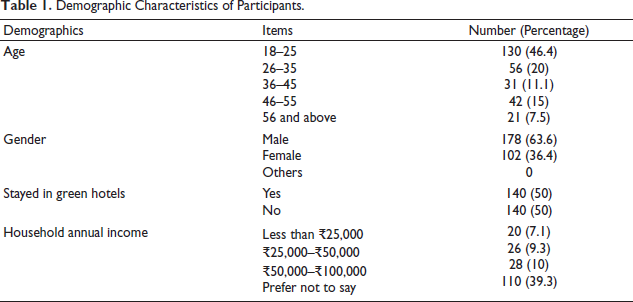
Demographic Characteristics of Participants.
Structural equation modelling (SEM) was used to test the proposed hypothetical model. The model was evaluated in two stages, starting with the development of a measurement model and ending with the testing of a structural model, as indicated by Hair et al. (2010). The measuring model aids the researchers in confirming the association between the study’s latent and manifest variables. Latent variable relationships and their strength have been investigated using a structural model. In addition to descriptive statistics for the study’s items, Cronbach’s alpha was calculated for each dimension, and the results show that the construct’s values are in the range of 0.75–0.92, indicating good to outstanding reliability (Tabachnick & Fidell, 2019). All variables in the study follow the normal distribution since their values fall within the range of 2, according to the results of skewness and kurtosis (George & Mallery, 2003). The descriptive statistics, factor loadings (FL), Cronbach’s alpha (CA), skewness (S) and kurtosis (K), of the many items included in the scale to examine factors influencing hotel visitors’ preference for green accommodations are presented in Table 2.
Analysis of Descriptive Statistics, Reliability, Validity and Normality.
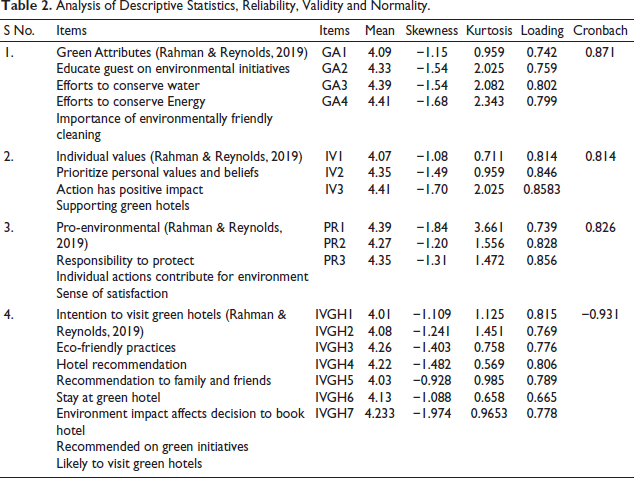
Analysis of Descriptive Statistics, Reliability, Validity and Normality.
In this research, the partial least squares (PLS) approach is used in estimating the SEM because highly complex models can be assessed using it and can better handle data insufficiency, like data heterogeneity. The Smart PLS computer program version 3.0 software was employed for this study. Two phases of model assessment (measurement model and structural model) were used to carry out the SEM-PLS. The effectiveness of this SEM-PLS method has been demonstrated (Hair et al., 2010).
Measurement Model
At the measurement model stage, the measures for latent constructs in reliability and validity, such as convergent validity and discriminant validity, were estimated. The dependability of latent constructs was established through the estimation of internal consistency reliability, item reliability and composite reliability (CR) measures. Cronbach’s alpha and CR values above 0.70 are regarded as acceptable; however, values below 0.70 show a lack of dependability. The findings showed that Cronbach’s alpha and Cronbach’s r values for each construct were above the usual threshold of 0.70, indicating strong reliability among the different measurements. Additionally, the study proved convergent validity because all the observed variables’ standardized loadings were higher than the suggested threshold value of 0.60, ranging from 0.680 to 0.958 without any cross-loadings. Convergent validity was confirmed by finding that the average variance extracted values for each latent construct in the measurement model were higher than 0.50 (Fornell & Larcker, 1981). The study then compared shared variances between components and the AVE of individual factors to test the discriminant validity. According to Fornell and Larcker (1981), Table 3 demonstrates that the AVE square roots for each construct are larger than their correlations. This confirmed that all five of the model’s constructs are conceptually and practically distinct from one another.
Model Fit.
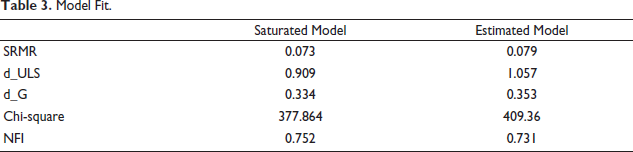
Model Fit.
Discriminant validity is evaluated by comparing the ratio between the square root of AVE and correlations. As can be seen in Table 4, the diagonal elements of the matrix, which stand in for the square roots of the AVEs, are larger than the corresponding inter-construct correlations, indicating that the ratio between the square roots of the AVEs and correlations has discriminant validity. Additionally, the correlation between the composite of the latent constructs and all other constructs is less than 0.7, demonstrating that the constructs are sufficiently distinct from one another (Urbach & Ahlemann, 2010).
Fornell–Larcker Model.
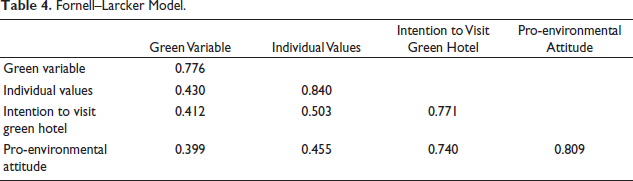
Fornell–Larcker Model.
In Table 3, the diagonal elements of the matrix, which stand for the square root of the AVEs, are larger than the corresponding inter-construct correlations, as demonstrated by discriminant validity in Table 4. For latent constructions, the correlation between the composite and all other constructs is less than 0.7, suggesting that there are significant differences between the constructs (Mansoor et al., 2025).
Hypothesis Testing Results.
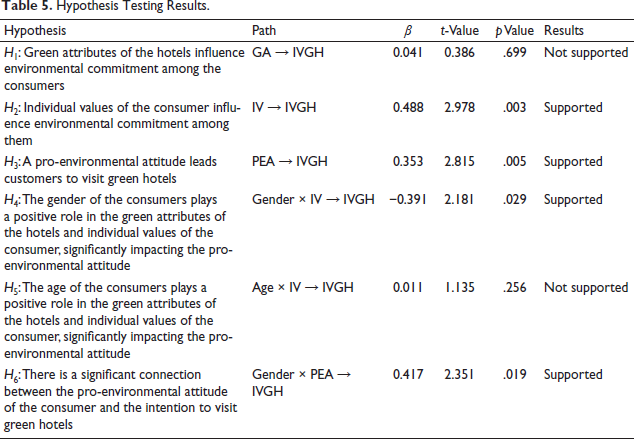
The study initially confirmed the reliability, predictive validity and accuracy of the model, as well as the applicability of SEM in examining the relationships among the constructs. Using a bootstrap approach, the effects of the independent variables, GA, IV and PEA, on the dependent variable, IVGH, were assessed. The results demonstrated that GA had no significant impact on IVGH (β = 0.041, t = 0.386, p = .699), thereby failing to support H1. In contrast, IV demonstrated a strong and significant positive influence on IVGH (β = 0.488, t = 2.978, p = .003), supporting H2. Similarly, PEA was found to significantly affect IVGH (β = 0.353, t = 2.815, p = .005), supporting H3. Further analysis highlighted that gender moderated the relationship between IV and IVGH, showing a significant effect (β = −0.391, t = 2.181, p = .029), thus supporting H4. However, age did not play a significant role in influencing IVGH (β = 0.011, t = 1.135, p = .256), leading to the rejection of H5. Finally, gender was also found to significantly moderate the relationship between PEA and IVGH (β = 0.417, t = 2.351, p = .019), supporting H6. In summary, these path estimations highlighted the significance of IV, PEA and gender in influencing consumers’ intentions to visit green hotels (Gupta, 2021).
The non-support for H1 (green attributes ↓ IVGH) shows that green hotel attributes on their own cannot directly influence consumers’ visit intentions to green hotels in the Indian context. It suggests that the relationship may be mediated through other psychological constructs, such as environmental commitment or PEA, and not operate on a direct connection. This finding challenges the conventional understanding that obvious green practices automatically translate into behavioural intentions, indicating that Indian consumers may require deeper value supports and attitudinal engagement before GA become motivating factors for visiting green hotels. The lack of support for H5 (age moderation) can be related to the sample’s demographic composition. With 46.4% of respondents aged 18–25 years, creating insufficient age variability, leading to the detection of significant moderating effects. In addition, the Indian hospitality context can present rare characteristics where environmental consciousness is becoming increasingly homogeneous across age groups. This is particularly evident in urban areas, where both younger and older consumers are exposed to sustainability messaging through social media, corporate initiatives and government campaigns. These results suggest that strategies on age-based segmentation may be less effective in the Indian green hotel market compared to value-based or gender-based approaches, as evidenced by the supported gender moderation effects (H4 and H6), which demonstrate that gender plays a more significant role in shaping how IV and PEA translate into visit intentions (Table 5).
In this research, we employed partial least squares-structural equation modelling (PLS-SEM) to examine the relationships established within the study. Given the exploratory nature of this research and the goal of optimizing the extent to which the dependent variable is explained, the utilization of PLS-SEM is well-justified. As recommended by Hair et al. (2010), a measurement model was created, and then a structural model was tested to evaluate the model. The measuring model aids the researcher in confirming the association between the study’s latent and manifest variables. Latent variable relationships and their strength have been investigated using a structural model. Cronbach’s alpha was calculated for each dimension in addition to descriptive statistics for the study’s items, and the results show that the construct’s values are in the range of 0.75–0.92, showing reliability, to be good to excellent (Tabachnick & Fidell, 2019). Prior to conducting data analysis with Smart PLS 4, this research utilized SPSS version 25 to validate the multivariate assumptions concerning normality, multicollinearity and the presence of outliers. The initial step involved assessing data normality by examining skewness and kurtosis values. All variables in the study follow the normal distribution since their values fall within the range of 2, according to the results of skewness and kurtosis (George & Mallery, 2003). The table gives the Descriptive Statistics, FL, CA, Skewness and Kurtosis of the different items used in the scale to measure purchase intention.
Efforts made by eco-friendly hotels like these could alleviate the inconvenience individuals perceive when practising ecological behaviours while also boosting their sense of the significance of being environmentally conscious (Essiz & Mandrik, 2021). Furthermore, environmentally conscious hotel businesses ought to showcase their dedication to environmental sustainability within their establishments and publicly express their care for the well-being of the environment. This may include adhering to environmental regulations, practising energy and water conservation, and actively participating in recycling efforts. Customers would be more inclined to trust that eco-friendly hotel companies are conscientious in their environmental actions (Gupta, 2021). This research discovered gender disparities in environmentally conscious buying intentions, aligning with theories concerning variations in human behaviour related to gender, such as social role theory and evolutionary psychology. In particular, the results indicated that men were more inclined to buy environmentally friendly accommodations, spread positive recommendations and invest extra in sustainable hotels (Tandon et al., 2021). The IVGH is supported by attitude, and it is consistent with the theory of planned behaviour in earlier studies (Gupta, 2021). The analysis shows unsupported hypotheses may be due to other contextual factors like low consumer awareness, cultural variations and sample characteristics.
It can be understood from the findings that the Indian consumer’s IVGH is not only supported by green hotel attributes, but it also shows that consumers need to have deep psychological intentions of sustainable hotel choices (Tandon et al., 2021). The IV and PEA are the intrinsic motivators that act as mediators in showing eco-friendly intentions (Mansoor et al., 2025). Hotels can utilize this and combine technical sustainability with value-based engagements through storytelling, education and community programs (Prakash et al., 2022). Gender analysis findings show that it can be used for sustainable communication of empathy, holistic care and social impact (Darwish et al., 2024). In this way, hotels can move beyond visible green operations to develop real-time sustainable values with targeted strategies (Ashaal et al., 2024).
The study findings did not show age moderation for the values–intention relationship. This may be due to demographic homogeneity and cultural diversity, as well as cross-generational sustainability awareness (Dutta, 2024). The importance of age-based segmentation can be reduced by environmental consciousness and by government initiatives, as well as digital campaigns. Future research needs to focus on actual purchase behaviour in various hotel categories and needs to segment consumers on the basis of lifestyle, education and region. Also, green hotel choices can be compared with other eco-friendly products to understand the ways in which domain-specific attitudes shape sustainable consumption.
Table 6 shows the comparison of this study with earlier studies to understand previously established models and empirical results. It can be seen that the key role of attitudes and values relates to global patterns; the effect of certain demographic moderators can be connected to findings in Western contexts. This comparison highlights both the convergent and novel aspects of this study, which highlights the particularities of the Indian context and the dynamic evolution of consumer preference in the hospitality industry.
The Comparison Table: Key Findings of the Study with Previous Literature.
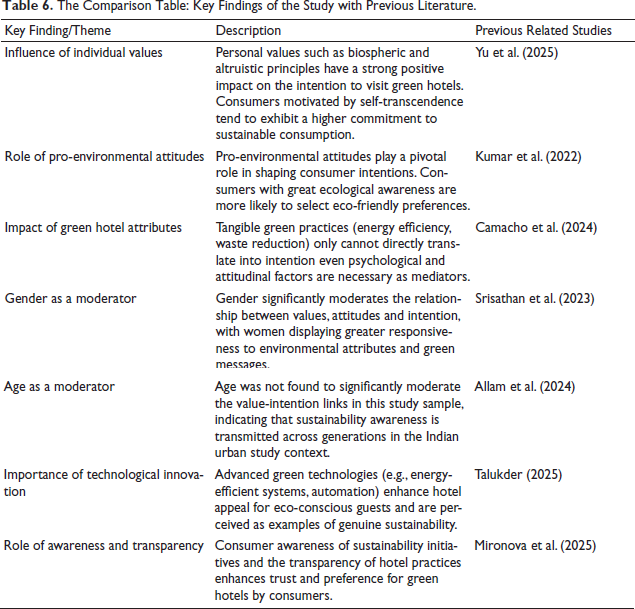
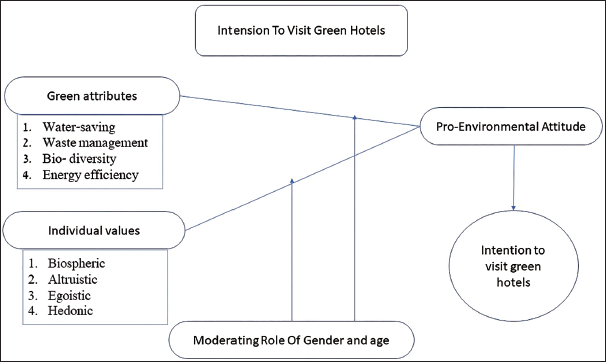
This study is novel in its connection with Schwartz’s value theory with both PEA and demographic moderators (gender and age), which explains green hotel intention. It offers a multidimensional analysis that is typically not found in previous research. Unlike many earlier studies that focused mainly on green hotel attributes, this research highlights the mediating role of psychological constructs in actual purchase intentions of consumers in hospitality within the Indian context. The analysis of gender as a significant moderator provides new insights and a greater understanding of how customized sustainability awareness and implementation can influence different consumer groups more effectively to change purchase intentions favourably (Figure 1).
Conceptual Framework.
This study suggests a basic understanding of consumer attitudes toward eco-friendly hotels, but it has several limitations. It does not examine consumer behaviour across different hotel categories, such as budget, mid-range or luxury, which may give different insights. The focus of the study is on consumer attitudes and not on actual purchasing behaviour, which requires separate research. The scope is also limited to green hotels and excludes other eco-friendly product categories. Future research should segment consumers by hotel type and observe real-world purchase behaviour to improve the accuracy of insights and help hotels tailor sustainability strategies. As climate concerns intensify, hotels are increasingly judged on ethical and environmental responsibility, and the findings show that consumers’ environmental values significantly influence their willingness to choose, recommend and pay more for sustainable hotels. Here, more consistent public awareness efforts are essential to strengthen understanding of the benefits of eco-friendly lodging and encourage broader adoption of green hotel practices.
This study builds upon prior high-impact research in sustainable tourism and hospitality, particularly studies that have examined the role of environmental attitudes and behavioural intentions in green hotel selection, as well as the broader environmental impacts of tourism systems. Future studies should further explore value-driven consumer behaviour across different cultural and economic contexts to enhance the generalizability of green consumption models. From a policy perspective, the results suggest that governments and tourism authorities should promote sustainability awareness campaigns and incentivize green certifications to encourage both consumers and hospitality providers to adopt environmentally responsible practices.
The suggested conceptual framework for green hotels provides insightful information about the elements affecting customer preference in the hospitality industry. Future studies must, however, broaden this framework to encompass other environmentally friendly goods and services in addition to green hotels. Researchers can find similarities and differences in consumer behaviour by empirically assessing how consumers react to various environmentally conscious product types. This information can then be used to develop more focused and successful marketing campaigns that encourage sustainable consumption across industries.
Footnotes
Authors’ Contributions
Dr Rajashree S. Kini (first and corresponding author) conceptualized the study, developed the research framework, interpreted the results, and contributed to manuscript writing and final review. Dr Tantri Keerthi Dinesh contributed to the research design, data analysis, supervised the research process, and assisted in drafting and refining the manuscript. Ashish Ani was involved in data collection, literature review and initial drafting of the manuscript.
Data Availability Statement
Available on request.
Declaration of Conflicting Interests
The authors declared no potential conflicts of interest with respect to the research, authorship and/or publication of this article.
Ethical Declaration
All procedures performed in this study were in accordance with the ethical standards of the institution.
Funding
The authors received no financial support for the research, authorship and/or publication of this article.
