



Abstract
The traditional fashion had always been just apparelling need for most of the people of Bangladesh. Over the last decade, unique contrives of apparelling has been adapting substantially to cope with the changing needs of the society but keeping in mind an inducing sense of traditional fashion which people can differentiate themselves from others. Interestingly, the traditional fashion has reached to a very competitive market in Bangladesh. As a consequence, some of the fashion houses such as, Aarong, Prabartana, Nipun, Anjans, Kay Kraft, Deshal, Rang, Sadakalo and Nabarupa have been successful to create a brand value. Specifically, Sadakalo is one of the leading fashion houses with particular focus on traditional clothes. The main aim of this article is to demonstrate how a fashion house can gain competitive advantages despite unpredictable market challenges. The article focuses on origin of Sadakalo, their products and retailing, markets and customers, planning, sourcing and warehousing, design and production, distribution, store operations, marketing and management issues and competitive challenges of Sadakalo that specially led to achieve competitive advantages. The article also explores the dynamic ideas and capabilities of the entrepreneur of Sadakalo.
Fashion is the imitation of a given example and satisfies the demand for social adaptation. … The more an article becomes subject to rapid changes of fashion, the greater the demand for cheap products of its kind.
The Fashion Industry in Bangladesh
Fashion, a global phenomenon, is supported by the shifts in the organization of garment production across the world as well as by the vast economic significance of garment production in world trade (Hansen, 2004). The fashion industry is the fastest-growing industry in the world (Rajput et al., 2012). Over the last decade, it has been observed that the fashion design and the fashion industry has severely undermined the traditional system of intrinsic fashion design, in which creativity emerges from small-scale businesses in developing country (Azuma and Fernie, 2003).
Over more than a decade, fashion industry of Bangladesh has contributed substantially to strengthen local economic growth and towards global export-friendly trade regime (Curran, 2009; Raihan, 1999). Bangladesh fashion industry has been producing for the local leading brands, namely, Aarong, Ecstasy and Cats Eye, and also for the world leading brands, including, Wal-Mart, Tesco, Zara, Marks and Spencer and H&M (Islam et al., 2012).
However, the fashion industry throughout the world is divided into a variety of market segments and consumer groups which are based upon demographical segmentations in the context such as gender, age group, income level, nature of fabrics, and category of garments and price (Priest, 2005). Along with demographical segmentations, the fashion industry in Bangladesh can be divided into two distinct markets—one for traditional clothing and the other for modern Western apparels. Specifically, there are two major types of fashion wares in Bangladesh, namely, one that coexists with the traditional fashion salwar kamiz and the other is Western style fashion in a relationship that is modified across the region’s changing political history in interaction with regional, national and international styles (Hansen, 2004). Nowadays, the Bangladeshi people both from urban and suburban area prefer Western fashion to traditional apparel though the demand for the latter has not yet declined throughout the country. Almost 90 per cent of products of the fashion industry are used to fulfil the local demand and the remaining is exported throughout the world especially in Europe and North America. On the other hand, segmentation based on women’s choices mainly consists of low-priced traditional clothes like saree and kamiz and Western clothes, such as, tops and skirts (Hansen, 2004).
There has been relatively little demand for imported traditional dresses from the South Asian countries like India and the Western clothes from the other parts of the world. The men’s segmentation usually consists of both low-priced and high-priced Western clothes like T-shirts, shirts and suits. The demand for men’s traditional dresses like punjabi and fatua is increasing due to some occasions like Eid festivals, International Mother Language Day, Durgapuja, Victory Day, Independence Day, Bengali New Year (in Bengali, known as Pohela Boishakh), birthdays and wedding anniversaries. Sadakalo closely works with the local community to bring innovative products especially in Pohela Boishakh (The Daily Star, 9 April 2013).
Since its inception, Sadakalo, a fashion retailer that has exclusively focused on traditional items has been successfully operating and designing its dresses as well as gift items in these occasions/festivals. The type of garment is becoming an important factor to make purchase decisions due to the global climate change. According to Azuma and Fernie (2003), in fashion context, climate has been of vital importance in forming a convenient dress style for a given region. Woolen and synthetic garments are less preferred during the winter season since winter is not as cold as in Bangladesh.
Inspirational Journey of Fashion House
Tahsina Shahin, Chairperson and the owner of Sadakalo, is one of the dynamic professionals in the fashion industry of Bangladesh. She is currently studying Executive Master of Business Administration (EMBA) at North South University, Bangladesh. She completed her M.A. from Shanto-Mariam Institute of Creative Technology (SMICT), Dhaka and B.A. (Hon’s) from Institute of Fine Arts at University of Dhaka. She dreamt of an outlet consisting products on the basis of only black and white with traditional focus and it came true in the year 2002 (4 October) by the launching of a small outlet named Sadakalo at Rifles Square, Dhanmondi, one of the hearts of the Dhaka city. Over the time, Tahsina Shahin’s small retail store has expanded into a multi-chain outlet with international operations.
Sadakalo’s unique business model did not just consider making fashionable traditional clothing—instead, its vision centred around the idea of creating clothing that would look different from the other brands. In order to achieve this objective, Tahsina Shahin first considered the other outlets in the market, and made one significant observation—traditional clothing was gaining popularity because it was colourful and vibrant. Retailers were focusing on colours that were often considered ‘effeminate’ for men, such as pink and yellow and turning them into colours that were not only popular but also stylish. She decided to create her own mix of colours that would highlight her sense and understanding of style, sophistication and beauty.
The shades black and white have for centuries represented inimitable luxury and unparalleled glamour. Designers have known about the power of this impecc-able pairing for years (McCulloch, 2010). Sadakalo is one of the leading brand fashion houses in Bangladesh with a spirit of indigenous culture through articulated design on clothes, almost exclusively with black and white colours (The Daily Sun, 1 May 2013; Financial Express, 24 October 2010). In Bengali, sada means white and kalo means black—so they solely rely on the two basic colours black and white, just as its name implies. Sadakalo’s journey started not with a commercial view but from the thought of realizing a dream—a dream of infinite design concepts with only two colours. The name is not given just for a proper noun but it reflects the nature and the products of the business (The New Age, 8 January 2013).
The idea of creating clothing that was black and white, at a time when everyone else was focusing on vibrant colours seemed like an idea that was doomed to fail. However, Tahsina believed that it was not the colour itself, but the idea of being ‘unique’ and ‘special’ that attracted customers, and argued that a tasteful combination of black and white would work—if her insight into the consumer mindset was correct, it would have to.
Sadakalo’s business has not only boomed within a short period of time, but they have managed to open a new outlet every year at different locations within the capital. To keep the spirit of local artisans alive, 10 of Bangladeshi’s leading handicraft sellers, namely, Nipun, Prabartana, Kay Kraft, Nogordola, Deshal, Anjan’s, Rang, Banglar Mela, Bibiana, Deshal and Sadakalo, joined together in 2009 to form Deshi Dosh (The Daily Star, 30 April 2013; The News Today, 15 September 2011). The aim of Deshi Dosh is to popularize local textiles; needle works and crafts, and create a platform to promote the handloom industry, which provides livelihood for nearly 1.5 million people in rural Bangladesh (The Daily Star, 1 September 2009).
Products, Markets and Customers
Bangladeshi people preferred dresses stitched by local tailors catering exclusively to local demands. Consumers’ attitude is changing in the present scenario, with the rise of tailoring costs and comparatively less charges of branded outfits; they are increasingly being attracted towards ready-mades (Rajput et al., 2012). However, Sadakalo’s clothes retailing insists on presenting apparel and accessories in only these two shades, giving them a unique edge over others in the industry. At Sadakalo, the products comprise of 35 per cent men’s wear, 35 per cent women’s wear, 25 per cent children’s wear, 5 per cent others’ products (fashion accessories, crafts and gift, etc.). A range of products offered by Sadakalo is shown in Figure 1.

In retailing, fashionable products have the feature that after a short period of time almost everybody in the relevant group of consumers owns the fashionable item (Pesendorfer, 1995). In the South Indian subcontinent, traditional clothing has revolved around. In women’s wear, saree is the most popular along with kamiz and tops. In men’s wear, traditional punjabi (modified versions, kurta and fatua) is commonly used.
As Azuma and Fernie (2003) observed, the fashion industry has given consumers easier access to clothes at inexpensive prices with modern stylish images. As far as the modern fashion industry is concerned, the clothing market is primarily segmented based upon gender—men and women. Bangladeshi men wear Western clothes like shirts and pants in place of traditional clothes like lungi and punjabi because of cultural and socio-economic factors. Due to colonization, the men of Indian subcontinent have adapted the Western outfit as their natural attire.
Sadakalo caters to provide men traditional dresses like punjabi and fatua which have become more of an occasional outfit to be worn on religious and cultural festivals. So the market for men clothing stands as somewhat around 85 per cent dominated by Western outfit and 15 per cent by traditional. Therefore, Sadakalo’s customers are limited to 10 per cent of the total market share of fashion industry. The market scenario for the women is totally opposite to that of the men. Even after colonization and globalization, most women of this subcontinent including the urban area continue to wear traditional clothes like saree and kamiz in contrast to jeans and tops (Hansen, 2004). Even today in schools and colleges, girls wear kamiz and fatua and women who are career oriented also maintain wearing kamiz or saree at workplaces.
Due to globalization, significant changes influenced the fashion industry and as a result some of Bangladeshi women tend to wear shirts and tops with pants and skirts especially in the urban areas but these Western outfits are still not widespread. So the women fashion market segmentation is largely dominated by traditional clothes, which consists of approximately 80 per cent, and the rest 20 per cent is Western. However, this 80 per cent is again divided into two major groups, i.e. the domestic and the foreign (Figure 2).
The foreign refers to the clothes from neighbouring countries mainly India. Still today, a large portion of women clothing comes from India. The imported Indian clothes still dominate half of the market while the domestic producers compete with the other half. The market scenario follows the economy of the country and purchasing power and behaviour of the consumers. Consumer income levels define their living standards which in turn determine their purchasing decisions. The consumers of Sadakalo fall mainly in the middle-income group. Among these, 10 per cent come from the lower-middle class, 70 per cent come from middle-middle class and 20 per cent come from the upper-middle class. According to gender, 70 per cent consumers are women and 30 per cent are men. According to age, the majority consumer comes from the age group of 30–49 years.
Planning, Sourcing and Warehousing: ‘Efficiency through Simplicity’
The planning department plays crucial role in the business. This department is a bridge linking all the other departments. The dominant practice implies that all departments should work independently apart from the planning department. This department mainly communicates, coordinates and integrates with other departments to make important decision for the business. This department plans the required designs of the year and the production quantity to meet the customer demands. Therefore, the financing and budgeting for the production chain, marketing, distribution and retailing are integrated here. So, all the other departments need to communicate only with the planning department. The designers are not aware of the production quantity and similarly the production department is not aware of the designers. There are four different warehouses required in the overall process in Sadakalo. They are raw warehouse, approved sample warehouse, rejected sample warehouse and finished goods warehouse. All the warehouses are monitored and controlled by the planning department.
Segmented Fashion Market for Sadakalo

The raw warehouse consists of raw fabric and other design accessories. There is a procurement team to deal with the total 30 suppliers of raw fabric and design accessories. The task of the procurement team is to source products from them, to ensure accurate quality check (QC) and to store the products in the raw warehouse. In this case, the QC becomes one of the vital factors. Both the design and the production team can source products from the raw warehouse by written requisitions to the planning department. In Sadakalo, design added in every two months. Only the approved samples made by the designers reach to the approved sample warehouse. The approval is given by the chief designer. The production team sources sample from the store by written requisition through the planning department. Everyday a number of creative and distinc-tive designs are made but only about 80 per cent of them reached to sample warehouse for approval. The rest 20 per cent left for the rejected warehouse, the products from this warehouse are sometimes delivered to the retail stores as a limited product line. This is from the viewpoint of Tahsina Shahin that the designs which are rejected by the chief designer might be attractive to some customers. Hence, those designs are not sent for bulk productions but delivered to retail stores as unique products and displayed in the stores separately. When the production team receives the finished goods from the suppliers, they execute thorough QC and then send them to the finished goods warehouse. If the bulk productions provided by the suppliers do not exactly match the sample given to them, then the production team rejects these products and returns them to the supplier. It is the responsibility of the distribution team to deliver products from the finished goods warehouse to the retail outlets.
Design and Production: ‘Encouraging Creativity and Teamwork’
Economist Robinson (1961) stated that fashion is the change in the design of things for decorative purposes. The concept of working only with two colours seemed not enough so Sadakalo went on to work with even more theme-based concepts. Sadakalo has six product lines—men’s wear, women’s wear, children’s wear, household products, fashion accessories, and gifts and crafts. Each segment has a team of creative designers and the teams are headed by a senior team form sourcing and product development department.
Designers of Sadakalo are supposed to report to the chief designer who is associated with the planning department to assess and identify the number of required designs throughout the year according to the needs in different occasions.
Sadakalo first introduced identical dresses for parents and children and also brought in the theme of similar dresses for couples. The team of designers always make reasonable attempt for constant variation of design. By doing so, they search throughout the country and collect new design patterns even from the remote rural areas. Hence, designs of Sadakalo are also outsourced from the artisans throughout the country. Some of the senior designers also attend international garment fairs to learn and gather new ideas from the international market. One of the most important tasks of the designers is to visit the retail stores to predict the demand for such designer products. The designers always work for a design which will be sold two months later from the time of approval for production. Hence, the lead time of designs is two months with respect to sales. The pressure of the design team is not equally distributed throughout the whole year.
The majority of the revenue which is around 45 per cent comes during the month of August due to the event of Eid-ul-Fitr, the biggest religious festival of the Muslims (The Daily Sun, 15 August 2011). Though Eid-ul-Fitr changes around 15 days year to year, the month of August is taken as a sample month from year 2011 for better understanding. The designers cannot produce such bulk amount of designs in a few days. Hence, their pressure for this event is reduced by dividing the designs required for the event in four and are done in the previous 4 months of the event.
It is very crucial delivering the right products in the right place and, most importantly, at an inexpensive price (Fernie, 1994). In Sadakalo, the planning department monitors the approved sample warehouse and supplies the required samples to the production team. The production of Sadakalo is 100 per cent outsourced raw materials and their 50 per cent production in their own. There are over 100 suppliers who meet the production requirements of the company.
The suppliers follow a fixed monthly calendar and visit the office twice a month, so on a daily basis there is a schedule for six suppliers to visit the corporate head office. The task of the production team is to source the required raw fabric and accessories from the raw warehouse and collect design from the approved sample warehouse, and provide those to the production supplier with a software generated invoice. The suppliers must deposit security money ($650–$3850 approximately) to the company since they take the raw products. The security money to be deposited varies from supplier to supplier but the value is always equal to or greater than related to the raw products that they take.
The planning team helps the production personnel by giving the number of quantity each design should be produced and the number of quantity of each size per design. It is very obvious that low-priced products are done in bulk production, whereas the high priced are done in a small scale. This is due to the market demand. The major duty of the production team appears when the suppliers deliver the products. Then it is moved to an accurate QC. There is an assembly line for QC, where the first workstation checks the measurement of the products, the second one matches each product with the given sample and the third one checks for stains, holes, stitches, and any other kind of issue for which the product might get rejected. There is no compromise being done with quality. If the whole bulk production or a few products get rejected, then the suppliers not only get less amount of the bill but also get fewer amounts from the security money since they have wasted the raw products too. The accepted products are sent to the finished good warehouse. The production period is also divided into two to four months like the designers, but the lead time of production is one month with respect to sales.
Distribution: ‘Just in Time Logistics’
Distribution is a crucial task of the supply chain cycle. If logistics support is considered, then the company provides this support with the van they possess. A single vehicle controls the full distribution channel. Only two outlets are covered each day for distribution. There is a weekly calendar followed by the team. Data entry is also very important in this department. There are separate teams for incoming and outgoing product entries. Mistakes in data entry might get very harmful for the whole team during monthly audit which is performed by the audit team from the accounts department. In the mess of bulk quantity products in the finished good warehouse, there might be some products which are not at all sent to the outlets; no other employee takes the pressure to check which products are not sent at all. Hence, the distribution team should be very careful about sending all designs promptly. Sending products to the outlets is one part of the distribution team. The other major part is to receive products from the outlets. The team always searches for products which had not been sold for two months. Then they ask the outlets to return those products to them so that they can deliver those to other outlets. These reshuffling have always worked in the positive manner for the company. It would be noticed that the distribution team takes product both from the rejected sample warehouse and finished good warehouse.
Store Operations: Home and Abroad
Sadakalo launched its premiere outlet at Rifles Square, Dhanmondi in the year 2002. Rifles Square was then first of its kind shopping mall at the junction of Dhanmondi Road # 2 and Satmasjid Road of capital city Dhaka. The people of Dhanmondi previously had little choice but to go other places of the city. So when BDR 1 (currently known as BGB) opened Rifles Square (now called Shimanto Square) at the heart of Dhanmondi, it became very popular in Dhanmondi as well as the surrounding residential areas such as Lalmatia and Muhammadpur. So, an outlet in this local has obviously has a greater demand. Though the outlet was relatively small, it attracted immense crowd making Sadakalo famous throughout the capital. At the same time, Banani (prime residential area of Dhaka) area was becoming popular for shopping and eating out and those linked to it. One of the reasons was that it was close to some private universities. The young people of these universities swarmed around the shops and restaurants at Banani. Naturally, Banani became the next location for Sadakalo in 2003.
Another most thriving place is Bailey Road, located in the centre of Dhaka. In 2004, celebrities Ali Zaker and Sara Zaker promoted the opening of Sadakalo’s third outlet at Bailey Road and it experienced an immediate success. For the photo session of products, Sadakalo has always preferred respected and famous celebrities of Bangladesh who are middle-aged and above. The famous painters, singers, actors and other celebrities of Bangladesh have contributed in the photo session. After such back to back success in three consecutive years, in the year 2006, Sadakalo aspired to open a Designer’s Corner, the first of its kind in Dhaka, showcasing clothes of 10 eminent designers from Bangladesh and abroad such as Bibi Russell, Roxana Salam and Shahrukh Amin in Gulshan Avenue for this ambitious project. Though the designers were independently famous and established, Ms. Shahin persuaded them to supply only black and white products to this outlet. Each designer had their own separate booths in the outlet. The products were very expensive and customer segment for this kind of product was low. On the other hand, the administrative costs were very high in Gulshan, since it was in prime location of the Dhaka city. As a result, the company decided to close the outlet in the last quarter of 2007. Sadakalo also opened another outlet in Gulshan at the Pink City market in the year 2008. The customers in this area seek imported products from India. Hence, the Indian products in this market boomed and the local fashion houses collapsed. Sadakalo also decided to close the outlet by the end of 2011.
Timeline of Sadakalo
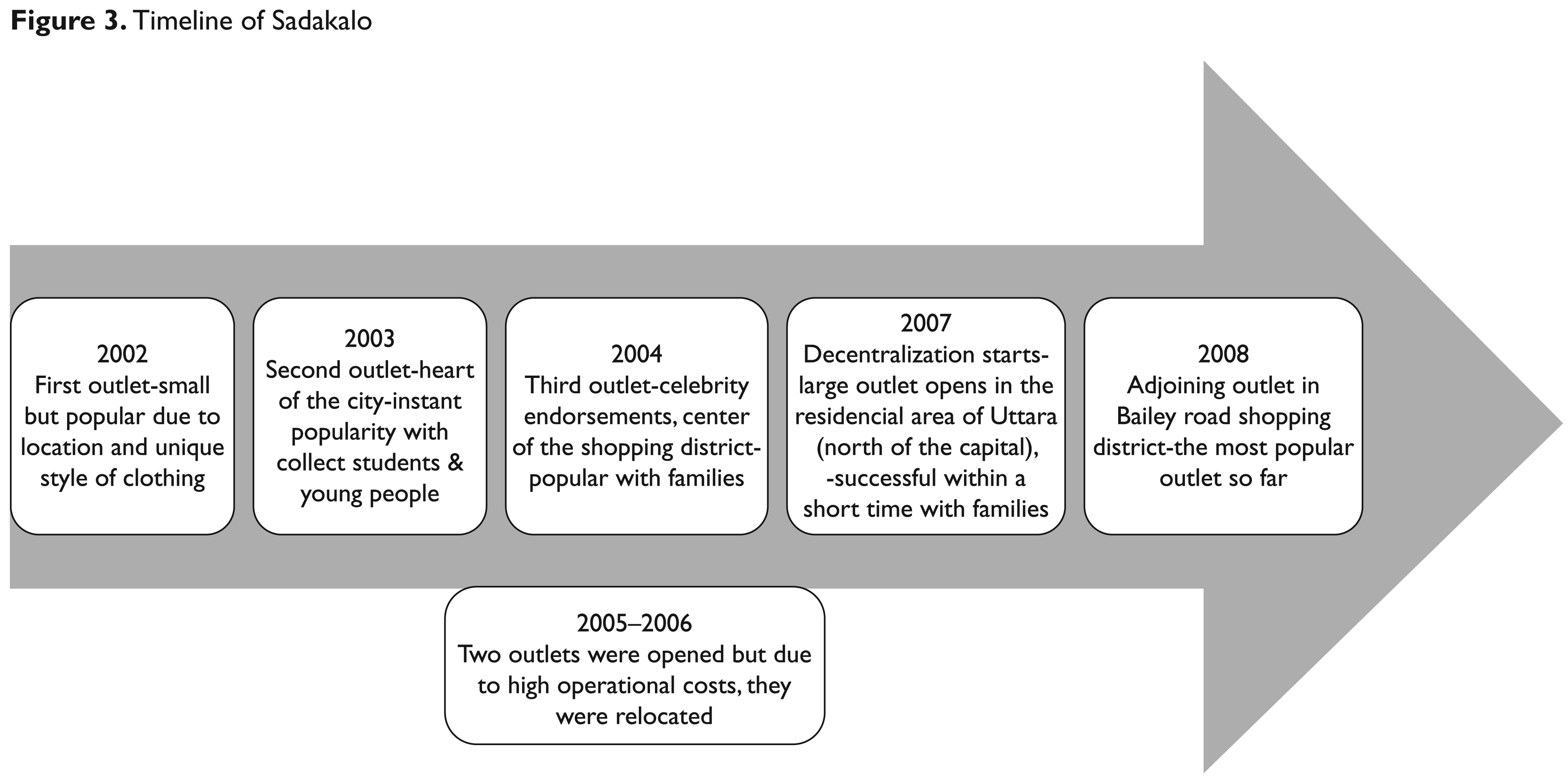
The company planned to decentralize its operation from Dhaka in 2007 and opened its fifth outlet at Uttara, north of Dhaka city. Generally, the people of Uttara do not prefer to commute to the city centre of Dhaka but rather to have everything within their local community so expanding operation in that area was inevitable by Sadakalo. Despite already having an outlet in Bailey Road, in 2008 Sadakalo opened another (sixth) outlet at the Navana Bailey Star Market which also outperformed Bailey Road. The success behind this outlet was due to the position of the outlet possessed by Sadakalo (Figure 3).
Bangladeshi fashions are slowly finding their way into USA and Europe; however, not all the popular fashion wear are available in abroad and therefore the immigrants have limited exposure to them. Sadakalo is the first fashion house in Bangladesh to open a chain shop in USA. In the year 2009, Sadakalo was offered to participate at a garments fair in New York. After the participation, the directors of the company were interested to open an outlet in New York. During the last quarter of the year 2009, the dream was successful by opening an outlet at Jackson Heights. A known relative of Ms. Shahin who had been staying in the USA for two decades took the responsibility to run the outlet. In the year 2010, the elder sister of Ms. Shahin took the responsibility to open and run an outlet in Florida. Due to some problems, the trade licenses of these two outlets are not registered as Sadakalo, but their businesses are properly controlled and monitored from the company head office. Sadakalo, in the hope of opening more outlets in USA, came to a contract with another company named Bangla Trading, the owner being Bengali that they would roam around the States and participate in different garment fairs. Bangla Trading participates in around 15 garment fairs throughout the year and Sadakalo exports products to Bangla Trading for the fair, besides exporting to New York and Florida. The two directors visit the USA twice a year since the year 2009.
Back in home, Sadakalo was also thriving with the prospect of being one of the prestigious members of Deshi Dosh—a flagship outlet consisting of 10 major traditional fashion houses at Bashundhara City market, the largest shopping mall of Bangladesh. In 2010, Deshi Dosh decentralized from the capital city of Dhaka to the second major city Chittagong and opened its next outlet at Afmi Plaza. At the same year, Sadakalo also expanded in the international market by opening its second outlet in Florida, USA. Finally in 2012, Sadakalo opened outlets at Aziz Super Market in Shahbag and also at Wari in old Dhaka. Shahbag has one of the entrances to Dhaka University and thus is an alluring place for the thousands of students. Thus, it is a natural selection for Sadakalo.
Marketing: ‘Style, Sophistication and Simple Value Proposition’
Sadakalo believes that the promotional expense should be around 3–4 per cent of the annual revenue. Hence, from the analysis of the previous yearly trends of promotional expense to revenue ratio, the planning department makes the promotional budget for the upcoming year.
In the year 2005, when Sadakalo opened the outlet at Baily Road, Ms Shahin asked the two famous celebrities of the country Mr Aly Zaker and his wife Ms Sara Zaker to participate in the promotional photo session. These two celebrities have never participated in any kind of promotional activities for anyone before but they agreed because of their personal relationship with Ms Shahin that led to be first promotional initiative for Sadakalo. Ms Shahin believes that their contribution led Sadakalo to a turning point and since then the customers perceive Sadakalo as prestigious tradition-oriented brand in the country.
Since the year 2005, Sadakalo has been continuously greater effort in marketing. Promotion becomes one of the major expenditures used for branding. The major promotion of Sadakalo includes advertisements, discounts and newspaper features. Since TV commercial is very expensive, this type of fashion house mainly focused on aforementioned promotions. Advertisements are mainly given to the popular lifestyle and fashion magazines of Bangladesh on monthly basis. The next preferred advertisement is the bill boards at different places of the city as majority customers of Sadakalo reside here. The last choice is the newspaper where the cost is relatively higher considering responses. The clear difference between bill boards and newspaper is that newspaper is circulated throughout the country and bill boards are placed at certain places of the city only. Hence, the company has always received good responses with bill boards rather than newspaper. The public relation personnel always keep good relationship with the feature writers of all the newspaper and magazines in Bangladesh. As feature and press releases are free of cost, good relationship with editors is the only way to get published. There is also a promotional discount offered during June–July as summer clearance sale. This sale collects a good amount of revenue to be reinvested for the event of Eid-ul-Fitr.
Management
Sadakalo follows a flat management which brings a good working environment and motivating vibe. Though there are department heads but below them, the structure is flat and everybody works as a team. The two directors, the chairperson and the managing director, directly communicate with the head of planning department. The other departmental heads are controlled by the head of planning department.
The reporting system is totally by document and software. Verbal communication is not considered as reporting because there is no record of verbal communication. The two important departments which were not discussed earlier are finance and accounts, and administration. There are eight employees in the finance and accounts department, out of which four make the audit team. Their task is to cross check and match the products of all warehouses and all stores with the respective software ledger.
Loss of products leads to punishment for the concerned department. The other important persons in this department are the accounts payable officers who face busy times with the suppliers. The administration department contributes significantly for managing employees in Sadakalo. There are three IT officers—one for security and trouble shooting, and the other one for technical procurements. IT makes the working environment smooth and keeps the supply chain of the company stable. There are also three human resource officers—one for recruitment, one for training and the other one for compensation and performance. IT and HR are soon going to become independent departments in a few years. The total number of employees of the company is around 220, out of which 80 are in the corporate head office and 140 are in the outlets.
The management hierarchy for supervising the outlet includes manager, store executive, assistant manager and customer service officers (sales person). Two outlet coordinators have been assigned to visit the outlets on regular basis and report to the head office.
Competitors
Despite the fashion industry has been experiencing severe competition due to dynamism of customers’ expectations, product and service attributes and market challenges (Islam et al., 2012), in 2009, Sadakalo became a member of Deshi Dosh which is a flagship outlet of 10 major domestic brands. The other nine are Rang, Anjans, Nipun, Bibiana, Prabartana, Nogordola, Deshal, Kay Kraft and Banglar Mela. These 10 brands sell the same kind of products within the same price range and thus they are the main competitors of each other. Among them, Sadakalo is on the leading forefront with Anjans and Kay Kraft but the rest seven are not lagging very far behind. On the contrary, competition is very high and one is always at the heel of another.
Since price and product are similar, Sadakalo more depends on customer loyalty to stay in business. The growth was very high from the beginning of the business and stayed in the range of 15–19 per cent from the year 2004 to 2008. The competition became stronger since 2008 and the growth rate began to fall. In the last four years (2008–2012), the growth rate came to a range 13 per cent. Possibly, this range would be continued for the next decade if all the other factors are kept constant. Besides nine other competitors, Aarong is also a competitor of Sadakalo even though at a long shot. Aarong has started business long before Sadakalo and all others of Deshi Dosh and its owner being also the owner of BRAC (formally known as Bangladesh Rural Advancement Committee, BRAC does not represent an acronym), it is naturally way ahead of them. BRAC is a 40-year-old establishment so Aarong has strong base of capital, supplier and almost every sector compared to the Deshi Dosh which have been started by individual entrepreneurs. And yet, Aarong is a competitor because of the product type and united the Deshi Dosh is putting up a good fight against the big giant.
The next important competitor of Sadakalo is the Indian clothing style found in shops such as Shoppers World, Vasavi and Zaara. It is the same for all Deshi Dosh and even Aarong who use simple traditional fabric and design patterns compared to the glossy and glitzy materials of Bollywood inspired Indian clothing. Although the product type is same, that is, saree and kamiz for women and punjabi for men, there is wide difference in material. A glimpse at the Bengali traditional style and Indian style and one would immediately notice the simplicity of the former and the showiness of the latter. Indian clothes have always been popular in Bangladesh both for the influence of satellite television channels (i.e., Star Plus, Zee TV, Zee Bangla, Sony) and their fancy fabric and designs and anything imported has a special charm to the customers. So, Sadakalo with its humble products must compete against the glamorous Indian clothes against all odds and not to forget Aarong and the rest of Deshi Dosh. It is a tough world, indeed!
Concluding Remarks
The fashion clothing market for Bangladeshi is untapped and the knowledge about the consumption pattern of urban customers can be beneficial to marketers. Sadakalo could expand across the country because the market in the capital city is becoming saturated. In the international market, there are market demands for such traditional products especially in Kolkata and London, which might be put in during the expansion plan. According to Financial Express (24 October 2010), Sadakalo, a leading fashion boutique of Bangladesh, eyes overseas market and setting up of new outlets outside the capital in a major expansion plan to cater to the need of fashion lovers. Through the last placement the market in Dhaka city might get saturated and restrained from expansion. The most effective growth opportunity is to expand outside the capital city of Dhaka.
One major problem of Sadakalo is that the production quantity per design is less compared to the customer’s demand. Today’s ‘fashion is accompanied by a process of continuous innovation, in which new designs are developed at sometimes big cost only to be replaced by other designs’ (Pesendorfer, 1995, p. 772). Since, the motto of Sadakalo is to provide new designs time to time but in small batches this might be a good type of branding but financially it is not helping. As discussed earlier, the promotion of Sadakalo is very less due to the management’s perception that brand value would bring customers’ to the outlets. Whereas they are unaware of the fact that customers’ needs to be constantly reminded about a brand through thorough promotion for them to remember.
Footnotes
Acknowledgements
Thanks to Tahsina Shahin (Chairperson), Mr Azharul Hoque Azad (Managing Director), and Mr Muntasir Mamun (Business analyst) of Sadakalo (Pvt.) Limited for their insight, thoughts and input during this case study preparation.