



Abstract
Think tanks have been considered the educated voice on behalf of citizens in practices of government. They are key agencies for discussion on contemporary issues of national and international policy making. Think tanks as powerful agents in the policy making process, sometimes are considered institutions of lobbying. This article is an outcome of focused group (FG) discussions conducted at four locations in India to comprehend the presence and position of think tanks, their research authority and their role and influence in the public policy making process as a stakeholder. The FG discussions with 80 experts captured national perspective on think tanks. The findings of the study suggest that institutional think tanks in India are relatively new phenomena in comparison to the west. In this backdrop, the article analyzes issues of definition and ideology, credibility in research, governance, funding and interaction on policy.
Introduction
In the Histoire d’un Crime (The History of a Crime) in 1852 and published in 1888, Victor Hugo, one of the influential French authors of nineteenth century wrote ‘on résiste à l’invasion des armées; on ne résiste pas à l’invasion des idées (One withstands the invasion of armies; one does not withstand the invasion of ideas)’. Major social revolutions in the world are testimony to power of ideas. Many times, the pernicious result and impact of ideas led to spread and acceptance of fascism, fundamentalism and other manifestations resulting into world wars, genocide and destruction of human lives too.
In the wake of globalization and fast and easily accessible communication, the power of ideas and thoughts has grown manifold. In view of complexity and also specialization, groups of idea generators and thought leaders started combining together to provide insights and indicate trends in different realms of human knowledge forming building blocks of societal change. Such formations in common parlance are being levelled as ‘think tanks’. Think tanks have been considered the third educated voice on behalf of citizens in practices of government. The inputs by think tanks are discussed and considered by the policy making bodies to ensure the utility and avoid the negative consequences of the policy.
The Indian policy making ecosystem has not seen recognition of the think tanks like US President Lyndon Johnson did for the US institutions in 1966 saying (Rich, 2004):
The men of Brookings did it by analysis, by painstaking research, by objective writing, by imagination that questioned the “going” way of doing things—you are a national institution so important—that if you did not exist, we would have asked someone to create you (p 1).
Many global think tanks have been recognised by leaders for their very specific quality and contribution. Indian think tanks do not have a parallel in India. A message was delivered by Dr Manmohan Singh, the then prime minster of India in the new building foundation ceremony at NCAER in 2013. It seems inconceivable for the world’s largest democracy and third largest economy (in PPP terms), which bears high social sector expenditure; has only six think tanks in the top 150 in the ‘Global Go To Think Tank Index’ by The Think Tanks and Civil Societies Program, University of Pennsylvania (McGann, 2014) on index based performance. Touted by many as global knowledge hub of twentieth century, India seems to be losing sheen in knowledge infrastructure and quality idea industry at home turf.
Analysis of the global ranking, Global Go To Think Tank Index, observes that almost all the countries who preferred to soviet model of development have failed to foster robust free thinking and encouraging private participation. Krastev (2000) recognized that the birth of independent policy research institutions in the post-communist countries is higher than those in most other places in the world and it is also motivating the critical link between democracy and development. The all pervasive milieu of socio-political conservatism in those government systems have so far throttled the capacity building of civil society for fair growth and meaningful debate. With no exception, India suffered the same fate due to tighter government control and choked conduit of research policy continuum. Thus, Indian think tanks and non-governmental organizations (NGOs) are thought to be weak as they lack access to the government (Chatterjee Miller, 2013). The NGOs and think tanks demand multi-dimensional and varied participatory channels to contribute to the policy making. The NGOs are confirmatory agents to the process as they play their roles as service providers, activists and educators and they can play the role of think tanks also.
In the unsettled framework of performance measurement, think tanks are not only contributing to the public policy making within the country but also influencing the international policies, which might be linked to the originating nation directly or indirectly and sometimes not at all. The structural influence has grown in its importance in the era of institutional functioning. This is also visible in Indian system of policy making. Although, Indian policy making has been less responsive to inputs of think tanks and also in associating with third parties in the public policy making, recently it has started recognizing the ways to work with think tanks to incubate, test, promote and evaluate the ideas and issues. For example, the policy issues in environment are well researched by the leading think tanks like The Energy and Resources Institute (TERI), Centre for Science and Environment, Ashoka Trust for Research in Ecology and the Environment (ATREE) and National Environmental Engineering Research Institute.
Focused Group Mapping
The policy making mechanism theoretically demands a multi-stakeholder engagement but studies observe a different and considered to be practical outcome. Kingdon (2010), in his revised edition of the book Agenda, Alternatives and Public Policy, observes that the policy experts and political leaders are mutually exclusive actors in the policy making mechanism.
As to the policy and political streams, I still find it useful to portray them as independent of one another but then sometimes joined, The policy community concentrates on matters like technical details, cost benefit analysis, gathering data, conducting studies, and honing proposals. The political people are involved in many more issue areas than the policy people are, and concentrate on winning elections, promoting parties and mobilizing support in the larger polity. (p. 228)
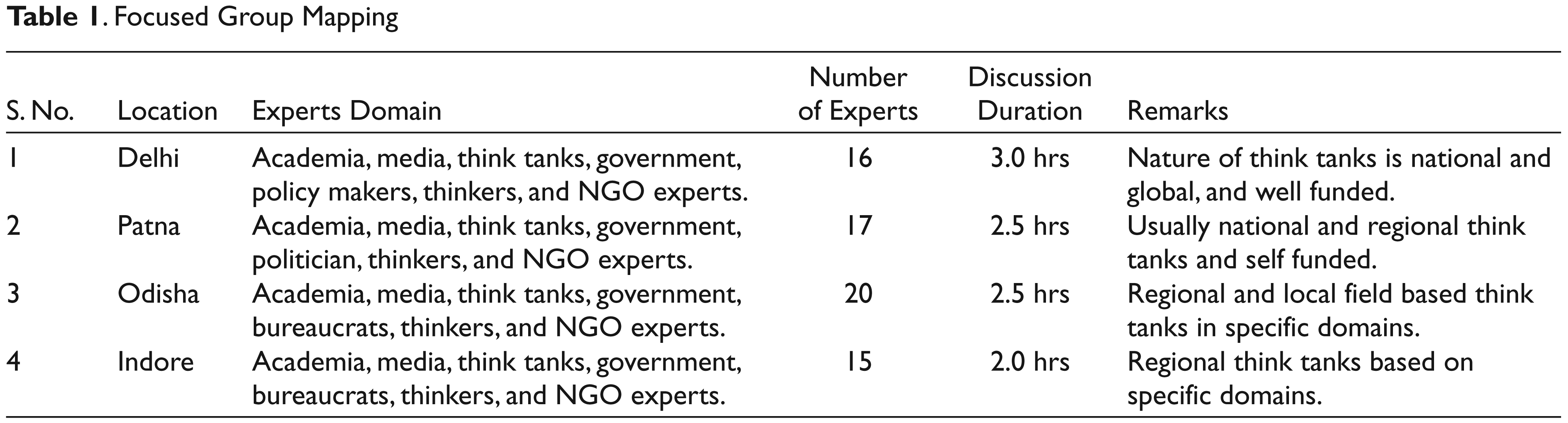
Therefore, the dependence of public policy mechanism on think tanks is practically the process of willingness of stakeholder engagement and political leadership. In this article, we study the presence and understanding of think tanks in Indian context and the challenges that they face them. We also study the policy making process in global context and Indian context and how think tanks of India influence the policy outcome. This article also attempts to analyze if the process of policy making in India is based on evidence based research of think tanks. Although, this article could not develop a confirmatory process to test if think tanks are acting in a predisposed gravity as lobbyist to influence the policy, it investigates the primary purpose of the think tanks researches. This article is based on the literature review and focused group (FG) discussion. FG method was used to collect primary data on an organized questionnaire for inputs from the experts in four locations of India, Delhi, Indore, Odisha and Patna. Each session invited almost 15 experts from academia, think tanks, government, media and public forums who have ideology and operational experience of long years as researcher or support to policy making organizations.
The observations of the FGs (see Table 1) have included critical inputs which are revealing on process of research and policy making, and sometimes conflicting from one FG location to another. The financial and network support of India Policy Foundation, the sponsoring think tank, has been a significant contributor to this research after the research inputs of Pennsylvania University’s think tank programme. The outcomes of the focused groups are important input to the article and presented in the discussion and the concluding remarks.
Think Tanks and Anatomy
The organized structure of think tanks with objective to provide inputs in policy making is traced in nineteenth century from British think tanks like the Royal United Services Institute (RUSI) in 1831 and Fabian Society in 1884 followed by the US like Carnegie Endowment for International Peace in 1910 and Brookings Institution in 1916; and European nations like Institute for International Political Studies in Italy in 1934. However, the university system has been the first think tanks for many nations before present definition—historically, Indian universities like Takshashila University (fifth century BC), Nalanda University (fifth century AD) and Roman institutions like Platonic Academy and The Lyceum (AICTE Report, 2014). These institutions and non-state thinkers of these were informal actors to the policy making process of the government. The informal systems of advisory and government engagement in India did not conceptualize and develop the formal mechanism of think tanks. The institutionalized processes and systems are observed to begin post-Independence. With time, Indian think tanks became popular, important and playing an important role in shaping policies of the nations, creating public opinion and also advancing the agenda of funding agencies and interested economic and political groups (Bill and Melinda Report, 2009). The burgeoning growth was also fuelled by state patronage and funding made available by national and international donor agencies, corporate and political parties and social organizations.
The literature review finds that there are broadly five categories of think tanks in India. First, entities enjoying legal autonomous status but largely funded by the state like Institute for Defence Studies and Analysis (IDSA), Institute of Economic Growth (IEG). Second is supported by political parties or national ideologue like Rajiv Gandhi Foundation (RGF), Gandhi Research Foundation (GRF) and India Policy Foundation (IPF). Third category includes think tanks getting opted by or support from corporate nationally or internationally, and institutions under public private partnership model like National Council of Applied Economic Research (NCAER), Observer Research Foundation (ORF), Centre for Civil Society (CCS) and TERI. Fourth, institutions funded and guided by the international agencies or governments like RAND Corporation, Centre for Policy Research (CPR). And fifth and last are the entities promoted by prominent thought leaders with support from diversified external institutions like Development Alternatives (DA), Centre for Science and Environment (CSE) and M. S. Swaminathan Research Foundation (MSSRF).
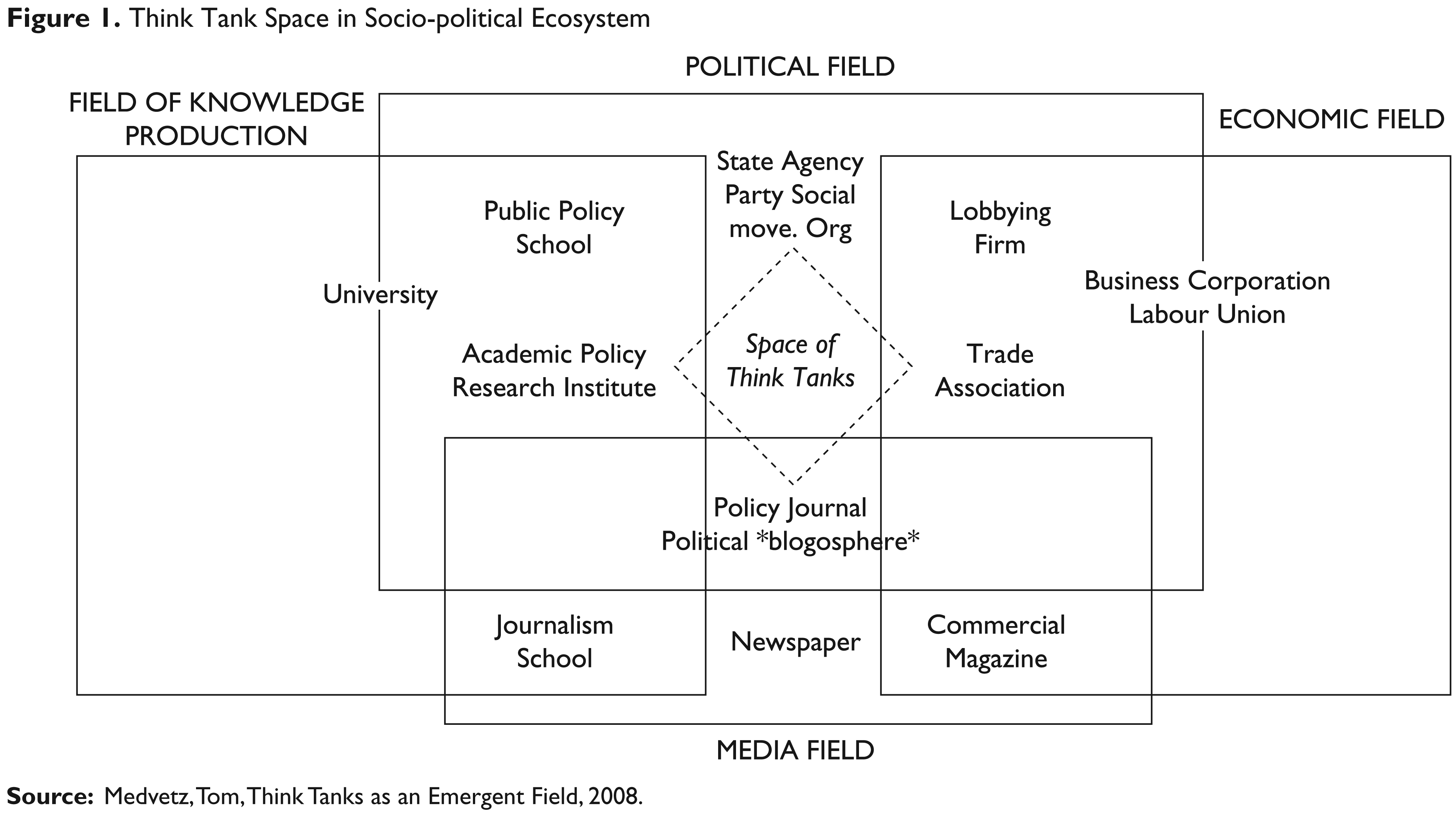
As shown in Figure 1, the think tank space is deductive process and construed on the common assumptions of several ideologies and actions. The assumed roles and responsibilities of the NGOs, media, chambers and other institutions have some inclined interest with less neutral agenda to suggest policy or futuristic view, which restricts them to be considered as pure think tanks. The political agencies, state agencies, trade associations, lobbying organizations and corporate think tanks are independent in terms of actions but respect the funding origination under a rule of law. These may be termed as market-oriented think tanks, private solutions to public problems, which are in growth mode with the ideology of the originating/funding bodies (Chafuen, 2013). The independent and unbiased inputs to the policy making process are the authentic need which are serviced by the think tanks which overcomes all the possible assumptions and limitations of the surrounding think tanks as shown in Figure 1. The sustainability of think tanks has given more space for negotiating on the definition.
Rich (2004) defines think tank as ‘independent, non-interest based, non-profit organisations and principally rely on expertise and ideas to obtain support and to influence the policy making process’. Abelson (1995) differentiates between ‘think tanks’ as delivering expertise based on objective research and ‘advocacy tanks’ as identifiable ideological tendency in their goals and research. Advocacy groups conduct evidence based scientific research and seek to influence public policy but their self-centrist and propaganda rich communication agenda mingled with specificity of certain interest, which are mostly devoid of publicness and imbued with pre determined goal realization separate them from think tanks (Mendizabal, 2011). Simon James (1998) noted that ‘Discussion of think tanks…has a tendency to get bogged down in the vexed question of defining what we mean by “think tank”—an exercise which often degenerates into futile semantics’. The unsettled definition of think tank is convenient framing to scope and sophistication and Abelson (2002) and McGann and Weaver (2000) conclude that scholars could not define the think tanks in one definition frame. They get edging of convenience in the definition or interpretation as described by Simon James in D. Stone (1996). Abelson (2004) finds that think tanks are getting into the business of developing, repackaging and marketing ideas to policymakers and the public.
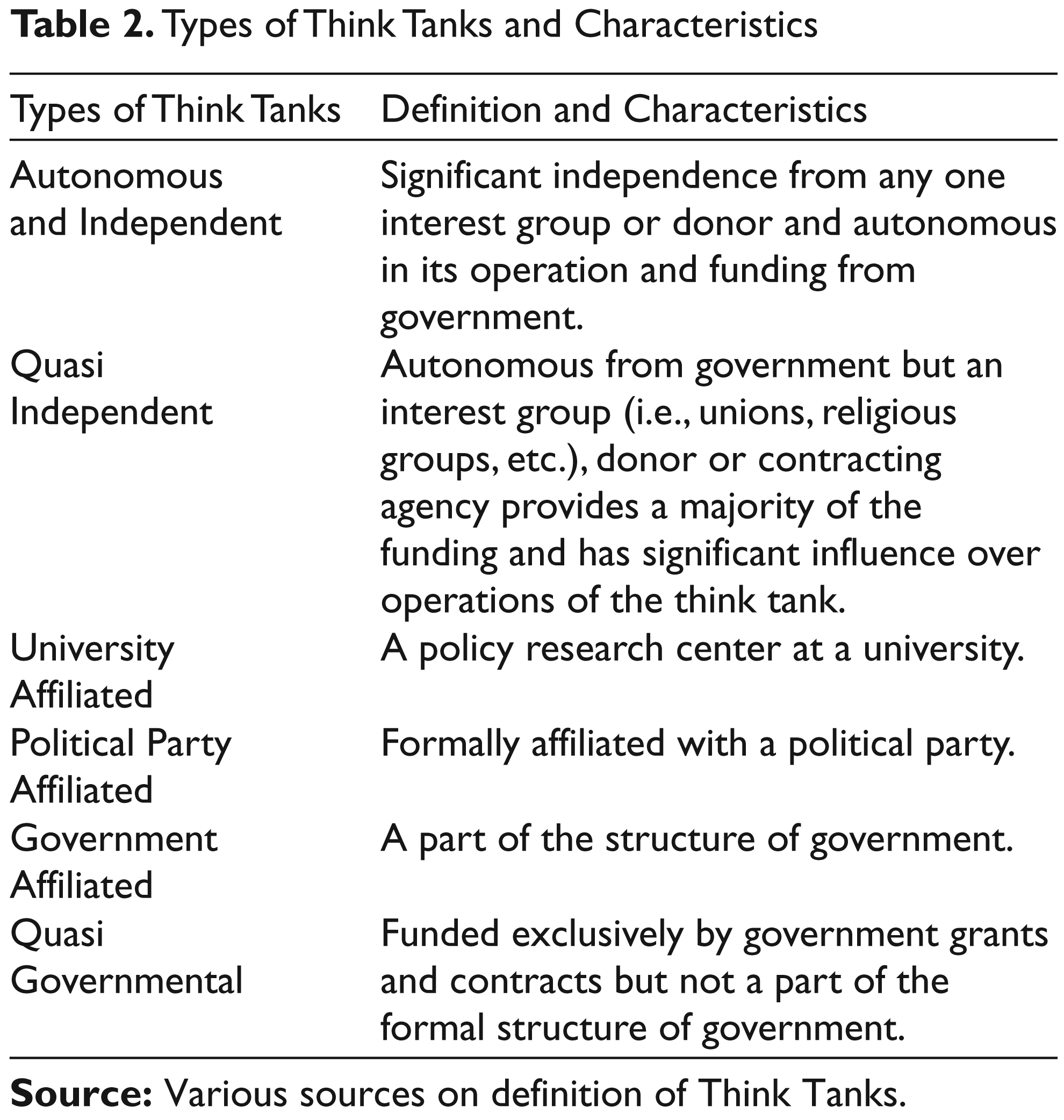
Think tanks are a highly heterogeneous group that include universities, research centres, media and consultancies, semi-informal networks, NGOs and both internal and external policy research centres. The structure and functional focus greatly depends on their context which includes nation’s governance structure, research domain, political practice and funding opportunities (as defined in Table 2). Think tanks are political actors—both in origin and in evolution. The relations between think tanks and political parties are equally diverse and depend on a number of factors including: their origin, the roles of key individuals, ideological allegiances, funding models and the effect of external forces on both groups. With the globalization and governments making more efforts to be globally powerful, foreign aid to think tanks has very strong hidden agenda to support or not to support. The think tanks, in the discussed ecosystem, can be defined as ‘Institutions engaged in research and dissemination activities under the political, governance and policy context to help in improving the public policy and critical contemporary solutions’.
Roles and responsibilities of think tanks need no introduction. Think tanks’ role is unique because of their ability to provide ‘independent research, analysis and policy advice to an audience that includes governments, the academic community, civil society and the public’ (McGann, 2007). Misconduct or misuses of these bodies are also not invisible (McGann and Weaver, 2000). Global evidences display the functional cooperation and frame think tanks as political actors, heterogeneous groups, structural and functional officialdom and ‘asylum’ of tall standing; Brookings being the latest example of Health Policy influence in the USA on call of government. At the same time, in recent years, there are objections raised on role of critical mass of Indian think tanks in the manner it was observed in Russia, Chile, Ecuador or Peru. These clusters are not incubators of new ideas, rather they advocate policy change (usually single issue), act as lobbyists for established ideas, more functional and less intellectual in input which defy ways of thinking to meet financial backing.
Types of Think Tanks and Characteristics
The relevance and influence of think tanks in a new form is observed and interpreted by Siim Kallas, vice-president of the European Commission responsible for Administrative Affairs, Audit and Anti-Fraud in his speech.
Originally, think tanks were conceived as ‘universities without teaching’. But they also differ on other points: they have no students, and they are not subjected to the system of peer review that academia uses to promote diversity of thought and scientific rigor. ‘Normal’ academic institutions are expected to conduct their research first and draw their conclusions some would argue that policy-driven US think tanks have reversed this process: ‘conclude, then justify’. In the US, think tanks have dramatically grown in size and influence numbers increased from 8 in 1910 to over 1,000 today! Today, modern think tanks are tax-exempt, political idea factories, with huge budgets. In the US, the top 20 conservative think tanks now spend more money than all of the ‘soft money’ contributions to the Republican Party.
Kallas (2009) opines that the modern think tanks are acting not only as thinking actors but also as soft lobbyist. The convergence of delivery is merging of the objectives and roles that we articulate for two different kinds of organizations, think tanks and Lobbying groups. This shift and addition in role demands their registration as lobbying agents to keep the interest groups’ agenda appropriately in place.
Public Policy Landscape in India
Public policy making is essentially an iterative, elaborative and complex process, which involves various actors, institutions, ideologies and agendas (Mathur, 2013). It is multi-institutional and multi-layered cohesive endeavour. The process of public policy formation in India rests with the three main branches of the Indian state: the legislature, executive and judiciary.
The endeavour of public policy making is intrinsically more exacting as a task than smaller administrative units elsewhere; due to its size—physical enormity, administrative multiplicity and relatively high population—and existence of astonishingly varied socio-economic and cultural diversity. The specific mention in India’s case is its underdevelopment; but rather more ruminating concern among policy makers have been underperformance.
An appropriate public policy process must have the obvious augmentation of up-to-date available subject matter knowledge and use advance analytical tools. The process should also be aware of overlapping impact it might produce and check integration and differentiation with other sector’s policy practice. The trade-offs and opportunity cost must be considered carefully to avoid future excessive tinkering with policy. The other critical aspect of right public policy making is legitimacy, which can be divided into two parts for easy understanding, procedural legitimacy and substantive legitimacy. Procedural legitimacy is viewed by decisions as made by an authority which is legally authorized to make it. It is the prime requirement as it provides initiation legitimacy. On the other side substantive legitimacy pertains to content and expertise behind policy formulation. The question is not whether the policy is substantially correct, but the persons who are involved in policy formulation are perceived to have subject matter knowledge about issue.
In addition, a right mix of centralization and decentralization is also required. Conceptually centralization ensures that priorities and interest of implementers do not supersede the public interest. However, the control wielded in centralization procedure should be of process control, that is, how decisions are made or quality is controlled, referring to quality of decision and not developing the bureaucratic systems
On the whole, while it is desirable for policy making to have consistent contact with reality and be aware of implementation related issues; nonetheless it should not be shackled by short term priorities, time constraint and comfort of implementers. Thus a sound policy making structure, therefore, observes appropriate separation between policy and implementation functions. Finally how to tackle trade-offs, and take rational decisions free from value judgement and biases are issues of critical importance.
Ideally, there is no overlapping or overstepping. The theory of checks and balance has been observed in the Indian constitutions but there is no rigorous separation of powers and execution. For instance, parliament has the judicial power of impeachment and punishing for contempt of parliament and the president has the legislative powers to promulgate an ordinance and later get it rectified by parliament. Thus, the Indian constitution has not applied the doctrine of separation of powers in its strictest form (Vishwanadham, 2012). The inconsistency in the Lokpal Bill is recent example of policy making conflicts in India.
There is no denial of high level of centralization in India as far as policy initiative and policy making is concerned, and more importantly the role of prime minister which usually supersede the role of all institutions and functionaries. The New Educational Policy by the parliament in 1986 and the policy of liberalization is the Prime Ministers handwork in which the basic framework of policy is formulated by the administrators, further strengthened by the union Education Ministry sent for the consideration of the Cabinet and then finally legislature’s approval was sought. Thus, the initiative does not emanate from the legislature, at least as observed in few selected cases (Maheshwari, 1987). So it is now manifested that the executive branch of state not only has strong bearing on formulation of policy but more important role in delivery of policy.
As also discussed earlier, the wide acceptability of artificial nature of politics and administration dichotomy is on wane and it is well known that the civil servants in high echelon of administration exercise a great deal of influence on policy because of their administrative knowledge, performance and closeness to political power (Heady, 1974). As policy is considered roadmap that gives concrete shape to government’s political, social, economic and cultural objective, it demands multiple level act of administration and long term course of action. The policy decisions provide a sense of direction to administrative action (Dhubhashi, 1985). In nutshell, it can be articulated that bureaucracy through the exercise of experienced choice and judgement influence public policy as well as they directly or indirectly through suggestion, expert advice, analytical output, correction and revision influence public policy.
The direct link of think tanks with public policy is not established, however, indirect influences are examined (McGann, 2012). Think tanks have been presenting their positions, publicizing policy proposals, and supporting empirical studies which serves as supply line for political armies in public policy process (Harvard Law Review, 2002). While one set of the think tanks work in line with government to improve the policy, another set act more towards testing the policy for public. This balances the process of policy creation. In a typical scenario in India, the policy landscape offers an opportunity for think tanks intervention but the engagement is not practiced by the system.
State of Think Tanks and Research Influence
Think Tanks’ Space in India
While the literature review on the think tank, public policy and the administrative mechanism of same have been discussed on the process and interpretation, the fact based finding of the present state of think tanks was examined through field work. The role of think tanks is critical because they have always been part of the policy landscape. There is great deal of literature in this domain on what policies think tanks do non-partisan research which is pro-poor and pro-people, what is the kind of mind people have, what is the kind of empowerment the think tank or an individual institution who functions should have, and what its impact is. But actually there is very little in the Indian context. Tacitly they are often invited for close door conversations by the government and it is just that we do not learn it. This also indicates that there is not an obvious definition and engagement model in the Indian context. The way think tanks have been construed is that they are not consulting firms, they are not lobbying agencies, they are not chambers of commerce, they are not merely research organizations and they should not be government research agencies. So what are these? Think tanks are defined as non-partisan (agencies) link of government and citizen for citizens’ need, aspiration, views, opinion, reactions and suggestions in form of public policy backed by informed research. These are not only performing adequacy role but also act as opinion making agencies. While all the FGs meant the same way on think tanks, there is minor anatomy variation depending on the location like Delhi and Odisha.
While the domestic think tanks are still fighting to create some space, foreign think tanks like Brookings are establishing their base although, they can influence policy from anywhere in the world. Is it colonialism in the era of knowledge war? While socialist model has failed and capitalist model is under attack and rent seeking by capitalism preaching nations is common through copy rights and patents, Is it another preparation to save the present capitalist approach and economic structure? Is think tank centres in foreign locations of importance a good idea? These are some of the issues put up by experts while the way forward is not apparent.
Research, Presence and Dominance
Adrian Wooldridge in a debate observes that think tanks in India and developing nations are not engaged properly with the system of political leadership and bureaucracy (Shah, 2013). For example, Indian coalition political leadership in 2009–2014 and broad ruling coalition in Brazil in 2010 onwards have found it difficult to create a coherent policy. A workshop on ‘Democracy Consensus’ (Shah, 2013) has given inputs to the linking of the political parties and bureaucracy to think tanks on policy making. The direct action engagement of the NGOs and the claim of some of these as think tanks have distanced the government and policy making ecosystem actors in fear of lobbying, activism and low quality and biased research output. While the think tanks are allowed to have particular ideologies which reflect the purpose of the think tank, the motivated objectives and researches are not productive. Although, all the focus groups consented to some influence of the think tanks in the policy making or influencing it, the majority still were convinced that it is usually on personal network in the policy making ecosystem than the quality of research per se. The policy formation is also highly centralized and dictated by the concerns of political agendas which leave very little space for think tanks’ activism in India. The visible sectors where India has taken some leads like economic development, environment have significant presence and influence of think tanks but not the other areas specially as important as education, health, agriculture and other important areas.
A section of the experts debated on the structural orientation on ideology, neutrality of ideology and purpose. The organizations in the knowledge domain are not independent of funding and governance. The ideology directs the governance, research capability and finding. Credibility of the research outputs is considered as one of dilutes of the think tanks. The think tanks are not engaged in real field work output or high quality research output. The managed research outcome is not considered an input to the policy making process. It is uniformly recognized that universities are most neutral research terminals; the deteriorating quality of university researches and the lack of quality researchers have questioned the credibility of researches. Public policy is lacking special inputs in technical domains like nuclear science, agriculture, medicine and health, foreign relations.
National Ideology and Imported Ideology
Think tanks follow an ideology in belief, ideas, approach. The traditional approach of think tanks has been ideology based work which has changed the features by change of social and economic structure from socialism to capitalism. While in the first generation think tanks have been guiding on the need and development framework; the second generation think tanks are progressing to evidence-based policy which is a debated area. The presence and ideology of think tanks are moving from inductive or deductive to abductive logic. The global society, which is separated in two spheres of Technology (developed nations) and Identity (developing nations), have divided approach for research and policy making. The purpose, reasons and logics are not same, so their structure, presence and utility will also differ on location. Universalization of the think tanks is not recommended by the experts in the FG discussion. They also caution the think tanks on their ‘Motivated reasoning’ approach to create evidences for their belief, debate in these cases are coined to structure the thoughts and create an opinion.
With increase of capitalist structure in the developed nations and their interest in continuing the structure, has supported the idea of design and structure in every form of organization including think tanks. The entry of foreign think tanks or support of foreign think tanks is influencing not only the thought process but also the policy and decision in the national mechanism. These are expected to grow with the concept of globalization. This is uncertain indication for development of policy making that is unbiased and neutral to the national interest of any country.
De-colonizing Language and Ideology
Bueno and Datta (2011) observe the presence of the international school of thought and influence in the national dynamics in Bolivia. This article observes the inter-engagement model of ideological think tanks and funding agencies for existing and new think tanks. They observe:
International actors played a key role in supporting the production of relevant knowledge. Neoliberal think tanks received funding from the World Bank, the IMF, IADB, CAF while think tanks in support of indigenous social movements received funding from several Think tanks often provided cadres of policy-makers in both the neoliberal era and once Morales assumed presidency.
The earlier evidence questions the integrity of the think tanks for national interest. While the language created by influential nations and systems are expected to create referencing in a knowledge deficit system and nation, the dissemination of intended knowledge by strong systems create their space to talk about their language and school of thought. This was supported by the experts and fresh look was expected by the experts working in remote areas of India. Also, the experts in major cities like New Delhi question the authenticity and credibility of ideology and research of Elite and influential think tanks and their specialists; they caution on the need of more think tanks from the places close to policy making locations.
Think tanks seem to assume that the structure is to be respected and research or opinion to be generated in same framework only; freedom of thought is restricted to definition of problem and that becomes the guiding principle of the influence. The Interest Groups make the way to help or create such institutions to lobby their concern. Nations need to develop their local expertise in knowledge and dissemination to structure inputs for policy making, instead of depending on the external agencies that have propensity to influence the policy outcomes.
Think Tanks Governance
Indian think tanks by design and structure are small ideology institutions as against the western concept which acts as large foundations. The leadership of the Indian think tanks is limited to the authority and credibility of the founding person or selected leader. This model fails to provide credibility to institution in long run or in absence of the leader for any reason. The governance of Indian think tanks is considered weak and trailing. Policy making agencies connect with large think tanks for several reasons including the governance neutrality and legitimacy. This also is limiting think tanks with talent which is specially the first need of these organizations. A structured organization will help in systematizing the research and dissemination in turn increasing the credibility of the think tank.
Financial Support and Sustainability
The biggest worry of any organization is sustainability of the organization. Think tanks are ideology-based research institutions which do not offer market dynamics but struggle to make a balance in the context and problem. These institutions are not the profit delivery terminals so the natural indifference for investment by any funding agency or institutions of capital persuasion is obvious. Governments nurture such institutions for several reasons. First, think tanks work for the national interest and not for interest of a group. Second, funding agencies of any interest group will induce their agenda against funding. Most of the think tanks in developing nations are victim of such rackets that offer funding on special issues for research with a given objective. Focus group experts feared the presence of same in Indian think tanks which are active to influence the language and school of thought for benefit of special groups or nations especially in economic development, defence and security, foreign relations, health and medicine. The freedom of thought, expression and communion are compromised in the educated funding model.
Baru (2010) argues that ‘Think Tanks, on economic policy, national security and foreign affairs, were finding it easier to raise funds abroad than at home, be it from a bureaucratic and feudal governmental system or from a miserly and disinterested corporate sector’. This trend has propensity to influence the policy making process, if not the buying of intellect and inputs. The dependence of the think tanks on external funding has forced these institutions to broaden their working and engage in action projects which not necessarily are knowledge producing actions but social development projects. Since think tanks are the second track diplomacy in this age, supporting, abetting and trying to enlighten the policy issues; their credibility is supreme. The culture of philanthropy is missing in Indian offering more space for influences to think tanks; and supporting the domestic institutions is important. Some of the experts observe that Indian philanthropy is not least and significant amount has gone to universities outside India by the businessmen and politicians, it can reverse and benefit Indian institutions. The issues are complex and unresolved in Indian context.
Conclusion
The interface of think tanks and public policy seems to be thin and engaged practice demand support of the government, funding agencies and media. In the course, media may be one of the affected institutions missing importance space in the opinion development but the policy mechanism ecosystem may benefit. The freedom, credibility, sustainability and ideology are base structural pillars of the think tanks actions and research which is biased when compromised. In the FG discussions, these critical features are found absent in the Indian system except few which are small in size and struggling to balance the existence and research agenda. The groups’ experts suggest for a change in the approach by government, funding agencies and the think tanks.
The intellectual colonization of few hundred people is taking the grass root voices away from the real policy need at the states and national level. They (individual experts) do not have sufficient exposure to grass root realities however, are deeply involved in policy debates, think tanks are better alternatives in democracy than individual experts in policy making mechanism,’ said the panel. A collective consciousness is must in diverse regional demography. Since, the organic growth of Think Tanks is not happening, it is not completing the democratic process which is seen as must for public policy making in democracy. It is time to strengthen the process and the institutions.
Footnotes
Acknowledgements
Authors would like to acknowledge the financial and administrative support of India Policy Foundation for the field research and particularly Professor Rakesh Sinha, honorary Director of IPF for valuable inputs in the research. This research paper is an independent output from the first Think Tank Report of India, expected to be published in 2014. Authors would also like to thank the blind reviewers for their inputs to improve the article.