



Abstract
Despite the significant strides made in the customer engagement literature, the need to understand any marketing actor’s engagement (vs. merely the customer’s) is increasingly recognized. Therefore, the budding actor engagement (AE) concept, which is commonly grounded in S-D logic, describes any marketing actor’s engagement, including that of customers, firms, employees, suppliers, and so on. However, while S-D logic-informed AE offers important insight into actors’ mutual value creation, it largely overlooks the sociopolitical notions that (a) actors’ potentially diverging goals may see them act against (vs. pro) focal others’ interests and (b) different actors may extract differing levels of value from interactions, as advanced in stakeholder theory. Based on these gaps, we extend existing AE research by developing integrative stakeholder theory/S-D logic-informed stakeholder engagement (SE). We deduce five core SE tenets, from which we conceptualize SE as a stakeholder’s state-based, boundedly volitional resource endowment in his/her role-related interactions, activities, and/or relationships. We conclude this article by discussing important implications that arise from our analyses and by identifying avenues for further research.
In recent years, customer engagement (CE), defined as a customer’s operant/d resource investment in his/her brand interactions (Kumar et al. 2019), has risen to occupy a prominent position on managerial agendas (Kumar and Pansari 2016). CE has been argued to drive desirable customer outcomes, including direct (i.e., purchase) and indirect behaviors (e.g., referrals), warranting its growing application (Brodie et al. 2011). However, given CE’s narrow focus on customers’ engagement with brands, an emerging literature substream recognizes the importance of extending CE’s scope to the domain of any marketing actor’s engagement, including that of firms, employees, distributors, suppliers, and so on (Kumar and Pansari 2016; Pansari and Kumar 2017). Like CE, actor engagement (AE) is commonly grounded in S-D logic (e.g., Alexander, Jaakkola, and Hollebeek 2018), which underscores the effect of actors’ resource integration on their interactively generated value cocreation (Vargo and Lusch 2016).
In line with S-D logic, existing AE research has tended to focus on actors’ mutual value creation (e.g., Brodie et al. 2019; Keeling, Laing, and De Ruyter 2018). However, networked actors may have different and at times incongruent objectives and expectations that can generate tension or conflict (Donaldson and Preston 1995), which remains largely injudicious in AE research. For example, manufacturers may act in the interest of distributors but at the cost of retailers, thus creating/destroying value for different actors. We therefore redirect extant AE research by extending its theoretical foundation to incorporate stakeholder theory, which recognizes actors’ potentially differing interests (Freeman 1984, 2010), thus ushering in a new phase in marketing-based engagement research. Following Okhuysen and Bonardi’s (2011) recommended theorizing by combining multiple lenses, we develop integrative stakeholder theory/S-D logic-informed stakeholder engagement (SE) that unlocks the following contributions.
First, integrative stakeholder theory/S-D logic-informed SE acknowledges that while actors may in some cases aspire to create mutual value (e.g., collaborative teams), in others, their goals may compete or conflict with those of other stakeholders (Donaldson and Preston 1995). In the latter case, actors’ sociopolitical agendas may drive their intent as far as to hinder or harm focal others (Hollebeek 2020; Miles 2017). For example, an envious manager may set up an employee to fail by constraining his/her resource access. Therefore, while a stakeholder’s engagement can create value for one actor, it may destroy value for another (Clark, Lages, and Hollebeek 2020), thus refining S-D logic-informed AE’s prevailing mutual value-creating stance. By developing an integrative stakeholder theory/S-D logic perspective of SE, this article reflects MacInnis’ (2011, p. 138) integrating purpose of conceptual research, which refers to viewing “previously distinct pieces as similar, often in terms of a unified whole whose meaning is different from its constituent parts.” Based on our reflections, we derive five core SE tenets that we use to conceptualize stakeholder theory/S-D logic-informed SE.
Second, based on our identified hallmarks of stakeholder theory/S-D logic-informed SE, we uncover relevant implications from our analyses and pinpoint avenues for further research. According to MacInnis (2011), good conceptual papers are “generative,” that is, they “guide future research by indicating novel research questions” (p. 143), thus moving “the field forward by setting an agenda for further research” (p. 142). Correspondingly, we deduce sample research questions for each of our five SE tenets and also illustrate these by applying them to the SE constituent subconcept of CE, thus offering a springboard for further research on stakeholder theory/S-D logic-informed SE.
This article’s remainder unfolds as follows. We next review the literature’s evolutionary path from S-D logic-informed CE to AE and introduce stakeholder theory-informed SE. We then develop stakeholder theory/S-D logic-informed SE, followed by a discussion of important implications that emanate from our analyses and an agenda for further research.
Literature Review
From S-D Logic-Informed CE to AE
Both CE and AE have seen significant literature-based development in recent years (Kleinaltenkamp et al. 2019). First, despite an elevated managerial interest in CE since the mid-2000s, academic CE research started to thrive around 2010 (e.g., Kumar et al. 2010). In this era, Brodie et al.’s (2011) seminal article draws on Vargo and Lusch’s (2008) S-D logic Premises 6, 8, 9, and 10 to explore CE. Based on their analyses, the authors define S-D logic-informed CE as “a psychological state that occurs by virtue of interactive, cocreative customer experiences with a focal agent/object (e.g., a brand) in…service relationships.” Five years later, Vargo and Lusch (2016) updated S-D logic’s premises and lifted the five most central of these to axiom status. In response to this update, Hollebeek, Srivastava, and Chen (2019) explore CE vis-à-vis S-D logic’s axioms (Brodie et al. 2016). In line with Kumar et al. (2019), Hollebeek, Srivastava, and Chen (2019, p. 166) define CE as “a customer’s motivationally-driven, volitional investment of focal operant resources (including cognitive, emotional, behavioral, and social knowledge and skills), and operand resources (e.g., equipment) into brand interactions in service systems.”
Second, owing to a growing recognition of the need to understand any marketing actor’s engagement (vs. merely the customer’s), the notion of S-D logic-informed AE emerged around 5 years ago. Specifically, we traced AE’s first mention to Chandler and Lusch’s (2015, p. 14) “multiple-actor engagement,” which, like CE, has been commonly explored from an S-D logic perspective since its inception (e.g., Alexander, Jaakkola, and Hollebeek 2018; Brodie et al. 2019; Hollebeek 2016). Correspondingly, S-D logic-informed AE has emerged as a growing substream in marketing-based engagement research, as shown in Table 1.
S-D Logic-Informed Actor Engagement (AE): Key Tenets and Definitions.
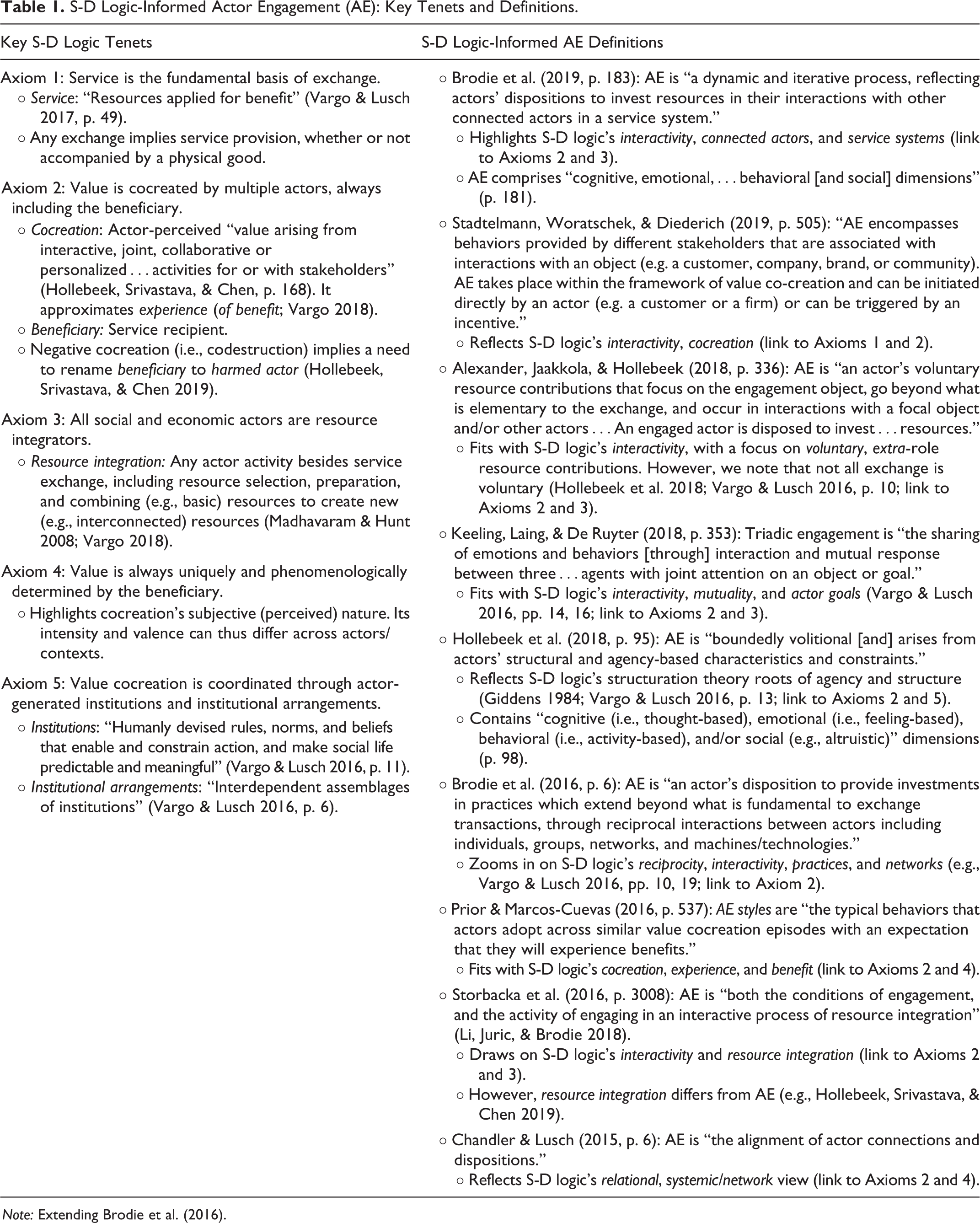
Note: Extending Brodie et al. (2016).
Inspection of Table 1 reveals the following core tenets of S-D logic-informed AE. First, like CE, AE is typically viewed as an interactive concept (e.g., Keeling, Laing, and De Ruyter 2018; Stadtelman, Woratschek, and Diederich 2019). In S-D logic, interaction is defined as “mutual or reciprocal action or influence” (Vargo and Lusch 2016, p. 9), revealing the incorporation of any type of (e.g., face-to-face, virtual) interactivity in its scope. Moreover, this definition acknowledges that even when actors do not participate in an interaction, their fate may be determined by it (e.g., decision-making behind closed doors).
Second, agreement exists regarding AE’s core systemic or networked nature, in which actors mutually respond to and affect one another (e.g., Chandler and Lusch 2015; Jaakkola and Alexander 2014). Laumann, Galaskiewicz, and Marsden (1978, p. 458) define networks as “set[s] of nodes [i.e., actors] linked by…social relationships (e.g., friendship, transfer of funds, overlapping membership) of a specified type.” Across their different roles, actors are expected to engage in particular behaviors, cognitions, and so on that are deemed appropriate to that role (e.g., employees asking job-related questions), which may however be undesirable in the actor’s other roles (e.g., customer role; Alexander, Jaakkola, and Hollebeek 2018). Therefore, the “of a specified type” portion of Laumann et al.’s definition, which we expect to largely derive from the actor’s (e.g., customer) role (Freeman 1984), reveals AE’s pertinent role-based nature. However, explicit recognition of role-based AE lags behind in existing AE research, as shown in Table 1, and discussed further in the section titled “Developing Stakeholder Theory/S-D Logic-Informed SE.”
Third, after Chandler and Lusch’s (2015, p. 6) initial linking of AE to a disposition, other authors have adopted the idea of dispositional AE, as shown in Table 1 (e.g., Alexander, Jaakkola, and Hollebeek 2018; Brodie et al. 2019). However, based on McCullough, Emmons, and Tsang (2002, p. 112) and Watson and Clark (1984), a disposition implies an actor’s relatively steady, generalized tendency or characteristic way of interacting with an object or activity, which we—in line with S-D logic-informed CE literature—view as uncharacteristic of AE, given engagement’s proneness to fluctuation (Brodie et al. 2011, p. 255; Silvia and Kashdan 2009). Sonnentag (2003, p. 518) illustrates: “…there are daily fluctuations in…work [i.e., employee] engagement within one person.” Likewise, Hollebeek, Glynn, and Brodie (2014, p. 162) highlight CE’s oscillation not only across but also within interactions, rendering it much unlike a disposition (Kaakinen et al. 2018). That is, while AE can remain relatively stable over time (e.g., through actor habituation; Jaycox, Foa, and Morral 1998), this is not an innate AE trait per se. The idea of dispositional AE therefore more closely approximates Prior and Marcos-Cuevas’ (2016, pp. 536-537) AE styles, which denote an actor’s “typical [i.e., more generalized/stable] behaviors…across…value co-creation episodes.”
Fourth, existing research has typically focused on AE’s mutual value-creating effect for the focal actor and their beneficiary, as also laid out in Table 1 (e.g., Brodie et al. 2019; Keeling, Laing, and De Ruyter 2018). However, as noted, networked actors may have differing or diverging goals and expectations, which can generate tension (Donaldson and Preston 1995), sparking an important impetus for us to extend S-D logic-informed AE research in this article. Before doing so, we next review important stakeholder theory-informed SE literature.
Stakeholder Theory-Informed SE
Stakeholder theory, which originates in the management and business ethics literatures since the 1980s, posits that value-creating organizational processes involve multiple stakeholders, including managers, employees, clients, partners, suppliers, and so on (Freeman 1984), thus fitting with S-D logic’s actor-to-actor view (Vargo and Lusch 2016). It examines how managers make decisions and allocate firm resources, thereby affecting other actors (Hult et al. 2011; Okazaki et al. 2020). Stakeholders are viewed to have differing goals, interests, rights, expectations, and responsibilities that can compete or conflict with one another (Hillebrand, Driessen, and Koll 2015). By seeking a balance between stakeholder requirements, available resources, and service system factors, decision-making stakeholders manage multiple actors’ demands in their value-creating processes, which may also destroy value for specific stakeholders (Clark, Lages, and Hollebeek 2020; Hult et al. 2011). Decision-making stakeholders thus engage by juggling different actors’ needs and demands (e.g., Corus and Ozanne 2012; Jonas et al. 2018), as shown in Table 2.
Stakeholder Theory-Informed Stakeholder Engagement (SE): Key Tenets and Definitions.

Scrutiny of Table 2 reveals the following observations. First, SE is traditionally viewed from a firm perspective (Donaldson and Preston 1995), where decision-making stakeholders tend to include managers, directors, or other firm representatives (e.g., Andriof et al. 2017; Greenwood 2007). However, Clark, Lages, and Hollebeek (2020) apply stakeholder theory to encompass any decision-making actor’s perspective, as also adopted in this article. In other words, any stakeholder, irrespective of his/her role, engages in role-related decision-making, warranting our adoption of a broadened omni-stakeholder perspective (Galhardo and De Souza 2020; Hollebeek and Andreassen 2018; Jaakkola and Alexander 2014). Moreover, different stakeholders may extract differing perceived value levels from an interaction (e.g., Clark, Lages, and Hollebeek 2020; Harrison and Wicks 2013), as also outlined.
Second, as decision-making stakeholders manage different actors’ interests, needs, and demands, they face sociopolitical issues including stakeholder agendas, disapproval, power play, red tape, conflict, perceived threat, tension, adversarial interactions, perceived information asymmetry, favoritism, manipulation, corruption, and so on, as also revealed in Table 2 (e.g., Greenwood 2007; Jordan et al. 2019). Due to stakeholders’ potentially differing goals, SE can thus be directed against (vs. pro) the interests of focal others (Blattberg 2004; Parent and Deephouse 2007). For example, polluting firms may prioritize their own profit objective at the expense of societal welfare, thus refining existing S-D logic-informed AE-based insight. Typically, stakeholders’ impeding of focal others, whether intentionally or unintentionally, facilitates the fulfilment of their own value-creating objective(s) (Clark, Lages, and Hollebeek 2020). For example, a stakeholder’s conscious blocking of another’s resource access can produce perceived value through satisfaction derived from this act (Trémolière and Djeriouat 2016).
Third and relatedly, though the aforementioned sociopolitical issues are not entirely preventable, stakeholder theory proposes SE to facilitate their resolution, including by fostering effective collaboration, negotiation, compromise, actor buy-in, consensus, perceived fairness, empathy, diplomacy, and so on, as also shown in Table 2 (e.g., Asante-Boadi et al. 2019; Seiffert-Brockman, Weitzl, and Henriks 2018). In other words, SE is viewed as a decision-making stakeholder’s primary mechanism for addressing, managing, and resolving sociopolitical issues (see Table 2; e.g., Ji et al. 2017; Luoma-Aho 2015). At the same time, engaging stakeholders are commonly required to make sacrifices, particularly in cases of clashing actor interests (e.g., by prioritizing focal stakeholders’ goals over others; Parent and Deephouse 2007). While reflecting an important service system reality (Letaifa, Edvardsson, and Tronvoll 2016), SE’s potential sociopolitical tension-addressing or -resolving role remains largely implicit in S-D logic-informed AE research, warranting AE’s integration with stakeholder theory-informed SE.
In sum, we draw on stakeholder theory-informed SE to refine and complement existing S-D logic-informed AE research in two ways. First, we argue that stakeholders will not necessarily strive to benefit focal others, as assumed in S-D logic-informed AE research to date. Instead, they may be indifferent to, or actively seek to hinder, focal others (Jones 1995), thus potentially offering disservice (vs. service) to them (Ford and Mouzas 2013). For example, employees may impair their colleagues’ role-related learning in an attempt to “stay ahead.” Second, though AE may see a value-creating effect for one stakeholder, it can yield a destructive impact for another (Clark, Lages, and Hollebeek 2020). For example, a firm’s launch of a new innovation may generate a revenue spike at the expense of their competitor’s market share. AE is therefore likely to produce asymmetric (vs. symmetric) value-creating effects across actors (Edvardsson, Tronvoll, and Gruber 2011), which remains underacknowledged in S-D logic-informed AE research. Addressing these gaps, we next develop integrative stakeholder theory/S-D logic-informed SE.
Developing Stakeholder Theory/S-D Logic-Informed SE
Our review suggests that while S-D logic-informed AE and stakeholder theory-informed SE share similarities, there are also differences. In terms of commonalities, both concepts advocate collaborative engagement to yield value-laden outcomes (e.g., Stadtelman et al. 2019; Viglia, Pera, and Bigné 2018). Conversely, we also identify unique hallmarks of each. For example, while stakeholder theory-informed SE recognizes the emergence of differing or asymmetric cross-stakeholder effects, this understanding remains tacit in S-D logic-informed AE research, warranting the development of our proposed integrative stakeholder theory/S-D logic perspective of SE.
Next, we derive five core SE tenets, which we use to conceptualize stakeholder theory/S-D logic-informed SE. Our findings add to the existing S-D logic-informed AE discourse by explicitly recognizing the role of engaging stakeholders’ sociopolitical dynamics, which are an everyday occurrence in service systems (Letaifa, Edvardsson, and Tronvoll 2016). By adopting an omni-stakeholder perspective, our analyses also add to the stakeholder theory-informed SE literature. That is, we recognize that not only a firm’s representatives’—but any stakeholder’s—engagement affects interdependent actors and their surrounding service systems (Pansari and Kumar 2017; Sim, Conduit, and Plewa 2018). We next introduce our stakeholder theory/S-D logic-informed SE tenets, which we also compare to key S-D logic-informed AE- and stakeholder theory-informed SE characteristics in Table 3.
S-D Logic-Informed Actor Engagement (AE), Stakeholder Theory-Informed Stakeholder Engagement (SE), and Our Integrative SE.

Role-Based SE
In stakeholder theory, SE covers multiple stakeholder roles, including that of customer, employee, firm, supplier, and so on (Freeman 1984), fitting with S-D logic’s actor-to-actor view, as outlined. These roles, which are behavioral “patterns…deemed appropriate to a person occupying a particular…position in interpersonal relations” (Turner 1956, p. 316), represent stakeholders’ key engagement object or that, which they engage with (Hollebeek 2011). Following stakeholder theory, we adopt stakeholder roles as SE’s chief unit of analysis. Our conceptualization therefore explicitly refers to SE’s role-based nature (see Table 3: role-based engagement object). We also use the term focal stakeholder to denote generalized reference to a particular stakeholder role (e.g., customer, firm). Moreover, while we view the focal stakeholder’s role as SE’s superordinate engagement object, each role, in turn, comprises particular subobjects (e.g., employee: uniform; customer: payment method), revealing a hierarchy of role-related objects or artifacts (Mehta and Belk 1991; Metiu and Rothbard 2013).
SE State versus Process
In line with S-D logic’s process-based view, S-D logic-informed AE has been defined as a process, as shown in Table 1 (e.g., Brodie et al. 2019; Storbacka et al. 2016). While we agree that a series of aggregated SE states, by definition, culminate in an SE process, we argue that individual, cross-sectional SE states also constitute SE (Pansari and Kumar 2017), as shown in Table 3 (see engagement state vs. process). Due to changing personal and contextual (e.g., sociopolitical) dynamics, SE varies over time, as recognized in stakeholder theory (e.g., Collinge 2020). Given engagement’s proneness to fluctuate (Hollebeek, Glynn, and Brodie 2014), as outlined, we highlight the importance of isolating SE at individual points in time throughout its process. Specifically, SE states offer rich building blocks that, in aggregation, facilitate understanding of unfolding SE trajectories. Consequently, limiting SE to a process overlooks its state-based detail or insight. Like Brodie et al.’s (2011) CE-based analyses, we therefore view SE as a state, with its accumulated states depicting a holistic SE process over time. Correspondingly, we refute S-D logic-informed AE’s notion of dispositional AE that signals the concept’s relative stability (e.g., Brodie et al. 2019; Storbacka 2019), as discussed. Instead, we highlight SE’s state-based (e.g., sociopolitically) oscillating nature.
SE’s Bounded Volitionality and Varying Role Value-Creating Intentionality
S-D logic’s institutions, defined as “humanly devised rules [and] norms…that enable and constrain action” (Vargo and Lusch 2016, p. 6), have been identified as important AE-inhibiting factors. In this vein, Hollebeek et al. (2018) introduce S-D logic-informed AE’s bounded (vs. full) volitionality (see Table 1), suggesting its incorporation of the focal actor’s free will-based- and less voluntary aspects. While we agree, SE’s bounded volitionality is not exclusively governed by institutions but can also transpire on account of other factors, including stakeholders’ personal characteristics or actions, particularly when these clash with those of others (Freeman 1984; Jones 1995). For example, while new market entrants experiencing bullying by their rivals are involuntarily impeded in their engagement, this arose through other stakeholders’ actions (vs. institutions per se), thus refining S-D logic-informed AE-based insight.
We thus propose stakeholder theory/S-D logic-informed SE’s boundedly volitional nature to arise through any stakeholder- or service system-based factor(s) (vs. institutions alone), as also outlined in Table 3 (see engagement-based volitionality and role value-creating intentionality). The idea of SE’s bounded volitionality matches our stakeholder theory perspective, given its recognition of individuals’ potentially diverging goals and interests, as outlined. For example, boundedly volitional SE may see stakeholders satisfice by choosing a satisfactory but suboptimal solution (vs. optimizing their goal fulfilment) under particular sociopolitical conditions (Agle et al. 2008; Stüttgen, Boatwright, and Monroe 2012).
Relatedly, the literature suggests S-D logic-informed AE’s intentional, goal-directed nature (e.g., Brodie et al. 2019; Keeling, Laing, and De Ruyter 2018). Drawing on stakeholder theory, we argue that SE can also arise more inadvertently. In other words, without actively choosing to, stakeholders can invest (e.g., cognitive) resources in their role, positively or negatively (e.g., Bowden et al. 2017; Ottaviani et al. 2009). For example, an employee might worry about being made redundant. Here, the individual is overcome by (vs. actively sought) his/her role investment, revealing low SE intentionality. Although inadvertent, this role-related investment still comes within SE’s ambit (Kumar et al. 2019).
We infer that highly volitional SE is typically accompanied by elevated role value-creating intentionality, as discussed in existing S-D logic-informed AE research. However, less volitional, lower role value-creating intentionality-based SE largely arises through stakeholders’ sociopolitical agendas or actions. Less volitional SE may in fact oppose stakeholder goals (e.g., through role-related rumination/dissonance; Oshikawa 1969), which remains tenuous in S-D logic-informed AE research. We thus augment current insight by proposing that SE spans a continuum ranging from low-to-high volitionality and role value-creating intentionality, which can also fluctuate given SE’s state-based nature (e.g., Brodie et al. 2011), as outlined.
SE as Resource Endowment (vs. Investment per se)
S-D logic-informed AE has been viewed as an actor’s operant (e.g., cognitive, emotional) and/or operand (e.g., equipment-based) resource investment in his/her role-related interactions (Hollebeek et al. 2018; Kumar et al. 2019). While we broadly agree, following Srivastava, Shervani, and Fahey (1998), we differentiate SE-based (i) investments and (ii) expenses, which we collectively denote as endowments (see Table 3: engagement-based resource investment vs. endowment). First, as in the finance literature, SE’s resource investment implies the individual’s value-seeking objective, as recognized in stakeholder theory and S-D logic. In other words, stakeholders invest their resources to extract greater role-related value in the future, typically reflecting elevated engagement volitionality and role value-creating intentionality. For example, employees studying toward their MBA degree invest ample cognitive resources to ameliorate their job prospects.
Second, we introduce the idea of SE-based expenses, which refer to a focal stakeholder’s disbursement of resources to maintain his/her role status quo, similar to on-balance sheet consumables (Srivastava, Shervani, and Fahey 1998). For example, for customers who buy gasoline to get to the gym, the gasoline cost is a role-related expense. While some role-related expenditures are volitional, others are less so and/or may reflect lower role value-creating intentionality, as acknowledged in stakeholder theory (e.g., Jensen 2002). For example, a stakeholder may burn his/her emotional resources by being upset about another’s actions, which remains largely injudicious in S-D logic-informed AE research. Moreover, we view the focal stakeholder’s in- and extra-role investment- and expense-based endowments to constitute SE (Kumar et al. 2019), thus extending beyond authors who limit S-D logic-informed AE to actors’ extra-role investments alone (e.g., Alexander, Jaakkola, and Hollebeek 2018; Brodie et al. 2019).
Beyond-Interaction SE
In marketing, S-D logic-informed CE’s or AE’s scope is commonly confined to actors’ role-related interactions (see Table 1; e.g., Brodie et al. 2019; Stadtelman et al. 2019), which we argue should be extended to encompass stakeholders’ beyond-interaction dynamics. For example, Schaufeli, Bakker, and Salanova’s (2006) employee engagement transcends beyond workers’ on-the-job interactions to include such activities as work-related reflection or planning at home (Kumar and Pansari 2015). Likewise, Van Doorn et al. (2010, p. 253) define CE behaviors as a customer’s “behavioral manifestation toward a brand or firm, beyond purchase.” We therefore introduce beyond-interaction SE, which extends to a focal stakeholder’s broader role-related activities and relationships (e.g., Verleye, Gemmel, and Rangarajan 2014; Vivek, Beatty, and Morgan 2012; Wilson 2019), as a subtle refinement to existing S-D logic-informed AE research (also see Table 3: engagement’s intra- vs. beyond-interaction scope).
Our beyond-interaction view accommodates stakeholder theory-informed SE, which is affected by sociopolitical issues outside the focal stakeholder’s interactions or control (Jones 1995). For example, SE can be determined by others’ agendas, dealings, and decision-making that transcend particular interactions. Thus, while role-related interactions are an integral part of SE, we view the concept to extend to stakeholders’ role-based activities and relationships beyond these interactions alone. Using these core SE tenets, we next conceptualize stakeholder theory/S-D logic-informed SE.
Stakeholder Theory/S-D Logic-Informed SE Conceptualization
We next draw on our identified SE tenets to conceptualize stakeholder theory/S-D logic-informed SE. First, while engagement’s role-based nature is explicitly recognized in stakeholder theory-informed SE (e.g., Freeman 1984), this recognition remains more implicit in S-D logic-informed AE research to date (e.g., Alexander, Jaakkola, and Hollebeek 2018). We therefore specify SE’s important role-based nature in our conceptualization.
Second, though extant S-D logic-informed research views AE as a process (e.g., Brodie et al. 2019; Storbacka et al. 2016), we advocate stakeholder theory/S-D logic-informed SE’s fundamentally state-based nature (Brodie et al. 2011), with aggregated SE states culminating in an SE process. We thus subtly refine existing S-D logic-informed AE research based on the premise that a purely process-based view would overlook SE’s important state-based detail that arises from its oscillating nature (e.g., Sonnentag 2003).
Third, though AE’s boundedly volitional nature has been acknowledged in prior S-D logic-informed AE research (Hollebeek et al. 2018), these authors limit AE’s volitionality-constraining factors to institutions, as discussed. We however argue that not only institutions, but any stakeholder- or service system-related factor may restrain SE, leading us to extend these authors’ notion of boundedly volitional AE. This extension stems from stakeholder theory-informed SE, which recognizes the potential negative or limiting effect of a broad range of factors beyond institutions alone, including bullying, unfavorable word-of-mouth, or defamation, to name a few (e.g., Co and Barro 2009; Freeman, Harrison, and Zyglidopoulos 2018).
Relatedly, SE’s identified varying role value-creating intentionality represents an important addition to the S-D logic-informed AE literature, which primarily assumes voluntarily engaging actors’ high role value-creating intent (e.g., Alexander, Jaakkola, and Hollebeek 2018; Brodie et al. 2019). Earlier, we established that SE can also see lower volitionality and intentionality levels (e.g., Oshikawa 1969), as recognized in stakeholder theory (Clark, Lages, and Hollebeek 2020; Freeman 2010). We thus extend existing S-D logic-informed AE research by proposing an SE continuum that ranges from low-to-high volitionality and role value-creating intentionality.
Fourth, we reclassify the existing notion of S-D logic-informed AE-based investments (e.g., Kumar et al. 2019). Specifically, we differentiate SE-based investments versus expenses, which we collectively denote as endowments. While a stakeholder’s SE-based investments transpire for the purpose of extracting greater role-related value in the future, SE-based expenditures serve to maintain one’s role-related status quo (Srivastava, Shervani, and Fahey 1998). We thus recognize that while some of stakeholders’ role-related endowments can advance their role status or performance, others are made just to preserve these (e.g., by satisfying salient others’ demands), in line with stakeholder theory’s notions of stakeholder collaboration, consensus, negotiation, and so on (see Table 1; e.g., Greenwood 2007; Jordan et al. 2019).
Finally, unlike S-D logic-informed research that confines AE’s scope to the focal actor’s role-related interactions (e.g., Brodie et al. 2019; Stadtelman et al. 2019), we view SE to extend beyond these interactions to include stakeholders’ broader service system-based activities and relationships (Van Doorn et al. 2010), as outlined. In our view, suppliers’ invested time and effort in preparing their client’s order, for instance, should come within SE’s ambit (vs. be excluded from it), thus refining existing S-D logic-informed AE-based acumen. Based on our analyses, we conceptualize stakeholder theory/S-D logic-informed SE as:
A stakeholder’s state-based, boundedly volitional resource endowment in his/her role-related interactions, activities, and/or relationships.
Implications and Further Research
We conclude by deriving theoretical and practical implications from our analyses and by offering an agenda for further research on stakeholder theory/S-D logic-informed SE.
T heoretical Implications
Extending S-D logic-informed CE and -AE research, we developed the integrative concept of stakeholder theory/S-D logic-informed SE, yielding the following theoretical implications. First, our integrative SE acknowledges that stakeholders’ differing value-creating aims can generate sociopolitical tension, conflict, or even incite stakeholders’ intent to harm (vs. help) focal others (e.g., Clark, Lages, and Hollebeek 2020; Freeman 1999), thus adding to S-D logic-informed AE research. Given these potential adversarial dynamics, the constructive (e.g., conflict-resolving) engagement of particular (e.g., centrally positioned) stakeholders is required to redirect and smoothen service system interactions and relationships (Gulati, Nohria, and Zaheer 2000; Hollebeek and Belk 2020). A wealth of opportunities for further research spring from this novel insight. For example, how are stakeholders’ tension/conflict best minimized and resolved? Which combinations of stakeholder and network factors should be used to prevent or curtail conflict?
Second, by developing integrative stakeholder theory/S-D logic-informed SE, we responded to Okhuysen and Bonardi’s (2011) call for theorizing by using multiple lenses (vs. a single lens). Broadly, our analyses signal a need to extend AE research beyond its predominant S-D logic foundation to date (Brodie et al. 2019, p. 184), as implemented here by taking an integrative stakeholder theory/S-D logic-informed perspective. However, other or further integrative theoretical perspectives may be used to frame SE research, including network theory (Borgatti and Halgin 2011) or actor-network theory (John 2009), among others.
Third, our SE conceptualization offers substantial scope for further (empirical) investigation. For example, boundedly volitional SE is significantly impacted by the extent of stakeholders’ converging (vs. clashing) objectives (Donaldson and Preston 1995), sparking a plethora of avenues for further study. Sample research questions include: How can decision-making stakeholders optimize different individuals’ outcomes from their engagement in particular contexts? What can stakeholders do to optimally benefit from their associates’ engagement? Next, we outline practical implications that arise from our analyses.
Practical Implications
Aside from their theoretical implications, our analyses also yield pertinent implications for decision-making stakeholders, who can take any role, in line with our adopted omni-stakeholder perspective. First, our recognition of SE’s role-based nature highlights the importance of stakeholder role definition and clarity, while minimizing role ambiguity (Lyons 1971; Netemeyer, Johnston, and Burton 1990). In other words, stakeholders’ clear understanding of their role-related expectations enables them to effectively execute their (e.g., employee) role, which can be cultivated through education and learning (Hollebeek, Srivastava, and Chen 2019). Given potentially conflicting goals, we advise decision-making stakeholders to not only consider their associates’ intra-role dynamics, but also their trans-role interactions and relationships (e.g., by suitably matching stakeholders to mutually reinforce their respective goal attainment; Seybolt 1980; Whelton 2019).
Second, SE’s identified state-based nature implies that its intensity or valence can rapidly fluctuate (Bowden et al. 2017), as outlined. We therefore recommend decision-making stakeholders (e.g., managers) to adopt an agile, flexible stance that accommodates potential SE swings. On the upside, SE’s oscillability renders it malleable, revealing decision-making stakeholders’ strategic opportunity to mold salient others’ engagement as desired. For example, customers’ dwindling brand engagement can, theoretically, be turned around on relatively short notice (e.g., by boosting perceived role value), exposing important new insight.
Third, SE’s bounded volitionality suggests that while SE typically contains an element of the focal stakeholder’s free will, at the same time, it is often constrained by relevant stakeholder- or service system factors. The higher SE’s relative volitionality (vs. nonvolitionality), the greater its typical role value-creating intentionality, as outlined. In other words, while stakeholders may actively choose to engage in particular role-related interactions, activities, or relationships to create value, their engagement can also be far less cognizant. In the latter case, the resulting spurious engagement (akin to spurious loyalty; Thanvarachorn, Alexander, and Doherty 2019) can be challenging for decision-making stakeholders to maintain. We therefore recommend focusing on the former (i.e., highly volitional) SE that transpires at elevated role value-creating intentionality (vs. less volitional/less intentional SE).
Fourth, we also introduced SE’s nature as a resource endowment (vs. investment per se), thus refining existing S-D logic-informed AE-based insight. SE-based endowments comprise role-related (i) investments to advance the focal stakeholder’s future role value and (ii) expenses that help maintain one’s role status quo (Srivastava, Shervani, and Fahey 1998). Based on this distinction, we advise decision-making stakeholders who seek to secure salient others’ role commitment to offer ample role investment (vs. expenditure) opportunities. For example, firms looking to reduce customer churn or employee turnover may wish to provide relevant role tenure-boosting or -rewarding incentives (Colvin and Boswell 2007).
Finally, SE’s identified beyond-interaction scope suggests that it extends beyond stakeholders’ role interactions to include their role-related activities and relationships (e.g., Vivek, Beatty, and Morgan 2012), which also need to be accounted for. For example, SE’s incorporation of role-based relationships signals a need for explicit attention to stakeholders’ ever-evolving ties and interdependencies (Brodie et al. 2019; Pansari and Kumar 2017). Therefore, to understand SE, decision-making stakeholders not only require an understanding of their associates and their respective roles, but also of their surrounding service systems, including nodes, strength-of-ties, embeddedness, and so on (e.g., Granovetter 1973; Wajid et al. 2019).
Further Research
In this article, we deepen emerging S-D logic-informed AE-based acumen by developing the integrative concept of stakeholder theory/S-D logic-informed SE to more comprehensively capture the realities of networked stakeholders’ engagement. This study offers a springboard for further stakeholder theory/S-D logic-informed SE research, including on its constituent subconcepts of CE, employee engagement, supplier engagement, and so on. Further research questions and their illustrative application to SE’s influential subconcept of CE are also offered in Table 4.
First, given SE’s role-based nature, stakeholders tend to engage differently across their multiple (e.g., customer/employee) roles (Alexander, Jaakkola, and Hollebeek 2018), as outlined. While particular modes of engagement are relevant to specific roles, they may be ineffective or inappropriate in others (Turner 1956), which merits further scrutiny. For example, how do stakeholders (e.g., customers) manage their cross-role SE (also see Table 4)? How can a stakeholder’s role-related learning guide his/her SE in other roles (Hollebeek, Srivastava, and Chen 2019)?
Further Stakeholder Engagement (SE) Research Avenues and Sample Application to Customer Engagement (CE) Research..
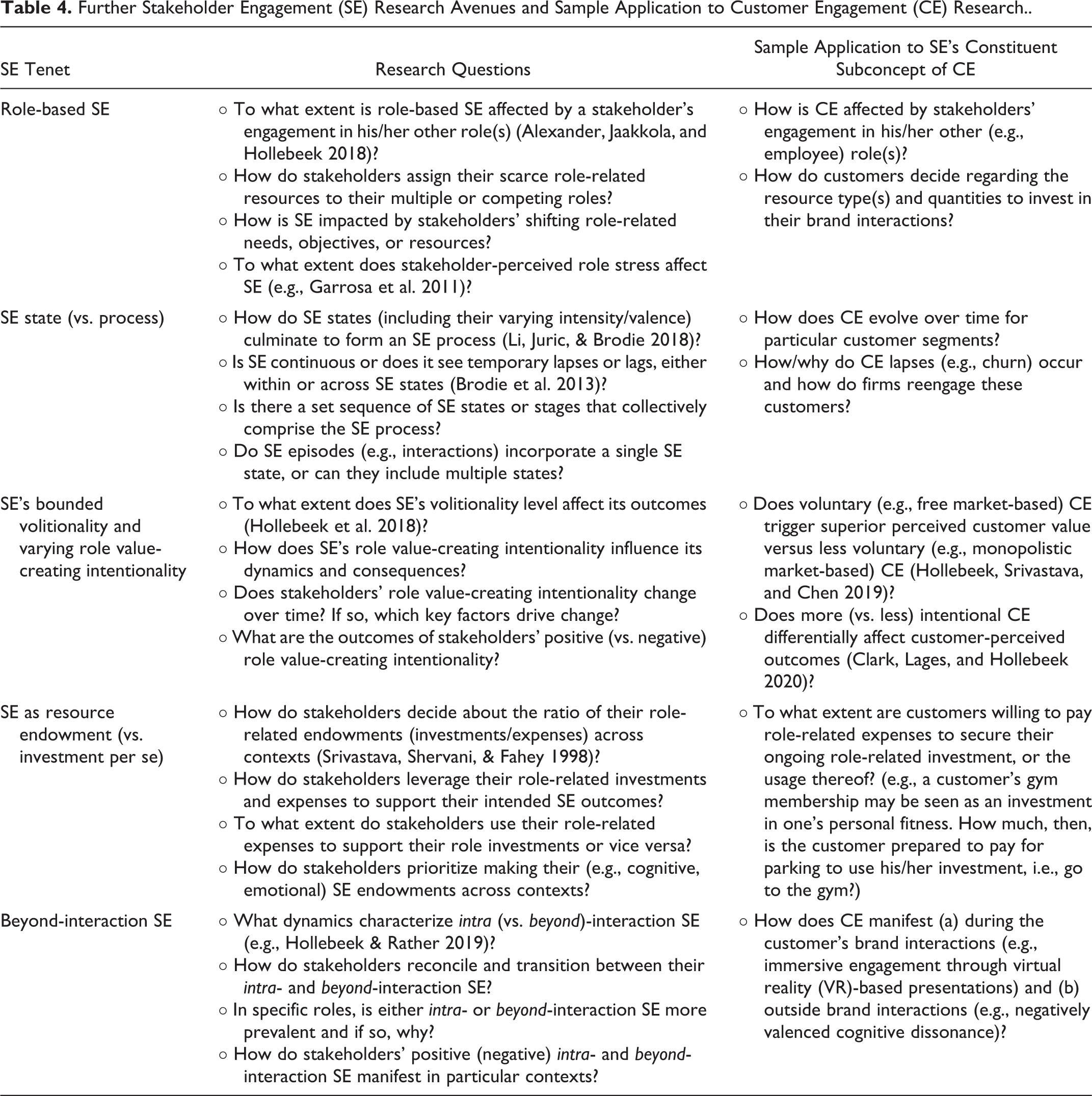
Second, we view SE as a transient state, with aggregated states culminating in an SE process. As a state, SE can rapidly fluctuate, in line with CE-based insight (Hollebeek, Glynn, and Brodie 2014). We refine extant S-D logic-informed AE research by arguing that while engagement can be relatively stable, it is not so per se, steering us away from prior authors’ dispositional view of AE (e.g., Brodie et al. 2019; Storbacka et al. 2016). However, if future researchers wish to study SE’s potential stability, we advise them to consider the related notion of AE styles (Prior and Marcos-Cuevas 2016), as discussed. Given their relatively steady nature, engagement styles can, for instance, be used to segment stakeholders in further research. For example, what CE styles do different customer segments display and (how) do these evolve over time (also see Table 4)?
Third, we propose SE’s boundedly volitional nature. While boundedly (vs. fully) volitional SE intuitively impedes stakeholders’ role-related value creation (e.g., by limiting choice), empirical insight in this area is lacking. We thus recommend testing SE dynamics and outcomes at differing volitionality levels. For example, does voluntary (vs. less voluntary) SE produce superior stakeholder-perceived value? To what extent may stakeholders experience resentment for their perceived constrained SE volitionality (also see Table 4)?
Relatedly, we introduce SE’s varying role value-creating intentionality. While highly volitional SE typically sees an elevated role value-creating intent, less volitional SE more likely spawns inadvertent and/or potentially less conscious (e.g., dissonance-based) SE. We thus recommend future empirical study on SE’s manifestation, drivers, and outcomes at different role value-creating intentionality levels. For example, is SE more positive for stakeholders’ consciously set role-related goals (vs. unplanned events)? How and why do stakeholders shift between (e.g., low-high) role value-creating intentionality episodes?
Fourth, we differentiate between SE-based investments and expenses, which we collectively denote as endowments, as outlined. SE-based investments imply stakeholders’ intent to extract greater future returns from their inputs, while expenses are resource disbursements to maintain one’s role-related status quo (Srivastava, Shervani, and Fahey 1998). Given this distinction, it is of interest to explore the interplay and trade-offs between SE-based investments versus expenses. For example, how do stakeholders decide to invest (vs. disburse) specific resources in their roles (also see Table 4)? Under what conditions might stakeholders substitute their role-related investments with disbursements or vice versa?
Finally, SE’s beyond-interaction scope suggests that it can manifest both in- and outside of a stakeholder’s role-related interactions, as outlined. However, empirical research addressing stakeholders’ intra (vs. beyond)-interaction engagement and their respective transition lags behind, offering a worthwhile avenue for further investigation. For example, what are the key dynamics characterizing intra (vs. beyond)-interaction SE (also see Table 4)? Moreover, intra- and beyond-interaction SE’s positive or negative valence and their respective shifts also warrant further study (Bowden et al. 2017; Li, Juric, and Brodie 2018). For example, is a supplier’s engagement with their client more positive during (vs. outside of) their interactions? How does SE’s valence evolve through a stakeholder’s role life cycle, and why do SE valence shifts transpire?
Executive Summary
Notwithstanding the advances made in the CE literature, the need to understand any marketing actor’s engagement (vs. merely the customer’s) is of growing managerial relevance, given networked actors’ propensity to mutually affect one another. In this vein, the S-D logic-informed AE concept addresses any marketing actor’s engagement, including that of customers, firms, employees, suppliers, and so on. However, though S-D logic-informed AE stresses actors’ mutual value creation, it overlooks the sociopolitical notions that (a) actors’ potentially diverging goals may see them act against (vs. pro) focal others’ interests and (b) different actors may extract differing levels of value from interactions, as advanced in stakeholder theory.
Based on this gap, we extend existing S-D logic-informed AE research by developing the integrative concept of stakeholder theory/S-D logic-informed SE. We derive five core SE tenets that we use to define stakeholder theory/S-D logic-informed SE as a stakeholder’s state-based, boundedly volitional resource endowment in his/her role-related interactions, activities, and/or relationships.
Our analyses yield the following managerial implications. First, SE’s core role-based nature warrants the importance of stakeholder role definition and clarity, while minimizing role ambiguity. That is, stakeholders’ clear understanding of their role-related expectations enables them to effectively execute their (e.g., employee) role, which can be cultivated through education and learning.
Second, SE’s state-based nature implies that it can rapidly fluctuate. We therefore recommend managers to adopt an agile, flexible stance that accommodates stakeholders’ potential SE swings. On the upside, SE’s fleeting nature renders it malleable, revealing managers’ strategic opportunity to mold salient others’ engagement as desired.
Third, SE’s bounded volitionality suggests that SE typically contains an element of the focal stakeholder’s free will that is deployed to create role-related value. However, at the same time, SE is often constrained by stakeholder or service system factors. This less volitional SE transpires at lower role value-creating intentionality and can thus be challenging for managers to maintain. We therefore recommend practitioners to focus on nurturing the former, highly volitional SE that sees elevated role value-creating intentionality (vs. less volitional/less intentional SE).
Fourth, SE’s identified nature as a resource endowment (vs. investment per se) implies that SE may comprise role-related (i) investments to advance the focal stakeholder’s future role value and (ii) expenses that help maintain one’s role status quo. Given this distinction, we advise managers who seek to secure salient stakeholders’ role commitment to offer ample role investment (vs. expenditure) opportunities.
Finally, SE’s beyond-interaction scope suggests that it extends beyond stakeholders’ role interactions to include their role-related activities and ever-evolving ties, interdependencies, and relationships. Therefore, managers not only require an understanding of stakeholders’ own role-related engagement, but also of that of their associates and broader surrounding service systems (e.g., nodes, strength-of-ties, embeddedness) that affect SE.
Supplemental Material
Supplemental Material, 0_-_JSR_SE_-_Executive_Summary - From Customer-, to Actor-, to Stakeholder Engagement: Taking Stock, Conceptualization, and Future Directions
Supplemental Material, 0_-_JSR_SE_-_Executive_Summary for From Customer-, to Actor-, to Stakeholder Engagement: Taking Stock, Conceptualization, and Future Directions by Linda D. Hollebeek, V. Kumar and Rajendra K. Srivastava in Journal of Service Research
Footnotes
Acknowledgments
We thank Professor David Sprott and Professor Tor Andreassen for reading/contributing to our 2018 JAMS India Conference paper, which offered important foundational thinking for this article. We also thank Professor Moira Clark and Dr. Cristiana Lages for a discussion on stakeholder theory and Dr. Rod Brodie, Julia Fehrer, Elina Jaakkola, and Jodie Conduit for a discussion on S-D logic, engagement, and related concepts. Moreover, we thank the editor and the review team for their constructive comments in the earlier rounds of revision. Finally, we thank Renu for copy editing this article.
Declaration of Conflicting Interests
The author(s) declared no potential conflicts of interest with respect to the research, authorship, and/or publication of this article.
Funding
The author(s) received no financial support for the research, authorship, and/or publication of this article.

Supplemental Material
Supplemental material for this article is available online.
References
Supplementary Material
Please find the following supplemental material available below.
For Open Access articles published under a Creative Commons License, all supplemental material carries the same license as the article it is associated with.
For non-Open Access articles published, all supplemental material carries a non-exclusive license, and permission requests for re-use of supplemental material or any part of supplemental material shall be sent directly to the copyright owner as specified in the copyright notice associated with the article.
