



Abstract
The present study is a modest attempt to examine whether the students pursuing postgraduation in entrepreneurship education perceive their entrepreneurial self-efficacy (ESE) to be significantly different from those pursuing postgraduate management education in other disciplines. It explores the ESE on 53 different tasks involved in searching, planning, marshalling, implementation phase of venture creation and general ESE measurement through a 5-point Likert scale self-administered questionnaire. The sample for the study includes 250 entrepreneurship graduates and 217 management graduates from different institutes in western India. The overall ESE of entrepreneurship graduates was found to be significantly higher than management graduates, but task specific ESE was significantly different for 22 out of 53 tasks. The results of the study, thus, are able to suggest the areas for further development to enhance the efficacy of entrepreneurship education programmes.
Introduction
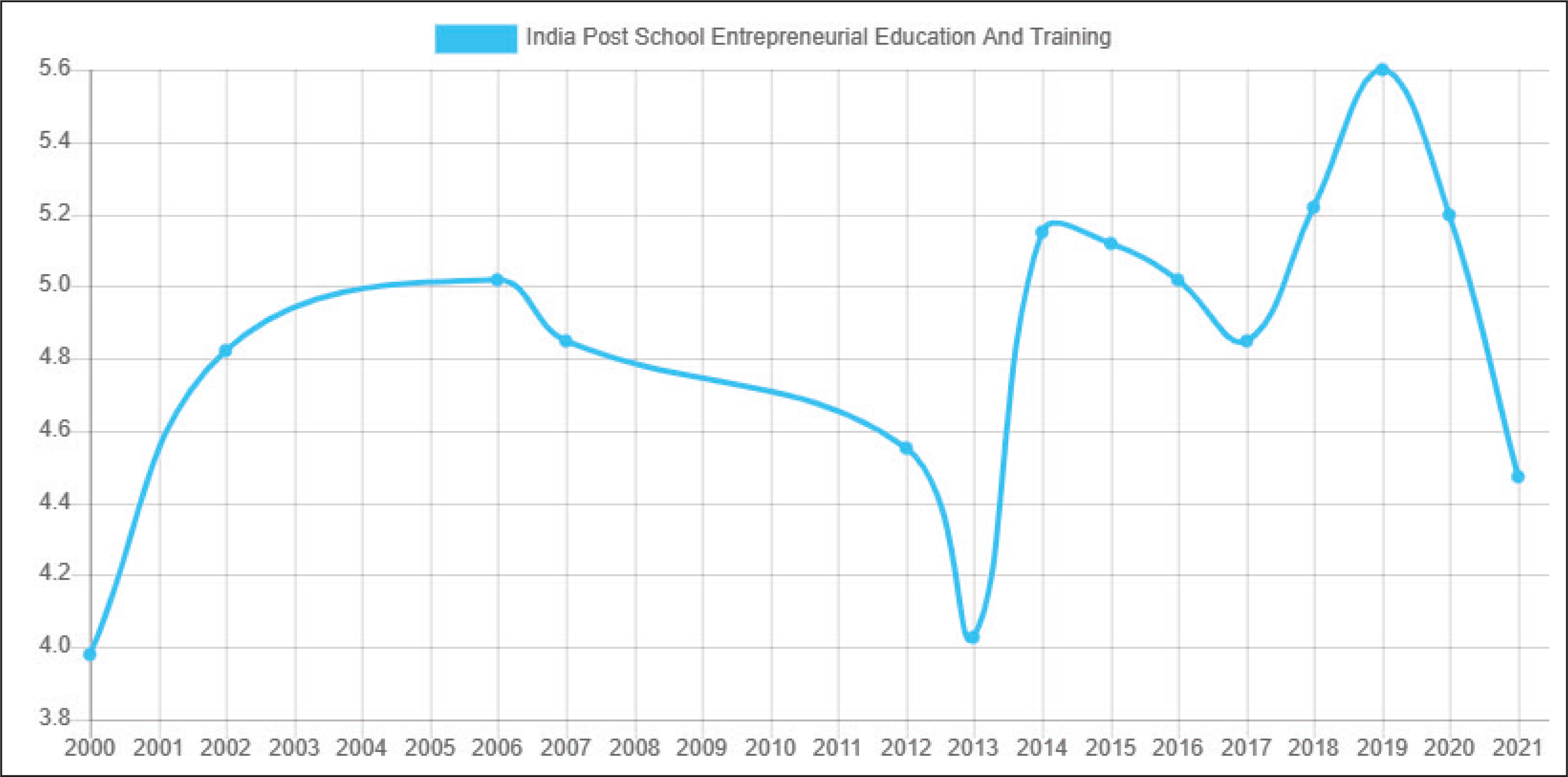
In the last few decades, entrepreneurship as a discipline in education has emerged strongly around the world. This is reflected through induction of new entrepreneurship curricula and programmes, numerous international intercollegiate business plans competitions and endowed professorships in the field of entrepreneurship. In India, a formal training and education in entrepreneurship picked up much later in comparison to the Western counterparts. However, recent government policies are laying additional emphasis on training and skill development for budding entrepreneurs in India. Today entrepreneurship education has become an integral part of regular curricula across various colleges and universities at undergraduate and postgraduate level. Moreover, in recent past, various renowned institutes across India have started offering 1-year and 2-year full-time postgraduate diploma/degree courses in entrepreneurship, family business, venture creation and innovation with Entrepreneurship Development Institute of India (EDII) as the torchbearer and pioneer. In 2019, All India Council for Technical Education (AICTE) has introduced 2 years’ full-time PGDM/MBA programme in innovation, entrepreneurship and venture development (IEV) and 15 colleges across Indian have been approved the same (AICTE, 2020). Global Entrepreneurship Monitor reporting the entrepreneurial framework condition across countries over time also indicate the growth in entrepreneurship education in India in last two decades as depicted in Figure 1.
Though entrepreneurship education is gaining grounds, the question is will increase in the number of educational institutes offering entrepreneurial studies, increase the number of entrepreneurs in the country? Does a course on entrepreneurship makes participants more entrepreneurial? Is entrepreneurship education significantly different than the regular management education?
In this context, it is pertinent to measure the relevance and influence of entrepreneurship education intervention on the entrepreneurial behaviour. Over the years, the literature has evolved from measuring entrepreneurial behaviour based on personal traits and demographic variables to intention-based studies. Entrepreneurial intention is considered to the closest predictor of entrepreneurial behaviour. Entrepreneurial intention, in turn is determined based on various precursors, such as perceived desirability, propensity to act, social norms, self-efficacy and social–political–economic context, derived through various intention models.
Among the antecedents of entrepreneurial intention, entrepreneurial self-efficacy (ESE) has consistently stood out as the highest influencing factor. Boyd and Vozikis (1994) proposed that ESE predicts the strength of entrepreneurial intentions and the likelihood of transformation of entrepreneurial intentions into entrepreneurial actions. A robust body of research in the field of entrepreneurship has explicitly investigated the relationship between ESE and entrepreneurial intention. There is a general agreement among researchers that change in the ‘self-efficacy’ can be considered as one of the important criteria for measuring the impact of entrepreneurship education due to the significant predictive ability of self-efficacy in determining entrepreneurial intention and actions (Boyd & Vozikis, 1994; Chen et al., 1998; Davidsson, 1995; Farashah, 2013; Fayolle & Gailly, 2005; Hamidi et al., 2008; Kickul & D’Intino, 2005; Kolvereid, 1996; Krueger & Brazeal, 1994; Krueger et al., 2000; Liñán et al., 2011; Malebana & Swanepoel, 2014; McGee et al., 2009; McStay, 2008; Sánchez, 2011; 2013; Segal et al., 2002; Sequeira et al., 2007; Shinnar et al., 2014).
The concept of self-efficacy evolved from the social learning theory proposed by Bandura (1977). Self-efficacy is defined as ‘one’s belief in his/her capability to perform a particular task’ (Gist, 1987). ESE refers to the ‘strength of a person’s belief that he or she is capable of successfully performing the various roles and tasks of entrepreneurship involving marketing, innovation, management, risk-taking and financial control’ (Chen et al., 1998). Moreover, according to self-efficacy theory proposed by Bandura (1982) self-efficacy is not a static trait, it can be developed and enhanced through various measures like enactive mastery, modeling, verbal persuasion and emotional arousal.
The current study proposes to understand the distinct influence of entrepreneurship education on ESE of the respondents by determining the difference in ESE of entrepreneurship graduates as compared to regular management graduates. ESE of 250 entrepreneurship graduates and 217 management graduates from different institutes in western India was measured using self-administered ESE questionnaire.
Literature Review
The literature pertaining to influence of entrepreneurship education on ESE mainly consist of two categories of studies: (a) studies measuring the difference in ESE of participants of entrepreneurship education programmes before and after the entrepreneurship education intervention and (b) studies measuring the difference in ESE of participants undertaking entrepreneurship education as compared to those undertaking other management courses. The present study mainly reviews the research undertaken in the second category, that is, difference in the influence of entrepreneurship education and management education on ESE of participants as this domain was found to be comparatively under researched.
One of the early studies in this domain was undertaken by Chen et al. (1998) in the Northeastern University, Boston, MA, USA, who compared the ESE of entreprenurship course students with the students who took organizational behaviour course and with those who enroled for organizational pyschology course. Their entreprenurship course students were found to have signficantly higher ESE compared to both the other group. The major differences were observed particularly in ESE of tasks related to marketing, management and financial control.
Another significant research exploring the influence of entrepreneurship education on the ESE of the participants conducted by De Noble et al. (1999) found significant difference among entrepreneurship graduates and other business graduates at a public university in southwestern USA. Entrepreneurship graduates were found to have significantly higher self-efficacy than other management graduates pertaining to opportunity recognition and dealing with unexpected challenges. Whereas management graduates fared better than entrepreneurship students in the self-efficacy for defining core purposes and maintaining investor relationships but the difference was not statistically signficant.
Another study on influence of entrepreneurship education on MBA students across five universities in the USA undertaken by Kilenthong et al. (2008) revealed that students who undertook entrepreneurship major depicted higher self-efficacy in business-related tasks when compared to other MBA students. The undergraduate students at Mid-Altantic Research University who opted for entrepreneurship major and entrepreneurship elective depicted higher self-efficacy of pursuing the career in entrepreneurship. Results also suggested that students with entrepreneurship majors would have more successful entrepreneurial career as compared to those with non-entrepreneurship major (Bernstein & Carayannis, 2012).
Karlsson and Moberg (2013) explored the influence of entrepreneurship education and marketing management education on the ESE of university students in Denmark with respect to ESE of different tasks of searching, planning, marshalling, implementation of human resources and implementation of financial resources. It was found that entrepreneurship education increased all task specific ESE though signficant increase was observed in planning, searching and marshalling. The planning phase self-efficacy of the participants increased the most. The increase in self-efficacy was signficantly more strong for the students with low initial self-efficacy as compared to those with high initial self-efficacy. For the control group consisting of marketing management masters’ students, none of the five constructs of ESE depicted signficant increase. The planning self-efficacy of the control group, infact, decreased after the course.
Malebana and Swanepoel (2014) conducted a research in two rural universities of South Africa on three groups of students comprising of students with 3 years of entrepreneurship education, students with single course on entrepreneurship and third group with no exposure to entrepreneurship education. They explored the the difference in the ESE of three groups of students peratining to different tasks involved in venture creation stages comprising of searching, planning, marshalling and implementing phase. Significant difference was observed in the self-efficacy of the participants who underwent entrepreneurship education in all the phases of entrepreneurship life cycle but the influence of entrepreneurship education was more pronounced on the activities involved in seraching and implementing phase. The extent of exposure to entrepreneurship education also signficantly influenced the self-efficacy of the participants. The participants who were exposed to semester course in entrepreneurship had signficantly higher self-efficacy as compared to those with no exposure to entrepreneurship education on only 4 parameters of self-efficacy out of 24 whereas as the students with 3 year course in entrepreneurship had signficantly higher self-efficacy on 12 parameters out of 24 when compared with those with no exposure to entrepreneurship education.
A similar study by Rauch and Hulsink (2015) compared the ESE of MSc entrepreneurship and MSc supply chain students at Rotterdam School of Management in the Netherlands. The two groups were found to have significantly different self-efficacy indicating greater impact of entrepreneurship training on self-efficacy of participants. The study also revealed significant positive impact of entrepreneurship education on the actual entrepreneurial behaviour of venture creation through delayed post-test conducted 18 months after the post-test.
Few studies, on the contrary, revealed no significant difference in the ESE of the entrepreneurship graduates as compared to other business graduates. Tan et al. (1996) in their study of undergraduate students from a polytechnic in Singapore found significant difference in ESE of business entrepreneurship students when compared to engineering non-entrepreneurship students, in comparison to engineering entrepreneurship students as well. But no significant difference was observed in the self-efficacy of business entrepreneurship students as compared to business non-entrepreneurship students.
In another study at a mid-sized university in USA by Noel (2002), it was found that ESE of undergraduates who took entrepreneurship major was neither signficantly different from those who took other business majors nor different from non-business undergraduates.
McStay (2008) in his dissertation also observed only partial impact on the self-efficacy of undergraduate students who underwent 14-week entrepreneurship course at an Australian university. There was significant difference in the self-efficacy of the students before and after the entrepreneurship course, but no significant difference was found in the self-efficacy of students who took entrepreneurship as compared to strategic management students after undergoing respective courses for a semester. Both the courses increased the self-efficacy of their respective participants to the similar extent.
The literature comparing the influence of entrepreneurship education and other management education on ESE is limited and inconclusive. Most of the studies are limited to Western countries and involve education intervention of varying duration with most of them focusing on small duration entrepreneurship courses. Moreover, very few studies have examined in detail the differential influence of entrepreneurship and other management education on task specific ESE of individuals. This represents an unpretentious need to understand the influence of entrepreneurship education and management education on ESE in the Indian context particularly for long-term entrepreneurship education programme. The article further attempts to examine the following premises.
Further, hypothesis related to difference in ESE of entrepreneurship graduates and management graduates for particular components of ESE can be determined based on the research instrument.
Baker and Welter (2020) in their book Contextualizing Entrepreneurship Theory have emphasized on the significance of ‘context’ in entrepreneurship research. The entrepreneurship context mainly refers to the stimuli in external environment which may constrain or foster entrepreneurship, and hence the results of any research examining the influence of a particular variable (education, in the case of present study) should evaluate the results taking into consideration relevant construct which may influence the results. The variables may include culture, social networks, history, spatial contexts, etc. In the present study, important contexts that may moderate the influence of education on ESE are family background and prior experience. Also, as a norm, management graduates are primarily trained to take corporate jobs whereas entrepreneurship graduates are trained to start their own venture or join family ESE, hence the two streams of education may enhance different components of ESE as required by two different career paths. Higher ESE among management graduates may influence them to behave entrepreneurially in their corporate jobs as Fini and Toschi (2016), in their study, found a strong link between ESE and corporate entrepreneurial intentions whereas the higher ESE among entrepreneurship leads to higher entrepreneurial intention (Mclellan et al., 2009).
Research Methodology
Data Collection and Measures
The study was conducted through self-administered questionnaire by personally distributing the questionnaire to the students as well as through e-mail. The questionnaire was developed considering the most prominent and widely applied scales of ESE in the literature (Barakat et al., 2014; Chen et al., 1998; De Noble et al., 1999; Ho et al., 2018; Lucas & Cooper, 2005; Malebana & Swanepoel, 2014; McGee et al., 2009; McStay, 2008; Newbold, 2014; Vanevenhoven & Liguori, 2013).
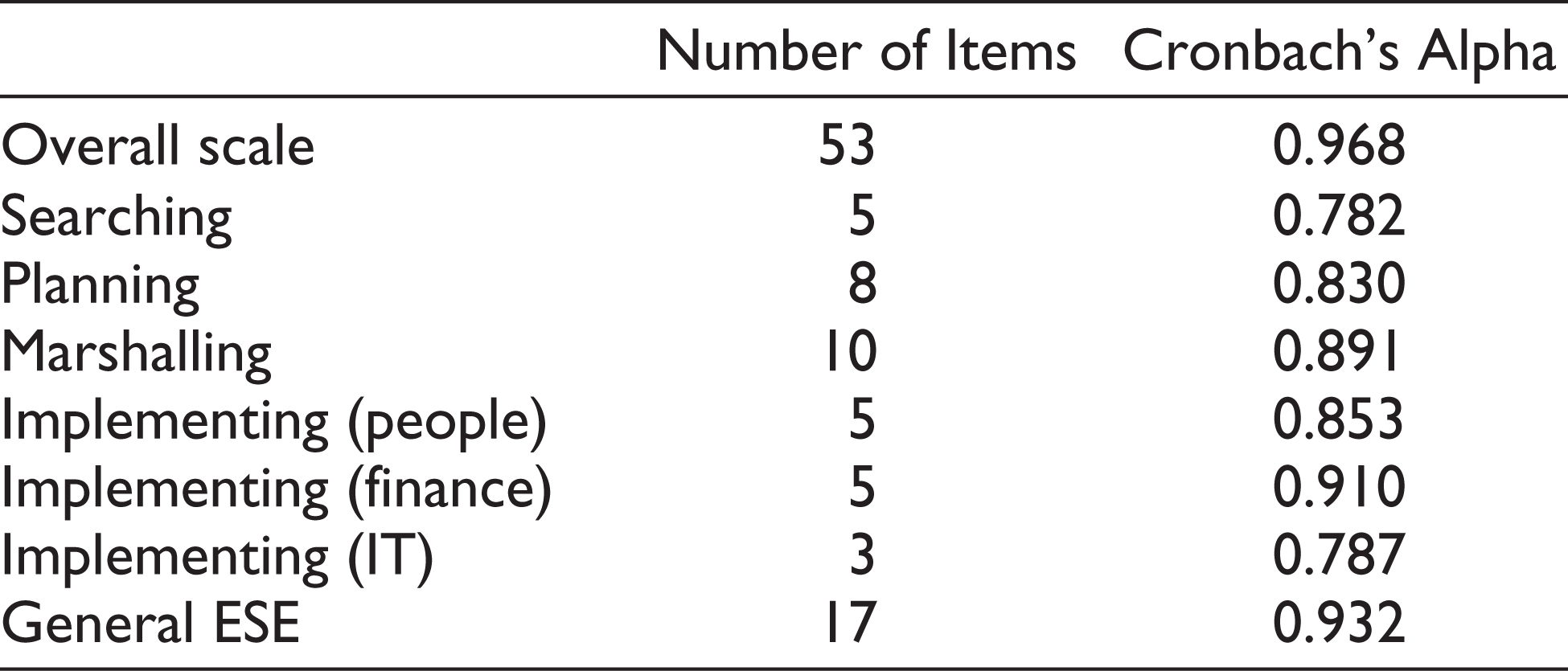
The various items across the scales were compared and contrasted, selecting the common as well as unique entrepreneurial tasks and attitude related items found appropriate in the Indian context. Few new items were also added to the questionnaire based on discussion with practicing entrepreneurs and entrepreneurship educators. This included items related to liaisoning skills, information technology (IT) skills, legal knowledge, perseverance and exit strategy which did not appear in the earlier scales of ESE. The final instrument comprised of 53 items grouped into seven factors based on exploratory factor analysis. The seven factors were labelled based on four phase venture creation model (i.e., searching, planning, marshalling and implementing) proposed by Stevenson et al. (1989), general ESE comprising of perseverance, risk and uncertainty management, group inter-personal skills, problem solving skills and ESE related to IT skills for new venture. The scale comprised of 5 tasks of searching phase, 8 tasks of planning phase, 10 tasks of marshalling phase, 5 tasks related to implementing (people), 5 tasks related to implementing (finance), 3 tasks related to implementing (IT) and 17 items related to general ESE.
The responses were measured on 5-point Likert scale with anchors ranging from very low confidence to very high confidence. Based on the factors of ESE scale, the following hypothesis can be examined.
The overall Cronbach’s alpha coefficient for the ESE scale was 0.968 and the reliability coefficient for all the factors of the scale was also considerably high as given in Table 1. This suggests favourably good reliability of the scale as per the established standards (Nunnally & Bernstein, 1994).
Reliability of ESE Scale
Sample
The questionnaire was distributed to more than 600 students in the last semester of their postgraduation in the month of March/April 2020 when they were about to graduate and make final career decision. This included students pursuing a 2-year postgraduate course in entrepreneurship (EMBA) and students pursuing a 2-year regular management course (RMBA) in any other discipline like marketing, finance, human resource, operations, etc., from colleges across Gujarat and Maharashtra. The geography was purposefully selected as most of the institutes offering 2-year full time postgraduation courses in entrepreneurship are located in these two states. The responses were received from 217 RMBA students and 250 EMBA students. Post data cleaning, total sample 457 including 243 EMBA and 214 RMBA was subjected to further analysis. Around 48% of RMBA respondents had fathers running their own business, on the other hand, 81% of EMBA graduates had entrepreneurial fathers. Also, among those hailing from family business background, 63% of EMBA students had been involved in the family business in the past whereas only 38% of RMBA students had been involved in family business. Gender composition of both the group was similar with 63% and 70% male respondents among RMBA and EMBA, respectively. Nearly 49% of RMBA and 46% of EMBA respondents had some prior work experience but the duration of experience was less than majority of the respondents.
Data Analysis
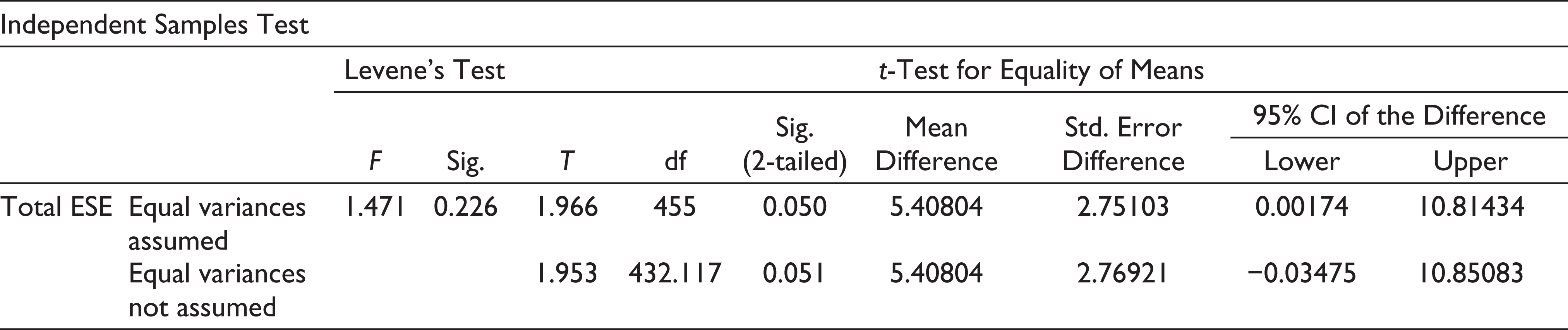
The data was analysed using the Statistical Package for the Social Sciences (SPSS) version 27. To understand the difference in overall ESE of entrepreneurship MBA graduates and regular MBA graduates, independent sample t-test was conducted after verifying for underlying assumption of normality and homogeneity of variance. Further to analyse the difference in ESE of EMBA graduates and RMBA graduates with respect to tasks involved in each phase of venture creation, MANOVA was applied. Tables 2 and 3 represent the results of assumptions of t-test, that is, normality and homogeneity of variance, the findings of independent sample t-test as well. Normality was measured using Kolmogorov–Smirnov, Shapiro–Wilk statistic whereas homogeneity of variance was measured based upon Levene’s test for equality of variance. Table 4 represents the mean and standard deviation of ESE scores of entrepreneurship education graduates and management education graduates.
Normality Test for ESE Scores of Entrepreneurship Graduates and Management Graduates

aLilliefors significance correction.
Homogeneity Test and Independent Sample t-test for ESE Scores of Entrepreneurship Graduates and Management Graduates
Descriptive Statistics of ESE Scores of Entrepreneurship Graduates and Management Graduates

Based on normality test, no substantial deviations were observed from normality. p-Value for ESE scores of entrepreneurship graduates based upon Kolmogorov–Smirnov statistic was greater than 0.05 (p = 0.2) and ESE scores for management graduates-based Shapiro–Wilk’s statistics were greater than 0.05 (p = 0.057). The variance across groups was found to be homogeneous based on Levene’s test of homogeneity of variance (p = 0.226). Hence the assumption for independent sample were primarily met satisfactorily. The results of t-test revealed significant difference in ESE of two groups-based p-value at significance level of 5% (p = 0.05). Descriptive statistics presented in Table 4 indicated that average ESE scores of entrepreneurship education graduates were higher than ESE scores of management education graduates substantiating the greater influence of entrepreneurship education on ESE as compared to management education. Hence Hypothesis 1 was supported statistically.
In order to further examine the differences in ESE of entrepreneurship and management graduates on each of the seven ESE factors identified through exploratory factor analysis, MANOVA was conducted. Before applying MANOVA, the outliers were eliminated from the data using Mahalanobis’ distance criteria. The maximum permissible value of Mahalanobis’ distance for six degrees of freedom based on critical value table was found to be 22.46. Following that, the data was examined for assumptions of MANOVA including homoscedasticity, multi-collinearity and normality. Homoscedasticity was verified based on Box M test, Levene’s test and multi-collinearity based on Pearson’s correlation coefficient. The results for the same are represented in Tables 5–7.
Box’s Test of Equality of Covariance Matrices Comparing Entrepreneurship Graduates and Management Graduates

Levene’s Test of Equality of Error Variancesa Comparing Entrepreneurship Graduates and Management Graduates

Tests the null hypothesis that the error variance of the dependent variable is equal across groups.
Pearson Correlation between Entrepreneurship Graduates and Management Graduates ESE Scores of Each Phase of Venture Creation

Box plot results confirmed homoscedasticity of the data as significance value was greater than 0.001 (p = 0.009). Due to high sensitivity of this test to deviation in normality, very small p values are also considered to be acceptable (Hair et al., 2014). Levene’s test results also revealed no significant deviations from homogeneity of variance in ESE scores of entrepreneurship graduates and management graduates except for searching phase and implementing (finance) phase where p value was less than 0.05. No multi-collinearity was observed in the data as none of the Pearson correlation coefficients was greater than 0.9. Hence, all assumptions of MANOVA with respect to homoscedasticity, independence of observation and linearity of dependent variable were fulfilled. Table 8 represents the results for MANOVA depicting differences in ESE scores of graduates and prospects across all phases of venture creation.
MANOVA results revealed significant difference in the ESE of entrepreneurship graduates and management graduates across all ESE factors as p-value for Pillai’s trace was less than 0.05 (p = 0.021). Pillai’s criteria was selected for decision making as among the four tests of MANOVA represented in Table 8, Pillai’s criteria is most robust and least affected by any violations in assumptions (Hair et al., 2014). Hence, there wasn’t sufficient statistical evidence to reject Hypothesis 2.
Multivariate Test Results Comparing ESE of Each Phase of Venture Creation between Entrepreneurship Graduates and Prospects

To further understand the significance of differences in ESE between both groups across all the all phases of venture creation, univariate test results represented in Table 9 were evaluated.
Univariate Test Results Comparing ESE of Entrepreneurship Graduates and Management Graduates

The factor-wise analysis of difference in ESE among entrepreneurship graduates and management graduates across each of seven parameters of ESE suggested significant differences in ESE related to implementing (finance) (p = 0.002) and general ESE (p = 0.015). The difference in marshalling ESE was also found to be nearly significant (p = 0.053) whereas no significant difference was observed in ESE of searching, planning, implementing (people) and implementing (IT) tasks. Hence, based on statistical evidence, Hypotheses 7 and 8 was supported whereas there was not sufficient evidence to support Hypotheses 3–6 and 9.
Descriptive statistics represented in Table 10 also reveal very minor variation in average ESE scores of two groups on searching, planning, implementing (people) and implementing (IT) parameters. But in none of the phases of venture creation, average ESE score of management graduates was found to be higher than entrepreneurship graduates. To further understand in detail, the difference in ESE of entrepreneurship graduates and management graduates on each task-specific self-efficacy, MANOVA was conducted for each of the 53 entrepreneurial tasks/attitude. The results obtained are presented in Table 11.
Descriptive Statistics Comparing ESE of Entrepreneurship Graduates and Prospects for Each Phase of Venture Creation

Multivariate Test Results Comparing ESE of Each Task of Venture Creation between Entrepreneurship Graduates and Management Graduates

The MANOVA results indicated significant difference in ESE of entrepreneurship graduates and management graduates when ESE on each task was considered as separate dependent variable. p-Value of Pillai’s trace MANOVA test was found to be less than 0.05 (p = 0.000). To further understand the specific tasks/attitude on which the two groups differed significantly in their ESE scores, univariate test was conducted on each of the 53 items of ESE scale. The results of univariate test are depicted in Table 12.
Univariate Test Results Comparing ESE of Each Task of Venture Creation between Entrepreneurship Graduates and Management Graduates

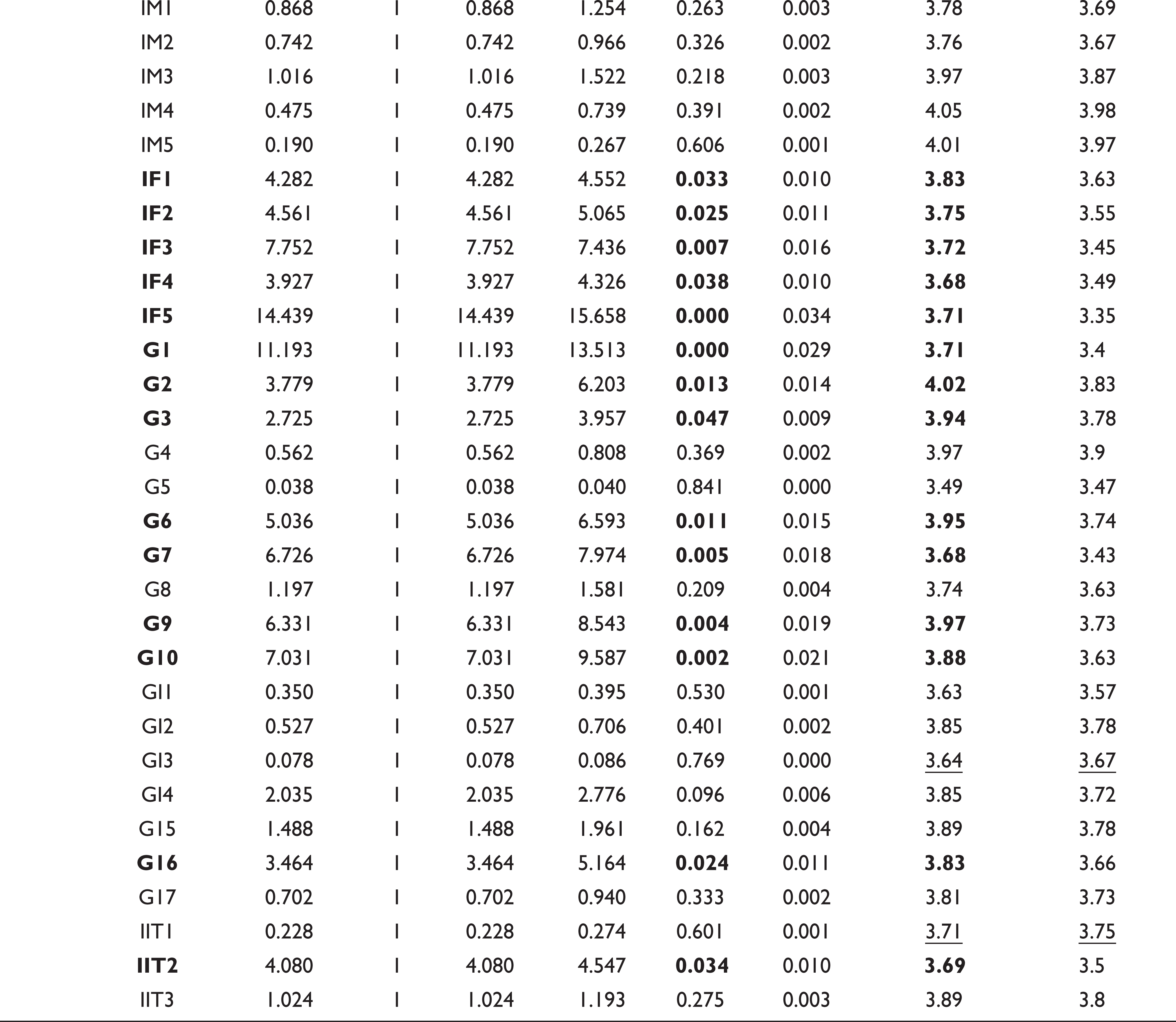
The result of task-wise ESE comparison between entrepreneurship graduates and management graduates revealed difference on 22 out of 53 tasks. The tasks where significant difference in ESE was observed across two groups mainly included the tasks related to marshalling, implementing (finance) and general ESE. The two groups differed in their ESE on 2 searching tasks (out of 5), 2 planning tasks (out of 8), 4 marshalling tasks (out of 10), all 5 implementing (finance) tasks, 1 implementing (IT) tasks (out of 3) and 8 general ESE tasks/attitude (out of 17). Descriptive statistics revealed that scores of EMBA graduates were higher than management graduates on 20 out of 22 parameters where the significant differences were observed. Only on two tasks including conducting market research for the idea and selecting the right marketing strategy for the product, regular MBA graduates were found to have higher ESE than EMBA graduates. On 31 tasks (out of 53) there were no difference in ESE of entrepreneurship graduates and regular MBA graduates. Of 31 tasks where the difference between ESE of entrepreneurship graduates was not significant, EMBA graduates had higher ESE on 24 tasks. On the remaining 7 tasks ESE of RMBA graduates was higher as underlined in the last column of Table 12. Of these 7 tasks, 3 belonged to planning phase, 2 to marshalling phase, 1 related to general ESE and 1 related to implementing (IT). Hence, overall, for majority of the tasks, ESE of entrepreneurship graduates was higher than management graduates.
Results and Discussion
The study mainly intended to find whether entrepreneurship education differently influences the ESE as compared to regular management education. Though the results indicate that EMBA students had overall higher average ESE score as compared RMBA but the difference was not significant in all the phases of venture creation. Higher influence of EMBA was mainly observed in tasks related to marshalling, implementing (finance) and general ESE. The findings are in consensus with many previous studies as they also found significant differences in ESE of students undertaking entrepreneurship courses as compared to those undertaking other management courses on specific ESE parameters (Chen et al., 1998; De Noble et al., 1999; Karlsson & Moberg, 2013; McStay, 2008). The higher ESE of EMBA graduates may also be attributed to their family background as the sampling mix indicated much higher number of EMBA respondents had family business as compared to RMBA repondents. Moreover, EMBA repondents also had higher involvement in the business before joining the course comapred to RMBA respondents.
Further task-wise analysis helped in identifying the particular tasks where EMBA graduates had higher ESE than RMBA graduates as well as the tasks where EMBA should provide further inputs. The results suggest that in order to ehance the efficacy of entrepreneurship education programme, it should provide more enriched inputs particularly related to tasks involved in seraching, planning and implemeneting (people) phase of venture creation model. The detailed tasks where further invention through entrepreneurship education may benefit the prospective entreprenurs asre listed below.
Generating innovative idea
Evaluating feasibility of an idea
Estimating the market size
Determining the appropriate pricing of new product/service
Appropriate marketing strategy for introducing the product/service in the market
Real time exposure to presenting business idea to group of investors
Greater and more relevant networking opportunities
Guidance on preparing exit strategy and its execution
Team building and selecting the initial employees
IT skills for enhancing the operational efficiency of the venture
The current study is one of the initial attempts in the Indian context to evaluate the differentiation proposition of long-term entrepreneurship education programmes as compared to regular management programmes based on comprehensive ESE scale. The other studies in this domain have been mainly undertaken in the western context and that too for short-term entrepreneurship courses. With the increasing number of institutes offering entrepreneurship education across the country, the findings of the study can be helpful in further enhancing the relevance of such programmes and differentiating its inputs from regular management education. The differentiated offering of entrepreneurship education programmes is imperative as regular management course mainly aim at preparing participants for corporate jobs and corporate entrepreneurship whereas entrepreneurship education aims at enhancing the skills, attitude and knowledge for starting one’s own venture.
Limitations and Future Direction
The current research can be further enriched by undertaking longitudinal study comparing the ESE of EMBA and RMBA students before and after their respective courses. The analysis of their initial ESE before the course may provide explanation to differences in their ESE after the completion of the course. It would help in identifying the tasks where the differences in ESE of EMBA and RMBA graduates can be attributed to the educational intervention and the tasks where difference in ESE of graduates existed due to the difference in their initial ESE.
Furthermore, future studies may explore the differential influence of entrepreneurship education on ESE of respondents with different demographic profile particularly family background so as to enable the findings in the cultural and social context. Moreover, task specific to corporate entrepreneurship may be incorporated in the ESE scale along with the venture creation process tasks used in the current study. It will be further helpful in understanding the differential influence of entrepreneurship and management education in the context of starting one’s own venture vis-a-vis corporate entrepreneurship. Inclusion of these variables in the related studies may further contribute to ESE and entrepreneurship education literature.
Footnotes
Declaration of Conflicting Interests
The authors declared no potential conflicts of interest with respect to the research, authorship and/or publication of this article.
Funding
The authors received no financial support for the research, authorship and/or publication of this article.