




Abstract
This study aims to offer insightful knowledge on organizational members’ real-life experience of working in a ‘new normal’ environment and explores changes in organizational HR practices and the future of work culture during this pandemic. Applying the qualitative methodology through implementing an in-depth interview technique, this study revealed subjective insights on pandemic impacts within diverse organizations and their coping strategies, that is, remote work practices and technological adaptations. The study found out that HR functionalities powered by different online tools and remote work or flexible roster duties are ensuring employee betterment and organizational productivity at the same time. Pandemic countermeasure oriented or transformed HR practices like online training and e-recruitment are keeping the workforce steady in this distressing time, but the ‘new normal’ lifestyle and evolved work environment, practices are putting much stress on and changing the dimension of work policies like employee well-being, compensation, leave, and so on, through isolation, quarantine and strict health guideline type issues.
Introduction
The COVID-19 pandemic has appeared as a global turmoil and significantly affected almost every country and territory of the world, leaving remarkable stains on innumerable people’s health, livelihoods and economic activities. Perhaps after the Second World War, this pandemic event was the biggest catastrophe that created consequential national crises across multiple countries. It not only snatched away hundreds of thousands of lives, but also shook the world economy, changed the way of life and introduced the ‘new normal’ way of living.
The world’s primary response to this pandemic was aggressively preventive, as most of the countries had to impose lockdowns and travel bans, prevent mass gatherings, limit the movement of citizens, limit the business operations, implement social distancing to ward off the COVID-19 transmission among people (Shahriar et al., 2021). Consequently, these measures deeply impacted the economic entities, commercial practices, business organizations, and people including employees, consumers and various stakeholders worldwide. The general presumption was, the first wave of this pandemic will be the last wave and without escalating its repercussions, the world might be able to escape from this nightmare in 2021, but sadly, in 2021 the evolved horrifying Delta variant or SARS-CoV-2 Delta variant with its second wave of rapid spread, inflicted sufferings and crisis throughout the world once again.
As the objective of keeping economic sustainability vibrant became pivotal for countries amid this unpropitious situation, improvised courses of action or practices assisted with technological leaps emerged in business organizations safeguarding prevention and business goals simultaneously. So, this global upheaval in a sense, accelerated the arrival of the future of work (World Economic Forum, 2020). Digitalization and technology played a key role in this transformation and the adoption of cloud computing, big data, and e-commerce remain high priorities for businesses and the changing labour markets, especially among the white-collar workforce (World Economic Forum, 2020). The traditional workplace functionalities along with employee interactions and human resources management activities took dramatic shifts towards virtual workspace, adopting and populating the idea of remote work systems for minimizing infection risks and keeping work productivities afloat. Nevertheless, even from a developing country’s perspective, this abrupt transformation of work systems and HR practices was much easier than perceived, as increased use of the internet and access to information have dramatically changed the pattern of communication processes in the last two decades. Due to the rapid adoption of advanced technologies, people are more connected; which actually helped the organizations to continue their required operations in this pandemic.
This pandemic-time workplace and practices transformation initiated diverse scenarios where organizational processes and operational or functional activities are disrupted and altered. Moreover, technology-based shifts towards virtual workspace, remote work and transformed HR practices raised new opportunities to exploit under favourable circumstances. Exploring organizations’ augmentation to tech-centric transformations and pandemic-driven coping strategies from the Human resource management standpoint can provide valuable insights into contemporary or transformed HR practices.
This exploratory research is an attempt to explore the changes in organizational HR practices and culture due to remote work practices in this contentious environment from the perspective of an emerging economy.
COVID-19 Criss in Dates and Numbers
The Coronavirus disease 2019 (COVID-19) is caused by a newly discovered virus named novel Coronavirus or 2019-nCoV or SARS-CoV-2. The existence of this infectious disease was, however, unknown to the world before the outbreak began in China.
Coronavirus emerged in late December of 2019 as the first case of Coronavirus disease (a novel kind of Coronavirus causing unusual pneumonia and severe illness) was first officially reported on 31 December 2019 in Wuhan, the capital of Hubei Province, China. With around 11 million people, Wuhan is one of the most populated cities in China which fell victim to this vicious virus first.
There are many views regarding the source of Coronavirus, according to China it emerged and spreaded from the live animal market or wet market in Wuhan named ‘Huanan Seafood Wholesale Market’ (Maron, 2020; Woodward, 2020). Many claimed that it was originated in a lab in Wuhan (Gertz, 2020) named ‘Wuhan Institute of Virology’, in some parts of the world people even used to phrase it as ‘Wuhan virus’ or ‘Chinese virus’ initially (Su et al., 2020). Later on, China denied the claims, however the mystery is not solved yet (Krishnan, 2020; Rincon, 2020).
At first, it was typically thought to be an inconsequential event but over a short period of time, this novel virus claimed thousands of lives and rattled the world severely with its deadliness. With its rapid exposure to the whole world, the globe and countries faced unforeseen circumstances thus, on 30 January 2020, The World Health Organization (2021) declared the COVID-19 as the public health emergency of international concern.
The first three confirmed cases of COVID-19 were reported on 7 March 2020, in Bangladesh by the Institute of Epidemiology Disease Control and Research (Hasan & Shaon, 2020). Later on, the WHO declared the Coronavirus outbreak as a pandemic on 11 March 2020. As of 25 August 2021, this deadly virus has already killed over 4,354,701people and infected about 206,772,296 (confirmed cases) around the world and the total number of vaccine doses administered is 14,562,060,269 (Johns Hopkins University, 2021).
According to the data of COVID-19-DGHS (2021), in Bangladesh as of 15 August 2021, the total number of COVID-19 infected people is 1,412,218 and 23,988 people died till now. And till now 1,281,327 have recovered from coronavirus disease and 341,033 had to maintain isolation. The number of new COVID cases is even increasing day by day. Though the world has seen many viral mutations and genetic variants of SARS-CoV-2 during this pandemic; things have become more difficult due to the emergence of delta variant or SARS-CoV-2 Delta variant (known as lineage B.1.617.2) (Centers for Disease Control and Prevention, 2021; WHO, 2021). According to the reports of Dhaka Tribune (2021) and The Financial Express (2021), findings of Bangabandhu Sheikh Mujib Medical University and the study showed that around 98% of people in Bangladesh were infected with the new Delta variant (lineage B.1.617.2) and only 1% with the South African variant (B.1.351).
This airborne contagious virus swiftly spread out to almost every country around the world and to control the outbreak, social distancing became the crucial measure used by each country’s government. Social distancing significantly affected all the major activities of a country as it demanded and requested numerous organizations, businesses, schools, colleges and universities and their representatives to work remotely.
The Emergence of Remote Work and Discussion on Relevant Literature
Corona is a crisis like no other (International Monetary Fund, 2020), societies around the world have been going through a difficult time, including global health crisis, economic downturn (Barbate et al., 2021; Kanupriya, 2021; Thangavel et al., 2022), social insecurities, uncertainties (Guo & Cannella, 2021) and inequalities. As a generic response to stop the spread and outbreak of Coronavirus, almost every country has taken various steps (Pandey & Saxena, 2022) like imposing lockdowns (Baccini & Brodeur, 2021; Shahriar et al., 2021), maintaining social and physical distance (Pandey & Saxena, 2022) isolation and quarantine (if required) (Raza et al., 2021), preventing the mass gathering, closing borders (Zanker & Moyo, 2020), imposing a national and international travel ban and limiting the movement of citizens, maintaining hygiene in public places.
The COVID-19 pandemic also has had a deep and wide-ranging impact on societies (Grasso et al., 2021; King & Carberry, 2020), organizations (Muzio & Doh, 2021), workplaces (Kaur et al., 2021; McGuire et al., 2021) and employments worldwide. The COVID-19 emergency has actually forced the organizations to adopt new realities, which includes shifting to virtual work or online-based remote work (Howard-Grenville, 2020), reconsidering long and short-term business operation priorities (Crosina & Schinoff, 2020), changing strategies and processes.
This COVID-19 pandemic pushed the organization around the world to switch to remote working. Though the concept of remote work is not new (Olson, 1983), the world has witnessed a massive shift towards remote work, COVID-working (Tagliaro & Migliore, 2022) or home office during the COVID-19 period.
Over the past few years, the increasing use of information and communications technology (ICT) and the internet has made the remote work concept much more popular (Charalampous et al., 2019), but this pandemic situation business operations demanded flexibility and higher agility (Brunet et al., 2021; Elragal et al., 2020). These changes also demanded certain modifications in human resource strategies and practices such as flexibility and job design (Harney & Collings, 2021); as a result, ICT supported remote work or work from home set up is in a process to reshape employment opportunities worldwide (Davies, 2021). Evidentially this pandemic has essentially changed the experience and practices of work for a huge majority of employees around the world (Carroll & Conboy, 2020; Collings et al., 2021). Regional practices and work systems have significant impacts on workplace studies. For instance, before the pandemic event, about 35% to 45% of workers in the United States and Europe worked from home or a public location like libraries or cafés but this number of remote workers varied greatly by nation (Tagliaro & Migliore, 2022).
Simultaneously, many researchers tried to explore various aspects related to remote work and human resource management, that is, exploring unexpected and enforced issues that the COVID-19 pandemic presented, along with the technological methods that the knowledge workers use to accomplish team collaboration goals (Waizenegger et al., 2020). Investigating the employees’ and employers’ experience of working from home (Bick et al., 2020; Vyas & Butakhieo, 2021), exploring the subjective well-being, satisfaction with work and family during remote work, short-time work and closure of childcare and schools due to the pandemic (Möhring et al., 2021). Researchers like Wrycza and Maślankowski (2020) even tried to analyse the employees’ perception towards remote work during the pandemic.
However, socio-economic aspects in the South Asian region and middle-income developing counties in this region like Bangladesh are a bit different from the developed nations, since the national announcement of the maiden case of COVID-19 in Bangladesh, a 10-days holiday was manifested by the government to keep all the public, private organizations closed. This public holiday or lockdown measure began on 26 March of 2020, but eventually, it was extended to 66 days instead of 10 days for slowing down the infections rate of the Coronavirus. Within this time, public transportation systems were halted, non-emergency or most inessential businesses and service organizations were closed down. People were advised to stay home avoid social interactions or any public gatherings (Alam, 2020). Following the global trend and to keep employee productivity and business performance vibrant amidst this corona situation, employers came up with the idea of the remote work process. As remote working facilitated work continuance, it also allowed employees to adopt the flexibility of working from home as a new way of life (Renard et al., 2021; Tagliaro & Migliore, 2022).
In his study Hossain (2021) explored the impacts of COVID-19 on the livelihood and employment of the marginal population in Bangladesh. Some other researchers like Kumar and Pinky (2020), Yadav and Iqbal (2021) and Chowdhury and Chakraborty (2021) tried to address the economic impacts of COVID such as unemployment, remittances inflow, domestic and international labour market, migrant workers, human development index. But none of these studies highlight the impact of the emergence of ICT-based remote work in Bangladesh.
Research Objective
The sudden pandemic situation provoked substantial changes in lifestyle and economical activities with extreme measures so the social or business organizations are going through a transformational phase where organizational processes, operational or functional activities are disrupted and altered. This study, focusing on human resource managerial aspects, aims to reveal how business organizations are coping with such shifting work environmental and operational issues to sustain productivity within pandemic adversities.
The main objective of this study is to understand employees’ or organizational members’ real-life experience of new work environment and explore changes in organizational HR practices and work culture during this corona pandemic from a developing country perspective.
Methodology
This research is a qualitative one. Qualitative research is frequently recognized as having the ability to generate new and unique insights (Eisenhardt & Graebner, 2007); it also helps to understand the subjective reality of the research participants even in complex or intricate situations; considering the complexities of the current pandemic situation exploratory–qualitative approach was adopted. This research design includes the following:
COVID-19 related data were collected from different websites, newspapers and recent studies on COVID-19.
Primary data were obtained from open-ended, depth interviews. Before COVID-19, no one knew about the local pattern of workplace techniques in Dhaka. Given that the goal of the research was to save costs and administrative work, we used judgment or purposive sampling to collect data in this study to learn about remote work issues (Zikmund et al., 2010).
The interviews were conducted with distant workers in the Dhaka and Chattogram division between 20 April 2021 and 20 August 2021. A set of semi-structured questionnaires was supplied through email so that respondents could prepare for the interview session ahead of time. The sample size for this study was seventeen, and it included a broad group of people from various fields of work, that is, banks, non-bank financial organizations, IT firms, fast-moving consumer goods (FMCGs) and ready-made garments. A detailed profile of the respondents has provided in Table 1.
Respondents/Interviewees’ Profile
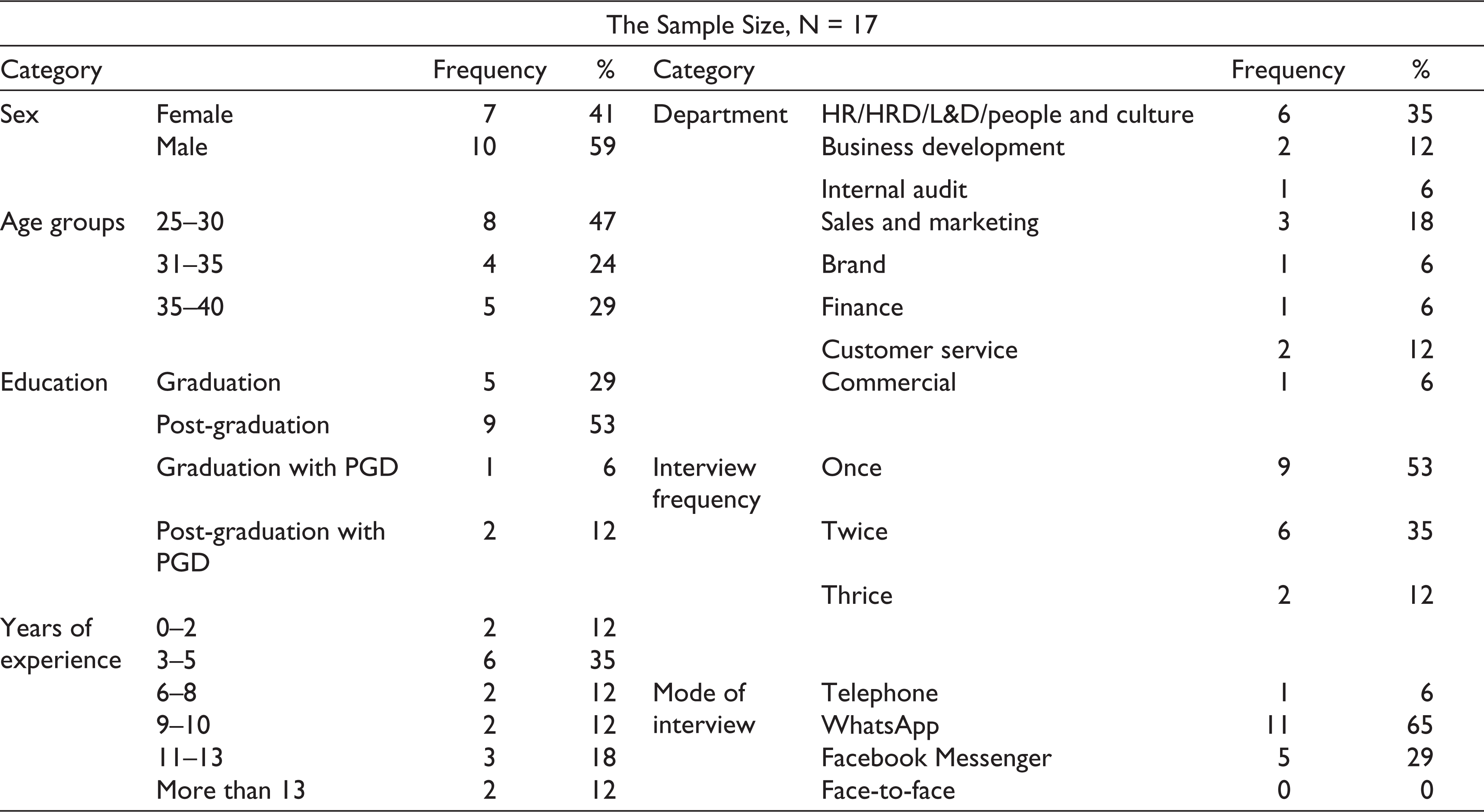
Interview sessions were conducted through WhatsApp, Facebook messenger phone calls, considering the goals of qualitative research interviews (Boyce & Neale, 2006), to study various human experiences on a certain notion or situation, with an emphasis on understanding and exposing the meaning of the interviewees or respondents’ real-life experiences. In other words, the sampling strategy was not focused on statistical generalizability, but on the meaningful descriptions of the participants’ experiences on remote work ecosystem considering the complex COVID-19 crisis. Each interview session ranged between 45 minutes to 1.5 hour in duration and resulted in 54 pages of double-spaced, verbatim texts. Later on, based on the information described by the respondents, data were labelled and classified into different topics to categorize three major themes.
Research Findings and Discussions
When the first official case of the virus was reported in Wuhan, China in December 2019, many presumed that it is going to be just like other common flu or respiratory illness and would not harm much, but proving everyone wrong, within a very short period, it emerged as a major global disaster. The death, destruction and terror that the coronavirus pandemic has brought to the world is somewhat inexorable. It has taken a heavy toll on the economy, business, global value chains, healthcare, politics, education, society and almost every aspect of human life in 2020–2021. In a critical situation like COVID-19 organizations also had to rapidly transform many aspects of their operational processes in order to survive.
Policymakers had to consider all the related aspects while designing the guidelines to continue the economic and all further activities to mitigate risk and minimize transmission of COVID-19. Undoubtedly it was a great challenge for the governments, organizations and individuals to maintain proper health guidelines at the workplace while continuing economic activities. The research findings showed that the workplace environment has also gone through significant changes or transformations. Some empirical analyses of remote work or home office and changes in organizational culture and practices during the adoption of ‘new normal’ due to the COVID-19 pandemic situation of 2020 are discussed in the following.
Remote Work and Roster Office: Flexibility of Work and Work–Life Balance
To mitigate the work disruption from the pandemic, remote work was the only option, at least for the first few months of lockdown. However, regarding the flexibility of work, mixed views were found from the interview analysis. On the one hand, it was reported that during the remote work employees only work based on the tasks and deliverables, once the job is done for the day, they do not have to spend time in front of their computers. This arrangement of ICT-supported remote office or home office has given a lot of flexibility to employees.
On the other hand, due to home office practices, the office schedule has also been disrupted. As employees are doing task-based jobs with total flexibility of office hours, they also face dilemmas like late-hour office tasks based on management demand. Therefore, among the respondent over 80% mentioned that their work–life balance has been disrupted.
Though ILO (2020a, 2020b) reported serious workplace closures, losses in working hours and employment in 2020 due to COVID-19, this remote work and roster-based office system helped the organizations to ensure employee health and safety in this COVID period.
As human resource is the greatest corporate asset for organizations (Sultana et al., 2018), therefore, it is also an organizational requirement to ensure balance between personal life and career work. Nevertheless, during the COVID-19 event, the equilibrium was hampered so and so. Work–life balance is about experiencing satisfaction and having perfect functioning both at work and family domain by avoiding role conflict (Clark, 2000). Even distribution of time, energy and commitment across different life domains lead to an experience of satisfaction among all domains, which altogether facilitate the prevalence of work–life balance (Kirchmeyer, 2000).
However, interview analysis showed that balancing work life and family life during COVID-19 have been much difficult, at the same time some respondents (Respondent_01, Dhaka; Respondent_02, Dhaka; Respondent_03, Dhaka; Respondent_04, Dhaka; Respondent_13, Dhaka; Respondent_07, Dhaka; Respondent_14, Chattogram; Respondent_17, Dhaka) mentioned that their responsibilities have been increased which demanded more effort. From April 2020, most of the employees are on roster office. Balancing work life and family life while working from home (with roster duties) during the lockdown tends to be very difficult for them.
Moreover, managing personal or family responsibilities needs more time and energy. So, many employees are likely to suffer work–family conflict while working from home during the COVID-19 pandemic at home at the time of lockdown or while working at the office with much overtime. Some of the respondents, that is, Respondent_13 (Dhaka), Respondent_14 (Chattogram), and Respondent_15 (Dhaka), mentioned that they suffered a lot with their teams during the first two months of general holidays or unofficial lockdown, due to the changes in operation and systems. Sudden changes in operation and organizational ecosystem certainly create tension among the employees; this research, however, suggests that the employees’ discomfort and anxiety to accept the virtual office or remote work system is closely related to their functional and technological skill gap.
Uses of Online Tools
According to Whiting (2020), this COVID-19 pandemic actually pushed the organizations to implement remote work practices and accelerate automation and digitalization. From forced office closings to the social restrictions that have been carried out amid the COVID-19 outbreak, remote work and roster office have become the ‘new normal’ in most cases. For some companies, remote work has become something of a new work system that they have prepared and adopted for their organizations vigorously so they can smoothly operate during the COVID-19 pandemic.
Certain functional departments such as HR, finance, marketing and operations have largely adopted digital methods for most of their functionalities and work processes. For many businesses, departments like sales, business development and customer service are now providing digital or online-based services to the customers with managing online payment or financing associated activities as well. Here 100% of the respondents mentioned that circumstantial necessities had forced their organizations to go digital in this pandemic to ensure work continuity and business sustainability.
Even within the lockdown situation, the government allowed movement and delivery of necessary goods so the people do not face any unexpected dearth during the pandemic. This allowed many businesses to carry on operations but forced them to obey strict rules and health guidelines. Given the unique conditions and measurements, businesses adopted technology and online approaches at heart to manage sales functionality with proper effectiveness. Mr Gourab, a Territory Sales Officer of FMCG products having two years of experience in the sales field expressed:
In this pandemic situation, technology adoption and internet usage seemed most crucial for the job as the situation demanded remote work practices. Though I was much used to various customer relationship management, sales forecasts and associated online tools, the pandemic presented with new needs for more online orientations for team management, work tracking and monitoring. So, my organization came up with integrated sales software for reporting and tracking sales, orders for the salesforces along with the profound use of internal online-based communication channels. But some problems emerged, as we were used to more physical reporting and managerial activities, sudden virtual automation leap made works difficult for many of my subordinates and field sales personnel to adapt with, since many of them are technologically backward and have less technical knowledge for online adoption. (Respondent _10, Rajshahi)
Findings from the respondents from customer service showed that the necessary pandemic work measures also influenced many businesses to reach and provide required customer support through online mediums especially with the help of social media sites. Transforming the customer support activities full online increased work efficiency even in pandemic times.
Human Resource and COVID-19
Managing the workplace environment and the human resources during the pandemic event was the most challenging task ever for the organizations. The human resource department of every organization that deals with the people had played the role of ‘frontliner’ in this COVID-19 crisis (Collings et al., 2021; Harney & Collings, 2021). It was the kind of situation that most of the organizations never thought that they would ever face. Since the social distancing, travel ban and lockdown measures were taken globally, HR had been working as the bridge between management, employees and the needs of organizations in this situation.
Since the business and other organizations also had to undergo necessary pandemic measures like lockdown, remote working, keeping workforces on track and ensuring productivity was like sailing against the wind. But human resource management was in the frontline of improvising the situation and with technological support, necessary measures and programmes, they managed to keep the workforce steady and effective. From the inception of the pandemic, HR roles were crucial for managing both pandemic response and organizational activities at the same pace. With the importance of flexibility in the work process and organizational structure, worktime management in pandemic provided effective results.
Human Resource Development Practices
Amid the horror of the pandemic; required skill set for employability changed overnight, therefore, it also became important for HR managers to prepare their workforce for the changes brought by the COVID-19, to keep the employee engagement and human resource development process running most of the organizations implemented the online-based learning and development programmes in 2020.
Interview results showed that initially in March–April of 2020, organizationsespecially learning and development specialists from HR departmentswere facing new challenges like making employees adapt to this new normal and online-based distance working systems. At first organizations initiated various short training and human resource development programmes for their employees to understand their perspective. When positive outcomes were reported, as a part of continuous professional development goals and human resource growth objectives, innovative technology-mediated procedures were taken by HR to better equip employees and managerial personnel with the pandemic situation. Here, depending on the mode of the training, authors divided the training into three main categories:
Face-to-face Training: Face-to-face or physical or classroom-based training with direct contact among the trainee and trainer is reported to be more suitable for functional; or technical and safety training, where practical demonstrations are required. In this COVID-19 period organizations are mostly trying to limit face-to-face training. Blended or Mixed Training: Mixed of face-to-face and online-based training. As in most cases, participants do face-to-face training for practical learning and as a continuation to that, they take part in the online sessions. Online-based Training: Fully online-based training (both internal and external) and e-learning courses offered by massive open online courses platforms in collaboration with different organizations, universities and training institutions around the world. Current trend in training mode is explained in Figure 1.
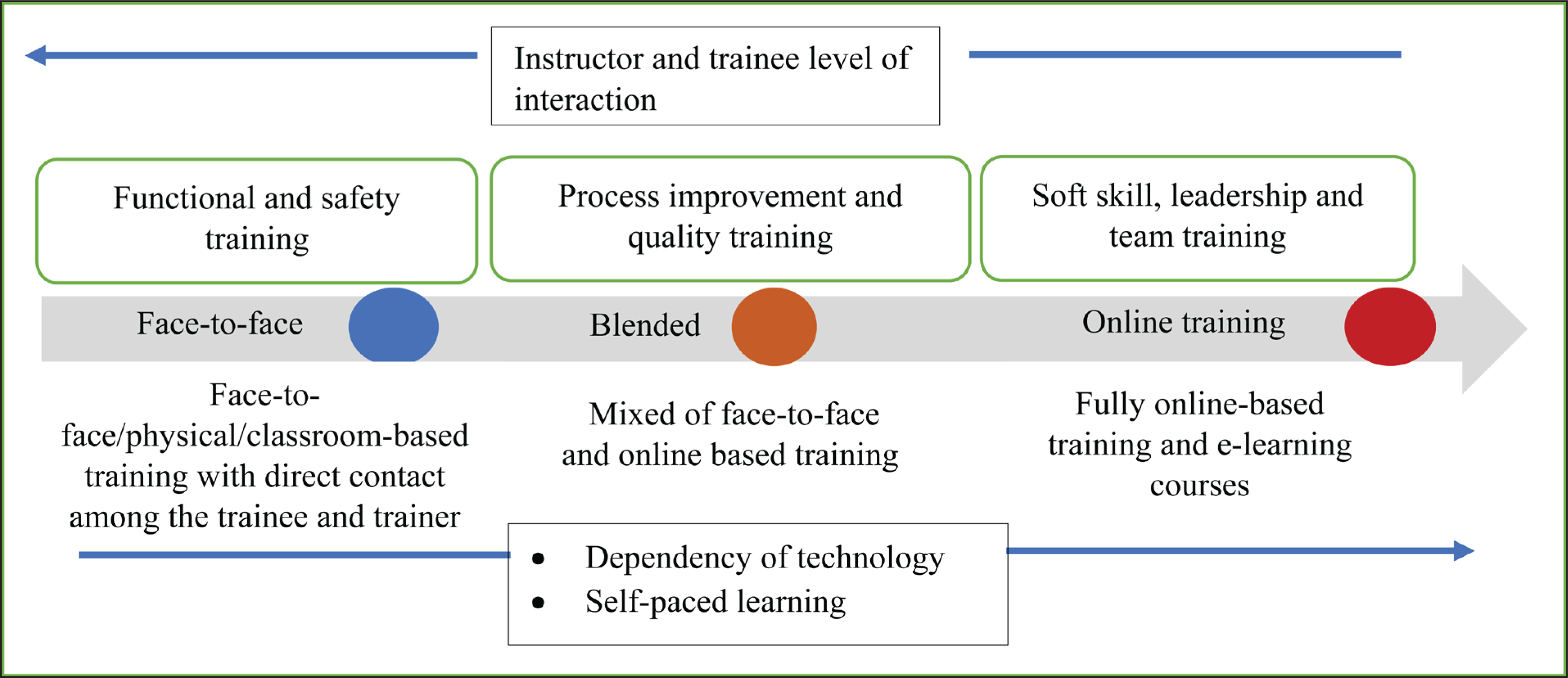
In this COVID situation, organizations are considering online-based training as the most suitable training mode. Previously organizations used to consider the online mode only for leadership or soft skill-based training, but due to the COVID crisis, organizations had to reconsider their learning and development approaches. From 2020 onwards, organizations are now considering fully online-based training for process improvement and quality safety as well as functional or technical capacity-building programmes.
Furthermore, as the expectation and requirement of employee development dimensions were reshaped by the pandemic event, many employees needed to be upskilled, reskilled or multi-skilled for the sustainability and work processes transformations. Upskilling and reskilling the employees was essential for HR to overcome the digital skill gaps and encourage employee engagement. As work processes had gone through transformations HR had to ensure the same employees can carry out the same job responsibilities in different ways by upskilling and reskilling them accordingly. With proper functional training, on-the-job training and soft skill developments along with online training sessions and programmes, HR contributed not only to continuous workforce development but also to the process improvement and raised workforce sustainability concerns.
e-Recruitment During the Pandemic
To keep the workflows vibrant and for enabling or improving employee capabilities as well as motivating them, the HR department adopted multidimensional online services for securing employee development even amidst pandemic drawbacks. Even recruitment activities have seen online transformational efforts following the pandemic measures and virtual work practices. Faisal, an HR manager described the situation as following:
To keep our employees productive during the pandemic time, we used online software and tools to hold webinars and training sessions. Besides usual Zoom or Google meets, our organization managed work monitoring and employee development programmes mostly through Microsoft Team, Zoho Remotely or Cisco Webex programmes. It was a bit complicated to bring all employees on board with these programmes virtually, so using different apps or software based on the suitability of different departments, I think we were successful at reaching respective employees. Also, for the recruitment process during the pandemic, we used Zoom, Skype or Harver software to carry out virtual interviews and assessment processes for evaluating candidates online. We even offered online-based virtual internship programmes for hiring new talents and maintaining work effectiveness in the event of the pandemic. (Respondent_02, Dhaka)
Leave, Isolation and Quarantine Policies
Leave policies and practices which differ from company to company and industry to industry have some common set of standards set by the government of each country. The organizations’ policies regarding leave and support may vary considerably based on factors such as the employer’s demographics, geography and industry.
During COVID-19, there was a huge shift in business organizations’ HR plans and policies. Companies were addressing leave policies in a less aggressive manner but considering each leave application with urgency. Organizations are now addressing leave and employee support policy while recognizing the change in workforce demographics like work from home office and day gap between each office period of certain departments. Providing alternative scheduling and flexible hours has become peripheral points for remote workers. Some companies in Bangladesh allow their employees to take their PTO or vacation or sick leave before they move to unpaid status. Depending upon employees’ compensation and other status, employees are offered to make different choices about deferring available paid time off or taking it immediately.
All the respondents in this study mentioned that their organizations provided paid leave to COVID-infected employees and also ensured quarantines for COVID exposed employees to prevent the spread of this contagious disease. In this case, the Directorate General of Health Services, Ministry of Health and Family Welfare and the Government of Bangladesh have also provided some health guidelines. Complying with government rules, organizations have been following those guidelines for defining employee leave, attendance, quarantine and isolation.
Additionally, organizations are now required to fully comply with government instructions and guidelines for international and domestic travel and maintaining compulsory quarantine at their own or institutional expense after any international travel.
Changes in Compensation and Benefits
COVID-19 has forced almost every company to adopt strategies to avoid major business loses and economic downturns. Though denying bonuses, cut-offs and lay-offs (Kumar, 2021) during the pandemic became very common in Bangladesh during March–April 2020. Findings confirmed that some employers wish to conserve cash for operations to avoid layoffs by implementing a broad-based salary reduction programme.
Out of 17 respondents, 14 reported that they experienced temporary salary cuts due to the pandemic in 2020. As their incomes were impacted during this health and economic crisis, around 71% of the respondents who faced pay cuts mentioned that they see it as organizational injustice. Research results suggested that this eventually impacted employee loyalty. Though a salary reduction arrangement should not include a commitment or guarantee on the part of the employer to pay the foregone amounts in future unstable situations like COVID-19.
Though initially some organizations had to reduce their financial benefits, most of them introduced emergency support such as free COVID tests and other medical tests related to COVID, regularly providing masks, hand gloves and other health and safety protection equipment as per job characteristics.
Employee Heath, Emotional and Social Well-being
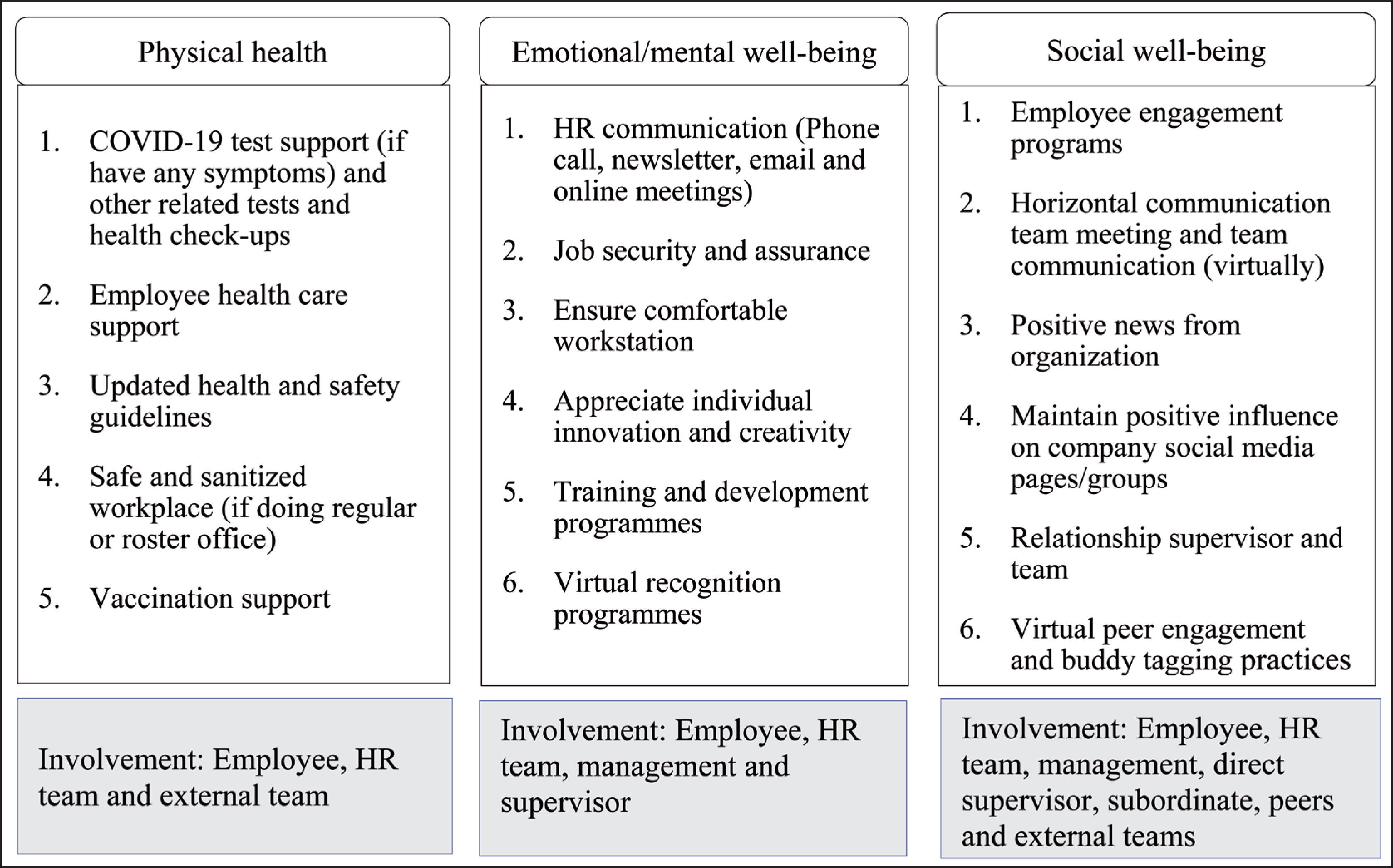
Employee individual and social well-being practices reflect the organizational culture and also provides a significant completive advantage to any organization. It is directly related to employee performance, motivation, commitment and engagement. This pandemic imposed numerous consequences for health, emotion and well-being worldwide; therefore, employee individual and social well-being is one of the main concerns of HR managers now. During the COVID-19 pandemic, organizations have been trying to reduce burnout and stress at remote work or roster work and employee well-being programmes, which essentially helped them reduce the crisis.
According to the interview analysis, HR communication, team meeting and communication, job security and assurance, employee health and emotional well-being programme, COVID-19 related health and safety guidelines and employee engagement programmes were mentioned as the key factors which influence employee individual and social well-being. Types and agendas of employee health, emotional and social well-being are explained in Figure 2.
In this regard, the HR manager mentioned that,
With a strong commitment to safeguarding our employees’ health and wellbeing, from March 2020 our HR and admin team, doctors and EHS team are conjointly conducting interactive corona awareness campaign at our factory premises. We are also arranging online COVID and mental health awareness programmes for the executives, managers and above. This three-dimensional awareness programme (monitor and corrective measures) helped us to implement workplace safety. We are providing surgical masks, hand gloves and hand sanitizers to the employees. (Respondent_02, Dhaka)
Final Thoughts
The unforeseen COVID-19 pandemic situation and its consequences placed heavy stress on organizational activities. The fast adoption of technology essentially helped the organizations to continue their operation during these lockdowns due to the COVID-19 pandemic. Many organizations introduced e-recruitment and virtual internship programmes which are quite new in the Bangladeshi context. The ‘new normal’ situation and its requirements changed or reshaped many of usual HR practices but revamping them with the help of online tools benefitted the organizations to control or handle the pandemic adversities with consistent productivity.
From the diverse industry scenario, it becomes more apparent that though the contemporary business activities are dominated by technological interventions, the pandemic event accelerated the demand for vigorous technological adaptations and implementations through remote work, virtual communication and software-based digital team management concepts. In order to survive and grow businesses along with managing human capital with the best effectiveness, it is crucial for present-day HR managers to comprehend and improvise pandemic or other adversities with substantial technological implementation and adaptations.
Despite the pandemic hardships, organizations managed to secure continuous workforce development processes with the help of technological supports like online training methods and learning processes. With the effective process, policy improvement and measures, organizations introduced new aspects in the organizational context to enhance human resource potentiality and sustainability which also brought many changes in organizational culture.
Besides the HR strategies and managerial implications, the context or environments in which HR managers operate became convoluted because of the socio-economic impact of the pandemic situation. As a result, patterns of career development, talent or personal/professional development have changed as the industry’s best performers and most businesses are demanding more skilled, flexible and technophile workforces for coping with the pandemic tides. At the same time, current job holders and job seekers are worried and concerned regarding how well they fit in such new work environment dynamics while they should develop new professional skills, technical aptitudes and gain substantial competencies to develop proper career plans and to ensure career development accordingly in this transforming time.
As many of the companies are still struggling to keep pace with pandemic hardships and measures while managing their workforce, transformational and changed practices like usage and adaption of online approaches intensely with subsequent training programmes to make employees familiar with the new virtual work environment can present these organization with capacities to escape pandemic strains and deadlocks through reinventing workflows for increasing organizational and workforce productivity. The pandemic event illuminated the needs and significance of new or emerging technologies to power the contemporary hybrid office environments and work processes, nevertheless, though technology-oriented business operation practices have enabled organizations to adopt new processes and strategies, their effectiveness and efficiencies in different aspects are still questionable in the developing country context. Further research exploring issues in ‘new normal’ HR approaches and their impacts on comprehensive organizational efficacy can be useful to understand the latest organizational culture dynamics better.
Theoretical Implication and Significance
The COVID-19 pandemic event drastically affected the functionalities and operations of businesses or other organizations all over the world. Special measures and health guidelines proposed or implemented to prevent this epidemic reshaped and in some extreme cases, halted organizational activities. As this study provides insights on how HR operations and functionalities evolved coping with the pandemic prevention mechanisms, constructive managerial implications and suggestions lie for pandemic stricken struggling organizations.
Within the pandemic global predicament, many organizations failed to cope with adversities and manage human capital effectively. This study’s findings can be worthwhile for the managers and decision-makers to devise reactive and proactive human resources strategies while dealing with the pandemic or any similar inauspicious situations.
For coping with the specific pandemic measures and new normal lifestyles, organizations throughout the globe reorganized, reshaped and transformed their workplace management strategies. Both the managers and employees faced abrupt challenges in their work due to new shifts towards remote working arrangements since 2020, despite their partial or full-time work-from-home dispositions. The key relationship between home and workplace is also stressed out in light of recent events as outside activities now shifted to or mixed with in-home activities, where the home environment is usually and should be shared by other household members with various rages of activities. So, concomitantly, corporate physical workplaces, assistance for working from home, and workplace rules relating to workplace flexibility must be reviewed and adapted to changing work arrangements.
With transformations and introductions of newer trends and practices in the workplace and human resource management, pandemic time workplace strategies evolved newer aspects of human resource management where many reformed approaches seem plausible for further exploitation and increasing productivity or efficiencies. However, transformed HR practices and organizational strategies explored through this study not only enlighten the current transposition in the HRM paradigm but also signify trends, evolution and future aspects of HRM dynamisms that are yet to be carefully evaluated for efficacy.
Limitation of the Study
Despite the organized efforts of exploring remote work and changes in organizational human capital management practices during the coronavirus pandemic, the study is not entirely free from some limitations. The study mostly revealed partial key insights on remote work, tech-centric HR development approaches, compensation, work flexibility and work–life balance as HR issues, whereas broader and integrative structures of HR practice are not overly reconnoitred.
The qualitative approach applied in this study followed in-depth interviews through telephony methods so there is a lack of proper in-person interactions or face-to-face rapport building with the respondents intricated data collection to some extent.
Moreover, coronavirus pandemic is a recently emerged phenomenon, impacts of which in different aspects are not yet profoundly determined and explored in the concurrent literature or studies. For instance, in the developing country context, not much definitive literature or previous researches are available on transformed or remote work and changed HR practices. However, though by investigating and summarizing literature of relevant pre-existing researches no concrete and conclusive research gaps were found, this study can be referential for further researches and may serve as a pioneer to lay paths for exploring new vistas of knowledge on HR practices and dynamics in a pandemic or any challenging situation.
Footnotes
Declaration of Conflicting Interests
The authors declared no potential conflicts of interest with respect to the research, authorship and/or publication of this article.
Funding
The authors received no financial support for the research, authorship and/or publication of this article.