



Abstract
This study examines how external environmental factors affect the motivation of first- and second-generation women entrepreneurs in India, and how their generational status moderates this relationship. We used a survey design method to collect data from 459 women business owners in India, who were classified as first- or second-generation based on whether they were the first or second generation in their family to start a business. We employed the partial least-squares structural equation modelling method to test our hypotheses and evaluate our model. We found that external environmental factors, such as education and training, financial support, government policies and non-financial support, had positive effects on entrepreneurial motivation for both groups of women entrepreneurs. However, we also found that generational status had a significant moderating effect on the link between education and training and entrepreneurial motivation, but not on the other three external environmental factors. Specifically, we found that education and training influenced second-generation women entrepreneurs more strongly than first-generation women entrepreneurs. Our findings have important implications for management practice and policymaking, as well as for the literature on women entrepreneurship. We suggest that concerned authorities should develop differential strategies for first- and second-generation women entrepreneurs, taking into account their different responses to external environmental factors. We also suggest that future research should explore other internal and external environmental factors that might interact with generational status or other variables to shape women entrepreneurs’ motivation.
Keywords
Introduction
Women entrepreneurs are not only economic engines, driving financial independence and societal empowerment, but also crucial actors in social development (Vossenberg, 2013). Yet, their entrepreneurial journeys are significantly shaped by external environmental factors, such as access to finance, social support, market opportunities and institutional policies (Koneru, 2017; Kumbhar, 2013; Sarfaraz et al., 2014). These factors profoundly impact their motivation to start and sustain businesses, a vital ingredient for entrepreneurial success (Tulus, 2009; Yadav & Unni, 2016). Therefore, understanding the interplay between environmental factors and women entrepreneurs’ motivation is crucial for organizations aiming to effectively support their endeavours (Sharma, 2013).
While existing research has established significant links between external environments and women entrepreneurs’ motivation (Bartha et al., 2019; Carsrud & Brännback, 2011; Langowitz & Minniti, 2007; Rahman & Day, 2012; Segal et al., 2005; Shane, 2003; Solórzano-García et al., 2020), a critical gap remains, ignoring the potential moderating role of generational status. This refers to whether a woman entrepreneur is a first-generation entrepreneur in her family, breaking new ground, or a second-generation entrepreneur, building upon family legacy. This distinction holds potential significance in shaping the nature and degree of motivation they experience, as well as the specific challenges and opportunities they encounter in the entrepreneurial ecosystem.
India, with its rapid economic growth and diverse population of women entrepreneurs (GEM, 2020), offers a compelling context to explore this gap. However, it also grapples with significant gender disparities in education, employment, health and social norms, which can influence women’s entrepreneurial aspirations and outcomes. Unravelling how these environmental factors and generational status interact to influence women entrepreneurs’ motivation in India can provide invaluable insights for policymakers, practitioners and researchers to better support and empower this critical segment of the economy.
This study aims to fill this critical knowledge gap by examining the moderating effect of generational status on the relationship between external environmental factors and women entrepreneurs’ motivation in India. By doing so, it seeks to make a distinct contribution to the field of women’s entrepreneurship studies by offering a nuanced understanding of this complex interplay in a context characterized by both immense potential and persistent challenges.
Literature Review
Women Entrepreneurial Motivation as Outcomes of External Environmental Factors
Entrepreneurial motivation is the driving force that leads individuals to pursue entrepreneurial opportunities and overcome the challenges associated with them (Carsrud & Brännback, 2011). Women entrepreneurs, in particular, face various barriers and constraints in their entrepreneurial endeavours, such as lack of access to finance, education, training, markets, networks and social support, as well as gender discrimination, cultural norms and legal restrictions (Brush et al., 2009; Kabeer, 2017; Koneru, 2017; Sarfaraz et al., 2014). These factors constitute the external environment of women entrepreneurs, which can either facilitate or hinder their motivation to start and sustain their businesses.
The external environment of women entrepreneurs can be understood from an institutional perspective, which views institutions as the rules of the game that shape human interaction and behaviour (North, 1990). Institutions can be formal or informal, and they can create incentives or disincentives for entrepreneurial activity (Quagrainie, 2016). Formal institutions include laws, regulations, policies and programmes that govern the economic, political and legal aspects of entrepreneurship. Informal institutions include norms, values, beliefs and attitudes that influence the social and cultural aspects of entrepreneurship. Both formal and informal institutions affect women entrepreneurs’ motivation by providing opportunities, resources, support, recognition and legitimacy for their businesses (Amine & Staub, 2009).
Previous studies have empirically examined the impact of various external environmental factors on women entrepreneurs’ motivation across different contexts and settings. For instance, Eijdenberg et al. (2015) classified these factors into three categories: individual characteristics, life-path conditions and environmental elements. They found that environmental elements such as market demand, competition, infrastructure and government support were significant predictors of women entrepreneurs’ motivation in Tanzania. Similarly, Rashid et al. (2015) identified four dimensions of the external environment that influenced women entrepreneurs’ motivation in Pakistan: education and training, financial support, government policies and non-financial support. They found that all four dimensions had a positive effect on women entrepreneurs’ motivation. Moreover, Ming-Yen and Siong-Choy (2007) investigated the role of external environmental factors such as family support, social networks, role models, market opportunities and government assistance on women entrepreneurs’ motivation in Malaysia. They found that family support and social networks were the most important factors affecting women entrepreneurs’ motivation. As a result, we put out the below list of hypotheses.
H1a: Education and training have a positive effect on women entrepreneurial motivation.
H1b: Financial support has a positive effect on women entrepreneurial motivation.
H1c: Government policies have a positive effect on women entrepreneurial motivation.
H1d: Non-financial support has a positive effect on women entrepreneurial motivation.
Moderating Effect of Generational Status on Women Entrepreneurial Motivations
However, most of these studies have assumed that the external environment affects all women entrepreneurs equally, regardless of their generational status. Generational status refers to whether a woman entrepreneur is the first or second generation in her family to start a business. This distinction may have implications for the level and type of motivation that women entrepreneurs experience, as well as the challenges and opportunities they face in the entrepreneurial environment. For example, first-generation women entrepreneurs may have higher levels of intrinsic motivation than second-generation women entrepreneurs because they are driven by their personal aspirations and passions rather than by family expectations or traditions (Gupta et al., 2008). On the other hand, second-generation women entrepreneurs may have higher levels of extrinsic motivation than first-generation women entrepreneurs because they are motivated by external rewards such as income, recognition or status (Gupta et al., 2008). Furthermore, first-generation women entrepreneurs may face more difficulties in accessing finance, education, training, markets, networks and social support than second-generation women entrepreneurs because they lack the inherited resources and connections that can facilitate their entrepreneurial endeavours (Danes et al., 2008). Conversely, second-generation women entrepreneurs may face more pressure and competition from their family members or peers than first-generation women entrepreneurs because they have to prove themselves worthy of their inherited legacy or reputation (Danes et al., 2008).
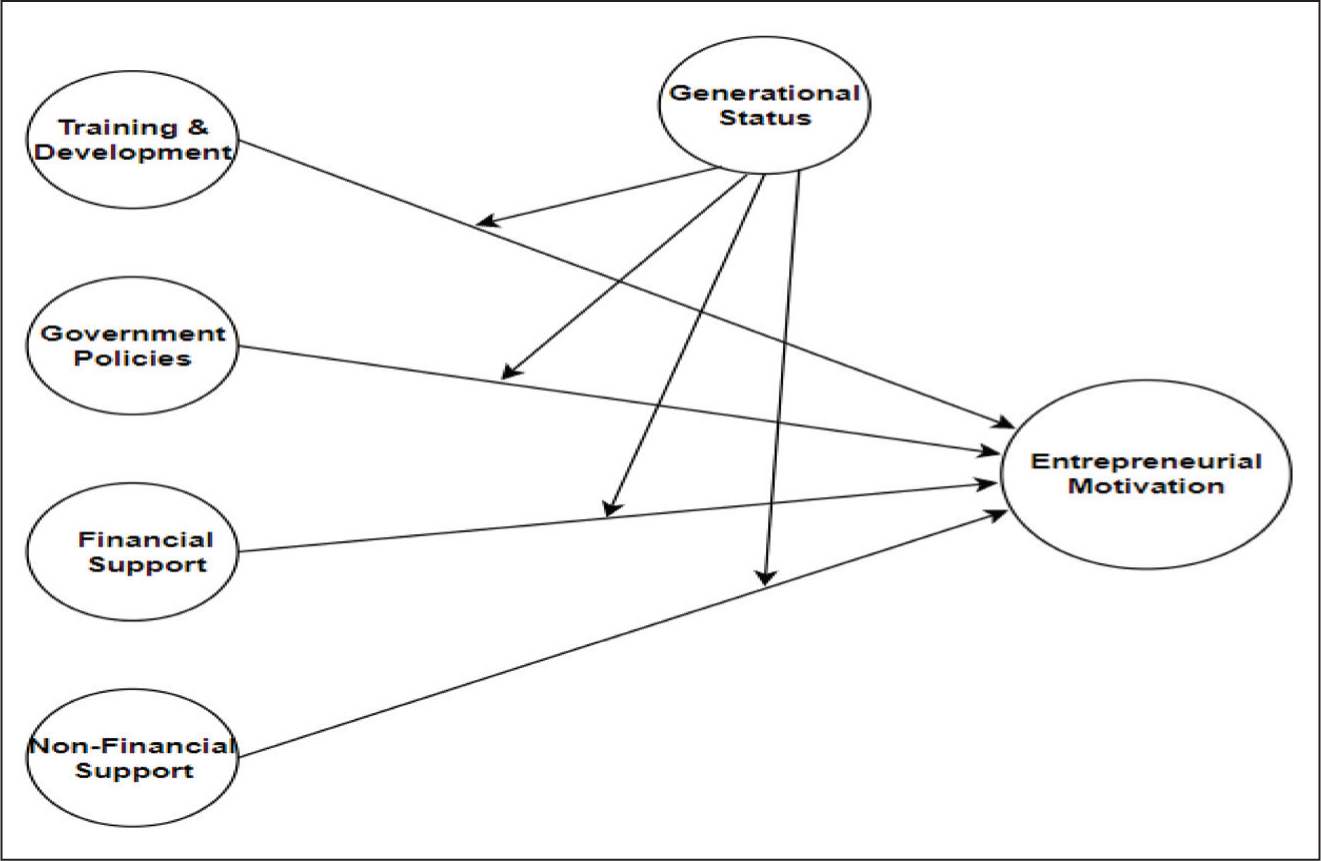
Therefore, it is important to examine the moderating role of generational status on the relationship between external environmental factors and women entrepreneurs’ motivation. This will help to understand how different groups of women entrepreneurs perceive and respond to their external environment, and how their motivation can be enhanced or hindered by different institutional factors. To date, only a few studies have addressed this issue. For example, Moses et al. (2016) compared the effects of external environmental factors such as government policies, financial support and market opportunities on the motivation of first- and second-generation women entrepreneurs in Nigeria. They found that government policies had a stronger effect on first-generation women entrepreneurs than on second-generation women entrepreneurs, while financial support had a stronger effect on second-generation women entrepreneurs than on first-generation women entrepreneurs. Market opportunities had a similar effect on both groups of women entrepreneurs. Based on the explanation above, it is acceptable to assume that generational status moderates the link between the external environmental determinants and women’s entrepreneurial motivation, in spite of solid empirical data about the extent of these moderating effects. The link between the external environmental factors and women’s motivation for entrepreneurship has to take into consideration the moderating influence of generational status, and the following hypotheses are postulated.
H2a: Generational status moderates the effect of education and training on women’s entrepreneurial motivation.
H2b: Generational status moderates the effect of financial support on women’s entrepreneurial motivation.
H2c: Generational status moderates the effect of government policies on women’s entrepreneurial motivation.
H2d: Generational status moderates the effect of non-financial support on women’s entrepreneurial motivation.
Methods and Materials
Sampling Design
This study employed a purposive sampling approach to select participants who met specific criteria relevant to the study’s objectives. Recognizing the limitations of unavailable sample frames due to confidentiality concerns, we carefully identified and contacted 1,000 women entrepreneurs in India who fulfilled the following criteria:
Women business owners in India with at least three years of business experience. This threshold ensured they had navigated initial challenges and achieved some level of success, providing valuable insights beyond the start-up phase. Our study specifically focuses on generational status (first-generation vs second-generation entrepreneurs) as a key moderating factor in the relationship between external environmental factors and entrepreneurial motivation. This distinction holds particular importance in the Indian context because first-generation entrepreneurs may face more significant hurdles in accessing financial resources, family support and business networks compared to their second-generation counterparts. Additionally, societal expectations surrounding women’s entrepreneurial pursuits may differ across generations, potentially influencing motivation and perceived challenges.
We obtained their contact information from various sources, such as online directories, social media platforms and referrals from other entrepreneurs. We sent them an email invitation to participate in the study, along with a link to the online survey. We followed up with two reminders after one week and two weeks, respectively. Out of the 1,000 women entrepreneurs contacted, 459 responded to the survey, resulting in a response rate of 45.9%. We checked the data for missing values, outliers and normality, and found no major issues that required data transformation or deletion. The final sample consisted of 459 women entrepreneurs from various sectors, such as manufacturing, services, retail and education.
We acknowledge the limitations of generalizability due to sampling methods and suggest future research using more robust, random sampling techniques to validate and expand upon our findings.
Measurement Scales and Validation
We employed validated 5-point Likert scales to measure key constructs, with 1 denoting strong disagreement and 5 signifying strong agreement. Some items were adapted from existing scales (Gnyawali & Fogel, 1994; Suzuki et al., 2002) to reflect the Indian context and specific constructs of interest:
Education and training: This dimension captures aspects like participation in business model contests and entrepreneurship training programmes. Financial support: Items assess the availability of low-interest loans, credit guarantees and other financial resources. Government policies: This factor evaluates the perceived ease and benefits of government policies related to business registration, taxation and support programmes. Non-financial support: Elements like access to communication networks, data resources and government research funding are included. Entrepreneurial Motivation: This construct is measured using statements like ‘entrepreneurship empowers me’ and ‘can boost my social standing’.
To ensure the reliability and validity of modified scales, we conducted thorough testing using Cronbach’s alpha, composite reliability, convergent validity and discriminant validity measures. All scales met acceptable thresholds, confirming the modifications did not compromise their psychometric properties.
Common Method Variance (CMV) Mitigation
Recognizing the potential for CMV when respondents provide data for all constructs, we implemented several procedural remedies:
Differentiated scale labelling and item placement: Questions measuring different constructs were strategically located throughout the survey to minimize response bias. Multiple statistical techniques: We employed tests like Harman’s single-factor test, marker variable technique and common latent factor technique to assess and ensure CMV was not a significant concern in our data.
This comprehensive approach to data collection, measurement and mitigation of potential biases strengthens the foundation of our research and allows for reliable exploration of the complex interplay between environmental factors, generational status and women entrepreneurs’ motivation in India.
Data Analysis Methods
To predict and evaluate the model, we employed the partial least-squares structural equation modelling (PLS-SEM) method. More precisely, we used the SmartPLS3 programme created by Ringle et al. (2015). The PLS-SEM approach was appropriate for this investigation because it is suitable for exploratory research, complex models, small to medium sample sizes, and non-normal data (Hair et al., 2017). These characteristics matched our research context, as we aimed to explore a relatively new phenomenon, test a moderating effect, use a purposive sample approach, and deal with ordinal data. Moreover, the PLS-SEM approach allowed us to assess both the measurement model and the structural model, as well as the model’s predictive relevance and effect sizes (Hair et al., 2017). We followed the guidelines and criteria suggested by Hair et al. (2017) to evaluate the quality and validity of our PLS-SEM results.
Results and Discussion
Analysis of Sample Profile
Five hundred forty-nine women entrepreneurs were included in the valid sample, which is a sufficient sample size (Sander & I, 2014). Table 1 displays the demographics of the sample of female entrepreneurs. Approximately, 88% of the sample’s 459 respondents, or a slim majority, are married. A 44% majority of them fall within the 31–40 age range regarding their age distribution. Since 51% of women entrepreneurs possess graduate degrees, 28% hold postgraduate degrees, and 17% carry diploma-level credentials, found healthy dispersion amongst women entrepreneurs in their educational qualification. Approximately, 66% of participants claim to live in a rural location, which is a substantial proportion. Finally, 56% of the respondents are first-generation entrepreneurs, and the remaining 44% are second-generation entrepreneurs.
Respondents Demographic Summary.

The descriptive statistics for several constructs are shown in Table 2. Regarding the entrepreneurial external environmental factor, the mean scores range from a minimum of 3.53 to a high of 3.73. The range of the correlation coefficients between the various constructs, from 0.348 to 0.75, shows a variety from a moderate link to a high one.
Descriptive Statistics of Constructs Used in the Study.

Measurement Model
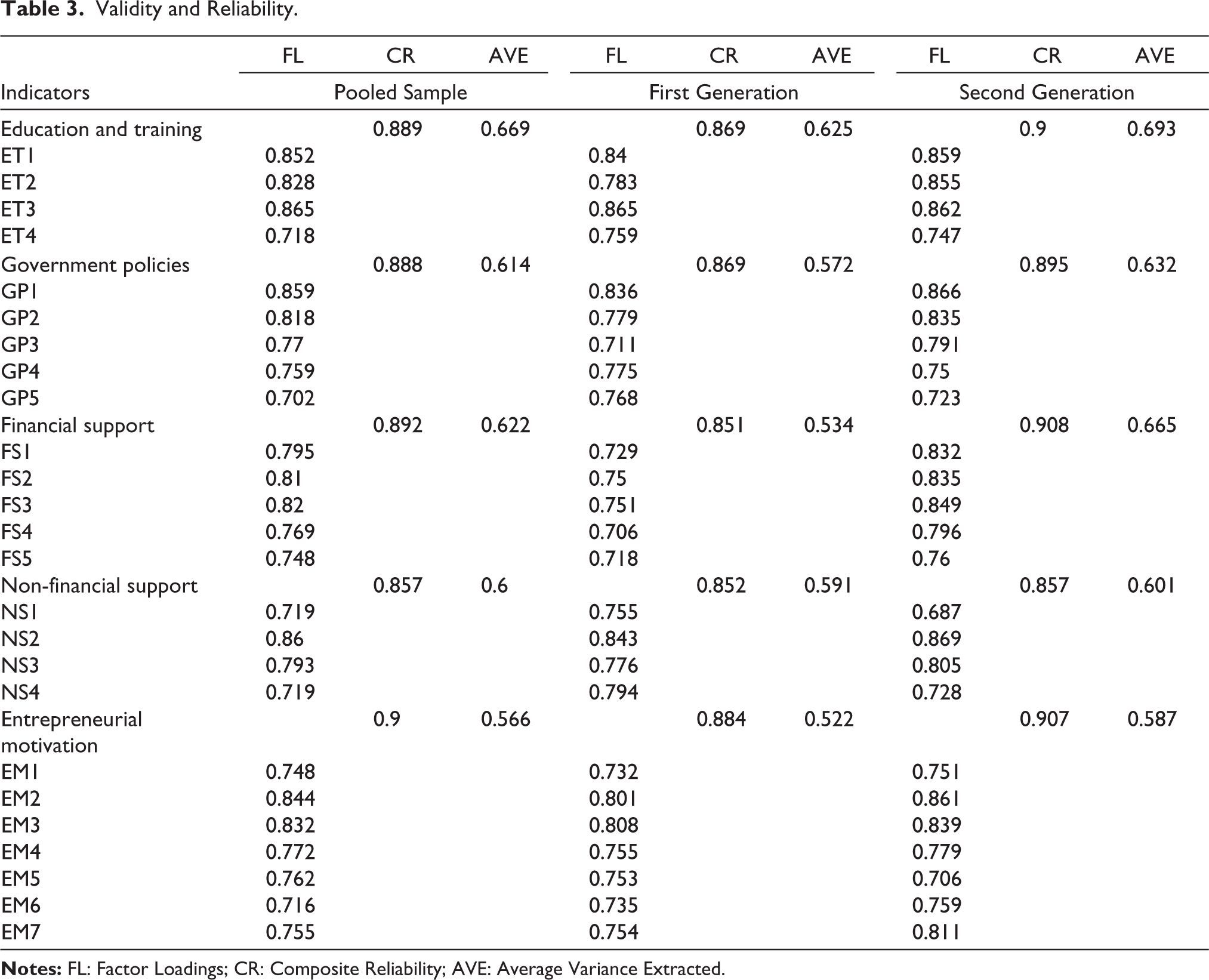
Measurement model was primarily evaluated for the combined sample (Hair et al., 2013). Table 3 displays the average variance extracted (AVE) data, composite reliability (CR) and outer loadings. The AVE and CR scores exceeded their respective cutoff points of 0.50 and 0.70, and each outer loading value was above the 0.70 criterion, demonstrating that the measurement methodology was reliable internally (Fitzner, 2007). Additionally, AVE and CR results demonstrated the convergent validity of the measurement methodology (Sapp & Harrod, 1993; Thanasegaran, 2009; Yaacob et al., 2021).
Validity and Reliability.
Using the heterotrait–monotrait ratio (HTMT) of the correlations, we evaluated the discriminant validity in the manner of Henseler et al. (2015). The fact that all of the HTMT ratios were below 0.85 indicates that the measurement model attained discriminant validity. We tested for measurement invariance between the first-generation and second-generation entrepreneurs concerning the various constructs using the MICOM approach, which Henseler et al. (2016) devised. Three steps make up the MICOM procedure: configurational invariance, compositional invariance and homogeneity of the composite mean values and variances (Matthews, 2017; Moon, 2021).
The validity and reliability metrics for the first-generation and second-generation samples were determined to be good after a separate evaluation of the measurement models (Table 3). Therefore, the latent variable scores might be estimated using the same indicators. Additionally, we employed the same data processing, algorithm settings and optimization standards. As a result, configurational invariance was confirmed for the list of requirements given by Hair Jr et al. (2017). Consequently, compositional invariance could be checked. The permutation test’s outcomes, shown in Table 5, demonstrate that compositional invariance was demonstrated for each construct.
Assessment of Path Coefficients
After confirming that the measurement models were accurate and dependable and that measurement invariance could be proven, we evaluated the structural model. The range of the Variance Influence Factor (VIF) values, from 1.233 to 2.347, was tested to make sure there were no collinearity problems. All VIF values are below the cutoff of 5 (Hair et al., 2013), which demonstrates that collinearity problems are not present. The investigator kept an eye on the composite to make sure it was a single construct object with the same nomological net in each group (Henseler et al., 2016). As a result, configural invariance is proven.
Considering compositional invariance, the phenomenon that occurs when composite scores are produced evenly amongst groups, is the goal of the MICOM procedure’s second stage (Matthews, 2017). The MICOM findings report for the second stage demonstrates that compositional invariance has been proven for all structures. This is clear from the fact that the initial correlations were at least as high as the 5% quantile correlations.
The first section of the results is displayed in Table 4a. In this stage, we evaluate how evenly distributed the mean values and variances are throughout the groups in the composites (constructs). If the mean original difference is a value between the lower and upper limits, then the first criterion of Step 3 has been satisfied, giving strong indications of invariance (Moon, 2021). All of the constructions in Table 4a pass this part of the invariance test.
Composite Equality—Mean Original Difference.

Table 4b displays the second part of the MICOM step 3 findings. All of the constructs’ variance original difference values are within the 95% confidence limit. In this phase, all the constructions did adhere to the requirements for proving complete invariance. As a result, this construct’s complete invariance is supported (Carranza et al., 2020; Kaur & Kaur, 2022).
Composite Equality—Variance Original Difference.

The outcomes of the route connections for the two subgroups are shown in Table 5. The structural models for the first-generation and second-generation samples have R2 values that vary from 0.373 to 0.644. Thus, we may conclude that the both the sample group of PLS path models had respectably powerful explanation (R2) (Green et al., 1996). According to the findings, there is statistically substantial evidence that financial support has a favourable direct influence on women’s entrepreneurial motivation in both the pooled sample and the samples from the first and second generations. However, inconsistent results are found regarding the direct impacts of education and training on the entrepreneurial drive of women. The pooled sample and the second generation of women entrepreneurs both experienced significant positive effects from education and training (ET) on their motivation to start their own businesses (T statistics = 2.145, p value = .014). However, the effect was insignificant for the first-generation sample (T statistics = 1.734, p value = .087). The findings show statistically significant effects on women’s entrepreneurial motivation for all samples for the government policies dimension (GP). Finally, yet importantly, the bootstrapping findings in Table 6 show that while in the pooled sample, non-financial support is shown to have a massive impact on first-generation and second-generation samples of female entrepreneurs’ entrepreneurial motivation, the effects are found to be significant.
The Structural Models for the First-generation and Second-generation Samples.

The Permutation p Value of Two Interest Groups.

When the permutation p value is .10 or below, there is a substantial difference between the two interest groups. According to the link between education and training and women’s entrepreneurial motivation, first-generation and second-generation entrepreneurs differ significantly. The permutation p value of .08 in Table 6 demonstrates this observation.
Using the information from the group-specific bootstrapping as well as the aforementioned permutation test, we can now conclude that there is a large difference between first-generation and second-generation entrepreneurs when it comes to education and training and women’s entrepreneurial motivation. However, the research found no statistically significant variations among the path coefficients for the impacts of financial support, government policies and non-financial support on women’s entrepreneurial motivation. We found that the generational status of women entrepreneurs’ moderating influence is statistically significant for one external environmental variable but not the other three, leading to conflicting results. The PLS-MGA and permutation tests are in favour of the hypothesis that the link between education and training and entrepreneurial motivation is moderated by generational status. Additionally, both tests demonstrate that generational status does not moderate the effects of the other three external environmental factors. Therefore, H2a is supported, whereas other hypotheses H2b, H2c and H2d are not.
IPMA for First-generation and Second-generation Entrepreneur Groups
We adhere to Su and Cheng (2019) guidelines regarding the importance-performance map analysis (IPMA) process. The IPMA results for the group of women entrepreneurs in the first and second generations are displayed in Figure 2. We conducted IPMA at the indicator level to find particular indicators targeted at practical interventions. Given that only financial support, government policies and non-financial support was found to be a significant predictor of entrepreneurial motivation for the first-generation women entrepreneurs, we only include its indicators in the first-generation women entrepreneurs’ sample—IPMA. Relative to the first generation of women entrepreneurs, the second generation of women entrepreneurs’ sample (IPMA) includes all indicators of those dimensions because it was determined that all external environmental factors (education and training, financial support, government policies and non-financial support) had a significant impact on entrepreneurial motivation. The indicators in the lower right corner (priority quadrant), notably those with above-average relevance (as shown by their respective total impacts) and below-average performance, have a significant potential to increase the outcome variable scores (as indicated by the average score scaled to 100) (Tailab, 2020). Therefore, the priority quadrant indicators have the most potential for raising the degree of entrepreneurial motivation among women business owners. As shown in Figure 2, one indicator of financial support, two indicators of government policies and one indicator of non-financial support all fall into the priority quadrant for the first generation of women entrepreneurs in the IPMA: FS2, GP2, GP3 and NS4, respectively. Two indicators of education and training (ET1, ET3), one indicator of financial support (FS3), one indicator of government policies (GP5), and one indicator of non-financial support (NS3) have exceptionally powerful impacts (importance) and occupy a priority quadrant concerning the sample of second-generation women entrepreneurs.
Conceptual Framework.
IPMA of First-generation and Second-generation Women Entrepreneurs.

Discussion
The main implication of our research is that it provides a deeper understanding of the factors that influence women entrepreneurs’ motivation in India, especially the role of generational status. By comparing and contrasting the differences and similarities between first-generation and second-generation women entrepreneurs, we offer a more nuanced and comprehensive picture of the diversity and complexity of women entrepreneurship in India. Our findings suggest that generational status moderates the relationship between education and training and entrepreneurial motivation, but not the other external environmental factors. This implies that education and training are more important for second-generation women entrepreneurs than for first-generation women entrepreneurs in terms of enhancing their motivation to start and run a business. Therefore, we recommend that policymakers and practitioners should design and implement more effective and tailored education and training programmes for women entrepreneurs, taking into account their generational status and specific needs and preferences. Such programmes could help women entrepreneurs acquire the necessary knowledge, skills and competencies to overcome the challenges and barriers they face in the entrepreneurial environment, and to pursue their entrepreneurial goals and aspirations more confidently and successfully (Figure 1).
Another implication of our research is that it highlights the significance of the external environment for women entrepreneurs’ motivation, regardless of their generational status. Our findings indicate that financial support, government policies and non-financial support are all positively associated with women entrepreneurs’ motivation, suggesting that these factors play a vital role in facilitating and fostering women entrepreneurship in India. Therefore, we suggest that policymakers and practitioners should create and maintain a more conducive and supportive external environment for women entrepreneurs, by providing them with adequate and accessible financial and non-financial resources, and by implementing more favourable and inclusive policies and regulations for women entrepreneurship. Such actions could help women entrepreneurs overcome the financial and institutional constraints and challenges they face in the entrepreneurial environment, and to pursue their entrepreneurial opportunities and ventures more effectively and efficiently.
However, we also acknowledge the limitations of our study and the directions for future research. One of the limitations of our study is that we used a purposive sampling technique, which might introduce biases and limit the representativeness and generalizability of our findings. Therefore, we suggest that future research should use more robust sampling methods, such as random or stratified sampling, to obtain a more representative and diverse sample of women entrepreneurs in India. Another limitation of our study is that we focused only on one moderating variable, that is, generational status, which might not capture the full range and complexity of the factors that influence women entrepreneurs’ motivation. Therefore, we recommend that future research should explore other moderating variables, such as age, education level, family background, cultural identity, or sector that might affect the relationship between external environmental factors and entrepreneurial motivation. Furthermore, we propose that future research should adopt a longitudinal or experimental design, to examine the causal effects and the dynamic changes of the external environmental factors and generational status on women entrepreneurs’ motivation over time. Such studies could provide more valid and reliable evidence and insights into the factors that shape and influence women entrepreneurship in India.
Conclusion
This study delved into the motivations driving women entrepreneurs in India, exploring the nuanced interplay between generational status and the external environment. Our findings revealed that:
Generational differences matter: Education and training significantly boost entrepreneurial motivation for second-generation women, highlighting the need for tailored programmes catering to their specific needs. External environment fuels aspirations: Regardless of generation, access to financial support, favourable government policies and non-financial resources universally enhances entrepreneurial motivation. These insights translate into actionable steps for stakeholders: Policymakers and practitioners: Design targeted education and training programmes for second-generation women, while fostering a supportive ecosystem through robust financial aid, inclusive policies and accessible non-financial resources for all women entrepreneurs. Future research: Employ diverse sampling methods and delve deeper into other moderating variables, such as age, education and cultural identity, to enrich our understanding of women’s entrepreneurial motivations across generations.
By considering both generational nuances and the broader entrepreneurial ecosystem, we can empower women across India to pursue their entrepreneurial dreams with greater confidence and achieve sustainable success.
Footnotes
Declaration of Conflicting Interests
The authors declared no potential conflicts of interest with respect to the research, authorship and/or publication of this article.
Funding
The authors received no financial support for the research, authorship and/or publication of this article.