



Abstract
Research on responsible leadership (RL) conceived it as a normative, deliberative and consensus-based approach without offering insights into how responsible leaders deal with the challenges occurring in natural settings that preclude an orderly effort or require immediate responses. With the aim of filling this gap, this study positions RL as the competency to deal with complex, uncertain and paradoxical challenges in business and stakeholder relationships. In this vein, we adopted a narrative reasoning method; integrated the literature on expertise, mindfulness, organizational climate and trust; and built a conceptual model. This study offers insights into how the expertise of leaders becomes indispensable in sensemaking and framing the ill-defined paradoxical challenges involving various stakes, and how the presence of a holistic values climate facilitates a conducive ground to execute competing stakeholders’ goals. This study also explicates the critical role of mindfulness in offsetting the limitations associated with these factors, which consequently assist responsible leaders in catering to the salient needs of stakeholders to gain their acceptance and trust.
Introduction
The proliferation of the research on responsible leadership (RL) is an answer not only to the call on rising business malpractices but also to the increasing need to respond to business challenges. Yet, little knowledge exists on how responsible leaders deal with real-world challenges that do not offer a well-defined problem, complete information, or the liberty to consult before making decisions that protect multiple interests (Doh & Quigley, 2014; Waldman et al., 2020). As an integral part of natural settings, uncertainty arises when individuals lack a plausible interpretation of the problem due to insufficient information, whereas equivocality surfaces when multiple interpretations exist and one lacks the understanding to intercede between them. These ill-defined and ambiguous situations often lead to failure in constructing the issue, recognizing the different stakes involved, its ethical and moral content, and its probable far-reaching consequences, leading to strategic failure or ethical lapses. In the case of equivocality, multiple competing stakeholders’ goals and organizational strategies make it difficult for leaders to choose between right and right and simultaneously embed these demands to satisfy conflicting needs. Therefore, due to their abstract and uncertain nature, these challenges often appear in the form of paradoxes or dilemmas (Sonenshein, 2007). Paradoxes are ill-defined problems and contradictions that persist over time and defy resolution, whereas dilemmas involve trade-offs by choosing either/or option and they are strategic, moral, or general in nature (Schad et al., 2016). In organizational life, strategic paradoxes or dilemmas occur while selecting a course of action out of two equally compelling courses, such as choosing between exploration or exploitation. On the other hand, moral paradoxes or dilemmas crop up when one has to choose between two courses of action having an equally legitimate side of truth, such as pursuing profit and purpose together and many other such tensions.
Dealing with paradoxes requires one to embrace the uncertainty and ambiguity and to comprehend these polarizing tensions in the context in which they occur while connecting the unconnected dots and seeing their wholeness. An analytical and deliberative frame of mind (emphasized as a requisite for RL; Miska & Mendenhall, 2018) resolves these problems through a reductionist approach by looking at the problems in isolation, linking facts to logic and thus being uncomfortable with the uncertainty, ambiguity and equivocality that such paradoxes foster (Miron-Spektor et al., 2018). Contrary to this, experts’ intuitions are comfortable with uncertainty and equivocality (Baldacchino et al. 2023; Hall et al., 2015). The intuitive judgment of experts offers shifting and swift solutions to these contradictions based on the holistic association of the elements in the environment in which they occur (Dane et al., 2012). Also, reconciling paradoxes requires a vast repertoire of situational and contextual discrimination to offer a wise solution suitable to the context, which can only be gained through expertise (Sonenshein, 2007; Sternberg, 1998).
Moving beyond the individual approach, an organization’s response to the environment’s inherent interdependent, paradoxical and dynamic nature may offer a realistic view of why some systems survive and flourish while others languish and become extinct. Understanding the different sets of values that organizations inculcate in their climate to pursue goals will be an umbrella approach to answer the strategies they follow; the policies, practices and codes of conduct they implement; and the performance management system they set up. Empirical findings regarding various dimensions of organizational climate predict associated strategic outcomes (Schneider et al., 2013). Building on these arguments, scholars in the field of RL emphasize building an ethical climate as essential in inducing ethical behaviour, considering them equivalent to responsible behaviour (Miska & Mendenhall, 2018; Waldman et al., 2020). Moreover, consistent with the arguments of the competing value framework (CVF; Quinn & Rohrbaugh, 1983), when organizations pursue values from one of the four models of the CVF, such as ethical values, other values and associated goals become a second priority. Given that the responsibility of leaders lies in not only behaving ethically but also responding strategically while balancing multiple paradoxical stakeholder objectives (Waldman et al., 2020), emphasizing a particular value, and thus a particular goal, compromise with other goals (Quinn & Rohrbaugh, 1983). This underscore building a constellation of holistic values climate (Marinova et al., 2019) that not only supports ethical behaviour but also equips employees with the required skills and abilities for innovations, dealing with technological advancement and business challenges while achieving profit.
Paradoxical demands increase the uncertainty and complexity of the environment and make the creation of trust difficult, yet such contexts require more trust (Okoli, 2021). Therefore, when dealt irresponsibly, these paradoxes spur a vicious cycle of intractable conflicts and decreased morale, wherein responsibly dealing with them fuels a virtuous cycle of stakeholder trust and, consequently, cooperation, collaboration and organizational sustainability. Thus, the competency of leaders in dealing with these competing demands may offer a holistic view of how organizations and their leaders garner stakeholder’s trust to ensure mutual sustenance.
Responding to the increasing call (Miska et al., 2020; Voegtlin et al., 2020; Waldman et al., 2020), this study aims to reduce the theoretical blind spots created by the dearth of knowledge on the factors influencing a responsible leader’s capacity to deal with paradoxical demands. Going beyond the normative and deliberative ethics of what leaders should and should not do (Maak & Pless, 2006), we conceive RL as the competency to deal with dilemmas and paradoxical challenges. Also, despite their shared foci in dealing with paradoxes, literature on expertise, climate and trust have been developed in relative isolation, wherein the scholarship in the area of stakeholder trust is limited and in its nascent stage (Burt, 2019; Francisco de Oliveira & Rabechini, 2019). With this rationale, we integrate the literature on expertise, holistic values climate and trust in a novel way and developed a unifying theoretical framework around ‘RL as a competency-based approach towards management of paradoxes to garner stakeholder’s trust’, as depicted in Figure 1. In this model, leaders’ mindfulness offsets some of the limitations of expertise and holistic values climate and works as a boundary condition. The model thus developed retains the ability to offer insights on dealing with not only paradoxes but other challenges emanating in today’s increasingly volatile, uncertain, complex and ambiguous (VUCA) business environment, and it opens up multiple avenues for the organization to train their workforce, especially top leaders, to deal with such environment effectively.
Responsible Leadership: A Competency-Based Approach to Garner Stakeholder’s Trust.
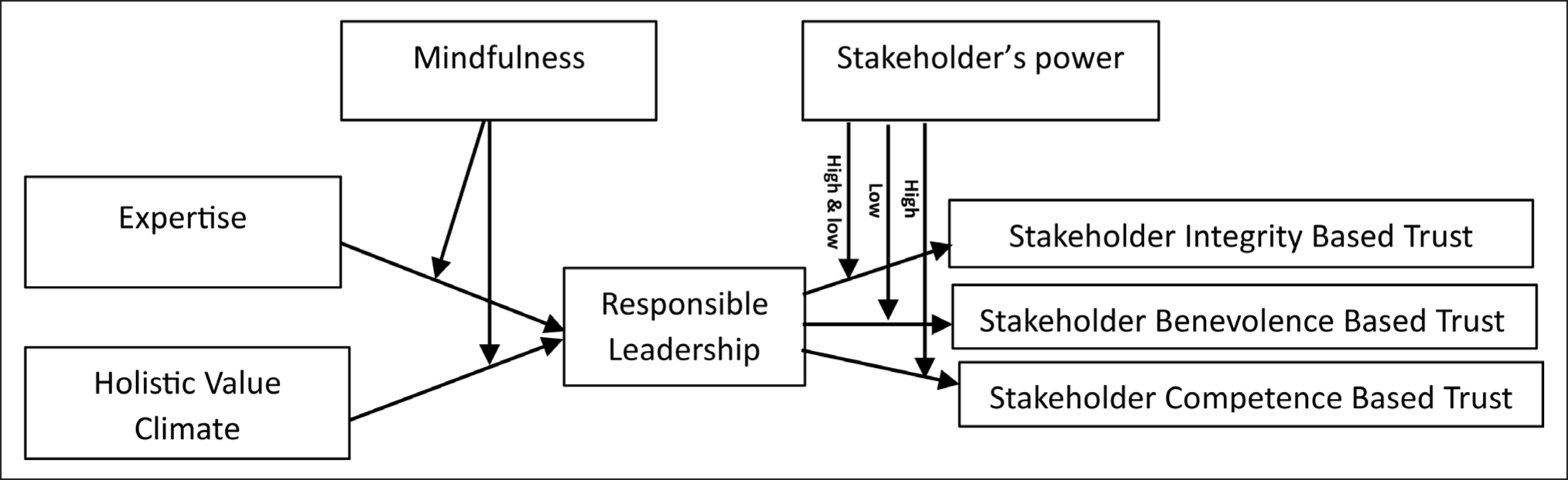
In the first part of the study, we introduce RL as a competency-based approach and discuss the existing state of work done in the field. Further, we introduce expertise, holistic values climate and mindfulness as antecedents of RL and discuss how they influence the competency of leaders to deal with paradoxical demands. In the second part, we discuss how RL, as a competency-based approach, assists leaders in identifying and catering to the salient needs of different stakeholders amid power differentials to gain trust. Next, in the discussion section, we discuss the theoretical and practical implications of this study in various settings, explain the study’s limitations, suggest future research direction and end the paper with concluding remarks.
Design and Methodology
In this conceptual study, we reviewed extant literature dealing with ‘paradox’ in organization-stakeholder relationships. Since the extant knowledge in this area is scattered across multiple disciplines and literature, we adopted a narrative reasoning or theory synthesis approach. This approach allowed us to integrate previously unconnected literature on expertise, mindfulness, organizational climate and stakeholder trust by underscoring their commonalities and offering a parsimonious conceptual framework of ‘responsible leadership as a competency-based approach towards management of paradoxes’. This framework on paradox management thus contributes substantially to the literature of RL and may work as a foundation for subsequent empirical and non-empirical work in this area. Conceptual articles become essential in enhancing the theoretical understanding of the phenomena when the concept or phenomena is theory-light or nascent (in this case, RL towards paradox management; Waldman et al., 2020; Cropanzano, 2009). The adoption of the theory synthesis approach enriches the literature by offering a big picture of the investigated phenomena while excluding incommensurable pieces of literature (Jaakkola, 2020).
Literature Review
Responsible Leadership
RL is defined as ‘an ethical phenomenon’ (Maak & Pless, 2006), ‘a relational influence process between leaders and stakeholders’ and the ‘capacity to reconcile and balance contradictory stakeholder demands’ (Voegtlin et al., 2020; Waldman et al., 2020). RL is different from ethical leadership, servant leadership and authentic leadership. The key difference between RL and the latter value-driven leadership styles is that RL is a broad multivalent leader-stakeholder relationship driven by the ethically consistent, cognitively driven strategic behaviour to generate common value (Agarwal & Bhal, 2020). Initial work on RL centres around normative and deliberative ethics and ethics of care, differentiating integrative responsible leaders from instrumental ones. Including and engaging stakeholders in the decision-making process of conflict resolution and involving oneself in extensive analysis and reasoning to foresee the consequences of one’s decisions are how integrative leaders protect multiple claims and gain stakeholder’s legitimacy. Based on their self-transcendence values (Voegtlin et al., 2020) and stakeholder orientation (Maak et al., 2016), integrative leaders are unanimously considered responsible leaders to deal with business and stakeholder challenges. Amongst individual-level factors, empathy and Machiavellianism (Voegtlin et al., 2020), self-transcendence/self-enhancement values and affect such as positive, negative, guilt and shame (Crilly et al., 2008) influence RL. Proximal contextual factors, such as performance goals, policies and practices, and distal factors, such as organizational culture (Rawshdeh et al., 2019), facilitate or constrain the responsible behaviour and decision-making of leaders. Institutional factors such as culture and economic development (Miska & Mendenhall, 2018) influence the social expectations of responsibility of business leaders and their organizations situated in the context. Further, positive leader-member exchange, person-organization fit and trust in responsible leaders are the mechanism that increases stakeholder’s cooperation and engagement and influence them to role model responsible leaders (Akhtar et al., 2020; Rawshdeh et al., 2019; Voegtlin et al., 2020).
In recent times, looking at the unprecedented level of volatility, uncertainty, complexity and ambiguity (VUCA) prevailing in the business environment, hosting a varied nature of paradoxes and dilemmas requires executives to make real-time decisions under limited resources without the liberty of consultation. Therefore, scholars question the ability of instrumental leaders to deal with such challenges as they tend to eliminate the complexity of the environment by cutting off myriad claims by focusing only on shareholders’ needs and interests (Maak et al., 2016). This suggests a greater need for responsible leaders to deal with complex, uncertain challenges that have potential consequences of redefining stakeholders’ and organizations’ fate (Maak et al., 2016; Miska et al., 2020). However, how these leaders construct such vague and competing demands that defy analysis and linear reasoning is yet to be explored.
Antecedents of Responsible Leadership
Expertise
Expertise is defined as a ‘high level of domain-specific knowledge acquired through experience’ (Dane et al., 2012). It enhances performance, effective decision-making and domain-related memory skills. An expert’s knowledge structure is stored in schemas with multiple attributes or stimuli connected through a network. With the rise in expertise, schemas become more detailed, accurate and complex. Due to high memory skills, similar stimuli stored in schemas are activated when individuals are exposed to specific problems, further guiding their decision-making (Kahneman & Klein, 2009). With the broad range of situational discrimination absorbed over the years, experts can make out even subtle differentiations in the situations, prompting them to an immediate, intuitive situational response. This is why experts are trusted more than novices because of their more-than-often accurate and faster decision-making (Baldacchino et al., 2023; Hall et al., 2015). Although at least a decade of experience is required to be an expert in any domain, the length of experience doesn’t always predict expertise (Dane et al., 2012). One requires continuous practice, training and performance feedback to hone it.
Expertise and Responsible Leadership
The balance theory of wisdom (Sternberg, 1998) asserts that a wise decision that balances multiple interests requires a manager to have a broad tacit knowledge base or a nuanced understanding of different organizational contexts to arrive at a judgment that fits the context (p. 7). Tacit knowledge is procedural knowledge of any domain that is accrued over a period of time and is a hallmark of expertise (Dane et al., 2012), suggesting its salient role in RL.
Further, empirical findings prove that experts employ their implicit knowledge base in such ill-defined and uncertain contexts to pick the relevant cues for making sense of the problem and its interpretation (Kahneman & Klein, 2009). Interview data of 30 firefighters employing a critical incident method surfaces intuitive expertise as the mechanism towards pattern recognition, making sense of urgent situation-sensitive questions in the unfolding moment at the fireground to save people and property (Okoli, 2021). Mergers and acquisitions (M&A) are another field involving significant investments and long-lasting implications. Here also, a tacit knowledge base becomes a saviour in spotting weak signals, anticipating marketplace changes, perceiving invisible situations and getting a vibe of good or bad feelings to make sense of a large amount of data in the successful decisions (Baldacchino et al., 2023). After interpreting and making certain the nature of the problem (strategic or moral), intuition gets invoked to form a judgment about the potential behaviours that seem morally or strategically correct.
However, at this stage, integrating multiple theories, scholars argue that, depending on the context, individuals may also deliberate on the most appropriate and effective responses offered by sensemaking (Hall et al., 2015; Locander et al., 2020) or may involve themselves in (moral) reasoning to justify their behaviour post intuitive judgment (Sonenshein, 2007). To support this, sales personnel who drew on their intuition in adaptive selling contexts could better gaze at the customers’ needs and make faster yet effective decisions (Hall et al., 2015). However, those who revised their intuitive judgments after a prolonged rather than moderate deliberation had lower selling effectiveness, longer selling times and consequently lower selling efficiency. Thus, a vast array of empirical findings from multiple disciplines (Baldacchino et al., 2023; Hall et al., 2015; Locander et al., 2020; Ramiah & Banks, 2015) suggest that expert’s intuition is the only accurate and effective means to frame and resolve problems that are novel and complex or that require an immediate response.
The common denominator of the mentioned contexts is their vagueness, wherein orderly and logical thinking fails to frame or decompose the problems. Therefore, wise decision-making in such contexts requires an expert’s tacit knowledge to identify relevant stakeholders affected by the decision, their stakes involved, the goal, that is, the common good that has to be achieved, and how to accomplish that goal (Sternberg, 1998). Thus, we propose the following:
Proposition 1: Expertise will positively influence RL in dealing with dilemmas and paradoxical challenges emanating from natural organizational settings.
Mindfulness as a Moderator
Mindfulness has its roots in the Buddhist contemplative tradition, and it is defined as receptive attention and awareness of the present moment reality (Kay & Skarlicki, 2020). It is a state of consciousness at the reach of any individual, although some people may be in a state of mindfulness more often than others due to their dispositional tendencies. Mindfulness entails a few key components: mindful attention to the phenomena occurring externally, awareness of the intrapsychic phenomena occurring internally within the individual, and mindful metacognition (Kay & Skarlicki, 2020). Mindful metacognition, also termed as decentring, refers to the detached monitoring of one’s thoughts and emotions (Kay & Skarlicki, 2020). Mindfulness is operationalized at the trait and state levels, and it may be enhanced via mindfulness practices. Mindful individuals are less susceptible to anxiety and stress, and hold higher self-regulatory and cognitive capacities (Kudesia et al., 2020). These individuals are prosocial, empathetic and considerate of others’ perspectives (Good et al., 2016; Pandey et al., 2018). In conflict and disputes, mindful individuals adopt a collaborative approach, and they involve themselves in citizenship behaviour and ethical decision-making in interpersonal situations (Good et al., 2016). Despite having an other-centred approach, these individuals perform at a higher level due to less mind wandering and attending to the goals (Kudesia et al., 2020).
Apart from its benefits, expertise has some limitations as well. Research proves that experts’ intuition is often affect-laden and congruent with one’s expectations, values and belief systems or that of their organization (Kahneman & Klein, 2009). Sensemaking of the problem coloured with one’s expectations, values and belief system leads to the selection of environmental cues associated with the situation, activating the most similar schemas stored in the memory unconsciously or subconsciously. Activation of schemas conveys strong or subtle feelings and subsequently motivating the situational reactions (Dane et al., 2012; Kahneman & Klein, 2009). As a consequence, research suggests that uncritical and heavy reliance on one’s prior opinion and belief system incommensurate with the required worldview leads to judgment compromising with the needs and interests of stakeholders (Locander et al., 2020). This bias in decision-making is termed as egocentric bias, which occurs due to failure in appropriate adjustment from one’s first-person phenomenological experiences and overestimating the extent to which others in the context share one’s beliefs and opinions (Pandey et al., 2018). Doubting one’s experience may erode the expertise’s base, yet some doubt is essential to offer the best rather than a suboptimal or dysfunctional solution.
Mindfulness via decentring enables one to ‘step back outside of one’s immediate experiences’ and reflect on the content of consciousness without identifying with it (Kay & Skarlicki, 2020). Being a metacognitive ability, decentring engenders a shift in perspective, wherein individuals witness the situation from a ‘distant’ and ‘detached’ perspective without getting infused with it. The reflection and disidentification with the content of consciousness, such as experiences, emotions and bodily sensations, induces a doubt about their permanence and, therefore, enables individuals to hold them more flexibly so that other’s beliefs and expectations appear equally relevant in the context (Kay & Skarlicki, 2020). When individuals cognitively critique and reflect on available information in light of the situation, they are involved in critical thinking, which reduces egocentric biases associated with intuitive judgments. Mindfulness as a trait and intervention increases critical thinking (Good et al., 2016), moral reasoning and perspective-taking, and it reduces egocentric bias (Pandey et al., 2018). Individuals higher on mindfulness possess greater cognitive flexibility to overcome cognitive rigidity, entrenchment and tunnel (limited or narrow) vision (Kudesia et al., 2020) to disconfirm dysfunctional schemas. Decentring also increases prosocial and empathetic concern (Good et al., 2016; Pandey et al., 2018), which increases the effectiveness of intuitive judgments suitable to the context (Locander et al., 2020). Therefore, mindfulness complements a leader’s expertise by reducing affective biases in decision-making when confronted with paradoxical stakeholders’ needs. Thus, we propose the following:
Proposition 2: Mindfulness will moderate the relationship between expertise and RL so that more mindful leaders will be more responsible.
Holistic Values Climate and Responsible Leadership
Different organizations operate under different values to pursue their goals, drawing values from either of the four models of the CVF (Quinn & Rohrbaugh, 1983). These values form the culture of the organization at the macro level. At the meso level, through the climate and associated policies and practices, these cultural and distal values influence the behaviour of employees at the micro level. Existing research on climate is heavily influenced by single attributes, assuming that they operate linearly and independently. Such research ignores the fact that different departments may work under the strong influence of a particular value, yet other values become salient as per the need of the situation. Therefore, these organizational attributes are interdependent and change intermittently, thus offering a realistic understanding of the paradoxical and dynamic nature of the organizational environment (Schad et al., 2016). This assertion is well supported by recent metanalysis confirming the simultaneous presence of the competing values from all four models of CVF in the organizational environment (Hartnell et al., 2011). In this study, we define ‘holistic organizational values climate’ as employees’ perception of the presence of a configuration of values drawn from all four frameworks of CVF in the organization’s climate.
According to the social information processing theory (SIP; Salancik & Pfeffer, 1978), members at the workplace look at those around them for cues regarding behavioural expectations and adapt their behaviour accordingly. Further, according to social learning theory (SLT; Bandura, 1986), people emulate behaviours being rewarded and abstain from the behaviour being reprimanded. With the help of policies and practices, research proves that the different attributes of organizational climates consistently induce corresponding behavioural patterns and strategic outcomes at the workplace. For example, the perception of a safety climate promotes precautionary behaviour toward accidents and a competitive climate toward pursuing the goal of market orientation, customer satisfaction and profit maximization (Schneider et al., 2013). So an organization pursuing holistic organizational values builds a climate that rewards behaviours that respect all the values ranging from human values, innovation and market focus to a moderate level of bureaucracy. Supporting this, Marinova et al. (2019) prove that such a climate facilitates contradictory and complementary goals and associated behaviours. Further empirical support towards this indicates that when firms implement strategy and associated policies and practices that aim to cater to the goals of a wide range of stakeholders rather than a few, it shows a superior customer-brand relationship and consequently higher firm performance (Mena et al., 2019; Rawshdeh et al., 2019).
Therefore, based on existing theories (Quinn & Rohrbaugh, 1983), meta-review (Hartnell et al., 2011) and empirical findings (Marinova et al., 2019; Mena et al., 2019; Rawshdeh et al., 2019), we propose that the presence of holistic values climate will set norms and facilitate behaviour that finds synergy between perceived contradictory goals and constrain behaviour that prioritizes a group of stakeholders at the cost of others. Thus, we propose the following:
Proposition 3: Presence of Holistic Organizational Values Climate positively relates to RL.
Mindfulness as a Moderator
The trait activation theory (Tett & Guterman, 2000) talks about the interactionist perspective of trait and trait-relevant context, asserting that even if contexts or organizations offer cues towards the facilitation of certain behaviour (achieving paradoxical goals), individuals lacking relevant personality characteristics may fail to respond to these cues in a requisite manner. Paradoxical demands surface when decisions must be made to pursue economic value versus social value, exploration versus exploitation and many other forms (Schad et al., 2016). These tensions become salient amid resource scarcity or stakeholder plurality, and they generate psychological discomfort, inconsistency and anxiety that are emotionally and cognitively threatening, resulting in inappropriate situational responses. When individuals can think consistently inconsistent, they accept and are energized by these interdependent tensions (Sargam & Pandey, 2022). These individuals can think in ‘both/and’ ways (Miron-Spektor et al., 2018), which equips them with a wide range of behavioural repertoire to respond to multiple goals and associated roles simultaneously.
Mindfulness via receptive and prolonged attention and awareness of the internal and external environment allows individuals to observe the phenomena from a greater distance (Good et al., 2016). This interrupts maladaptive habits and offers more control over anxiety-provoking thoughts and cognitions. A gap between attention and habitual response to environmental demands provides individuals with a greater degree of freedom in responding to the situation rather than reacting defensively (Good et al., 2016) in the form of a selection of either/or goals (Miron-Spektor et al., 2018). Evidence suggests that mindfulness assists behavioural flexibility with a range of behavioural repertoire to perform multiple tasks while responding to various stakeholders simultaneously (Kudesia et al., 2020), which is essential for responsible leaders to cater to conflicting demands by leveraging the supportive environment. Therefore, we propose the following:
Proposition 4: Mindfulness will moderate the relationship between a Holistic Values Climate and RL to strengthen their positive relationship.
Outcomes of Responsible Leadership
Stakeholder Trust
Trust in the organization-stakeholder relationship is defined as the willingness of the stakeholders to be vulnerable to the actions of the leaders and their organizations (Mayer et al., 1995). Although trust is an essential mechanism through which responsible leaders achieve strategic outcomes (Akhtar et al., 2020), not all dimensions of trust are equally relevant across all relationships, and the salience of different bases of trust depends on the social contexts, such as a difference of power in the relationship (Mayer et al., 1995, p. 727). As power entails asymmetric control over valued resources and others’ situations (Scholl et al., 2015), in such contexts, particular needs become more salient than others owing to the vulnerability of power being exercised opportunistically to reduce the morass of claims.
In this study, different individual stakeholders are considered as trustors and leaders representing the organizations as trustees. Therefore, it is an individual-to-organizational level analysis wherein attributions regarding the organization constitute a reputational umbrella for the individual or collective actions of those representing the organization (Pirson & Malhotra, 2011). Also, we focus on the three important dimensions of trust: ability, benevolence and integrity, introduced by Mayer et al. (1995). Ability is defined as skills and competencies in a particular domain that enable trustees to induce trust. Benevolence is the perception that a trustee wants to do good to the trustor, and integrity is the trustor’s belief that the trustee has a strong sense of justice and is consistent with his words and actions. In this study, the stakeholder’s relative power is considered in two forms: high and low. Although in certain contexts (stakeholder activism), these power relationships become dynamic in nature (Greenwood & van Buren, 2010), over a period, the perception of the power differentials is an objective reality for the parties constituting the institutional field (DiMaggio & Powell, 1983).
The vulnerability of stakeholders increases in the presence of power differentials in favour of the organization (Greenwood & van Buren, 2010), and the parties must conform to these pressures to ensure their survival unless and until they can control or manipulate their responses to them (DiMaggio & Powell, 1983). Thus, their dependability increases at the discretion of organizations and leaders representing them. These stakeholders may include employees, individual investors, the community, society and some suppliers who are not critical to the firm and have lesser lobbying influence. Since power holders face fewer constraints in pursuing self-interested goals (Scholl et al., 2015), mentioned stakeholders have no option but to rely on the uncertain actions and decisions of the organizations so that their investment and interest will not be compromised. However, in such cases, two types of relationship exist: (a) wherein the stakeholder is unknown, and there is no existing relationship between the two parties; and (b) wherein the stakeholder is known, and there is an established relationship between the two parties. In the first case, the integrity of the trustee becomes salient for the stakeholder to ascertain that the trustee will honour their commitment and will be open and transparent in the relationship so that the chances of discrepancies and deceit are low (Burt, 2019). Research proves responsible leaders as being empathetic, increasing their consciousness toward stakeholders’ needs and concerns and what is expected from them in the relationship (Voegtlin et al., 2020) and thus helps in garnering stakeholders’ trust (Akhtar et al., 2020). Therefore, we propose that RL, as a competency-based approach, enables responsible leaders to cognize and cater to the salient integrity-based needs of these less powerful stakeholders and garner their integrity-based trust.
When there is a deeper relationship wherein the stakeholders are more dependent on the organizations, they are at the receiving end and are at greater risk of opportunistic behaviour due to higher exchange and frequent personal interactions (Mayer et al., 1995; Scholl et al., 2015). Fear of opportunism becomes more salient amid increasing environmental uncertainty and equivocality as the distribution of scarce resources leads to rightsizing, kindling fierce competition amongst dependent stakeholders, and in many other forms. In such relationships, the perception of a leader’s benevolence values, such as favour, understanding and forgiveness, protects the trustor from harm (Crilly et al., 2008; Pirson & Malhotra, 2011). Through empathy and perspective-taking (Voegtlin et al., 2020), responsible leaders cater to the salient need for the benevolence of dependent stakeholders (Crilly et al., 2008) to garner the respective dimension of trust. Therefore, we propose the following:
Proposition 5a: RL is positively related to a stakeholder’s integrity-based trust when stakeholders hold a relatively lower level of power in the relationship.
Proposition 5b: RL is positively related to a stakeholder’s benevolence-based trust when stakeholders hold a relatively lower level of power in the relationship.
Retaining more power than the referent organization denotes stakeholders holding more resources to control their actions and decisions (Scholl et al., 2015). These stakeholders include shareholders, customers, government agencies and essential supply chain partners (Greenwood & van Buren, 2010; Pirson & Malhotra, 2011). Yet their interdependencies implicate some risks, which are accentuated due to the complexity of the business environment. In such an environment, integrity becomes an important dimension on which these influential stakeholders evaluate the trustees before entering the relationship. The integrity of trustees is assessed based on the information of their past actions of credible communications, transparency and fairness readily available in the institutional field (Mayer et al., 1995). Enactment of these communications offers evidence that the trustee will act responsibly through transparent financial reporting (Maak et al., 2016), ‘involve themselves in due -diligence and prevent moral wrongdoing’ (Maak & Pless, 2006), to generate economic values following standards set by government bodies (Greenwood & van Buren, 2010). Sensitive to their concerns (Voegtlin et al., 2020) and being a moral person and manager, a responsible leader caters to the need for transparency and fairness in their business conduct (Agarwal & Bhal, 2020).
Competence is another attribute on which powerful stakeholders evaluate organizations and their leaders before entering a relationship. Skills and abilities in effectively dealing with uncertain, complex and ambiguous business challenges (Okoli, 2021), stakeholder’s agitations (Ramiah & Banks, 2015), and offering products/services on time while meeting or exceeding their expectations are the criteria on which these stakeholders evaluate trustee’s competence. Supporting this, research proves competence to be the most salient attribute compared to the other bases of trust for the owner holding relatively more power in evaluating the contractor’s trustworthiness (Francisco de Oliveira & Rabechini, 2019). Consistent with this, findings indicate expertise as an essential competence through which responsible leaders achieve organizational performance goals (Voegtlin et al., 2020) and thus earn the competency-based trust of powerful stakeholders. Therefore, we propose the following:
Proposition 5c: RL is positively related to stakeholders’ integrity-based trust when stakeholders hold a relatively higher level of power in the relationship.
Proposition 5d: RL is positively related to stakeholders’ competency-based trust when stakeholders hold a relatively higher level of power in the relationship.
Results and Discussion
In today’s fast-paced global world, making effective decisions amid negotiations, working with partners, hiring talent, performance appraisals and other such endeavours become critical success factors for leaders and their organizations. Therefore, responding to the call (Doh & Quigley, 2014; Miska et al., 2020; Waldman et al., 2020), our study advances the theory of RL by explaining the role of expertise, mindfulness and holistic values climate in influencing a leader’s capacity to deal with the challenges of these natural settings successfully toward garnering different attributes of trust.
Theoretical & Practical Implications
The previous theorization on RL suggested a greater cognitive capacity as essential to deliberate on the needs and interests of stakeholders to balance multiple concerns (Maak et al., 2016; Miska & Mendenhall, 2018; Voegtlin et al., 2020). These studies consider organizational context offering well-defined problems, a chaos-free environment and ample time for such extensive analysis, ignoring the fact that the real world or natural settings hardly provide such opportunities (Hall et al., 2015; Ramiah & Banks, 2015; Sonenshein, 2007). In such situations, a seasoned expert may work as a saviour to alleviate some of these cognitive demands by relying on their broad reservoir of tacit knowledge toward sensemaking (Locander et al., 2020) and making a faster yet effective judgment that generates a common good. Seasoned experts equally yield effective results through analysis, deliberation and argumentation when contexts demand. Therefore, expertise as a leader’s competency not only meets the normative requirements of RL but also equips them to deal with real-world challenges, which is the first contribution of our theory.
Empirical research on mindfulness is replete with paradoxical outcomes of prosocial and ethical behaviour as well as higher task performance (Good et al., 2016; Kudesia et al., 2020). Yet, existing research on RL fails to consider a leader’s mindfulness to be one of the salient factors in being socially responsible. In this vein, ours is the first study that advances how mindfulness broadens an individual’s attentional repertoire to offset their limited vision and conventional approach in dealing with pluralistic goals and increases their awareness of the consequences of one’s action in pursuing difficult business goals that often leads to irresponsible behaviour, which is the second contribution of this study.
Extant studies advocate building an ethical climate to induce responsible behaviour (Maak et al., 2016; Miska & Mendenhall, 2018); however, they fail to offer the complete reality of today’s organizations that are required to deal with challenges on multiple fronts (Agarwal & Bhal, 2020). Towards this, our study suggests nurturing a holistic value climate as essential in simultaneously meeting multiple paradoxical goals, and it offers a realistic picture of how organizations that do various things together survive and thrive (Miron-Spektor et al., 2018), which is the third contribution of this study. Contention between shareholder theory and stakeholder theory led to the conception of RL (Miska & Mendenhall, 2018), wherein the former emphasizes reducing contradictory claims to attend to more influential stakeholders’ interests, whereas the latter has a balanced approach to gain the trust of all the stakeholders. Yet, the existing theory fails to explain how leaders induce trust in stakeholders if trust is the salient mechanism to achieve strategic outcomes (Akhtar et al., 2020). Do leaders try to address all the apprehensions of stakeholders, or if they focus on certain needs vulnerability to, which may damage stakeholder’s trust in leaders (Pirson & Malhotra, 2011)? Therefore, this study segregates different sets of stakeholders in terms of power differential, explores their salient vulnerability and the risk they perceive in their relation, and how responsible leaders cater to those needs to garner that specific dimension of trust. In this way, this study contributes to the stakeholder theory, the growing literature on stakeholder trust and RL, which is the fourth contribution of this study.
The effectiveness of this model increases in the context of multinational organizations dealing with a vast web of stakeholder relations, representing increasing diversity. A diverse workforce consists of people of diverse ages, genders and ethnicities holding different values, belief systems and associated demands and, therefore, it puts forth many competing challenges to businesses and their leaders. As people are less able to rely on interpersonal similarity in such a diverse context (Sargam & Pandey, 2023; Mayer et al., 1995), building a holistic values climate becomes essential to avoid the consequence of broken trust. Adding to this, a leader’s expertise and mindfulness may prove to be an effective mechanism to build interpersonal trust to host greater diversity in the workplace. Further, the findings of this study have implications for organizations operating in unstable or weak institutional contexts of emerging economies since these contexts host a web of moral and strategic paradoxes compared to the strong and stable institutional environment (Miska & Mendenhall, 2018). When the institutional framework of economies is relatively weak and unstable, there is less correspondence between the rule of law and actual practice. This results in greater chances of departure from binding contracts, surfacing opportunistic and irresponsible behaviour since systems in place are not strong enough to bring the offender to book (Sargam & Pandey, 2023). Most of the countries in the Asian economies (except a few), due to their weaker regulative and legal systems (Maak et al., 2016; Stahl & De Luque, 2014), are an example of a low level of institutionalized trust. In such a context, building and nurturing a holistic organizational values climate may work as an impersonal substitute to advance and protect multiple stakeholders’ interests.
Power is a central feature of all relationships; however, evaluating stakeholder relations in terms of power to reduce the complexity may threaten the organization’s sustainability, whereas using it to cognize the most pressing interest of stakeholders may foster trust and legitimacy. Yet, ascertaining the power differential in the relationship may also have unintended consequences, as people of certain cultures are more sensitive to power differentials than others (Sargam & Pandey, 2023). Evaluating stakeholders’ power becomes an apparent reality and an effortless manoeuvre in such a context; however, being empathetically mindful in such evaluation may protect less powerful stakeholder’s interests. Adding to this, developing a workforce of mindful experts may assist in dealing with such societal norms effectively as expertise grants a greater understanding of the context (Locander et al., 2020; Sternberg, 1998), wherein mindfulness offers more psychological resources and agency (Kudesia et al., 2020) to deal with such moral challenges.
While explicating the success story of the Indian business model compared to the Western ones, Cappelli et al. (2010) explain how performing more than twice the number of surgeries at one-tenth of the cost and with more margins than the best US hospitals deliver, Narayana Hrudayalaya provides cardiac surgery to poor Indian children who cannot afford it. Patanjali Ayurveda Limited offers a similar story of entering a fiercely competitive FMCG market with a paradoxical objective of offering ayurvedic products at an affordable price to the poor Indian population while ensuring self-sustainability, that is, profit (Sargam & Pandey, 2022). After entering into business, they disrupted the existing market and forced the global players to re-evaluate their business strategy (Mukherjee, 2024). In both cases, leaders’ expertise in their respective fields was the salient factor that helped them identify the opportunity amid the resource-scarce, challenging business environment. Their strong knowledge of the product, holistic understanding of the societal context and business environment, and the needs of their end customer helped them identify the opportunity that no others could see. Although expertise may help organizations and their leaders identify new market opportunities and develop new products and services, which they claim to cater to social needs. Many times, their social endeavours attempt to treat the symptoms of the problem rather than the root cause and provide a temporary remedy (Maak et al., 2016). Their undertaking of such societal issues aims towards potentially increasing their profit and reputation, and they abstain from treating the root cause of these issues as it requires a substantial investment of resources. However, when leaders are mindful, they operate with the human values of compassion and empathy (Good et al., 2016). Such mindful experts focus on serving the social mission while employing their expertise and knowledge to provide permanent solutions to the paradoxical challenges, that is, serving the social cause while ensuring financial sustainability, as in the case of Narayana Hrudayalaya and Patanjali Ayurveda. These organizations are respected and trusted by their stakeholders for their unconventional approach to meeting hard-core societal needs.
Another example comes from an organization that is respected for its social mission, employee-centred practices, agile and innovative products and services, and ethical code of conduct in business operations (Saini, 2005; Tripathi & Kumar, 2020). Tata Group of companies in India is a synonym for trust and is known for its responsibility. The presence of complementary and contradictory values in the climate of this organization makes it a paradoxical organization (Marinova et al., 2019) that supports its employees to cater to the needs of all the stakeholders towards achieving the reputation of one of the most responsible organizations of India (Tripathi & Kumar, 2020). However, even in the presence of such strong paradoxical organizational values, stakeholders may engage in irresponsible behaviour if they lack the ability to manage conflicting demands. This is consistent with the recent media news wherein Tata suspended its few stakeholders for various unethical, unacceptable and inappropriate business conducts. 1
With this, the findings of this study suggest organizations to use mindfulness tests, evaluate recruitment participants on their expertise in dealing with paradoxical situations through case-based assessment and interview them to determine their ability to deal with stakeholder challenges. Further attending to the call to investigate training programmes for developing responsible leaders (Voegtlin et al., 2020), looking at the lesser effectiveness of previously suggested training programmes, mindfulness training methods may work as a saviour. These interventions are cost-effective and easily administrable in the workplace on a large-scale basis (Good et al., 2016).
Limitations and Future Research Directions
Our study has some limitations as well. Research proves that individuals’ behaviour is anchored in the proximal and distal context in which it occurs. As cultural values and belief systems influence an expert’s tacit knowledge (Kahneman & Klein, 2009; Sargam & Pandey, 2023), wherein certain cultural values foster paradoxical mindsets compared to others, it would be interesting to examine the moderation effect of different cultural values in strengthening or weakening the positive relationship between expertise and RL. Also, we investigated the moderating role of mindfulness, whereas looking at its contradictory findings of prosocial behaviour and higher performance, it may also mediate to influence the paradoxical behaviour of responsible leaders.
Further, this study discussed several exemplary factors that influence paradox management toward RL. Future research may examine the role of factors such as personality hardiness (personality characteristics), psychological empowerment, internal locus of control and others that influence a leader’s ability to behave responsibly. Individuals with hardiness are flexible and tolerant towards uncertainty and ambiguity. They consider challenging situations an opportunity to improve their abilities (Ayala Calvo & García, 2018). Therefore, this factor may influence an individual’s ability to manage complex and ambiguous paradoxical demands. Also, external locus of control and psychological empowerment may work as mediating mechanisms to trickle down the effect of expertise and holistic values climate, respectively, to facilitate responsible behaviour. The literature defines psychological empowerment as an individual’s beliefs about their competence, feeling of empowerment and greater control over their work environment, wherein individuals with the external locus of control tend to change themselves with an everchanging flux of time and adapt to the environment with greater flexibility (Sargam & Pandey, 2022).
Future research may empirically test the model presented in this article and establish its applicability in different contexts. Studies may focus on other dimensions of a leader’s trustworthiness, such as identification, openness and their relevance in the context of power differentials. Further research may also focus on developing the scale of RL that captures not only relational challenges but also items pertaining to the management of complex environmental challenges to establish a complete understanding of RL as a competency-based approach.
Conclusion
In contrast to past research conceptualizing RL as a normative and deliberative approach, this study positions RL as competency in dealing with paradoxical stakeholder demands emanating from natural settings. In this vein, we elaborate on the role of expertise, mindfulness and holistic organizational values climate in fostering a leader’s competency in dealing with these challenges responsibly while garnering the stakeholder’s trust. The theory and model thus built offer a foundation for subsequent work in this area and provide insights to organizations and their leaders in responsibly dealing with multiple paradoxical challenges instantaneously and simultaneously in today’s environment heavily characterized as VUCA.
Footnotes
Declaration of Conflicting Interests
The authors declared no potential conflicts of interest with respect to the research, authorship and/or publication of this article.
Funding
The authors received no financial support for the research, authorship and/or publication of this article.