



Abstract
Organizations arrange telecommuting work conditions for their employees during unprecedented times but do not want to see employees with lower commitment levels. The present study finds how home-based teleworking during the COVID-19 pandemic influenced telecommuters’ organizational commitment. Using quantitative research techniques, the study approached 412 telecommuters working in the Indian IT sector to collect the responses to the survey questionnaire statements. A purposive sampling method was applied to select the sample. The structural equation model technique was used to test the hypothesized model. Results from the study indicate that home-based teleworking as a current working condition of the telecommuter showed a significant adverse effect on affective commitment. Organizational commitment may result in employee psychological connection with an organization, feeling obligated to stay with an organization, and perceived benefits from the organization, but when an organizational work environment shifted from a physical location to work from home, these commitments resulted in different ways. In contrast, it positively impacted telecommuters’ normative and continuance commitment. Further, the telecommuter’s gender moderates the relationship between telecommuting working conditions and normative and continuance commitment but not affective commitment. However, the telecommuter’s family status moderates the relationship between teleworking working conditions and affective and continuance commitment but not normative commitment. It is recommended that organizations that are interested in having more employee commitment during unprecedented times should induce a rich communication technology to enrich the emotional connection (affective commitment), make feel responsibility and responsible (normative commitment), and nurture the policies and structures to see employee perceive more benefits for career and professional development.
Keywords
Introduction
The growth and expansion of information and communication technology back in the early twentieth century has made the world’s workplace notably upgradable and conventional in different ways through which organizational productivity can consistently increase. 1 Nevertheless, the disruption like the COVID-19 pandemic has influenced this phenomenon to be at the next level either in a positive way or negative way. 2 The COVID-19 pandemic that began in early 2020 drastically altered our way of living and working. During early COVID-19 times, organizations have experienced an exponential rate of difficulties in creating and organizing human resources for consistent productivity determination and keeping their businesses inundated and are endlessly trying to find innovative ways to do so. This unfortunate and unexpected coronavirus outbreak has left both employees and organizations with many unanswered questions and uncertain situations. Not only working professionals who have been standing idle with job loss due to the experienced ripples of COVID-19—but most—all the levels of labourers, skilled and semi-skilled workers were abstemiously affected highly. 3 As businesses tried to adjust and continue operating, lockdowns and social distancing measures sparked a fast and widespread adoption of teleworking or remote work. Millions of workers from many industries switched from traditional office-based labour to home-based teleworking, marking a dramatic turning point in the nature of work. Numerous studies and discussions have focused on how this transition will affect workers and companies. Of all the aspects that have been studied, organizational commitment has emerged as one of the most important variables that affect employee and organizational outcomes. It has been demonstrated that organizational commitment influences work performance, job satisfaction, and turnover intentions. One powerful way of putting employees back on their work during the pandemic period is providing them an opportunity to work from home or remotely work since their open access to information and communication technologies, such as mobile gadgets, fast internet connectivity, use of digital devices, and channels, was dramatically increased. 4 However, working from the outside of the organization, physical setup is popularly termed differently as telecommuting, virtual work, telework, remote work, and distributed work arrangements 5 while the present study adopted the definition given by Nilles as telecommuting is “working anywhere other than the organization’s primary office(s) for at least some portion of an employee’s working hours.” 6 Since 2005, the number of telecommuters has grown 140%, 10 times faster than the current workforce worldwide. It is expected that 70% of the workforce will work virtually at least 5 days a month by 2025. 7 Furthermore, the latest statistics provided by GlobalWorkplaceAnalytics.com (2018) show that 4.3 million employees (3.2% of the workforce) work at least half their hours from home.
Organizational commitment as a three-dimensional factor of the telecommuter’s work nature has a broader scope for demandable research. 8 Telecommuting is said to be a double-edged sword, that is, it has undoubtedly both positive and negative effects on employees and organizations. Positive effects are flexibility in schedule work, better work–life balance, job satisfaction, reduced travel time, and job autonomy. 9 On the other hand, it has adverse effects like psychological and professional isolation, significantly affirmed during the COVID-19 lockdown period. 9 When a negative or positive effect of telecommuting possibly exists, it is imperative to study how these effects influence both employees and organizations. Given that telecommuting has many potential issues, how it impacts organizational commitment is still a billion-dollar question to ask. 5 Organizational commitment is commonly characterized as the extent to which a person identifies with, feels attached to, and is loyal to their organization. The main goal of this study is to comprehend how the move to home-based teleworking during the epidemic affects this commitment. Furthermore, we explore this topic in more detail by examining how telecommuters’ organizational commitment is influenced by their gender and family status. The distinctions between work and personal life got more hazy as remote employment became the norm for many people. People’s experiences with this blurring effect varied according to their familial status and gender. Due to school closures and altered childcare arrangements, the pandemic highlighted the difficulties experienced by working parents, especially working mothers, who had to immediately balance greater caregiving tasks with job obligations. Research on the consequences of teleworking during the pandemic has, thus far, mostly focused on how it affected workers’ general well-being, productivity, and contentment.10,11 Nonetheless, there is a noticeable lack of information in the literature about the subtle variations in organizational commitment depending on family status and gender, which are essential to comprehending the whole range of telecommuter experiences. In order to close this gap, this article will look at how telecommuters’ organizational commitment was affected by home-based teleworking during the pandemic and how gender and family status influenced this relationship. By doing this, we seek to cast light on the disparate experiences that telecommuters have in the face of extraordinary changes in the workplace and offer insightful advice to companies trying to adjust to a post-pandemic work environment.
Therefore for the present study, the three dimensions of organizational commitment were studied in relation to telecommuting.12,13 The present research aims to examine the relationship between home-related teleworking (there are different types of teleworking), which organizations imposed during the COVID-19 period on employee organizational commitment, which is a three-dimensional factor (affective, normative, and continuance). It is also intended to test the interaction effect of gender (male and female) and family status (staying alone and staying with family).
Theory Support and Hypotheses Development
Teleworking During Pandemic
Working remotely, also known as teleworking, was initially introduced in the 1970s using working from home as a notated term. “Working from home” was referred to connote the term detached working from the workplace, usually by communication technologies as an alternative for travelling physically. 14 By the 1980s, working from home was portrayed as the “next working environment revolution.” 15 Thus, enthusiasm for teleworking has been under consistent development among employees, workers, managers, networks, organizations, different industries, and others. Teleworking is defined as a form of “flexible” work which involves distance work, remote work or telecommuting which is dependent upon the use of information and communication technologies. 16 Following his definition of teleworking, some others categorized it into three categories such as (i) home-based teleworking 3 ; (ii) teleworking from remote sources 17 and (3) mobile network.7,18
Demands of work and working environment have significantly under great transformation during the COVID-19 pandemic. Many organizations started offering work from home suitably related to home-based teleworking to their employees. 19 While employees are teleworking, distance travel is ignored, and the organizations treat keeping a technical profile and self-discipline as necessary. Thus, employees can work effectively and efficiently. However, we need more research literature available on teleworking, especially during disruption times such as COVID-19, and how individuals perform their daily work. 20
Organizational Commitment
Organizational commitment can be studied given desirable outcomes, for instance, employee performance, involvement, motivation, organizational citizenship, etc.13,21,22 However, there are different conceptualizations of organizational commitment. At the same time, the present study is based on the view of organizational commitment with three dimensions: affective commitment, normative commitment, and continuance commitment. 23 Coming to the meaning of these three dimensions according to Meyer and Allen, affective commitment is an emotional connection, involvement, and identification between employee and organization through which the employee thinks to remain with the organization and contributes to the development.24–26 Secondly, normative commitment is the employees’ feeling of loyalty and obligation to stay with the organization thereby he takes responsibility, shares norms, and does a trade-off between organizational investment and his emotions. 27 Thirdly, continuance commitment, which is instrumental, is employee’s interest in being with the organization because of benefits perceived, less alternative opportunities, and high switching cost.
Home-based Teleworking and Organizational Commitment
Need-to-belong theory explains that employees seek an opportunity to work with colleagues, involve in joint-work formats to repeat team acceptance and status, and thus can work with different efficiencies in order to satisfy both individual and organizational goals. 5 This perception of emotional association with peers and colleagues on the job stimulates trust, positive effect, and mutuality among the employees and generates a feeling of belongingness. Further, according to relational cohesion theory, such positive emotional connection between employees can be extended to a more extensive network within and outside the organization. It creates an affective commitment (attachment of emotional) of the employee with an organization and normative commitment (feeling of embeddedness and responsibility to the organizational growth) as well.28,29
Contrasting to affective and normative commitment, instrumental continuance commitment is a perceived economic benefit of an employee received from the organization rather than an emotional or psychological. 5 In detail, continuance commitment results from receiving benefits such as monitory, job autonomy, flexibility, seniority, and compensation from an organization regularly. Therefore, employee is willing to stay with the organization; otherwise, when an employee finds a smaller number of alternatives in searching for a job opportunity out there. 23 As per relational cohesion theory and interpersonal network studies, the benefit of staying with an organization is the maintenance of power of individual and compactness in professional and personal networks as both can impact employment opportunities and growth in salary and career development.30,31 Since relation cohesion theory stresses the importance of frequent interpersonal interaction between individuals and organizations, a positive, stronger effective relationship can be built with peers and organizations. 5 Further, this positive interaction generates a positive emotion related to the organization’s affective and normative commitment.
Physical nearness is an essential antecedent for this positive emotional connection among employees, as employees enjoy informal and formal exchanges during the workday. Impulsive and informal interactions, in particular, are supportive in forming effective connections between colleagues, but such relations are partial for telecommuters owing to their professional isolation. 12 Employees’ interchange with peers is minimal during teleworking times, and the working process is perhaps mediated through technology enablers (teleconferencing, emails, mobile, digital platforms, etc.).
There is a contradictory view of employees who are experiencing teleworking at certain times. Some telecommuters believe that few employees are unwilling to exchange interactions and are often limited to connecting through technology-enabled channels as a means of interchange. On the other hand, some telecommuters believe that a reduction in informal interaction positively affects professional isolation since these are unplanned disruptions. Though fewer interactions may develop trust in information and communication technology to know how the equals perceive them, some telecommuters keep themselves always available by setting their chat status as “in a meeting”. In contrast, at the same time, they do intentionally disconnect the call to get some mental space to focus on the work. 32 The anticipation that telecommuters be continually connected and accessible impressions the differentiation between work and personal time, parting them feeling frustrated and distracted. This may lead to extra “reduced interaction frequency, sense of network embeddedness and responsibility to co-workers” and eventually diminish telecommuters’ affective and normative commitment to the organization.
For example, some researchers have considered that working from the organization is pivotal to securing employees’ motivation, belongingness, and commitment. 33 This sense of belonging leads to trust, meaningful collaborations, and knowledge sharing. Because of this, teleworking analysis is required to increase the employees’ commitment to their organization. Thus, the researchers argue that in the absence of physical structure and organizational culture, which are essential for maintaining belongingness, remote employees may feel like independent contractors and would not be committed to the organization. Telecommuters who experience psychological isolation are less likely to seek out the regular encounters with their co-workers required to produce happy emotions, which unsatisfies their desire for social ties and a sense of belonging. Telecommuters’ feeling of organizational obligation, embeddedness, and belonging is likely to diminish without strong relationships with co-workers, which will impair their affective and normative commitment to the company. Home-related teleworking has become prevalent, providing flexibility but potentially leading to professional isolation. The hypothesis posits a negative correlation between professional isolation and telecommuters’ affective commitment to their organization. When individuals feel disconnected, lacking interpersonal interactions, it may diminish their emotional attachment to the company. Affective commitment hinges on a sense of belonging and shared values, often cultivated through office camaraderie. The isolation inherent in home-based work may erode these vital ties, impacting commitment. As telecommuting surges, understanding its nuanced effects on organizational loyalty is crucial for fostering a cohesive and dedicated remote workforce.
Thus, we argue:
H1: Home-related teleworking caused professional isolation is negatively related to telecommuters’ affective commitment to the organization. H2: Home-related teleworking caused professional isolation is negatively related to telecommuters’ normative commitment to the organization.
Continuance commitment of telecommuters to the organization stems from the perceived benefits of the organization. Employee continuance commitment is desirable with value maximization through which the employee remains with the company, alternative job opportunities are significantly less, and switching cost is very high.23,29 Many telecommuters believe that teleworking is more beneficial than working at an organizational location since it saves many resources such as travel costs, travel time, and fewer workplace destructions.
24
This teleworking also reserves physical, emotional, and mental strength by giving control of frequency, timing, and duration of interaction with colleagues. Professional isolation means a lack of physical presence, visibility of the organization, formal communication, etc., which hinders professional and career development.
34
Those telecommuters who report directly to their superiors about their contributions to the organization’s development get less positive relationships than those who work in the organization’s physical environment. Thus, trust and affection between them decrease as physical isolation increases.
35
However, whether telecommuters purposefully influence professional isolation to increase their productivity and work schedule flexibility or fight to overwhelm the potential disadvantageous effects like career advancement and organization visibility, earlier studies suggest that physical isolation due to home-related teleworking shows a positive effect on employee’s continuance commitment of the organization. Therefore, we hypothesize that:
H3: Home-related teleworking caused professional isolation is positively related to telecommuters’ continuance commitment to the organization.
Interaction Effect of Gender and Family Status
Enormous studies were found on the concept of organizational commitment which is a three-dimensional factor (affective, normative, and continuance) in the organization development literature. However, not even a few studies in the Indian context were based on the interaction effect of gender and family status on organizational commitment. 36 It is evidently observed from past studies that employee gender and organizational commitment relationship has become an opportunistic research gap. 37 In such contextual gap study, researchers have found contradictive results 38 such as men because of higher salaries and good occupational positions have a stronger organizational commitment tendency, 39 while some researchers argued and proved that females have stronger organizational commitment than males.40,41 On the other hand, few studies have proved that gender does not show any significant impact on organizational commitment. 42
Employee family status as studied living alone or living with family seems likely to differently affect how the COVID-19 pandemic impacts employee’s work and life, thus maintaining aspirational organizational commitment. For instance, how family households having one or two working parents stereotypically are affected by the necessity to work from home (home-based teleworking). Research shows that women, with the lion’s share at work, usually opt out of career development opportunities, especially during uncertain times (COVID-19).43,44 Employees during the pandemic, who were forced to work away from their families (due to lockdown) and social distancing, are expected to be less committed to the organization than those who are staying with their families.
45
With this differentiated view of gender and family status’s impact on employee organizational commitment, we hypothesize that:
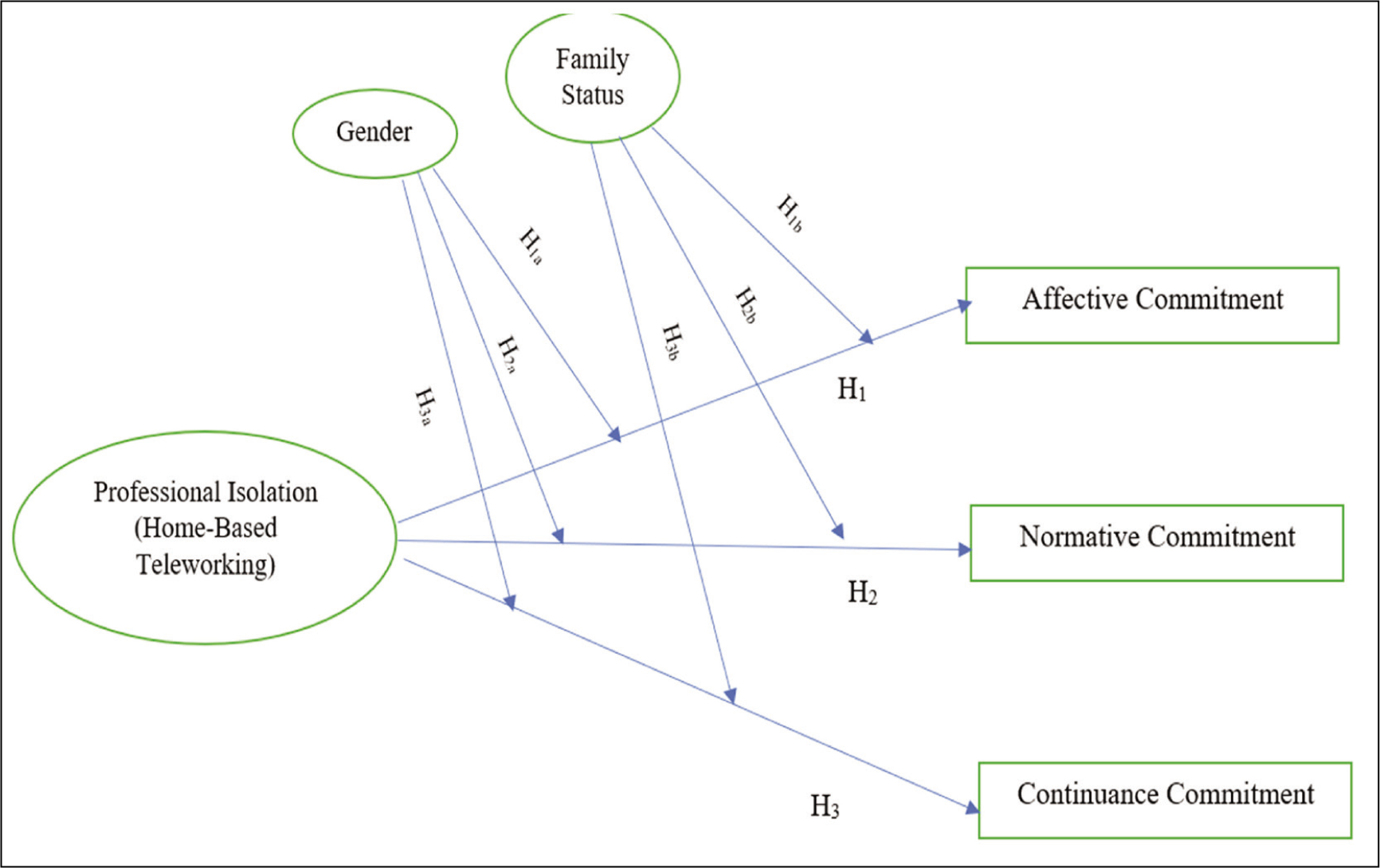
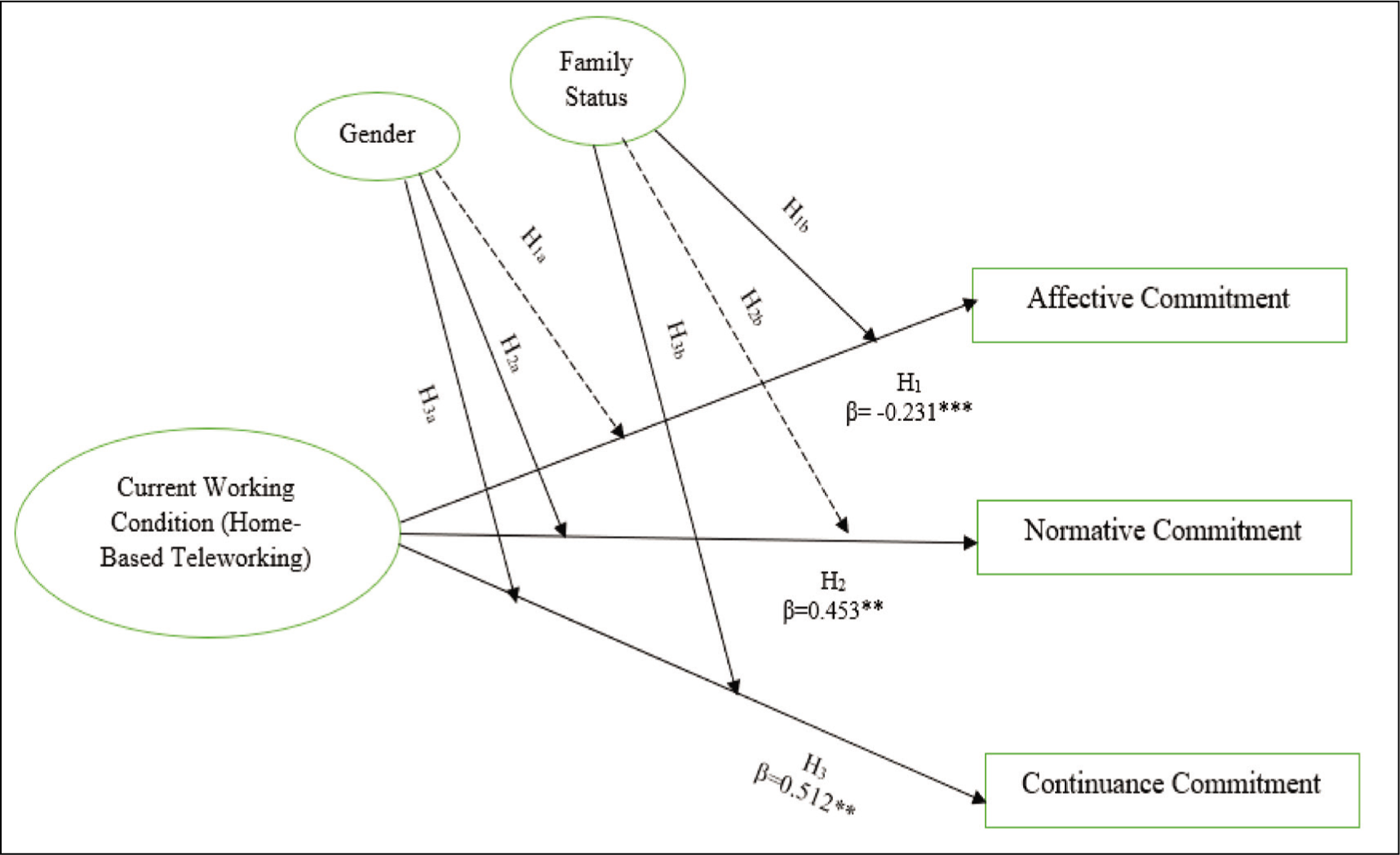
H1a: Telecommuter’s gender significantly moderates (strengthens or weakens) the relationship between home-based teleworking and affective organizational commitment. H2a: Telecommuter’s gender significantly moderates (strengthens or weakens) the relationship between home-based teleworking and normative organizational commitment. H3a: Telecommuter’s gender significantly moderates (strengthens or weakens) the relationship between home-based teleworking and continuance organizational commitment. H1b: Telecommuter’s family status significantly moderates (strengthens or weakens) the relationship between home-based teleworking and affective organizational commitment. H2b: Telecommuter’s family status significantly moderates (strengthens or weakens) the relationship between home-based teleworking and normative organizational commitment. H3b: Telecommuter’s family status significantly moderates (strengthens or weakens) the relationship between home-based teleworking and continuance organizational commitment.
Research Methods and Measures
The study is quantitative in nature in which respondents were selected based on the criteria of employees working as telecommuters during the COVID-19 pandemic. It is intended to have a sample of respondents working in a teleworking context. Employees are preferably considered a target sample if one-third of their working hours are from virtual or home-based teleworking. To meet such criteria of sample selection, we followed the snowball sampling method under the non-probabilistic method of sample selection to make the operationalization of the process easy. We have reached a sample of 480 telecommuters working in the IT sector from the southern part of India.
A structured questionnaire was developed based on the standard measurement items representing study variables and was used as a survey instrument. Sample respondents were approached through electronic mail with an attachment of a questionnaire created in Google Forms requesting them purely if they are interested in the research survey and ready to contribute. Among 480 responses collected from the respondents, 68 responses were removed as these did not meet the criteria. For instance, few were mindful responses even when the questions were reverse coded in the Likert scale and some were incomplete responses with a semi-finished state. Therefore, the final sample responses of 412 were used for analysis purposes.
Measures
Three factors are studied as compiled dimensions of organizational commitment: affective, normative, and continuance commitment. 23 Therefore, the present study uses standard organizational commitment questionnaire (OCQ) scales that measure these three dimensions of organizational commitment. The affective commitment was measured using four items, for example, “I do not feel like ‘part of my family’ at this organization (R)”; “This organization has a great deal of personal meaning for me”; and “I would be thrilled to spend the rest of my career in this organization.” While normative commitment was measured using four items, for example, “I would feel guilty if I left this organization now”; “This organization deserves my loyalty”; and “I do not feel any obligation to remain with my organization (R).” Finally, the third dimension, continuance commitment, was measured using three items, for example, “Right now, staying with my job at this organization is a matter of necessity as much as desire”; “I believe I have too few options to consider leaving this organization”; and “It would be tough for me to leave my job at this organization right now even if I wanted to.” During the COVID-19 pandemic, current working conditions (CWC), which signifies home-based teleworking, was measured using a four-item scale by Randa Diab-Bahman and Abrar Al-Enzi. 3 We measured professional isolation with a six-item scale adapted from Golden et al. 46 Items were scored on a five-point Likert-type scale, where 1 = never and 5 = most of the time. Example items were “I feel that although I am professionally isolated, I am more productive working from home than working at my workplace”; “I feel that although I am professionally isolated, I get my work done in less time while working from home than I would at my Workplace”; and “I have been able to find a comfortable place in my home to conduct my work but still I feel I am professionally isolated with the current working conditions.” All the scaled items were slightly rephrased to fit into the IT context. All the reliability and validity tests were conducted while analysing the data, and finally, a structural equation model was developed to test the proposed hypotheses using Analysis of Moment Structures (AMOS 20.0 version) software.
Informant’s Profile
The respondent’s profile can be read in Table 1. Observation shows that out of 412 samples, most respondents were males (68%) and the remaining were females (32%). Between the 25–30 years and 30–35 years of age groups, there were 30% and 22% of respondents, respectively, while 21% of respondents were in the 20–25 years, 16% in the 35–40 years, and 11% were in the older than 40-year age groups. An inquiry about educational qualification shows that the majority (35%) of the respondents hold an MTech degree, 28% a PhD degree; in addition, 98 (24%) respondents from the model were Masters in Business Administration (MBA), whereas remaining 13% stated “Others” in the qualification details.
Respondents’ Demographic Details.
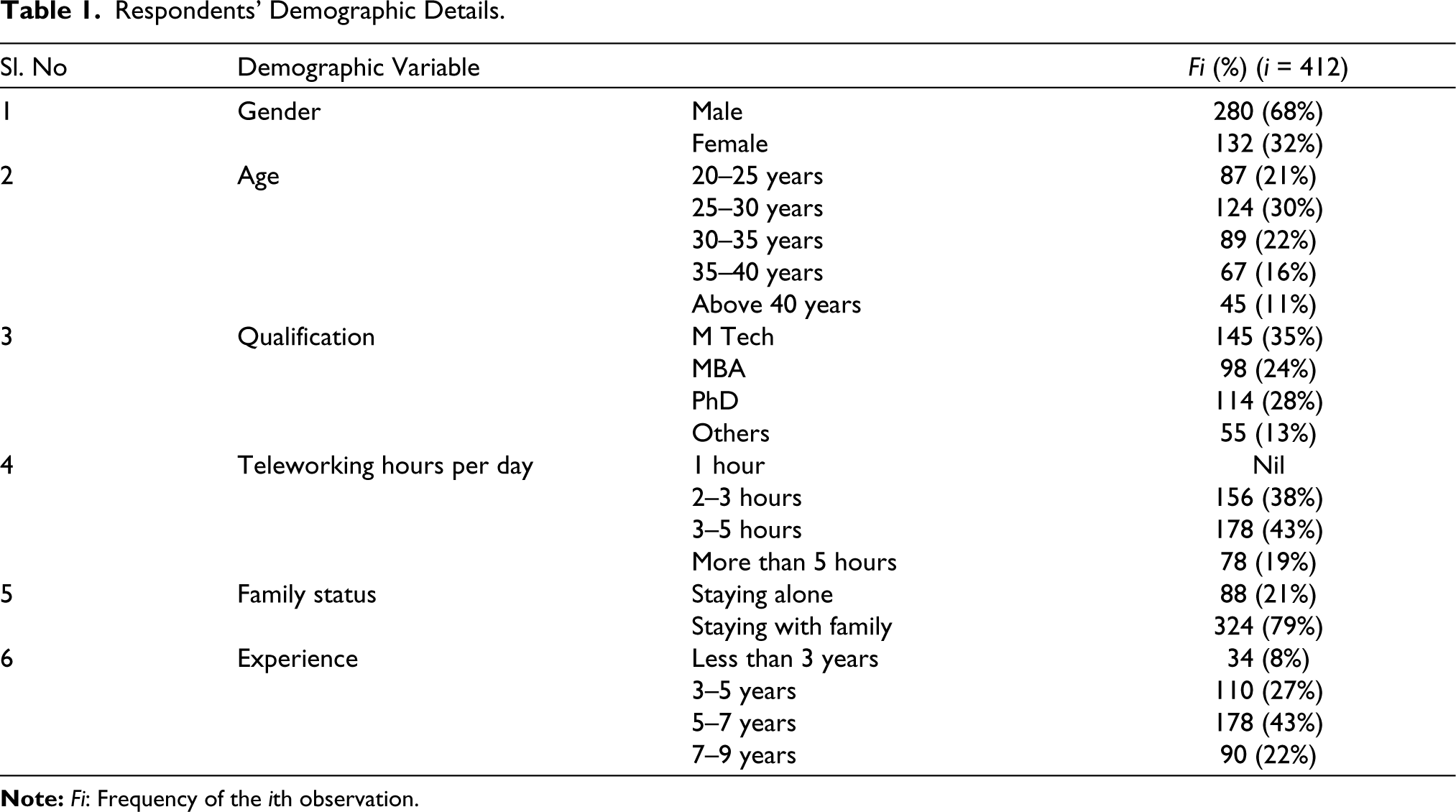
With regard to the information related to family status, the study found that 79% (324/412) of the sample were working from home with family, while the rest 88 (21%) respondents were staying away from their family (during the COVID-19 lockdown). We enquired about respondents’ teleworking duration in a day and observed that the highest percentage (43%) of the sample were working three to five hours per day virtually, 38% were working two to three hours per day as telecommuters, and only 19% working more than seven hours of telework in a day (see Table 1).
Data Analysis and Results
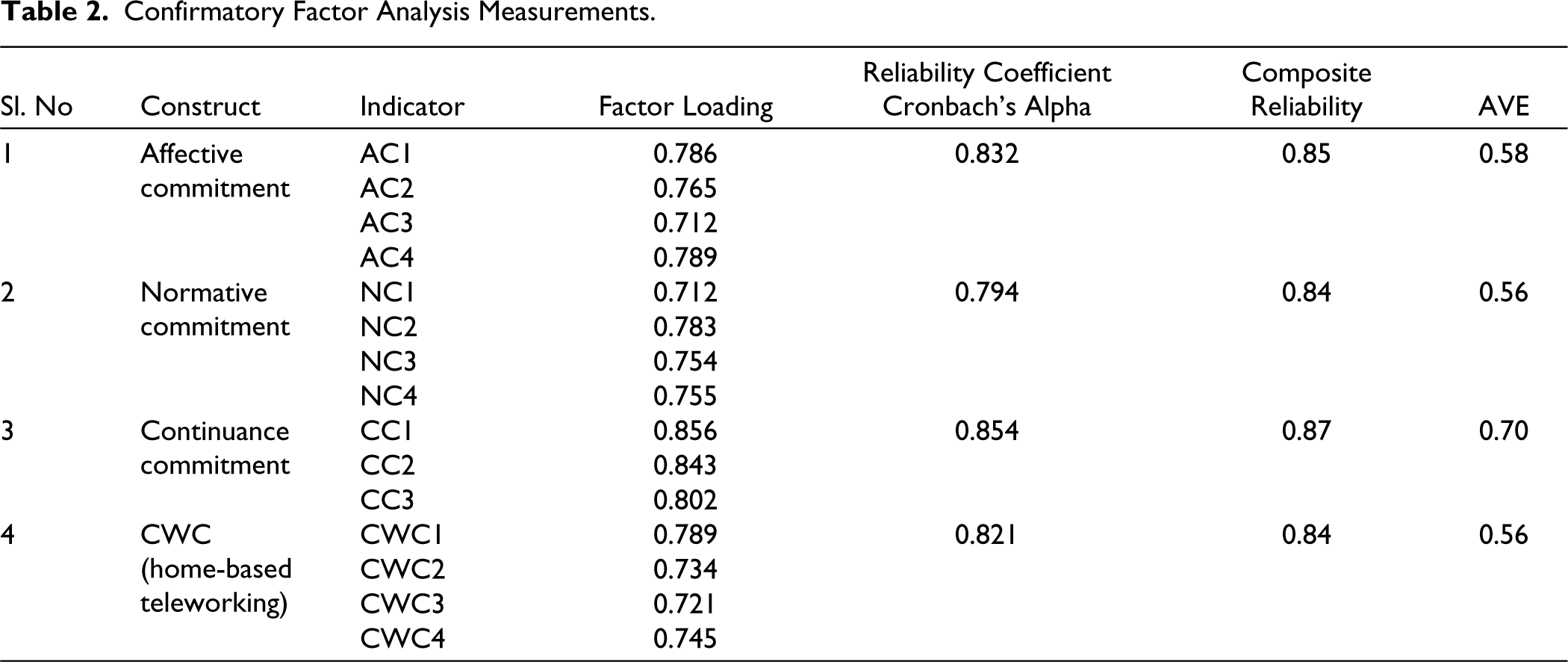
To measure the dimensionality of the constructs, we performed confirmatory factor analysis using AMOS 18.0. Each item used to measure all four constructs showed a high correlation, thus providing a good representative of each underlying construct. These item factor loadings were achieved at the above standard value of 0.70.47,48 The convergent validity of the four constructs was proved based on the average variance extracted (AVE) score above 0.50. 49 For each of the four constructs, affective commitment’s AVE was 0.58, normative commitment’s AVE was 0.56, continuance commitment’s AVE was 0.70, and home-based teleworking’s AVE was 0.56. Cronbach’s alpha assessed the latent construct’s reliability above 0.70. 50 The threshold value and all the construct’s Cronbach’s alpha values ranged between 0.78 and 0.86 (see Table 2), thus validating the construct’s reliability.
Confirmatory Factor Analysis Measurements.
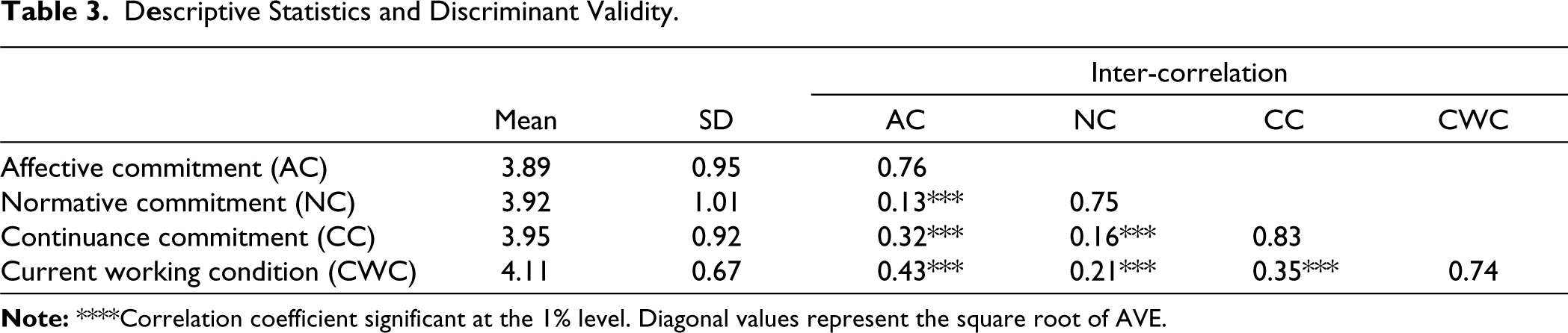
According to this, discriminant validity was checked 51 ; if the factor square root of the AVE value is greater than the corresponding inter-factor correlation, then discriminant validity is permitted. In the present study, the square root of the AVE for all four constructs separately was greater than the inter-factor correlation values (see Table 3). In addition to these measurements, we have ascertained there is no issue of multicollinearity in the present study since all the constructs’ correlation value was calculated below 0.80. Higher correlation, that is, more than 0.80, could potentially generate an issue of multicollinearity. 52 Discriminant validity measures, descriptive statistics mean and standard deviation, and zero-order inter-correlations were calculated. The average response of each construct is as follows: affective commitment: mean = 3.89 and SD = 0.95; normative commitment: mean = 3.92 and SD = 1.21.
Continuance commitment (mean = 3.95 and SD = 0.92; CWC: mean = 4.11 and SD = 0.67) was found positive (see Table 3) along with a less dispersion rate (all standard deviations are less than or close to 1). Furthermore, the zero-order inter-correlation between the constructs was positive (the correlation coefficient range was between 0.13 and0.43). Harman’s single factor score was run to check common method bias, and the result of a single factor with a total variance of 34.56% in the present study proved that no common method bias exists. Confirmatory factor analysis model fit indices (ꭓ 2 /df = 3.21 with P < 0.000; goodness-of-fit index (GFI) = 0.945; Tucker–Lewis fit index (TLI) = 0.962; normed fit index = 0.932; comparative fit index (CFI) = 0.968; root mean square error approximation (RMSEA) = 0.021) satisfies the recommended thresholds as per the criteria.47,53–55 This indicates that all latent variables indicators have a good explanatory power of their intended constructs in the study.
Descriptive Statistics and Discriminant Validity.
We have tested the hypothesized model using structural equation modelling (SEM) because SEM allows not only a simultaneous estimation of a measurement model that relates the items in each scale to the construct they represent but also a structural model that relates constructs to one another providing parameter values (see Figure 1). SEM results show that home-related telecommuter is caused by professional isolation and it negatively affects the affective commitment of the organization. Since the path coefficient (β = –0.231; P = 0.000 <0.05) is statistically significant it supports our H1 hypothesis. For our H2, home-related teleworking caused professional isolation negatively affects telecommuter’s normative commitment to the organization and is found positively statistically significant from the result (β = 0.453; P = 0.001 < 0.05). Finally, statistical evidence from the SEM test (β = 0.512; P = 0.021 < 0.05) confirmed that professional isolation caused by home-related teleworking positively affects the continuance commitment of the organization, thus supporting our hypothesis H3 (Figure 2).
Conceptual Model.
Moderation Effect of Gender and Family Status
We tested the interaction effect of two moderator variables (gender and family status) on the path movements between current work conditions and affective commitment, normative commitment, and continuance commitment. Gender was measured with two categories (male and female), whereas family status was measured whether staying alone during the COVID-19 lockdown period or staying with family. Following Byrne’s 2016 view, we applied multi-group analysis with moderator variables while testing the hypothesized model using the structural equation model over AMOS software since this way of analysing the moderation effect of variables also possibly be applied.
Multi-group analysis performed with gender as a moderator produced good model fit indices, which were obtained within the recommended thresholds (χ 2 /df = 4.42, GFI = 0.945, TLI = 0.931, CFI = 0.960, RMSEA = 0.053), whereas multi-group analysis of family status fit indices was found with acceptable thresholds of χ 2 /df = 3.42 < 5, GFI = 0.935 > 0.90, TLI = 0.958 > 0.90, CFI = 0.943 > 0.90, RMSEA = 0.069 < 0.08 (Hair et al. 43 ). We found that the moderation effect of gender on the path between CWC and affective commitment is not statistically significant (Z score = 1.05; P > 0.05 (0.375)); however, gender moderates the relationship between CWC and normative commitment (Z score = 6.71; P < 0.01 (0.000)) and between CWC and continuance commitment (Z score = 11.54; P < 0.01 (0.000)). A thorough view of Table 4 clarifies that the male group has more normative (estimate = 0.42; Z = 6.71; P < 0.001) and continuance commitment (estimate = 0.64; Z = 111.54; P < 0.001) during the teleworking type of job than that of females do (see Table 4).
Moreover, family status moderation effect on the path between CWC and normative commitment was found not statistically significant (Z score = 1.46; P > 0.05 (0.256)), whereas it showed a significant moderation effect between CWC and affective commitment (Z score = 9.65; P < 0.01 (0.000)) and between CWC and continuance commitment (Z score = 10.96; P < 0.01 (0.000)). Employees who were working with family during this COVID-19 pandemic lockdown period showed more affective commitment (estimate = 0.47; Z = 9.65; P < 0.001) and continuance commitment (estimate = 0.54; Z = 10.96; P < 0.001) than those who were working away from their family (staying alone) during this lockdown period (see Table 4).
Group Comparisons.

Discussions
The primary objective of the present research is to assess the relationship between a CWC, scientifically termed home-based teleworking, and organizational commitment. Previous studies generally focused on this research problem, given the need-to-belong theory and relational cohesion. 5 However, given the present situation (COVID-19 pandemic), this study was based on relational cohesion theory. 29 We can assume that society has to live with the COVID-19 pandemic for a longer time. Social cohesion has been used to express a range of different aspects of relationships during the pandemic. This present study investigates the impact of the abrupt home confinement imposed by the spread of COVID-19 on employee cohesion within the organization.
Findings from the study show that employees working remotely have a negative affective commitment to the organization, by which hypothesis (H1) is accepted in the present underdefined sample. This finding supports the research finding, which proved that employees’ professional isolation is negatively associated with telecommuters’ affective commitment to the organization. 32 However, it is proved as an adverse result of the research finding of Wang et al. 5 Further, we found evidence from the present study that the home-based teleworking condition of an employee has a significant positive impact on a normative commitment to the organization since hypothesis (H2) is accepted. However, it is not with the support of a negative relationship. As a reflection of these two hypotheses results in the present study, employees who are working as telecommuters are perhaps not able to have a remarkable willingness to maintain and improve reliability and positive and meaningful relationships with others since these relationships are more critical for their emotional, mental, and physical well-being. Continuing and pleasing interactions with colleagues and organization who share mutual affective concern make a meaningful relationship.56–58 As the need-to-belong theory proposes, 59 employees feel weak emotional and psychological connection with an organization and thus execute a less affective commitment as the teleworking condition mandates. However, the present study confirmed that according to the need-to-belong theory, which limits telecommuters’ ability to form an affective and normative commitment was persistent affective commitment to the organization but not to the normative commitment. Since employees keep a sense of responsibility and embeddedness even though computer-mediated technology was used to perform the job, ultimately, they keep the accountability and work legitimacy at the same level as at non-telecommuting setup. 5
Moreover, the study proved that telecommuters’ continuance commitment is significantly influenced by professional isolation caused by a CWC which is imitated as home-based teleworking; therefore, hypothesis H3 is accepted. Based on this finding, we argue that employees working telework might feel more professional isolation 35 and thus get a poor evaluation of performance, fewer chances of career development, and condensed marketability. 33 Lack of connectivity with colleagues and organization due to teleworking conditions leads an employee to miss professional and career development opportunities using informal learning, networking, mentoring, etc. 46
The interaction effect of gender and family status in the relationship between home-based teleworking and organization commitment confirmed that gender moderates the effect of home-based teleworking on employee normative and continuance conditions. On the other hand, family status moderates the impact of CWCs on affective and continuance commitment. To be a noticing point, male telecommuters show a higher intention of normative and continuance commitment than female telecommuters. 39 In contrast, telecommuters who are working from home being with family members are connected with the organization emotionally and intend to be with an organization due to the perceived benefits of the organization and fewer opportunities available in the market 44 ; therefore, their affective and continuance commitment is practical but not normative because of imbalanced life between family and work parallelly. Male employees are more invested and dedicated in their work than their female counterparts, according to research. Females showing a low commitment may be because of a lack of representation in the data as well as the social setting and mental wiring of people in India. Working women are overwhelmed with office work, household chores, and childcare when they are telecommuting, they have many things to handle simultaneously. At times prioritizing things becomes very difficult. Maybe this is the reason it hurts their commitment statistics. Additionally, it was discovered that the relationship between tenure, educational attainment, and marital status had an impact on the degree of organizational commitment and job involvement. For instance, the employees feel more connected if they have considerably higher levels of tenure in the organization. The possible reason could be that when an employee invests time and effort, it becomes more difficult to leave the organization. Moreover, educational level can have an inverse effect on organizational commitment where the lower the educational level of employees, the higher their commitment. The possible reason could be that employees with a lower educational level face a lack of job opportunities and are more likely to be grateful for the job they are presently able to maintain. On the other hand, it was seen that employees who are married feel more satisfied at their personal front and are ready to involve themselves more in their job.
Organization Implications
Grounded on the study’s findings, it has a specific outcome-based implication for human resource managers, practitioners, and managers of different resources in the organization interchangeably as the study finds that employees who are working virtually show organization commitment in the form of affective (emotionally associated), normative (responsible), and continuance (to preserve the perceived benefits). To see different work outcomes from telecommuters, affective and normative commitments are more critical. 14 Therefore, organizations are recommended to have specific measures to nurture employees’ emotional connection (affective) and feeling of responsibility and embeddedness (normative) even though they work in the teleworking setup. One clear implication to keep up this recommendation is to ensure different team-building activities are remotely offered to telecommuters; therefore, they apprehend less feeling of not being emotionally connected. 30 In addition, making available different training programmes, support from supervisors, and chances of decision-making for telecommuters further improves the propensity of affective and normative commitment. 13
As suggested by Lu et al. 21 although it looks pretty challenging to convert telecommuter continuance commitment into normative commitment, practitioners should put some effort into converting utility-based motivations derived from both normative and continuance commitment, thus influencing employees to stay with the organization. Perhaps the perceived benefits offered by the organization are in such a way conducive that telecommuters express their willingness to stay with the organization, even though they have opportunities in the market. 5 The effective utilization of information and communication technology enables increased communication between telecommuters, strengthens the network’s density and power, and lessens the dependency on superiors for organizational visibility; therefore, it is recommended that organizations focus on inducing different multichannel technologies for communication purposes. Further, an organization can see a drastic improvement in telecommutes affective, normative, and continuance commitment using change in an organizational culture embedded with structures and policies that enable conventional work activities.32,60,61
Limitations and Future Research
Even though the study has attempted its most acceptable methodology and theoretical background for arguing its research contribution, it has its limitations. First, the study covered the sample of employees working remotely during the unprecedented time (COVID-19) wherein entire organizations were forced on arranging non-conventional working conditions for their employees. In that view, we have approached only the Indian IT sector’s telecommuters, which is one of the typical contributors to the nation’s economy. The findings may not be generalizable to any other sector other than Indian IT. While collecting data from sample respondents, we did not mention any specific communication technologies for telecommuting since rich communication media weakens the telecommuter’s professional isolation. 5
Other than gender and family status, factors such as telecommuter’s age, salary, experience, type of personality, existing emotional bondage with colleagues, emotional support extent, etc., 30 were not studied as moderator variables; hence, future studies may use these variables to their scope. Likewise, future studies can preferably compare telecommuters’ and non-telecommuters’ organizational commitment in the Indian context by referring to different sectors and seeing their present study results. Moreover, studies intended to research organization commitment can select a sample of intentional telecommuters since these people select to telework to upsurge their work schedule flexibility and emphasize their work away from the common disturbances often found in shared workspaces. 32
Footnotes
Declaration of Conflicting Interests
The authors declared no potential conflicts of interest with respect to the research, authorship and/or publication of this article.
Funding
The authors received no financial support for the research, authorship and/or publication of this article.