




Abstract
Background
Polycystic ovary syndrome (PCOS) is a common, lifelong condition affecting about 20% of women, characterised by symptoms such as infertility, obesity, acne and excess facial hair, which can negatively impact both physical and mental health.
Purpose
This study aimed to assess the effect of Surya Namaskar on reducing social physique anxiety (SPA) in women diagnosed with PCOS.
Methods
The study applied a pre- and post-test design with 60 women diagnosed with PCOS; there were 100 participants in the study. Out of these 100, only 70 participants had high levels of SPA. Out of these 70 participants, only 60 responded and agreed to participate in the study. The participants were selected from colleges in Dehradun, India, and were between the ages of 18 and 30 years. Split into intervention and control groups. The intervention group practiced Surya Namaskar for 12 weeks, while the control group did not participate in any structured physical activity. SPA and body dissatisfaction were measured using established scales at the beginning and end of the study. Statistical analyses, including paired and independent samples t-tests, were conducted to assess changes within and between the groups.
Results
The results indicated that Surya Namaskar significantly improved overall health and well-being, with the intervention group showing notable reductions in SPA and body dissatisfaction compared to the control group. Statistical analyses confirmed significant differences in psychological outcomes, supporting the effectiveness of Surya Namaskar in this context.
Conclusion
Surya Namaskar significantly alleviates SPA and body dissatisfaction, enhancing the psychological health of women with PCOS. Given its accessibility and low cost, Surya Namaskar shows potential as an effective complementary treatment to improve the quality of life for women with PCOS. Further research is needed to explore its long-term effects and the mechanisms behind these improvements.
Introduction
Polycystic ovary syndrome (PCOS) is a hormonal disorder that affects women during their reproductive years, with symptoms ranging from irregular ovulation and infertility to excessive hair growth, acne, sleep disturbances, ovarian cysts and reduced libido. Beyond the physical effects, PCOS can have a profound impact on mental health, often leading to heightened anxiety, depression, and a diminished quality of life. Elevated testosterone levels, a defining feature of the condition, usually exacerbate these challenges. 1
While some women experience mild symptoms, others face a broader and more severe range of difficulties. The effects of PCOS extend beyond the body, with many women feeling emotionally burdened. Issues like body image concerns and reduced self-esteem are common. Studies have shown that women with PCOS are significantly more vulnerable to anxiety and depression, underscoring the importance of holistic care that addresses both their physical and emotional well-being. 2 A study on PCOS patients showed considerably more significant levels of sadness and anxiety than 20 healthy control women of the same age. 3 The cause of depression in PCOS can be traced back to the disease’s upsetting symptoms, which include high levels of hirsutism, insulin resistance and acne, weight gain and so on. Depressive symptoms are roughly twice as prevalent in PCOS, and hirsutism is the primary cause of psychological distress in 146 PCOS-affected women. 4 Also, women with PCOS are less sociable. Possible explanations include PCOS symptoms, such as hirsutism, which make socialising difficult and contribute to social phobia. PCOS often emerges at a time in a young woman’s life when appearance feels especially important, making its effects on self-esteem even more challenging. Many women with PCOS struggle with low self-esteem and dissatisfaction with their body image, feeling different from their peers. This emotional burden is often compounded by a higher risk of anxiety and depression, which can profoundly affect their overall well-being and quality of life.5–7 PCOS is a cause of lower self-esteem and body satisfaction than the general population. Insulin resistance is associated with depression in PCOS, according to some intriguing evidence. 8
PCOS affects 5%–20% of women and is linked to symptoms like obesity, infertility and excessive hair growth, which can contribute to anxiety, body image concerns and social isolation. While much of the research on PCOS focuses on its biological causes, the psychological effects are often overlooked. 9
The biomedical model focuses primarily on physical symptom treatment, while the biopsychosocial (BPS) model recognises the importance of biological, emotional and social factors, emphasising the patient’s overall experience. 10 To provide comprehensive care, both physical symptoms and mental health needs should be addressed, offering support to reduce the risks of anxiety, depression and social isolation. 11
Social Physique Anxiety (SPA)
SPA refers to individuals’ unease when they believe others are judging their physical appearance. This anxiety often leads to avoiding social situations that involve body exposure due to concerns about judgment or embarrassment. SPA is commonly linked to body dissatisfaction, low self-esteem, and a desire to change one’s body shape.12, 13 Women with PCOS experience a higher prevalence of SPA. A study by Månsson et al 14 showed that 27% of women with PCOS had social phobia, a condition closely associated with SPA. Additionally, the physical symptoms of PCOS, such as obesity, infertility and excessive hair growth, can intensify body image issues, increasing the likelihood of SPA.15, 16 However, the link between SPA and PCOS is multifactorial, involving hormonal, psychological and social elements. 17 Further research is needed to explore the mechanisms linking SPA and PCOS, focusing on psychological factors to design effective interventions incorporating practices like Surya Namaskar.
Surya Namaskar
Surya Namaskar, or the sun salutation, is an ancient Yoga practice rooted in Hindu traditions. It is a symbolic gesture of gratitude to the Sun (Surya), which is known as the ultimate source of energy and life. This practice is derived from the Sanskrit word namas, which means bow and reflects unity, mindfulness and reverence. The sequence comprises 12 interconnected positions, synchronized with controlled breathing, where each movement aligns with either inhalation or exhalation. Research has shown that this alignment of breath and motion enhances mental focus while providing significant physical benefits. 18 Regularly practising Surya Namaskar in the morning supports health by boosting vitamin D levels, regulating circadian rhythms, and improving overall well-being. 19
Hindu scriptures such as Puranas emphasise the Sun’s vital role in spiritual and physical sustenance. Beyond its spiritual importance, Surya Namaskar addresses modern health challenges, including stress, obesity and hormonal imbalances. Studies demonstrate its effectiveness in improving glucose metabolism, lipid profiles and insulin sensitivity, which are crucial for managing PCOS. 20
Engaging in daily Surya Namaskar, at least five rounds weekly, has been shown to help with weight management, enhance cardiovascular health and regulate menstrual cycles. 21 In addition, a 12-week Yoga programme has proven to significantly improve glucose levels, hormonal regulation, and mental health in women with PCOS. 22 Surya Namaskar offers a holistic and effective strategy for addressing the multidimensional challenges associated with PCOS by integrating physical, psychological and spiritual benefits.
The Theoretical Framework of the Study
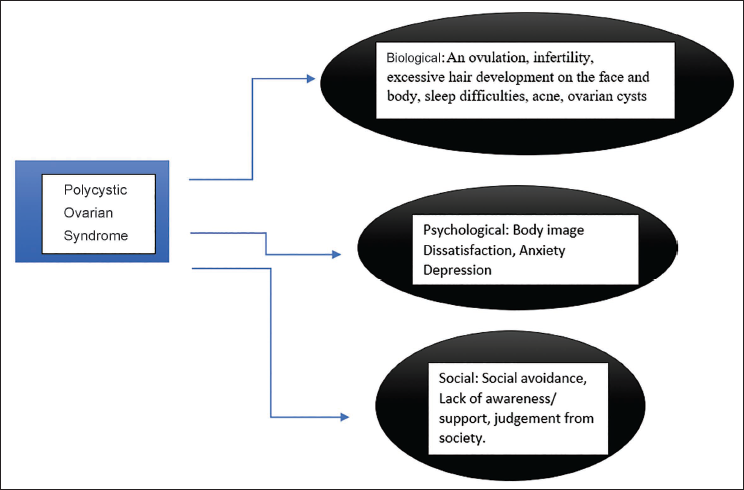
This study applies the BPS model, a framework in health psychology that examines how biological, psychological and social factors shape health. 23 Unlike traditional models, the BPS approach highlights the interconnectedness of physical conditions with mental and social influences. The ‘bio’ component focuses on biological factors such as hormonal imbalances, the ‘psycho’ element examines mental health aspects like stress and body image, and the ‘social’ dimension looks at environmental and cultural factors. For PCOS, the BPS model is particularly relevant as it integrates biological factors such as hormonal dysregulation, psychological issues like anxiety and body dissatisfaction, as well as social influences such as stigma and healthcare access (Figure 1). 24 Recent research further supports the model, emphasising that effective PCOS management requires addressing both physical and psychological aspects, including lifestyle changes and psychological support. 25
The Three Framework Constructs of Polycystic Ovary Syndrome (PCOS) 24 .
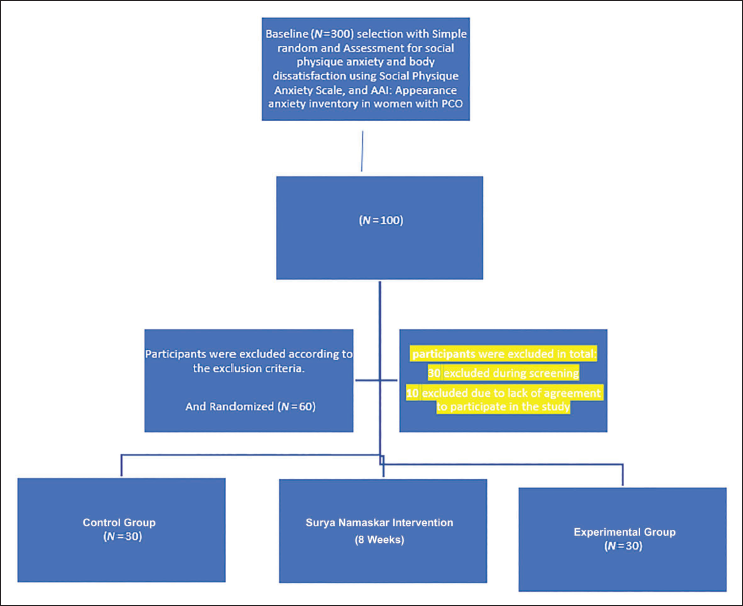
Flow Chart of the Study Procedure. 28
Objectives of the Study
The research has the following objective:
To assess the effect of Surya Namaskar on reducing SPA in women diagnosed with PCOS.
Hypothesis
There will be a significant effect of Surya Namaskar in dealing with SPA in women with PCOS.
Methods
Design
This study employed a pre- and post-test design with two groups: an experimental group (pre- and post-intervention) and a control group. The pre- and post-test design was chosen to evaluate the effectiveness of the intervention by comparing changes in the experimental group with those in the control group. 26 This design allows for the control of extraneous variables and facilitates measuring intervention-related changes.
Sampling
One hundred participants, including screening, were conducted to identify participants with high levels of SPA. Out of the 100 participants, 70 were identified as having high SPA based on pre-defined inclusion criteria. Among these 70 eligible individuals, 60 participants consented to participate and were included in the study. The participants were then randomly assigned to two groups:
Experimental group (n = 30): This group received the intervention. Control group (n = 30): This group did not receive the intervention and served as a comparison.
The participants were selected from colleges in Dehradun, India, and were between the ages of 18 and 30 years.
Inclusion Criteria
Women with a diagnosis of PCOS aged between 18 and 30 years.
Women diagnosed with PCOS by a gynaecologist.
Participants who had high levels of SPA as assessed by the SPA.
Participants who were able to attend the intervention sessions.
Participants who were willing to complete the study questionnaires and assessments.
Exclusion Criteria
Participants who were pregnant or breastfeeding had a history of psychiatric disorders.
Participants who were undergoing any other treatment for PCOS during the study.
Participants who could not attend the intervention sessions or complete the study questionnaires and assessments.
Measures
Social Physique Anxiety Scale (SPAS)
The SPAS, 27 introduced by Hart et al in 1989, is a tool for assessing SPAS. This scale comprises 12 self-report items rated on a 5-point Likert scale, where individuals indicate the extent to which each statement reflects their feelings. Hart et al demonstrated that the scale has strong construct validity, reliability over time, and high internal consistency (α = 0.90), while also showing minimal influence from social desirability bias. The SPAS is intended for research rather than clinical diagnosis, so it lacks specific cut-off points for interpreting scores. Instead, the scale produces continuous data, and thus analyses typically involve correlation and regression techniques that account for this continuity, rather than categorising participants into discrete groups.
Procedure for Data Collection
The SPAS 27 was administered to these 100 women. Based on the results, 70 participants showed signs of SPA and were selected for further analysis using a pre- and post-test control group design. Among these 70 participants, 60 consented to continue with the study. There were 10 dropouts who were not willing to participate in the study. These 60 participants were randomly assigned to either the control or experimental groups, with 30 participants in each group. The experimental group underwent Surya Namaskar’s intervention technique. There were no dropouts here. Professional trainers conducted these sessions during a PCOS well-being and fitness camp, which consisted of two 50-min sessions per week. There are 12 poses in traditional Hatha Surya Namaskar. The eight basic asanas include the mountain pose, upward salute, standing forward bend, low lunge, plank pose, four-limbed staff pose, upward facing dog pose and downward facing dog pose. The experimental group received follow-up to ensure adherence to the practice (Figure 2). 28
The control group did not receive any interventions. After 8 weeks, both groups were re-evaluated using the SPAS to assess the effectiveness of the interventions. The collected data were analysed to test the study’s hypothesis. The participants’ compliance was maintained throughout the study via informed consent and consistent follow-ups, ensuring adherence to instructions and the study protocol.
Results
The study highlights the demographic data of the participants in both groups. Independent samples t-tests show differences between the experimental and control groups regarding age, marital status, family type, occupation, qualification and area characteristics. This establishes that both groups had highly similar demographic profiles, enhancing the internal validity and allowing more apparent inferences regarding the effects of Yoga to be drawn.
Table 1 shows that the descriptive statistics for age, education and SPA were analysed for a sample of 100 participants. The mean age was 1.74 [standard deviation (SD) = 0.836], with a slight positive skewness of 0.525 [standard error (SE) = 0.241] and a platykurtic distribution (kurtosis = −1.373, SE = 0.478), indicating a somewhat flat distribution. The mean education level was 1.21 (SD = 0.409), with a moderate positive skewness of 1.446 (SE = 0.241), suggesting that a more significant proportion of participants had lower levels of education. The kurtosis for training was 0.92 (SE = 0.478), which indicates a distribution close to normal in terms of its peak. SPA had a mean score of 27.7 (SD = 4.412), with a slight positive skewness of 0.401 (SE = 0.241) and near-normal kurtosis (kurtosis = 0.005, SE = 0.478). Overall, the skewness and kurtosis values suggest that age, education and SPA data are approximately normally distributed, with slight deviations observed mainly in the education variable.
Demographic Characteristics and Baseline Measures of Social Physique Anxiety (SPA) and Appearance Anxiety.
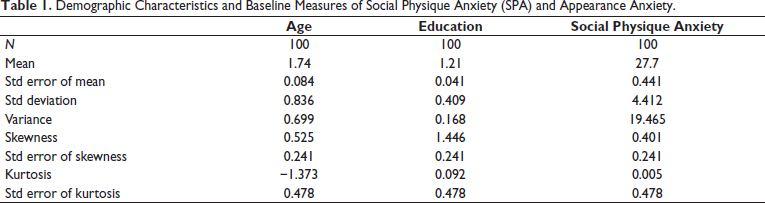
Table 2 shows that the results of the paired samples t-test indicate a significant reduction in SPA from the pre-test [mean (M) = 25.73, SD = 3.036] to the post-test (M = 20.62, SD = 4.673). The standard error of the mean was 0.392 for the pre-test and 0.603 for the post-test, suggesting more variability in the post-test scores. The t-value for the difference between pre- and post-test scores was 5.117, with 59 degrees of freedom and a p value of .000, indicating a statistically significant difference at the 0.05 level. The 95% confidence interval for the mean difference in SPA scores ranged from 3.993 to 6.240 and confirmed that the reduction in SPA was consistent and substantial. These findings suggest that the intervention or the period between the pre- and post-test effectively reduced SPA in the participants.
Paired Samples Statistics and t-test for Social Physique Anxiety (SPA) Pre- and Post-test.

M, mean; N, number of subject; SD, standard deviation.
The descriptive statistics (Table 3) revealed that the experimental group (M = 18.53, SD = 3.481) had a lower mean post-intervention score for SPA compared to the control group (M = 22.70, SD = 4.829). This suggests that the intervention effectively reduced SPA scores in the experimental group. The independent samples t-test results (Table 3) show a significant difference between the two groups. Levene’s equality of variances test yielded an F-value of 3.933 (p = .052) at the significance level of 0.05. This indicates a statistically significant difference between experimental and control groups. The intervention had a statistically significant effect in reducing SPA in the experimental group, compared to the control group, with a mean difference of 4.167 points. The results suggest that the intervention successfully decreased SPA, which was statistically significant.
Independent Samples t-test for Equality of Post-intervention Social Physique Anxiety (SPA) Scores.

N, number of subject; SD, standard deviation.
Discussion
This study aimed to assess the effect of Surya Namaskar on reducing SPA in women with PCOS. The results of the paired samples t-test and independent samples t-test strongly support the effectiveness of Surya Namaskar as an intervention for reducing SPA in this group. The paired samples t-test revealed a marked decrease in SPA scores from the pre-test to the post-test, which confirms that Surya Namaskar successfully reduced SPA. This finding aligns with existing research that shows that physical activities such as Yoga enhance and maintain body image, alleviate anxiety, and promote overall mental well-being.18, 21 The increased standard error in post-test results suggests more variability in participant responses, which may reflect individual differences or other factors influencing SPA in women with PCOS. The independent samples t-test revealed a significant difference in SPA between the experimental and control groups. The experimental group showed a more substantial reduction in SPA. The mean difference indicates that Surya Namaskar had a more significant effect than the control groups on reducing SPA. These results underscore the importance of interventions like Surya Namaskar, which can address both the physical and emotional challenges of PCOS, such as infertility, obesity and excessive hair growth.15, 29 The significant reduction in SPA observed in the experimental group further asserts that Surya Namaskar benefits physical health and improves psychological well-being in women with PCOS.20, 21 Over the past few decades, Yoga has been shown to reduce stress, promote mental health and enhance physical fitness. The significant reduction in SPA in the experimental group suggests that Yoga, particularly Surya Namaskar, may provide a holistic approach by addressing both physical health issues and psychological distress. Surya Namaskar may benefit the body by improving mood and physical health. Research has shown that Yoga can enhance insulin sensitivity, reduce stress, and increase metabolic function in women with PCOS.22, 30 Since PCOS is linked to hormonal imbalances, insulin resistance and obesity, these findings suggest that Surya Namaskar may also improve metabolic health, which could improve mental health outcomes. 20 The combined physical and mental health benefits of Surya Namaskar suggest that it is a practical holistic approach to improving the overall well-being of women with PCOS.
The findings of this study have valuable clinical implications, particularly in improving the quality of life for women with PCOS. Given the relationship between SPA and both physical and psychological well-being, integrating Surya Namaskar or other Yoga-based interventions into clinical treatments could help alleviate anxiety, enhance body image and improve emotional health. 21 Additionally, as Surya Namaskar is a cost-effective and easily accessible practice, it could serve as a complementary treatment for women with PCOS, supplementing medical interventions such as hormonal therapies, weight management programmes and mental health counselling.
Conclusion
In conclusion, the results of this study support Surya Namaskar as an effective intervention for reducing SPA in women with PCOS. The reduction in SPA observed in both the pre-test/post-test comparison and between the experimental and control groups highlights the potential of Surya Namaskar’s practice as valuable. Further research should investigate the long-term benefits and underlying mechanisms of the Surya Namaskar and focus on enhancing the overall well-being of women with PCOS. Given that Surya Namaskar is accessible and does not require specialised equipment, it holds great promise as a complementary approach to managing PCOS.
Limitations and Future Directions
While the study results are promising, there are several constraints to consider. The sample size was relatively small, which restricted the generalisability of the findings. Future research with more extensive and more diverse samples would be beneficial in confirming these results. Additionally, the study did not assess the long-term effects of Surya Namaskar on PCOS, so further research is needed to examine whether the reduction in SPA persists over time. Exploring the psychological mechanisms behind the reduction in SPA, such as improvements in self-esteem, body image and mindfulness, could provide further insights into how Yoga influences mental health in women with PCOS.
Footnotes
Abbreviations
BPS, Biopsychosocial; DF, Degree of freedom; M, Mean; N, Number of subject; PCOS, Polycystic ovary syndrome; SD, Standard deviation; SE, Standard error; SPA, Social physique anxiety; SPAS, Social Physique Anxiety Scale.
Acknowledgements
The authors are indebted to all the participants for allowing the researcher to conduct the study. They also thank their friends and family for their encouragement and support.
Authors Contribution
All authors who contributed to the study’s conception and design have read and approved the final manuscript.
Statement of Ethics
The Ethics Committee of Lovely Professional University, Punjab, granted the approval.
Declaration of Conflicting Interests
The authors declared no potential conflicts of interest with respect to the research, authorship and/or publication of this article.
Funding
The authors received no financial support for the research, authorship and/or publication of this article.
ICMJE Statement
The manuscript complies with ICJME guidelines.
Patient Consent
Written informed consent was obtained from the participants to participate in the study.
