




Abstract
Background
Over 2000 years old, Anapanasati meditation is the technique of mindful breathing where Anapana is breathing and sati is mindfulness. Anapanasati meditation focuses on training the mind to be sensitive to one or more of the entire body, rupture, pleasure and the mind itself—steadying, satisfying or releasing the mind (Satipathannasutta).
Purpose
Mindfulness can be enhanced with the extensive practice of mindfulness meditation. The study was conducted to see the effect of Anapanasati meditation on orphan adolescents.
Methods
The total sample size comprised 54 orphan adolescents from the Indian city of Pune, Maharashtra. The population had an equal number of male and female participants. Anapanasati meditation was taught to the adolescents for 3 months. Content analysis was used to analyse the subjective experiences of the individuals over a period of 3 months after inter-coder reliability for the items.
Results
Appraisal of others’ emotions, emotional regulation, sharing feelings with their peers and a promising future saw a maximum increase after Anapanasati meditation. This content analysis provides valuable insights into the impact of meditation on emotional experiences.
Conclusion
While stability is observed in various emotional facets, there are nuanced changes that hint at the transformative potential of meditation, particularly in enhancing self-awareness and regulating negative emotions. These findings contribute to the growing body of knowledge on meditation’s psychological effects and underscore the need for further research to explore the intricacies of emotional changes during and after meditation.
Introduction
The Ānāpānasati Sutta contains several suttas taught by Gautama Buddha that describe the Buddhist meditation technique of Anapanasati. Anapanasati is now common in Tibetan, Zen, Tiantai and Theravada Buddhism, as well as in Western-based mindfulness programmes. Over 2000 years old, Anapanasati is also the first stage of Vipassana meditation, where Anapana is breathing and sati is mindfulness. In other words, Anapanasati meditation is being mindful of one’s breathing. 1 The Ānāpānasati Sutta specifically concerns mindfulness of inhalation and cultivating the Seven Factors of Enlightenment: sati (mindfulness), dhamma.
Anapanasati meditation focuses on training the mind to be sensitive to one or more of the entire body, rupture, pleasure and the mind itself—steadying, satisfying or releasing the mind (Satipathannasutta). Mindfulness can be enhanced with the extensive practice of mindfulness meditation. Focused attention meditation helps to improve attentional stability, which may lead to cognitive flexibility. 2
Studies have shown that the practice of meditation enhances emotional regulation abilities. As mindfulness helps individuals to be aware of their present thoughts and emotions, it helps to process and control one’s responses to the surroundings or circumstances. There is a reduction in stress for those who practice mindfulness meditation regularly. Stress reduction is possible even after shorter periods of practice as well. The effects of mindfulness meditation were visible after only 3 weeks.3, 4
Brief, daily sessions of meditation can help improve an individual’s response to stressors, improve their coping mechanisms and decrease the adverse impacts of stress. Mindfulness has been shown to reduce insomnia and improve sleep quality. 5
Studies often focus on the negative aspect of an orphanage, highlighting how their background makes them more anxious, depressed or prone to suicide. Orphans have higher resilience despite the hardships they face. 6 Perceived social support plays a major role in the orphan’s development. Anapanasati meditation has been used effectively to increase cognitive, emotional and social factors in adolescents; they felt calmer, and their anger reduced. There is an increase in Metta bhav, or altruism, after practicing Anapanasati meditation. 7 Factors such as anxiety regarding social situations, sensitivity to reward and impulsiveness may exert their influence and make adolescents prone to taking risks. Ryff’s six stages of psychological well-being, namely positive relationships with others, personal mastery, autonomy, a feeling of purpose and meaning in life and personal growth and development, can be enhanced with Anapanasati meditation. 8 Anapanasati meditation can be used to increase the psychological as well as psychosocial well-being of orphan adolescents. There is a paucity of research on well-being interventions, especially with Anapanasati on orphan adolescents.
Protective factors are important to the well-being of the individual, even more so for orphan adolescents. Orphan adolescents go through turbulent times, and they face multiple challenges both at the psychological and educational areas. Their emotional and social well-being often gets neglected and compromised as orphans. There is no direct functional support system for them.9, 10 Whatever little social support they get is usually through the orphanage itself. Institutions that understand the value of education, send their orphans to government schools. In such a situation, the school and education serve as their refuge from a doomed life and ticket to a better future. These institutions and their children are receptive, open and hopeful towards opportunities and interventions that can help them achieve a better level of well-being. Interventions that are easily understood and can be implemented are more acceptable both cognitively and practically.11, 12 The Anapanasati meditation was identified to be one such intervention that results in enhanced well-being of an individual. It is believed that once this is practiced, it would lead to positive changes in other aspects of the adolescent’s life too. Studies have shown that breath meditation is an effective tool that can reduce or even prevent depression, anxiety and stress. 13 It helps control emotions, energy flow, reduce anger and improve coping styles. Anapanasati is also said to help increase altruism or Metta bhav. Meditation has often been tried to be included in the school routine for its obvious benefits, yet has not been very successfully implemented. 14 In line with this theory, the MITRA Upakram initiative of the Government of Maharashtra in association with the Vipassana Research Institute was put in motion to facilitate wholesome mental growth of school children. Few schools have included it. However, this is a privilege not available to orphans in their orphanages or schools. Thus, Anapanasati meditation as an intervention technique for enhancing well-being and equipping the adolescent orphans with psychological skills is intended with this research. Anapanasati meditation is cost-effective as well as less time-consuming. Also, results of the study would help establish the need for Anapanasati meditation among adolescents as a technique for enhancing well-being. 15
Although over 2000 years old, Anapanasati meditation is yet to be explored as an intervention. The present study aims to use Anapanasati meditation as a mediator to enhance positive mental health.16, 17 Protective factors like resilience, internal locus of control and psychological well-being can be increased using this ancient technique in its purest form. Anapanasati has a positive effect on stress. 18 The well-being of orphan adolescents is a crucial issue that affects their emotional, psychological, social and physical development. Orphaned adolescents often face unique challenges that make them more vulnerable than their peers with parental support. 18 The loss of parents can lead to feelings of abandonment, grief and insecurity, which may affect their mental health and overall development. Therefore, fostering the well-being of orphan adolescents is essential to help them build resilience, self-esteem and a sense of belonging, which are critical for their successful transition into adulthood. 19
One of the most significant aspects of well-being among orphan adolescents is mental health. The absence of parental support can lead to stress, anxiety, depression and even post-traumatic stress disorder (PTSD). Many orphans experience a lack of emotional security, which may make them more susceptible to negative emotions and self-doubt. Without proper guidance and emotional support, they may struggle to cope with academic pressure, peer relationships and personal identity.20, 21 Providing mental health interventions, such as counselling, therapy and peer support groups, can help them process their emotions and develop coping mechanisms. Additionally, creating a safe and supportive environment where they can express their feelings without fear of judgement is essential for their psychological well-being.
Social well-being is another critical aspect that needs attention. Orphan adolescents often lack strong social connections, which can lead to feelings of isolation and loneliness. It is important to provide orphans with opportunities to engage in social activities, such as group discussions, extracurricular activities and community service programmes. Such interactions help them develop interpersonal skills, build friendships and foster a sense of belonging. 22
There is a paucity of research on Vipassana and Anapanasati meditation as well as the positive mental health of orphans. Most studies focus on the behavioural and emotional problems of orphan adolescents, when there have been multiple studies that show that orphan adolescents have a higher resilience than their non-orphan counterparts.23, 24 This research study tries to fill the gap by studying both.
Objective of the Study
The objective of this study is to find out the effect of Anapanasati meditation on thought patterns and the subjective well-being of orphan adolescents.
Methods
Prior consent of participation in the study was taken from the respondents and authorities for the conduct of the intervention. The total sample size comprised 54 orphan adolescents from the city of Pune, Maharashtra. The population had an equal number of male and female participants. Anapanasati meditation was taught to the adolescents for 3 months. Orphan adolescents who have been living in an institution/orphanage for the past 5 years, have lost both their parents and have no any known physical or psychological illness were included in the study. It was done in a group, which helped the orphan adolescents to focus on the task at hand. At the height of stress and anxiety, when other intervention techniques are difficult to be implemented, Anapanasati meditation steps in, acting as a tool for relaxation. Regular practice of Anapanasati meditation saw an increase in psychological as well as psychosocial well-being. With the present study, the researchers want to contribute towards the promotion of mental health interventions working on the well-being approach. Content analysis was used to analyse the subjective experiences of individuals over a period of 3 months after inter-coder reliability for the items (Table 1).
Results
Content Analysis.
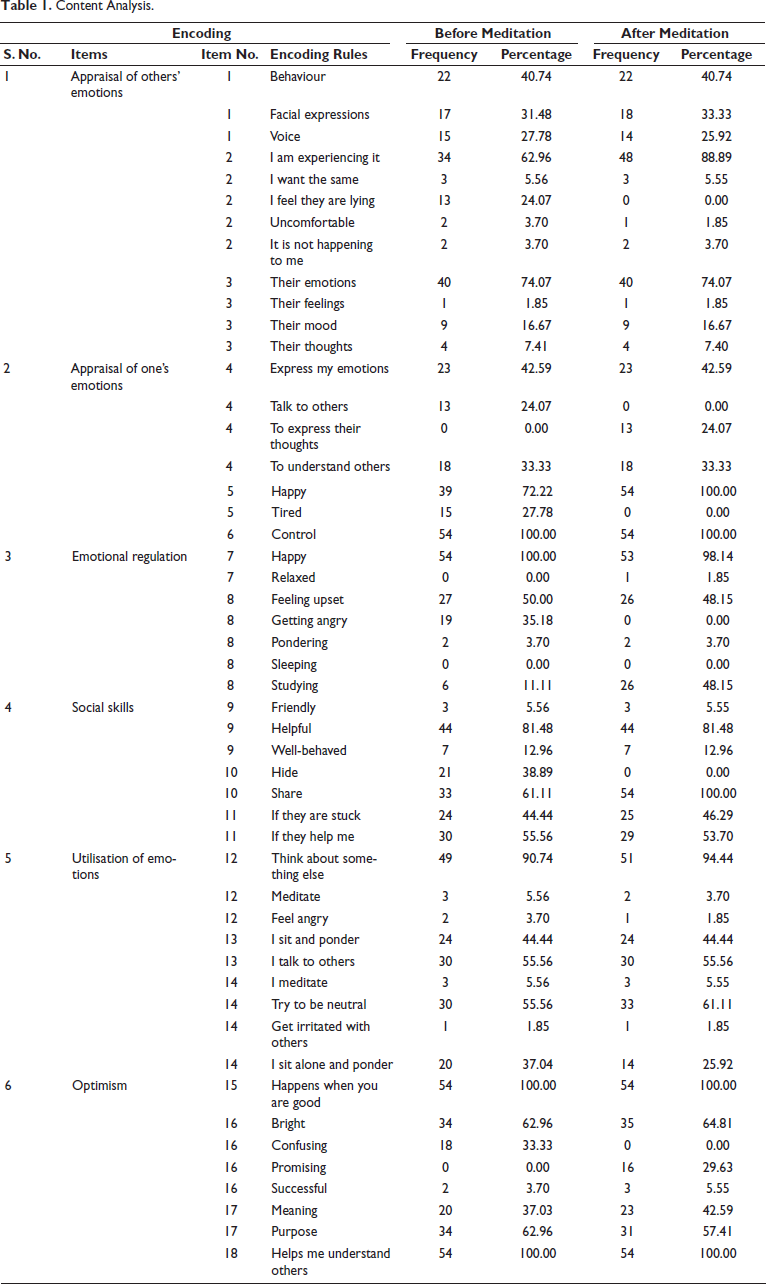
Before the meditation, appraisal of others’ emotions focused more on the behaviour. But after meditation, results show that the participants had an increase in appraisal of others’ emotions.
In the first set of data, ‘facial expressions’ had a frequency of 17 (31.48%), whereas in the second set, it had a frequency of 18 (33.33%). In the first set, ‘voice’ had a frequency of 15 (27.78%), whereas in the second set, it had a frequency of 14 (25.92%).
In the first set, ‘I feel they are lying’ had a frequency of 13 (24.07). However, after meditation in the second set, ‘I feel they are lying’ had a frequency of 0 (0.00%), indicating a drastic change from the first set.
Appraisal of One’s Emotions also showed a significant change after meditation by the participants. In the first set, ‘talk to others’ had a frequency of 13 (24.07%), whereas in the second set, it had a frequency of 0 (0.00%), indicating a change. In the second set, ‘to express their thoughts’ had a frequency of 13 (24.07%), while it was 0 (0.00%) in the first set.
Emotional Regulation also saw a significant change in the second set after meditation. In the second set, ‘getting angry’ had a frequency of 0 (0.00%), while in the first set, it was 19 (35.18%).
‘Studying’ had a frequency of 26 (48.15%) in the second set, while in the first set, it was 6 (11.11%). This indicates that not only did the participant start controlling their anger, but they also found out ways to channel their anger and utilise it for something more productive.
Social Skills also show a significant improvement. Before meditation, hiding emotions from peers was strong. In the second set, ‘hide’ had a frequency of 0 (0.00%), while in the first set, it was 3 (5.56%).
Utilisation of Emotions also saw a significant change in the following areas. ‘Feel angry’ had a frequency of 2 (3.70%) in the first set, while it had a frequency of 1 (1.85%) in the second set. ‘I sit alone and ponder’ had a frequency of 20 (37.04%) in the first set, while it had a frequency of 14 (25.92%) in the second set.
Optimism also saw a significant change after meditation. In the second set, ‘confusing’ had a frequency of 0 (0.00%), while in the first set, it was 18 (33.33%). ‘Promising’ had a frequency of 16 (29.63%) in the second set, while it was 0 (0.00%) in the first set.
Discussion
There are variations in frequencies for several items between the two sets, indicating potential changes in responses or coding criteria. Some items, such as facial expressions, voice and I feel they are lying, showed slight differences in frequencies between the two sets. In contrast, some items, such as talk to others, getting angry and hide, showed notable changes in frequencies between the two sets.
The practice of meditation has been associated with numerous mental and emotional benefits, influencing various aspects of an individual’s psychological well-being. In this analysis, we delve into the data pertaining to the Appraisal of Other’s Emotions (Item No. 1), Emotional Regulation (Item No. 3), Utilisation of Emotions (Item No. 5) and Optimism (Item No. 6) to understand how meditation may impact these specific facets of emotional experience. By examining the frequencies and percentages before and after meditation, we aim to identify patterns, trends and noteworthy changes that may provide insights into the effects of meditation on emotional states.
The frequencies and percentages for ‘behaviour’, ‘facial expressions’ and ‘voice’ appear consistent both before and after meditation. This suggests that individuals maintain a stable level of attention and sensitivity to these external cues regardless of their meditative state. However, a significant increase in the frequency and percentage is observed for the category ‘I am experiencing it’ after meditation. This suggests a heightened self-awareness or attunement to one’s own emotional states during the meditative practice. It could indicate an increased ability to recognise and internalise emotions, aligning with the introspective nature of meditation.
The analysis of Emotional Regulation reveals intriguing findings. ‘Happy’ and ‘control’ exhibit consistent frequencies of 100% both before and after meditation, indicating a sustained positive emotional state and a sense of self-control. Conversely, ‘feeling upset’ and ‘getting angry’ show a noticeable decrease in frequency after meditation. This suggests that the practice of meditation may contribute to a reduction in negative emotions and an enhanced ability to regulate emotional responses. The stability in positive emotions aligns with existing literature on meditation’s positive impact on emotional well-being.
In examining the Utilisation of Emotions, we find that ‘Think about something else’, ‘I talk to others’, ‘Try to be neutral’ and ‘Happens when you are good’ maintain high and consistent frequencies both before and after meditation. This indicates a persistent and effective utilisation of emotional strategies, suggesting that individuals engage in these coping mechanisms regardless of their meditative state. These findings imply that certain emotional regulation techniques are deeply ingrained and may not be significantly altered by the practice of meditation.
Optimism, as measured by ‘Happens when you are good’, demonstrates a remarkable consistency with a frequency of 100% both before and after meditation. This suggests that the participants consistently associate positive outcomes with their own actions, and this belief remains stable during meditation. However, ‘confusing’ and ‘promising’ exhibit a decrease in frequency after meditation, indicating a potential shift in the perception of ambiguity and the promise of future events. This nuanced change suggests that while optimism remains high, there may be a more discerning evaluation of certain situations post-meditation.
Conclusion
The overarching analysis reveals a pattern of stability in many emotional facets across different categories before and after meditation. Consistent frequencies are observed in categories related to emotional appraisal, regulation, utilisation and optimism. This stability suggests that certain emotional aspects may be deeply ingrained or less susceptible to immediate changes induced by meditation. The notable exception is the heightened self-awareness observed in the ‘I am experiencing it’ category under Appraisal of Others’ Emotions, suggesting that meditation may foster a greater connection with one’s own emotional experiences.
This content analysis provides valuable insights into the impact of meditation on emotional experiences. While stability is observed in various emotional facets, there are nuanced changes that hint at the transformative potential of meditation, particularly in enhancing self-awareness and regulating negative emotions. 25 These findings contribute to the growing body of knowledge on meditation’s psychological effects and underscore the need for further research to explore the intricacies of emotional changes during and after meditation.
The study findings also suggest that Anapanasati meditation can be an effective tool in improving adolescents’ social skills, altruism and optimism for the future, improving their resilience and helping them build meaningful relationships with both their peers and seniors. An initiative of the Government of Maharashtra, India, MITRA Upkaran is a programme that aims at making Anapanasati meditation accessible to every adolescent studying in schools and institutions. However, currently it is being implemented in only certain schools in Maharashtra, as the positive effects of this meditation are still being studied. The current study will be a new addition to the existing literature on Anapanasati meditation as well as mindfulness practices. This gives a new direction to the implementation of the practice of Anapanasati meditation not only in schools but also in adolescents’ places of residence. It can be done in group settings as a guided meditation technique to help reduce stress and anxiety and enhance well-being, altruism, resilience and internal locus of control. It can also be practiced regularly in schools and institutions. As it increases mindfulness, the internal locus of control will increase, thereby helping the individual in a better social adjustment, resilience, positive life orientation, emotional regulation and the various benefits meditation provides for promoting good mental health. Further research on this technique would help highlight the timeless but everlasting impact of practising this meditation technique.
Footnotes
Acknowledgements
The authors of this study thank the orphanage and the government school for their cooperation and consent for data collection. The authors thank the participants of the study. The authors also thank the expert translators who helped with the Marathi translation of the scales.
Authors’ Contribution
The authors confirm that the research contributions were as follows:
All three authors contributed to the research design and conceptual framework. All three authors contributed to the data collection and analysis of the data. All three authors contributed to writing the research article.
Declaration of Conflicting Interests
The authors declared no potential conflicts of interest with respect to the research, authorship and/or publication of this article.
Funding
The authors received no financial support for the research, authorship and/or publication of this article.
Statement of Ethics
Informed consent was taken from the participants of the study in a written format. Debriefing was also done after the completion of the study to maintain transparency as well as privacy of the study participants. Ethical guidelines were strictly followed so that no harm was caused to the participants during the study. The authors take full responsibility for the ethics to be maintained.
