




Abstract
Background
Orphan adolescents face multiple vulnerabilities, including a lack of parental guidance, poor educational opportunities, socio-economic disadvantages and peer pressure, making them prone to unhealthy behaviours, risk-taking, anxiety and depression. Despite these challenges, they often exhibit resilience, though forming stable social bonds remains difficult. The use of Anapanasati meditation in orphanages is a low-cost, easy and convenient solution to facilitating holistic growth, encouraging positive psychosocial performance and enhancing internal locus of control.
Purpose
The objective of the current study was to find the effectiveness of Anapanasati meditation on the internal locus of control, psychological well-being, resilience and altruism among orphan adolescents.
Method
A sample of 108 adolescents (54 orphan and 54 non-orphan adolescents) comprising of equal number of male and female participants in the age group of 13–17 years was included in the study. Data was collected from orphan adolescents residing in institutions in Pune, Maharashtra.
Results
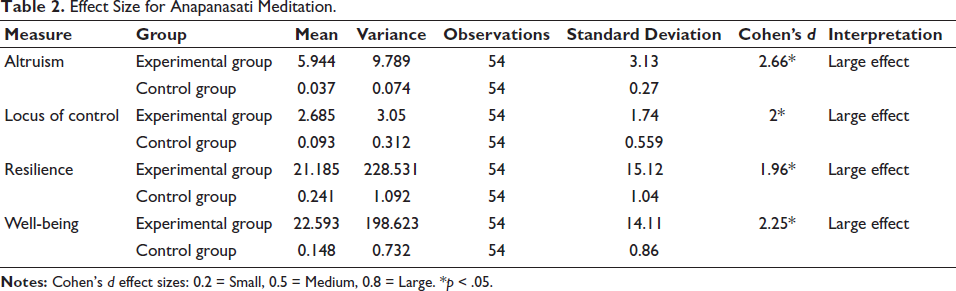
For the present study, t-test and Bonferroni and Holm’s (post-hoc) were calculated. Cohen’s d was also calculated to find the effect size of the intervention. There were significant changes in the experimental group compared to the control group. The three-month intervention was found to be effective from the second month onwards.
Conclusion
The results of the current study indicate that meditation programmes can be practically applied in schools, orphanages and residential care facilities. Anapanasati meditation, which is relatively simple, economically and culturally non-intensive, seems particularly suitable in resource-restrained settings.
Introduction
One of the most ancient known documented meditation practices in the history of mankind, Anapanasati meditation or mindfulness of breathing, dates back to the period in human history, which occurred more than 2,500 years ago, under Gautama Buddha. This practice was meticulously codified in the Pali Canon, particularly in the Anapanasati Sutta (Majjhima Nikāya 118), where the Buddha offers a comprehensive framework for cultivating mindfulness through awareness of the breath. While Anapanasati was originally taught within the spiritual context of the Buddhist path to liberation (nirvāṇa), its adaptability and simplicity have allowed it to transcend its religious origins and become central in modern scientific and therapeutic discourses on mental health and cognitive training.1, 2
Anapanasati has also proven valuable in educational and occupational settings. Programmes integrating breath awareness meditation into schools have demonstrated improvements in students’ emotional resilience, attention span and academic performance. 3 The recent study confirms that breath mindfulness improves adaptive coping and emotional flexibility, two of the resilience pillars. 4
Orphan adolescents face multiple vulnerabilities, including a lack of parental guidance, poor educational opportunities, socio-economic disadvantages and peer pressure, making them prone to unhealthy behaviours, risk-taking, anxiety and depression. Despite these challenges, they often exhibit resilience, though forming stable social bonds remains difficult. The psychological well-being of non-orphans is significantly higher than their orphaned peers. Orphan support projects must consider psychosocial well-being in addition to material support.5, 6
Mindfulness-based interventions, particularly Anapanasati meditation, have been shown to enhance emotional regulation, resilience, attention, metta bhav (compassion) and overall psychological well-being. Past research evidence shows that such practices are able to alleviate aggression, stress, anxiety, depression and enhance cognitive functioning and social behaviour among adolescents.7, 8 The use of Anapanasati meditation in orphanages is a low-cost, easy and convenient solution to facilitating holistic growth, encouraging positive psychosocial performance and enhancing internal locus of control.9, 10 Thus, the current research is expected to assess the potential of Anapanasati meditation to improve resilience, well-being and adaptive coping in a group of orphan adolescents.
Method
For the present study, Ryff’s Psychological Well-Being Scale, Generative Altruism Scale, Resilience Scale and Rotter’s Locus of Control Scale were used.
For the present study, participants from three CWC-certified Grade A children’s homes were included in the study. An experimental group of 54 orphan adolescents and a control group of 54 orphan adolescents were included in the study from Pune, Maharashtra. For a period of three months, Anapanasati meditation was taught for 10 minutes daily to the adolescents.
Before the conduction of the study, informed consent was taken from the participants and the concerned authorities for the study. The authorities were told about the entire procedure that would be followed. Ethical guidelines were strictly followed—permission was taken from the concerned authorities, data confidentiality was maintained, publication guidelines were followed and the right to withdrawal was informed to the participants. Debriefing was also done after the completion of the study. The scales were administered to the participants of the experimental group before and after the intervention. The intervention was scheduled at their place of residence at 6 PM. in the evening daily. Subjective experiences of the participants in the experimental group were taken into account at the end of each week. The intervention was done in a group setting. The researcher was available for the subjects throughout the intervention. The control group was not given the intervention. However, the assessment was done at the end of every month. Feedback was taken from the participants and the caregivers every month.
Results
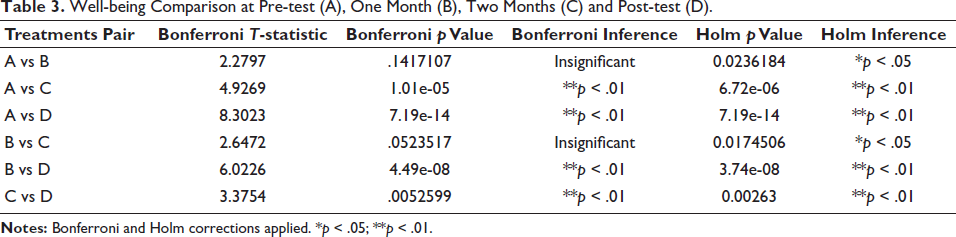
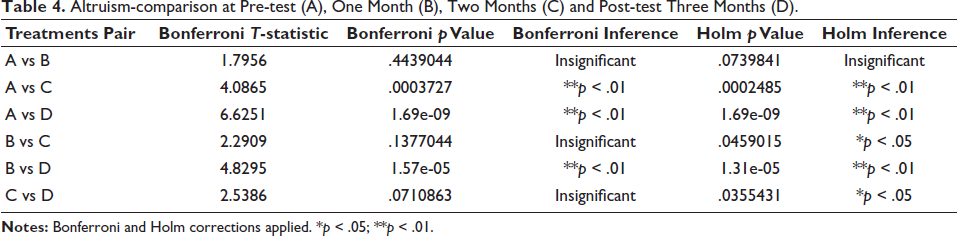
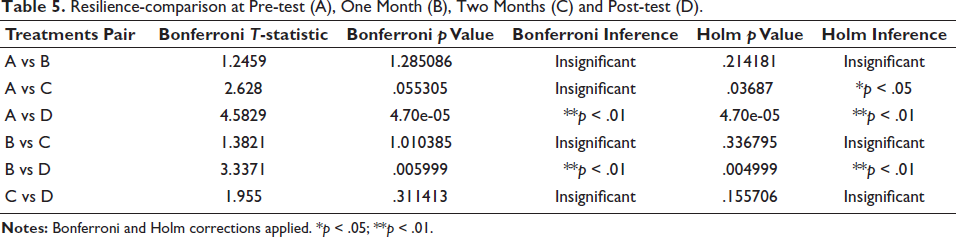
In the present study, the effects of Anapanasati meditation on locus of control, altruism, well-being and resilience were examined using t-tests for both the experimental and control groups. To identify the differences within groups, Bonferroni and Holm’s (post-hoc) method was used. The efficacy of the intervention was evaluated using Cohen’s d. A t-test was also used to identify gender differences in locus of control, altruism, well-being and resilience. The characteristics of well-being among the orphan adolescents were also determined using the t-test.
Post-test Assessment of Internal Locus of Control, Altruism, Resilience and Well-being.

Effect Size for Anapanasati Meditation.
Bonferroni and Holm’s Comparisons (Post-hoc)
Well-being Comparison at Pre-test (A), One Month (B), Two Months (C) and Post-test (D).
*p < .05; **p < .01.
Altruism-comparison at Pre-test (A), One Month (B), Two Months (C) and Post-test Three Months (D).
*p < .05; **p < .01.
Resilience-comparison at Pre-test (A), One Month (B), Two Months (C) and Post-test (D).
Internal Locus of Control-comparison at Pre-test (A), One Month (B), Two Months (C) and Post-test (D).

Separate samples, gender differences in internal locus of control, altruism, resilience and well-being after the intervention were investigated using t-tests.
Gender Differences in Internal Locus of Control, Altruism, Resilience and Well-being (Post-test).

*p < .05.
Well-being Post-test Assessment.

*p < .05.
Discussion
Anapanasati meditation practised by the orphan adolescents brought about significant improvement in well-being. Resilience, altruism and internal locus of control increased with the practice of Anapanasati meditation. During the first month of practice of Anapanasati meditation, no significant changes were found in the orphan adolescent’s well-being, resilience, internal locus of control and altruism. Significant changes were found after the second month for well-being, resilience, altruism and internal locus of control. Significant changes in altruism were observed only in the second and third months.
Anapanasati meditation (three-month intervention) proved to be effective in improving well-being, resilience and emotional regulation of the individuals. This result is important as it shows that an intervention of three months can bring about positive changes in an individual’s daily life.
Gender differences were found in internal locus of control and well-being. Males had a higher internal locus of control and females had higher well-being. There were no significant gender differences in resilience and altruism.
Orphan adolescents reported positive changes in how adolescents managed their emotions and social interactions. After a period of three months of daily practising Anapanasati meditation, they found themselves to have a better at understanding and recognition of others’ feelings, recognition of their own feelings, their emotional regulation and utilisation of their feelings, while negative thoughts such as mistrust were reduced. They also reported using studies as a coping mechanism whenever they felt upset or angry. 11 Similarly, suppression of emotions was now less, indicating a shift towards using more adaptive coping skills. 12 The adolescents reported that with the practice of Anapanasati meditation, they developed a healthier way of releasing their emotions, enhanced their relationships and contributed to their overall well-being. 13
Conclusion
This research has important theoretical, practical, policy and societal implications. The demonstrated improvements in psychological well-being, resilience, internal locus of control and altruistic behaviour in orphan adolescents after taking part in Anapanasati meditation show that contemplative practices can be an effective intervention strategy in promoting emotional well-being among adolescents.
From a theoretical perspective, these findings contribute to the growing research in positive psychology and mindfulness by showing how Anapanasati meditation may strengthen psychological resources in adolescents who are vulnerable due to parental loss and institutional living. 14 The results also generalise to the resilience theory that meditation is effective in building protective factors that allow individuals to overcome exposure to psychosocial risks. Moreover, the reported increase in altruistic and internal locus of control indicates that meditation not only favours personal psychosocial adjustment but could also foster prosocial behaviour, thus connecting individual development with the overall societal progress.
The results of the current study indicate that meditation programmes can be practically applied in schools, orphanages and residential care facilities. Anapanasati meditation, which is relatively simple, economically and culturally non-intensive, seems particularly suitable in resource-restrained settings. Educating adolescents through training caregivers, educators or peer mentors to lead meditation sessions can aid in the acquisition of basic life skills by adolescents, such as emotional regulation, stress management and empathy. These benefits would be expected to continue even after the short term and in the future, the young people would have healthier inter-personal relationships, a greater participation in academic activities and more adaptive coping mechanisms as they mature.
The current study is not limited to the institutional context but is employed for displaying the broader societal context. By shaping resilience, emotional intelligence and altruism, meditation may help potentially vulnerable adolescents to become adults with high levels of confidence, social responsibility and emotional stability. On a long-term time scale, these interventions can mitigate the negative effects traditionally linked to untreated adolescent mental health issues, such as social isolation and deviance, thus enabling positive contributions to civic life and national growth.
In conclusion, this study supports Anapanasati meditation as a promising, contextually relevant practice for supporting adolescent emotional health. Embedding meditation within education, child welfare and mental health policies could help create more inclusive and sustainable systems of care. The current research is able to clearly highlight the efficiency of Anapanasati meditation as well as important points regarding the transformative possibilities of such a simplistic form of less time-based breath-focused meditation that has not been accorded the power of an effective intervention, particularly for the vulnerable population.
Future research should emphasise the strengths of orphan adolescents rather than just their deficits. Researchers may like to look into such evidence-based interventions tailored to vulnerable youth and ultimately contribute to global conversations about how contemplative practices can be harnessed to promote human flourishing in contexts of adversity.
Footnotes
Acknowledgement
The authors of this study thank the orphanage and the government school for their cooperation and consent for data collection. The authors thank the participants of the study. The authors also thank the expert translators who helped with the Marathi translation of the scales.
Authors’ Contribution
The authors confirm that the following research has been divided:
Declaration of Conflicting Interests
The authors declared no potential conflicts of interest with respect to the research, authorship and/or publication of this article.
Funding
The authors disclosed receipt of the following financial support for the research, authorship and/or publication of this article: Self-financed by the authors of the research work.
ICMJE Statement
The authors confirm that the following research has been divided:
Patient Consent
Informed consent was taken from the participants of the study in a written format. Debriefing was also done after the completion of the study to maintain transparency as well as the privacy of the study participants.
Statement of Ethics
Informed consent was taken from the participants of the study in a written format. Debriefing was also done after the completion of the study to maintain transparency as well as the privacy of the study participants. Ethical guidelines were strictly followed so that no harm was caused to the participants during the study. The authors take full responsibility for maintaining the ethics to be maintained.
