




Abstract
Background
Modern integrative frameworks such as the self-awareness, self-regulation and self-transcendence (S-ART) and LIBRE/EMC2 highlight the neurocognitive-affective mechanisms underpinning mindfulness in young learners.
Purpose
This study explored how trait-level psychological dispositions and academic factors relate to electrophysiological and behavioural markers of state mindfulness in novice student meditators.
Methods
Ninety-seven university students (mean age = 24.59 years) participated in the study, with 89 consenting to electroencephalography (EEG) recording during a tristage Ānāpānasati-inspired meditation. EEG spectral powers were analysed across five neural oscillatory bands in the prefrontal, occipital, and default mode regions to assess state mindfulness, complemented by behavioural evaluation using the Amsterdam Resting-State Questionnaire. Additionally, trait-level data encompassing personality, values, mindfulness and academic background were gathered through validated self-report measures.
Results
The mindfulness trait of Acting with Awareness was associated with reduced Discontinuity of Mind and Theory of Mind, as well as heightened theta power during meditation, indicating enhanced breath-focused attention. Discontinuity of Mind also correlated with elevated posterior alpha and prefrontal beta, consistent with fragmented or effortful mentation. Planning-related thinking was consistently associated with self-reported early STEM subjects’ proficiency, and corresponded with reduced delta and alpha power—suggesting unnecessary mentation during meditation. While value traits showed negligible robust behavioural correlations, EEG findings revealed that individuals scoring higher on Stimulation values exhibited lower prefrontal alpha power, possibly reflecting heightened alertness while meditating. Modest associations also emerged between Extraversion, Emotional Stability and state mindfulness dimensions across neurobehavioural indices.
Conclusion
These findings offer preliminary support for trait-to-state continuity in early meditative experience, highlighting how attentional traits and academic conditioning may shape neural engagement in novices. Although predictive value was weak, the results underscore the importance of dispositional context in shaping novice state mindfulness, warranting further replications and investigations to clarify the directionality and stability of the observed trait–state associations.
Keywords
Introduction
The ‘Self-Awareness, Self-Regulation, and Self-Transcendence (S-ART)’ framework in literature proposes that mindfulness-based practices might foster three adaptive mechanisms—self-awareness, self-regulation, and self-transcendence—that underpin emotional resilience, empathy, and prosociality.1–3 The neurobiological mechanisms underpinning S-ART, such as attention and emotion regulation, also contribute to improved academic performance, emphasising the interconnectedness of emotional health and academic learning. 4 Parallelly, the LIBRE/EMC2 framework, developed within the Indian context, identifies four foundational dimensions of holistic social-emotional learning: empathy, mindfulness, compassion, and critical inquiry (EMC2), anchored in whole-brain learning and the co-development of cognitive and affective systems.4, 5 Within this context, contemporary integrative frameworks like S-ART and LIBRE offer complementary blueprints for cultivating holistic well-being and preparing learners for an interconnected, unpredictable, and ethically complex world. Despite the grounding of these frameworks in neurobiological and psychological research, 4 the stated dimensions are under-explored in the Indian context.
The present study is thus positioned at the intersection of these two frameworks. Specifically, it investigated the neurobehavioural correlates of state mindfulness in novice Indian meditators through an Ānāpānasati-inspired meditation paradigm,6, 7 for its interrelationships with other variables aligned with both S-ART and LIBRE frameworks. 8 Trait and state mindfulness were conceptualised as expressions of attentional control and moment-to-moment awareness, corresponding to S-ART mechanisms and the LIBRE dimension of mindfulness.9, 10 Personality traits, especially emotional stability and conscientiousness, served as dispositional substrates for S-ART’s regulatory functions and reflected LIBRE’s empathy and engagement dimensions.11, 12 Schwartz’s value traits provided an additional lens into socio-affective factors. Self-transcendence values such as benevolence and universalism, empirically linked to compassion and empathic concern, mapped onto S-ART’s self-transcendence and LIBRE’s compassion dimensions.13–15 Conversely, values like achievement and power, associated with self-enhancement over prosociality, offered a counterpoint for understanding value–mindfulness relationships. 16 Critical inquiry—arguably the most cognitively demanding LIBRE dimension—was operationalised via STEM-subjects-based academic proficiency, supported by prior research linking math-linked performance with reasoning and cognitive control.17–19 Although not a full proxy for moral or philosophical reasoning, it remains a practical indicator of critical thinking in India’s quantitatively oriented academic system. 20
Overall, by integrating trait and state dimensions of mindfulness with electrophysiological and behavioural data, this study aimed to examine how novice meditators enact key S-ART and LIBRE competencies in an educational setting. Rather than directly testing the frameworks, the study offers preliminary insights into how psychological dispositions and academic factors shape early-stage contemplative practice in an Indian youth sample. The findings are intended to inform future research on context-sensitive mindfulness-based interventions in mental health and education.
Materials and Methods
Participants
Ninety-seven novice meditators (mean = 24.59 ± 5.18 years), predominantly male (n = 90), completed the study. Participants were recruited through convenience sampling and required to be English-proficient and enrolled in an Indian higher education institution. In the completed sample, eighty-nine participants (82 males) provided consent for concurrent electroencephalography (EEG) examination during the in-person meditation intervention phase, alongside behavioural self-reporting. A control group was not included, as the study aimed to examine within-group variability linked to individual differences, rather than evaluate the causal neurobehavioural efficacy of state mindfulness.
Instruments
Self-reported Academic Scores
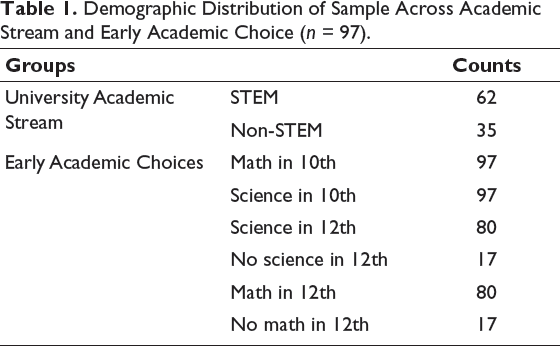
Participants self-reported their university academic stream (STEM or Non-STEM), and their early STEM subject scores, which included: grade 10 mathematics and science, and, when applicable, grade 12 mathematics, physics, and chemistry (Table 1). To assess data reliability, intra-academic score correlations were computed using Spearman’s rho and Kendall’s tau-b due to non-normal distributions. All subject pairs showed strong, statistically significant correlations (rho = 0.556–0.870; tau-b = 0.412–0.708, all p < .001). Additionally, internal consistency was strong (Cronbach’s α = 0.899; McDonald’s ω = 0.903); therefore, the data were considered suitable for further analysis.
Demographic Distribution of Sample Across Academic Stream and Early Academic Choice (n = 97).
Values
Trait values were measured using the Revised Portrait Values Questionnaire (PVQ-RR), which categorises values hierarchically into four higher-order, ten basic, and 19 refined traits. 16 Separate male and female versions were used to ensure gender fairness, both of which included 57 items on a 6-point Likert-type scale. 21 The PVQ-RR is designed to minimise social desirability bias, 22 and has been validated in various cultural contexts.23, 24 In this sample, internal consistency was adequate, with average inter-item reliability of α = 0.615 and ω = 0.653 for refined values, α = 0.653 and ω = 0.685 for basic values, and α = 0.798 and ω = 0.809 for higher-order values. ‘Achievement’ (ω = 0.498), ‘Humility’ (ω = 0.455), and ‘Benevolence Dependability’ (ω = 0.375) showed the poorest reliability and were interpreted with caution.
Personality
The Big Five personality traits—extraversion (EX), agreeableness, conscientiousness, emotional stability (inverse of neuroticism; N’), and openness to experience—were assessed using the 50-item International Personality Item Pool-Big Five Factor Markers (IPIP-BFM-50). 11 Each trait included 10 items rated on a 5-point scale. 21 This instrument has shown robust psychometric properties across contexts.25–29 The current sample showed satisfactory internal consistency (αmean = 0.733; ωmean = 0.753).
Trait Mindfulness
The Five Facet Mindfulness Questionnaire-39 (FFMQ) assessed five aspects of trait mindfulness: observing, describing, acting with awareness (AA), non-judging, and non-reactivity. 9 Responses were recorded on a 5-point scale. 21 FFMQ is recognised for its robust validity30, 31 and reliability32–34 across different cultures. The current sample also showed strong internal consistency (αmean = 0.796; ωmean = 0.802).
State Mindfulness
State mindfulness was measured using the Amsterdam Resting-State Questionnaire (ARSQ), comprising 28 items assessing post-meditative mental experience across seven domains: Discontinuity of Mind (DOM), Theory of Mind (TOM), Self (SLF), Planning (PLN), Sleepiness (SLP), Comfort (CMF), and Somatic Awareness (SOA).10, 35 Participants rated their experiences on a 5-point scale. 21 Also, a composite state mindfulness variable (SMIND) was curated as the combined presence of SOA and CMF, along with the absence of SLP, SLF, PLN, DOM, and TOM. 6 The ARSQ has demonstrated acceptable reliability and a validated factor structure.10, 36, 37 Reliability in the present sample was acceptable (αmean = 0.695; ωmean = 0.716).
Procedure
Data Acquisition
The study was conducted in two phases: an asynchronous self-report survey and a subsequent in-person intervention. Participants first completed online questionnaires (IPIP-BFM-50, PVQ-RR, and FFMQ) along with demographic and academic information. In the second phase, they participated in a mindfulness intervention inspired by Ānāpānasati.6, 38 A 30-minute arithmetic task (Stage 0) was implemented to induce cognitive workload, replicating daily life stressors. This was followed by a 5-minute eyes-closed resting period (RS) (Stage 1) for relaxation, a 5-minute breath counting session (BC) (Stage 2) to introduce mindfulness, and a 10-minute breath-focus meditation (BF) (Stage 3) to evaluate breath awareness. Participants who consented were concurrently monitored with EEG, but all participants responded to the ARSQ post-intervention.
Electroencephalography
EEG signals were recorded using Brain Products’ Recorder Software (v1.25.001) and the EasyCap system, with 64 electrodes placed according to the extended International 10–20 system.39, 40 Data were sampled at 500 Hz with impedance maintained within 5–15 kΩ. FCz served as the reference electrode, while AFz functioned as the ground. Signals were amplified via Brain Products’ LiveAmp system and processed using a third-order sinc low-pass filter with a frequency range of 0.01–131 Hz. 39 Preprocessing was done in MATLAB R2021a using EEGLAB v2023, with artefact correction implemented through the ASR-ICA pipeline (Artefact Subspace Reconstruction-Independent Component Analysis).41, 42 Only the central two-thirds of each meditation segment were analysed.6, 7 Data were downsampled to 250 Hz and filtered with a 1–60 Hz IIR-Butterworth bandpass filter and a 50 Hz Zapline notch filter.43, 44 ASR-cleandata excluded channels with spectral power ±3 SD. 45 Subsequently, ICA decomposition removed noise components (classification probability > 0.5) based on automated IC labelling.45, 46 Bad channels and the FCz reference electrode were then interpolated, and a mean-mastoid re-referencing was applied. 39
Spectral power was computed via Fourier transform using EEGLAB’s eegstats plugin (v1.2). For each participant and intervention stage, power (dB/Hz) was averaged across all electrodes and analysed over five bands—delta (1–4 Hz), theta (4–8 Hz), alpha (8–13 Hz), beta (13–30 Hz), and gamma (30–60 Hz)—and three regions: the occipital region (OCC) including O1-2, Oz, PO3-4, and POz6, 47; the prefrontal cortex (PFC) including FP1-2, AF3-4, AFz, F1-F4, and Fz6, 48; and the PFC-excluded posterior default mode network (DMN) which included CP1-CP4, CPz, P1-P4, Pz, PO3-4, POz, and Oz.6, 49
Statistical Analyses
Prior to hypothesis testing, data were screened for normality, linearity, and outliers. To mitigate the risk of Type I errors,50, 51 Bonferroni corrections were applied based on the number of comparisons conducted upon the behavioural variables. Spectral powers and indices were considered a single test to avoid overcorrection, and exploratory or post-hoc analyses used p < .05. 50
Pearson’s correlation coefficients were first computed to assess associations between state mindfulness dimensions and each set of trait-level variables (trait mindfulness, trait values, personality, and early academic scores). For significant, empirically relevant correlations, linear regression examined unique predictive effects. These models were used to identify potential mechanisms underlying trait-to-state transitions in mindfulness.
Following behavioural analyses, EEG spectral powers during the three meditation stages yielded across the five neural oscillations’ bands and three brain regions (PFC, OCC and DMN) were correlated with trait- and state-mindfulness, trait values, personality traits, and self-reported early STEM-subjects’ scores. Both baseline powers during the RS stage and relative changes for the other stages (BC and BF vs. RS) were assessed. All correlations involving the relationships between neural oscillations and the specified psycho-social traits were robust, employing the WRS2 package in R. 52 To examine academic stream differences (STEM vs. Non-STEM), Yuen’s robust independent-sample t-tests were used due to unequal group sizes and variance violations. 7 Lastly, post-hoc tests explored behavioural–electrophysiological relationships wherever applicable.
Results
Novice Mindfulness’ State-trait Associations
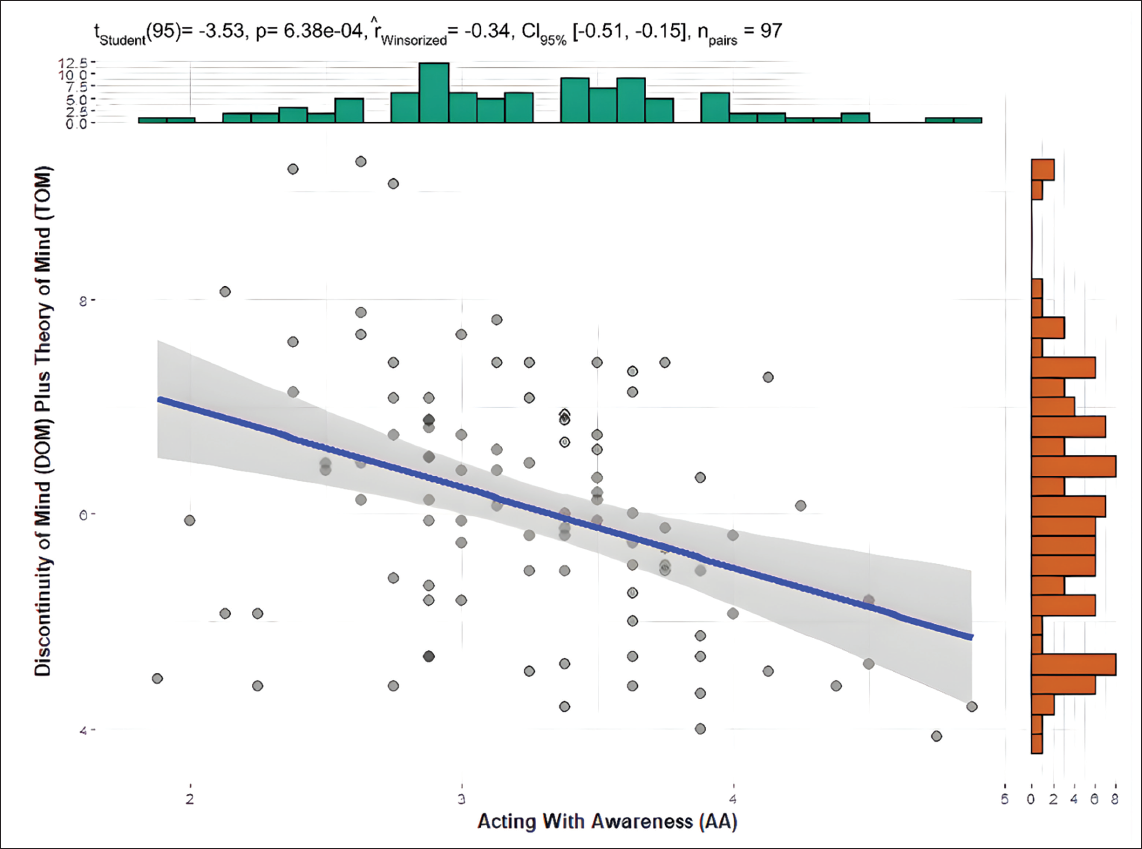
After Bonferroni corrections, two significant correlations emerged between trait and state mindfulness (Table 2; α = 0.006). Most significant were DOM (r = −0.291) and TOM (r = −0.321), both of which mildly negatively correlated with AA. A post-hoc analysis between AA and a concatenated variable, ‘DOM + TOM’, was calculated based on these results. Given that significant results were found only with AA, DOM, and TOM, linear regression analysis was performed exclusively for these dimensions (Table 2), after assumption checks. The combined dimensions of ‘DOM + TOM’ accounted for significant variance in AA (R2 = 0.147, p < .001), with both DOM and TOM having mild independent negative regression coefficients (β = −0.218 & −0.26, respectively, with p < .05). Figure 1 presents a scatterplot illustrating the relationship between AA and ‘DOM + TOM’ results.
Correlation and Regression Coefficients Between Self-reported State- and Trait-mindfulness.
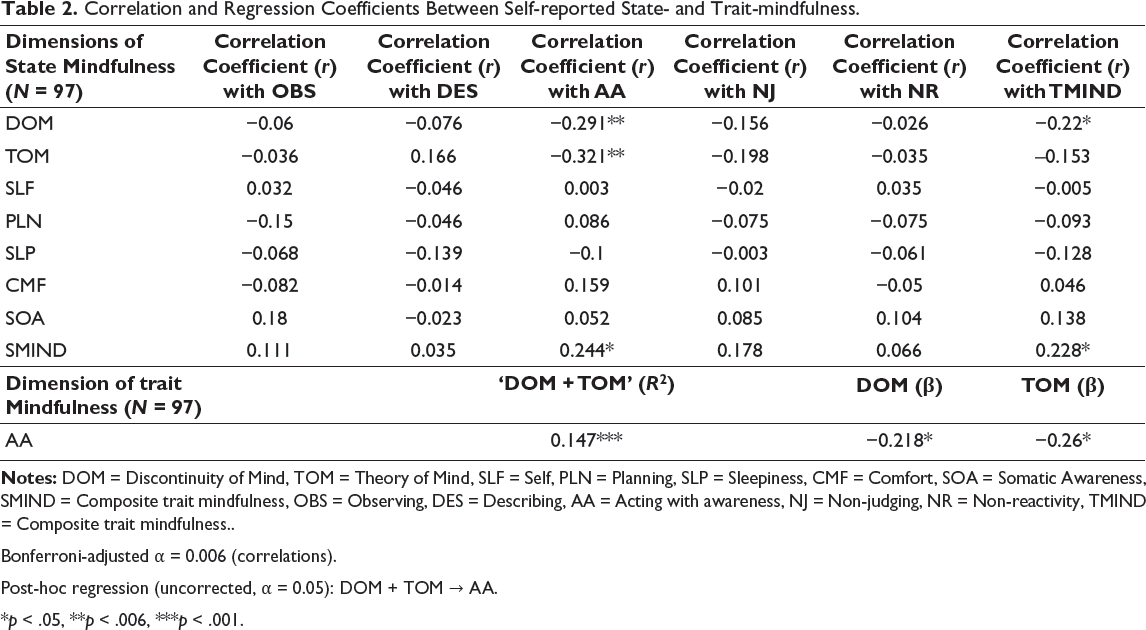
Bonferroni-adjusted α = 0.006 (correlations).
Post-hoc regression (uncorrected, α = 0.05): DOM + TOM → AA.
*p < .05, **p < .006, ***p < .001.
Scatterplot Illustrating the Association of ‘Discontinuity of Mind Plus Theory of Mind’ With ‘Acting With Awareness’ (Marginal Histograms Along the Top and Right Axes Visualise the Distributions of ‘Acting With Awareness’ and ‘Discontinuity of Mind Plus Theory of Mind’, Respectively, Using Robust Statistics. Plots Were Generated Using ‘ggstatsplot’ 53 and ‘ggplot2’ 54 via the ‘ClinicoPath’ Jamovi Module 55 ).
The electrophysiological assessment of neural oscillations in relation to state mindfulness also demonstrated weak associations, with only DOM showing significant interrelationships, post multiple comparisons correction (Table 3; α = 0.006). Following the tristage mindfulness intervention, self-reported DOM showed significant positive correlations with EEG spectral power across alpha, beta, and theta bands. Higher DOM was positively associated with the average alpha and beta oscillations during all three stages. However, the positive alpha association was limited to the posterior-DMN and OCC regions, while the beta correlation was observed to be significant in the PFC region only. Lastly, theta oscillations during RS showed weaker yet significant positive correlations with DOM in all three regions, as well as at the average scalp-wise level (Table 3).
Significant Robust Correlations Between Trait/State Mindfulness Dimensions and EEG Spectral Indices During Meditation Stages Over Three Different Brain Regions.
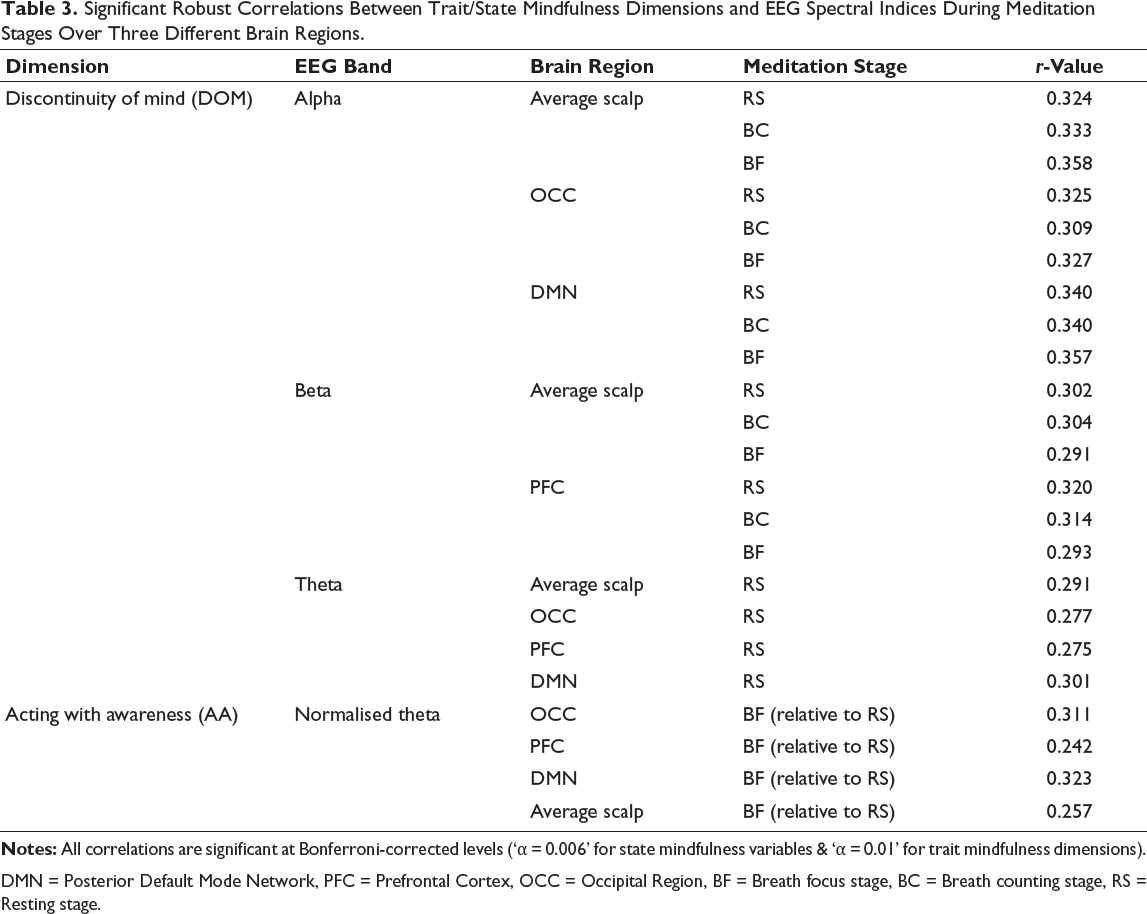
DMN = Posterior Default Mode Network, PFC = Prefrontal Cortex, OCC = Occipital Region, BF = Breath focus stage, BC = Breath counting stage, RS = Resting stage.
Trait mindfulness also yielded limited significant interrelationships with EEG-examined oscillatory powers, post Bonferroni corrections (Table 3; α = 0.01). AA exhibited significant positive correlations with normalised theta power increases during the BF meditation stage relative to the RS, across all examined brain regions (Table 3). Notably, given the established link between theta activity and working memory engagement, 56 cognitive workload (CWL)57, 58 during the BF stage was assessed post-hoc and found to be negatively correlated with AA (r = −0.272, p = .0099).
Novice State Mindfulness’ Associations with Values Traits
No significant results were identified regarding the self-report-based correlational association between state mindfulness and value traits at the higher order quadrant (α = 0.013), basic values (α = 0.005), or at the refined level (α = 0.003), following the multiple comparisons corrections. However, some marginally significant results were observed; Face (FAC) was found to be weakly negatively correlated to SOA (r = −0.292, p < .01) and Benevolence Dependability (BED) to SLP (r = −0.265, p < .01). Whereupon, following the assumption checks toward linear regression, SOA and SLP accounted only for a moderate variance, influencing negatively the novices’ values of FAC (R2 = 0.0852, p = .004) and BED (R2 = 0.0702, p = .009), respectively. Lastly, the electrophysiological examination of state mindfulness-values relationships found only Stimulation to relate negatively to an increase in alpha power in the PFC region (r = −0.308, p = .003), during the BC stage, relative to the RS stage, after Bonferroni adjustments.
Novice State Mindfulness’ Associations with Personality Traits
After applying multiple comparisons correction (α = 0.01) in the behavioural analysis, only N’ exhibited a mildly significant negative correlation with DOM (r = −0.3) and a positive correlation with SMIND (r = 0.3). Subsequent regression analysis showed only a moderate variance explained by DOM (R2 = 0.0897) and SMIND (R2 = 0.0899). The EEG analysis, utilising a Bonferroni-corrected significance level of α = 0.01, indicated a positive association between the EX trait and increased delta power during the BF stage compared to the RS stage in both DMN (r = 0.325) and OCC (r = 0.324) regions. Additionally, a positive association with an increase in theta power was observed during the BF stage in the OCC (r = 0.276) and BC stage in the DMN (r = 0.289) regions, both relative to the RS stage, for the EX trait.
Novice State Mindfulness and Its Interrelationships with Academic Factors
Academic factors were first examined in relation to self-reported state mindfulness. Therein, the PLN facet was found to consistently correlate positively with early STEM subjects’ proficiency after the Bonferroni corrections (α = 0.006). Significant associations emerged for 12th Mathematics (r = 0.392), 12th Physics (r = 0.353), and 12th Chemistry (r = 0.310), with marginally significant results for 10th Mathematics and Science (both r = 0.243, p ~ .022). However, Yuen’s independent sample robust t-tests towards state mindfulness subdimensions revealed no significant effects of university academic choice (STEM vs. Non-STEM).
Subsequently, neural oscillatory powers during novice meditation were examined in relation to academic scores, revealing significant negative associations post-correction (α = 0.01). Specifically relative to the RS stage, 10th-grade Science scores were negatively correlated with delta power increase in the OCC region during the BF stage (r = −0.284) and with enhanced alpha power in the PFC during the BC stage (r = −0.282). Similarly, 12th-grade Chemistry scores showed negative correlations with both the BC stage’s PFC alpha increase (r = −0.307) and the BF stage’s OCC delta (r = −0.299). Although 12th-grade Physics and Mathematics scores exhibited comparable negative trends, their associations did not meet the corrected significance threshold. Notably, strong electrophysiological support was not observed for the novice sample’s self-reported PLN-academic scores’ association. However, given the consistently significant associations between the PLN dimension and early STEM academic scores, a post-hoc analysis was conducted to examine memory processing using a spectral ratio metric (Fronto-Central Theta ÷ Fronto-Central Gamma). 59 The fronto-central electrodes used for calculating the memory processing metric included F1–F6, Fz, FC1–FC6 and FCz, for assessing memory-heavy cognitive processing. The memory metric was found to be significantly higher in the STEM group compared to the Non-STEM group during the RS (tY(53) = 2.069, p = .043, Ξ = 0.383) and BC stages (tY(53) = 2.795, p = .007, Ξ = 0.439).
Discussion
This study explored how trait-level psychological dispositions and academic factors relate to neurobehavioural markers of state mindfulness in novice student meditators, using a tristage Ānāpānasati-inspired intervention. 6 Guided by constructs derived from the S-ART and LIBRE/EMC2 frameworks,2, 5 the study examined associations between meditative experience and a range of trait-level variables, including mindfulness facets, personality dimensions, universal values, and academic variables.
Novice Mindfulness’ State-trait Associations
The trait mindfulness facet, Acting with Awareness (AA), demonstrated a consistent association across both self-report and EEG-derived measures. Behaviourally, AA showed a modest yet statistically significant negative correlation with the state mindfulness dimensions–Discontinuity of Mind (DOM) and Theory of Mind (TOM), suggesting that individuals who report greater dispositional attentiveness tend to experience fewer intrusions and reduced perspectivation during meditation.9, 60 This relationship held in regression analyses, where the combined ‘DOM + TOM’ variable accounted for approximately 15% of the variance in AA, suggesting a meaningful link between present-focused attention and reduced discursivity.
Convergent support for this pattern emerged from the electrophysiological data. AA was positively associated with increases in theta power during the breath-focus (BF) stage of meditation, relative to resting baseline, particularly in the posterior default mode network (DMN) and occipital regions. Theta activity in these regions has previously been linked to internally directed attention and working memory engagement,56, 57 and may reflect sustained attentional control during early mindfulness practice. Further, a post-hoc analysis revealed that higher AA was associated with lower cognitive workload during the BF stage, inferred from EEG-based workload indices. 58 This inverse association may tentatively suggest that those with higher AA engage more efficiently with attentional demands during breath-focused meditation, possibly requiring fewer cognitive resources to maintain focus.
Additionally, self-reported DOM—reflecting subjective experiences of mental fragmentation during meditation—showed positive correlations with increased power in the alpha and beta bands during all three stages of the intervention. Notably, these correlations were region-specific: alpha power increases were localised to the posterior regions, whereas beta increases were most prominent in the prefrontal cortex (PFC). Literature has found that alpha activity in posterior regions often reflects disengagement of the visual sensory stream and may be related to priming for increased load in working memory systems.61, 62 Increased beta in the PFC is typically associated with higher cognitive effort or ruminative load.63, 64 Although the exact causality of these relationships remains unclear, the co-occurrence of elevated DOM ratings and specific oscillatory activity across brain regions suggests a tentative neural profile of cognitive instability during novice meditation.
Together, these behavioural and neural findings offer preliminary evidence that trait-level mindful awareness may be meaningfully reflected in momentary meditative experience, both subjectively and electrophysiologically. However, given the moderate effect sizes, it is not possible to draw strong conclusions about trait–state coupling. Nonetheless, the interrelated associations between AA, DOM/TOM reductions, and theta modulation provide a starting point for future research exploring the attentional mechanisms underlying mindfulness states in novice meditators.
Novice State Mindfulness’ Associations with Values Traits
The associations between state mindfulness dimensions and trait values were generally sparse and broadly indicate limited evidence for systematic coupling between momentary meditative states and self-reported value orientations in this novice sample. However, two marginally significant negative behavioural associations emerged at the refined value level. The ARSQ domain Somatic Awareness (SOA) was weakly negatively correlated with Face (FAC), a value reflecting concern with maintaining one’s public image, and Sleepiness (SLP) was similarly associated with reduced Benevolence–Dependability. In both cases, regression models showed that the relevant ARSQ dimensions accounted for modest proportions of variance in the corresponding values. While these associations did not meet corrected significance thresholds, they may hint at preliminary patterns worth further exploration. One plausible explanation is that individuals who exhibit greater bodily awareness (SOA) during meditation may place less emphasis on maintaining external impressions, consistent with theories linking mindfulness to decreased ego-involvement.65, 66 Conversely, the negative association between SLP and benevolence-oriented values may reflect a general disengagement from prosocial orientations when meditative states are marked by low arousal or attentional fatigue. Nevertheless, these interpretations remain speculative given the limited robustness of the findings.
The only EEG–values association that survived correction was a negative correlation between Stimulation (STIM)—a value characterised by a desire for novelty and excitement—and increased alpha power in the prefrontal cortex during the breath counting stage, relative to the resting stage. As increased alpha in the PFC is often interpreted as an index of cortical inhibition or disengagement from external stimuli, 67 the observed negative correlation may reflect a tendency toward restlessness when performing repetitive or low-arousal tasks, consistent with a preference for novelty and sensory stimulation. Rather than relaxing, these individuals may resist the breath-counting’s minimalistic nature, maintaining a more alert or externally-oriented cognitive stance. However, this interpretation remains preliminary and requires replication with a larger sample and more targeted designs.
Overall, these findings suggest that novice state meditation may not be shaped by deep-seated value structures in novice meditators and longitudinal work is required to assess whether value-mindfulness alignment strengthens with sustained practice.
Novice State Mindfulness’ Associations with Personality Traits
Among the Big Five personality traits assessed, only two demonstrated notable associations with dimensions of state mindfulness: Emotional Stability (N′) and Extraversion (EX). While these associations were modest, they offer tentative insights into how dispositional affective and social tendencies may relate to early meditative experience.
Behaviourally, N′ was positively associated with the composite State Mindfulness (SMIND) and negatively associated with Discontinuity of Mind (DOM), indicating fewer cognitive interruptions during meditation. Each of these relationships explained approximately 9% of the variance in linear regression models. These findings are consistent with prior research suggesting that emotional stability may facilitate attentional continuity and present-moment engagement during mindfulness practices.12, 68 At the neural level, EX was positively correlated with increases in low-frequency oscillatory activity during meditation. Specifically, with increased delta and theta power in both the posterior default mode network (DMN) and occipital (OCC) regions during the breath-focus and breath-counting stages, compared to the resting stage, respectively. These spectral changes may reflect enhanced internal task processing or attentional recruitment in socially engaged individuals, 69 though without behavioural anchoring in this sample, these interpretations remain tentative.
Novice State Mindfulness and Its Interrelationships with Academic Factors
Academic factors—particularly early academic performance in STEM subjects—showed promising behavioural associations with state mindfulness dimensions. The Planning (PLN) subscale of the ARSQ was significantly positively correlated with academic marks in the STEM-based 12th-grade subjects, with marginal associations at the 10th-grade level. These correlations may suggest a reliable link between early academic achievement in analytically demanding subjects, that is, a propensity for critical inquiry,17–19 and the tendency to engage in unnecessitated planning-related cognitions during meditation. Electrophysiologically, proficient early-STEM performers demonstrated decreased delta (in OCC) and alpha (in PFC) during BC and BF stages, markers often associated with reduced neural idling and more focused attentional readiness. 70 In sum, these neurobehavioural patterns for the STEM-proficient novice meditators may reflect a bias toward active mental engagement over meditative mental-emptying.17, 18, 44
A post-hoc spectral-based memory-metric group analysis found that university STEM students exhibited significantly higher memory-related processing during the resting and breath-counting stages, further reinforcing this interpretation. 70 Although this metric was not directly associated with PLN at the individual level, it offers indirect support for cognitive processing differences by academic background through a greater baseline readiness for working memory engagement. The convergence between planning-related mentation, STEM academic achievement, and electrophysiological indicators of attentional engagement suggests a trait-to-state continuity, wherein individuals with strong analytical backgrounds may approach meditation with a cognitively structured style. Future longitudinal and intervention-based studies may clarify the directionality and stability of these associations over time.
Conclusion
This study offers preliminary evidence of how trait-level mindfulness, personality characteristics, value orientations, and academic factors may relate to subjective and neural oscillatory markers of state mindfulness in novice Indian meditators. While most associations were modest, two patterns—linking Acting with Awareness trait with state-wise meditative attentional efficiency, and Planning with early STEM-achievement and task-related EEG activity—demonstrated dual behavioural and neural alignment. These exploratory findings suggest a modest-to-weak influence of psychosocial traits upon novice mindfulness. However, they do offer preliminary insights into how dispositional and contextual factors may shape early contemplative states and point to promising hypotheses for future research.
Lastly, the conclusions drawn must be interpreted cautiously in light of several limitations. The cross-sectional design prevents causal inference, and the absence of a control group limits the specificity of meditation-related effects. The sample, consisting entirely of novices, primarily males, and drawn via convenience sampling, restricts generalisability. Additionally, EEG spectral data, while informative, offer only indirect estimates of neural engagement and are sensitive to individual variability. Future research should build on these findings using longitudinal or qualitative-based designs, larger and more gender-balanced samples, and psychosocial-trait-specific neuroimaging protocols. Such efforts will be essential to clarify the directionality and stability of trait–state associations, and to determine whether observed patterns reflect early adaptation or incidental cognitive tendencies.
Footnotes
Acknowledgements
The authors thank the UX Lab of the Indian Institute of Technology Delhi, as well as all participants, for volunteering their time for the experiment.
Authors’ Contribution
MB: Overall supervision of the study, interpretation of data, study conceptualisation, study conduction, analysis of data, drafting of manuscript, approval of final manuscript.
AS: Interpretation of data, analysis of data.
HJ: Interpretation of data, drafting of manuscript.
JK: Overall supervision of the study.
Statement of Ethics
The Institute Ethics Committee (IEC) of the Indian Institute of Technology, Delhi, approved Proposal No. P021/P0101, which followed the Indian Council of Medical Research (ICMR) ethical guidelines.
Declaration of Conflicting Interests
The authors declared no potential conflicts of interest with respect to the research, authorship and/or publication of this article.
Funding
The authors received no financial support for the research, authorship and/or publication of this article.
Consent to Participate
All participants provided informed consent before they participated in the study.
Consent for Publication
Not applicable.
ICMJE Statement
The International Committee of Medical Journal Editors (ICMJE) manuscript guidelines were adhered to by the present research.
