




Abstract
Background
Holistic education frameworks such as those conceptualising self-awareness, self-regulation, and self-transcendence (S-ART) and the LIBRE/EMC2 model, prioritise the integration of social-emotional-cognitive-spiritual transdisciplinary factors—a focus perennially emphasised in Indian spiritual-philosophical wisdom.
Purpose
The study examines how gender and academic pathways relate to neurobehavioural differences in empathy, values, personality, and mindfulness in Indian university students—a context where these psychosocial, holistic educational factors might be particularly salient.
Methods
This cross-sectional study involved a behavioural cohort (Sample 1, n = 580) evaluated on empathy (IRI), values (PVQ-RR), personality (IPIP-BFM-50), and mindfulness (FFMQ-39) traits. A neurobehavioural subset (Sample 2, n = 97) participated in a 50-minute Ānāpānasati meditation, during which their state mindfulness was evaluated through self-report (ARSQ). Eighty-nine participants in Sample 2 completed this intervention while undergoing concurrent electroencephalography (EEG) recording. EEG spectral power (delta, theta, alpha, beta, gamma) was calculated across prefrontal, occipital, and default mode regions, and analysed in relation to state mindfulness, along with significant alpha power-related electrophysiological indices (PAF, COG, F3-F4 Arousal/Valence, Cognitive Workload).
Results
Findings indicated that gender contributed significantly to variance in psychosocial holistic educational traits: females demonstrated higher scores in empathy, agreeableness, and self-transcendence-oriented values, while males showed greater emotional stability and a preference for power-dominance values. The university stream (STEM/non-STEM) and early subject choice (science/math in Grade 12th) demonstrated limited explanatory power, exhibiting small effects for certain trait value dimensions. Notably, there were no differences in EEG oscillatory dynamics measured towards state mindfulness across different academic pathways.
Conclusion
This study suggested a distinct separation: gender significantly predicted trait-level psychosocial variation, except for trait mindfulness, while state mindfulness exhibited universal neurocognitive accessibility across academic pathways. In the Indian educational context, this supports embedding mindfulness practices throughout educational systems as a plausible, equitable strategy for holistic development and integrating social-emotional learning to promote gender-balanced development.
Keywords
Introduction
In recent decades, both the global and Indian educational landscapes have faced intensifying calls to move beyond a purely economic or intellectually-centric vision of success to include qualities such as empathy, care, and humaneness as crucial indicators of true development.1, 2 This tenet underpins Indian philosophical traditions, which insist that education must nurture mind, body, and spirit, grounding each individual in ethical and motivational resources for personal and societal transformation.3–5 These educational philosophies, shaped perennially by Vedanta and the contemporary visions of Tagore, Vivekananda, Aurobindo, and Osho, define education as a liberative, integrative process. 1 They converge on the modern notion that holistic education, which balances intellectual, emotional, social, aesthetic, and spiritual dimensions, is vital for true human flourishing.6–9 Recent reforms, notably India’s National Education Policy (NEP 2020), now advocate holistic development, social-emotional learning (SEL),10, 11 and ethical nurturing rooted in the original Indian educational philosophy.12, 13 SEL integrates cognitive, emotional, and social capacities, complementing the NEP 2020 goals of nurturing the whole person and supporting well-rounded academic and personal growth. Specifically, LIBRE/EMC2, a recent Indian holistic educational framework, complements SEL and CASEL (Collaborative for Academic, Social, and Emotional Learning) by emphasising the integration of mindfulness, compassion, empathy, and critical inquiry to foster learning environments that meet these goals.1, 11, 14
Within the integrative LIBRE/EMC2 perspective, psychosocial dimensions—empathy, values, personality, and mindfulness—converge to shape holistic student development. 1 Evaluating these multidimensional constructs in relation to academic pathways and gender differences is essential for advancing systematic, culturally relevant, holistic education. Emerging scholarship highlights that classroom-level assessments can provide timely and actionable insights into students’ socio-emotional growth, informing institutional strategies and curricular design.9, 15 Such feedback loops enable bottom-up implementation that aligns meaningfully with learner-centred policy visions, 16 positioning holistic assessment as a vital link between pedagogy and policy. 1
Continuing within the LIBRE/EMC² integrative framework, empathy—the ability to understand and share others’ cognitive and emotional states—emerges as a driver of collaborative learning. 17 Schwartz’s value theory situates personal priorities (e.g., self-transcendence, self-enhancement) as both shaped by and shaping educational trajectories. 18 Personality traits from the Big Five model further predict academic engagement and field choice, while mindfulness under self-awareness, self-regulation, and self-transcendence (S-ART) supports self-regulation essential for academic resilience.19–23 Gender differences emerge robustly across these domains in the literature. Women typically score higher than men on empathy and its facets.24, 25 They also prioritise self-transcendence and conservation values, whereas men favour power and achievement.26–28 In personality literature, females tend to exhibit greater agreeableness and extraversion, while males tend to show higher emotional stability.29, 30 Findings on trait mindfulness differences are minimal, though some research shows it may be slightly higher in females. 31 Further, chosen academic pathways may also correlate with distinct socio-emotional profiles. 32 Humanities students often outperform STEM peers on measures of empathy.33, 34 STEM majors report stronger security values, while non-STEM students endorse values, such as power in business programmes and universalism-benevolence in social sciences.28, 35 Conscientiousness tends to be higher in STEM, while extraversion and agreeableness are lower.36, 37 When it comes to mindfulness, there has been no strong evidence of an academic effect.38–40 Lastly, early academic choices show that arts engagement boosts empathy, 41 and pushes children into socially-oriented professions in the future. 42 Research on personality in non-Indian contexts pointed to extraversion linked with social-science subjects and agreeableness linking with social work and healthcare areas.43, 44 Overall, mindfulness and value traits were highly under-researched in the Indian context, and global findings appeared largely mixed.45, 46
Despite extensive research on each construct independently, few studies integrate them within a unified SEL and holistic education framework, especially in Indian contexts where educational pathways are highly gendered and culturally specific.47, 48 The current study addresses this gap by neurobehaviourally assessing the psychosocial dimensions of holistic education—empathy, values, and mindfulness, 1 along with personality, among Indian university students in relation to gender and academic pathways. This integrative approach aims to inform educational reforms and contribute evidence toward value-based, holistic management and educational philosophy in contemporary India, advancing a systemic understanding of student development. 1
Materials and Methods
Participants
This investigation collected data from a large behavioural cohort (Sample 1) and a nested electrophysiological cohort (Sample 2). Neurobehavioural group differences were analysed for one gender-based comparison and three academic pathway distinctions: university stream (STEM vs. non-STEM), Science in 12th Grade, and mathematics in 12th Grade. The latter two specific academic pathways’ variables were selected as early academic choices given their high-stakes nature (10th/12th Grade) in the Indian educational system, marking critical junctures that shape subsequent career trajectories. Ethical approval for this study was granted by the Institutional Ethics Committee of the Indian Institute of Technology, Delhi (P021/P0101).
Sample 1
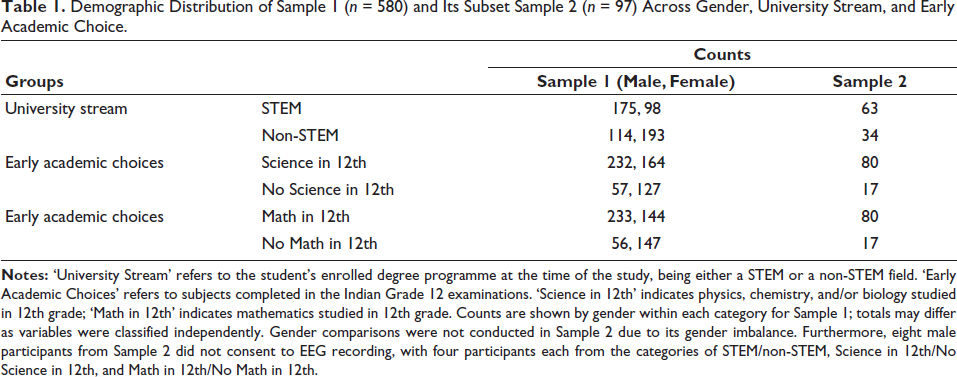
Sample 1 comprised 580 English-proficient novice meditator adults (50.17% females, Age: M = 22.52 years, SD = 4.45 years), currently enrolled in various Indian higher education institutions. Participants were recruited through a combination of purposive and snowball sampling strategies. Participants completed four standardised trait-based self-reports anonymously online: Interpersonal Reactivity Index, Revised Portrait Values Questionnaire, Five-Facet Mindfulness Questionnaire, and International Personality Item Pool Big-Five Factor Markers. 49 They also provided pertinent demographic information, such as gender, university stream, and early academic choices, to analyse group differences based on gender and academic pathways (Table 1).
Sample 2
A subset of 97 novice meditators was recruited from Sample 1 to form Sample 2 (Table 1). Due to availability, this group was predominantly male (n = 82) with a mean age of 24.59 years (SD = 5.18). From this group, 89 participants (82 males; 59 STEM, 30 non-STEM) completed the experimental protocol with concurrent 64-channel electroencephalography (EEG) to capture neurocognitive correlates of state mindfulness during the 50-minute, three-stage Ānāpānasati-based meditation. And, the remaining eight participants underwent only the behavioural assessment using the Amsterdam Resting-State Questionnaire. The gender skew in the EEG subsample is acknowledged as a study limitation; therefore, this sample was only subjected to academic pathways-based group differences’ examination.
Notably, the tristage Ānāpānasati-based meditation was preceded by a 30-minute arithmetic task (Stage 0) designed to induce a standardised cognitive workload, simulating everyday academic stressors.40, 50 The subsequent meditation phases comprised: a 5-minute eyes-closed resting state (RS; Stage 1) to establish a relaxed baseline; a 5-minute breath-counting session (BC; Stage 2) to introduce a focused attentional anchor; and a 10-minute breath-focus meditation (BF; Stage 3) to cultivate sustained breath awareness. 51 This protocol was designed to systematically transition participants from a state of cognitive load to deeper states of mindful observation, given the novice nature of sample two’s participants.
Demographic Distribution of Sample 1 (n = 580) and Its Subset Sample 2 (n = 97) Across Gender, University Stream, and Early Academic Choice.
Instruments
Electrophysiological Data Acquisition
EEG was recorded using a 64 Ag/AgCl electrode EasyCap system (Brain Products GmbH) positioned according to the international 10–20 system, with signals amplified via a BrainVision LiveAmp system, sampled at 500 Hz, and referenced to FCz. 52 Preprocessing in EEGLAB included bandpass (1–60 Hz) and notch (50 Hz) filtering, Artefact Subspace Reconstruction (ASR), and Independent Component Analysis (ICA) for noise removal.40, 50 The data were re-referenced to the averaged mastoids following the retrieval of the cleaned and interpolated online reference electrode.40, 50 Spectral power (dB/Hz) for delta (1–4 Hz), theta (4–8 Hz), alpha (8–13 Hz), beta (13–30 Hz), and gamma (30–60 Hz) bands was computed via Fourier transform using EEGLAB’s eegstats plugin (v1.2) and analysed across three meditation-wise functionally relevant regions. 51 The prefrontal cortex (PFC) included electrodes FP1–2, AF3–4, AFz, and F1–F4, Fz;40, 53 the occipital region (OCC) comprised O1–2, Oz, PO3–4, and POz;40, 54 and the posterior default mode network (DMN; barring PFC) was defined by CP1–CP4, CPz, P1–P4, Pz, PO3, PO4, POz, and Oz.49, 55 For each stage (RS, BC, and BF) of the Ānāpānasati-based intervention, power values were averaged across all electrodes within these predefined regions for statistical analysis.40, 50
Additionally, alpha power-derived indices—peak alpha frequency (PAF), centre of gravity (COG), valence measured at F3-F4 electrodes, arousal measured at F3-F4 electrodes, and cognitive workload (CWL)—were analysed as the literature proposed plausible electrophysiological correlates of state mindfulness.40, 56–61 PAF, COG, valence, arousal, and CWL were calculated directly for the former two and indirectly for the rest through individual channel power across the three stages of meditation using the eegstats plugin (v1.2).
Electrophysiological Correlates of State Mindfulness
To assess potential neural oscillatory differences in state mindfulness between academic pathways for Sample 2, spectral power and alpha-derived indices were analysed across the three meditation stages (RS, BC, BF) over the PFC, OCC, and posterior DMN regions. The analysed metrics included: (a) spectral power density (dB/Hz) in standard frequency bands (delta, theta, alpha, beta, gamma); and (b) established electrophysiological indices of state mindfulness—PAF, COG, F3-F4 valence, F3-F4 arousal, and CWL.
Self-reported State Mindfulness
The behavioural assessment of state mindfulness in Sample 2 was captured via the Amsterdam Resting-State Questionnaire (ARSQ), 22 a 28-item tool assessing resting-state mental activity, post-Ānāpānasati-based intervention, across seven domains: Discontinuity of Mind, Theory of Mind, Self, Planning, Sleepiness, Comfort, and Somatic Awareness. 62 Items were rated on a 5-point scale to reflect one’s thoughts during periods of rest. Prior research supports its reliability 22 and factor structure.49, 63, 64 This study also yielded reliable scores (Cronbach’s αmean = 0.704; McDonald’s ωmean = 0.724).
Self-reported Trait Mindfulness
Trait mindfulness for both samples was measured using the Five-Facet Mindfulness Questionnaire–39 (FFMQ), 21 which assesses five facets: observing, describing, acting with awareness, non-judging, and non-reactivity, on a 5-point scale. The FFMQ has well-established validity49, 65, 66 and reliability67–69 across cultures. Internal consistency in the current sample was also high (αmean = 0.793; ωmean = 0.796).
Self-reported Trait Empathy
The trait empathy of both samples was assessed using the Interpersonal Reactivity Index (IRI), 17 a 28-item self-report tool measuring four subcomponents: Fantasy, Perspective-Taking, Empathic Concern, and Personal Distress, rated on a 5-point Likert scale.49, 70 The IRI has demonstrated stable psychometric properties globally and in Indian populations,49, 71–75 including good internal consistency in this study (αmean = 0.685, ωmean = 0.7).
Self-reported Values Traits
The Portrait Values Questionnaire (PVQ-RR) 18 was used to assess the 19 refined motivational values of the two samples, grouped into ten basic and four higher-order domains. Participants responded to 57 items on a 6-point scale, with versions tailored for gender neutrality. The tool accounts for social desirability biases 76 and is validated across cultures.49, 75, 77 Internal consistency in this sample was satisfactory (αmean = 0.721 and 0.834; ωmean = 0.736 and 0.837, for basic and higher-order values, respectively).
Self-reported Personality Traits
The International Personality Item Pool Big Five Factor Markers-50 (IPIP-BFM-50) 23 was used to evaluate the Big Five personality traits: extraversion, agreeableness, conscientiousness, emotional stability (the reverse of neuroticism), and openness to experience, in Samples 1 and 2. The 50 items are evenly distributed and rated on a 5-point scale. This tool has been widely tested validity49, 78–80 and reliability.78, 80–82 Within this sample, acceptable internal consistency was found (αmean = 0.743; ωmean = 0.755).
Statistical Analysis Towards Group Differences
Behavioural Self-report-based Group Differences Analysis
Prior to group differences analyses pertaining to the self-report data (FFMQ, PVQ-RR, IRI, IPIP-BFM-50, ARSQ) of the two samples, data were screened for missing responses and response patterns indicative of inattentive or careless responding. Given the potential for confounds, non-normal distributions, and the presence of outliers, a two-step approach using univariate t-tests followed by analysis of covariance (ANCOVA) was employed.83, 84 Yuen’s robust independent-samples t-tests were conducted for all initial univariate comparisons. 85 Significance thresholds were adjusted using the Bonferroni correction to account for multiple comparisons within each construct, and effect sizes were reported as ξ, appropriate for trimmed-mean comparisons (small ~0.10, medium ~0.30, large ~0.50).32, 49
Only where significant differences were detected in the t-tests, ANCOVA was subsequently conducted to control for the potential confounding influence of gender, university stream (STEM/non-STEM), early academic choices (Math/Sciences in 12th Grade), and their interactions as required. For gender-based comparisons, ANCOVA was adjusted for university stream- and early academic choice-related main and interaction effects; conversely, university stream/early academic choice analyses were adjusted for gender-related and early academic choices/university stream-based influences. ANCOVA’s assumptions of normality, homogeneity of variances, and homogeneity of regression slopes were tested and satisfied in all reported cases. Effect sizes were assessed using ηp2 (small ≥ 0.01, medium ≥ 0.06, large ≥ 0.14) and post-hoc Cohen’s d (small ≥ 0.20, medium ≥ 0.50, large ≥ 0.80). All reported findings were considered significant at the corrected p value thresholds specific to each set of tests. Marginally non-significant univariate t-tests’ results at the uncorrected level were also reviewed to explore potential confounding influences and justify further testing where appropriate. All statistical analyses were conducted using Jamovi 86 with the Walrus package for robust t-test procedures 87 and the CAR package for ANCOVA analyses.88, 89
Electrophysiological Correlates of State Mindfulness: Group Differences Analysis
Analysis of electrophysiological data followed the same robust statistical approach used for behavioural measures. Yuen’s robust independent-samples t-tests were conducted to examine academic pathway differences (STEM vs. non-STEM, Math/Sciences in 12th Grade or not) for two primary families of EEG-derived metrics: (a) spectral power across five frequency bands (delta, theta, alpha, beta, gamma) in three brain regions (PFC, OCC, DMN) during each of the three meditation stages (RS, BC, BF), constituting 45 parallel comparisons (α = 0.001); and (b) five neurocognitive indices (PAF, COG, F3-F4 valence, F3-F4 arousal, CWL) across the three stages, constituting 15 parallel comparisons (α = 0.003). Effect sizes were reported as ξ. Where significant differences emerged in these initial tests, ANCOVA was employed to perform posteriori assumption checks, controlling for gender, university stream (STEM/non-STEM), early academic choices (Math/Sciences in 12th Grade), and their interactions as required.
Results
Robust group-difference analyses across gender and three academic pathways (STEM or non-STEM university stream and two early academic choices, namely, 12th grade mathematics and 12th grade Science) revealed distinct patterns for trait-level psychosocial constructs (empathy, values, mindfulness, personality) and state mindfulness-level electrophysiological measures.
Trait Empathy
Gender Differences
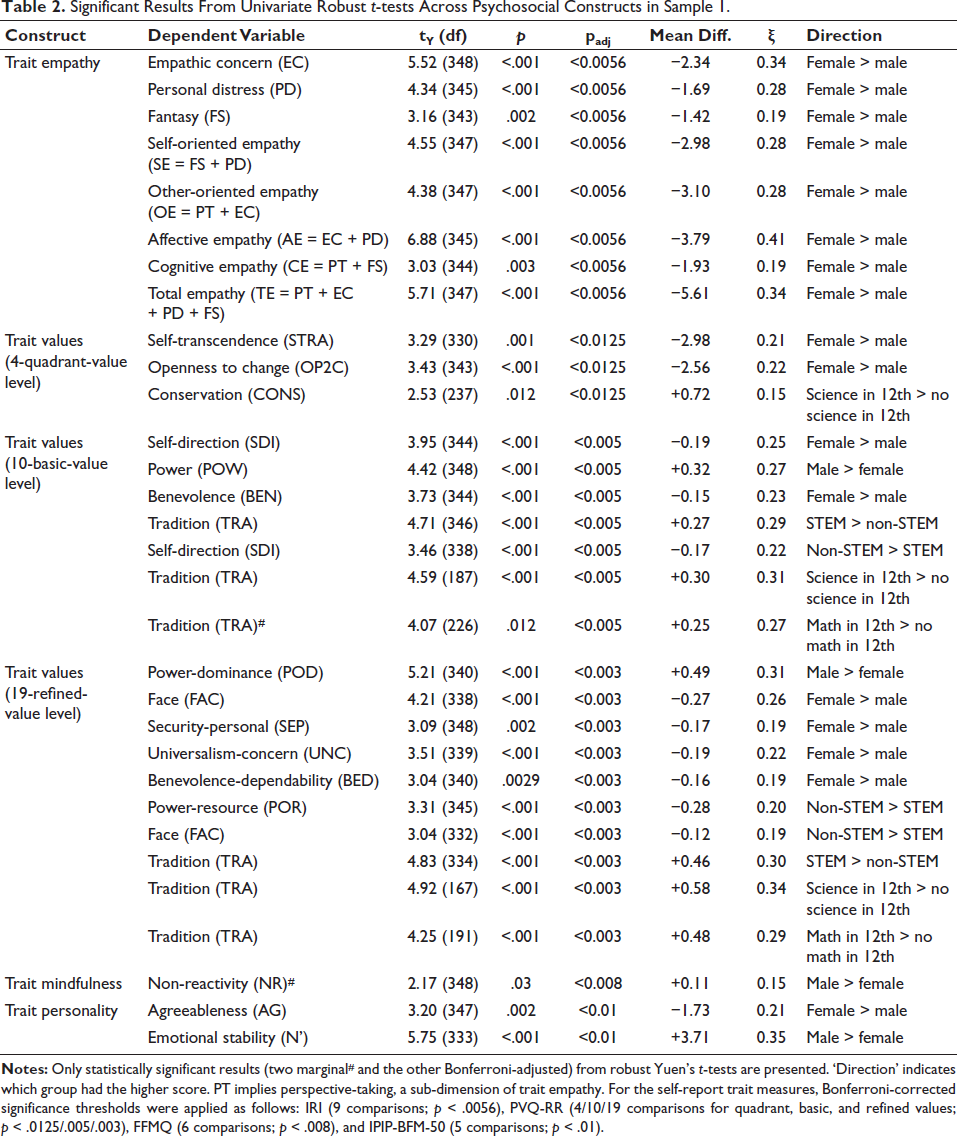
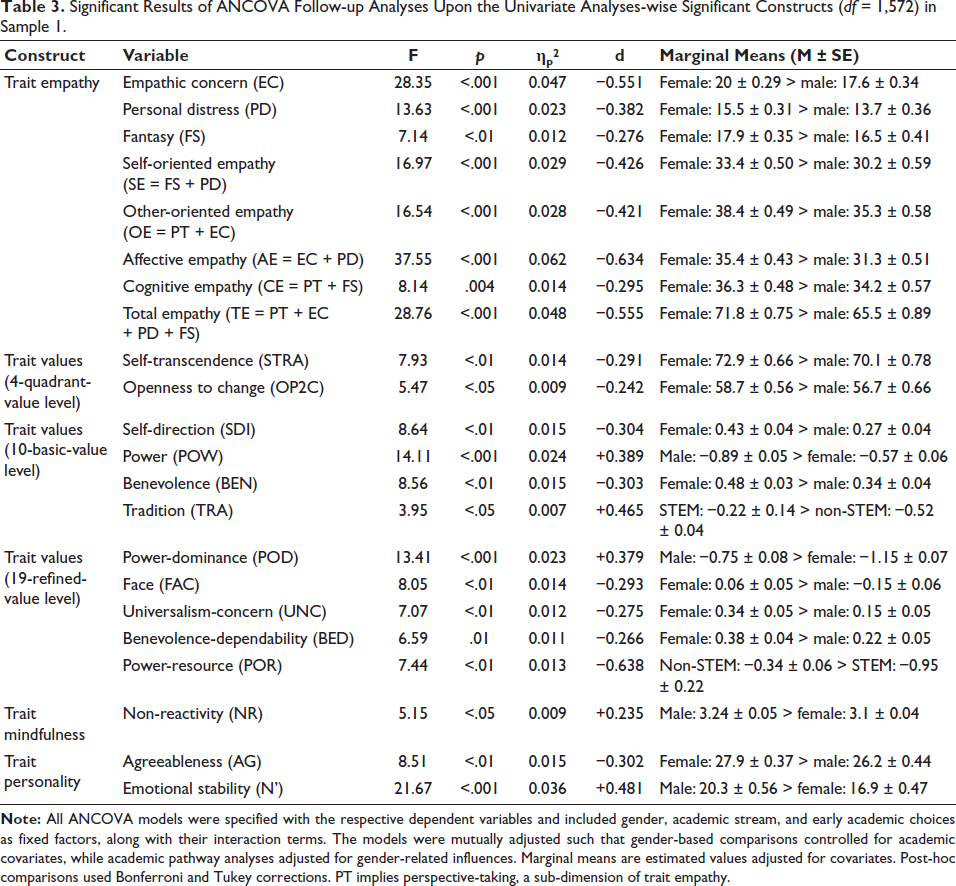
Robust t-tests revealed female participants consistently reported higher scores than males at both the dimension level and in composite indices, exhibiting small to moderate significant effect sizes (Table 2). Follow-up ANCOVA models confirmed the persistence of these gender-based differences (Table 3). Therefore, the influence of gender remained significant for most dimensions, with females continuing to show elevated empathy scores even after adjusting for academic pathway covariates.
Significant Results From Univariate Robust t-tests Across Psychosocial Constructs in Sample 1.
Significant Results of ANCOVA Follow-up Analyses Upon the Univariate Analyses-wise Significant Constructs (df = 1,572) in Sample 1.
University Stream
Neither subscale scores nor broader empathy composites differed meaningfully between STEM and non-STEM groups in the univariate analyses; consequently, no ANCOVA follow-ups were performed.
Early Academic Choices
Initial t-tests indicated marginal differences in certain empathy components based on early subject selection in 12th Grade (p < .05). However, none of these differences met the corrected significance thresholds after Bonferroni adjustment.
Trait Values
Gender Differences
Significant gender-based distinctions were observed across all three levels of Schwartz’s value framework. Robust t-tests revealed that females scored higher on values associated with self-transcendence, openness to change, benevolence, and universalism, whereas males demonstrated a greater preference for values linked to power and dominance. These differences ranged from small to moderate in effect size (Table 2). ANCOVA models affirmed the robustness of these gender effects across quadrant-, basic-, and refined-level value dimensions, implying value endorsements may be predicted significantly by gender (Table 3).
University Stream
At the quadrant level, no significant differences emerged between STEM and non-STEM students. However, at the level of basic and refined values, certain dimensions, such as tradition-humility and power-resource, showed significant group differences in univariate analyses (Table 2). Subsequent ANCOVA tests revealed that only a subset of these associations remained significant after accounting for gender and early academic choices, indicating a limited but noteworthy influence of university stream on value orientation (Table 3).
Early Academic Choices
T-tests highlighted some significant differences in value traits based on early academic choices, particularly in dimensions linked to tradition and humility. However, once gender and university stream variables were controlled for in ANCOVA models, these effects did not retain statistical significance.
Mindfulness
Gender Differences
Univariate testing indicated a marginally significant gender difference in the non-reactivity facet of trait mindfulness, with males reporting slightly higher scores (Table 2). Although this effect did not survive Bonferroni correction, it was further examined using ANCOVA (Table 3). When controlling for academic pathway covariates, the gender difference in non-reactivity remained mildly significant with a small effect size, suggesting a potential, though limited, influence of gender. Due to the highly gender-skewed nature of Sample 2, this analysis was not conducted for state mindfulness measured by ARSQ.
University Stream & Early Academic Choices
No significant differences were observed between university streams and early academic choices in either trait or state self-reported mindfulness, and all facets showed comparable means. Furthermore, robust t-tests revealed no significant differences in stage- or region-specific EEG spectral power or neurocognitive indices (PAF, COG, arousal, valence, CWL) between groups after Bonferroni correction, encompassing both university stream (STEM/non-STEM) and early academic choices (Science/Math in 12th or not). This consistent absence of group differences across behavioural and electrophysiological measures indicates that academic pathways might exert minimal influence on trait- or state mindfulness dynamics.
Personality Traits
Gender Differences
Consistent with prior research, females scored higher in agreeableness, whereas males reported higher emotional stability. These differences exhibited small and moderate effect sizes, respectively (Table 2). These findings were supported by ANCOVA models, where gender remained a significant predictor even after adjusting for university stream and early academic choice (Table 3).
University Stream & Early Academic Choices
No significant differences in personality traits were found between STEM and non-STEM students, nor in other early academic choices, as indicated by t-tests conducted across all five traits.
Discussion
This study examined how gender, university stream, and early academic choices relate to group differences in empathy, values, personality, and mindfulness within an Indian university sample. Through grounding in dimensions of the LIBRE/EMC2 model, and broad holistic education and SEL theory, the research aimed to situate its analysis within the discourse of Indian philosophy and evolving policy priorities of the NEP 2020.1, 13, 14, 20 Results revealed robust and consistent gender effects across most trait-domains, with more limited and nuanced differences based on university stream and early academic choice. In sum, this study aims to provide an initial empirical lens into how group differences in key psychosocial domains of holistic education manifest within the Indian university context, while remaining attentive to the interplay of tradition, educational reforms, and contemporary theoretical perspectives.1, 90
Trait Empathy
Female students consistently reported higher empathy scores across both cognitive and affective dimensions, on all levels. These findings are in line with global literature and reinforce longstanding patterns of gendered emotional socialisation, where women are encouraged to develop relational awareness and prosocial responsiveness.24, 25, 91 These differences persisted even after controlling for academic factors, suggesting that gender-linked development, possibly reinforced through socialisation and cultural expectations, robustly shapes empathic tendencies. 47 No significant differences were found by university stream or early academic choice in the present sample, diverging from earlier work suggesting humanities students display elevated empathy.33, 34 This null finding may reflect sample-specific features or shifts in educational norms, though further research is needed.
Trait Values
Gender differences were similarly pronounced in value orientations. Females endorsed self-transcendence, openness to change, benevolence, and universalism more strongly, whereas males placed greater importance on power and dominance values, aligning with previous findings.26–28 Interestingly, university stream differences in value traits—particularly higher tradition-humility and lower power-resource in STEM students—were modest but observable. This supports Myyry and Helkama’s 35 suggestion that academic environments may selectively reinforce particular value priorities. However, once gender was accounted for, the early academic choice differences no longer remained significant, pointing to the stronger role of socio-demographic conditioning over self-selected curricular paths.
Mindfulness
Differences in mindfulness traits were negligible. A small gender effect emerged in non-reactivity, with male students reporting slightly higher scores. This is broadly consistent with mixed findings in prior research. 31 No significant differences were observed across university streams or early academic choices.
Most notably, EEG and self-report measures indicated no significant differences in spectral power or neurocognitive indices among academic pathways during state mindfulness practice. This neurobehavioural evidence suggests mindfulness practices engage universal neural mechanisms accessible across academic backgrounds. Furthermore, these findings support the S-ART model’s view that mindfulness-related capacities are primarily shaped through intentional, individual practice, rather than by demographic or institutional variables. 20 This reinforces the importance of structured interventions to support mindfulness development in all areas of education, rather than expecting it to emerge spontaneously within existing academic or social systems.
Personality Traits
In line with established findings, females scored higher in agreeableness, while males scored higher in emotional stability.29, 30 These differences remained significant after adjusting for university stream and early academic choices, suggesting relatively stable gender-linked patterns in core personality traits. No significant differences were observed across university stream or early subject choice, indicating that, within this Indian sample, educational specialisation did not meaningfully stratify Big Five traits in the absence of intentional shaping through curriculum or culture.
Integrated Implications
Taken together, the findings emphasised that gender remains a dominant organising variable for psychosocial holistic educational traits, barring trait mindfulness in Indian university students, while university stream and early academic choices showed limited effects. The consistent gender-based differences suggest that self-regulatory and prosocial capacities may be differentially cultivated through culturally informed gendered social norms, even before individuals enter formal academic domains, although this remains a hypothesis warranting further exploration. 20 Crucially, state mindfulness demonstrated universal neurocognitive accessibility across academic pathways, supporting its integration throughout educational systems as an equitable approach to holistic development. Essentially, the findings suggest a need for transdisciplinary approaches to holistic development, since students across streams share similar emotional and cognitive baselines, providing a strong rationale for embedding SEL initiatives transversally.10, 11, 14
Conclusion
This study on an Indian university sample highlights the enduring influence of gender on key psychosocial traits—empathy, values, and personality—while revealing a consistently limited role for academic pathways in shaping these domains. Trait mindfulness emerged as the sole domain largely unaffected by gender. Further, the core neurobehavioural processes underlying state mindfulness seem to remain universally accessible, being unmodulated by variations in academic pathways. By mapping patterns of trait and state variation within a contemporary Indian student population, the findings contribute to an understanding of how demographic and academic factors may interact in culturally specific contexts. As psychological research continues to inform education and public policy, the results broadly underscore the need for transdisciplinary educational approaches that integrate holistic competencies across academic settings to promote balanced cognitive and affective development, rather than confining them to specific disciplines or programmes.
While the study benefits from a large, diverse sample, several limitations must be acknowledged. The reliance on self-report measures and a cross-sectional design warrants cautious interpretation of causality, emphasising the need for longitudinal and mixed-methods research to trace developmental trajectories. Although participants were drawn from multiple universities, the sample may not be nationally representative; moreover, future replications might incorporate additional controls, such as socioeconomic status or linguistic proficiency, to enhance interpretive depth. Also, the gender imbalance in Sample 2 precluded its analysis towards state mindfulness. Furthermore, while Sample 2 provided initial evidence through spectral power analysis, the specific network dynamics underpinning this phenomenon remain unexplored. Future research should employ more advanced neuroimaging methods—including synchronisation-, connectivity-, and source-estimation-based EEG analyses—to delineate gender and academic differences in the precise neural mechanisms engaged by novice practitioners. Additionally, given unequal group sizes in early academic choices, Yuen’s robust t-test was employed to provide a more reliable estimation of mean differences. This method has been shown to yield valid inferences in small and uneven samples, 92 supporting its appropriateness in the present context, though replication with more balanced cohorts remains warranted. Finally, future investigations would benefit from longitudinal and multimethod approaches to improve generalisability, in relation to examining these effects in different countries and cultures. Moving beyond the broad STEM–non-STEM distinction toward discipline-specific analyses may further yield a more nuanced and contextually grounded understanding of holistic educational development.
Footnotes
Acknowledgements
The authors thank all participants for volunteering their time and the UX Lab of the Indian Institute of Technology Delhi.
Authors’ Contribution
MB (Corresponding Author): Overall supervision of the study, interpretation of data, study conceptualisation, study conduction, analysis of data, drafting of manuscript, approval of final manuscript. AS: Interpretation of data, analysis of data. HJ: Interpretation of data, drafting of manuscript. JK: Overall supervision of the study.
Consent to Participate
Informed written consent was obtained from every participant prior to their inclusion in the study.
Consent for Publication
Not applicable.
Data Availability Statement
The datasets produced or analysed in this study are accessible from the corresponding author (MB) upon reasonable request.
Statement of Ethics
This study received ethical approval from the Institute Ethics Committee (IEC) of the Indian Institute of Technology, Delhi (Approval No. P021/P0101). All procedures were conducted in strict accordance with the ethical standards prescribed by the Indian Council of Medical Research (ICMR).
Declaration of Conflicting Interests
The authors declared no potential conflicts of interest with respect to the research, authorship and/or publication of this article.
Funding
The authors received no financial support for the research, authorship and/or publication of this article.
ICMJE Statement
The authors confirm that the preparation of this manuscript adhered to the recommendations of the International Committee of Medical Journal Editors (ICMJE).
