



Abstract
Poverty alleviation projects are implemented as part of the national development and prosperity agenda. This study aimed to gain an understanding of the factors that contribute to the project governance practices in poverty alleviation efforts for the rural poor in Malaysia, which will lead to better project delivery and the successful outcome of the projects. Multiple case studies were conducted on two public initiative housing assistance projects in rural areas of peninsular Malaysia. It explored how dealing with the rural poor influences public officials in conducting projects through stewardship-governance notion. A qualitative approach through multiple case studies was utilised in this study where multiple sources of evidence were used such as semi-structured interviews with 12 public officials, document analysis and observation. The study discovered five factors that contribute to project governance practices, namely altruistic empathy, intrinsic motivation, effective leadership, learning environment and shared vision where these factors interplay with each other towards the achievement of project outcome. Hence, this article contributes to the dynamic understanding of how public officials embraced motivational factors in conducting their works related to the rural poverty alleviation projects. Appropriate utilisation of project governance practices drives for better project delivery to the target groups.
Introduction
The implementation of Malaysia's five-year development plans charted by government ministries and departments has spurred the country's social and economic growth through the execution of various programmes and projects designed to enhance the quality of life of the poor people and move them out of the poverty trap. However, poverty incident in Malaysia is still high where it stands at 5.5% as of 2019 (DOSM 2020), while inequality and unevenness in the context of poverty in both rural and urban areas still exist, although there is rapid progress in physical infrastructures and job opportunities (Dawood and Leng 2016).
While many projects related to rural poverty alleviation have successfully been implemented in Malaysia, many projects are unable to achieve the outcome (Hoe et al. 2017). This could be the results of poor planning at the project initiation stage, lack of awareness in project monitoring and late decision-making by the authority (Nawi et al. 2018) as well as inadequate governance in managing those projects (Kwon and Kim 2014). Therefore, project governance is identified as a management tool that could enhance the efficiency of project implementation and make the project outcome more effective in enhancing the quality of life of poor people.
Project governance could be identified as a system involving any elements pertaining to the governance of a particular project (Musawir et al. 2020). Therefore, project governance is essential in ensuring the successful delivery of projects. While the subject of project governance in various areas and sectors has been widely debated for the past two decades, it has a similar objective, whereas to demonstrate the application of project governance to enhance overall project performance. On the other hand, Levie et al. (2017) define project governance as a structure where the project objectives are set, and the way of achieving those objectives and monitoring performance are determined. However, there is a lack of academic study on the factors that contribute to the project governance practices, which in turn could contribute to the success of rural poverty alleviation projects. While many studies are focusing on general governance and poverty alleviation (Jomo and Chowdhury 2016; Lehmann et al. 2018), the lack of knowledge and understanding of project governance among the public officials involved in project planning and implementation needs to be addressed (Abu Hassim et al. 2017).
Hence, to put into perspective, poverty alleviation projects which are instrumental in charting country's rural development are considered unique since it encompasses transforming social structure and community realignment which require governance approach based on shared goals and values such as trust and collaboration. However, many poverty alleviation projects failed to meet expectations due to the governance issue during project development and implementation. This situation has led to the failure of project attainment, and the target groups will not benefit from the project. Hence, this study seeks to address the questions on what are the factors that contribute to the project governance practices in rural poverty projects in Malaysia. A clear understanding of factors that contribute to the project governance practices in poverty alleviation efforts in Malaysia will lead to better project delivery and the successful outcome of the projects.
The following sections present the literature review, the methodology, the findings and discussion, as well as conclusions, recommendations and limitations.
Literature Review
This section reviews literature based on two main themes of the study, namely project governance and rural poverty.
Project Governance
Project governance term coined from the word governance, which is a broad discipline of knowledge and applicable to numerous fields of study. As a subset of governance, project governance holds the same basic principles as its original subject and the theories about governance. Kujala et al. (2016) stated that project governance is a subset of project management where it provides a platform for the project-based organisation to steer and make a suitable intervention of the project as well as ensuring the practice of central coordination mechanisms and rules aligning the goals of project actors. On top of that, Olsen et al. (2005) explain project governance as structures that contain several factors, namely contractual incentives, hierarchical structure based on authority and a trust-based system which then can help improve project delivery. A good relationship between project actors will promote trust among themselves, thus will allow works to be done transparently. While the excellent relationship between project actors is vital in any project, it must be within the organisation and project framework in order to avoid any conflict of interest that could potentially harm the project deliverables. Therefore, good project governance will contribute to meeting the project purpose from the perspective of all stakeholders that involve in the projects. Primarily, project governance in poverty alleviation projects can be defined as a a management system which comprises a set of values and structure in delivering the right project to the right target groups through effective and efficient possible ways with the ultimate aim to propel the quality of life of the poor people and bring them out of poverty.
Stewardship theory promotes two main intrinsic values, explicitly trust and collaboration as the main idea which should be embraced by the principal, stewards, project managers and the whole of the project team (Bond-Barnard et al. 2018). The failure of human factors such as trust and collaboration could lead to project management failure, where the level of trust predicts the level of collaboration, which affects the success of the project (Bond-Barnard et al. 2018; Höglund et al. 2019). This argument is supported by Pinto et al. (2009), who empirically found that trust helps strengthen cooperation where it will benefit the whole project. Besides, Bekker (2009) opines that project governance should be a tool for decision-making with trust embedded in the framework, while Guo et al. (2014) propose a combination of project governance structure and self-governance which consists of three essential factors namely control, flexibility and trust. Hence, it is a reflection of the stewardship theory, where an element of self-governance, such as trust, is essential in ensuring a good working relationship between the parties involved in the project.
Stewardship theoretical lens provides a perspective that governance is driven by several elements that should be possessed by the individual, such as trust, collaboration, reciprocity, reputational enhancement, job satisfaction and collective interest (Slyke 2007). Stewardship theory stressed the involvement-oriented philosophy where employees will develop the behaviour of self-control when given responsibilities and challenges as well as having a collectivist culture and a positive attitude towards group harmony to avoid any conflict and confrontation (Davis et al. 1997). Although the interests and goals of the project actors and organisation are aligned, it could not assure the alignment of positive behaviour and moral stands among project actors. Hence, other elements, such as control, are needed to complement the intrinsic values derive from the stewardship theory (Pinto et al. 2009).
Rural Poverty
Although many programmes and projects have been implemented to alleviate poverty among the rural folks, it still exists not only in the form of absolute poverty but also in the form of relative poverty and pocket of poverty. In general, poverty is defined as the failure for any individual or household to comply with basic needs as measured by income or consumption (Siwar 2006) and it is related to anything desired for a basic life such as income, housing, job and employment, health and education access. Therefore, poverty is a situation with high complexity and uncertainty where the human being is not able to live in ordinary life and heavily depending on assistance provided by other parties, which also could come in many forms in order for them to survive in a day to day life.
According to Khan (2000), factors that contribute to rural poverty are corrupt public bureaucracy, the government not providing the right projects needed by the people, lack of transparency and accountability, extreme controls or regulations, centralisation of power as well as urban bias in public investment for infrastructure. Therefore, the government has to address the needs of the rural poor and how the projects could improve their wellbeing as well as ensure the projects are governed accordingly. Besides, Macours and Swinnen (2008) argue that infrastructure and public amenities such as housing and agricultural projects are needed to reduce the gap between rural and urban poverty. Based on the Statistics Department (DOSM 2020) statistics, poverty incidence in rural areas has decreased from 17.5% in 2016 to 12.4% in 2019, while poverty incidence in the urban areas has also decreased from 4.8% in 2016 to 3.8% in 2019. While these statistics are consistent with most developing nations, the existence of discrepancies between rural and urban areas shows that different dimensions and perspectives should be taken in terms of identifying, planning and implementing the right projects in order to tackle both sectors of poverty. It is also crucial to determine the area which records high poverty incidents and take appropriate measures to address the needs of the affected community by using accurate data and statistics.
However, silos mentality among the government agencies slows the process of delivery to the target group. The competing and overlapping tasks between different ministries, which contribute to a situation where responsibilities and policies are often overlapped, were identified as one of the main problems in poverty alleviation efforts in Malaysia (Abdalla and Elhadary 2012). This is supported by UNHR (2020) in their special report on poverty in Malaysia which exposed that Malaysia has disjointed, poorly targeted and underfunded social protection programmes where more than 110 programmes spun across more than 20 ministries and agencies. The poor rural needs effective delivered projects in the form of housing assistance, road and basic amenities to enhance their living experience. It is suggested that the officials involved in the planning and implementation of poverty alleviation projects should not only understand the rules and regulations of public project development but also to the extent of possessing ethical values and ethics in which could support effective project delivery, particularly in the context of rural poverty projects.
The literature review found that efficiency in project planning and execution could be achieved through the practices of project governance. However, the factors that could drive the governance practices throughout the project cycle are yet to be determined, specifically in the context of rural poverty projects.
Methodology
Research Approach
In order to identify the embedded factors that drive project governance practices in rural poverty alleviation projects, a qualitative approach through case study method is used in this study. A case study can be defined as a study of the social phenomenon in natural surroundings set up during a specific period that focuses on detailed descriptions, interpretations and explanations and involves actors that participate in the social process (Swanborn 2010). This strategy suits the objectives of this study as it perceives the data and information at the micro-level. This study focuses on enriching academic literature and provides findings on project governance practices and its contributing factors in rural poverty alleviation housing schemes. One of the main reasons why this approach is used is due to a lack of a case study addressing project governance practices and its factors, which could be found in the literature (Hällgren and Lindahl 2017) as well as it is the best approach to understand a particular phenomenon (Yin 2018).
Selection of Case
Two public poverty alleviation housing schemes for rural poor, Case A – Projek Perumahan Rakyat Termiskin (Poor People Housing Project) or PPRT and Case B – Program Pembangunan Kawasan (Regional Development Programme) or PPK, are two different projects under the purview of the Ministry of Rural Development (KPLB). These two projects are coordinated by two different divisions of the ministry and implemented by two different implementing agencies (IA) but share the same aim, which is to provide a comfortable and safe house for the poor people to enhance their quality of life. While these projects have a similar aim, the approach and concept of these projects are different. The PPRT is a housing assistance scheme where the government will help to build a new house or renovate a part of a house for eligible participants, while the PPK is a housing scheme where a new housing area or settlement will be developed by the government and will be hand over to the eligible participants. These projects targeted the rural poor since housing is one of the main issues among the rural poor.
Selection of Informants
Basic Information of the Informants.

Data Collection and Analysis
For data collection, the case study protocol was developed as this protocol is the data collection plan and hence enhances the reliability of the study (Yin 2018). Multiple data collection methods, such as semi-structured interviews, document analysis and observation, were conducted to understand the phenomenon better.
Validity and Reliability
Concerning validity and reliability, this study used the same procedure for data collection in both cases, and the operational measures of the theoretical constructs were based on the theoretical framework developed for this study. Therefore, this study uses multiple methods of data collection and multiple data sources with multiple case studies in order to enhance the internal validity of the study (Merriam and Tisdell 2016). A period of three months was engaged during data collection to look for variations in understanding the phenomenon, which is crucial to satisfy internal validity. With regards to the external validity or the generalisability of the findings, this study tried to maximise the variation of the samples, which includes selected officials involved in the projects throughout the project cycle as well as tried to present adequate evidence from different data sources as suggested by Merriam and Tisdell (2016). However, it shall be noted that generalisation with other projects could not be made based on the nature of the qualitative study itself, but the findings are distinctive with the chosen cases. On the other hand, the utilisation of the case study protocol is consistent with Yin (2018) to enhance the reliability of the case study while the researcher keeps all the evidence in accordance with the sequence of the data collected to boost the confidence and reliability of the study (Merriam and Tisdell 2016; Yin 2018).
Findings
This section provides a brief explanation about the projects selected for the case study and followed by the findings, which are the contributing factors found in the project.
Case A: Brief Description
PPRT is developed to enhance the quality of life of low-income families by constructing a new house or renovating their current house to provide a comfortable and safe home for them as a basis for continuous family development. The project was executed by IACSA (an acronym) in a rural area of the southern state in peninsular Malaysia, where they are responsible for conducting the verification process for the participants, project procurement, monitoring, and hand over to the participants once the projects completed.
The cost for constructing a new house under the scheme is RM 56,000, which is based on conventional construction, while RM 46,000 for industrialised building system (IBS) based construction. The scope of the project is a new house with three rooms and a minimum built-up area of 660 s.f. on the land owned by the participant. The main criteria for the selection of participants are; they are verified as ‘hardcore poor’ or ‘poor’ in the national poverty data bank (e-Kasih) and also endorsed as qualified by the Poverty Alleviation Focus Group Meeting at the district or state level.
Case B: Brief Description
PPK is an integrated project developed to create a new and well-planned housing area for rural people who are exposed to natural disasters, safety and health threats or poor people who are categorised under the e-Kasih system. The PPK project typically involved constructing several houses and basic infrastructure and amenities such as access road, water tank and playground. An agency under KPLB implements the project, which is also responsible for selecting the participants.
For this particular study, the PPK project is located in a rural area of the northern state in peninsular Malaysia, with the total cost of the project is RM 7.8 million and was implemented by IACSB (an acronym). The scopes of works include the construction of 60 houses, futsal court and external works such as sewerage works, water reticulation and road work, as well as mechanical works such as electrical system and sanitary service. Other works such as children's playgrounds, road markings and signage and also sewerage treatment plants are included under the provisional sum of the contract. During the data collection, the project is 99% completed, pending the issuance of a certificate of completion and compliance by the authority while the IACSB is finalising the participants' selection process.
Factors Contribute to the Project Governance Practices
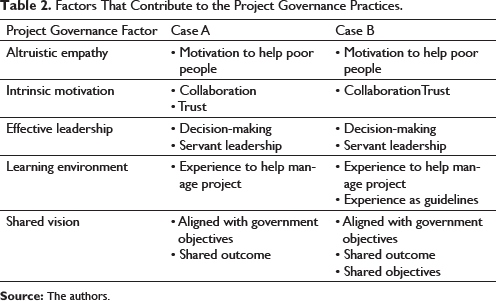
Factors That Contribute to the Project Governance Practices.
Altruistic Empathy
Altruistic empathy is a project governance element that distinguishes between poverty alleviation projects and other types of projects. It is a part of the motivational factors where officials involved in the project hold a form of altruism based on feeling to others. While they are paid to deliver the job on behalf of the government, the officials involved in the poverty alleviation projects possess unique motivation charisma, which is to help poor people through constant engagements and delivering a project which subsequently contributes to a positive outcome. Although the ministry and implementing agencies face several constraints in the form of limited budget and projects, pressure from political parties, too many poor people that need help as well as the demands from the authorities, they are still able to perform their works according to the needs statements because of the altruistic empathy that drive them forward. Informant 1 in IACSA summarised as the following statement:
‘When we went at the grassroots level, we feel that this is an exciting task because we can help the poor and low-income people in rural areas. We help them, for example, constructing their homes from vacant land to complete houses with infrastructure, which I can see them very happy. The whole family is delighted with the help that the government provides. As an IA, I envisage that as a great motivation to us, not only for me but to the whole staff as well.’
Intrinsic Motivation
As discussed in the literature review, intrinsic motivation, which consists of trust and collaboration, is among the driving factors found in this study. Both cases show the existence of an element of trust and collaboration throughout the project implementation. As the projects comprise two main actors, namely, the ministry and IA (implementing agency), there is a high level of trust between both actors since they have been working together for a long period and the fact that the IA is under the ministry. Both implementing agencies placed trust on the appointed contractor, although in Case A, the contractor failed to complete the project on time, with low quality of construction. Moreover, the target group, which is the project participants have placed their trust in the implementing agencies to deliver the project accordingly. This element of trust then drives the collaboration efforts between themselves. What makes the project unique is that continuous engagement between the ministry or IA and the target group enhances trust. Throughout the project implementation, trust is exchanged between the actors involved, and it is crucial to keep it controllable to avoid any risk. Informant 2 for Case B expressed by stating that:
Trust is very subjective… While we think that we have done it all, other people have not completed their portion (of works)… They do not do it… They are slow… (or) Have other interests, and the trust is moving there. Sometimes we cannot control since we assume everyone is doing their duty.
Effective Leadership
Effective leadership plays a crucial role in ensuring efficient project delivery. In the context of the poverty alleviation project, effective leadership is a contributing factor that could reflect the ability of the organisation (ministry and IA) to manage the project efficiently in order to serve the participants, which are the target group of the project. At every level of governance structure, decision-making is a crucial element where leaders must have the ability to make the right decisions in various circumstances. From the preparation of needs statements until the project completion, decision-making exists in every phase of the project, thus making it crucial in the project. For example, Case A having a problem with the channelling of clean water into the house from the water authority primary pipe connection as the cost involved is not calculated at the early phase of the project; thus the IA has to obtain special approval from the ministry since it involved an additional cost. The same thing happened to Case B, where upgrading costs of the entry road to the PPK settlement were not counted during the project cost development. Hence, an additional allocation was requested to the ministry to decide according to justifications given by the IA.
On the other hand, the ability to get on the ground and mingled around with the target group is essential in the context of rural projects. This unique skill works in tandem with the ability to communicate and engage with other stakeholders such as the target groups and authorities to expedite project implementation. Informant 4 for Case B stated:
‘Leaders have to get going to the ground. We could see that some officials were not interested in socialising with the villagers, especially Gen-Y; they used to have a comfortable life. Thus, they have difficulty when asked to get going to the ground. Therefore, they must get going to the ground since rural development needs leaders who have those skills.’
Learning Environment
The learning environment in this context means poverty alleviation projects have provided diverse experiences settings for the officials involved to learn not only to help manage projects but also to serve as guidelines and accelerate project execution. While formal training is essential in terms of theoretical approach in project management and stakeholder management, learning through experiences is proven to be useful for the officials involved in this project. It is found that the officials learned not only on project management skills through the experiences but also in the form of engagement with the target group, where this is a particular skill that only can be developed during on the ground visit. The learning environment in IA also accelerates project execution. For instance, the IACSB leaned on their experiences in managing similar PPK projects, which boosts their confidence in implementing the project fast and without any hassles while another IA, which previously never develop PPK projects, has difficulty even to kick off the project.
Shared Vision
The different actors in poverty alleviation projects have a shared vision, which is to enhance the quality of life of poor people and move them out of poverty. Thus, a shared vision, which comprises aligning the project objectives with government objectives, shared objectives and the shared outcome is among the contributing factor found in this study. Both cases have their objectives aligned with the government objectives, and the different actors shared the same objectives. Similarly, both cases contribute to the same project outcome where participants are expected to have a better home, which enables them to raise their family in better condition and subsequently allow them to work without been burden with the rental charges. The following statement by Informant 5 of IACSB illustrates this argument:
‘For me, when we renovate or build the house, the people who receive the house can have a more comfortable life. The basic need of people is a home or shelter… they can focus on their children's learning, house hygiene because when building a new house, the toilet system and drainage are all well-organised. So, it gives them a comfortable and better life in the future.’
Discussion
This article deliberates factors that contribute to the project governance practices that could be found during the whole cycle of project management. The analysis of the two cases has demonstrated the unique and similar factors found in both cases. It is also found the interplay among the factors of project governance in both cases.
Altruistic empathy needs a unique character where the officials can feel how the poor people live in a difficult condition, understand what needs to be done to help them, convert it into the passion of works along with professionalism and competency in delivering projects. The findings indicate that altruistic empathy is present in most of the project governance practices, predominantly during the on the ground visit and engagement sessions with the stakeholders. This unique motivational character drives the officials in conducting rigorous participants' selection and could potentially avoid them in making the wrong decision. These findings are in line with Kolm (2006), where the sentiments of altruistic empathy motivate an individual to assist other people when the assistance will results in the pleasure of the beneficiary or improve their condition while a sense of relief and social properness is presented back to the individual. This is also consistent with Unger's (1991) findings, where altruistic empathy appears to be motivated by the individual's perception of the needs of others in the community rather than personal benefits. This study found that altruistic empathy is adopted by all officials at every organisation level alike with the suggestion by Kuppelwieser (2011), where altruistic empathy which is part of stewardship-style behaviour is not limited to the executive levels; instead, it is applied at every level of the organisation for the good of the organisation and the stakeholders.
The complementary nature of governance factors principally means that combinations of factors contribute to better project governance practices rather than counting on a single factor. The intrinsic motivation, which comprises trust and collaboration complemented the altruistic empathy, where both factors are identified as the driving factors. Trust, in particular, is intertwined with every contributing factor found in this study. Trust encourages mutual respect and avoids negative stigma among the target group and further could accelerate any collaboration efforts needed to complete the project (Edelenbos and Eshuis 2012). While the trust between the ministry and IA is well established because of the long term interaction among themselves (Lu et al. 2015), trust between IA and contractor and between participants, IA and contractor need to be developed throughout the project execution. Plenty of time is needed for the project team, which comprises the IA, contractor and the ministry to know each other, build trust and clarify their respective roles and expectations (Buvik and Rolfsen 2015). When there is an issue regarding the project implementation, intrinsic motivation is a tool in expediting the solution through transparent and clear communication between parties involved, as addressed by Kadefors (2004). Besides, collaboration is essential for effective project coordination and delivery, and this study’s findings are consistent with Yeboah-Assiamah et al. (2015) recommendations for collaborative governance to be enhanced among state and local government agencies as well as other stakeholders at the local level in strengthening their activities to alleviate poverty.
The findings are also engaging in the context of effective leadership. It is ordinary for effective leadership to act as a contributing factor to project governance practices in any type and complexity of a project. However, effective leadership within the sphere of poverty alleviation projects is unique in the existence of the ability to link the organisation with personal goals in an ethical manner (Melchar and Bosco 2010). As this study found that altruistic empathy leads the officials to act with feelings towards helping people live in poverty and have a sense of what they have gone through, there is strong evidence that the officials can align those motivations with the organisation's approach of works. Subsequently, this is translated into better decision-making, robust empowerment, shared vision and integrity among the officials involved. Hence, the positive interplay between altruistic empathy, intrinsic motivation and effective leadership are significant to improve project delivery. Such interplays have not previously been addressed in the literature.
Characterised by altruistic empathy and intrinsic motivation, the learning environment provides room for officials to enhance their skills and knowledge on the works related to the poverty alleviation projects. While the environment, according to stewardship theory, should be designed to create a high commitment or involvement-oriented circumstances (Tosi et al. 2003), this study found that proper learning environment settings and contexts are significant to empower the officials in their daily tasks. For instance, getting on the ground is one of the learning by experience techniques where the officials could feel and appreciate the difficulties and challenges of constructing the rural project. Experiences by implementing agencies in managing many poverty alleviation projects are also valuable in order to develop trust and foster collaboration with the ministry as trust enables collaborative behaviour and promotes adaptive organisational forms (Rousseau et al. 1998). Hence, project governance is practised when the learning environment is conducive to the actors of the rural poverty alleviation project.
Furthermore, in line with Kluvers and Tippett (2011) and Slyke (2007) on the higher value of collective goals rather than individual goals, this study found the public officials can align the objectives of the project with the organisational objectives with altruistic empathy becomes prompting point to progress the alignment. Through a shared vision, the target group, which refers to the rural poor, could extract optimum benefit in the form of project outcome where the right projects are conducted rightly. Shared vision promotes togetherness in action and a trusted working relationship, which spread among all the actors in these poverty alleviation projects. In the literature, the organisation's perspective on stewardship is where the managers act as stewards by performing a collectivist and pro-organisational behaviour in order to achieve the organisation's objectives (Contrafatto 2014). Following this view, this study reveals the ability of shared objectives, which subsequently translated into shared outcomes with meaningful existence of altruistic empathy and intrinsic motivation along the line. These factors interplay with each other and could improve project performance.
Conclusions
This study aims to identify factors that contribute to the project governance practices in rural poverty alleviation projects. The analysis from two housing projects for rural poor has demonstrated the interplay between five factors, namely altruistic empathy, intrinsic motivation, effective leadership, learning environment and shared vision which significantly strengthened the project governance practices. The cases demonstrate the determination of project actors in what they believe could contribute significantly to uplifting the lives of the rural poor. The analysis also indicates that intrinsic motivation, which predominantly comprises trust and collaboration, acts as a driver to boost other factors found in this study. The importance of trust backs the interplay between intrinsic motivation and effective leadership. Although positive prior ties could stimulate faster trust development between actors, this study suggests that trust could be fostered between the poor people and government machinery system in the presence of altruistic empathy among the actors in the government machinery system and collaboration-based activities between them.
Nonetheless, what seems to be essential is to have an insight into what are the contributing factors that could be positively manipulated in the practices of project governance for better results in poverty alleviation projects outcome. The findings support the notion that a broader understanding of the effect of project governance elements and their context could be obtained by investigating more projects in different contexts (Williams et al. 2010) while extending further understanding that stewardship theory as an appropriate lens for assessing project governance (Joslin and Müller 2016) particularly in the context of poverty alleviation projects. In addition, it has been suggested that stewardship theory leads to better project performance in a high-risk project, while agency theory leads to better performance in a low-risk project (Musawir et al. 2020). However, this does not appear to be the case. From the context of this study, the stewardship element is crucial, although it is a low-risk project in nature, judging from the scale and complexity. Hence, this study underlines a better understanding of the factors that contribute to the project governance practices and its interplay in poverty alleviation efforts in Malaysia, which will lead to better project delivery and successful outcome of the projects.
The positive interplay between the parent organisation and project-based organisation is significant in adding value and guiding public officials to deliver the project effectively to the intended target groups, subsequently facilitating project outcome achievement. Also, the findings will enable related public organisations, particularly the related ministries, departments and agencies to reinforce the underlying project governance elements towards strengthening the delivery system of poverty alleviation projects and embrace it in poverty alleviation and rural development policies.
Recommendations and Limitation
It is essential to state that this study is limited to case studies related to the development of housing assistance for poor people in rural areas. Therefore, it is limited to the context of the actors involved and the particular local conditions. Subsequently, the findings are biased by the informants' response to the situation while the researcher conducted his reflection through observation notes and memo writing. As this study only involved public officials structured in the government system; thus, future study is recommended to include other stakeholders such as political masters, contractors, target groups and other related agencies to determine their impact on the governance practices of the project. Further, a better understanding of the project governance practices and its contributing factors will enable the researcher to develop project governance frameworks specifically for poverty alleviation projects.
Footnotes
Declaration of Conflicting Interests
The authors declared no potential conflicts of interest with respect to the research, authorship and/or publication of this article.
Funding
The authors received no financial support for the research, authorship and/or publication of this article.
