



Abstract
The establishment of protected areas as a strategy for biodiversity conservation implies the need for sustainable alternative livelihoods of rural, forest-dependent communities. This article contributes to the discourse on balancing environmental conservation and economic well-being by examining state-initiated livelihood projects in Mount Hamiguitan Range Wildlife Sanctuary (MHRWS), Philippines, a UNESCO World Heritage Site. As the literature emphasizes on impacts of livelihoods on communities, it is also important to deal on the dynamics in the conceptualization and implementation of these livelihoods from the perspectives and experiences of implementers and beneficiaries, to possibly ensure sustainability. The data from in-depth interviews with implementers and survey among partner beneficiaries, revealed that strategies like conceptualizing projects with defined principles and purpose, engaging and understanding the community, implementing adaptive and responsive strategies, providing sustained marketing and technical support, and establishing partnerships with agencies, serve as facilitating factors for these livelihoods. However, these projects are challenged by lack of sustainability plan, of coordinated governance, and of sufficient, full-time, and tenured personnel. Hence, while state-initiated livelihood projects could be sustainable given its (state’s) mandate and resources, there are also impediments due to some structural inadequacies.
Introduction
The establishment of protected areas (PAs) is a strategy for environmental protection and biodiversity conservation adopted by several countries. There is an increase of PAs worldwide from ‘13.4 million square kilometers in 1990 to 32 million square kilometers in 2014, with a total of 209,000 PAs that cover 15.4% of the world’s terrestrial area and 3.4% of the ocean area’ (Achiso 2020, 2565–2566).
In the Philippines, Republic Act No. 11038, known as ‘Expanded National Integrated Protected Areas System Act of 2018’ was promulgated. This law stipulates that the state shall ensure its full implementation, including resources mobilisation for institutional mechanisms, and ‘the full scientific and technical support needed for the conservation of biodiversity and the integrity of the ecosystems, culture and indigenous practices’. Thus, other than the areas declared as PAs by acts of Congress, there are 94 ‘parcels of land and/or bodies of water’ considered as PAs ‘within the classification of national park pursuant to the Philippine Constitution’ (The LawPhil Project 2018, sec 4a.1).
However, along with PA establishment is the need of alternative livelihoods for forest-dependent communities. There must be livelihood options for these communities especially that they are already constrained from extracting forest resources in PAs. As Derkyi et al. (2013, 1) put it, ‘the politics of protected areas need to reconsider the position of the inhabitants by creating space to build a livelihood, paying them for taking care of nature or relocating them beyond the protected area’. Tumusiime et al. (2011) also argued that strict enforcement of policies per se hardly protects the park. Rather, strategies that allow regulated access to PAs’ resources in the ‘short term’, and coming up with opportunities outside the PA for people’s sustainable livelihood in the long term, need to be considered. Persha et al. (2010) likewise suggest that while strict PAs promotes biodiversity conservation, focusing on it solely may discount other ‘resource governance approaches’ that are appropriate for ‘existing conservation regimes.’ Hence, Chao et al. (2018) argued that the mandate for PAs had transformed lately from ‘protecting biodiversity to alleviating poverty and supporting livelihoods’. Nevertheless, there is a challenge in balancing forest conservation and livelihood provision.
While there could be much discourse on how livelihoods in PAs are affecting the targeted communities, there is also a need to investigate the processes and dynamics on how these projects are conceptualized and implemented. Specifically, delving on the facilitating and impeding factors of implemented livelihoods may explain why these have such impacts on targeted communities. Pretorius and Chikadzi (2014) made an analysis on the challenges in the implementation of income-generating projects in South Africa. However, such analysis is solely based on the perspectives of the beneficiaries, not including that of the implementers. These livelihood projects are also implemented by non-governmental organizations (NGOs), not within the context of PAs. Hence, this article extends the above discourse by examining the state-initiated livelihoods in a PA in Southern Philippines, based on data generated from interviews of both implementers and beneficiaries. It provides a brief background on Mount Hamiguitan Range Wildlife Sanctuary (MHRWS) in this section. It then presents a brief literature review on livelihoods in PAs, including the Sustainable Livelihood Approach as framework for analysis of the selected livelihoods. It also provides the methodology before presenting and discussing the results on facilitating and impeding factors, and the conclusion.
Mount Hamiguitan Range Wildlife Sanctuary: Profile, Potentials, and Problems
MHRWS is in the province of Davao Oriental, Mindanao Island, Southern Philippines. It lies in a greater portion of ‘north–south trending mountainous upland’ along San Isidro (north and northwest), Governor Generoso (south and southwest) and Mati City (east). It has a total of ‘6,348.99 hectares with a buffer zone of 783.77 hectares duly delineated and demarcated’. Its elevation ranges from 170 to 1,637 meters above sea level (masl) ‘with rough to very rough terrain and slopes of up to more than 100% (Naive 2021; UNESCO n.d.).
MHRWS is part of the ‘Philippine Biogeographic Zone’, with high endemicity (UNESCO n.d.). It has different ecosystems having many ‘endangered, endemic, and rare species of flora and fauna’. It contains five vegetation types namely: ‘agro-ecosystem, dipterocarp forest, montane forest, typical mossy forest and mossy-pygmy forest’. Out of its 477 identified species of plants, 163 species are endemic, 35 species are threatened, and 33 species are rare. Out of the 163 endemic plants, 86 are found in montane forest, 78 in dipterocarp forest, 66 in mossy pygmy forest, and 49 in typical mossy forest, and 43 in agro-ecosystem. The 22–23 rare species are in montane and the mossy-pygmy forest, while the 16 rare species are in dipterocarp forest, and least number of rare species are in agro-ecosystem (Amoroso and Aspiras 2011).
However, it has 35 threatened species where 22 are in dipterocarp forest, 20 are in montane forest, 15 are in agro-ecosystem, 10 are in typical mossy forest, and 9 are in mossy-pygmy forest. Along with other endemic and endangered flora in the country, these identified species in MHRWS are threatened because of ‘forest degradation and conversion of forested land to agriculture, shifting cultivation, and overcollection’ (Amoroso and Aspiras 2011). MHRWS is challenged by ‘antropogenic threats like logging, indiscriminate forest product harvesting, and land conversion for farming’ (NCLCA 2014).
The above data indicate that MHRWS is rich in biodiversity. Thus, the Conservation International declared it as one of the Philippine ‘hotspots’ that need to be conserved and protected. Consequently, it was declared on July 30, 2004, as PA under the category of wildlife sanctuary, through Republic Act 9303 (Amoroso and Aspiras 2011). In 2014, it was declared as UNESCO’s World Heritage Site. Its declaration as PA has also been expanded through the ‘establishment of Local Conservation Area (LCA) through local legislation’ (NCLCA 2014).
Literature Review
There are literatures focusing on livelihood options, including comparative and assessment studies, particularly on their impact on households’ income and dependence on forest products (Foerster et al. 2011; Nakakaawa 2015; Persha et al. 2010). One commonly observed livelihood option in forest dependent communities is extraction of non-timber forest products (NTFPs) (Gubbi and MacMillan 2008; Harbi et al. 2018; Mukul et al. 2010; Pandey et al. 2016). NTFPs are ‘goods of biological origin other than timber from natural, modified or managed forested landscapes’ like rattans, resins, bamboo, fruits, vegetables, palms, etc. (Pandey et al. 2016, 2).
There is a debate on whether NTFP collection offers viable livelihoods to forest dependent communities without compromising forest conservation. On one hand, NTFPs support these communities in terms of ‘food security, nutrition, health and subsistence’ (Pandey et al. 2016, 6). In a district of South Sumatra Province, rattan harvest and production is found feasible and profitable. It has ‘low intensity and non-deleterious forest use’, which is beneficial for both local livelihoods and forest conservation (Harbi et al. 2018). Likewise, from the perspectives of selected households in forest-dependent communities in Satchari National Park, Nepal, promotion of NTFPs as a livelihood has positive conservation value (Mukul et al. 2010).
In the Philippines, Chenchina et al. (2018) argued that integrating livelihoods into forest conservation strategies like collection of NTFPs, ‘results in measure of sustainability’ and affects positively the well-being of communities near the PA. However, a case study in India shows that the ‘role of NTFP collection in sustainable development is questionable’ particularly in terms of ‘social justice, poverty alleviation and environmental sustainability.’ It argues that ‘economic returns from NTFP collection were variable and highly influenced by ‘socio-economic status, political patronage’, those with low local political influence have greater risk of being sanctioned and prosecuted than the ‘better placed local people’ (Gubbi and MacMillan 2008).
More so, there are studies comparing the villages that use natural resources and those that do not use these resources within PA, in terms of livelihood indicators like income, consumption, education, health, and social capital. The two categories of villages do not differ in the said indicators (Foerster et al. 2011). Nakakaawa et al. (2015) also compared the livelihood assets, park dependence, and livelihood outcomes between areas with and without Collaborative Resource Management Agreement (CRMA) and found no significant difference in the last two variables. Likewise, Karki (2013) examined how the Bardia National Park of Nepal and conservation incentives contributed to households’ sustainable livelihoods.
Based on the above discourse, there is not much emphasis on the dynamics and processes of planning and implementing livelihoods in these communities. Thus, this article addresses this gap in the literature by focusing on the experiences of both implementers and beneficiaries of livelihoods among communities near PA. To aid in the analysis on data relating to these experiences, the Sustainable Livelihood Approach is considered which is briefly discussed in the next section.
The Sustainable Livelihood Approach
The Sustainable Livelihood Approach (SLA) is a well-known framework and tool in formulating livelihoods and other development projects. It is guided by principles of people-centeredness, responsiveness and participation, multi-level, and partnerships. It facilitates the implementation of dynamic and sustainable development projects (Serrat 2008).
Sustainable Livelihood Approach (cited in Morse and McNamara 2013).

As shown in Figure 1, the SLA framework indicates that in designing livelihood strategies that could lead to desired livelihood outcomes, there is a need to assess the livelihood assets of households or communities. These assets refer to the five types of capitals that a household or community may have namely: natural (soil, water, crops, etc.), physical (machinery, buildings, etc.), human (health, skills), social (networks), and economic or financial (income). Also, the framework entails an assessment on context, particularly vulnerability and institutional and policy context, where a household or community is located (Morse and McNamara 2013).
Basically, the SLA aids development planners and researchers in designing or understanding projects by coming up with detailed presentation of the situation (assets and context) so that it will be addressed through strategies and outcomes. Thus, SLA could be used as ‘a) a set of principles guiding development interventions; b) a formal analytical framework to help understand what ‘is’ and what can be done; and c) an overall developmental objective’ (Morse and McNamara 2013, 20).
Guided by SLA, this article examines the livelihoods implemented by a national agency, state university, and local government unit in MHRWS. As it attempts to understand the process and dynamics on how these livelihoods are conceptualized and implemented, it determines how SLA’s concepts and principles are actualized in the said setting.
Methodology
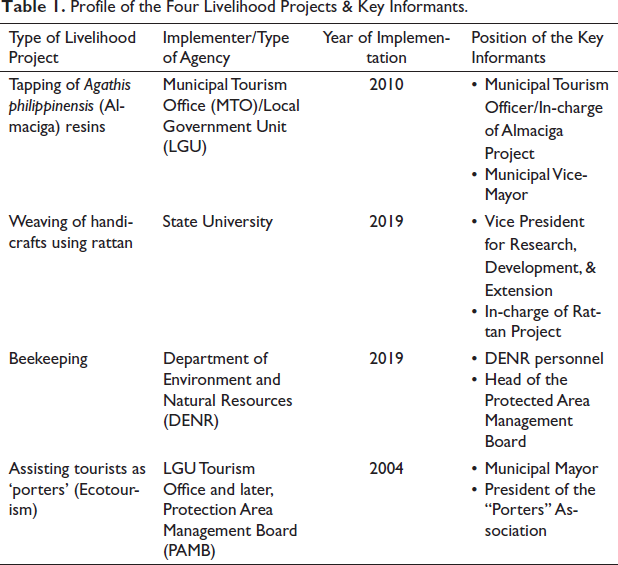
This article is based on research conducted at the municipalities of San Isidro and Governor Generoso, Davao Oriental, Philippines, where MHRWS is located. The study employed a descriptive design using qualitative and quantitative approaches. The qualitative tool for data collection is Key Informant interviews (KIIs) while a Survey was conducted for the quantitative approach. There are eight key informants (KIs) who were interviewed following a semi-structured guide question. They were purposely selected for they play crucial role in the conceptualization and implementation of the livelihood projects that were investigated. Their profile is presented in Table 1.
Profile of the Four Livelihood Projects & Key Informants.
For the survey, 73 partners and beneficiaries were conveniently selected and interviewed. Convenient sampling was employed because of absence of complete sampling frame, geographic dispersion of the respondents, financial and temporal limitations, and concerns on peace and order. The survey respondents were asked on topics related to their participation and assessment on project conceptualization and implementation, and their assessment on the benefits and the staff (implementers), and on the project outcomes. They were also asked of the issues and problems in implementing the projects, and how are these addressed. Their socio-demographic profile is presented in Table 2. Prior to data gathering, informed consent was secured from the participants and ethical concerns were considered. The qualitative data were transcribed and subjected to thematic analysis. Themes and patterns from responses were identified and established. The data generated from the survey were also analysed using basic descriptive statistics like frequencies and percentages.
Frequency and Percentage Distribution of the Respondents’ Socio-demographic Profile.

This article considered four livelihood projects implemented in communities near MHRWS, as shown in Table 1. These livelihoods include tapping of Agathis philippinensis (Almaciga) resins, gathering of rattans for handicrafts, beekeeping, and serving as tourists’ porters and guides. The Almaciga is initiated by the LGU while the rattan is introduced by a state university. The beekeeping is implemented by a national agency, and the ecotourism is initiated by the LGU Tourism Office but later regulated by MHRWS’s PAMB. The association of porters for ecotourism, was established since 2004 while the federation of Almaciga tappers was initiated in 2010. The other two livelihoods (beekeeping and rattan) were introduced only in 2019.
The survey respondents are distributed across all age categories although more than half (52%) are young adults or 15–35 years old. Many are males (61.6%) and married (61.7%). More than half (58.9%) are indigenous peoples, mostly (80.8%) are Catholic and many (67.2%) have elementary level or graduates of elementary education.
Results and Discussion
This article presents an analysis of the above-mentioned four livelihoods, with some highlighted unique features of these livelihoods. The findings on the perspectives of implementers are validated by that of the beneficiaries. The first part includes the facilitating factors while the second part contains the impeding factors in conceptualization and implementation of said livelihoods.
Facilitating Factors of Livelihood Projects
‘Facilitating factors’ is operationally used in this article as any act, mechanism, condition, process, or strategy that supports to the success or sustainability of any livelihood project. In the SLA, these factors could be observed as assets, institutional and policy context, and strategies as shown in Figure 1. Based on the experiences and perspectives of the implementers and beneficiaries, the following factors facilitate the relative success and sustainability of livelihood projects.
Conceptualizing a Project with Defined Principles and Purpose
The conceptualization of a project serves as its very foundation and direction. If a project is well-designed, then a big part of its success is more likely ensured. The above livelihood projects were conceptualized based on defined principles and purpose. From the implementers’ perspectives, these projects are designed based on principles of forest conservation, environmental protection, poverty reduction, and cultural preservation. The implementers have clear objective for the project that is, to provide livelihood of a community to limit its dependence on MHRWS’s resources. Hence, livelihood projects need to be integrated into PA management. In the narratives of the informants, they said, ‘…it is part of a program on PA management, providing biodiversity-friendly enterprises…’; ‘… we explored on alternative livelihoods needed by our IPs to address poverty… to protect our environment…’.
In the survey, all the respondents said that they are amenable to how the project was conceptualized. Many (71.2%) of them mentioned that the project intends to benefit them by giving them livelihood and income. All of them also agreed that the projects help protect and conserve MHRWS. The Almaciga tappers do not only practice sustainable harvesting or tapping of resins but also help in protecting the forest from illegal cutting of trees and extracting other resources. For Beekeeping, they could help prevent forest encroachment by improving farm production outside the PA. The porters/guides also help control the entry of illegal loggers. For rattan, they are trained on how to have a more sustainable harvesting.
Integrating livelihood into conservation is a common strategy for forest dependent communities affected by PA establishment. One example is the extraction of non-timber forest products (Chenchina et al. 2018; Foerster et al. 2011; Harbi et al. 2018; Nakakaawa et al. 2015; Pandey et al. 2016; Persha et al. 2010). It implies that implementing livelihood is not simply augmenting income of the households but also promoting conservation. As indicated in the SLA, the context has to be considered in coming up with livelihoods. In this case, environmental conservation is an essential component in a community near PA. This objective must be clarified with partner communities as in the case of the above projects. Hence, engaging the community during conceptualization is very important as discussed below.
Engaging and Understanding the Community
The implementers of the above projects revealed that they engaged the community or target beneficiaries from conceptualization to implementation. One of the implementers on Almaciga project shared that his immersion in the community enabled him to have a deeper understanding on their culture and dynamics. After seven years of being engaged with the community and observed previous livelihood options that failed, he gained experience on having a more adaptive livelihood option. Staying in the community made him realize that IPs’ actual situation and needs must be understood properly and that as implementers, they need to be flexible with the community. He learned that as long as IPs are not hungry, the forest is preserved. These livelihoods must be more familiar to the community.
In the Beekeeping project, the implementers conducted socio-economic survey including FGDs, site assessment, and feasibility study. They consulted local leaders before implementation. The Rattan project is an offshoot of a research based on buffer zone management framework. Results of said study suggest a livelihood project that is appropriate for the community. Likewise, there were consultative meetings with the target beneficiaries.
All the survey respondents were consulted on the project’s design. Almost all (97.0%) of them participated in planning and all of them are also amenable to how the project was conceptualized. In fact, almost all (91.7%) of them rated the project conceptualization high (with score of 8–10 based on 1–10 scale where 10 as the highest).
The above data are consistent with the principles in SLA where participation of target community, is highly emphasized. It focuses on people-centeredness, participation, and partnerships (Morse and McNamara 2013; Serrat 2008). The said findings also confirm that of Lambi et al. (2012) stating that people should be asked (and not to be dictated) on what livelihood options they would like to venture. However, the above result differs from that of the study of Martin et al. (2018) where the respondents for all the three villages near Nam Et-Phou Louey National Protected Area (NPA) in Northern Laos ‘consistently’ recognized their ‘lack of participation in the planning of NPA’.
Implementing Adaptive and Responsive Strategies
Being engaged with the community enables the implementers to understand the context. Understanding the socio-economic and political factors is vital to success or failure of livelihood projects (Mukul et al. 2010). Assessing the communities’ resources is important for more sustainable livelihood strategies as argued by the SLA. These resources would be matched with their needs and be the basis for conceptualizing a livelihood project (Morse and McNamara 2013; Serrat 2008).
Thus, the implementers of the above projects are able to develop and implement adaptive and responsive strategies, which include introducing locally-based enterprise, selecting beneficiaries inclusively and fairly, organizing and empowering the beneficiaries, integrating cultural preservation, and monitoring and training regularly. Each of these strategies is discussed in the following sections.
Introducing Locally-based Livelihood
One of the implementers of the Almaciga project shared his observation on a number of unsustained livelihoods in the area for they are less familiar with these projects. He related that, ‘…livestock…vegetable gardening…these were not sustained…they continued on timber poaching… so we thought of something that is just existing in the area…’.
In the case of Almaciga, the IPs practiced traditional way of tapping resins until the project was introduced. They used it for igniting fire only and harvested in a less sustainable manner. For rattan, some few households are into handicrafts using the said material. The Beekeeping was introduced because it was also practiced traditionally, though in relatively less sustainable way.
Based on the survey, almost all (97.3%) of the respondents agree on the project’s objectives. They mentioned such reasons as augmenting income, addressing poverty, protecting the environment, improving their farm, and having clear objective.
These findings support to what is being argued by the SLA and Lambi et al. (2012) that ‘context-specific economic opportunities’ should be introduced to communities near PAs in Cameroon. Hence, these livelihood opportunities have to be aligned with ‘socio-economic and cultural realities’.
Selecting Beneficiaries Inclusively and Fairly
Another significant component in implementing livelihood projects is selection of partner beneficiaries. If target participants are selected inclusively and fairly, they more likely support the project. Conflicts could also be minimized when selection is fair. In the case of Almaciga, all the tappers were asked to join. An informant who is in-charge of the Almaciga project said, ‘…all tappers from all barangays who want to have additional livelihood, were told to write their names…’. In the other projects, they also considered some criteria in choosing their participants. One informant from the Beekeeping project related, ‘… we prioritized the occupants inside the PA multiple U zone, those who encroach the forest and cut timbers...to eventually stop them from illegal extraction of forest resources…’
Almost all (97.3%) of the survey respondents agreed that the selection of participants is fair. Their justification includes: all are informed and invited, families are represented, IPs, forest guards and residents in the community are prioritized, and participation is voluntary.
Organizing and Empowering the Partner Beneficiaries
A common strategy on implementing development projects is organizing the community. In all the above (4) projects, the beneficiaries are formed into associations. In the case of Almaciga, the associations are even formed into federation. The federation formulated policies that regulate the members’ behaviour and guide their association’s activities. They have developed a mechanism on managing their sales. For instance, they allocate 50 cents per kilo of their income to their association and another 50 cents per kilo to their barangay. Their association has the autonomy to decide on the proceeds of allocated amount.
Hence, they need to empower themselves to sustain their project even in the absence of implementers. According to an informant from Almaciga project, ‘…PO needs to develop its confidence...to stand on its own and sustain the project, because we are not always in the community…’ An officer of the porters’ association also mentioned that, ‘…we need to organize ourselves so that we can come up with policies to regulate our actions, arrange fairly our schedule on guiding the tourists…’
This result supports the study among Almaciga tappers in selected sites in the Philippines. They need to strengthen their organizations to have strong ‘bargaining power’ in securing better resin price and policy support to prioritize IPs (Daracan et al. 2020). Likewise, LGUs and other institutions empower people to enhance their potentials in having livelihood opportunities (Sopsop and Buot 2011).
Hence, organizing the target beneficiaries is an effective way of implementing projects. Accordingly, organized and empowered communities initiate change and address their own problems (Brown 2006). As Pretty and Smith (2004) put it, POs promote ‘positive biodiversity outcomes’ as ‘social connectedness’ results in social capital, useful agent for ‘collective management programs’.
Integrating Cultural Preservation
Another notable practice of these projects particularly that of Almaciga, is conducting an annual ‘Almaciga Congress’ every 26th July. This event aims primarily to recognize the IPs and promote cultural preservation and environmental protection. Aside from cultural dances and celebration, the members are oriented with recent policies of DENR. They are provided with refresher training on proper tapping technique during the said event. They also discuss issues and concerns and receive gifts from the LGU. The said Congress is conducted at the ‘Almaciga Ecopark and Biodiversity Learning Center’ which was established by the LGU particularly by MTO.
The above activity for the Almaciga tappers may just be one day but it could be significant to the project. It motivates the community to support the project actively. It is also a venue for sharing issues and problems to concerned government officials or personnel.
Monitoring and Training Regularly
Another factor that facilitates the implementation of livelihoods is regular monitoring and training. Implemented activities should be monitored regularly so that emerging issues and concerns be addressed immediately. As related by an implementer of the Beekeeping project, ‘…there is really a constant interfacing with them regarding the project’s implementation…if possible twice or thrice a month we have monitoring…’
Constant training and orientation among the partner beneficiaries are also considered to enhance their knowledge and skills needed for the project. According to one of the implementers of the Rattan project, ‘…unless they understand sustainable harvesting and rotation, …and there is no other solution but to have constant education to always remind them about sustainable harvesting…’
Similarly, Pandey et al. (2016) mentioned that forest-dependent communities need to be provided with information on ‘market, policy, and products’ about non-timber forest products. Sopsop and Buot (2011) also mentioned the need of assisting the community’s farming system for augmented income.
Providing Sustained Marketing and Technical Support
Another significant factor in implementing livelihood projects is an established market. Beneficiaries are motivated to produce if they have stable market. Likewise, the implementers’ honesty and transparency related to product pricing resulted in their good relationship with beneficiaries.
In the case of Almaciga, the members are provided with stable market support. The implementers are able to link them to a company that buys Almaciga resin. They also strategize to have a ‘one-month round’ production to ensure weekly income for the members. To regulate and control tapping of resin from another’s area, the federation also imposes a policy that only the members’ products are bought.
For the Rattan project, the implementers suggested a policy support so that beneficiaries are legitimized to harvest rattan. An informant even mentioned of a ‘center’ for handicrafts. He said that, ‘…we observed that those projects that are sustained have center… a place where they could gather (for production, marketing, training, etc.).’
In the beekeeping project, technical and marketing support are provided to beneficiaries. As revealed by an informant from this project, ‘…we really supported them continuously…from technology to marketing, we did not leave them so that resources will not be wasted…’
The above findings support the contention that insufficient market and credit support from the government, and increasing demand of forest products (like rattans) are some of the reasons for continuous extraction of forest resources (Sopsop and Buot 2011). These data are also related to the findings that NTFP collectors have minimum benefits because they have limited skills and they ‘lack resources to store, process and market their produce’ (Gubbi and Macmilan 2008). Again, assessing the resources is essential before implementing a livelihood project as argued by the SLA. As experienced in the above projects, the availability of marketing and technical support facilitated their sustainability (Morse and McNamara 2013; Serrat 2008).
Establishing Partnership with Agencies
Engaging with various government agencies also facilitated the implementation of the above projects. These agencies provide technical and funding support. As shared by an informant in the Rattan project, ‘…that is why we have partnership with LGU and academe so we can also tap their expertise…’ Another informant in the Beekeeping project likewise added, ‘…so we also need counterpart from other implementing agencies like LGUs… to sustain projects like this, it needs partnerships and collaboration and co-funding from various groups… ‘.
However, it was suggested that while partnerships include various agencies, there has to be a lead agency to engage directly with the community. One informant in the rattan project suggested that the academe could take such role. State universities in particular, have the mandate to extend their generated knowledge and technologies to their communities.
Another informant in the Almaciga project mentioned that the LGU is effective on leading livelihood projects because they could easily immerse in the community. LGU’s lead role is more facilitative when local executives are determined to implement and support the project.
The above findings are affirmed by that of Harbi et al. (2018) where ‘building partnerships with banks and investors for venture capital support’ is one of the strategies for rattan collectors and processors in Indonesia. Again, this effort to establish linkages with agencies is based on assessment of resources and context mentioned in the SLA. Hence, it promotes a sustainable livelihood and conservation (Morse and McNamara 2013; Serrat 2008).
Impeding Factors in the Implementation
While there are factors that facilitated the projects’ implementation, there are also those that impede based on informants’ perspective. These factors include lack of sustainability plan, of coordinated governance and integrity, and of sufficient, full-time and tenured personnel.
Lack of Sustainability Plan
Based from the informants’ narratives, the lack of sustainability plan is a hindering factor to a project’s success and sustainability. In many cases, when there is a change in administration, the projects implemented by previous leadership are no longer sustained. As revealed by an informant from Almaciga project, ‘…if ever the present administration is changed with a new one, it will not be sustained…’
Hence, livelihood projects need to be integrated in a broader program, supported by policies, and allocated with funds. An informant from Beekeeping project suggested that, ‘…to integrate and harmonize it to a program by the LGU and other agencies that exists in the community…also on policy…because it is binding…once it will be institutionalized, it will be sustained…’ Another informant in the Rattan project added, ‘…there is a need to have policy support from LGU, to address concerns related to the project…’
Having a concrete sustainability plan may also help counter the tendency for some locals to be ‘myopic’ or lack of concern for the future, and less participative. An informant in the Almaciga project revealed that ‘…the people especially if they have difficulty in life, they want an easy, instant way…’. They tend to opt for some easy way. Thus, he was challenged to mobilize them and address their tendency to be dependent. There has to be mechanisms and strategies on how to deal with these traits.
The implementers recognized the challenge on how to keep the beneficiaries on track. An informant in the Almaciga project said, ‘…the interest of our beneficiaries should be sustained…should have the heart for the project…’ In the survey, the beneficiaries also recognized the issue on inactive participation or lack of participation of some members.
Thus, all the above factors, the integration of livelihood projects to an existing, more established and broader program, the policy support and institutionalization, and the ‘myopic’ tendency and dependent characteristics of communities, have to be considered in formulating a sustainability plan. Such plan may counter attempts of incumbent administration to discontinue previous projects. Hence, assessing the socio-political context of communities as argued by the SLA, unravels these factors that are requisites for formulating sustainability plan (Morse and McNamara 2013; Serrat 2008).
The above findings relate with the study of Gardner et al. (2016, 502) in a ‘multiple use protected area in Madagascar’. It suggests that due to livelihood change in PAs, management plan needs to integrate ‘mechanisms to detect, understand, and mitigate or adapt to livelihood change’ to minimize its potential negative effects. Allowing formal access to Mount Elgon National Park in Uganda, by ‘upscaling the collaborative resource management agreement (CRMA) coverage’ would also enhance the communities’ livelihoods and possibly lowers poverty in the region (Nakakaawa et al. 2015). Likewise, PA’s dual goals of ‘conservation and socioeconomic’ well-being could be realized when livelihoods are ‘incorporated into planning via multiple-use zones and community-based resource management strategies’ (Chechina et al. 2018, 429).
Lack of Coordinated Governance and Integrity
A big challenge in implementing a livelihood project (at least in the Philippine context) is corruption. Unfortunately, there are community officials who are driven by their self-interest when a livelihood project is implemented in their locality. They try to also benefit from the project. According to an informant from Almaciga project, ‘…the Barangay officials…they have self-interest…for example, on forest conservation…they also have their own chainsaw…they protect illegal loggers because they themselves get a peso for every board foot of the timber…’.
The informants likewise considered lack of political will and coordination between the local and national agencies. Officials tend to be apprehensive in implementing laws strictly. The local and national agencies are less clarified with their respective mandate, for example, issuance of permits.
Hence, there must be ‘an appropriate balance of regulation, enforcement, and incentives’ to realize conservation efforts and local livelihoods (Harbi et al. 2018, 8). The ‘limited access to appropriate infrastructure and resources’ and ‘limiting institutional policies and procedures’ are impeding the success of livelihood projects (Pretorius and Chikadzi 2014). Thus, there is really a need to examine and assess the political context where a livelihood project would be implemented as contended by the SLA (Morse and McNamara 2013; Serrat 2008).
Lack of Sufficient, Full-time and Tenured Personnel
Implementating livelihood projects requires mobilization of communities. Implementers are often challenged by ‘to see is to believe’ tendencies and responses of locals when there are new projects. They also have the tendency to be dependent. Hence, personnel need to guide and motivate them to participate and sustain the project. Personnel should conduct constant monitoring of activities. They have to be available to clarify and respond to issues and problems on the project. An informant from Almaciga project mentioned that, being a ‘one-person’ implementer is difficult especially for projects with broad scope.
The limited staff in many government offices resulted in multiple tasking, which could affect the quality and outcome of services. There is also a problem when the assigned personnel has a ‘contractual’ or non-tenured status. As revealed by an informant from Beekeeping project, ‘…we have very limited staff, only one is permanent…that is the challenge when you manage a project and you are on contractual status, you could hardly sustain it…those who are skilled tend to seek for greener pasture…we lost experts to handle the project…we will spend resources again to train new ones...’
Hence, there have to be sufficient number of full-time and tenured personnel to implement and monitor livelihood projects. Pretorius and Chikadzi (2014) identified the beneficiaries’ ‘limited and poor-quality education and lack of business knowledge and management skills’ as obstacles to success and sustainability of livelihood projects. It is also important to assess the capabilities of these staff and the overall institutional context of implementers in order to respond to the needs of partner communities (Morse and McNamara 2013; Serrat 2008).
Conclusion
The state-initiated livelihood projects in MHRWS, a protected area and a UNESCO World Heritage site, have the potential for sustainability. Principles in the SLA are observable in these projects. The implementation of these livelihood projects is facilitated by factors like conceptualizing a project with defined principles and purpose; engaging and understanding the community; implementing adaptive and responsive strategies (e.g., introducing locally-based livelihood, selecting beneficiaries inclusively and fairly, organizing and empowering the partner beneficiaries, integrating cultural preservation, monitoring and training regularly); providing sustained marketing, and technical support; and establishing partnership with agencies.
Hence, these projects are well-conceptualized as these are anchored on principles of conservation and poverty alleviation. Most importantly, these projects are based on targeted communities’ needs, practices, and resources, which is the core of SLA. The participation of the community in the conceptualization of these projects is manifested. Their natural, economic, social, and cultural capitals are assessed and considered in coming up with these projects. Having such an assessment in the community would ensure sustainability since practices, capacities, needs, and interests of targeted partners and beneficiaries are considered.
Given its mandate, the state (in this case, the LGU, a national agency of the executive branch, and a state university) has the capacity to mobilize its resources to implement livelihood projects that are aligned with its dual purpose of biodiversity conservation and poverty alleviation. It also has the capacity to provide technical and marketing support, which are requisites for projects’ sustainability.
However, this potential for sustainability is greatly challenged by the state’s structural and systemic limitations. A major impediment is the lack of sustainability plan for these projects. The said plan could be a mechanism to withstand changes and challenges of transitory leadership in government. Previous projects are usually discontinued by incumbent administration. Hence, institutionalizing these projects through policies and mainstreaming in major and established programs could be an option.
Similarly, the lack of coordination among agencies in government impedes sustainability of livelihood projects. Lack of coordinated activities causes waste of resources and deters the attainment of projects’ objectives. Likewise, the tendency of some government agencies particularly in the Philippine context, to burden their personnel with multiple tasks makes them less focused and productive in implementing livelihood projects. In effect, these projects’ sustainability is challenged since many communities, while they participate, manifest reliance on personnel to mobilize and provide them with sustained support.
Footnotes
Declaration of Conflicting Interests
The authors declared no potential conflicts of interest with respect to the research, authorship and/or publication of this article.
Funding
This article is part of a research program funded by the Department of Science and Technology - Grants-in-Aid (DOST-GIA) of the Republic of the Philippines.
