




Abstract
This study explores the mediating role of customer imitation behaviour in the relationship between customer buying behaviour and determinants of effective celebrity endorsement advertisements. Along with major celebrity characteristics, the study has incorporated personal characteristics and characteristics of customers’ social environment as antecedents to imitation. The article shows that attractiveness and credibility of the celebrity affect the attitude towards advertisements through the mediating role of imitation behaviour, implying that celebrity advertisements can be created in ways that stimulate customer imitation. The article further demonstrates that celebrities for endorsements can be selected according to personal characteristics of the target audience. Finally, the study reinforces the role of attitude towards celebrity advertisement in shaping the purchase intentions of customers.
Keywords
Introduction
An individual, on average, is exposed to approximately 600 advertisements a day via print, radio, television and Internet (Clow & Baack, 2006). In an attempt to find ways to gain attention in this cacophony, marketers have looked into the possibilities of making use of celebrity worship in society. It has been reported that people build a powerful emotional attachment with celebrities to build their own self-identities and subjective evaluations of self-worth (Caughey, 1984, 1985). The admirers review their appearance, capabilities, values and attitudes to imitate their idols. Therefore, engaging celebrities to endorse brands has emerged as an important tool in marketing communications.
The extant literature has primarily looked into celebrity attributes, such as, attractiveness, credibility, gender, product–image match and popularity, as factors of effective endorsements. This article draws from related literature on sociology, political science, organizational behaviour and economics and posits that there are other factors also that lead to the outcomes of celebrity endorsements. Social influences on customers, such as peer pressure, and their personal characteristics, such as self-satisfaction and dominance tendencies, can determine the success of celebrity endorsements.
Customers, especially young customers, also imitate their idols, and this consequently affects their buying behaviour. The hypothesis in the study is that customer buying behaviour is influenced by the extent to which actions and behaviours of celebrities (in the advertisements) are imitated. It explores the mediating role of imitation behaviour in the relationship between customer buying behaviour and determinants of effective celebrity endorsements.
Review of Literature and Conceptual Framework
Celebrity endorsement is an advertising tactic where the image as well as the status of a celebrity is used for promotion, brand recognition, brand recall and differentiation. It is also used for educational and social purposes. A celebrity is a known personality with a status whose actions and words are noticed by a majority in the society, which gives the celebrity a specific image. Celebrities can be from diverse fields such as sports, business, literature, politics and even from the animation world (such as Mickey Mouse).
McCracken (1989) uses ‘meaning transfer perspective’ to describe the process through which the symbolic characteristics of the celebrity endorser move from the celebrity to the offering and then to the consumer. He explains that the meaning that resides in the celebrity adds value to products with greater precision than can be offered by anonymous actors or models. Celebrities have their own meanings as they have created this meaning in the films, political campaigns or sports achievements in a given cultural environment that cannot be found elsewhere.
A good endorser strategy can improve recall, attitude and preference for the brand (Katyal, 2007; Liu, Huang & Minghua, 2007; Ranjbarian, Shekarchizade & Momeni, 2010). The use of celebrities in advertisements can have many advantages, including facilitation of brand identification, subduing negative attitudes towards a brand, positioning or repositioning of a brand and affecting purchase intentions (Kaikati, 1987).
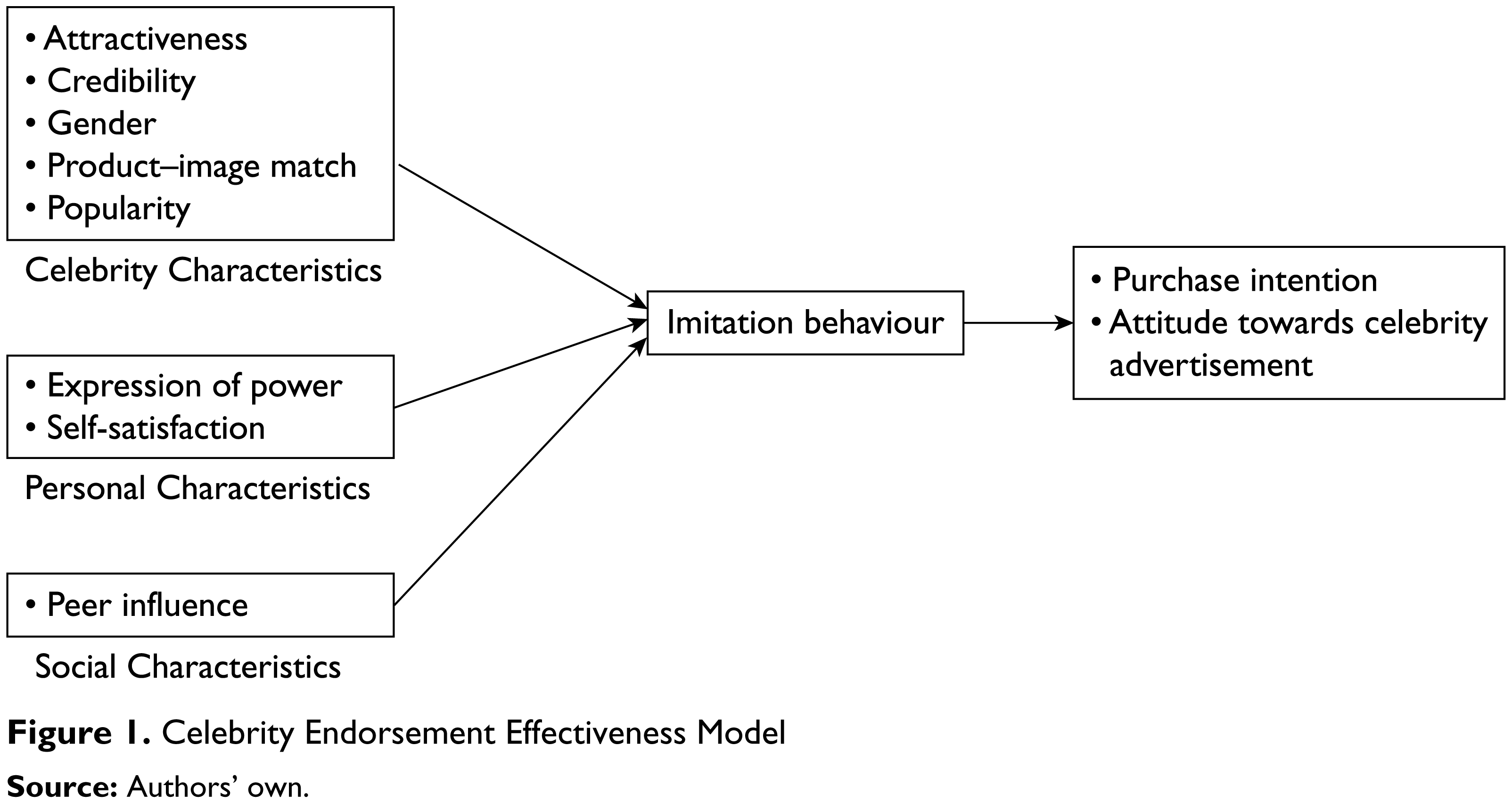
Celebrity endorsement affects consumers’ memory and learning. It helps in better storage and retrieval of information in consumers’ minds (Nader, Johnson & Buhler, 1995). On reviewing the literature on the effects of celebrity endorsement, Agrawal and Kamakura (1995) suggest that celebrities enhance message recall, make advertisements believable, improve brand recognition and facilitate a positive attitude towards the brand. Purchase intentions and attitude towards advertisement are considered in this study, for looking into the effect of celebrity endorsement on customer behaviour (Figure 1). The following sections expound on four major areas of the study: imitation behaviour; celebrity characteristics; personal characteristics of customers; and social environment of customers.
Imitation Behaviour
Imitation is a cognitive process that involves vision, perception, representation, memory and motor control. Goldenberg’s (2003) description of imitation includes movements, actions, skills, behaviours, gestures, pantomimes, mimics, vocalizations, sounds and speech. The process involves two different kinds of activities: observation and replication of what one observes. Dautenhahn and Nehaniv (2002) have discussed the importance of the time or place in which the imitation is done, various characteristics of the environment in which it is done, the state of the individual performing the action and his social interactions. They explain successful imitation as the right behaviour in the appropriate context, that is, who, when, where, how and what makes imitation.
Context-based imitation is the construction of a set of associations based on observations of various actions of a presenter in different contexts. These associations are memorized and learned so that a situation stimulates appropriate motor actions even when the presenter is no longer there (Rizzolatti, Fogassi & Gallese, 2001).
Meltzoff and Moore (1997) studying imitation in infants have emphasized that the infants produce behaviour similar to the behaviour of adults, and the effectiveness of actions depends on equivalence between the observer’s self-generated actions and the actions of the observed. Imitation is an effective way of learning new traits by exploiting the other’s knowledge (Borenstein & Ruppin, 2005). It is a potent way to transfer knowledge from an instructor to the observer using the shared environment (Hoffman, Grimes, Shon & Rao, 2006).
Imitation is a phenomenon that is prevalent in every individual’s day-to-day life, where the environment is complex or unknown. Imitation is a behavioural rule with soft assumptions of rationality, and people choose an action evaluated as successful based on the payoffs received in the past (Apesteguia, Huck, Oechssler & Weidenholzer, 2007). People imitate for developing skills or for achieving high outcomes without acquiring information or skill (Matthey, 2010). Bekkering, Wohlschlager and Gattis (2000) have studied imitation among children and found that imitative performances are guided by goals. Chan and Prendergast (2008) have found that goal-oriented consumption of advertising images (such as ‘to learn about the in-things’) contributes to imitation of celebrity models. Bikhchandani, Hirshleifer and Welch (1998) claim that people imitate the actions of those celebrities who appear to have expertise in a particular field.
Walton (2004) has mentioned happiness, surprise, anger, fear, sadness, disgust, jealousy, contempt, shame and embarrassment as determinants for individual actions. Some emotions such as anger, jealousy, shame and happiness dominate the public discourse. To show one’s dominance and importance, or to seek others’ attention for self-admiration, people start adopting the actions of the person who is known to everyone and is admired by them.
Extant literature has identified determinants of effective advertisements endorsed by celebrities. However, customers can imitate the behaviour of the celebrity for the reasons discussed in the forgoing paragraphs. Embracing actions of celebrities would create impact on the memory, and it would facilitate learning. It can also help customers in seeking importance or attention. This article investigates the mediating role of imitation behaviour in the relationship between effectiveness of celebrity endorsement (attitude towards the advertisement and purchase intention) and its determinants.
Celebrity Characteristics
Based on meta-analysis of the existing literature, Amos, Holmes and Strutton (2008) have discussed all the major celebrity characteristics that effect celebrity-endorsed advertisements. The key predictors identified in the study were celebrity credibility, celebrity expertise, celebrity performance, celebrity trustworthiness, celebrity attractiveness, celebrity familiarity, negative information, celebrity likeability and celebrity/product fit.
Celebrity credibility is the communicator’s positive characteristics that have a significant impact over the receiver’s degree of accepting the message (Ohanian, 1990). Expertise represents the extent to which the communicator is considered a valid source of assertion (Erdogan, 1999). Trustworthiness represents the degree of confidence placed by the consumer in the communicator (Ohanian, 1991), emphasis being on faithfulness and reliability of the celebrity (Khatri, 2006). Expertise and trust-worthiness are also believed to be embodied in credibility (Goldsmith, Lafferty and Newell, 2000; Ohanian, 1991). Expertise and trustworthiness are considered in this study as part of the credibility construct. Following hypotheses were tested in the study:
H1a: Celebrity credibility affects customers’ imitation behaviour, which in turn affects their attitude towards celebrity advertisements. H1b: Celebrity credibility affects customers’ imitation behaviour, which in turn affects their purchase intention.
Celebrity familiarity and likeability are considered equivalent to celebrity attractiveness, which refers to the physical attractiveness measured on personality traits (Kahle & Homer, 1985). Though a few scholars have described both the constructs distinctly, familiarity being the knowledge of the source and likeability being the affection for the source (Erdogan, 1999), based on the frequency of use in the literature, attractiveness has been taken in this study as an antecedent of effectiveness of celebrity endorsement (Table 1), leading to the following hypotheses:
H2a: Celebrity attractiveness affects customers’ imitation behaviour, which in turn affects their attitude towards celebrity advertisements. H2b: Celebrity attractiveness affects customers’ imitation behaviour, which in turn affects their purchase intention.
A good match between the celebrity and the product is considered to be a key determinant for the effectiveness of an advertisement (Batra & Homer, 2004; Erdogan, Baker & Tagg, 2001; Kahle & Homer, 1985; Misra & Beatty, 1990). Kamins (1990) showed that advertising is effective when a celebrity’s image matches with their associated product messages. His findings showed that for products related to physical appearance, the use of physically attractive celebrity would substantially enhance credibility and would positively affect consumers’ attitude towards the advertisement. McCracken (1989) pointed out that some celebrity endorsements give better results as compared to the others due to a better match of the duo. Others have also emphasized the product–celebrity match for the effectiveness of the advertisement (Hsu & McDonald, 2002; Kahle & Homer, 1985; Till & Busler, 1998). However, the statements of ‘Product Celebrity Image Match’ loaded in ‘attractiveness’ and ‘self-satisfaction’ in the exploratory factor analysis. Therefore, the variable was not considered in the present study.
Peetz, Parks and Spencer (2004) arrived at the conclusion that gender has a significant effect on the customer’s purchase intention and building the brand image. Their study revealed that male athletes influenced purchase intention more than female athletes. However, gender was not considered in the present study because of the limitation of the sample size. Popularity is another variable that has often been taken in the literature as a determinant of effectiveness of celebrity endorsement. Popularity of the celebrity has also been referred to as the level of success at a given point of time in the chosen profession of the celebrity (Amos et al., 2008). Popularity was not taken as a variable in the present study as diverse celebrities were recalled by the respondents and frequency of recall for any celebrity was not sufficient to enable further analyses. On the basis of importance of the variables in the extant literature, attractiveness, credibility and product–image match of celebrities were considered in this study, for investigating effectiveness of celebrity-endorsed advertisements (Table 1).
Personal Characteristics of Customers
The magnitude of the effect of imitation should not vary according to the characteristics of endorser only. A celebrity endorsement for viewers with appropriate personal characteristics would result in positive imitation behaviour. Self-satisfaction and expression of power are considered as other determinants of imitation behaviour in this study.
In the case of celebrity endorsement, consumers are satisfied due to the transfer of image of the endorsing celebrity by acquiring the product or service, and by the recognition they receive. According to Baumeister (1991), traditions and institutions are less influential as bearers of meaning than the self. This view of the self can have two meanings. In the first variant, the self is the agent responsible for the construction of meaning. The individual performs the task of assembling a system of meaning, using all types of cultural elements. She attempts to adjust personal elements with the cultural elements. The purpose is to relate the subjective elements of self with the objective elements of culture.
In the second variant, the self is the source of meaning. The self and its development become meaning and goal of life. This can mean having pleasure in getting some kind of gain, or in avoiding some kind of pain. It is hypothesized in this study that people would imitate that act of the celebrity which gives them such a pleasure, and which is easy to follow and is acceptable among others. ‘Self-satisfaction’ construct is used to measure the role of such behaviour in imitation. Following hypotheses were framed:
H3a: Customers’ self-satisfaction with imitation affects their imitation behaviour, which in turn affects their attitude towards celebrity advertisements. H3b: Customers’ self-satisfaction with imitation affects their imitation behaviour, which in turn affects their purchase intention.
Another variable used in this study is ‘expression of power’. According to social dominance theory, in order to minimize inter-group conflict, societies develop ideologies that maintain and legitimize group inequalities and discriminations (Sidanius & Pratto, 1999). Individuals with high social dominance have higher peer acceptance. People can try to have a higher level of dominance over their peers by imitating acts that would reinforce the societal hierarchies and stereotypes.
A Review of Celebrity Characteristics that Influence Effectiveness of Celebrity Endorsement

Power is described as an asymmetry in the relationship among individuals (Simon, 1953), a concept derived from the fields of political science, sociology and economics. Power can be due to an asymmetry in knowledge (Hand, 1986) or in dependence (Emerson, 1962). Asymmetry in relationship generally arises due to ‘resource holding capacity’, such as the ability to fight (Smith & Parker, 1976), or due to possession of an inalienable commodity, such as image and knowledge (Noe, van Schaik & van Hooff, 1991). One can imitate to acquire and demonstrate some information or knowledge for expressing one’s supremacy and power in a surrounding. Power is a more inclusive concept as it comprises both dominance and leverage, whereas dominance is defined as power based on force or threat of force (de Waal, 1989). Expression of power is considered as one of the predictor variables of imitation behaviour in this study, leading to the following hypotheses:
H4a: Customers’ desire to express power affects their imitation behaviour, which in turn affects their attitude towards celebrity advertisements. H4b: Customers’ desire to express power affects their imitation behaviour, which in turn affects their purchase intention.
Social Environment of Customers
Imitation behaviour can also be affected by the social environment of the viewer. A celebrity endorsement in an appropriate social environment would result in customers imitating the actions of the celebrity. The impact of peer pressure on imitation behaviour has been investigated in this study.
Peer pressure is the phenomenon where one tends to get influenced by the lifestyle and the way of thinking of one’s peers (Oak, 2010). It results in a situation where a group of people has conformity of attitude. Successful peer interaction requires an understanding of the relationships between thoughts, actions and needs of each other (Stafford, 2004). They need to follow some rules in order to maintain healthy peer relationship, such as: (a) the regulation of negative emotions and inhibition of inappropriate behaviours; (b) the ability to remain engaged and sustain attention to the task; and (c) adequate language skills (Eisenberg, Fabes, Karbon, Bernzweig, Poulin & Hanish, 1993; Eisenberg, Fabes, Karbon, Murphy, Maszk & Smith, 1995).
Vulnerability to peer influence shows a readiness to conform to the wishes of others and a readiness to accept and internalize information from others. The first is normative influence, and the latter is informative influence. This also implies that the person has a need to enhance her image through material possessions (Bearden, Netemeyer & Teel, 1989).
Peer pressure forces others to behave the way peers admire. When a highly influential member of the group is impressed by the selective celebrity and adopts his actions, she may influence the other members directly or indirectly to adopt the selective celebrity behaviour. Such imitation behaviour is generated on the basis of peer influence. Peer influence leading to imitation behaviour has been hypothesized in this study as follow:
H5a = Peer influence on customers affects their imitation behaviour, which in turn affects their attitude towards celebrity advertisements. H5b = Peer influence on customers affects their imitation behaviour, which in turn affects their purchase intention.
The Study
The study empirically investigated the model in Figure 1. The instrument has scales on credibility, attractiveness and product–image match adapted from the work of Ohanian (1990); on popularity from the work of Shimp (2010); on peer influence from the work of Mangleburg and Bristol (1998); on imitation behaviour from the work of Chan and Prendergast (2008), on attitude towards advertisement from the works of MacKenzie and Lutz (1989) and Yi (1990); on self-satisfaction from the work of Andrews and Withey (1976); and on expression of power from the work of Xin and Chi (2010). The instrument was pretested (debriefing) with 20 postgraduate management students of a university, and it was found satisfactory in terms of the meanings of items and formatting of the instrument.
The participants (N = 227) in the study were final year undergraduate engineering students from two private universities in India. The participants were requested to fill in an online instrument and the data were collected over a period of four months. Many respondents had not filled in their age and gender, but they were included in the sample as the questionnaires were duly filled otherwise. Gender was not taken into consideration because of low response on the variable.
An iterative process of exploratory factor analysis was performed to assess and diagnose the reliability of the constructs. Thereafter, confirmatory factor analysis (CFA) was conducted to check the reliability and validity of the full measurement model. Finally, structural equation modelling was used to examine the hypothesized relationships between the variables.
Results
The results were checked for the reliability of each variable. Cronbach’s alpha ranged from 0.69 to 0.94. We conducted exploratory factor analysis with varimax rotation. Some statements of ‘expression of power’ clearly represented a sub-factor ‘equality’ (for example, ‘it would be good if all are equal’, ‘equality should be our ideal’ and ‘everyone should be given equal chances’), while some statements of ‘credibility’ represented a clear sub-factor of ‘expertise’ (‘celebrity in advertisement is expert of the product category’, ‘celebrity in advertisement is knowledgeable to endorse the product’, ‘celebrity in advertisement is highly qualified to endorse the product’). These were removed. Similarly, some confounding statements, like ‘I check out celebrity lifestyle to keep updated with trends’ and ‘I do not believe in following celebrities to satisfy the aspects of life’, which seem to represent both satisfaction and imitation behaviour were removed.
The questionnaire asked respondents to recall celebrities of some product brands (for example, ‘please name the celebrity that comes first to your mind in the advertisement of Pepsi’). Then they were asked to rate those celebrities on a popularity scale. Many celebrity names were recalled in the survey, but none of them was recalled by more than 70 respondents, which was low for such an analysis. Therefore, the variable ‘popularity’ was removed from the model to be tested. ‘Product Celebrity Image Match’ had only two statements and they were loading in ‘attractiveness’ and ‘self-satisfaction’. Therefore, the variable was removed (Hair, Black, Babin, Anderson & Tatham, 2006). Finally, the 32 statements clearly loaded on nine a priori factors with factor loadings ranging from 0.56 to 0.85 (except for Purchase Intentions at 0.39 and 0.44, at for Attractiveness at 0.49). Cronbach alpha for the latent variables ranged from 0.73 to 0.91.
The CFA was conducted for this measurement model in AMOS 18. An analysis of regression weights and covariance residuals prompted removal of six observed variables from different latent variables. The removal of the observed variable did not appear to affect the conceptual meaning of the latent variables. An analysis of modification indices prompted freeing five within-construct error covariance parameters. The final measurement model had 26 observed variables and seven latent variables (Appendix 1). Table 2 gives the details of fit indices of the measurement model.
Means, Standard Deviations, Composite Reliabilities, Average Variance Extracted, Correlations and Squared Correlations among Latent Variables for Full Measurement Modela

2. Composite reliability is on the diagonals.
3. All statistics are significant at p < 0.01; * p is between 0.01 and 0.05; ns = non-significant.
4. aN = 227; bmean of summated scales ranging from 1 to 5.
The CFA shows a reasonable fit of the measurement model (X²/DF = 1.90, RMR = 0.08, RMSEA = 0.06, TLI = 0.89, CFI = 0.91). Composite reliability of latent variables varies from 0.69 to 0.89, and establishes convergent validity of the variables (Bagozzi & Yi, 1988). Except for ‘purchase intention’, average variance extracted (AVE) is around the threshold limit of 0.50 or more for all the variables. With the exception of purchase intention, discriminant validity gets support for all other variables as AVE for each one of them is higher than the squared correlations of that variable with the other variables (Fornell & Larcker, 1981). After assessing the fitness of the measurement model, where latent variables showed their distinctiveness, we proceeded to test the structural relationships between the constructs (purchase intention did not show discriminant validity with other variables, but looking at the CFA results, and composite reliability results for the variable, it was retained in the model).
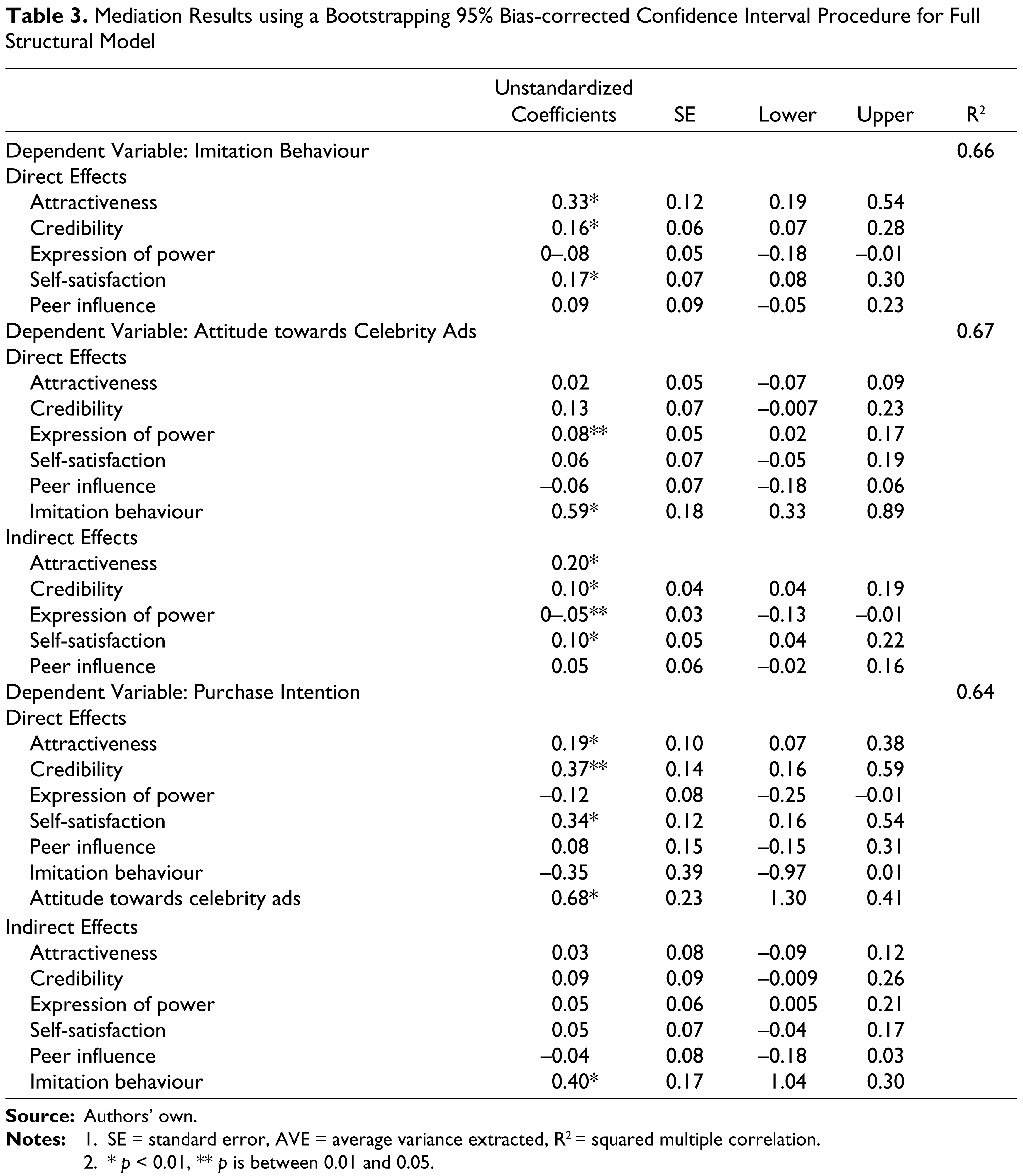
We ran the bootstrapping bias-corrected confidence interval procedure for testing significance and confidence intervals of the estimates (Preacher & Hayes, 2008). We used 4,000 bootstrap samples for generating the 95 per cent confidence intervals. Table 3 shows the result of the full structural model (with all direct and indirect paths).
Mediation Results using a Bootstrapping 95% Bias-corrected Confidence Interval Procedure for Full Structural Model
2. * p < 0.01, ** p is between 0.01 and 0.05.
Examination of the significance of indirect effects and the effect sizes accompanying those effects is advocated for theory building and hypothesis testing (Baron & Kenny, 1986; Rucker, Preacher, Tormala & Petty, 2011). Measures such as mediation ratio, which is a ratio between indirect effects and total effects, have been suggested for gauging the relative strength of effect sizes (Ditlevsen, Christensen, Lynch, Damsgaard & Keiding, 2005; Freedman, 2001), and complete mediation is demonstrated if the direct path coefficients are not statistically significantly different from zero.
There is support for the complete mediating role of imitation behaviour in the relationship between attractiveness, credibility, self-satisfaction and attitude towards advertisements, since direct paths are not significant and zero is contained in 95 per cent confidence intervals.
Peer influence does not have significant coefficients either for direct effects or indirect effects on attitude towards advertisement. There is lack of support for the mediating role of imitation behaviour in all the relationships between independent variables and the criterion variable ‘purchase intention’ as none of the path coefficients are significant. This implies that Hypotheses 1b, 2b, 3b, 4b and 5b, which related independent variables to customers’ purchase intention through imitation behavour, are not supported. Attractiveness, credibility, and satisfaction demonstrate direct significant effects on both the criterion variables ‘attitude towards advertisement’ and ‘imitation behaviour’. Variance explained in imitation behaviour is 0.66; in attitude towards advertisements is 0.67; and it is 0.64 in purchase intention.
Model re-specification is suggested for identifying a model that fits well both empirically and conceptually (Hair et al., 2006). To assess the magnitude of the direct effects, and magnitude and significance of the indirect effects without the confounding effects of non-significant relationships, the model was re-specified, retaining only the significant and non-zero paths. All coefficients of ‘peer influence’ were low and not significant. Therefore, Hypothesis 5a which relates peer influence to attitude towards celebrity advertisement is not supported. The variable ‘peer influence’ was removed from the re-specified model.
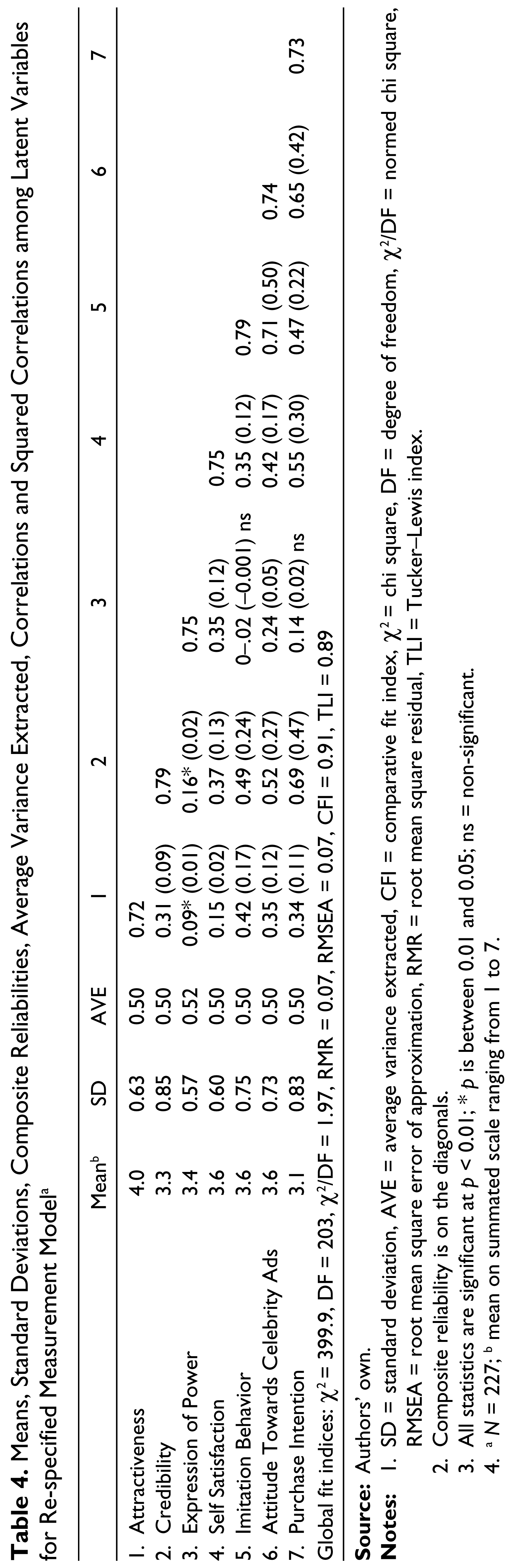
Means, Standard Deviations, Composite Reliabilities, Average Variance Extracted, Correlations and Squared Correlations among Latent Variables for Re-specified Measurement Modela
2. Composite reliability is on the diagonals.
3. All statistics are significant at p < 0.01; * p is between 0.01 and 0.05; ns = non-significant.
4. a N = 227; b mean on summated scale ranging from 1 to 7.
Since a variable (peer influence) was removed from the nomological network, therefore it became a new measurement model, and it was tested for its reliability and validity. Table 4 gives the details of fit indices of the model. The CFA shows a reasonable fit (χ2/DF = 1.97, RMR = 0.07, RMSEA = 0.07, TLI = 0.89, CFI = 0.91). Composite reliability of latent variables varies from 0.73 to 0.79 and establishes convergent validity of the variables. Average variance extracted (AVE) is at the threshold limit of 0.50 or more for all the variables, thus providing support for discriminant validity for all the variables as AVE for each one of them is higher than the squared correlations of that variable with the other variables (AVE for attitude at 0.50 is equal to its squared correlation with imitation behaviour). Assessment of the fitness of the measurement model showed that latent variables were distinct and we, therefore, proceeded to test the structural relationships between the constructs.
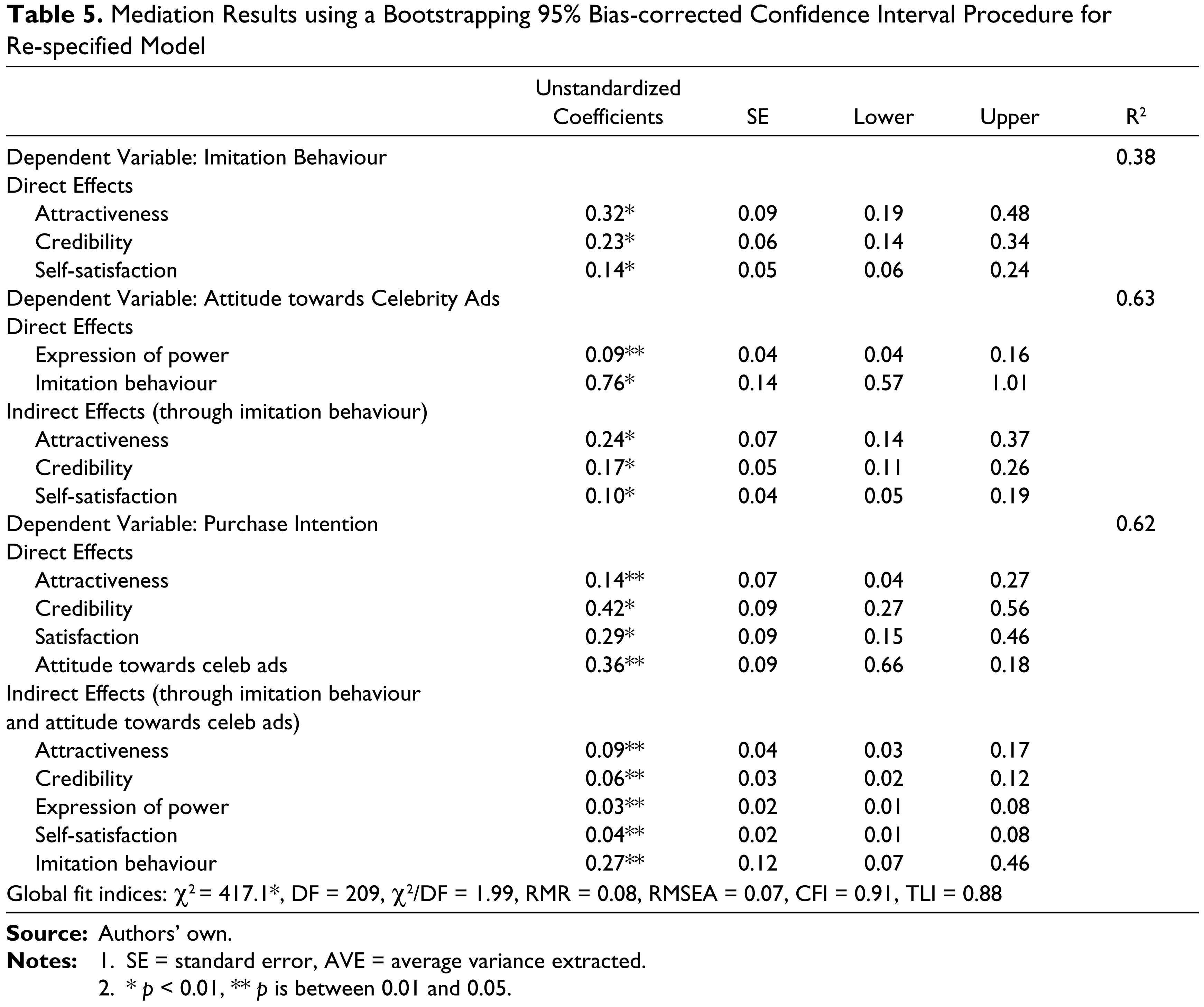
The structural model depicted in Figure 2 was then estimated. Table 5 shows the results of the testing of this model. This model with fewer degrees of freedom than the measurement model has reasonable fit (χ2/DF = 1.99, RMR = 0.08, RMSEA = 0.07, CFI = 0.91, TLI = 0.88). The bootstrapping bias-corrected confidence interval procedure was used for testing significance, and confidence intervals of the estimates, with 4,000 bootstrap samples for generating the 95 per cent confidence intervals.

Mediation Results using a Bootstrapping 95% Bias-corrected Confidence Interval Procedure for Re-specified Model
2. * p < 0.01, ** p is between 0.01 and 0.05.
Variance explained in the latent variables ranged from 0.38 to 0.63. All path coefficients are significant, and results support the findings of Model 1, albeit with slightly different coefficients. For effect of credibility on imitation behaviour, the coefficient has increased from 0.16 to 0.23. Coefficient for the impact of imitation behaviour on attitude towards advertisement has increased from 0.59 to 0.76. Coefficient of indirect effect of credibility on attitude towards advertisements has increased from 0.10 to 0.17. Coefficient for attitude towards celebrity advertisement on purchase intention has decreased from 0.68 to 0.36. Consequently, the indirect effect of imitation behaviour on purchase intention has decreased from 0.40 to 0.27. R2 of imitation behaviour has decreased from 0.66 to 0.38; that of attitude towards celebrity advertisement has decreased from 0.67 to 0.63; and for purchase intention, it has decreased from 0.64 to 0.62.
There is support for the mediating role of imitation behaviour in the relationship between attractiveness, credibility, self-satisfaction and attitude towards advertisement. This implies a support for Hypotheses 1a, 2a and 3a. The indirect effects are significant and vary from 0.10 to 0.24. Attractiveness, credibility and self-satisfaction have high direct effects and indirect effects, which are moderate to low in size (0.04 –0.09). The direct relationship between expression of power and attitude towards celebrity endorsement has a low coefficient. The Hypothesis 4a is thus partially supported.
Conclusion
Imitation is an important theme in learning in the fields of psychology and organizational behaviour. In marketing, learning and memory are important areas in consumer socialization and customer decision-making processes. How consumers acquire knowledge and experience for purchase decision making, and how it is stored and retrieved for purchase and consumption decisions, has been extensively studied. Similarly, consumer socialization studies have looked into different aspects of young people’s relations to consumption and advertising. However, marketing literature has not investigated the role of imitation in these processes. In this study, this role in the context of celebrity endorsement has been explored.
Major celebrity characteristics, such as, celebrity/product fit, celebrity credibility, celebrity performance, celebrity familiarity, celebrity likeability, celebrity attractiveness, celebrity expertise, celebrity trustworthiness and negative information, have been studied for effectiveness of celebrity-endorsed advertisements. However, customer characteristics have not received importance in the literature. The magnitude of the effect of imitation would also vary according to the characteristics of the customer, as well as her social environment. Expression of power and customer self-satisfaction are incorporated in this study as variables of customer characteristics; and peer influence is incorporated as a variable of customer social environment in the celebrity endorsement model.
The article highlights that imitation behaviour has an important role in shaping a consumer’s attitude towards a celebrity advertisement. It shows that attractiveness and credibility of the celebrity affect the attitude through the mediating role of imitation behaviour. A celebrity who is attractive and credible would have more chances of persuading customers if they imitate her mannerisms. If those mannerisms can be integrated with the product and its use in the advertisement, persuasion would be more effective. Customer self-satisfaction also impacts attitude through the mediation of imitation. This implies that an advertisement that stimulates imitation behaviour of a celebrity, whose behaviour is imitated by the public otherwise also, would be effective for self-satisfied customers.
It is found that expression of power directly impacts the attitude towards the celebrity advertisement. This suggests that customers who have need for expression of power have favourable opinions of celebrity advertisement, and do not necessarily imitate celebrity behaviour. Peer influence, which was incorporated in the study to investigate the role of elements of social environment of the customer, does not have any impact on the effectiveness of celebrity advertisement, either directly or through imitation.
For the practitioners, the study has three important findings. One is the importance of selection of appropriate celebrity for different segments of customers. Study shows that if celebrity is imitated, then that has more chances of making the advertisement successful. However, if the target segment is that of self-satisfied customers, then it is important to take a celebrity who is imitated. Second, celebrity advertisements need to be created in ways that stimulate imitation behaviour. The challenge is to incorporate the value proposition and the use of market offering into the idiosyncrasies of the celebrity actions that people imitate. Third, the study has reinforced the importance of attitude towards celebrity advertisement. If the advertisement creates a positive attitude towards itself, then that would add to the purchase intentions of customers.
Limitations
There is a need to better refine and develop the measures, and delve more into the antecedents of imitation behaviour, as 38 per cent variance is explained in the variable, while imitation behaviour itself affects attitude towards celebrity advertisements substantially (variance explained is 0.63 along with expression of power, coefficient is 0.76, while that of expression of power it is 0.09). Expression of power, which was conceptualized as antecedent of imitation behaviour, requires further investigation as it is found to have a direct impact on customer behaviour. Similarly, role of peer influence should be further explored as it was found to have no effect either on imitation or the customer behaviour.
The scales on the different variables in the study have been adapted from diverse studies. Exploratory factor analysis showed distinct and meaningful sub-factors within the constructs, while some statements appeared to relate to more than one variable. Investigation of CFA model further revealed poor fit of some observed variables, prompting removal of a few of them and freeing some within construct paths. Though the final model on the basis of incremental indices showed a reasonable fit, there is a need for further refinement and development of appropriate measures for such a study.
Furthermore, some important variables such as popularity of the celebrity and product–image match of the celebrity were not included in the study because of lack of good operationalization. It would be interesting to see their effects and interactions with the variables included in the study. Similarly, brand recall, an important measure of judging the effectiveness of imitation as well as attitude to the celebrity advertisement, can be included in future studies.