



Abstract
Marketers invest in various media platforms to influence consumer behaviour (CB). Advertisement on every media platform has a different composition that engages the consumers in a distinct way. Digitalization has led to changes in consumers’ media habits. Hence, a deeper understanding of advertisements on different media platforms and its implications on CB need to be established. This article focuses on the effects of television (TV), radio, newspapers, magazines and the Internet advertisements on awareness (AWR), interest (INT), conviction (CON), purchase (PUR) and post-purchase (PPUR) behaviour of consumers. The online survey method was utilized for the study. Data were collected from 529 respondents comprising students in India. Statistical tools such as Cronbach alpha, exploratory factor analysis (EFA) and Kruskal–Wallis (K–W) test were used to analyse the collected data. The results indicate that newspapers advertisements affect all the five stages of CB. The impact of TV and the Internet for creating AWR, INT and CON among the consumers is statistically evident. The results also revealed that magazines and newspapers are effective media in influencing PUR and PPUR behaviour of consumers. Advertising managers can take a cue from this research and enhance the objectivity of advertisements by investing in appropriate media.
Introduction
In a competitive market, it is important for advertising managers to grab consumers’ attention through advertisements and sales promotion. A sizable marketing budget is spent on advertising. The trend of using digital media platforms for advertisements is growing. This study intends to explore the importance of various media advertisements on consumer behaviour (CB) stages such as awareness (AWR), interest (INT), conviction (CON), purchase (PUR) and post-purchase (PPUR).
The consumer expectations of information from various media such as TV, radio, newspapers, magazines and the Internet are entirely different. The characteristics of different media and its immediate and long-term effects on consumers are also varied (Doyle & Saunders, 1990). For instance, TV allows high-quality audio–visual content that is more suitable for product categories, which require physical demonstration. Radio offers audio content and is most suitable for businesses catering to the local markets (Petersen, 2018).
Berkowitz, Allaway, and D’Souza (2001) posited that over a period of time, the effect of different media platforms on consumers’ memory varies. For instance, initially TV advertisements have a substantial impact on consumers’ memory, but in the long term, it fades away. In contrast, a magazine initially has a low but persistent impact on consumers’ memory because the readers can read a magazine at their own pace.
Broadcast media such as TV and radio are among the popular media in India because of its mass reach (Farooq & Latif, 2011; Fill, 2009). In India, newspapers play an important role as an effective medium of communication. This is due to its reach in almost every part of the country. India has the largest newspaper market in the world with over 330 million daily newspaper circulations (Jayaraj, 2011). Advertisers still prefer traditional mediums such as TV and print for advertisements (Statista, 2016). Of the total advertisement spend, TV advertisement spend in India was 44.7 per cent and print advertisement spend was 29.8 per cent. The digital advertisement spend was the third largest with a growth rate of 15.5 per cent (Pahwa, 2017). This is because of the increasing number of Internet users after the entry of Reliance JIO in the Indian telecommunication market.
The Internet is a more engaging medium than print because of its various levelled structure. Compared to a reader of newspapers and magazines, the Internet gives more control to users for watching the content of their choice (Bezjian-Avery, Calder, & Iacobucci, 1998). In this study, the term ‘internet’ encompasses digital channels, namely, Facebook, Twitter, Instagram, YouTube, email to name a few (Ducoffe, 1996; Gilaninia, Taleghani, & Karimi, 2013; Mishra & Vashiath, 2017; Trivedi, 2017a). In the light of the varied influence of different media platforms, Opeodu and Gbadebo (2017) indicated that an advertisement on various media platforms plays a vital role in influencing consumer’s choice. Hence, wise choice of media platform for advertisements is key for the promotion of products and services (Singh, 2012). Advertisements are a widely accepted source of information among the consumers as compared to other sources, and hence, media mix decisions are crucial for advertisers (Shrivastava, 2014).
This research is relevant because for a marketer, prioritizing the usage of different media platforms for advertising is proving to be a conundrum. Today, the advertising cost of each media is very high, and any inappropriate media strategies can be a costly decision. Thus, it is essential for advertising managers to understand various media advertisements and its impact on CB.
Various theories of CB posited that there is a relationship between advertisements and different stages of CB. Ranjbarian, Shaemi, and Jolodar (2011) established that TV advertisements affect attention, INT and desire. Nysveen and Breivik (2005) stated that the effects of radio advertisements are less on changing consumers’ attitude and behaviour. However, very limited research works were conducted considering all the five stages of CB. In the present study, the researcher has attempted to explore various advertising media affecting CB at each stage. This study is of utmost relevance to the current situation of the advertisement market, as this will give crucial insights regarding balancing between traditional and digital media.
The following part of the article elaborates the literature review involved in deriving the independent and dependent variables. The research methodology section discusses sampling, measures and statistical tools used to collect and analyse the data. The results are discussed in detail and compared with previous studies. Finally, the limitations of the present study and scope of future research are examined.
Literature Review
This section reviews various theories and studies in the area of media vehicles, advertisement effectiveness and CB stages.
Advertising
Out of the total cost of a product, 34 per cent is attributed to advertising expenses. This is important because through advertisements, marketers aim to achieve high top of the mind recall (Singh, 2012). Hence, advertisements are a critical part of the marketing strategy, especially in business-to-consumer contexts. Kotler, Keller, Koshy, and Jha (2009) stated that the consumer passes through different stages before making a final PUR. This was explained with the help of different models like attention, INT, desire & action (AIDA), attention, INT, desire, CON & action (AIDCA), hierarchy of effects model, innovation adoption model and information processing model. Ehrenberg (1992) posited that an advertisement first creates AWR and INT resulting in product PUR. The research conducted by Rai (2013) established the effects of advertisements on attitude formation and CB.
Various Media Advertisements
Marketers use different media vehicles to send across an engaging message to the targeted audience. Ayanwale, Alimi, and Ayanbimipe (2005) established that newspapers, magazines, radio, TV and outdoor are popular media among the marketers. However, Internet advertising is the current trend. It includes many forms of commercial content, namely, billboards, banner advertisements, corporate websites, e-mail messages, interactive games, and so on (Ducoffe, 1996).
In 2004, the amount spent for advertising on broadcast, cable TV and radio was 44 per cent, which was marginally higher than newspapers and magazines. This is because of the positive effect of TV commercials and online advertisements on consumers (Sadhasivam & Nithya Priya, 2015; Sorce & Dewitz, 2007). In contrast, Nayak and Shah (2015) opined that newspaper advertisements play a crucial role in creating a brand and it affects purchase decision (PURDEC). Raju and Devi (2012) conducted similar research and established that press advertisements are considered more trustworthy. Sorce and Dewitz (2007) found that magazine advertisements are more effective than that of TV. Pongiannan and Chinnasamy (2014) established empirical evidence for print media being the favourite medium among the advertisers. However, contradicting the prevailing notions, Trivedi (2017a) posited that viral advertisements do not have a direct impact on consumers’ PI. Message process involvement and attitude towards the brand mediate the relationship between viral advertisements and PI.
The aforesaid inferences state that media affects CB on various purchasing levels. The previous studies were restricted to either general impact of media (positive or negative) or focused on measuring effects on brand AWR and PURDEC. In the twenty-first-century media revolution, consumers have more media options. Hence, more research needs to be conducted to measure the effects of media advertisements on various stages of CB. This facilitates advertisers to take the right media mix decisions.
Advertising Effectiveness
Advertising effectiveness is referred to as the consumers’ liking of commercials resulting in PUR behaviour (Rimoldi, 2008). Advertising effectiveness is one of the critical factors to analyse PI. Calder Malthouse and Schaedel (2009) established that consumers’ engagement with media positively affects advertising effectiveness. Mehta (2000) indicated that advertising effectiveness depends on many factors like choice of media and consumers’ involvement with the media. Nysveen and Breivik (2005) posited that advertisement content and quality of media have a significant impact on the effectiveness of the commercial. Bishnoi and Sharma (2009) found that TV advertisements affect more to rural teenagers as compared to urban teenagers. Madhavi and Rajakumar (2004) indicated that Internet advertisement effectiveness could be easily analysed. Mehta (2000) found that Internet advertisements are less effective as users have more control over it as compared to print advertisements. Numberger and Schwaiger (2003) suggested that advertising effectiveness is optimum when the Internet and print media are used together. However, apart from advertisement effectiveness, AWR and intention also affect PURDEC (Bendixen, 1993; Siegel & Ziff-Levine, 1990).
Theory of Reasoned Action
Ajzen and Fishbein (1980) proposed the theory of reasoned action. According to this theory, attitude towards behaviour is one of the important predictors of behavioural intention. Attitude is defined as ‘an internal evaluation of an object such as branded product’. Lutz (1985) established that consumer attitude towards the advertisement affects consumer exposure, attention and reaction to the individual advertisement through a variety of cognitive and affective processes. In CB research, attitude towards the advertisement, attitude towards the brand and PI are commonly used constructs for predicting the effectiveness of marketing communications on different media (Trivedi, 2017b).
CB Stages
Leading models like AIDA (Lewis, 1898), AIDCA (Bedell, 1940; Kitson, 1921) and Lavidge and Steiner (1961) have studied the steps involved in consumers’ buying behaviour. Most of the studies have taken AIDA, AIDCA and Steiner model as a dependent variable (Chudzian, 2014; Rajagopal, 2011; Ranjbarian et al., 2011; Ugonna et al., 2017; Vihonen, 2013). Additionally, Ugonna et al. (2017) tested the AIDCA model from the modern-day advertising perspective and indicated that the AIDCA model is useful to map the effectiveness of media advertisements on CB. In this research, the Lavidge and Steiner (1961) model was used to measure the effects of media advertisements on various stages of CB such as AWR, INT, CON, PUR and PPUR.
Awareness
Aaker and Equity (1991) explained AWR as the consumers’ knowledge about the particular brand. Rowley (1998) indicated that customers should be made familiar with the product during this stage. Baca, Holguin Jr, and Stratemeyer (2005) posited that at this stage, the goal of advertisers should be to communicate about the product’s characteristics and advantages. Rossiter, Percy, and Donovan (1991) established that brand AWR is the prerequisite for generating PI. Various researchers have established a strong linkage between buyer’s behaviour and brand AWR (Hoyer, 1984; Nedungadi, 1990). Thus, to create more AWR in the market, advertisers should give a constant update of existing products and information about new products to consumers (Meyrick, 2006).
Interest
Creatively showcasing product benefits and characteristics can generate INT of consumers in the advertisement. Sachdeva (2015) established that relevant advertisements as per the viewer’s INT affect the level of INT in advertisements. Farooq, Shafique, Khurshid and Ahmad (2015) established the linkage between TV advertisements and INT. Similar research was conducted by Tang and Chan (2017) about an online advertisement. They concluded that the generation Y pay more attention to those advertisements, which are in line with their INT as compared to the need for a product. Rajagopal (2010) indicated that entertaining radio advertisements are more potent in generating consumers’ INT. Companies invest in varied marketing activities to generate consumers’ PI (Baca et al., 2005; Broeckelmann, 2010; Rowley, 1998). This can be further explained by a classic example of creating INT through advertisement by Fanta (a soft drink brand). This advertisement portrayed the mood change in a girl and boy due to a sip of Fanta, displaying the impact of the product on consumers’ mood (Hansen, 1972).
Conviction
Rajasekhar and Makesh (2013) defined CON as an active component, which is affected by emotions and attitude of consumers. Prospective customers feel convinced about an offering if the product is affordable and addressing their needs (Bradley, 2003). Factual and satisfactory information leads to CON resulting in PURDEC (Callen-Marchione & Ownbey, 2008). A commercial by Oppo phone (a mobile phone brand) portrayed Amy Jackson taking a selfie thus inducing desire among the consumers to buy the phone. In this study, the researcher has focused on five media and its effects on CB stages. Hence, the following hypotheses are proposed:
H1: TV advertisements have a significant influence on AWR, INT and CON stages of CB. H2: Radio advertisements have a significant influence on AWR, INT and CON stages of CB. H3: Newspaper advertisements have a significant influence on AWR, INT and CON stages of CB. H4: Magazine advertisements have a significant influence on AWR, INT and CON stages of CB. H5: Internet advertisements have a significant influence on AWR, INT and CON stages of CB.
Purchase
Ajzen and Fishbein (1980) established that PUR behaviour of the consumers could be predicted by knowing their PI. Ducoffe (1995) posited that the credible source of information has more significant impact on PURDEC. This information includes brand image and AWR, which significantly affects PURDEC (Farris, Bendle, Pfeifer, & Reibstein, 2010). Advertisements create an emotional response, and it has a significant impact on PURDEC (Saleem & Abideen, 2011). The use of brand associations in advertisements can have a significant effect on the PURDEC (Heath, 2000).
Similarly, Romaniuk and Sharp (2003) indicated that cognition related to the brand name affects the set of alternatives and PURDEC. However, Mendelson and Bolls (2002) established that a positive attitude towards the advertisement leads to PURDEC. McGuire (1978) established that PUR behaviour of the advertised brand is affected by attention, retention and effectiveness of advertising message. Hence, it is established that various media advertisements have differential effects on PURDEC.
Post-purchase Behaviour
PPUR behaviour is satisfaction or dissatisfaction that consumers get after the PUR of the product (Kotler & Keller, 2012). In the PPUR stage, the consumers compare the performance of a product with perceived expectations. This evaluation adds in experience and learning of consumers, which in turn affects future PUR (Schiffman & Kanuk, 2009). The PPUR intentions were defined as consumer probability of repeat buying from the same retailer and sharing positive word of mouth among friends and relatives (Cronin, Brady, & Hult, 2000; Wang, Lo, & Yang, 2004; Zeithaml, Berry, & Parasuraman, 1996). The repeat PUR is significantly affected by brand AWR (Macdonald & Sharp, 2000). However, Kotler and Keller (2007) stated that it is the satisfaction with the product that leads to repeat PUR. Chaffrey and Smith (2008) found that good after sales service leads to satisfaction, which then affects PPUR behaviour. Reddy (2016) indicated that Internet media offers a platform for consumers to express their PPUR opinion about the products.
Based on the above literature, the following hypotheses are proposed:
H6: TV advertisements have a significant influence on the PUR and PPUR behaviour of consumers. H7: Radio advertisements have a significant influence on the PUR and PPUR behaviour of consumers. H8: Newspaper advertisements have a significant influence on the PUR and PPUR behaviour of consumers. H9: Magazine advertisements have a significant influence on the PUR and PPUR behaviour of consumers. H10: Internet advertisements have a significant influence on the PUR and PPUR behaviour of consumers.
Methodology
Data and Sample
A structured questionnaire was framed and executed in a group of 529 students using convenience sample. The respondents were male and female students pursuing graduation and post-graduation studies in five major cities (Ahmedabad, Surat, Vadodara, Rajkot & Bhavnagar) of the state of Gujarat in India. The survey was administered online. Only one response per student was considered. Partial responses were not considered for analysis due to incompleteness, hence leaving 397 responses fit for further analysis.
Measures
The questionnaire consisted of 15 items in English. The items used in the questionnaire were rated with the help of a seven-point Likert scales starting from 1-Strongly Disagree to 7-Strongly Agree. The literature review identified CB stages, namely, AWR, INT, CON, PUR and PPUR (see Table 1).
Scales Used in the Study

Data Analysis
SPSS software was used for data analysis. The internal consistencies of the scales were checked by testing Cronbach’s alpha value. As shown in Table 2, Cronbach’s alpha values were above 0.70 and hence acceptable (Nunnally, 1978). The validity of the instrument was checked by exploratory factor analysis (EFA). Hypotheses testing was conducted using the Kruskal–Wallis (K–W) test. The results are exhibited in Table 3.
Reliability Test

The Output of Hypothesis Testing

Factor Analysis
Kaiser–Meyer–Olkin (KMO) test and Bartlett’s test were used to check the suitability of data for factor analysis. The KMO value was 0.93, and the value of Bartlett’s test was significant thus indicating that the factor analysis was useful. The results are exhibited in Table 6. The total variance explained by each variable was more than 0.5; it indicates a substantial amount of variance among all variables. EFA was run to extract the factors. All the values of factor loadings exceeded 0.50 and hence acceptable. The same is exhibited in Table 4.
Exploratory Factor Analysis
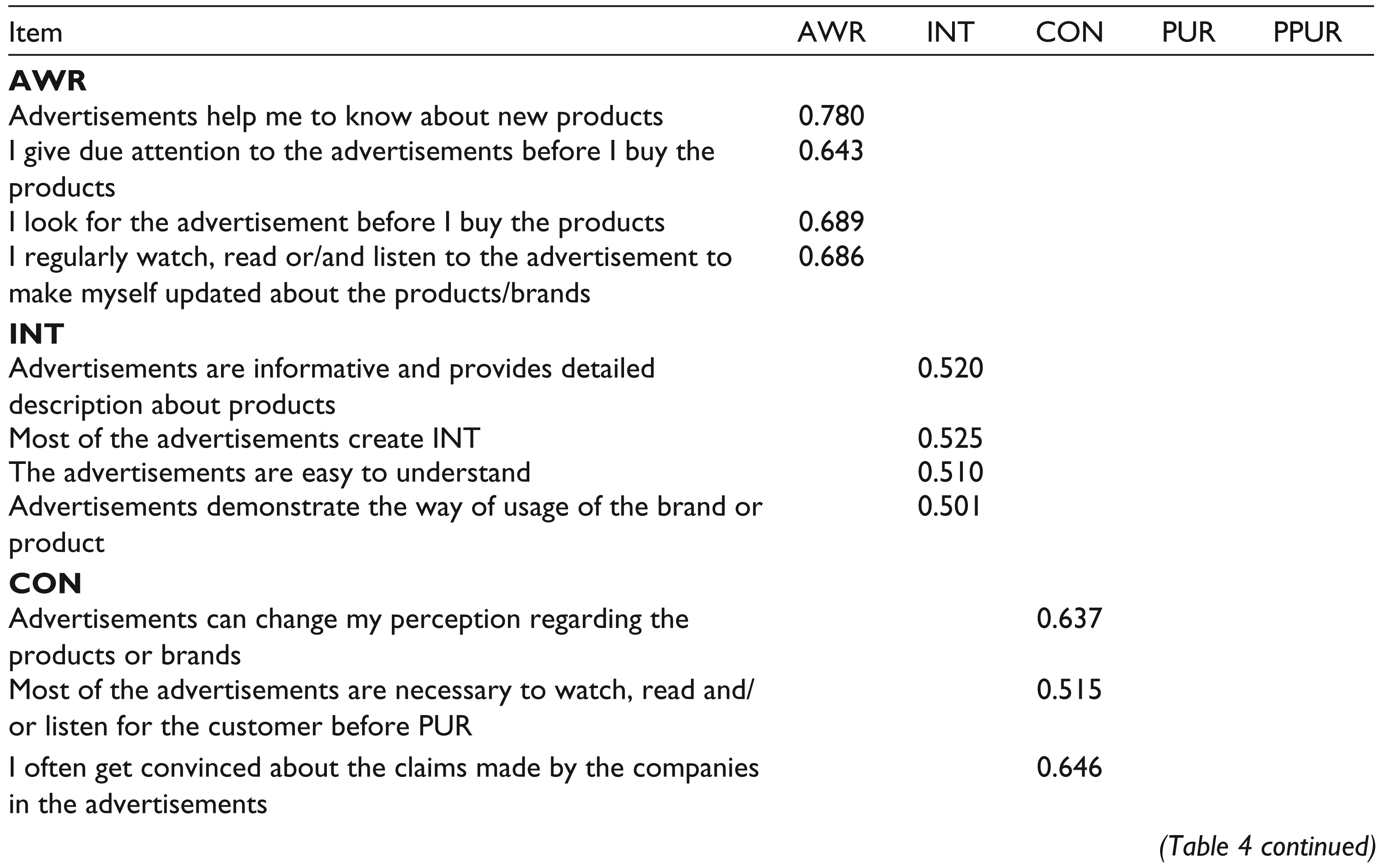
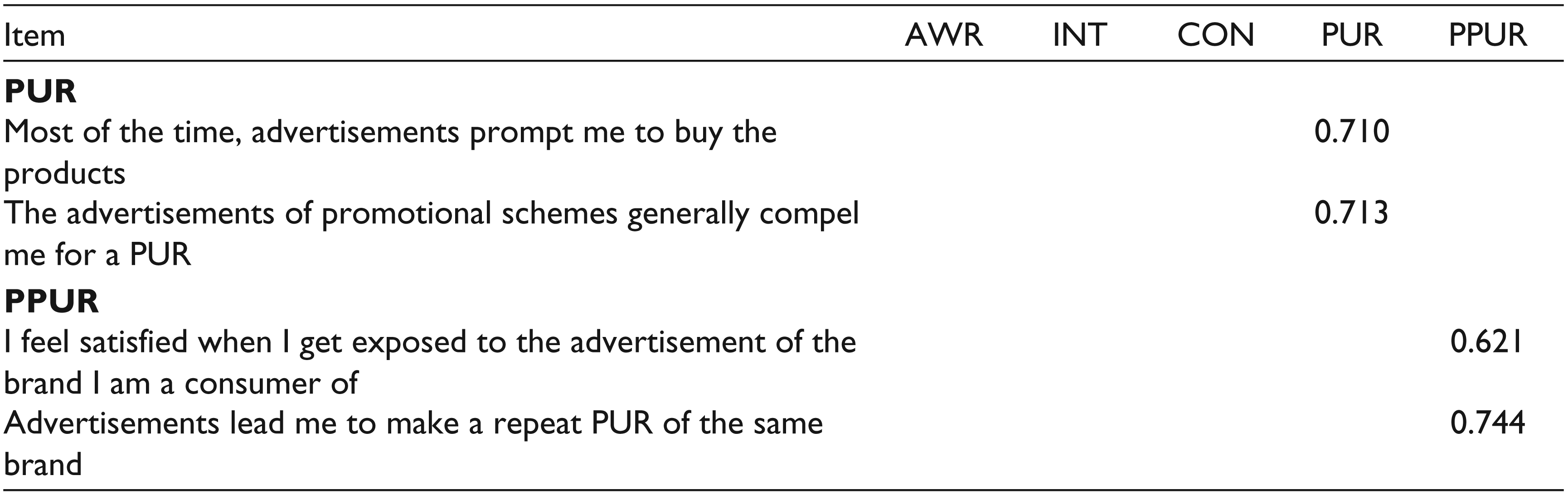
Factors were extracted by using the method of principal component analysis (PCA) and rotation method of varimax with Kaiser Normalization having eigenvalue more than one. The unrotated and rotated component matrix was executed. After rotation, the factor structure was improved. AWR, INT and CON were grouped as the pre-PUR stage, whereas the PUR and PPUR were grouped as PUR stage. The reliability analysis was performed. The Cronbach’s alpha value for both the factors was greater than 0.7. Normality test was executed for factor scores to check whether the scores are normally distributed. The Kolmogorov–Smirnov test and Shapiro–Wilk test were executed. The significance value was less than 0.05. The same is exhibited in Table 5. Thus, the factor scores are not normally distributed. Hence, nonparametric tests were used.
Tests of Normality

Hypotheses Testing (K–W test)
The results of the K–W test are exhibited in Table 3. For the utility of advertisements in TV, newspapers and Internet, the respective significant two-tailed values are 0.007, 0.044 and 0.010. This indicates that hypotheses H1, H3 and H5 are accepted. The corresponding values in the case of newspapers and magazines are 0.023 and 0.009, respectively. This indicates that hypotheses H8 and H9 are accepted.
KMO and Bartlett’s Test

Conclusion and Discussion
TV advertisement has a significant impact on AWR, INT and CON stages of CB. This validates hypothesis H1. This result is in sync with Ranjbarian et al. (2011), where the impact of TV advertisements on AIDA was tested. This result is also matched with the findings of Anjum, Irum, and Sultana (2015), Hoque, Ahmed and Fouji (2013), and Sanayei et al. (2013). If a marketer intends to give regular reminders to consumers, then TV is the best medium. For example, Hindustan Unilever (HUL) is spending a massive amount on TV advertisements to ensure high brand recall. However, radio advertisements did not have an impact on any of the stages of CB. This result validates hypothesis H2. This result is in line with the findings of Nysveen and Breivik (2005), where media impacts on advertisement effectiveness were tested. This explains low advertisement spend on radio as compared to TV, newspapers and Internet.
Newspaper advertisements have a significant impact on AWR, INT, CON, PUR and PPUR behaviour. This validates hypotheses H3 and H8. Additionally, due to habitual reading, newspaper advertisements affect CB across all the stages. These results matched with the results derived by Kakkad (2016). The results obtained from the Newspapers Association of American (2014) also support these findings where the effects of newspaper advertisements on pre-PUR and PURDEC were tested. The fact that newspaper advertisements significantly affect PURDEC is also endorsed by Nayak and Shah (2015). The majority of research work found that newspaper advertisements are more effective in influencing PURDEC. This research also established the significant influence of newspaper advertisements on PURDEC. This explains the popularity of newspapers among advertisers as one of the most preferred media after TV.
Moreover, magazines advertisements significantly affect PUR and PPUR behaviour. This validates hypothesis H9. This result is supported by findings of Havlena (2009), where it was observed that magazine advertisements affect all stages of the PUR funnel.
Internet advertisements affect AWR, INT and CON stages of consumers. This validates hypothesis H5. This result is in alignment with the results obtained by Ahmed (2017), where it was observed that online advertisements have more impact on pre-PUR stages as compared to the PUR and PPUR stages. This result is partially in agreement with the result obtained by Tang and Chan (2017), where they found that online media is used more for creating AWR and it did not have an impact on the PURDEC.
To conclude, the findings indicated that TV and Internet advertisements are affecting AWR, INT and CON stages of CB. Magazines are more effective in influencing PUR and PPUR stages of CB. However, radio advertisements did not affect any of the stages of CB. In contrast, newspapers are the only medium which affect all the stages of CB.
Implications for Theory and Practice
In the era of digital revolution, consumers are bombarded with hundreds of advertising messages. This brings the need for managers to design a media mix strategy, which will break through the chaos and create the necessary impact. When a medium is selected for showcasing advertising, it should be carefully chosen to ensure the achievement of the advertiser’s goals. Many research works have been carried out to test the impact of advertisements on CB. However, few research works were done out by considering five stages of CB. This is the unique contribution of this research to theory. Further, this research work also suggests that newspapers advertisement affects all the five stages of CB. Another significant contribution attained from this research is the result which states that magazines and newspapers are an important source of media, which affect the PUR and PPUR behaviour of consumers.
Brand managers allocate huge budgets for advertisements. In the light of the new norms laid by the Indian government, only 12 min of commercial time per hour will be permissible on TV for displaying advertisements. Hence, TVC costs have risen drastically (Trivedi, 2017b). In 2016, Patanjali showcased 1.14 million advertisements on different TV channels. The success of Patanjali in 3 years’ span itself reflects the importance of media selection and advertisement strategies (Laghate, 2017). This research provides insights to advertisers about the selection of various media in line with their advertising objectives of creating AWR, generating INT, instilling CON and influencing PUR and PPUR behaviour.
Scope of Future Research and Limitations
This research was conducted using an appropriate mix of Indian students pursuing graduation and post-graduation. This young cohort makes up 65 per cent of the Indian population and has a considerable stake in PURDEC. Similar research can be conducted for different age categories. In this research, the impact of advertisements on AWR, INT, CON, PUR and PPUR stages of CB was studied. Similar research can also be conducted considering other aspects of CB like product attributes, colour, taste, quality, ingredient to name a few. Future researchers can focus on each of the digital channels, namely, Facebook, Twitter, Google, and so on and suggest the most effective channel to influence consumers.
Declaration of Conflicting Interests
The author declared no potential conflicts of interest with respect to the research, authorship and/or publication of this article.
Funding
The author received no financial support for the research, authorship and/or publication of this article.