



Abstract
The goal of this article is to understand how the pro-environmental behaviour (PEB) of secondary school students can be encouraged. In an exploratory study, we examine to what extent pro-environmental cues—that is, ‘situational strength’ (Mischel, Psychological Review, 80(4):252, 1973)—were present in schools and whether students in ‘stronger’ situations reported higher levels of PEB than students in ‘weaker’ ones. Moreover, we examined relationships between student characteristics—gender, perceived behavioural control (PBC), pro-environmental attitudes (PEA) and intentions (Fishbein & Ajzen, Belief, attitudes, intention, and behavior. An introduction to theory and research. Reading, MA: Addison-Wesley, 1975)—and their PEB. A sequential mixed method was used, utilizing data from three Dutch secondary schools. Survey data covering 179 students showed relationships among students’ gender, PEA and intentions, and PEB. Qualitative data—derived from semi-structured interviews with staff members, structured assignments for students and observations—showed differences in situational strength between the schools. Moreover, the data suggest an interplay between student characteristics and situational strength in affecting PEB.
Keywords
Introduction
The past decades have witnessed an increase in studies on the role of education in fostering pro-environmental behaviour (PEB). Especially where it comes to influencing behaviour in the long term, there is the belief that learning situations are needed wherein students can develop capabilities to think critically, ethically and creatively about environmental issues and make informed decisions about how to cope with environmental problems (Wals, Brody, Dillon, & Stevenson, 2014).
However, lesson content is not the only thing shaping student attitudes and behaviour, the wider school environment can encourage or discourage students’ PEB as well (Mcmillin & Dyball, 2009). Studies should therefore also take a broader view of educational organizations and view them as situations or cultural environments where students live and learn (Ernst, Blood, & Beery, 2017). For instance, pro-environmental cues—such as projects throughout the curriculum oriented towards sustainability, environmentally friendly products in the canteen or water- and energy-saving practices in the school—can foster students’ PEB (e.g., Cincera & Krajhanzl, 2013). This reasoning is also present in theories on ‘whole-school approaches’ to behavioural management. According to the whole-school approach, interventions aimed at stimulating certain behaviours are only effective when these are not just a reflection of subjects and areas of learning, but when the educational institution as a whole (ranging from management behaviour and decisions to school building characteristics) is involved in encouraging target behaviour (e.g., Henderson & Tilbury, 2004; Pepper, 2013).
In order to increase our understanding of how exactly the school environment influences students’ PEB, we introduce the concept of ‘situational strength’, referring to the degree to which schools provide pro-environmental cues for creating relatively uniform expectancies concerning the desirability of PEB and, consequently, create a situation that its members (in our case, students and teachers) interpret in a similar way (cf. Mischel, 1973). A strong situation offers many cues related to desired behaviour and results in putting unambiguous psychological pressure on individuals to display said behaviour. One can—for instance—think of policies, practices and procedures within an organization or school that communicate what behaviour is expected. When—on the other hand—a situation is weak, there will be more ambiguity as to what behaviour is desired. This can, for instance, happen when policies and practices are not present—or are inconsistent with each other—resulting in the transmission of conflicting messages. In an explorative study among Dutch secondary school students, we examine whether students will display more PEB in case schools offer more consistent pro-environmental cues and thus create a strong situation wherein all actors receive ‘the message’ that PEB is expected and rewarded.
We know, however, that behaviour is not only influenced by environment but also by personal characteristics. More specifically, next to external factors (i.e., ‘situational strength’ in this study), Kollmuss and Agyeman (2002) identify two groups of personal factors that explain PEB, namely demographic and internal human factors. We have used this typology in our study and complemented the list with factors culled from later studies on PEB (e.g., Rioux, 2011), resulting in the inclusion of ‘gender’ (as a demographic factor) and ‘perceived behavioural control’ and ‘pro-environmental attitude and intentions’ (as internal human factors).
The central question of our study was formulated as: ‘To what extent and how is the pro-environmental behaviour of students related to the situational strength within their schools, their gender, PBC (perceived behavioural control), and PEA and intentions?’
Theoretical Background and Research Questions
Situational Strength and Pro-environmental Behaviour
Research has put forward two important ways to arrange a situation in order to facilitate adoption of PEB, namely lowering the costs of pro-environmental choices (Arbuthnott, 2009) and providing role models for students to observe and learn PEB from (Higgs & McMillan, 2006).
To start with the first, Diekmann and Preisendörfer (2003) argue that the lower the behavioural costs of PEB are, the easier it is for a person to actually engage in that particular behaviour. Behavioural costs do not only refer to the economic costs but also encompass broader costs, such as the effort and time put in and the inconvenience incurred by an individual acting in favour of the environment. Creating a low-cost situation in schools can, for instance, be achieved by decreasing the ‘task difficulty’ (e.g., by introducing more sustainable food alternatives for students in the school canteen—such as organic, vegetarian or local—or by providing separate waste bins) or by increasing the financial or social rewards of PEB (Handgraaf, de Jeude & Appelt, 2013).
With regard to the second strategy, literature has shown that schools can express their expectations when it comes to PEB by providing role models for students to observe and learn from (Higgs & McMillan, 2006). Role models represent social norms which prescribe specific behavioural options, and which continually guide students in their behaviour (Jackson, 2005). A social norm can be defined as a set of behavioural rules and standards that are shaped by members of a group (Cialdini & Trost, 1998) and are viewed as a powerful tool for the encouragement of PEB. For most individuals, following the majority decision is the most convenient and easy choice because most individuals don’t like to deviate from the social group.
Several studies have shown that exposing students to multiple role models can effectively shorten and improve learning processes (Higgs & McMillan, 2006). Apart from its teachers functioning as individual role models, schools as a whole can also be ostensible in decreasing their negative environmental impacts and increasing their social positive impact. Another way to express social norms regarding PEB is by disseminating messages: telling people about what many other people do. This can be achieved through ‘traditional media’, like advertisement and posters, and more modern communication- and information technologies, like social media.
Based on the above-mentioned theoretical considerations, our first research question reads:
R1: ‘Do students from schools with more pro-environmental cues present (i.e. stronger situations) display more pro-environmental behaviour (PEB) than students from schools that provide less pro-environmental cues?’
Student Characteristics and Pro-environmental Behaviour
Without pretending to provide a comprehensive pallet of both types of factors, we will elaborate here on a couple of demographic and internal human factors.
Demographic Factors
A recurrent demographic factor in PEB research among young people is gender. The underlying idea being that people who vary in terms of sex may have been exposed to different experiences and may consequently have formed different beliefs concerning PEB (Fishbein & Ajzen, 1975). However, research on the link between gender and PEB has yielded mixed results; some studies show women to be more environmentally aware than men, but other studies find no significant differences (see, for instance, De Leeuw, Valois, Ajzen, & Schmidt, 2015; Gifford, 2014). In a recent study, De Leeuw et al. do report statistically significant (although not very large) differences between male and female high-school students. Female students were shown to have slightly stronger intentions, more positive environmental attitudes and a slightly stronger feeling of moral obligation to behave ‘pro-environmentally’ (De Leeuw et al., 2015, pp. 133–134). No effects of sex on behaviour was found. Yet, given the diverging results of earlier studies regarding the influence of gender, we still chose to incorporate this factor in our analysis and formulated our second research question as:
R2: ‘To what degree will we find different levels of PEB among female students as opposed to male ones?’
Internal Human Factors
Many studies concerning PEB have found their basis in the Theory of Reasoned Action, later refined as the Theory of Planned Behaviour, as developed by Fishbein and Ajzen (1975) (see De Leeuw et al., 2015), which states that an individual’s behaviour can be predicted by means of their intention to engage in that particular behaviour. Intention can be further explained by the degree to which exhibiting the behaviour is viewed positively or negatively (i.e., attitude) and the belief that one is able to successfully execute the behaviour required to produce the valued outcome (i.e., PBC) on the one hand, and the social pressure one perceives related to performing that particular behaviour (the ‘subjective norm’) on the other. While the latter factor (subjective norm)—which we conceptualized and operationalized as situational strength—can be classified as being external, the first three factors can be seen to be internal.
The model is popular for its clarity and practical utility (e.g., De Leeuw et al., 2015) and is used as a conceptual model in several research areas, ranging from sustainability research and consumer studies to health psychology; it has, however, also attracted criticism over the course of time. For instance, some authors doubt whether people are indeed rational beings—as the theory seems to suggest—and call for studies on the unconscious influences of behaviour or emotion (e.g., Sheeran, Gollwitzer, & Bargh, 2013). Others, such as Sniehotta, Presseau and Araújo-Soares (2014), state that the theory lacks empirical underpinning. More specifically, experimental tests of the predictive power of the various factors and their interrelationships are scarce, and existing empirical studies have yielded mixed results concerning the effects of the different factors on behaviour (Sniehotta et al., 2014). For instance, De Leeuw et al. (2015) showed that perceived behavioral control had a strong effect on intentions, whereas the effect of attitude was small. While Blok, Wesselink, Studynka and Kemp (2015) also pointed to PBC as the most significant factor explaining the intention to act, they also found a strong positive effect of the attitude towards PEB. The relationships between the various components of the Theory of Reasoned Action appear complex therefore and may, to some extent, be context-specific. Whereas the study of De Leeuw and colleagues (2015) was carried out among high school students in Luxembourg, the study of Blok et al. (2015) was conducted among employees of a Dutch university. As proposed by others (e.g., Ernst et al., 2017), therefore, models tested on adults may yield different results when applied to youths.
In order to explore how the different factors relate to PEB among students in Dutch secondary schools, we formulated our third research question as:
R3: ‘To what extent will we find positive relationships between the pro- environmental attitude (PEA), perceived behavioral control (PBC) and pro-environmental intention (PEI) on the one hand and their pro-environmental behavior (PEB) on the other?’
The Interplay Between Student Characteristics and the Situational Strength of Schools
In our study, we are particularly interested in the moderating effect situational strength has on the relationship between the individual characteristics of students on the one hand, and their PEB on the other. Theory states that in strong situations, variances in perception of the meaning of the situation will be small among individuals and will reflect a common desired content, whereas, in weak situations, differences in perceptions will be large and will reflect individual characteristics (Schneider et al., 2002). Or, put in more extreme terms, in strong situations, individual differences do not matter, and individuals will act in a way promoted by the situation. In these cases, personal characteristics will less likely predict individual behaviour. Traffic lights are often used as an example of how strong situations can constrain personal factors in affecting behaviour (Cooper & Withey, 2009). The colour of the light is a better predictor of driver behaviour than differences in personality between drivers. While most people, whether daring or cautious, will stop in case of a red light, the course of action is less clear cut when confronted with a yellow traffic light. Sensation-seeking individuals are likely to speed through, whereas cautious individuals are likely to stop.

In order to examine whether we will find a similar effect in our study, we formulated the fourth research question as:
R4: ‘If relationships between demographic and internal human factors can be determined, are they stronger in “weak” or “strong” situations?’
Methods
Our study has an explorative character because we introduced a relatively new concept to PEB literature (situational strength). A sequential mixed method was used with both qualitative and quantitative methods for the purpose of better understanding (Ivankova, Creswell, & Stick, 2006). Data were gathered by means of a questionnaire and a structured group assignment for students, semi-structured interviews with staff teachers and a semi-structured observation of three secondary schools.
Dutch Secondary Schools as Study Context
Sustainability has only quite recently become a topic in Dutch educational policy. There are several indications that Education for Sustainable Development (ESD) is considered important. On an international level, for instance, Lotz-Sisitka (2015) launched the Global Action Plan for ESD. Through this plan, the UN aims to supply every person with the knowledge, skills, attitudes and values to enable him or her to contribute to a sustainable society. There were also several initiatives to promote ESD on a national level. One important example is ‘Learning for Sustainable Development’ (Leren voor Duurzame Ontwikkeling), the predecessor of the current ‘Duurzaam door’ (‘sustainability continued’). These programmes pay special attention to curriculum and teacher development with regard to sustainability. Through the so-called Motie Ouwehand, a parliamentary motion which was enshrined in law by the Dutch government in 2014, resources have been made available to promote sustainability in educational settings. This law has led to increased awareness of the topic’s importance among the diverse actors within the educational system, such as school principals, teachers, consultants and scientists. The central tenet being that students (from primary education on up) should develop the skills to critically reflect on their environmental impact, and that they should learn to analyse the problems and develop solutions; the focus, therefore, goes ‘beyond knowledge’. At this point in time, however, only a small number of schools have actually incorporated the topic of sustainability into their programme in this way, ranging from 4 per cent of primary schools to 11 per cent of universities (Heideveld, 2015). Moreover, only 9 per cent of the schools could be regarded as being ‘sustainable’ (Heideveld, 2015). The definition of a ‘sustainable school’ is an ambitious one. It is not just about teaching students what sustainability is and what solutions there are for particular sustainability problems but also ‘systems thinking’ as a precondition for understanding the complex and holistic nature of sustainability problems and the different value systems at issue that need to be reconciled; so there is quite a lot of room for improvement in this particular sector.
In the Netherlands, children are admitted to a secondary school when they are around 12 years of age (OECD, 2018). There are three types of secondary education: (a) four years of pre-vocational secondary education (VMBO); (2) five years of higher general secondary education (HAVO); and (3) six years of pre-university education (VWO). Most secondary schools combine some or all of these three types of education in order to easily facilitate the transfer of pupils from one type to another (OECD, 2008). Our study included lower (years 1–3; 12–14 years old) and higher (years 4–6; 15–18 years old) classes from HAVO and VWO of all three schools.
Procedure
We purposefully selected two schools running the so-called Eco-school Programme. The Eco-school programme is the largest sustainable school programme in the world with a mission to: ‘empower students to be the change our sustainable world needs by engaging them in fun, action-orientated learning’ (Pauw & Petegem, 2013; Cincera & Krajhanzl, 2013; Eco-Schools, 2014,
In total, nine schools that were part of the Eco-school programme were invited by email to participate in this study. Only two schools responded to this request (School B and C). School B was certified by Eco-schools with a bronze flag, while School C was granted a white flag. In order to have variance in the situational strength of the schools under scrutiny, we also contacted a school outside the list of Eco-schools (School A) through someone in the network of one of the authors. We assumed that Eco-certificated schools would provide more pro-environmental cues than others—and that therefore their situational strength would be higher—and therefore we considered School A a reference school.
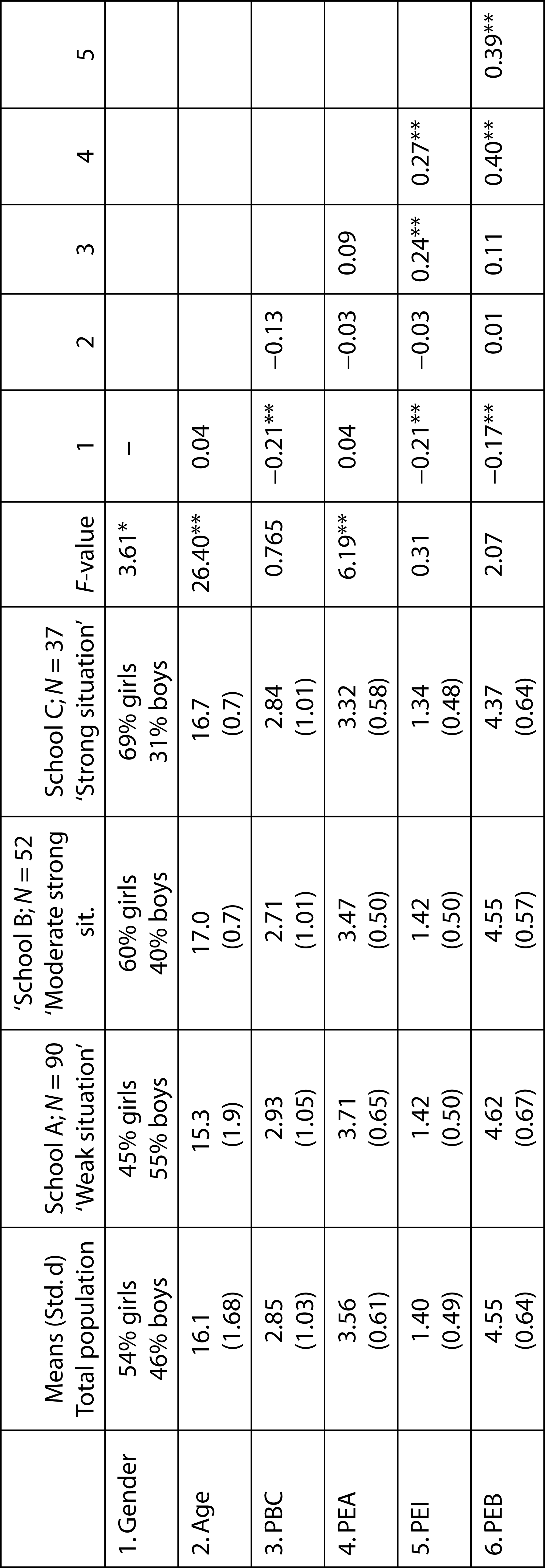
At each school, our contact person assigned us two to five classes of senior general secondary education (HAVO) or pre-university education (VWO). More specifically, a total of 179 students participated: 90 students from School A; 52 students from School B; and 37 students from School C. All were between the ages of 12 and 19, 54 per cent (96) of them girls and 46 per cent (81) boys, which is representative for the Dutch student population as a whole (CBS, 2014). The students of School A (mean age 15.3) were significantly younger and more often girls than those in School B and C (mean age 17 and 16.7, respectively) (see Table 2). The contact persons at each school introduced us to three staff members for the interviews. More specifically, they were as follows: the principal and two biology teachers of School A; a location manager and two biology teachers of School B; and the facility manager and two biology teachers, one of whom coordinated the Eco-school project, of School C.
Instruments
Pro-environmental behaviour
Pro-environmental behaviour (PEB) was measured by six items, aiming to capture PEB-performance at home as well as during school hours. The distinctions between purchasing decisions, habits and recycling (Gilg, Barr, & Ford, 2005) served as a starting point. We reworded items by Gilg et al. (2005) in order to make them relevant for students (e.g., the item on buying organic food was reworded as: ‘In the school canteen, I consciously choose organic food’). We initially reformulated ten items and then conducted a principal component factor analysis; only the items that loaded solely on the first factor were included. The reliability of the scale with the six items remaining (see Appendix A) was satisfactory (Cronbach’s alpha = 0.74).
Situational Strength
The three schools were compared on four aspects: the task difficulty of PEB, the use of teachers as role models, the ecological footprint of the school and the messages in and around the school promoting sustainability. Several techniques were used. First, three staff members of each school were interviewed on the basis of a semi-structured interview guide. The central questions were: ‘To what degree does the school stimulate pro-environmental behaviour inside and outside classes?’; ‘What do you think the ecological footprint of your school is?’; and ‘To what extent do you think that pro-environmental behaviour should be an integral part of the curriculum?’. Further sub-questions where then asked, depending on the answers given. For instance, after the last of the questions quoted just now, we asked interviewees to provide examples of how exactly PEB should be implemented. Interviews lasted between 15 and 20 minutes and were conducted during school breaks and the break hours of the staff members surveyed. The interviews were carried out in Dutch and were recorded with permission from the participants and transcribed and analysed at a later stage.
Second, students from each school carried out a group assignment in subgroups of three to five students; the researcher was given time during regular classes. The questions that students had to answer were: ‘In what way does your school stimulate pro-environmental behaviour?’ and ‘What more could your school do to stimulate pro-environmental behaviour?’
Third, in order to examine the task difficulty in the schools, the buildings, the school guide and websites were examined using a semi-structured observation guide that contained items regarding ecological footprint, communications on sustainability and the school canteen.
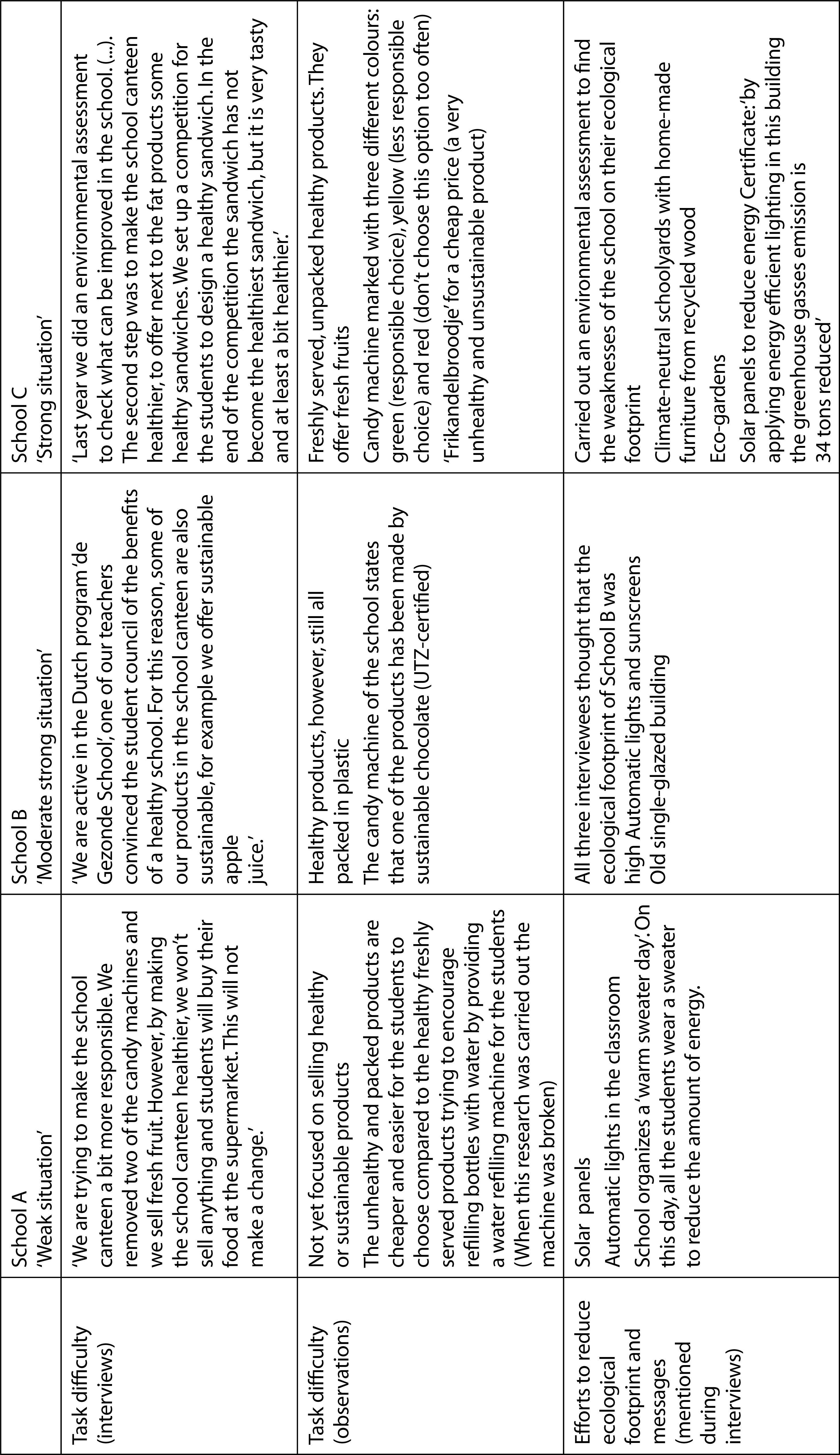
Table 1 gives a summary of a large data matrix we developed and wherein we listed which pro-environmental cues were detected with each technique for every school.
Situational Strength in Schools A, B and C

Demographic Factors
Gender was measured with one item; in the data analyses, we used the following codes: 1 = female, 2 = male. Age was included as a control variable and was measured by asking students their age.
Internal Human Factors
PEA was measured by five items (see Appendix A) culled from the 15-item questionnaire of the International Institute for Sustainable Development (Creech, McDonald, & Kahlke, 2009). We could not include the whole questionnaire, given the time available to the students; hence, we chose those items that corresponded most with their experiences. Items were measured with a 5-point Likert scale. The reliability of these items was satisfactory (Cronbach’s alpha = 0.73).
PEI was measured with a self-developed item which asked students to express their intentions by being posed with a dilemma: ‘1 million seabirds die each year on account of the plastic soup in the ocean while producing half a kilogram of plastic requires 10 litres of water and emits 3.5 kg CO2. If you could buy an environmentally friendly reusable and recycled bottle of water for twelve euros, would you buy it?’ (1 = yes, sustainable option, 2 = no, unsustainable option).
PBC was measured with one item (‘It is difficult for someone like me to influence the environment’), which could be answered by means of a 5-point Likert scale and was derived from the International Social Survey Program (Franzen, 2003).
Data Analysis
In order to examine whether students from schools with more pro-environmental cues present display more PEB than students from schools that provide less pro-environmental cues, schools were ranked first according to the degree of situational strength. This was done in a narrative way, meaning we enumerated the pro-environmental cues cropping up during interviews, group assignments and observations and labelled the school with the most cues as ‘strong’, the school with the least cues as ‘weak’ and the one in between as ‘moderate’. After that, an analysis of variance (ANOVA) analysis with PEB as dependent variable and school as independent variable was carried out.
IBM SPSS Statistic 20 was used for analysing the quantitative data: correlations analyses and regression analyses—with PEB as dependent variable—were carried out in order to examine to what degree different levels of PEB among female students as opposed to male ones existed and to what extent the PEA, PBC and PEI of students on the one hand and their pro-environmental behaviour (PEB) on the other related positively to each other.
Given the exploratory nature of our study, we chose to enter the variables into the regression analysis step by step. Through this procedure, we could see how and/or whether a new variable entering the equation sorted an effect. The order in which the variables were entered was based on the following logic: age and gender are fixed, and often used as control variables, so as such were entered first. The Theory of reasoned action (TRA) suggests furthermore that behaviour is explained by intention, which in turn can be explained by attitude and, in turn, by PBC (see, for instance, De Leeuw et al., 2015). The order in which the variables were entered therefore follows the order in which the theoretical models present them.
Finally, in order to detect differences in the existence or strength of relationships among study variables in the different situations, the correlation and regression analyses were done for each school separately.
Results
Situational Strength in the Three School and Students’ Pre-environmental Behaviour
Table 1 shows the differences between the three schools. With regard to task difficulty, it could be stated that both schools B and C offer and promote more healthy and sustainable foodstuffs in the canteen when compared to School A. School C’s canteen policy is focused more on sustainability, while the policy of School B’s canteen focuses more on health. Aside from the availability of foodstuffs in the school canteen, it is important to highlight that School A was trying to encourage PEB by offering a water refilling system.
School C appeared very active in reducing the school’s ecological footprint; it featured, for instance, climate-neutral schoolyards with furniture home made from recycled wood. Both students and interviewees mentioned that their school was an official Eco-school, and that reducing the ecological footprint was one of the steps needed to be acknowledged as one. School B was less active in decreasing the ecological footprint, as most of the students and interviewees were only able to mention the healthy food options at the canteen. One group of students even mentioned that the school did not do anything to encourage PEB. School A appeared least active in reducing the ecological footprint. It organizes a ‘warm sweater day’ yearly, but nine groups of students of School A mentioned that it did not do anything to reduce its Ecological footprint. Finally, School C was very active in communicating on sustainability compared to schools A and B. It was also the only school to pay attention to the topic of sustainability on their website.
In summary, none of the three schools had created a very strong situation regarding PEB because none of them paid attention to sustainability in their school guide; moreover, sustainability was not yet integrated within their curricula. However, when comparing the three schools, School C seemed to have the strongest situation of the three schools. The school had started the Eco-school programme recently, which reflected in their ‘white flag’. The school was active in promoting sustainability by offering students voluntary projects related to it and by reducing their ecological footprint; they made a good start by implementing sustainability in their policy. The other two schools were less active in promoting sustainability. More specifically, these schools only occasionally and often even unconsciously helped students choose the most environmentally friendly option.
Table 2 shows that higher PEB scores were found in the weakest situation (M = 4.62 on a 5-point scale) and lower scores in the strongest situation (M = 4.37). The differences were, however, not significant, so we will have to treat this result with caution.
Table 2 shows the means and standard deviations and correlation of all variables for the whole group. School A’s students reported the most PEA. Regarding demographic factors, girls reported more PBC (r = −0.21, p <0.01), PEI (r = −0.21, p <0.01) and PEB (r = −0.17, p <0.01) than boys. The control variable ‘age’ was not related to study variables. Regarding the internal human factors, PBC was only correlated to PEI (r = 0.24, p <0.01). PEI, PEA and PEB were all positively linked to each other.
Means and Standard Deviations of Study Variables of the Whole Group of Students and per School; Correlations Between Study Variables of the Whole Group of Students
Gender and Pro-environmental Behaviour
Regression analysis with the whole data set (N = 179 students, see Table 4) showed that girls reported more PEB than boys. However, the initial positive relationship between gender and PEB (β = −0.16, p <0.10) disappeared after the other variables (PBC, PEA and PEI) entered the equation (β = −0.12, ns).
Internal Human Factors and Pro-environmental Behaviour
PBC was not related to PEB (β = 0.03, ns), whereas positive relationships were found between PEA and PEB (β = 0.32, p <0.01), and between PEI and PEB (β = 0.25, p <0.01).
Situational Strength as Moderator
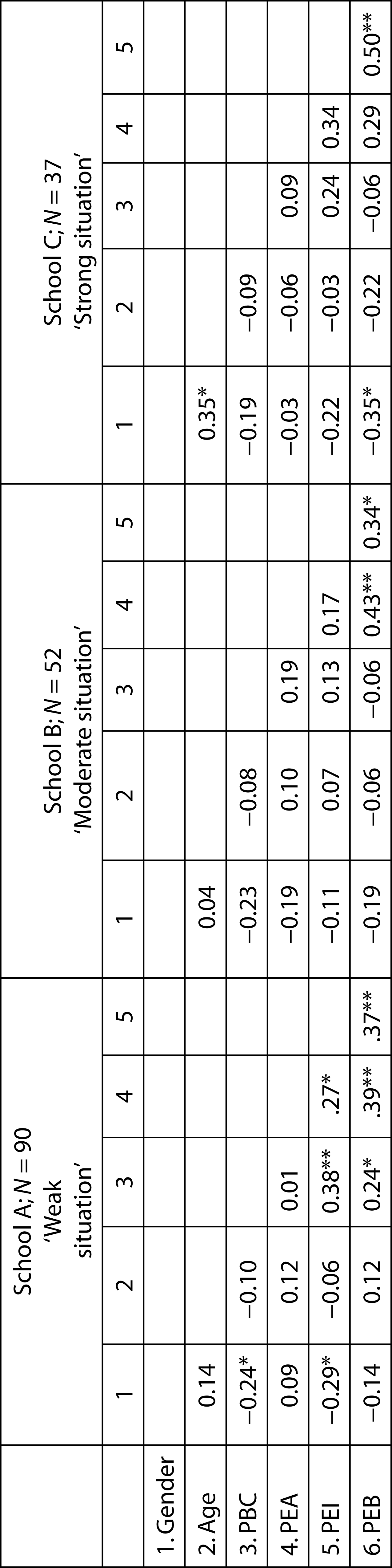
Table 3 shows that correlations among study variables differed across the schools. For instance, while demographic factors were not at all related to PEB in schools A and B, gender did relate to PEB in School C (the strongest situation in our sample). Moreover, while all internal human factors appeared to be related to PEB in the school with the weakest situation (School A), at school C this was only the case for behavioural intentions.
Correlations Between Study Variables per School
Regression analyses also differed across the schools (see Table 4) albeit not quite in the expected way. More specifically, we found a positive relationship between PBC and PEB (β = 0.23, p < 0.05) in the weakest situation. This effect disappeared, however, after PEA entered the equation (β = 0.17, ns). PEA appeared to be positively related to PEB (β = 41, p < 0.01), and this effect was sustained after the inclusion of behavioural intention into the analysis (β = 0.36, p < 0.01); the latter variable (intention) was not associated to PEB here.
Results of Linear Regression Analysis for the Whole Group of Students and Students of Each School with Pro-environmental Behaviour as Dependent Variable
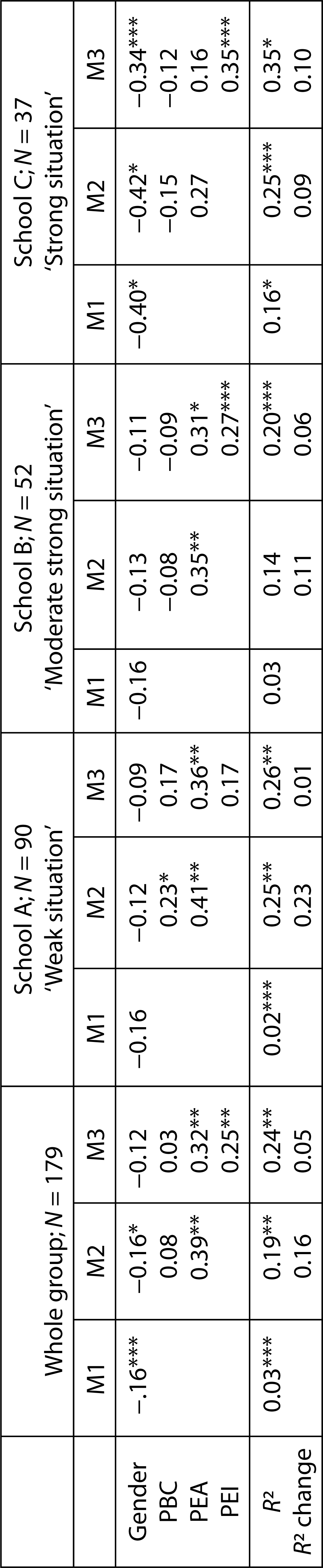
In the strongest situation (School C), we found a positive relationship between gender and PEB (β = −0.41, p < 0.01), but this effect decreased after inclusion of behavioural intention (β = −0.34, p < 0.10). The latter variable (intention) was associated to PEB, albeit that the significance was marginal (β = 0.35, p < 0.10).
In School B, which was classified as offering a moderately strong situation, we detected a positive relationship between PEA and PEB (β = 0.35, p < 0.05), and this effect was sustained after behavioural intention entered the equation (β = 0.31, p < 0.05). Behavioural intention was positively associated with PEB, although the effect here also seemed marginally significant (β = 0.27, p < 0.10).
Discussion and Conclusions
The goal of our pilot study was to increase our understanding of how the wider school environment can influence students’ PEB by examining the relationship between ‘situational strength’ within three secondary schools and the PEB its pupils displayed. Furthermore, we explored whether the degree of situational strength affects relationships between student characteristics (in terms of demographic and internal human factors) and PEB.
We can conclude that the schools that participated in our study differed in the degree to which they created uniform expectancies concerning PEB. However, against our expectations, for theories on situational strength suggest that individual differences influence behaviour when situations are weak (Mischel, 1973), we did not find higher levels of PEB in the school that created the strongest situation (in terms of providing the most pro-environmental cues) compared to the school that created the weakest one. We did, however, find differential effects of gender and internal human factors on PEB across situations.
We can conclude that girls showed more PEB than boys, albeit that this effect disappeared after other variables were taken into account. Moreover, the strongest effects were found in the school that created the strongest situation. Can it be that girls are more inclined to engage in line with what the school communicates as being the desired behaviour? We cannot test this assumption, but it would be interesting to dig deeper into this question in future studies.
Regarding the role of internal human factors, we can conclude that PBC did not affect PEB in our samples. In line with what theories on situational strength suggest, we found an effect (albeit weak) in the weakest situation (i.e., few pro-environmental cues present in the school).
Moreover, we can state that PEA was strongly related to PEB. In line with former findings, this effect was present in the weakest and moderate situations and absent in the strongest one.
Finally, with regard to PEI, we found a positive relationship with PEB but only in the moderate and strong situations. This was once again not what was expected. How and why different factors play a role in translating intention into behaviour in these kinds of situations apparently need further examination.
An additional finding was that participation in Eco-school programmes, even gaining flags, did not guarantee schools actually creating strong situations. Because related studies partly arrive at different conclusions regarding the impact of Eco-school programmes on PEB (compare, e.g., Boeve-de Pauw et al., 2013; Cincera & Krajhanzl, 2013), we surmise that the precise way in which schools give shape to their Eco-school programmes is important; the devil is in the details.
Reflection on Methods and Suggestions for Future Studies
As mentioned, our study was a first attempt to explore the role of situational strength in stimulating students’ PEB. Reflecting on the ways in which we designed our study, we come up with several suggestions for future studies.
First, as mentioned a few times throughout this article, we didn’t set out to be complete but rather to focus on several personal and situational characteristics which enabled us to examine their interplay. Therefore, we selected a limited set of personal variables where numerous other types of variables could have played a role as well (Bamberg & Möser, 2007). Second, we acknowledge some limitation related to the measurements of our dependent and independent variables. The instruments we used in the student survey were (partly) self-developed, as we wanted to assure that the questions we asked would relate to student experiences. Furthermore, while we measured PEA as a general attitude towards environmental issues, we could also have chosen more specific measures targeted at certain environmental issues. As mentioned in earlier research, the specificity of items influences results (Bamberg et al., 2007). Moreover, we decided to develop items ourselves as to make the questionnaire no longer than necessary (to avoid incomplete responses due to fatigue effects). However, we acknowledge that there are more detailed instruments for measuring PBC (e.g., the Environmental Action Control instrument developed by Smith-Sebasto and Fortner (1994), but, finally, we measured PEI and PBC with one single item. Hence, for future studies, we therefore recommend more attention be paid to the psychometric quality of the measuring instruments.
Third, we focused on the higher levels of the educational system, while the majority of secondary school pupils are educated at lower levels (i.e., vocational education). Moreover, it might well be that younger pupils (i.e., primary school children) react to environmental cues in different ways than the ones we included. It would therefore be interesting to examine whether our results hold true in these kinds of environments as well. What is more, while several schools were asked to participate in our study, we only received responses from schools already awarded with flags. Although our research suggest that these flags do not guarantee actual implementation of pro-environmental practices, our data may be biased due to self-selection. Future studies should find ways to include more and a greater variety of schools in their design. This would also enable more sophisticated data analyses than the correlation, regression and ANOVA analyses we had to rely on.
Fourth, concerning the measurement of situational strength, we realize that we focused on a limited set of aspects; like the availability of certain foodstuffs in the school or the presence of messages about sustainability in and around the schools. Although we have used a mix of methods (like interviews and observations) and included multiple actors’ perceptions (staff members, students and ourselves as researchers) as a means to triangulate the data, we suggest that future studies should dig deeper into the operationalization of situational strength and also into finding ways to determine the levels of said strength. Maybe a numerical scale can be constructed with which strength can be measured.
In sum, although the data we gathered suggest differences exist in relationships between student characteristics and their PEB across situations, we cannot draw hard conclusions regarding how these relationships differ. However, again, we believe that theories on situational strength have the potential of increasing our understanding of how student characteristics interact with environmental cues in explaining students’ PEB. We therefore hope that our study serves as an inspiration for further studies in this field.
Theoretical Reflections
The role of education in fostering people’s PEB is a recurring topic in educational research. An important stream of research is focused on how students can develop the capabilities for the critical analysis of environmental problems and creatively develop ways of coping with them. However, student attitudes and behaviour are not just influenced by the content and shape of lessons, but by the wider school environment as well. By introducing the concept of situational strength, we have met the call for more studies, incorporating an analysis of the school as a setting or cultural environment which shapes student behaviour through interactions with adults and each other.
Moreover, we conclude that the relationships between the variables we analysed in this article are more complex than theory—such as the Theory of Reasoned Action—suggests and are probably context-specific to some extent. While the concept of situational strength has increased our understanding of how context can play a role in affecting PEB, further examination is needed on which specific contextual variables are involved. In this respect, it could prove worthwhile to integrate theories on situational strength with theoretical frameworks that pay specific attention to the interplay between contextual and personal factors—like the Reasonable Person Model (Kaplan & Kaplan, 2009). This model integrates environmental factors on the one hand, and human cognition and emotions on the other with an eye to explaining people’s reasonable behaviour and, as such, moves beyond the more rationalistic models prevalent in economic thinking, like the TRA.
Footnotes
Declaration of Conflicting Interests
The authors declared no potential conflicts of interest with respect to the research, authorship and/or publication of this article.
Funding
The authors received no financial support for the research, authorship and/or publication of this article.