



Abstract
Abstract
Purpose: This article analyses the effect of board diversity on the financial performance of non-financial firms listed in the Nifty Index. Specifically, it examines the mediation effect of the promoter’s presence and multiple directorships on the financial performance of the firm, that is, return on net worth (RONW), return on equity (ROE) and its sales growth.
Methodology: The article uses the hierarchical regression model to analyse the effect of board diversity on financial performance. The presence of the promoters on the board and multiple directorships are taken as the control variables.
Findings: Empirical results show the significant effect of the promoter’s presence on the board on the firm’s earnings and a significant positive effect of firm age, board size, age diversity and experience diversity on the financial performance. However, we do not find any statistically significant relationship between firm size and financial performance in any model. The results also show that the age and experience of the female directors are significantly less compared to the male directors. However, the age and experience of the non-executive directors and independent directors are found to be higher among the other positions held by the directors. We also find a negative relationship between multiple directorships in other firms and the financial performance of the firm.
Value: The article proposes that there should be a greater number of independent directors in a firm that has its promoter on the board. One recommendation for the board is to reduce the number of directorships held in other boards to ensure more constructive contribution towards the firm’s financial performance. The article studies the effect of the promoter’s presence on the board and multiple directorships held by board members on the financial performance of the firm.
Keywords
Introduction
The aim of this study is to understand the effect of board diversity and the presence of the promoter on a firm’s financial performance.
Many developed and developing countries have framed laws for corporate governance to prevent corporate frauds and significantly increase the possibilities of a firm’s success and growth (Hay, Verdin, & Williamson, 1993). The relationship between multiple directors, which refers to the number of external appointments held by a firm’s directors, and the impact this has on its performance has attracted much research attention in the context of corporate governance. Multiple directorships seem to suggest the inability of directors to meaningfully contribute to the success of a firm given that their commitment is stretched to multiple boards (Core, Holthausen, and Larcker 1999. This implies they are unable to give focussed attention to a single firm. On the contrary, some literature endorses multiple directorships and perceives it as the ability of the directors to work on multiple boards. Therefore, multiple directorships positively impact a firm’s performance (Fama & Jensen, 1983; Ferris, Jagannathan, & Pritchard, 2003).
Many stakeholders have raised their concerns over multiple directorships in multiple boards. Multiple directorships can be attributed to limited talent pool and board diversity. Poor board attendance by these directors can translate into less contribution to a firm’s board activities. On the other hand, multiple directorships can offer valuable access to professional networks and resources (Mans-Kemp, Viviers, & Collins, 2018). Cashman, Gilan, and Jun (2012) disagree on the association of the so-called multiple directorships and firm performance. They claim that multiple directorships confirm directors’ ability to enhance value in the multiple firms.
Researchers have analysed the relationship between board diversity and firm performance for several Fortune 1000 firms. This study controls for factors such as industry, size and other corporate governance measures and finds a significant positive relationship that exists between the presence of women on the board of a firm and its performance. An inverse relationship is found between the percentage of women and the average age of the board (Carter et al., 2003). It is observed that research on the impact of board diversity on the performance of a firm is largely concentrated on studying the direct relationship between demographic diversity and performance (Miller & Triana, 2009), with special focus on the mediation effect of board diversity on performance, that is, firm reputation and innovation. Miller and Triana (2009) point to a positive relationship that exists between firm performance and its reputation and innovation. Reputation and innovation partially mediate the relationship between firm performance and board diversity.
The Council of Institutional Investors has mandated against the appointment of full-time directors on more than two boards, while the National Association of Corporate Directors suggests three or four directorships. However, Demise (2006) suggests that limits on the directorships are not advisable. There is some evidence to support that busy outside directors affect firm performance. It is seen that boards with high multiple directorships have lower market-to-market ratios and operating profitability. The possibility of CEO turnover to performance tends to be lower when the outside directors have multiple board seats (Fich & Shivdasani, 2012). In India, recently, Kotak Committee gave some recommendation to improve corporate governance practices. It recommended a minimum of six directors on board, an independent woman director and a maximum number of directorships to seven. The committee also proposed specific limits to multiple directorships to deal with the perceived issue of overboardness (Shekhar & Krishnan, 2018).
The central idea of strategic management is to study the effect of executives and strategies on the performance of a firm. Literature supports the executive development interventions in the firms to increase their financial performance. Hambrick (2007) studies how the top management team of a firm impacts its performance. The study uses the ‘upper echelons perspective’ to detail the characteristics present in the top management team. It finds that executive background characteristics can predict the performance and the strategic choice of a firm. This new perspective has shifted focus to demographic-based research. But the results and findings have been limited and sometimes contradictory (Hambrick, 2007).
Over the past few decades, several research studies have focussed their attention on investigating the relationship between multiple directorships and firm performance with specific attention to developed countries. However, the findings till date are indecisive and inconsistent. This study tries to resolve these inconsistent perspectives by evaluating existing knowledge and based on that, developing a new model that takes into account the effect of board diversity and firm characteristics (Hunton & Rose, 2008). Corporate governance defines and puts in place structure, processes and mechanisms to enhance long-term shareholder value and improve operational performance in accordance to the firm’s core values (Velnampy, 2013). Thus, it is the purpose of good governance to maximise the profitability and value of the firm. Velnampy (2013) considers poor management, product failure, inadequate finance and weak management as the reasons for failure of a venture. The study proposes a new set of reasons for the success or failure of a venture, that is, a frequency of product purchase, service requirements, buyer fragmentation, supplier fragmentation and labour intensity.
Literature Review
Board Diversity
Various research methods have shown the significant impact that board diversity has on the strategic change constraint. An association is found between higher levels of board size/diversity and optimal institutional/governance performance of boards. Board diversity also affects the ability of the board to make strategic decisions in a turbulent business environment (Goodstein, Gautam, & Boeker, 1994; Jackling & Johl, 2009). There is no significant effect of demographic diversity on the measures of cognitive diversity (Kilduff, Angelmar, & Mehra, 2000). Many studies have also identified a relationship between a board’s demographic diversity and the firm’s financial performance. Board diversity is positively associated with selected financial indicators (Erhardt, Werbel, & Shrader, 2003).
The behavioural integration of the top management plays an integral role in facilitating the performance of small and medium-sized firms (Lubatkin, Simsek, Ling, & Veiga, 2006). The demographic characteristics of the top management team influence its information processing abilities (Amason, Shrader, & Tompson, 2006). Findings also show that diversity of experience impacts agenda setting and how firms generate alternatives, but do not affect the speed of decision-making. Personality factors such as flexibility, achievement motivation, networking abilities and action orientation seem to have a clearer impact on the decision speed (Kauer, Prinzessin Waldeck, & Schuffer, 2007).
Gender diversity also impacts the quality of the monitoring role performed by the board and the firm’s financial performance. The subject of board diversity has garnered much research interest in the recent era. Research in this area includes data from the USA. Greater gender diversity leads to greater economic gains (Campbell & Mínguez-Vera, 2008; Dwyer, Richard, & Chadwick, 2003). The study of existing literature points to the relationship between functional top management team and its dominant relationships, variables of interests and contributions (Menz, 2012). There is a positive impact of larger board size and attendance on firm performance; however, the presence of an independent director and the number of the board meetings held do not show any influence on financial performance (Bhatt & Bhattacharya, 2015). Gender diversity positively impacts a firm’s performance, leading to financial gains without destroying shareholder value. A firm should therefore ensure a right mix of male and female directors, instead of just ensuring the presence of at least one woman on the board (Carter et al., 2010; Gordini & Rancati, 2017).
Multiple Directorships
The evidence on the relationship between multiple directorships and the performance of a firm is varied. Fama and Jensen (1983) find that multiple directorships positively impact the monitoring ability of the directors and stand testimony to their ability to monitor multiple boards (Brown & Maloney, 1999; Cotter, Shivdasani, & Zenner, 1997). Kang and Shivdasani (1995) find that the directors with more directorships become the target of a hostile takeover attempt. Consistent with this view, Ferris et al. (2003) find that firms perform better where their directors hold multiple appointments on diverse boards. Ferris et al. (2003) find that firms give higher returns when they announce the appointment of directors with multiple board seats. In contrast to this view, Fich and Shivdasani (2012) find a higher return when a director with more multiple directorships leaves the board. Several researchers have investigated the impact of multiple directorships on board meeting attendance. Directors with multiple board seats are seen to have a higher degree of absence in board meetings (Jiraporn, Davidson, DaDalt, & Ning, 2009). The directors become overcommitted, therefore, they are more likely to miss board meetings.
Studies find that outside directors with multiple directorships (busyness) negatively impact the performance of a firm, that is, multiple directorships do not help in terms of enhancement of resources’ accessibility and networks (Jackling & Johl, 2009). Multiple directorships affect a firm’s performance positively but not significantly. Moreover, the presence of ex-government officials and founder on the board is seen to positively impact the performance of a firm (Abdul Latif, Kamardin, Mohd, & CheAdam, 2013). Some research does not support the detrimental effect of powerful CEOs on firm performance (Chen, Lai, & Chen, 2015).
Leaderships (Presence of Promoter/s)
Norburn and Birley (1988) do not testify to any significant differences in the characteristics of managers within high-performing firms and poor performing firms. The diverse study illuminates the significant impact that the top management team has on the performance of a firm (Pitcher & Smith, 2001). The authors analyse the changes in the top management team over time and their impact on firm performance. Other studies (Demsetz & Villalonga, 2001) find no trace of any relationship that exists between a firm’s ownership structure and its financial performance. In fact, market mediates the effect of ownership structure and performance of the firm. Boone and Hendriks (2009) analyse the moderation effect of leadership on the financial performance of the firm.
Research does not testify to any significant impact of multiple directorships on the strategic decision-making of executives. Findings reveal that demography of the top management team is indirectly related to performance through a process that directly relates to performance (Homberg & Bui, 2013). There is no evidence to suggest that a higher number of independent directors, larger firm size or higher institutional ownership impact firm performance. The controlling promoter’s presence on a firm’s board has a considerable negative association with its financial performance (Jameson, Prevost, & Puthenpurackal, 2014). Many family-owned firms in India have either the promoter or/and family members on the board. However, their presence is not seen to have any significant impact on the financial performance of the firm. Moreover, the boards with a promoter and his/her family members bring less diversity to the board (Carter, Simkins, & Simpson, 2003; Das & Dey, 2016). Madan Mohan and Muthu (2016) find that the board ownership and duality significantly affect return on assets of these family-owned Indian firms.
Based on literature review, we realise the need to analyse the effect of the promoter’s presence and multiple directorships (busy directors) on the financial performance of the firm. Some prior studies have considered the effect of board diversity and multiple directorships and the impact this has on the firm performance. Moreover, in the context of Indian firms, the role of promoter directors becomes very pivotal in its success. A major chunk of the research on board diversity and firm performance has focussed attention on studying the direct relationship that exists between board characteristics and firm performance (Miller & Triana, 2009). To the best of our knowledge, no prior study has examined the mediation effect of promoter’s presence and multiple directorships on the financial performance of a firm. The present study reveals the genuine effect of board diversity, promoter’s presence and multiple directorships on firm performance. Our findings will help prospective investors, professional bodies, auditors and analysts to propose a robust board with a view to improve the financial performance of the firm.
Method
A sample of 39 non-financial companies included in the Nifty 50 Index is considered for this study. We exclude banking and financial firms as they are strictly regulated by the Reserve Bank of India. The listed firms represent the picture of the corporate boards of India. Therefore, the firms listed in the Nifty 50 Index are selected for the study. Also, these listed firms are regulated by the Security Exchange Board of India (SEBI), and their data are comparable.
The variables of the study are derived from literature review. Consistent with prior research, the impact of firm age, the board size, firm size and board diversity on the performance of the firm is verified (Jackling & Johl, 2009; Shrader & Simon, 1997). The measures of the variables are derived from theory. The reliability and validity of the measures are cross-verified by experts. Performance data and details of the board of directors are collated from firms’ websites and their annual reports. The presence of promoter director on the board is used as the control variable. The number of directorships under section 165 of the Companies Act, 2013 is considered for the study. The number of directorships indicates the contribution of the respective directors to board activities. Descriptive statistics, cross-tabulation, parametric test and regression analysis are conducted to analyse the data. We analyse the effect of the promoter’s presence on the board and multiple directorships on a firm’s financial performance. Previous studies have also used multiple directorships, role duality and women directors as independent variables and firm performance as the dependent variable (Adams & Ferreira, 2009; Haniffa & Hudaib, 2006). However, we only find a significant effect of age diversity and experience diversity on a firm’s performance. Therefore, we exclude other demographic diversities in the regression analysis. Our results support the findings of Darmadi (2011), Ghabayen (2012), and Homberg and Bui (2013), that is, no relationship exists between board diversity of a firm and its performance.
Measures
We use total assets of the firm as the proxy variable of the size of the firm. The board size includes the total number of nominee directors, independent directors, executive directors and non-executive directors. The company’s registered year is considered as the base year for calculating the age of the firm.
To assess the heterogeneity at the top management level, we consider the age, level of education, specialisation of education and functional background of the multiple directors. The coefficient of variations is calculated to measure the heterogeneity of age and education and is found to be consistent with existing research (Allison, 1978; Bantel & Wiersema, 1992; Pitcher & Smith, 2001). The age of top executive managers in years is considered, that is, the number of years required to complete the respective degree/s (e.g., years to attain post-graduation = 12 years schooling + 3/4 years graduation + 2 years post-graduation). The coefficient of variation is the ratio of standard deviation and the mean. The score of near zero indicates complete homogeneity (Smith et al., 1994). Age and education are measured in years (continuous data), and therefore, a coefficient of variation is preferred for measuring the heterogeneity (Allison, 1978; Bantel & Wiersema, 1992).
Blau’s index is used to measure the heterogeneity of specialisation of education and functional background of the executives. For categorical data, we use Blau’s index to measure the heterogeneity (Allison, 1978; Blau, 1977; Carter et al., 2010). The index measures the proportion of the group in each individual category, squares the proportion and sums them up and then subtracts from 1. The value of Blau’s index ranges from 0 to 1. A perfectly heterogeneous group will have a Blau’s index equal to 1. The educational specialisation comprises Art; Business and Economics; Science; Engineering; and Law. The functional background includes Marketing; Finance; Technical; and Operations and General Administration (Amason et al., 2006).
It is extremely difficult to measure firm performance using a single measure. None of the single performance measures fully capture the constructs (Biggadike, 1979; Brush & Vanderwerf, 1992). Some researchers find that different measures of performance lead to different results (Sapienza & Grimm, 1997). In this study, we select three measures to capture firm performance, namely, profitability, sales growth and stock market returns. The mean sales growth for the past 4 years is calculated from the net sales turnover (last 5 years) for each firm. To measure the profitability, the mean of the past 3 years’ return on net worth (RONW) and return on equity (ROE) are calculated. These three measures widely provide the view of firm performance and are consistent with previous studies (Finkelstein, 1992; Judge & Zeithaml, 1992).
Results and Discussion
Regression Analysis
The hierarchical regression is run to test the hypothesis. Predictor variables are entered in the first step and the control variables in the successive steps. We use predetermined values for control variables, and therefore, hierarchical regression is more appropriate for our purposes. The presence of the promoter director/s and multiple directorships are considered as the controlled variables. Firm size, age, firm age, board size, diversity and experience diversity are used as predictor variables. The significant effect of the promoter’s presence on the board is tested using the change in R2 from the first model to the second model (Cohen & Cohen, 1983; Jaccard, Wan, & Turrisi, 1990). A separate analysis is conducted for each dependent variable, namely, RONW, ROE and sales growth. The controlling effect of the promoter’s presence and multiple directorships are tested separately.
Equation 1 (no mediation effect):
RONW/ROE/Sales Growth = β0 + β1 Firm Size + β2 Firm Age + β3 Board Size + β4 Age Diversity + β5 Experience Diversity
Equation 2 (promoter’s presence as the control variable):
2. RONW/ROE/Sales Growth = β0 + β1 Firm Size + β2 Firm Age + β3 Board Size + β4 Age Diversity + β5 Experience Diversity + β6 Promoter’s Presence
Equation 3 (multiple directorships as the control variable):
3. RONW/ROE/Sales Growth = β0 + β1 Firm Size + β2 Firm Age + β3 Board Size + β4 Age Diversity + β5 Experience Diversity + β6 Multiple Directorships
Return on Net Worth
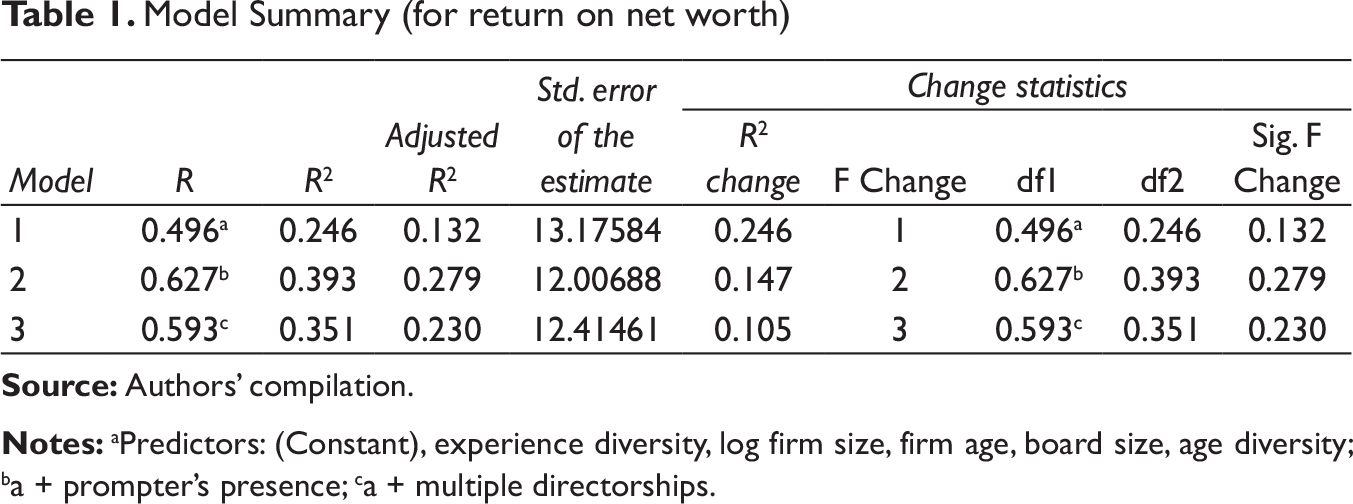
Model Summary (for return on net worth)
Regression Analysis for Return on Net Worth

As illustrated in Table 1 (model 1), firm age (p = 0.03 < 0.05), board size (p = 0.022 < 0.05) and experience diversity (p = 0.01) significantly affect RONW (in the absence of the control variable). Model 2 shows the effect of the control variable on firm performance. The result shows a significant change of 0.147 R2 (p = 0.009 < 0.01). All the variables (except firm size) reflect a significant impact on RONW after including the control variable. The negative signs of board size, experience diversity and promoter’s presence on the board indicate the negative significant relationship with RONW, which is consistent with the findings of Erhardt et al. (2003). Thus, the increase in the number of board members decreases the firm’s RONW. The more experience a board shows the less is the RONW at 1 per cent significance level. Moreover, the promoter’s presence on the board reflects negative RONW at the 1 per cent significance level. This means that as the number of experienced directors increases, the performance of manufacturing firms tends to decrease. Empirical results show that age diversity positively impacts the relationship with RONW, while experienced diversity has a negative significant relationship with RONW. Thus, the increase in the age diversity increases RONW, while the increase in experience diversity decreases RONW. The results also postulate that no statistical relationship exists between firm size and RONW. The results are consistent with Miller and Triana (2009).
The result also shows (model 3; Table 2) a significant mediation effect (p = 0.03 < 0.05) of multiple directorships on RONW at the 5 per cent significance level. Except for firm size, all the independent variables show a significant relationship with RONW. R2 change is 0.105 (p = 0.03 < 0.05), which is substantial at the 5 per cent significance level. The negative β value indicates the negative relationship between multiple directorships and firm performance. Thus, the increase in the number of directorships in other firms reduces the firm’s performance. The results are inconsistent with the certification view (Fich & Shivdasani, 2012; Jiraporn et al., 2009).
Return on Equity
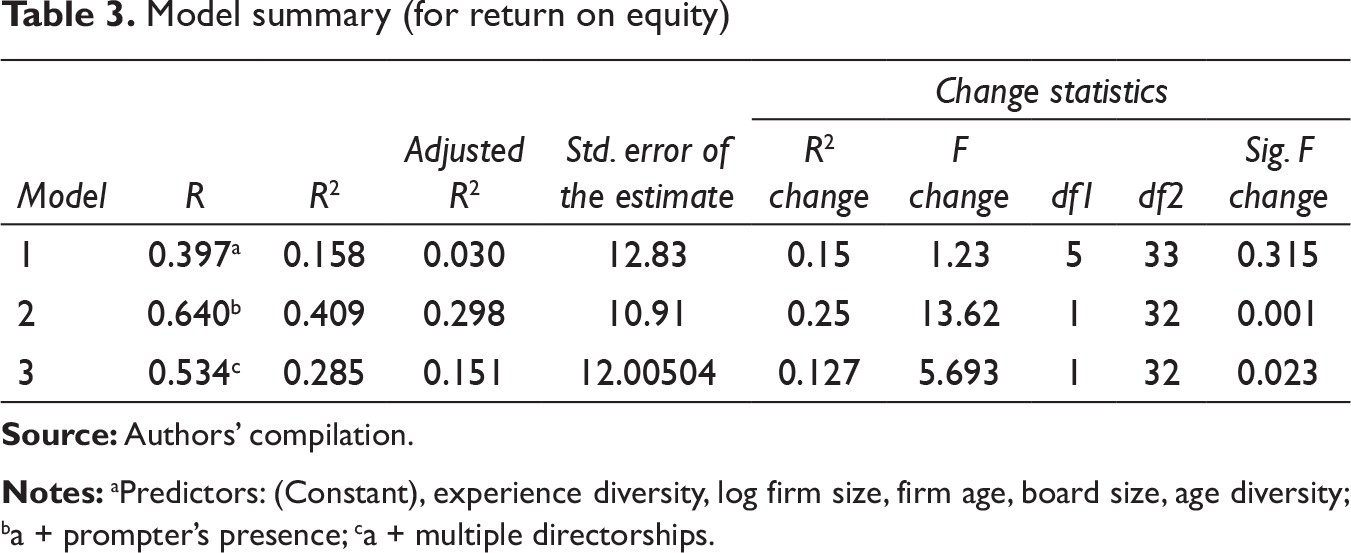
Tables 3 and 4 show the regression results for the ROE. Empirical results show that only firm age (p = 0.049 < 0.05) and ROE have a positive impact on the relationship at the 5 per cent significance level (in the absence of control variable). Moreover, the firm age (p = 0.018 < 0.05) and board size (p = 0.002 < 0.01) show a significant relationship with ROE at the 5 per cent (positive relationship) and 1 per cent (negative relationship) significance levels, respectively. Thus, empirical results show that, the presence of a greater number of promoters in the other board and large board size decreases the ROE of the firm. R2 change in this model is 0.252 (p = 0.001 = 0.001), which is consistent with Dwyer et al. (2003), Gordini and Rancati (2017). This means that the presence of the promoter on the board negatively affects the ROE at the 0.1 per cent significance level. The results show that there is no statistical relationship between age diversity, firm size and experience diversity on ROE.
Model summary (for return on equity)
Regression analysis for return on equity

Sales Growth
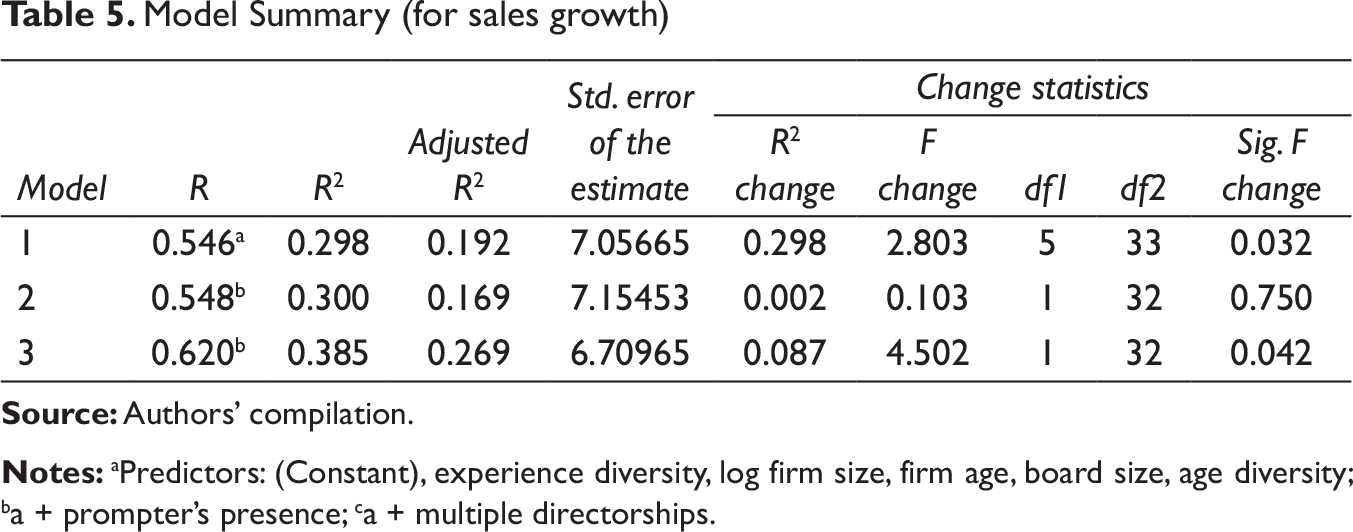
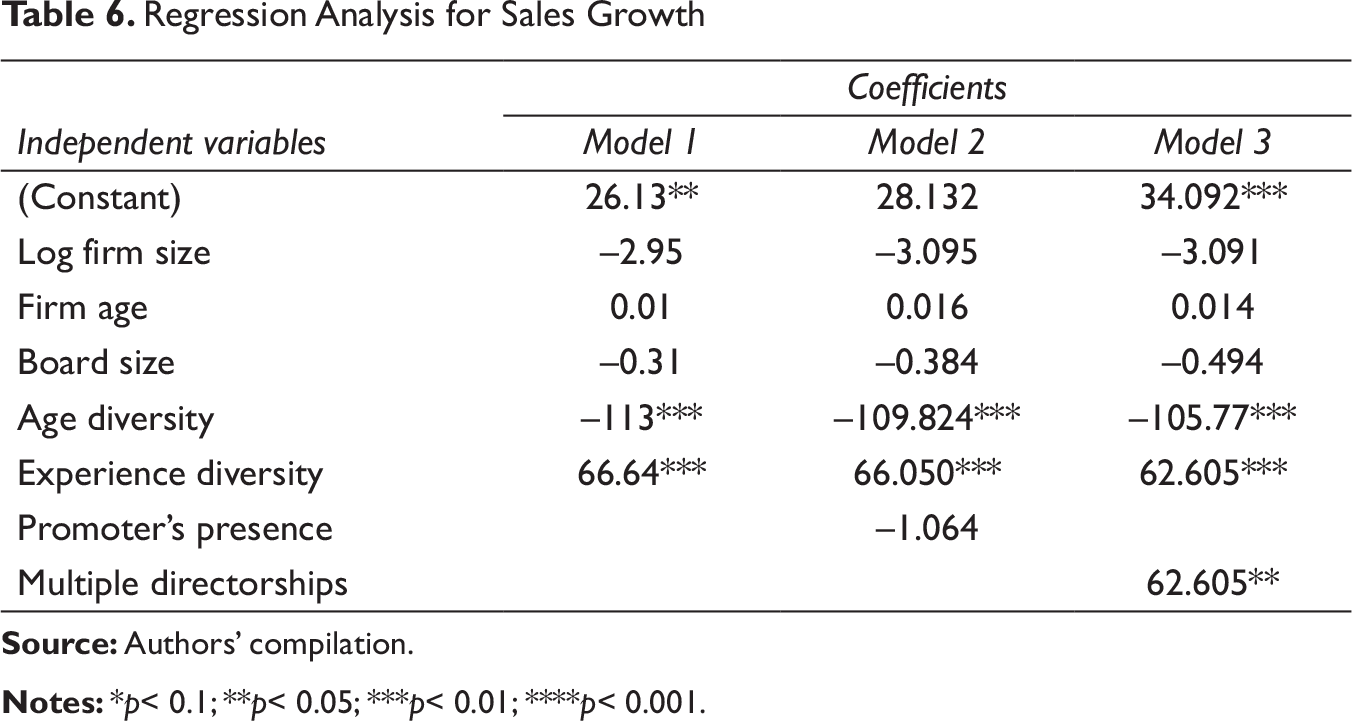
The statistical relationship between sales growth and predicted variables has also been analysed in Tables 5 and 6. Empirical results show that age diversity (p = 0.01 < = 0.01) and experience diversity (p = 0.008 < 0.01) exhibit a positive significant relationship at the significance level of 1 per cent. Age diversity reflects high impact (β = 113) followed by experience diversity (β = 66.64) on sales growth. There is no significant (p = 0.75) change in the R2 (0.002) value in this model, implying that the presence of the promoter on the board has no significant impact on the sales growth of the firms. The results are consistent with Norburn and Birley (1988).
Model Summary (for sales growth)
Regression Analysis for Sales Growth
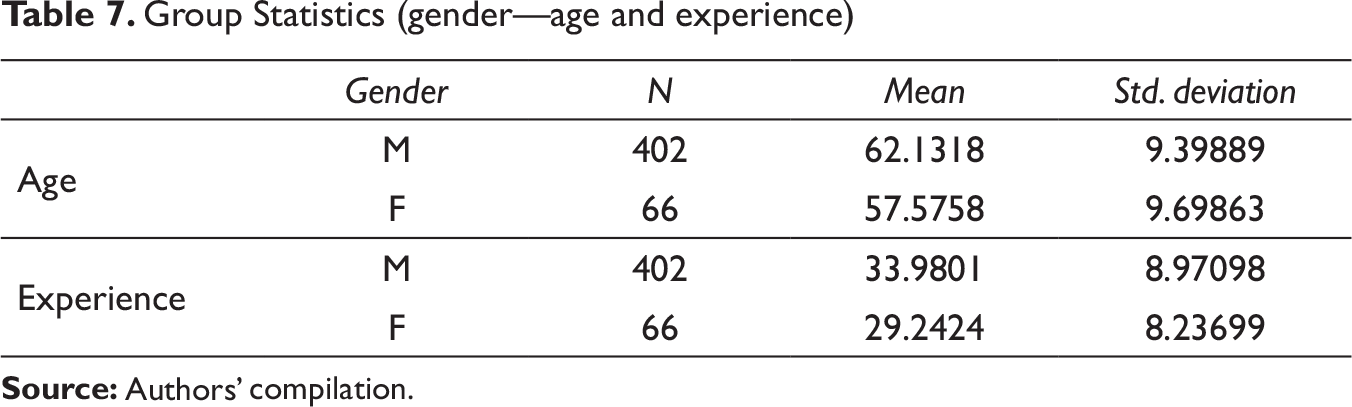
Group Statistics (gender—age and experience)
Independent Samples Test (gender—age and experience)
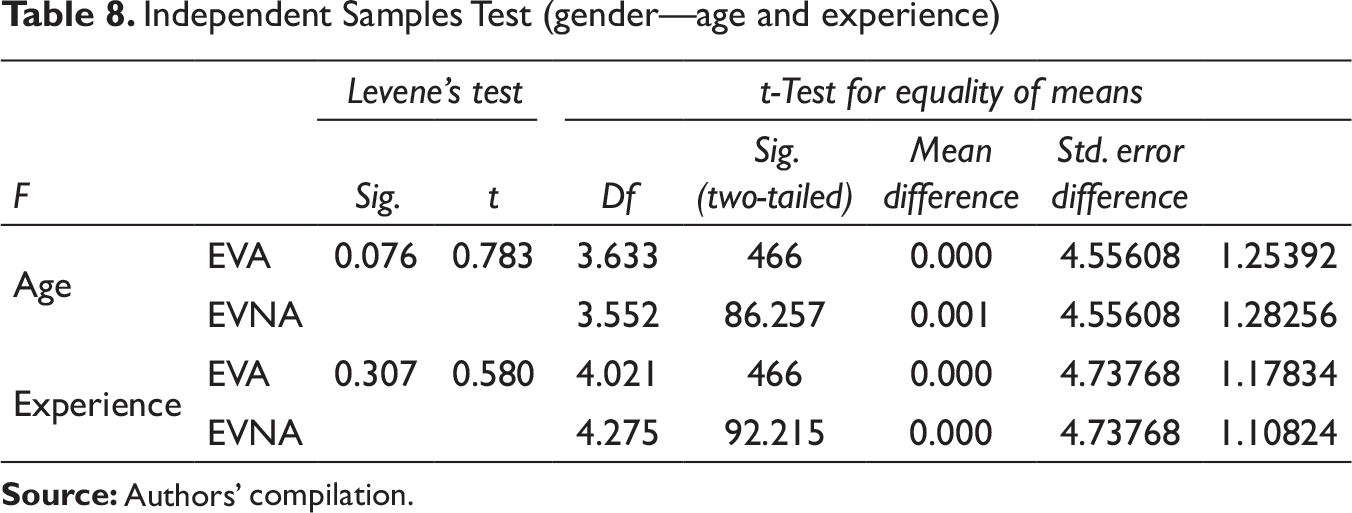
Parametric Tests
Tables 7 and 8 show the parametric results of age and experience of both the male and the female directors. The age and experience are significantly different at the 1 per cent significance level (age p = 0.00 < 0.001; experience p = 0.00 < 0.001). The mean age of male directors (62.13 years) is significantly higher than the age of the female directors (57.58 years) on the board. Similarly, the experience of the male (33.98 years) and female (29.24 years) directors is also significantly different. Cohen’s d1 for age (d = 0.477) denotes medium effect size. While Cohen’s d for experience (d = 0.55) denotes medium-to-high effect size. The results find resonance with Carter, Simkins, and Simpson (2003).
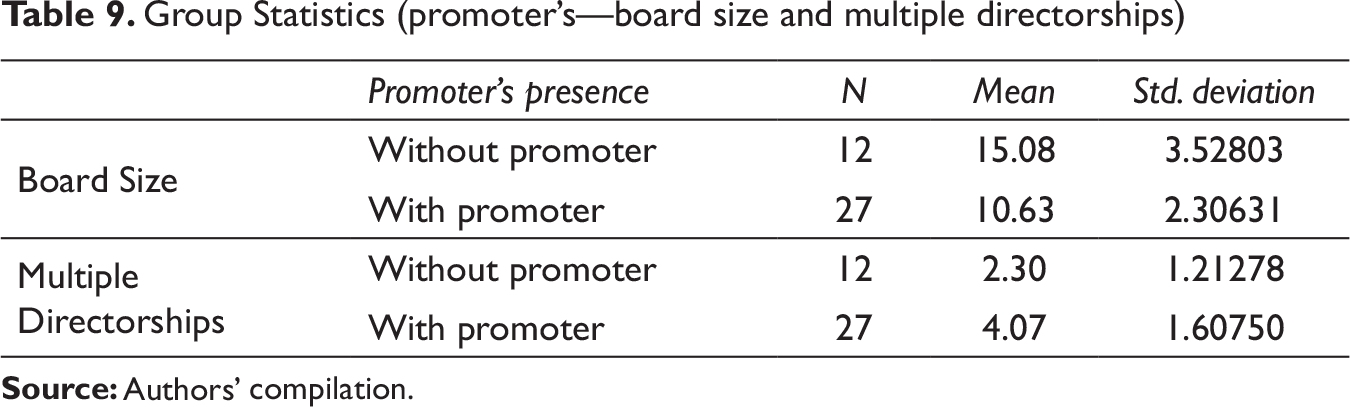
Group Statistics (promoter’s—board size and multiple directorships)
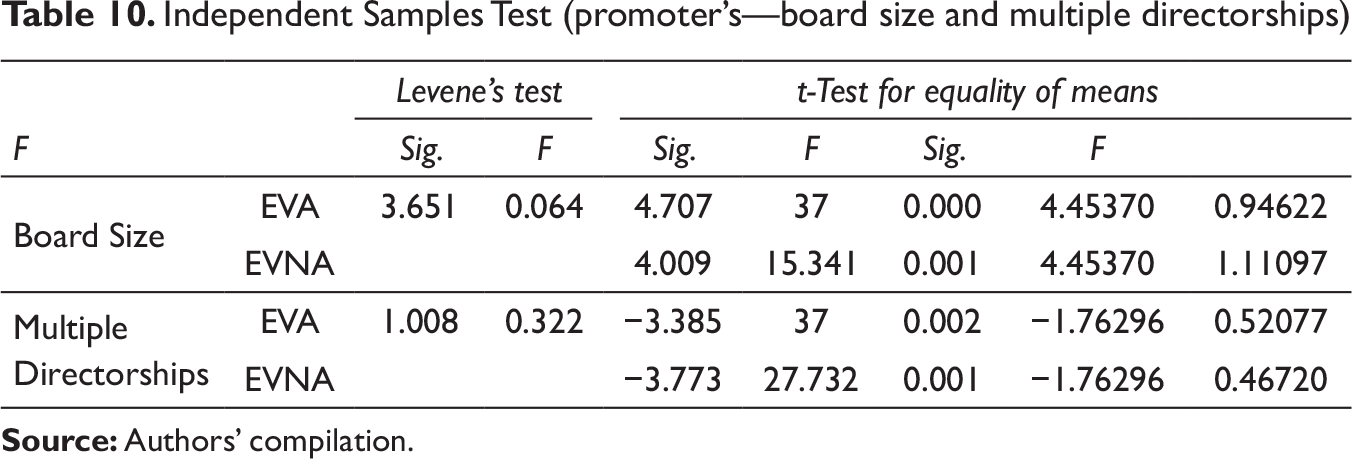
Independent Samples Test (promoter’s—board size and multiple directorships)
Conclusion
This study analyses the impact of board diversity on the financial performance of a firm. It finds that age and experience diversity have a significant impact on the firm’s financial performance. Age diversity shows a positive relationship while experience diversity has a negative relationship with financial performance. The study also finds an under-representation of women on selected boards. Age and experience of the women directors are comparatively less in number as compared to their male counterparts. A significant difference is also found in age and experience of the gender and different designations of the directors on the board. Age and experience of the non-executive directors are observed to be the highest among other positions. The study also finds a control effect of the promoter’s presence on the board. The presence of majority promoter directors has a negative impact on financial performance. Moreover, negative financial performance is also found where directors hold a higher number of directorships in other firms. This means directorship has a negative mediation effect on each financial indicator, that is, RONW, ROE and sales growth. Based on the empirical findings, the researchers propose that firms with promoter director/s should appoint a higher proportion of independent directors. The firms need to reduce the directorship of the directors in other firms to increase their contribution to board activities and improve their financial performance. In addition, the board should also have an experienced woman director at the executive position. This study is limited to selected firms of the Nifty 50 index. Hence, findings should be generalised with caution. It is recommended that further studies should be carried out with a diverse cluster of boards.
1 Cohen suggested that d = 0.2 should represent a ‘small’ effect size, 0.5 a ‘medium’ effect size and 0.8 ‘large’ effect size.
Footnotes
Declaration of Conflicting Interests
The authors declared no potential conflicts of interest with respect to the research, authorship and/or publication of this article.
Funding
The authors received no financial support for the research, authorship and/or publication of this article.