




Abstract
This study involves attitudinal measures by public agents committed to the environment, society and governance. It seeks to build idealists in socio-environmental management in the Amazon, promoting the induction of behaviours that lack a logical methodology to support solutions in a strategy for sustainability. The question to be raised here is: What attitudinal measures could be adopted by public agents in responsible socio-environmental governance? To answer this question, the general objective is to investigate the attitudinal measures of public officials in the face of their commitment to socio-environmental management in organisations. Thus, the content analysis method and related procedures were applied through bibliographic and documentary surveys made available on platforms such as ANPAD’s Spell, Google Scholar, Scopus and Web of Science, using keywords and Boolean criteria. Habermas’ Theory of Communicative Action was used in the analysis. The results made it possible to carry out a critical study that is valid in empirical experiments, which makes it possible to outline measures for the development of socio-environmental actions; it considered participatory and collaborative management models, environmental diagnosis in organisations; it offers the reader a SWOT framework in the face of a middle-up-down structure, through which knowledge creation is induced; it focuses on the institutional tactical level, aligning knowledge management processes involving leadership, coordination, control and measurement; it outlines the establishment of sustainability indicators, making it possible to measure socio-environmental performance in public organisations. This is an academic contribution to those interested in promoting socio-environmental management in the public sector, pointing to innovative practices as valid models to be considered in optimal decision-making.
Keywords
Introduction
This study is related to the actions taken by agents committed to environment, society and governance and to those who have conceived of administrative modernisation in the public service, now with the induction of attitudinal measures aimed at socio-environmental management. This would be the ideal time to adopt practical means capable of providing conceptual support to government bodies in the direction of credible solutions in favour of sustainability. Thus, the question to be answered in this study is: What measures should be adopted by socio-environmental management agents in the public service? In order to answer this question, the general objective is to investigate the attitudinal measures of public agents in the face of their commitment to socio-environmental management in organisations; and, for the results, the specific objectives are (a) to characterise the actions to be implemented in a public service organisation that guarantees managerial compatibility of a socio-environmental nature; (b) to conceptually analyse the factors that interfere with the institutionalisation of the role of the socio-environmental manager in the organisation; (c) and to propose technical-normative idealisers through an operational configuration to be institutionalised. This document is made up of topics and subtopics. After this introduction, there is a theoretical and conceptual framework that can support the results below; a methodological body with procedures on the preparation of this study; the results follow in line with the objectives proposed above; and the conclusion with the answer to the research question, and then the references that supported this task.
Theoretical and Conceptual Review
This study is based on Institutionalist Theory in interface with New Public Management Theory, considering that it will provide a useful proposition on the functioning of rules and techniques that can be very well modelled for various types of government institutions. According to Gala (2003), Douglas North formulates an institutional theory of economic development based on the historical process and, subsequently, on a theoretical analysis of successful institutional trajectories, that is, those that have been able to develop institutional arrangements to develop productive activities. Thus, Institutionalist Theory represents a role of restriction and a role of construction for the agents involved in the course of their economic transactions. For this author, organisations are the main agents of a society whose categories can be divided into political, economic, social and educational organisations. With this, he suggests that social development stems from a base of laws, rules and habits capable of stimulating the accumulation of capital and knowledge.
The New Public Management Theory, according to Lacerda et al. (2023), has been adopted in public administration as an evolution of patrimonialism and bureaucratic methods through efforts geared towards economic efficiency and the use of methods consolidated in private enterprise, and although government organisations have advanced in the provision of services perceiving the citizen as a consumer of public services and products, they still lack efforts geared towards the public interest and democracy, if we look at this formula for solving problems exclusively focused on good practices perceived in the private market. In view of this, the authors state that innovation in the public sector comes from better spending, promoting the quality of the services provided, developing legitimacy and social trust and greater social participation in the search for solutions to complex problems such as population ageing, poverty, social inequalities, global warming and environmental catastrophes.
Concept of Socio-environmental Management, Corporate Social Responsibility (CSR) and Public Service
Socio-environmental management gains prominence when society imposes accountability measures or in the face of a possible scarcity of natural resources resulting from changes caused by human actions. Da Silva and De Azevedo Almeida (2019) show that economic development must be accompanied by issues related to well-being and social justice, balancing the distribution of resources, reducing inequalities and preserving the environment. In addition, the authors propose three pillars for sustainability, namely social relevance, ecological prudence and economic viability.
Rek and Marini (2019) state that environmental management methodologies are made up of instruments aimed at instituting socio-environmental practices in public and private organisations, and through these methodologies, actions, projects, programmes and public policies are put into operation with the aim of raising awareness among stakeholders, reducing environmental degradation, reducing negative environmental impacts and improving the quality of life in the environment. These authors present the phases that make up environmental management, beginning with the identification of the values involved in conflicts and the establishment of public policies, promoting the institutionalisation of the management system and the economic–financial, legal and technical instruments that make up sustainable environmental management. They recommend the need to adopt strategic positions, such as drawing up an environmental policy, planning, environmental management and monitoring.
It is important to consider CSR in order to highlight new ways of managing a system beyond the mere organisation of production factors, considering ethical actions in relation to the social and environmental impacts generated. Public and private organisations need to express this responsibility transparently by developing acts and attitudes aimed at minimising the negative social and environmental impacts that their actions may cause. We would just like to highlight the interdisciplinary nature of the concept of socio-environmental responsibility, as it is a systemic approach focused on relations with all the parties directly or indirectly interested in the company’s business, interested in ethical development and social well-being (Ávila et al., 2023).
Public service, from a broad perspective, involves all types of state provision, from essential state activities to economic activities carried out by a government structure. For Cezne (2005), the concept of public service refers to any activity carried out by the state or by anyone who exercises administrative functions of a public nature, in this case by means of legal permission to do so. In addition, these activities must be carried out under the aegis of the law or regulatory standard. Philippi et al. (2017) indicate the knowledge chain model, combining knowledge management with the so-called secondary activities in organisations, such as those consisting of leadership, coordination, control and measurement, in order to carry out activities for the acquisition, selection, generation, internalisation and externalisation of knowledge resulting from the interactions of internal processes. This idealised conception, based on reading the aforementioned authors, allows us to infer that secondary activities in the public service can encourage attitudes towards socio-environmental decisions, suggesting the manifestation of creativity, flexibility and innovation.
Conceptualising Strategic Planning and Strategic Management (SWOT) Analysis, Institution and Institutionalisation
According to De Mendonça Santos and Macêdo (2023), SWOT analysis is a theoretical method for assessing the work environment from the perspective of internal environments (strengths and weaknesses) and external environments (opportunities and threats). Strengths are internal conditions capable of aiding proper organisational performance and weaknesses are difficulties that hinder proper organisational performance. Opportunities are, in turn, external conditions that can favour the achievement of objectives that are not controllable by the organisation, and threats are external conditions that can hinder business progress. Mirales et al. (2019) point out that the purpose of this method is to help organisations position themselves strategically in the environment in which they operate, to make assertive decisions, highlighting the collection of information to base the strategic formation process, directing the organisation towards the development of sustainable competitive advantages.
The roots of neo-institutionalism lie in institutionalism. Both approach rationality-based models of organisation with scepticism, considering institutionalisation to be a process that depends on the actions of the state, making organisations instrumentally less rational. The following two concepts are fundamental to the new institutionalism: institutions and institutionalisation. According to Braga (2020), institutions are not just restrictive structures, that is, they all authorise and control at the same time, and can be characterised as socially constructed and routinely reproduced programmes or systems of government that function as relative elements of restrictive environments, accompanied by explanations that are taken for granted. On the other hand, institutionalisation can be represented as a particular set of social reproductive processes. In general terms, Braga (2020) concludes by saying that while the institution represents a social order or pattern that has achieved a certain state or property, institutionalisation indicates the process for achieving it. In this sense, he adds that it would be up to the organisation to consider the influences of the environment on its decisions and actions. Institutional theorists have contributed to the study of organisations by reconceptualising organisational environments. Considering the new institutionalism approach, the environment penetrates the organisation and creates a particular worldview for those agents in relation to the categories of structure, action and thought.
Concept of Technical and Regulatory Measures, Compliance and Accountability
Social and environmental management in government organisations involves regulatory measures. Reading Rek and Marini (2019), it can be predicted that adequately structured public policies are essential for socio-environmental management, through which strategic actions can be promoted, as well as investments that will support organisational performance through the expected quality of results. Some examples of predictable expectations emerge from this literature, such as the preservation of the environment, biodiversity conservation, sustainable development and poverty eradication, all of which are very well aligned with the sustainable development goals set out by the United Nations; these are arguments that could only be brought to fruition through properly regulated legislation. These authors argue that public policies involving socio-environmental management should be operationalised through municipal, state and federal legal norms as enforcement mechanisms, which become reasonable definitions for the materialisation of the effects of standardised operationalisation. In relation to technical measures, Braga (2020) enters this context when he discusses technical environments as control models in organisations in the quest to improve efficiency, and it is essential to identify, from the point of view of technical environments, whether public institutions are able to show solidity when incorporating new experiences into their organisational routines.
Technical measures bring us back to organisational competencies. As a set of instruments based on ethics and integrity, compliance guides managers in decision-making processes and requires monitoring to check that the regulatory criteria are being met (Rocha Pereira & Pedro Filho, 2023). This conceptual expectation is echoed by Serotini (2023), who defines compliance as a means of complying with laws, guidelines and internal and external regulations in the quest to mitigate risks, whether of a regulatory, legal or reputational nature, from the point of view of ethical control by those responsible for management practices. Based on Serotini’s (2023) notes, it is possible to assume that, even though organisations need to operate under the compliance framework, with socio-environmental sustainability regulations, it is possible to see occurrences that are harmful to the environment and, in this way, denounce the lack of investment in preventive methods by organisations and their supervisory or punitive processes on the part of the controlling power.
In institutional environments, control measures lack legitimacy with society, as a condition of accountability resulting from technical pressures to be judged by tax-paying citizens. As Da Silva & De São Pedro Filho (2021) rightly point out, accountability offers democratic development through appropriate actions to control and monitor indicators aimed at measuring results in public management, technical measures that guide the convergence of actions with standards and also guide the behaviour of the manager.
Methodology
Based on the socio-environmental problems faced in society, we decided to study an application of attitudinal, normative and technical measures capable of proposing possible solutions from a public organisation. It refers to a proposition to be offered in view of the commitment to socio-environmental management of the organisations in focus in the Amazon. Therefore, this is a qualitative, descriptive and exploratory type of research, since the aim is to describe properties, characteristics and profiles relevant to public agents in the face of the socio-environmental responsibilities of local public authorities, with a view to proposing useful methodologies in the convergence of attitudes favourable to socio-environmental development.
According to Saunders (2009), the researcher structures these procedures according to their system of beliefs and assumptions about the development of knowledge, making various types of assumptions, such as assumptions about human knowledge (epistemology), about the realities encountered in the research (ontology) and about the extent and ways in which their own values influence the research process (axiology).
Content Analysis Method
As for the method, we used the content analysis method developed by Bardin (1977), using three stages, namely pre-analysis, exploration of the material, categorisation or coding and treatment of the results, inferences and interpretation. In the first stage, the material to be used in the analysis is organised, with the aim of operationalising and systematising ideas, as well as formulating objectives and hypotheses and drawing up an analysis plan. The second stage is characterised by coding, classification and categorisation according to the defined rules. In the last phase, the analyst reflects on the research material and the results obtained, taking into account the various possibilities for analysing the research material.
The Procedures Adopted
The data collection procedure involved a bibliographic and documentary survey. Bibliographic research was carried out using scientific articles, journals, theses and books on the subject, preferably published in recent years. It was decided to carry out an investigation based on publications available in databases on public access platforms, such as Scientific Periodicals Electronic Library of National Association of Postgraduate and Research in Administration (Spell Anad), Google Scholar, Scopus and Web of Science, using keywords combined by Boolean methods. Documentary searches were carried out, collecting standards and legislation on the subject; technical consultations were adopted, focusing on themes similar to socio-environmental management in public institutions. Criticism about the relevance to the object of study was accepted, and for this purpose, qualified and up-to-date works were collected; full reading of these selected contributions went through the cleavage of those excerpts aligned with the subject; categorisation was then carried out, bringing together related ideas, which were structured in the form of topics, in line with what is proposed in this document.
In Terms of the Tool Used
A study by Mirales et al. (2019) presents SWOT framework as a methodology capable of proposing reflections on the environment in which certain organisations operate, recording information about their internal and external environment. Given this scenario, there is potential for using this strategic analysis method, since it can provide an adequate perception of the scenario experienced by public institutions in the face of pressure from society regarding socio-environmental management practices, in addition to the adequate provision of public services and/or products. Based on the reflections and information obtained, the decision-making process of senior management, consisting of normative and technical measures, is capable of positively influencing socio-environmental management in public institutions, which leads to a better subsidy for the results of this investigative work.
As for Analysis
In view of the systematised data, the analysis used Habermas’ (1999) Theory of Communicative Action. For Habermas, this theory understands the individual as a participatory being who, before acting, evaluates the possible consequences, considering the rules, norms, values and laws, without therefore acting mechanically. In relation to types of action, Habermas presents two types, instrumental action and communicative action, and, based on his criticism of instrumental action situated in rationality, he creates communicative rationality or communicative reason. This study is therefore based on this action of communicative rationality, proposing an analysis of the actions and attitudes of public agents with regard to the responsibilities of public institutions when it comes to implementing socio-environmental management. Thus, through cognitive comprehensiveness and analytical language for the production of the text, the aim is to make a scientific contribution to socio-environmental governmental practices.
Attitudinal Measures in Socio-environmental Management in Public Organisations
This study makes it possible to build a fundamental strategic perspective on socio-environmental management in organisations whose leaders adopt responsibility for the fundamentals of sustainability. It considers the validity of adopting attitudinal measures by managers through their commitment to implementing socially and environmentally appropriate public policies. These are initiatives that stimulate the behaviour of individuals and groups so that, with a critical vision and collective awareness, they can promote a better relationship with the environment, while valuing economic, social and institutional development, through equity, risk reduction and effective control that avoids ecological overload, following the prescriptions contained in Philippi et al. (2017).
By using analyses of models that aim to overcome traditional models that do not emphasise sustainable development and comparative analyses of the social responsibility tools most adhered to by the companies that make up the BM&FBovespa Corporate Sustainability Index, for example, it is possible to identify practical guidelines for managers to contribute to the construction of management focused on sustainability and CSR (Philippi et al., 2017).
In this sense, New Public Management appears as a solution to the patrimonialist and bureaucratic management models when it aims to bring the practices and methodologies used in public management into line with the best practices applied in the private sector. This has brought about an improvement in the provision of public services insofar as it has started to treat citizens as consumers. However, there is still a considerable gap between the perceived improvement in public services and the effective realisation of democracy to serve public interests. As a result, new values are being incorporated to take into account the particularities of public administration, such as its political and democratic aspects. One of the contemporary models is called the New Public Service, characterised by promoting innovation in the management of public resources and services, in order to break with backward and outdated practices, as Lacerda et al. (2023) rightly point out.
Characterisation of Actions to be Implemented in an Organisation
In this compartment, the study offers the prospect of guaranteeing managerial compatibility of a socio-environmental nature to be developed in an organisation committed to the relationship. These are measures that can enable participatory and collaborative management.
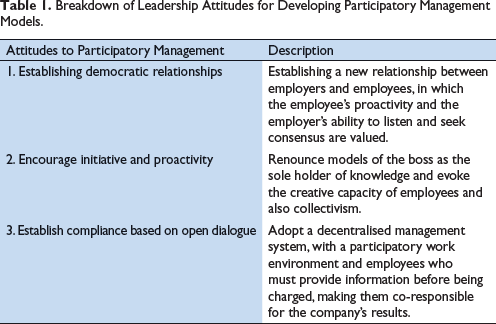
Participative management, as shown in Table 1, is a management model aimed at aligning strategies, from their implementation to the evaluation of the practical effects resulting from this process. The procedures resulting from alignment are good at characterising the form, conduct and valid guidelines and can lead to indications of innovation, which is common in organisations undergoing the necessary adaptability. In today’s society, the processes are the result of establishing a democratic relationship between the leader and those being led, with proactivity and the capacity for dialogue being valued as goals for consensus; this avoids conflicts of interest, friction of ideas and brings about the conformity designed by the parties involved.
Breakdown of Leadership Attitudes for Developing Participatory Management Models.
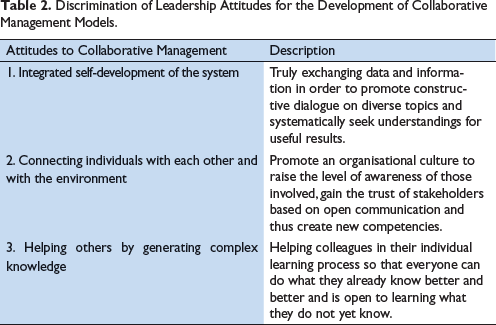
As shown in Table 2, collaborative management indicates a management model that identifies the organisation as an intelligent whole that seeks self-development, with the aim of connecting employees to each other and the environment. In view of this, it is proposed to consolidate a flow of learning process in the relationships between the people and organisations involved, generating enough knowledge to create solutions, respecting the complexity of current systems, in the format explained in Philippi et al. (2017).
Discrimination of Leadership Attitudes for the Development of Collaborative Management Models.
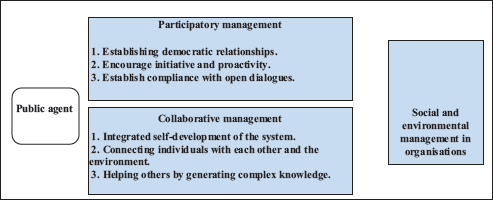
Collaboration therefore means working together to help develop each other and, consequently, institutional competencies. However, participatory management is not opposed to collaborative management. On the contrary, collaborative and participative management models complement each other in that collaborative management includes the perspective of participation, including the need to help others make decisions based on new knowledge generated, as shown in Figure 1, which shows applicability from an angular view of leadership.
Employment Participatory and Collaborative Management in Socio-environmental Management.
This highlights the importance of the knowledge-building processes advocated by Philippi et al. (2017), which use information flow management to increase organisational competencies and improve relationships. In this process of building knowledge, we have the example of the methodology for building the 8C environment—knowledge, trust, sharing, awareness, collaboration, communication, culture and competence—which helps to eliminate individual defences and develop knowledge management techniques and innovation, promoting synergy and proactivity. This builds valuable internal social capital to generate sustainable development.
Conceptual Analysis of the Factors that Interfere with the Institutionalisation of the Role of the Socio-environmental Manager in the Organisation
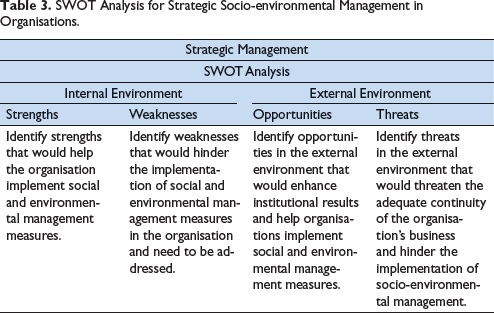
The diagnosis of the environment in which organisations operate can be reshaped using SWOT analysis. In this way, managers in organisations can see the strengths and weaknesses of a given context, revealing opportunities and threats, as shown in Table 3.
SWOT Analysis for Strategic Socio-environmental Management in Organisations.
Institutional governance can then develop a commitment to the development, well-being and quality of life of all stakeholders, namely its employees, families and civil society. These beneficiaries of responsible socio-environmental management are positively impacted by its qualified management. In addition to the effects on the general environment, from where resources are collected or where waste is discharged, it is essential to find ways to reconcile the objectives, both institutional and individual, of the participants in the process.
In addition, a socially responsible company must obey the law, be profitable and ethical and exercise the role of corporate citizenship. These responsibilities can be represented by the following four perspectives: economic, legal, ethical and philanthropic; or by the perspective of the environmental, social, economic, stakeholder and voluntary dimensions, following the understanding of Philippi et al. (2017); or from an interdisciplinary perspective of the environmental, social and economic dimensions, known as the triple bottom line or three pillars of sustainability, also taking into account the active participation of all stakeholders, as discussed by Silvestre and Ţîrcă (2019) and Abad-Segura et al. (2019), as we consider in this work. The literature identifies some determining factors for the choice of social responsibility tools by organisations, as shown in Table 4.
Breakdown of the Dimensions of Social and Environmental Responsibility That Should Be Involved in Implementing Management Measures.

This contextualisation in the breakdown mentioned above is significant in that it once again recalls the concept of SWOT analysis, as it guides the organisation so that its managers can protect themselves in the economic and social scenario; they can find a system, methodological, programmatic and activity tool, whose strategic implementation results in recognition of corporate social and environmental responsibility. It should be noted that the complexity and diversity of social and environmental responsibility issues sometimes require the use of various management tools in order to institutionalise the strategy assertively. According to Philippi et al. (2017), the assertiveness of the strategy involves the use of a tool architecture classified by a normative framework (what to do), a management system (how to integrate) and process guidelines (how to measure and communicate).
Proposal From Normative and Technical Creators
This subtopic of the task includes propositions considered credible through an operational configuration that can be institutionalised; it derives determining factors for the generation of a management tool capable of promoting adequate socio-environmental management, considering the organisational strategies well defined earlier in this study. Constructs adapted from the recommendations of Philippi et al. (2017) were developed. It should be noted that, although the authors propose ten factors, only five were used in this indicator, due to the logical pertinence dealt with in Table 5.
Proposal for Determining Factors for Generating a Management Tool.
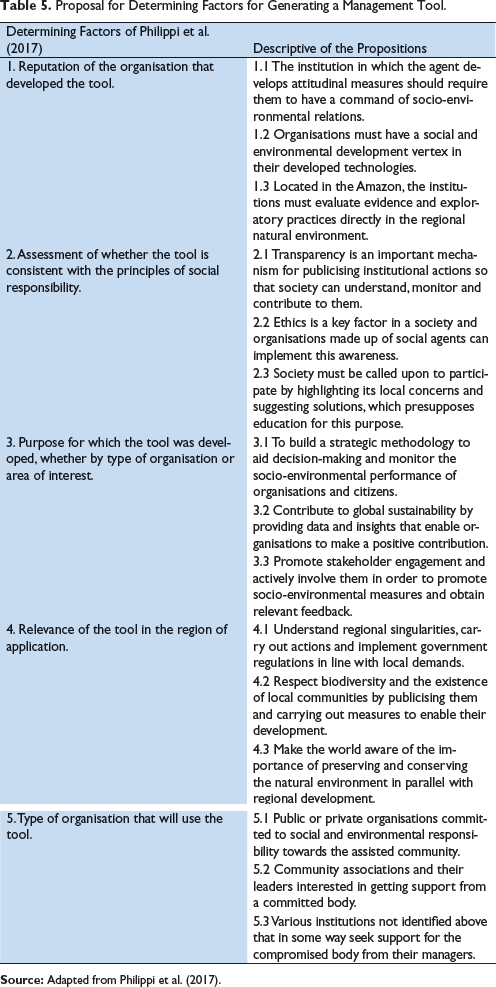
The argument is based on the dynamic analysis of socio-spatial events in the Brazilian Amazon. It seeks to respect the individual who establishes relationships with the natural environment according to their knowledge and organisational, productive and available technology capabilities. According to Da Ponte and Szlafsztein (2022), this relationship has developed through interaction and the passage of time and signals the potential for humanisation of the Amazon region, designated as a complex mosaic of coupled human–natural systems.
There is an organisational structure highlighted by Philippi et al. (2017) focused on proposing the implementation of concrete socio-environmental actions from a public organisation, here situated as middle-up-down. From this perspective, knowledge creation is possible, focusing on the tactical level or middle management. However, it involves a relationship with top management and operational employees in the dynamics of internal behavioural implementation. In this way, a much more efficient creation process is expected than in the top-down or bottom-up models. This organisational structure can be complemented by a management model that deals with organisational knowledge called the knowledge chain. This management model aligns knowledge management processes with the organisation’s secondary activities, such as leadership, coordination, control and measurement, as prescribed by these authors.
From this perspective, it is important to establish sustainability indicators capable of measuring the socio-environmental performance of public organisations. Research into the application of social, environmental and economic sustainability indicators in higher education institutions could be mentioned at this point in the study, given the structural similarities between the environmental and social dimensions of public organisations and educational institutions, such as the existence of materials, sewage treatment, waste production and the demands of individuals. Therefore, considering the peculiarities experienced by higher education institutions, we highlight some of the main indicators proposed, such as number of teachers per course, number of teachers trained in some area of sustainability, number of civil servants hired by function, absence or presence of civil servants in sectors focused on sustainability, amount of spending on technicians, training, hiring, absence of accidents, amount of consumption of resources and materials per civil servant or department, amount of waste production per user, presence of sustainable tenders and number of projects developed in sustainability, as in the approach dealt with by Da Silva and De Azevedo Almeida (2019).
Indicators are parameters that serve to inform the situation of an element and, once formulated, help to identify the organisation’s current situation in relation to the objectives set for its socio-environmental development. In this way, indicators support decision-makers by helping to allocate resources, comparing processes and situations, pointing out future trends and, above all, measuring the results and impacts of decisions made, as indicated by Da Silva and De Azevedo Almeida (2019). To the extent that these practices are standardised, social and environmental management activities can be checked for adequacy, as well as contributing to the proper disclosure of information as a way of promoting social participation through compliance and accountability methodologies.
Conclusion
For anyone interested in promoting socio-environmental management in public environments, some practical innovation measures can be identified as valuable models to consider when making decisions. Carrying out an environmental diagnosis, using SWOT analysis, can contribute to implementing effective and appropriate actions, given its simplicity, objectivity and ability to make organisations identify the characteristics of the internal and external environments in order to respond to social, environmental and economic responsibilities, considering all the stakeholders involved.
With this information, it is possible to establish the institutionalisation of an effective strategy to promote socio-environmental perspectives, acting specifically on regulatory proposals, integrated management systems and processes of continuous actions and monitoring.
The vision of improving the participatory management model towards an evolution towards the collaborative management model contributes insofar as it transforms the organisation into an intelligent and synergistic whole to promote sustainable development. Allied with these management models is knowledge management, which recognises the limitation that no single individual has enough knowledge to solve today’s complex problems and that only the exchange of information and constructive dialogue will result in useful solutions for society as a whole. It is therefore essential to develop sufficient synergy to develop intelligent arrangements of knowledge management techniques, actions and methods to achieve environments that generate innovation.
In addition, contextual analysis makes it possible to learn about the organisational, productive and technological capacities available. Taking proper advantage of the systemic structure of public organisations makes it possible, albeit slowly and gradually, to improve management methods, and, in this respect, it is interesting to use the so-called middle-up-down proposition, in which knowledge is generated by middle management areas (tactical level), where secondary activities are centred, such as leadership, coordination, control and measurement, the main developers and direct target audience of social, environmental and economic sustainability indicators in organisations. This is a contribution from academia to those interested in promoting social and environmental management in public environments.
Footnotes
Declaration of Conflicting Interests
The authors declared no potential conflicts of interest with respect to the research, authorship and/or publication of this article.
Funding
The authors received no financial support for the research, authorship and/or publication of this article.
