



Abstract
This essay explores the rich archive of photographer Nemai Ghosh whose production stills on the sets of Satyajit Ray kept his cinema alive in popular memory. While it might appear that Ghosh was overwhelmed by the vision of Satyajit Ray, the essay explores how the documentary impulse in his work created continuity as well as rupture with the cinema of Ray and others in Bengal. Nemai Ghosh’s forte lay in capturing candid moments of actors just before and after filming on the sets. These interstitial moments caught between the vision of the director and the photographer shooting a production still could be used to tease out other deeper meanings about star personas. As we look through Nemai Ghosh’s larger body of work, particularly at images which may not have found public circulation as film stills, we see other kinds of mediations between the photographer, the camera and his subjects. By extricating still frames out of motion, Ghosh’s photographs invite us to contemplate certain tensions between female actors, their roles and their extra cinematic lives. Recollections of these stars are layered by stories, anecdotes and popular myths. In this essay, I explore what it might mean to look back at Nemai Ghosh’s images through the prism of these overlapping memories.
… in front of the screen, I am not free to shut my eyes; otherwise, opening them again, I would not discover the same image; I am constrained to a continuous voracity; a host of other qualities, but not pensiveness; whence the interest, for me, of the photogram (Barthes, 1980, p. 55).
In her introduction to Manikda: Memories of Satyajit Ray by photographer Nemai Ghosh, actor Sharmila Tagore writes,
What we had in common was Manikda who happened to be a mentor to both of us. Till such time as he met Manikda, incredulous as it may sound, he (Ghosh) had no knowledge of professional photography. Despite that Manikda decreed that Nemai Ghosh would be the official stills photographer for Aranyer Din Ratri (Days and Nights in the Forest, 1969). Naturally, like many others, I too had my doubts, but of course no one dared oppose Manikda (Ghosh, 2011, pp. xiii-xiv).
By the time Ray asked her to play the role of Aparna in Aranyer Din Ratri, Sharmila Tagore was a leading actor in Hindi cinema. It was also her first meeting with Nemai Ghosh in Palamau, Bihar. After seeing some of his photographs, Tagore decided to hijack Ghosh on a rest day for the unit. 1
The resulting photo shoot reveals a very different persona from that of Ray’s protagonist, Aparna. While Tagore plays a “modern” young woman in Aranyer Din Ratri, the photo session documents the glamorous Bombay star. Wearing a sleeveless black top and slacks, Tagore lounges against a black Ambassador used in the film. Hair pulled back fashionably, she holds her sun glasses in some frames as she sits on the car, posing like a Vogue model (Figure 1). Many stills frame her in three quarters as she turns her head to smile at the camera in classic postures of glamour photography. Even though this was his first such photo shoot, any doubts about Ghosh’s “professional” status were laid to rest after this session.

Sharmila Tagore on a photo shoot with Nemai Ghosh during the filming of Aranyer Din Ratri (Days and Nights in the Forest, 1969) in Palamau (now in Jharkhand).
Aranyer Din Ratri marked the beginning of a close and lasting relationship between Satyajit Ray and Nemai Ghosh who photographed on the sets of all of his subsequent films. Despite working with several other directors in Calcutta and Bombay, Ghosh was deeply influenced by Ray. He often acknowledged Ray as a mentor who taught him how to see. Ghosh’s candid and more staged portraits of the auteur have become iconic representations of Ray, while his production stills taken on the sets kept the director’s films alive in popular memory at a time when DVDs and YouTube did not exist. Since many of these photographs often replicated the frames of the films, it might appear at first glance that Ghosh’s work was overwhelmed by the vision of Satyajit Ray. Nemai Ghosh, however, was an intrepid documentarist. He continued to take photographs even when the film camera stopped rolling and when it could be assumed that his job was over. This documentary sensibility makes Ghosh distinct from his other contemporaries in Bombay who created auratic portraits of popular female stars for glossy film magazines. 2 While he also took studio portraits, Nemai Ghosh’s forte lay in capturing candid moments of actors just before and after filming on the sets of Ray and other directors in Bengal. These portraits could be seen to reflect continuity as well as ruptures with the films. As interstitial moments caught between the vision of the director and the photographer shooting a production still, they could be used to tease out other deeper meanings about star personas. Looking through Nemai Ghosh’s larger body of work, particularly at images which may not have found public circulation as film stills, we see other kinds of mediations between the photographer, the camera and his subjects. By extricating still frames out of motion, Ghosh’s photographs invite us to contemplate certain tensions between female actors, their roles and their extra cinematic lives. Recollections of these stars are layered by stories, anecdotes, and popular myths. In this essay, I explore what it might mean to look back at Nemai Ghosh’s images through the prism of these overlapping memories.
Satyajit Ray’s cinematic repertoire was marked by several important women-centered films. Well-known actresses were associated with certain phases of Ray’s oeuvre. For instance, Charulata (The Lonely Wife, 1964) starred Madhabi Mukherjee who also acted in Mahanagar (The Big City, 1963) and Kapurush O Mahapurush (The Coward and The Holy Man, 1965) while Ray selected Mamata Shankar for his last three films. 3 Aparna Sen acted in Samapti (The Conclusion) which was part of Ray’s Teen Kanya (Three Daughters, 1961) and had cameos in Pratidwandi (The Adversary, 1970) and Jana Aranya (The Middleman, 1975). Others had roles in just one film by Ray. For instance, Swatilekha in Ghare Baire (The Home and The World, 1984), Simi Garewal in Aranyer Din Ratri, Krishna Bose in Pratidwandi, and the Bangladeshi actress Babita in Ashini Sanket (The Distant Thunder, 1973). Sharmila Tagore started her career as an actress with a role in Apur Sansar (The World of Apu, 1959). She played the female lead in the largest number of Ray films that included Devi (The Goddess, 1960), Nayak (The Hero, 1966), Seemabaddho (Company Limited, 1971), and Aranyer Din Ratri.
With the exception of Madhabi, Nemai Ghosh documented Ray as he directed all these actresses and sculpted their appearance in his films through elaborate storyboards, sketches, and costume designs. In an interview with Cineaste, Ray once noted that though his films were often based on stories that had strong women characters (for instance by Tagore and Bankim Chandra) they also reflected his own vision of women (Gupta, 2007, p. 126). Ray’s leading women protagonists were always imbued with dignity and they almost always occupied a high moral ground in the narrative. This was reflected in many films, for instance, the idealistic journalist Aditi in Nayak, Aparna in Aranyer Din Ratri, and Tutul in Seemabaddho, all played by Sharmila Tagore.
One of Ray’s most complex films (and Ghosh’s first Ray assignment), Aranyer Din Ratri is an introspective film about a drifting Bengali middle class at the peak of the Naxalite movement in Calcutta. The film tracks the journey of four educated young men on a holiday to the forests of Palamau. Overbearing and insensitive to the local Santhal people they meet Aparna and her widowed sister-in-law Jaya at the resort. Aparna becomes the moral epicenter of the story as she gently transforms one of the men, Asim (Soumitra Chatterjee). 4 Unlike Ray’s other films where the women struggle to make independent choices within the bounds of tradition, Aparna is visibly “modern.” We see this at the beginning of the film when one of the men excitedly spots what he terms, “sari and slacks” in the forest. In her first introduction in the film, Aparna is clad in pants and wears sunglasses. In contrast to the more corporeal and erotic presence of Duli, the Santhali woman (Simi Garewal) and the barely restrained sexuality of her sister-in-law Jaya (Kaveri Bose), Aparna’s persona is more cerebral. She is fashionable but interested in books and music. When Asim remarks that she is different from the other Calcutta girls, Ray signposts Aparna’s difference from Atasi, the former girlfriend of Asim’s friend Hari. A short cameo played by Aparna Sen, we see Atasi dressing up in front of the mirror as she has an altercation with Hari. Her modernity, Ray seems to suggest, is skin deep and we see a visible motif of this as Hari grabs at her hair in anger, only to encounter a wig! This ambivalence about the fashionable “modern girl” finds reflection in Pratidwandi made a year later. The film highlights the contrast between Siddhartha’s love interest Keya (Joysree Roy) who is simple and homely, and his glamorous sister Sutapa (Krishna Bose) who works as a corporate secretary. Siddhartha is troubled by Sutapa’s late nights and suspected involvement with her boss but his sister’s salary runs the household. While Ray is not openly judgmental about either of the women, there is an implicit critique of their relationship to consumption. Given the anger of the 1970s, it is easy to understand Ray’s deep discomfort with this kind of materialism that Supriya Choudhury writing in the context of Seemabadha describes as his “ironic, even puritan, disregard of pleasure” (2006, p. 270). In a telling moment in Pratidwandi, a friend of Siddhartha rues how in times of crushing unemployment, women found it easier to earn money. This is echoed in Jana Aranya where an unemployed young student bitterly remarks that his working sister (who would later be revealed to be engaged in sex work) is unrecognizable because she now acts in theater and wears lipstick. Set against the dystopic backdrop of economic crisis when disillusionment with a Nehruvian vision of socialism went hand in hand with an increasing fascination for consumer goods, Pratidwandi and Jana Aranya reflect the anxieties of the unemployed middle-class young man that often coalesced around women’s encounters with more visible forms of consumption, especially their appearance.
The problem was—as Rita Felski and others have argued in the context of 1920s modernity—that women had a more complicated relationship to consumption (1995, pp. 62–65). 5 One of the most complex expositions of this relationship is explored by Ray in Mahanagar (1963). Aarti, a middle-class homemaker, takes up a job as a traveling salesgirl in the city to augment her husband’s income. Here she meets the archetypal “modern girl”—the Anglo Indian, Edith who wears skirts and make-up and is assertive but is also the subject of suspicion and sexism because of her modernity. Edith gifts Aarti a lipstick telling her “it’s good for business.” As the film unfolds, we see the fears of Aarti’s bhadralok husband with her new found independence, expressed through his discomfort with her painted lips, sunglasses, and compact. Mahanagar, Aranyer Din Ratri, and Ray’s urban trilogy were set against the backdrop of the 1960s and 1970s that witnessed an explosion of photographs of fashionable women on the covers of magazines, in textile advertisements and in cinema. In a moment of economic crisis, women who were intelligent, capable of earning but also fashionable, outgoing and (by implication) sexually active posed a threatening combination of modernity. We see this anxiety in the critique of Aranyer Din Ratri by Andrew Robinson who wrote one of the early biographies of Ray. For Robinson, there was a problem with Sharmila Tagore’s portrayal of Aparna as she was fashionable despite having a melancholic past: “her one-upmanship, her fashionable hairdo and clothes and her manner of speaking, which owes something to Bombay-coy, just are not psychologically consistent with a girl who nurses these twin sources of grief” (1989, p. 199).
Sharmila Tagore with Co-actor Robi Ghosh on Location During the Filming of Aranyer Din Ratri (1969)
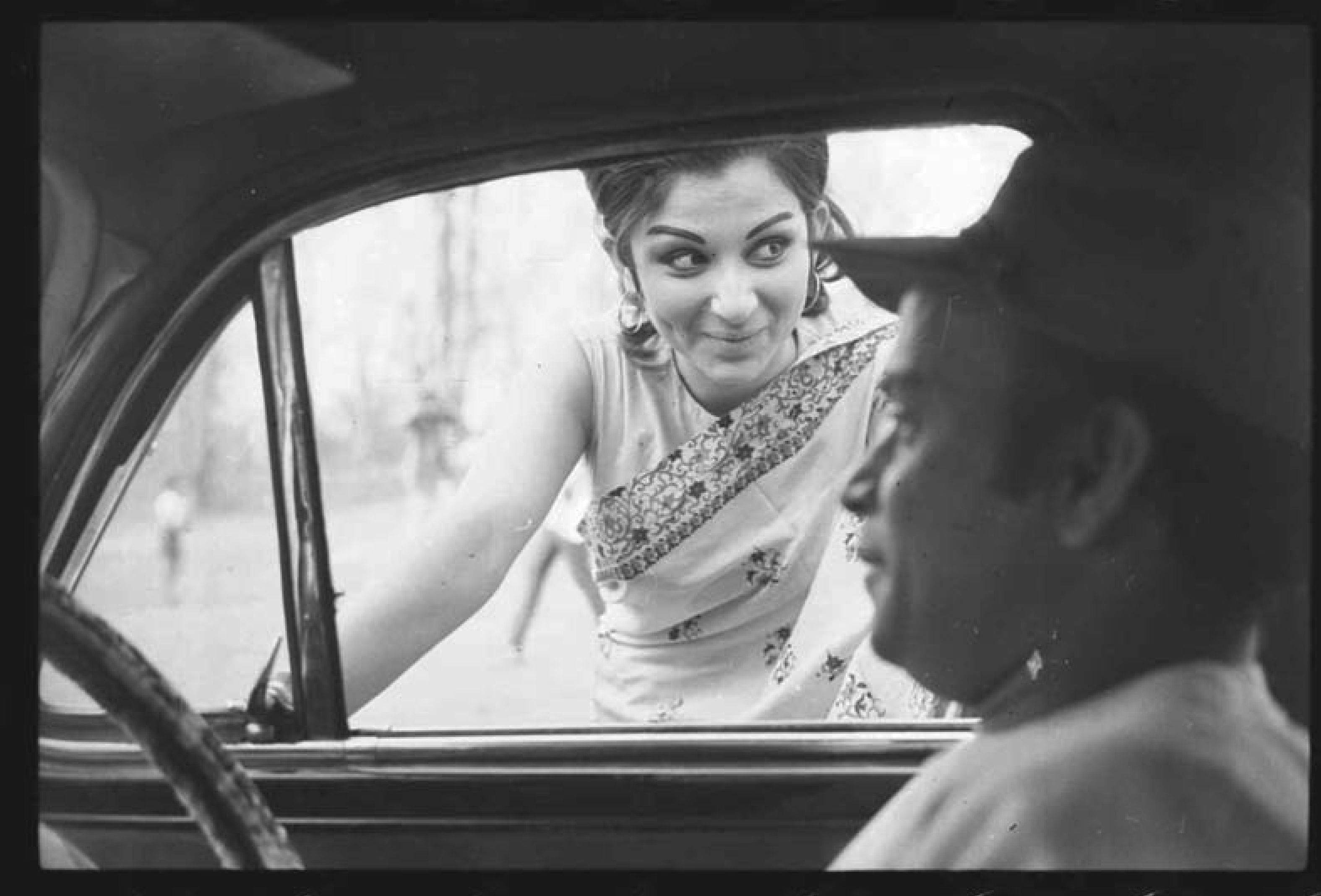
Nemai Ghosh’s portraits of Sharmila Tagore taken during intervening moments between shots seem to reflect this tension between the more reticent Aparna in Ray’s vision and a star who had many identities. For instance, Ghosh composes a glamorous portrait of Tagore through the contours of a car window as she chats casually with others outside the frame (Figure 2). In another photograph, she sits at a window of the bungalow with hair pinned down in preparation of the role (Figure 3). Among the many stills from the sequence where Aparna is first introduced in slacks and shirt, we witness an “interruption” as Tagore momentarily steps out of the role using the same accoutrements as her character in the film. Wearing sunglasses and a hat belonging to Sekhar in the film (Robi Ghosh), Tagore strikes a jaunty pose against the doorway of the forest bungalow becoming the fashionable Bombay star (Figure 4). In these arrested moments, our appreciation of the image is less likely to be derived from Ray’s vision that filters through in other production stills of the scene. Instead, we recognize these stances to be similar to popular pin-ups or other glamorous photographs even as we draw upon other kinds of circulating knowledge about the career and off screen life of stars like Tagore. 6 By 1969, Sharmila Tagore had already delivered three big hits in Bombay—Kashmir ki Kali (1964), Waqt (1965), and An Evening in Paris (1967). In 1966, she created controversy by posing on the cover of Filmfare in a bikini and then made an informed decision to diversify her screen image through films like Aradhana (1969) and Amar Prem (1972). However, she continued to make more radical choices in her personal life as she had an inter-religious marriage and sustained her career long after marriage. 7 Tagore’s background was key to her stardom—she came from a literary Bengali family even as she chose to be in the “commodified” world of Bombay cinema. She became a leading star in Bombay but simultaneously she continued to act in Ray’s films. Our reading of these photographs is mediated by all this information about Tagore. Her star persona defied any single representation, which may account for the anxiety of Andrew Robinson for whom melancholia was inconsistent with Ray’s sartorial choice for Aparna. There are similar insights in Ghosh’s portraits of Simi Garewal who played a sensual Santhali woman in Aranyer Din Ratri. In the primitivist imagination of many photographers in the 1960s, the tribal woman was “pre-modern,” closer to nature and untouched by “civilization.” Nemai Ghosh recalls how Garewal was “turned” into a Santhal woman with make-up that took three hours to transform the colour of her skin. 8 As with Tagore, his candid photographs of the shoot draw attention to intervening moments during this transformation when Garewal returns the gaze of the camera with the practiced smile of a professional.

Sharmila Tagore Between Shots During the Filming of Aranyer Din Ratri (1969).

“Striking a Pose” in a Moment Between Shots During the Filming of Aranyer Din Ratri (1969).
In the next of Ray’s urban trilogy, Seemabaddha, Sharmila Tagore plays the role of Tutul, the sister-in-law of Shyamalendu, an ambitious company executive in a multi-national Calcutta firm (Figure 5). On her first visit to the home of her sister, Tutul, who lives in Patna, seems fascinated by the sights and sounds of the city. She experiences the sensorium of the race course, clubs, swimming pools and nightclubs as she is introduced to the world of the “boxwallas” by her brother-in-law. Through Tutul eyes we also witness Ray’s critique of the shallowness of this world which culminates in her disillusionment with her brother-in-law. While he is harshest on Shyamalendu, the urban trilogy has many vignettes of consuming women engaged in toiletry or adornment. I will discuss one of them in Seemabaddha. As part of her “tour” of urban pleasures, Tutul accompanies her sister to Eve’s beauty parlor in New Market. We witness this through Tutul’s eyes as she stands at the entrance overwhelmed by the sight and the sounds of dryers, music, and chatter. Her sister beckons her but Tutul stands at the threshold, hesitant to step in. In Nemai Ghosh’s documentary photographs taken during filming, “Tutul” enters Eve’s. In these images, we see Sharmila Tagore with her hair under a dryer. Reflections in the mirrors lining the walls of the salon create many shapes and patterns and draw attention to the figure of Ghosh as he takes photographs (Figure 6). By the 1950s, magazines like Filmfare often carried features on star fashions or hair styles, but these carefully constructed images only presented the “finished product.” 9 Ghosh’s photographs are extraordinary as they draw attention to different interventions that helped create the idealized presence of the star—of regimes of the body (through the beauty and fashion industries) as well as photography that circulated the star body. Ghosh recalls how one of these stills of the star “in the making” was published in JS (Junior Statesman). 10 His photographs also seem to blur the distinctions between the star and ordinary women. The beauty parlor has often been viewed as a comforting social space where women relax as they shut out the pressures of work and domesticity. Engrossed in a racy novel as her hands are manicured, Tagore is one among the many women enjoying fleeting moments of leisure as she pampers herself in the salon. Her presence does not seem to interfere with the business at Eve’s as other women chat and are attended to in the background. The final shots of this sequence transform the ordinary woman—Ray’s “Tutul”—into the glamorous Bombay star as her rollers are removed to reveal a short and trendy hairstyle (Figure 7).
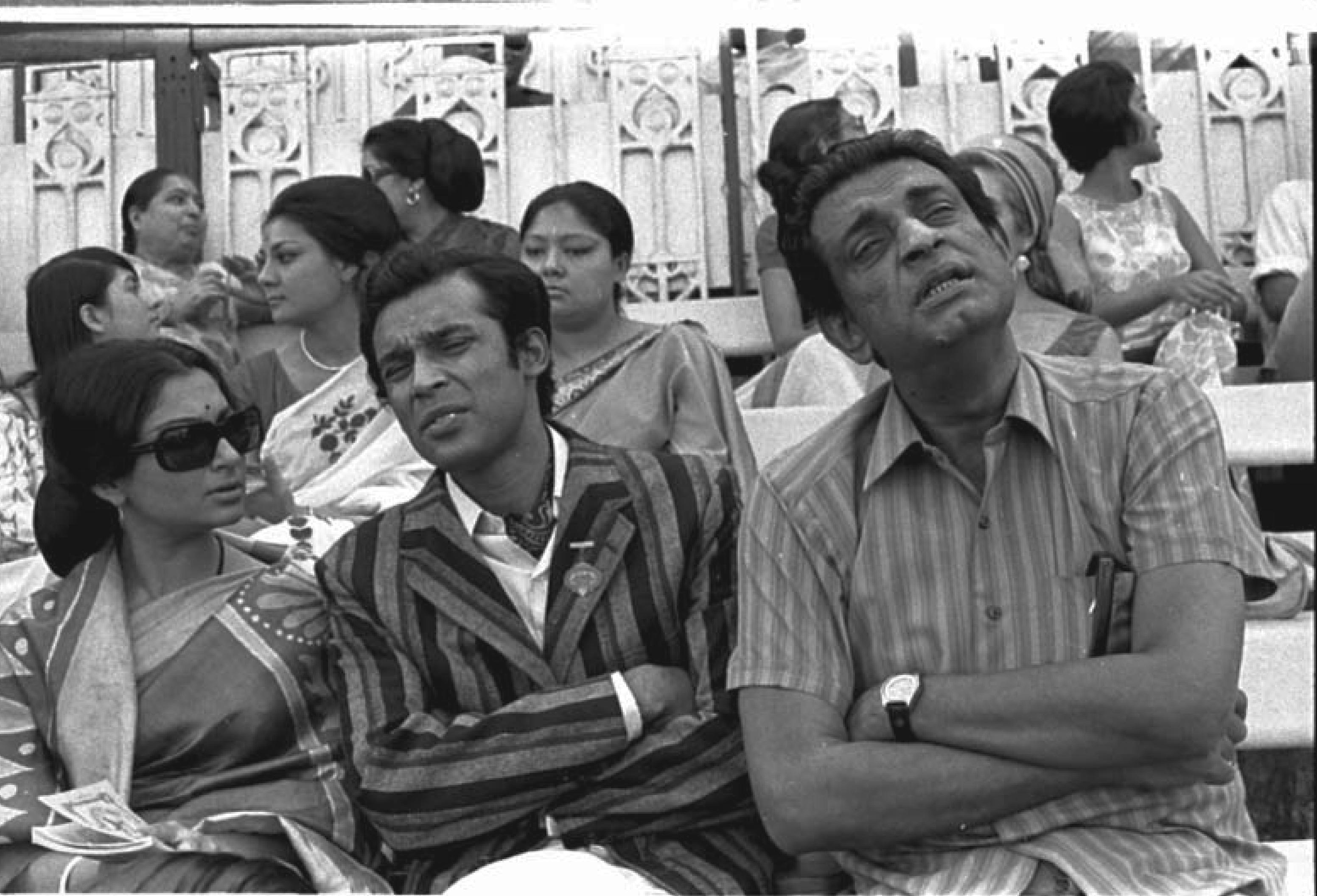
Satyajit Ray directing Sharmila Tagore and Barun Chanda on the sets of Seemabaddha.
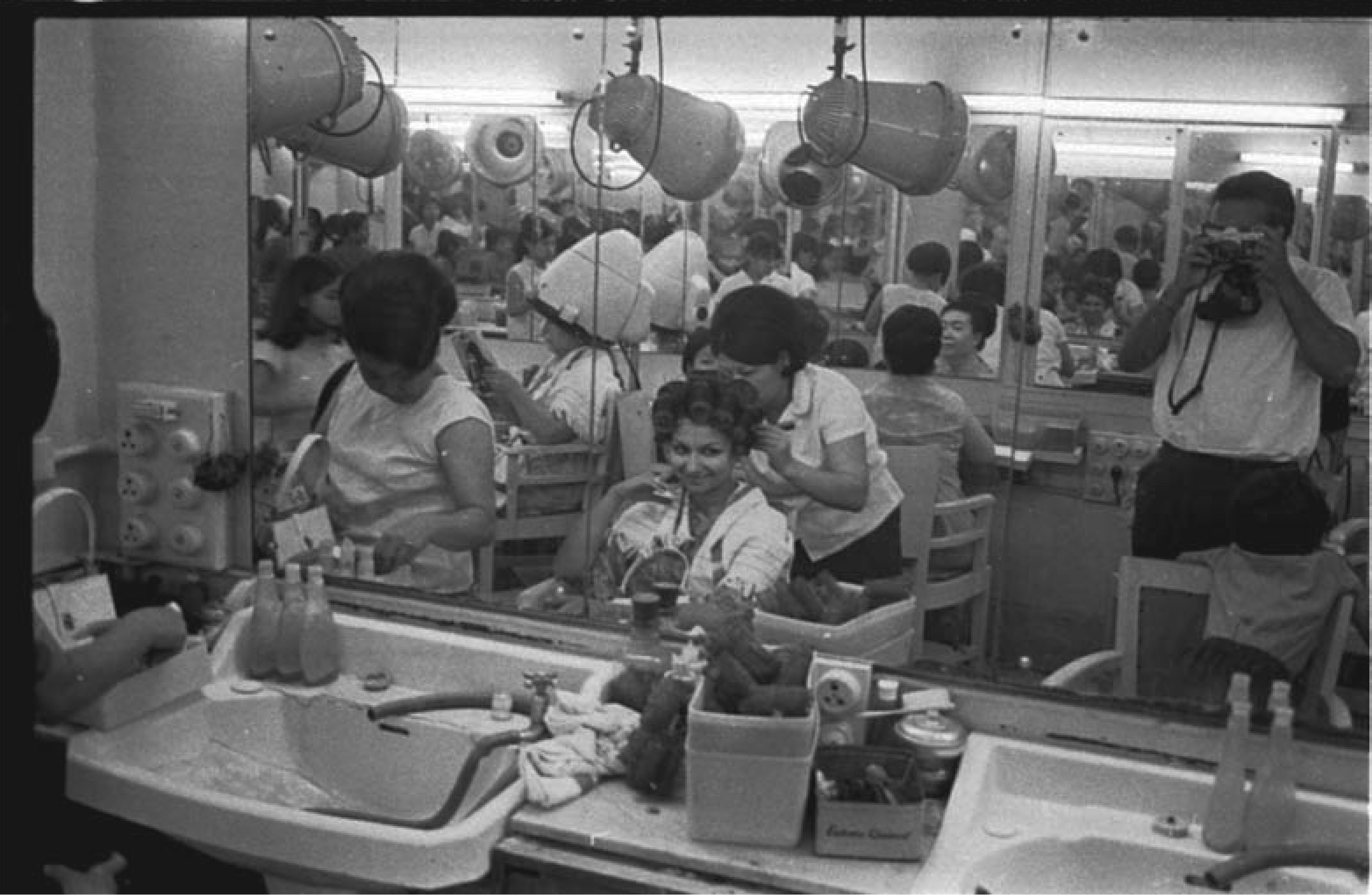
Sharmila Tagore during a break from the shooting of Seemabaddha (Company Limited, 1972) in Eve’s Beauty Salon. Nemai Ghosh can be seen in the mirror.
Tagore was so impressed with Ghosh’s photo session in Aranyer Din Ratri that she gifted him with a lens. This was to be the beginning of several portfolio shoots that documented other female star images who straddled the worlds of Bengali and Hindi cinema. For instance, Tarun Bhaduri once approached Ghosh to do a portfolio for his young daughter who had just completed a course in acting at the Film Institute at Pune. The photographs from this shoot reveal a very young Jaya Bhaduri (she had appeared in Mahanagar by then) in everyday spaces such as the home, traveling in a taxi, making an offering at the Dakineshwar temple, or framed against a tram on a busy Calcutta street. Clad in simple printed cotton saris or wearing flared pants, lungis and maxis like other teenagers of the time, these candid photographs draw attention to Bhaduri’s star persona that emphasized her “simplicity” and “spontaneity.” She leaves her long hair open and uses no make-up as the photographs reveal her mercurial facial expressions. These images reflect Bhaduri’s “girl next door” image at the time. 11 Magazine shoots and interviews by the actress as well as her presence in several important roles (especially Guddi, 1971) reinforced her “ordinariness.” Shot in a cotton sari for one of her interviews, Jaya Bhaduri discussed how she never insisted on expensive costumes: “My emphasis is on simplicity and not on glamour.” 12 Ghosh recalls an incident when she was mistaken for an “ordinary” young woman. Catching sight of Bhaduri standing on the balcony of a friend’s home, a group of school girls passing below remarked in Bengali, “Look, she looks so much like Jaya!” Ghosh’s documentary photographs on the sets of Sadhu Judhistirer Karcha, 1971, however, draw attention to the differences between school girls and Jaya Bhaduri. In some images, Jaya poses with her fans and looks at a scrapbook of her own photographs evoking the memory of a similar sequence in Guddi where she plays a star-struck teenager. In another set of stills the actor cools herself with a small motorised hand fan as she waits endlessly with Gouri Mitra to take her shot (Figure 8). Instead of focussing on the glamor of appearing before the camera, these photographs draw attention to the disguised labor of stardom. They signal the fatigue of waiting and moments when nothing seems to happen on the sets.
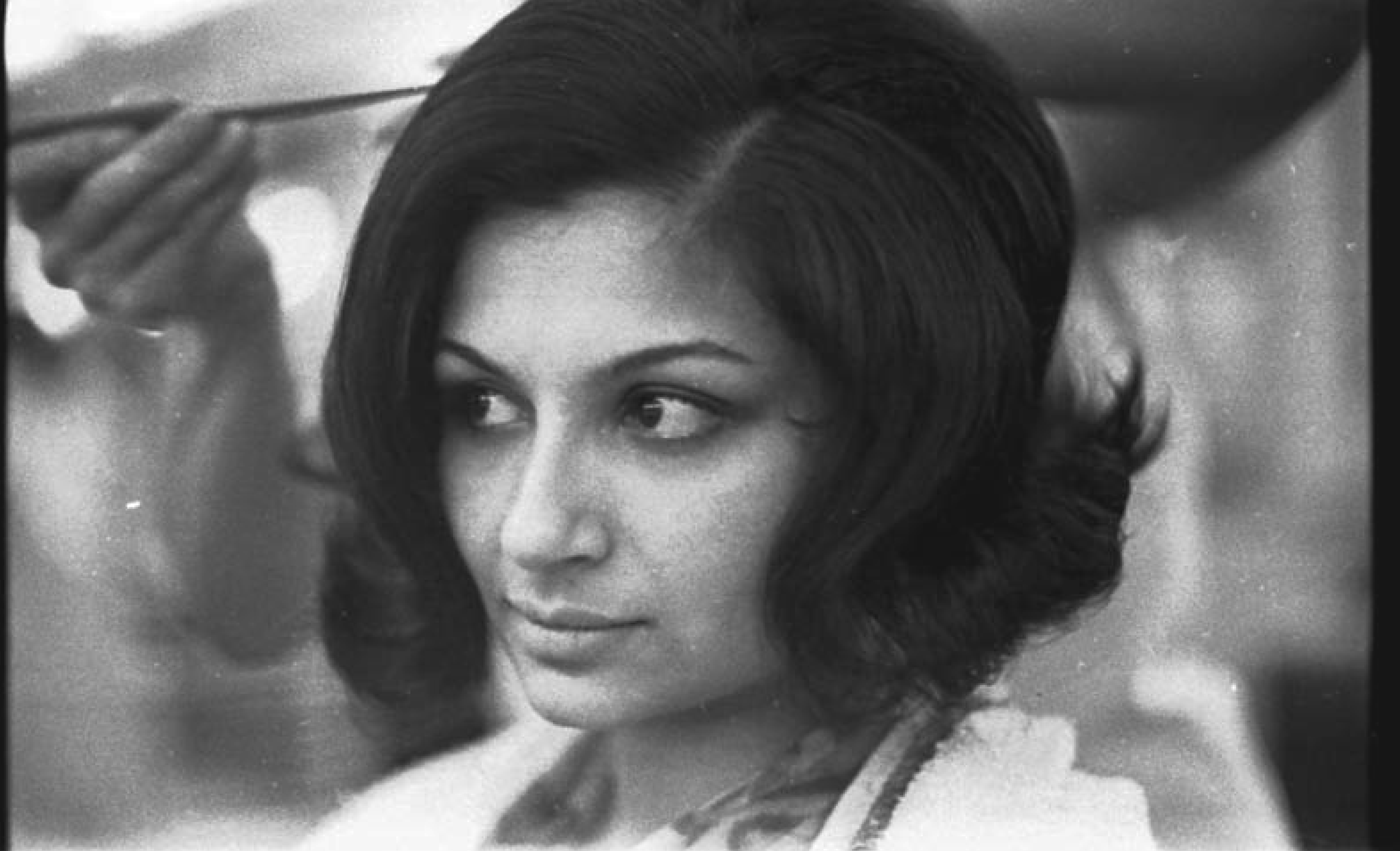
Sharmila Tagore in Eve’s Beauty Salon during the shooting of Seemabaddha where she emerges with a fashionable bob. In the film she does not enter the parlour.
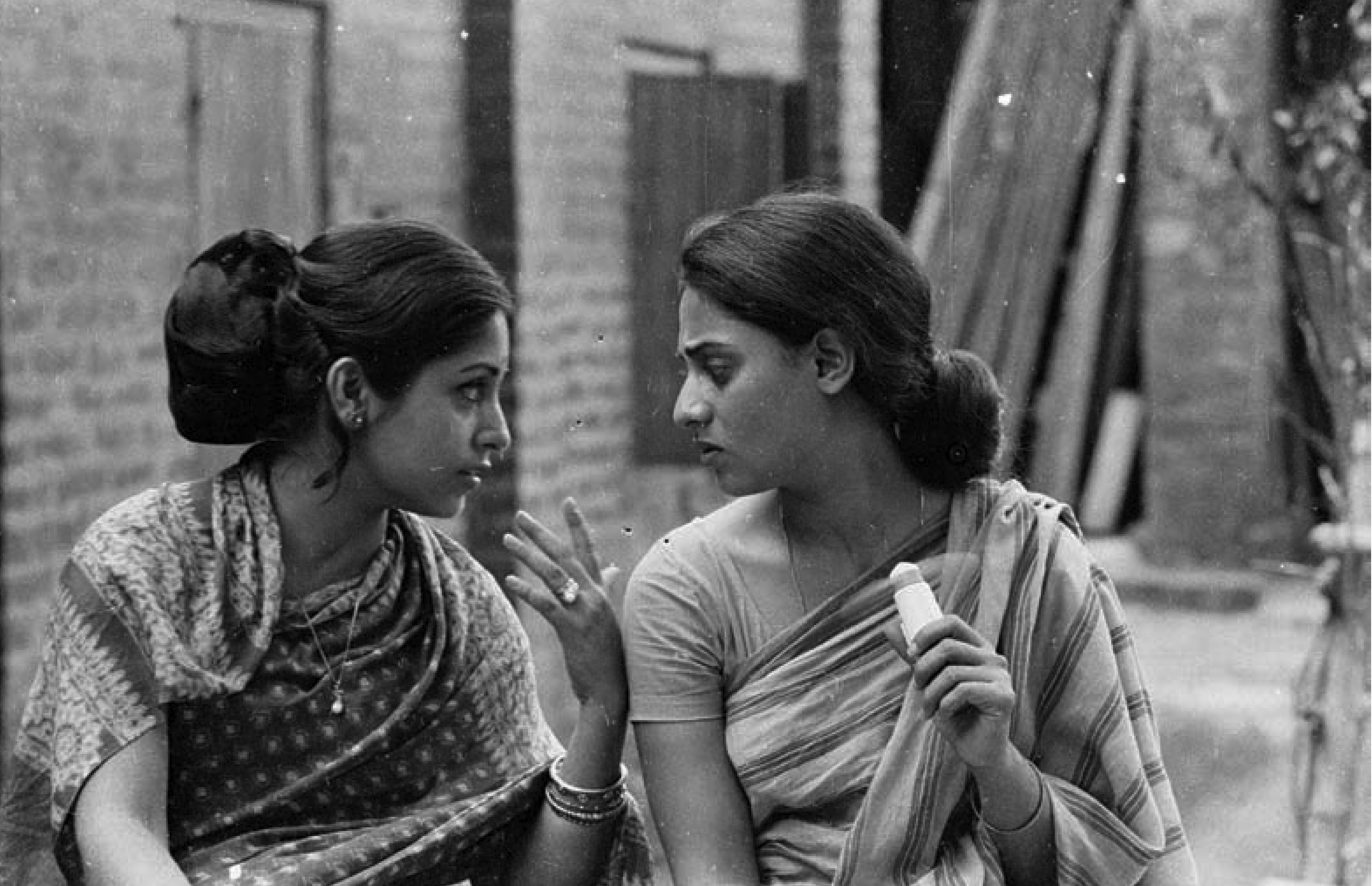
Jaya Bhaduri cooling herself with a motorized fan as she waits with Gouri Mitra for a shot on the sets of Sadhu Judhisththirer Karcha, 1971.
A decade later, Nemai Ghosh captured a pensive and thoughtful portrait of another very talented actor who was in Delhi to receive a National Award for her performance in Chakra, 1980. Though Smita Patil had a much longer career in mainstream cinema, she was mostly remembered for her roles in the films of the Indian New Wave of the 1970s and 1980s. Patil’s stardom was marked by her distinct appearance (little or no make-up that was often described as her “natural” look) and her “socially committed middle class background” (Gandhy & Thomas, 1991, p. 125). Despite the criticism of her “plain” appearance in the commercial industry, Patil had come to be recognized as an intelligent and spontaneous actor who was extremely conscious of the value of advocacy in the roles she played. Her career was cut short by her premature and tragic death in 1984. On the sets of Ray’s Sadgati (Deliverance, 1981), Ghosh documented one of her most memorable performances. Surrounded by buffaloes, the stricken and equally mute Jhuria registers the death of her husband. Off the sets he captures her interest in photography through a series of candid shots. The most extraordinary of these is an image of “Jhuria” shooting with a telephoto lens! (Figure 9).
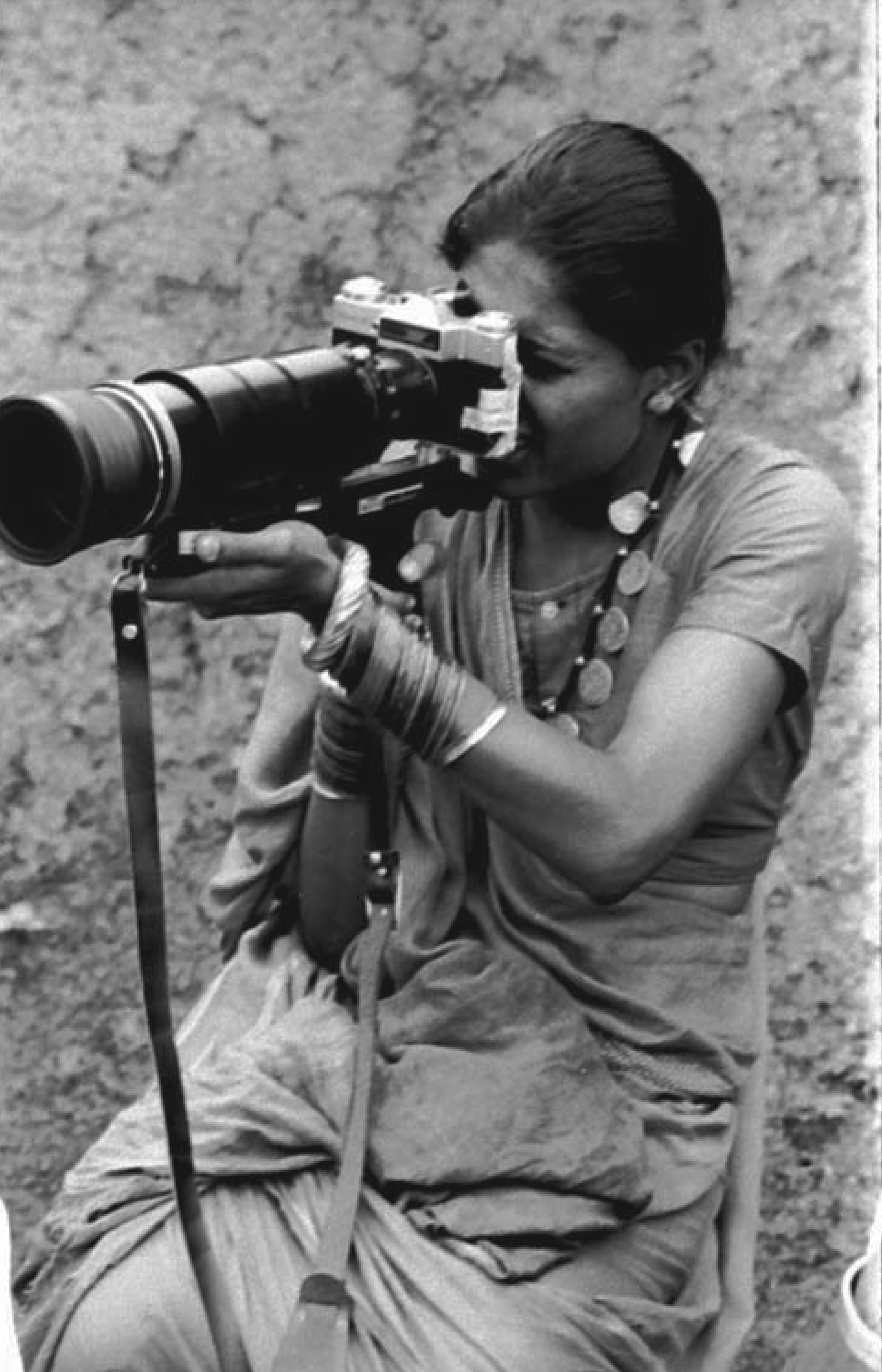
Smita Patil photographing with a long lens on the sets of Sadgati (Deliverance, 1981).
Besides documenting actors in Satyajit Ray’s films, Nemai Ghosh’s portraits also pay tribute to other memorable performances in popular Bengali cinema. One of his shoots features Supriya Choudhury at a studio session at Bourne and Shepherd in Calcutta. Known for her powerful performance in Ritwik Ghatak’s Meghe Dhaka Tara (The Cloud Capped Star, 1960) and Komal Gandhar (A Soft Note on a Sharp Scale, 1961) Choudhury’s off-screen romantic relationship with Uttam Kumar is well known in Bengal (Guptoo, 2010, p. 185). Ghosh’s portraits of a more mature Supriya Choudhury taken for a jatra shoot (Choudhury reinvented herself in theater and television after her career in cinema was over) can be juxtaposed interestingly with his photographs of another legendary actress from Bengal who chose to disappear from the public eye once she started to age (Figure 10). Far more famous than the “real-life” couple, Suchitra Sen and Uttam Kumar were a legendary screen couple.
13
Suchitra Sen was photographed by Nemai Ghosh in one of her last screen appearances in Bankim Chandra’s Devi Chaudhurani, 1974. In accepting Dinen Gupta’s film, Sen had done the “almost unthinkable” (Guptoo, 2010, p. 184). She had refused the same role offered by Ray as he had wanted her to sign an exclusivity clause during the period of the shooting. She stopped acting soon after this. An appreciation of Ghosh’s portraits of Suchitra Sen and Supriya Choudhury is heightened by circulating knowledge about their stardom that included not just their screen persona but knowledge of their off screen lives as well. Ghosh’s portraits of Sen’s daughter Moon Moon, who bears a striking resemblance to her, continue to draw attention to Sen’s absent presence.
14
For Roland Barthes, the photograph with its paradoxical representation of absence and presence had a melancholic association with death. In a more personal tribute to Greta Garbo, he reflected on how freezing her face in photographs would forever represent a mythic, unattainable and almost divine ideal of beauty. The same could perhaps be said for these portraits of Suchitra Sen:
… the essence was not to be degraded; her face was not to have any reality except that of its perfection, which was intellectual even more than formal. The Essence became gradually obscured, progressively veiled with dark glasses, broad hats and exiles; but it never deteriorated (Barthes, 1973, p. 63).
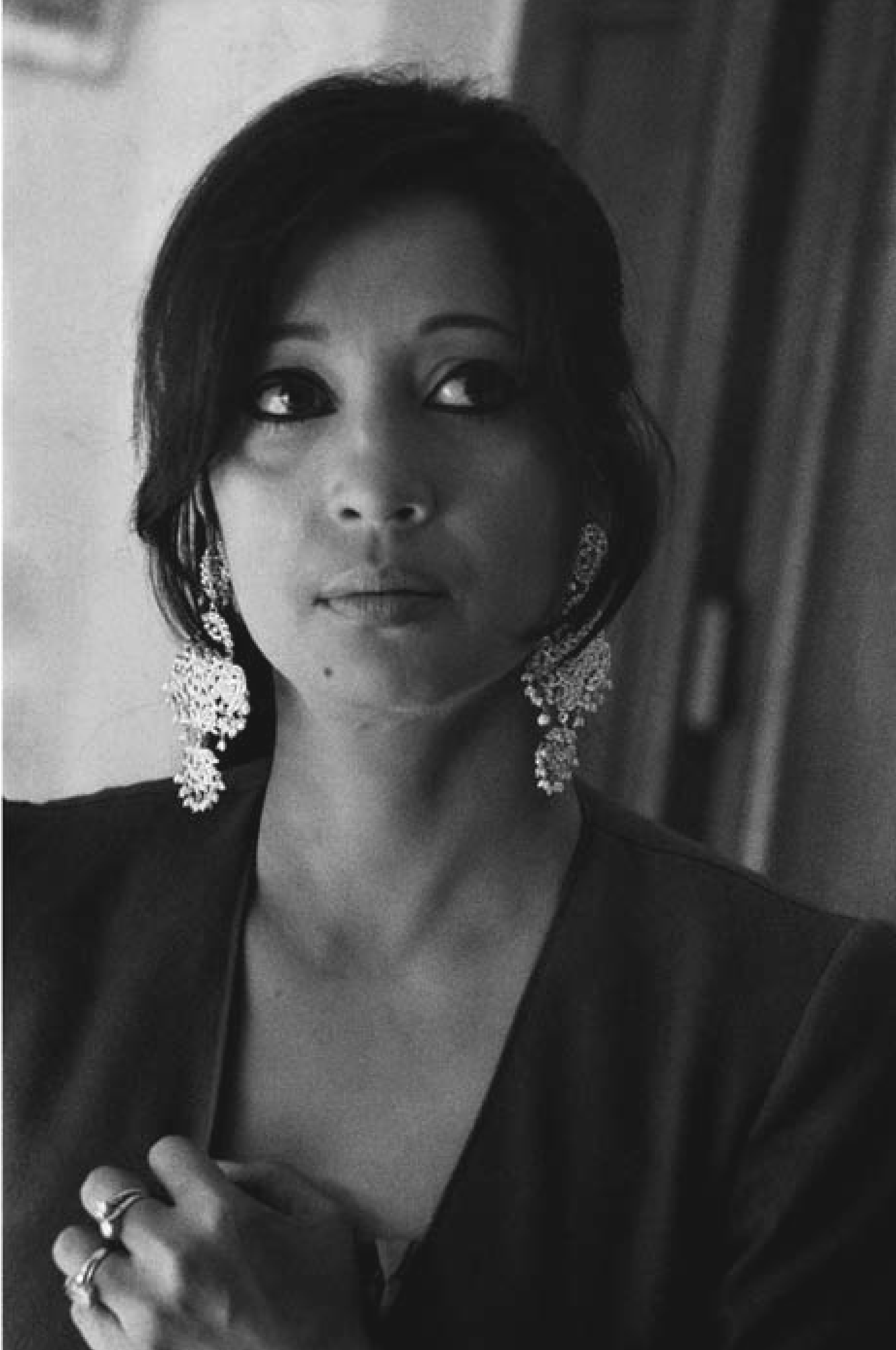
The elusive Suchitra Sen
One still in the Nemai Ghosh collection features the photographer himself, taking a light meter reading of Satyajit Ray in his study with another heroine. 15 Beginning her career with Ray’s Samapti, Aparna Sen became one of the most significant stars of Bengali cinema articulating a refreshing modernity as well as sexual assertiveness, particularly in roles where she played the urban working woman. Her films, many of them with Soumitra Chatterjee, also represented, like Uttam–Suchitra, a “hit pair” of the 1960s. Sen turned to directing films even as she continued to act. She was photographed by Ghosh directing Shabana Azmi on the sets of her own film, Sati, 1989 (Figure 11). Another set of pictures captures a young assistant of Satyajit Ray as she controls crowds on the sets of Jana Aranya. Suhasini Mulay was already a known face after her debut in Mrinal Sen’s Bhuvan Shome, 1969. Ghosh frames her in a series of casual portraits as she lounges wearing bell bottoms and a shirt. The photographs are marked by their unhurried air and a sense of comfort between the subject and the photographer. Ghosh also took a series of candid pictures of another non-Bengali actor with a huge presence in popular cinema when she came visiting Sharmila Tagore on the sets of Seemabaddha. Tanuja had already made a mark for herself in films like Anthony Firingi, 1967, Rajkumari, 1970, and Prathom Kadam Phool, 1970. The photographs pay homage to these memorable actors and iconic screen performances.
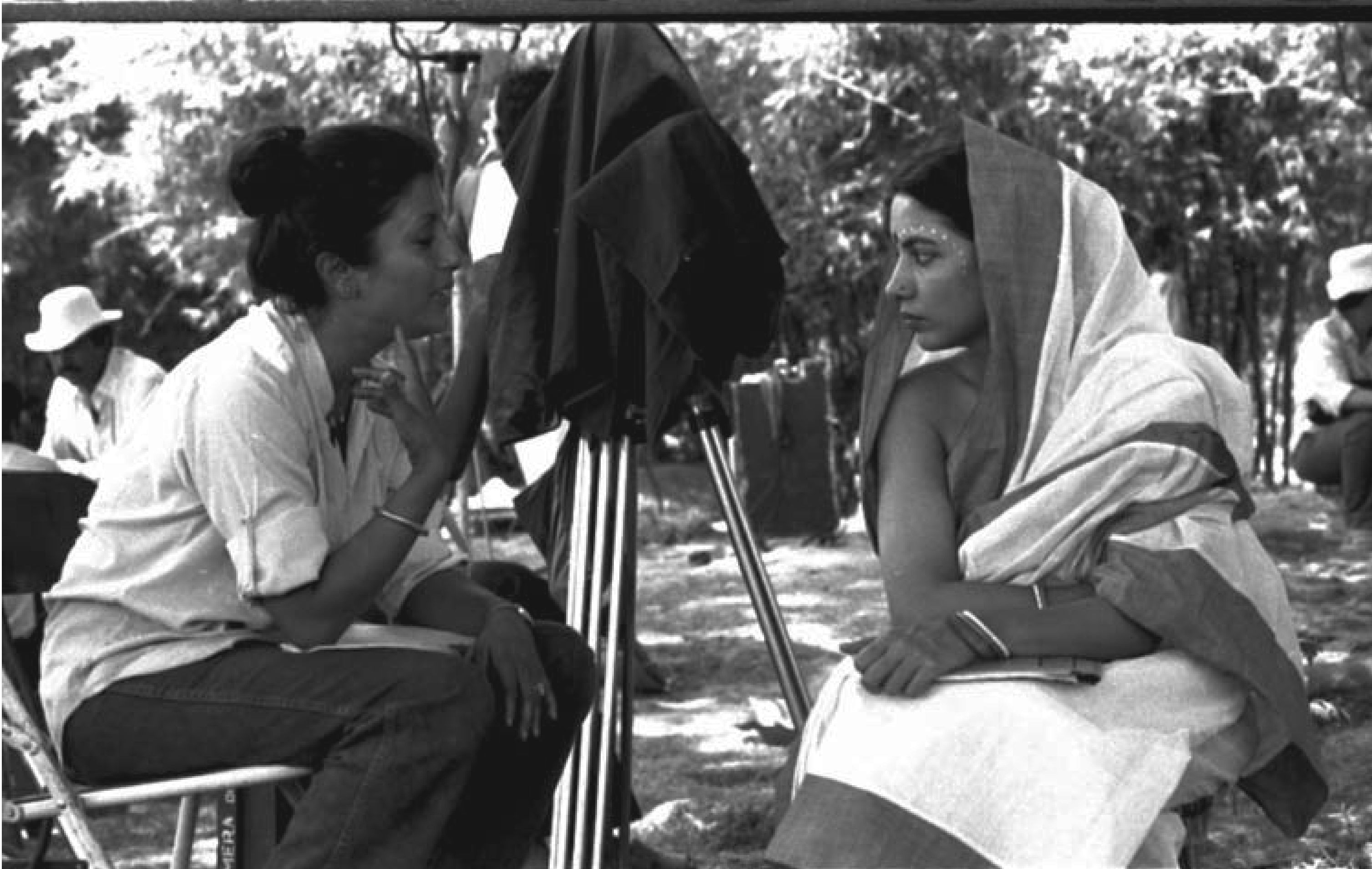
Aparna Sen directing Shabana Azmi on the sets of Sati, 1989
As photographers turned to color, star images also circulated through advertisements and endorsements printed in glossy magazines. The 1970s marked the moment of the “blends” when the textile industry embraced photography with enthusiasm to showcase their printed fabric and saris. Durga Puja was a particularly important time in Calcutta when advertisers and publicists cashed in on photographs of actresses modeling saris in the Bengali magazine Anandlok. 16 Coveted as souvenirs, these bumper issues turned even Bombay stars into bradramahilas. Nemai Ghosh shot Shabana Azmi, Poonam Dhillion, Zarina Wahab, Anuradha Patel, Kalpana Iyer, Smita Patil, and Debashree for the magazine. Of course, the emphasis of these photographs was on the beauty of the sari as the actor held out the anchal or displayed it prominently by pulling it over to the front. Marking a break with the classic and somewhat stiff sari pose of the early 1960s—with the garment draped tightly around the figure, the leg bent at the knee, and one hand held out with the anchal—the models in these photographs were captured in outdoor locations in more kinetic and imaginative stances. For instance, images of Debashree show her straddling the pillars or lying languorously on the steps of Victoria Memorial. The photographs pay homage to the sari that could never be displaced as a fashion statement in Bengal. Nemai Ghosh also shot scores of personal portfolio shoots of unknown young women that bear witness to other kinds of desires and aspirations for glamour. Set against the backdrop of the arrival of satellite television and the explosion of images of beauty and fashion, these photographs depict many aspiring Sutapas from the 1990s (Figure 12). The fascination and fears of Siddhartha about the sexuality of his sister in Pratidwandi seem to find full expression with these images that reflect how many more women wanted to be like her.
Spanning over four decades, Nemai Ghosh began work in an era long before the popularization of television, when photographs were among the only forms of star publicity. While Ghosh always appeared to have been shadowed by the presence of Satyajit Ray, his documentary photographs reveal narratives that extend beyond Ray’s vision. Ghosh’s large archive of photographs taken both on and off the sets of Ray could be seen to constitute a museum of cultural memory that pays tribute to iconic female performers in Bengali cinema. As these photographs collide with our recollections of these stars and the roles played by them, they continue to prompt new stories and memories. This is the enduring and constantly evolving legacy of Nemai Ghosh’s versatile body of work.
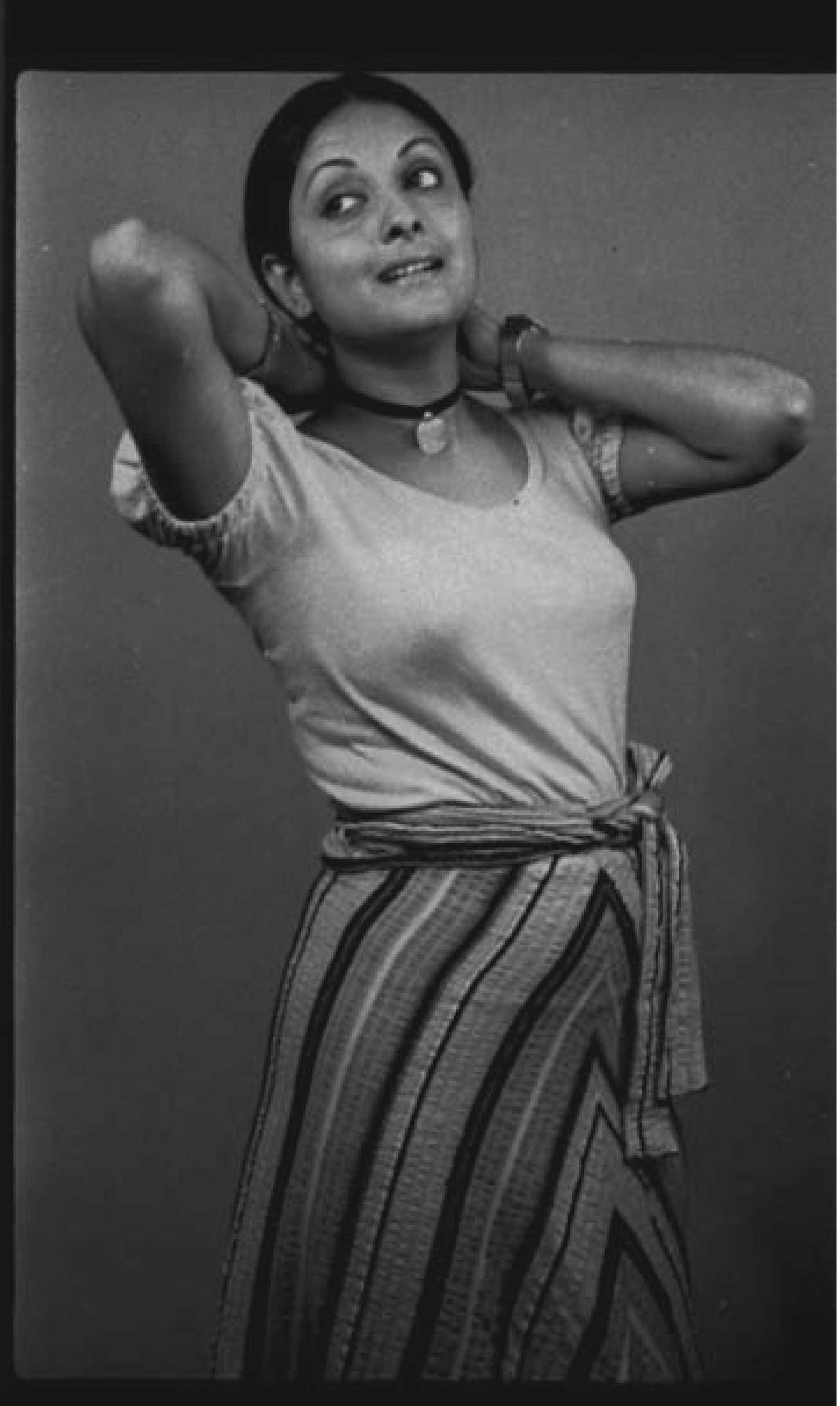
Soma Dey, Calcutta. Nemai Ghosh’s photographs of aspiring actresses in the 1990s reflect a desire for glamour and fame.
Footnotes
Acknowledgements
I am grateful to Sharmila Tagore, Shohini Ghosh, Shikha Jhingan and Ranjani Mazumdar for valuable insights and suggestions that helped clarify my arguments. Thanks are also due to Kishore Singh for making it possible to use images from the Nemai Ghosh collection.