




Abstract
Over the course of the last 18 years, privatised television news channels have transformed the nature of the national news culture in Pakistan. In addition to sensational news packaging, leading current affairs talk-show hosts routinely capitalise on aggressive interrogative tactics to antagonise politicians on air, producing a dramatised performance that feeds a politics of publicity. Within this context, the emancipatory potential of television once celebrated through media deregulation in the early 2000s has since been replaced with a disdainful liberal discourse on the lack of critical-rational debate. Based on in-depth interviews with a range of television news professionals in Karachi, I explore how Pakistani news media professionals negotiate the tension between a principled commitment to protecting the ‘independence’ of mass media and a cynical disavowal of its existing forms. Sensationalist media programming is certainly not unique to Pakistani television, and an increasing interest in postcolonial news publics continues to provide much needed perspectives from non-Western models of journalism, yet I believe a scholarly focus on media sensationalism remains impoverished without an understanding of the contextual constraints within which television news producers mediate their livelihood. In this article, I argue that the prevailing discourse on the ethics of journalism in Pakistan becomes a productive site through which the differences between privileged and vulnerable media labour emerge as most apparent.
Introduction
What I’ve come to realise after coming to ‘the dark side’ is that our job is to give the news to people – and if not enough people are watching, then we’re doing a disservice to the news as well. So, I feel that the ends justify the means. Using apocalyptic Hollywood footage to sell a story on climate change, or using Amitabh Bachchan saying a filmy dialogue to an underworld don to talk about real crime gangs, I’d say ‘yeah, okay that’s alright’…if you aim to sell climate change, then that’s a justified end. Can you imagine trying to get people to watch ‘An Inconvenient Truth’ with Al Gore just sitting there and talking to you?’ (Bilal, Executive Producer, GEO News)
It was a rhetorical question, and before I could use the moment to push back, Bilal soldiered on, defending his decision as an executive producer to introduce Hollywood film scenes of molten lava and thousand-foot waves crashing on cities, as the kind of visuals required to hook audiences on a discussion of climate change on his prime-time news show. Addressing himself as a former ‘print journalist snob’, he recounts how he surprised even himself by transferring from his previous job as a political reporter at an English newspaper to ‘the dark side’ of Pakistani journalism, i.e., Urdu television news. This dysphemism assumed various forms over the course of my fieldwork carried out in Karachi between 2014 and 2016 and its negative connotations continue to frame the public commentary on Pakistani news media. Since the deregulation of the electronic media industry in 2002, privatised television news channels have effectively transformed the nature of the national news culture in Pakistan. Indeed, the context of the emergence of these news channels weighs heavily on the evolution of the media industry over the past 18 years. Although much has changed in the industry since my fieldwork ended in 2016, 1 I argue that an ethnographic analysis that contextualises the rise of sensationalist television news in Pakistan can throw light on enduring, broader questions around how certain broadcast news-making practices unsettle the quintessential image of independent mass media as the guardian of liberal democracy, particularly as the authority of television news journalism becomes increasingly destabilised on a global scale.
During General Musharraf’s regime (1999–2008), Pakistan’s economy was liberalised and his government ushered in an information revolution by implementing new media laws, which finally broke the state’s 40-year-long monopoly on electronic media. While the issuance of TV broadcasting and FM radio licenses to private media outlets was largely seen as a positive development, there was no framework in place for regulating cross-media ownership, thus paving the way for powerful private investors to gain political influence. It was during the critical series of events of the Emergency in 2007 that the newly privatised media gathered much of its image as one of the political ‘game changers’. 2 Musharraf’s envisioned liberalisation of Pakistan eventually unraveled into a series of political blunders – highlighted and criticised by the many news channels he was so proud of having introduced. 3 The remarkable civil movement that demanded Musharraf’s resignation from power in 2008 lauded the media for maintaining pressure on the military regime (Shafqat, 2017) – a phase that required an evolving television industry to quickly turn revolutionary. Buoyed by their success as a fourth estate, private Urdu language news channels sought to capitalise on the aggressive tactics displayed by leading current affairs talk-show hosts who routinely antagonised politicians on air, demanding answers from an inept government on behalf of viewing citizens. Heated arguments amongst talk-show guests over various crises inevitably involved the use of anti-Indian and anti-American rhetoric, peddled in religious conspiracy theories of ‘foreign hands’ attempting to dismantle the Islamic Republic of Pakistan. Often accused of sensationalism and unprofessional conduct, these channels and their content regularly provoke a discourse of anxiety, notably found in commentaries on the media in the English press. 4
Seasoned print journalists frequently bemoan the arrival of sensational and, more accurately, dramatised broadcast news packaging, where Bilal’s use of Hollywood footage as described earlier would be considered a tame example. Sonorous voice overs and dramatic video montages set to popular musical scores have become a regular feature in news packages, along with entertaining lyrics to align with the news of the day. 5 For many of my interlocutors, punching up the news with entertainment was not simply an aesthetic choice, it was an industry standard, practiced by more than 45 independent news channels, all of which were vying for the same slice of the advertising pie. Along with a transformed news broadcast style, current affairs talk-show hosts have adopted increasingly aggressive interrogation tactics to antagonise politicians on air. Drawing both local and international attention for their alarming acquiescence in stoking religious and sectarian conflicts, private news channels and their prime time anchors have been regularly accused of pandering to populist religious sentiments in a range of infamous episodes: from condoning assassinations in blasphemy cases, to providing airtime to antistate militant organisations, or popularising antigovernment protests. While many of the news media professionals, I interviewed would often pick out various aspects of dramatisation to express their dismay at what television news has resorted to, they would end up acknowledging with a shrug that it was all part of ‘selling the news’. Not surprisingly, this offhanded explanation was echoed largely by professionals in upper management levels of television news channels and, as I will later show, filters through the employee hierarchy to mould the expectations of entry-level news reporters.
In this article, I am interested in exploring the ways in which a particular class of Pakistani broadcast journalists negotiate sensationalist practices in television news, specifically those who have transitioned to the production of Urdu television news after working with English language newspapers. My initial focus on this exclusive professional cohort does not aim to privilege elite liberal anxieties, but rather to understand the contexts from which their critiques arise, and the implications of their relationship to power. The sociopolitical ramifications of a privatised media landscape in Pakistan has led to the rapid growth of an industry that must rely on an available labour pool of largely lower-middle-class applicants, with television news organisations having to train their entry-level employees on the job. Michael Hardt’s (Hardt,1999) characterisation of the postindustrial informational economy describes labour regimes as predicated on transactions involving knowledge, information, communication and affect. Arguing that ‘affective labour’ is one dimension of what he terms ‘immaterial labour’, Hardt suggests that ‘Since the production of services results in no material and durable good, we might define the labor involved in this production as immaterial labor – that is, labor that produces an immaterial good such as a service, knowledge or communication’. 6 Hardt points to how these sectors of the economy are ‘focused on the creation and manipulation of affects’ 7 and insists that while ‘affective labour’ was never outside the capitalist economy, it now represents ‘the very pinnacle of the hierarchy of labour forms’. 8 Indeed, anthropologists and academics working with journalistic communities in a variety of countries have shown that this kind of affective labour manifests itself in many forms of producing news, particularly under the widely acknowledged transformation of the global news industry through digital media practices (Boczkowski, 2009; Boyer, 2010; Boyer & Yurchak, 2010; Gursel, 2016). In the case of Pakistani lower-middle-class journalists, I will later describe how the practices entailed in such affective labour have to follow an industry standard, which means not only compromising ethical convictions in the line of duty but also being willing to participate in the very real front lines of the ratings battles so ardently fought between private media groups and their owners.
For now, I will return to my focus on Pakistani elite news professionals, by foregrounding their anxiety surrounding affective Urdu television news, particularly as it mediates an increasingly complex set of claims on representation and authority in public culture. This anxious discourse becomes an important signifier of both the liberal desire for independent mass media in a modernising society as well as the liberal aversion to mass-based politics. Through this lens, I am interested in looking at how the cynical disavowal of sensationalist practices in Urdu news television turns on the ways in which uneducated mass audiences are figured as an emergent consuming class in an increasingly urban and postliberalised Pakistan. What are the ways, then, in which affective television news becomes a form of mediation that is both constitutive of, and produced by, the discursive and material forms of public culture?
Much of the hand wringing over the considerable lack of ethics in Pakistani journalism plays out in the English-language print media. Listed as one of the official languages of Pakistan, the use of English indexes a framework of social difference – where the colonial remnants of the prestige of English continues to act as a marker that identifies fluent users as modern, critical-rational actors who, by the nature of this prestige, belong to the minority of the privileged few. This language divide is reflected in the variety of mass media available, with English newspapers that can be traced back to prepartition print, alongside the continuing transmission of BBC-Urdu Radio. The Urdu-dominated television industry, however, can be more recently located in the grip of advertising revenue that fuels private television programming. While regional language channels are few, they still manage to sustain their business operations in contrast to the confirmed failure of English language channels. The media landscape of recent years is a telling example of the effective ways in which privatisation allows market forces to mould the propagation of certain channels vis-à-vis other social divisions, such as language. 9 Where state television had media policies in place to unify a disparate population linguistically, the aim of privatised media outlets includes diversifying their audiences’ purchasing power by offering content in multiple languages. In 2004, an amendment allowing cross ownership of media led to the consolidation of powerful media groups. While the first players on the scene were mainly prominent newspaper groups, quickly launching satellite television channels and FM radio stations, a number of business groups with commercial conglomerates moved into the media landscape to further stretch the lucrative scope of television advertising as well as building political capital for themselves. During 2014–2016, there were 45 independent news channels operating in Pakistan, and my analysis here will focus on the responses of broadcast journalists employed by three specific media groups – GEO, Dawn and Express – all of which had launched English news channels in the mid-2000s that were short lived, (GEO shut down in 2008, Dawn English had to switch language formats in 2010 and Express 24/7 ended in 2011). Originally hired for their elite English language skills, these broadcast journalists turned to Urdu-only news channels in order to remain working in the television news industry. My access to these interlocutors was no doubt facilitated by my own employment at GEO prior to graduate school in addition to cross referencing a particular social-professional network in Karachi that privileges Western-educated Pakistanis with cultural and social capital on their return. I was invited into media organisations to observe news production at work, I sat in during professional training seminars, and I would interact with my interlocutors at social events as well. While this elite class of journalists did not consider me as a professional peer, their responses during interviews clearly mark an assumption of our shared cultural capital through our fluency in English and higher education – and as much as I pressed for clarifications, the examples extracted for this paper will illustrate how understandings of what ‘valid’ news practices should be often went unarticulated in comparison to the derision of actual news practices currently in place.
The Costs of Attracting Advertisers
Bilal (pseudonym) is in his early thirties, relatively young to be the executive producer for one of the highest ranked news programmes on GEO News and yet he is emblematic of the kinds of rapid professional mobility granted to English-educated journalists in the news industry. Lured from the ‘echo chambers’ of liberal print media, Bilal was attracted to the opportunities of being able to reach a vastly wider audience through television news. As he mentions though, having the potential to access mass audiences does not always translate in gaining their attention:
It’s quite frustrating because you will do shows that you think are really good but there will be no ratings that day because your competitor is Dr. Shahid Masood and he’s churning out conspiracy theories on the other channel about how Nawaz Sharif [then prime minister] and Raheel Sharif [then army chief] differ over the colour of their ties! The challenge has been very real – in television, the numbers are really important. You want quality journalism certainly but you also want audiences – those numbers are so tangible; in TV ratings, those numbers are not only instant, they’re also public. Television is so expensive to produce that you want, you need advertising. (Bilal, Executive Producer, GEO News)
Housed under the Jang Group, which owns the country’s largest circulating Urdu newspaper, GEO News emerged as one of the first private Urdu news channels after the deregulation of the media industry in 2002. GEO quickly became an infamous brand for introducing a sensationalist news reporting style to a nation that had only known terse and sober news broadcasts from Pakistan Television (PTV), the sole state television network for decades. Bilal’s frustration over losing viewers to talk-show hosts peddling conspiracy theories on rival channels is both valid and ironic, given that this particular competitor, Dr. Shahid Masood, gained much of his fame through his years of hosting a current affairs talk show on GEO News itself. One of the many open secrets of the industry is that the astronomical salaries awarded to Pakistani prime-time anchors ensure that their news–analyst–personality–brand (and their audience following) can only be bought at a very high price.
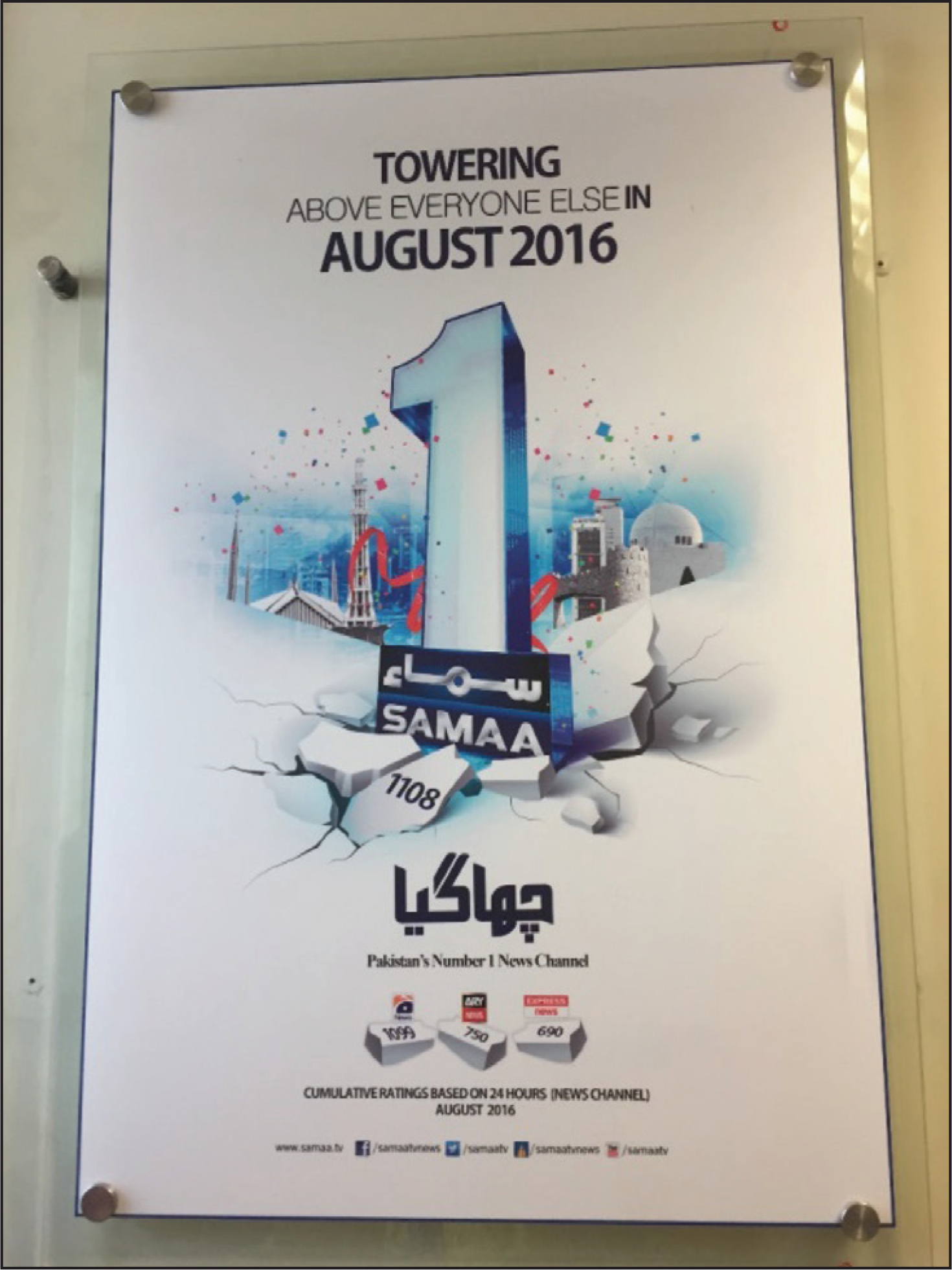
In 2016–2017, advertisers in Pakistan spent close to 90 billion rupees, with 38 billion rupees spent on television alone.
10
Operating on a business model that runs predominantly on advertising revenue, private media groups sell the highest number of commercial airtime spots on their news channels, with the top three highest percentages of these spots being bought by beverage conglomerates, cellular communication service providers and washing detergent brands.
11
In 2018, the number of cell phone subscriptions in the country reached over 150 million, figures that had competing cellular operators aggressively pursuing television advertising with increasingly cheaper call packages.
12
As one of my interlocutors explains below, popular cell phone services such as Mobilink and Telenor were largely interested in targeting mass audiences for whom even the slightest variation in cheap call packages would result in additional subscriptions. Reliant on this advertising money to stay operational, news channel owners shift this burden onto their news production teams, who must attract potential mass consumers to stay tuned into a news broadcast or a political talk show:
Phone companies said we were catering to an elite audience who don’t use their products. So, if there’s an ad for Blackberry, they’ll give it to us but they weren’t giving us the “paanch rupey ka call package” (Phone call packages for five rupees) and that’s where we started to feel the pinch - we were spending about seven to eight crores a month, it was a huge amount and the return was barely two or three crores. I tried to balance it out but I told my team, look, we’re switching from English to Urdu, so please be prepared to enter a gutter. (Rehman, Executive Producer, Dawn News)
Rehman (pseudonym) is a senior executive producer and one-time head of programming at Dawn News, a news channel owned by the Dawn media group, mostly known for publishing the largest circulating English newspaper in Pakistan. With the launch of its English language news channel in 2006, Dawn hired young graduates from private universities and recruited Western-trained broadcast journalists who had returned to Pakistan for the media boom of mid-2000s. Within three years, the channel had to switch from English-language formats to Urdu and, despite its lag in the rankings, has managed to stay in business for the past decade. The switch to Urdu meant a number of changes: revamping the news broadcasts, firing the foreign-accented on-screen talent, bringing in local journalists and according to Rehman, ‘entering a gutter’. I pushed back on this characterization of Urdu news practices and asked for an explanation, having encountered such dismissive sentiment towards Pakistani news media one too many times, particularly from professionals like Rehman, who have extensive experience of reporting for Western news organisations (such as Reuters, BBC and The Guardian) and have risen to the top echelons of the professional class of journalists in Pakistan:
Look, the Urdu media here is very rightist, very pro-establishment, and they come out with stories that they can’t substantiate. They’re more interested in speculating things and then begging their reporters to confirm it as news. It’s not about language, it’s about the style. I tried to run Dawn Urdu in the same format as we were running Dawn English, and we badly failed… the bigwigs are always saying we have to be more like SAMAA, or more like GEO, more ‘awami’ like. (Rehman, Executive Producer, Dawn News)
Seeking Awami Audiences
If Dawn English had failed financially because advertisers were not interested in targeting an elite minority audience, then the lacklustre ratings of Dawn Urdu in 2010 were a result of trying to run the Urdu news channel as if it were still an English-based news channel, and therein lay the ‘problem’. Rehman’s contempt for current news practices as they cater to awami audiences reveals not so much disdain for the teeming masses as an anxiety over the particular ways through which one would tap into such an audience while ostensibly delivering the news. This anxiety often took the form of dismissive embarrassment when an interlocutor would admit to crafting the origins of particularly infamous programmes. During an interview with Ahmed (pseudonym), a senior executive at Dawn News, I listened patiently while he described in detail the importance of his news organisation as the primary example of hard-hitting, quality journalism in Pakistan, working against the tide of sensationalist competitors. Meanwhile, these same channels were blasting away at a lowered volume on the wall of television screens on display in his office. He stepped out to receive a phone call, and on his return, found me watching a screen where a shrouded body soaked in blood was splayed across the floor; the camera was zooming in and out, with sinister music fading away as the title of the show came bursting onto screen. It was one of Dawn News’ most popular programmes, a crime re-enactment show that took official crime reports and dramatised them in narrative form, complete with actors and dialogue. Ahmed returned in time to catch the title of the show, and he let out a loud chuckle behind me, ‘Oh shit, don’t judge us based on this – these crime shows are just part of the news now. It’s not that we want to do them, but it’s what the audience wants!’. One of the ways members of this particular subset of interlocutors attempted to disassociate their sense of professional worth from such kinds of programming was to shift the responsibility onto audiences that ‘didn’t know any better’. Another was to reference distinguished and seasoned print journalists, who now occupied CEO and Editor positions in the organisation, as the main culprits behind exaggerated news content, clearly identifiable as those ‘knowing fully well’. As Bilal described it:
I remember it was my second month at GEO, I was talking to some senior journalists about packaging the headlines for a show [on black money markets] that night and this person, who is a very senior person in the organisation says, ‘You should have a bundle of money and you should have someone flip through all the bank notes while saying ‘gghrrr-rrr’ [the sound of banknotes being flipped through] and I laughed at him saying, ‘Seriously? With the sound effect?’ And he said ‘yes, yes, gghrr-rrr’ – I was just staring at this guy and I thanked him but of course I just brushed it off. And now a year down the line, I’m thinking to myself, maybe I should use the bundle of money shot! [laughs]’. (Bilal, Executive Producer, GEO News)
While Bilal’s narration of this incident allows us a brief glimpse of his initial disbelief that a senior executive he considered a mentor would provide such an idea, I am more interested in the moment of his reassurance that he did indeed brush off the suggestion as I believe it ties in with the earlier example of Ahmed’s reaction to the crime show. What is it about the raspy exaggerated voice over and the crude sound effects of millions of rupees being flipped through that troubles the sensibilities of a ‘former print journalist snob’ or that of a rational, critical modern subject? In Ahmed’s case earlier, why does the acknowledgement of successfully tapping into mass audiences seem to unsettle the liberal news media professional? Crime re-enactment shows, lambasted as they are in elite print commentary as wildly unethical, have proven to be extremely successful for news channels to attract mass audiences and boost their ratings. Marketing executives will quickly point out the loophole that rationalises showing dramatised crimes of passion on news channels – if the narrative arc of the show rests on actual police reports, the channel is justified in alerting audiences to the newsworthiness of such crimes while taking heavy liberties with the way in which they portray these re-enactments. On the one hand, we could explain this success through marketing and advertising metrics, taking seriously Ahmed’s insistence that such shows only work because ‘the audience wants it!’ – a phrase that at its core, validates the notion that marketing is merely a reflection of the deepest and truest needs of the people to whom it is addressed. But on the other, we would still be left with confronting the stinging embarrassment of such an acknowledgment. For what did the production of successful sensationalist programming indicate, if not the realisation of the postcolonial modernising subject coming to terms with the remnants of their naïve and irrational past? Indeed, ‘being addressed as a member of a mass public means being interpellated as at once “oneself”’, as William Mazzarella (2013, p. 37) has described the work of the ‘open edge’ of mass publicity, ‘but also at the same time, a generalizable member of what is in principle the infinite, anonymous space of the “public at large”’ . This would suggest that the anxiety over fashioning news to appear ‘awami’ is misplaced – it is not so much that elite executive producers are at a loss as to how to connect to mass audiences, but rather, it rests in the understanding that they know all too well. 13
Class, Culture and Crafting Sensationalism
The dilemma facing English-language print journalists now employed in Urdu news media meant turning away from a trained ‘BBC-model’ of serious, sober journalism and tuning their craft to a localised set of ‘dramatic’ news practices. Warily recalling one of his first assignments of putting together a news package at Express News, Khurram (pseudonym) was nonetheless forthcoming. His news bureau chief sent him to Faisalabad to start producing local news stories for the primary reason that people rating meters (devices used for measuring television ratings) had recently been installed in the city’s households:
Once, there was continuous load shedding (rolling blackout — intentional electrical power shutdown) and a group of people had gathered to protest outside one of the power companies. We shot a few scenes of footage and sent it back to the chief in Lahore; he replied with a text message: ‘maza nahin aya’ (‘that wasn’t entertaining’) and he told us to gather more people, burn a few tyres, raise louder slogans – so we did! Suddenly we had a sizeable protest with flames and an agitated crowd. All the news channels vans were reaching our Faisalabad protest site and the event received considerable coverage, all the while those damn people meters ticked away. (Khurram, News Reporter, Express News)
Similar to the interlocutors mentioned earlier, Khurram also transferred into television news after working as an English print journalist and his encounter with that ubiquitous catchphrase of the editing room ‘maza nahin aya’ resulted in his crafting the quintessentially angry South Asian crowd, conveniently packaged for the 9
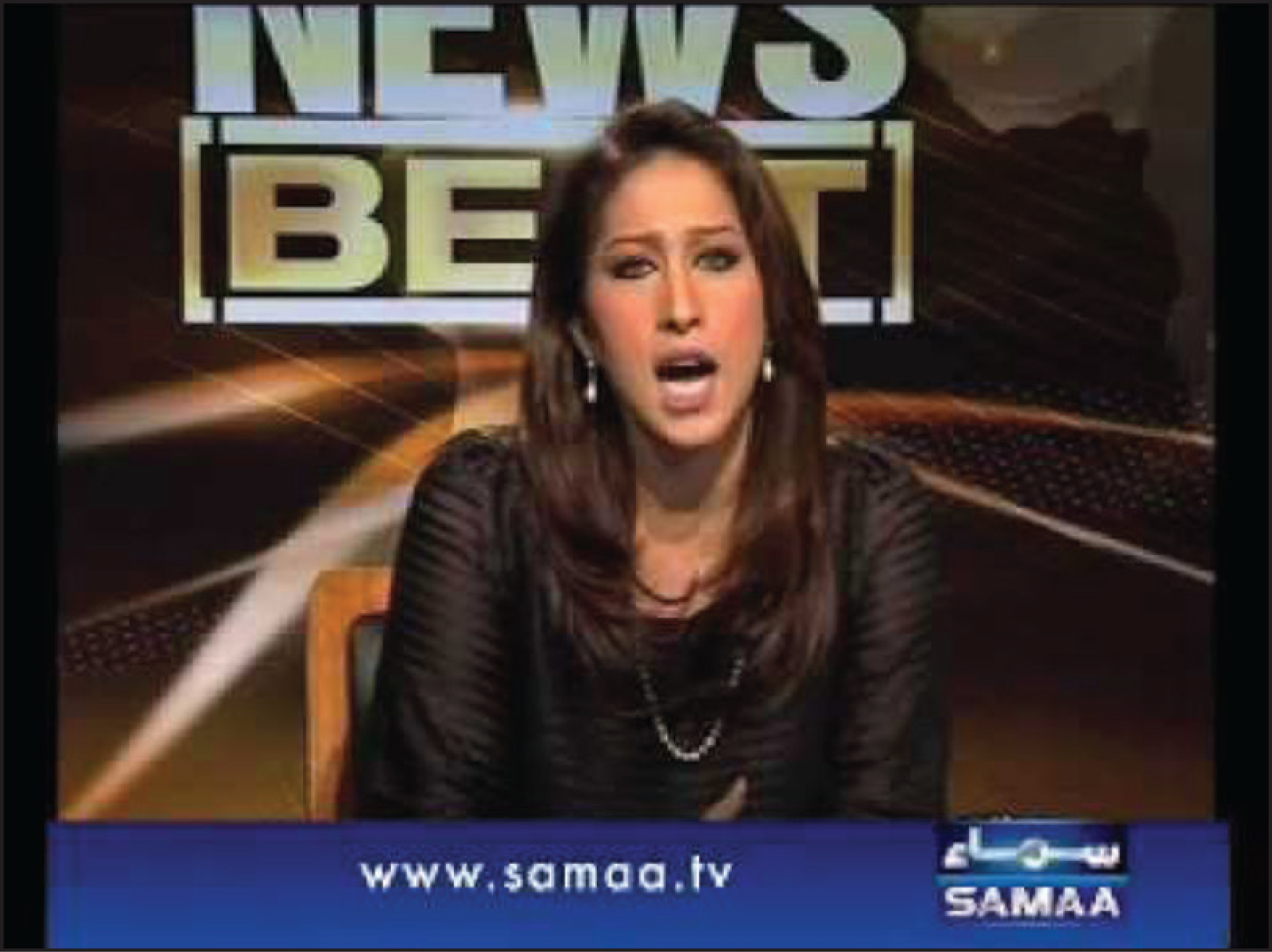
An episode from late 2010 was often referenced in which popular news anchor Mehr Bukhari deliberately misconstrued then-governor Salman Taseer’s efforts to advocate for a victim of a blasphemy case and the anchor accused him of being a blasphemer himself during a live interview. He was shockingly assassinated a month later, and his death was largely seen by liberal elites as a senseless consequence of his vitriolic portrayal in the media. 14 Not surprisingly, a media executive in charge of Bukhari’s show did not share this view when I asked about this particular episode as a glaring example of sensationalising a sensitive issue: ‘Yes, it was my programme. But Mehr Bukhari cannot be held responsible, I cannot be held responsible, SAMAA cannot be held responsible – because look, I can ask you questions during an interview, however controversial they may be. But the answers that you give, only you can be held responsible for that’.
Before we dismiss this poorly aimed attempt to shift the burden of accountability, the executive’s response does expose the chain of command that broadcast journalists must navigate when weighing decisions on crafting ‘sensational’ news. Barring a few rare exceptions, the editors-in-chief of most Pakistani news channels are de facto also the owners of their individual private media groups – the political agendas of each news channel are thus identifiable by the content that they produce, whether antigovernment or proestablishment, depending, especially in 2014–2016, on the particular history of the channel’s CEO with the current ruling political party. The irony of young, untrained and middle-to-lower-class journalists reporting upwards to a chain of media professionals that ultimately ends with an elite, politically motivated, ‘untrained’ Editor-in-Chief, was not lost on my interlocutors and was simply a sobering reality for the business model of much of the Pakistani media landscape. ‘Dramatic’ and ‘emotional’ news coverage was understood as an industry standard, along with the established use of popular music in news headlines and exaggerated speculations in an effort to ‘break’ a particular news story first. For many, the boundary line between ‘sensational’ and ‘unethical’ lay in the greater purpose of the news story itself, as explained by Fatima, a senior producer at Dawn News:
For me, the ends justify the means. If you are shining a light on an important issue, then you need it to be dhamakedar (explosive) and that’s fine! But putting music to footage of a supermodel walking up to a court hearing or, I don’t know – that looped footage of a policeman getting slapped, it has no real value. By value I mean, it has no impact on society. If you’re not contributing to any substantial discourse of the society, it may not be unethical, but you’re still doing news wrong. (Fatima, Senior Producer, Dawn News)
Upper-class journalists who expressed ridicule towards the state of current broadcasting practices in Urdu news nonetheless acknowledged that it was through such practices that channels were able to attract mass audiences and thus secure the advertising needed to keep them in business. The need to stay in business was of course often rephrased, as Fatima’s comment below illustrates, as the responsibility to deliver the news to ‘impressionable people’ who made up the majority of the voting electorate and who, despite their pitied illiteracy, were now fluent consumers of the liberal free market:
As broadcasters, I think that rather than giving in to the stupidity that people are already seeing, it’s our responsibility to change mindsets. When you’re sitting in a country where there are so many impressionable people and so much illiteracy, it’s a responsibility to broadcast things which will change people for the positive. What else is the point? (Fatima, Senior Producer, Dawn News)
It became increasingly clear to me that behind much of the defence of these ‘dramatic’ broadcast practices lay the underlining assurance of a certain class of media professionals who considered themselves to be safely outside (if not above) the purview of their desired mass audience. Jennifer Hasty (2010) has suggested that one of the reasons the practices of news media have been understudied by anthropologists is that ‘for an anthropologist schooled in controversies over the politics of ethnographic representation, there is something profoundly uncomfortable about the practices of news media, something vaguely reflective of our own discursive practices, more purely politicised but also more politically compromised than anthropology’. Indeed, this discomfort is precisely why I would suggest that the practices of sensationalist news should be examined less as a desperate attempt to gain audiences and more as a cultural logic of practice. Such an approach would guide a deeper reflection on how authoritative statements on bounded notions of ‘culture’ are produced and circulated, especially as the range of these articulations emerges as increasingly valuable currency in a postliberalised economy.
In her work on Indian regional news media, Sahana Udupa (2015) deftly avoids reductionist accounts of commercial media as merely serving private interests, and instead looks to formulate journalism’s mediations in terms of ‘desire’. Choosing a framework of desire, or in this case, aspiration, allows us to turn away from culturalist and particularist understandings of South Asia, and refuses the assumptions that there must be something essentially different with ‘desi culture’ and its journalism. Instead, Udupa (2015, p. 206) says, a framework of desire locates these media worlds and urban landscapes as part of a broader wave of globalisation that arrives with its particular class project of capital accumulation but ‘faces and foments multiple contestations shaped by colonial history, postcolonial state structures and a rich repertoire of cultural practices that are themselves shifting’. My earlier examination of the justifications of an elite class of journalists is not intended to sympathise with the commercial pressures of producing television news, but rather I am interested in tracing how an aspirational narrative comes to bear on the journalistic profession in particular ways in Pakistan. Indeed, the struggles my interlocutors faced to maintain ethical practices in journalism can be viewed as what Bourdieu (1993) has described as ‘legitimation struggles’. For Bourdieu, in any given cultural field, people are positioned differently according to their ability to influence the outcome of aesthetic disputes – these are ultimately power struggles, with dominant interests seeking to impose their values as legitimate. In the case of Pakistani television news, such disputes occur regularly within the cultural logics of news production, particularly against a backdrop of vast class differences amongst news media colleagues. The professional vulnerability of lower-middle-class journalists is thrown into sharp relief when the work they are expected to produce, be it visually compelling spectacles or reporting at the cost of falsifying facts, is both peddled by elite news professionals as the only way to attract mass/‘awami’ audiences and critically rejected as crass sensationalism.
The Limits of Ethical Journalism
In 2013, the Pakistan Federal Union of Journalists surmised that at least 18,000 new journalists had entered the workforce, of whom almost 70% had no formal training in journalism and less than 5% were women. The hiring of untrained media personnel is an indication of the ways in which young broadcast journalists in Pakistan are not only tasked with producing affective news, but are also expected to act as authentic cultural mediators between corporate news channels and the awam. Stereotypical examples in liberal elite commentary on recently recruited, untrained reporters being sent off to cover breaking news events, invariably frames them as scrambling through police cordoned areas after bomb explosions, contaminating crime scenes, or entering into the houses of the victims of such attacks, shoving cameras and microphones into grieving family members’ faces and asking them inane questions in between their wails. Caught between the ratings race to deliver breaking news footage to their respective newsrooms and being simultaneously scapegoated by their corporate management when they step out of bounds, the rawness of the untrained journalist has come to conveniently stand in for the media industry on its worst days. It is true that one cannot deny the reality of such instances, but while the marked class differences play out in a number of different ways between the kinds of broadcast journalists described earlier in this paper and the class of professionals I will now turn my attention to, I would argue that the prevailing discourse on the ethics of journalism in Pakistan becomes a productive site through which the differences between privileged and vulnerable media labour emerge as most apparent.
I met Sidra (pseudonym) at a training seminar for broadcast journalists in Karachi in August of 2016. She was in her mid-twenties and had started her career working as a reporter for an Urdu news channel three years before. The lecture on ethics that day was given by Quatrina, a prominent senior female talk-show anchor with thirty years of experience in English print, who immediately launched into a tirade against the current state of Pakistani news media: ‘tamasha zyada, khabr kam, (less news and more drama) entertainment, salaciousness, tabloidism! Journalism is jihad – back in my day, you had ink in your veins, but today you have bijlee current (electric current)!’. During the Q&A, several seminar participants raised the same complaint about the types of stories their editors ask of them: they explained that if an editor wanted a news package on petrol prices for example, then they had already crafted a story on how people could not get to work because of a shortage of petrol. The reporters were then sent out to collect sound bites and vox pops of the assumed ‘frustrations of the awam’ – only to sometimes discover that petrol stations were fully functional. Returning to the news office with this updated information, however, did these reporters no good, as they were first berated and then sent back out to make the news package according to the editor’s script. Quatrina appeared visibly perturbed and I waited for her reaction to the inevitable conclusion: reporters admitted that they would convince people on the street to lie on camera about the lack of petrol and complain that they hadn’t been able to get to work that day. Predictably aghast, Quatrina ominously warned her seminar participants that under no circumstances should they accept such unethical news assignments. Unfazed, Sidra asked:
Sidra: ‘But how do we do that?’ Quatrina replied: ‘You simply refuse to do the assignment!’ Sidra persisted: ‘But I’ll lose my job if I don’t carry out assignments’ Finally, Quatrina threw her hands up: ‘Then you simply lose it, my dear. You’ll find another job, but you can’t compromise on ethics!’
In the side glances and murmurs exchanged across the room, it was clear to Sidra and her colleagues that Quatrina knew little of the daily struggles they faced in their respective news channels. Indeed, it is within this gaping distance between journalists who were invited to guest lecture at training seminars and those who sought enrolment in them that the limits of professional aspirations in Pakistani news media appear most prominently. Over the past decade, electronic media industry jobs became, and continue to be, extremely attractive as aspirational careers to Urdu-medium-educated, lower-middle-class youth in Pakistan. Overlooking their lack of journalistic training with the mandatory directive to learn quickly on the job, corporate television news channels promised young applicants relatively high salaries at entry-level positions, in many cases much higher than their parents had earned or ever would in jobs such as teaching in the public sector, print journalism (Urdu print) and clerical and administrative work in government and municipal departments. My interlocutors among this class would certainly complain about the kinds of news they were expected to cover, but they would just as often mention the sense of adventure associated with producing news in a high-pressure environment. They were proud to flaunt press identification that gets them waved past security gates, and perhaps the aspect most earnestly expressed was the feeling of participating in a drama much larger than themselves. According to Appadurai (2004), such aspirations are ‘never simply individual (as the language of wants and choices inclines us to think). They are always formed in interaction and in the thick of social life’. 15 I asked Sidra if the pressures of the job, the long hours on the road, the longer hours in the editing room, on top of management demands to make the news entertaining, ever pushed her to quit. She shook her head emphatically, saying ‘This is the dream. I could never imagine my family accepting my crazy working hours but they are so proud that I’m a journalist. I could quit a channel, but I can’t quit journalism’. Indeed, many like Sidra did quit their channels – quite regularly. An open secret in the media industry is the failure of certain channels to pay their employees on time past the first month, a trend that has worsened in recent years. For some of my interlocutors, they simply could not afford to wait out the three-month delay in salary payment and would anxiously apply to a different channel in order to get that first month’s paycheck. Sidra’s exchange with Quatrina, described earlier, was only one example of the stratified class differences within the media industry, additionally marked by who can and cannot place a higher premium on upholding journalistic ethics when faced with the threat of losing a job that paid on time. If there are enough news channels around for young journalists to switch to, there are also plenty of young hires to replace them. Human resources representatives at news channels are quick to point out that the limited resource pool of trained news media professionals available in the early years of the media boom has been vastly diluted by a large influx of untrained applicants in the past 15 years, but are less forthcoming about the lack of funds to properly train incoming hires. Within this context, we can then ask, how does the burden of producing sensationalist news mediate the vulnerability of lower-middle-class media professionals who find themselves recruited into increasingly affective and precarious labour?
Maintaining ‘Independent’ Media at the Cost of Self-Censorship
As scholars of Indian mass media have observed, the arrival of mass publicity prior to political democratisation in many colonial contexts is often seen by postcolonial elites as explaining the ‘in-between’ time that the masses are still stuck in, justifying the liberal tendency to reluctantly favour authoritarian forms of public regulation until political maturity is ‘achieved’ (Mazzarella, 2013; Rajagopal, 2001; Udupa, 2015). Ironically in Pakistan’s case, it was a military dictator’s ‘benevolence’ that lifted the restraints of state media, in turn accelerating an information revolution that demanded the return of civilian rule. Once a beacon of progress for liberal elites, private news channels have since fallen from grace; their ‘independent’ status has become increasingly dubious as a number of recent scandals have revealed the corrupt relationships between media group owners and their top anchors with political parties and influential businessmen, who peddle their agendas through competing channels. 16 It is these very relationships that enable media groups to thwart the state’s efforts to rein in sensationalist broadcasting. Indeed, the consequences for misreporting on issues pertaining to the civilian government, oftentimes in the form of slander and false quotes, are brushed aside with ineffective defamation and libel laws – the state continues to issue monetary fines and legal notices to news channels that pile up in dusty office corners, effectively rendering the government’s electronic media monitoring unit as a toothless watchdog. On the other hand, the risks of misreporting on selected, sensitive issues carry a much graver threat.
The consequences for Pakistani investigative journalism are extremely dangerous, particularly when journalists pursue news stories concerning the military, extremist militant groups, and cases of religious sensitivity such as blasphemy. While much of the scholarly focus on Pakistan post 9/11 has been interested in issues of terrorism and Islamic fundamentalism (Iqtidar, 2011; Haqqani, 2005; Toor, 2011), little attention has been paid to the journalists risking their lives, and often times paying a high price, for the very stories that draw the attention of these expert analyses. The disappearances of journalists working on such issues and the body dumps that follow serve to threaten the journalist community into practicing strict forms of self-censorship when reporting on sensitive topics. Pakistani media professionals have a long history of engaging with self-censorship, particularly during the eras of military rule, when entire pages of newspapers would purposely be left blank to protest the denial of free speech, but self-censorship in the age of private television news cannot be as symbolically circulated. 17 Pressures on independent news channels to align with the establishment point of view have been steadily mounting in Pakistan and were most heavily felt by the media community during the run up to the 2018 elections. The situation has worsened in 2019 with news broadcasts being mysteriously blocked, journalists being forced to shut down their social media accounts, opposition leaders being banned from appearing on television, and fake viral campaigns threatening journalists run amok. 18
Anthropological studies on mass media and its audiences (Abu-Lughod, 2004; Lukacs, 2010; Mankekar, 1999; Mazzarella, 2013; Nakassis, 2016; Rajagopal, 2001) have long complicated the notion that mass audiences are ‘passive’ recipients, especially within the postcolonial context where television and other electronic mass media have been state controlled or in the hands of culture industry professionals who benefit from sharing the ‘dominant codes’ of the nation state (Abu Lughod, 1999; Hall 1980). While mass media have been viewed as powerful tools for social engineering, one of the fallouts of this focus has been the perception of media institutions as static entities that function entirely as ideological apparatuses of governments. This approach fails to account for the productive factor of censorship: 19 for instance, the ways in which it generates its own resistance 20 and deflects attention away from media producers as critical mediators, articulating and translating larger projects. The role of such professionals in the light of a privatised mass media in Pakistan takes on a particular significance with both the historical context of state censorship and increasing ways of mass electronic circulation of media forms. Thus, when Pakistani television news producers are tasked with packaging a news segment or designing programme outlines for controversial topics on political talk shows, they must now imagine how to mediate both a narrative of ‘national interest’ and an oppositional stance that would result in an informed debate while catering to the widest possible cross section of viewers to pull in high ratings. The vast differences in the socioeconomic spectrum that spans this viewing population requires that news media producers both acknowledge and construct ‘mass appeal’ in forms that are then criticised for being sensationalist and populist by educated elites. In this regard, producers engage with the ‘open edge of mass publicity’ (Mazzarella, 2013) engendered between the media objects they create and the collectivities they call into being. One of the outcomes of studying elite interlocutors in the Pakistani news media industry is a critical focus on anxieties over the material effects of sensationalist news as it circulates as a performative, affective force in public and political culture. Additionally, taking a closer look at the shared professional aspirations of both elite news media professionals and lower-middle-class journalists allows for an expanded analysis of the ways in which the practice of journalism is necessarily rooted in local cultural logics. The attendant discourses that arise over its anxieties and standards can then be viewed not so much as struggles of legitimation within a professional community, but instead as legitimate desires.
Footnotes
Declaration of Conflicting Interests
The author declared no potential conflicts of interest with respect to the research, authorship and/or publication of this article.
Funding
The author disclosed receipt of the following financial support for the research, authorship, and/or publication of this article: This work was supported by the United States Educational Foundation in Pakistan (USEFP) Dissertation Fellowship (2014–2016).