



Abstract
While conjugation or couple formation in Bollywood films has received consistent scholarly attention, its functioning under marriage has remained relatively overlooked. When discussed, the focus has been on discerning the sociological relevance of conjugal representations rather than its phenomenological significance. Foregrounding conjugality as the experience of being married, this article attempts to fill this lacuna by discussing Reema Kagti’s multicouple film Honeymoon Travels Pvt. Ltd. It first situates Honeymoon as a precursor to Kagti’s later explorations of marital dynamics in works such as Talaash (2012) and Dahaad (2023), establishing a thematic continuity in her oeuvre. This article then recognises honeymoon as a period of crisis that immediately reveals many contingencies that structure marriage. Accordingly, this article argues that Honeymoon forwards conjugality as a circulating arrangement of couples, themselves undergoing intrapersonal and interpersonal changes and informing the multiplicity ingrained in conjugality, employing a multivalent use of Bollywood tropes. Using multidisciplinary theories, this article outlines how the institution of marriage, the feelings and actions unfolding within it, and its participants remain in perpetual motion to affirm the unity of conjugality. In the course of this discussion, Honeymoon emerges as an instance of New Bollywood Cinema that successfully conveys the multiplicity-embedded experience of conjugality even as it remains bound to the post-globalisation formal reorientation of Bollywood cinema.
Keywords
Popping the Question of Conjugality
When Pia realises that she is in love with Rancho, ordinary events of her life burst into song-and-dance sequences. The duo is shown swaying in rain-soaked translucent clothes with umbrellas bobbing about and later standing near an arched bridge bathed in the soft glow of the moonlight and streetlamps, thus evoking the quintessential Bollywood tableau of romance. Indeed, they proudly declare this embrace of cinematic visuality as they ‘sing’ (lip-sync to) the song ‘Zoobi Doobi’ with the refrain ‘Like it happens in films, it’s transpiring ditto’. 1 By mapping the domain of what ‘happens in [Bollywood] films’ to the highly selective domain of romance, not only does this allusion in the movie 3 Idiots (Hirani, 2009) draw one’s attention to the oft-discussed permeability between the real and the reel (Shankar, 2004) but also the well-established generic centrality of romantic conjugation in Bollywood (Anjaria, 2021).
3 Idiots culminates in Pia’s elopement from her marriage ceremony—arranged with another man—and her reunion with Rancho. While the couple’s future marriage is implied, the film does not depict the actual wedding or what follows thereafter. This dual evasion of matrimony—Pia fleeing one wedding and the film sidestepping any prolonged engagement with another—harks back to the narrative pattern dominant in Hindi cinema prior to the globalisation era when romantic films concluded in the pre-nuptial domain of union. However, beginning in the 1990s, Sangita Gopal (2011) notes a shift: the rise of, what she terms, New Bollywood Cinema and the emergence of post-nuptial storylines that delve into the complexities of married life.
It is worth noting that while this trend became more pronounced in the 1990s, earlier Bollywood films also explored such themes. For instance, though Abhimaan [Pride] (Mukherjee, 1973) and Chalte Chalte [On the Way] (Mirza, 2003) span three decades of Bollywood—representing the pre- and post-globalisation eras—both films explore how seemingly trivial misunderstandings can threaten marital harmony, only to conclude by resolving the couple’s broader conflicts, albeit with varying degrees of nuance. In its closing scene, the singer-duo couple of Abhimaan walk out of an auditorium followed by the diegetic audience clapping after them, as if to validate the couple’s perfectly flawless union to the film’s real audience. Chalte Chalte calls attention to its couple’s continuing bickering even as the authenticity of their union is baptised by the background singing of the famous romantic number ‘Dilwale Dulhania Le Jayenge’ (The One with the Heart Will Take the Bride Away), first used in Chor Machaye Shor [Thief Raises the Alarm] (Roy, 1974) and later popularised by the film Dilwale Dulhania Le Jayenge (Chopra, 1995).
Despite addressing post-nuptial challenges in both classic and contemporary Bollywood, these films consistently harp on the same message: a perfectly stable marriage is attainable, provided all factors inimical to it have been suitably eliminated. Any shift within the marital dynamic then is typically attributed to some external causality and viewed as detrimental. It is in this context that the then-debutante director Reema Kagti’s Honeymoon Travels Pvt. Ltd. (Kagti, 2007, hereafter Honeymoon) offers a refreshingly novel approach for its time. Honeymoon, the main focus of this article, follows six newly married couples who come together for a group honeymoon trip to Goa. It distinguishes itself by discarding the negative connotations of instability, instead accepting it as inherent to conjugal life. However, before delving into this film, I’ll briefly discuss the more recent Hindi series Made in Heaven (Akhtar et al., 2019, 2023, hereafter MIH), which illustrates the continued resonance of this legacy in New Bollywood.
With exorbitant North Indian weddings as its backdrop, MIH revolves around the personal and professional lives of the wedding planners Tara Khanna (Sobhita Dhulipala) and Karan Mehra (Arjun Mathur) as they run the eponymous wedding planning business. Doubtlessly, at the heart of the series lies the conspicuous consumption and vagaries of arrangements that are synonymous with the ‘great Indian wedding’—an intimate experience of the Bollywood culture industry (Kapur, 2009). Each episode of MIH deals with the marriage of a new couple while the seasons are bound by developments in the lives of characters associated with the wedding company. The ambition of the series is captured in the breadth of marital situations it explores in conjunction with intersectionalities like caste, religion, and sexuality.
Indian weddings are never deemed complete without the participation of the families of the nuptial couple—a point highlighted by the posed family photo displayed after the completion of each wedding as well as the lengths to which Tara and Karan often go in convincing families, opposed to their child’s/parent’s re/marriage, to attend the ceremony as a display of their support and acceptance. Resultantly, the series teems with couples of different ages and backgrounds. When it comes to the clients of the company, the conjugations follow the tropes of old Bollywood in ending with marriage, without exploring the post-nuptial situation. However, the endless troubles that keep arising—be it ‘modern’ ones like the bride cheating on her husband during her pre-wedding party with a Bollywood star or ‘traditional’ ones like the fairness in the bride’s skin tone—and threatening a last-minute cancellation of the wedding almost each time succeed in calling attention to the inherent instability of marriages. Thus, the demands of each event invariably exceed what Tara and Karan sign up for. This shows that anyone who decides to associate themselves with the fragile institution of marriage in whatever degree must also be prepared to be accommodative of affective and material destabilisations.
The element of married-ness takes precedence over marriages in the series in moments where it explores the conjugal life of Tara and her businessman-CEO husband Adil (Jim Sarbh). While earlier Bollywood conventions used flashbacks to act as deus ex machina in fostering romantic sentiments between estranged lovers, MIH deploys them subversively to narrate the gradual breakdown of Tara’s marriage. Both Kal Ho Naa Ho (Advani, 2003) and PK (Hirani, 2014) feature scenes towards the end where the female protagonist is furnished with additional information that changes her interpretation of past event(s), helping her realise that what she deemed as a betrayal in a previous love affair was actually a misunderstanding leading to a cathartic moment of romantic fulfilment (even if that does not lead to marriage, as happens in the case of Kal Ho Naa Ho). 2 Cinematically, this occurs through the present scene being interjected by the repetition of past scenes which have already been familiarised to the audience but which they now view differently in the light of the new information. On the contrary, when the first few episodes of MIH reveal Adil is having an extra-marital affair with his and Tara’s mutual friend Faiza (Kalki Koechlin), each flashback contains previously unseen elements from Tara’s past that hint at the rotten foundations of her marriage to Adil. For Tara marriage was not just romantically motivated, it was also a means of climbing up the social ladder. The calculation of her approach turned on her seducing Adil, her boss, already engaged to another woman, and leaking a scandalous sex tape with him so that she would appear a victim; she thereby elicits Adil’s sympathy and love, and the break-up of his previous engagement. Thus we see that the post-nuptial situation in MIH ensues from the non-romantic machinations that underlie Tara and Adil’s conjugation. Their marriage is shown at its weakest in a poignant intersection between Tara’s personal and professional life. The marriage agency has a private investigator to snoop into the background of brides-to-be for the grooms’ families. While Tara is normally reluctant to use this service, she readily enlists the detective to spy on her own husband. It is through moments like this that MIH, much like Honeymoon, highlights the precariousness of marital life even though pre-nuptial conjugations occupy the majority of its screen-time.
Note, Gopal identifies another distinguishing feature of New Bollywood: the multiple couple format in which the post-nuptial narrative unfolds. MIH, initially produced by Excel Entertainment (owned by Farhan Akhtar and Ritesh Sidhwani) and in Season 2 joined by Tiger Baby Films (owned by Zoya Akhtar and Reema Kagti), follows multiple couples over the course of the series but also at times within the same episode. While some are long-married couples whose marital problems unfold before us, we see others only until the point of their wedding, their futures obscured by the show’s episodic formula. Even then, the suspicions, precarious circumstances and accommodations that go into the making of the marriage, including the snooping detective, suggest the troubles that lie ahead. In fact, Excel Entertainment, known for critically acclaimed as well as commercially viable films (St-Jean & Brunet, 2015) has taken the multicouple form as a recurrent focus in a number of films. Thus, Dil Chahta Hai [What the Heart Wants] (Akhtar, 2001, hereafter DCH), Zindagi Na Milegi Dobara [You Only Get to Live Once] (Akhtar, 2011, hereafter ZNMD), Dil Dhadakne Do [Just Let the Heart Beat] (Akhtar, 2015, hereafter DDD), Kho Gaye Hum Kahan [Where Did We Get Lost] (Singh, 2023, hereafter KGHK) all deal with more than one romantic pair. While these movies only share tenuous connections with the theme of marriage, MIH’s involvement is deeper, portraying the many contingencies that frame marital conjugations. Kagti’s involvement in MIH as a co-creator with Zoya Akhtar is particularly noteworthy, suggesting a recurring preoccupation in her career.
The first section of this article briefly explores Kagti’s later works Talaash [The Search] (Kagti, 2012) and the web series Dahaad [Roar] (Kagti, 2023), where marriage is central to the narrative, and then analyses Honeymoon as a precursor to her continuing focus on precarity in marital dynamics. Honeymoon is unique for its attention to the peculiar experience of being married, and for presenting conjugality as inherently diverse and complex. The film achieves this in two ways. First, it presents an unpredictable and queer storyline; second, it subverts conventional Bollywood cinematic tropes to elicit novel perspectives. In line with this, the second section discusses how the film calls for a re-imagination of conjugality. It suggests that the different couples, each embodying diversely deviant conjugal experiences, are connected by concrete exchanges that charge the intracouple and intercouple transformations they undergo. Together these exchanges highlight the openness of conjugality in a process akin to Deleuzian assemblage. The third section picks up the argument to explore how conjugality as assemblage is generated in Honeymoon by a rearrangement of the formal elements of classic and New Bollywood. It shows how the film re-produces classic Bollywood tropes of conjugation and engages with queer representation in Bollywood’s history to upset any essentialised reception of conjugality. In the course of the discussion, conjugality emerges as an experience of contingency that acknowledges the accommodative aspects of the institution of marriage even as the latter continues to maintain its normative bounds at each point.
Kagti and Her Precarious World of Conjugality
Reema Kagti is one of the well-known names among the younger generation of female directors in contemporary Hindi cinema. Although not born into the industry, Kagti’s entry was somewhat facilitated by her initial work as an assistant director on projects like Lagaan [Land Tax] (Gowariker, 2001), but more importantly, DCH (Akhtar, 2001) and Lakshya [Aim] (Akhtar, 2004). These last two films established her first connections with Farhan Akhtar and Ritesh Sidhwani. Later she would go on to closely collaborate with Farhan’s sister Zoya on multiple projects. It is noteworthy that Farhan and Zoya possess strong ties to Bollywood both through their father Javed Akhtar, a renowned screenwriter and lyricist, and mother Honey Irani, an erstwhile child actor who later transformed herself into a director and screenwriter. Besides, director Farah Khan is also a cousin of the Akhtar siblings. 3 Such connections probably meant that despite being an outsider, Kagti could sustain herself in the Bollywood’s family and star-dominated system rather than rely on the amorphous national and international ‘politics of friendship’ of fellow marginal filmmakers (Vitali, 2020, p. 11).
Kagti’s directorial ventures, limited to only four released works between 2007 and 2024, include Honeymoon (2007), a comedy-drama, Gold (2018) a period sports film, Talaash (2012) and the web series Dahaad (2023) both crime/police films. 4 They could be said to be part of the ‘hatke’ film phenomenon that emerged in the wake of economic liberalisation. These are small-budget initiatives targeting multiplex and OTT release, experimenting with narrative form even while maintaining ties with mainstream Bollywood. Rachel Dwyer argues that India’s economic liberalisation led to a bifurcation between the old and the new middle class. The latter, mainly comprising educated, cosmopolitan youth, retained an ‘aesthetic need for realism [without] the hostility to [mainstream] Bollywood’ (Dwyer, 2011, p. 202) and were a key audience for so-called hatke films. 5 Talaash and Dahaad, released after Honeymoon, and working inventively with the logics of the crime and police film genres, also engage the key thematic of this article, the inherently precarious nature of conjugal relationships in contemporary Indian society.
Set in the bustling metropolis of Mumbai, Talaash’s gripping narrative follows the investigation by Senior Police Inspector Surjan Singh Shekhawat/Suri (Aamir Khan) of the murder of a renowned actor. This narrative of professional pursuit runs parallel to one of deeply personal struggle: Suri’s married life with Roshni (Rani Mukerji), fractured by the lingering grief of their son’s accidental death. Their estrangement is palpable in social situations where they speak about each other, rather than to each other; when they do, they argue. The estrangement is captured in a scene when, after arriving home together, Suri informs Roshni he has some work to do. Roshni silently gets out of the car and starts walking towards their home, her back turned to Suri while he drives away, Suri looks at her retreating figure through the rear-view mirror, the distance between them expanding with each moment.
The film also frequently employs a white colour palate, which Indians ritually associate with mourning, to highlight how grief reshapes the couple’s marital relationship. In one scene, Roshni chances upon an old photograph depicting a romantic moment between her and Suri. This triggers a flashback of the actual event where the couple and their then-alive son Karan (Jineet Rath) are all dressed in white. The photograph, we further learn, was playfully taken by Karan himself, accounting for his absence from the frame, a poignant foreshadowing of his current absence from their lives. This detail suggests that even their cherished memories of love were facilitated by their son’s presence and are now tinged by the gaping void left by his death.
Furthermore, Suri’s investigation mirrors his personal struggle with his past loss in multiple ways. Both his son’s death and that of the actor was caused by drowning. In terms of visuality, Suri’s sleepless nights are interspersed with memories of his son, and the present investigation is recurrently intercut with scenes of the night of his son’s accident. The case brings Suri emotionally close to a prostitute named Rosie/Simran, though she is later revealed to be a ghost (bhoot, Hindi for ghost, also means past). This nuanced use of the extramarital trope suggests that marital problems do not need to have an actual extramarital source. Rather, it seems to suggest that susceptibility of marriages to breakdown could be inherent to the relational arena of marital conjugation. Thus, what I find central to Dina Khdair’s identification of a melodramatic poetics in post-liberalisation puzzle films like Talaash is that it invariably ties itself to filial relationships and the ‘loss or dysfunction of [such] relationships’, historically the cornerstone of Bollywood melodrama (Khdair, 2013, p. 190). Therefore, even though the film ends with Suri and Roshni sitting together with some suggestion of reconciliation afforded by the catharsis Suri finds in supernatural communications, first with Rosie and later with his dead son, no reassuring direct communication is shown to transpire between the couple. Their coupledom thus continues to hover in the realm of precarity.
This entire business of marital conjugation is, however, far removed from the world of prostitutes shown in Talaash. In response to a marriage proposal, one of the sex workers even says with a painful mockery ‘I am a whore and always will be’. Indeed, this figure underscores the gendered vulnerability of women in society, particularly those involved in sex work. At one point, Rosie tells Suri: ‘It’s something to think about. A girl vanishes and no one asks after her. […] Prostitution is illegal. We don’t exist officially. And that which doesn’t exist…how can it go missing?’ Kagti’s later series Dahaad continues to explore this theme of invisibilisation in the eyes of law, focusing on marriage as a key factor. This narrative thread of female precarity gains added significance in the light of the 2012 Nirbhaya case relating to the bestial gang rape and murder of a young woman professional. This event stirred national debate and anger, sparking widespread concerns about women’s safety and gender justice. It took place between Talaash and Dahaad, and its ramifications resonate through many episodes of MIH as well.
Mainly set in rural Mandawa, Rajasthan, as opposed to Talaash’s urban setting, Dahaad questions the customary perceptions of marriage. In a conversation with the female Sub-inspector Anjali Bhaati (Sonakshi Sinha), Inspector Devi Lal Singh (Gulshan Devaiah) says: ‘I don’t know who has indoctrinated the world into believing that marriage is a cure for loneliness’. He continues, ‘Marriage is the biggest deception in the world’. This conversation takes place while the two are working towards arresting a psychopathic serial killer responsible for the disappearance and subsequent death of innumerable women. These women were from the lower castes, exceeding the age of 25, whose families were not financially capable of meeting the dowry demands of prospective grooms’ families and ‘marrying off’ their daughters. This premise immediately frames marriage as intrinsically precarious, especially for underprivileged women who stake everything on the promise of matrimony. The killer Anand (Vijay Varma), himself a ‘nice’ married man, would feign romantic desire for these women and persuade them to elope with him to get married. Following the consummation of the relationship, on the supposed day of the marriage, he would hand them contraceptive pills covered in cyanide. The unsuspecting women take the pills, leading to their immediate death. The women’s families, each of whom receives a letter from their daughter announcing their elopement, no longer have to worry about dowry and hardly ever lodge missing complaints. These women thus disappear. In fact, it is only an accidental turn of events that directs Anjali and Devi Lal towards investigating these missing women.
Dahaad is not interested in prescribing what a good or bad marriage is. Rather, it attempts to highlight the inherent vulnerabilities that arise from the single-minded desire to enter this institution. The same opening credit sequence frames each episode. It portrays a vast, arid landscape, lined with scrawny, stunted trees under the scorching bright sun of Rajasthan. The sequence then unfolds with a series of evocative images, all associated with marriage or the desire for marriage: mehndi on a woman’s palm, lines of women walking in ghunghat or veil, lovers’ names scribbled on a monument. Each image, however, is also an undoing of itself: the mehndi is rubbed off, the veiled line of women disappears and the names are faded on the monument which itself is ruined. What is preserved with forensic meticulousness is a decaying red rose in a jug, prints of women’s hands and feet across havelis or mansions—all signs of conjugal assurance—while the women themselves remain absent. The lines between the veiled face of a woman and an empty earthen pot (customarily used by women to collect water from afar) are blurred. These images highlight how marriage entails an erasure of women’s distinctive identities, indeed, their very lives. Moreover, each episode opens with a similar short scene with different women who meet the same fate. They walk into a public toilet with a pill and water bottle in hand and lock the door, never to come out alive. Lying on squalid bathroom floors, their mouths froth while they remain dressed in bridal clothes and jewellery. It is noteworthy that the cyanide that is used to poison them is a compound used in making gold jewellery, the metal that brides are typically bedecked in during Hindu marital ceremonies.
It is an Indian custom that after marriage, women change their surname to that of their husband’s. The final episode of Dahaad ends with Anjali changing hers to Meghwal that, as opposed to her previous caste-neutral surname Bhaati, identifies her as a lower caste. However, this is not a result of her giving in to her mother’s continuous pleadings with her to get married. Rather, it symbolises her defiance of societal mores. Subverting the customary event of women’s giving up surnames, she changes hers not to the end of relinquishing but to reclaim her identity, here, of caste. In doing so, the series invites its audience to question what the institution of marriage really entails. Both Talaash and Dahaad suggest that there is something inherent to marital conjugations that stirs a critical perspective on the institution. This ‘something’, I argue, is its inherently contingent nature.
Since the 1990s, traditional marriage has been destabilised across Asia. This trend is marked by later and lesser marriages and rising divorce rates (Jones, 2018). Marriage, it seems, is fading. And yet, quite counterintuitively, it has continued to remain thematically important in Bollywood films. However, this apparent contradiction can be easily explained when one realises that this social institution has subsumed such changes to further strengthen itself. For instance, scholars have argued that the continuance of the family-oriented arranged marriage system among South Asian citizens (Jones, 2018) and their diasporic counterparts (Aguiar, 2018) has been sustained by its formal reordering through components like increased participation of the to-be-married-off children in the matchmaking process. In India, changes have also been noted in the rates of consanguineous and intercaste alliances (Allendorf & Pandian, 2016) and marriages based on differences in the religious affiliation and financial status of the partners (Goli et al., 2013). Many of these changes result from social transformations like increasing female education which in turn alter marital expectations, conjugal satisfaction and stability (Dommaraju, 2016). Indeed, Bollywood’s representation of Indian marriages also generates discourses and critiques about the institution for global and local audiences (Aguiar, 2018). Academic interest in the representation of marriage in Hindi films, especially its sociological implications, has also developed. Scholars have noted that scenes and narrative arcs involving marriages offer insight into the continued authority of traditional patriarchal social structures and idealised gendered roles (Kripalani, 2008). The bid to control ‘deviance’ was marked, with even extramarital desires depicted as temporary lapses whose containment ultimately reinforced social norms (Dwyer, 1998). However, recent trends show a shift, with married female characters granted greater agency and an ability to challenge repressive norms (Moini, 2011). While this reflects a gradual loosening of rigid social expectations in cinematic narratives, the focus continues to be on the sociological aspect of conjugal representation, to the neglect of its phenomenological significance. This article addresses this lacuna by foregrounding conjugality as the experience of being married and takes Honeymoon to reflect on the shifting phenomenology of the couple.
If marriage is already a convoluted social issue, then the period of honeymoon further complicates it. Rhona Rapoport and Robert N. Rapoport (1964) argue that notwithstanding the popular perception of it as a short, carefree and blissful period following marriage, honeymoon plays a crucial role in determining later conjugality and is always under a threat of disruption. They observe that it is a pressurised situation involving significant challenges: being isolated with one’s partner, negotiating between one’s autonomy and the needs of one’s partner, learning to closely cohabit and establish a mutually satisfying sexual relationship, the pressure of coming out as an ideal couple. All of this can push participants into crisis. Marital conflicts are more likely to surface, even as the mode of vacation or the presence of fellow travellers partially delays confrontation. They further note that the modality of two people coming together as a unit after marriage can exceed their individualities, or the way they carry themselves as singular units. Honeymoon thus brings into sharp focus this highly contingent coming-together-ness and the forms of conjugality that emerge from it.
The film Honeymoon opens with its six newly married couples boarding the Goa-bound ‘Honeymoon Travels Pvt. Ltd.’ bus. In keeping with the potential for growth and turbulence integral to the honeymoon, the bus journey could be said to function metaphorically, carrying its passengers into terrains of upheavals, bends of disruptions and crossroads of conciliations. 6 A high frequency of conjugal mutations is captured, the couples, their actions and feelings infused with a perpetually active becoming. I find French philosopher Gilles Deleuze’s concepts of assemblage and deterritorialisation particularly effective theoretical frameworks for analysing how conjugality plays out in Honeymoon.
Deleuze’s non-essentialist idea of assemblage is an important concept in his oeuvre. Thomas Nail has suggested that it comes closer in meaning to ‘agencement’, referring to the phenomenon of an active coming together of things rather than a unification into a fixed arrangement (Nail, 2017, pp. 21–22). The assemblage is always internally fragmentary and open to deterritorialisations and reterritorialisations. According to Deleuze, thinking about any form of existence in terms of assemblage makes it ‘an aesthetic phenomenon rather than a moral or religious one’ (Deleuze, 2002 [1962], 23). ‘Aesthetic’ comes from the Greek aisthesthai meaning ‘perceive’: thus, to think about the depiction of conjugality in Honeymoon through assemblage is to frame it through perception-based or phenomenological exploration. While sociology tracks marriage as a changing social institution, phenomenology captures the instability, the hues of each moment of being married. By highlighting Honeymoon’s treatment of conjugality as an arrangement/agencement, this article adds to the body of South Asian media scholarship on fluid, non-normative relationships. 7 Yet, it does so by referring to an alternative genealogy that does not solely focus on homosocial or non-heterosexual angles in heterosexual relationships, or on purely queer partnerships. Rather, it frames the heterosexual arena of nuptial depictions in this early instance of New Bollywood Cinema as a space of fluidity.
Altering Conjugalities
Childhood sweethearts Zara (Minissha Lamba) and Aspi (Abhay Deol) dress alike, act alike and even seem to mirror each other as they have their food. Not only is this flawless conjugality on view for the other honeymoon couples, it also suffuses the moments of intimacy they share in the privacy of their hotel room. They are the unchanging, ideal couple out of some Bollywood film and a foil to the other ‘unlike-ly’ couples in Honeymoon who embody the flux of unstable and contingent life-worlds.
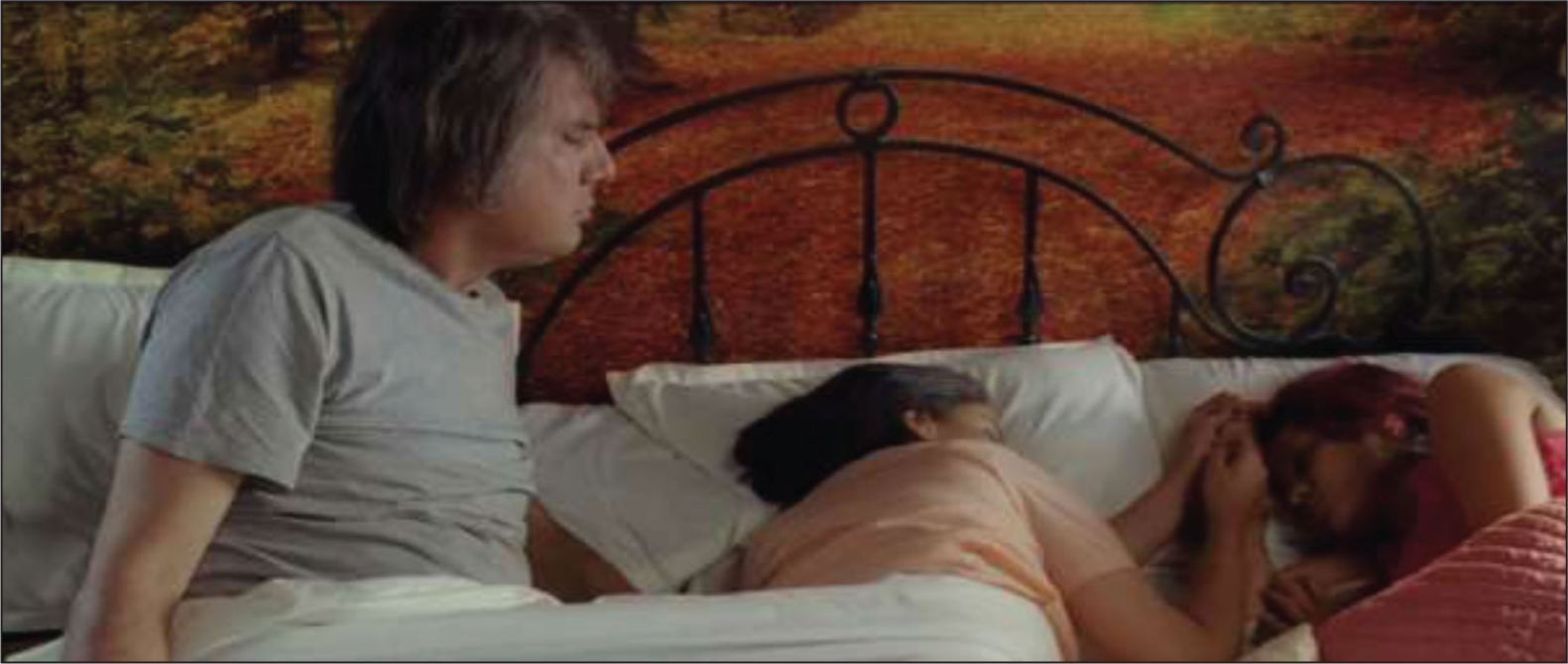
One such couple is Naheed (Shabana Azmi) and her husband Oscar (Boman Irani), 55-year-olds who remarried a decade after the demise of their first spouses. Arnaud Régnier-Loilier’s (2019) study on the practice of repartnering focuses on the probability of cohabitation between individuals, one or both of whom are in a post-separation state. She notes that widows and widowers take longer to repartner, especially if they have to bear the responsibility of raising children from their previous relationships. Such children then become an integral part of a possible new relationship contract, like remarriage. It is this aspect that Honeymoon uses to test the limits of conjugality. While throughout the film the peculiar lateness of Oscars’ marriage is repeatedly highlighted, what queers this grizzled couple is the gradual inclusion of Oscar’s daughter Gina (Shahana Goswami) from his prior marriage, within their conjugality. Gina is initially upset about her father’s remarriage, but is reconciled when, after her break-up with her boyfriend she seeks comfort in Naheed late one night. This reconciliation takes place in the bed of the Oscars, where the three lie together the next morning (see Figure 1). 8 While Gina’s boarding of the honeymoon bus along with the Oscars on their return journey symbolises her insertion within their conjugality, it is their close physical proximity on the nuptial bed that underscores it. Her presence between the parents captures a paradox. In a normative situation, the presence of the child would serve as a marker of conjugal sanctity, validating the heteronormative family unit through the physical manifestation of its parents’ union. Yet Gina’s positioning creates a striking inversion: rather than affirming the consummation of the new marriage, it symbolically supplants it. As a living embodiment of Oscar’s previous marriage, her physical placement subverts the notion of a child being the source of conjugal completion while resonating the complexities of repartnering.
If the Oscars’ coupledom is queer only in the sense of its unusual form of cohabitation, the film specifically addresses sexual queerness through two couples, Madhu (Sadhya Mridul) and Bunty (Vikram Chatwal), Vicky (Karan Khanna) and Pinky (Ameesha Patel). In the course of the honeymoon, while Bunty comes out to Madhu, Vicky recognises homosexual desires within himself but keeps them hidden from his dreamy wife. While this mismatch in sexuality jeopardises both marriages, the couples finally decide to remain married. The contingent nature of conjugality reveals itself in the different trajectories through which they arrive at an equivalent position. Premchand Dommaraju (2016) notes that divorce is a possibility for unhappily married women only if they are financially stable or get support from their natal families. Although both Madhu and Pinky are shown to be working women, the sufficiency of their earnings is doubtful and the film does not hint that either of their families will offer support if they end their marriage. Despite facing marital difficulties, Madhu lies to her parents that she is happy, while Pinky tells a similar lie to herself. Instead of framing their reinvestment in marriage as a false or repressive choice, Honeymoon presents it as the exercising of agency within existing constraints. Madhu had decided to marry soon after a break-up. Being with the NRI Bunty through a self-arranged marriage gives her global mobility, a central aspiration of transnational marriages (Aguiar, 2018). It also allows her to fulfil her desire to taste the freedom many individuals seek after separation (Régnier-Loilier, 2019). All of this is possible because Bunty is gay. Perhaps Madhu would be liberated from playing wife, opening up possibilities of independence—sexual and otherwise. For Bunty too this arrangement seems propitious as it satisfies his Indian family’s demand that he marry even as he leads life as he wishes. While the Vickys do not reach any such explicit agreement, Pinky attains marital fulfilment if not from her husband, then by using marriage to become a mother. Such compromises offer provisional conjugal stability. This is in contrast to standard Bollywood depictions that affirm positive conjugations as the ultimate horizon of romance narratives. Such positive conjugation is necessarily informed by a romance that is instinctive, sensual and beyond control or reason (Anjaria, 2021). To refer back to 3 Idiots, Pia, having ‘truly’ loved Rancho, breaks into the song-and-dance sequence ‘Zoobi Doobi’ despite herself. Her decision to enter an arranged marriage was based on methodical reasoning and thus must ultimately yield to the power of her uncontrollable love for Rancho. Honeymoon is comfortable with more modest standards of coupledom. Its queer storyline thus disrupts the Bollywoodised conjugation, even as its plotting of two different ways of being queer while remaining in a heterosexual marriage exercises further stress on the elasticity of conjugality.
All of these conjugal disruptions are made possible by the coming together of these multiple couples during their honeymoon, itself a middle-class enterprise (Rapoport & Rapoport, 1964). Indeed, Gopal (2011) associates the ubiquity of the multi-couple form (a special case of the multi-plot form) in New Bollywood Cinema with the burgeoning of the middle class and the concomitant rise of multiplex theatres. 9 She argues that erstwhile single-screen theatres needed to involve all of its audience, comprising different classes who were otherwise divided and mutually antagonistic, in a united desire of seeing a single couple come together. This compulsion was eliminated in multiplexes frequented by middle-class viewers alone. Though this middle class is differentiated, they are ultimately united by their purchasing power and aspirational desires. Gopal (2011, p. 127) says that the ‘diversity and difference in the multi-plot are enabling factors that are crucial for the construction of a new version of society and the citizenry’. Here, the middle class remains a ‘differentiated collective’ and a prime participant, channelling the imprint of the social on the construction of the film form and its exhibition space. For Gopal, a key feature of these multi-couple/multi-plot films is the relative independence of individual plots from each other, their connection somewhat perfunctory.
However, Honeymoon deviates from mainstream multi-couple films (e.g. Excel Entertainment films like DCH, ZNMD, DDD, KGHK) by establishing a well-integrated interactive network amongst the married couples. As a result, the conjugal flux foregrounded by the film has much to do with how members of one couple see, touch and affect the other, each thus vested with a concrete and intersectional transformative force. Thus, if homosexual desire is what sends Vicky’s marriage into crisis, it is his visual and physical encounters with Bunty that make him conscious of his desire in the first place. Again, for the Bengali couple Partho (Kay Kay Menon) and Mili (Raima Sen), it is the continual encouragement which Mili receives from her freedom-seeking co-traveller Madhu that gives her the courage to fully express herself. If conjugality is unpredictable, then it is only normal that characters will frequently find themselves in dire need of help. This is comically depicted in the ‘love triangle’ comprising Hitesh (Ranvir Shorey), his wife Shilpa (Dia Mirza) and her former lover Jignesh (Arjun Rampal). In handling various challenges—ending her forced marriage by eloping with Jignesh and subsequently attempting to establish a conjugal life with him—Shilpa repeatedly seeks divine intervention. Comically, each time she appeals, and she appeals a lot, it is ‘only this one time’. This underscores a crucial point about conjugality: while Shilpa may find happiness with Jignesh, sustaining this bliss requires constant effort, conjugal harmony is perpetually at risk.
The structural volatility of conjugal experience is highlighted in Honeymoon by elements of surprise and suspense. This volatility is portrayed both lightheartedly and in quasi-serious ways. On the comedic side, the film plays with viewer expectations through clever framing and timing in introducing the older Oscars. Initially, we only see the back of passengers’ heads as the honeymoon tour guide addresses the couples on board, describing them as ‘beautiful and young’. The camera quickly cuts to a reverse shot to reveal Oscar and Naheed, who had been bent down, probably fiddling with their luggage. As they raise their heads, in reaction, they are revealed to be elderly—standing out in a bus where the other honeymooners seem to be in their twenties and thirties—prompting the guide to awkwardly add ‘…and everyone’. More dramatically, it builds tension around Oscar’s seemingly secretive phone call, at a distance from Naheed, to a household featuring his photo with another woman and children. The suspense abates when it is revealed that Naheed is not only aware of Oscar’s action, she also approves of it. While the possibility of Oscar’s having another wife remains, it is clear that he is not cheating on Naheed. Only much later does the audience realise that the woman in the picture is Oscar’s previous wife, and that he was calling his daughter. Such scenes invite the audience to speculate about the unfolding narrative and extend the experience of multiplicity and chance that, as this article argues, constitutes conjugality.
In championing flux over fixedness, Deleuze (2002 [1962], pp. 23–24) says: ‘[…] there is no being beyond becoming, nothing beyond multiplicity […] Multiplicity is the affirmation of unity; becoming is the affirmation of being’. Nail explicates that in a unity, the constitutive elements are subjected to a predetermined organising principle, proscribing recombinations that might otherwise give rise to a new state of the united being. But an assemblage is only a ‘fragmentary whole’ or a mixture albeit with a well-defined constitutive process. It comprises an abstract machine or condition, concrete assemblage or elements and personae or agents. Elements are observable parts of an assemblage that give it a semblance of consistency. While agents are operators that connect the elements with the condition, the condition itself refers to the set of abstract relations associating the elements and the agents within an assemblage at any instant (say in terms of their similarities and differences). It is noteworthy that none of these three constituents are autonomous or absolutely determining for the others but change when any of the other two alter. Indeed, an assemblage sets limits to check the chaos that permeates its structure even as these limits get modified. In the context of Honeymoon, marriage becomes the abstract machine through which the characters as personae are tenuously united as couples sharing concrete elements like love, trust, compatibility and dependence. These are values normatively associated with the couple’s shared experience of being married, even as they are felt at the individual level by the constituent members of the coupledom and make the assemblage of conjugality comprehensible. Marriage assigns designated, gendered positions to each individual which, along with the other parts of an assemblage, are open to deterritorialisation or a process of continuous becoming by changing. Honeymoon expresses transformations that reproduce the existing assemblage of marriage in a new way through shifting physical arrangements at both the fragmentary micro-level of individual couples as well as a macro-level of all the couples on the honeymoon trip taken as a whole.
Conjugal dynamism at the micro level is observable in the relation of the Parthos. There is an element of dissociation in our first view of them, Partho and Mili shown individually looking out through the bus window. The only exchange they share is when Mili complies with Partho’s instruction that she change seats so that he can sit near the window. Conventionally Indian men relegate women to the window seat to ‘protect’ them from movement in the aisle. The dissociation of the couple is a correlate of the gendered imbalance of their marriage, even as it flouts certain traditional patriarchal norms. However, when Mili becomes more comfortable with expressing herself, elements of intimacy develop. Mili not only defies her husband when he asks that she sit by his side, she sits on his lap. Invoking the ubiquitous code of Hindu goddesses sitting on the laps of their male consorts, Mili subverts traditional iconography to generate a playful conjugal intimacy. 10
The film deploys such shifts in physical orientation to move beyond narrative, visually tracing conjugality as an assemblage. While a reading can focus on a single couple, a holistic knowledge about all the couples enables analysis of the bearing and effect of each couple on the others. Throughout the film, the couples are shown changing seating positions inside the bus and around dinner tables. Such shifts show that not only do members of a couple act as agents in affecting personal conjugal experience, couples in their vicinity also possess the power of deterritorialising their private conjugal relationship, making it over as part of the evolving assemblage.
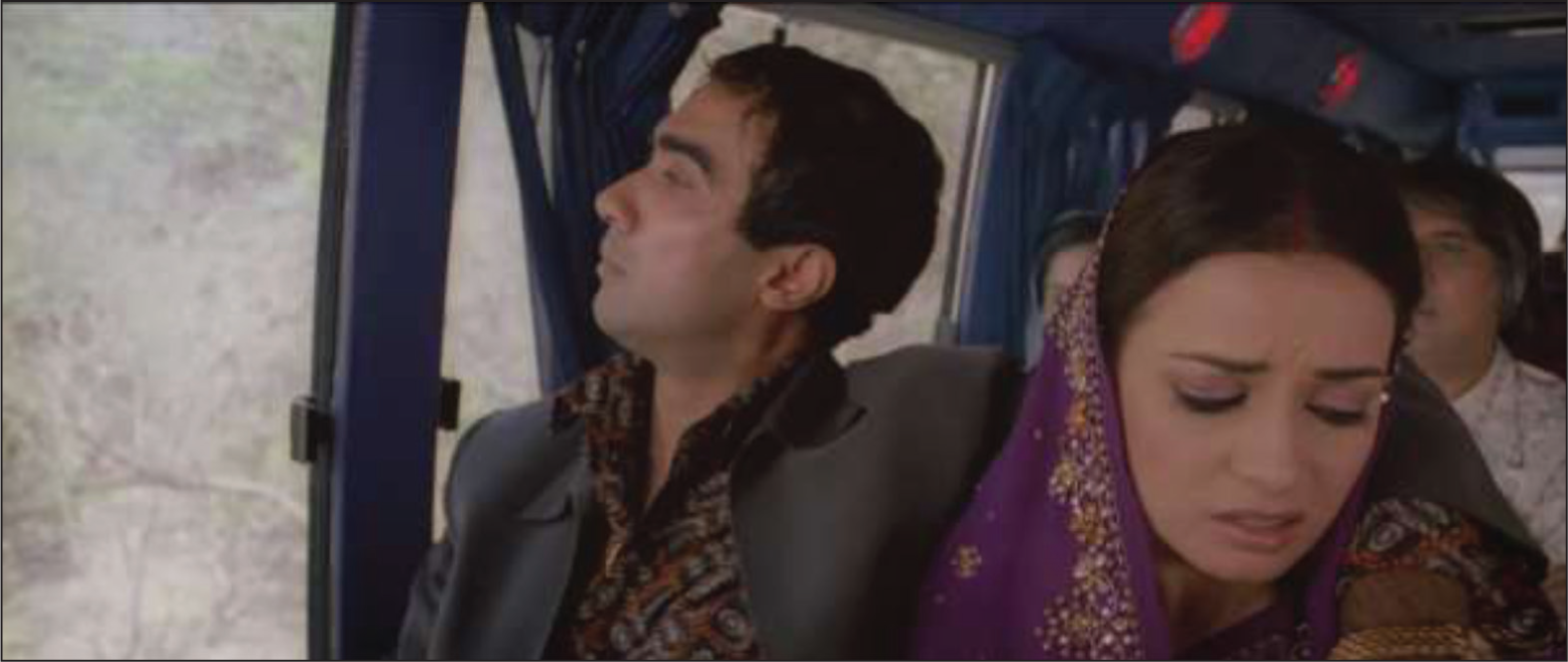
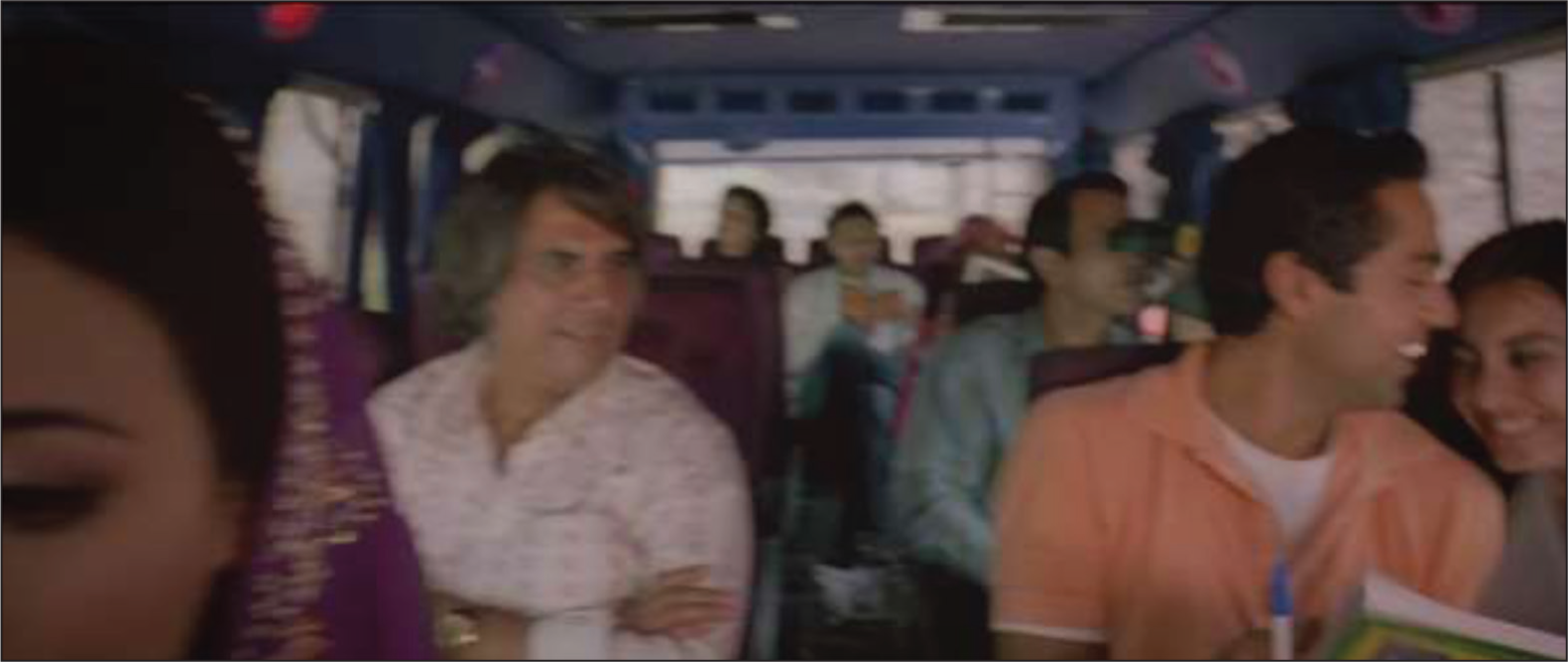
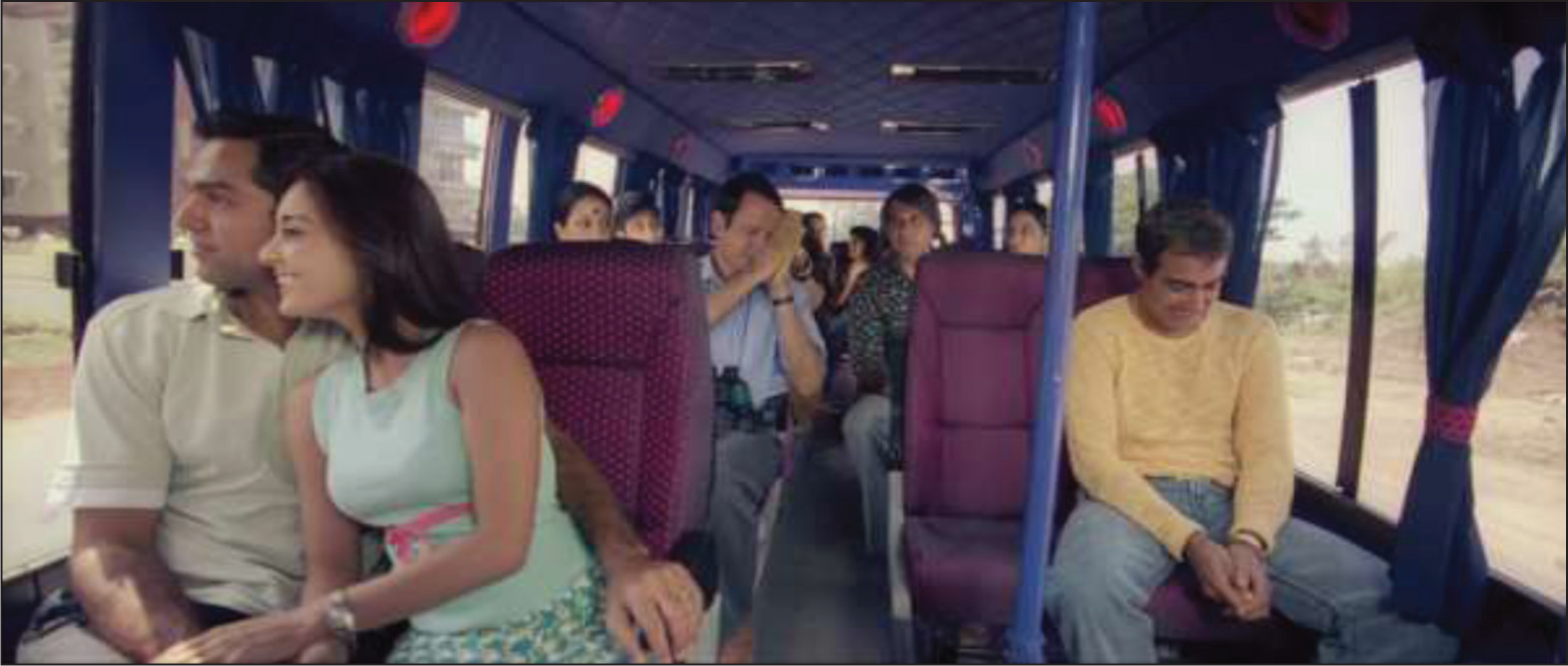
As the bus starts, an inconsolable Shilpa sits crying beside husband Hitesh in the first row (see Figure 2). The tension and discontent between them is highlighted in the visibility of the perfect Aspis on the opposite side (see Figure 3). The next day, Shilpa seems somewhat reconciled, and the couple assumes an inconspicuous position indistinguishable from the others. But later in the day when Jignesh, Shilpa’s lover comes to rescue her from her unhappy marriage and they elope, a jilted Hitesh sits alone in a front row, once again contrasted with the happy Aspis (see Figure 4). Thus, the degree of conjugal discord of the Hiteshes is inversely proportional to the spatial positioning and emotional disposition of the Aspis. It is the relative position of these two couples that manifest in a deterritorialisation of Shilpa’s marriage with Hitesh.
Such spatial relations become intensified when two couples are entangled in the force of sexual desire, even if this is unidirectional, as in case of the Buntys and Vickys. Initially the Vickys sit in a middle row from where Vicky keeps stealing glances at Bunty, who sits in the last row with Madhu. In the next arrangement, Vicky sits in the front row, conflict writ large on his face. As his desire grows, the distance between the two men decrease. Thus, we next find the two couples sitting around a dining table, with Bunty and Vicky seated next to each other. Vicky’s physical proximity to Bunty contrasts with his growing emotional distance from Pinky, intensified by Vicky’s decision to keep his conflicted sexuality hidden from her, as opposed to Bunty’s openness with Madhu. These spatial and bodily configurations indicate that Honeymoon does not follow the trend of other multi-couple films which set up only tenuous connections and comparisons between individual units, say through the use of ‘vertical split screen [, …] simultaneous enlargement and splicing of the frame’ (Gopal, 2011, p. 142). Instead, it secures all ‘units’ within a well-established albeit rearrangeable system.
Genealogies of the Contemporary Couple
The complexities of contemporary conjugality echo the transformative period of nineteenth- and twentieth-century India. During this era, married couples found themselves presented with a range of affective aspirations and means of inhabiting their conjugality. Reformers, driven by anti-colonial as well as class/caste concerns, attempted to transform the nation into a ‘modern’ state. Extended family units and caste norms became subject to a reform-minded public scrutiny directed at sati prevention, widow remarriage, age of consent and prohibition of child marriage. Intra-family conditions were no longer the sole determinant in conjugality. To elaborate, while the couple always operated under publicly ordained values and norms of caste and extended family, during the nineteenth and twentieth centuries, a pronounced legal and political frame emerged. The companionate marriage that came to be the dominant mode of nuptial conjugation, however, was not monolithic. Rochona Majumdar (2009) discusses how many competing marital ideals emerged in Bengal during this era. On the one hand, the zamindars and traders, especially belonging to the Kayastha and Suvarnabanik castes, set high standards of conspicuous expenditure on marriage ceremonies (Majumdar, 2009, pp. 95–96). On the other hand, the Brahmo community developed cultural practices like the circulation of marriage poems (known as priti upohar) that became integral to wedding festivities (Majumdar, 2009, pp. 106–107).
A focus on companionate marriage also figured in regions like the Tamil districts of the Madras Presidency. Mytheli Sreenivas (2008) discusses how the rise of the mercantile classes through the anticaste agenda of the Dravidian movement resulted in changes in conjugality comparable to those observed in Bengal. Drawing from the new focus on the couple as a unit separate from the mutigenerational kin group, women writers idealised marriages that upheld emotional virtues like love, affection and pleasure (Sreenivas, 2008, pp. 94–119), thereby creating an affective canvas for other couples to situate themselves. These new ideas of romantic love continued well into the twenty-first century and gained hegemony through wide circulation in cultural texts. William M. Reddy (2012, p. 18) discusses how anthropologists have regarded this affect as ‘a self-consciously chosen modern practice, more or less modelled on images circulating in global media, including Bollywood films’. Thus, he argues, the stark bifurcation between spiritual love and carnal desire in Western literature and socio-religious practices since the twelfth-century CE is hardly present in Bengal and Orissa in the ninth- through twelfth-century CE, a period when there was relatively little contact between these Indian regions and the West. Francesca Orsini (2007) further elaborates on the configuration of romantic love by arguing that conjugations in South Asia draw from a range of idioms like shringara, viraha, ishq, prem and love, influencing both the affect and the sociality experienced by couples. Such scholarship critically signposts a genealogy for the intracouple–intercouple imbrication that one finds in Honeymoon.
A sense of the instability, contingency and deterritorialisation of marriage in the contemporary is ingeniously represented in the film’s metaphorical use of the honeymoon bus. It travels from one site to another while the couples inside it experience conjugal deterritorialisations. Thus, it is not surprising that once Hitesh is displaced from the system of marriage, he finds himself returning home on a vehicle other than the bus. Spatial and territorial configurations are further divided within the bus, the space where the couple sit and another smaller section in the front where the driver (Darshan Jariwala) and his assistant are located, the two separated by a thin door. Only the tour guide moves between these spaces, though the film never shows his actual transit from one section to the other. While this appears to be a division between the middle and lower classes, the driver complicates this by acting as the self-righteous voice of social norms. He mocks or condemns certain modes of conjugality like that of older Oscars or the elopement of Shilpa. He claims the domain of normative authority, with the couples on the other side expected to follow established strictures. In practice, they only destabilise such norms, while never directly confronting the driver. However, when Shilpa and Jignesh are attacked by goons hired by her family, and the driver objects to the deviant couple getting on the bus, the passengers rebuke him and insist they be given refuge. Thus, the couples explicitly transcend the space of being followers to that of being norm-makers, even as they operate within the institution of conjugality. 11 This movement is caught visually when Oscar is shown opening the dividing door to ask the tour guide to take a group photograph.
Reproducing Conjugality in New Bollywood Cinema
In the last decade, scholarly attention has shifted from the linear representation of audio-visual practices in Bollywood to their multiple and contradictory features as they play out in the real world. Amit S. Rai (2010) applies the Deleuzian concept of assemblage to the South Asian media context to unravel how diverse socio-historical and technological processes come together under globalisation. These affect both the identity and consciousness of the population and other seemingly separate forms of media (e.g. cinema, television, music industries, fan practices) to reproduce an assemblage of a liberalised social. Bollywood’s assemblage is ‘untimely’ in nature for it brings together elements from different historical periods and cultural contexts, resulting in continuous deterritorialisations of cultural meanings and identities. It is under these conditions that New Bollywood, as argued by Neelam Sidhar Wright (2015), develops its postmodernist formal tendencies. These draw on the oeuvre of existing cinema, welcoming an era of aesthetic experimentation, while continuing to maintain intertextual relations with erstwhile Bollywood films. The result is a creative borrowing and repurposing of materials to mount a complex form and style that exhibits ‘parodic reflexivity’ (p. 191). Needless to say, a sophisticated reception of these developments heavily relies on the audience’s knowledge and exposure to a wide range of films. Honeymoon operates with the assumption of such cine literacy.
Until recently, romance films in Bollywood narrated the arduous journey that hero and heroine had to undertake before the story culminates in the triumph of their love. Gopal (2011) notes a transition of such romances from the to-be-conjugated to the already-conjugated coupledom in New Bollywood Cinema, a narrative that generally unfolds after marriage. She attributes this change to the growing autonomy of the post-globalised Indian society where impediments to the union of couples come not as much from external social proscriptions as intracouple complications. Belonging to this post-nuptial domain, Honeymoon uses romantic tropes from classic Bollywood cinema in subversive ways to both accentuate its distance from the old as well as depict the fragility of romance in conjugal relationships.
The red rose has long been the messenger of love in Hindi cinema. This is evident in films like Maine Pyar Kiya [I Fell in Love] (Barjatya, 1989) where bouquets of red roses appear in the background as the lovers’ romance deepens and gain partial social acceptance. Oscar’s use of this romantic symbol in Honeymoon is more nuanced. Sensing Naheed’s low spirits, he assumes a dramatic pose, thoughtfully holding out in his right hand a red rose that he finds in their hotel room, possibly a plastic one. Clutched in his left hand, however, is the pair of slippers he had been unpacking which he gives her soon after offering the rose (see Figure 5). Not only does the second action dilute the romantic charm of the first one, it gently reminds us that conjugality is a practical everyday affair, even as it remains a sphere of patient listening where the silent sighs of the other are heard.

Again, the conjugation between Shilpa and Jignesh disrupts the centrality of dramatic romantic union common to Bollywood’s usual depiction of couple formation. Anjaria (2021) notes that lovers are exemplars of Bollywood heroism. Early in the movie, Jignesh is framed as the hero archetype through a delayed introduction and by focusing the moment when he opens his helmet to reveal his face. This shot is replayed thrice, in quick succession, each time zooming in a bit, mimicking Bollywood’s customary way of drawing attention to the hero (Anjaria, 2021). Complete with the ‘pyar ka dushman’ or love’s enemy trope (Anjaria, 2021, pp. 50–53), Jignesh’s union with Shilpa is hindered when her family gets her married to Hitesh against her will. The two flee and ultimately get refuge in the bus, a moment hammered home when Naheed makes a speech about the victory of love. However, Honeymoon resists these traditional romantic tropes. The film positions Shilpa and Jignesh, the typical Bollywood hero–heroine pair, as the last to get on the metaphorical bus of conjugality, and only towards the end of the movie. Overall, the film decentralises the primacy of such conventional romantic representations, choosing to focus on the other couples and offering alternative ways of understanding their conjugality. All these examples illustrate ways in which Honeymoon upturns pre-existing tropes to open up the imagination of conjugation in Bollywood.
Although Honeymoon’s approach to the post-nuptial domain destabilises some conventional elements of Bollywood (e.g. the red rose, pyar ka dushman), at the same time it problematises its incorporation of song sequences, globally deemed characteristic of Bollywood cinema, and theorised as a cinema of interruptions by Lalitha Gopalan (2002) because of the ubiquity of such digressive elements. Sangita Gopal reminds us that while classic Bollywood cinema laid claim to modernity through the depiction of romantic love between couples, its bid for legitimacy with the nationalist project of inculcating traditional family and marriage norms meant that the on-screen exhibition of private acts like kissing was impermissible (Madhava Prasad, 1998, pp. 88–113). Instead, the extra-narrative song sequence took over at the moment of repression, portraying personal desire through non-realist and exaggerated public acts like dance. This was not compensation for that which could not be expressed; it was an expressive mode with a unique sovereignty because of its power to exist and circulate beyond the cinematic text. 12 Since the post-nuptial films are produced against a global, neoliberal and highly privatised socio-economic condition, concerns about public indoctrination are supplanted by a freely depicted intimacy within the narrative itself. Couples thus gain autonomy and the previous function of film songs becomes irrelevant. Gopal (2011) argues that in New Bollywood, songs now exist mainly as background tracks, often made realistic by depicting a diegetic source or context within the narrative. Following this, Aspi and Zara’s perfectly synchronised dance, performed before the other couples, ends with Zara magically sweeping through the air and landing in Aspi’s arms. It is ultimately rendered believable when it is revealed that the couples are actually superheroes.
While Honeymoon imbibes such New Bollywood features, it also draws on classic Bollywood’s interruptions which resonate well with the multiple and continuous narrative transformations. Such interruptions best reveal themselves in the film’s flashbacks of pivotal moments in the past that have a bearing on the characters’ present selves. The background music accompanying each of these are different classic Bollywood songs. These are played on an interactive radio show whose RJ supplements the flashbacks with narration. While the source of these songs is diegetically embedded, making them realistic, the interruption is caused by the way the songs are reused. For instance, the song ‘Mere Rang Mein Rangne Wali’ (you woman, who are suffused with my colours) was originally used in the 1980s film Maine Pyar Kiya to unproblematically express romantic love blossoming between protagonists Prem and Suman. Following old Bollywood norms, romance ultimately operates within the domain of family values, where heterosexual love must pass the long-drawn test of the homosocial patriarchal order involving the couple’s fathers. In Honeymoon, when this song is played against the flashback of Mili and Partho’s union, it is no longer a straightforward paean to love. Rather, it reveals elements of patriarchal domination that easily penetrate even a love marriage: during the nuptial ceremony, the priest forbids Mili from walking ahead of Partho—a traditional norm that visibly pleases Partho. Thus, the film recontextualises the song and the audience’s prior emotional associations, inviting critical discernment towards the seemingly innocent original.
The multivalency of audience reception is further highlighted in a song sequence involving the Oscars (see Figure 6). On a swaying boat with their back towards the camera, Naheed sits beside Oscar and sings (in her voice, like actresses from the first era of sound films did) ‘Ajeeb Dastan Hai Yeh’ (What a curious saga this is) from Dil Apna Aur Preet Parai (The Heart Remains Mine, the Beloved Someone Else’s) (Sahu, 1960). Behind them sits a German tourist whose role as a spectator had already been established when she, along with the Oscars, was trying to spot dolphins. This scene refers to the increasing global circulation of de-contextualised Bollywood songs through free-floating music videos popular amongst diasporic and other audiences, even finding a space in the popular cultural texts of other nations (Gopal & Moorti, 2008). As a stranger the tourist might not know that the Oscars have had an ‘ajeeb’ or unlikely late-age union; neither would she know that the original song too featured a swaying boat. (There, however, the heroine’s words were suggestive of the curious turns that led to her losing the man she loved to another woman.) The tourist might not even understand the lyrics without any guiding subtitles. Being a foreigner, for her the song only means what she sees—the warm companionship of an older couple. Yet the song’s many connotations open up perception beyond the immediate diegetic context in what seems like a multigenerational address. The song implicates the audience who become agents in discerning contradictory elements that are assembled by Bollywood films like Honeymoon, even as their reception itself is transformed by the narrative form.

Honeymoon also meaningfully adapts old Bollywood tropes in its depiction of homosexual desires, itself an interruptive act in the Bollywood of the early 2000s. The film does this by disrupting classic Bollywood song sequences deployed to cover up the prohibition on the kiss in relation to the two queered couples, the Buntys and the Vickys. Honeymoon navigates Bollywood’s private–public dichotomy, both marriage and honeymoon uncomfortably situated on the line of control between the private and the public. Honeymoon, intended as a private retreat for newlyweds, often encounters public intrusion in two ways: through the presence of other honeymooning couples in nearby accommodations (lover’s nests), and shared transportation and its commercialisation (Rapoport & Rapoport, 1964), which transforms this private event into a collective aspiration and display of the middle class. On the other hand, legal jurisdiction frames the union of individuals through marriage as a public form.
It is this legal aspect of conjugation that criminalises homosexuality in many countries around the world. In fact, during the release of Honeymoon in 2007, same-sex conjugations were still illegal in India (to be decriminalised only in 2018, an event addressed in MIH). We will observe that the prohibition on the kiss is, at least initially, displaced from heterosexual to the homosexual. Like other New Bollywood film, Honeymoon uninhibitedly exhibits many intimate moments between the couples. Thus Bunty and Madhu share a passionate kiss only for the sensual moment to be disrupted by Bunty’s withdrawal, followed by a subsequent confession of his homosexuality. Again, while Pinky refers to frequent sexual interactions with Vicky during their honeymoon, the film does not show us any of this. However, the two homosexual characters are not only prohibited from visually acting out their sexual desires, they are also deprived of the ability to narrativise their sexual past. Thus, flashbacks with aesthetics like grey scale or yellow filters depict the pre-marital past of most of the characters and are used for both Pinky and Madhu but are not available in sketching the subjectivity of their husbands. Pinky’s past reveals her dreams about her romantic partner; Madhu’s past is about the betrayal she suffers from her previous boyfriend. Clearly, the history of their desires can be housed within Bollywood’s pre-existing heteronormative limits, but there is no room for their husbands’ memories. If Vicky is allowed a history, then it only begins after marriage and inside the bus when he first glances at Bunty, a moment represented in the same visual aesthetics as the rest of the film, only with increased saturation and glow. Bollywood appears to offer little in the way of a distinct aesthetic for homosexuality and its multiple and shifting desires, although scholars such as Gayatri Gopinath (2005) have undertaken a reading against the grain to tease out queer allusions, imagery and subtexts from Hindi cinema. 13 By and large, however, queerness has been exiled from the narrative domain, and deviant desires find refuge and expression in Bollywood’s larger-than-life song sequences. When the song ‘Sajna Ji Vari Jaaun Ji Main’ (Dearest, for you I’m dying) plays on the deck of a cruise ship, not only do all the couples realistically perform different non-synced steps unlike the typically well-rehearsed dance moves of Bollywood (only the Aspis display such skill, but they are not part of this particular group trip), but even men lip-sync to this female-voiced song (sung by Sunidhi Chauhan). Against such an already queered ambiance, as the instrumental interlude of the song plays, Vicky visualises himself kissing Bunty (see Figure 7). The act is more explicit in Pinky’s shocked face in the background than in the direct photographic capture of the men kissing. Arguably this again shows Bollywood’s historic dependency on heteronormative tropes (like wives frowning about cheating husbands) even as it tries to represent homosexuality. Even then, in making its song suggest what classic Bollywood employed songs to avoid doing, that is, depicting physical intimacy, Honeymoon disrupts Bollywood’s heteronormativity even as it aligns with New Bollywood’s liberty of making the on-screen kiss permissible.

Note, Pinky and Vicky too share one on-screen kiss, where their lips are actually shown to touch (see Figure 8). However, this occurs in a dream sequence within a flashback, thus doubly removed from their present reality. Thus, even though the as-yet-heteronormative regime of New Bollywood permits the explicit visualisation of the kiss for this heterosexual couple, the unreality of the kiss relays it as a woman’s heteronormative fantasy displacing an engagement with the problems in their relationship. Here Bollywood’s heteronormative frame proves inadequate in bridging the intimacy-related gulf that remains between Pinky and Vicky irrespective of any sexual intercourse they may have engaged in. Gopal’s (2011) observation that songs in New Bollywood are asynchronous and either refer to the past or look longingly forward to some future moment resonates with the impossible desires of Vicky and Pinky.

In Honeymoon, the kiss is one scene amongst a series the camera captures, if in a displaced way, in its navigation of the public and the private. It is highly conscious about opening up the private moments of the couple’s interaction for the cinematic public. However, the film also follows the conventions of the tourist film, panning over Goa’s tourist spots, with shots taken from the windscreen of the bus in the manner of the sightseeing vacation where spots must be ticked off, rather than capturing the ambience of a quiet honeymoon getaway. If on the one hand, the camera captures how a group honeymoon cuts short the possibility of intimacy, at other times, it observes how in honeymoon travel perfect intimacy is almost an imposition on these honeymooning newlyweds. The result is a somewhat strange set of shots. Framings are not symmetrical, nor are the couples positioned at the centre, which might have eased audience engagement. Instead, the camera places each of the couples together in the corner of its frames with the expanse of their hotel rooms staring at them. Vast portions of these frames feature walls covered with large pictures of idyllic vacation spots. These are a reminder that honeymoons force couples to dissociate from their social groups in order to be intimate, making them cogs in a giant commercialised machine. The shots are mostly captured from a high or a low angle, reminiscent of CCTV framing, adding a disturbing quality to even non-dramatic scenes. Such cinematographic choices capture the chaos and tension in the coming together of these multi-couples as well as the general uncertainty that structurally informs conjugality. At the same time, the camera assumes an ethical stance, making the audience conscious of their voyeurism.
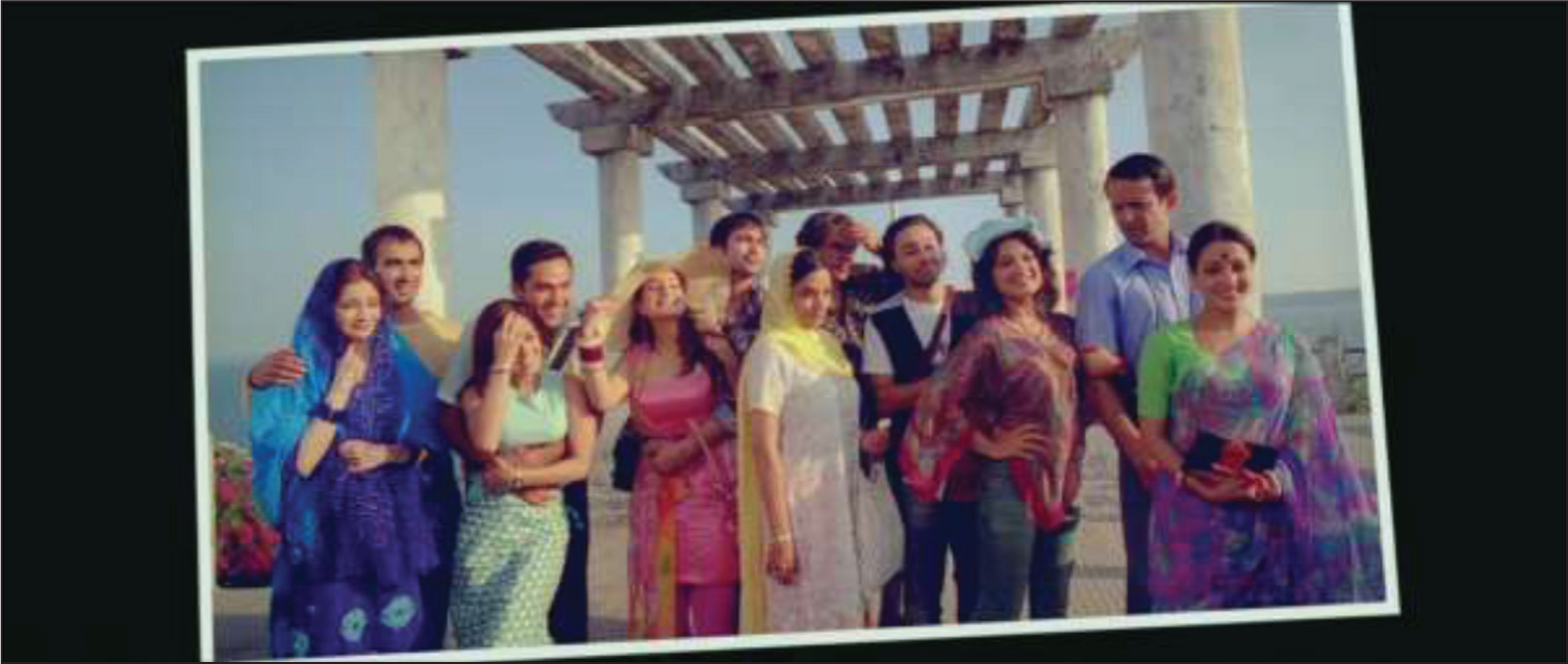
The multiple, contradictory and evolving undercurrents informing the experience of conjugality are affirmed by the film through still photography. During their first day trip, all the couples arrange themselves in a perfectly synchronised pose for a group photograph, with the wives in the first line, each of their husbands standing just behind them (see Figure 9). Rochona Majumdar (2009) notes the popularity of photographs of couples in urban middle-class families from the late 19th century, and how these continued to influence the way couples arranged themselves before the camera in later periods, suggesting an inter-generational nexus in the representation of conjugality. Social anxieties were growing about nuclear families fragmenting the traditional joint family system. Majumdar argues that the stiff, straight posture of the newlyweds in these photos was supposed to convey their ability to keep the extended family alive through their duty and devotion. Likewise, in Honeymoon the first group photo of the couples captures a uniform idea about conjugality embodied in its systematic ordering of the couples. However, before the film ends, the couples request a second group photo (see Figure 10). Besides Jignesh replacing Hitesh and the addition of Gina, the couples are no longer neatly arranged in uniform positions but pose more haphazardly. This is not to suggest the couples have become more liberal in their disposition. That would be to suggest a linear change while this article is interested in the structural fluidity of conjugality Honeymoon depicts. The second picture then captures an assemblage of conjugality aware of the previous camera arrangement and consciously asserts its difference from it; it is visual proof of the flux that informs each conjugation. If the film continuously captures the narrative and formal assemblage of conjugality, these two pictures render these assemblages at two moments, with the potentiality of further mutations and rearrangements.

Conclusion
The second season of MIH opens in a wedding venue six months from the narrative juncture at which the first season left off. The venue is teeming with white female flesh strewn across for the wedding party’s visual pleasure. When Tara expresses disgust at the client’s offensive demands, Karan reminds her: ‘They want this novelty, we’ll oblige’. This willingness to accommodate the client stems less from blindly lucrative motivations and more from the events concluding Season 1. The finale revealed that extremist political groups vandalised the opulent space of their previous Made in Heaven office in retaliation for Karan’s support to the legalisation of homosexuality. Season 2 hence largely focuses on the necessities of rebuilding—both the business and Tara’s personal life after her marriage with Adil breaks up. To relaunch their wedding-themed venture, they must wade through Delhi’s less glamorous localities and arcane buildings in impractically high heels, ‘walk[ing] through hell’, as Tara says, to recreate their ‘Heaven’. If at the core of many of Kagti’s works is this disturbing sense of precarity, then equally present is the resilience that it engenders in the agents inhabiting her precarious worlds.
In this context, Honeymoon uniquely reframes instability, presenting it not as a negative force but as an inherent aspect of conjugality. As suggested at the beginning of this article, the complexities associated with honeymoon make the period especially potent for analysing the structure of conjugality in which the participants find themselves soon after their marriage—an institution that in itself is undergoing tremendous changes all over the world. In focusing on this period, Honeymoon foregrounds the contingent nature of conjugality. Drawing on the Deleuzian concept of assemblage, this article argues that, through its narrative and formal interventions, the film affirms the unity of conjugality in its multiplicity. Instead of trying to formulate what conjugality is, the film shows all that it can be. This article first discusses some of the odd conjugal situations that the film brings to the fore. Establishing the concrete connection between the various couples, it considers how the film develops an aesthetics of narrative surprise and suspense as well as visual reorientation to show how conjugality is constantly subject to chance and change. Taking contingency as a key element informing conjugality within the narrative of the film, this article then shifts its focus to the formal qualities of Honeymoon. It argues that while the film shares many formal aspects with New Bollywood Cinema in its audio-visual depiction of conjugality, it equally borrows and re-produces elements from classic Bollywood’s portrayals of conjugations to assemble a unique representation. Especially drawing attention to the significance of song sequences, on-screen kissing and cinematography, this article underscores Honeymoon’s continual engagement with the public/private divide the fissures of which mark both marriage and honeymoon. If conjugality has a being, then it reveals itself in its continuous becoming. By doing so, this article positions Honeymoon as the first instance of Kagti’s recurring exploration of precarity within marital dynamics.
Footnotes
Acknowledgements
The author is grateful to Dr Mohamed Shafeeq K. for detailed comments on initial drafts of this article, for his continual encouragement and of course for introducing her to Film Studies. She would also like to thank the anonymous reviewer for their valuable insights on historising conjugality in the South Asian context and for directing her to Made in Heaven. Prof. Ravi Vasudevan’s editorial interventions and meticulous attention to detail were crucial in making the language and arguments crisp, keeping the article’s focus phenomenological and working within the paper’s scope. She is equally grateful to the editor Dr Kartik Nair for his patience with the development of this piece and the discussions that ultimately led to the imagination and execution of an entirely new section tracing a thematic genealogy in Reema Kagti’s oeuvre. Needless to say, she remains responsible for any mistakes or oversights.
Declaration of Conflicting Interests
The author declared no potential conflicts of interest with respect to the research, authorship and/or publication of this article.
Funding
The author received no financial support for the research, authorship and/or publication of this article.